

Submitted:
05 June 2026
Posted:
05 June 2026
You are already at the latest version
Abstract
Age-related changes in motor–cognitive function are associated with altered neural adaptability, particularly during tasks requiring integration of cognitive and motor processes. Dual-task paradigms are commonly used to assess such interactions; however, gait-based tasks may be unsuitable for older adults with balance impairments. This study used electroencephalography (EEG) to examine neural modulation during a controlled seated foot-tapping paradigm under dual-task and feedback conditions. Thirty-six cognitively healthy participants (18 younger adults aged 18–30 years; 18 older adults aged 65–90 years) completed three conditions: single-task tapping (ST), dual-task tapping with a flanker task (DT), and dual-task tapping with auditory biofeedback (DT+). Relative EEG spectral power across the alpha, beta, and high beta bands were analysed across left, right, and midline regions. An aggregate modulation index (AMI) was also computed to quantify overall signal changes across the three tested conditions. Results revealed a significant group difference in alpha-band modulation, with greater modulation in younger adults compared to older adults. In particular, younger adults had significant reductions in alpha activity in DT+ relative to DT across all brain regions. In contrast, older adults showed no significant alpha modulation across conditions but exhibited increased high beta activity from ST to DT. These findings suggest that alpha-band EEG activity reflects age-related differences in feedback-driven neural adaptability, supporting alpha-band modulation as a quantifiable biomarker of motor–cognitive adaptability.
Keywords:
EEG
; brain
; movement analysis
; motor-cognitive
; aging
; gerontology
; IMU
1. Introduction
Progressive aging is associated with declines in both motor and cognitive capabilities [1]. These include variability in movements associated with walking [1], diminished coordination [2,3], structural changes in grey and white matter volumes [4,5,6], and reduced performance in attention, sensory perception, and executive functions [7,8]. These age-related changes are closely interrelated. In particular, reductions in cognitive resources and executive control have been found to contribute to poorer motor performance [9]. As a result, dual-task paradigms, in which individuals perform both motor and mental tasks simultaneously, are widely used to probe cognitive–motor interactions and to detect functional declines associated with aging [10].
Reviews of neuroimaging studies have consistently shown higher prefrontal cortex activation in older adults, compared to younger adults, during cognitive–motor dual tasks [11], which has been interpreted as reduced neural efficiency or compensatory recruitment in the aging brain. These age-related differences highlight the potential of dual-task paradigms to reveal changes in executive control and attentional resources associated with aging. However, neuroimaging methods such as functional magnetic resonance imaging (MRI) are constrained by cost, restricted availability, and limited feasibility during repeated motor tasks [12]. Accordingly, there is growing interest in electroencephalography (EEG) approaches that allow neural activity to be monitored during online movement under controlled conditions. EEG provides a non-invasive means of capturing brain electrical activities, such as alpha and beta power and activation pattern during cognitive, motor, as well as cognitive-motor dual tasking conditions [13]. Changes in alpha and beta power and desynchronization during dual-tasking conditions can practically quantify the neural mechanisms of cognitive-motor interference in aging.
Walking with a concurrent mental task is one commonly used dual-task paradigm to probe cognition-balance interactions and fall risks in older adults [10]. However, such dual tasks are not feasible for people with impaired postural balance, particularly older adults who have a higher risk of falls [14]. Some studies switch to simpler tasks such as seated foot tapping [15]. Dual tasks involving simple motor tasks alone may not be sensitive to age-related changes in cognitive functions [16]. In contrast, comparing neural activity across tasks with varying levels of challenge can reveal how effectively individuals adapt to changing task demands, as reflected in measurable, task-dependent modulation of neural processes [17]. Modulation is important in the area of aging, as it captures how cognitive resources are dynamically allocated across varying task demands [18].
Neural modulation can be further influenced through the use of biofeedback. There are different theories explaining the biofeedback effects. Some suggest that concurrent task demands and external feedback can compete for limited neural resources, potentially amplifying the interference effects, especially in older adults who already show constrained neural adaptability [19]. Some other studies suggest that appropriately designed auditory biofeedback devices can entrain the brain, improve motor timing and coordination to reduce variability in rhythmic actions, and enhance sensorimotor integration [20,21]. While seated tapping is a low-risk motor task, it remains unclear whether task-dependent neural modulation can be detected among older adults when such tasks are combined with concurrent cognitive demands and biofeedback. Importantly, it is not currently known whether the neural modulation differs between younger and older adults. Addressing this gap is critical for evaluating the potential of such paradigms to reveal aging-related neural biomarkers.
This study employed an EEG sensor approach to assess neural responses during dual-task motor performance with and without auditory biofeedback. By using a safe, seated foot-tapping motor task, the present study aims to measure modulation patterns in older and younger adults. By integrating EEG-derived neural measures with behavioural timing outcomes during a controlled seated foot-tapping task, this study aims to 1) investigate any age-related differences in neural modulation between these two age groups and 2) examine how dual-tasking and dual-tasking-assisted with biofeedback affect EEG -derived brain activities across different brain regions within younger and older adults.
2. Method
2.1. Participants
Younger adults (n = 18; 18–30 years; mean ± SD: 23.8 ± 2.5 years) and older adults (n = 18; 65–90 years; 77.0 ± 1.4 years) were recruited for this study. All participants were right-leg dominant and able to complete seated motor tasks for the duration of the experimental protocol. Inclusion criteria required no self-reported history of neurological conditions, musculoskeletal impairments, or medical conditions known to affect motor function or EEG signal quality. Participants were also required to demonstrate normal cognitive function, with a score of 24 or greater in the Standardized Mini Mental State Exam [22]. Younger adults were primarily recruited through university-affiliated channels, whereas older adults were recruited via community outreach associated with university networks and local advertisements. This study was approved by the University of Wollongong Human Research Ethics Committee (Approval No. 112/2023). All participants provided written informed consent prior to participation. Based on the repeated measures design with estimated effect sizes of 0.4 and a significance level of 0.05, power estimates using G*Power software (version 3.1.1) indicated statistical power values of approximately 0.75 for both age groups.
2.2. Experiment Overview
The experiment employed a repeated-measure design in which each participant completed three task test conditions during a single laboratory session: 1) single-task (ST), 2) dual-task (DT), and 3) dual-task with biofeedback (DT+) conditions. The order of these conditions was randomized across participants to minimise order-related confounds. A 2-minute rest interval was provided between conditions. All tasks were performed in a seated configuration. The seated foot-tapping protocol for the young adult cohort has been described previously [21]; the present study extends this framework to include an older adult cohort to examine neural modulation and determine any age-related differences under dual-task and biofeedback conditions.
Test Condition Definitions
The three experimental conditions differed in task combination and external pacing:
Single-task (ST): foot tapping (self-paced) only
Dual-task (DT): foot tapping (self-paced) + flanker task
Dual-task with biofeedback (DT+): foot tapping (participants asked to synchronise the heard auditory feedback) + flanker task + auditory pacing
During self-pace foot tapping, participants alternated forefoot and rearfoot contacts with the floor in a structured sequence (two consecutive toe taps followed by two heel taps). The task was performed continuously for two minutes at a self-selected pace. The requirement to switch tapping from heels to their toes introduced additional cognitive load [23]. The flanker cognitive task required participants to identify the orientation of a centrally presented arrow, within 1 second, while ignoring other flanking distractors [24]. Responses were registered via a handheld controller. Familiarization of flanker task was provided, prior to the actual data collection. EEG event markers corresponding to stimulus onset and response execution were logged synchronously to support event-related neural analysis. The auditory pacing was provided through a metronome, with frequency individually calibrated before testing based on an one-minute video-recorded foot-tapping trial, in which participants produced repeated taps at a self-selected comfortable rhythm. With the metronome in the DT+ condition, participants were instructed to align their foot taps with the auditory signal as accurately as possible.
2.3. Measurements
Continuous EEG was recorded using a 19-channel system (SynAmps2 amplifier, Compumedics Neuroscan, USA) operated with Acquire software (version 4.5.1) during each of the 3 conditions. Signals were sampled at 1000 Hz and band-limited to DC–70 Hz, with a 50 Hz notch filter applied to attenuate line noise, which were identified in a previous study to be effective in minimizing noises in EEG signals [25]. Electrodes were positioned according to the international 10–20 system using tin disc electrodes. Recordings were referenced to the left mastoid (A1), with the right mastoid (A2) recorded concurrently, and a ground electrode located along the midline between Fpz and Fz. Additional electrodes were placed peri-orbitally to capture vertical and horizontal electro-oculographic activity, enabling subsequent correction of eye-movement and blink artifacts. Alpha (8-13 Hz), beta (13-30 Hz) and high beta (30-40 Hz) were studied. Alpha frequency band provides information regarding active cortical resources [26] and alpha activity indicates the working or suppression of neural networks during cognitive motor interference [27]. Beta and high beta frequency bands can reflects cognitive control and inhibition [28] and can provide crucial information regarding cognitive processes and the ability of the brain to maintain cognitive motor workflow and stability.
Aggregate Modulation Indexes % (AMI) were calculated to reflect the magnitude of changes for EEG power across the three experimental conditions. The AMI can help address the dynamic nature of EEG changes across time for better detection of neural patterns than alpha power alone [29]. This was performed by first taking the average EEG relative power across all 19 electrodes and three hemispheres for each tested frequency band and each experimental condition. Then the percentage change between single and dual-task conditions (Dual-Task Effects) and dual-task and dual-task + biofeedback conditions (Biofeedback Effects), relative to the dual-task condition, was computed. Finally the two changes were averaged to calculate the overall AMI value. The calculation procedure is provided in the following:
% change between ST and DT (Dual-Task Effects) = (DT – ST)/ ST) * 100%
% change between DT and DT+ (Biofeedback Effects) = ((DT+) – DT)/ DT) * 100%
Total AMI = (DualTask Effects + Biofeedback Effects)/2
2.4. Statistical Analysis
All statistical analyses were conducted in SPSS Statistics (IBM v28.0, New York, USA). Between-group differences in neural modulation were assessed using a 2 × 3 mixed ANOVA, with participant group (younger vs older adults) as the between-subject factor and frequency band (alpha, beta, high beta) as the within-subject factor. The dependent variable was the Aggregate Modulation Index (AMI), computed to quantify overall changes in EEG activity across conditions. Where significant main or interaction effects were observed, post hoc t-tests were conducted to examine group differences within each frequency band. Multiple comparisons were controlled using the Benjamini–Hochberg procedure (false discovery rate, FDR = 0.05).
Within-group repeated-measures MANOVAs were performed on young and older adult groups separately to detect any significant differences in EEG power within each frequency band among the three tested conditions within each of the three brain regions: the left hemisphere, right hemisphere and the midline. If MANOVA showed statistically significant differences, follow-up repeated measures ANOVAs were performed across the three task conditions at each brain region for each frequency band. Significant ANOVAs were followed by pairwise comparisons among the three experimental conditions, with p-values corrected using the Benjamini–Hochberg procedure. For false discovery rate control using the Benjamini–Hochberg method, p-values obtained from pairwise comparisons were first ranked from smallest to largest. Statistical significance was determined by comparing each ordered p-value with its corresponding Benjamini–Hochberg threshold (i × Q / n), where i denoted the rank, Q was set to 0.05, and n represented the number of comparisons (n = 3).
Omnibus testing (e.g., MANOVA followed by ANOVA) was used as an initial screening step, thereby restricting post-hoc analyses to a limited set of planned contrasts and supporting the application of false discovery rate (FDR) correction only across the three condition-specific comparisons for each outcome.
3. Results
3.1. Between-Group Analysis (Younger and Older Adults)
Table 1 and Table 2 show the Aggregate Modulation Indexes (AMI) values in alpha, beta and high beta frequency bands for younger and older adults. A 2 × 3 mixed ANOVA revealed a significant frequency band × participant interaction (F(2,33) = 5.76, p = 0.007). This effect was further supported by univariate analyses, which also showed a significant interaction (F(2,68) = 8.17, p < 0.001). Pairwise t-tests with Bonferroni corrections revealed significant differences in alpha band AMI values between young and old adults (p = 0.03). The large standard deviations in AMI, especially among older adults, resulted from the presence of positive and negative responses, indicating that while some older adults were able to utilise biofeedback effectively, others experienced inefficient modulation, contributing to the observed dispersion. No significant differences were observed for beta (p = 0.28) and high beta (p = 0.9) between young and older adults.
No significant main effect of participant group was observed when averaged across frequency bands (F(1,34) = 3.14, p = 0.057), indicating that group differences were frequency-specific rather than global. In contrast, there was a significant main effect of frequency band (F(2,68) = 5.16, p = 0.008), confirming overall differences in modulation across spectral components.
Relative powers in each of the three brain regions across experimental conditions are shown in Figure 1 and Figure 2. The figures showed that younger adults exhibited higher alpha power than older adults under the ST condition in all three brain regions. This between-group difference remained evident in the DT condition. However, under the DT+ condition, alpha power values were comparable between the two groups
3.2. Within-Group Analysis (Considering Conditions and Brain Regions Effects)
Among young adults, MANOVA showed an overall significant difference in alpha frequency band across the three task conditions and three brain regions (F = 4.43, p < 0.01). Univariate ANOVA revealed that there were significant differences across tested conditions in the left hemisphere (F = 9.97, p <0.01), right hemisphere (F = 8.8, p < 0.01) and midline (F = 11.02, p < 0.01), with the midline showcasing the strongest effect of ( = 0.4). Pairwise comparison further showed that participants in the DT+ condition significantly decreased relative alpha power in the left hemisphere (F = 3.14, p < 0.01), midline (F= 3.01, p<0.01), and right hemisphere (F = 3.68, p < 0.02), compared to the dual-task condition. Figure 3 shows the representative topological distributions of alpha-band activity in a young participant, showing activity reductions in all three brain regions from DT to DT+ conditions. For relative beta and high beta powers, no main significant differences were observed (F = 1.5, p = 0.25 & F = 2.9, p = 0.052).
Among older adults, MANOVA revealed a main significant effect in relative beta power (F = 3.65, p = 0.027), but no significant differences were observed in further univariate tests. MANOVA also revealed a main significant effect in relative high beta power (F = 3.6, p = 0.027). Further univariate ANOVA revealed significant effects in the right hemisphere across task conditions (F = 3.64, p = 0.047), with higher relative power in dual-task condition compared to the single-task condition (p < 0.01) and no significant differences were observed between dual-task and DT+ conditions (p > .05). ANOVA did not reveal any significant differences across the task conditions for relative alpha powers (p > 0.05).
4. Discussion
4.1. Key Findings and the Seated Tapping Paradigm
This study examined EEG signal modulation across single-task (ST), dual-task (DT), and dual-task with biofeedback (DT+) conditions in younger and older adults. Three key findings emerged. First, alpha-band aggregate modulation index (AMI) differed significantly between groups, with greater modulation in younger adults, while no group differences were observed in beta and high beta bands. Second, younger adults showed alpha-band suppression in DT+ condition, relative to the DT condition. Third, older adults showed minimal alpha modulation, but increased beta and high beta from ST to DT, with no further modulation in DT+.
The use of a seated tapping paradigm enabled controlled acquisition of EEG signals by minimising postural and biomechanical confounds within whole-body movement. This configuration provides a stable platform for isolating sensor-derived neural responses to cognitive–motor demands, allowing EEG to function as a reliable, noise-free outcome measures for quantifying attention, motor control, and feedback processing [30,31]. As such, it would maximize the validity of our human sensing model for studying neural adaptability.
4.2. Age- and Condition-Dependent Neural Modulation
Our younger participants demonstrated higher Alpha relative power consistently across regions than older participants, which is in line with previous studies [32,33]. Alpha suppression is associated with active attentional engagement and information processing [32,33]. The reduced modulation observed in older adults suggests diminished capacity to dynamically adjust neural responses to increasing task demands. This suggests that alpha-band EEG features provide a signal biomarker of adaptability, particularly in distinguishing age-related differences. At the ST condition, the higher alpha power observed in younger adults compared to older adults is consistent with the established age-related reduction in alpha activity [34]. Notably, this study further demonstrated significant alpha suppression in younger adults under the DT+ condition, resulting in comparable alpha power between the two groups. Meanwhile, the absence of group differences in beta and high beta suggests these signals are less sensitive to adaptive changes at the system level.
Examining individual group results showed that younger adults had significant reductions in alpha power in DT+ compared to DT, with consistent effects across the left hemisphere, right hemisphere, and midline, and the strongest modulation observed in the midline region. Consistent with evidence that alpha suppression is associated with active attentional engagement and information processing [32,33], the reduction in alpha power in DT+ reflects a release of inhibition [34] which then allows greater integration of externally provided feedback signals into motor control. Our results suggest that alpha modulation in younger adults reflects the integration of external feedback with higher motor-cognitive adaptability rather than general cognitive load. The introduction of biofeedback likely increased demands for continuous monitoring and error detection [35], leading to enhanced neural engagement reflected in reduced alpha power. Meanwhile, the midline dominance suggests involvement of central control regions associated with sensorimotor integration and executive processing, while bilateral modulation (left and right hemispheres) indicates coordinated engagement of task-relevant neural systems [36].
In contrast, the older adults showed no significant alpha modulation across conditions, suggesting reduced sensitivity of attentional control systems to both task demand and feedback. This is consistent with prior work showing age-related reductions in inhibitory control and alpha dynamics [37]. According to the ‘Compensation-Related Utilization of Neural Circuits Hypothesis (CRUNCH)’ framework [38], older adults may operate closer to their neural capacity limits, limiting their ability to further modulate activity under increasing demands. This may explain the absence of further adaptation in DT+. Instead, older adults exhibited increases in beta and high beta activity from ST to DT, particularly in the right hemisphere. This is partly consistent with previous studies which reported higher right-hemisphere theta and alpha power in older adults during working-memory tasks [39] and the role of right hemisphere for maintaining resilience to aging [40]. Furthermore, the hemispheric reduction model in older adults as described by Cabzea et al. [41] showed that aging may reduce unilateral neural efficiency, which might promote certain hemispheric side to work harder or be more under scrutiny. Tasks such as sequential motor function (similar to continuous foot tapping in our experiment) applies loading on the left hemisphere and this may enable older adults to recruit their right hemisphere for functional stability whilst they are doing a cognitive – motor dual task [42,43]. Furthermore, interhemispheric inhibition may activate right hemisphere activity in older adults when they are under cognitive load resulting in dual task [44], which was also what we are observed in our findings. Beta activity has been associated with motor control and compensatory recruitment under cognitive load [45,46]. This suggests that older adults rely more on motor-related processes to maintain performance, rather than engaging flexible attentional modulation. However, no further changes were observed in DT+, indicating limited responsiveness to feedback. While auditory feedback has been shown to reduce dual-task cost Ghai et al. [47] Park & Lee [48], the lack of significant modulation here suggests that older adults may have reduced ability to translate external cues into adaptive neural responses.
4.3. Implications and Biomarker Potential
The observed differences between younger and older adults suggest that alpha modulation, as indicated by the Aggregate Modulation Index (AMI), may serve as a plausible biomarker of age-related changes in adaptability. Reduced AMI values in older adults reflect blunted alpha responsiveness, suggesting a diminished capacity to integrate feedback and update motor commands, which is a critical component of functional performance in real-world contexts. This interpretation is consistent with the CRUNCH framework, where aging is associated with reduced neural flexibility and limited capacity to recruit additional resources under increasing demand [38].
Unlike traditional interpretations that link alpha activity primarily to task difficulty, the results demonstrate that AMI-derived alpha modulation is specifically sensitive to the integration of external feedback across experimental conditions, rather than to generic load effects. The graded changes in alpha modulation across task conditions reflects the system’s ability to shift between internally driven control and externally guided adjustment. This suggests that alpha modulation may reflect a functional index of neural adaptability, capturing how efficiently the brain incorporates incoming sensory information to update motor behaviour.
These findings have several practical implications for sensor-based applications. If validated in future studies, alpha-band AMI may be used to: 1) detect early declines in motor–cognitive integration, 2) monitor changes in neural responsiveness over time or following interventions, and 3) support assessment and design of adaptive biofeedback systems, where older adults respond very differently from younger adults.
4.4. Limitations
Several limitations should be considered when interpreting these findings. First, the use of a seated tapping paradigm, while advantageous for controlled signal acquisition with reduced movement artefact in EEG signals, limits generalisation to more complex and ecologically valid motor tasks such as gait or postural control. Although the simplified setup enables clearer interpretation of EEG-derived signals, future studies should extend this framework to dynamic, real-world movements to evaluate how alpha-based biomarkers behave under more functional conditions. Second, the present study employed a cross-sectional design, which does not capture longitudinal changes in neural adaptability across individuals. As motor–cognitive decline is a progressive process, future work should investigate how alpha modulation evolves across time within individuals, particularly to validate its utility as a longitudinal biomarker of aging-related change.
5. Conclusion
EEG modulation across single-task, dual-task, and dual-task with biofeedback conditions demonstrate that alpha-band activity is not significantly altered by dual-task demand alone, but is selectively modulated in response to feedback-based conditions, particularly in younger adults. In contrast, older adults showed limited alpha modulation and reduced responsiveness to biofeedback, alongside increased reliance on beta-related activity under dual-task conditions. These results suggest that motor–cognitive adaptability is primarily reflected in the ability to integrate external feedback rather than in response to cognitive load alone. The distinct modulation patterns observed between age groups indicate that aging is associated with reduced flexibility in neural response to changing task demands, particularly in feedback-driven contexts. From an applied perspective, the alpha-band modulation would be a potential quantitative biomarker of feedback-driven neural adaptability for assessing age-related changes in motor–cognitive function.
References
- Hunter, S. K.; Pereira, H. M.; Keenan, K. G. The aging neuromuscular system and motor performance. J. Appl. Physiol. 2016, vol. 121(no. 4), 982–995. [Google Scholar] [CrossRef] [PubMed]
- Hirono, Tetsuya; et al. Age-related changes in gait speeds and asymmetry during circular gait and straight-line gait in older individuals aged 60–79 years. Geriatr. Gerontol. Int. Gerontol. Int. 2021, vol. 21(no. 5), 404–410. [Google Scholar] [CrossRef]
- Pan, Z.; Fang, Q.; Watson, D. M.; Van Gemmert, A. W. A.; Aiken, C. A. Aging reduces manual dexterity and force production asymmetries between the hands. Laterality 2023, vol. 28(no. 4–6), 239–253. [Google Scholar] [CrossRef] [PubMed]
- Storsve, A. B.; et al. Differential Longitudinal Changes in Cortical Thickness, Surface Area and Volume across the Adult Life Span: Regions of Accelerating and Decelerating Change. J. Neurosci. 2014, vol. 34(no. 25), 8488–8498. [Google Scholar] [CrossRef]
- Good, B. D.; Johnsrude, I. S.; Ashburner, J.; Henson, R. N. A.; Friston, K. J.; Frackowiak, R. S. J. A Voxel-Based Morphometric Study of Ageing in 465 Normal Adult Human Brains. NeuroImage 2001, vol. 14(no. 1), 21–36. [Google Scholar] [CrossRef]
- Inoue, R.; Nishimune, H. Neuronal Plasticity and Age-Related Functional Decline in the Motor Cortex. Cells 2023, vol. 12(no. 17), 2142. [Google Scholar] [CrossRef]
- Grady, C. L.; McIntosh, A. Randy; Horwitz, B.; Rapoport, S. I. AGE-RELATED CHANGES IN THE NEURAL CORRELATES OF DEGRADED AND NONDEGRADED FACE PROCESSING. Cogn. Neuropsychol. 2000, vol. 17(no. 1–3), 165–186. [Google Scholar] [CrossRef]
- Staub, B.; Doignon-Camus, N.; Després, O.; Bonnefond, A. Sustained attention in the elderly: What do we know and what does it tell us about cognitive aging? Ageing Res. Rev. 2013, vol. 12(no. 2), 459–468. [Google Scholar] [CrossRef]
- Bernard, J. A.; Seidler, R. D. Evidence for motor cortex dedifferentiation in older adults. Neurobiol. Aging 2012, vol. 33(no. 9), 1890–1899. [Google Scholar] [CrossRef]
- Aditya, S.; et al. Relationship Between Cognitive Abilities and Lower-Limb Movements: Can Analyzing Gait Parameters and Movements Help Detect Dementia? A Systematic Review. Sensors vol. 25(no. 3), 813, 2025. [CrossRef]
- Udina, C.; et al. Functional Near-Infrared Spectroscopy to Study Cerebral Hemodynamics in Older Adults During Cognitive and Motor Tasks: A Review. Front. Aging Neurosci. 2020, vol. 11. [Google Scholar] [CrossRef] [PubMed]
- Specht, K. Current Challenges in Translational and Clinical fMRI and Future Directions. Front. Psychiatry 2020, vol. 10(no. 924). [Google Scholar] [CrossRef]
- Gramann, K.; et al. Cognition in action: imaging brain/body dynamics in mobile humans. Rev. Neurosci. 2011, vol. 22(no. 6). [Google Scholar] [CrossRef]
- Khan, M. J.; Kannan, P.; Wong, T. W.-L.; Fong, K. N. K.; Winser, S. J. A Systematic Review Exploring the Theories Underlying the Improvement of Balance and Reduction in Falls Following Dual-Task Training among Older Adults. Int. J. Environ. Res. Public Health 2022, vol. 19(no. 24), 16890. [Google Scholar] [CrossRef]
- Idowu, M. I.; Szameitat, A. J.; Parton, A. The assessment of executive function abilities in healthy and neurodegenerative aging—A selective literature review. Front. Aging Neurosci. 2024, vol. 16. [Google Scholar] [CrossRef] [PubMed]
- Vasu, D. Thazhakkattu; Yee, T. Pan Jia; Chou, L.-W.; Yen, F. Lai. Effects of Dual-Task and Single-Task Interventions on Physical and Cognitive Function in Older Adults: A Scoping Review. J. Aging Res. 2026, vol. 2026(no. 1). [Google Scholar] [CrossRef]
- Feng, S.; Hong, S.; Zhang, X.; Wang, X.; Chen, L. The impact of task difficulty on neural modulation throughout a visuomotor multi-day practice training. Brain Res. Bull. 2024, vol. 219, 111124. [Google Scholar] [CrossRef] [PubMed]
- Zapparoli, L.; Mariano, M.; Paulesu, E. How the motor system copes with aging: a quantitative meta-analysis of the effect of aging on motor function control. Commun. Biol. 2022, vol. 5(no. 1). [Google Scholar] [CrossRef]
- Li, K. Z. H.; Bherer, L.; Mirelman, A.; Maidan, I.; Hausdorff, J. M. Cognitive Involvement in Balance, Gait and Dual-Tasking in Aging: A Focused Review From a Neuroscience of Aging Perspective. Front. Neurol. 2018, vol. 9. [Google Scholar] [CrossRef]
- Pranjić, Marija; Janzen, T. B.; Vukšić, Nikolina; Thaut, M. From Sound to Movement: Mapping the Neural Mechanisms of Auditory–Motor Entrainment and Synchronization. Brain Sci. 2024, vol. 14(no. 11), 1063–1063. [Google Scholar] [CrossRef]
- Aditya, S.; Clarke, A.; Armitage, L.; Pappas, E.; Traynor, V.; Lee, W. C.-C. Effects of a secondary mental task and additional auditory feedback on body movements and EEG. Exp. Brain Res. 2026, vol. 244(no. 6). [Google Scholar] [CrossRef]
- Rm, C.; Jc, A.; Ss, B.; Mf, F. Population-based Norms for the Mini-Mental State Examination by Age and Educational Level. JAMA. 12 May 1993. Available online: https://pubmed.ncbi.nlm.nih.gov/8479064/.
- Park, B.; Brünken, R. The Rhythm Method: A New Method for Measuring Cognitive Load-An Experimental Dual-Task Study. Appl. Cogn. Psychol. 2014, vol. 29(no. 2), 232–243. [Google Scholar] [CrossRef]
- Eriksen, B. A.; Eriksen, C. W. Effects of noise letters upon the identification of a target letter in a nonsearch task. Percept. Psychophys. 1974, vol. 16(no. 1), 143–149. [Google Scholar] [CrossRef]
- Motamedi-Fakhr, Shayan; Moshrefi-Torbati, M.; Hill, M.; Hill, C. M.; White, P. R. Signal processing techniques applied to human sleep EEG signals - a review. ResearchGate. 24 Jun 2014. Available online: https://www.researchgate.net/publication/263320048_Signal_processing_techniques_applied_to_human_sleep_EEG_signals_-_a_review (accessed on 29 May 2026).
- Malik, Aamir Saeed; Amin, Hafeez Ullah. Designing EEG experiments for studying the brain: design code and example datasets; London Elsevier Ap, 2017. [Google Scholar]
- Mo, Z.; Grennan, G.; Kulkarni, A.; Ramanathan, D.; Balasubramani, Pragathi Priyadharsini; Mishra, J. Parietal alpha underlies slower cognitive responses during interference processing in adolescents. Behav. Brain Res. 2023, vol. 443, 114356–114356. [Google Scholar] [CrossRef] [PubMed]
- Wiesman, A. I.; Koshy, S. M.; Heinrichs-Graham, E.; Wilson, T. W. Beta and gamma oscillations index cognitive interference effects across a distributed motor network. NeuroImage 2020, vol. 213, 116747. [Google Scholar] [CrossRef] [PubMed]
- Rosanne, Olivier; Alves, A.; Falk, T. H. EEG Amplitude Modulation Analysis across Mental Tasks: Towards Improved Active BCIs. Sensors 2023, vol. 23(no. 23), 9352–9352. [Google Scholar] [CrossRef] [PubMed]
- Mancioppi, G.; et al. A New Motor and Cognitive Dual-Task Approach Based on Foot Tapping for The Identification of Mild Cognitive Impairment. IEEE Xplore, Jul. 01, 2022; Available online: https://ieeexplore.ieee.org/abstract/document/9871345.
- Šerbetar; Mamen, A. Dual-Task Interference Increases Variability in Sub-Second Repetitive Motor Timing. J. Funct. Morphol. Kinesiol. 2025, vol. 10(no. 4), 366. [Google Scholar] [CrossRef]
- Jensen, A.; Mazaheri, A. Shaping Functional Architecture by Oscillatory Alpha Activity: Gating by Inhibition. Front. Hum. Neurosci. 2010, vol. 4. [Google Scholar] [CrossRef]
- Klimesch, W. Alpha-band oscillations, attention, and controlled access to stored information. Trends Cogn. Sci. 2012, vol. 16(no. 12), 606–617. [Google Scholar] [CrossRef]
- Cruz, G.; Melcón, M.; Sutandi, L.; Palva, J. M.; Palva, S.; Thut, G. Oscillatory brain activity in the canonical alpha-band conceals distinct mechanisms in attention. J. Neurosci. 2024, e0918242024. [Google Scholar] [CrossRef]
- Fu, Z.; Sajad, A.; Errington, S. P.; Schall, J. D.; Rutishauser, U. Neurophysiological mechanisms of error monitoring in human and non-human primates. Nat. Rev. Neurosci. 2023. [Google Scholar] [CrossRef]
- Asanowicz, D.; Panek, B.; Kotlewska, I. Selection for Action: The Medial Frontal Cortex Is an Executive Hub for Stimulus and Response Selection. J. Cogn. Neurosci. 2021, 1–28. [Google Scholar] [CrossRef]
- Protzak; Gramann, K. EEG beta-modulations reflect age-specific motor resource allocation during dual-task walking. Sci. Rep. 2021, vol. 11(no. 1). [Google Scholar] [CrossRef]
- Reuter-Lorenz, P. A.; Cappell, K. A. Neurocognitive Aging and the Compensation Hypothesis. Curr. Dir. Psychol. Sci. 2008, vol. 17(no. 3), 177–182. [Google Scholar] [CrossRef]
- Zając-Lamparska, Ludmiła; Zabielska-Mendyk, E.; Zapała, Dariusz; Augustynowicz, P. Differences in the Lateralization of Theta and Alpha Power During n-Back Task Performance Between Older and Young Adults in the Context of the Hemispheric Asymmetry Reduction in Older Adults (HAROLD) Model. Symmetry 2024, vol. 16(no. 12), 1623–1623. [Google Scholar] [CrossRef]
- Festini, S. B.; Kegler, G.; Reuter-Lorenz, P. A. Hemispheric organization of the brain and its prevailing impact on the neuropsychology of aging. Handb. Clin. Neurol. 169–180, 2025. [CrossRef]
- Cabeza, R. Hemispheric asymmetry reduction in older adults: the HAROLD model. Psychol. Aging 2002, vol. 17(no. 1), 85–100. [Google Scholar] [CrossRef]
- Duda, B. M.; Owens, M. M.; Hallowell, E. S.; Sweet, L. H. Neurocompensatory Effects of the Default Network in Older Adults. Front. Aging Neurosci. 2019, vol. 11. [Google Scholar] [CrossRef]
- Wong, C. N.; et al. Brain activation during dual-task processing is associated with cardiorespiratory fitness and performance in older adults. Front. Aging Neurosci. 2015, vol. 7. [Google Scholar] [CrossRef]
- Knights, E.; Morcom, A. M.; Henson, R. N. Does Hemispheric Asymmetry Reduction in Older Adults in Motor Cortex Reflect Compensation? J. Neurosci. 2021, vol. 41(no. 45), 9361–9373. [Google Scholar] [CrossRef]
- Palacios-García, et al. Increase in Beta Power Reflects Attentional Top-Down Modulation After Psychosocial Stress Induction. Front. Hum. Neurosci. 2021, vol. 15. [Google Scholar] [CrossRef]
- Palmer, A.; Payne, A.; Ting, L. H.; Borich. Prefrontal-motor and somatosensory-motor cortical network interactions during reactive balance are associated with distinct aspects of balance behavior in older adults. In bioRxiv (Cold Spring Harbor Laboratory); Feb 2021. [Google Scholar] [CrossRef]
- Ghai, S.; Ghai, I.; Schmitz, G.; Effenberg, A. O. Effect of rhythmic auditory cueing on parkinsonian gait: A systematic review and meta-analysis. Sci. Rep. 2018, vol. 8(no. 1). [Google Scholar] [CrossRef]
- Park, M.-O.; Lee, S.-H. Effects of cognitive-motor dual-task training combined with auditory motor synchronization training on cognitive functioning in individuals with chronic stroke. Medicine 2018, vol. 97(no. 22), e10910. [Google Scholar] [CrossRef]
Figure 1.
Alpha relative power across different conditions for all hemispheres between young and old adults.
Figure 1.
Alpha relative power across different conditions for all hemispheres between young and old adults.
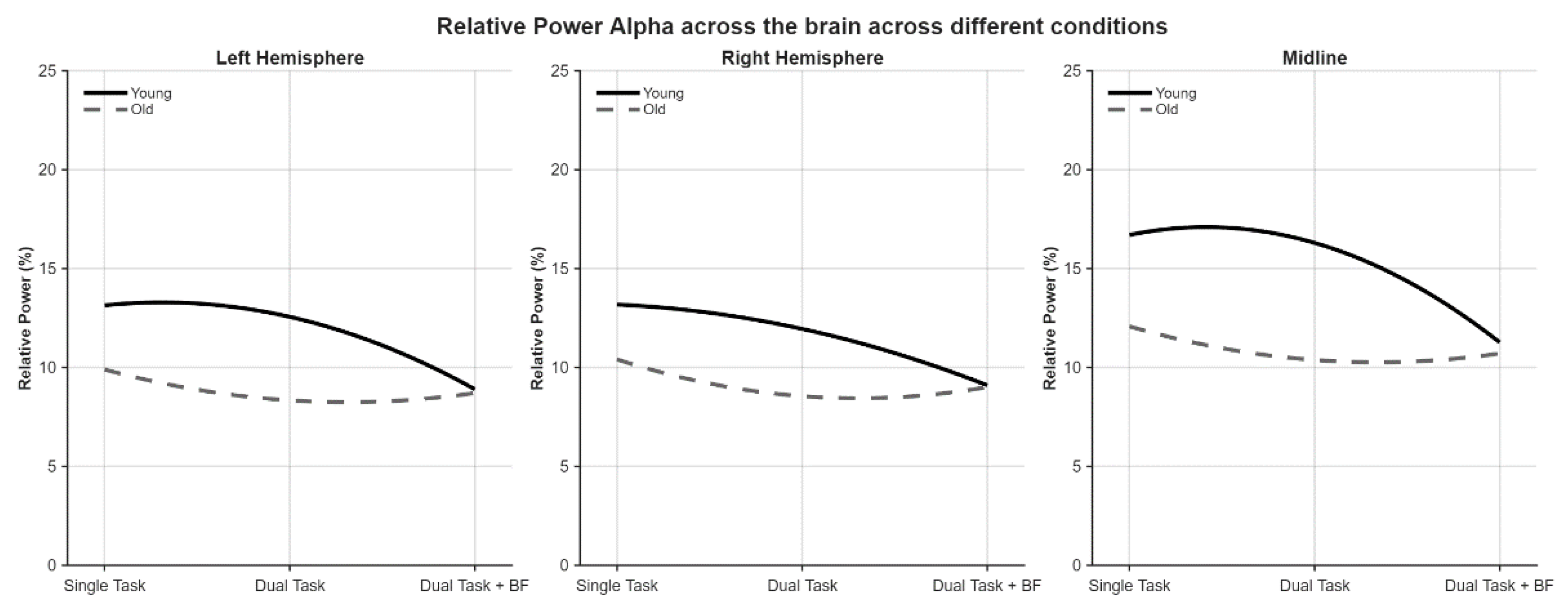
Figure 2.
High Beta relative power across different conditions for all hemispheres between young and old adults.
Figure 2.
High Beta relative power across different conditions for all hemispheres between young and old adults.
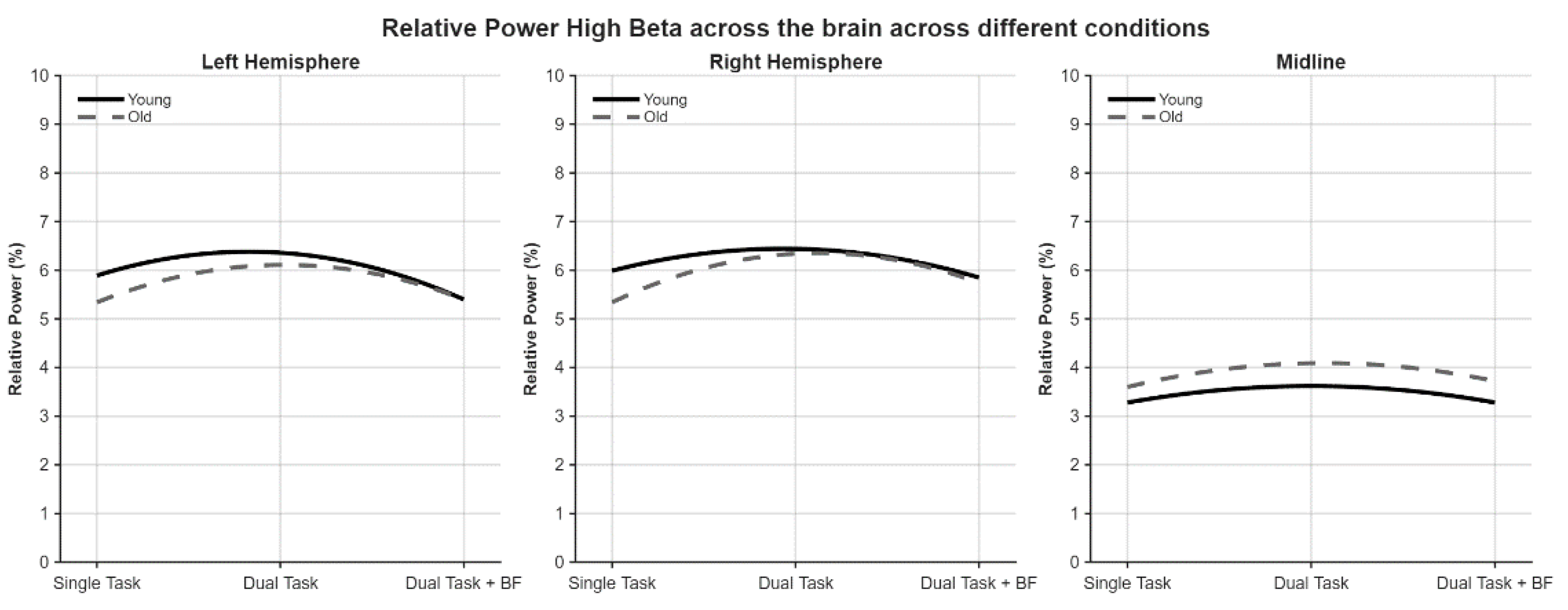
Figure 3.
Typical scalp topologies of alpha power over three experimental conditions in a representative young participant.
Figure 3.
Typical scalp topologies of alpha power over three experimental conditions in a representative young participant.
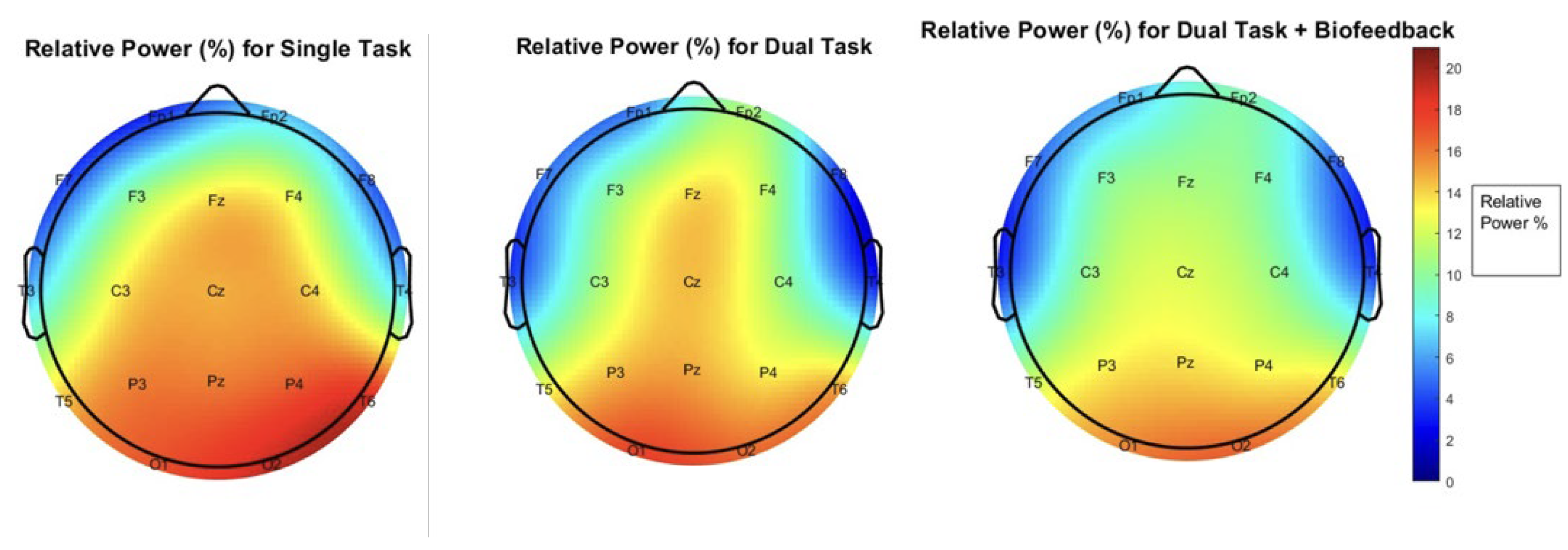

Table 1.
Relative power (%) and AMI values (%) across 3 experimental conditions (power averaged across all EEG electrodes) for young adults.
Table 1.
Relative power (%) and AMI values (%) across 3 experimental conditions (power averaged across all EEG electrodes) for young adults.
| Parameter | Single Task | Dual-Task | Dual-Task + Biofeedback | AMI |
|---|---|---|---|---|
| Alpha | 14.37±3.38 | 13.59±3.64 | 9.79±4.25 | -14.8±20.40 |
| Beta | 16.58±4.24 | 16.68±4.34 | 15.67±3.60 | -1.9±12.61 |
| High Beta | 5.05±1.40 | 5.47±1.74 | 4.87±1.56 | -6.4±16.83 |
Table 2.
Relative power (%) and AMI values (%) across 3 experimental conditions (power averaged across all EEG electrodes) for older adults.
Table 2.
Relative power (%) and AMI values (%) across 3 experimental conditions (power averaged across all EEG electrodes) for older adults.
| Parameter | Single Task | Dual-Task | Dual-Task + Biofeedback | AMI |
|---|---|---|---|---|
| Alpha | 10.8±5.17 | 9.09±4.48 | 9.47±3.91 | 2.57±29.80 |
| Beta | 15.97±4.70 | 16.56±4.00 | 16.19±3.75 | -2.1±14.73 |
| High Beta | 4.75±1.64 | 5.51±1.52 | 4.9±1.44 | -10.29±17.71 |
Disclaimer/Publisher’s Note: The statements, opinions and data contained in all publications are solely those of the individual author(s) and contributor(s) and not of MDPI and/or the editor(s). MDPI and/or the editor(s) disclaim responsibility for any injury to people or property resulting from any ideas, methods, instructions or products referred to in the content. |
© 2026 by the authors. Licensee MDPI, Basel, Switzerland. This article is an open access article distributed under the terms and conditions of the Creative Commons Attribution (CC BY) license (http://creativecommons.org/licenses/by/4.0/).
Copyright: This open access article is published under a Creative Commons CC BY 4.0 license, which permit the free download, distribution, and reuse, provided that the author and preprint are cited in any reuse.


