

Submitted:
04 June 2026
Posted:
05 June 2026
You are already at the latest version
Abstract
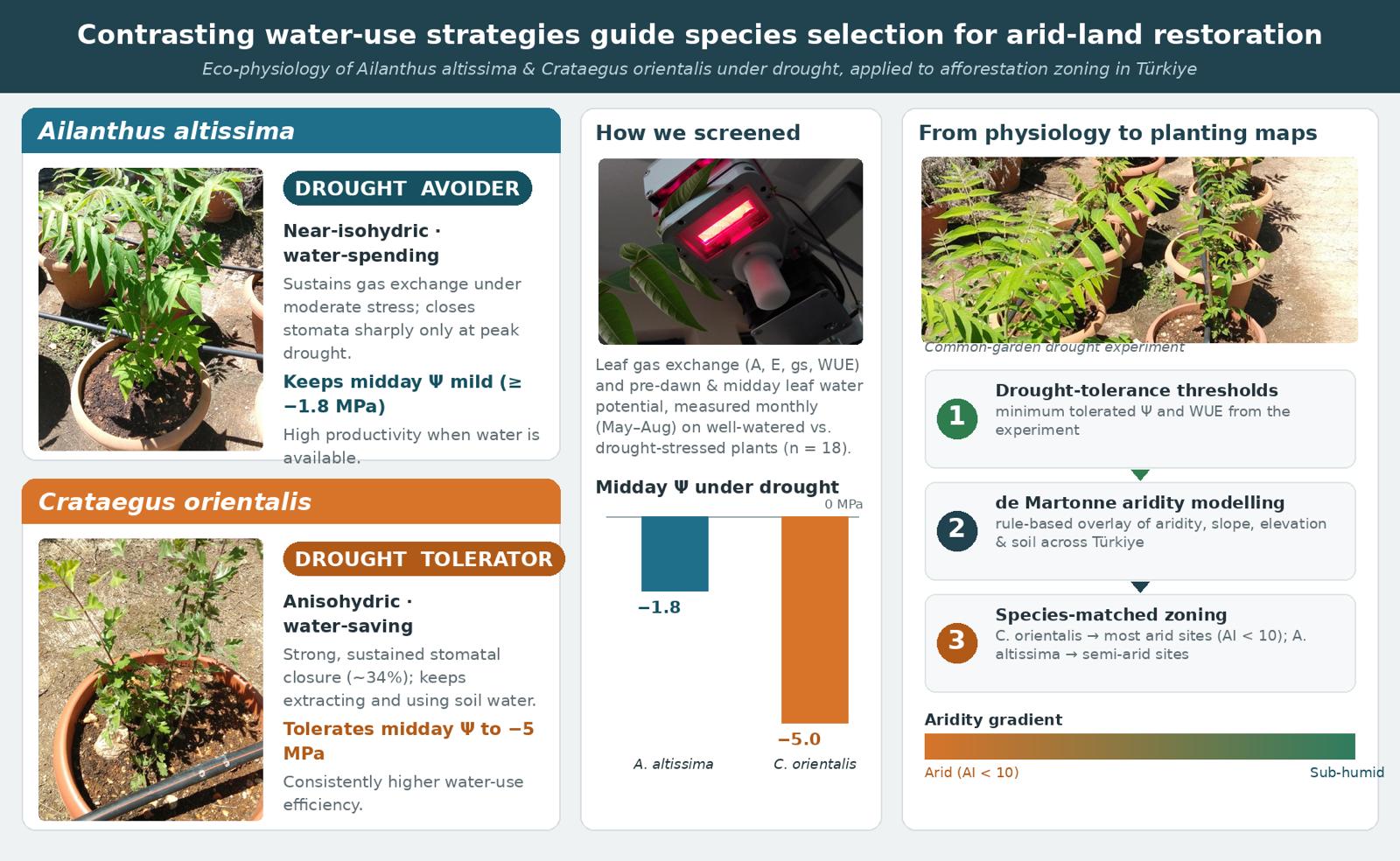
Water availability is the primary environmental factor limiting plant settlement in arid and semi-arid ecosystems, and increasing drought stress due to climate change is making forest restoration efforts in the Mediterranean basin increasingly critical. The Eastern Mediterranean region of Turkey, particularly Kahramanmaraş Province, is characterized by increasingly severe drought stress resulting from low natural precipitation and rising temperatures under global warming. This study comparatively evaluates the ecophysiological responses of Ailanthus altissima (Mill.) Swingle and Crataegus orientalis Pall. ex M. Bieb. under adequate irrigation and drought-stress conditions. To determine plant water status, pre-dawn and midday leaf water potentials were measured; water use efficiency (WUE) was calculated using net photosynthesis rate, stomatal conductance, and transpiration parameters. Both species were able to maintain photosynthetic activity under drought conditions and showed higher WUE values compared to control conditions. However, significant differences in physiological adaptation strategies emerged between the species. Ailanthus altissima exhibited a water-spending strategy with rapid physiological adjustment, while Crataegus orientalis adopted a conservative water-saving strategy through pronounced stomatal regulation. Modeling results, supported by spatial drought stress indices, have shown that both species have high adaptation potential in arid and semi-arid rehabilitation areas. The findings reveal that ecophysiological characteristics play a critical role in the selection of drought-tolerant woody species and provide a scientific basis for sustainable forest restoration under climate change.
Keywords:
water use efficiency
; drought stress
; Ailanthus altissima
; Crataegus orientalis
; Eastern Mediterranean
; arid ecosystems
; forest rehabilitation
; leaf water potential
1. Introduction
The Mediterranean basin is one of the world’s most important biodiversity hotspots, yet it faces severe and growing threats from land degradation, desertification, and climate change [1,2]. Turkey, situated at the crossroads of the Mediterranean, Irano-Turanian, and Euro-Siberian phytogeographical regions, harbors exceptional floristic diversity; however, its arid and semi-arid zones-comprising a substantial proportion of the region’s total land area-are increasingly vulnerable to climate change and, specifically, to drought-induced ecosystem collapse [3,4]. Additionally, the Eastern Mediterranean region, particularly the provinces of Kahramanmaraş, Adıyaman, and Şanlıurfa, receives low annual precipitation (typically within the range 400-700 mm yr-1) and these are concentrated in the winter months, with long hot and dry summers that impose severe water deficit stress on vegetation [5].
Global climate change projections for the Mediterranean basin consistently predict increasing temperatures, reduced and more variable precipitation, and more frequent extreme drought events [6,7]. These changes, in turn, accelerate soil erosion and vegetation loss in already degraded landscapes, creating self-reinforcing desertification cycles. The restoration and rehabilitation of barren and deforested lands thus represent a critical challenge for land managers and policymakers in Turkey [8]. In this context, selecting tree and shrub species with demonstrated ecophysiological resilience to drought is fundamental to the success of any afforestation or restoration program [9].
Water use efficiency (WUE), defined as the ratio of carbon assimilated per unit of water transpired, is a key parameter for evaluating species suitability in water-limited environments [10]. High WUE indicates that a plant can achieve a positive carbon balance while minimizing water loss-a critical adaptive trait in arid and semi-arid ecosystems and one that determines the length of the overall cropping season under most rainfed conditions [11]. Leaf water potential (Ψleaf) at pre-dawn and midday provides complementary information on the plant water status, reflecting both overnight hydraulic recovery and the severity of midday water deficit [12]. Together, these parameters provide a comprehensive picture of a species’ drought adaptation strategy [13].
Ozturk et al. [1] investigated the ecophysiological adaptation strategies of a selected group of Mediterranean maquis species including Ceratonia siliqua L., Olea oleaster Hoffm. & Link, Pistacia lentiscus L., and Quercus coccifera L. both in healthy and degraded sites in western Turkey. Their findings demonstrated that WUE varied markedly among species and that Q. coccifera exhibited the highest WUE (slope = 2.88; r2 = 0.61), while O. oleaster has the lowest (slope = 2.40; r2 = 0.78), thus establishing Q. coccifera as a prime candidate for reforestation of degraded Mediterranean areas. Sakcali et al. [14] similarly identified ecophysiological traits predictive of a species’ suitability for the reclamation of degraded areas in the Mediterranean. These foundational studies underscore the value of comparative ecophysiological assessments in identifying drought-resilient species for restoration. More recent work in China and Central Asia has extended this framework to broader arid and semi-arid contexts, emphasizing the unique relevance of WUE as a screening parameter for species selection under water deficit [15,16].
Ailanthus altissima (Mill.) Swingle (tree of heaven) is a deciduous tree native to China that has become widely established across Turkey and the broader Mediterranean basin. Despite its invasive character in some contexts, its exceptional drought tolerance, rapid growth rate, and the ability to colonize poor, degraded soils make it a species of considerable interest for the rehabilitation of barren areas [17]. Crataegus orientalis Pall. ex M. Bieb. (oriental hawthorn), on the other hand, is a native woody species distributed across the Eastern Mediterranean, Caucasus, and Middle East that is well-adapted to shallow, rocky soils under semi-arid climates [18]. Both species are present in rehabilitation planting programs in Türkiye, yet their comparative ecophysiological performance under drought stress and their suitability for specific arid regions have not been systematically modeled to date.
As a primary determinant of WUE, stomatal regulation is a central mechanism by which plants balance carbon gain against water loss under drought conditions [19,20]. Studies of afforestation species in the drylands of China have shown that drought-induced stomatal closure, although it reduces assimilation, raises water-use efficiency in trees subject to prolonged summer drought [21,22]. Osmotic adjustment and the regulation of root hydraulic conductance have likewise been identified as critical traits that help trees maintain turgor and sustain physiological activity as soil water is depleted [23,24]. The characterization of such traits in drought-tolerant species candidates for ecological rehabilitation programs in Turkey is therefore essential to matching species physiology to site-specific hydrological conditions.
The de Martonne aridity index (AI) is widely used to classify climate zones and to delineate the spatial extent of arid, semi-arid, and sub-humid areas suitable for specific land restoration interventions [25,26]. Integrating this index with species-level ecophysiological thresholds provides a powerful, spatially explicit framework for guiding tree species selection in restoration programs [27,28]. This approach has been applied with success in degraded rangelands of the Loess Plateau in China, where species with contrasting water-use strategies were mapped to aridity gradients to maximize rehabilitation success [29,30]. A comparable framework is urgently needed for Turkey, where arid and semi-arid zones are expanding as a result of climate change and where current afforestation efforts often suffer from high seedling mortality during summer drought [31,32].
The specific objectives of this study were to evaluate their key ecophysiological parameters and assess the climatic drought characteristics of the study area with using a Walter-Lieth diagram to model their rehabilitation potential in arid and semi-arid degraded areas of Turkey using spatial drought-stress indices. We hypothesized that drought stress will significantly alter the physiological responses of each species although each one will develop different water-use strategies. Specifically, we predict that A. altissima will exhibit a more ‘water-spending’ strategy, given its high gas exchange capacity. In contrast, C. orientalis will likely develop a more conservative, drought-resistant ‘water-saving’ strategy, characterized by increased stomatal regulation.
2. Materials and Methods
2.1. Study Area and Climate Characterization
The study was conducted in the summers of 2023 and 2024, in Kahramanmaraş Province, southeastern Turkey (37°30′-38°00′ N, 36°30′-37°30′ E) situated in the Eastern Mediterranean phytogeographical region. The area is characterized by a semi-arid Mediterranean climate with hot, dry summers and mild, rainy winters. Mean annual precipitation is approximately 724 mm yr-1, heavily concentrated in the October-April period, with a pronounced dry season extending from May through September. Mean annual temperature is 17.9°C, with hot, and dry summers in which July and August maxima frequently exceeding 35°C. These climatic parameters were compiled from the Turkish State Meteorological Service [38] and visualized as a Walter-Lieth climate diagram [33] (Figure 1). This diagram illustrates the duration and severity of the dry season, with a distinctive extended summer drought period of approximately 5-6 months, during which potential evapotranspiration greatly exceeds precipitation, creating severe water deficit conditions for vegetation.
2.2. Plant Material and Experimental Design
Five-year-old seedlings of A. altissima (45 to 50 cm height) and C. orientalis (30 to 35 cm height) were obtained from the Kahramanmaraş Regional Directorate of Forestry nursery. Seedlings were transplanted into 12 L plastic containers filled with a standardized substrate consisting of forest soil, peat, and perlite (2:1:1 v/v/v) and maintained in a semi-controlled greenhouse environment to exclude rainfall while allowing daily temperature fluctuations and photoperiod.
A completely randomized design with two treatments was utilized, including a (1) Control (well-watered), where plants were maintained at 80-100% field capacity by regular irrigation; and a (2) Drought stress, where irrigation was withheld until pre-dawn leaf water potential reached approximately -2.0 MPa, simulating field drought conditions typical of the summer dry season. A total of eighteen replicates (n = 18) per treatment per species were used. All measurements were conducted during the peak summer drought period (July-August).
2.3. Leaf Water Potential Measurements
Pre-dawn leaf water potential (Ψpd) and midday leaf water potential (Ψmd) were measured using a Scholander-type pressure chamber (PMS Instrument Company, Albany, OR, USA) [34]. Pre-dawn measurements were taken between 04:00 and 05:30 h (solar time) before sunrise, when plant water potential is close to soil water potential. Midday measurements were taken between 12:00 and 13:30 h at maximum solar radiation. Three fully expanded leaves per plant were excised and immediately measured. Results are expressed in MPa (n = 18, mean ± SE).
2.4. Gas Exchange Measurements
Leaf gas exchange parameters were measured on the same days as water potential determinations using a portable infrared gas analyzer system (GFS-3000, Walz GmbH, Effeltrich, Germany). Net photosynthetic rate (A, μmol CO2 m-2 s-1), stomatal conductance (gs, mol H₂O m-2 s-1), and transpiration rate (E, mmol H₂O m-2 s-1) were recorded under ambient CO₂ concentration (~400 ppm) and an average room temperature of 25°C ± 1°C. Water use efficiency (WUE, μmol CO₂ mmol-1 H₂O) was calculated as the ratio of net photosynthesis to transpiration rate (A/E) [1,10]. All measurements were taken between 09:00 and 11:00 h to avoid midday stomatal closure. In all cases, three measurements per plant were taken and then averaged (n = 18, mean ± SE).
2.5. Statistical Analysis
Data was analyzed using IBM SPSS Statistics v.26 (IBM Corp., Armonk, NY, USA). Differences between control and drought-stress treatments were assessed by independent samples t-test for each species. Species comparisons within treatments were performed by one-way ANOVA followed by Tukey’s HSD post-hoc test. Significance level was set at p < 0.05 for all analyses. Figures were prepared using OriginPro 2022 (OriginLab Corporation, Northampton, MA, USA).
2.6. Modelling Approach for Spatial Suitability Assessment
To model the suitability of A. altissima and C. orientalis for rehabilitation of arid and barren areas across Turkey, we integrated our ecophysiological findings with spatial climate datasets as follows:
where AI = de Martonne aridity index, P = annual precipitation in mm and T = mean annual temperature in °C. (All data was obtained from the Turkish State Meteorological Service [38] and the WorldClim v2.1 global climate database at 1 km resolution [35]. Sites with AI between 20 and 10 (arid to semi-arid) and AI < 10 (arid) were delineated as primary and secondary suitability zones for rehabilitation.
AI = P / (T+ 10)
The ecophysiological thresholds established in our experiments (minimum Ψpd tolerated, WUE under drought) were used to define the ecophysiological envelope of each species. Species distribution modelling was performed using a rule-based raster overlay approach in QGIS 3.28, combining AI, slope, elevation, and soil type (from the FAO Harmonized World Soil Database) layers. Outputs were validated against existing distribution records for both species compiled from national floristic and herbarium sources [36].
3. Results
3.1. Climate of the Study Area
The Walter-Leith climate diagram for Kahramanmaraş (Figure 1) illustrates the pronounced seasonal water deficit characteristic of the Eastern Mediterranean climate. Precipitation is concentrated between November and April, with monthly totals dropping below 10 mm from June through September. The dry season, defined as the months in which the precipitation curve falls below the temperature curve (scaled 2:1), extends for approximately 5-6 months. July is both the driest (mean precipitation~5 mm) and the hottest month of the year (mean monthly temperature ~28°C). Figure 1 supports our assumption that the study area represents a realistic analog for the arid and semi-arid rehabilitation zones targeted in this study.
3.2. Leaf Water Potentials
Pre-dawn and midday leaf water potentials of both species under control and drought-stress conditions varied markedly over the course of the season (Figure 2). Under control (well-watered) conditions, pre-dawn Ψ of A. altissima remained moderate throughout, ranging from −0.37 ± 0.03 MPa in August to −0.68 ± 0.16 MPa in July, with midday Ψ between −0.72 and −1.62 MPa. Crataegus orientalis operated at distinctly lower tissue water potentials even under irrigation, with control pre-dawn Ψ falling to −1.53 ± 0.03 MPa and midday Ψ to −3.27 ± 0.10 MPa at the height of the dry season in July, reflecting its naturally more negative baseline water status.
Under drought stress, both species reached more negative water potentials, but to very different degrees. In A. altissima, midday Ψ under stress stayed comparatively mild across the season, with the lowest value of −1.82 ± 0.09 MPa in June and a midday value of only about −0.85 MPa in July; pre-dawn Ψ under stress fell to −1.47 ± 0.28 MPa in August. By contrast, C. orientalis tolerated far lower water potentials under drought, with midday Ψ reaching −5.03 ± 0.06 MPa and pre-dawn Ψ −3.03 ± 0.09 MPa in July, the driest month. This difference of 3.21 MPa in midday Ψ at peak drought between both species indicates that A. altissima maintains a relatively high and stable leaf water status (a drought-avoiding, near-isohydric behavior), whereas C. orientalis tolerates pronounced tissue dehydration (a drought-tolerant, anisohydric behavior). Plants exhibiting anisohydric behavior keep their stomata open and continue assimilating carbon as soil water availability decreases, allowing leaf water potential (Ψ) to drop markedly under drought or high evaporative demand; in contrast, isohydric plants close their stomata to maintain a relatively constant Ψ, conserving water but limiting photosynthesis [19,20].
3.3. Ecophysiological Parameters of Ailanthus altissima
Gas exchange parameters of A. altissima are shown in Figure 3 and summarized in Table 1. Net assimilation rate (A) was largely maintained under drought on a seasonal basis (control 11.1 ± 0.3 vs stress 9.0 ± 0.5 µmol CO2 m−2 s−1), but with a pronounced mid-season depression: in July, the hottest and driest month, A under stress fell to 4.8 ± 0.8 µmol CO2 m−2 s−1 (a 57% reduction relative to control; p < 0.001) before partially recovering in August. Transpiration rate (E) and stomatal conductance (gs) both declined significantly under drought over the season (E: 2.0 ± 0.1 → 1.6 ± 0.1 mmol H2O m−2 s−1, p < 0.01; gs: 114 ± 5 → 93 ± 6 mmol H2O m−2 s−1, p < 0.01), with the sharpest stomatal closure in August (gs reduced by ~61%). Consequently, the water-use efficiency response of A. altissima was strongly seasonal rather than uniform: WUE under stress was statistically indistinguishable from control in spring (May–June), fell below control at the height of the July drought (4.0 ± 0.6 vs 7.7 ± 0.1 µmol mmol−1; p < 0.001) when assimilation collapsed, and then rose markedly above control in August (9.1 ± 0.6 vs 5.2 ± 0.4 µmol mmol−1; p < 0.001) as transpiration was curtailed more strongly than carbon gain. This pattern is consistent with a water-spending strategy in which the species sustains gas exchange under moderate stress and improves WUE chiefly late in the drought period.
3.4. Ecophysiological Parameters of Crataegus orientalis
The ecophysiological responses of C. orientalis are presented in Figure 4 and Table 1. Net assimilation rate was higher than in A. altissima throughout the season (seasonal control 19.7 ± 0.7 µmol CO2 m−2 s−1) and declined significantly under drought in June and July (e.g. July: 24.4 → 15.0 µmol CO2 m−2 s−1; p < 0.001), recovering to control levels by August. Transpiration rate and stomatal conductance were reduced under drought in every month (seasonal E: 3.8 ± 0.1 → 2.5 ± 0.1 mmol H2O m−2 s−1, p < 0.001; gs: 220 ± 7 → 145 ± 5 mmol H2O m−2 s−1, a ~34% reduction, p < 0.001), reflecting consistent and pronounced stomatal regulation across the dry season. As a result, WUE under drought stress was significantly higher than control in May, June and August (seasonal mean 6.3 ± 0.1 vs 5.3 ± 0.2 µmol mmol−1; p < 0.001), reaching up to 6.9 ± 0.1 µmol mmol−1. This combination of strong, sustained stomatal closure, elevated WUE and tolerance of very low leaf water potentials (midday Ψ down to about −5.0 MPa; Figure 2) is the hallmark of the conservative water-saving strategy of C. orientalis, in which water loss is preferentially restricted over carbon gain [14].
3.5. Comparative Summary of Water Use Efficiency
Table 1 summarizes the key ecophysiological parameters of both species under control and drought-stress conditions. Both species sustained relatively high instantaneous water-use efficiencies under drought (monthly A/E values mostly between 4 and 9 µmol mmol−1), but followed contrasting seasonal trajectories: C. orientalis showed a consistent, significant increase in WUE under stress across most of the season, whereas the WUE gain in A. altissima was concentrated late in the drought period (August). On a seasonal basis the two species reached comparable mean WUE under stress (C. orientalis 6.3 ± 0.1; A. altissima 6.1 ± 0.3 µmol mmol−1). Both values exceed in magnitude the highest slope-based WUE reported for maquis species by Ozturk et al. [1] under natural field conditions in the eastern Mediterranean (Q. coccifera, slope = 2.88). We note, however, that Ozturk et al. expressed WUE as the slope of the photosynthesis–transpiration regression, which is not strictly equivalent to the instantaneous A/E ratio used here, so this comparison should be interpreted with caution. These findings nonetheless indicate that both A. altissima and C. orientalis possess competitive water-use characteristics relevant to rehabilitation planting.
3.6. Modeled Suitability Zones for Arid Area Rehabilitation in Turkey
The spatial modeling analysis identified extensive areas of Turkey as potentially suitable for rehabilitation using one or both study species. Using the de Martonne aridity index, approximately 38% of Turkey’s land area (ca. 290,000 km2) falls within arid (AI < 10) or semi-arid (AI 10-20) categories, concentrated in Central Anatolia, southeastern Turkey, and Inner Aegean valleys (Table 2). Based on our ecophysiological thresholds, Crataegus orientalis, with its higher WUE and more conservative stomatal behavior, is modelled as suitable for the most water-limited sites (AI < 10), particularly in the provinces of Konya, Niğde, Kırşehir, Nevşehir, Adıyaman, and Şanlıurfa.
A. altissima, with its higher absolute photosynthetic rates and rapid growth but lower drought-stress WUE, is modeled as most suitable for semi-arid rehabilitation zones (AI 10-20) and barren areas with moderate precipitation (500-700 mm yr-1) combined with high summer temperatures, such as those found in Kahramanmaraş, Gaziantep, Hatay, and inland portions of the Aegean region. Its high growth rate makes it particularly valuable for rapid canopy closure in early-stage restoration.
4. Discussion
The present study provides the first comparative ecophysiological characterization of Ailanthus altissima and Crataegus orientalis under drought conditions relevant to the arid and semi-arid zones of Turkey, supported by a spatially explicit modeling framework for rehabilitation planning. Our findings show that both species possess substantial drought tolerance, manifested through different but complementary adaptive strategies, and that both have the ability to significantly increase WUE under water deficit conditions, a critical attribute for survival and productivity in water-limited environments [10,11].
The decline in leaf water potential under drought stress in both species was substantial, yet both maintained values above the wilting point. C. orientalis consistently maintained less negative pre-dawn and midday Ψ than A. altissima, suggesting superior hydraulic regulation. This is consistent with findings on native Eastern Mediterranean sclerophylls, where tight stomatal control prevents catastrophic xylem cavitation even under prolonged drought [1,12]. The pre-dawn Ψ values we recorded for stressed C. orientalis (-1.63 MPa) indicate only moderate midday water deficits, consistent with the drought-avoidance behavior described for Mediterranean sclerophylls such as Q. coccifera and C. siliqua [1], further supporting the designation of C. orientalis as a drought-avoiding species.
The water-spending strategy observed in A. altissima under control conditions, high transpiration and high net photosynthesis, shifts toward greater stomatal economy under drought stress, resulting in elevated WUE. This pattern mirrors that described for Olea oleaster and Pistacia lentiscus by Ozturk et al. [1], who noted that water-spending species are characterized by mesomorphic leaves showing wide variation in daily water potential, with night recovery of plant water status.
The rapid growth rates of A. altissima under favorable conditions, combined with its capacity to upregulate WUE under drought, makes it particularly suited for early-succession rehabilitation planting in barren areas where rapid canopy establishment is desired [17].
C. orientalis, by contrast, sustained a consistently elevated WUE under drought stress (seasonal mean 6.3 µmol mmol−1, reaching 6.9 µmol mmol−1 in spring) and maintained a higher A/E ratio than A. altissima through most of the dry season. These instantaneous values exceed in magnitude even the highest slope-based WUE reported by Ozturk et al. [1] for Q. coccifera (slope = 2.88; r2 = 0.61), which is the most efficient species in their Mediterranean maquis study, although slope-based and instantaneous A/E measures are not strictly equivalent. Its strong stomatal control under drought, reflected in a pronounced seasonal reduction in gs (~34%), together with its tolerance of very low leaf water potentials, is a hallmark of the drought-tolerant strategy also described for C. siliqua and Q. coccifera [1,14]. This strategy is particularly effective in environments where soil water is limiting for extended periods, as is the case throughout the arid zones of Turkey [7].
Insufficient water in the site is considered one of the main environmental factors limiting photosynthesis, plant growth and yield [1]. However, limiting factors also cause morphological and ecophysiological changes in plants [11]. Both species in our study maintained positive net carbon assimilation rates under drought stress levels representative of field conditions in the study region (Ψpd ≈ -1.6 to -1.9 MPa). This is a critical finding for rehabilitation practitioners: unlike annual crops or mesophytic species, both A. altissima and C. orientalis can sustain carbon gain and presumably growth during summer drought episodes, albeit at reduced rates [1,13].
The spatial modelling outputs identify semi-arid zones of Turkey-comprising approximately 222,000 km2 of land with AI between 10 and 20-as the primary target area for rehabilitation using both species. These zones include some of Turkey’s most severely degraded forest lands, where decades of overgrazing, charcoal production, and agricultural encroachment have left barren and sparsely vegetated hill slopes prone to erosion [8,36]. The modelling approach used here, integrating ecophysiological thresholds with spatial climate data, follows the conceptual framework advocated by Sakcali and Ozturk [8] and extends it to a regional scale applicable to Turkish forestry planning.
In strictly arid zones (AI < 10), our modeling suggests that C. orientalis has a clear advantage due to its superior WUE and more conservative water use. Its native status in eastern Turkey also favors ecological compatibility and reduced risk of negative interactions with local biodiversity. A. altissima, while highly productive in semi-arid conditions, may require supplementary irrigation during the establishment phase in the most arid sites, and its use should be carefully managed to prevent invasive spread into adjacent natural habitats [17]. The Walter-Lieth diagram for the study area (Figure 1) graphically demonstrates the need for species that can tolerate 5-6 months of severe water deficit-a condition both species satisfy based on our findings.
The consistent global climate change will introduce further changes in plant growth patterns across Turkey, and data is needed for important tree species to make long-term predictions [1]. Our study contributes to this need by providing ecophysiological benchmarks for two species of immediate practical relevance to Turkish forest rehabilitation. Future research should extend these measurements to field conditions across multiple aridity gradients, incorporate multi-year assessments spanning extreme drought years, and evaluate seedling survival and biomass accumulation in operational rehabilitation plots.
The elevated WUE values recorded in both species under drought stress are consistent with a growing body of evidence from arid and semi-arid regions of China and Central Asia. Li et al. [15] demonstrated that tree species with high instantaneous WUE under controlled drought conditions were significantly more likely to survive and maintain positive radial growth in field rehabilitation plantings in the semi-arid Loess Plateau, a finding directly analogous to our modelling outputs for southeastern Turkey. Huang et al. [16] documented, at broader scales, a sustained increase in terrestrial ecosystem water-use efficiency across the Northern Hemisphere over recent decades, underscoring the value of WUE as an integrative indicator of vegetation responses to aridity and reinforcing its use as a screening parameter for restoration species selection. The present study extends this evidence base to a Mediterranean context and to the specific species used in Turkish rehabilitation programs.
Stomatal behavior in the two species reflected contrasting but complementary responses to water deficit. C. orientalis combined a strong, sustained reduction in stomatal conductance (~34% on a seasonal basis) with tolerance of very negative leaf water potentials (midday Ψ reaching about −5 MPa under stress), a pattern characteristic of anisohydric, drought-tolerant sclerophylls that continue to extract and use soil water as it becomes scarce [19,20]. In contrast, A. altissima maintained a comparatively high and stable leaf water status (midday Ψ generally above about −1.8 MPa) while reducing transpiration, closing its stomata most strongly only at the peak of the drought (up to a ~61% reduction in gs in August). This behavior is consistent with a near-isohydric, drought-avoiding strategy that protects tissue water potential at the expense of mid-season carbon gain. This complementarity is consistent with observations from Chinese mixed-species plantations, where contrasting water-use strategies among co-occurring trees buffered canopy health and water-use efficiency under drought [21,37]. The practical implication for Turkish rehabilitation is that planting A. altissima and C. orientalis in mixed stands may buffer against inter-annual climate variability more effectively than monospecific plantations.
The de Martonne aridity index used in our spatial modelling has been validated as a robust classifier of water availability for afforestation planning across Eurasia [25,26]. Recent applications of this index in Turkish provincial forestry planning have confirmed its utility in delineating priority rehabilitation zones [38]. The convergence of our ecophysiological threshold modeling with the de Martonne classifications provides a scientifically robust basis for species zoning that can be directly integrated into Turkey’s National Afforestation and Erosion Control Action Plan. Comparable spatial-ecophysiological frameworks have been advocated for the dryland restoration programs of Iran, Jordan, and Morocco [39,40], suggesting that the methodological approach of the present study has regional transferability across the broader Middle East and Mediterranean region.
The invasive potential of A. altissima in certain contexts warrants management attention. While its drought tolerance and rapid growth are advantageous for early-stage rehabilitation of barren slopes, controlled use and monitoring are necessary to prevent encroachment into adjacent native plant communities [41,42]. Nevertheless, in the most severely degraded and arid sites where native species cannot establish, the pragmatic use of A. altissima as a pioneer nurse species, followed by underplanting with native species such as C. orientalis, may represent a viable and ecologically sound restoration sequence [43]. Such facilitated succession approaches have been documented in dryland restoration contexts in China, southern Europe and Turkey where pioneer species modify microclimate and soil conditions to enable native species establishment [44,45,46].
5. Conclusions
This study demonstrates that both A. altissima and C. orientalis exhibit substantial drought tolerance and competitive water-use efficiency under water-deficit conditions representative of the arid and semi-arid zones of Turkey. C. orientalis combined strong, sustained stomatal control with a consistently elevated water-use efficiency under drought (seasonal mean ~6.3 µmol mmol−1) and tolerance of very low leaf water potentials, equaling or exceeding in magnitude the instantaneous water-use efficiencies inferred for Mediterranean maquis species under natural field conditions, through a conservative, drought-tolerant water-saving strategy. A. altissima displayed a drought-avoiding, water-spending strategy, sustaining high productivity under favorable conditions, maintaining stable leaf water status, and upregulating its water-use efficiency mainly late in the drought period.
Spatial modeling based on the de Martonne aridity index identified approximately 290,000 km2 of Turkey-primarily in southeastern and central Anatolia-as suitable for rehabilitation using one or both species. C. orientalis is recommended for the most arid sites (AI < 10) where water conservation is paramount, while A. altissima is recommended for semi-arid rehabilitation zones (AI 10-20) requiring rapid canopy establishment. Both species may contribute to ecosystem continuity and sustainability in areas threatened by drought stress, desertification, and the progressive effects of climate change. Their inclusion in Turkish forest rehabilitation programs should be accompanied by site-specific monitoring and adaptive management frameworks to optimize planting outcomes and minimize potential ecological risks.
Author Contributions
Conceptualization, B.A. and Ö.B.; methodology, B.A.; software, E.Y.; validation, E.Y., B.A., M.B. and E.B.; formal analysis, B.A.; investigation, Ö.B.; resources, B.A.; data curation, E.Y.; writing-original draft preparation, E.Y., B.A., Ö.B., M.B. and E.B.; writing-review and editing, B.A., E.Y., M.B. and E.B.; visualization, E.Y. and E.B.; supervision, B.A.; project administration, B.A.; funding acquisition, B.A. All authors have read and agreed to the published version of the manuscript.
Funding
This research received no external funding.
Data Availability Statement
Data supporting the reported results are available from the corresponding author upon reasonable request.
Acknowledgments
The authors thank the Kahramanmaraş Regional Directorate of Forestry for providing plant material and logistical support.
Conflicts of Interest
The authors declare no conflicts of interest.
Abbreviations
The following abbreviations are used in this manuscript:
| WUE | Water use efficiency |
| Ψleaf | Leaf water potential |
| MPa | megapascal |
| Ψpd | Pre-dawn water potential |
| Ψmd | Midday water potential |
| A | Net assimilation rate |
| E | Transpiration rate |
| gs | Stomatal conductance |
| PAR | Photosynthetic active radiation |
| PET | Potential evapotranspiration |
| AI | Aridity index |
References
- Ozturk, M.; Dogan, Y.; Sakcali, M.S.; Doulis, A.; Karam, F. Ecophysiological responses of some maquis (Ceratonia siliqua L., Olea oleaster Hoffm. & Link, Pistacia lentiscus and Quercus coccifera L.) plant species to drought in the east Mediterranean ecosystem. J. Environ. Biol. 2010, 31, 233–245. [Google Scholar]
- Ozturk, M.; Yucel, E.; Gucel, S.; Sakcali, S.; Aksoy, A. Plants as biomonitors of trace elements pollution in soil. In Trace Elements as Contaminants and Nutrients: Consequences in Ecosystems and Human Health; Prasad, M.N.V., Ed.; John Wiley and Sons: Hoboken, NJ, USA, 2008; pp. 721–742. [Google Scholar]
- Dindaroglu, T.; Tunguz, V.; Babur, E.; Menshov, O.; Battaglia, M.L. Determination of the relationship among compound Topographic Index (CTI), soil properties and land-use in karst ecosystems. Phys. Geogr. 2023, 44(3), 307–329. [Google Scholar] [CrossRef]
- Dindaroglu, T.; Babur, E.; Battaglia, M.; Seleiman, M.; Uslu, O.S.; Roy, R. Impact of Depression Areas and Land-Use Change in the Soil Organic Carbon and Total Nitrogen contents in a Semi-Arid Karst Ecosystem. Cerne 2021, 27, e-102980. [Google Scholar] [CrossRef]
- Pereira, J.S.; Chaves, M.M. Plant responses to drought under climate change in Mediterranean-type ecosystems. In Global Change and Mediterranean-Type Ecosystems; Moreno, J.M., Oechel, W.C., Eds.; Springer: New York, NY, USA, 1995; Volume 117, pp. 140–160. [Google Scholar] [CrossRef]
- Houghton, J.T.; Ding, Y.; Griggs, D.J.; Noguer, M.; Van der Linden, P.J.; Dai, X.; Maskell, K.; Johnson, C.A. Climate Change: The Scientific Basis. In IPCC Third Assessment Report of Intergovernmental Panel on Climate Change; Cambridge University Press: Cambridge, UK, 2001. [Google Scholar]
- Penuelas, J.; Filella, I.; Lloret, F.; Pinol, J.; Siscart, D. Effects of a severe drought on water and nitrogen use by Quercus ilex and Phillyrea latifolia. Biol. Plant. 2000, 43, 47–53. [Google Scholar] [CrossRef]
- Sakcali, M.S.; Ozturk, M. Eco-physiological behaviour of some Mediterranean plants as suitable candidates for reclamation of degraded areas. J. Arid Environ. 2004, 57, 141–153. [Google Scholar] [CrossRef]
- Flexas, J.; Bota, J.; Galmes, J.; Medrano, H.; Ribas-Carbo, M. Keeping a positive carbon balance under adverse conditions: Responses of photosynthesis and respiration to water stress. Physiol. Plant. 2006, 127, 343–352. [Google Scholar] [CrossRef]
- Lawlor, D.W.; Cornic, G. Photosynthetic carbon assimilation and associated metabolism in relation to water deficits in higher plants. Plant Cell Environ. 2002, 25, 275–294. [Google Scholar] [CrossRef]
- Galmes, J.; Cifre, J.; Medrano, H.; Flexas, J. Modulation of relative growth rate and its components by water stress in Mediterranean species with different growth forms. Oecologia 2005, 145, 21–31. [Google Scholar] [CrossRef]
- Ladjal, M.; Deloche, N.; Huc, R.; Ducrey, M. Effects of soil and air drought on growth, plant water status and leaf gas exchange in three Mediterranean cedar species: Cedrus atlantica, C. brevifolia and C. libani. Trees 2007, 21, 201–213. [Google Scholar] [CrossRef]
- Filella, I.; Llusia, J.; Pinol, J.; Penuelas, J. Leaf gas exchange and fluorescence of Phillyrea latifolia, Pistacia lentiscus and Quercus ilex saplings in severe drought and high temperature conditions. Environ. Exp. Bot. 1998, 39, 213–220. [Google Scholar] [CrossRef]
- Sakcali, M.S.; Bahadir, H.; Ozturk, M. Eco-physiology of Capparis spinosa L.: A plant suitable for combating desertification. Pak. J. Bot. 2008, 40, 1481–1486. [Google Scholar]
- Li, X.; Zhang, C.; Fu, H.; Shao, M.; Li, H.; Deng, L. Water use efficiency and growth performance of five tree species for afforestation in the semi-arid Loess Plateau of China. For. Ecol. Manag. 2020, 462, 117981. [Google Scholar] [CrossRef]
- Huang, M.; Piao, S.; Sun, Y.; Ciais, P.; Cheng, L.; Mao, J.; Poulter, B.; Shi, X.; Zeng, Z.; Wang, Y. Change in terrestrial ecosystem water-use efficiency over the last three decades. Glob. Change Biol. 2015, 21, 2366–2378. [Google Scholar] [CrossRef] [PubMed]
- Galmes, J.; Medrano, H.; Flexas, J. Photosynthetic limitations in response to water stress and recovery in Mediterranean plants with different growth forms. New Phytol. 2007, 175, 81–93. [Google Scholar] [CrossRef]
- Ogaya, R.; Penuelas, J. Comparative field study of Quercus ilex and Phillyrea latifolia: Photosynthetic response to experimental drought conditions. Environ. Exp. Bot. 2003, 50, 137–148. [Google Scholar] [CrossRef]
- Tardieu, F.; Simonneau, T. Variability among species of stomatal control under fluctuating soil water status and evaporative demand: Modelling isohydric and anisohydric behaviours. J. Exp. Bot. 1998, 49, 419–432. [Google Scholar] [CrossRef]
- McDowell, N.; Pockman, W.T.; Allen, C.D.; Breshears, D.D.; Cobb, N.; Kolb, T.; Plaut, J.; Sperry, J.; West, A.; Williams, D.G.; et al. Mechanisms of plant survival and mortality during drought: Why do some plants survive while others succumb to drought? New Phytol. 2008, 178, 719–739. [Google Scholar] [CrossRef]
- Jia, H.; Guan, C.; Zhang, J.; He, C.; Yin, C.; Meng, P. Drought effects on tree growth, water use efficiency, vulnerability and canopy health of Quercus variabilis–Robinia pseudoacacia mixed plantation. Front. Plant Sci. 2022, 13, 1018405. [Google Scholar] [CrossRef]
- Guo, H.; Wang, Y.; Li, G.; Du, S. Effects of rainfall exclusion treatment on photosynthetic characteristics of black locust in the sub-humid region of the Loess Plateau, China. Plants 2024, 13, 704. [Google Scholar] [CrossRef]
- Rieger, M. Offsetting effects of reduced root hydraulic conductivity and osmotic adjustment following drought. Tree Physiol. 1995, 15, 379–385. [Google Scholar] [CrossRef] [PubMed]
- Turner, N.C. Turgor maintenance by osmotic adjustment: 40 years of progress. J. Exp. Bot. 2018, 69, 3223–3233. [Google Scholar] [CrossRef]
- de Martonne, E. L’indice d’aridité. Bull. Assoc. Géogr. Fr. 1926, 3, 3–5. [Google Scholar] [CrossRef]
- Spinoni, J.; Naumann, G.; Carrao, H.; Barbosa, P.; Vogt, J. World drought frequency, duration and severity for 1951-2010. Int. J. Climatol. 2014, 34, 2792–2804. [Google Scholar] [CrossRef]
- Breshears, D.D.; Cobb, N.S.; Rich, P.M.; Price, K.P.; Allen, C.D.; Balice, R.G.; Romme, W.H.; Kastens, J.H.; Floyd, M.L.; Belnap, J.; et al. Regional vegetation die-off in response to global-change-type drought. Proc. Natl. Acad. Sci. USA 2005, 102, 15144–15148. [Google Scholar] [CrossRef]
- Lü, Y.; Fu, B.; Feng, X.; Zeng, Y.; Liu, Y.; Chang, R.; Sun, G.; Wu, B. A policy-driven large scale ecological restoration: Quantifying ecosystem services changes in the Loess Plateau of China. PLoS ONE 2012, 7, e31782. [Google Scholar] [CrossRef]
- Jiao, F.; Wen, Z.M.; An, S.S. Changes in soil properties across a chronosequence of vegetation restoration on the Loess Plateau of China. Catena 2011, 86, 110–116. [Google Scholar] [CrossRef]
- Deng, L.; Liu, G.B.; Shangguan, Z.P. Land-use conversion and changing soil carbon stocks in China’s ‘Grain-for-Green’ Program: A synthesis. Glob. Change Biol. 2014, 20, 3544–3556. [Google Scholar] [CrossRef]
- Boydak, M. Reforestation of Lebanon cedar (Cedrus libani A. Rich.) in degraded Taurus Mountain ecosystems in Turkey. Silva Fenn. 2004, 38, 75–84. [Google Scholar] [CrossRef]
- Babur, E.; Yalçıntaş, B.; Ünsal, Y. T. Impact of Cedrus libani afforestation on soil carbon and nitrogen stocks in the Upper Mediterranean Basin. Turk. J. For. Sci. 2025, 9(1), 75–88. [Google Scholar] [CrossRef]
- Zepner, L.; Karrasch, P.; Wiemann, F.; Bernard, L. ClimateCharts.net-An interactive climate analysis web platform. Int. J. Digit. Earth 2021, 14, 338–356. [Google Scholar] [CrossRef]
- Scholander, P.F.; Hammel, H.T.; Bradstreet, E.D.; Hemmingsen, E.A. Sap pressure in vascular plants. Science 1965, 148, 339–346. [Google Scholar] [CrossRef]
- Fick, S.E.; Hijmans, R.J. WorldClim 2: New 1-km spatial resolution climate surfaces for global land areas. Int. J. Climatol. 2017, 37, 4302–4315. [Google Scholar] [CrossRef]
- Güner, A.; Aslan, S.; Ekim, T.; Vural, M.; Babaç, M.T. (Eds.) Türkiye Bitkileri Listesi (Damarlı Bitkiler) [A Checklist of the Flora of Turkey (Vascular Plants)]; Nezahat Gökyığit Botanik Bahçesi ve Flora Araştırmaları Derneği: İstanbul, Türkiye, 2012. [Google Scholar]
- Zhou, H.; Zhao, W.; He, Z.; Li, S.; Liu, H. Ecological water use efficiency and its response to drought stress during growing season in the Temperate Steppe of North China. Agric. For. Meteorol. 2022, 316, 108837. [Google Scholar] [CrossRef]
- Climate and Agriculture Meteorology Department-Research department. Climate assessment of Türkiye in 2025. 2026. Available online: http://www.emcc.mgm.gov.tr/files/State_of_the_Climate_in_Turkey_in_2025.pdf (accessed on 10 May 2026).
- Ennos, R.; Dodds, M. Estimating biodiversity and adaptation strategies for arid land restoration in the Middle East and North Africa region. J. Arid Environ. 2021, 194, 104610. [Google Scholar] [CrossRef]
- Niang, I.; Ruppel, O.C.; Abdrabo, M.A.; Essel, A.; Lennard, C.; Padgham, J.; Urquhart, P. Africa. In Climate Change 2014: Impacts, Adaptation, and Vulnerability; Barros, V.R., et al., Eds.; Cambridge University Press: Cambridge, UK, 2014; pp. 1199–1265. [Google Scholar] [CrossRef]
- Kowarik, I.; Säumel, I. Biological flora of Central Europe: Ailanthus altissima (Mill.) Swingle. Perspect. Plant Ecol. Evol. Syst. 2007, 8, 207–237. [Google Scholar] [CrossRef]
- Vilà, M.; Espinar, J.L.; Hejda, M.; Hulme, P.E.; Jarošík, V.; Maron, J.L.; Pergl, J.; Schaffner, U.; Sun, Y.; Pyšek, P. Ecological impacts of invasive alien plants: A meta-analysis of their effects on species, communities and ecosystems. Ecol. Lett. 2011, 14, 702–708. [Google Scholar] [CrossRef]
- Whisenant, S.G. Repairing Damaged Wildlands: A Process-Orientated, Landscape-Scale Approach; Cambridge University Press: Cambridge, UK, 1999. [Google Scholar] [CrossRef]
- Gao, T.; Xu, B.; Yang, X.; Jin, Y.; Ma, H.; Li, J.; Yu, H. Using MODIS time series data to estimate aboveground biomass and its spatiotemporal variation in Inner Mongolia’s grassland between 2001 and 2011. Int. J. Remote Sens. 2013, 34, 7444–7460. [Google Scholar] [CrossRef]
- Padilla, F.M.; Pugnaire, F.I. The role of nurse plants in the restoration of degraded environments. Front. Ecol. Environ. 2006, 4, 196–202. [Google Scholar] [CrossRef]
- Akgün, B.; Yazar, E.; Kocacinar, F. Photosynthetic responses of Amygdalus arabica Olivier and Atriplex canescens (Pursh) Nutt. to drought stress under field conditions. Sib. J. For. Sci. 2018, 6, 103–111. [Google Scholar] [CrossRef]
Figure 1.
Walter-Lieth climate diagram for the Kahramanmaraş study area (Eastern Mediterranean, Turkey, 1992–2022). Mean monthly temperature (red line) and precipitation (blue line) are plotted on a 1 °C : 2 mm scale. The blue shaded area marks the humid (non-drought) period, in which precipitation lies above the temperature curve, whereas the orange stippled area marks the dry period, in which precipitation falls below it, corresponding to an extended summer drought of roughly five months. Climate data: Turkish State Meteorological Service [38]; diagram conventions after ClimateCharts.net [33].
Figure 1.
Walter-Lieth climate diagram for the Kahramanmaraş study area (Eastern Mediterranean, Turkey, 1992–2022). Mean monthly temperature (red line) and precipitation (blue line) are plotted on a 1 °C : 2 mm scale. The blue shaded area marks the humid (non-drought) period, in which precipitation lies above the temperature curve, whereas the orange stippled area marks the dry period, in which precipitation falls below it, corresponding to an extended summer drought of roughly five months. Climate data: Turkish State Meteorological Service [38]; diagram conventions after ClimateCharts.net [33].
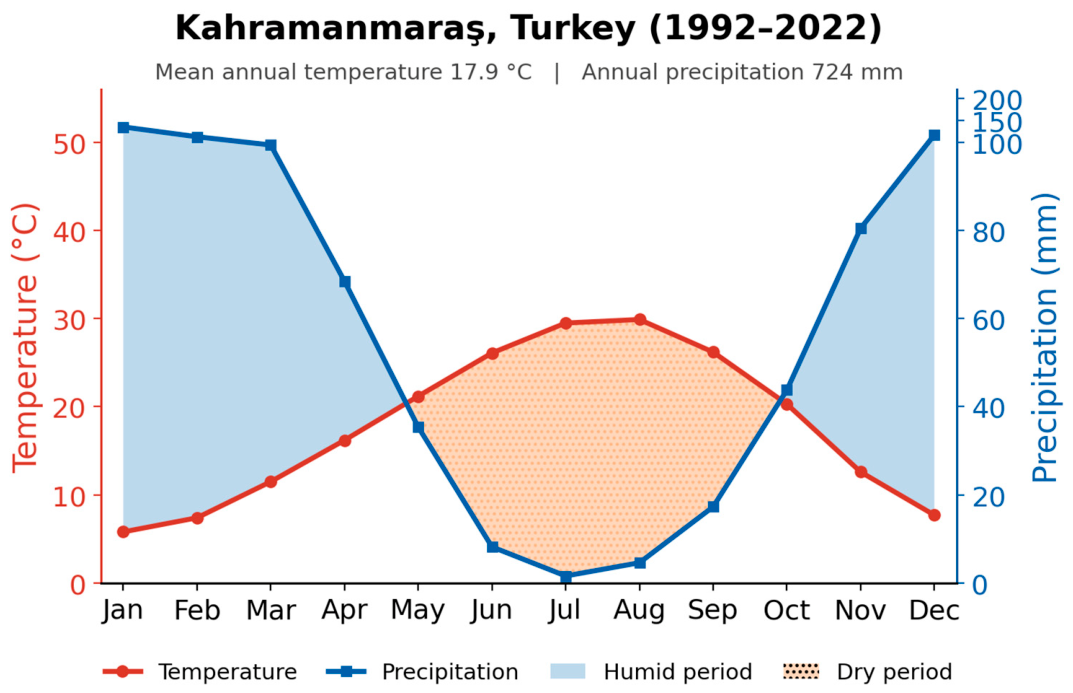
Figure 2.
Water potentials of Ailanthus altissima (A) Pre-dawn (B) Midday and Crataegus orientalis (C) Pre-dawn (D) Midday. Control: Well-watered, Stress: Drought Stress. Legend (A) applies to all graphs (n = 18, bars ± SE).
Figure 2.
Water potentials of Ailanthus altissima (A) Pre-dawn (B) Midday and Crataegus orientalis (C) Pre-dawn (D) Midday. Control: Well-watered, Stress: Drought Stress. Legend (A) applies to all graphs (n = 18, bars ± SE).
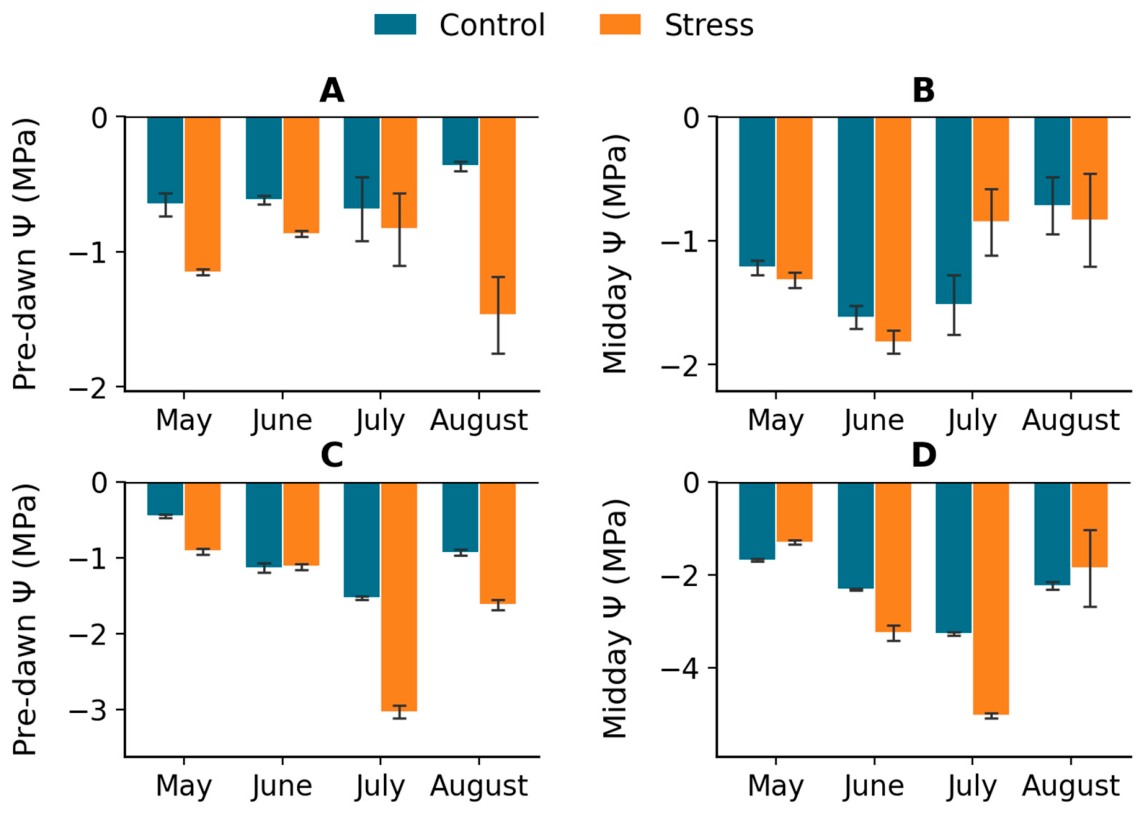
Figure 3.
Ecophysiological parameters of Ailanthus altissima (A) Net assimilation rate (B) Transpiration rate (C) Stomatal conductance (D) Water use efficiency. Control: Well-watered, Stress: Drought Stress. Legend (A) applies to all graphs (n = 18, bars ± SE).
Figure 3.
Ecophysiological parameters of Ailanthus altissima (A) Net assimilation rate (B) Transpiration rate (C) Stomatal conductance (D) Water use efficiency. Control: Well-watered, Stress: Drought Stress. Legend (A) applies to all graphs (n = 18, bars ± SE).
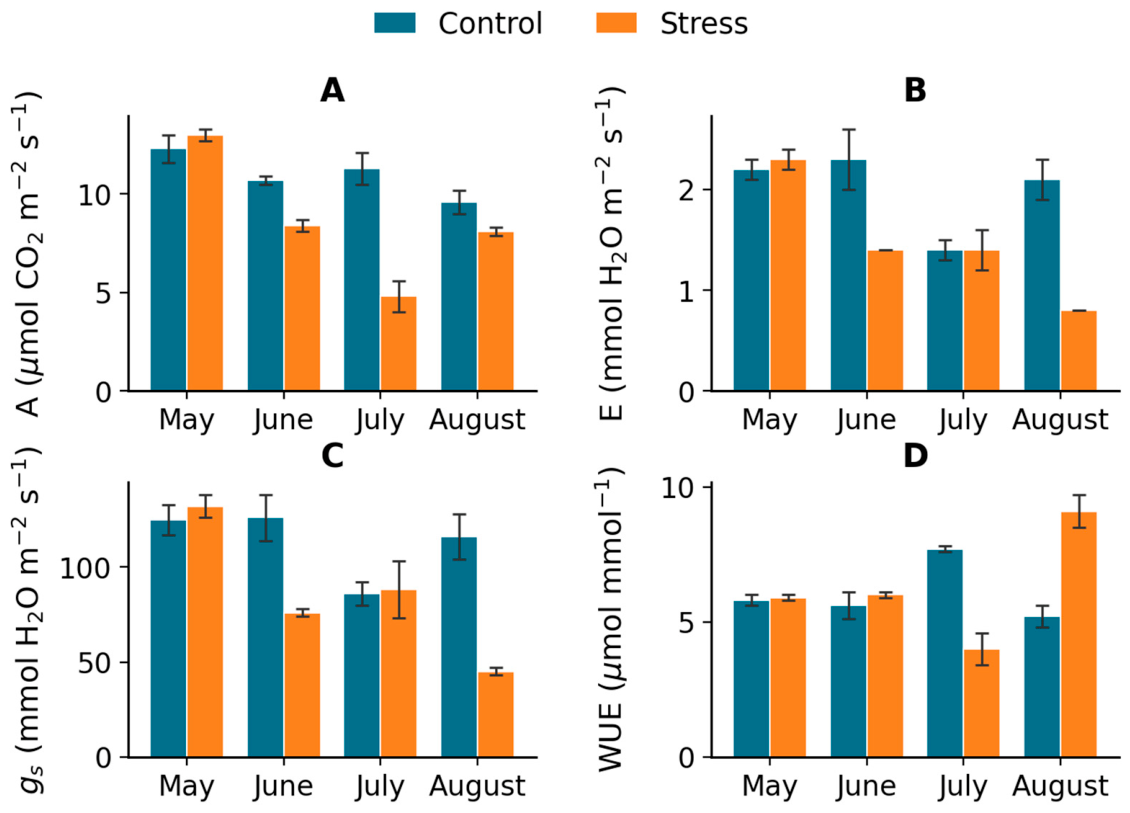
Figure 4.
Ecophysiological parameters of Crataegus orientalis (A) Net assimilation rate (B) Transpiration rate (C) Stomatal conductance (D) Water use efficiency. Control: Well-watered, Stress: Drought Stress. Legend (A) applies to all graphs (n = 18, bars ± SE).
Figure 4.
Ecophysiological parameters of Crataegus orientalis (A) Net assimilation rate (B) Transpiration rate (C) Stomatal conductance (D) Water use efficiency. Control: Well-watered, Stress: Drought Stress. Legend (A) applies to all graphs (n = 18, bars ± SE).
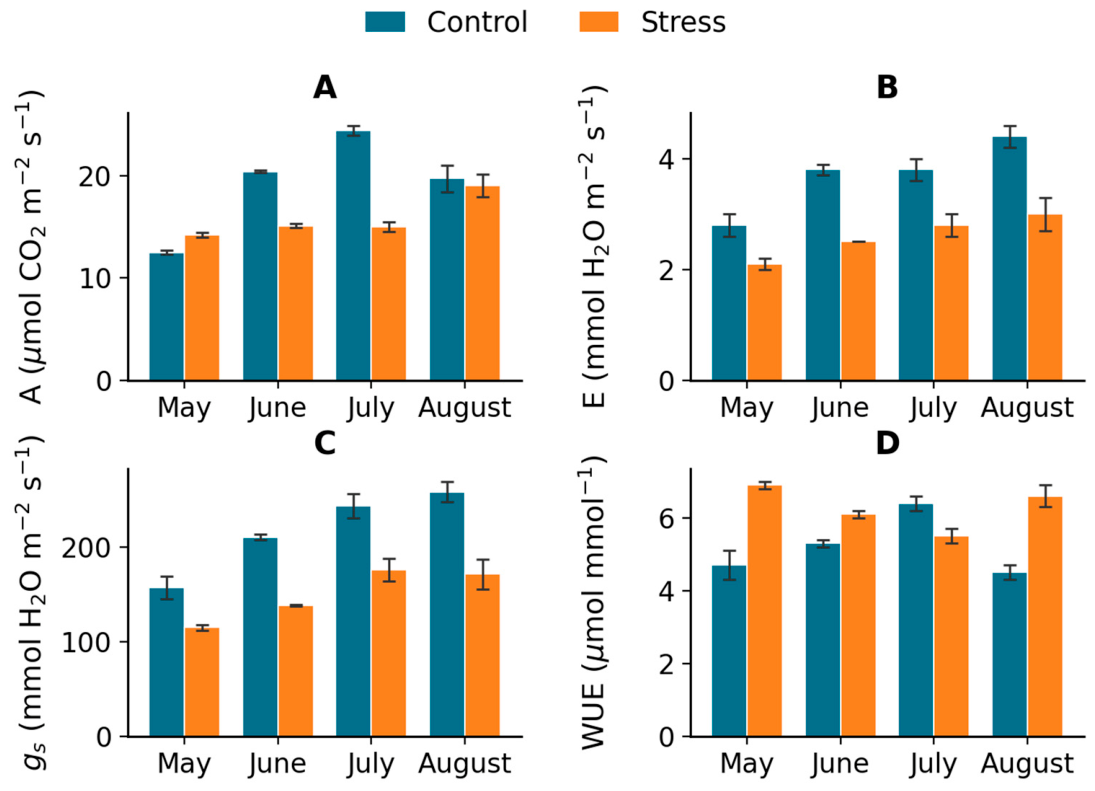

Table 1.
Ecophysiological parameters of Ailanthus altissima and Crataegus orientalis under control (well-watered) and drought-stress conditions (mean ± SE, n = 18).
Table 1.
Ecophysiological parameters of Ailanthus altissima and Crataegus orientalis under control (well-watered) and drought-stress conditions (mean ± SE, n = 18).
| Parameter | Treatment | May | June | July | August |
| Ailanthus altissima | |||||
| A (µmol CO₂ m⁻² s⁻¹) |
Control | 12.3 ± 0.7 | 10.7 ± 0.2 | 11.3 ± 0.8 | 9.6 ± 0.6 |
| Stress | 13.0 ± 0.3 | 8.4 ± 0.3*** | 4.8 ± 0.8*** | 8.1 ± 0.2** | |
| E (mmol H₂O m⁻² s⁻¹) |
Control | 2.2 ± 0.1 | 2.3 ± 0.3 | 1.4 ± 0.1 | 2.1 ± 0.2 |
| Stress | 2.3 ± 0.1 | 1.4 ± 0.0** | 1.4 ± 0.2 | 0.8 ± 0.0*** | |
|
gs (mmol H₂O m⁻² s⁻¹) |
Control | 125 ± 8 | 126 ± 12 | 86 ± 6 | 116 ± 12 |
| Stress | 132 ± 6 | 76 ± 2*** | 88 ± 15 | 45 ± 2*** | |
| WUE (µmol CO₂ mmol⁻¹) |
Control | 5.8 ± 0.2 | 5.6 ± 0.5 | 7.7 ± 0.1 | 5.2 ± 0.4 |
| Stress | 5.9 ± 0.1 | 6.0 ± 0.1 | 4.0 ± 0.6*** | 9.1 ± 0.6*** | |
| Crataegus orientalis | |||||
| A (µmol CO₂ m⁻² s⁻¹) |
Control | 12.5 ± 0.2 | 20.4 ± 0.1 | 24.4 ± 0.5 | 19.7 ± 1.3 |
| Stress | 14.2 ± 0.2*** | 15.1 ± 0.2*** | 15.0 ± 0.5*** | 19.0 ± 1.1 | |
| E (mmol H₂O m⁻² s⁻¹) |
Control | 2.8 ± 0.2 | 3.8 ± 0.1 | 3.8 ± 0.2 | 4.4 ± 0.2 |
| Stress | 2.1 ± 0.1** | 2.5 ± 0.0*** | 2.8 ± 0.2*** | 3.0 ± 0.3*** | |
|
gs (mmol H₂O m⁻² s⁻¹) |
Control | 157 ± 12 | 210 ± 3 | 243 ± 13 | 258 ± 11 |
| Stress | 115 ± 3** | 138 ± 1*** | 176 ± 12*** | 171 ± 16*** | |
| WUE (µmol CO₂ mmol⁻¹) |
Control | 4.7 ± 0.4 | 5.3 ± 0.1 | 6.4 ± 0.2 | 4.5 ± 0.2 |
| Stress | 6.9 ± 0.1*** | 6.1 ± 0.1*** | 5.5 ± 0.2** | 6.6 ± 0.3*** | |
Values are means ± SE. Asterisks indicate a significant difference between drought-stress and control plants within the same month and species (Welch’s t-test): * p < 0.05, ** p < 0.01, *** p < 0.001; absence of an asterisk denotes a non-significant difference. A: net assimilation rate; E: transpiration rate; gs: stomatal conductance; WUE: water use efficiency. Leaf water potentials are presented in Figure 2.
Table 2.
Modeled suitability of Ailanthus altissima and Crataegus orientalis for rehabilitation of arid and semi-arid areas in Turkey based on de Martonne aridity index (AI) and ecophysiological thresholds.
Table 2.
Modeled suitability of Ailanthus altissima and Crataegus orientalis for rehabilitation of arid and semi-arid areas in Turkey based on de Martonne aridity index (AI) and ecophysiological thresholds.
| Zone | AI | Area (km²) |
A. altissima Suitability |
C. orientalis Suitability |
|---|---|---|---|---|
| Arid | < 10 | ~68,000 | Low | High |
| Semi-arid | 10-20 | ~222,000 | High | High |
| Dry sub-humid | 20-30 | ~180,000 | Moderate | Moderate |
| Sub-humid | > 30 | ~310,000 | Low | Low |
AI: de Martonne Aridity Index (P / (T + 10)). Area estimates derived from Turkish State Meteorological Service data and WorldClim v2.1 [35].
Disclaimer/Publisher’s Note: The statements, opinions and data contained in all publications are solely those of the individual author(s) and contributor(s) and not of MDPI and/or the editor(s). MDPI and/or the editor(s) disclaim responsibility for any injury to people or property resulting from any ideas, methods, instructions or products referred to in the content. |
© 2026 by the authors. Licensee MDPI, Basel, Switzerland. This article is an open access article distributed under the terms and conditions of the Creative Commons Attribution (CC BY) license (http://creativecommons.org/licenses/by/4.0/).
Copyright: This open access article is published under a Creative Commons CC BY 4.0 license, which permit the free download, distribution, and reuse, provided that the author and preprint are cited in any reuse.


