

Submitted:
04 June 2026
Posted:
05 June 2026
You are already at the latest version
Abstract
Interest in electric vehicles (EVs) is rising as the world shifts toward sustainable transportation, yet consumer adoption remains highly uneven, particularly in developing countries. This study examines how five dimensions of consumption value—functional, social, emotional, novelty, and conditional—influence consumer choice behavior toward EVs in Indonesia, while also testing the moderating role of infrastructure readiness. Using a quantitative approach, data were collected through an online survey with purposive sampling, yielding 455 valid responses. Partial least squares structural equation modeling (PLS-SEM) was applied to assess the measurement and structural models. The results reveal that functional, social, emotional, and conditional values significantly influence consumer choice behavior, whereas novelty value has no significant effect. Infrastructure readiness also significantly moderates most consumption values, with negative coefficients indicating that limited charging access and inadequate maintenance support weaken the positive impact of consumer values on EV adoption. The findings show that although consumers value performance, social image, emotional appeal, and situational factors, poor charging infrastructure hinders adoption. This study contributes to EV adoption literature by integrating consumption value theory with infrastructure readiness as a moderator. The results emphasize that developing charging infrastructure, expanding service availability, and maintaining supportive government policies are critical steps for accelerating EV adoption in emerging markets.
Keywords:
electric vehicles
; consumer choice behavior
; infrastructure readiness
; theory of consumption values
1. Introduction
The rapid advancement of economic development has led to increased human civilization but at the same time has led to increased environmental degradation. As a result, sustainability concerns have become increasingly internationally known. Tu [1] identifies new energy vehicles as one means to overcome these environmental challenges, and scholars have also agreed that moving towards green energy is key, as fossil fuel combustion is still a leading source of greenhouse gas emissions [2].
Electric vehicles (EVs) are one way to effectively reduce emissions in the transport sector [3]. However, EVs are sustainable innovations due to their ability to decrease pollution as well as fossil fuel usage and minimize noise and vibration, ultimately improving comfort [4,5]. Policies have been developed by governments around the globe to encourage EV development [6]. Sales of global EVs exceeded one million units in 2017, a 54% growth compared with 2016, though China had the largest market share overall, according to the IEA’s report.
Consumer acceptance is the most important aspect of EV success despite the growth [7]. Consumers often exhibit limited knowledge and experience with EVs, contributing to uncertainty in adoption decisions [8]. Consumer value theory asserts that Consumers tend to select products that align with their perceived value dimensions and personal needs [9,10]. Therefore understanding these values is essential in improving EV penetration [11]. Consumers are often able to associate EVs financial benefits in terms of low operational cost [12], emotional rewards, and environmental benefits [13].
Research on perceived value theory proposes that value perception explains how consumers choose sustainable means of transport, namely bike-sharing, and public transport, is influenced by value perceptions [14,15]. Scholars frequently categorize these values to examine their influence on consumer perceptions. [5], for instance, found functional values – including monetary, performance, and convenience – most likely to motivate adoption of EVs. In keeping with the Theory of Consumption Value [10], consumers select the products that they perceive as having the most value (and therefore, are most likely to purchase), which supports the theoretical rationale behind some products’ purchase intention, purchasing behavior [16] and sustainable purchasing behaviors [17,18].
But while the global EV market is growing, uptake in many developing countries (one of the largest automotive markets of Southeast Asia, Indonesia, among them) remains low. The EV development in Indonesia is further encouraged by national policies and incentives that were laid down to stimulate EV development in Indonesia. Some studies of how to implement consumer value theory in this issue, in particular in developing countries, remain scarce. Accordingly, this study investigates the effect of consumption values on the intention of consumers to choose electric vehicles and seeks out which consumption values primarily drive their decision making.
2. Literature Review and Hypotheses
The systematic study of consumer behavior deals with how individuals choose, acquire, use, and also dispose of the products and services that satisfy their needs. An understanding of consumer behavior has an immediate bearing upon the successful creation of marketing tactics [19]. Value is the cornerstone of marketing in this arena. Emphasized by [20,21], marketing managers are encouraged to adopt strategies that meet the value expectations from clients about a firm for long-term success. A leading outcome of the broader model of consumer experience, customer value is found among [22] most influential forces in today’s marketplace [23].
Consumer value, as we know it, has developed over the years. Perceived value was defined by [24] as the overall valuation of a product or service by a consumer based on their perceptions about the utility of the product or service provided (what is received as compared to what is lost). A majority of the early work concentrated on quality and price as critical determinants of value judgments [25]. From the 1990s until today, however, it is multidimensional views of consumer perceived value (CPV) that have been gaining influence. [10] argued that consumer choice is modulated by various different dimensions of consumption value contributing to varying degrees within the context of a decision situation.
Value is an integral facet of marketing and is well-researched as it has an immense influence over consumers’ attitude, purchasing intentions, and loyalty towards the marketing-related products [15,26]. It is described as one of the basic elements for successful marketing techniques [27]. CPV is inherently subjective and affected by the factors and features which create a situation and an individual product, differentiating one product from another [28].
Based on decades of research in sociology, psychology, economics, and consumer behavior, [10] proposed the Theory of Consumption Values (TCV). The Theory of Consumption Values has been widely applied and validated across various contexts, repeatedly exhibiting strong explanatory reliability [29,30]. TCV has defined five dimensions of consumer value: functional, emotional, social, epistemic, and conditional.
Functional value is the perceived usefulness of a product or service according to the functional, utilitarian, or physical characteristics of a product or service. Typically, functional values have been defined as price, durability, and reliability [29]. The importance of practical needs and tangible product characteristics influences purchase decisions [31]. Previous studies have demonstrated that functional value positively influences behavioral [32]. In the case of electric vehicles (EVs) functional values are manifested by observed product features such as performance, cost savings, and energy efficient methods [13]. However, some research published in recent years [17] also emphasized that functional value has limited impact on decision-making. As such, we put forward the following hypothesis:
H1.
Functional value has a positive effect on EV choice behavior.
The second most widely described dimension is that of social value, which is sometimes called symbolic value. It deals with perceived benefits from a product’s social affiliation, such as with certain cultural and socioeconomic groups or with specific demographic categories. This value is related to both the image and the meanings that a product can be understood to provide [10]. Since symbolic value is essentially constructed by society, it tends to be more difficult to measure than functional value [33]. When facing social risk, consumers have a tendency to need more information in order to reduce negative consequences, which helps them decrease the level of uncertainty among consumers, which leads them to rely on expert opinion [34].
Based on previous research, it is known that the symbolic nature of green products enhances its adoption beyond the purely functional or instrumental characteristics [35]. This could suggest that social status and recognition influence products consumers select. In contrast, prior research [17] also found minor influence of social value on decision making. [36] also observed that pro-environmental identity may represent a significant symbolic marker which might communicate that owning an EV could convey technological sophistication and environmental consciousness. Based on this, we propose:
H2.
Social value predicts positively the EV choice behavior.
Rational and emotional forces and emotional factors are fundamental components to consumer decisions [37]. Emotional value comprises utility of an event that derives from a product or service generated from feelings or emotions [10]. This dimension illustrates the degree to which the product can produce positive emotional states [31]. Before that, prior research highlights that emotional aspects can be the main drivers to the decision maker on consumer choice [38]. [18] claim that emotion or non-functional value would have been enough to predict green purchasing behavior. [31] also had a positive correlation with both emotional value and behavioral intentions. Accordingly, we hypothesize:
H3.
Emotional value plays a positive role in EV choice behavior.
Consumers tend to seek information prior to purchase due to curiosity, novelty motivation, or knowledge enrichment [39]. Epistemic (novelty) value is the utility that derives from a product’s ability to generate curiosity, provide novelty or satisfy a consumer’s need for knowledge [10]. Exploring new features also has a significant impact on the consumers’ intention to buy green products [40]. New technology adoption is extremely dependent on product expertise [41]. Before making decisions about innovative products, consumers evaluate available information [17]. As a result, consumers might find EVs appealing because of the revolutionary technology they adopt [42]. Based on this reasoning, the following hypothesis is proposed:
H4.
Epistemic value has positive effect on choice behavior of EVs.
Conditional value is the utility extracted from a product according to circumstances or situations [10]. Conditional value arises in contexts where particular settings or conditions contribute to the functional or social benefit of the product. According to [43], conditional value is usually applicable to products that are primarily used with specific times. Consumers tend to assign value to products based on specific situational contexts [31]. As such, a number of studies [17] identify conditional value as a strong predictor of consumer choice. Furthermore, studies in sustainable consumption [44] indicate that the availability of situational factors greatly contributes to environmentally-responsible actions. Pro-environmental behavior can be enabled or resisted by context and infrastructural influences [45]. Changes in situational variables can influence consumers’ purchasing behavior of green products [46]. Thus, we hypothesize:
H5.
Conditional value has positive influence on EV choice behavior.
It has been suggested in previous works [47], that electric vehicles can be an inexpensive alternative to conventional automobiles. Nonetheless, basing consumer intentions on perceived value alone is still inadequate. Several operational issues, such as a narrow driving range, long battery recharge time [48] and insufficient charging infrastructure [49,50] still contribute to consumer perception of the viability of EVs. Thus infrastructure readiness influences consumers’ attitude towards EVs strongly. It can magnify or dampen perceived value impacts on purchasing behavior. From these results, the following hypotheses are suggested:
H6:
Infrastructure readiness moderates the effect of functional value on EV choice behaviors.
H7:
Infrastructure readiness moderates the effect of social value on EV choice behavior.
H8:
Infrastructure readiness moderates emotional value effect on EV choice behavior.
H9:
Infrastructure readiness moderates the impact of epistemic value on EV choice behavior.
H10:
The effect of conditional value on EV choice behavior is moderated by infrastructure readiness.
While previous research has examined individual consumption values and their effects on EV adoption, only few studies have considered the extent to which consumption values contribute to individual EV adoption within an integrated framework, particularly for emerging markets. There is still limited scientific evidence on how both functional, social, emotional, conditional and epistemic values together contribute to the consumer decision-making process toward EVs.
3. Methodology
This research used a quantitative research design to understand how consumption values affect consumer attitudes towards electric vehicles and examine the moderating influence of infrastructure readiness. The study investigated five dimensions of consumption value based on functional, social, emotional, epistemic, and conditional, consumer attitude as the dependent variable, and infrastructure readiness as the moderating variable.
Primary data were collected using two sections of a structured questionnaire. The first part collected demographic variables such as gender, level of education, and occupation. The second section involved measuring study variables on a five-point Likert scale from “strongly disagree” to “strongly agree.” It was conducted using an online questionnaire distributed on various social media platforms. Purposive sampling was used to ensure respondents were from Indonesia and familiar with electric vehicles or interested in sustainable transportation.
Partial least squares structural equation modeling (PLS-SEM) was conducted using SmartPLS software to test the research hypotheses. Before the structural model was tested, the measurement model was tested for reliability and validity. And this also included tests for internal consistency reliability and convergent validity. Then the Standardized Root Mean Square Residual (SRMR) was run to compare the fit of the model. In line with the research objectives and hypotheses, the structural model was utilized to examine the relationships between variables. The path coefficients show both the size and direction of the consumption values’ effects on consumer choice behavior. To assess another possibility, infrastructure readiness was added as a moderating variable. This would determine whether it strengthens or weakens the power of consumption values on customers’ preference toward electric vehicles
4. Results and Discussion
Before analyzing the structural model, the demographic characteristics of the respondents were examined. As shown in Table 1, the sample consisted of 455 respondents, with 58% males and 42% females. In terms of age distribution, the majority (48%) were between 21 and 30 years old, followed by those aged 31–40 (36%). Regarding education, most respondents held a bachelor’s degree (71%), followed by master’s degree holders (11%) and high school students/graduates (18%). Based on occupation, employees accounted for the largest proportion (48%), followed by professionals or business owners (21%), housewives (10%), students (15%), and others (6%).
This study examines the effect of consumer value on consumer choice behavior and the moderating role of infrastructure readiness, using Smart PLS for the analysis. Figure 1 presents the estimated model generated from the calculation.
The measurement model was then evaluated for reliability and validity. All constructs achieved Cronbach’s alpha values above the recommended minimum of 0.60 [51], indicating acceptable internal consistency (Table 2). Convergent validity was assessed using Average Variance Extracted (AVE), and all constructs recorded AVE values near or above 0.50, meeting the recommended threshold for adequate convergent validity [51].
Model fit was evaluated using the Standardized Root Mean Square Residual (SRMR). As shown in Table 3, the SRMR value of 0.071 is below the maximum recommended threshold of 0.10, indicating that the model has an acceptable fit and adequately represents the data.
The structural model was analyzed to test the effects of consumer values on consumer choice behavior and the moderating influence of infrastructure readiness. Table 4 presents the path coefficients, t-values, and p-values.
The findings suggest that functional value (H1), social value (H2), emotional value (H3), and conditional value (H5) have statistically significant positive effects on consumer choice behavior. In contrast, epistemic (novelty) value (H4) has no significant effect on consumer choice.
As for the moderating effects, infrastructure readiness has a significant moderating effect on the relationship of functional value (H6), social value (H7), emotional value (H8), and conditional value (H10) with consumer choice behavior. Its moderating effect on novelty value (H9), however, is not statistically significant.
Functional value is connected to the technical capability and functionality of the vehicle. The findings show that functional value significantly affects consumers’ intention to purchase EVs. Respondents described EVs as strong, energy efficient, and innovative, having lower operating costs, instant torque, smooth acceleration, and a quiet driving experience. These results are in line with [52], who also showed that functional value has a great influence on purchasing intention for hybrid and EV vehicles. Similarly, [5] verified that monetary and performance benefits of EVs directly affect adoption intention.
A car’s social or symbolic value goes beyond transportation to encompass status, identity, and social recognition. Based on these findings, we propose that social value plays an important role in promoting the adoption of EVs. Individuals are more likely to consider EVs when influenced by their social environment. EV ownership is commonly associated with modernity, prestige, and an image of “being green,” enabling consumers to signal innovation and commitment to the environment. This aligns with [53], who noted ecological products often connote a socially responsible identity and an understanding of membership in a social group.
Emotional value is also central to determining EV choice behavior. This research indicates that emotional responses (such as, for example, pride, excitement, and joy) have a positive impact on EV purchase preference. For example, [54] highlighted the strong positive relationship between perceived emotional value and buying intentions; similarly, [55] discovered the strong association of emotional evaluations with EV usage intention. Modernity, futuristic design, and enjoyable driving experience of EVs all help reinforce consumers’ preferences.
In terms of epistemic value, consumers are also able to be drawn by the novelty and technology- enhancing effects of EVs. This study, however, shows no significant association between novelty value and EV purchasing intention. This indicates that Indonesian consumers choose cost savings and quality of operation over curiosity or learning-based drive for them. This finding is in agreement with [56], as well, who also found no evidence that novelty value was associated with attitudes toward EVs. However, [57] noted different evidence, suggesting that novelty-seeking can affect EV buying behavior in some contexts.
EV purchasing decisions are significantly influenced by conditional value, comprising monetary and non-monetary benefits. This finding is in line with [58,59], which found that the consumer attitude toward energy-efficient vehicles is positively impacted by conditional value. In Indonesia, such as being exempt from annual vehicle tax and no/very little traffic restrictions, especially in Jakarta, are strong drivers. Further, EV manufacturers offer extensive warranty on lifetime battery, limiting perceived risk and boosting buyer confidence.
Infrastructure readiness is key to the adoption of EVs as it provides immediate solutions to the issues around the availability of charging network, range anxiety, and maintaining car. Adding infrastructure as a moderation variable yielded two main findings from the study. First, infrastructure readiness has a major moderating effect on the influences of functional, emotional, social, and conditional values on EV choice behavior although not novelty.
Second, the moderation coefficients are negative, which means that insufficient infrastructure reduces consumers’ favorable attitudes towards EVs. This corresponds to what is perceived to be a barrier: despite EVs delivering high value, lack of charging stations, little home charging option, and no skilled technicians stifle adoption. This supports [60], who stressed the role of charging infrastructure on consumers’ purchase intent of EVs. Hence, it is critically important to accelerate infrastructure development to promote EV adoption in Indonesia. This is primarily the case in the case of policies to increase public charging stations and incentivize private-sector investment.
5. Conclusion
This research indicates that consumption value shapes how consumers choose electric vehicles (EVs). Functional value—performance, technical specifications, and efficiency—is a driving factor for EV adoption; EVs combine high performance, cost-effectiveness, and innovative features. Social value is important too, as EVs align with buyers’ identities and self-images, representing prestige, environmental responsibility, and forward-thinking lifestyles. Emotional value, manifested in the technological thrill of technology and the peace and quiet of driving, further enhances positive attitudes around EV adoption.
Similar to previous studies, conditional value like government subsidies and competitive pricing play a key role in terms of adoption, and lower financial barriers by reducing the financial costs of entry. In contrast, novelty value does not meaningfully contribute, meaning that consumers look for practical benefits rather than novelty. Infrastructure readiness is critical, so that EVs can address issues with charging availability and maintenance.
Strong infrastructure reinforces the impact of consumption values, whereas poor perceptions, especially of charging accessibility, are keeping acceptance at bay. This highlights further need for larger public charging networks and improved maintenance facilities.
This study reveals that infrastructure readiness weakens the effect of consumption values— contrary to typical positive moderation assumptions. This work expands the knowledge base of determinants of EV adoption, providing actionable recommendations to manufacturers and decision-makers alike. By using these insights on practical benefits and social relevance, it is easier for stakeholders to shape strategies to facilitate market development for EVs as well as to boost sustainable transportation.
This study contributes to the body of knowledge on sustainable transportation and consumer behavior by investigating the relationship between infrastructure readiness and consumption values. Future studies should investigate how consumer values function in specific cultural and socioeconomic contexts to increase the generalizability of these findings.
Author Contributions
Conceptualization, A.H and S.M.; methodology, A.H. and S.M.; software, Y.S; validation, S.M. and Y.S; formal analysis, A.H. and V.S.; investigation, A.H. and S.M.; resources, A.H. Y.S. and V.S.; data curation, Y.S and A.S; writing—original draft preparation, A.H. S.M. and V.S; writing—review and editing, Y.S ; visualization, A.S.; supervision, A.H. ; project administration, A.S.; funding acquisition, V.S. All authors have read and agreed to the published version of the manuscript.
Funding
This research was funded by Direktorat Hilirisasi Riset dan Pengabdian Masyarakat (DRPM) Universitas Padjadjaran.
Institutional Review Board Statement
Ethical review and approval were waived for this study, due to the data are completely anonymous and informed consent was obtained at the time of original data collection.
Informed Consent Statement
Informed consent was obtained from all subjects involved in the study.
Data Availability Statement
Not applicable.
Acknowledgments
This paper was possible thanks to the financial support of the Universitas Padjadjaran, Bandung. Indonesia.
Conflicts of Interest
The authors declare no conflict of interest.
References
- Tu, T.C. New energy vehicles and environmental sustainability. J. Eco-Innov. 2019, vol. 7(no. 2), 120–128. [Google Scholar]
- Sarzynski, A.; Larrieu, J.; Shrimali, G. Greenhouse gas emissions and energy transition. Energy Policy 2012, vol. 45(no. 1), 583–593. [Google Scholar]
- Sierzchula, W. Factors affecting EV adoption. Technol. Forecast. Soc. Change 2014, vol. 83(no. 1), 1–14. [Google Scholar]
- Ahmadi, L. Electric vehicles and sustainable transportation. J. Clean. Mobil. 2022, vol. 12(no. 3), 45–58. [Google Scholar]
- Han, L.; Liao, X.; Yu, Y. Electric vehicle adoption: Performance and comfort factors. Transp. Res. Part A 2017, vol. 105(no. 1), 143–158. [Google Scholar]
- Sierzchula, W.; Bakker, S.; Maat, K.; van Wee, B. The influence of financial incentives on EV sales. Energy Policy 2016, vol. 94(no. 1), 103. [Google Scholar]
- Lieven, T.; Mühlmeier, S.; Henkel, S.; Waller, J.F. Who will buy electric cars? J. Consum. Mark. 2011, vol. 28(no. 5), 220–228. [Google Scholar]
- Zhang, T.; Gensler, S.; Garcia, R. Knowledge and EV adoption. J. Bus. Res. 2013, vol. 66(no. 11), 2041–2048. [Google Scholar]
- Murray, J. Understanding Consumer Value; Routledge: London, U.K., 1991. [Google Scholar]
- Sheth, J.N.; Newman, B.I.; Gross, B.L. Consumption Values and Market Choice; South-Western Publishing: Cincinnati, OH, USA, 1991. [Google Scholar]
- Rezvani, Z.; Jansson, J.; Bengtsson, M. Consumer motives for EV adoption. Transp. Res. Part D. 2015, vol. 41, 89–113. [Google Scholar]
- Hagman, J.; Langbroek, J.H. Conditions for electric vehicle taxi: A case study in the Greater Stockholm region. J. Sustain. Transp. 2019, vol. 13(no. 6), 450–459. [Google Scholar] [CrossRef]
- Schuitema, G.; Anable, J.; Skippon, S.; Kinnear, S. Consumer performance perceptions of EVs. Transp. Res. Part A 2013, vol. 48(no. 1), 39–49. [Google Scholar]
- Lai, W.T.; Chen, C.F. Behavioral intentions in green transport. Transp. Res. Part F. 2011, vol. 14(no. 5), 326–334. [Google Scholar]
- Wang, Y.; Wu, L.; Zhang, X. Perceived value and public transport adoption. Transp. Res. Part A 2018, vol. 113, 1–14. [Google Scholar]
- Aravindan, A. Consumption value theory and purchase intention for green. Int. J. Sustain. Mark. 2023, vol. 8(no. 1), 13–29. [Google Scholar]
- Lin, C.; Huang, Y. Consumer value and green product purchase intention. J. Appl. Soc. Psychol. 2012, vol. 42(no. 3), 593–622. [Google Scholar]
- Gonçalves, H.; Lourenço, T.F.; da Silva, A. Green purchasing behavior and non-functional values. J. Clean. Prod. 2016, vol. 129, 144–154. [Google Scholar]
- Anderson, E.W.; Fornell, C.; Mazvancheryl, S.K. Customer satisfaction and shareholder value. J. Mark. 2005, vol. 68(no. 4), 172–185. [Google Scholar] [CrossRef]
- Prahalad, C.K.; Hamel, G. Strategy as a field of study: Why search for a new paradigm? Strateg. Manag. J. 1994, vol. 15(no. S2), 5–16. [Google Scholar] [CrossRef]
- Flint, D.J.; Woodruff, R.B.; Gardial, S.F. Exploring customer value changes. J. Bus. Res. 2002, vol. 55(no. 5), 319–330. [Google Scholar]
- Babin, B.J.; Darden, W.R.; Griffin, M. Work and/or fun: Measuring hedonic and utilitarian shopping value. J. Consum. Res. 1994, vol. 20(no. 4), 644–656. [Google Scholar] [CrossRef]
- Patterson, P.G.; Spreng, R.A. Modelling customer value. J. Bus. Res. 1997, vol. 7(no. 3), 233–247. [Google Scholar]
- Zeithaml, V.A. Consumer perceptions of price, quality and value: A means-end model and synthesis of evidence. J. Mark. 1988, vol. 52(no. 3), 2–22. [Google Scholar] [CrossRef]
- Monroe, K.B. Pricing: Making Profitable Decisions, 2nd ed.; McGraw-Hill: New York, NY, USA, 1990. [Google Scholar]
- Koller, M.; Floh, A.; Zauner, A. Multi-dimensional customer value. J. Bus. Res. 2011, vol. 64(no. 2), 175–181. [Google Scholar]
- Holbrook, M.B. Consumption experience and value. Mark. Sci. 2006, vol. 59(no. 6), 714–725. [Google Scholar]
- Sanchez, J.; Callarisa, L.; Rodriguez, R.; Moliner, M.A. Perceived value differences in services. Serv. Ind. J. 2006, vol. 26(no. 3), 307–321. [Google Scholar]
- Park, H.; Rabolt, N. Theory of Consumption Values across cultures. J. Cross-Cult. Consum. Stud. 2009, vol. 4(no. 2), 45–60. [Google Scholar]
- Williams, P.; Soutar, G.N. Value theory in buyer behavior. J. Consum. Behav. 2009, vol. 8(no. 3), 145–153. [Google Scholar]
- Bodker, M.; Gimpel, G.; Hedman, J. Value in the digital service economy. Electron. Mark. 2009, vol. 19(no. 2–3), 127–138. [Google Scholar]
- Wang, S.; Li, J.; Zhao, D. Multidimensional value and green transport. J. Clean. Prod. 2013, vol. 41, 1–8. [Google Scholar] [CrossRef]
- Burcu, T.; Seda, S.G. Symbolic and social value in consumer decision making. Int. J. Consum. Stud. 2013, vol. 37(no. 6), 2013. [Google Scholar]
- Aqueveque, C. Extrinsic cues and perceived risk: The influence of consumption situation. J. Consum. Mark. 2006, vol. 23(no. 5), 237–247. [Google Scholar] [CrossRef]
- Noppers, E.H.; Keizer, K.; Bolderdijk, J.W.; Steg, L. Status and sustainable technology adoption. J. Environ. Psychol. 2014, vol. 38, 1–10. [Google Scholar]
- Whitmarsh, L.; O’Neill, S. Green identity, green living? The role of pro-environmental self-identity in determining consistency across diverse pro-environmental behaviours. J. Environ. Psychol. 2010, vol. 30(no. 3), 305–314. [Google Scholar] [CrossRef]
- Mackay, H. The Consumer’s Mind; HarperCollins: New York, NY, USA, 1999. [Google Scholar]
- Faiers, A.; Cook, M.; Neame, C. The influence of emotional and rational factors on consumer choice. Energy Policy 2007, vol. 35(no. 1), 39–49. [Google Scholar]
- Yeo, V.C.S.; Mohamed, R.; Yeo, M. Curiosity and consumer information search. J. Consum. Mark. 2016, vol. 33(no. 2), 98–108. [Google Scholar]
- Tanner, C.; Kast, S.W. Promoting sustainable mobility. Transp. Res. Part A 2003, vol. 37(no. 10), 857–870. [Google Scholar]
- Hessami, Z.; Yousefi, S. Product expertise and adoption of innovations. Technol. Forecast. Soc. Change 2013, vol. 80(no. 6), 1042–1054. [Google Scholar]
- Turrentine, T.; Kurani, K. Car buyers and advanced technologies. Transp. Res. Part C 2007, vol. 15(no. 3), 184–195. [Google Scholar]
- Lin, Y.H.; Chen, M.F.; Liu, S.C. Conditional value and consumer decisions. J. Retail. Consum. Serv. 2010, vol. 17(no. 1), 10–18. [Google Scholar]
- Biswas, A.; Roy, M. Green products: Changing consumer behavior. J. Bus. Strategy 2015, vol. 36(no. 1), 39–46. [Google Scholar]
- Lorenzoni, I.; Nicholson-Cole, S.; Whitmarsh, L. Barriers to pro-environmental behavior. Glob. Environ. Chang. 2007, vol. 17(no. 3–4), 445–459. [Google Scholar] [CrossRef]
- Saxena, R.; Khandelwal, P. Situational factors in green product purchase. J. Consum. Mark. 2010, vol. 27(no. 5), 112–120. [Google Scholar]
- Winter, M.; Kunze, J.; Balducci, F. Economics of electric vehicles. Energy Transp. Econ. 2010, vol. 12(no. 2), 80–93. [Google Scholar]
- Hidrue, M.K.; Parsons, G.R.; Kempton, W.; Gardner, M.P. Willingness to pay for electric vehicles. Energy Econ. 2011, vol. 33(no. 3), 686–700. [Google Scholar] [CrossRef]
- Barth, M.; Jugert, P.; Fritsche, I. The role of infrastructure in electric vehicle adoption. Transp. Res. Part F. 2016, vol. 43, 177–189. [Google Scholar]
- Halbey, M.; Schmidt, M.; Peters, A. Charging infrastructure and consumer acceptance. Transp. Environ. J. 2015, vol. 9(no. 3), 115–124. [Google Scholar]
- Hair, J.F.; Hult, G.T.M.; Ringle, C.; Sarstedt, M.; Danks, N. PLS-SEM Using SmartPLS 4; Sage: Thousand Oaks, CA, USA, 2022. [Google Scholar]
- Noor, M. The Electric Vehicle (EV) Revolution: How Consumption Values, Consumer Attitudes, and Infrastructure Readiness Influence the Intention to Purchase Electric Vehicles in Malaysia. World Electr. Veh. J. 2025, vol. 16(no. 10), 556. [Google Scholar] [CrossRef]
- Hur, W.M.; Kim, H.; Kim, H. Social identity and green consumption. Sustain. Manag. Rev. 2013, vol. 15(no. 2), 103–120. [Google Scholar]
- Sweeney, J.C.; Soutar, G. Consumer perceived value: A multi-item scale. J. Retail. 2001, vol. 77(no. 2), 203–220. [Google Scholar] [CrossRef]
- Moons, I.; De Pelsmacker, D.P. EV adoption and emotional evaluations. Transp. Res. Part A 2012, vol. 48, 122–135. [Google Scholar]
- Alesia, A.; Kim, J.; Park, S. Novelty value and consumer attitudes toward electric vehicles. J. Transp. Res. 2014, vol. 22(no. 1), 33–45. [Google Scholar]
- Lee, K.C.H.; Zailani, S.; Shaharudin, M.R. Energy saving behaviour and willingness to purchase EV among Malaysian: The consumption values perspective. Energy Nexus 2025, vol. 100(no. 5), 28. [Google Scholar] [CrossRef]
- Wang, Z.; Guo, F.; Li, X. Conditional value and energy-efficient vehicles. Energy Policy 2021, vol. 156, 112–123. [Google Scholar]
- Alganad, A.M.; Chik, R.; Fatkin, J. Conditional value and consumer attitudes toward energy-efficient vehicles. Sustain. Consum. J. 2021, vol. 14(no. 2), 77–89. [Google Scholar]
- Patt, A.; Aeschbach, J.; van Vliet, O. Charging infrastructure and EV adoption potential. Energy Policy 2019, vol. 133, 110–118. [Google Scholar]
Figure 1.
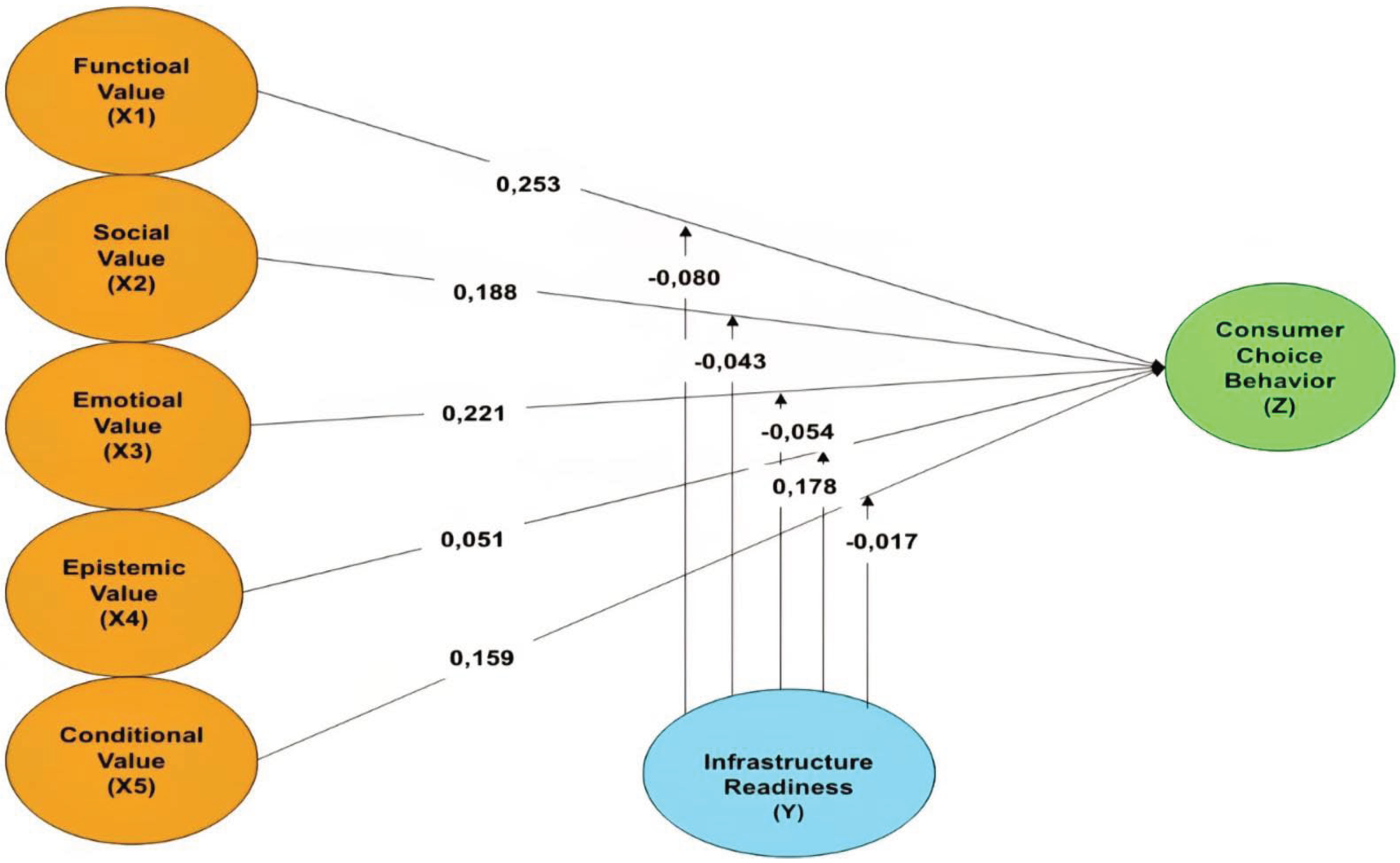

Table 1.
The demographics of the respondents.
| Characteristic | Percentage | |
| Gender | - Female | 42 |
| - Male | 58 | |
| Age | -Below 20 | 2 |
| -21-30 | 48 | |
| -31-40 | 36 | |
| -Above 40 | 14 | |
| Education | - Master degree | 11 |
| - Bachelor degree | 71 | |
| - High School/Students | 18 | |
| Occupation | - Employee | 48 |
| - Professional/ business owner | 21 | |
| - Housewife | 15 | |
| - Students | 10 | |
| - Other | 6 |
n = 455.
Table 2.
Value of Cronbach’s Alpha and AVE.
| Variables | Cronbach’s alpha | AVE |
| Functional Value X1 | 0.805 | 0.462 |
| Social Value X2 | 0.883 | 0.740 |
| Emotional Value X3 | 0.780 | 0.477 |
| Novelty Value X4 | 0.631 | 0.576 |
| Conditional Value X5 | 0.698 | 0.525 |
| Consumer Attitude Y | 0.813 | 0.519 |
| Infrastructure Readiness Z | 0.806 | 0.631 |
Table 3.
Model of Fit.
| Saturated model | Estimated model | |
| SRMR | 0.072 | 0.071 |
Table 4.
The effects of consumer values on consumer choice behavior.
| Hypothesis | Path | Path Co- efficient |
T- values |
P- values |
Result |
| H1 | Functional Value -> Consumer Choice Behavior | 0.253 | 4.664 | 0.000 | Supported |
| H2 | Social Value -> Consumer Choice Behavior | 0.188 | 3.672 | 0.000 | Supported |
| H3 | Emotional Value-> Consumer Choice Behavior |
0.222 | 3.892 | 0.000 | Supported |
| H4 | Epistemic Value -> Consumer Choice Behavior | 0.051 | 1.070 | 0.285 | Not Supported |
| H5 | Conditional Value -> Consumer Choice Behavior |
0.159 | 2.963 | 0.003 | Supported |
| H6 | Infrastructure Readiness x Functional Value-> Consumer Choice Behavior |
-0.083 | 2.585 | 0.013 | Supported |
| H7 | Infrastructure Readiness x Social Value - > Consumer Choice Behavior |
-0.043 | 2.254 | 0.021 | Supported |
| H8 | Infrastructure Readiness x Emotional Value -> Consumer Choice Behavior |
-0.032 | 2.518 | 0.012 | Supported |
| H9 | Infrastructure Readiness x Novelty Value -> Consumer Choice Behavior |
0.137 | 0.607 | 0.544 | Not Supported |
| H10 | Infrastructure Readiness x Conditional Value -> Consumer Choice Behavior |
-0.017 | 2.349 | 0.072 | Supported |
Disclaimer/Publisher’s Note: The statements, opinions and data contained in all publications are solely those of the individual author(s) and contributor(s) and not of MDPI and/or the editor(s). MDPI and/or the editor(s) disclaim responsibility for any injury to people or property resulting from any ideas, methods, instructions or products referred to in the content. |
© 2026 by the authors. Licensee MDPI, Basel, Switzerland. This article is an open access article distributed under the terms and conditions of the Creative Commons Attribution (CC BY) license (http://creativecommons.org/licenses/by/4.0/).
Copyright: This open access article is published under a Creative Commons CC BY 4.0 license, which permit the free download, distribution, and reuse, provided that the author and preprint are cited in any reuse.


