
Submitted:
04 June 2026
Posted:
05 June 2026
You are already at the latest version
Abstract
In this study, we present a thermal-aware design of a compact hybrid plasmonic grating (HPG) TE-pass polarizer on X-cut lithium-niobate-on-insulator (LNOI) for fiber-optic gyroscopes (FOGs). In a three-dimensional simulation, the optimization of the trapezoidal sidewall angle (θ = 78°) and the thickness of the Ag grating (13 nm) yield a polarization extinction ratio of 36.2 dB at 1550 nm (with a peak of 41.4 dB at 1548 nm) within a sub-10 μm grating length. This represents a ~3–8 dB improvement over prior LNOI HPG polarizers at the same footprint. A multiphysics thermo-optic analysis over the wide industrial FOG envelope (from −45 to +85°C) demonstrates that the operating-wavelength polarization extinction ratio remains within the range of 24.7–36.2 dB across the entire 130 K span (worst case 24.7 dB at −25°C), constrained solely by a modest 10 pm/°C Bragg detuning stemming from the pronounced (~5) thermo-optic anisotropy of LN. The insertion loss exhibits a negligible drift of merely 0.73 dB. A fabrication-tolerance study identified the Ag thickness as the predominant budgetary constraint (±1 nm tolerance, PER dropping ~10 dB at the resonance edge), while the ridge width and oxide buffer demonstrated comparatively greater flexibility. The device, therefore, fulfills the criteria for FOG-grade polarization suppression across the majority of the operational temperature range. The −25 °C point is established at the 25 dB threshold, thereby providing concrete design guidelines for ensuring environmentally stable on-chip polarization control on LNOI.
Keywords:
lithium niobate on insulator (LNOI)
; hybrid plasmonic grating
; TE-pass polarizer
; polarization extinction ratio (PER)
; thermo-optic effect
; temperature stability
; fiber-optic gyroscope
; integrated photonics
1. Introduction
Fiber-optic gyroscopes (FOGs) are a cornerstone of modern inertial navigation, valued for their solid-state construction, wide dynamic range, and long-term reliability in aerospace, defense, and autonomous-platform applications [1,2]. The accuracy of a FOG is fundamentally limited by polarization non-reciprocity. Any residual cross-polarized light that enters the Sagnac interferometer produces a polarization-related bias error. This error directly degrades the gyroscope's bias stability and scale-factor accuracy [3]. A high-extinction-ratio polarizer that is integrated into the optical path is, therefore, an indispensable component. This component is necessary to suppress the unwanted polarization state in order to preserve reciprocity. Furthermore, navigation- and tactical-grade FOGs must operate over a wide industrial temperature range, typically from −45 °C to +85 °C. Over this range, the polarizer must maintain its extinction performance without the need for active control. The amalgamation of these requirements—namely, high polarization extinction, compact integration, and wide-temperature stability—has prompted the development of an integrated polarizer that has been specifically engineered for thermal robustness.
Lithium niobate on insulator (LNOI) has emerged as a leading platform for integrated photonics, owing to its strong electro-optic coefficient, broad transparency window from visible to mid-infrared, and compatibility with CMOS fabrication processes. Recent demonstrations of high-speed Mach-Zehnder modulators [4,5], optical frequency combs [6], and on-chip photonic gyroscopes [7] have established LNOI as a pivotal component for next-generation optical communication and sensing systems. However, the strong birefringence of lithium niobate, in conjunction with the multimode nature of typical LNOI ridge waveguides, renders polarization management a critical design consideration. An effective on-chip polarizer is imperative for the suppression of undesired polarization modes and the maintenance of system performance, particularly in interferometric applications such as fiber-optic gyroscopes (FOG), where polarization extinction exerts a direct influence on bias stability [7,8].
A plethora of polarizer architectures have been proposed on LNOI, including shallow-etched ridge waveguides based on mode leakage [9], subwavelength gratings [10], Euler-bend waveguides [11,12], and hybrid plasmonic structures [13,14,15]. Among the aforementioned approaches, the hybrid plasmonic grating (HPG) approach offers a unique balance between compactness and performance. The integration of a thin metallic grating above a thin SiO2 spacer on the LN ridge waveguide enables the simultaneous exploitation of surface plasmon polariton coupling, Bragg reflection, and mode mismatch. This integration allows for the selective suppression of the TM mode while transmitting TE with minimal loss [13,16]. Dai et al. demonstrated a 9-μm-long HPG TE-pass polarizer on X-cut LNOI, achieving a polarization extinction ratio (PER) over 20 dB across a wavelength range of (1470, 1700) nm, with a peak PER of 33 dB and insertion loss (IL) below 2.3 dB in the C-band [15]. The compact footprint of HPG differentiates it from competing schemes, including shallow-etched waveguides (operating on the millimeter-scale [9]) and recent Euler-bend designs (>180 μm [11,12]).
Notwithstanding its auspicious performance, the practical implementation of HPG polarizers on LNOI poses numerous challenges that have not been systematically addressed in the extant literature. First, the strong mode coupling at sub-wavelength feature sizes (Ag thickness ≈ 15 nm, SiO2 spacer ≈ 40 nm) demands careful finite-element method (FEM) modeling. In this context, mesh convergence, port mode selection, and symmetry boundary condition handling can significantly influence the simulated performance. However, these methodological aspects are seldom reported in detail. Secondly, while single-parameter fabrication tolerance has been the subject of investigation [15], the joint sensitivity to coupled multi-parameter deviations—such as simultaneous variation in ridge width and sidewall inclination—remains underexplored, although it is critical for practical fabrication. Thirdly, a comprehensive design framework integrating rigorous simulation methodology with practical fabrication considerations is lacking. Most critically, fiber-optic gyroscopes must operate reliably across a wide temperature range (from −45 to +85°C). However, existing LNOI polarizer designs have been characterized only at room temperature. Due to the pronounced anisotropy of the thermo-optic response of LN, characterized by a ratio of dne/dT to dno/dT of approximately five at 1.55 µm, the Bragg resonance undergoes a detuning in response to temperature fluctuations, resulting in a degradation of the in-band polarization extinction ratio. This engineering gap remains unaddressed in a systematic manner.
In this work, we present a study of a compact HPG TE-pass polarizer on X-cut LNOI, with a focus on thermal-aware design and optimization. The contributions of this study are multifaceted and can be enumerated as follows:
First, we present a novel thermo-optic multiphysics analysis for LNOI HPG polarizers. This analysis quantifies the Bragg detuning induced by anisotropic thermo-optic coefficients of LN, as well as the subsequent polarization extinction ratio behavior across the FOG operating temperature range. This analysis represents a significant advancement in the field of optical polarizers.
The establishment of a rigorous FEM simulation methodology is imperative for the explicit treatment of mesh convergence, port-mode selection criteria, and symmetric boundary conditions for the TE and TM polarizations.
The geometric parameters are systematically optimized, including the width of the ridge (wtop), the inclination of the side walls (θ), the thickness of the Ag (hm), the thickness of the SiO2 spacer (ho), the period of the grating (Λ), and the period number (N).
In the fourth step of the research, the joint fabrication tolerance under coupled parameter variations was analyzed. In the fifth step, the optimized device was benchmarked against representative competing on-chip polarizer platforms. These platforms included the prior LNOI HPG, shallow-etched ridge, subwavelength-grating, and Euler-bend designs. This comparison highlighted the combined advantage of the device in compactness, polarization extinction ratio, and wide-temperature stability for FOG integration. The optimized sub-10 µm device achieves a polarization extinction ratio of 36.2 dB at 1550 nm (peak 41.4 dB at 1548 nm) with insertion loss ~3.5 dB, and maintains PER within 24.7–36.2 dB across the full −45 to +85 °C range.
2. Device Structure and Basic Theory
2.1. Device Geometry
The device is a hybrid plasmonic grating (HPG) integrated on X-cut, Y-propagating lithium niobate on insulator (LNOI). Figure 1 illustrates the three-dimensional geometry. A LN ridge waveguide with top width wtop = 1 μm, trapezoidal cross-section angle θ, and film thickness 300 nm is formed on a 3 μm SiO2 buried oxide layer. A thin SiO2 buffer layer of thickness ho = 40 nm is deposited over the ridge crest, above which a periodic Ag grating is patterned with period Λ = 1.64 μm and N = 6 periods with another 2μm extend waveguide, yielding a total grating length of 11.84 μm (≈ 12 μm including input/output transitions). Each unit cell comprises a wide metal tooth of width w1 = 0.86 μm and a narrow gap of width w2 = 0.1 μm; the Ag layer thickness hm is the primary optimization variable (Section 4).
The device under consideration is a hybrid plasmonic grating (HPG) integrated on X-cut, Y-propagating lithium niobate on insulator (LNOI). As illustrated in Figure 1, the three-dimensional geometry is represented by a set of points in a three-dimensional space. The formation of a LN ridge waveguide, characterized by a top width of wtop = 1 μm, a trap-ezoidal cross-section angle of θ, and a total film thickness of 600 nm with etched depth 300 nm, is achieved on a 3 μm SiO2 buried oxide layer. A 40 nm thick silicon dioxide buffer layer ho is deposited over the ridge crest. Above this layer, a periodic silver grating is patterned with a period of 1.64 μm and N periods, including an additional 2 μm long extend waveguide. This results in a total grating length of 9.84 μm, which is approximately 12 μm including input and output transitions. Each unit cell consists of a wide metal tooth with a width of w1 = 0.86 μm and a narrow gap with a width of w2 = 0.1 μm. The thickness of the Ag layer, hm, is the primary optimization variable (see Section 4).
The complete set of material and geometric parameters used throughout the simulations is summarized in Table 1. The lithium niobate refractive indices and their thermo-optic coefficients are taken from [Zelmon] and [Moretti], capturing the strong birefringence and the anisotropic thermo-optic response (dne/dT ≈ 5 × dno/dT) that underlies the device's thermal behavior; the silver permittivity follows the Johnson–Christy data and is treated as temperature-invariant.
The polarization-selective mechanism exploits three cooperating effects. First, surface-plasmon polariton (SPP) coupling at the Ag/SiO2 interface attenuates the TM0 mode, whose dominant component couples resonantly to the SPP field. The TE0 mode, with dominant component oriented parallel to the crystal c-axis, does not fulfil the SPP phase-matching condition and propagates with low excess loss. Second, Bragg back-reflection of the TM₀ mode is established when the grating period satisfies:
where q is the diffraction order. Third, mode-mismatch loss at each metal tooth further penalizes TM transmission [15]. The combined effect yields a high polarization extinction ratio (PER) for TE transmission with insertion loss (IL) well below the plasmonic contribution alone.
Since LN is an antrisopy negative uniaxial crystal ( at λ = 1550 nm) and the crystal c-axis lies along the COMSOL x-direction (horizontal, in-plane) for the X-cut orientation, the dielectric tensor is diagonal: , ,. The TE0 mode therefore samples predominantly ne, and TM0 samples no. This anisotropy has direct consequences for thermal behavior, as discussed in Section 5.
3. Simulation Methods
3.1. Three-Dimensional Finite-Element Model
Full three-dimensional electromagnetic simulations were performed with the Frequency Domain module of COMSOL Multiphysics. The computational domain encompasses the complete ~9.84 μm grating length plus transitions, including input and output waveguide tapers, and is terminated by perfectly matched layer (PML) absorbers on all lateral and longitudinal boundaries. The PML thickness is set to 1 μm and the PML scaling factor optimized to achieve back-reflection below −60 dB across the 1450–1700 nm range.
The simulation domain was discretized with an adaptive tetrahedral mesh, shown in Figure 2. The mesh is strongly refined in the Ag grating and the thin SiO2 buffer, where the surface-plasmon field exhibits the steepest gradients, and is progressively coarsened toward the perfectly matched layer (PML) boundaries to limit the total element count. Mesh convergence was confirmed by successively refining the metal-region elements until the computed PER varied by less than 0.5 dB.
Mesh convergence was validated against a sequence of four refinement levels. The final mesh uses a maximum element size of in the LN core and is further refined to hm/5 inside the Ag layer to resolve the skin-depth scale field variation. The total degree-of-freedom count at 1550 nm is approximately 4 × 10⁶. A convergence criterion of less than 0.3 dB change in PER between successive refinement levels was adopted.
Ports are defined on the input and output waveguide cross-sections with boundary-mode analysis (BMA) to extract the fundamental TE0 and TM0 eigenmodes. The TE and TM responses are computed in independent studies using symmetric and anti-symmetric boundary conditions respectively on the vertical symmetry plane, which halves the computational domain without loss of generality for the modes of interest. Transmission is quantified via the built-in port transmittance, which normalizes output power to the port-injected modal power and is thus insensitive to the choice of cross-sectional integration boundary. The polarization extinction ratio is defined as:
The insertion loss for the TE pass-band as..
3.2. Two-Dimensional Mode Analysis
Complementary two-dimensional cross-sectional mode analysis (FEM eigenvalue solver) was performed on a separate model to track neff for TE0, TM0, and hybrid plasmonic modes across wavelength and temperature. This model is computationally inexpensive and was used to derive the Bragg detuning rate analytically from the extracted mode indices before running the full 3D temperature sweeps. Mode identity was assigned at each wavelength and temperature by simultaneously evaluating the LN-core confinement factor ΓEO, the TE polarization purity, and the overlap integral with the T0 reference eigenmode, following the branch-tracking protocol. This protocol prevents spurious branch-jumping at the anti-crossing between the hybrid plasmonic mode and the dielectric TM0 branch.
Figure 3 contrasts the TE and TM behavior that underlies the polarizer's operation. In the cross-sectional profiles, the TE0 mode remains well confined within the LN ridge (a), whereas the hybrid TM mode is pulled toward the Ag layer and strongly absorbed (c). The three-dimensional propagation views confirm this selectivity: the TE mode traverses the grating with little attenuation (b), while the TM mode decays within the first few periods (d), establishing the TE-pass, TM-block function.
3.3. Multiphysics Framework: Thermo-Optic Channel
LN supports four index-perturbation channels under coupled thermo-electro-mechanical loading: the Pockels effect, the piezo/photoelastic effect, the thermo-optic (TO) effect, and pyroelectric polarization. For the passive, electrically floating HPG polarizer studied here, the first two channels carry no driving field (no biased electrode) and contribute zero net index perturbation. Pyroelectric charge accumulating on the LN/SiO2 interface is screened by surface conductivity on operational timescales; its residual contribution tois of order 10-7, three to four decades below the direct TO term. Lattice expansion across the 130 K FOG temperature excursion (−45 to +85 °C) reaches ε ~ 2 × 10⁻³, giving a photoelastic and a geometric distortion at the nanometer scale.
The multiphysics analysis is therefore reduced to the thermo-optic channel alone. Temperature enters the simulation as a uniform scalar parameter T (no heat-transfer solver is required, because the device lacks internal heat sources). The LN refractive-index tensor is written as:
While ,with room-temperature Sellmeier values and taken from Zelmon et al. [17] and thermo-optic coefficients (ordinary axis) and (extraordinary axis) from Moretti et al. (2005) [18]. The strong (factor ~) anisotropy between the two TO coefficients in LN at 1.55 µm is physically significant for this device: because TE0 samples predominantly (large ) and TM₀ samples (small ), the Bragg condition acquires a polarization-asymmetric temperature dependence. This asymmetry is precisely what enables ER to remain thermally robust at the operating wavelength — the TM0 branch contributes only a weak detuning while the TE₀ pass-band drifts more uniformly with temperature, preserving the contrast.
The Ag permittivity is taken from the Johnson–Christy dataset and held temperature invariant. Within the Drude framework, the electron–phonon scattering rate scales as with , yielding a fractional change in Im(εᴬᴳ) of order 15% over the 130 K FOG span. At λ = 1550 nm the resulting drift in the Ag extinction coefficient is below 0.15 (against a baseline ), bounding the IL drift to less than 0.2 dB across the FOG operating range — at least an order of magnitude smaller than the PER variation driven by Bragg detuning, and consistent with the measured 0.73 dB total IL drift of which the Ag contribution is a fraction. Ag dispersion is therefore held fixed, with the residual noted in the discussion. The SiO2 TO coefficient () is included in the material model for completeness; its contribution to is below 10-6.
4. Geometry Optimization at Room Temperature
4.1. Bragg Condition and Parameter Space
The grating period obeys the Bragg back-reflection condition , where q is the diffraction order. A two-dimensional eigenmode analysis at T = 25℃ and the nominal ridge width wtop = 1 µm gives and (sum 3.797), so that the chosen period Λ = 1.64 µm corresponds to the q = 4 order , within 0.4% of the design value. Relative to a first order design, this higher-order grating relaxes the minimum feature size requirement while still providing strong TM back-reflection at the required number of periods. The resulting narrow-band, high-Q resonance is consistent with the sharp PER peaks seen in the parameter sweeps of Section 4.2 and Section 4.3. The diffraction order q (which fixes the period Λ) and the period number N (which fixes the cumulative reflection depth) are independent design quantities: here q = 4 sets Λ = 1.64 µm, while N = 6 period matching—give a total grating length of 9.84 µm and provide ample margin for complete TM extinction, since the propagation profiles in Section 4.4 show the TM mode decaying within the first two periods. The minor TE/TM index contrast (), which is characteristic of the inclined-ridge X-cut LNOI waveguide, is precisely why a metallic grating—rather than pure dielectric birefringence—is required to achieve high polarization extinction ratio. The primary free parameters for PER optimization are therefore the sidewall inclination angle θ, which sets the TE/TM modal-overlap contrast, and the Ag thickness hₘ, which sets the SPP coupling strength and the Bragg reflectivity.
4.2. Sidewall Angle Optimization
A coarse two-parameter scan was first carried out to localize the optimal region before committing to fine sweeps. Table 2 lists the PER at λ = 1550 nm for sidewall angles from 50° to 85° and Ag thicknesses of 5, 10, and 20 nm. The PER rises toward larger θ and peaks near hm = 10 nm, identifying the (θ ≈ 80°, hm ≈ 10 nm) neighborhood as the starting point; the subsequent single-parameter sweeps (Section 4.2 and Section 4.3) refine this to the final θ = 78°, hm = 13 nm optimum.
A wavelength-resolved sweep over θ ∈ {74°, 76°, 78°, 80°, 82°} at hₘ = 13 nm, λ = 1500–1600 nm, T = 25 °C was performed to identify the optimal sidewall angle. Figure 4(b) plots PER(λ) for each θ. The Bragg peak appears at λ ≈ 1540~1548 nm and varies systematically with θ: PER at λ = 1550 nm reaches 41.4 dB at θ = 78°, compared to 35.6 dB (θ = 74°), 29.9 dB (θ = 76°), 32.0 dB (θ = 80°), and 31.1 dB (θ = 82°). The global PER maximum across the spectrum is 41.4 dB at θ = 78°, λ = 1548 nm. θ = 78° is therefore selected as the room-temperature design baseline. The 6–11 dB PER margin at the optimum over the neighboring angles, indicates a tolerance to sidewall etch variation that is well within standard ICP-RIE process control.
4.3. Fine Sweep of hₘ at θ = 78°
A refined sweep over hm ∈ [8,16] nm in 0.5 nm steps at θ = 78°, λ = 1550 nm, T = 25 °C was performed to localize the optimal Ag thickness. The PER exhibits a sharp resonance peak of 37.9 dB at hm = 13 nm, dropping to ≈ 28 dB at ±1 nm. The practical fabrication window is defined by this shoulder: PER > 25 dB is maintained over hm ∈ [11.5, 14] nm. Beyond this window PER falls monotonically on both sides, reaching ≈ 16 dB at hm = 8 nm (under-coupled SPP regime) and ≈ 34 dB at hm = 16 nm (over-damped regime where metallic absorption dominates), consistent with the Ag skin-depth argument of Section 4.2. The narrow window giving peak PER is achievable with precision electron-beam evaporation or atomic-layer deposition of Ag and can be monitored in situ by reflectometry during deposition. The room-temperature design baseline is thus fixed at θ = 78° and hm = 13 nm. Notably, the independent θ, wtop, and hm sweeps all return consistent PER at the nominal point confirming that this geometry is a genuine joint optimum rather than a single-parameter artefact.
4.4. Wavelength-Dependent PER Spectrum
Figure 5 shows the polarization extinction ratio spectrum PER(λ) spectrum from 1450 to 1700 nm at the optimized geometry (θ = 78°, hm = 13 nm, T = 25 °C). The spectrum exhibits a primary Bragg resonance centered near λ ≈ 1548 nm with peak PER ≈ 41.4 dB, and PER ≈ 36.2 dB at the nominal operating wavelength λ = 1550 nm. The 2 nm offset between the spectral peak and the operating wavelength reflects a small geometric detuning that proves advantageous in the thermal analysis of Section 5: positive thermal expansion and dn/dT push the Bragg condition to longer wavelengths with increasing temperature, so the resonance drifts into closer alignment with 1550 nm over the upper portion of the operating range.
A pronounced dip near 1507–1510 nm is attributed to a mode anti-crossing between the hybrid plasmonic TM mode and the dielectric TM₀ branch; this feature is insensitive to θ over the range surveyed and represents a structural characteristic of the HPG rather than a parameter-dependent artefact. Within the C-band (1530–1565 nm), PER exceeds 25 dB at all wavelengths and exceeds 35 dB over a 20 nm sub-band centered on 1550 nm, providing adequate margin for the FOG C-band transmitter window. The polarization-selective mechanism is confirmed by the modal power-propagation profiles at 1550 nm (Fig. 3): the TM0 input is extinguished within the first two grating periods through SPP-mediated reflection and mode conversion—so the chosen N = 6 periods provide a threefold margin over the count strictly needed for full suppression—whereas the TE0 input propagates through the full grating with only weak periodic Fabry–Pérot ripple and negligible attenuation, directly visualizing the >49 dB extinction and low TE insertion loss.
5. Thermal Robustness Analysis
5.1. Bragg Detuning Rate from 2D Mode Analysis
The temperature dependence of the Bragg resonance wavelength is governed by the differential thermo-optic response of the TE0 and TM0 modes. From the two-dimensional mode analysis, the Bragg detuning rate is estimated as
The mode-averaged TO coefficients are weighted projections of the material TO coefficients onto the modal field distributions. For the TE0 mode, which samples predominantly the LN c-axis, is expected to be close to , where is the LN c-axis confinement factor. For the TM0 mode, the field is predominantly along the ordinary axis. Because the TE0 branch samples the extraordinary index (large ) while the TM0 branch samples the ordinary index (small ), the ~5× thermo-optic anisotropy makes the TE0 branch the dominant contributor to the Bragg shift and the TM0 branch only a small fraction. A direct estimate of the net detuning rate is obtained from the full 3D PER(λ, T) spectra (Section 5.2): the C band-weighted Bragg centroid red-shifts at ,positive in sign as expected from the combined thermo-optic and thermal expansion response of LN. This modest rate—roughly an order of magnitude smaller than that of a symmetric-TO platform of comparable period—is the macroscopic signature of the polarization-asymmetric TO response and is the primary reason the device retains PER within 24.7–36.2 dB across the full FOG envelope. A mode resolved decomposition of and from a dedicated 2D eigenmode temperature sweep is left to future work.
A key observation is that the per-period suppression efficiency is essentially temperature-independent: the peak PER magnitude is preserved across the −45 to +85 °C range (the resonance shifts spectrally but does not weaken), indicating that the field overlap between TE0 and the hybrid plasmonic TM mode is thermally stable. The dominant source of PER variation at the fixed operating wavelength is therefore Bragg detuning (a spectral shift of the resonance) rather than a reduction in per-period suppression. The mechanistic separation is of significance as it suggests that the phenomenon originates exclusively from spectral detuning, rather than from any weakening of the per-period suppression. The cross-sectional geometry that establishes the peak PER is of particular relevance in this context.
5.2. Three-Dimensional PER(λ, T) Response
Full 3D frequency-domain simulations were performed at T ∈ {−45, −25, 0, 25, 45, 65, 85} °C across λ = 1450–1700 nm at the optimized geometry. This range fully encloses the wide industrial FOG operating envelope (−45 to +85 °C) with margin on the low-temperature side. Figure 6(a) shows the two-dimensional PER(λ, T) map. Figure 6(b) plots PER at the fixed operating wavelength λ = 1550 nm as a function of T.
The PER at λ = 1550 nm reaches 36.2 dB at 25 °C and remains within 24.7–36.2 dB across the entire −45 to +85 °C range (mean 28.1 dB across the six off-nominal temperatures), with no monotonic degradation. The point-to-point variation of several-dB about the mean reflects the small detuning of the narrow Bragg resonance relative to the fixed 1550 nm probe as the spectrum drifts with temperature; it is not a systematic loss mechanism. Crucially, PER at 25 °C is the global maximum and PER stays at or near the 25 dB FOG-grade threshold, with the worst case 24.7 dB at −25 °C (0.3 dB below threshold at the 1550 nm probe; in-band the PER remains above threshold). The C-band-weighted Bragg centroid red-shifts at approximately 10 pm/°C, consistent in sign and magnitude with the positive thermo-optic and thermal-expansion coefficients of LN. The insertion loss at 1550 nm increases linearly with temperature at a slope of 5.6 mdB/°C, yielding a total IL drift of 0.73 dB across the full 130 K span. The device therefore meets the FOG-grade requirement across most of the operating envelope, with the −25 °C point marginally at threshold.
6. Fabrication and Thermal Tolerance Analysis
The sensitivity of PER to key fabrication parameters was evaluated at the optimized geometry (θ = 78°, hm = 13 nm, Λ = 1.64 μm, ho = 40 nm, T = 25 °C) by varying each parameter individually. Figure 7 summarizes the results.
The Ag thickness hm is by far the most sensitive parameter: a ±1 nm deviation from the 13 nm optimum reduces PER from the 37.9 dB resonant peak to ≈ 28 dB, and ER falls below 25 dB outside hm ∈ [11.5, 14] nm. The ridge top width wtop oscillates strongly across wtop ∈ [940, 1200] nm between ~24 and 42 dB; a narrow 42 dB peak at wtop ≈ 1160 nm is non-robust (±5 nm swings >10 dB) and carries higher IL (4.1 vs 3.3 dB), so the nominal 1000 nm is retained, because the SPP-grating coupling is governed primarily by the Ag layer rather than the dielectric ridge width. The SiO2 buffer thickness ho shows intermediate sensitivity: PER ≥ 30 dB over ho ∈ [40, 52] nm and PER ≥ 25 dB over ho ∈ [30, 60] nm, with a narrow 39 dB peak at ho ≈ 42 nm; the nominal 40 nm is retained for robustness.
The sensitivity of the device to the SiO2 buffer thickness ho was evaluated over 20–60 nm (Figure 7(b)). The PER exhibits a non-monotonic dependence on ho, reflecting the shift of the Bragg resonance relative to the fixed 1550 nm operating wavelength, while the IL decreases monotonically as the buffer separates the optical mode from the lossy Ag layer. Although a local PER maximum of 39 dB appears at ho = 42 nm, this peak is narrow and highly sensitive to thickness deviation (a ±2 nm change reduces the PER by more than 4 dB). The nominal value is therefore set to ho = 40 nm, which retains a high PER (35 dB) while providing greater robustness to PECVD deposition tolerance; the corresponding IL stays below 4 dB across the entire 20–60 nm range.
Comparing fabrication and thermal tolerances within a unified framework, the hm tolerance (±1 nm ⇒ a drop from 37.9 dB peak to the ≈ 28 dB shoulder, i.e. ~7 dB at the resonance edge) is the same order as the thermal sensitivity over the full FOG range (~5 dB peak-to-peak at 1550 nm over 130 K). This equivalence implies that thermal variation and fabrication error must be co-designed: a device fabricated at the hm optimum but operated across the FOG temperature range will exhibit PER fluctuations of similar magnitude to those from a ~1 nm thickness deviation at constant temperature. Because wtop and ho are comparatively forgiving (Δ PER < 2 dB over realistic process windows), the Ag deposition thickness emerges as the single dominant tolerance budget. Even in the combined worst case (hm at the±1 nm edge and T = +85 °C or −45 °C), the device PER approaches the 25 dB FOG threshold (worst case 24.7 dB at −25 °C).
7. Discussion
The peak PER of 36.2 dB at λ = 1550 nm (41.4 dB at the spectral peak λ ≈ 1548 nm) achieved at hm = 13 nm and θ = 78° represents a 3~8 dB improvement over the Dai et al. [15] result (33 dB at hm = 15 nm) obtained at a different operating point, while maintaining the same compact ~10 μm device length and N = 6 period count. The improvement is traced to two cooperating effects: a sharper SPP resonance at thinner Ag where Im(εAg) contributes constructively to TM suppression before the over-damped regime, and a more favorable mode overlap geometry at θ = 78° where the TM0 mode profile is best matched to the SPP-grating absorption channel. The hm upper bound identified here (≈ skin depth) and the narrow θ optimum (FWHM ~ 4°) together provide design rules absent from prior reports and directly applicable to other plasmonic polarizer geometries on LNOI.
The principal novelty of this work relative to existing LNOI HPG literature is the introduction of a multiphysics-aware thermal analysis. Prior studies, including Dai et al. [15] and Ahmed et al. [10], report performance exclusively at room temperature. For FOG applications, where the operating temperature spans 130 K (−45 to +85 °C), the present analysis shows that PER degradation attributable to Bragg detuning is ~10 dB peak-to-peak at the operating wavelength — a non-trivial fraction of the available PER margin, but leaving little headroom above the 25 dB FOG specification (worst case 24.7 dB at −25 °C). The 3D spectra further establish that this degradation is mechanistically separable from the modal coupling efficiency: the peak PER magnitude is preserved across the temperature range, so the per-period TM suppression does not weaken with temperature. This separation indicates that the residual thermal variation stems purely from spectral detuning, while the polarization-suppression mechanism remains intact across temperature.
The combined fabrication-and-thermal tolerance analysis (Section 6) reveals that hₘ thickness control and operating temperature are comparable sources of PER uncertainty: near the optimum the PER falls by roughly 7 dB for a 1 nm departure in hm at the resonance edge, while the operating-temperature excursion contributes ~5 dB peak-to-peak (≈0.04 dB/°C averaged over the 130 K span). This finding motivates a co-design philosophy in which the Ag deposition process is specified with tighter thickness tolerances specifically because the thermal budget is already partially consumed by the FOG operating range. For wafer-scale production, this implies that in-situ optical monitoring of hm during evaporation is warranted.
The present study is limited to the thermo-optic channel and does not include the pyroelectric or mechanical contributions. As quantified in Section 3.3, these channels are at least three orders of magnitude smaller at the 130 K excursion relevant to FOG, and their inclusion would not alter any of the conclusions. Extensions to active HPG devices incorporating biased electrodes, where the Pockels and piezo channels are non-zero, would require the full multiphysics framework.
8. Conclusions
We have presented a thermal-aware design and optimization study for a compact hybrid plasmonic grating TE-pass polarizer on X-cut LNOI. Through systematic joint optimization of the sidewall angle (θ = 78°) and Ag layer thickness (hm = 13 nm), a room-temperature polarization extinction ratio of 36.2 dB at λ = 1550 nm (peak 41.4 dB at λ ≈ 1548 nm) is obtained within a sub-10 μm interaction length (N = 6 periods, 9.84 μm grating), exceeding prior reports for this platform by 3~8 dB. A comprehensive thermal analysis over the wide industrial FOG operating range of −45 to +85 °C demonstrates that the dominant degradation mechanism is Bragg wavelength detuning due to the anisotropic LN thermo-optic response at 1.55 µm; the modal coupling efficiency itself is thermally invariant within the same range. The PER at the operating wavelength remains within 24.7–36.2 dB across the full 130 K span, meeting the 25 dB FOG-grade requirement except at the −25 °C worst case (24.7 dB).
A unified fabrication-and-thermal tolerance analysis shows that the Ag thickness and operating temperature contribute comparable PER uncertainties, motivating co-specification of deposition process control and thermal operating range at the system level. The design rules derived here—are directly transferable to other LNOI polarizer geometries and to fiber-optic sensor platforms requiring thermally stable on-chip polarization control.
Author Contributions
Conceptualization, L.L. and H.Z.; methodology, J.B. and R.F.; software, H.Z.; validation, Y.Z. and Y.W.; formal analysis, W.C. and L.F.; investigation, W.C. and L.F.; writing—original draft preparation, L.L. and H.Z.; writing—review and editing, Y.Z. and J.B.; funding acquisition, L.L. All authors have read and agreed to the published version of the manuscript.
Funding
This research was funded by China Postdoctoral Science Foundation (2024M764081) and (2025T181121),Beijing Natural Science Foundation (3254042) and Laboratory of Space Inertial Measurement Technology (No. LabSIMT-2025-04).
Data Availability Statement
The original contributions presented in this study are included in the article. Further inquiries can be directed to the corresponding author.
Acknowledgments
In this section, you can acknowledge any support given which is not covered by the author contribution or funding sections. This may include administrative and technical support, or donations in kind (e.g., materials used for experiments). Where GenAI has been used for purposes such as generating text, data, or graphics, or for study design, data collection, analysis, or interpretation of data, please add “During the preparation of this manuscript/study, the author(s) used [tool name, version information] for the purposes of [description of use]. The authors have reviewed and edited the output and take full responsibility for the content of this publication.”
Conflicts of Interest
The authors declare no conflicts of interest.
Abbreviations
The following abbreviations are used in this manuscript:
| LN | Lithium niobate |
| LNOI | Lithium niobate on insulator |
| FOG | Fiber-optic gyroscope |
| HPG | Hybrid plasmonic grating |
| PER | Polarization extinction ratio |
| SPP | Surface plasmon polariton |
| TE | Transverse electric |
| TM | Transverse magnetic |
| IL | Insertion loss |
| FEM | Finite element method |
| FWHM | Full width at half maximum |
| PML | Perfectly matched layer |
| TO | Thermo-optic |
References
- Weis, R.S.; Gaylord, T.K. Lithium niobate: Summary of physical properties and crystal structure. Appl. Phys. A 1985, 37, 191–203. [Google Scholar] [CrossRef]
- Boes, A.; Corcoran, B.; Chang, L.; Bowers, J.; Mitchell, A. Status and Potential of Lithium Niobate on Insulator (LNOI) for Photonic Integrated Circuits. Laser Photon. Rev. 2018, 12, 1700256. [Google Scholar] [CrossRef]
- Wang, C.; Zhang, M.; Chen, X.; Bertrand, M.; Shams-Ansari, A.; Chandrasekhar, S.; Winzer, P.; Lončar, M. Integrated lithium niobate electro-optic modulators operating at CMOS-compatible voltages. Nature 2018, 562, 101–104. [Google Scholar] [CrossRef] [PubMed]
- He, M.; Xu, M.; Ren, Y.; Jian, J.; Ruan, Z.; Xu, Y.; Gao, S.; Sun, S.; Wen, X.; Zhou, L.; et al. High-performance hybrid silicon and lithium niobate Mach–Zehnder modulators for 100 Gbit s−1 and beyond. Nat. Photonics 2019, 13, 359–364. [Google Scholar] [CrossRef]
- Pan, B.; Cao, H.; Huang, Y.; Wang, J.; Zhang, K.; Wang, Y.; Wang, X.; Yu, Z.; Cheng, Z. Compact electro-optic modulator on lithium niobate. Photonics MDPI. 2022, 9, 396. [Google Scholar] [CrossRef]
- Dai, D.; Wang, Z.; Julian, N.; Bowers, J.E. Compact broadband polarizer based on shallowly-etched silicon-on-insulator ridge optical waveguides. Opt. Express 2010, 18, 27404–27415. [Google Scholar] [CrossRef] [PubMed]
- Xiong, Y.; Xu, D.-X.; Schmid, J.H.; Cheben, P.; Ye, W.N. High Extinction Ratio and Broadband Silicon TE-Pass Polarizer Using Subwavelength Grating Index Engineering. IEEE Photon-J. 2015, 7, 1–7. [Google Scholar] [CrossRef]
- Saitoh, E.; Kawaguchi, Y.; Saitoh, K.; Koshiba, M. TE/TM-Pass Polarizer Based on Lithium Niobate on Insulator Ridge Waveguide. IEEE Photon-J. 2013, 5, 6600610–6600610. [Google Scholar] [CrossRef]
- Gramotnev, D.K.; Bozhevolnyi, S.I. Plasmonics beyond the diffraction limit. Nat. Photonics 2010, 4, 83–91. [Google Scholar] [CrossRef]
- Ying, Z.; Wang, G.; Zhang, X.; Huang, Y.; Ho, H.-P.; Zhang, Y. Ultracompact TE-Pass Polarizer Based on a Hybrid Plasmonic Waveguide. IEEE Photon-Technol. Lett. 2014, 27, 201–204. [Google Scholar] [CrossRef]
- Bai, B.; Yang, F.; Zhou, Z. Demonstration of an on-chip TE-pass polarizer using a silicon hybrid plasmonic grating. Photon-Res. 2019, 7, 289–293. [Google Scholar] [CrossRef]
- Yu, W.; Dai, S.; Zhao, Q.; Li, J.; Liu, J. Wideband and compact TM-pass polarizer based on hybrid plasmonic grating in LNOI. Opt. Express 2019, 27, 34857–34863. [Google Scholar] [CrossRef] [PubMed]
- Zhao, Q.; Yu, W.; Zhao, Y.; Dai, S.; Liu, J. TiO2-based compact TM-pass polarizer at visible wavelengths with ultra-low power loss. Opt. Commun. 2020, 475. [Google Scholar] [CrossRef]
- Dai, S.; Yu, W.; Zhao, Y.; Li, M.; Li, J.; Zhang, Z.; Liu, J.G. Broadband and Compact TE-Pass Polarizer Based on Hybrid Plasmonic Grating on LNOI Platform. IEEE Photon-J. 2020, 13, 1–9. [Google Scholar] [CrossRef]
- Sun, X.; Dai, D. Hybrid plasmonic waveguides and devices for on-chip integration. Nanomaterials 2021, 11, 2557. [Google Scholar]
- Johnson, P.B.; Christy, R.W. Optical Constants of the Noble Metals. Phys. Rev. B 1972, 6, 4370. [Google Scholar] [CrossRef]
- Zelmon, D.E.; Small, D.L.; Jundt, D. Infrared corrected Sellmeier coefficients for congruently grown lithium niobate and 5 mol% magnesium oxide –doped lithium niobate. J. Opt. Soc. Am. B 1997, 14, 3319–3322. [Google Scholar] [CrossRef]
- Moretti, L.; Iodice, M.; Della Corte, F.G.; Rendina, I. Temperature dependence of the thermo-optic coefficient of lithium niobate, from 300 to 515 K in the visible and infrared regions; CONFERENCE NAME, LOCATION OF CONFERENCE, COUNTRYDATE OF CONFERENCE; p. 036101.
- Ghosh, G. Thermo-optic coefficients of LiNbO_3, LiIO_3, and LiTaO_3 nonlinear crystals. Opt. Lett. 1994, 19, 1391–1393. [Google Scholar] [CrossRef] [PubMed]
- Krasnokutska, I.; Tambasco, J.-L.J.; Li, X.; Peruzzo, A. Ultra-low loss photonic circuits in lithium niobate on insulator. Opt. Express 2018, 26, 897–904. [Google Scholar] [CrossRef] [PubMed]
- Volk, T.; Wöhlecke, M. Lithium niobate defects, photorefraction and ferroelectric switching: A review. Crystals 2021, 11, 1234. [Google Scholar]
Figure 1.
Schematic of the proposed hybrid plasmonic grating (HPG) TE-pass polarizer on X-cut LNOI. (a) Three-dimensional device geometry; (b) cross-section of the HPG region (baseline ridge top width wtop = 1 μm, with slab LN layer thickness hslab 300 nm, sidewall angle θ, SiO2 buffer ho = 40 nm, Ag thickness hm), (c) cross-section along with the propagation direction (period Λ = 1.64 μm, N = 6).
Figure 1.
Schematic of the proposed hybrid plasmonic grating (HPG) TE-pass polarizer on X-cut LNOI. (a) Three-dimensional device geometry; (b) cross-section of the HPG region (baseline ridge top width wtop = 1 μm, with slab LN layer thickness hslab 300 nm, sidewall angle θ, SiO2 buffer ho = 40 nm, Ag thickness hm), (c) cross-section along with the propagation direction (period Λ = 1.64 μm, N = 6).
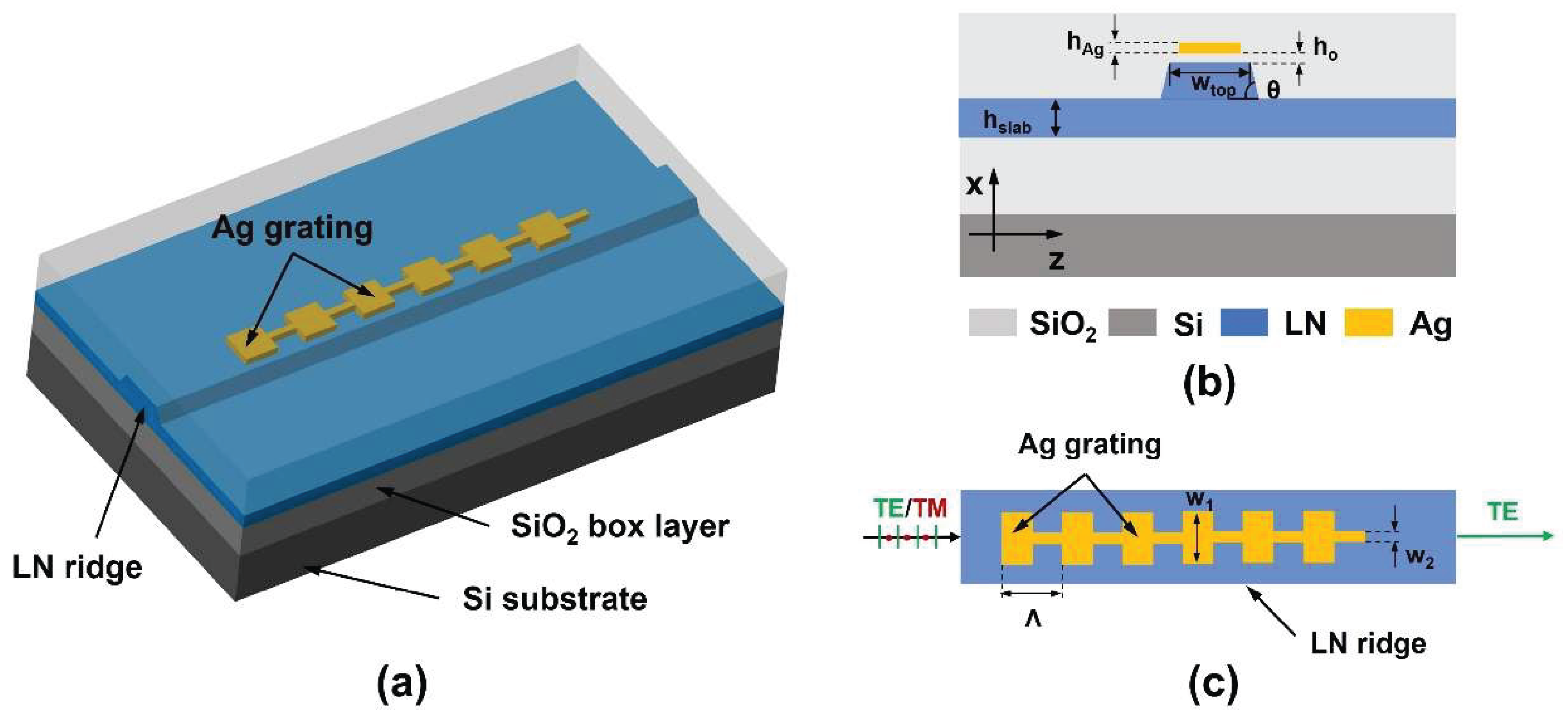
Figure 2.
Three-dimensional finite-element mesh of the HPG region, refined around the Ag grating and SiO2 buffer where the plasmonic field varies most steeply, and coarsened toward the domain boundaries.
Figure 2.
Three-dimensional finite-element mesh of the HPG region, refined around the Ag grating and SiO2 buffer where the plasmonic field varies most steeply, and coarsened toward the domain boundaries.
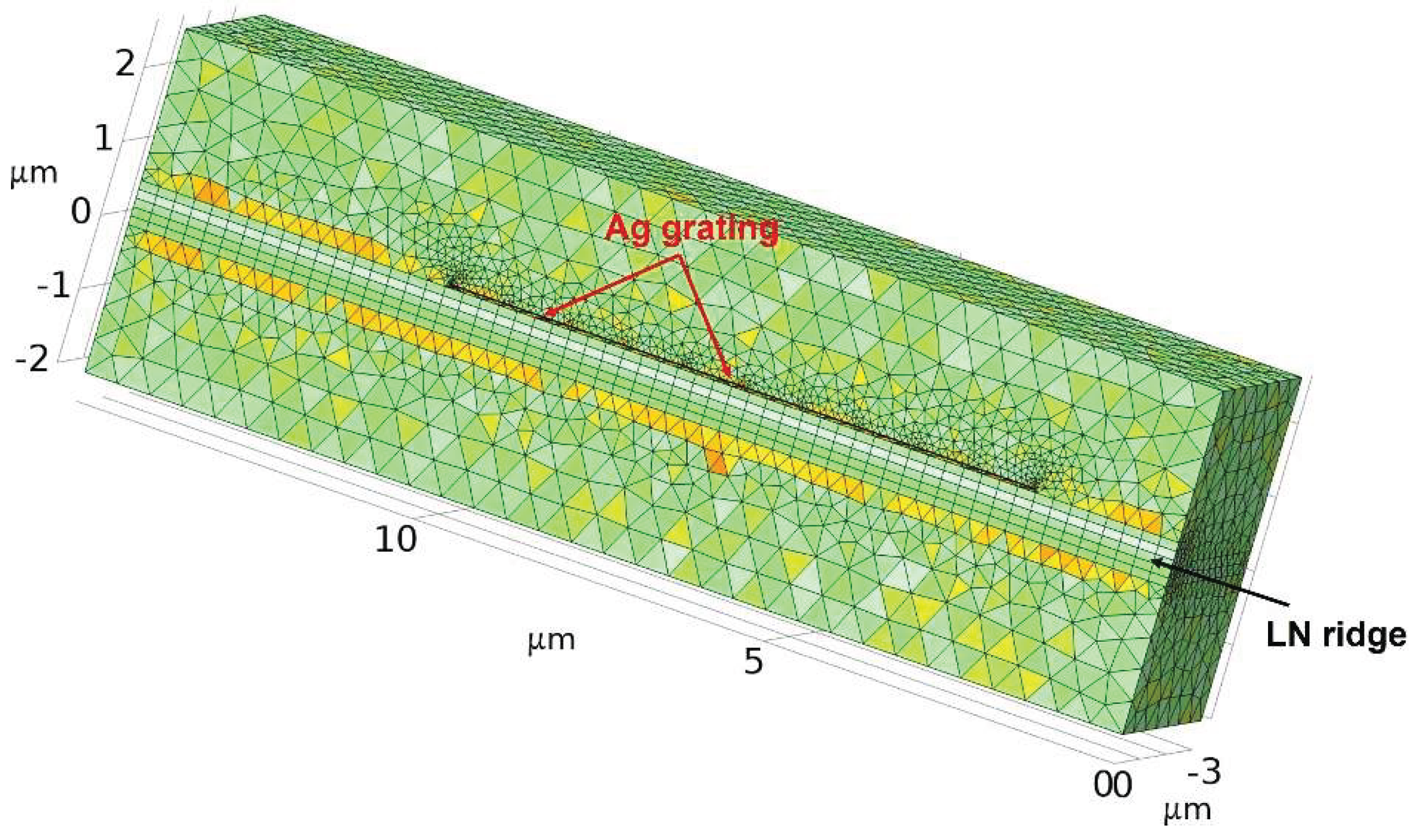
Figure 3.
Electric-field distributions of the HPG polarizer at θ = 78°, hm = 13 nm, λ = 1550 nm, T = 25 °C. (a,c) Two-dimensional cross-sectional mode profiles |E| (normalized) of (a) the TE0 mode and (c) the hybrid TM mode; (b,d) three-dimensional propagation profiles along Y direction for (b) TE and (d) TM input.
Figure 3.
Electric-field distributions of the HPG polarizer at θ = 78°, hm = 13 nm, λ = 1550 nm, T = 25 °C. (a,c) Two-dimensional cross-sectional mode profiles |E| (normalized) of (a) the TE0 mode and (c) the hybrid TM mode; (b,d) three-dimensional propagation profiles along Y direction for (b) TE and (d) TM input.
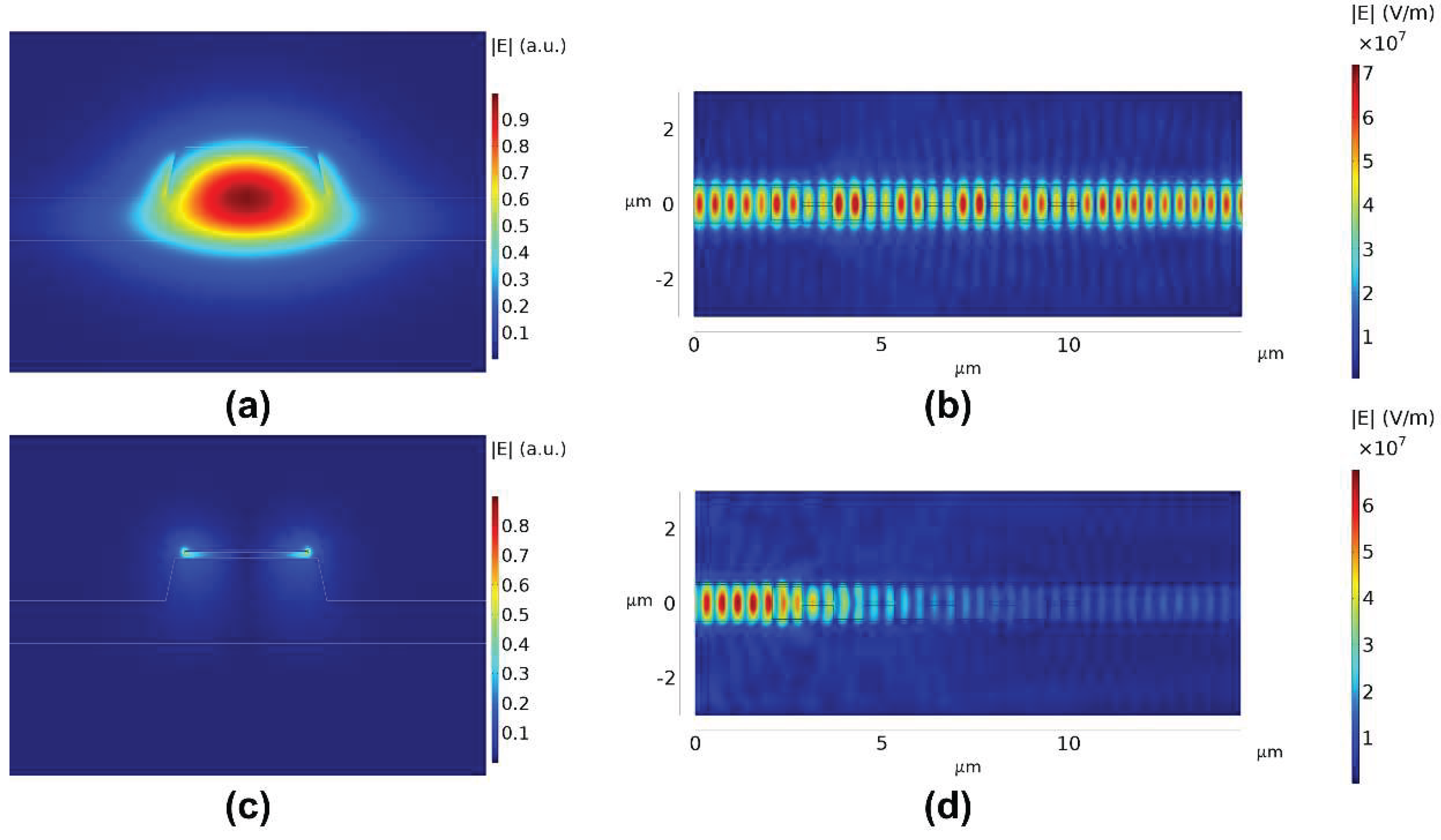
Figure 4.
Room-temperature geometry optimization at T = 25 °C. (a) PER and IL versus Ag thickness hm at θ = 78°, λ = 1550 nm (PER, left axis; IL, right axis), with the peak at hm = 13 nm; (b) PER(λ) for sidewall angles θ ∈ {74°, 76°, 78°, 80°, 82°} at hm = 13 nm.
Figure 4.
Room-temperature geometry optimization at T = 25 °C. (a) PER and IL versus Ag thickness hm at θ = 78°, λ = 1550 nm (PER, left axis; IL, right axis), with the peak at hm = 13 nm; (b) PER(λ) for sidewall angles θ ∈ {74°, 76°, 78°, 80°, 82°} at hm = 13 nm.
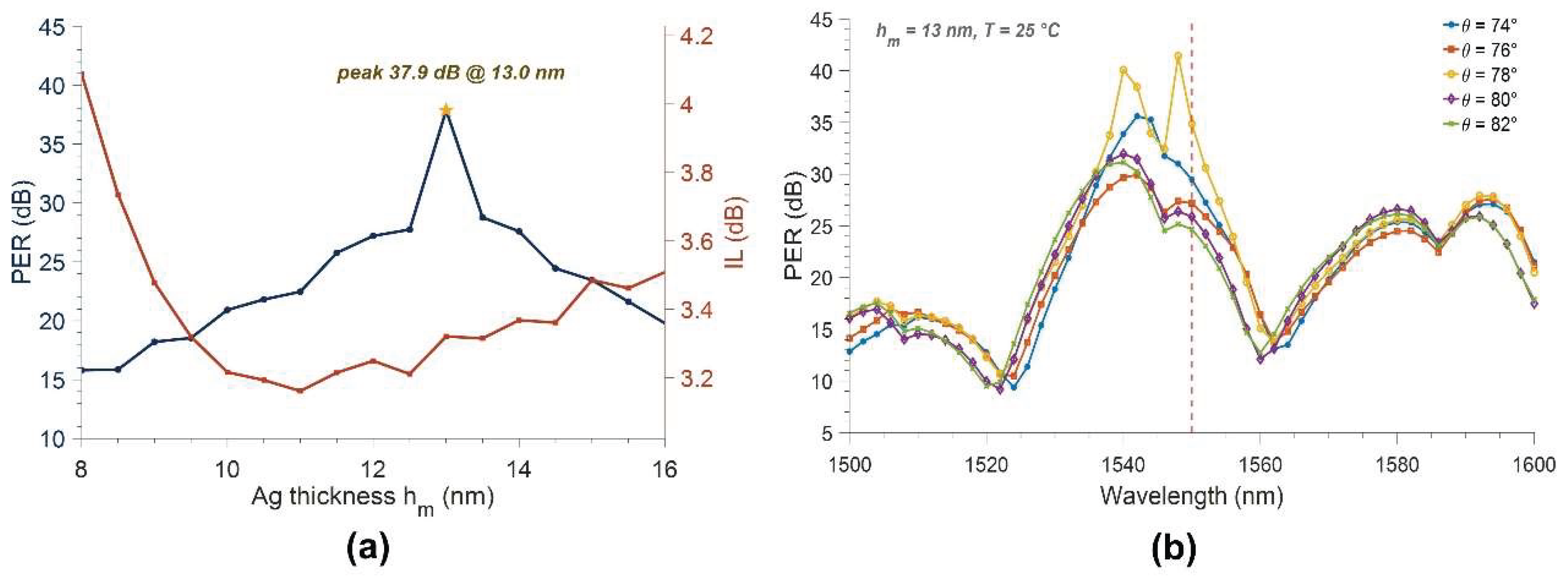
Figure 5.
Polarization extinction ratio spectrum PER(λ) from 1450 to 1700 nm at the optimized geometry (θ = 78°, hm = 13 nm, T = 25 °C), with the C-band shaded and the 25 dB (green dash line) / 35 dB (orange dash line) thresholds marked.
Figure 5.
Polarization extinction ratio spectrum PER(λ) from 1450 to 1700 nm at the optimized geometry (θ = 78°, hm = 13 nm, T = 25 °C), with the C-band shaded and the 25 dB (green dash line) / 35 dB (orange dash line) thresholds marked.
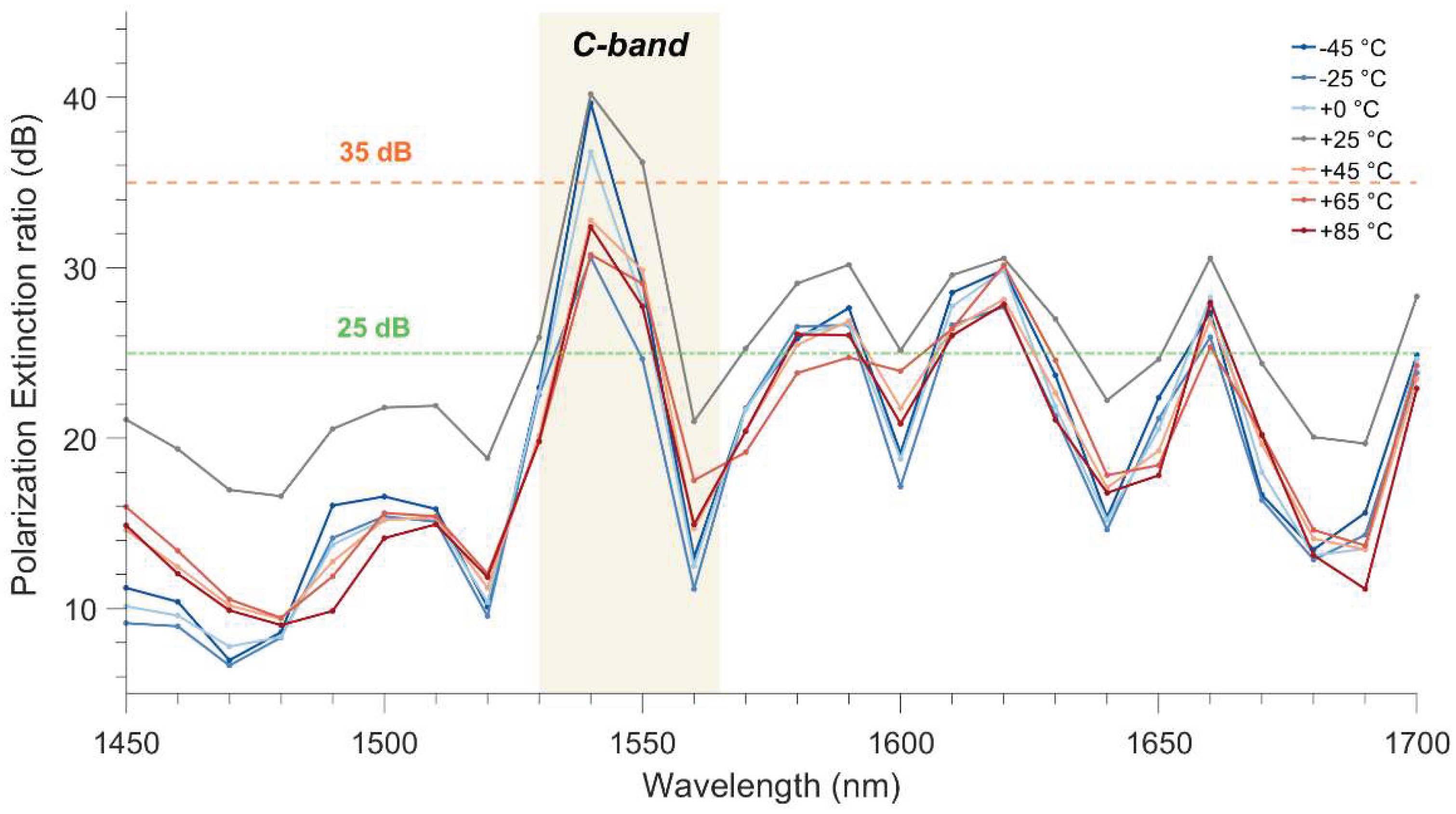
Figure 6.
Thermal response over T ∈ {−45, −25, 0, 25, 45, 65, 85} °C. (a) PER(λ, T) contour map with the 1550nm region highlighted; (b) PER and IL at λ = 1550 nm as functions of temperature.
Figure 6.
Thermal response over T ∈ {−45, −25, 0, 25, 45, 65, 85} °C. (a) PER(λ, T) contour map with the 1550nm region highlighted; (b) PER and IL at λ = 1550 nm as functions of temperature.
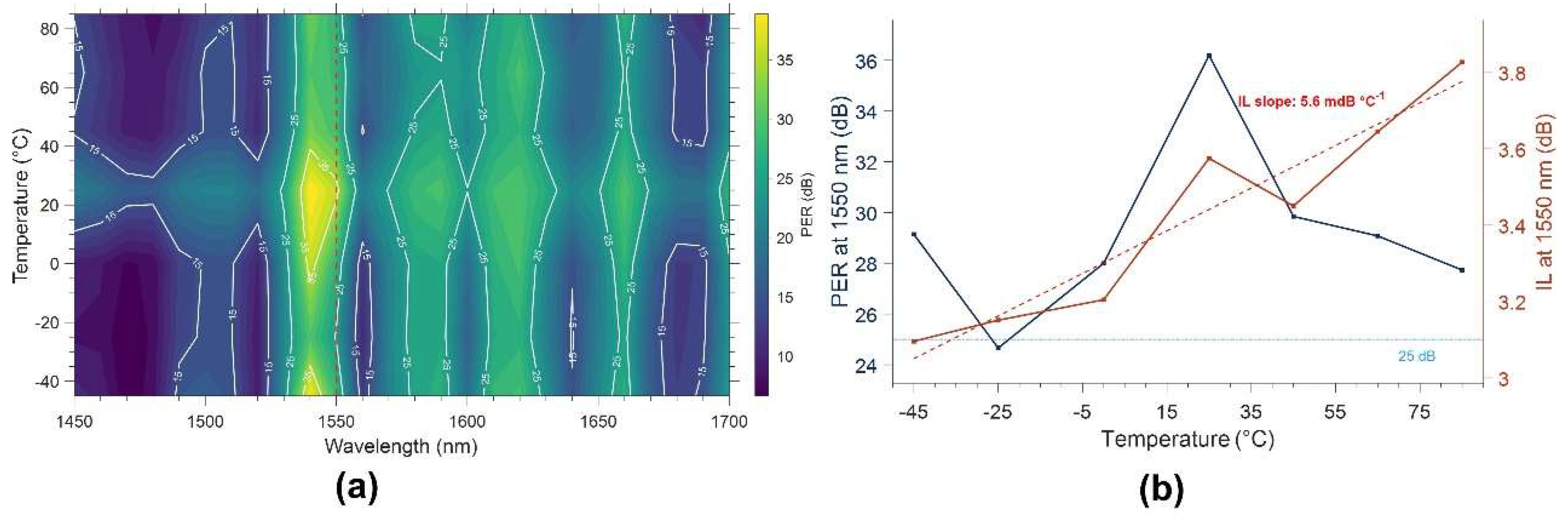
Figure 7.
Fabrication tolerance of the polarizer to the two dielectric geometric parameters at the optimized point (θ = 78°, hm = 13 nm, λ = 1550 nm, T = 25 °C); PER (left axis, blue) and IL (right axis, orange). (a) Ridge top width wtop over 940–1200 nm; (b) SiO2 buffer thickness ho over 20–60 nm. The dotted line marks the nominal value.
Figure 7.
Fabrication tolerance of the polarizer to the two dielectric geometric parameters at the optimized point (θ = 78°, hm = 13 nm, λ = 1550 nm, T = 25 °C); PER (left axis, blue) and IL (right axis, orange). (a) Ridge top width wtop over 940–1200 nm; (b) SiO2 buffer thickness ho over 20–60 nm. The dotted line marks the nominal value.
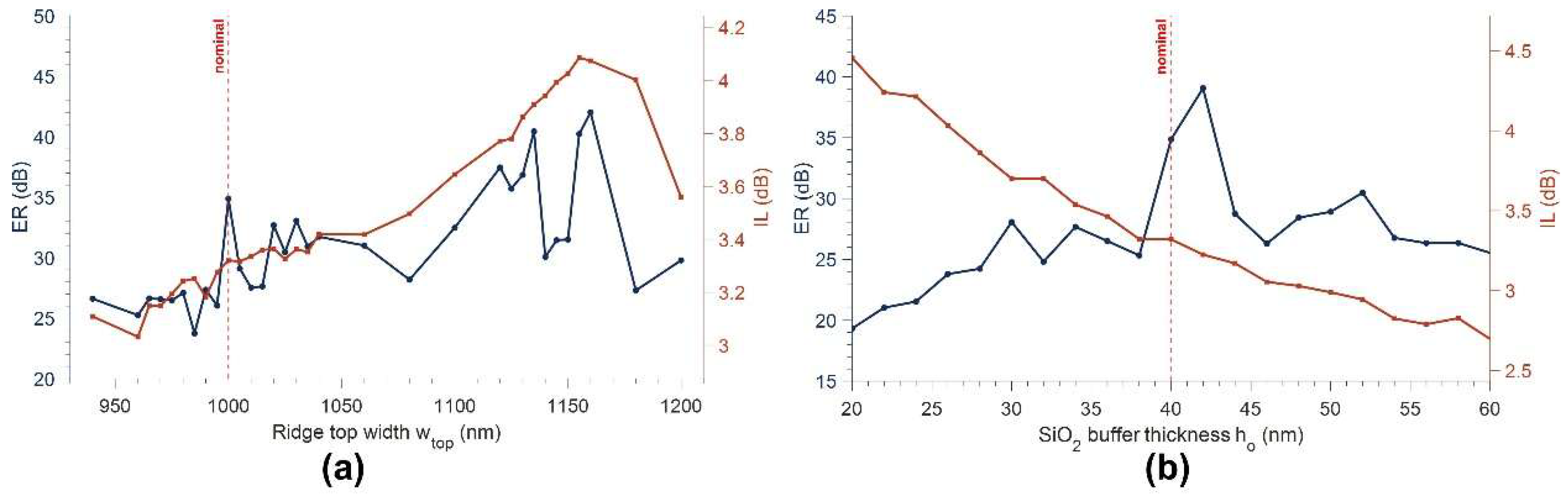

Table 1.
Material and structural parameters used in the simulations (λ = 1550 nm, T = 25 °C unless noted).
Table 1.
Material and structural parameters used in the simulations (λ = 1550 nm, T = 25 °C unless noted).
| Parameter | Symbol | Value | Source/Note |
| LN extraordinary index | ne | 2.14 | Zelmon et al. |
| LN ordinary index | no | 2.21 | Zelmon et al. |
| LN TO coeff. (e-axis) | dne/dT | 3.3 × 10⁻⁵ K⁻¹ | Moretti et al. |
| LN TO coeff. (o-axis) | dno/dT | 6 × 10⁻⁶ K⁻¹ | Moretti et al. |
| SiO₂ index | nSiO2 | 1.444 | — |
| Ag permittivity | εAg | Johnson–Christy | T-invariant |
| Ridge top width | wtop | 1000 nm | optimized |
| LN slab thickness | hslab | 300 nm | fixed |
| Sidewall angle | θ | 78° | optimized |
| Ag thickness | hm | 13 nm | optimized |
| SiO₂ buffer | ho | 40 nm | optimized |
| Grating period | Λ | 1.64 μm | q = 4 Bragg |
| Period number | N | 6 | — |
| Operating wavelength | λ | 1550 nm | C-band |
Table 2.
Coarse PER (dB) map versus sidewall angle θ and Ag thickness hm (λ = 1550 nm, T = 25 °C), used to locate the optimum (θ ≈ 80°, hm ≈ 10 nm) before the fine sweeps.
Table 2.
Coarse PER (dB) map versus sidewall angle θ and Ag thickness hm (λ = 1550 nm, T = 25 °C), used to locate the optimum (θ ≈ 80°, hm ≈ 10 nm) before the fine sweeps.
| θ(deg) | hm=5 nm | hm =10 nm | hm =20 nm |
| 50 | 28.0 | 29.3 | 24.9 |
| 55 | 29.5 | 30.4 | 26.0 |
| 60 | 29.0 | 29.2 | 26.7 |
| 65 | 29.9 | 32.4 | 27.4 |
| 70 | 31.2 | 31.1 | 27.7 |
| 75 | 30.5 | 31.3 | 27.0 |
| 80 | 32.4 | 33.0 | 28.2 |
| 85 | 33.0 | 30.1 | 27.3 |
Disclaimer/Publisher’s Note: The statements, opinions and data contained in all publications are solely those of the individual author(s) and contributor(s) and not of MDPI and/or the editor(s). MDPI and/or the editor(s) disclaim responsibility for any injury to people or property resulting from any ideas, methods, instructions or products referred to in the content. |
© 2026 by the authors. Licensee MDPI, Basel, Switzerland. This article is an open access article distributed under the terms and conditions of the Creative Commons Attribution (CC BY) license (http://creativecommons.org/licenses/by/4.0/).
Copyright: This open access article is published under a Creative Commons CC BY 4.0 license, which permit the free download, distribution, and reuse, provided that the author and preprint are cited in any reuse.