
Submitted:
04 June 2026
Posted:
05 June 2026
You are already at the latest version
Abstract
Optimized wind turbine configurations enable sustainable power generation; however, maximizing total power output through wind farm layout optimization (WFLO) remains a critical and complex challenge. WFLO strategically the optimal positioning of the wind turbines within a designated wind farm area to mitigate wake effects and maximize overall power output. Wake effects, where upstream turbines diminish the wind velocity reaching downstream turbines, can substantially lower the overall power output of a wind farm. This study proposes an ant colony optimization (ACO) approach to address WFLO, employing a continuous wind farm model that enables flexible turbine placement to minimize the cost of energy (CoE). Three scenarios were examined: constant wind speed under a single wind direction; constant wind speed across multiple wind directions; and variable wind speed across multiple directions incorporating direction-specific occurrence probabilities. The proposed framework facilitates continuous spatial optimization, substantially expanding the feasible search space by eliminating grid-based constraints. Its effectiveness is validated through comparative evaluation against methods reported in prior studies. Results demonstrate that the ACO algorithm consistently achieves superior performance, yielding a 2.13% – 4.03% reduction in CoE and a 2.22% – 4.06% increase in total power output across diverse wind conditions. This study highlights the potential of continuous spatial optimization as an effective alternative to conventional grid-based approaches in WFLO.
Keywords:
wind farm layout optimization
; ant colony optimization
; wind farm
; wind turbine
; algorithm
; WFLO
1. Introduction
Rising socio-economic development and demographic growth are increasing electricity demand [1]. To meet these growing demands and support sustainability, accelerated deployment of renewable energy and electrification are fundamental strategies [2]. Wind energy serves as a cost-competitive renewable technology in climate strategies [3]. Wind turbines (WTs) are the primary technology for converting kinetic energy into electricity [4]. Strategic clustering of wind turbines (WTs) within a wind farm (WF) enhances energy capture; however, wake-induced interactions remain the primary constraint, significantly reducing total power output and efficiency [4]. Upstream turbines generate wake interference, which reduces wind velocity for downstream turbines and consequently diminishes their energy capture due to persistent wake effects. Hence, optimized turbine layouts are critical for minimizing wake interactions and maximizing energy extraction efficiency in wind farm (WF) projects. This challenge is known as the wind farm layout optimization (WFLO) problem.
Wind farm layout optimization (WFLO) is the process of determining the optimal spatial placement of wind turbines within a designated site to maximize energy generation while minimizing costs [5]. WFLO primarily seeks to maximize total power output or minimize the cost of energy (CoE), where cost models are often simplified empirical functions based solely on turbine count [6]. WFLO is highly non-convex and multimodal, making it computationally challenging to achieve a globally optimal solution [7,8]. To address these challenges, researchers predominantly utilize metaheuristics, offering a robust balance between solution quality and computational tractability. Genetic algorithms (GAs) are widely utilized due to their ability to perform global searches, thereby overcoming local optima in complex and multimodal WFLO problems [9,10,11,12,13,14]. Particle swarm optimization (PSO) is a robust metaheuristic method for solving WFLO problems (15-18], including evolutionary strategy [19,20,21,22], differential evolution (DE) [23,24,25,26]. Furthermore, various algorithm frameworks have been developed to optimize the WFLO problem [5,6,27,28,29,30,31,32]. Mathematical programming methods are also employed for WFLO [33,34].
Previous studies predominantly adopt discrete WFLO formulations, wherein the wind farm domain is discretized into uniform grid cells with turbine placement restricted to cell centers using binary (0/1) decision variables. Consequently, discretized representations may underexplore intermediate regions, potentially missing globally optimal solutions. Although finer grid resolution partially mitigates this limitation, it escalates computational demands without fully overcoming discrete representation constraints. In contrast, the continuous WFLO model turbine locations as continuous spatial variables, permitting placement at any feasible coordinates within the wind farm boundary. This approach enables more flexible turbine placement and solution space exploration. Continuous WFLO models can achieve higher power output and lower energy costs through precise position adjustments that minimize wake interactions. However, this expanded search space introduces greater computational challenges and demands more efficient optimization strategies.
Continuous WFLO models have received less attention in the literature compared to discrete WFLO models. To address this gap, the present study investigates solving continuous WFLO models using the ant colony optimization (ACO) algorithm. Notably, applications of the ACO algorithm to continuous WFLO are particularly scarce. The continuous WFLO models a high-dimensional continuous task, leveraging a 2D Cartesian XY coordinate system to optimize unconstrained turbine placement. The ACO framework represents turbine locations via coordinates, iteratively updating placements within 2D Cartesian XY space to systematically search for optimal, unconstrained arrangements. This approach provides an accurate, practical assessment of turbine placement. The main contributions of this study are summarized as follows:
- Unlike cell-based discretization, this framework enables continuous spatial optimization, vastly expanding the feasible search space for precise turbine placement.
- This study proposes the ACO algorithm with a new way to adapt pheromone levels, where the pheromone strength reflects the power losses of each turbine. By giving more weight to turbines that lose more power due to wake effects, the framework can focus more on reducing these losses during optimization.
- Results demonstrate that the continuous WFLO model enhances total power output while reducing the cost of energy (CoE), offering novel insights into integrating continuous WFLO modeling with effective ACO algorithm.
The remainder of the paper is organized as follows: Section 2 literature reviews in the field. Section 3 outlines the problem formulation for WFLO. Section 4 details the methodology, fundamental principles of the ACO algorithm, and the procedural workflow for the proposed ACO algorithm for WFLO problem. Section 5 presents the results, followed by a comprehensive discussion. Finally, Section 6 summarizes the research outcomes and outlines potential directions for future work.
2. Literature Reviews
Metaheuristics are the dominant frameworks for WFLO problem. Metaheuristic algorithms have the advantage of being simple and straightforward. Mosetti et al. pioneered WFLO research by implementing evolutionary Genetic Algorithms (GAs) to maximize power across three wind scenarios [9]. Utilizing a 100-cell grid and the Jensen model, they established a fundamental benchmark for simulating wake effects in layout optimization. Subsequently, Grady et al. achieved superior results by increasing population size and the number of iterations, thereby enhancing the GA’s global search efficiency [10]. Distributed genetic algorithms (DGAs) optimize turbine placement to maximize wind farm profits more effectively than traditional genetic algorithms [11]. A novel genetic algorithm coding approach and an objective function that enhances wind farm efficiency and total power output compared to Grady’s model [12]. The proposed GA framework marginally outperformed the results of Grady et al. across three wind scenarios while significantly reducing the required computational time [35]. The study employs a multi-population genetic algorithm with the 2D Jensen–Gaussian wake model to optimize wind farm layouts, improving power generation and efficiency [14]. They employed GA, integrating the Jensen wake model, to optimize turbine placement across a 100-cell grid, maximizing power output and efficiency across three distinct wind cases.
Various metaheuristic approaches, including particle swarm optimization (PSO) [15,16,17,18], evolutionary strategy [19,20,21,22], differential evolution (DE) [23,24,25,26], and other advanced algorithms [5,6,27,28,29,30,31,32], have been effectively utilized to address the WFLO problem, alongside mathematical programming approaches [33,34]. However, optimizing wind farm layout to maximize total power output while minimizing costs of energy (CoE) remains a major research challenge; thus, advancing metaheuristic algorithms remains a promising approach to address these complex layout challenges effectively.
The literature indicates that grid-based approaches to WFLO problems are common due to their simpler implementation and lower computational cost. In contrast, discrete grid-based methods limit turbine positions to specific points, which may lead to sub-optimal configurations due to stricter spatial limitations [36]. Continuous approaches enable turbine placement within an unrestricted spatial domain, potentially yielding more efficient layouts by exploring a larger solution space. However, continuous formulations increase problem complexity and computational demands.
3. Problem Formulation for WFLO
3.1. Wake Model
A primary objective in wind farm layout optimization (WFLO) problem is to mitigate energy losses arising from wake interactions between turbines. To accurately evaluate these wake-induced losses, an appropriate wake model must be employed. The Jensen wake model [37] has been widely employed in wind farm layout studies and continues to serve as a benchmark engineering wake model. In this study, the original Jensen wake model is adopted as a reference to evaluate the proposed ACO algorithm under conditions consistent with prior studies. The Jensen wake model is widely used in WFLO frameworks due to its mathematical tractability and low computational cost. These characteristics are particularly advantageous for iterative metaheuristic algorithms that require a vast number of objective function evaluations [14].
This study focuses exclusively on horizontal-axis wind turbine (HAWT) configurations in the analysis. In the Jensen wake model, the wake shown in Figure 1a is assumed to originate with the turbine rotor diameter and to expand linearly in the downstream direction. As illustrated in Figure 1a, the Jensen wake model characterizes wake formation under uniform wind conditions. Upon interaction with the rotating turbine, a wake is generated and subsequently undergoes linear expansion as it propagates downstream from the rotor. Applying the principle of momentum conservation, the velocity is assumed to remain uniform across the wake cross-section and is derived as follows [9,37,38]:
The full wind velocity is denoted as , while the wind velocity within the wake at a downstream distance from the turbine is represented as . The turbine rotor radius is . The parameter is determined as follows [9,39]:
In this formulation, represents the turbine thrust coefficient. The downstream wake radius at distance is subsequently calculated as [9,39]:
where the entrainment constant ∝ depends on hub height and terrain roughness of the wind farm [9,39]:
Wake interactions in wind farms (WFs) become stronger as the number of installed wind turbines (WTs) increases, intensifying the overall wake impact. A downstream turbine can be strongly influenced by the combined wakes of multiple upstream turbines, a phenomenon known as the multiple wake effect, as illustrated in Figure 1b.
For wind turbines operating under multiple wake interactions, the kinetic energy of the combined wake flow is determined by the linear superposition of the individual kinetic energy deficits. The total velocity deficit is calculated as follows [9,10,28,38,39,40]:
or
where represents the number of upstream turbines whose wakes overlap the target turbine.
3.2. Wind Farm Layout Optimization (WFLO) Problem
The primary aim of the optimization algorithm is to minimize or maximize a specified objective function. The objective function in the WFLO problem incorporates investment costs and total turbine power output to determine the optimal placement of turbines within the wind farm area. The investment cost is modeled as a function of the total number of installed turbines within the wind farm (WF) with the unit annual cost of the first turbine and a cost reduction factor of applied to additional turbines. The function of the wind farm is defined as follows [9]:
The main objective of this study is to minimize the cost of energy (CoE). Accordingly, the optimization objective is formulated as given in Eq. (11).
, denotes the total power output of the wind farm, accounting for wake effects, and is computed as follows [9,10,28,40]:
Here, denotes the effective wind speed of turbine i. In addition, the park efficiency , which evaluates the effectiveness of the wind turbine layout, is computed as follows [28,38,40]:
where denotes the maximum power output in the absence of wake effects.
We employ cartesian coordinates to specify the two-dimensional positions of the turbines within the wind farm. The decision variables are the turbine coordinates, where and denote the - and -coordinates of turbine , respectively. Where , and is the number of turbines in the WF. The objective function can be written as:
Here, denotes the power generated by turbine at position , accounting for wake losses. A minimum safe distance must be maintained between adjacent wind turbines. The inter-turbine spacing is constrained to a minimum of five rotor diameters (5D), in accordance with the standard practice in the WFLO literature [9,10,28,38,40]. Industry practice commonly recommends a spacing of at least 5D between turbines to minimize turbulence generated by upstream wakes. The spacing requirement between any two turbines, and , is mathematically expressed by the following constraint:
The spatial arrangement of wind turbines within the wind farm is subject to a set of constraints, which can be expressed mathematically as follows:
Here, and denote the horizontal and vertical dimensions of the wind farm, respectively.
The coordinates of turbine in the northwest coordinate system centered at turbine are . The relative position of turbine with respect to turbine is transformed into wind-aligned coordinates via a rotation matrix defined by wind direction . Thus, the coordinates of turbine,relative to wind direction are derived by rotating the original positions using the rotation equation [41]:
Once inter-turbine distances are determined, the velocity deficit for each turbine is calculated.
4. Metodhology
4.1. Ant Colony Optimization (ACO) Algorithm
Ant Colony Optimization (ACO) algorithm is a metaheuristic algorithm inspired by ant foraging, in which pheromone trails guide the search for shortest paths between the nest and food sources [42]. ACO has demonstrated strong effectiveness and has been widely employed to solve a variety of power system optimization problems, including many that are NP-hard in nature. The algorithm mimics the collective foraging behavior of ant colonies, and its search procedure can be decomposed into the following:
a. Ants randomly explore the search space to generate candidate solutions.
b. Ants deposit pheromone on the paths corresponding to constructed solutions.
c. Pheromone levels are updated in proportion to solution quality.
d. Subsequent ants probabilistically favor paths with higher pheromone intensity.
Ants traversing from source point A to destination point B deposit pheromones, along path edges Subsequent ants detect these trails and select the next edge probabilistically, favoring higher concentrations [43]:
where is the probability for ant choosing edge and are heuristic parameters, is visibility (inverse distance), and denotes feasible neighbors from node .
A fundamental characteristic of this metaheuristic is the global pheromone update mechanism executed at the conclusion of each iteration. In this process, the pheromone intensity on the edge connecting nodes and is systematically adjusted based on the aggregate contributions of the entire population of agents that successfully constructed a solution during that iterative cycle. The pheromone level on edge updates according to the following rule [43]:
where represents the pheromone evaporation rate, denotes the total number of ants, and quantifies the pheromone deposit by ant on edge proportional to its solution quality:
where is a fixed deposit constant and represents the total cost of the solution constructed by ant . Figure 2 illustrates the procedural framework of ACO algorithm.
4.2. Proposed Ant Colony Optimization (ACO) Algorithm for WFLO
Continuous adaptations of ACO for optimization have shown effectiveness in multiple studies [44,45,46]. The proposed Ant Colony Optimization (ACO) algorithm for continuous wind farm layout optimization (WFLO) proceeds through the following steps:
Step 1: Initialization Phase
Initializes random positions for all turbines within the wind farm boundaries , while enforcing a minimum safe distance of between every turbine pair (). Wake-induced velocity deficits are computed using the Jensen model, accounting for multiple wake (Eq. 9), which yields turbine-specific wind speeds. The power of turbine and total power output Eqs (12) and (13) identifies this initial wind farm layout as the best wind farm layout. The pheromone intensity associated with turbine is calculated using the equations below:
The power of each turbine and the total power output, as given in Eqs. (12) and (13), identify the initial wind farm layout as the initial layout. The pheromone intensity associated with each turbine is then calculated using the equations below:
denotes the power output of turbine i in the absence of wake effects. The initial pheromone intensity is calculated using Eqs. (22) and (23).
Step 2: Main Optimization Loop (for t=1 to max_iter)
For each iteration and for each of the operating in parallel, where denotes the total number of ant agents employed in the ACO algorithm.
For each iteration, and for each of the agents operating in parallel, where denotes the total number of ant agents employed in the ACO algorithm.
Step 2.1-pheromone-guided ant allocation
In the proposed ACO algorithm, the pheromone intensity is calculated through direct power-loss evaluation using Eqs. (22) and (23), which significantly enhances the computational efficiency of the algorithm. This approach eliminates the need for iterative wake simulations, enabling rapid pheromone updates while preserving solution quality.
The number of ants allocated to turbine , denoted by , is directly proportional to its pheromone level. The equations are presented below:
Step 2.2-turbine coordinate relocation
Each ant randomly perturbs the coordinates of its assigned turbine. The new positions are then projected onto the feasible space, enforcing the wind farm boundaries and a minimum spacing constraint of 5D between turbines. For each ant’s updated layout, wake-induced velocity deficits are computed using the Jensen model, including multiple-wake interactions (Eq. (9)), which yields turbine-specific wind speeds. The new power output of each turbine and the total wind farm power are subsequently computed using Eqs. (12) and (13).
Step 2.3-elite selection
If , then the new coordinates and the power output of turbine are updated; furthermore, if the updated turbine layout is accepted and stored as the best layout, indicating an improvement in the objective function.
Step 3: Pheromone Update Phase
The pheromone intensity associated with each turbine is updated according to the best layout identified so far, as defined in Eq. (23).
Step 4: Termination and Output
Once the maximum-iteration criterion (max_iter) is satisfied, the algorithm returns the optimal turbine layout , along with the maximized total power output, minimized cost of energy (CoE) , and maximized wind farm efficiency, , respectively.
The proposed ACO algorithm optimizes continuous WFLO through initialization, pheromone-guided ant perturbations, elite selection, and termination, converging on optimal turbine layouts that maximize power while respecting wake effects and spacing constraints. The flowchart of proposed ACO for WFLO is shown in Figure 3.
5. Results and Discussion
This study examines wind farm layout design in a standard 2000 × 2000 m² flat terrain area, consistent with prior WFLO studies. The proposed ACO algorithm models the WFLO problem on a continuous grid, with turbines located at continuous (x,y) coordinates, as shown in Figure 4. Table 1 presents wind turbine and wind farm specifications used in layout optimization, consistent with prior studies.
The performance of the proposed ACO algorithm for the WFLO problem was evaluated by optimizing wind turbine layouts across three wind scenarios and by comparing the results with prior literature findings. Three wind speed scenarios were examined to assess the optimization performance: (a) constant speed with single direction, (b) constant speed with multiple directions, and (c) variable speed with multiple directions. Case study (a) assumes a constant 12 m/s wind from the north, validating the wake model and layout (Figure 5a). Case study (b) divides the azimuth into 36 equal-angle sections, with uniform 12 m/s wind generated from all directions (Figure 5b). Case study (c) adopts 36 wind directions as in (b), incorporating three wind speeds (8, 12, 17 m/s) with varying occurrence probabilities (Figure 5c). Figure 6 shows the probability distribution of wind direction for Case Study (c). The 12 m/s and 17 m/s wind speeds occur more frequently at wind directions between 270° and 350°, indicating northwest as the prevailing wind direction for the wind farm.
The proposed ACO algorithm for WFLO was coded and implemented in MATLAB on a PC with an Intel Core i7 processor and 16 GB RAM. This study evaluates the proposed ACO algorithm across wind farm layouts with 30, 39, 40, and 41 turbines. Configurations employed 80 and 200 ant colonies, respectively, with maximum iterations of 300 and 1000. The proposed ACO algorithm for WFLO was executed independently ten times. Mean values from the ten independent runs represent the WFLO solutions.
Computational results are benchmarked against prior WFLO studies using results reported in the referenced literature, including Grady et al. [10] and recent studies. Grady et al. [10} are widely recognized in prior literature for benchmarking enhanced metaheuristic algorithms in wind farm layout optimization.
5.1. Case Study (a): Constant Wind Speed, Single Direction
Case study (a) assumes a constant 12 m/s wind from the north, with turbines positioned accordingly. Table 2 summarizes the computed layout optimization results. Table 2 compares the proposed ACO algorithm’s results with those reported in prior references for benchmarking.
The proposed ACO algorithm demonstrates an energy cost (CoE) that outperforms both previously reported figures and our recalculated benchmarks, yielding a 3.80% reduction. The proposed ACO algorithm also achieves 3.66% higher total power output than Turner et al. []. The proposed ACO algorithm produces the near-optimal layout, resulting in the highest total power output of 15,343 kW and the most favorable economic performance, with a cost of energy (CoE) of 1.440e-3. Although efficiency was not the primary optimization objective in this study, the proposed ACO algorithm achieves competitive efficiency compared to previous studies reported in the literature. The optimal wind farm configuration identified by the ACO algorithm is illustrated in Figure 7, alongside the benchmark results reported by Turner et al.[33].
5.2. Case Study (b): Constant Wind Speed, Multiple Directions
In case study (b), the wind speed was set to 12 m/s, and the wind direction was measured at 36 discrete points from 0° to 360° in 10° increments; the results are presented in Table 3.
The proposed ACO algorithm achieves a cost of energy (CoE) that significantly outperforms established literature values and our recalculated benchmarks. By optimizing the 40-turbine layout, the resulting layout yields CoE reductions of 3.78%, 4.03%, and 3.52% relative to the Biswas et al. [28], Rezk et al. [40], and Daqaq et al. [38], respectively. Also, optimizing the 41-turbine, the resulting layout yields CoE reductions of 3.26% compare relative to the Daqaq et al. [38]. The proposed ACO algorithm identifies the optimal layout, yielding higher power outputs of 18,624 kW and 18,965 kW for the 40- and 41-turbine configurations, respectively. The proposed ACO algorithm demonstrates competitive efficiency, achieving performance exceeding that reported in prior studies, despite efficiency not being the primary focus of the optimization. The optimal wind farm configuration identified by the ACO algorithm is illustrated in Figure 8, alongside the benchmark results reported by Daqaq et al.[38].
5.3. Case Study (c): Variable Wind Speed, Multiple Directions
To more accurately represent the variability of wind speed and direction observed in real conditions. This case utilizes modeling frameworks to replicate the complex, non-linear dynamics of wind speed and directionality inherent in large-scale empirical environments. Case study (c) incorporates 36 wind directions and three wind speeds of 8, 12, and 17 m/s with direction-specific occurrence probabilities. Figure 6 presents the probability data. The total wind farm power output is derived by integrating the full range of wind directionality with three distinct wind speed probability scenarios. These wind conditions incorporate higher levels of complexity, presenting significant computational challenges for optimization algorithms tasked with addressing the WFLO problem.
As shown in Table 4, the ACO algorithm achieves a lower cost of energy than the reference methods, yielding a 2.13% reduction compared to Biswas et al. [28] for a 39-wind-turbine layout. For a 40-turbine configuration, the ACO algorithm yields CoE reductions of 2.31%, 2.66%, and 2.16% compared to the method by Rezk et al.[40] and the MRFO and CMRFO5 variants developed by Daqaq et al.[38], respectively. The ACO algorithm also achieves 2.39% higher total power output than Biswas et al.[28] for a 39-turbine configuration. In a 40-turbine layout, the ACO algorithm demonstrates superior performance, yielding power output increases of 2.36%, 2.74%, and 2.22% over the benchmarks established by Rezk et al.[40] and the MRFO/CMRFO5 variants of Daqaq et al.[38], respectively.
The ACO algorithm effectively optimizes the turbine layout, resulting in maximum power outputs of 33,127 kW and 33,786 kW for the 39- and 40-turbine scenarios, with superior CoE values of 0.8144e-3 and 0.8137e-3, respectively. The ACO algorithm achieves superior wind farm efficiency compared to benchmarks in the existing literature, despite efficiency not being the primary objective of this optimization study. The optimal wind farm configuration identified by the ACO algorithm is illustrated in Figure 9, alongside the benchmark results reported by Biswas et al.[28], Rezk et al.[40], and Daqaq et al.[38]. The proposed ACO algorithm demonstrates superior optimization efficiency, yielding performance metrics that surpass benchmarks established in recent literature. The wind farm efficiency demonstrates superior via ACO algorithm than other literature, despite efficiency not being the primary focus of the optimization study.
6. Conclusions
The ACO algorithm was applied to address the WFLO problem by minimizing the ratio of cost to total power output. This objective function guides the determination of the optimal turbine arrangement within the wind farm to enhance overall efficiency. The ACO algorithm was employed to solve the WFLO problem across three distinct wind scenarios. The experimental results were benchmarked against several established optimization methods reported in the literature to evaluate performance. This comparative analysis highlights the relative effectiveness of the proposed approach in terms of key metrics such as total power output and cost of energy.
The ACO algorithm yields a lower cost of energy (CoE) in wind condition case (a) compared to values reported in previous studies. Correspondingly, the total power output achieved by the ACO algorithm surpasses previously published results. This indicates that the proposed ACO algorithm effectively reduces energy costs while simultaneously increasing power generation under this wind scenario. Under wind condition case (b), the ACO algorithm demonstrated superior performance by achieving a significantly lower cost of energy (CoE) compared to previously reported benchmarks. Concurrently, it generated a total power output that surpasses earlier published results under similar wind conditions. Case (c) reflects realistic wind conditions, offering critical insights for optimizing turbine placement within wind farms. The ACO algorithm achieved a significantly lower cost of energy (CoE), surpassing previously established benchmarks. Additionally, it generated a total power output that exceeds earlier reported results under comparable conditions. These findings demonstrate the ACO algorithm’s capability to enhance both economic performance and energy generation in practical wind farm scenarios.
This framework enables continuous spatial optimization, significantly expanding the feasible search space for precise turbine placement by removing grid-based constraints. The present study confirms this through results showing that the ACO algorithm consistently achieves superior cost of energy (CoE) and total power output across all wind condition cases. These results demonstrate that the proposed continuous spatial framework allows the algorithm to bypass the resolution constraints of traditional fixed-grid systems, leading to a 2.13% to 4.03% improvement in cost of energy and a 2.22% to 4.06% increase in total power output across diverse wind scenarios.
Future research should focus on incorporating load constraints and turbine fatigue analysis into the optimization process to ensure turbine longevity while maximizing power output. Exploring multi-objective optimization frameworks that balance cost of energy, power generation, and turbulence reduction can yield more comprehensive solutions for real-world applications. Additionally, optimizing cable layout concurrently with turbine placement can reduce overall infrastructure costs in large-scale onshore wind farms.
Author Contributions
Conceptualization, O.A.W.R., B.S.,N.S.; methodology, O.A.W.R.; software, O.A.W.R.; coding, O.A.W.R.; validation, O.A.W.R., B.S., and N.S.; formal analysis, O.A.W.R.; investigation, O.A.W.R., B.S.; resources, O.A.W.R.; data, O.A.W.R.; writing—original draft preparation, O.A.W.R.; writing—review and editing, O.A.W.R.; visualization, O.A.W.R.; supervision, B.S., N.S.; project administration, B.S.,N.S.; funding acquisition, O.A.W.R.; All authors have read and agreed to the published version of the manuscript.
Funding
This research was funded by doctoral program at Institut Teknologi Sepuluh Nopember (ITS).
Acknowledgments
The author gratefully acknowledges the academic support and guidance provided throughout the investigation.
Conflicts of Interest
The authors declare no conflicts of interest.Abbreviations.
References
- Hovenkamp, L.; Wang, Y.; Nabernegg, S.; Hubacek, K. Increased material footprint as a side effect of progress towards affordable, reliable, sustainable and modern energy. Energy Ecol. Environ. 2025, 10, 710–722. [Google Scholar] [CrossRef]
- Lal, A.; Tavoni, M.; Preuss, N.; You, F. Aligning EU energy security and climate mitigation through targeted transition strategies. Nat. Commun. 2026. [Google Scholar] [CrossRef]
- McKenna, R.; Lilliestam, J.; Heinrichs, H.U.; Weinand, J.; Schmidt, J.; Staffell, I.; et al. System impacts of wind energy developments: Key research challenges and opportunities. Joule 2025, 9, 101799. [Google Scholar] [CrossRef]
- Li, T.; Yang, B.; Yang, Q.; Zhang, M.; Hu, W.; Guo, K. Wind farm layout optimization with multi-type wind turbines for minimizing levelized cost of energy. Renew. Energy 2025, 124386. [Google Scholar] [CrossRef]
- Feng, J.; Shen, W.Z. Solving the wind farm layout optimization problem using random search algorithm. Renew. Energy 2015, 78, 182–192. [Google Scholar] [CrossRef]
- Patel, J.; Savsani, V.; Patel, V.; Patel, R. Layout optimization of a wind farm to maximize the power output using enhanced teaching learning based optimization technique. J. Clean. Prod. 2017, 158, 81–94. [Google Scholar] [CrossRef]
- Stanley, A.P.; Ning, A. Massive simplification of the wind farm layout optimization problem. Wind Energy Sci. 2019, 4, 663–676. [Google Scholar] [CrossRef]
- Malisani, P.; Bartement, T.; Bozonnet, P. Offshore wind farm layout optimization with alignment constraints. Wind Energy Sci. 2025, 10, 1611–1623. [Google Scholar] [CrossRef]
- Mosetti, G.P.C.D.B.; Poloni, C.; Diviacco, B. Optimization of wind turbine positioning in large windfarms by means of a genetic algorithm. J. Wind Eng. Ind. Aerod. 1994, 51, 105–116. [Google Scholar] [CrossRef]
- Grady, S.A.; Hussaini, M.Y.; Abdullah, M.M. Placement of wind turbines using genetic algorithms. Renew. Energy 2005, 30, 259–270. [Google Scholar] [CrossRef]
- Huang, H.S. Distributed genetic algorithm for optimization of wind farm annual profits. In Proceedings of the 2007 International Conference on Intelligent Systems Applications to Power Systems, Taipei, Taiwan, 6–10 November 2007; pp. 1–6. [Google Scholar]
- Emami, A.; Noghreh, P. New approach on optimization in placement of wind turbines within wind farm by genetic algorithms. Renew. Energy 2010, 35, 1559–1564. [Google Scholar] [CrossRef]
- Abdelsalam, A.M.; El-Shorbagy, M.A. Optimization of wind turbines siting in a wind farm using genetic algorithm based local search. Renew. Energy 2018, 123, 748–755. [Google Scholar] [CrossRef]
- Gao, X.; Li, Y.; Zhao, F.; Sun, H. Comparisons of the accuracy of different wake models in wind farm layout optimization. Energy Explor. Exploit. 2020, 38, 1725–1741. [Google Scholar] [CrossRef]
- Wan, C.; Wang, J.; Yang, G.; Zhang, X. Optimal micro-siting of wind farms by particle swarm optimization. In Proceedings of the International Conference in Swarm Intelligence, Chicago, IL, USA, 10–12 June 2010; pp. 198–205. [Google Scholar]
- Pookpunt, S.; Ongsakul, W. Optimal placement of wind turbines within wind farm using binary particle swarm optimization with time-varying acceleration coefficients. Renew. Energy 2013, 55, 266–276. [Google Scholar] [CrossRef]
- Xu, C.; Yang, J.; Li, C.; Shen, W.Z.; Zheng, Y.; Liu, D. A research on wind farm micro-sitting optimization in complex terrain. In Proceedings of the International Conference on Aerodynamics of Offshore Wind Energy Systems and Wakes (ICOWES 2013), Lyngby, Denmark, 16–18 October 2013; pp. 669–679. [Google Scholar]
- Chowdhury, S.; Zhang, J.; Messac, A.; Castillo, L. Optimizing the arrangement and the selection of turbines for wind farms subject to varying wind conditions. Renew. Energy 2013, 52, 273–282. [Google Scholar] [CrossRef]
- Kusiak, A.; Song, Z. Design of wind farm layout for maximum wind energy capture. Renew. Energy 2010, 35, 685–694. [Google Scholar] [CrossRef]
- Kusiak, A.; Zheng, H. Optimization of wind turbine energy and power factor with an evolutionary computation algorithm. Energy 2010, 35, 1324–1332. [Google Scholar] [CrossRef]
- González, J.S.; Rodriguez, A.G.G.; Mora, J.C.; Santos, J.R.; Payan, M.B. Optimization of wind farm turbines layout using an evolutive algorithm. Renew. Energy 2010, 35, 1671–1681. [Google Scholar] [CrossRef]
- Song, Z.; Zhang, Z.; Chen, X. The decision model of 3-dimensional wind farm layout design. Renew. Energy 2016, 85, 248–258. [Google Scholar] [CrossRef]
- Wang, Y.; Liu, H.; Long, H.; Zhang, Z.; Yang, S. Differential evolution with a new encoding mechanism for optimizing wind farm layout. IEEE Trans. Ind. Inform. 2017, 14, 1040–1054. [Google Scholar] [CrossRef]
- Chen, L.; Li, H.; Shen, Y. A Differential Evolution Algorithm for Wind Farm Layout Optimization Using a New Bilevel Programming Model. In Proceedings of the International Conference on Genetic and Evolutionary Computing, Macau, China, 3–6 October 2021; pp. 584–596. [Google Scholar]
- Tao, S.; Yang, Y.; Zhao, R.; Todo, H.; Tang, Z. Competitive elimination improved differential evolution for wind farm layout optimization problems. Mathematics 2024, 12, 3762. [Google Scholar] [CrossRef]
- Tao, S.; Liu, S.; Zhao, R.; Yang, Y.; Todo, H.; Yang, H. A state-of-the-art fractional order-driven differential evolution for wind farm layout optimization. Mathematics 2025, 13, 282. [Google Scholar] [CrossRef]
- Changshui, Z.; Guangdong, H.; Jun, W. A fast algorithm based on the submodular property for optimization of wind turbine positioning. Renew. Energy 2011, 36, 2951–2958. [Google Scholar] [CrossRef]
- Biswas, P.P.; Suganthan, P.N.; Amaratunga, G.A. Optimal placement of wind turbines in a windfarm using L-SHADE algorithm. In Proceedings of the 2017 IEEE Congress on Evolutionary Computation (CEC), San Sebastián, Spain, 5–8 June 2017; pp. 83–88. [Google Scholar]
- Rao, R.V.; Keesari, H.S. Multi-team perturbation guiding Jaya algorithm for optimization of wind farm layout. Appl. Soft Comput. 2018, 71, 800–815. [Google Scholar] [CrossRef]
- Kumar, K.K.; Reddy, G.N. The sparrow search algorithm for optimum position of wind turbine on a wind farm. Int. J. Renew. Energy Res. 2021, 11, 1–8. [Google Scholar] [CrossRef]
- Yang, K.; Cho, K. Simulated annealing algorithm for wind farm layout optimization: A benchmark study. Energies 2019, 12, 4403. [Google Scholar] [CrossRef]
- Wahyu Riyanto, O.A.; Santosa, B.; Siswanto, N. Proposed Ant Colony Optimization Approach for Wind Farm Layout Optimization Problem. In Proceedings of the IOP Conference Series: Earth and Environmental Science, Denpasar, Indonesia, December 2025; IOP Publishing: Bristol, UK, 2025; Volume 1564, p. 012136. [Google Scholar]
- Turner, S.D.O.; Romero, D.A.; Zhang, P.Y.; Amon, C.H.; Chan, T.C.Y. A new mathematical programming approach to optimize wind farm layouts. Renew. Energy 2014, 63, 674–680. [Google Scholar] [CrossRef]
- Ulku, I.; Alabas-Uslu, C. A new mathematical programming approach to wind farm layout problem under multiple wake effects. Renew. Energy 2019, 136, 1190–1201. [Google Scholar] [CrossRef]
- Parada, L.; Herrera, C.; Flores, P.; Parada, V. Wind farm layout optimization using a Gaussian-based wake model. Renew. Energy 2017, 107, 531–541. [Google Scholar] [CrossRef]
- Dhoot, A.; Antonini, E.G.; Romero, D.A.; Amon, C.H. Optimizing wind farms layouts for maximum energy production using probabilistic inference: Benchmarking reveals superior computational efficiency and scalability. Energy 2021, 223, 120035. [Google Scholar] [CrossRef]
- Jensen, N.O. A note on wind generator interaction; Risø National Laboratory: Roskilde, Denmark, 1983. [Google Scholar]
- Daqaq, F.; Ellaia, R.; Ouassaid, M.; Zawbaa, H.M.; Kamel, S. Enhanced chaotic manta ray foraging algorithm for function optimization and optimal wind farm layout problem. IEEE Access 2022, 10, 78345–78369. [Google Scholar] [CrossRef]
- Katic, I.; Højstrup, J.; Jensen, N.O. A simple model for cluster efficiency. In Proceedings of the European Wind Energy Association Conference and Exhibition, Rome, Italy, 1987; pp. 407–410. [Google Scholar]
- Rezk, H.; Fathy, A.; Diab, A.A.Z.; Al-Dhaifallah, M. The application of water cycle optimization algorithm for optimal placement of wind turbines in wind farms. Energies 2019, 12, 4335. [Google Scholar] [CrossRef]
- Kim, S.; Kim, M. Rotation representations and their conversions. IEEE Access 2023, 11, 6682–6699. [Google Scholar] [CrossRef]
- Blum, C. Ant colony optimization: Introduction and recent trends. Phys. Life Rev. 2005, 2, 353–373. [Google Scholar] [CrossRef]
- Dorigo, M.; Birattari, M.; Stutzle, T. Ant colony optimization. IEEE Comput. Intell. Mag. 2006, 1, 28–39. [Google Scholar] [CrossRef]
- Yang, Q.; Chen, W.N.; Yu, Z.; Gu, T.; Li, Y.; Zhang, H.; Zhang, J. Adaptive multimodal continuous ant colony optimization. IEEE Trans. Evol. Comput. 2016, 21, 191–205. [Google Scholar] [CrossRef]
- Mavrovouniotis, M.; Li, C.; Yang, S. A survey of swarm intelligence for dynamic optimization: Algorithms and applications. Swarm Evol. Comput. 2017, 33, 1–17. [Google Scholar] [CrossRef]
- Santosa, B.; Ai, T.J. Pengantar Metaheuristik: Implementasi dengan Matlab, Vol.1; ITS Tekno Sains, 2017. [Google Scholar]
Figure 1.
a) Jensen wake model and; b) Multiple wake effect in the wind farm.
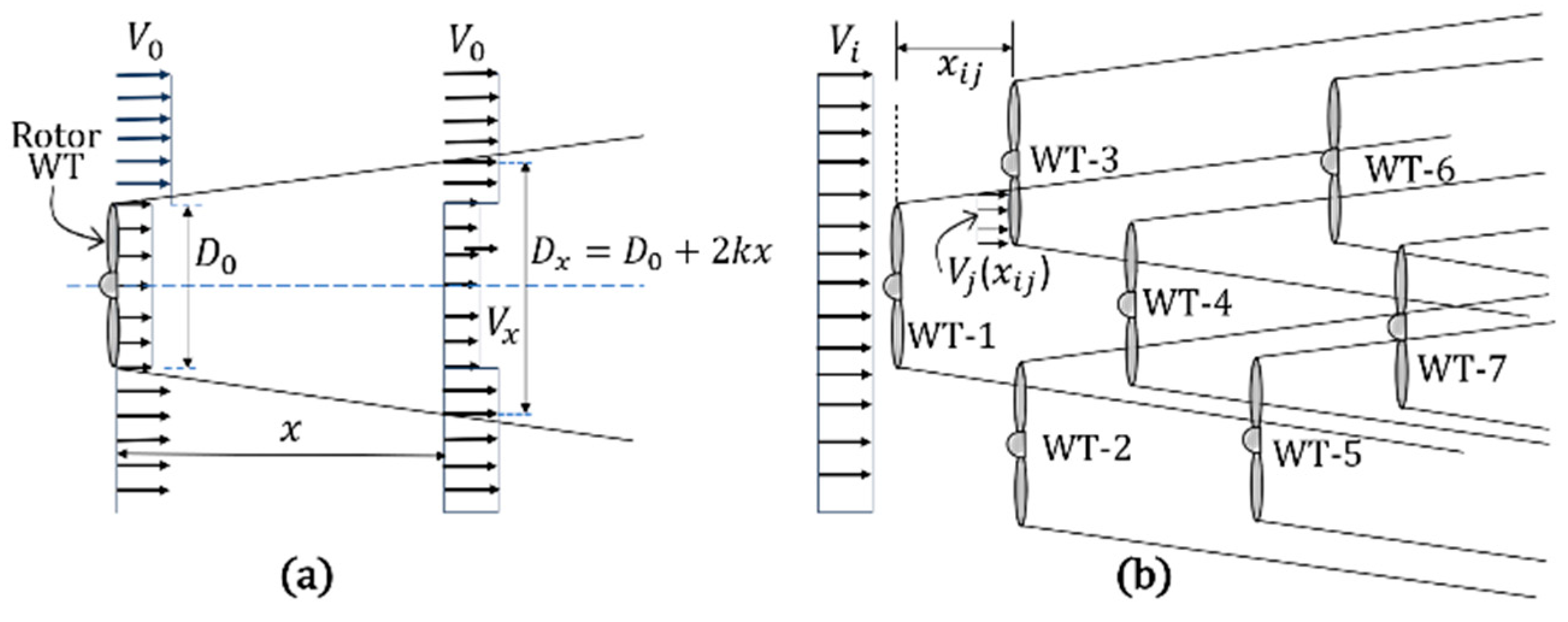
Figure 2.
Basic ACO framework.
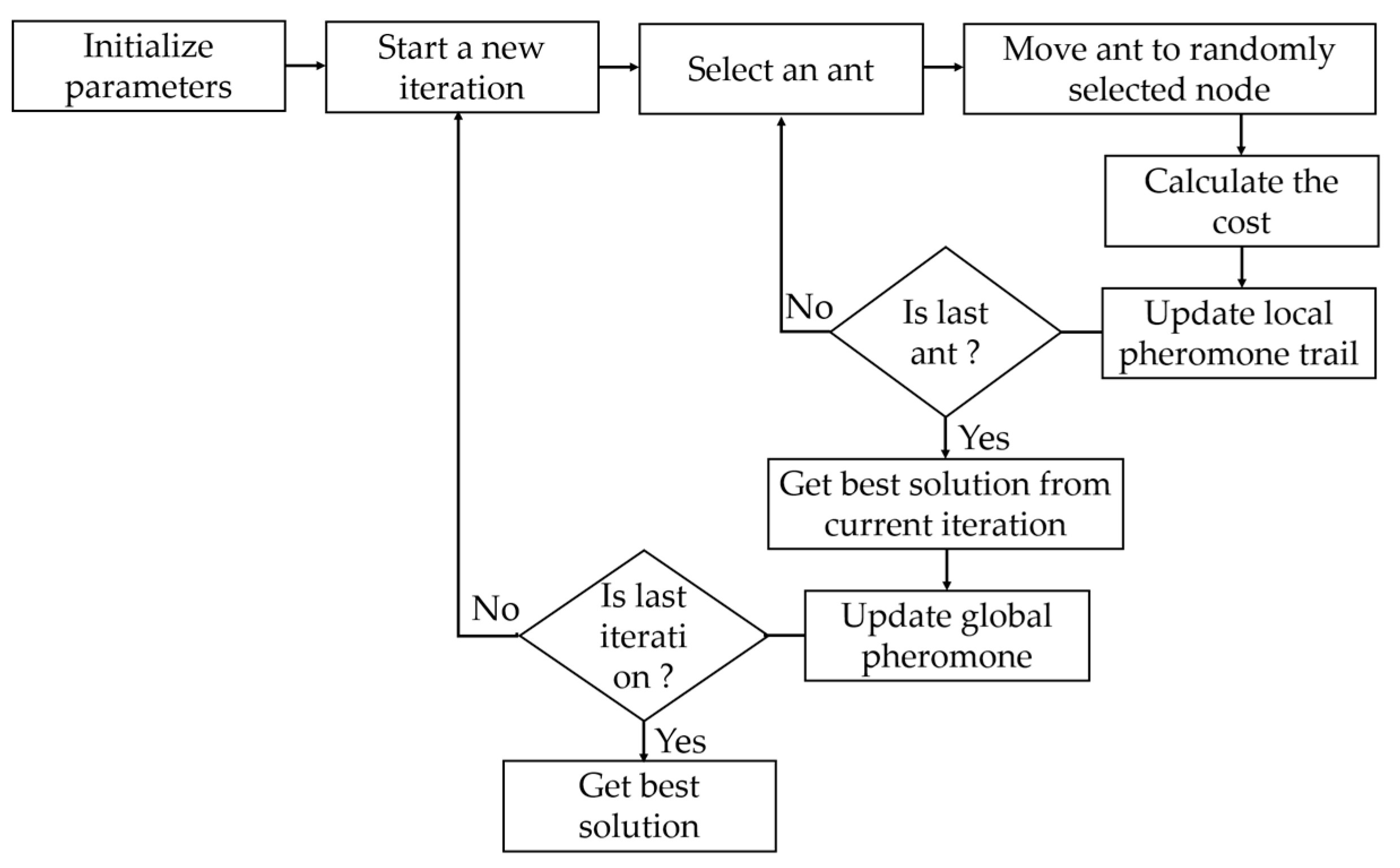
Figure 3.
Flowchart of proposed ACO for WFLO.
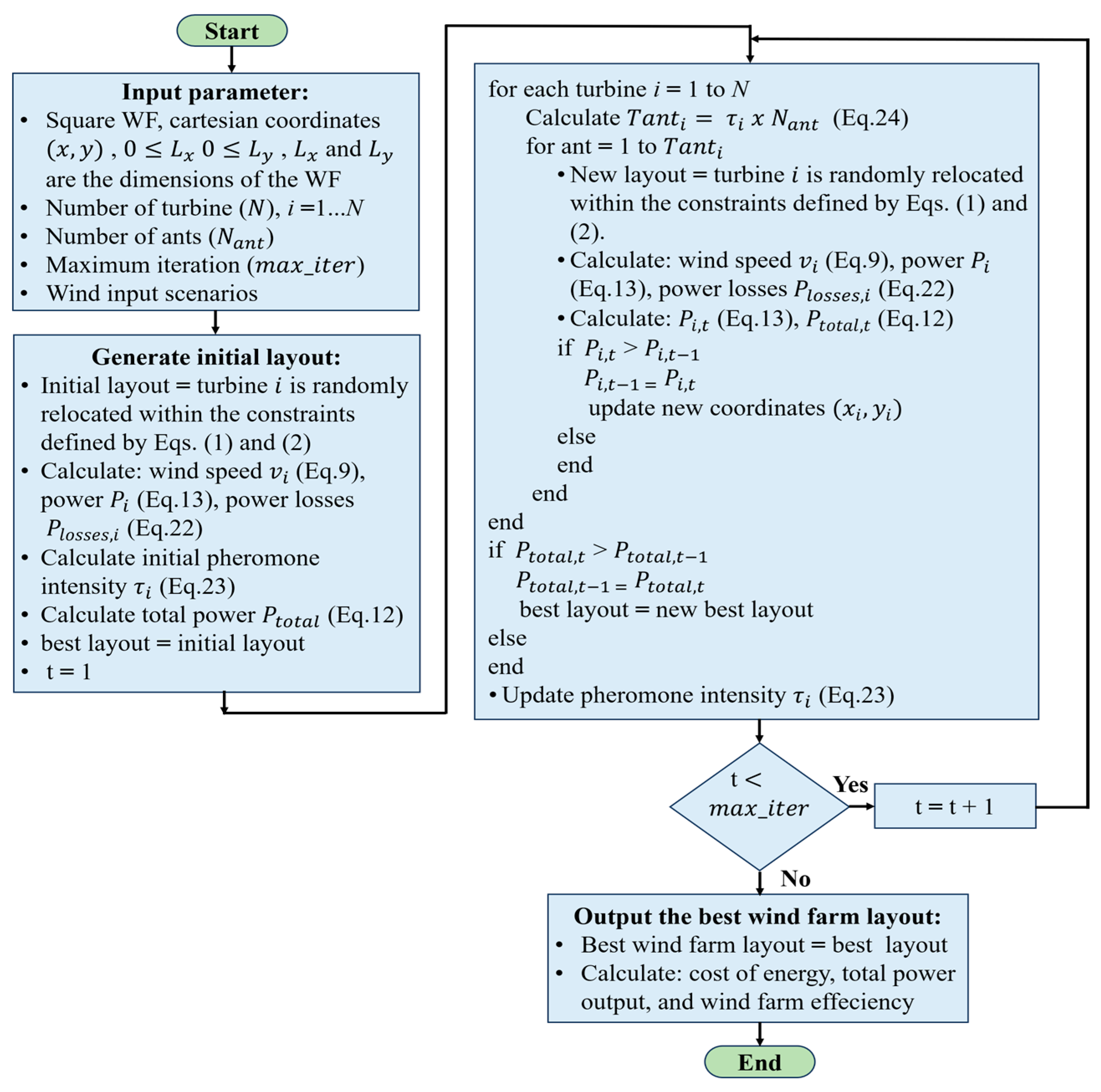
Figure 4.
Continuous spatial model for flat terrain wind farm.
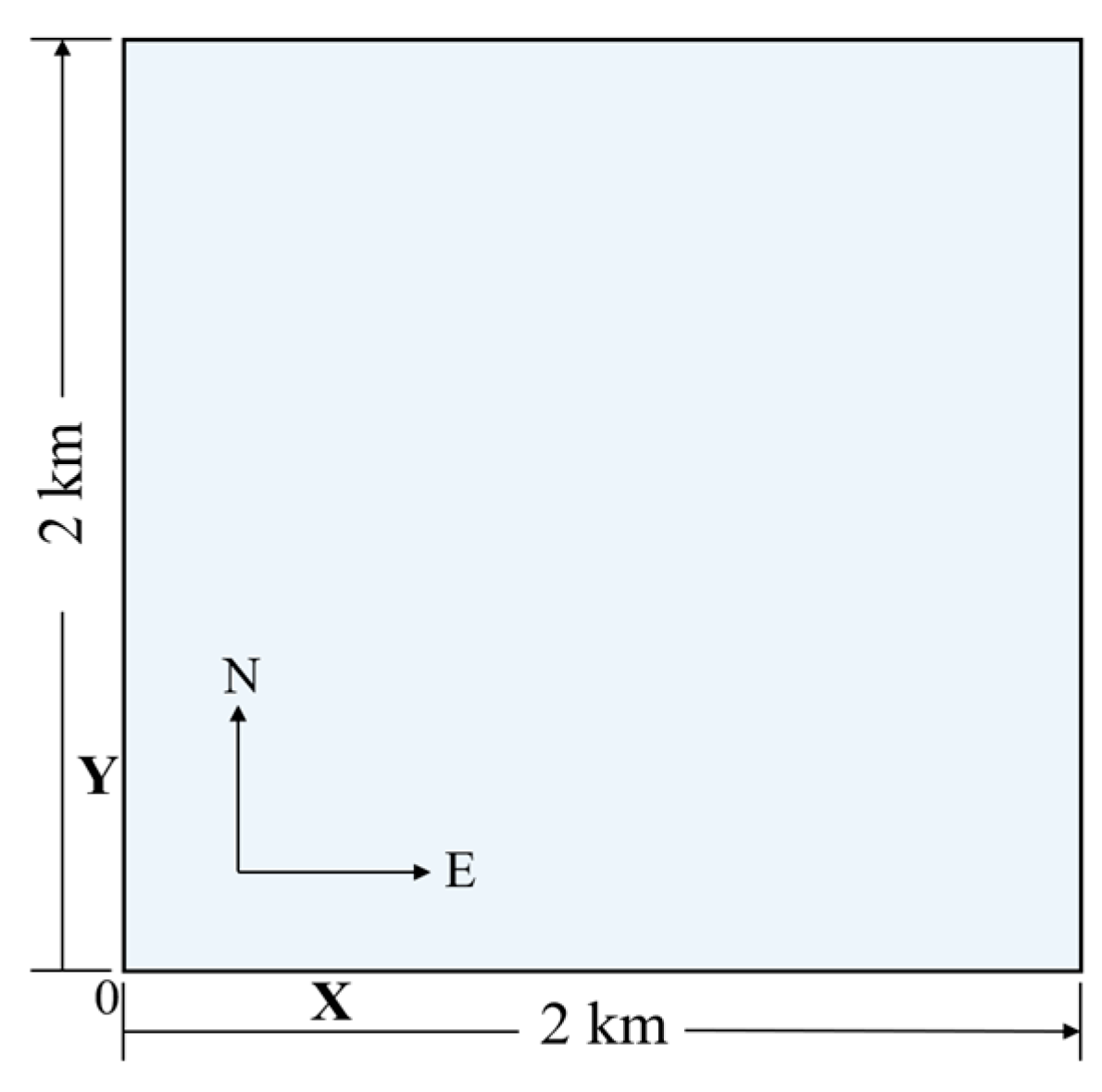
Figure 5.
Wind cases: (a) constant speed, single direction; (b) constant speed , multiple directions;(c) variable speed, multiple directions.
Figure 5.
Wind cases: (a) constant speed, single direction; (b) constant speed , multiple directions;(c) variable speed, multiple directions.
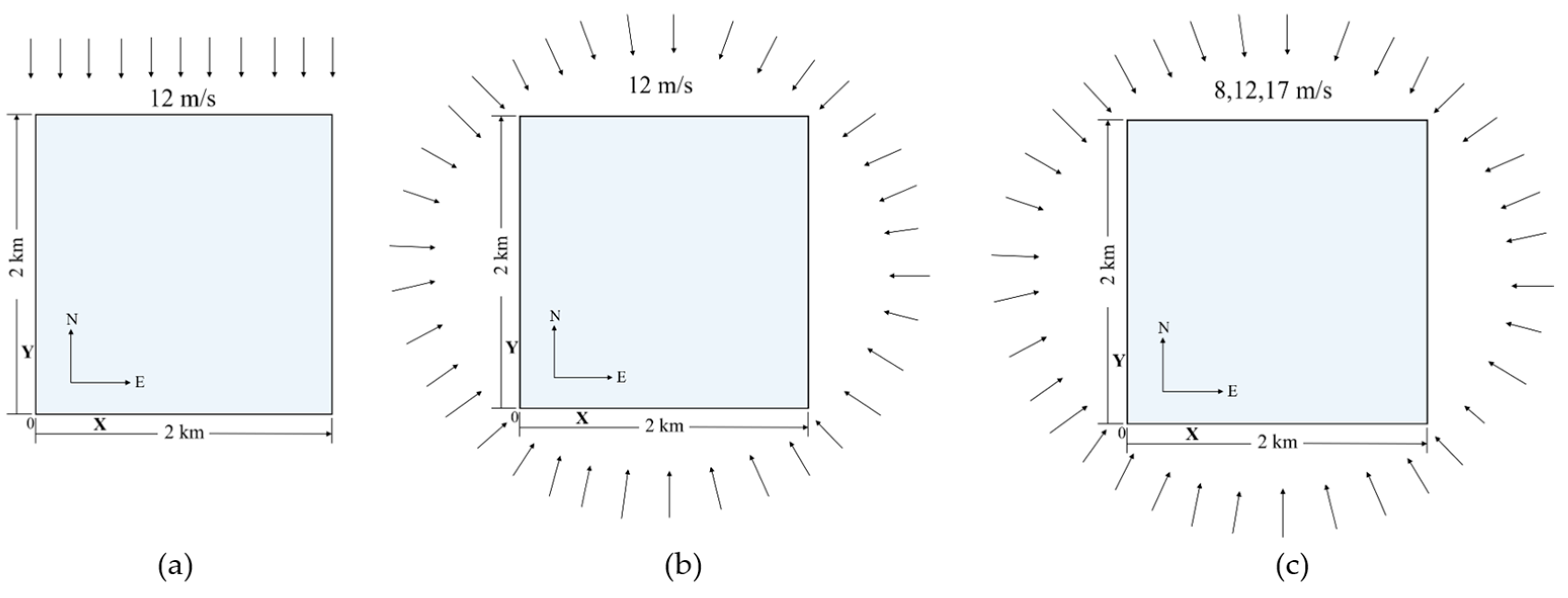
Figure 6.
Wind direction probability distribution for case study (c).
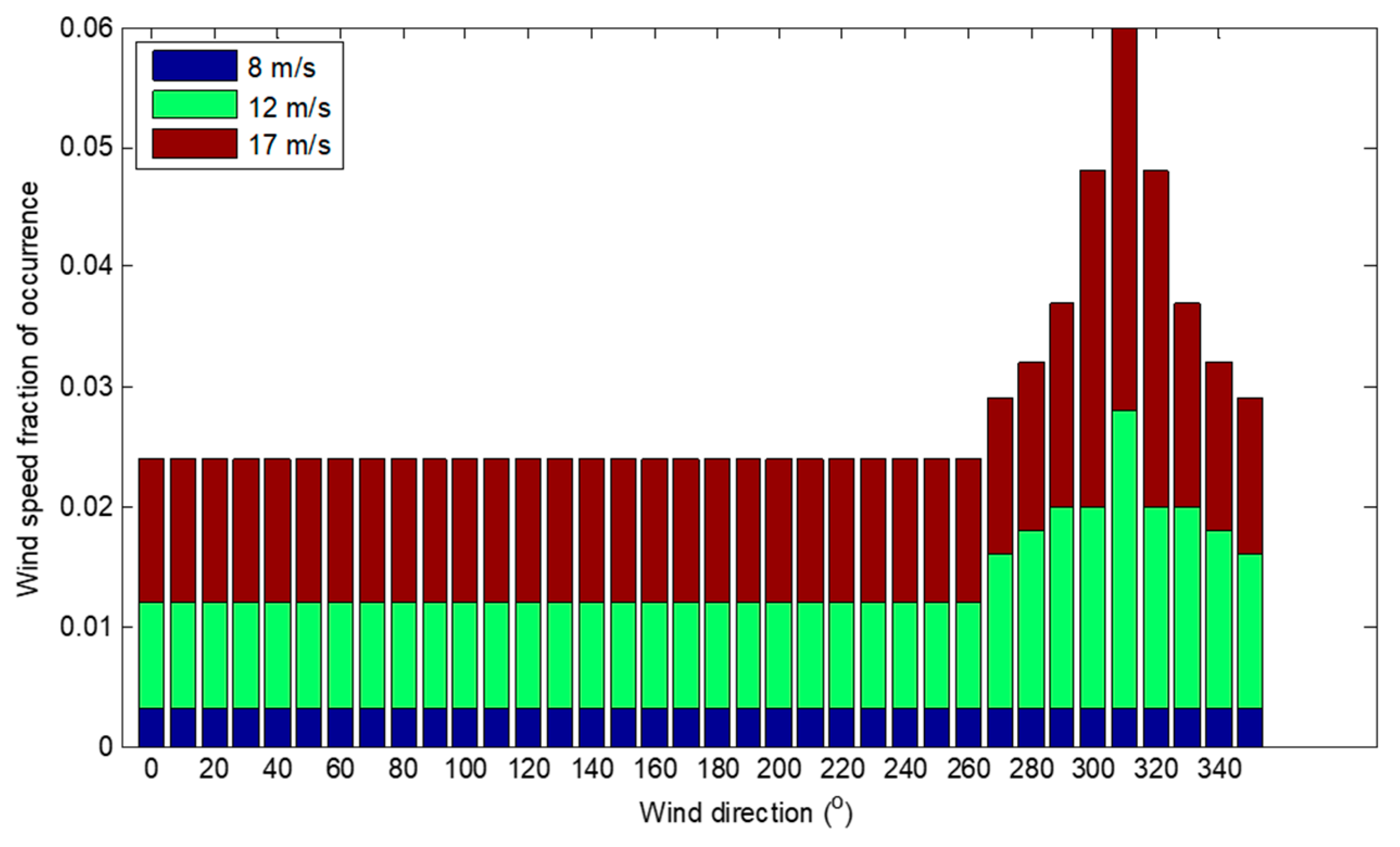
Figure 7.
Optimal layout configurations of case-a (constant wind speed, single direction): (a) MILP,Turner et al.[33] study; (b) ACO, present study.
Figure 7.
Optimal layout configurations of case-a (constant wind speed, single direction): (a) MILP,Turner et al.[33] study; (b) ACO, present study.
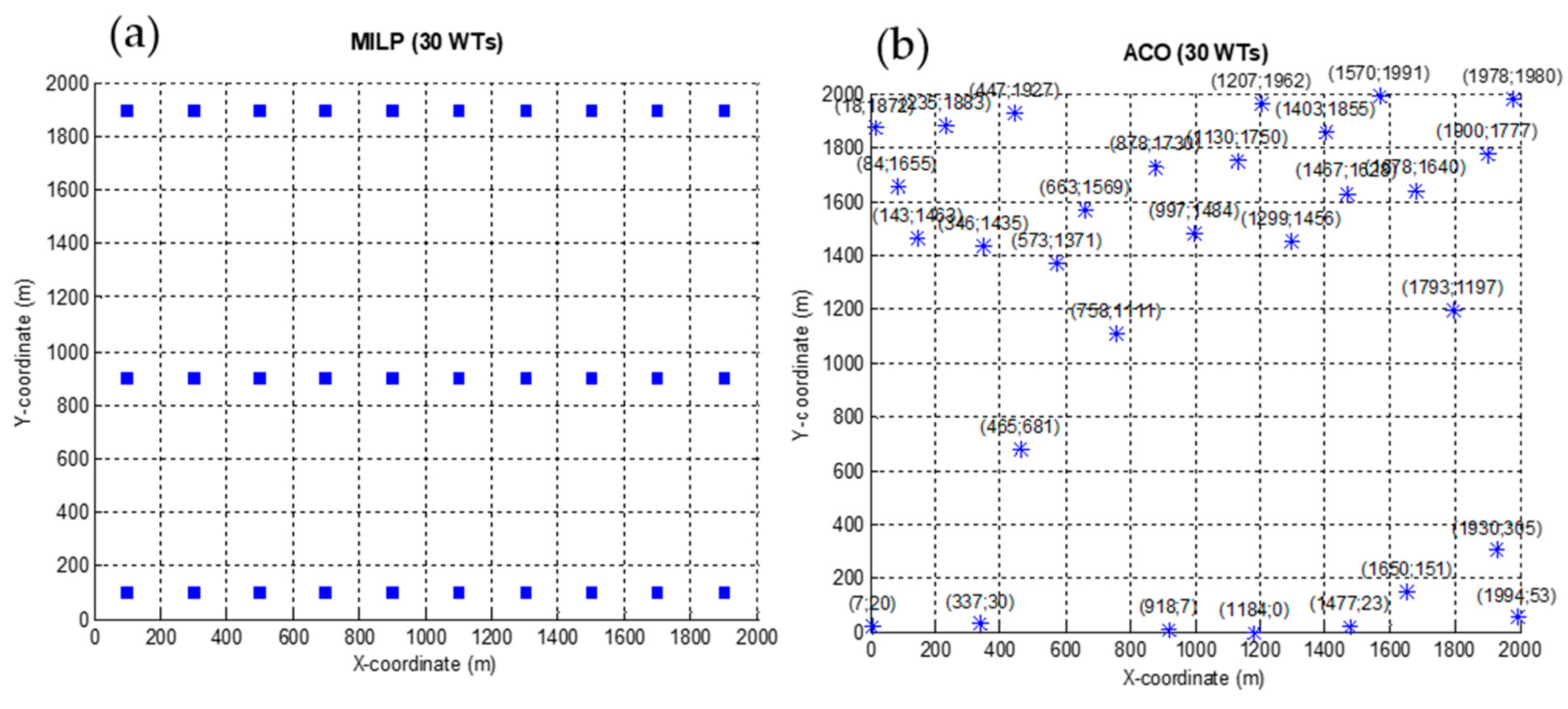
Figure 8.
Optimal layout configurations of case-b (constant wind speed, multiple directions): (a) MRFO, Daqaq et al.[38] study; (b) CMRFO5, Daqaq et al.[38] study; (c) 40-WTs, present study.; (d) 41-WTs, present study.
Figure 9.
Optimal layout configurations of case-c (variable wind speed, multiple directions): (a) Biswas et al. [28] study; (b) Rezk et al. [40] study; (c) Daqaq et al. [38] study; (d) present study.
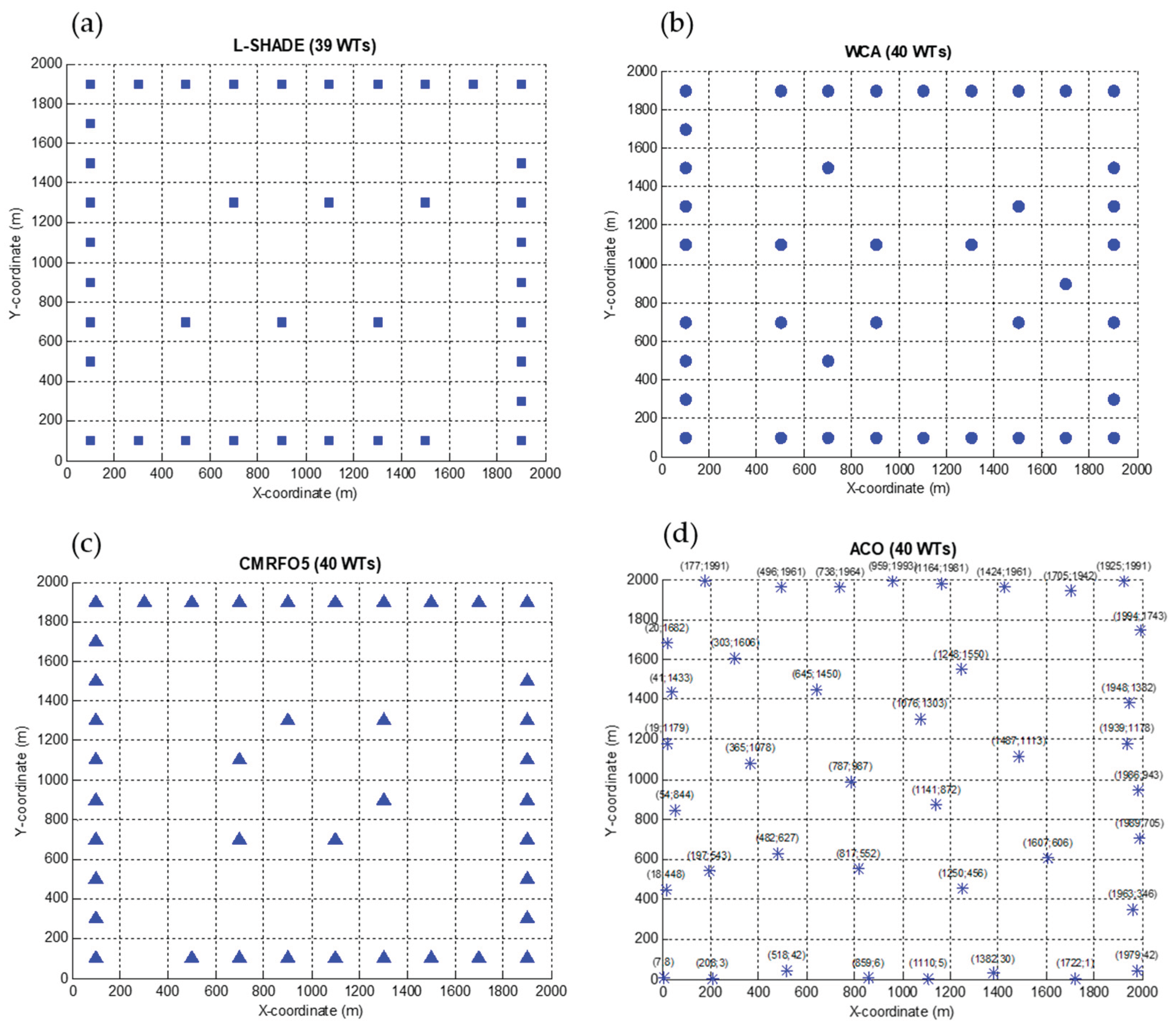

Table 1.
Wind turbine and wind farm characteristics.
| Property | Value | Property | Value |
|---|---|---|---|
| rotor diameter | 40 m | cut-in wind speed | 4 m/s |
| hub height | 60 m | cut-out wind speed | 26 m/s |
| thrust coefficient | 0.88 | Wind farm size | 2 km x 2 km |
| Power coefecient | 0.39 | Minimum spacing | 200 m (5D) |
| Surface roughness length | 0.3 | Wind directional degree | {10o,20o,30o,…,360o} |
| Air density | 1.225 kg/m3 |
Table 2.
Case study (a) layout optimization results.
| Authors | Method | Number of Turbines |
Total Power (kW) | Efficiency (%) | Objective (cost/kW) 10-3 |
|
|---|---|---|---|---|---|---|
| Turner et al.[33] | MILP | Reported | 30 | 14,800 | 95.160 | NA |
| Calculated | 30 | 14,752 | 94.86 | 1.497 | ||
| Present study | ACO | 30 | 15,343 | 98,657 | 1.440 |
*Bold values indicate the best results.
Table 3.
Case study (b) layout optimization results.
| Authors | Method | Number of Turbines |
Total Power (kW) | Efficiency (%) | Objective (cost/kW) 10-3 |
|
|---|---|---|---|---|---|---|
| Biswas et al.[28] | L-SHADE | Reported | 40 | 17,920 | 86.420 | 1,534 |
| Calculated | 40 | 17,904 | 86.341 | 1.536 | ||
| Rezk et al.[40] | WCA | Reported | 40 | 17,878.32 | 86.220 | 1.538 |
| Calculated | 40 | 17,890 | 86.276 | 1.537 | ||
| Daqaq et al.[38] | MRFO | Reported | 40 | 17,880 | 86.260 | 1.538 |
| Calculated | 40 | 17,897 | 86.308 | 1.536 | ||
| Daqaq et al.[38] | CMRFO5 | Reported | 41 | 18,337 | 86.280 | 1.530 |
| Calculated | 41 | 18,309 | 86.142 | 1.533 | ||
| Present study | ACO | 40 | 18,624 | 89.814 | 1.476 | |
| 41 | 18,965 | 89,232 | 1.480 |
*Bold values indicate the best results.
Table 4.
Case study (c) layout optimization results.
| Reference | Method | Number of Turbines |
Total Power (kW) | Efficiency (%) | Objective (cost/kW) 10-3 |
|
|---|---|---|---|---|---|---|
| Biswas et al.[28] | L-SHADE | Reported | 39 | 32,351 | 86.680 | 0.8322 |
| Calculated | 39 | 32,275 | 86.497 | 0.8339 | ||
| Rezk et al.[40] | WCA | Reported | 40 | 33,005 | 87.000 | 0.8330 |
| Calculated | 40 | 32,793 | 85.688 | 0.8383 | ||
| Daqaq et al.[38] | MRFO | Reported | 40 | 32,884 | 85.900 | 0.8360 |
| Calculated | 40 | 32,652 | 85.320 | 0.8420 | ||
| Daqaq et al.[38] | CMRFO5 | Reported | 40 | 33,052 | 86.340 | 0.8317 |
| Calculated | 40 | 33,052 | 86.366 | 0.8318 | ||
| Present study | ACO | 39 | 33,127 | 88.780 | 0.8144 | |
| 40 | 33,786 | 88.283 | 0.8137 |
*Bold values indicate the best results.
Disclaimer/Publisher’s Note: The statements, opinions and data contained in all publications are solely those of the individual author(s) and contributor(s) and not of MDPI and/or the editor(s). MDPI and/or the editor(s) disclaim responsibility for any injury to people or property resulting from any ideas, methods, instructions or products referred to in the content. |
© 2026 by the authors. Licensee MDPI, Basel, Switzerland. This article is an open access article distributed under the terms and conditions of the Creative Commons Attribution (CC BY) license (http://creativecommons.org/licenses/by/4.0/).
Copyright: This open access article is published under a Creative Commons CC BY 4.0 license, which permit the free download, distribution, and reuse, provided that the author and preprint are cited in any reuse.


