
Submitted:
04 June 2026
Posted:
05 June 2026
You are already at the latest version
Abstract
Peritoneal metastasis (PM) is the most frequent and lethal pattern of dissemination in gastrointestinal malignancies. Despite advances in systemic chemotherapy, outcomes remain poor because the unique biology of PM, characterized by poor vascularization and the peritoneal–plasma barrier (PPB), limits drug penetration and contributes to treatment resistance. To address these challenges, several locoregional treatment strategies have been developed, including cytoreductive surgery plus hyperthermic intraperitoneal chemotherapy (CRS+HIPEC) and pressurized intraperitoneal aerosol chemotherapy (PIPAC). However, their widespread adoption is constrained by invasiveness, strict patient selection, and inconsistent survival benefits. Catheter-based normothermic intraperitoneal chemotherapy (CBIP) has emerged as a practical and less invasive alternative, particularly in East Asia. Through an implanted intraperitoneal port, CBIP enables repeated drug administration, providing sustained regional exposure while imposing minimal procedural burden. Importantly, it can be readily integrated with systemic chemotherapy, making it suitable for long-term multimodal treatment. Among available agents, paclitaxel (PTX) is particularly well suited for intraperitoneal administration because of its prolonged retention within the peritoneal cavity and limited systemic absorption. These pharmacokinetic properties allow high local drug concentrations with relatively low systemic toxicity. Consequently, PTX-based CBIP represents a biologically rational and clinically feasible treatment strategy for PM. This review summarizes the pharmacological rationale, clinical evidence, and emerging innovations in drug formulation and delivery that may further enhance the efficacy of PTX-based intraperitoneal chemotherapy for this challenging disease.
Keywords:
peritoneal metastasis
; peritoneal–plasma barrier catheter-based intraperitoneal chemotherapy
; Paclitaxel
; conversion surgery
; nanoparticle
1. Introduction
The incidence of peritoneal metastasis (PM) in gastrointestinal malignancies varies substantially according to the primary tumor origin; however, it consistently represents one of the major patterns of metastatic spread in advanced disease. In gastric cancer, synchronous PM is reported in approximately 10–21% of patients at initial diagnosis. However, when occult disease detected by peritoneal cytology, staging laparoscopy, recurrent cases, and autopsy findings are taken into account, the lifetime incidence of PM is estimated to reach 30–50%. [1,2,3] In pancreatic cancer, radiologically detectable synchronous PM is observed in approximately 9–14% of patients, whereas PM is identified in 20–50% of advanced cases when staging laparoscopy and autopsy data are included[4,5], indicating a high prevalence of occult peritoneal disease. In colorectal cancer, the incidence of synchronous PM is relatively lower, ranging from 4–8% at diagnosis; however, the cumulative incidence increases to approximately 8–25%. [6,7] Among hepatobiliary malignancies, gallbladder cancer and cholangiocarcinoma exhibits synchronous PM in approximately 10–20% of patients, whereas hepatocellular carcinoma shows a lower incidence of only 2–6%. [8]
Despite advances in systemic chemotherapy and molecular-targeted therapy, the prognosis of patients with PM remains substantially worse than that of patients with other metastatic patterns, even within the same stage IV category. [9,10,11] This unfavorable outcome is largely attributable to the unique biological and anatomical characteristics of PM[12], including sparse vascularization[13], dense stromal fibrosis[14], the peritoneal–plasma barrier (PPB) [15], and a profoundly immunosuppressive microenvironment. [16] Especially, the PPB critically influences drug delivery in peritoneal metastasis.[15,17] This dynamic barrier, composed of the mesothelium, interstitium, and microvasculature, enables prolonged retention of intraperitoneally administered drugs while simultaneously limiting penetration of systemically delivered agents into peritoneal tumors. Drug transport is strongly affected by molecular size, solubility, fibrosis, and extracellular matrix density.[18,19] Consequently, achieving deep drug penetration into metastatic nodules remains a major therapeutic challenge.
These anatomical and pharmacologic characteristics provide a strong rationale for intraperitoneal (IP) chemotherapy. By directly delivering anticancer agents into the peritoneal cavity, IP administration can achieve markedly higher local drug exposure while limiting systemic toxicity. Among various locoregional approaches, cytoreductive surgery (CRS) combined with hyperthermic intraperitoneal chemotherapy (HIPEC) has been widely adopted, particularly in Western countries. HIPEC combines macroscopic tumor debulking with heat-enhanced cytotoxicity and improved tissue penetration [20], and has demonstrated survival benefit in selected patients with ovarian [21] and colorectal [22] cancers. CRS+HIPEC has been reported to be beneficial also for selected patients with gastric [23,24] and pancreatic [25]cancers, although the benefit remains highly dependent on tumor biology, completeness of cytoreduction, and patient selection. Another emerging strategy is pressurized intraperitoneal aerosol chemotherapy (PIPAC), which was developed mainly in Europe. PIPAC delivers aerosolized chemotherapy under pressure to improve intraperitoneal distribution and tissue penetration, and early studies have demonstrated favorable pathological responses and promising survival outcomes [26,27,28,29]. However, the absence of randomized evidence and standardized treatment protocols remains a major limitation.
In contrast, repeated normothermic IP chemotherapy delivered through a subcutaneous access port and intraperitoneal catheter, referred to as catheter-based intraperitoneal chemotherapy (CBIP), represents a more practical and minimally invasive therapeutic strategy (Figure 1A). CBIP provides a platform for sustained and repeated IP drug administration via an implanted port system, enabling non-invasive weekly delivery of high local concentrations of anticancer agents over prolonged periods. In addition, the system allows serial sampling of peritoneal fluid for cytological and biomarker-based disease monitoring. Unlike HIPEC or PIPAC, CBIP does not require repeated general anesthesia and is therefore better suited for long-term treatment. In this review, we summarize the mechanistic rationale, pharmacologic basis, clinical evidence, and future perspectives of PTX-based catheter-based intraperitoneal chemotherapy for gastrointestinal cancers with PM.
2. Characteristics of PM from a Pharmacokinetic Perspective
The peritoneal cavity is the largest enclosed compartment in the human body, lined by a mesothelial monolayer and characterized by abundant visceral adipose tissue and a unique local immune microenvironment. Despite its large surface area, effective peritoneal blood flow is remarkably low, estimated at only 60–100 mL/min (approximately 1–2% of cardiac output). This distinctive physiological feature fundamentally differentiates the peritoneum from other visceral organs and contributes to the limited efficacy of systemic chemotherapy against peritoneal malignancies.[13,30]
A key determinant of drug disposition within the peritoneal cavity is the peritoneal–plasma barrier (PPB).[15,17] Rather than a single anatomical structure, the PPB is a dynamic, multilayered interface composed of the mesothelium, submesothelial interstitium, and subperitoneal microvasculature. Drug transport across this barrier occurs through interstitial diffusion and microvascular absorption, providing the pharmacokinetic basis for intraperitoneal (IP) chemotherapy by enabling high local drug concentrations and prolonged peritoneal residence compared with intravenous administration. Classical studies identified the microvascular endothelium as the principal rate-limiting component, with transport kinetics largely determined by molecular size, charge, and solubility.[17,18] Consequently, larger molecules exhibit slower clearance and higher peritoneal-to-plasma area-under-the-curve (AUC) ratios.[31,32] In addition, the submesothelial interstitium, particularly extracellular matrix composition and collagen density, plays a critical role in regulating solute diffusion.[19,33] Recent studies have further implicated the endothelial glycocalyx, including hyaluronan, in controlling macromolecular permeability.[34] These observations highlight the PPB as a highly dynamic interface that is continuously remodeled by physiological and pathological processes. Inflammation and tumor infiltration induce angiogenesis, fibrosis, and mesothelial injury, thereby altering transport characteristics and drug distribution.
Importantly, the PPB acts bidirectionally. While it limits systemic absorption of IP-administered drugs and thereby maintains high intraperitoneal exposure, it also restricts the penetration of systemically administered agents into peritoneal tumors. This challenge is further exacerbated by tumor-associated fibrosis and desmoplasia, which increase interstitial density and pressure, creating a formidable barrier to drug diffusion from both the bloodstream and the peritoneal cavity. Therefore, the major therapeutic challenge in PM is not merely achieving high drug concentrations within the peritoneal cavity, but ensuring sufficient penetration into metastatic nodules.
3. Pharmacological Characteristics of PTX
Among the available agents, PTX possesses particularly favorable pharmacokinetic properties for CBIP. PTX, originally isolated from the bark of Taxus brevifolia (Pacific yew), is highly hydrophobic and is therefore formulated as large micelles with Cremophor and ethanol. As a result, PTX forms micellar particles with a relatively large molecular diameter (approximately 10–12 nm) in solution. These micelles are absorbed predominantly through the lymphatic system, leading to prolonged retention within the peritoneal cavity and limited systemic exposure.[35] Accordingly, after IP administration, the peritoneal-to-plasma area under the concentration–time curve (AUC) ratio for PTX has been reported to be approximately 1000,[36] with more recent studies showing a range of 550–2300, substantially higher than that observed with many hydrophilic agents.[37,38] Indeed, pharmacokinetic study demonstrated that intraperitoneal concentration of PTX maintain above effective dose for 3 days after IP administration of PTX. [39] (Figure 1B)
In addition, PTX exerts antifibrotic effects, including inhibition of fibroblast proliferation and extracellular matrix deposition [40,41], resulting no peritoneal adhesion even after repeated IP administration. These characteristics enable sustained exposure of peritoneal tumor surfaces to cytotoxic concentrations while minimizing systemic toxicity, making PTX one of the most suitable agents for repeated CBIP chemotherapy.
4. Pharmacological Characteristics of PTX
The PPB limits drug diffusion from both the bloodstream and the peritoneal cavity; thus, the key challenge is not simply achieving high intraperitoneal drug concentrations, but ensuring deep penetration into metastatic nodules. Preclinical studies have demonstrated that IP PTX achieves direct penetration into peritoneal metastatic nodules.[42,43,44] However, despite achieving high intraperitoneal concentrations, tumor penetration remains limited. Experimental studies using radiolabeled PTX have demonstrated that drug infiltration is limited to less than 100 μm from the tumor surface in xenograft models.[45] Other studies employing fluorescein-labeled PTX have shown penetration extending several hundred micrometers beneath the surface of peritoneal nodules. (Figure 2) [46] While this superficial distribution can effectively destroy peripheral tumor cells, it is unlikely to eradicate deeply located lesions, making repeated administration essential.
However, even repeated IP therapy has limited penetration depth and minimal activity against extra-peritoneal disease. In addition, postoperative adhesions may impair drug distribution within the peritoneal cavity. These limitations support the rationale for combining IP and systemic chemotherapy. Preclinical studies have demonstrated complementary distribution patterns, with IV-administered PTX localizing mainly to perivascular regions, whereas IP-delivered PTX accumulates in relatively avascular tumor areas.[46,47] (Figure 2) In addition, PTX has been shown to induce marked destruction microvessels in the tumor periphery.[48], which may disrupt tumor architecture and reduce interstitial fluid pressure, thereby facilitating deeper penetration of IV administered agents. Recent experimental data show that IP PTX enhances the intratumoral concentration of IV administered Carboplatin [49], providing direct evidence for the synergistic potential of sequential IP and systemic chemotherapy. Collectively, these findings support combination of CBIP-PTX with systemic chemotherapy as a rational strategy to overcome spatial drug-delivery barriers in PM.
5. Clinical Results of CBIP-PTX with Systemic Chemotherapy for Patients with PM
5.1. Gastric Cancer
CBIP-PTX was developed for gastric cancer with PM (GCPM) in Japan. First regimen consisted of oral S-1 (80 mg/m², days 1–14), weekly intravenous (IV) paclitaxel (PTX, 50 mg/m²), and IP-PTX administered via an implanted peritoneal port. A phase I study established the recommended IP dose at 20 mg/m². [39] Early phase II studies demonstrated encouraging outcomes in patients with macroscopic PM or positive peritoneal cytology with a 1-year overall survival (OS) rate of 78% with a median survival time (MST) of 22.5 months, which was reproduced comparable results in another prospective cohort. [50,51] Importantly, repeated second-look laparoscopies frequently demonstrated substantial regression of peritoneal nodules and disappearance of ascites, allowing conversion gastrectomy in selected responders. Postoperative continuation of IP chemotherapy was also feasible. Then, randomized phase III PHOENIX-GC trial was conducted, which compared IP+IV PTX plus S-1 against standard cisplatin plus S-1 (SP). [52] Although the primary analysis narrowly failed to achieve statistical significance (MST 17.7 vs. 15.2 months; HR 0.72; p=0.08), several important findings strongly supported the efficacy of IP therapy. First, protocol violations substantially affected interpretation, including crossover to IP treatment in approximately 12% of patients assigned to the control arm. Second, the IP group included a greater proportion of patients with massive ascites, representing a biologically unfavorable subgroup. When analyses were restricted to the per-protocol population, the survival benefit became significant (HR 0.64; p=0.022), and adjustment for ascites imbalance further strengthened the effect (HR 0.59; p=0.008). Moreover, the IP arm achieved markedly superior ascites control and cytological conversion rates (76% vs. 33%), indicating stronger suppression of peritoneal disease biology.
Subsequent studies consistently reproduced favorable outcomes across multiple systemic chemotherapy backbones. (Table 1) Combination regimens incorporating SOX [53,54,55,56,57], FOLFOX [58,59], capecitabine/oxaliplatin or cisplatin [60,61], or S1/cisplatin [62] generally achieved 1-year OS rates of approximately 70–80% and MSTs around 15–22 months. Notably, escalation of IP-PTX doses to 40–80 mg/m² did not clearly improve survival outcomes, suggesting that pharmacologic saturation within the peritoneal cavity may already be achieved at moderate doses. Most recently, the Chinese multicenter phase III DRAGON-01 trial provided further high-level evidence. In this study, IP-PTX combined with IV PTX and S-1 significantly improved survival compared with systemic chemotherapy alone, achieving an MST of 19.4 months versus 13.9 months (p=0.0054). Importantly, survival benefits persisted in long-term follow-up, including improvements in 1-, 2-, 3-, and 5-year OS rates, suggesting durable disease control in selected patients.[63]
One of the most clinically important aspects of IP-taxane therapy is its ability to induce cytological conversion and facilitate conversion surgery. Across studies, conversion from positive to negative peritoneal cytology (CY1→CY0) occurred in 64–97% of patients[50,51,52,53,54,58,60,62,64], substantially exceeding rates typically achieved with systemic chemotherapy alone. Conversion gastrectomy became feasible in 26–63% of cases, and patients undergoing surgery often achieved prolonged survival, with reported MSTs ranging from 24 to 42 months. [50,51,52,53,54,55,57,58,60,62,63,64] These findings suggest that IP-PTX may convert selected stage IV patients into candidates for potentially curative-intent treatment.
The toxicity profile of CBIP-taxane appears manageable and generally comparable to conventional systemic chemotherapy. The most common adverse events are hematologic toxicities, including grade 3/4 leukopenia and neutropenia, which are usually manageable with dose modifications or temporary interruption. [50,51,52,53,54,55,56,57,58,59,60,61,62,63] Non-hematologic toxicities, such as neuropathy, gastrointestinal symptoms, fatigue, or hepatic dysfunction, are relatively infrequent. Importantly, severe abdominal pain is uncommon despite repeated IP administration. An additional issue unique to CBIP is port-related complications. In a University of Tokyo cohort, approximately 20% of patients experienced complications including inflow obstruction, infection, reflux, or fistula formation. [65]However, severe complications requiring major surgical intervention were uncommon, and most studies reported low rates of grade 3/4 port-related adverse events.
IP-PTX therapy may also have important roles beyond macroscopic peritoneal metastasis. In patients with microscopic peritoneal disease (P0CY1), several studies reported cytological conversion rates exceeding 75–95% with encouraging survival outcomes. [66] Furthermore, preliminary evidence suggests that postoperative IP-PTX may help prevent peritoneal recurrence in high-risk patients with serosal invasion. [67] Even in highly advanced cases with massive malignant ascites and poor performance status, IP therapy has shown potential benefit. Because systemic drug delivery into peritoneal lesions is particularly impaired in these patients, IP-PTX may partially overcome this limitation. Combination approaches integrating cell-free and concentrated ascites reinfusion therapy (CART) with IP-PTX have demonstrated encouraging survival outcomes despite historically dismal prognoses. [68]
In Western populations, clinical evidence remains limited but is steadily emerging. In the United States, the prospective phase II STOPGAP study, [69] evaluating IP-PTX in combination with 5-fluorouracil and leucovorin, has been completed and has subsequently progressed to a phase III trial (STOPGAP II). (https://clinicaltrials.gov/study/NCT07001748) In Europe, a phase III study, IPa-Gastric trial, is currently evaluating the added benefit of IP-PTX to standard fluoropyrimidine- and oxaliplatin-based systemic regimens.(https://clinicaltrials.gov/study/NCT07304271) These studies are expected to clarify the generalizability of IP taxane–based strategies beyond East Asian populations and to better define their role within global treatment paradigms.
5.2. Pancreatic Cancer
Pancreatic ductal adenocarcinoma (PDAC) remains one of the deadliest malignancies, with a 5-year survival rate below 10%.[70] Peritoneal metastasis (PM) is a frequent and highly lethal metastatic pattern, with reported median survival of only 2–3 months and 1-year overall survival (OS) rates of 10–14%.[71] Although modern systemic regimens such as FOLFIRINOX and gemcitabine plus nab-paclitaxel (GEM+nab-PTX) have improved outcomes in metastatic PDAC,[72] their efficacy specifically against PM remains unclear. In contrast, HIPEC has been poorly investigated in PDAC because of the aggressive biology and poor prognosis of the disease.
Two phase II studies have suggested promising activity of CBIP using PTX. Satoi et al. evaluated IV/IP PTX plus S-1 and reported a median OS of 16.3 months, with response and disease control rates of 36% and 82%, respectively.[73] Patients who underwent conversion surgery achieved significantly longer survival than those who did not (27.8 vs. 14.2 months). Yamada et al. subsequently investigated IV gemcitabine and nab-PTX combined with IP PTX, demonstrating a median OS of 14.5 months, a response rate of 50%, and a disease control rate of 95%, with cytology conversion observed in 39% of patients.[74] Conversion surgery was again associated with markedly prolonged survival.
Based on these encouraging findings, an ongoing phase III trial is comparing IP PTX–based therapy with standard systemic GEM+nab-PTX in patients with PDAC and PM.[75] This multicenter study will directly evaluate whether bidirectional chemotherapy using IP PTX can improve survival outcomes in this highly refractory disease.
5.3. Colorectal Cancer
Colorectal cancer (CRC) accounts for approximately 10.2% of all newly diagnosed cancers worldwide, and second leading cause of cancer-related death. [76]. PM is one of the most frequent metastatic patterns in CRC and is associated with particularly poor prognosis. Population-based studies have shown that synchronous PM is present in approximately 4–7% of patients at the time of initial CRC diagnosis, while an additional 4–6% develop metachronous PM during the disease course.[77,78] Historically, PM from CRC has been regarded as a terminal condition with substantially worse prognosis than hematogenous metastases such as liver or lung metastases. Large registry analyses reported median OS of only 5–9 months in untreated patients [79] and approximately 12–16 months with modern systemic chemotherapy alone. [80]
In selected patients, however, CRS plus HIPEC has significantly improved outcomes. The randomized trial by Verwaal et al. demonstrated superior survival with CRS+HIPEC compared with systemic chemotherapy alone,[81] and subsequent cohort studies reported median OS exceeding 30–40 months with 5-year survival rates of 30–45% after complete cytoreduction.[82,83] Prognosis is strongly influenced by the PCI, completeness of cytoreduction, tumor biology, and histological subtype. Patients with low PCI and complete cytoreduction achieve the best outcomes, whereas signet-ring cell carcinoma and extensive small bowel involvement are associated with poor survival.[84] Nevertheless, recurrence remains frequent, and many patients are not candidates for aggressive surgery because of diffuse disease or poor performance status.
PIPAC has emerged as a promising alternative for CRC with PM. Recent studies have shown that oxaliplatin-based PIPAC is feasible, safe, and well tolerated. Lurvink et al. reported median OS of 15–27 months,[85] while Sleiman et al., in an analysis of 949 patients from 11 studies, reported median OS ranging from 8 to 37.8 months, with most patients completing the planned treatment cycles.[86] These findings are consistent with the pooled median OS of approximately 16 months reported by Alyami et al.[26] Histopathologic response rates were also encouraging, including complete response in nearly 50% of patients and major regression in 29%. [85] Toxicity was generally mild, with most adverse events limited to grade 1–2 abdominal pain or nausea, whereas grade ≥3 toxicities occurred in only 12–15% of patients and no treatment-related deaths were reported.[26,86] Quality of life was largely preserved during treatment.
CBIP-PTX therapy has been employed in Japan for treatment of PM from CRC. A preceding phase I study demonstrated favorable safety and preliminary efficacy, with a response rate of 25%, improvement in PCI in 50% of patients, complete conversion to negative peritoneal cytology, median progression-free survival (PFS) of 8.8 months, and median OS of 29.3 months.[87] Based on these encouraging results, the subsequent iPac-02 study was conducted as a single-arm, multicenter phase II trial enrolling 38 patients with isolated unresectable colorectal PMs.[88] Patients received weekly intraperitoneal PTX (20 mg/m²) combined with FOLFOX- or CAPOX-bevacizumab. The primary endpoint was response rate, while secondary endpoints included PFS, OS, PCI improvement, conversion to negative peritoneal cytology, and safety.
6. Clinical Results of CBIP-PTX with Systemic Chemotherapy for Patients with PM
6.1. Seek the Optimal Systemic Chemotherapy to Combine with IP-PTX
IP-PTX should be recognized fundamentally as a locoregional treatment, with limited activity against extraperitoneal disease. Given that PM frequently coexists with systemic dissemination, the integration of effective and well-tolerated systemic chemotherapy is essential to optimize overall patient outcomes. In this context, combination strategies incorporating contemporary molecularly targeted agents and immunotherapies are particularly promising. In this context, recent phase II studies have incorporated IP-PTX into modern systemic regimens, thereby enabling the concurrent use of biomarker-driven therapies, including anti–PD-1 inhibitors and HER2-targeted agents. Kang et al. reported outcomes in 22 patients with GCPM treated with FOLFOX with or without nivolumab in combination with IP-PTX (60 mg/m²), demonstrating a median overall survival of 20.2 months. [89] Yang et al. are currently investigating a combination regimen comprising cadonilimab (a dual CTLA-4/PD-1 inhibitor), LM-302 (a claudin 18.2–targeted antibody–drug conjugate), and S-1 with IP-PTX (20 mg/m²) in patients with CLDN18.2-positive GC (NCT06519591). Claudin 18.2 has emerged as a promising molecular target in gastric cancer, and its monoclonal antibody, zolbetuximab, has recently been approved as a first-line treatment for metastatic disease. [90,91] Claudin 18.2 is preferentially expressed in diffuse-type and poorly differentiated gastric cancers, histological subtypes that are strongly associated with peritoneal dissemination. [92,93] Therefore, combining IP-PTX with zolbetuximab represents a biologically rational therapeutic strategy and may provide excellent efficacy in patients with GCPM. In addition, a phase II trial (NCT05185947) is evaluating the combination of IP/IV PTX with the tyrosine kinase inhibitor nilotinib across multiple malignancies, including, but not limited to, gastric cancer. [94] These ongoing efforts are expected to refine the optimal systemic partners for IP-PTX–based therapy and to further enhance clinical outcomes through a rational, multimodal treatment approach.
6.2. Modification of PTX for IP Specific Drug
Another promising strategy for improving IP chemotherapy is the development of IP-specific anticancer formulations. Increasing preclinical evidence suggests that advanced biomaterials, including hydrogels, nanoparticles, and implantable delivery systems, can achieve sustained locoregional drug release within the peritoneal cavity, thereby enhancing therapeutic exposure while reducing systemic toxicity.[95] For paclitaxel (PTX), both chemical modification and formulation-based approaches have demonstrated superior antitumor efficacy compared with conventional formulations in murine PM models. Li et al. showed that PTX solubilized with poly(L-glutamic acid) improved biodistribution and drug delivery efficiency in ovarian cancer PM.[96] Yamada et al. reported that hyaluronic acid (HA)-based formulations prolonged intraperitoneal retention of PTX and enhanced antitumor effects in nude mice.[97] Similarly, Bajaj et al. demonstrated that HA-based in situ crosslinkable hydrogels improved PTX retention and therapeutic efficacy after IP administration.[98] Soma et al. developed a nanomicellar PTX formulation using a PMB polymer, an amphiphilic copolymer composed of 2-MPC and n-BMA, which enhanced direct penetration into peritoneal tumors.[47] Emoto et al. further showed that NK105, a “core-shell”-type polymeric micellar PTX nanoparticle, enhanced antitumor activity against both peritoneal and extraperitoneal lesions.[99] In addition, De Clercq et al. demonstrated that PTX-loaded genipin-crosslinked gelatin microspheres prolonged intraperitoneal drug retention and improved therapeutic outcomes in advanced ovarian cancer models. More sophisticated nanocarrier systems, including pH-sensitive polymersomes and tumor-penetrating peptide (iRGD)-functionalized nanoparticles, have further improved tumor accumulation and intratumoral penetration after IP administration.[100,101] Collectively, these studies suggest that physicochemical modification of nanomicellar structures, including particle size, surface charge, and solvent polymer characteristics, critically influences the therapeutic efficacy of IP-PTX. Although no anticancer agents have yet been specifically approved for IP chemotherapy, the development of optimized nanodrugs for locoregional delivery may represent a major breakthrough in the treatment of PM.
6.3. Modification of Intraperitoneal Immune Microenvironment
Another important consideration in CBIP is its impact on the peritoneal immune microenvironment. The high local concentrations achieved by IP-PTX may exert substantial cytotoxic effects not only on tumor cells but also on resident and infiltrating immune cells, potentially resulting in profound local immunosuppression. The peritoneal cavity harbors a unique immune milieu that is generally immunosuppressive and plays a critical role in regulating tumor progression and therapeutic response in PM.[16,102,103] Recent analyses of ascitic immune cells have shown that IP-PTX treatment reduces the proportion of CD8(+) T cells while increasing CD11b(+) myeloid cells. Notably, a marked expansion of CD16(−)CCR3(+) eosinophils was observed in a subset of patients and was associated with enhanced tumor regression and improved survival outcomes.[104] These findings suggest that the therapeutic effects of IP-PTX may be mediated, at least in part, through modulation of the local immune environment. Given the pivotal role of the immune microenvironment in determining chemosensitivity and treatment outcomes,[105] strategies aimed at restoring or enhancing antitumor immunity within the peritoneal cavity may represent an important avenue for maximizing the efficacy of CBIP.
6. Conclusion
CBIP-PTX represents a biologically rational treatment strategy for PM from gastrointestinal cancers, and accumulating clinical evidence increasingly supports its therapeutic utility, particularly in East Asian populations. A major advantage of this approach is its repeatability which enables prolonged locoregional treatment for peritoneal tumors. Moreover, it can be safely combined with various systemic regimens, including recently developed molecularly targeted agents and immune-based therapies. With further optimization of treatment protocols and continued clinical validation, CBIP-PTX may become an important component of future multimodal treatment strategies for this highly lethal disease.
References
- Thomassen, I.; van Gestel, Y.R.; van Ramshorst, B.; Luyer, M.D.; Bosscha, K.; Nienhuijs, S.W.; et al. Peritoneal carcinomatosis of gastric origin: a population-based study on incidence, survival and risk factors. Int. J. Cancer.;PubMed 2014, 134(3), 622–8. [Google Scholar] [CrossRef] [PubMed]
- Sirody, J.; Kaji, A.H.; Hari, D.M.; Chen, K.T. Patterns of gastric cancer metastasis in the United States. Am. J. Surg.;PubMed 2022, 224 1 Pt B, 445–8. [Google Scholar] [CrossRef] [PubMed]
- Rijken, A.; Pape, M.; Simkens, G.A.; de Hingh, I.; Luyer, M.D.P.; van Sandick, J.W.; et al. Peritoneal metastases from gastric cancer in a nationwide cohort: Incidence, treatment and survival. Int. J. Cancer 2024, 154(6), 992–1002. [Google Scholar] [CrossRef] [PubMed]
- Vincent, A.; Herman, J.; Schulick, R.; Hruban, R.H.; Goggins, M. Pancreatic cancer. Lancet 2011, 378(9791), 607–20. [Google Scholar] [CrossRef] [PubMed] [PubMed Central]
- Wu, G.; Standring, O.J.; King, D.A.; Gholami, S.; Devoe, C.E.; Thiels, C.A.; et al. Management of Peritoneal Metastasis in Patients with Pancreatic Ductal Adenocarcinoma. Curr. Oncol. 2025, 32(2). [Google Scholar] [CrossRef] [PubMed] [PubMed Central]
- Koppe, M.J.; Boerman, O.C.; Oyen, W.J.; Bleichrodt, R.P. Peritoneal carcinomatosis of colorectal origin: incidence and current treatment strategies. Ann. Surg. 2006, 243(2), 212–22. [Google Scholar] [CrossRef] [PubMed] [PubMed Central]
- Baaten, I.; West, N.P.; Quyn, A.J.; Seymour, M.T.; Seligmann, J.F. Colorectal cancer peritoneal metastases: Biology, treatment and next steps. Eur. J. Surg. Oncol. 2020, 46 4 Pt A, 675–83. [Google Scholar] [CrossRef] [PubMed]
- Rijken, A.; Bakkers, C.; Klumpen, H.J.; van der Geest, L.G.; de Vos-Geelen, J.; van Erning, F.N.; et al. Insights into synchronous peritoneal metastases from hepatobiliary origin: Incidence, risk factors, treatment, and survival from a nationwide database. Eur. J. Surg. Oncol. 2023, 49(8), 1436–43. [Google Scholar] [CrossRef] [PubMed]
- Koemans, W.J.; Lurvink, R.J.; Grootscholten, C.; Verhoeven, R.H.A.; de Hingh, I.H.; van Sandick, J.W. Synchronous peritoneal metastases of gastric cancer origin: incidence, treatment and survival of a nationwide Dutch cohort. Gastric Cancer 2021, 24(4), 800–9. [Google Scholar] [CrossRef] [PubMed]
- Franko, J.; Shi, Q.; Goldman, C.D.; Pockaj, B.A.; Nelson, G.D.; Goldberg, R.M.; et al. Treatment of colorectal peritoneal carcinomatosis with systemic chemotherapy: a pooled analysis of north central cancer treatment group phase III trials N9741 and N9841. J. Clin. Oncol. 2012, 30(3), 263–7. [Google Scholar] [CrossRef] [PubMed] [PubMed Central]
- Wu, L.; Zhu, L.; Xu, K.; Zhou, S.; Zhou, Y.; Zhang, T.; et al. Clinical significance of site-specific metastases in pancreatic cancer: a study based on both clinical trial and real-world data. J. Cancer 2021, 12(6), 1715–21. [Google Scholar] [CrossRef] [PubMed] [PubMed Central]
- Cortes-Guiral, D.; Hubner, M.; Alyami, M.; Bhatt, A.; Ceelen, W.; Glehen, O.; et al. Primary and metastatic peritoneal surface malignancies. Nat. Rev. Dis. Prim. 2021, 7(1), 91. [Google Scholar] [CrossRef] [PubMed]
- Solass, W.; Horvath, P.; Struller, F.; Konigsrainer, I.; Beckert, S.; Konigsrainer, A.; et al. Functional vascular anatomy of the peritoneum in health and disease. Pleura Peritoneum 2016, 1(3), 145–58. [Google Scholar] [CrossRef] [PubMed] [PubMed Central]
- Fujimori, D.; Kinoshita, J.; Yamaguchi, T.; Nakamura, Y.; Gunjigake, K.; Ohama, T.; et al. Established fibrous peritoneal metastasis in an immunocompetent mouse model similar to clinical immune microenvironment of gastric cancer. BMC Cancer 2020, 20(1), 1014. [Google Scholar] [CrossRef] [PubMed] [PubMed Central]
- Jacquet, P.; Sugarbaker, P.H. Peritoneal-plasma barrier. Cancer Treat. Res. 1996, 82, 53–63. [Google Scholar] [PubMed]
- Kim, H.; Kwon, M.; Lee, S.K.; Son, S.M.; Lee, O.J.; Man Yoon, S.; et al. Distinct Immunosuppressive Tumor Microenvironment in Gastric Cancer With Peritoneal Metastasis. J. Gastric Cancer 2025, 25(4), 605–20. [Google Scholar] [CrossRef] [PubMed] [PubMed Central]
- Dedrick, R.L.; Myers, C.E.; Bungay, P.M.; DeVita, V.T., Jr. Pharmacokinetic rationale for peritoneal drug administration in the treatment of ovarian cancer. Cancer Treat. Rep. 1978, 62(1), 1–11. [Google Scholar] [PubMed]
- Markman, M. Intraperitoneal antineoplastic drug delivery: rationale and results. Lancet Oncol. 2003, 4(5), 277–83. [Google Scholar] [CrossRef] [PubMed]
- Ceelen, W.P.; Flessner, M.F. Intraperitoneal therapy for peritoneal tumors: biophysics and clinical evidence. Nat. Rev. Clin. Oncol. 2010, 7(2), 108–15. [Google Scholar] [CrossRef] [PubMed]
- Oleson, J.R.; Calderwood, S.K.; Coughlin, C.T.; Dewhirst, M.W.; Gerweck, L.E.; Gibbs, F.A., Jr.; et al. Biological and clinical aspects of hyperthermia in cancer therapy. Am. J. Clin. Oncol. 1988, 11(3), 368–80. [Google Scholar] [CrossRef] [PubMed]
- van Driel, W.J.; Koole, S.N.; Sikorska, K.; Schagen van Leeuwen, J.H.; Schreuder, H.W.R.; Hermans, R.H.M.; et al. Hyperthermic Intraperitoneal Chemotherapy in Ovarian Cancer. N Engl. J. Med. 2018, 378(3), 230–40. [Google Scholar] [CrossRef] [PubMed]
- Mirnezami, R.; Mehta, A.M.; Chandrakumaran, K.; Cecil, T.; Moran, B.J.; Carr, N.; et al. Cytoreductive surgery in combination with hyperthermic intraperitoneal chemotherapy improves survival in patients with colorectal peritoneal metastases compared with systemic chemotherapy alone. Br. J. Cancer 2014, 111(8), 1500–8. [Google Scholar] [CrossRef] [PubMed] [PubMed Central]
- Pelc, Z.; Sedlak, K.; Endo, Y.; Van Sandick, J.; Gisbertz, S.; Pera, M.; et al. Hyperthermic intraperitoneal chemotherapy (HIPEC) for gastric cancer with peritoneal metastasis - Joint analysis of European GASTRODATA and American national cancer database. Am. J. Surg. 2025, 242, 116235. [Google Scholar] [CrossRef] [PubMed]
- Tops-Welten, M.W.; Galanos, L.J.K.; Creemers, G.J.; Luyer, M.D.P.; De Hingh, I.; van Hellemond, I.E.G. Gastrointestinal CancerEmerging treatment modalities for gastric cancer with peritoneal metastases: a systematic review. Oncologist 2025, 30(9). [Google Scholar] [CrossRef] [PubMed] [PubMed Central]
- Gudmundsdottir, H.; Yonkus, J.A.; Thiels, C.A.; Warner, S.G.; Cleary, S.P.; Kendrick, M.L.; et al. Oncologic Outcomes of Cytoreductive Surgery and Hyperthermic Intraperitoneal Chemotherapy for Highly Selected Patients with Metastatic Pancreatic Ductal Adenocarcinoma. Ann. Surg. Oncol. 2023, 30(12), 7833–9. [Google Scholar] [CrossRef] [PubMed]
- Alyami, M.; Hubner, M.; Grass, F.; Bakrin, N.; Villeneuve, L.; Laplace, N.; et al. Pressurised intraperitoneal aerosol chemotherapy: rationale, evidence, and potential indications. Lancet Oncol. 2019, 20(7), e368–e77. [Google Scholar] [CrossRef] [PubMed]
- Struller, F.; Horvath, P.; Solass, W.; Weinreich, F.J.; Strumberg, D.; Kokkalis, M.K.; et al. Pressurized intraperitoneal aerosol chemotherapy with low-dose cisplatin and doxorubicin (PIPAC C/D) in patients with gastric cancer and peritoneal metastasis: a phase II study. Ther. Adv. Med. Oncol. 2019, 11, 1758835919846402. [Google Scholar] [CrossRef] [PubMed] [PubMed Central]
- Ellebaek, S.B.; Graversen, M.; Detlefsen, S.; Lundell, L.; Fristrup, C.W.; Pfeiffer, P.; et al. Pressurized intraperitoneal aerosol chemotherapy (PIPAC) of peritoneal metastasis from gastric cancer: a descriptive cohort study. Clin. Exp. Metastasis 2020, 37(2), 325–32. [Google Scholar] [CrossRef] [PubMed]
- Chen, R.; Yang, Z.; Li, R.; Yang, Y.; Zheng, J.; Wang, J.; et al. Pressurized intraperitoneal aerosol chemotherapy in advanced gastric cancer with peritoneal metastases: a comprehensive meta-analysis of feasibility, efficacy, and safety. Gastroenterol. Rep. (Oxf) 2025, 13, goaf040. [Google Scholar] [CrossRef] [PubMed] [PubMed Central]
- Perl, J.; Bargman, J.M. Peritoneal dialysis: from bench to bedside and bedside to bench. Am. J. Physiol. Ren. Physiol. 2016, 311(5), F999–F1004. [Google Scholar] [CrossRef] [PubMed]
- de Bree, E.; Michelakis, D.; Stamatiou, D.; Romanos, J.; Zoras, O. Pharmacological principles of intraperitoneal and bidirectional chemotherapy. Pleura Peritoneum 2017, 2(2), 47–62. [Google Scholar] [CrossRef] [PubMed] [PubMed Central]
- Rietveld, P.C.S.; Guchelaar, N.A.D.; Sassen, S.D.T.; Koch, B.C.P.; Mathijssen, R.H.J.; Koolen, S.L.W. A Clinical Pharmacological Perspective on Intraperitoneal Chemotherapy. Drugs 2025, 85(7), 931–43. [Google Scholar] [CrossRef] [PubMed] [PubMed Central]
- Flessner, M.F. The transport barrier in intraperitoneal therapy. Am. J. Physiol. Ren. Physiol. 2005, 288(3), F433–42. [Google Scholar] [CrossRef] [PubMed]
- Kamiya, K.; Hatayama, N.; Tawada, M.; Asai, A.; Yamauchi, M.; Kinashi, H.; et al. Role of endothelial hyaluronan in peritoneal membrane transport and disease conditions during peritoneal dialysis. Sci. Rep. 2024, 14(1), 7412. [Google Scholar] [CrossRef] [PubMed] [PubMed Central]
- Singla, A.K.; Garg, A.; Aggarwal, D. Paclitaxel and its formulations. Int. J. Pharm. 2002, 235(1-2), 179–92. [Google Scholar] [CrossRef] [PubMed]
- Markman, M. Intraperitoneal chemotherapy in the management of malignant disease. Expert Rev. Anticancer Ther. 2001, 1(1), 142–8. [Google Scholar] [CrossRef] [PubMed]
- Sugarbaker, P.H. Intraperitoneal paclitaxel: pharmacology, clinical results and future prospects. J. Gastrointest. Oncol. 2021, 12 (Suppl 1), S231–S9. [Google Scholar] [CrossRef] [PubMed] [PubMed Central]
- Guchelaar, N.A.D.; Noordman, B.J.; Koolen, S.L.W.; Mostert, B.; Madsen, E.V.E.; Burger, J.W.A.; et al. Intraperitoneal Chemotherapy for Unresectable Peritoneal Surface Malignancies. Drugs 2023, 83(2), 159–80. [Google Scholar] [CrossRef] [PubMed]
- Ishigami, H.; Kitayama, J.; Otani, K.; Kamei, T.; Soma, D.; Miyato, H.; et al. Phase I pharmacokinetic study of weekly intravenous and intraperitoneal paclitaxel combined with S-1 for advanced gastric cancer. Oncology 2009, 76(5), 311–4. [Google Scholar] [CrossRef] [PubMed]
- Jackson, J.K.; Skinner, K.C.; Burgess, L.; Sun, T.; Hunter, W.L.; Burt, H.M. Paclitaxel-loaded crosslinked hyaluronic acid films for the prevention of postsurgical adhesions. Pharm. Res. 2002, 19(4), 411–7. [Google Scholar] [CrossRef] [PubMed]
- Choung, H.K.; Jin, S.E.; Lee, M.J.; Kim, C.K.; Hwang, J.M. Slow-releasing paclitaxel in polytetrafluoroethylene/polylactide-co-glycolide laminate delays adjustment after strabismus surgery in rabbit model. Invest Ophthalmol. Vis. Sci. 2008, 49(12), 5340–5. [Google Scholar] [CrossRef] [PubMed]
- Innocenti, F.; Danesi, R.; Di Paolo, A.; Agen, C.; Nardini, D.; Bocci, G.; et al. Plasma and tissue disposition of paclitaxel (taxol) after intraperitoneal administration in mice. Drug Metab. Dispos. 1995, 23(7), 713–7. [Google Scholar] [CrossRef] [PubMed]
- Mohamed, F.; Sugarbaker, P.H. Intraperitoneal taxanes. Surg. Oncol. Clin. N Am. 2003, 12(3), 825–33. [Google Scholar] [CrossRef] [PubMed]
- Soma, D.; Kitayama, J.; Ishigami, H.; Kaisaki, S.; Nagawa, H. Different tissue distribution of paclitaxel with intravenous and intraperitoneal administration. J. Surg. Res. 2009, 155(1), 142–6. [Google Scholar] [CrossRef] [PubMed]
- Kyle, A.H.; Huxham, L.A.; Yeoman, D.M.; Minchinton, A.I. Limited tissue penetration of taxanes: a mechanism for resistance in solid tumors. Clin. Cancer Res. 2007, 13(9), 2804–10. [Google Scholar] [CrossRef] [PubMed]
- Kamei, T.; Kitayama, J.; Yamaguchi, H.; Soma, D.; Emoto, S.; Konno, T.; et al. Spatial distribution of intraperitoneally administrated paclitaxel nanoparticles solubilized with poly (2-methacryloxyethyl phosphorylcholine-co n-butyl methacrylate) in peritoneal metastatic nodules. Cancer Sci. 2011, 102(1), 200–5. [Google Scholar] [CrossRef] [PubMed]
- Soma, D.; Kitayama, J.; Konno, T.; Ishihara, K.; Yamada, J.; Kamei, T.; et al. Intraperitoneal administration of paclitaxel solubilized with poly(2-methacryloxyethyl phosphorylcholine-co n-butyl methacrylate) for peritoneal dissemination of gastric cancer. Cancer Sci. 2009, 100(10), 1979–85. [Google Scholar] [CrossRef] [PubMed]
- Kitayama, J.; Emoto, S.; Yamaguchi, H.; Ishigami, H.; Watanabe, T. Intraperitoneal paclitaxel induces regression of peritoneal metastasis partly by destruction of peripheral microvessels. Cancer Chemother. Pharmacol. 2014, 73(3), 605–12. [Google Scholar] [CrossRef] [PubMed]
- Tamura, K.; Kimura, N.; Ohzawa, H.; Miyato, H.; Sata, N.; Koyanagi, T.; et al. Optimizing Timing of Intraperitoneal Chemotherapy to Enhance Intravenous Carboplatin Concentration. Cancers 2024, 16(16). [Google Scholar] [CrossRef] [PubMed] [PubMed Central]
- Ishigami, H.; Kitayama, J.; Kaisaki, S.; Hidemura, A.; Kato, M.; Otani, K.; et al. Phase II study of weekly intravenous and intraperitoneal paclitaxel combined with S-1 for advanced gastric cancer with peritoneal metastasis. Ann. Oncol. 2010, 21(1), 67–70. [Google Scholar] [CrossRef] [PubMed]
- Yamaguchi, H.; Kitayama, J.; Ishigami, H.; Emoto, S.; Yamashita, H.; Watanabe, T. A phase 2 trial of intravenous and intraperitoneal paclitaxel combined with S-1 for treatment of gastric cancer with macroscopic peritoneal metastasis. Cancer 2013, 119(18), 3354–8. [Google Scholar] [CrossRef] [PubMed]
- Ishigami, H.; Fujiwara, Y.; Fukushima, R.; Nashimoto, A.; Yabusaki, H.; Imano, M.; et al. Phase III Trial Comparing Intraperitoneal and Intravenous Paclitaxel Plus S-1 Versus Cisplatin Plus S-1 in Patients With Gastric Cancer With Peritoneal Metastasis: PHOENIX-GC Trial. J. Clin. Oncol. 2018, 36(19), 1922–9. [Google Scholar] [CrossRef] [PubMed]
- Fujiwara, Y.; Ishigami, H.; Miwa, H.; Tanaka, T.; Kodera, Y.; Imamoto, H.; et al. Phase II study of intraperitoneal paclitaxel plus S-1/oxaliplatin for gastric cancer with peritoneal metastasis: SOX+IP PTX trial. J. Clin. Oncol. 2016, 34((15) (suppl)), Abst. 4040. [Google Scholar] [CrossRef]
- Saito, S.; Yamaguchi, H.; Ohzawa, H.; Miyato, H.; Kanamaru, R.; Kurashina, K.; et al. Intraperitoneal Administration of Paclitaxel Combined with S-1 Plus Oxaliplatin as Induction Therapy for Patients with Advanced Gastric Cancer with Peritoneal Metastases. Ann. Surg. Oncol. 2021, 28(7), 3863–70. [Google Scholar] [CrossRef] [PubMed] [PubMed Central]
- Shi, M.; Yang, Z.; Lu, S.; Liu, W.; Ni, Z.; Yao, X.; et al. Oxaliplatin plus S-1 with intraperitoneal paclitaxel for the treatment of Chinese advanced gastric cancer with peritoneal metastases. BMC Cancer 2021, 21(1), 1344. [Google Scholar] [CrossRef] [PubMed] [PubMed Central]
- Seo, W.J.; Kim, D.W.; Lee, C.M.; Park, J.Y.; Jang, Y.J.; Park, J.M.; et al. Intraperitoneal paclitaxel with systemic S-1 plus oxaliplatin for advanced or recurrent gastric cancer with peritoneal metastasis: A single-arm, multicenter phase II clinical trial. Eur. J. Surg. Oncol. 2025, 51(6), 109603. [Google Scholar] [CrossRef] [PubMed]
- Tu, L.; Zhang, W.; Ni, L.; Xu, Z.; Yang, K.; Gou, H.; et al. Study of SOX combined with intraperitoneal high-dose paclitaxel in gastric cancer with synchronous peritoneal metastasis: A phase II single-arm clinical trial. Cancer Med. 2023, 12(4), 4161–9. [Google Scholar] [CrossRef] [PubMed] [PubMed Central]
- Kang, S.H.; Min, S.H.; Kim, J.W.; Lee, E.; Park, S.W.; Lee, S.; et al. Safety and Efficacy of Intraperitoneal Paclitaxel Plus Intravenous Fluorouracil, Leucovorin, and Oxaliplatin (FOLFOX) for Gastric Cancer with Peritoneal Metastasis. Ann. Surg. Oncol. 2022, 29(8), 5084–91. [Google Scholar] [CrossRef] [PubMed]
- Zhao, S.; Su, L.; Chen, Y.; Li, X.; Lin, P.; Chen, W.; et al. Phase 2 randomized controlled trial of intravenous or intraperitoneal paclitaxel plus mFOLFOX6 vs. mFOLFOX6 as first-line treatment of advanced gastric cancer. Front Oncol. 2022, 12, 850242. [Google Scholar] [CrossRef] [PubMed] [PubMed Central]
- Chia, D.K.A.; Sundar, R.; Kim, G.; Ang, J.J.; Shabbir, A.; So, J.B.Y.; et al. Outcomes of a Phase II Study of Intraperitoneal Paclitaxel Plus Systemic Capecitabine and Oxaliplatin (XELOX) for Gastric Cancer with Peritoneal Metastases. Ann. Surg. Oncol. 2023, 30(3), 1889–90. [Google Scholar] [CrossRef] [PubMed]
- Vatandoust, S.; Bright, T.; Roy, A.C.; Abbas, M.N.; Watson, D.I.; Gan, S.; et al. Phase 1 trial of intraperitoneal paclitaxel in combination with intravenous cisplatin and oral capecitabine in patients with advanced gastric cancer and peritoneal metastases (IPGP study). Asia Pac. J. Clin. Oncol. 2022, 18(4), 404–9. [Google Scholar] [CrossRef] [PubMed]
- Kobayashi, D.; Kodera, Y.; Fukushima, R.; Morita, M.; Fushida, S.; Yamashita, N.; et al. Phase II Study of Intraperitoneal Administration of Paclitaxel Combined with S-1 and Cisplatin for Gastric Cancer with Peritoneal Metastasis. Ann. Surg. Oncol. 2024, 31(2), 735–43. [Google Scholar] [CrossRef] [PubMed]
- Yan, C.; Yang, Z.; Shi, Z.; Lu, S.; Shi, M.; Nie, M.; et al. Intraperitoneal and Intravenous Paclitaxel Plus S-1 for Gastric Cancer With Peritoneal Metastasis: A Phase 3 Randomized Clinical Trial. JAMA Oncol. 2026. [Google Scholar] [CrossRef] [PubMed] [PubMed Central]
- Yang, Z.Y.; Yuan, F.; Lu, S.; Xu, W.; Wu, J.W.; Xi, W.Q.; et al. Efficacy and Safety of Conversion Therapy by Intraperitoneal and Intravenous Paclitaxel Plus Oral S-1 in Gastric Cancer Patients With Peritoneal Metastasis: A Prospective Phase II Study. Front Oncol. 2022, 12, 905922. [Google Scholar] [CrossRef] [PubMed] [PubMed Central]
- Emoto, S.; Ishigami, H.; Hidemura, A.; Yamaguchi, H.; Yamashita, H.; Kitayama, J.; et al. Complications and management of an implanted intraperitoneal access port system for intraperitoneal chemotherapy for gastric cancer with peritoneal metastasis. Jpn. J. Clin. Oncol. 2012, 42(11), 1013–9. [Google Scholar] [CrossRef] [PubMed]
- Aizawa, M.; Ishigami, H.; Yabusaki, H.; Nashimoto, A.; Imamoto, H.; Imano, M.; et al. Phase II study of intraperitoneal paclitaxel plus S-1/paclitaxel for gastric cancer with positive peritoneal cytology: CY-PHOENIX trial. J. Clin. Oncol. 96(Abst). 2017, 35((4) (Suppl)). [Google Scholar] [CrossRef]
- Kitayama, J.; Ishigami, H.; Yamaguchi, H.; Emoto, S.; Watanabe, T. Intraperitoneal Paclitaxel is useful as adjuvant chemotherapy for advanced gastric cancer with serosal exposure. Case Rep. Oncol. 2014, 7(1), 58–64. [Google Scholar] [CrossRef] [PubMed] [PubMed Central]
- Yamaguchi, H.; Kitayama, J.; Emoto, S.; Ishigami, H.; Ito, T.; Hanafusa, N.; et al. Cell-free and concentrated ascites reinfusion therapy (CART) for management of massive malignant ascites in gastric cancer patients with peritoneal metastasis treated with intravenous and intraperitoneal paclitaxel with oral S-1. Eur. J. Surg. Oncol. 2015, 41(7), 875–80. [Google Scholar] [CrossRef] [PubMed]
- Senthil, M.; Dayyani, F. Phase II clinical trial of sequential treatment with systemic chemotherapy and intraperitoneal paclitaxel for gastric and gastroesophageal junction peritoneal carcinomatosis - STOPGAP trial. BMC Cancer 2023, 23(1), 209. [Google Scholar] [CrossRef] [PubMed] [PubMed Central]
- Mizrahi, J.D.; Surana, R.; Valle, J.W.; Shroff, R.T. Pancreatic cancer. Lancet 2020, 395(10242), 2008–20. [Google Scholar] [CrossRef] [PubMed]
- Mackay, T.M.; van Erning, F.N.; van der Geest, L.G.M.; de Groot, J.W.B.; Haj Mohammad, N.; Lemmens, V.E.; et al. Association between primary origin (head, body and tail) of metastasised pancreatic ductal adenocarcinoma and oncologic outcome: A population-based analysis. Eur. J. Cancer 2019, 106, 99–105. [Google Scholar] [CrossRef] [PubMed]
- Boileve, A.; Mercier, L.; Bonnet, B.; Tarabay, A.; Blanchet-Deverly, S.; Hollebecque, A.; et al. Lung-only metastatic pancreatic cancer: Differences in patients 'characteristics, molecular profile and survival. Eur. J. Cancer 2026, 235, 116227. [Google Scholar] [CrossRef] [PubMed]
- Satoi, S.; Fujii, T.; Yanagimoto, H.; Motoi, F.; Kurata, M.; Takahara, N.; et al. Multicenter Phase II Study of Intravenous and Intraperitoneal Paclitaxel With S-1 for Pancreatic Ductal Adenocarcinoma Patients With Peritoneal Metastasis. Ann. Surg. 2017, 265(2), 397–401. [Google Scholar] [CrossRef] [PubMed]
- Yamada, S.; Fujii, T.; Yamamoto, T.; Takami, H.; Yoshioka, I.; Yamaki, S.; et al. Phase I/II study of adding intraperitoneal paclitaxel in patients with pancreatic cancer and peritoneal metastasis. Br. J. Surg. 2020, 107(13), 1811–7. [Google Scholar] [CrossRef] [PubMed] [PubMed Central]
- Yamamoto, T.; Fujii, T.; Hirano, S.; Motoi, F.; Honda, G.; Uemura, K.; et al. Randomized phase III trial of intravenous and intraperitoneal paclitaxel with S-1 versus gemcitabine plus nab-paclitaxel for pancreatic ductal adenocarcinoma with peritoneal metastasis (SP study). Trials 2022, 23(1), 119. [Google Scholar] [CrossRef] [PubMed] [PubMed Central]
- Bray, F.; Laversanne, M.; Sung, H.; Ferlay, J.; Siegel, R.L.; Soerjomataram, I.; et al. Global cancer statistics 2022: GLOBOCAN estimates of incidence and mortality worldwide for 36 cancers in 185 countries. CA Cancer J. Clin. 2024, 74(3), 229–63. [Google Scholar] [CrossRef] [PubMed]
- Lemmens, V.E.; Klaver, Y.L.; Verwaal, V.J.; Rutten, H.J.; Coebergh, J.W.; de Hingh, I.H. Predictors and survival of synchronous peritoneal carcinomatosis of colorectal origin: a population-based study. Int. J. Cancer 2011, 128(11), 2717–25. [Google Scholar] [CrossRef] [PubMed]
- Segelman, J.; Granath, F.; Holm, T.; Machado, M.; Mahteme, H.; Martling, A. Incidence, prevalence and risk factors for peritoneal carcinomatosis from colorectal cancer. Br. J. Surg. 2012, 99(5), 699–705. [Google Scholar] [CrossRef] [PubMed]
- Jayne, D.G.; Fook, S.; Loi, C.; Seow-Choen, F. Peritoneal carcinomatosis from colorectal cancer. Br. J. Surg. 2002, 89(12), 1545–50. [Google Scholar] [CrossRef] [PubMed]
- Franko, J.; Shi, Q.; Meyers, J.P.; Maughan, T.S.; Adams, R.A.; Seymour, M.T.; et al. Prognosis of patients with peritoneal metastatic colorectal cancer given systemic therapy: an analysis of individual patient data from prospective randomised trials from the Analysis and Research in Cancers of the Digestive System (ARCAD) database. Lancet Oncol. 2016, 17(12), 1709–19. [Google Scholar] [CrossRef] [PubMed]
- Verwaal, V.J.; van Ruth, S.; de Bree, E.; van Sloothen, G.W.; van Tinteren, H.; Boot, H.; et al. Randomized trial of cytoreduction and hyperthermic intraperitoneal chemotherapy versus systemic chemotherapy and palliative surgery in patients with peritoneal carcinomatosis of colorectal cancer. J. Clin. Oncol. 2003, 21(20), 3737–43. [Google Scholar] [CrossRef] [PubMed]
- Elias, D.; Lefevre, J.H.; Chevalier, J.; Brouquet, A.; Marchal, F.; Classe, J.M.; et al. Complete cytoreductive surgery plus intraperitoneal chemohyperthermia with oxaliplatin for peritoneal carcinomatosis of colorectal origin. J. Clin. Oncol. 2009, 27(5), 681–5. [Google Scholar] [CrossRef] [PubMed]
- Cashin, P.H.; Graf, W.; Nygren, P.; Mahteme, H. Cytoreductive surgery and intraperitoneal chemotherapy for colorectal peritoneal carcinomatosis: prognosis and treatment of recurrences in a cohort study. Eur. J. Surg. Oncol. 2012, 38(6), 509–15. [Google Scholar] [CrossRef] [PubMed]
- Goere, D.; Malka, D.; Tzanis, D.; Gava, V.; Boige, V.; Eveno, C.; et al. Is there a possibility of a cure in patients with colorectal peritoneal carcinomatosis amenable to complete cytoreductive surgery and intraperitoneal chemotherapy? Ann. Surg. 2013, 257(6), 1065–71. [Google Scholar] [CrossRef] [PubMed]
- Lurvink, R.J.; Rauwerdink, P.; Rovers, K.P.; Wassenaar, E.C.E.; Deenen, M.J.; Nederend, J.; et al. First-line palliative systemic therapy alternated with electrostatic pressurised intraperitoneal aerosol chemotherapy (oxaliplatin) for isolated unresectable colorectal peritoneal metastases: protocol of a multicentre, single-arm, phase II study (CRC-PIPAC-II). BMJ Open 2021, 11(3), e044811. [Google Scholar] [CrossRef] [PubMed] [PubMed Central]
- Sleiman, M.J.; Jelip, A.; Buchs, N.; Toso, C.; Liot, E.; Koessler, T.; et al. Pressurized Intraperitoneal Aerosol Chemotherapy for Peritoneal Carcinomatosis in Colorectal Cancer Patients: A Systematic Review of the Evidence. Cancers 2024, 16(21). [Google Scholar] [CrossRef] [PubMed] [PubMed Central]
- Murono, K.; Nagata, H.; Ishimaru, K.; Emoto, S.; Kaneko, M.; Hiyoshi, M.; et al. Safety of intraperitoneal paclitaxel combined with conventional chemotherapy for colorectal cancer with peritoneal carcinomatosis: a phase I trial. Cancer Chemother. Pharmacol. 2019, 83(1), 145–50. [Google Scholar] [CrossRef] [PubMed]
- Murono, K.; Yokoyama, Y.; Nozawa, H.; Sasaki, K.; Emoto, S.; Matsuzaki, H.; et al. Intraperitoneal paclitaxel combined with FOLFOX/CAPOX plus bevacizumab for colorectal cancer with peritoneal carcinomatosis (the iPac-02 trial): study protocol of a single arm, multicenter, phase 2 study. Int. J. Colorectal Dis. 2023, 38(1), 173. [Google Scholar] [CrossRef] [PubMed] [PubMed Central]
- Kang, S.H.; Kim, J.W.; Lee, E.; Yoo, M.; Jeon, D.; Park, W.; et al. Intraperitoneal paclitaxel plus intravenous fluorouracil, leucovorin, oxaliplatin (FOLFOX) and nivolumab for gastric cancer with peritoneal metastasis: results from the IPLUS Phase II study. Gastric Cancer 2026. [Google Scholar] [CrossRef] [PubMed]
- Shitara, K.; Lordick, F.; Bang, Y.J.; Enzinger, P.; Ilson, D.; Shah, M.A.; et al. Zolbetuximab plus mFOLFOX6 in patients with CLDN18.2-positive, HER2-negative, untreated, locally advanced unresectable or metastatic gastric or gastro-oesophageal junction adenocarcinoma (SPOTLIGHT): a multicentre, randomised, double-blind, phase 3 trial. Lancet 2023, 401(10389), 1655–68. [Google Scholar] [CrossRef] [PubMed]
- Shah, M.A.; Shitara, K.; Ajani, J.A.; Bang, Y.J.; Enzinger, P.; Ilson, D.; et al. Zolbetuximab plus CAPOX in CLDN18.2-positive gastric or gastroesophageal junction adenocarcinoma: the randomized, phase 3 GLOW trial. Nat. Med. 2023, 29(8), 2133–41. [Google Scholar] [CrossRef] [PubMed] [PubMed Central]
- Zhong, F.; Ren, Z.; Li, W.; Jones, T.; Zeng, X.; Wang, S.; et al. The sensitivity and specificity of Claudin18.2 and MUC6 in the differential diagnosis of endocervical gastric-type glandular lesions. Hum. Pathol. 2025, 160, 105837. [Google Scholar] [CrossRef] [PubMed]
- Luchini, C.; Matkowskyj, K.A.; Kuwata, T.; Longacre, T.A.; Schirmacher, P.; Takamatsu, M.; et al. Claudin-18.2 immunohistochemical evaluation in pancreatic cancer specimens: review and recommendations for routine testing and scoring. Virchows Arch. 2025, 487(3), 487–99. [Google Scholar] [CrossRef] [PubMed] [PubMed Central]
- Gallanis, A.F.; Perati, S.R.; Canady, S.N.; Epstein, M.; Moore, N.; Satterwhite, A.A.; et al. Efficacy of Bidirectional Paclitaxel plus Capecitabine or Nilotinib for Peritoneal Carcinomatosis: A Single Institution Analysis of Two Phase II Clinical Trials. Ann. Surg. Oncol. 2026, 33(5), 4679–89. [Google Scholar] [CrossRef] [PubMed] [PubMed Central]
- Nowacki, M.; Peterson, M.; Kloskowski, T.; McCabe, E.; Guiral, D.C.; Polom, K.; et al. Nanoparticle as a novel tool in hyperthermic intraperitoneal and pressurized intraperitoneal aerosol chemotheprapy to treat patients with peritoneal carcinomatosis. Oncotarget 2017, 8(44), 78208–24. [Google Scholar] [CrossRef] [PubMed] [PubMed Central]
- Li, C.; Newman, R.A.; Wu, Q.P.; Ke, S.; Chen, W.; Hutto, T.; et al. Biodistribution of paclitaxel and poly(L-glutamic acid)-paclitaxel conjugate in mice with ovarian OCa-1 tumor. Cancer Chemother. Pharmacol. 2000, 46(5), 416–22. [Google Scholar] [CrossRef] [PubMed]
- Yamada, J.; Kitayama, J.; Tsuno, N.H.; Yamashita, H.; Miyato, H.; Soma, D.; et al. Intra-peritoneal administration of paclitaxel with non-animal stabilized hyaluronic acid as a vehicle--a new strategy against peritoneal dissemination of gastric cancer. Cancer Lett. 2008, 272(2), 307–15. [Google Scholar] [CrossRef] [PubMed]
- Bajaj, G.; Kim, M.R.; Mohammed, S.I.; Yeo, Y. Hyaluronic acid-based hydrogel for regional delivery of paclitaxel to intraperitoneal tumors. J. Control Release 2012, 158(3), 386–92. [Google Scholar] [CrossRef] [PubMed] [PubMed Central]
- Emoto, S.; Yamaguchi, H.; Kishikawa, J.; Yamashita, H.; Ishigami, H.; Kitayama, J. Antitumor effect and pharmacokinetics of intraperitoneal NK105, a nanomicellar paclitaxel formulation for peritoneal dissemination. Cancer Sci. 2012, 103(7), 1304–10. [Google Scholar] [CrossRef] [PubMed] [PubMed Central]
- Simon-Gracia, L.; Hunt, H.; Scodeller, P.; Gaitzsch, J.; Kotamraju, V.R.; Sugahara, K.N.; et al. iRGD peptide conjugation potentiates intraperitoneal tumor delivery of paclitaxel with polymersomes. Biomaterials 2016, 104, 247–57. [Google Scholar] [CrossRef] [PubMed] [PubMed Central]
- Simon-Gracia, L.; Hunt, H.; Scodeller, P.D.; Gaitzsch, J.; Braun, G.B.; Willmore, A.M.; et al. Paclitaxel-Loaded Polymersomes for Enhanced Intraperitoneal Chemotherapy. Mol. Cancer Ther. 2016, 15(4), 670–9. [Google Scholar] [CrossRef] [PubMed] [PubMed Central]
- Liu, M.; Silva-Sanchez, A.; Randall, T.D.; Meza-Perez, S. Specialized immune responses in the peritoneal cavity and omentum. J. Leukoc. Biol. 2021, 109(4), 717–29. [Google Scholar] [CrossRef] [PubMed] [PubMed Central]
- Takahashi, K.; Kurashina, K.; Yamaguchi, H.; Kanamaru, R.; Ohzawa, H.; Miyato, H.; et al. Altered intraperitoneal immune microenvironment in patients with peritoneal metastases from gastric cancer. Front Immunol. 2022, 13, 969468. [Google Scholar] [CrossRef] [PubMed] [PubMed Central]
- Matsumiya, M.; Sonoda, H.; Yamashita, H.; Kurashina, K.; Takahashi, K.; Ohzawa, H.; et al. Intraperitoneal Paclitaxel-Induced Eosinophil Recruitment as a Potential Mediator of Tumor Response in Peritoneal Metastases from Gastric Cancer. Ann. Surg. Oncol. 2026. [Google Scholar] [CrossRef] [PubMed]
- Galluzzi, L.; Buque, A.; Kepp, O.; Zitvogel, L.; Kroemer, G. Immunogenic cell death in cancer and infectious disease. Nat. Rev. Immunol. 2017, 17(2), 97–111. [Google Scholar] [CrossRef] [PubMed]
Figure 1.
Catheter-based intraperitoneal chemotherapy (CBIP) using paclitaxel. (A) CBIP using an implantable port system. (B) Time-course changes in paclitaxel (PTX) concentrations in serum and peritoneal fluid in a representative patient following intravenous (50 mg) and intraperitoneal (20 mg) administration of PTX.
Figure 1.
Catheter-based intraperitoneal chemotherapy (CBIP) using paclitaxel. (A) CBIP using an implantable port system. (B) Time-course changes in paclitaxel (PTX) concentrations in serum and peritoneal fluid in a representative patient following intravenous (50 mg) and intraperitoneal (20 mg) administration of PTX.
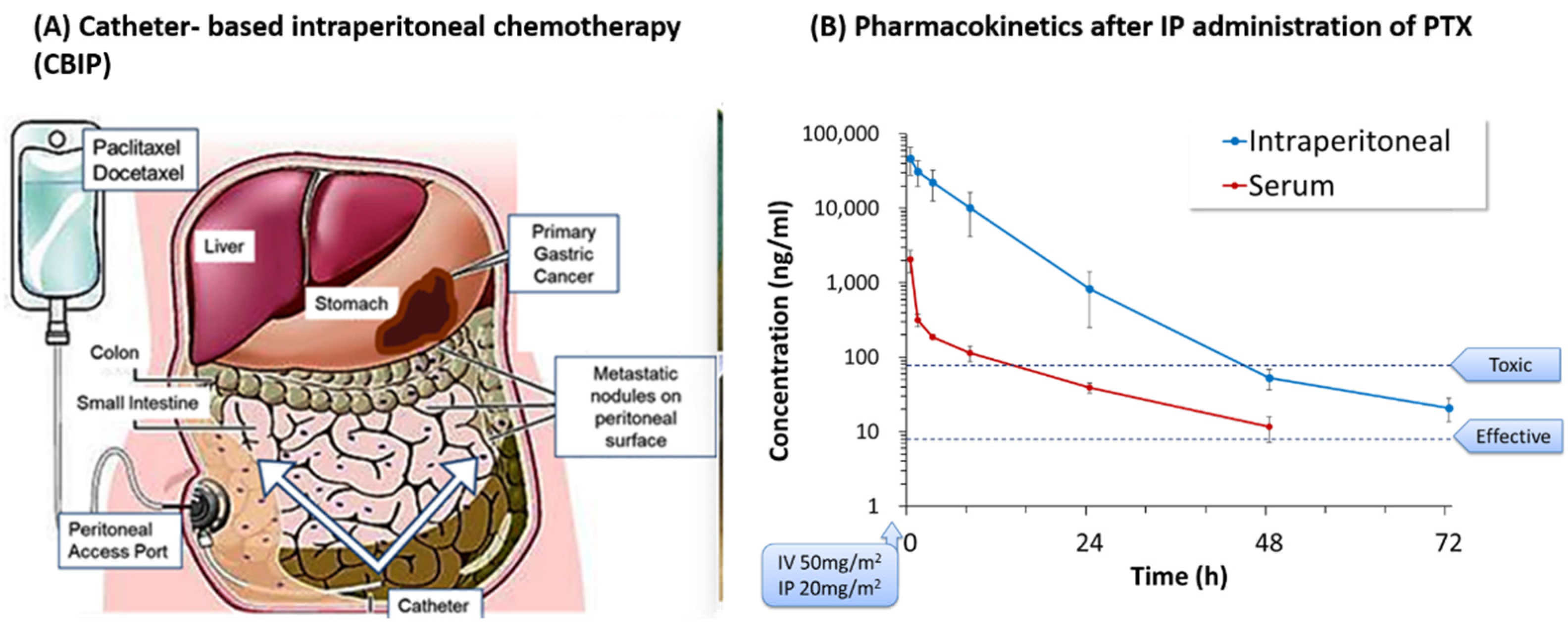
Figure 2.
Infiltration of paclitaxel (PTX) into peritoneal tumor after intraperitoneal administration. Intratumoral distribution in peritoneal tumors after intravenous (IV) or intraperitoneal (IP) injection of PTX nanoparticles. Peritoneal tumors were established by IP inoculation of the human gastric cancer cell line MKN45P. Oregon Green–conjugated PTX nanoparticles (100 μg) were administered either IV via the tail vein or directly into peritoneal cavity (IP). After 24 h, peritoneal tumors were resected, and fluorescein intensity was evaluated in tissue sections. A representative line corresponding to the deepest apparent penetration of green fluorescent PTX was defined (red arrow), and fluorescence intensity along the line was measured and plotted. The maximal depth of PTX penetration after IP administration in each tumor is objectively measured.
Figure 2.
Infiltration of paclitaxel (PTX) into peritoneal tumor after intraperitoneal administration. Intratumoral distribution in peritoneal tumors after intravenous (IV) or intraperitoneal (IP) injection of PTX nanoparticles. Peritoneal tumors were established by IP inoculation of the human gastric cancer cell line MKN45P. Oregon Green–conjugated PTX nanoparticles (100 μg) were administered either IV via the tail vein or directly into peritoneal cavity (IP). After 24 h, peritoneal tumors were resected, and fluorescein intensity was evaluated in tissue sections. A representative line corresponding to the deepest apparent penetration of green fluorescent PTX was defined (red arrow), and fluorescence intensity along the line was measured and plotted. The maximal depth of PTX penetration after IP administration in each tumor is objectively measured.
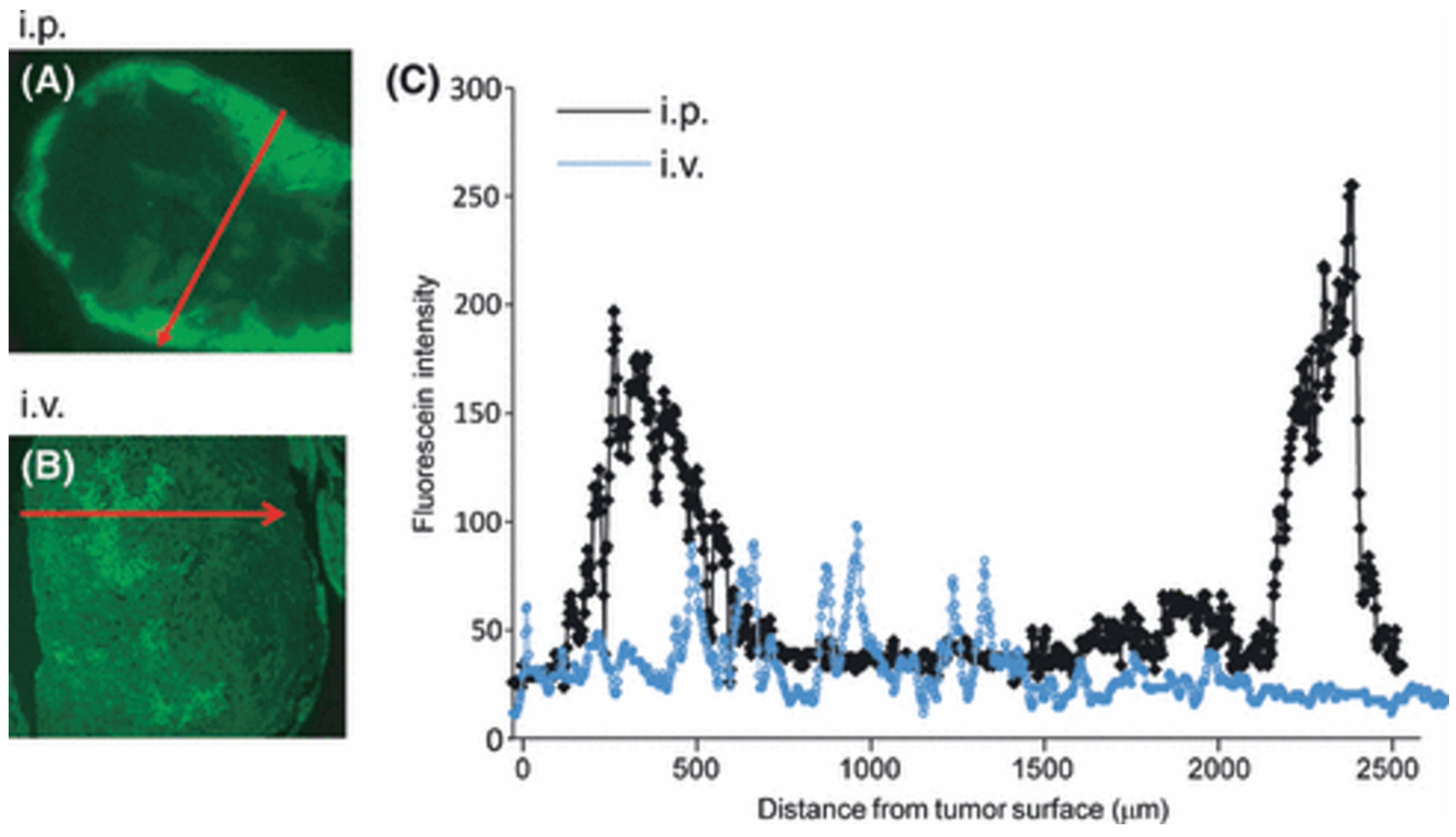

Table 1.
Efficacy of Catheter-based intraperitoneal chemotherapy (CBIP) using PTX for Patients with PM.
Table 1.
Efficacy of Catheter-based intraperitoneal chemotherapy (CBIP) using PTX for Patients with PM.
| Author, Year | PTX dose (mg/m2) | Systemic regimen | Study | n | MST | 1y-OS | Response rate | Cytology negative conversion rate | conversion Surgery rate |
Grade3/4 Neutro-penia | Major Grade3/4 non-hematological Toxicity | Ref. |
|---|---|---|---|---|---|---|---|---|---|---|---|---|
| Gastric cancer | ||||||||||||
| Ishigami H, 2010 | 20 | S-1+PTX | P2 | 40 | 22.5M | 78.0% | 10/18 (55.6%) | 86.0% | 37.5% | 38.0% | Nausea vomit: 8%, Anorexia:5% | [45] |
| Yamaguchi H, 2013 | 20 | S-1+PTX | P2 | 35 | 17.6M | 77.1% | 5/7 (71.4%) | 97.0% | 31.4% | 34.0% | Nausea vomit:3% | [46] |
| Ishigami H, 2016 | 20 | S-1+PTX | P3 | 114 | 17.7M | 71.9% | 9/17 (52.9%) | 95.0% | 45.7% | 50.0% | Nausea vomit: 10%, Anorexia 10%, Febrile neutropenia 8% | [47] |
| Fujiwara, 2016 | 40 | S-1+L-OHP | P2 | 60 | ND | 71.5% | 4/6 (67.7%) | 71.0% | 35..9% | 50.0% | Anorexia 12%, Febrile neutropenia 6% | [48] |
| Saito S, 2021 | 40 | S-1+L-OHP | P2 | 44 | 25.8M | 79.5% | 2/3(67.7%) | 86.0% | 45.0% | 39.0% | Febrile neutropenia 5% | [49] |
| Chia, DKA, 2023 | 40 | Cap+L-OHP | P2 | 44 | 14.6M | 67.8% | ND | 70.5% | 29.5% | 18.0% | Febrile neutropenia 14% | [55] |
| Tu, L, 2023 | 80 | S-1+L-OHP | P2 | 49 | 16.9M | 81.6% | 21/47 (51.2%) | ND | 26.5% | 40.8% | Nausea vomit: 22.5%, Diarrhea 12.2%, | [52] |
| Yang ZY, 2022 | 20 | S-1+PTX | P2 | 67 | 19.3M | 67.2% | 22/64 (34.4%) | 67.2% | 62.9% | 26.9% | Liver dysfunction 9% | [59] |
| Zhao S, 2022 | 80 | mFOLFOX | P2 | 29 | 11.0M | ND | 11/29 (37.9%) | ND | ND | 34.5% | Diarrhea20.7% | [54] |
| Seo WL, 2025 | 80 | Cap+CDDP | P2 | 28 | ND | 76.9% | 10/24 (41.7%) | ND | ND | 41.7% | [51] | |
| Kobayashi D, 2024 | 20 | S1+CDDP | P2 | 53 | 19.4M | 73.6% | ND | 64.0% | 30.0% | 24.0% | Diarrhea 13%, Anorexia 17% | [57] |
| Yan C, 2026 | 20 | S-1+PTX | P3 | 148 | 17.7M | 69.6% | ND | ND | 50.7% | 19.9% | Fatigue 7.7%,Anorexia 5.1% | [58] |
| Pancreatic cancer | ||||||||||||
| Satoi S, 2017 | 20 | S-1+PTX | P2 | 33 | 16.3M | 62.0% | 12/33(36.4%) | 55.0% | 24.2% | 42.0% | Febrile neutropenia 14% Anorexia 12% | [67] |
| Yamada S, 2020 | 20 | GEM+nab-PTX | P1/2 | 46 | 14.5M | 61.0% | 21/46 (45.6%) | 76.0% | 39.1% | 69.6% | Anorexia 20% | [68] |
| Colorectal cancer | ||||||||||||
| Murono K, 2019 | 20 | mFOLFOX6+Bmab or CapeOX+ Bmab | P1/2 | 6 | 29.3M | ND | 3/6(25%) | ND | ND | 16.7% | Nausea vomit: 16.7%, Abdominal pain:16.7% | [81] |
Disclaimer/Publisher’s Note: The statements, opinions and data contained in all publications are solely those of the individual author(s) and contributor(s) and not of MDPI and/or the editor(s). MDPI and/or the editor(s) disclaim responsibility for any injury to people or property resulting from any ideas, methods, instructions or products referred to in the content. |
© 2026 by the authors. Licensee MDPI, Basel, Switzerland. This article is an open access article distributed under the terms and conditions of the Creative Commons Attribution (CC BY) license (http://creativecommons.org/licenses/by/4.0/).
Copyright: This open access article is published under a Creative Commons CC BY 4.0 license, which permit the free download, distribution, and reuse, provided that the author and preprint are cited in any reuse.


