

Submitted:
04 June 2026
Posted:
05 June 2026
You are already at the latest version
Abstract
Although economic complexity (ECI) is closely linked to structural transformation, its implications for inclusive green growth (IGG) remain underexplored, particularly in sub-Saharan Africa (SSA). Notably, there is a knowledge gap on how progress in ECI affects IGG. Second, there is a policy gap concerning how progress in energy equity conditions the impact of ECI on IGG. We address these gaps by employing cross-country data from 35 SSA countries for the period 2010-2020. Findings based on Lewbel’s (2012) two-stage least squares and Driscoll–Kraay’s (1998) robust standard errors estimators reveal that ECI does not promote IGG. Particularly, we find that although ECI promotes economic growth, it comes at the expense of income equity and environmental sustainability. The contingency analysis also demonstrates that while improving energy equity amplifies (mitigates) the growth effect (inequality downside) of ECI, it exacerbates the environmental cost. These findings underscore the need for policymakers to design complementary and compensatory policy mechanisms that ensure SSA’s drive toward economic complexity translates into greener and more inclusive growth.
Keywords:
economic complexity
; environmental cost
; energy equity
; inclusive green growth
; SSA
1. Introduction
Global interest in inclusive green growth, a development paradigm that promotes economic growth, income equity and environmental sustainability, has intensified in the past decade. Consistent with this global shift, Sub-Saharan African (SSA) countries are seeking pathways to achieve resilient, inclusive, and greener growth (Ofori et al., 2024; Sachs et al., 2021; Fay, 2012). Within this agenda, the role of economic complexity, defined as a country’s accumulation of productive knowledge and capabilities as reflected in the diversity and sophistication of its goods and services (Hidalgo & Hausmann, 2009), has been overlooked, leaving pressing knowledge and policy gaps in the literature.
The role of economic complexity (ECI) in IGG in the SSA demands closer investigation, as evidence from advanced economies highlights its impacts on growth, inequality, and the environment. (see e.g., Hartmann et al., 2017; Can & Gozgor, 2017; Pugliese et al., 2017; Lee & Vu, 2019). On the one hand, research has shown that the transition from a predominantly agrarian economy to a highly industrial, knowledge-intensive one can trigger high energy consumption and environmental footprint (Ahmed et al., 2022; Rafique et al., 2022). For instance, progress in ECI can undermine environmental quality by degrading forest resources, water bodies, air quality, and arable land (Khan et al., 2022). Additionally, the expansion of agriculture, mining, construction, and manufacturing activities inherent in more complex economies can intensify the release of pollutants, such as cadmium, chromium, lead, and radionuclides, into soil and water systems, thereby posing significant threats to biodiversity. Besides, in SSA, where economic activity is largely informal and human capital levels remain relatively low, ECI can also exacerbate income inequality.
Another strand of literature also contends that ECI can foster inclusive growth and environmental sustainability by enhancing economic connectedness, diversification, and green innovation (Bhorat et al., 2019; Hausmann & Hidalgo, 2014, 2011). In SSA, where considerable scope for economic transformation exists, ECI can stimulate private sector development by increasing sectoral linkages, enhancing global value chain participation, and improving competitiveness. Through industrial upgrading, upskilling, and job creation, ECI can also contribute to poverty reduction and social inclusion. Moreover, the sectoral interconnectedness characteristic of complex economies can enhance access to essential services such as healthcare, education, clean water, and recreation (Hidalgo & Hausmann, 2009). From an environmental perspective, ECI can reduce energy intensity and ecological footprint by promoting recycling, reuse, and the adoption of green innovation, particularly in waste treatment, renewable energy production, and sustainable food systems (Romero & Gramkow, 2021; Gramkow & Anger-Kraavi, 2018).
Consistent with the complex dynamics linking ECI and development, we also examine the role of energy equity, defined by Baker et al. (2019) as fair and equitable access to electricity for all segments of the population, irrespective of location, race, socioeconomic status, or political affiliation, in the ECI–IGG relationship. This focus is crucial from both policy and scholarly perspectives, as reliable electricity access is critical to sustaining the productive structures that underpin complex economic systems. Put differently, affordable electricity is a prerequisite for transitioning from a predominantly primary-sector economy to a highly productive, knowledge-driven one (Hidalgo, 2021). Our emphasis on energy equity is reinforced by IEA (2024), which indicates that SSA faces severe energy poverty and pronounced urban–rural disparities in electricity access. Further, IEA (2024) notes that SSA relies heavily on non-renewable sources for both domestic and industrial use. In such contexts, advancing ECI without addressing energy inequities risks exacerbating income inequality and accelerating environmental degradation. However, the existing literature on economic development offers no empirical evidence on how energy equity interacts with ECI to affect IGG in SSA.
Although previous studies have examined the effects of energy efficiency, institutional quality, economic globalisation, and digital infrastructure on IGG (see e.g., Ofori et al., 2024, 2023; Abid et al., 2021) in developing countries, there is a research gap regarding how economic complexity and energy equity affect IGG in SSA. Additionally, a pressing knowledge gap exists regarding how energy equity moderates the impact of economic complexity on IGG. This study bridges these gaps by addressing the following research questions:
- How does economic complexity affect inclusive green growth in developing economies?
- What is the impact of energy equity on inclusive green growth in developing economies?
- Does progress in energy equity condition economic complexity to promote inclusive green growth?
To this end, we employ macro data for 35 SSA countries over the period 2010–2020 for the analysis. Robust evidence, based on Lewbel’s (2012) two-stage least squares and Driscoll–Kraay’s (1998) standard errors robust estimators, reveals that economic complexity does not foster inclusive green growth in SSA. Notably, our findings suggest that although economic complexity promotes economic growth, it also exacerbates income inequality and compromises environmental quality. The contingency analysis also demonstrates that improvements in energy equity act as a complementary and compensating mechanism, amplifying the growth-enhancing effect of economic complexity while mitigating its impact on inequality. However, a trade-off emerges, as the findings further suggest that energy equity intensifies the environmental degradation downside of economic complexity.
Through these findings, we make three significant contributions to the structural transformation and economic development literature. First, we estimate the extent to which the accumulation of productive knowledge affects IGG in SSA, building on the emerging literature on ECI’s socioeconomic and environmental effects in advanced economies (see e.g., Hidalgo, 2021; Vu, 2020; Shahzad et al., 2022; Romero & Gramkow, 2021; Can & Gozgor, 2017). Policy-wise, we provide evidence on whether investments in research, innovation, and productive capabilities can deliver greener and more inclusive growth in SSA. Second, we assess the role of energy equity within the framework of distributional energy justice. Notably, we demonstrate how reducing energy access disparities in energy-poor and insecure regions impacts inclusive green growth, providing insights for institutions such as the African Development Bank, the International Energy Agency, the World Bank, and the United Nations. Third, we investigate the contingent effect of energy equity in the economic complexity and IGG nexus, providing policy guidance on whether simultaneous investment in productive capacity and equitable energy systems is a key driver of greener and more inclusive transformation in SSA.
2. Literature Review
2.1. Economic Complexity and Inclusive Green Growth: Theoretical Underpinnings
This study draws on multiple theoretical perspectives to establish the link between ECI and IGG within the broader framework of economic development. From the growth perspective of IGG, the structural change theories of Lewis (1954) and Rostow (1959) posit that the transition from a low-productivity, agrarian economy to a more industrialised and sophisticated one requires the accumulation of productive knowledge and technical expertise. This manifests in manufacturing trajectories that evolve from producing simple goods to more technologically advanced and complex products (Bhorat et al., 2019; Hausmann & Hidalgo, 2011). In this way, increasing economic complexity can accelerate structural transformation by fostering the emergence of knowledge-intensive sectors capable of producing complex goods that yield higher returns (Hoeriyah et al., 2022). This argument is reinforced by both endogenous growth theory and Schumpeterian growth theory, which position innovation as a critical driver of structural transformation, private-sector productivity and economic growth through the development of novel products and production processes (Romer, 1994; Schumpeter, 1934).
On the empirical front, a substantial body of research reports a positive association between economic complexity and economic growth. For instance, Zhu and Li (2017), employing the method of reflections for a sample of 210 countries, report that economic complexity exerts a positive effect on growth in both the short and long run. Similarly, Tabash et al. (2022) find that economic complexity has a positive influence on growth in 24 African economies over the period 1995–2017. Likewise, Stojkoski et al. (2023) reveal that economies with higher levels of complexity realise faster long-term growth trajectories. Using data from 31 OECD countries between 1982 and 2017, Udeogu et al. (2021) also estimate a positive real output growth effect of economic complexity in 31 OECD countries, evidence that is corroborated by Hoeriyah et al. (2022), who find that economic complexity positively affects economic growth in 86 developing countries from 2010 to 2019. In addition, Canh and Thanh (2022), applying a range of econometric techniques to a panel of 70 economies spanning 1996–2014, demonstrate that economic complexity enhances growth stability, particularly in high-income countries— a conclusion further supported by Güneri and Yalta (2021), who find a positive link between economic complexity and economic stability.
Nevertheless, some scholars caution that the benefits of economic complexity may require considerable time to materialise as broad-based economic development gains. For instance, Mesagan and Vo (2024) find that economic complexity promotes economic growth only in the long run, exerting a negative impact in the short term. Similarly, Stojkoski and Kocarev (2017) conclude that economic complexity significantly enhances long-run growth dynamics. However, in a recent study encompassing 30 African countries, Ogbuabor et al. (2025) identify an adverse effect of economic complexity on sectoral performance in agriculture and manufacturing. The authors attribute this outcome to the relatively low complexity levels and weak institutional capacity of African countries.
From an inclusive growth perspective, economic complexity has the potential to stimulate sustained growth by fostering broad-based education, improving healthcare provision, and expanding access to essential services such as clean water and electricity (Lapatinas, 2016; Hidalgo & Hausmann, 2009). However, its equity implications remain the subject of considerable debate. On the one hand, greater economic complexity can reduce income inequality by transforming occupational structures, enhancing employment opportunities and contributing to poverty reduction (Hartman et al., 2017; Constantine, 2017). On the other hand, the high technological adoption characteristic of industrial and knowledge-intensive economies, as highlighted in the skills-biased technological change theory, can exacerbate inequality. This arises because technological progress disproportionately benefits skilled workers, whose enhanced capabilities command higher wages compared to their unskilled counterparts (Acemoglu, 2002).
The empirical literature on the relationship between economic complexity and income inequality remains highly contested. A portion of this body of work suggests that rising economic complexity is associated with widening income disparities. For example, Chu and Hoang (2020), analysing data from 88 countries between 2002 and 2017, find a significant positive link between economic complexity and income inequality. Similarly, Lee and Vu (2020) report a positive relationship between economic complexity and inequality across 96 countries. Within-country analysis by Ivakhnenko et al. (2024) also reveals that regions with more complex economies tend to experience higher income inequality compared to their less complex counterparts.
Conversely, other studies suggest that economic complexity can contribute to income inequality reduction. For example, Gómez-Zaldívar et al. (2022) demonstrate in the case of Mexico that higher levels of economic complexity are associated with lower inequality. Likewise, Lee and Wang (2021), in a panel study of 43 countries spanning 1991 to 2016, conclude that advancement in economic complexity is associated with reductions in income inequality, but only in countries with low levels of risk. This evidence is further corroborated by recent research emphasising the non-linear relationship between economic complexity and income inequality. For instance, Sepehrdoust et al. (2022) demonstrate that, in middle-income countries, economic complexity initially intensifies income inequality but begins to reduce it once a critical threshold of complexity is reached.
In terms of the environment, the theoretical underpinnings of IGG are often drawn from Grossman and Krueger’s (1991) environmental Kuznets curve hypothesis. This framework posits that the transition from a predominantly agrarian economy to one that is highly industrialised, technologically complex, and service-oriented can, beyond a certain threshold, enhance environmental quality. Central to this proposition is the view that economically complex nations are more likely to deploy environmentally friendly technologies and/or invest in research and development aimed at promoting environmental sustainability (Romero & Gramkow, 2021; Paramati et al., 2022; Shahzad et al., 2022; Lapatinas et al., 2019; Ahmad et al., 2022). To illustrate, Stojkoski et al. (2023) argue that advancements in economic complexity, driven by green technology production, research, and sustainable trade, can promote IGG. Such outcomes are plausible given that the accumulation of knowledge and skills, coupled with greater product diversity and ubiquity within industrial systems, tends to mitigate pressure on natural capital. However, a contrasting body of research warns that economic complexity can undermine environmental sustainability. This can occur through the expansion of industrial output, increased energy consumption, and increased exploitation of natural resources (Liu et al., 2021; Ntang et al., 2024).
Empirical evidence on the environmental implications of economic complexity is emerging rapidly, albeit with mixed results. Using time-series data for France, Can and Gozgor (2017) find that advancements in economic complexity reduce CO₂ emissions in the long run. Similarly, Doğan et al. (2021) report that economic complexity mitigates environmental degradation in 28 OECD countries between 1990 and 2014. In a recent study, Lee and Olasehinde-Williams (2024) present strong evidence that economic complexity improved environmental performance in OECD countries between 2007 and 2016. Boleti et al. (2021) further show that economies producing more sophisticated goods tend to record better environmental performance, such as quality health, biodiversity, water, and sanitation; however, this comes at the cost of poor air quality. Likewise, Doğan et al. (2019) find that while economic complexity reduces CO₂ emissions in high-income countries, it exacerbates environmental degradation in lower- and upper-middle-income economies.
However, Neagu (2020), examining 48 highly complex economies, finds that economic complexity exacerbates ecological deficits. Similarly, Yilanci and Pata (2020) demonstrate that, in China, economic complexity increases the ecological footprint in both the short and long run over the period 1965–2016. Shahzad et al. (2023) report similar results for the G7 countries, using instrumental variable regression and conditional quantile regression estimation techniques. Country-specific evidence from Colombia also suggests that economic complexity negatively impacts environmental quality (Laverde-Rojas et al., 2021). This finding is reinforced by studies that economic complexity adversely affects environmental sustainability in low-income countries (Ntang et al., 2024), but improves environmental quality in upper-middle- and high-income countries (Adedoyin et al., 2021). Similarly, Khezri et al. (2022) find that, in 29 Asia–Pacific countries over the period 2000–2018, economic complexity initially increases emissions but contributes to CO₂ emissions reduction in the long run through improvements in energy efficiency.
2.2. The Link Between Economic Complexity, Energy Equity and Inclusive Green Growth
Energy is intrinsically linked to economic complexity. Reliable access to electricity is a fundamental enabler of large-scale production, underpinning industrial diversification, innovation, and sustained economic growth. As implicitly recognised in neoclassical growth theory, energy constitutes a vital input in the production process; accordingly, its utilisation in the manufacture of complex goods carries significant implications for advancing inclusive green growth (see, Shahzad et al., 2023; Apergis & Payne, 2009). Moreover, within the framework of distributional energy justice, equitable access to electricity across all segments of the population, regardless of their political affiliation, race, location, gender, and economic status, can promote broad-based economic development (see Baker et al., 2019, p.5). This is particularly critical in SSA, where electricity access gaps between urban and rural populations remain stark.
On the one hand, the production of complex goods is inherently energy-intensive, which can incentivise firms and governments to invest in innovations that enhance energy efficiency. Such advancements can create pathways through which electricity consumption can contribute to inclusive green growth, even within highly complex economies (Adekoya et al., 2023). Indeed, highly complex economies, characterised by knowledge-intensive industries and a skilled workforce, are generally better positioned to develop and deploy sustainable energy solutions for eco-friendly production (Romero & Gramkow, 2021).
On the other hand, if progress towards energy equity relies heavily on fossil fuels, it may exacerbate the environmental footprint through higher greenhouse gas emissions. This is because greater energy demand arising from expanded access and economic activity can intensify emissions, even with a modern energy supply, if the energy mix is not predominantly renewable. This is plausible in SSA, where a large proportion of the population uses unclean production technologies (IEA, 2024). In this context, energy equity can condition economic complexity to increase environmental degradation. Finally, from an income growth and equity standpoint, expanding energy equity in predominantly informal economies without complementary policies to foster its productive use in education, healthcare, business, and job creation can inadvertently exacerbate inequality. As Büchs et al. (2023) note, the benefits of clean energy adoption often accrue disproportionately to affluent households and firms.
2.3. Gaps in the Literature and Novelty of the Paper
Our review reveals that the impacts of economic complexity and energy equity on inclusive green growth in SSA remain unexplored. This gap is critical, as many SSA economies are locked in low-sophistication production structures, while persistent energy inequities hinder inclusive and sustainable development. We address these knowledge and policy gaps, extending the work of Stojkoski et al. (2023), Tabash et al. (2022), and Ntang et al. (2024), who examine economic complexity’s effects on growth and environmental quality in Africa, but neither focus specifically on SSA nor consider energy equity’s moderating role. We contribute to the literature by employing an empirical strategy that yields unbiased and consistent estimates even in the presence of cross-sectional dependence, serial correlation, heteroskedasticity, and endogeneity. Finally, we account for potential outlier effects by isolating South Africa from the sample to verify the robustness of our results.
3. Methods and Data
3.1. Data and Justification for the Inclusion of Variables
This study assesses the role of economic complexity and energy equity in inclusive green growth using macro data from 2010 to 2020 for 35 SSA countries. Notably, the economic complexity data for several SSA countries, such as Chad, Eritrea, Madagascar, South Sudan, Zimbabwe, and São Tomé and Príncipe, are either scant or missing for a substantial portion of the study period, necessitating their exclusion from the sample. Moreover, although economic complexity data from the Observatory of Economic Complexity are available from 2008 to 2020, the first two years were dropped to minimise data loss and maximise the robustness of the analysis.
According to Fay (2012), growth constitutes development only when it is both inclusive and environmentally sustainable. Inclusive green growth thus integrates three core domains: economic expansion, equitable income distribution, and environmental sustainability. These dimensions operate as interdependent constraints, such that assessing them jointly is essential to avoid misleading inferences based on improvements in any single metric. Accordingly, following Stojkoski et al. (2023), we conceptualise inclusive green growth through three interconnected dimensions: economic growth, income inequality, and greenhouse gas emissions. We compute economic growth as the natural logarithm of the first difference of real gross domestic product (GDP) in constant 2015 prices. Within-country income inequality is also measured using the Palma ratio, defined as the share of national income held by the wealthiest 10% of the population divided by the share held by the poorest 40%. A higher Palma ratio, therefore, reflects greater income disparity between the wealthiest and poorest segments of society. We also proxy environmental quality by total greenhouse gas emissions in kilotons of CO₂ equivalent. Data for economic growth and greenhouse gas emissions are sourced from the World Development Indicators (World Bank, 2025), while inequality data are retrieved from the World Income Inequality Database (UNU-WIDER, 2025). To assess the robustness of our estimates, we employ alternative indicators for each dimension. We measure economic growth as the log difference of GDP in 2017 purchasing power parity (PPP) terms; income inequality by the Gini coefficient, which denotes how income distribution within the population deviates from perfect income equality; and environmental sustainability by total carbon dioxide emissions (kilotons).
Our primary explanatory variable is economic complexity (ECI), developed by Hidalgo and Hausmann (2009) and accessed from the Observatory of Economic Complexity. Economic complexity is an index, capturing the stock of productive knowledge embedded in an economy’s export basket, measured in terms of diversity and ubiquity. The index ranges from -3 (least complex economies) to +3 (most complex economies).
We also consider energy equity as a moderating variable, measured as the ratio of the rural population with access to electricity to the urban population with access to electricity. From a distributional energy justice perspective (Baker et al., 2019)1, equity in electricity access is expected to complement economic complexity in fostering inclusive and green growth by stimulating economic activity, reducing income disparities, and mitigating environmental degradation through reduced reliance on solid fossil fuels. The data are obtained from the World Development Indicators (World Bank, 2025). We acknowledge, however, that this measure captures only one dimension of energy equity: the spatial disparity in electricity access between rural and urban populations2.
In line with best practices in multiple regression analysis, we control for key variables to mitigate omitted variable bias and account for institutional quality, capital flows, financial development, resource allocation, and digital infrastructure. Given theoretical and econometric considerations, we specify distinct control sets for each model. In the growth model, we include foreign direct investment, human capital, private investment, internet access, and corruption control (Tabash et al., 2022; Udeogu et al., 2021; Hoeriyah et al., 2022; Peprah et al., 2019). For the income inequality model, we control for corruption, foreign direct investment, financial development, remittances, and human capital in the conditioning information set (Adams et al., 2025; Lee & Vu, 2020; Feenstra et al., 2015; Svirydzenka, 2016). Finally, in the environmental sustainability model, we follow the sustainable development literature by controlling for foreign direct investment, internet access, financial development, human capital, and remittances (see, e.g., Saud et al., 2023; Ahmed et al., 2022; Rafique et al., 2022). Table 1 presents a comprehensive description of all variables, their symbols, and the data sources.
3.2. Empirical Model Specifications
Consistent with the theoretical foundations outlined in Section 2 and in line with the emerging scholarly discourse on the non-linear effects of economic complexity on economic development, we follow the approach of Ofori et al. (2024) and Stojkoski et al. (2023) by modelling the growth dimension of IGG as:
In Equation (3), signifies environmental quality and is proxied by the log of greenhouse gas emissions. All other symbols are as previously defined, except for and , which refer to the country-specific environmental effects and the intercept of the environment model, respectively. It is important to note that the parameters of primary interest in our analysis are , and , which respectively capture the direct effects of economic complexity on economic growth, income inequality, and environmental quality. Furthermore, we place particular emphasis on , and to determine whether economic complexity and energy equity interact in a way that fosters economic growth, reduces income inequality, or improves environmental sustainability. The corresponding total effects from Equations 1-3 are specified respectively as:
3.3. Econometric Issues and Estimation Strategy
From an econometric perspective, employing macro data for cross-country analysis poses several challenges that must be addressed to ensure reliable inference and policy recommendations. Research shows the common issues associated with panel datasets include autocorrelation, cross-sectional dependence, the influence of outliers, and endogeneity. To assess the presence of autocorrelation, we employ Wooldridge’s (2002) test for serial correlation in panel data. Cross-sectional dependence is also evaluated using both the temporal test proposed by Juodis and Reese (2021) and the method outlined by Fan et al. (2015). The Juodis and Reese test is based on the null hypothesis of weak cross-sectional dependence against the alternative of strong cross-sectional dependence, whereas Wooldridge’s test examines the null hypothesis of no first-order autocorrelation against the alternative of first-order autocorrelation.
The results, reported in Table A2, indicate test statistics of 109.377 and 233.33 for the Wooldridge (2002) and Fan et al. (2015) tests, respectively. Both statistics are statistically significant at the 1% level, providing strong evidence of the presence of autocorrelation and cross-sectional dependence in the dataset. These findings underscore the need for estimation techniques that explicitly account for such violations to avoid biased and inconsistent results.
The overview of the economic complexity in Figure 1 also suggests that outliers should be accounted for in the estimation process. Notably, South Africa is the only SSA country with an ECI score greater than zero, indicating a structural deviation from the rest of the sample. Additionally, the issue of endogeneity warrants careful consideration in our empirical approach. In the growth model (Equation 1), endogeneity may arise from potential reverse causality between economic growth and variables such as foreign direct investment and private investment. Furthermore, endogeneity arising from measurement error is plausible because the human capital variable, which we proxy by mean years of schooling and returns to education, omits critical dimensions such as work experience, cognitive ability, and health status.
Similarly, in the income inequality model (Equation 2), the inclusion of corruption control as an explanatory variable raises the possibility of endogeneity. This concern is supported by the evidence in Table 2, which highlights significant institutional weaknesses in addressing corruption. As argued by Acemoglu and Robinson (2012), weak institutions can perpetuate income inequality, while, conversely, high levels of income inequality can entrench the dominance of political elites, thereby undermining the capacity and autonomy of institutions to combat corruption. Such bidirectional relationships necessitate the use of estimation techniques that correct for potential endogeneity to ensure credible and unbiased results.
Accordingly, we employ two standard estimators: Lewbel’s (2012) two-stage least squares and Driscoll and Kraay’s (1998) pooled least squares estimators, which collectively address serial correlation, endogeneity, outliers in the data, and cross-sectional dependence. Three principal considerations inform the choice of the Driscoll and Kraay (1998) [DCK] estimator for this study. First, as Hoechle (2007) demonstrates, the DCK estimator is well-suited for both balanced and unbalanced panel datasets and is capable of handling missing observations without compromising efficiency. Second, the estimator is specifically designed to produce robust standard errors in the presence of complex error structures, including both temporal dependence and cross-sectional dependence (De Hoyos & Sarafidis, 2006). Third, the DCK framework accommodates heteroskedasticity and serial correlation, both of which are inherent challenges in long-period panel datasets of heterogeneous cross-sectional units.
While the DCK estimator addresses several econometric complications, it does not, by itself, resolve the problem of endogeneity. Econometrically, instrumental variable methods are employed to correct for endogeneity; however, the reliability of such techniques is critically dependent on the availability of valid and strong instruments— variables that are both highly correlated with the endogenous regressor(s) and satisfy the orthogonality condition. In practice, identifying such instruments can be problematic, as they may be weak, invalid, or only weakly correlated with the endogenous regressors, thereby undermining the credibility of inference and limiting the robustness of policy recommendations.
To circumvent these limitations, this study employs the Lewbel (2012) two-stage least squares estimator, which offers a robust alternative in contexts where conventional instruments are unavailable or weak. Unlike approaches such as the two-step system GMM estimator of Roodman (2009), Lewbel’s approach constructs instruments internally from the model itself, exploiting a heteroskedasticity-consistent identification procedure. The procedure operates in two stages: in the first stage, the endogenous variable(s) are regressed on the exogenous covariates to obtain residuals; in the second stage, these residuals are then used to generate instruments that satisfy the requisite orthogonality conditions without reliance on traditional exclusion restrictions. This method has been shown to yield consistent and efficient estimates under standard regularity conditions and has been applied in a growing body of empirical literature (see e.g., Opoku-Mensah et al., 2025; Opoku et al., 2023; Millimet & Roy, 2016). Further, we explicitly examine the sensitivity of the estimates by excluding the influence of South Africa in the sample.
4. Results and Discussion
4.1. Summary Statistics
Table 2 presents the summary statistics of the variables. The data show a mean greenhouse gas emissions value of 61727.8 Kilotons (kt) of CO2 equivalent, with a large standard deviation of 106,769 kt, pointing to considerable cross-country heterogeneity in emission levels across SSA. Similarly, the mean of income inequality, which we proxy by the Palma ratio, is 5.009, suggesting that the proportion of income held by the top 10% wealthiest people in SSA is at least five times higher than that of the poorest 40%. The Gini index further corroborates this picture, averaging 55.205 on a scale of 0 to 100, a value that places SSA among the most unequal regions globally. Regarding our key moderating variable, energy equity, the mean value is 0.352, implying that, on average, rural electricity access stands at only about 35% of urban electricity access across the sampled countries. The wide standard deviation of 0.305 and a range spanning from 0.014 to 1.004 signal notable variation in energy access disparities across SSA, with some countries approaching near-parity between rural and urban access and others exhibiting extreme urban concentration of electricity supply.
Financial development also averaged 0.168 (16.8%), which indicates that the financial systems of the sampled countries remain in the early stages of development. The mean values for corruption control and foreign direct investment stand at –0.542 and 4.585%, respectively. The former underscores the persistent institutional weaknesses in addressing corruption across much of SSA, while the latter reflects the relatively substantial inflows of external finance to the continent over the past two decades. Regarding our primary independent variable, economic complexity, the average score is –0.844, indicating that the sampled economies possess a narrow productive capacity or knowledge base, consistent with Hartmann et al. (2017), who argue that such economies typically specialise in the production of less sophisticated goods. It is worth noting that ECI scores are standardised around a global mean of zero, such that negative values indicate below-average complexity relative to the world distribution. The mean score of –0.844 therefore reflects SSA’s concentration in less diversified, commodity-dependent productive structures, with limited engagement in knowledge-intensive manufacturing or services. The minimum value of –2.186 and maximum of 0.399 further illustrate the wide disparity in productive sophistication among the sampled countries.
However, Figure 1 reveals significant variability in the economic structures of the sampled countries. Except for South Africa, all countries in the sample record low levels of economic complexity. In particular, Gabon, Angola, Sudan, Burkina Faso, and the Republic of Congo rank among those with the least complex economic structures. The dominance of primary commodity exports and the limited diversification of their productive bases explain their persistently low ECI scores. South Africa’s outlier status reflects its comparatively advanced manufacturing sector, financial services, and export diversification, which distinguish it markedly from the rest of the SSA sample. This structural deviation motivates the sensitivity analysis conducted in Section 4.3, where we re-estimate the baseline models excluding South Africa to ensure that our findings are not driven by this single influential observation.
Figure 2 illustrates the correlation between economic complexity and each of the three dimensions of inclusive green growth: economic, social, and environmental. The upper-left panel shows a strong positive relationship between economic complexity and economic growth (proxied by real GDP), indicating that countries with higher ECI scores tend to have larger economies. The upper-right panel reveals a positive association between ECI and income inequality (proxied by the Palma ratio), suggesting that as economies become more complex, income disparities may widen, a pattern consistent with skills-biased technological change, where the returns to complexity-intensive activities accrue disproportionately to skilled workers. The lower panel displays a strong positive relationship between ECI and greenhouse gas emissions. This implies that structural transformation toward more complex productive structures is accompanied by rising environmental pressures, at least at SSA’s current stage of development. Precisely, the correlation between economic complexity and greenhouse gas emissions appears particularly steep, suggesting that higher economic complexity may not necessarily foster equitable income distribution or improved environmental quality. While these preliminary bivariate patterns are informative and motivate the study’s empirical investigation, they are descriptive in nature and do not account for confounding factors or reverse causality. We therefore subject the data to rigorous multivariate analysis to ensure the robustness and reliability of our inferences, explicitly addressing panel data challenges such as autocorrelation, endogeneity, and cross-sectional dependence in the sections that follow.
4.2. Presentation of the Main Results
This section presents findings for the effect of economic complexity across the three dimensions of inclusive green growth. The estimations are conducted using the Lewbel (2012) two-stage least squares and Driscoll and Kraay (1998) standard errors robust estimators, which account for potential endogeneity and cross-sectional dependence, respectively. Each table follows a structure organised across eight columns. The first four columns report results for the first outcome measure (real GDP or Palma ratio or greenhouse gas emissions), while columns 5–8 replicate the same specifications for the second outcome measure (nominal GDP or Gini index or CO₂ emissions). Within each set of four columns, Column 1 presents the baseline model with only control variables, Column 2 adds the economic complexity index (ECI), Column 3 further introduces the energy equity variable (ENEREQ), and Column 4 includes the interaction term between ECI and ENEREQ to test the moderating effects. This approach allows us to assess the robustness of each variable’s effect and isolate the independent and joint contributions of economic complexity and energy equity to each dimension of inclusive green growth.
4.2.1. Effects of Economic Complexity and Energy Equity on IGG
The results reported in Table 3 indicate that economic complexity has a significantly positive effect on economic growth, regardless of the growth measure employed. Specifically, a 1-unit increase in ECI is associated with 1.760% and 1.796% increases in real GDP and nominal GDP, respectively (Columns 2 and 6). These estimates retain their sign and significance when energy equity is added in columns 3 and 7, though the magnitude attenuates slightly, suggesting that part of ECI’s growth effect operates through improved energy access. Furthermore, we find that energy equity positively impacts growth. We demonstrate that a one-point increase in energy equity is associated with a 2.009% rise in real GDP and a 2.183% increase in nominal GDP (Columns 3 and 7). The coefficients of the interaction term between economic complexity and energy equity are also positive and statistically significant (columns 4 and 8), suggesting that the growth-enhancing effect of economic complexity is amplified when accompanied by improvements in energy equity. The computed total effect of ECI at the mean level of energy equity is 0.298 and 0.342 for real and nominal GDP, respectively, both statistically significant at least at the 10% level. The Anderson LM statistics confirm instrument relevance across all specifications, while the CD Wald F statistic exceeds the weak-instrument threshold in the full interactive model (Column 4), providing further confidence in the validity of the Lewbel (2012) regressions.
Table 4 presents the results for the effects of economic complexity and energy equity on income inequality. The evidence indicates that economic complexity has a positive and significant association with both the Palma ratio (0.221%) and the Gini index (0.056%), suggesting that higher economic complexity is associated with greater income inequality (Columns 2 and 6). The results are consistent with the skills-biased technological change hypothesis, which posits that the productivity gains from knowledge-intensive activities disproportionately benefit skilled workers, thereby widening the wage gap between the top and bottom ends of the income distribution. Importantly, the ECI coefficients remain positive and statistically significant after controlling for energy equity in columns 3 and 7, confirming a robust positive association between complexity and inequality. In contrast, energy equity demonstrates a statistically significant negative effect on inequality, with coefficients of –1.402% for the Palma ratio and –0.516% for the Gini index model, indicating that equitable access to energy reduces income disparities (Columns 3 and 7). This result is consistent with the idea that broader rural electricity access enables households and small enterprises in underserved areas to engage in higher-value economic activities, thereby narrowing the rural–urban income gap. The interaction term is negative but not statistically significant in columns 4 and 8, suggesting that while energy equity may partially offset the inequality-increasing effect of economic complexity, this moderating effect is not precisely estimated in the full sample, possibly due to limited variation in the interaction term across countries. The negative direction of the interaction nonetheless points to an important compensatory mechanism, as confirmed by the sensitivity analysis (Section 4.3).
Table 5 reports findings on the role of economic complexity and energy equity in environmental quality, proxied by greenhouse gas emissions. This is appropriate, as it captures both production and consumption pressures on the environment associated with growth. Greenhouse gas emissions include carbon dioxide (CO₂), methane (CH₄), nitrous oxide (N₂O), and fluorinated gases, emitted across major sectors, including energy, industry, agriculture, waste, and land-use change. We find that economic complexity harms environmental quality, with estimated impacts of 1.159% on greenhouse gas emissions and 0.575% on CO₂ emissions (Columns 2 and 6). The estimates suggest that a one-unit increase in ECI significantly raises pollution levels, consistent with the idea that SSA’s current stage of structural transformation relies heavily on fossil-fuel-intensive manufacturing and resource extraction. This finding aligns with the observation that early industrialisation in developing countries tends to occur via emission-intensive sectors before cleaner technologies become economically viable.
Energy equity, on the other hand, has a positive and significant effect on emissions (2.7645 for GHG and 3.8878 for CO₂, columns 3 and 7), which may reflect the fact that greater access to energy, especially from non-renewable sources dominant in SSA, can initially drive higher energy consumption and emissions as previously energy-deprived rural populations gain access to electricity-powered appliances and production activities. This result aligns with energy ladder models, which suggest that transitioning from biomass to grid electricity can, in the short run, raise total household and industrial energy consumption. The interaction term is also positive and significant in both environmental models (Columns 4 and 8), indicating that while energy equity advances energy accessibility, its combination with economic complexity may exacerbate environmental pressures by increasing emissions. The positive total effect of ECI (0.901 for GHG and 0.227 for CO₂) further confirms that, at the mean level of energy equity observed in SSA, economic complexity worsens overall environmental quality, highlighting the need for complementary green industrial policies.
4.3. Sensitivity Analysis
In this section, we assess the effects of economic complexity on inclusive green growth by excluding South Africa from the analysis. This sensitivity analysis is motivated by the evidence in Figure 1, which shows that South Africa has a markedly higher ECI than other SSA countries. Doing so is econometrically prudent to isolate the impact of ECI on IGG from the effects of outliers.
The corresponding estimates, which we report in Table 6, Table 7 and Table 8, reveal that economic complexity exhibits a statistically significant and positive association with all three dimensions of IGG across all specifications. The direction and significance of the results remain essentially unchanged by the exclusion of South Africa, underscoring the broader importance of strengthening productive knowledge structures in advancing SSA’s inclusive green growth agenda.
However, the magnitude of the ECI coefficients on the economic, social, and environment dimensions of IGG is attenuated in the sample with South Africa. That is, in the full-sample analysis, the coefficients are consistently higher, a pattern plausibly attributable to South Africa’s relatively strong institutional framework and its relatively advanced health, industrial, educational, and social inclusion systems— features that significantly exceed those found in most other countries in Sub-Saharan Africa.
4.4. Robustness Checks
In this section, we ascertain the robustness of our findings by re-estimating the models using the Driscoll–Kraay standard errors robust estimator. Overall, the results are consistent with those obtained from our instrumental variable regressions. As reported in Table A3, the growth effect of economic complexity remains positive and statistically significant across both indicators of economic growth. Regarding inequality and environmental sustainability, the results in Table A4 and Table A5 suggest that economic complexity exacerbates greenhouse gas emissions and income inequality, aligning with the findings from our main regressions in Table 3, Table 4 and Table 5. Furthermore, the interaction between economic complexity and energy equity is associated with increases in both economic growth and emissions, while its effect on inequality appears to equalise income.
The diagnostic tests reported in Table 3, Table 4, Table 5, Table 6, Table 7 and Table 8 and Table A3, Table A4 and Table A5 confirm that the empirical results are consistent, unbiased, and therefore reliable for both inference and policy formulation. Specifically, the Anderson canonical Lagrange multiplier test statistics indicate that the internally generated instruments are not under-identified. Moreover, the Cragg–Donald Wald statistics confirm the relevance of these instruments, reinforcing their suitability for the estimation framework. In addition, the Fisher statistics across all models, economic growth, income inequality, and environmental sustainability, demonstrate joint statistical significance, thereby validating the explanatory power of the models in capturing variations in inclusive green growth.
4.5. Discussion of Findings and Contributions to the Literature
This study makes three notable contributions to the literature on structural transformation and sustainable development. First, we provide robust evidence that economic complexity fosters economic growth in SSA. This finding reinforces the view that developing countries can accelerate growth by enhancing their productive capacities (e.g., Stojkoski et al., 2023; Hartmann et al., 2017). Economic complexity can offer a sustainable pathway to macroeconomic stability through industrialisation, export diversification, foreign exchange earnings, and entrepreneurship. These growth-enhancing effects are auspicious in the context of the African Continental Free Trade Area, as countries can leverage their ECI drive to attract foreign capital and strengthen private-sector productivity. Our results are consistent with those of Udeogu et al. (2021) and Tabash et al. (2022).
The second major lesson from this study is that economic complexity triggers environmental degradation and income inequality in SSA. The inequality-enhancing effect of ECI suggests that while improvements in productive capacity spur growth, the gains are unevenly distributed, primarily benefiting skilled workers and investors in more industrialised or complex economies. This supports the skills-biased technological change hypothesis (Acemoglu, 2002; Aghion et al., 2019) and aligns with the findings of Chu and Hoang (2020) and Lee and Vu (2020). On the environmental front, the adverse effect of economic complexity is consistent with the industrial expansion and energy-intensive production that typically accompany higher productive capacity, particularly in contexts like SSA, where non-renewable energy use remains dominant. These results corroborate recent evidence on the environmental costs of economic complexity in developing economies (e.g., Ntang et al., 2024; Adedoyin et al., 2021; Laverde-Rojas et al., 2021).
Another significant contribution of this study is that energy equity plays a dual role in the nexus between economic complexity and inclusive green growth. We show that although progress in energy equity amplifies the growth effects of ECI and mitigates its inequality-enhancing effects, it also exacerbates the environmental sustainability downsides. This suggests that expanding energy access across both rural and urban populations, when combined with greater economic complexity, can lead to higher energy consumption and accelerate the exploitation of natural capital, such as freshwater, land, soil, and forests.
5. Conclusions and Policy Implications
This study contributes to the sustainable development literature by examining the role of economic complexity and energy equity in inclusive green growth. Specifically, we assess the direct effect of economic complexity on IGG and investigate how energy equity moderates this relationship. Our empirical analysis covers a panel of 35 sub-Saharan African countries over the period from 2010 to 2020.
The findings, derived from Lewbel’s (2012) two-stage least squares estimator and the Driscoll–Kraay (1998) robust standard errors, yield several policy-relevant insights. First, we find that economic complexity does not promote IGG in SSA. This overall effect masks important nuances: while economic complexity fosters economic growth, it does so at the expense of increased income inequality and a high environmental footprint. Second, the evidence suggests that improving energy equity directly enhances economic growth and reduces income inequality, albeit at the cost of exacerbating environmental degradation. Moreover, energy equity plays a complementary and compensatory role by amplifying the growth-enhancing impact of economic complexity while mitigating its inequality-inducing effect. Overall, our findings suggest that advancing economic complexity can be an important driver of structural transformation and growth in SSA. However, without well-designed complementary and compensatory mechanisms, such as strategic improvements in energy equity, these gains risk being undermined by widening inequality and increased environmental footprint.
Drawing from these findings, we propose the following strategic policy directions for fostering inclusive green growth in SSA. First, SSA countries should prioritise industrial diversification to drive the production of diverse and high-value products, thereby strengthening the resilience of economic growth. This can be achieved through sustained investments in innovation, scientific research, knowledge systems, and entrepreneurship ecosystems. Crucially, to ensure the benefits of economic complexity are broadly shared, structural transformation must be coupled with social inclusion measures, including targeted skills training, SME development, and value-chain integration for marginalised groups. Second, we recommend systemic investments in modern, affordable, and reliable energy services, with a strong focus on equitable distribution to underserved and marginalised communities. Energy equity initiatives should be paired with programmes enabling low-income households to leverage electricity for productive, income-generating activities, thereby reducing income inequality. Third, to address the environmental trade-offs associated with economic complexity and energy expansion, African economies must accelerate the transition towards clean energy. This requires regulatory frameworks and incentive schemes that stimulate investment in renewable energy while discouraging reliance on fossil fuels. Specialised support programmes should help vulnerable households and SMEs access and utilise clean technologies. We further urge African governments to scale up renewable energy production, working in partnership with institutions such as the European Union, the African Development Bank, and the World Bank, to unlock the continent’s vast renewable energy potential.
Notwithstanding the important contributions to the inclusive green growth and energy justice literature, our study acknowledges a key limitation which concerns measure of energy equity as already noted in the data section (Section 3.1). Foremost, energy equity (distributional energy justice) is a multidimensional concept that also encompasses affordability (i.e., the ability of households to pay for energy services without financial hardship), reliability (i.e., the consistency and quality of energy supply), and the transition to clean energy sources (Sovacool et al., 2016; Heffron & McCauley, 2017). Our proxy does not account for these dimensions, nor does it reflect intra-urban or intra-rural disparities, gender-differentiated energy access, or the productive use of electricity beyond basic household consumption. Data constraints, particularly the limited availability of harmonised, multi-dimensional energy equity indicators across SSA countries over the study period, preclude a more comprehensive measurement approach. Future studies that use richer data (when available) such as household energy expenditure, could address these limitations and provide a more nuanced assessment of energy equity’s role in shaping inclusive green growth. Second, the study could be extended to other developing regions with different institutional and structural to advance the inclusive green growth discourse.
Funding
This research did not receive any specific grant from funding agencies in the public, commercial, or not-for-profit sectors.
Acknowledgments
The authors thank Prof. Rym Ayadi, President of EMEA, and participants of the 2024 EMANES Conference in Barcelona, Spain, for helpful discussions and feedback.
Appendix A

Table A1.
List of sampled countries.
| Algeria | Central African Republic | Gambia | Mauritius | Sierra Leone |
| Angola | Congo | Ghana | Morocco | South Africa |
| Benin | Cote d’Ivoire | Kenya | Mozambique | Sudan |
| Botswana | Egypt | Lesotho | Namibia | Tanzania |
| Burkina Faso | Eswatini | Liberia | Niger | Togo |
| Burundi | Ethiopia | Malawi | Rwanda | Uganda |
| Cameroon | Gabon | Mali | Senegal | Zambia |
Table A2.
Preliminary test results.
| Test | Test Statistic | P-value |
| Groupwise Wald test | 681.14 *** | 0.000 |
| Juodis and Reese (2021) cross-sectional dependence test | 2.040** | 0.016 |
| Fan et al. (2007) cross-sectional dependence test | 233.71*** | 0.000 |
| Wooldridge’s (2002) serial correlation test | 109.37*** | 0.000 |
Note: The results are obtained from Equation 1, with economic growth as the outcome variable.
Table A3.
Effects of economic complexity and energy equity on economic growth (DCK Estimates).
| Log of real GDP | Log of nominal GDP | |||||||
|---|---|---|---|---|---|---|---|---|
| Variables | 1 | 2 | 3 | 4 | 5 | 6 | 7 | 8 |
| FDI | -0.0308*** | -0.0316*** | -0.0228*** | -0.0286*** | -0.0353*** | -0.0370*** | -0.0278*** | -0.0333*** |
| (0.005) | (0.007) | (0.007) | (0.005) | (0.005) | (0.006) | (0.007) | (0.005) | |
| HCAP | 0.6940*** | 0.0450 | -0.1650*** | -0.1292*** | 0.6649*** | 0.0113 | -0.2090*** | -0.1755*** |
| (0.108) | (0.090) | (0.037) | (0.033) | (0.104) | (0.084) | (0.038) | (0.033) | |
| GFCF | 0.0309*** | 0.0058 | 0.0014 | 0.0093 | 0.0293*** | 0.0039 | -0.0008 | 0.0066 |
| (0.007) | (0.007) | (0.004) | (0.006) | (0.007) | (0.007) | (0.004) | (0.006) | |
| INTA | 0.0320*** | 0.0345*** | 0.0101*** | 0.0025* | 0.0309*** | 0.0332*** | 0.0077*** | 0.0005 |
| (0.004) | (0.005) | (0.002) | (0.001) | (0.004) | (0.005) | (0.002) | (0.001) | |
| CORRUPT | -0.6787*** | -0.9026*** | -0.7690*** | -0.6056*** | -0.7015*** | -0.9387*** | -0.7985*** | -0.6456*** |
| (0.017) | (0.110) | (0.058) | (0.047) | (0.015) | (0.099) | (0.050) | (0.040) | |
| ECI | 0.8246*** | 0.3755*** | 0.6257*** | 0.8757*** | 0.4046*** | 0.5323*** | ||
| (0.126) | (0.082) | (0.101) | (0.127) | (0.095) | (0.123) | |||
| ENEREQ | 2.4201*** | 4.1290*** | 2.5390*** | 4.1380*** | ||||
| (0.086) | (0.223) | (0.103) | (0.250) | |||||
| ECI x ENEREQ | 2.0795*** | 1.9459*** | ||||||
| (0.177) | (0.185) | |||||||
| Constant | 20.7250*** | 23.5795*** | 23.3638*** | 22.4154*** | 21.7675*** | 24.6901*** | 24.4638*** | 23.5763*** |
| (0.177) | (0.104) | (0.157) | (0.177) | (0.175) | (0.108) | (0.166) | (0.186) | |
| Observations | 317 | 224 | 224 | 224 | 317 | 224 | 224 | 224 |
| F statistic | 807.07*** | 502.4*** | 23009.7*** | 29817.4*** | 957.3*** | 302.5*** | 12893.05*** | 13858.7*** |
Note: DCK is Driscoll-Kraay 1998 standard errors robust estimator; Robust standard errors in parentheses; * p < 0.10, ** p < 0.05, *** p < 0.01.
Table A4.
Effects of economic complexity and energy equity on income inequality (DCK Estimates).
| Log of Palma ratio | Log of Gini index | |||||||
|---|---|---|---|---|---|---|---|---|
| Variables | 1 | 2 | 3 | 4 | 5 | 6 | 7 | 8 |
| FDI | -0.0008 | 0.0070** | 0.0001 | 0.0000 | 0.0001 | 0.0024*** | -0.0002 | -0.0002 |
| (0.001) | (0.002) | (0.002) | (0.002) | (0.000) | (0.001) | (0.000) | (0.000) | |
| REMIT | -0.0142** | -0.0728*** | -0.0225*** | -0.0233*** | -0.0053*** | -0.0235*** | -0.0049*** | -0.0050*** |
| (0.005) | (0.002) | (0.003) | (0.003) | (0.001) | (0.001) | (0.001) | (0.001) | |
| FINDEV | 0.2519*** | 0.6000** | 1.9942*** | 1.8416*** | 0.0121 | 0.1095 | 0.6268*** | 0.5931*** |
| (0.032) | (0.213) | (0.120) | (0.192) | (0.016) | (0.065) | (0.046) | (0.041) | |
| HCAP | -0.1009*** | -0.1567*** | 0.1447*** | 0.1491*** | -0.0629*** | -0.0807*** | 0.0312** | 0.0321** |
| (0.014) | (0.012) | (0.031) | (0.040) | (0.005) | (0.005) | (0.012) | (0.014) | |
| CORRUPT | 0.0968*** | 0.0181 | -0.0838*** | -0.0633 | 0.0438*** | 0.0262*** | -0.0117* | -0.0071 |
| (0.027) | (0.019) | (0.015) | (0.037) | (0.007) | (0.006) | (0.006) | (0.010) | |
| ECI | 0.2203** | 0.1549*** | 0.0985 | 0.0584** | 0.0342** | 0.0217 | ||
| (0.078) | (0.045) | (0.104) | (0.025) | (0.015) | (0.032) | |||
| ENEREQ | -1.3444*** | -1.2200*** | -0.4988*** | -0.4714*** | ||||
| (0.034) | (0.169) | (0.018) | (0.040) | |||||
| ECI x ENEREQ | 0.1537 | 0.0339 | ||||||
| (0.238) | (0.069) | |||||||
| Constant | 1.7585*** | 2.0309*** | 1.4878*** | 1.4673*** | 4.1567*** | 4.2406*** | 4.0391*** | 4.0345*** |
| (0.026) | (0.113) | (0.097) | (0.131) | (0.009) | (0.040) | (0.038) | (0.047) | |
| Observations | 350 | 236 | 236 | 236 | 350 | 236 | 236 | 236 |
| F statistic | 895.7*** | 4755.6*** | 2668.9*** | 6347.7*** | 107.7*** | 3708.3*** | 6893.3*** | 7661.6*** |
Note: DCK is Driscoll-Kraay 1998 standard errors robust estimator; Robust standard errors in parentheses; * p < 0.10, ** p < 0.05, *** p < 0.01.
Table A5.
Effects of economic complexity and energy equity on the environment (DCK Estimates).
| Log of Greenhouse gas emissions | Log of CO2 emissions | |||||||
|---|---|---|---|---|---|---|---|---|
| Variables | 1 | 2 | 3 | 4 | 5 | 6 | 7 | 8 |
| INTA | 0.0190*** | 0.0299*** | 0.0062 | 0.0016 | 0.0399*** | 0.0449*** | 0.0117** | 0.0064** |
| (0.003) | (0.007) | (0.005) | (0.004) | (0.005) | (0.009) | (0.004) | (0.002) | |
| FINDEV | 1.1133* | -1.9462*** | -2.5262*** | -4.5826*** | 2.3002*** | 0.3540 | -0.4563 | -2.8376*** |
| (0.516) | (0.490) | (0.338) | (0.282) | (0.417) | (0.638) | (0.354) | (0.265) | |
| HCAP | -0.1167 | -0.5495*** | -0.8987*** | -0.7119*** | 0.3513*** | -0.0572 | -0.5450*** | -0.3287*** |
| (0.066) | (0.111) | (0.126) | (0.104) | (0.101) | (0.054) | (0.093) | (0.042) | |
| REMIT | -0.1053*** | -0.1115*** | -0.1749*** | -0.1785*** | -0.0668*** | -0.0277 | -0.1162*** | -0.1204*** |
| (0.011) | (0.028) | (0.020) | (0.015) | (0.010) | (0.020) | (0.014) | (0.015) | |
| FDI | -0.0137*** | -0.0267*** | -0.0188*** | -0.0210*** | -0.0034 | -0.0237* | -0.0127 | -0.0152*** |
| (0.001) | (0.007) | (0.005) | (0.002) | (0.004) | (0.011) | (0.007) | (0.003) | |
| ECI | 1.1741*** | 0.9706*** | -0.2513 | 0.5819*** | 0.2976*** | -1.1173*** | ||
| (0.104) | (0.144) | (0.268) | (0.148) | (0.076) | (0.144) | |||
| ENEREQ | 2.8002*** | 5.4803*** | 3.9118*** | 7.0153*** | ||||
| (0.199) | (0.535) | (0.098) | (0.266) | |||||
| ECI x ENEREQ | 3.3009*** | 3.8225*** | ||||||
| (0.404) | (0.314) | |||||||
| Constant | 10.1295*** | 12.8859*** | 13.0696*** | 12.0161*** | 6.9966*** | 9.1242*** | 9.3809*** | 8.1608*** |
| (0.133) | (0.283) | (0.412) | (0.428) | (0.156) | (0.179) | (0.279) | (0.214) | |
| Observations | 338 | 226 | 226 | 226 | 338 | 226 | 226 | 226 |
| F statistic | 3433.04*** | 158.4*** | 1443.6*** | 973.9*** | 11873.3*** | 9956.9*** | 29042.07*** | 4150.2*** |
Note: DCK is Driscoll-Kraay 1998 standard errors robust estimator; Robust standard errors in parentheses; * p < 0.10, ** p < 0.05, *** p < 0.01.
| 1 | The energy justice is conceptualized as comprising three core dimensions: distributional, procedural and recognition/restorative (see Heffron & McCauley, 2017). However, this study focuses specifically on the dimension of energy equity, which corresponds to distributional justice. |
| 2 | While this narrower focus allows for a more targeted analysis, it also represents a limitation, as it does not fully capture the broader multidimensional nature of energy justice. This limitation is discussed further in the final section of the paper. |
References
- Abid, N.; Ikram, M.; Wu, J.; Ferasso, M. Towards environmental sustainability: exploring the nexus among ISO 14001, governance indicators and green economy in Pakistan. Sustainable Production and Consumption 2021, 27, 653–666. [Google Scholar] [CrossRef]
- Acemoglu, D. Technical change, inequality, and the labour market. Journal of Economic Literature 2002, 40(1), 7–72. [Google Scholar] [CrossRef]
- Acemoglu, D.; Robinson, J. A. Why nations fail: The origins of power, prosperity and poverty; Profile: London, 2012; pp. 45–47. [Google Scholar]
- Adams, S.; Ofori, I. K.; Gbolonyo, E. Y. Energy consumption, democracy, and income inequality in Africa. Empirical Economics 2025, 1–40. [Google Scholar] [CrossRef]
- Adedoyin, F. F.; Nwulu, N.; Bekun, F. V. Environmental degradation, energy consumption and sustainable development: accounting for the role of economic complexities with evidence from World Bank income clusters. Business Strategy and the Environment 2021, 30(5), 2727–2740. [Google Scholar] [CrossRef]
- Aghion, P.; Akcigit, U.; Bergeaud, A.; Blundell, R.; Hémous, D. Innovation and top income inequality. The Review of Economic Studies 2019, 86(1), 1–45. [Google Scholar] [CrossRef]
- Ahmed, Z.; Can, M.; Sinha, A.; Ahmad, M.; Alvarado, R.; Rjoub, H. Investigating the role of economic complexity in sustainable development and environmental sustainability. International Journal of Sustainable Development & World Ecology 2022, 29(8), 771–783. [Google Scholar] [CrossRef]
- Apergis, N.; Payne, J. E. Energy consumption and economic growth in Central America: evidence from a panel cointegration and error correction model. Energy Economics 2009, 31(2), 211–216. [Google Scholar] [CrossRef]
- Baker, S.; DeVar, S.; Prakash, S. The Energy Justice Workbook. Retrieved from https://iejusa.org/wp-content/uploads/2019/12/The-Energy-Justice-Workbook-2019-web.pdf.
- Bhorat, H.; Kanbur, R.; Rooney, C.; Steenkamp, F. 8. Sub-Saharan Africa’s Manufacturing Sector: Building Complexity. In The Quality of Growth in Africa; Columbia University Press, 2019; pp. 234–263. [Google Scholar]
- Boleti, E.; Garas, A.; Kyriakou, A.; Lapatinas, A. Economic complexity and environmental performance: evidence from a world sample. Environmental Modeling & Assessment 2021, 26(3), 251–270. [Google Scholar] [CrossRef]
- Büchs, M.; Cass, N.; Mullen, C.; Lucas, K.; Ivanova, D. Emissions savings from equitable energy demand reduction. Nature Energy 2023, 8(7), 758–769. [Google Scholar] [CrossRef]
- Can, M.; Gozgor, G. The impact of economic complexity on carbon emissions: evidence from France. Environmental Science and Pollution Research 2017, 24(19), 16364–16370. [Google Scholar] [CrossRef] [PubMed]
- Canh, N. P.; Thanh, S. D. The dynamics of export diversification, economic complexity and economic growth cycles: Global evidence. Foreign Trade Review 2022, 57(3), 234–260. [Google Scholar] [CrossRef]
- Chu, L. K.; Hoang, D. P. How does economic complexity influence income inequality? New evidence from international data. Economic Analysis and Policy 2020, 68, 44–57. [Google Scholar] [CrossRef]
- Constantine, C. Economic structures, institutions and economic performance. Journal of Economic Structures 2017, 6(1), 1–18. [Google Scholar] [CrossRef]
- De Hoyos, R. E.; Sarafidis, V. Testing for cross-sectional dependence in panel-data models. The Stata Journal 2006, 6(4), 482–496. [Google Scholar] [CrossRef]
- Doğan, B.; Driha, O. M.; Balsalobre Lorente, D.; Shahzad, U. The mitigating effects of economic complexity and renewable energy on carbon emissions in developed countries. Sustainable Development 2021, 29(1), 1–12. [Google Scholar] [CrossRef]
- Doğan, B.; Saboori, B.; Can, M. Does economic complexity matter for environmental degradation? An empirical analysis for different stages of development. Environmental Science and Pollution Research 2019, 26(31), 31900–31912. [Google Scholar] [CrossRef]
- Driscoll, J. C.; Kraay, A. C. Consistent covariance matrix estimation with spatially dependent panel data. Review of Economics & Statistics 1998, 80(4), 549–560. [Google Scholar]
- Fan, J.; Liao, Y.; Yao, J. Power enhancement in high-dimensional cross-sectional tests. Econometrica 2015, 83(4), 1497–1541. [Google Scholar] [CrossRef]
- Fay, M. Inclusive green growth: The pathway to sustainable development. In World Bank; 2012. [Google Scholar]
- Publications.
- Gómez-Zaldívar, M.; Osorio-Caballero, M. I.; Saucedo-Acosta, E. J. Income inequality. 2022. [Google Scholar]
- and economic complexity: Evidence from Mexican states. Regional Science Policy &.
- Practice, 14(6), 344-364. 14, 6.
- Gramkow, C.; Anger-Kraavi, A. Could fiscal policies induce green innovation in. 2018. [Google Scholar]
- developing countries? The case of Brazilian manufacturing sectors. Climate Policy.
- 18, (2), pp. 246–257.
- Grossman, G. M.; Krueger, A. B. Environmental impacts of a North American free; 1991. [Google Scholar]
- trade agreement. https://www.nber.org/system/files/working_papers/w3914/w3914.pdf.
- Güneri, B.; Yalta, A. Y. Does economic complexity reduce output volatility in developing countries? Bulletin of Economic Research 2021, 73(3), 411–431. [Google Scholar] [CrossRef]
- Hartmann, D. Economic complexity and human development: How economic diversification and social networks affect human agency and welfare; Taylor & Francis, 2014. [Google Scholar]
- Hartmann, D.; Pinheiro, F. L.; Chen, P.; Elsner, W.; Pyka, A. Economic complexity and inequality at the national and regional level. arXiv e-prints 2022. [Google Scholar]
- Hartmann, D.; Guevara, M. R.; Jara-Figueroa, C.; Aristarán, M.; Hidalgo, C. A. Linking economic complexity, institutions, and income inequality. World Development 2017, 93, 75–93. [Google Scholar] [CrossRef]
- Hausmann, R.; Hidalgo, C. A.; Bustos, S.; Coscia, M.; Simoes, A. The atlas of economic complexity: Mapping paths to prosperity; Mit Press, 2014. [Google Scholar]
- Hausmann, R.; Hidalgo, C. A. The network structure of economic output. Journal of Economic Growth 2011, 16(4), 309–342. [Google Scholar] [CrossRef]
- Heffron, R. J.; McCauley, D. The concept of energy justice across the disciplines. Energy policy 2017, 105, 658–667. [Google Scholar] [CrossRef]
- Hidalgo, C. A. Economic complexity theory and applications. Nature Reviews Physics 2021, 3(2), 92–113. [Google Scholar] [CrossRef]
- Hidalgo, C. A.; Hausmann, R. The building blocks of economic complexity. Proceedings of the National Academy of Sciences 2009, 106(26), 10570–10575. [Google Scholar] [CrossRef]
- Hoechle, D. Robust standard errors for panel regressions with cross-sectional dependence. The Stata Journal 2007, 7(3), 281–312. [Google Scholar] [CrossRef]
- Hoeriyah, L.; Nuryartono, N.; Pasaribu, S. H. Economic complexity and sustainable growth in developing countries. Economics Development Analysis Journal 2022, 11(1), 23–33. [Google Scholar] [CrossRef]
- IEA. World Energy Investment 2024, IEA, Paris https://www.iea.org/reports/world-energy-investment-2024, Licence: CC BY 4.0.
- Ivakhnenko, T. Y.; Polbin, A. V.; Sinelnikov-Murylev, S. G. Economic complexity and income inequality in Russian regions. Issues of Economics 2024, (5), 105–127. [Google Scholar] [CrossRef]
- Juodis, A.; Reese, S. The incidental parameters problem in testing for remaining cross-section correlation. Journal of Business & Economic Statistics 2022, 40(3), 1191–1203. [Google Scholar]
- Khezri, M.; Heshmati, A.; Khodaei, M. Environmental implications of economic complexity and its role in determining how renewable energies affect CO2 emissions. Applied Energy 2022, 306, 117948. [Google Scholar] [CrossRef]
- Lapatinas, A. Economic complexity and human development: A note. Economics Bulletin 2016, 36(3), 1441–1452. [Google Scholar]
- Laverde-Rojas, H.; Guevara-Fletcher, D. A.; Camacho-Murillo, A. Economic growth, economic complexity, and carbon dioxide emissions: The case of Colombia. Heliyon 2021, 7(6), e07188. [Google Scholar] [CrossRef] [PubMed]
- Lee, C. C.; Olasehinde-Williams, G. Does economic complexity influence environmental performance? Empirical evidence from OECD countries. International Journal of Finance & Economics 2024, 29(1), 356–382. [Google Scholar]
- Lee, C. C.; Wang, E. Z. Economic complexity and income inequality: Does country risk matter? Social Indicators Research 2021, 154(1), 35–60. [Google Scholar] [CrossRef]
- Lee, K. K.; Vu, T. V. Economic complexity, human capital and income inequality: a cross-country analysis. The Japanese Economic Review 2020, 71(4), 695–718. [Google Scholar] [CrossRef]
- Lewis, W. A. Economic Development with Unlimited Supplies of Labour. Manchester School of Economic and Social Studies 1954, 22(2), 139–91. [Google Scholar] [CrossRef]
- Lewbel, A. Using heteroscedasticity to identify and estimate mismeasured and endogenous regressor models. Journal of Business & Economic Statistics 2012, 30(1), 67–80. [Google Scholar] [CrossRef]
- Liu, H.; Liang, S.; Cui, Q. The nexus between economic complexity and energy consumption under the context of sustainable environment: Evidence from the LMC countries. International Journal of Environmental Research and Public Health 2021, 18(1), 124. [Google Scholar] [CrossRef]
- Mesagan, E. P.; Vo, X. V. The importance of economic complexity in the resource-growth discourse: empirical evidence from Africa. Journal of the Knowledge Economy 2024, 15(1), 2772–2793. [Google Scholar] [CrossRef]
- Millimet, D. L.; Roy, J. Empirical tests of the pollution haven hypothesis when environmental regulation is endogenous. Journal of Applied Econometrics 2016, 31(4), 652–677. [Google Scholar] [CrossRef]
- Neagu, O. Economic complexity and ecological footprint: evidence from the most complex economies in the world. Sustainability 2020, 12(21), 9031. [Google Scholar] [CrossRef]
- Ntang, P. B.; Baida, L. A.; Abba Yadou, B. How does economic complexity influence environmental degradation? New insights from African countries. In Natural resources forum; Blackwell Publishing Ltd: Oxford, UK, February 2024; Vol. 48, No. 1, pp. 58–82. [Google Scholar]
- Ofori, I. K.; Freytag, A.; Asongu, S. A. Economic globalisation and Africa's quest for greener and more inclusive growth: The missing link. International Economics 2024, 178, 100509. [Google Scholar] [CrossRef]
- Ofori, I. K.; Gbolonyo, E. Y.; Ojong, N. Foreign direct investment and inclusive green; 2023b. [Google Scholar]
- growth in Africa: Energy efficiency contingencies and thresholds. In Energy Economics.
- 117, 106414.
- Ogbuabor, J. E.; Agu, C.; Onah, B. U.; Urama, C. E. Economic Complexity and Sectoral Performance in Africa: The Role of Economic Governance Institutions. Sustainable Development 2025, 33(3), 4557–4576. [Google Scholar] [CrossRef]
- Opoku-Mensah, E.; Chen, W.; Tuffour, P.; Agozie, D. Q.; Gyamfi, B. A.; Mahmoud, A. Toward sustainable energy transition: Unveiling the synergies of democracy, energy justice, and structural adjustment on emissions in West Africa. Sustainable Development 2025, 33(1), 379–398. [Google Scholar] [CrossRef]
- Peprah, J. A.; Kwesi Ofori, I.; Asomani, A. N. Financial development, remittances and economic growth: A threshold analysis. Cogent Economics & Finance 2019, 7(1), 1625107. [Google Scholar] [CrossRef]
- Pugliese, E.; Chiarotti, G. L.; Zaccaria, A.; Pietronero, L. Complex economies have a lateral escape from the poverty trap. PloS one 2017, 12(1), e0168540. [Google Scholar] [CrossRef] [PubMed]
- Rafique, M. Z.; Nadeem, A. M.; Xia, W.; Ikram, M.; Shoaib, H. M.; Shahzad, U. Does economic complexity matter for environmental sustainability? Using ecological footprint as an indicator. Environment, Development and Sustainability 2022, 24(4), 4623–4640. [Google Scholar] [CrossRef]
- Romer, P. M. The origins of endogenous growth. Journal of Economic Perspectives 1994, 8(1), 3–22. [Google Scholar] [CrossRef]
- Romero, J. P.; Gramkow, C. Economic complexity and greenhouse gas emissions. World Development 2021, 139, 105317. [Google Scholar] [CrossRef]
- Roodman, D. How to do xtabond2: An introduction to difference and system GMM in Stata. The Stata Journal 2009, 9(1), 86–136. [Google Scholar] [CrossRef]
- Rostow, W. W. The stages of economic growth. The Economic History Review 1959, 12(1), 1–16. [Google Scholar] [CrossRef]
- Sachs, J.; Kroll, C.; Lafortune, G.; Fuller, G.; Woelm, F. The Decade of Action for the Sustainable Development Goals: Sustainable Development Report 2021; Cambridge University Press: Cambridge, 2021. [Google Scholar]
- Saud, S.; Haseeb, A.; Zafar, M. W.; Li, H. Articulating natural resource abundance, economic complexity, education and environmental sustainability in MENA countries: Evidence from advanced panel estimation. Resources Policy 2023, 80, 103261. [Google Scholar] [CrossRef]
- Schumpeter, J.A. The Theory of Economic Development; Harvard University Press: Cambridge Mass, 1934. [Google Scholar]
- Sepehrdoust, H.; Tartar, M.; Gholizadeh, A. Economic complexity, scientific productivity and income inequality in developing economies. Economics of Transition and Institutional Change 2022, 30(4), 737–752. [Google Scholar] [CrossRef]
- Shahzad, U.; Elheddad, M.; Swart, J.; Ghosh, S.; Dogan, B. The role of biomass energy consumption and economic complexity on environmental sustainability in G7 economies. Business Strategy and the Environment 2023, 32(1), 781–801. [Google Scholar] [CrossRef]
- Shahzad, U.; Madaleno, M.; Dagar, V.; Ghosh, S.; Doğan, B. Exploring the role of export product quality and economic complexity for economic progress of developed. 2022. [Google Scholar]
- economies: Does institutional quality matter? Structural Change & Economic Dynamics 62, 40–51.
- Sovacool, B. K.; Heffron, R. J.; McCauley, D.; Goldthau, A. Energy decisions reframed as justice and ethical concerns. Nature Energy 2016, 1(5), 1–6. [Google Scholar] [CrossRef]
- Stojkoski, V.; Kocarev, L. The relationship between growth and economic complexity: evidence from Southeastern and Central Europe. MPRA Paper 77837 (University Library of Munich, 2017), 2017.
- Stojkoski, V.; Koch, P.; Hidalgo, C. A. Multidimensional economic complexity and inclusive green growth. Communications Earth & Environment 2023, 4(1), 130. [Google Scholar] [CrossRef]
- Tabash, M. I.; Mesagan, E. P.; Farooq, U. Dynamic linkage between natural resources, economic complexity, and economic growth: Empirical evidence from Africa. Resources Policy 2022, 78, 102865. [Google Scholar] [CrossRef]
- Udeogu, E.; Roy-Mukherjee, S.; Amakom, U. Does increasing product complexity and diversity cause economic growth in the long-run? A GMM Panel VAR evidence. Sage Open 2021, 11(3), 21582440211032918. [Google Scholar] [CrossRef]
- UNU-WIDER, World Income Inequality Database (WIID). Version 29 April 2025. [CrossRef]
- Vu, T. V. Economic complexity and health outcomes: A global perspective. Social Science & Medicine 2020, 265, 113480. [Google Scholar] [CrossRef]
- World Bank. World Development Indicators. Januray 2025. Washington, DC: World Bank. https://databank.worldbank.org/source/world-development-indicators.
- Wooldridge, J. M. Econometric Analysis of Cross Section and Panel Data; MIT Press: Cambridge, MA, 2002. [Google Scholar]
- Yilanci, V.; Pata, U. K. Investigating the EKC hypothesis for China: the role of economic complexity on ecological footprint. Environmental Science and Pollution Research 2020, 27(26), 32683–32694. [Google Scholar] [CrossRef]
- Zhu, S.; Li, R. Economic complexity, human capital and economic growth: empirical research based on cross-country panel data. Applied Economics 2017, 49(38), 3815–3828. [Google Scholar] [CrossRef]
Figure 1.
The depth of economic complexity in sampled countries.
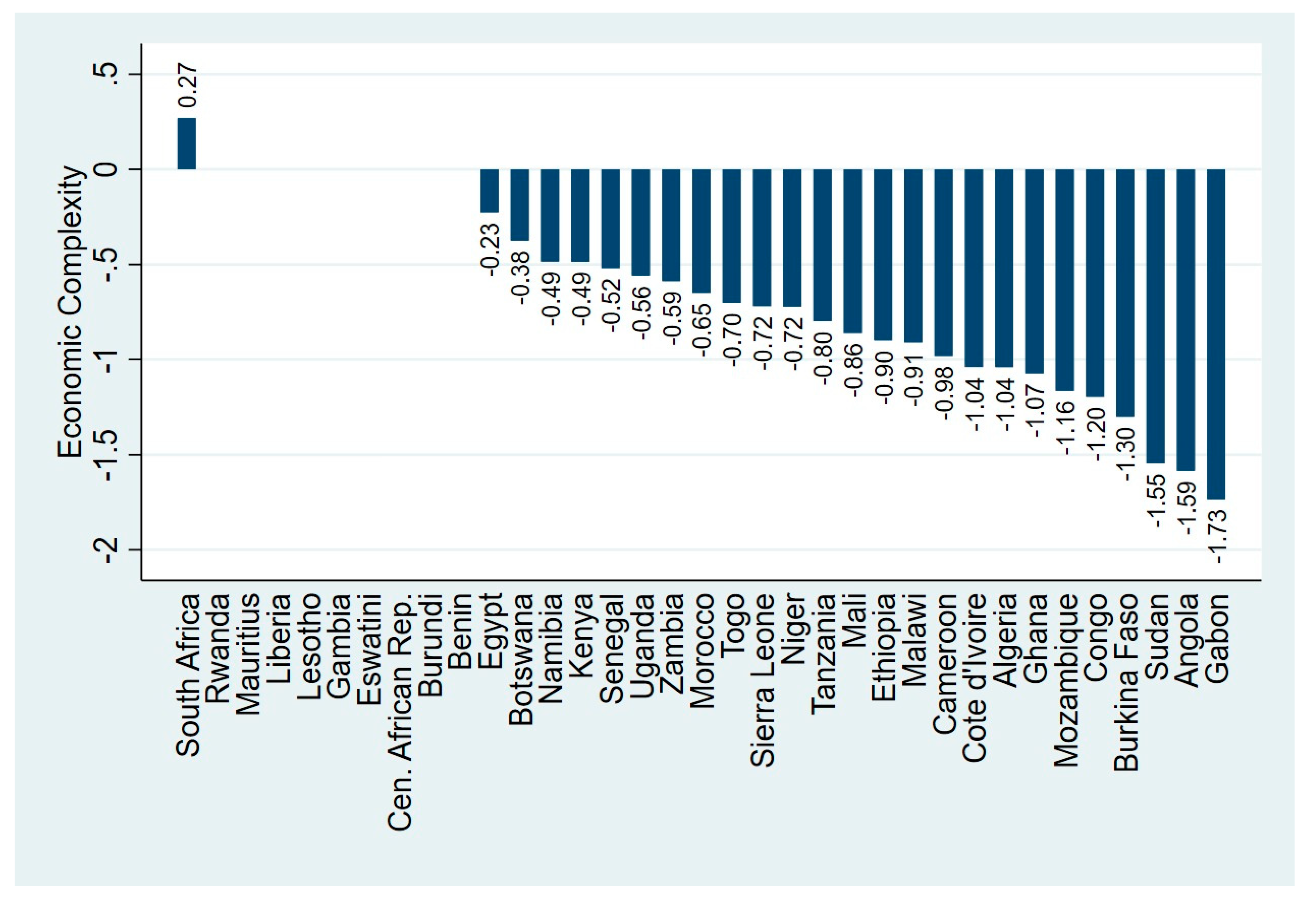
Figure 2.
Bivariate relationship between ECI, economic growth, income inequality and emissions.
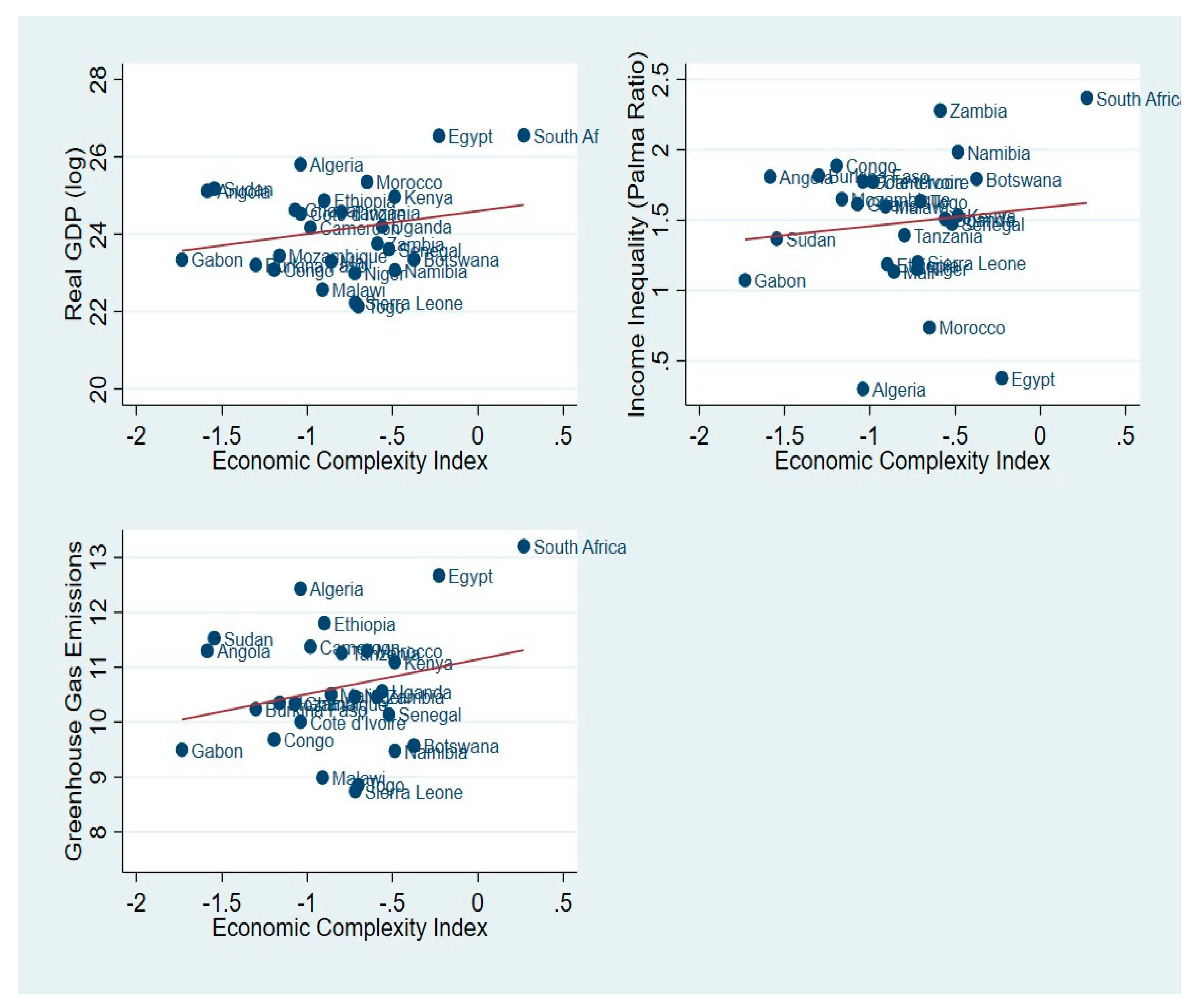
Table 1.
Variable description and data sources.
| Variables | Symbol | Definition | Data sources |
|---|---|---|---|
| Gini index | GINI | Measures income inequality in the population on a scale from 0 to 1. Higher values indicate higher inequality. | UNU-WIDER (2025) |
| Palma ratio | PALMA | The share of the top 10% wealthiest people in the population divided by the share of the bottom 40% in the population | UNU-WIDER (2025) |
| Real GDP | GDPG | Natural logarithm of gross domestic product (constant 2015 US$) | World Bank (2025) |
| Nomina GDP | NGDP | Natural logarithm of gross domestic product (current 2017 US$) | World Bank (2025) |
| Greenhouse gas emission | GHGG | Natural logarithm of total greenhouse gas emissions (kt of CO2 equivalent) | World Bank (2025) |
| CO2 emission | CO2KT | Natural logarithm of carbon dioxide (CO2) emissions in kilotons (kt) | World Bank (2025) |
| Economic complexity | ECI | Economic complexity index | Hidalgo & Hausmann (2009) |
| Foreign direct investment | FDI | Foreign direct investment, net inflows (% of GDP) | World Bank (2025) |
| Financial development | FINDEV | Financial development index | Svirydzenka (2016) |
| Human capital | HCAP | Mean years of schooling and returns on education | Feenstra et al. (2015) |
| Energy equity | ENEREQ | The ratio of the rural population with access to electricity to the urban population with access to electricity | Authors’ construct |
| Internet access | INTA | Individuals using the Internet (% of population) | World Bank (2025) |
| Remittances | REMIT | Personal remittances, received (% of GDP) | World Bank (2025) |
| Corruption control | CORRUPT | Captures perceptions of the extent to which public power is exercised for private gain, including both petty and grand forms of corruption, as well as “capture” of the state by elites and private interests. | World Bank (2025) |
| Private investment | GFCF | Gross fixed capital formation (% of GDP) | World Bank (2025) |
Table 2.
Summary statistics, 2008-2020.
| Variable | Obs | Mean | Std. Dev. | Min | Max |
| Log of real GDP | 385 | 23.589 | 1.406 | 20.939 | 26.745 |
| Log of nominal GDP | 385 | 24.516 | 1.406 | 22.023 | 27.832 |
| Gini index | 350 | 55.205 | 7.833 | 31.877 | 72.877 |
| Palma ratio | 350 | 5.009 | 2.223 | 1.255 | 15.137 |
| Carbon dioxide emission | 350 | 30039.4 | 81638.4 | 120.0 | 447929.9 |
| Greenhouse gas emissions | 350 | 61727.8 | 106769.01 | 1400.0 | 560859.9 |
| Foreign direct investment | 385 | 4.585 | 10.232 | -18.918 | 103.337 |
| Remittances | 385 | 3.436 | 4.896 | 0.000 | 27.302 |
| Financial development | 385 | 0.168 | 0.127 | 0.033 | 0.643 |
| Human capital | 350 | 1.873 | 0.464 | 1.166 | 2.939 |
| Corruption control | 385 | -0.542 | 0.543 | -1.546 | 1.003 |
| Economic complexity | 260 | -0.844 | 0.476 | -2.186 | 0.399 |
| Energy equity | 385 | 0.352 | 0.305 | 0.014 | 1.004 |
| Private investment | 361 | 24.285 | 8.842 | 6.350 | 81.021 |
| Internet access | 368 | 20.310 | 17.838 | 0.580 | 84.120 |
Note: Obs is observations; Std. Dev is the Standard Deviation.
Table 3.
Effects of economic complexity and energy equity on economic growth (Lewbel 2SLS estimates).
Table 3.
Effects of economic complexity and energy equity on economic growth (Lewbel 2SLS estimates).
| Log of real GDP (US$’ 2015) | Log of nominal GDP (2017 PPP) | |||||||
|---|---|---|---|---|---|---|---|---|
| Variables | 1 | 2 | 3 | 4 | 5 | 6 | 7 | 8 |
| FDI | -0.0103 | -0.0318** | -0.0200** | -0.0261*** | -0.0122 | -0.0342** | -0.0241** | -0.0326*** |
| (0.016) | (0.015) | (0.010) | (0.008) | (0.017) | (0.015) | (0.010) | (0.008) | |
| HCAP | 0.5755 | -0.8072* | -0.0815 | -0.3693** | 0.4744 | -0.7696* | -0.0759 | -0.4223*** |
| (0.538) | (0.419) | (0.218) | (0.150) | (0.547) | (0.420) | (0.215) | (0.150) | |
| GFCF | 0.0283* | 0.0096 | -0.0099 | -0.0007 | 0.0247 | 0.0029 | -0.0165* | -0.0028 |
| (0.015) | (0.015) | (0.009) | (0.007) | (0.015) | (0.015) | (0.009) | (0.007) | |
| INT | 0.0349*** | 0.0432*** | 0.0127*** | 0.0065 | 0.0350*** | 0.0412*** | 0.0091* | 0.0045 |
| (0.008) | (0.006) | (0.005) | (0.004) | (0.009) | (0.006) | (0.005) | (0.004) | |
| CORRUPT | -0.6609*** | -1.1034*** | -1.0242*** | -0.6669*** | -0.6723*** | -1.1575*** | -1.0255*** | -0.7027*** |
| (0.162) | (0.209) | (0.147) | (0.112) | (0.165) | (0.209) | (0.145) | (0.112) | |
| ECI | 1.7609*** | 0.9232*** | -0.2211 | 1.7960*** | 0.8339*** | -0.1370 | ||
| (0.351) | (0.307) | (0.243) | (0.352) | (0.303) | (0.243) | |||
| ENEREQ | 2.0099*** | 3.6616*** | 2.1834*** | 3.6835*** | ||||
| (0.293) | (0.390) | (0.289) | (0.390) | |||||
| ECI x ENEREQ | 1.4760*** | 1.3613*** | ||||||
| (0.372) | (0.371) | |||||||
| Total effect | 0.2984* | 0.3421** | ||||||
| (0.1533) | (0.1531) | |||||||
| Constant | 20.8840*** | 25.6156*** | 23.8921*** | 23.3724*** | 22.0853*** | 26.6938*** | 24.9315*** | 24.5349*** |
| (0.912) | (0.765) | (0.460) | (0.368) | (0.928) | (0.766) | (0.454) | (0.368) | |
| Observations | 317 | 224 | 224 | 224 | 317 | 224 | 224 | 224 |
| Fisher Statistic | 21.743*** | 21.451*** | 46.728*** | 55.113*** | 19.753*** | 21.7195*** | 50.406*** | 57.8513*** |
| Anderson LM statistic | 32.054*** | 28.46*** | 40.96*** | 108.84*** | 32.054*** | 28.467*** | 40.967*** | 108.844*** |
| CD Wald F statistic | 5.7747 | 3.876 | 3.8796 | 11.992** | 5.7747 | 3.8764 | 3.8796 | 11.9921** |
Note: LM is Lagrange Multiplier; CD is Cragg-Donald; Standard errors in parentheses; * p < 0.10, ** p < 0.05, *** p < 0.01.
Table 4.
Effects of economic complexity and energy equity on income inequality (Lewbel 2SLS estimates).
Table 4.
Effects of economic complexity and energy equity on income inequality (Lewbel 2SLS estimates).
| Log of Palma ratio | Log of Gini index | |||||||
|---|---|---|---|---|---|---|---|---|
| Variables | 1 | 2 | 3 | 4 | 5 | 6 | 7 | 8 |
| CORRUPT | -0.1865 | 0.0099 | -0.3195** | -0.3507*** | -0.0393 | 0.0379 | -0.0824* | -0.0781** |
| (0.142) | (0.177) | (0.139) | (0.116) | (0.046) | (0.063) | (0.047) | (0.038) | |
| FDI | -0.0016 | 0.0070 | 0.0004 | 0.0005 | -0.0001 | 0.0024 | -0.0001 | -0.0001 |
| (0.003) | (0.004) | (0.003) | (0.003) | (0.001) | (0.002) | (0.001) | (0.001) | |
| REMIT | -0.0075 | -0.0727*** | -0.0166* | -0.0153 | -0.0033 | -0.0237*** | -0.0031 | -0.0031 |
| (0.006) | (0.012) | (0.010) | (0.010) | (0.002) | (0.004) | (0.003) | (0.003) | |
| FINDEV | 0.8414** | 0.6156 | 2.4918*** | 2.7063*** | 0.1851 | 0.0873 | 0.7762*** | 0.8065*** |
| (0.389) | (0.455) | (0.388) | (0.449) | (0.126) | (0.161) | (0.130) | (0.148) | |
| HCAP | -0.0604 | -0.1561** | 0.1756*** | 0.1700*** | -0.0510** | -0.0816*** | 0.0405** | 0.0373* |
| (0.072) | (0.071) | (0.060) | (0.059) | (0.023) | (0.025) | (0.020) | (0.020) | |
| ECI | 0.2217** | 0.1917*** | 0.2689** | 0.0564* | 0.0452* | 0.0638* | ||
| (0.091) | (0.070) | (0.113) | (0.032) | (0.023) | (0.037) | |||
| ENEREQ | -1.4022*** | -1.5722*** | -0.5162*** | -0.5583*** | ||||
| (0.105) | (0.220) | (0.035) | (0.072) | |||||
| ECI x ENEREQ | -0.2092 | -0.0556 | ||||||
| (0.227) | (0.075) | |||||||
| Total effect | 0.1953*** | 0.0442* | ||||||
| (0.0692) | (0.0228) | |||||||
| Constant | 1.4103*** | 2.0227*** | 1.2356*** | 1.2600*** | 4.0545*** | 4.2522*** | 3.9634*** | 3.9834*** |
| (0.210) | (0.258) | (0.211) | (0.179) | (0.068) | (0.091) | (0.071) | (0.059) | |
| Observations | 350 | 236 | 236 | 236 | 350 | 236 | 236 | 236 |
| Fisher Statistic | 2.1618* | 10.894*** | 40.807*** | 35.723 | 2.4437** | 8.2488*** | 44.333*** | 39.252*** |
| Anderson LM statistic | 60.375*** | 38.7152*** | 37.892*** | 66.987*** | 60.375*** | 38.7152*** | 37.892*** | 66.987*** |
| CD Wald F statistic | 17.7712*** | 8.8308* | 7.1089* | 12.5133*** | 17.7712*** | 8.8308* | 7.1089* | 12.5133*** |
Note: LM is Lagrange Multiplier; CD is Cragg-Donald; Standard errors in parentheses; * p < 0.10, ** p < 0.05, *** p < 0.01.
Table 5.
Effects of economic complexity and energy equity on the environment (Lewbel 2SLS estimates).
Table 5.
Effects of economic complexity and energy equity on the environment (Lewbel 2SLS estimates).
| Log of Greenhouse gas emissions | Log of CO2 emissions | |||||||
|---|---|---|---|---|---|---|---|---|
| Variables | 1 | 2 | 3 | 4 | 5 | 6 | 7 | 8 |
| FDI | 0.0010 | -0.0350*** | -0.0320*** | -0.0269*** | 0.0160* | -0.0274** | -0.0215** | -0.0161*** |
| (0.008) | (0.011) | (0.009) | (0.007) | (0.009) | (0.013) | (0.008) | (0.006) | |
| INTA | 0.0215*** | 0.0293*** | 0.0055 | 0.0013 | 0.0432*** | 0.0447*** | 0.0113*** | 0.0064** |
| (0.006) | (0.005) | (0.004) | (0.004) | (0.006) | (0.006) | (0.004) | (0.003) | |
| FINDEV | 1.0094 | -1.9183** | -2.4753*** | -4.5650*** | 2.1633*** | 0.3665 | -0.4222 | -2.8350*** |
| (0.727) | (0.759) | (0.610) | (0.527) | (0.810) | (0.873) | (0.599) | (0.462) | |
| HCAP | -0.1260 | -0.5549*** | -0.9028*** | -0.7132*** | 0.3391 | -0.0596 | -0.5477*** | -0.3289*** |
| (0.192) | (0.158) | (0.130) | (0.106) | (0.214) | (0.181) | (0.128) | (0.093) | |
| REMIT | -0.1137*** | -0.1122*** | -0.1751*** | -0.1786*** | -0.0779*** | -0.0279 | -0.1163*** | -0.1204*** |
| (0.015) | (0.025) | (0.021) | (0.017) | (0.017) | (0.029) | (0.020) | (0.015) | |
| ECI | 1.1592*** | 0.9499*** | -0.2639 | 0.5752** | 0.2837* | 1.1192*** | ||
| (0.202) | (0.163) | (0.173) | (0.233) | (0.160) | (0.152) | |||
| ENEREQ | 2.7645*** | 5.4711*** | 3.8878*** | 7.0139*** | ||||
| (0.248) | (0.317) | (0.243) | (0.278) | |||||
| ECI x ENEREQ | 3.3096*** | 3.8238*** | ||||||
| (0.303) | (0.266) | |||||||
| Total effect | 0.9011*** | 0.2267*** | ||||||
| (0.1315) | (0.1155) | |||||||
| Constant | 10.0755*** | 12.9275*** | 13.1323*** | 12.0417*** | 6.9255*** | 9.1430*** | 9.4229*** | 8.1647*** |
| (0.317) | (0.437) | (0.351) | (0.299) | (0.353) | (0.503) | (0.344) | (0.262) | |
| Observations | 338 | 226 | 226 | 226 | 338 | 226 | 226 | 226 |
| Fisher Statistic | 19.7454*** | 14.776*** | 37.770*** | 63.915*** | 38.370*** | 28.2231*** | 87.730*** | 170.822*** |
| Anderson LM statistic | 268.576*** | 184.381*** | 191.61*** | 194.63*** | 268.57*** | 184.381*** | 191.617*** | 194.639*** |
| CD Wald F statistic | 318.197*** | 190.50*** | 197.84*** | 187.08*** | 318.19*** | 190.50*** | 197.841*** | 187.084*** |
Note: LM is Lagrange Multiplier; CD is Cragg-Donald; Standard errors in parentheses; * p < 0.10, ** p < 0.05, *** p < 0.01.
Table 6.
Effects of economic complexity and energy equity on economic growth [Without South Africa] (Lewbel 2SLS estimates).
Table 6.
Effects of economic complexity and energy equity on economic growth [Without South Africa] (Lewbel 2SLS estimates).
| Log of real GDP | Log of nominal GDP | |||||||
|---|---|---|---|---|---|---|---|---|
| Variables | 1 | 2 | 3 | 4 | 5 | 6 | 7 | 8 |
| FDI | -0.0202 | -0.0271* | -0.0166* | -0.0303*** | -0.0214 | -0.0289** | -0.0206** | -0.0356*** |
| (0.017) | (0.014) | (0.009) | (0.008) | (0.018) | (0.015) | (0.010) | (0.008) | |
| HCAP | -0.3817 | -0.7768** | -0.0167 | -0.1720 | -0.4694 | -0.7918** | -0.0320 | -0.2191 |
| (0.567) | (0.314) | (0.195) | (0.168) | (0.583) | (0.321) | (0.198) | (0.168) | |
| GFCF | 0.0332** | -0.0027 | -0.0182** | 0.0015 | 0.0290* | -0.0093 | -0.0249*** | -0.0026 |
| (0.016) | (0.014) | (0.009) | (0.007) | (0.016) | (0.015) | (0.009) | (0.007) | |
| INTA | 0.0403*** | 0.0408*** | 0.0068 | 0.0040 | 0.0405*** | 0.0402*** | 0.0041 | 0.0017 |
| (0.008) | (0.005) | (0.005) | (0.004) | (0.009) | (0.005) | (0.005) | (0.004) | |
| CORRUPT | -0.5263*** | -0.8787*** | -0.8540*** | -0.6861*** | -0.5394*** | -0.9401*** | -0.8818*** | -0.7125*** |
| (0.165) | (0.187) | (0.140) | (0.115) | (0.169) | (0.191) | (0.142) | (0.115) | |
| ECI | 1.0350*** | 0.3339 | -0.2193 | 1.1407*** | 0.3403 | -0.2102 | ||
| (0.364) | (0.308) | (0.289) | (0.373) | (0.312) | (0.289) | |||
| ENEREQ | 2.2527*** | 3.3145*** | 2.4028*** | 3.5349*** | ||||
| (0.270) | (0.503) | (0.274) | (0.504) | |||||
| ECI x ENEREQ | 1.1489** | 1.2457** | ||||||
| (0.518) | (0.520) | |||||||
| Constant | 22.4900*** | 25.3987*** | 23.5748*** | 23.0146*** | 23.6791*** | 26.6089*** | 24.7164*** | 24.1517*** |
| (0.969) | (0.647) | (0.436) | (0.422) | (0.995) | (0.662) | (0.443) | (0.424) | |
| Observations | 307 | 214 | 214 | 214 | 307 | 214 | 214 | 214 |
| Fisher Statistic | 14.975*** | 15.644*** | 37.877*** | 39.705*** | 13.623*** | 15.919*** | 40.278*** | 43.206*** |
| Anderson LM statistic | 29.390*** | 40.802*** | 42.114*** | 81.285*** | 29.390*** | 40.802*** | 42.114*** | 81.285*** |
| CD Wald F statistic | 5.2582 | 5.9779 | 4.0427 | 7.3881* | 5.2582 | 5.9779 | 4.0427 | 7.3881* |
Note: LM is Lagrange Multiplier; CD is Cragg-Donald; Standard errors in parentheses; * p < 0.10, ** p < 0.05, *** p < 0.01.
Table 7.
Effects of economic complexity and energy equity in income inequality [Without South Africa] (Lewbel 2SLS estimates).
Table 7.
Effects of economic complexity and energy equity in income inequality [Without South Africa] (Lewbel 2SLS estimates).
| Log of Palma ratio | Log of Gini index | |||||||
|---|---|---|---|---|---|---|---|---|
| Variables | 1 | 2 | 3 | 4 | 5 | 6 | 7 | 8 |
| CORRUPT | -0.0760 | 0.3821* | -0.1513 | -0.3853*** | -0.0099 | 0.1741** | -0.0157 | -0.0783* |
| (0.148) | (0.230) | (0.155) | (0.149) | (0.049) | (0.082) | (0.051) | (0.048) | |
| FDI | -0.0012 | 0.0067 | 0.0003 | 0.0010 | -0.0000 | 0.0022 | -0.0001 | 0.0001 |
| (0.002) | (0.005) | (0.003) | (0.003) | (0.001) | (0.002) | (0.001) | (0.001) | |
| REMIT | -0.0081 | -0.0654*** | -0.0064 | 0.0093 | -0.0034* | -0.0212*** | 0.0004 | 0.0054* |
| (0.006) | (0.012) | (0.009) | (0.010) | (0.002) | (0.004) | (0.003) | (0.003) | |
| FINDEV | -0.2313 | -0.8217 | 1.6318*** | 2.6874*** | -0.1330 | -0.4339* | 0.4508*** | 0.7586*** |
| (0.487) | (0.684) | (0.485) | (0.534) | (0.160) | (0.245) | (0.161) | (0.171) | |
| HCAP | -0.0535 | -0.1594** | 0.1960*** | 0.1958*** | -0.0486** | -0.0835*** | 0.0464** | 0.0450** |
| (0.068) | (0.072) | (0.055) | (0.056) | (0.023) | (0.026) | (0.018) | (0.018) | |
| ECI | 0.0518 | 0.0656 | 0.4426*** | -0.0040 | -0.0004 | 0.1194*** | ||
| (0.109) | (0.074) | (0.120) | (0.039) | (0.025) | (0.038) | |||
| ENEREQ | -1.4445*** | -2.4239*** | -0.5294*** | -0.8475*** | ||||
| (0.095) | (0.253) | (0.032) | (0.081) | |||||
| ECI x ENEREQ | -1.1315*** | -0.3702*** | ||||||
| (0.263) | (0.084) | |||||||
| Constant | 1.6081*** | 2.3098*** | 1.3038*** | 1.3077*** | 4.1100*** | 4.3600*** | 3.9966*** | 4.0116*** |
| (0.220) | (0.288) | (0.206) | (0.187) | (0.072) | (0.103) | (0.068) | (0.060) | |
| Observations | 340 | 226 | 226 | 226 | 340 | 226 | 226 | 226 |
| Fisher Statistic | 2.0717* | 6.3512** | 43.623*** | 37.677*** | 4.0771** | 6.362** | 52.820*** | 49.044*** |
| Anderson LM statistic | 50.972*** | 25.877*** | 27.376*** | 34.666*** | 50.972*** | 25.877*** | 27.376*** | 34.666*** |
| CD Wald F statistic | 14.593*** | 5.5602 | 4.8931 | 5.4614 | 14.593*** | 5.5602 | 4.8931 | 5.4614 |
Note: LM is Lagrange Multiplier; CD is Cragg-Donald; Standard errors in parentheses; * p < 0.10, ** p < 0.05, *** p < 0.01.
Table 8.
Effects of economic complexity and energy equity on the environment [Without South Africa] (Lewbel 2SLS estimates).
Table 8.
Effects of economic complexity and energy equity on the environment [Without South Africa] (Lewbel 2SLS estimates).
| Log of greenhouse gas emissions | Log of CO2 emissions | |||||||
|---|---|---|---|---|---|---|---|---|
| Variables | 1 | 2 | 3 | 4 | 5 | 6 | 7 | 8 |
| FDI | 0.0013 | -0.0359*** | -0.0335*** | -0.0281*** | 0.0160* | -0.0288** | -0.0230*** | -0.0176*** |
| (0.008) | (0.011) | (0.008) | (0.007) | (0.009) | (0.012) | (0.008) | (0.006) | |
| INTA | 0.0232*** | 0.0261*** | 0.0029 | -0.0002 | 0.0455*** | 0.0415*** | 0.0091** | 0.0056* |
| (0.005) | (0.005) | (0.004) | (0.004) | (0.006) | (0.005) | (0.004) | (0.003) | |
| FINDEV | -1.4366* | -3.3784*** | -3.7327*** | -4.7576*** | -0.1518 | -1.3660 | -1.8706*** | -3.0242*** |
| (0.808) | (0.754) | (0.595) | (0.532) | (0.912) | (0.858) | (0.559) | (0.467) | |
| HCAP | -0.0857 | -0.4587*** | -0.8062*** | -0.7141*** | 0.3743* | 0.0551 | -0.4308*** | -0.3271*** |
| (0.185) | (0.149) | (0.121) | (0.106) | (0.209) | (0.170) | (0.114) | (0.093) | |
| REMIT | -0.1092*** | -0.0744*** | -0.1399*** | -0.1734*** | -0.0737*** | 0.0171 | -0.0745*** | -0.1123*** |
| (0.014) | (0.024) | (0.020) | (0.018) | (0.016) | (0.028) | (0.019) | (0.016) | |
| ECI | 0.8179*** | 0.6683*** | -0.2416 | 0.1584 | -0.0474 | -1.0745*** | ||
| (0.199) | (0.157) | (0.178) | (0.227) | (0.148) | (0.156) | |||
| ENEREQ | 2.6602*** | 5.3624*** | 3.7313*** | 6.7772*** | ||||
| (0.233) | (0.388) | (0.219) | (0.341) | |||||
| ECI x ENEREQ | 3.1307*** | 3.5307*** | ||||||
| (0.387) | (0.339) | |||||||
| Constant | 10.2787*** | 12.6039*** | 12.8673*** | 12.0967*** | 7.1144*** | 8.7355*** | 9.0937*** | 8.2275*** |
| (0.307) | (0.417) | (0.328) | (0.300) | (0.347) | (0.474) | (0.309) | (0.263) | |
| Observations | 328 | 216 | 216 | 216 | 328 | 216 | 216 | 216 |
| Fisher Statistic | 14.644*** | 9.443** | 32.171*** | 43.756*** | 24.405*** | 17.930*** | 77.278*** | 113.924*** |
| Anderson LM statistic | 249.05*** | 168.06*** | 176.63*** | 179.951*** | 249.05*** | 168.06*** | 176.63*** | 179.951*** |
| CD Wald F statistic | 251.60*** | 143.75*** | 151.832*** | 143.341*** | 251.60*** | 143.756*** | 151.832*** | 143.341*** |
Note: LM is Lagrange Multiplier; CD is Cragg-Donald; Standard errors in parentheses; * p < 0.10, ** p < 0.05, *** p < 0.01.
Disclaimer/Publisher’s Note: The statements, opinions and data contained in all publications are solely those of the individual author(s) and contributor(s) and not of MDPI and/or the editor(s). MDPI and/or the editor(s) disclaim responsibility for any injury to people or property resulting from any ideas, methods, instructions or products referred to in the content. |
© 2026 by the authors. Licensee MDPI, Basel, Switzerland. This article is an open access article distributed under the terms and conditions of the Creative Commons Attribution (CC BY) license (http://creativecommons.org/licenses/by/4.0/).
Copyright: This open access article is published under a Creative Commons CC BY 4.0 license, which permit the free download, distribution, and reuse, provided that the author and preprint are cited in any reuse.


