

Submitted:
04 June 2026
Posted:
04 June 2026
You are already at the latest version
Abstract
Global climate change impacts snow and ice resources and the frequency and timing of dangerous hydrological phenomena. The article presents the results of a study of snow resource variability in Western Kazakhstan in the context of global warming. The research aims to assess the impact of global climate change on regional snow cover conditions. Statistical analysis methods were used to assess these effects. A database of snow and regional climate was collected. The statistical error of the initial data was 2-4%. It was established that snowmelt runoff from rivers mainly forms in the low-mountain areas of Mugalzhary in the north of the Aktobe region and on the Podural plateau in the north of the West Kazakhstan region. This affects the timing of the spring flood. However, these trends are not statistically significant (the coefficient of determination is 0.02-0.24) and their value is within the statistical errors. The calculated Spearman statistics prove the existence of a statistical relationship between global and regional climate indicators (correlation coefficients 0.23-0.40). Changes, but it is influenced by many local factors. This must be taken into account when planning economic activities in the region.
Keywords:
big data analytics
; global climate
; snow resources
; Western Kazakhstan
; climate indices
; catastrophic floods
1. Introduction
At present, researchers in many countries are quite confident that the Earth’s climate is changing. According to the Intergovernmental Panel on Climate Change [1], over the past 140 years, the average global surface air temperature has increased by 0.6 ± 0.20 °C.
Global climate change affects the extent of glaciation, snow cover, and permafrost, ultimately altering hydrological processes and contributing to the development of dangerous natural phenomena [2,3]. Experts of the World Meteorological Organization cite the reduction of snow cover as the main indicator of climate change [URL:https://public.wmo.int/en/our-mandate/climate/wmo-statement-state-of-global-climate# bootstrap-panel-2]. Recent studies of climate change in Kazakhstan indicate a convergence of global and regional trends. The climate of Kazakhstan has warmed: the average annual air temperature in the country for 1991-2020 increased by 0.9 °C compared to the previous thirty years [4,5].
Snow and ice are important components of Earth’s environment. The summary “Ocean and Cryosphere in a Changing Climate” notes that over the past decades, climate change has been reducing the area of snow cover, glaciers and permafrost [6], while changing the frequency, power and location of natural hazards.
The documents of the Global Water Commission (GCEW) emphasize that global changes in the hydrological cycle are manifested primarily in shifts in the direction and volume of water flows, and that these changes affect not only natural systems but also the economy [The Economics of Water]. Executive Summary. (2024) https://watercommission.org/#watercycle].
A report by the United Nations University (January 2026) states that “the world is entering an era of global water bankruptcy” and that what was an anomaly, an aberration, is now becoming a baseline [UNU-INWEH Report: Madani, K. (2026). Global Water Bankruptcy: Living Beyond Our Hydrological Means in the Post-Crisis Era. United Nations University Institute for Water, Environment and Health (UNU-INWEH), Richmond Hill, Ontario, Canada. DOI: 10.53328/INR26KAM001 https://news.un.org/ru/story/2026/01/1467215].
The Republic of Kazakhstan is highly vulnerable to droughts and floods, requiring the development of appropriate strategies to manage water resources. Water security of the country is one of the key problems of the Republic of Kazakhstan. It is related to ensuring food and environmental security, regional stability (as a source of river flow), and the quality of management (including technological and political decisions related to transboundary rivers).
In the arid zone, the main share of annual runoff (up to 90-95%) in the basin of the Aral and Caspian Seas [7,8] takes place in spring as a result of snow melting. The height and density of snow affect the regime of freezing and melting of soil, and the runoff of melted snow water. One cause of extreme runoff is climate change, as indicated by air temperature, precipitation, and snow cover.
Several studies report changes in air temperature and precipitation across various regions of Kazakhstan due to climate change, while other studies report opposite trends [9,10,11,12]. There is a need to diagnose the current state of snow resources in order to assess future changes in the conditions of their formation.
The relevance of the research lies in assessing the current dynamics of snow resources in Western Kazakhstan and adjacent regions of the Russian Federation, given the threat of increased runoff from melting snow and the potential for extreme floods. The novelty of the research lies in the assessment of long-term changes in the characteristics of snow cover in the Zhaiyk-Caspian basin of Kazakhstan, including data from climate monitoring stations in the Russian Federation. This makes it possible to assess changes in snow and water resources and to project future volumes of melted snow runoff.
The assessment of the impact of climate change on snow cover dynamics and associated fluctuations in river flow is presented in [13,14,15]. The studies’ materials allow us to conclude that in different parts of the world, snow coverage area and height are decreasing, snow cover is melting earlier, and the volume of melt runoff is decreasing. The use of remote sensing (RS) data enabled assessment of changes in the snow regime at the continental and subcontinental scales, as well as across the territory of Kazakhstan as a whole [16,17]. It is concluded that climate change leads to a reduction in snow cover area, a decrease in snow reserves, and a shift in the onset of snowmelt to earlier dates.
The study aimed to assess the spatial and temporal changes in individual factors of river flow formation (atmospheric circulation, snow depth, snow reserves, dates of snow cover).
2. Materials and Methods
2.1. Research Area
The Zhaiyk-Caspian basin within the borders of the Republic of Kazakhstan is located in the Atyrau, Aktobe, West Kazakhstan, and Mangistau regions. The main waterway of the region is the Zhaiyk River, flowing through the territories of the Russian Federation and Kazakhstan. The area of the river basin is 236 thousand km2, and the length is 2428 km. Average annual runoff Zhaiyk in the alignment of the Kushum post is 10.3 km3 [18].
Within Kazakhstan, the river receives several tributaries, the main of which are Yelek, Or, Shyngyrlau, Shagan, Yembulatovka, and Rubezhka. To the west of the Zhaiyk River flow the Chizha-1, Chizha-2, Karaozen and Saryozen rivers. In the south of the basin, the Oyil, Sagiz and Zhem rivers flow, which do not have a permanent mouth and lose their waters in the sands to filtration and evaporation.
A huge territory and a variety of physical, geographical and climatic conditions characterise the drainage basin. In general, the climate shows a clear latitudinal distribution. The temperature of the cold half of the year varies from -0.4 °C in the south to -11.4 °C in the north. The amount of precipitation varies from 59 mm in the south to 144 mm in the north of the region (https://www.kazhydromet.kz/ru/klimat/obzor-ob-osobennostyah-klimata-na-territorii-kazahstana).
In the north of the Aktobe region, in the mountains of Mugalzhary, the lowest temperatures, the highest precipitation, and the most snowstorm days are recorded. Accordingly, this greatly affects the accumulation of snow cover. The amount of precipitation in the cold half of the year reaches 144 mm, the air temperature is -11.4 °C, and the number of days with snowstorms is 23. formation of the flow of a transboundary river. In the West Kazakhstan region, the climate is milder; air temperatures in the cold half of the year reach -9.2 °C, and precipitation totals 125 mm. The water basin is divided into regions homogeneous with respect to snow conditions, as shown in Figure 1.
With movement to the south, climatic conditions change, becoming desert and semi-desert. There is a sharp warming of the cold half of the year and a decrease in winter precipitation. This greatly affects the formation of seasonal snow cover. In the very south of the catchment area, the climate contributes to the occurrence of only temporary snow cover, and there is practically no river flow in the summer.
The peculiarities of the distribution of the river network on the territory of Western Kazakhstan are due to the presence of the Caspian Sea in the south-west, and in the north-east - the mountain formations of the Southern Urals, so the rivers here have a general direction of flow from north-east to south-west. The climate of the Zhaiyk-Caspian basin is sharply continental. It is characterised by hot summers and frosty winters. However, in the territory near the Caspian Sea, weather conditions are milder, with an average temperature in December-January of -5 to -8 °C (https://meteo.kazhydromet.kz/climate_kadastr/).
The rivers of the Zhaiyk-Caspian basin are mainly rivers of pure snow feeding, and when the snow melts simultaneously in the entire basin, a high wave of floods quickly passes along the river. Kazakh plain rivers, including those of the Zhaiyk-Caspian basin, are grouped separately based on their water regime. The Kazakh type is characterised by rivers with exceptionally sharp and high flood waves, and in the rest of the year, the flow is very small, up to complete drying of the rivers. Rain floods are practically not observed on these rivers.
In the spring of 2024, a dangerous flood situation developed in the eastern, northern, central and western regions of Kazakhstan. At the end of March, as snow rapidly melted following a sharp warming, the water levels in the rivers began to rise. The most dangerous situation has developed in Aktobe, West Kazakhstan, Atyrau and Mangistau regions. An additional factor was the emergency discharge of water in transboundary rivers. In many regions, the rise in the water level exceeded long-term values and reached a historical maximum. Huge material damage was caused: roads were washed out, oil wells were flooded, hydraulic structures and outbuildings in the riverbeds were damaged [https://reliefweb.int/report/kazakhstan/devastating-floods-kazakhstan-national-emergency]. Large low-lying areas, dacha areas and agricultural land were flooded (Figure 2). The death of farm animals and human casualties were noted. To mitigate the consequences, the Ministry of Emergency Situations and the Armed Forces were involved. Numerous volunteers and non-governmental organisations assisted the victims.
The rise in water level was due to the simultaneous effects of several factors: strong soil moisture in the fall, high snowpack, and winter freezing. The most important factor was the accumulation of above-average long-term snow across almost the entire territory of Kazakhstan, which froze, and then all the melt runoff ran along the surface [19,20].
The winter-spring season of 2023/2024, before the start of extreme flooding, had distinctive features. In the first decade of March, in the northern half of the basin (the western slopes of Mugalzhar, Obshchey Syrt, and the Podural plateau), the average snow cover height ranged from 1 to 50 cm. In the second decade of March, there were heavy snowfalls, and the snow depth in some areas exceeded the long-term norm, ranging from 20 to 70 cm. The snow melted intensively, and 7 cm or more melted per day. The next important feature of the winter season 2023/2024 is precipitation in the form of rain in December, January, and February, which contributed to the formation of crust and ice crusts in the snow cover.
2.2. Initial Data for Research
To analyse the characteristics of the snow cover, data from the following sources were used:
– electronic archive of the Kazakhstan and Russian National Hydrometeorological Service (50 meteorological stations);
–1989 and 2020 climate guides;
– international databases of snow cover and climate indices.
All materials are freely available at the links on the sites [URL:http://www.pogodaiklimat.ru, URL: https://aisori-m.meteo.ru/waisori/select.xhtml, URL: https://meteo.kazhydromet.kz/climate_kadastr/]. These are the materials from long-term monitoring carried out on a network of meteorological stations operating under a single standard approved by the World Meteorological Organisation (WMO). These are Excel tables and GIF maps prepared for publication by the European Centre for Medium-Range Weather Forecasts (UK), the Rutgers Institute (USA), the International Climate Laboratory (Hawaii, USA) [URL: https://www.cpc.ncep.noaa.gov/data/indices/soi., https://gml.noaa.gov/webdata/ccgg/trends/co2/co2_annmean_mlo.txt., URL:https://climate.rutgers.edu/snowcover/table_area.php?ui_ set=1&ui_sort=0,].
In the Republic of Kazakhstan, regular monitoring of snow cover is conducted along the network of snow gauge routes operated by the Kazakhstan National Hydrometeorological Service. There are linear snow surveys at meteorological stations and route snow surveys in hard-to-reach mountainous regions. The network of observation posts uses standard instruments and measurement methods approved in the guidance documents [21]. – collection of information on the height, density and water content of the snow cover for operational and climatic archives. Operational data are used to make hydrological forecasts. Long-term archives are used to assess snow loads and climate change.
2.3. Statistical Models and Time Series Analysis
Two approaches are used to predict hydrometeorological phenomena: deterministic and stochastic. The first uses calculation formulas that account for the physical and hydraulic laws governing the phenomenon. The second uses statistical dependencies between weather hazards and meteorological characteristics [22].
Physical and mathematical models use dependencies between the predictor and river flow expressed in physical formulas. The water balance formula accounts for many factors in the formation of river runoff, including the arrival of moisture in the form of snow and rain. In water balance models, evaporation and filtration coefficients are used, calibrated separately for each river basin. These methods work well only in the studied areas with a dense network of observations and selected coefficients [23,24]. For the vast study area, there is a lack of ground data, so classical methods of mathematical statistics were chosen.
The task of statistical modelling is to reproduce hydrometeorological conditions based on the laws of probability theory and mathematical statistics. Methods of mathematical statistics allow you to analyses and systematize large arrays of observational data. For this purpose, various assessment methods, also called multivariate statistical methods, are used. time series forecast, assessment of reliability and errors of a data series, and selection of a distribution.
Time series analysis. A time series is a sequence of observations arranged in chronological order. Rows can be periodic and non-periodic. Rows can also be stationary and non-stationary. Nonstationarity, or time variability, can be due to various factors, such as climate change or changes in the observation point. Stationarity can be assessed by decomposing the series into a trend component. The influence of variability is large when it accounts for more than 30% of the series’ total variance [25,26].
Correlation analysis. This is an indicator of the closeness of the relationship between groups of random variables. In this case, a change in one variable leads to a change in another dependent variable. For a random variable with a normal distribution, a parametric correlation is used, for example, Pearson’s r. If the data deviate strongly from normality, it is recommended to use nonparametric correlation coefficients, for example, Spearman’s or Kendall’s tau.
Statistical significance of the study results. Verification of the accuracy and reliability of the results of statistical analysis is carried out in two stages:
- 1)
- Selection of the theoretical law of distribution to estimate averages and Possible marginal errors;
- 2)
- calculation of the criteria of agreement to confirm the reliability of the results obtained by the theoretical law.
In normal distribution, parametric agreement criteria are used to assess the reliability of the results, for example, the Student’s t-test or Pearson’s χ2 test [27]. However, many authors believe that the distribution of natural disasters follows the Pareto distribution. In this case, nonparametric agreement criteria, such as the Kolmogorov-Smirnov (K-S) test, should be used. The criteria for consent are calculated.
Assessment of the stationary nature of the series. The variability of a time series is very important for assessing climate change. To study the stationarity of a series, it is decomposed into a trend component and residues – random fluctuations. The measure of the significance of a time trend is the coefficient of determination (R2), the ratio of the trend’s variance to the total variance of the data series. If the coefficient of determination exceeds 30% of the variance, we speak of statistically significant temporary changes.
2.4. Global Climate Indices
Several standard indicators are used to describe the Earth’s global climate [28,29,30,31]. These are indices of global surface temperature and the general circulation of the atmosphere (Arctic, North Atlantic, and Southern El Niño oscillations), as well as data on the average area of snow cover and carbon dioxide content. The index means the deviation of annual values from the average climatic norm.
Global Surface Temperature (GST) is the average value of air temperature over the ocean and land. It is an indicator of Earth’s climate variability. It is averaged according to the World Meteorological Organisation’s standard for meteorological stations. There have been numerous observations since the end of the 19th century.
The content of carbon dioxide in the atmosphere (PPM CO2) is the ratio of the volume of carbon dioxide to the total volume of air in units per million units of air volume. The content of the main greenhouse gas is the primary factor determining climate change on Earth. The data are measured and standardised by the US National Oceanic and Atmospheric Administration (NOAA) at the Mauna Loa Observatory in Hawaii. Numerous direct observations date back to the 60s of the 20th century, as well as recovered data from glacial cores in the Quaternary epoch.
The Arctic Oscillation (AO) is the primary mode of variability in the Northern Hemisphere surface atmospheric pressure and geopotential fields. It describes the forms of variability of atmospheric processes. It is characterised by surface pressure anomalies of one sign in the Arctic and anomalies of the opposite sign in the mid-latitude belt. The AO index is considered one of the main climatic indices characterising non-seasonal variations in atmospheric pressure above sea level of the entire Northern Hemisphere [32,33].
El Niño: Southern Oscillation (ONI) is an indicator of the state of the planetary climate system, reflecting the degree and phase of the El Niño phenomenon in the equatorial Pacific Ocean. The influence of the Southern Oscillation on climate and the formation of extreme events worldwide is generally recognized. However, its impact on the climate of temperate and polar latitudes is still poorly understood [34].
The North Atlantic Oscillation (NAO) is the difference in atmospheric pressure at sea level between Iceland’s low level and the high level of the Azores. It controls the strength and direction of westerly winds, as well as the location of storm tracks in the North Atlantic.
Snow cover areal extent (SCE) is the global snow cover area in million km2. It is calculated based on satellite monitoring data and published in the public domain.
3. Results
3.1. Long-Term Trends in Snow Reserves
In the north of the Zhaiyk-Caspian basin, two regions have been identified, characterised by a stable snow cover exceeding 30 cm in height every year. In other regions, a temporary snow cover of 5-20 cm lasts only 2-3 months during snowy, cold winters. There is no snow cover.
Table 1 presents averaged data on height, water content, and snow cover duration across climatically similar regions. The first climatic region is the north of the Aktobe and the south of the Orenburg regions of the Russian Federation. It includes the Mugalzhary Mountains and the southern Urals. The second region is the West Kazakhstan region of the Republic of Kazakhstan, and the south of the Saratov region of the Russian Federation. It includes plain forest-steppe territories. In these regions, there are ambiguous trends in snow cover. In the 50s and 70s of the 20th century, and at the beginning of the 2000s, snow reserves decreased. In the 80s and 90s of the 20th century, and since the beginning of 2010, snowfall has increased at most weather stations.
Table 2 shows anomalies in snow cover characteristics relative to the climatic norm of the middle of the 20th century. Positive anomalies of snow height and water content are observed everywhere. However, anomalies of the duration of snow cover are negative. In the 50s and 60s of the 20th century, a significant excess of snow water content standards was observed at meteorological stations in the mountains of Mugalzhary.
The long-term evolution of snow cover characteristics is shown in Figure 3. A sharply negative trend in water content is observed only in the low-mountain areas of the north of the Aktobe region. This is due to the influence of snowy winters of the 50s, when the water content significantly exceeded the climatic norm.
In the low-mountain areas of the Mugalzhary Mountains, the increase in snow depth was 2-3 cm with a coefficient of determination of 2% of the variance, which is within the statistical errors of 3-5%. In the plain areas of the West Kazakhstan region, the snow cover height increased by 10-15 cm, accounting for 25% of the variance, which is much higher than the series’ statistical error. In the low-mountain areas of Mugalzhary, there is a strong drop in the average snow water content: 20-30 mm with a coefficient of determination of 19% of the variance. These changes are largely statistical. With increased latitudinal moisture transport and global air temperature, humidity in the territories increases, while water reserves in the snow cover decrease [30,31].
3.2. The Impact of Global Climate on the Snow Content of the Region
To confirm the relationship between local and global climate, a correlation analysis was conducted. Since the data series do not follow a normal distribution, the Spearman’s rank correlation coefficient was chosen. The results of the analysis are shown in Table 3 and Table 4. A statistically significant correlation between the height and water content of the snow cover and the climatic indices of the circulation of the Arctic and North Atlantic vortices was determined. With positive values of the indices, moisture transport from the latitudes and an increase in precipitation prevail in the centre of Eurasia at temperate latitudes. With negative values, meridional transport and dry cold winters prevail.
3.3. Confirmation of the Statistical Significance of the Research Results
Statistical characteristics of the data series are shown in Table 5. The studied series of observations is homogeneous and reliable. Statistically significant Student’s t-Test and standard series errors within 5% of the significance level meet the requirements for the initial data in modelling. The coefficients of determination of trend lines are 1-2% of the total variance, which indicates insignificant long-term changes in the low-mountain areas of Mugalzhary – the coefficient of determination is 18% of the dispersion of the series. However, the standard deviation and coefficient of variation are up to 50% of the mean, which indicates large interannual fluctuations.
Table 6 shows the results of the assessment of long-term trends in snow cover and climate indices. There are statistically significant trends in changes in snow water content in low-mountain areas and an increase in global air temperature. This is consistent with the results of other researchers, who found that warming is much faster in glacial and high-mountain areas [35,36]. There is a tendency to reduce the number of days with snow cover and to increase the height and water content of snow in plain areas. However, the trend is comparable to statistical noise, with an insignificant coefficient of determination (R2).
Due to global climate change, air temperatures in polar and high-altitude regions are increasing, and atmospheric circulation is changing. Latitudinal air transport and increased atmospheric humidity are beginning to prevail. However, trends can vary significantly with altitude and between neighboring weather stations.
In the north of the Aktobe region, there has been a 70-year trend of reducing the water content of the snow cover. This is because in the 50s and 60s of the 20th century, at low-altitude stations in the mountains of Mugalzhary, there was a decade-long period of cold, snowy winters. However, this region accounts for only a small part of the entire catchment area, within the limits of average statistical errors.
4. Discussion
Snow cover and river runoff in arid regions are highly dependent on global climate change [37,38]. Global climate indicators can be divided into two classes: those related to the carbon cycle and those related to the general circulation of the atmosphere. The carbon cycle includes global surface temperature and the content of greenhouse gases. They have a statistically significant positive trend. melting of glaciers and snow cover, and liquid precipitation in the highlands. The second important indicator of climate is the indices of the atmosphere’s general circulation. Due to strong atmospheric turbulence, these indicators are stochastic and difficult to predict [32,33]. The indicators of the general circulation exhibit cyclicity associated with fluctuations in Earth’s orbit and astronomical cycles. Unlike the carbon cycle, their trends are insignificant and not statistically significant. Atmospheric humidity, precipitation, and the accumulation of snow reserves depend on them.
The Arctic and North Atlantic oscillations mainly influence the inland climate of Eurasia. In the epochs of negative indices, meridional transport and dry, cold, snowless winters prevail. In contrast, during positive indices, latitudinal transport and increased humidity prevail, as the poles are warming faster than the equator. This increases humidity in the Northern Hemisphere. The influence of the southern El Niño oscillation on the climate of the northern hemisphere has not yet been studied. However, it strongly affects the circulation of tropical latitudes and ocean currents [34]. It has a cyclical nature associated with ocean-surface heating and does not exhibit a temporal trend. The global area of snow cover can also vary greatly from year to year, but its temporary changes are insignificant.
Long-term planning of economic activity in the region should account for the variability of snow resources. In arid regions, snow cover accounts for most of the flow in rivers. Its feature is an extremely uneven spatio-temporal distribution that depends on atmospheric circulation. Many scientists note the ambiguous impact of global climate change on atmospheric moisture content and snow formation. This is due to increased latitudinal transport and atmospheric humidity. However, these trends are not statistically significant, which makes long-term forecasting very difficult.
There is no reason to believe that there will be a sharp decrease in snow reserves in the near future. For planning economic activities and designing hydraulic structures, it is necessary to account for current trends in snow cover variability, including possible insignificant growth and strong interannual variability.
5. Conclusions
As a result of the research, trends in changes in snow reserves in Western Kazakhstan were assessed, taking into account global climate change and atmospheric circulation:
“Due to global climate change, there are trends to change the characteristics of the snow cover. The average height of snow increased by 3 cm, and the maximum decreased by 4 cm.
“The long-term variability of the snow cover does not have a strict regularity. It strongly depends on the wind regime and terrain features. Year-to-year fluctuations in snow cover are random. However, from 2000 to 2010, snow reserves below long-term levels were observed at most observation points, contributing to the decrease in river flow.
Global climate change affects regional snow conditions. The correlation dependence confirms this. However, the connection is not very close.
Changes in climate and snow cover affect the region’s water regime. Flooding occurs earlier and lasts for a shorter period.
Author Contributions
Akhmetkal Medeu - creation of the general concept of research; Viktor Blagovechshenskiy and Nina Pimankina - data collection and analysis; Vitaliy Zhdanov - general edition of the scientific article.
Funding
The study was supported by the Committee on Science of the Ministry of Science and Higher Education of the Republic of Kazakhstan.
Acknowledgments
The authors express their gratitude to the staff of the Institute of Geography and Water Security for their participation in conducting flood surveys in Western Kazakhstan in March-April 2024.
Conflicts of Interest
The authors declare no conflict of interest.
References
- 8th national communication and 5th biennial report of the Republic of Kazakhstan to the United Nations Framework Convention on Climate Change; (In Russian). Astana, 2022; p. 491. ISBN 978-601-269-214-3.
- Burlibayev, M.Zh.; Volchek, A.A.; Kalinin, M.Y. Water Resources of Central Asia and Their Use. “Water for Life”: mater. international. nauch.-prakt. konf., posv. summing up the results of the decade declared by the UN. Almaty (In Russian) 2016, Book. 2, 372–377. [Google Scholar]
- Davletgaliev, S.K. Surface water resources of the Zhaiyk-Caspian basin within the boundaries of the Republic of Kazakhstan. Hydrometeorol. Ecol. (In Russian) 2011, 1, 56–65. [Google Scholar]
- Cherednichenko, A.V.; Cherednichenko, A.V.; Cherednichenko, V.S. Time series of temperature and precipitation. In Statistical analysis. Almaty; (In Russian). 2013; p. 365. [Google Scholar]
- Cherednichenko, A.V.; Cherednichenko, V.S.; Ashim, I.B. Dynamics of climatic parameters in the north-western region of Kazakhstan. Hydrometeorol. Ecol. (In Russian) 2024, 1, 54–64. [Google Scholar] [CrossRef]
- Hock, R.; G. Rasul, C.; Adler, B.; Cáceres, S.; Gruber; Hirabayashi, Y.; Jackson, M.; Kääb, A.; Kang, S.; Kutuzov, S.; Milner, A.; Molau, U.; Morin, S.; Orlove, B.; Steltzer, H. High Mountain Areas. In IPCC Special Report on the Ocean and Cryosphere in a Changing Climate; date of access; Pörtner, H.-O., Roberts, D.C., Masson-Delmotte, V., Zhai, P., Tignor, M., Poloczanska, E., Mintenbeck, K., Alegría, A., Nicolai, M., Okem, A., Petzold, J., Rama, B., Weyer, N.M., Eds.; Available from www.ipcc.ch, 2019. [Google Scholar]
- Pimankina, N.; Kononova, N.K.; Yeriskovskaya, L.A. Analysis of the influence of atmospheric circulation on the fluctuations of the Tuyuksu Glacier mass balance (Ile Alatau mountains). Abstract Proceedings. Davos Atmosphere and Cryosphere Assembly DACA-13., July 8-12, 2013; p. 1116. [Google Scholar]
- Seversky, I.V.; Kokarev, A.L.; Pimankina, N.V. Snow and Ice Resources of Kazakhstan. Water Resour. Kazakhstan Assess. Forecast Manag. 21 Vol. (In Russian) 2012, 246. [Google Scholar]
- Cherednichenko, A.V. Climate dynamics in Kazakhstan. The beginning of the cooling era; (In Russian). Almaty, 2015; p. 237. [Google Scholar]
- Makhmudova, L.; Alimkulov, S.; Tursunova, A.; Birimbayeva, L.; Talipova, E.; Alzhanov, O.; Rodrigo-Clavero, M. E.; Rodrigo-Ilarri, J. Seasonally Contrasting Sensitivity of Minimal River Runoff to Future Climate Change in Western Kazakhstan: A CMIP6 Scenario Analysis. Water 2025, 17(16), 2417. [Google Scholar] [CrossRef]
- Kholoptsev, A.V.; Naurozbayeva, Z.K. The Northern Caspian Levels and Their Ice Regime Changing During Current Climate Warming. In Physical and Mathematical Modelling of Earth and Environment Processes. Springer Proceedings in Earth and Environmental Sciences., 1st ed.; Karev, V.I., Ed.; Springer: Cham, 2022; pp. 133–146. [Google Scholar] [CrossRef]
- Naurozbayeva, Zhanar; Baubekova, Aziza; Kvasha, Anastasia; Lobanov, Vladimir; Kløve, Bjorn; Torabi, Ali. Haghighi: Determining factors for changes in the ice regime of the Caspian Sea. Int. J. Water Resour. Dev. 2023. [Google Scholar] [CrossRef]
- Cherednichenko, A.V.; Cherednichenko, A.V.; Cherednichenko, V.S.; Abdrakhimov, R.G. Surface runoff of the Republic of Kazakhstan under the uncertainty of climate change. Modern problems of reservoirs and their catchments. VI International. Scientific and Practical Conf.: in 3 vols. In Hydro- and Geodynamic Processes. Water Resources Management; (In Russian). Kitaev, A.B., Larchenko, O.V., Dvinskikh, S.A., Eds.; Perm, 2017; Vol. 1, pp. 151–158. [Google Scholar]
- Pimankina, N.V.; Takibaev, Zh.D. Dynamics of snow cover in the basin of the Arys River in the context of climate change. Khabarshy. Geogr. Ser. (In Russian) 2023, 3(70), 72–84. [Google Scholar] [CrossRef]
- Ivkina, N.I.; Terekhov, A.G.; Eltay, A.G.; Galaeva, A.V. Features of the water regime of the Emba River (eastern coast of the Caspian Sea). Hydrometeorol. Ecol. (In Russian) 2020, 3, 93–110. [Google Scholar]
- Terekhov, A.G.; Abaev, N.N.; Maglinets, Yu. A. On Some Features of the Snow Cover in Central Asia in the Period 2001–2021. In Regional Problems of Remote Sensing of the Earth: Proceedings of the VIII International Conference. nauch. conf.; Electronic Scientific Edition.; (In Russian). Vaganov, E.A., Ed.; Krasnoyarsk, 2021; pp. 283–286. [Google Scholar]
- Tillakarim, T.A.; Gafurov, A.; Kauazov, A.M. Results of modelling water reserves in the snow cover using the modsnow model in the Esil water management basin. Hydrometeorol. Ecol. (In Russian) 2023, 4, 7–15. [Google Scholar] [CrossRef]
- Galperin, R. I. (Ed.) Water Resources of Kazakhstan: Assessment, Forecast, Management: in 21 volumes. Volume. VII: River flow resources of Kazakhstan. – Book. 1: Renewable Resources of Surface Waters of Western, Northern, Central and Eastern Kazakhstan.; (In Russian). Almaty, 2012; p. 684. [Google Scholar]
- Medeu, A.R.; Makhmudova, L.K.; Myrzakhmetov, A.B.; Zagidullina, A.R.; Kanai, M. A. Flood situation on the Zhaik River (Urals) in 2024. Geogr. Water Resour. (In Russian) 2024, 4, 14–23. [Google Scholar]
- Terekhov, A.G.; Sairov, S.B.; Abaev, N.N.; Sagatdinova, G.N.; Amirgaliev, E.N. On the possible causes of exceptionally large spring floods in Kazakhstan in 2024. Curr. Probl. Remote Sens. Earth From Space (In Russian) 21(2024), 331–338.
- Instructions for hydrometeorological stations and posts; (In Russian). Kazhydromet Publishing House, Part 1-3: Almaty, 2006; p. 350.
- Stepanenko, V.M.; Miranda, M.P.; Lykosov, V.N. Numerical modelling of the mesoscale interaction of the atmosphere and hydrologically heterogeneous land. Comput. Technol. (In Russian) 2008, 13(3), 118–128. [Google Scholar]
- Alimkulov, S.; Makhmudova, L.; Satenova, B.; et al. Modelling Daily River Discharge Using Machine Learning Ensembles in the Context of Climate Change: Application to the Zhaiyk-Caspian Basin, Kazakhstan. In Earth Syst Environ; 2025. [Google Scholar] [CrossRef]
- Alimkulov, S.; Makhmudova, L.; Davletgaliev, S.; Talipova, E.; Snow, D.; Birimbayeva, L.; Dyldaev, M.; Smagulov, Z.; Sailaubek, A. Current Trends and Future Scenarios: Modelling Maximum River Discharge in the Zhaiyk–Caspian Basin (Kazakhstan) Under a Changing Climate. Hydrology 2025, 12, 278. [Google Scholar] [CrossRef]
- Pyankov, S.V. Geoinformation support for modelling hydrological processes and phenomena; (In Russian). Pyankov, S.V., Shikhov, A.N., Eds.; Perm, 2017; p. 148. [Google Scholar]
- Malinin, V.N. Statistical Methods of Analysis of Hydrometeorological Information: Textbook. In 2 volumes. Analysis of time series and random fields. Edition 2, ispr. St. Petersburg, RSHU Publ. (In Russian) 2020, Volume 2, 196. [Google Scholar]
- Borovikov, V.P. A popular introduction to modern data analysis and machine learning on Statistica; (In Russian). Goryachaya liniya – Telekom Publ.: Moscow, 2018; p. 354. [Google Scholar]
- Thompson, D.W.J.; Wallace, J.M.; Hegerl, G.C. Annular modes in the extratropical circulation. Part II: Trends. J. Clim. 2000, 13(5), 1018–1036. [Google Scholar] [CrossRef]
- Walter, M.T.; Brooks, E.S.; McCool, D.K.; King, L.G.; Molnau, M.; Boll, J. Process-based snowmelt modelling: Does it require more input data than temperature-index modelling? J. Hydrol. 2005, 300(1–4), 65–75. [Google Scholar] [CrossRef]
- Galin, M.B. Investigation of low-frequency variability of the general circulation of the atmosphere using temporal empirical orthogonal functions. Izv. Russ. Acad. Sci. Atmos. Ocean Physics. (In Russian) 2007, 43(1), 18–27. [Google Scholar]
- Byshev, V.I.; Neiman, V.G.; Ponomarev, V.I.; et al. The role of global atmospheric oscillation in the formation of climatic anomalies in the Far Eastern region of Russia. DAN. 2014, 458(1), 92–96. [Google Scholar] [CrossRef]
- Newman, M.; Alexander, M.A.; Ault, T.R.; et al. The Pacific Decadal Oscillation, Revisited. J. Clim. 2016, 29, 4399–4427. [Google Scholar] [CrossRef]
- Minobe, S. Resonance in bidecadal and pentadecadal climate oscillations over the North Pacific: Role in climatic regime shifts. Geophys. Res. Lett. 1999, 26(7), 855–858. [Google Scholar] [CrossRef]
- Stepanov, V.N. About the probable reason for the change in the characteristics of El Niño in the 2000s. Meteorol. Hydrol. (In Russian) 2016, 11, 22–40. [Google Scholar]
- Georgievskii, V.Yu.; Grek, E.A.; Grek, E.N.; Lobanova, A.G.; Molchanova, T.G. Assessment of current changes in the maximum river flow in Russia. Meteorol. Hydrol. 2019, 11, 46–55. [Google Scholar]
- Moldakhmetov, M.M.; Makhmudova, L.K.; Kurmangazy, E. Statistical parameters of the time series of spring flood runoff in the Esil River basin. Bull. Kazn. Geogr. Ser. 2020, 56, 39–49. Available online: https://bulletin-geography.kaznu.kz/index.php/1-geo/article/view/889 (accessed on 18 August 2025).
- Nurbatsina, A.; Tursunova, A.; Makhmudova, L.; Salavatova, Z.; Huthoff, F. Projected Hydrological Regime Shifts in Kazakh Rivers Under CMIP6 Climate Scenarios: Integrated Modelling and Seasonal Flow Analysis. Atmosphere 2025, 16, 1020. [Google Scholar] [CrossRef]
- Kholoptsev, A.V.; Naurozbayeva, Z.K. Estimates of the Periodicity of Atmospheric Blockings Over Kazakhstan in the Spring–Summer Time According to ERA5 Reanalysis Data. In Physical and Mathematical Modelling of Earth and Environment. Processes—2022, Springer Proceedings in Earth and Environmental Sciences; Karev, V.I., Ed.; Volume 2023, pp. 19–30. [CrossRef]
Figure 1.
Research area. Regions are homogeneous in snow cover.
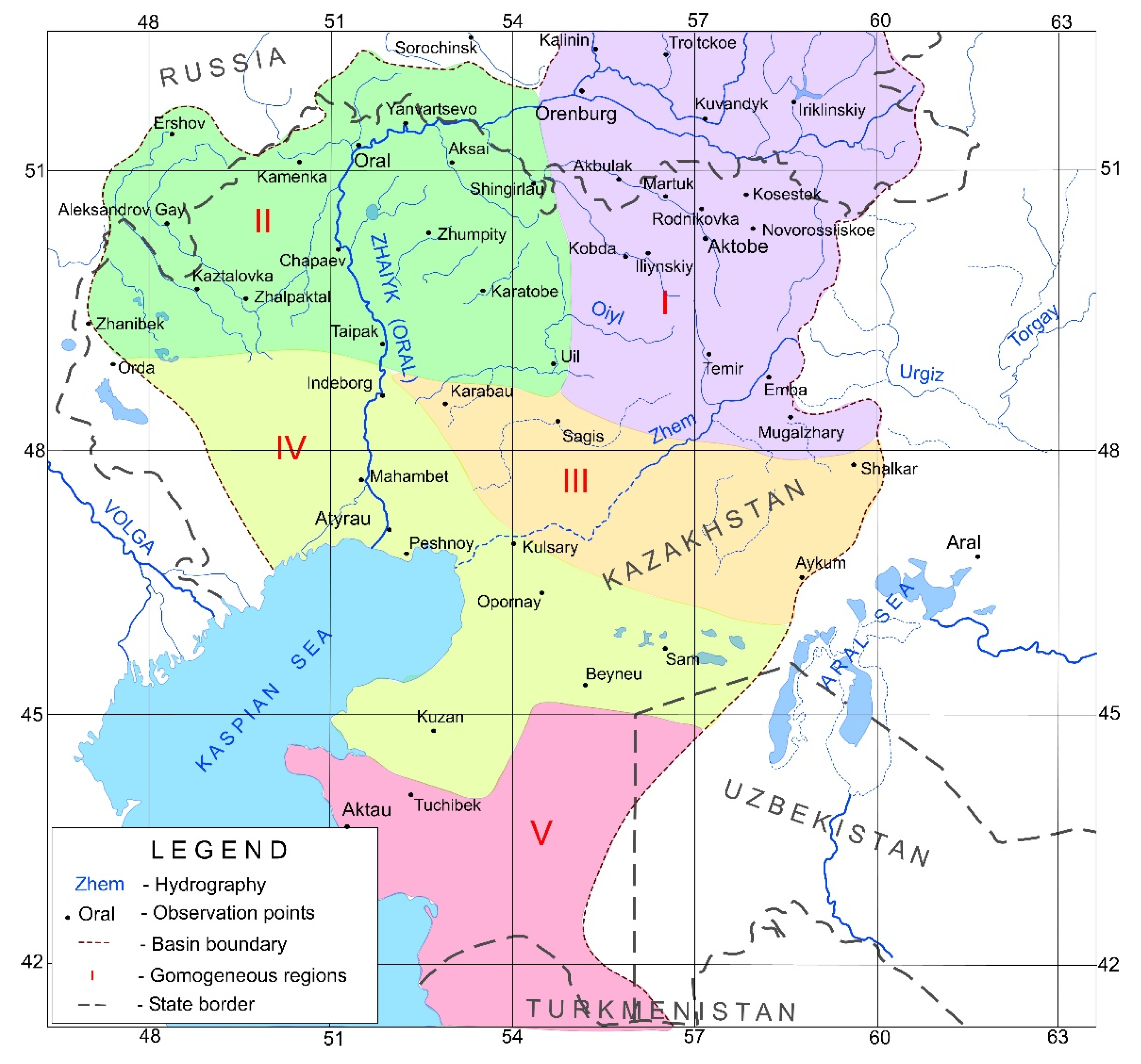
Figure 2.
Flood damage in Western Kazakhstan in March 2024. Photos by Zhdanov V.
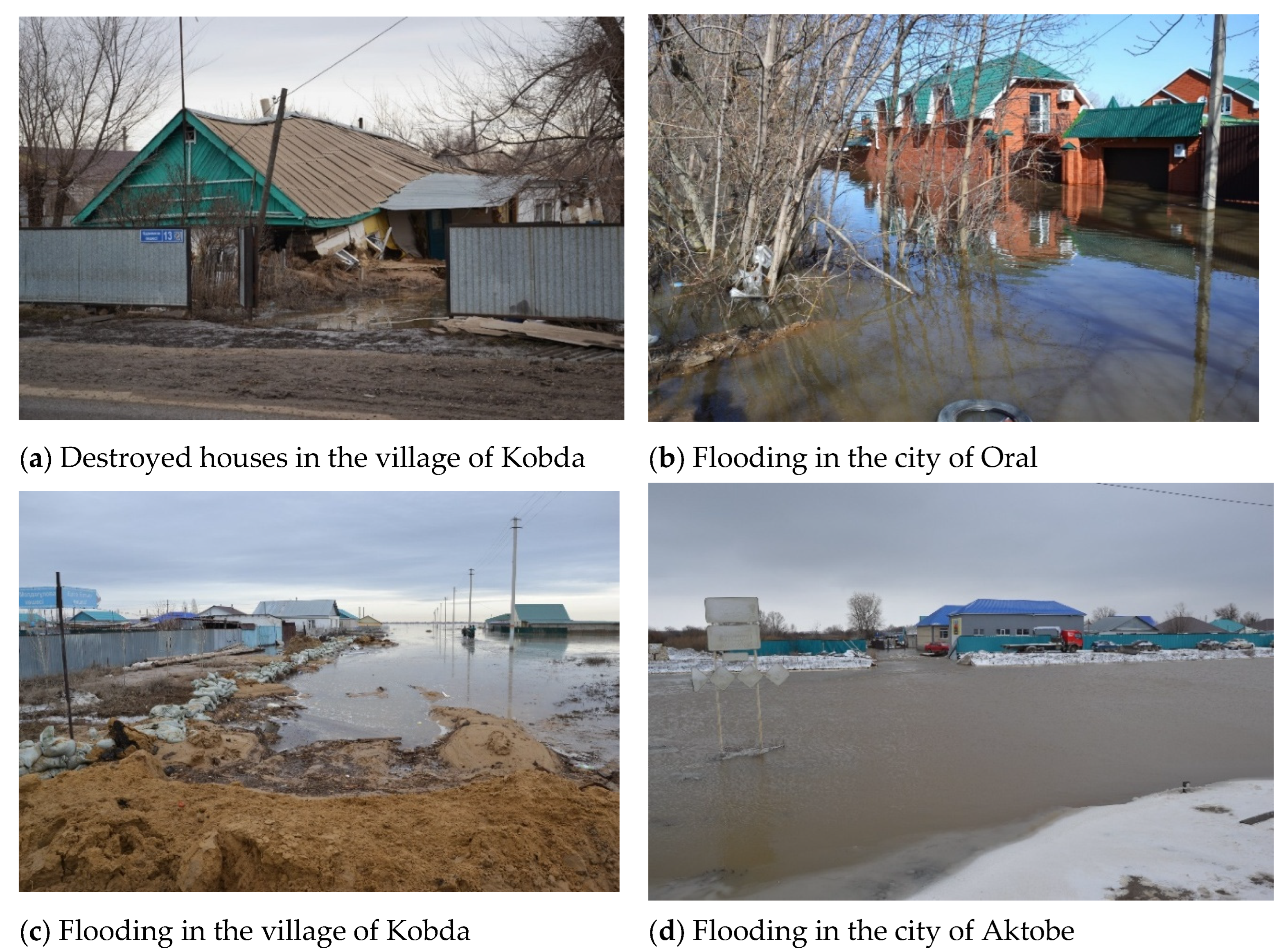
Figure 3.
Time Course of Snow Cover Characteristics in Two Neighbouring Regions of Western Kazakhstan.
Figure 3.
Time Course of Snow Cover Characteristics in Two Neighbouring Regions of Western Kazakhstan.


Table 1.
Average values of maximum height, water content and duration of snow occurrence in two climatic regions.
Table 1.
Average values of maximum height, water content and duration of snow occurrence in two climatic regions.
| Years | North of the Aktobe region | West Kazakhstan region | ||||
|---|---|---|---|---|---|---|
| Snow depth, cm | Snow water content, mm | Days with snow | Snow depth, cm | Snow water content, mm | Days with snow | |
| 1951-1960 | 39 | 120 | 134 | 23 | 68 | 118 |
| 1961-1970 | 33 | 96 | 113 | 23 | 72 | 106 |
| 1971-1980 | 30 | 89 | 143 | 25 | 72 | 118 |
| 1981-1990 | 40 | 79 | 135 | 33 | 81 | 121 |
| 1991-2000 | 47 | 93 | 132 | 34 | 87 | 121 |
| 2001-2010 | 37 | 75 | 130 | 25 | 69 | 107 |
| 2011-2020 | 36 | 85 | 121 | 38 | 80 | 109 |
| 1951-2024 | 38 | 90 | 129 | 29 | 75 | 113 |
| Average: | 31 | 78 | 138 | 21 | 66 | 130 |
Table 2.
Regionally average values of the anomaly of maximum height, water content and duration of snow occurrence in two climatic regions.
Table 2.
Regionally average values of the anomaly of maximum height, water content and duration of snow occurrence in two climatic regions.
| Decades | North of the Aktobe region | West Kazakhstan region | ||||
|---|---|---|---|---|---|---|
| Snow height, cm | Snow water content, mm | Days with snow | Snow height, cm | Snow water content, mm | Days with snow | |
| 1951-1960 | 8 | 42 | -4 | 2 | 2 | -12 |
| 1961-1970 | 2 | 18 | -25 | 2 | 6 | -24 |
| 1971-1980 | -1 | 11 | 5 | 4 | 6 | -12 |
| 1981-1990 | 9 | 1 | -3 | 12 | 15 | -9 |
| 1991-2000 | 16 | 15 | -6 | 13 | 21 | -9 |
| 2001-2010 | 6 | -3 | -8 | 4 | 3 | -23 |
| 2011-2020 | 5 | 7 | -17 | 17 | 14 | -21 |
| 1951-2024 | 7 | 12 | -9 | 8 | 9 | -17 |
Table 3.
Spearman’s coefficient of correlation between climatic indices and characteristics of snow cover.
Table 3.
Spearman’s coefficient of correlation between climatic indices and characteristics of snow cover.
| Climate Index | North of the Aktobe region | West Kazakhstan region | ||||
|---|---|---|---|---|---|---|
| Snow height, cm | Snow water content, mm | Days with snow | Snow height, cm | Snow water content, mm | Days with snow | |
| GST | 0,17 | -0,33 | -0,13 | 0,32 | 0,05 | -0,19 |
| SCE | -0,18 | -0,16 | -0,06 | 0,27 | 0,19 | 0,23 |
| ONI | 0,10 | 0,09 | 0,10 | -0,02 | -0,06 | 0,01 |
| AO | 0,15 | 0,02 | 0,05 | 0,17 | 0,17 | -0,07 |
| NAO | 0,23 | -0,10 | 0,14 | 0,28 | 0,16 | 0,02 |
| CO2 | 0,23 | -0,24 | -0,04 | 0,40 | 0,13 | -0,06 |
Table 4.
Correlation Dependence of Climatic Indices and Snow Cover Characteristics for March.
| Climate Index | North of the Aktobe region | West Kazakhstan region | ||||
|---|---|---|---|---|---|---|
| Snow height, cm | Snow water content, mm | Days with snow | Snow height, cm | Snow water content, mm | Days with snow | |
| GST | 0,15 | -0,32 | -0,16 | 0,36 | 0,12 | -0,17 |
| SCE | -0,32 | -0,21 | 0,14 | 0,07 | 0,07 | 0,24 |
| ONI | 0,15 | 0,14 | 0,07 | 0,02 | -0,03 | 0,01 |
| AO | 0,10 | 0,02 | 0,03 | 0,28 | 0,23 | 0,08 |
| NAO | 0,13 | -0,08 | 0,02 | 0,30 | 0,24 | 0,04 |
Table 5.
Statistical characteristics of data series.
| Region | Character snow cover |
Median | Disp-ersion | The standard deviation | Coefficient of variation | Stan- dart error |
Standard error, % | Student t-test |
|---|---|---|---|---|---|---|---|---|
|
North of the Aktobe region |
H, cm | 37,57 | 93,24 | 9,66 | 25,70 | 1,12 | 2,99 | 33,47 |
| W, mm | 89,99 | 613,76 | 24,77 | 27,53 | 2,88 | 3,20 | 31,25 | |
| N, days | 129,45 | 480,13 | 21,91 | 16,93 | 2,55 | 1,97 | 50,82 | |
|
West Kazakhstan region |
H, cm | 29,01 | 91,84 | 9,58 | 33,04 | 1,11 | 3,84 | 26,04 |
| W, mm | 75,43 | 505,41 | 22,48 | 29,80 | 2,61 | 3,46 | 28,86 | |
| N, days | 113,47 | 414,94 | 20,37 | 17,95 | 2,37 | 2,09 | 47,92 |
Table 6.
Statistical characteristics of data series.
| Area | Parameter | The Trend for 70 Years | Coefficient of determination R2 | Error |
|---|---|---|---|---|
| North of the Aktobe region | H, cm | 10 | 0,02 | 1,12 |
| W, mm | -30 | 0,24 | 2,88 | |
| N, days | -6 | 0,05 | 2,55 | |
| North of the Ural Region | H, cm | 12 | 0,2 | 1,11 |
| W, mm | 10 | 0,04 | 2,61 | |
| N, days | -8 | 0,06 | 2,37 | |
| Global climate indices | SCE | -0,2 | 0,01 | - |
| GST | 1,5 | 0,87 | - | |
| AO | 0,8 | 0,14 | - | |
| NAO | 1 | 0,26 | - |
Disclaimer/Publisher’s Note: The statements, opinions and data contained in all publications are solely those of the individual author(s) and contributor(s) and not of MDPI and/or the editor(s). MDPI and/or the editor(s) disclaim responsibility for any injury to people or property resulting from any ideas, methods, instructions or products referred to in the content. |
© 2026 by the authors. Licensee MDPI, Basel, Switzerland. This article is an open access article distributed under the terms and conditions of the Creative Commons Attribution (CC BY) license (http://creativecommons.org/licenses/by/4.0/).
Copyright: This open access article is published under a Creative Commons CC BY 4.0 license, which permit the free download, distribution, and reuse, provided that the author and preprint are cited in any reuse.


