

Submitted:
03 June 2026
Posted:
04 June 2026
You are already at the latest version
Abstract
We report the first cases of asciminib-induced gynecomastia in two elderly patients treated for chronic myeloid leukemia, in the third-line setting for 6 months and in the second-line setting for 3 months, respectively. Both patients exhibited hormonal disturbances, with elevated follicle-stimulating hormone (FSH) and luteinizing hormone (LH) levels; one had low serum total testosterone, while the other had elevated estradiol levels. Temporary discontinuation and dose reduction of asciminib alleviated symptoms. The pathophysiological mechanisms and management options for this adverse event are discussed.
Keywords:
asciminib
; gynecomastia
; chronic myeloid leukemia
; hormonal disturbances
1. Introduction
Although the prognosis of chronic myeloid leukemia (CML) has markedly improved in the era of tyrosine kinase inhibitors (TKIs), novel agents are still needed for patients who are resistant or intolerant to existing therapies. Asciminib is a first-in-class STAMP (Specifically Targeting the ABL Myristoyl Pocket) inhibitor. It acts by locking the BCR::ABL1 protein into an inactive conformation. Unlike ATP-competitive TKIs, which bind to the catalytic site of multiple kinases, this unique mechanism of action confers high specificity for BCR::ABL1, resulting in fewer off-target effects and improved tolerability. While gynecomastia has been reported with some ATP-competitive TKIs, we describe here the first two cases occurring in men treated with asciminib.
2. Case 1
An 84-year-old man had been receiving asciminib (40 mg twice daily, then 80 mg once daily) for 6 months when he developed painful bilateral gynecomastia. He had been diagnosed with chronic-phase CML 18 years earlier and had been treated with imatinib for 9 years, followed, after cytogenetic and molecular relapse, by bosutinib for another 9 years. The bosutinib dose had been reduced from 400 mg to 200 mg daily due to renal impairment (glomerular filtration rate: 50 mL/min/1.73 m²). Asciminib was initiated when the BCR::ABL1IS level increased to 19% while on bosutinib. The patient declined bone marrow cytogenetic analysis. Next-generation sequencing revealed no BCR::ABL1 mutations. A major molecular response (MMR) was achieved within 6 months of asciminib therapy. The patient had a long-standing history of osteoarthritis treated with analgesics and a remote history of prostate cancer not requiring treatment. At the onset of gynecomastia, breast ultrasound demonstrated asymmetric bilateral dendritic gynecomastia, slightly more pronounced on the right, without suspicious lesions or axillary lymphadenopathy. Testicular ultrasound showed mild testicular atrophy without suspicious abnormalities. Alpha-fetoprotein and beta-human chorionic gonadotropin levels were normal. Endocrinological evaluation revealed low total testosterone levels and a twofold increase in prolactin (Table 1). Asciminib was discontinued. Long-term androgen therapy was contraindicated due to prostate cancer; however, a short course of topical androstanolone gel was administered (application of 5 g once daily for two weeks), resulting in resolution of mastodynia. Three months after asciminib discontinuation, gynecomastia persisted but was no longer painful. MMR was lost (BCR::ABL1IS 1.1%). In agreement with the patient, treatment was resumed at a reduced dose (40 mg/day) after an additional three months, once gynecomastia had completely resolved. At that time, BCR::ABL1IS was 13%. Six months after asciminib resumption, the patient remained asymptomatic and achieved a deep molecular response (BCR::ABL1IS 0.008%; MR4) (Figure 1).
3. Case 2
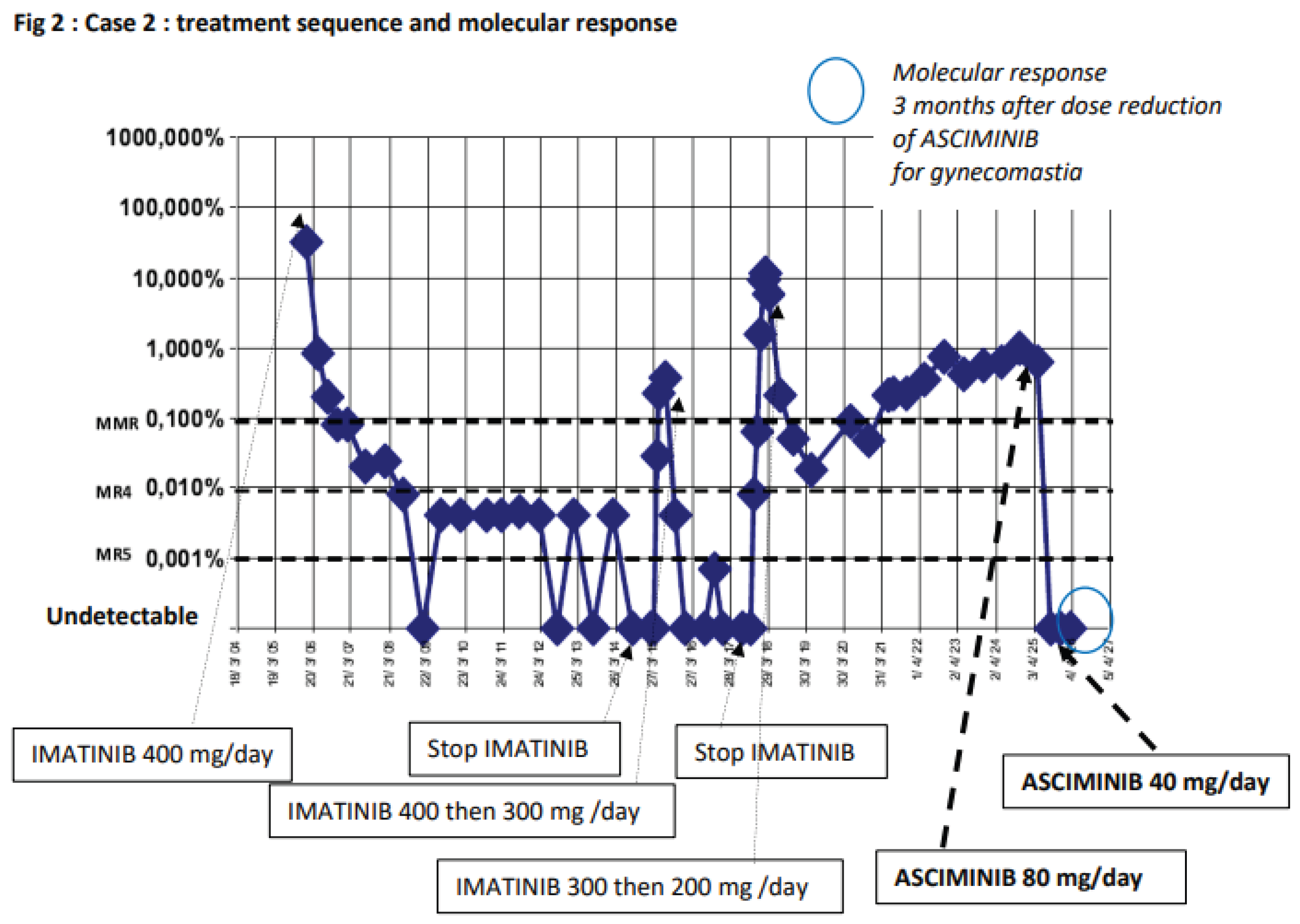
An 84-year-old man had been receiving asciminib 80 mg daily for 3 months when he developed painful left-sided gynecomastia. He had previously been treated for chronic-phase CML with imatinib for 19 years, including two brief treatment-free remission periods, with dose reductions due to nephroangiosclerosis and renal failure (glomerular filtration rate: 32 mL/min/1.73 m²), down to 200 mg/day. His medical history included hepatitis C cured without sequelae 20 years earlier by interferon and ribavirin, gout, hypertension, coronary artery disease treated with stent placement, and monoclonal gammopathy of undetermined significance. His long-term medications included allopurinol, furosemide, ramipril, amlodipine, clopidogrel, aspirin, atorvastatin, esomeprazole, and intermittent prednisone. The patient had lost MMR for 4 years before imatinib was discontinued when BCR::ABL1IS reached 0.98%. Asciminib was selected as second-line therapy due to contraindications to second-generation TKIs and ponatinib. At the onset of gynecomastia, the patient declined imaging studies. Alpha-fetoprotein and beta-human chorionic gonadotropin levels were normal. Laboratory findings showed hormonal imbalance with elevated FSH and LH levels despite normal total testosterone levels (Table 1). In agreement with the patient, asciminib was continued at the same dose, based on several arguments: mild symptoms, short exposure to the drug, lack of alternative treatments, and excellent response (deep molecular response achieved at 3 months, with undetectable BCR::ABL1 (uMR4.5). After 6 months of treatment, and despite resolution of gynecomastia following a short course of topical androstanolone (application of 5 g once daily for 3 weeks), the dose was reduced to 40 mg/day in the context of sustained deep molecular response. Three months later, uMR4.5 was maintained (Figure 2)

Table 1.
Hormonal Data.
| Normal Values | Case 1 | Case 2 | |
|---|---|---|---|
| FSH (UI/l) | 1.5-12.4 | 54 | 34.4 |
| LH (UI/l) | 1.7-8.6 | 33 | 27.2 |
| Testosterone (ng/dl) | 260-1000 | 66 | 682 |
| Δ4-androstenedione (mmol/l) | 2.09-5.93 | ND | 2.05 |
| Oestradiol (pmol/l) | 33-221 | <73.5 | 113.5 |
| Progesterone (ng/ml) | <0.05-0.149 | ND | 0.06 |
| Prolactine (µUI/ml) | 86-324 | 745 | 266 |
| TSH (mUI/l) | 0.38-5.33 | 0.96 | 1.14 |
Abbreviations: FSH, follicle stimulating hormone; LH, luteinizing hormone; TSH, thyroid-stimulating hormone; ND, not done.
4. Discussion
Gynecomastia is a recognized, though uncommon, adverse event in patients with CML [1,2,3,4,5,6,7] or gastrointestinal stromal tumors (GIST) [8] treated with imatinib. It has also been reported, albeit rarely, with nilotinib [9] and dasatinib [10,11,12], possibly because these second-generation TKIs have limited penetration across the blood–testis barrier compared with imatinib. The mechanism is thought to involve inhibition of PDGFR-α and c-KIT [1,3], which are expressed in the testes and play roles in hormone production and spermatogenesis. Inhibition of PDGFR leads to decreased number and increased apoptosis of Leydig cells, resulting in reduced testosterone production, while levels of testosterone precursors (progesterone and 17-hydroxyprogesterone) increase. This disrupts the androgen-to-estrogen ratio. In a series of 38 patients on imatinib, 35 had low testosterone levels and high testosterone precursors ones, and 7 had gynecomastia [1]; in another series of patients treated for GIST at the dose of 400 mg/day as in CML, 3/6 patients with gynecomastia had high oestradiol level, while testosterone was normal in all of them [8]. Of note, hormonal abnormalities were not always associated with gynecomastia (0 cases of gynecomastia/38 patients with low testosterone levels after 6 months on imatinib) [13]. Ponatinib is also acting on the kinases involved in male hormonal production but gynecomastia has not been described with this TKI thus far. Bosutinib minimally inhibits PDGFR and c-Kit and is not known as causing gynecomastia. Asciminib selectively targets BCR::ABL1, thus raising the possibility of alternative mechanisms underlying gynecomastia. Indeed, ABL1 is also expressed in the testis, including in Leydig cells which produce testosterone, but at low levels and with low tissue specificity [14,15]. This gene is supposed to play a role in spermatogenesis, while its function in steroidogenesis and its influence on hormonal status are not documented.
Both of our patients shared several features: advanced age, prolonged exposure to TKIs, and renal insufficiency, all factors that may impair hormonal balance. Although their biological profiles differed, both exhibited hormonal imbalance leading to hypothalamic–pituitary axis stimulation. However, in the Italian series of 38 patients, the occurrence of imatinib-related gynecomastia was dose-dependant but age-independent [1]. Of note, most patients were rather middle-aged than elderly males (57 years [SD 16·7] vs 50 years [13·6]) in patients with or without gynecomastia respectively). Renal insufficiency itself can contribute to gynecomastia, partly through reduced testosterone levels and altered sex hormone–binding globulin levels [16]. Prolactine secretion can also be modified, as seen in Case 1. However, the temporal association with asciminib initiation rather suggests a drug-related effect. Moreover, urinary excretion of asciminib is minimal and dose adaptation to renal function is not recommended. Trough levels of the drug were not measured in our patients, in the absence of guidelines for dose adaptation based on drug concentration. Importantly, other causes of gynecomastia, including testicular malignancy and recently initiated concomitant medications, were excluded.
Management considerations are critical, as gynecomastia developed early (within 3–6 months) and therapeutic alternatives were limited. Dose adjustment proved effective in both cases, allowing continuation of asciminib with maintained efficacy. Whether response-adapted dose reduction strategies, already recommended with other TKIs [17], are applicable to asciminib has not yet been explored. In pre-clinical studies, the dose of 40 mg BID maintained 100% of patients without T315I mutation above the serum concentration with a 90% inhibitory effect defined on pSTAT5 inhibition. Asciminib being now approved in first line in several countries, the issues of tolerance and dose adaptation might become more and more frequent. Treatment options for drug-induced gynecomastia include topical androgens and systemic hormonal therapies (androgens, antiestrogens, aromatase inhibitors), surgery and radiation being mentioned but rarely indicated [8].
5. Conclusions
Two elderly men treated with asciminib for CML experienced gynecomastia. If the pathophysiology of this adverse event is not fully understood, hormonal abnormalities were present. Both cases proved manageable with dose adjustment and short-term topical androgen therapy.
Author Contributions
L.L., S.T. and F.H. followed-up patients and wrote the manuscript; L.R. performed molecular analyses and reviewed the manuscript; S.G. provided comments on endocrinological data and reviewed the manuscript. All authors have read and agreed to the published version of the manuscript.
Funding
This research received no external funding.
Institutional Review Board Statement
The study was conducted in accordance with the Declaration of Helsinki.
Informed Consent Statement
The patients gave informed consent.
Data Availability Statement
Further inquiries can be directed to the corresponding author.
Acknowledgments
ChatGPT (free) for use of correct American language.
Conflicts of Interest
L.L., S.T. and F.H. are speakers and board members for Novartis and Incyte Biosciences. L.R and S.G. declare no conflict of interest.
References
- Gambacorti-Passerini C, Tornaghi L, Cavagnini F, Rossi P, Pecori-Giraldi F, et al (2003). Gynaecomastia in men with chronic myeloid leukaemia after imatinib. Lancet 361:1954-1956. [CrossRef]
- Tavil B, Kınık S, Gözen A, Olcay L (2013). Gynecomastia in a Boy with Chronic Myeloid Leukemia during Imatinib Therapy. Turk J Haematol.;30 :336-337. [CrossRef]
- Bay K, Bjerrum O-W, Olsson-Strömberg U, Porkka K, Høgh Dufva I, Andersson A-M. (2013). Reproductive Hormone Profiles during Imatinib Therapy in Men with Chronic Myeloid Leukemia. Andrology 2:1. [CrossRef]
- Jain A, Varma S, Garg R, Malhotra P. (2017). Unilateral Gynaecomastia in a Young Man with Chronic Myeloid Leukemia. Indian J Hematol Blood Transfus.33:448-450. [CrossRef]
- Gupta P, Cherian KE, Kapoor N, Fouzia NA, Paul TV (2019). Imatinib-induced Gynecomastia (2019). Indian J Endocrinol Metab. 23:648. [CrossRef]
- Mangaraj S, Priyanka Samal P (2021). Imatinib Induced Gynecomastia- A Rare Endocrine Facet of Anti Cancer Therapy. Endocrine Practice. 27:S138-S139. [CrossRef]
- Li XL, Li M, Tu SK, Fan HJ, Shi ZW, Wang LZ, Tian J, Song K (2024). Imatinib-induced gynecomastia: A case report. Exp Ther Med.11: 28:425. [CrossRef]
- Liu H, Liao G, Yan Z (2011). Gynecomastia during imatinib mesylate treatment for gastrointestinal stromal tumor: a rare adverse event. BMC Gastroenterol. 11:116. [CrossRef]
- Nilotinib (2012). React. Wkly. 1385: 34. [CrossRef]
- Caocci G, Atzeni S, Orru N, Azzena L, Martorana L, Littera R, Ledda A, La Nasa G (2008). Gynecomastia in a male after dasatinib treatment for chronic myeloid leukemia. Leukemia 22: 2127–2128. [CrossRef]
- Signorelli J, Fathi, A-T, Hobbs, G (2022). Dasatinib-Induced Gynecomastia in 2 Patients with Chronic Myeloid Leukemia: Case Reports and Review of the Literature. J Hematol Oncol Pharm 12 :24.
- Kaushik H, Devde KD, Manuja N, Arora R, Dongre A (2024). Dasatinib-Induced Gynecomastia: A Case Report. Cureus. 2024;16(12):e76121. [CrossRef]
- Ghalaut VS, Prakash G, Bansal P, Dahiya K, Dokwal S, Ghalaut PS, Bala M, Dhankhar R (2014). Effect of imatinib on male reproductive hormones in BCR-ABL positive CML patients: A preliminary report. J Oncol Pharm Pract 20:243-248. [CrossRef]
- Human Protein Atlas proteinatlas.org.
- Guan X, Chen P, Ji M, Wen X, Chen D et al.(2022). Identification of Rat Testicular Leydig Precursor Cells by Single-Cell-RNA-Sequence Analysis. Front Cell Dev Biol. 2022;10:805249. [CrossRef]
- Edey MM. Male Sexual Dysfunction and Chronic Kidney Disease (2017). Front Med (Lausanne). 22:4:32. [CrossRef]
- Apperley J, Milojkovic D, Cross N.C.P, Hjorth-Hansen H, Hochhaus A, et al (2025). LeukemiaNet recommendations for the management of chronic myeloid leukemia. Leukemia 39, 1797–1813 . [CrossRef]
Figure 1.
Case 1: Treatment sequence and molecular response.
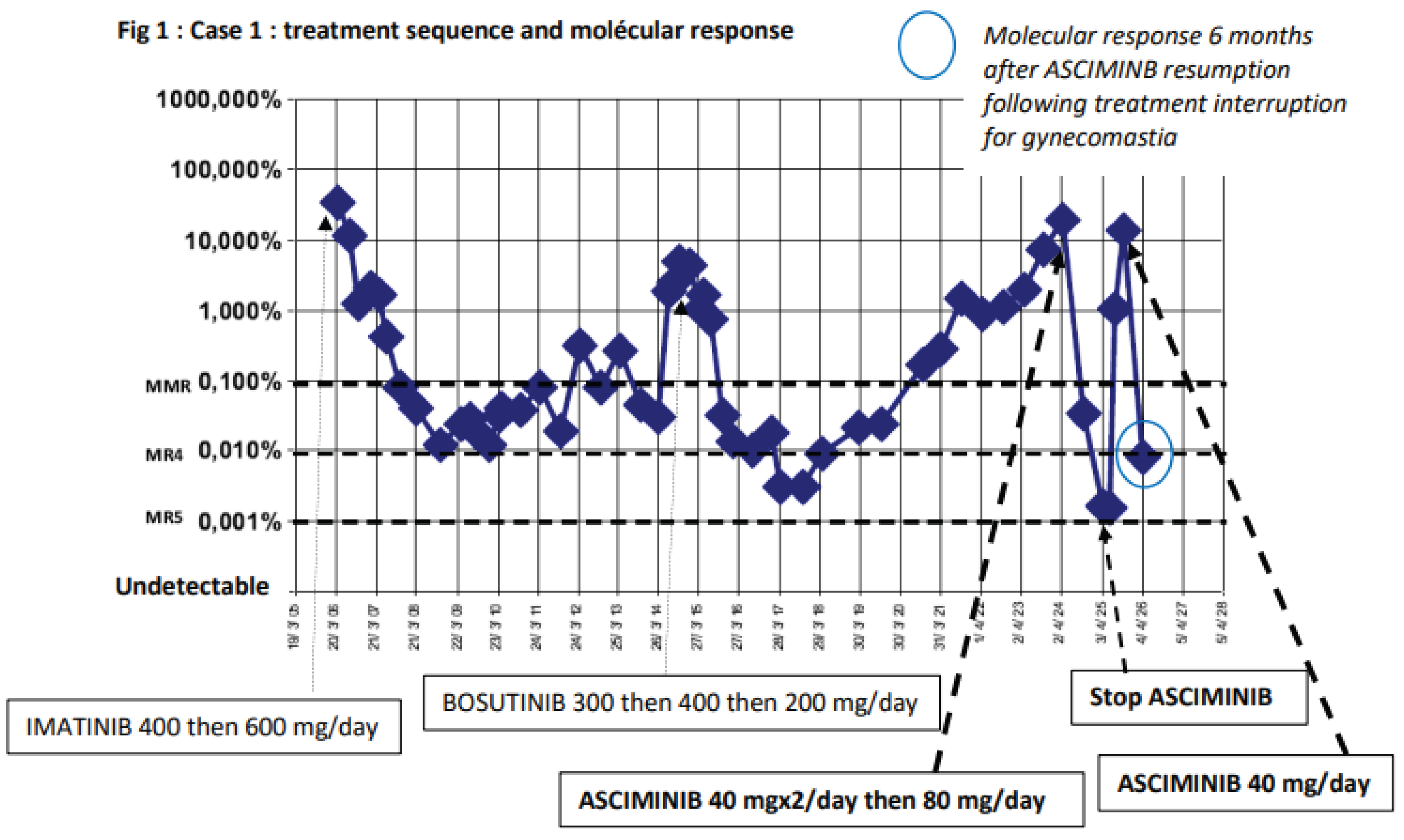
Figure 2.
Case 2: Treatment sequence and molecular response.
Disclaimer/Publisher’s Note: The statements, opinions and data contained in all publications are solely those of the individual author(s) and contributor(s) and not of MDPI and/or the editor(s). MDPI and/or the editor(s) disclaim responsibility for any injury to people or property resulting from any ideas, methods, instructions or products referred to in the content. |
© 2026 by the authors. Licensee MDPI, Basel, Switzerland. This article is an open access article distributed under the terms and conditions of the Creative Commons Attribution (CC BY) license (http://creativecommons.org/licenses/by/4.0/).
Copyright: This open access article is published under a Creative Commons CC BY 4.0 license, which permit the free download, distribution, and reuse, provided that the author and preprint are cited in any reuse.


