
Submitted:
03 June 2026
Posted:
04 June 2026
You are already at the latest version
Abstract
Meteorological drought is a major hydroclimatic hazard across South Asia, with far-reaching consequences for water security, agriculture, ecosystems, and cli-mate-resilient development. In India, where hydroclimatic variability is strongly gov-erned by the Indian summer monsoon, understanding how future precipitation re-gimes and drought-event characteristics may evolve under anthropogenic forcing is essential for effective adaptation planning. This study examines projected changes in monsoon precipitation and meteorological drought characteristics across India’s six homogeneous precipitation zones using bias-corrected NASA NEX-GDDP-CMIP6 daily precipitation simulations from 19 global climate models. Model performance is evaluated against high-resolution gridded precipitation observations from the India Meteorological Department for the historical reference period 1985–2014. Future changes are assessed for three 21st-century periods: near future (2021–2050), mid fu-ture (2051–2080), and far future (2081–2100), under SSP2-4.5 and SSP5-8.5. The ability of the multi-model ensemble to reproduce observed monsoon rainfall patterns is quantified using the Pattern Correlation Coefficient and Root Mean Square Error. Me-teorological drought characteristics, including severity, duration, and intensity, are derived from the 12-month Standardized Precipitation Index using a run-theory-based event framework. The findings show that the CMIP6 multi-model ensemble reasonably captures the broad spatial organization of Indian summer monsoon rainfall, although precipitation magnitudes are generally underestimated relative to observations. Future projections indicate an overall intensification of mon-soon precipitation, particularly under SSP5-8.5, with far-future increases exceeding 30–40% over parts of central and western India. However, this projected wetting ten-dency does not imply a uniform reduction in drought risk. Instead, SPI-12-based drought diagnostics reveal pronounced spatial and temporal heterogeneity in drought-event behaviour, with enhanced severity, persistence, and intensity emerging most prominently over Central North-East, North-West, and West-Central zones. The results highlight a critical hydroclimatic paradox: increasing mean precipitation can coexist with intensified meteorological drought when rainfall variability, seasonal re-distribution, and dry-spell persistence increase. Overall, the study demonstrates the value of bias-corrected ensemble projections and event-based drought diagnostics for identifying regional drought vulnerabilities and supporting climate adaptation, drought preparedness, and water-resource planning across India.
Keywords:
meteorological drought
; SPI-12
; NASA NEX-GDDP-CMIP6
; Indian Summer Monsoon
; run theory
1. Introduction
Drought is one of the most persistent and damaging climate hazards, with impacts that extend across water resources, agriculture, ecosystems, energy production, and human livelihoods. Unlike rapid-onset extremes, drought evolves gradually through sustained precipitation deficits and can persist from months to years, producing cumulative stress on surface water, groundwater, crop productivity, and ecological stability [1,2]. Under anthropogenic warming, changes in atmospheric circulation, moisture transport, precipitation variability, and evaporative demand are expected to reshape drought frequency, duration, severity, and spatial extent across many regions [3]. Regionally resolved drought assessments are therefore essential for adaptation planning, agricultural risk management, and long-term water-security strategies.
India is particularly exposed to meteorological drought because its hydroclimatic regime is strongly controlled by Indian Summer Monsoon (ISM). The ISM, active mainly from June to September, supplies the dominant share of annual rainfall and regulates agricultural production, reservoir storage, groundwater recharge, and ecosystem functioning across the country [4,5]. This strong seasonal dependence means that even moderate monsoon rainfall deficits can rapidly translate into widespread water stress and agricultural losses. The risk is further amplified by India’s large agrarian population, extensive cultivated area, and strong livelihood dependence on climate-sensitive farming systems. Drought behaviour over India is spatially heterogeneous because monsoon rainfall is shaped by complex interactions among large-scale circulation, ocean–atmosphere variability, land–atmosphere feedbacks, and regional physiography. Orographic controls from the Western Ghats and the Himalayas influence moisture transport and rainfall distribution, while climate mode such as El Niño–Southern Oscillation, Indian Ocean Dipole, and intraseasonal monsoon oscillations modulate active and break phases of the monsoon [6,7]. Consequently, drought characteristics vary substantially across India’s homogeneous precipitation zones, making all-India averages insufficient for capturing region-specific drought exposure.
Historical drought episodes demonstrate the cascading consequences of monsoon failure in India. Major droughts such as those of 1877, 1899, 1918, 1972, 1987, 2002, and 2009 were associated with severe reductions in crop production, water availability, livestock resources, and rural livelihoods [8,9]. The 2002 drought, linked to a large deficit in all-India summer monsoon rainfall, produced substantial agricultural losses and broader economic disruption [10]. Recent below-normal monsoon years have further emphasized the sensitivity of India’s food, water, and energy systems to rainfall variability [11]. These impacts highlight the need to understand how drought-event characteristics may evolve under future climate forcing.
Climate change can influence drought through both dynamic and thermodynamic mechanisms. A warmer atmosphere can hold more moisture, intensify atmospheric water-vapour transport and increase precipitation variability [3,12]. Over South Asia, this thermodynamic response interacts with changes in monsoon circulation, sea-surface temperature gradients, land–ocean thermal contrast, and intraseasonal variability, leading to complex regional rainfall responses [13,14]. Importantly, drought risk may persist or intensify even where mean precipitation increases, because higher temperatures and stronger atmospheric moisture demand can accelerate soil-water depletion during dry intervals [15]. Therefore, future drought assessment requires analysis not only of rainfall totals but also of drought frequency, persistence, severity, and intensity. Climate model ensembles provide the primary basis for assessing future drought risk under alternative forcing pathways. Previous studies based on CMIP5 improved understanding of South Asian hydroclimatic change but were limited by persistent biases in simulating the ISM, including errors in rainfall distribution, convective processes, intraseasonal variability, and oceanic precipitation patterns [16,17]. CMIP6 represents an important advance through improved model physics, updated forcing scenarios, and expanded representation of atmosphere–ocean–land processes [18,19]. Nevertheless, substantial inter-model uncertainty remains over monsoon regions, requiring observational evaluation and ensemble-based interpretation before climate projections are used for drought-impact assessment.
Meteorological drought is commonly quantified using standardized indices that enable comparison across different climate regimes. The Standardized Precipitation Index (SPI), introduced by [20] and recommended by the World Meteorological Organization for drought monitoring, is widely used because it relies solely on precipitation and can be computed across multiple accumulation periods [21]. At 12-month scale, SPI-12 integrates precipitation anomalies over an annual cycle and is well suited for diagnosing longer-term meteorological drought conditions relevant to streamflow, reservoir storage, groundwater recharge, and annual agricultural water availability [22]. Although indices such as SPEI incorporate temperature-driven evaporative demand, SPI remains appropriate when the objective is to isolate precipitation-driven drought behaviour and avoid additional uncertainty from evapotranspiration estimates [2,23]. Beyond drought identification, event-based characterization is needed to quantify how drought structure changes under climate forcing. Run theory provides a statistically consistent framework for extracting drought events from standardized index time series [24,25,26]. A drought event is typically defined as a continuous period during which SPI remains below a selected threshold, commonly −1.0 for moderate drought. From each event, drought frequency, duration, severity, and intensity can be derived, allowing changes in drought architecture to be examined across regions, scenarios, and future periods.
Despite growing attention to drought projections over India, important gaps remain. Many previous studies have used raw or minimally corrected climate model outputs, limited model ensembles, or all-India averages that obscure regional drought contrasts [11,27] CMIP6-based assessments are increasing, yet fewer studies combine bias-corrected daily projections, multi-model evaluation, SPI-12-based drought diagnosis, run-theory-derived drought characteristics, and regional aggregation across India’s homogeneous precipitation zones. Moreover, the temporal evolution of drought risk across near-, mid-, and far-future periods remains insufficiently resolved under contrasting intermediate- and high-emission pathways. This study addresses these gaps by assessing projected changes in meteorological drought across India.
Accordingly, this study aims to: (i) evaluate the ability of 19 CMIP6 global climate models to reproduce observed annual and monsoon-season precipitation over India during 1985–2014 using the Pearson correlation coefficient and root-mean-square error; (ii) quantify projected changes in Indian Summer Monsoon precipitation across India’s six homogeneous precipitation zones under SSP2-4.5 and SSP5-8.5 for the near future (2021–2050), mid future (2051–2080), and far future (2081–2100); and (iii) characterize the spatial and temporal evolution of meteorological drought at the SPI-12 scale using run theory to derive drought severity, duration, and intensity, thereby identifying the region most vulnerable to future drought intensification. By integrating model evaluation, standardized drought diagnosis, event-based characterization, and regional synthesis, this study provides a focused assessment of how India’s meteorological drought regime may evolve under 21st-century climate change.
2. Materials and Methods
2.1. Study Area
India extends approximately from 8°N to 38°N and 66°E to 100°E, covering about 3.29 million km² and encompassing highly diverse physiographic and hydroclimatic regimes (Figure 1). Its landscape ranges from the Himalayan mountains in the north and the arid Thar Desert in the northwest to the humid western coast, Indo-Gangetic plains, and rain-shadow regions of the Deccan Plateau. These strong topographic and climatic gradients produce pronounced spatial contrasts in monsoon rainfall, water availability, and drought susceptibility. Because India’s agricultural and water-resource systems are closely linked to the seasonal behaviour of the Indian Summer Monsoon, regional-scale drought assessment is essential for understanding climate-risk exposure across the country [5,6].
For regional analysis, India is classified into six homogeneous precipitation zones: Himalayan Region (HR), North East (NE), North West (NW), Central North East (CNE), West Central (WC), and Peninsular Region (PR). These zones represent regions with broadly coherent precipitation variability and provide a suitable framework for evaluating spatial contrasts in projected monsoon precipitation and SPI-12-based meteorological drought characteristics. This regionalization enables drought severity, duration, and intensity to be interpreted within India’s distinct hydroclimatic settings rather than from national-scale averages alone [6,9].
2.2. Data Sources and Methods
2.2.1. IMD Gridded Precipitation
Observed precipitation was obtained from the India Meteorological Department (IMD) high-resolution daily gridded rainfall dataset at (0.25°×0.25°) spatial resolution. The dataset is available from the National Data Centre, IMD, Pune, and provides long-term daily rainfall records over India from 1901 onward [28]. In this study, the IMD product was used as the observational reference for evaluating historical precipitation simulations from CMIP6 global climate models during 1985–2014 and for deriving SPI-12-based meteorological drought characteristics. The IMD gridded rainfall product was developed from quality-controlled rain-gauge observations distributed across India and interpolated onto a regular latitude–longitude grid using Shepard’s inverse-distance-weighting method [28,29]. Although rain-gauge density is not spatially uniform, the dataset provides broad national coverage and is widely used as a benchmark observational product for analysing Indian monsoon rainfall variability, precipitation extremes, and drought-related hydroclimatic conditions [28,30,31]. Its long temporal coverage, daily resolution, and high spatial detail make it suitable for evaluating annual and JJAS precipitation variability and for supporting gridded drought assessment over India.
2.2.2. NASA NEX GDDP CMIP6
Future precipitation projections were obtained from the NASA Earth Exchange Global Daily Downscaled Projections CMIP6 dataset (NASA-NEX GDDP-CMIP6), which provides statistically downscaled daily climate variables from CMIP6 global climate models at (0.25°×0.25°) spatial grid [32]. The dataset is based on CMIP6 simulations conducted under the Scenario Model Intercomparison Project and distributed through the Earth System Grid Federation, supporting climate-impact assessments consistent with the scenario framework used in the IPCC AR6 Report [3,19,33]. NASA-NEX GDDP-CMIP6 uses a Bias-Correction and Spatial Disaggregation approach to reduce systematic biases in coarse-resolution GCM outputs and project them onto a finer observational grid [32,34,35,36]. In this procedure, modelled historical climatology is compared with reference observations over a common baseline period to estimate bias-correction factors, which are then applied to future simulations while retaining the climate-change signal from the parent GCMs. Spatial disaggregation further transfers the corrected fields to a high-resolution grid, improving the regional applicability of GCM outputs for hydroclimatic impact assessment.

Table 1.
Summary of precipitation products used in drought assessment.
| Data | Source | Resolution | Historical | SSP2-4.5 | SSP5-8.5 |
|---|---|---|---|---|---|
| Precipitation | IMD | (0.25° × 0.25°) | ✓ | - | - |
| NEX GDDP CMIP6 | (0.25° × 0.25°) | ✓ | ✓ | ✓ |
2.3. Formulation Approach
This methodological framework includes data pre-processing, selection of skillful GCMs, historical validation, empirical computation of SPI, drought characteristics estimation and exposure assessment.
2.3.1. Historical Validation
The performance of the 19 NASA-NEX GDDP-CMIP6 models was evaluated against IMD observations for the historical baseline period 1985–2014 using the Pattern Correlation Coefficient (PCC) and Root Mean Square Error (RMSE; Table 2). These metrics were computed for both annual and Indian Summer Monsoon precipitation, defined as the June–September season. PCC quantifies the spatial agreement between simulated and observed precipitation climatology, with values closer to 1 indicating stronger pattern correspondence, whereas RMSE, expressed in mm day⁻¹, measures the magnitude of model error. The combined use of PCC and RMSE provides a balanced assessment of both spatial pattern fidelity and bias magnitude, which is essential for selecting reliable models for regional hydroclimatic projection [27,37,38].
Overall, the CMIP6 models reproduced the broad spatial structure of Indian precipitation, including high rainfall over the North East and along the Western Ghats and comparatively low rainfall over the North West and interior rain-shadow regions. However, model skill varied considerably across the ensemble. Based on the adopted selection criterion of PCC ≥ 0.80 and RMSE ≤ 2.77 mm day⁻¹, the six best-performing models were retained to construct the ensemble mean used for subsequent precipitation-change and drought analyses. These thresholds correspond to the upper-skill model subset identified from the combined PCC–RMSE ranking and were used to reduce the influence of models with weaker spatial agreement or larger precipitation errors.
The selected six-model ensemble captures the major features of the observed monsoon precipitation climatology but retains systematic regional biases (Figure 2). During the historical period, the ensemble reproduces enhanced precipitation over the North East and Western Ghats and reduced precipitation over the North West and parts of central India. The bias field indicates widespread underestimation over the North West, Central North East, and West Central zones, while localized overestimation occurs over parts of the North East and along the Western Ghats. The predominance of negative bias across much of India suggests that the selected ensemble generally simulates lower precipitation than observed. These residual biases emphasize the importance of historical validation before applying the model ensemble to future precipitation projections and SPI-12-based meteorological drought assessment.
Figure 2.
Multi-model-mean of historical simulations with respect to historical observation during monsoon period since 1985-2014.
Figure 2.
Multi-model-mean of historical simulations with respect to historical observation during monsoon period since 1985-2014.
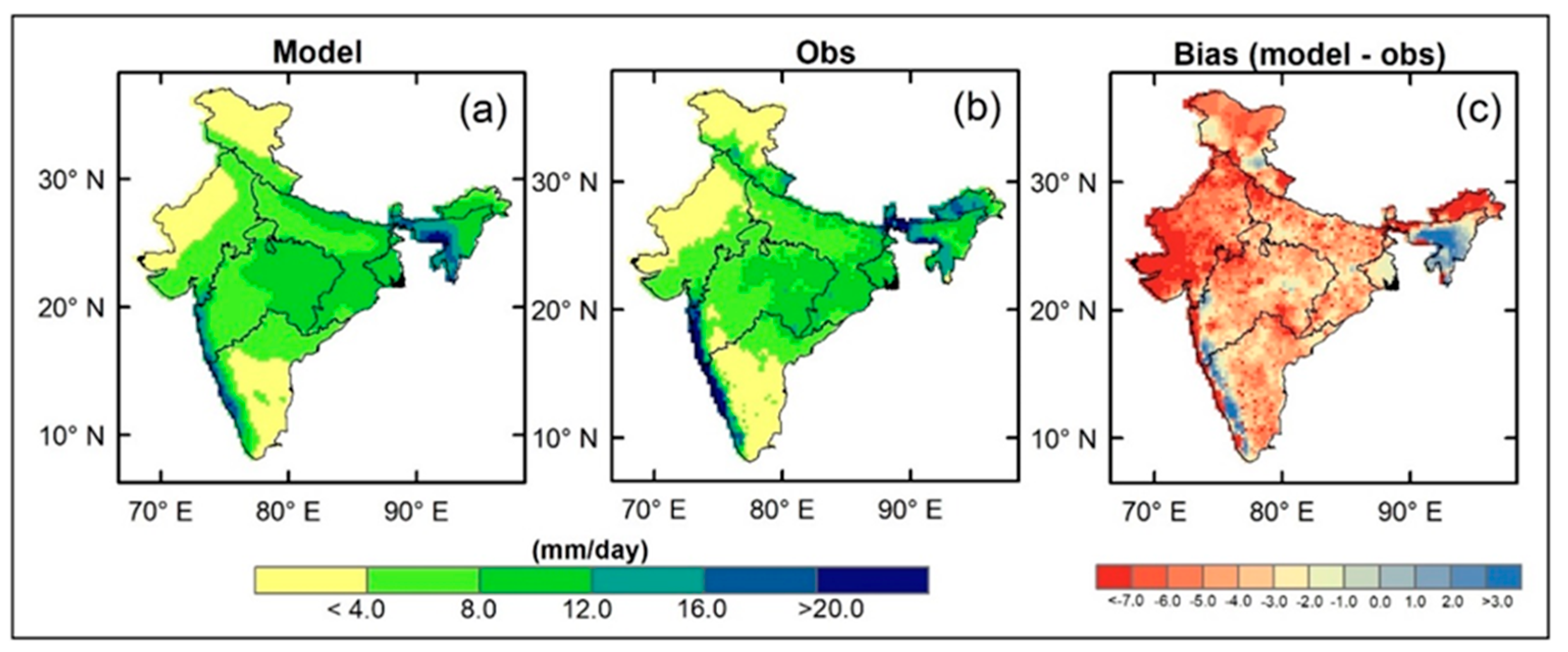
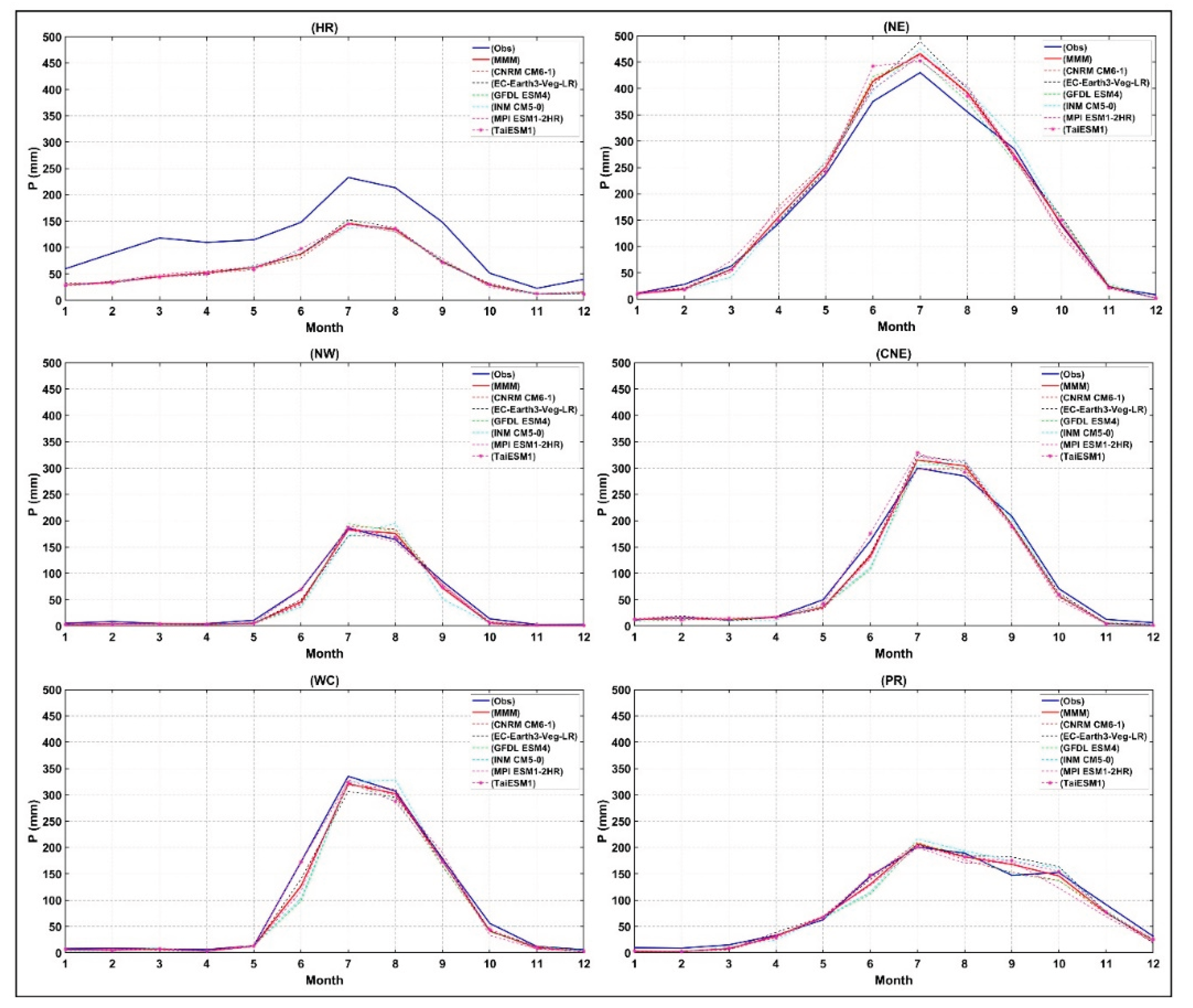
Figure 3.
Monthly precipitation climatology over India’s six homogeneous precipitation zones during 1985–2014. The blue line shows IMD observations, while colored lines represent the selected skillful models and their multi-model mean.
Figure 3.
Monthly precipitation climatology over India’s six homogeneous precipitation zones during 1985–2014. The blue line shows IMD observations, while colored lines represent the selected skillful models and their multi-model mean.
2.3.2. Empirical Computation of SPI
The Standardized Precipitation Index (SPI) was computed using a non-parametric empirical probability framework to quantify precipitation deficits at the 12-month accumulation scale. For each grid cell, monthly precipitation was accumulated over a moving 12-month window, ranked in ascending order, and converted into empirical cumulative probabilities using the Gringorten plotting position [39,40]
where () is the ranked 12-month accumulated precipitation value, is its rank, and is the sample size. The empirical probability was then transformed into a standard normal variate as:
where denotes the inverse cumulative distribution function of the standard normal distribution. This empirical formulation avoids imposing a predefined probability distribution on precipitation and is therefore suitable for regions with diverse hydroclimatic regimes [41]. The SPI-12 timescale was selected because it integrates precipitation anomalies over an annual cycle and is suitable for assessing longer-term meteorological drought conditions relevant to water-resource availability, reservoir storage, groundwater recharge, and agricultural productivity [22].
Table 3.
Standardized Precipitation Index (SPI) drought classification following [20].
Table 3.
Standardized Precipitation Index (SPI) drought classification following [20].
| Drought category | Category | Value |
|---|---|---|
| No drought | Extremely wet | ≥ 2.00 |
| Severely wet | 1.50 to 1.99 | |
| Moderately wet | 1.00 to 1.49 | |
| Mild wet | 0.00 to 0.99 | |
| Mild drought | Mild drought | −0.99 to 0.00 |
| Moderate drought | Moderate drought | −1.49 to −1.00 |
| Severe drought | Severe drought | −1.99 to −1.50 |
| Extreme drought | ≤ −2.00 |
2.3.3. Computation of Drought Characteristics
Drought characteristics were derived from the SPI-12 time series using run theory, which provides an event-based framework for identifying and quantifying drought episodes from threshold-based index sequences [2,24,42]. In this study, a drought event was defined as a continuous period during which SPI-12 remained below −1.0, corresponding to moderate or more severe drought conditions. For each grid cell, drought severity, duration, and intensity were computed to characterize the cumulative magnitude, persistence, and mean strength of drought conditions. The spatial severity ), duration and intensity at grid are expressed as follows;
Together, these metrics provide a concise representation of drought-event architecture and enable spatial comparison of drought severity, persistence, and intensity across scenarios, time periods, and homogeneous precipitation zones.
3. Results
3.1. Projected Changes in Precipitation Dynamcis
Figure 4 presents the projected percentage change in JJAS monsoon precipitation relative to the historical baseline period (1985–2014) for the near future (NF: 2021–2050), mid future (MF: 2051–2080), and far future (FF: 2081–2100) under SSP2-4.5 and SSP5-8.5. Both scenarios indicate a widespread wetting tendency across India, with the magnitude and spatial coherence of precipitation increases strengthening from NF to FF. Under SSP2-4.5, near-future increases are generally moderate, mostly within 10–20%, with stronger anomalies concentrated over western, central, north-western, and peninsular India. By the mid future, increases locally exceed 20–30% over central and western India, and this wetting pattern persists into the far future, although with comparatively weaker amplification than under SSP5-8.5. Under SSP5-8.5, the projected wetting signal is stronger and more spatially extensive, particularly after mid-century. Near-future precipitation changes broadly resemble SSP2-4.5 but with slightly larger positive anomalies over western and central India. By the mid future, increases become more pronounced across central, western, north-western, peninsular, and parts of north-eastern India. In the far future, SSP5-8.5 produces the strongest response, with precipitation increases exceeding 30% across several regions. These results indicate a clear scenario-dependent intensification of monsoon precipitation, with higher radiative forcing leading to larger late-century rainfall increases.
The decadal trend analysis for 2021–2100 further supports this projected wetting tendency (Figure 5). Under SSP2-4.5, JJAS precipitation trends are generally weak to moderate and spatially fragmented, mostly ranging between approximately −2 and +3 mm decade⁻¹. Positive trends occur over parts of western, central, Himalayan, and north-eastern India, whereas localized weak negative trends appear over some interior and peninsular regions. Under SSP5-8.5, positive trends become stronger and more spatially coherent, with several regions showing increases of approximately 3–5 mm decade⁻¹. Statistically significant trends are also more widespread under SSP5-8.5, particularly over central, western, peninsular, Himalayan, and north-eastern India, indicating a more robust strengthening of monsoon rainfall under high-emission forcing. Together, Fig 4 and 5 demonstrate that future JJAS precipitation over India is projected to increase under both emission pathways, but the magnitude, spatial extent, and statistical significance of the response are strongly scenario- and time-dependent. The progressive increase from NF to FF reflects an intensifying climate-change signal, while the stronger response under SSP5-8.5 highlights the sensitivity of Indian monsoon rainfall to higher greenhouse-gas forcing. However, increased mean monsoon precipitation should not be interpreted as a direct reduction in drought risk, because meteorological drought also depends on rainfall variability, intra-seasonal distribution, dry-spell persistence, and regional hydroclimatic sensitivity. Previous studies have emphasized that skill-informed model selection can provide a more constrained basis for regional climate-impact assessment than an unconstrained multi-model mean, particularly in monsoon regions where GCMs differ substantially in their representation of precipitation climatology and variability [27,37,38].
3.2. Projected Changes in Drought Characteristics
Figure 6 and Figure 7 present the spatial evolution of SPI-12-based drought characteristics under SSP2-4.5 and SSP5-8.5, respectively. Three run-theory metrics were analysed: drought severity, representing the cumulative SPI deficit; drought duration, representing the total persistence of drought months; and drought intensity, representing the mean deficit per drought month. Overall, the projections indicate that drought characteristics remain substantial across India throughout the 21st century, with stronger spatial amplification under SSP5-8.5 than under SSP2-4.5. Under SSP2-4.5, drought severity shows a spatially heterogeneous response across the future periods (Figure 6a1–a4). During the historical period and near future, severity is generally within the range of approximately 70–95 SPI-months across much of India, with relatively higher values over parts of the North West, Central North East, West Central, and Peninsular regions. By the mid future, severity increases become more spatially coherent over central, western, and peninsular India, with several areas approaching 85–95 SPI-months. In the far future, drought severity remains widespread but spatially variable, with most regions showing moderate-to-high values on the displayed scale. This pattern indicates that drought severity persists under the intermediate-emission pathway, particularly across semi-arid and monsoon-transition regions. Moreover, drought duration under SSP2-4.5 exhibits a more coherent spatial signal than severity (Figure 5b1–b4). Historical and near-future duration values are generally high, mostly ranging between 45 and 60 months, with greater persistence over the North West, Central North East, West Central, and parts of Peninsular India. By the mid future, large areas approach 55–60 months, indicating increased cumulative drought persistence. In the far future, duration remains regionally important, with most areas showing approximately 34–38 months on the displayed scale. Drought intensity varies within a narrower numerical range, mostly between about 1.38 and 1.50, but localized higher intensities emerge over central, north-western, eastern, and peninsular India (Figure 6c1–c4). Together, these results suggest that SSP2-4.5 is associated with persistent drought exposure, with the strongest combined severity–duration–intensity signals concentrated over the North West, Central North East, West Central, and parts of Peninsular India.
Under SSP5-8.5, drought characteristics show stronger and more spatially extensive changes than under SSP2-4.5 (Figure 7). Drought severity remains high across much of India in the near future, generally around 80–95 SPI-months, and becomes more regionally differentiated by the mid future (Figure 7a1–a4). In the far future, severity intensifies across several regions, with the strongest signals over the Himalayan, North East, North West, West Central, Central North East, and Peninsular regions. This indicates that high-emission forcing broadens the spatial footprint of severe SPI-12 drought conditions by the late 21st century. Drought duration under SSP5-8.5 remains elevated across India throughout the projection period (Figure 7b1–b4). Historical and near-future duration values are mostly between 45 and 60 months, with widespread persistence over northern, western, central, and peninsular India. During the mid future, high duration persists over the North West, Central North East, West Central, and North East regions. In the far future, most regions show approximately 32–38 months on the displayed scale, with relatively higher persistence over northern, eastern, and peninsular India. Drought intensity under SSP5-8.5 generally ranges from about 1.38 to 1.50, with localized higher values over central, western, eastern, and peninsular India, particularly during the mid and far future (Figure 7c1–c4). Compared with SSP2-4.5, SSP5-8.5 therefore produces stronger combined increases in drought severity, persistence, and mean deficit strength.
The comparison between SSP2-4.5 and SSP5-8.5 highlights a clear scenario dependence in future drought hazard. While both pathways show persistent SPI-12 drought conditions, SSP5-8.5 produces broader and stronger late-century intensification, especially across the Central North East, North West, West Central, Himalayan, North East, and Peninsular regions. These regions emerge as key drought hotspots because they show repeated increases across one or more drought metrics. Importantly, this intensification occurs despite projected increases in mean JJAS precipitation, indicating that higher seasonal rainfall totals do not necessarily reduce drought risk. SPI-12 drought characteristics are controlled by multi-month precipitation deficits, rainfall timing, intra-seasonal variability, dry-spell persistence, and regional hydroclimatic sensitivity. These findings are consistent with previous studies reporting increasing drought risk over South Asia and the Indian subcontinent under climate warming [11,43,44]. The projected increase in drought severity, duration, and intensity also agrees with evidence that warming can enhance atmospheric moisture demand and intensify drought impacts, particularly in arid and semi-arid regions where rainfall variability and land-surface drying strongly influence drought development [45,46].
4. Discussion
4.1. Relative Role of Precipitation in Driving Meteorological Drought
Precipitation variability is the dominant driver of meteorological drought in this study because SPI-12 is derived exclusively from accumulated precipitation anomalies. This dependence is particularly relevant for India, where the Indian Summer Monsoon supplies nearly 70–80% of annual rainfall and strongly controls seasonal water availability, agricultural production, and drought development [28,47]. The results indicate that projected increases in mean JJAS precipitation do not necessarily translate into reduced drought risk. Although monsoon precipitation increases by approximately 10–30% across many regions under SSP2-4.5 and exceeds 30% locally under SSP5-8.5 by the far future, SPI-12 drought severity, duration, and intensity remain substantial across several regions, particularly the North West, Central North East, and West Central zones. This apparent contrast reflects the importance of rainfall timing, persistence, and multi-month accumulation deficits. Under SSP2-4.5, drought severity commonly remains within about 70–95 SPI-months across large parts of India during the historical, near-future, and mid-future periods, while drought duration frequently reaches 45–60 months over the North West, Central North East, West Central, and parts of the Peninsular region. Under SSP5-8.5, these drought characteristics become more spatially extensive, with near-future severity generally around 80–95 SPI-months and persistent drought duration of 45–60 months across northern, western, central, and peninsular India. These values indicate that drought risk is governed not only by seasonal rainfall totals but also by the sequencing of wet and dry periods, the persistence of rainfall deficits, and the accumulation of precipitation anomalies over annual timescales.
The precipitation trend analysis further supports this interpretation. Under SSP2-4.5, JJAS precipitation trends are generally weak to moderate, mostly ranging from approximately −2 to +3 mm decade⁻¹. Under SSP5-8.5, trends become stronger and more spatially coherent, with several regions showing positive trends of about 3–5 mm decade⁻¹. However, the continued intensification of SPI-12 drought characteristics under both scenarios indicates that a wetter mean monsoon does not preclude more severe or persistent drought episodes. In particular, the North West, Central North East, and West Central regions repeatedly emerge as drought-sensitive zones, suggesting that these regions are especially vulnerable to intra-seasonal rainfall variability, dry-spell persistence, and multi-month precipitation deficits. The stronger drought response under SSP5-8.5 demonstrates a clear scenario dependence. Compared with SSP2-4.5, the high-emission pathway produces broader late-century increases in drought severity, duration, and intensity, especially across the North West, Central North East, West Central, Himalayan, North East, and Peninsular regions. This suggests that higher radiative forcing may amplify hydroclimatic variability and increase the probability of sustained precipitation deficits, even in regions where mean monsoon rainfall increases. Therefore, precipitation change alone is an incomplete indicator of future drought risk; event-based metrics derived from SPI-12 provide a more informative assessment of drought hazard structure.
These findings are consistent with previous assessments reporting increased drought risk across South Asia and the Indian subcontinent under climate warming [11,43,44,48,49]. They also agree with evidence that drought risk can increase despite rising precipitation when rainfall becomes more variable, temporally concentrated, or separated by longer dry intervals [2,41]. Because SPI-12 does not explicitly account for temperature or evaporative demand, future analyses should complement precipitation-based drought diagnostics with temperature-sensitive and land-surface indicators such as SPEI, soil moisture, and evapotranspiration to better capture compound drought processes under warming [15,50].
4.2. Atmospheric Conditions Associated with Droughts over India
Meteorological drought over India is controlled not only by seasonal rainfall deficits but also by the atmospheric and oceanic processes that regulate monsoon moisture transport, rainfall persistence, and break-spell development. The Indian Summer Monsoon is a coupled land–ocean–atmosphere system in which variations in sea-surface temperature, land–sea thermal contrast, low-level circulation, and intraseasonal convection can produce sustained rainfall deficits over the subcontinent [7,47]. This is directly relevant to the present SPI-12 results, where drought intensification remains evident in several regions despite projected increases in mean JJAS precipitation. Remote Indo-Pacific forcing is a major source of monsoon variability and drought risk. El Niño events are commonly associated with suppressed convection and weakened monsoon rainfall over India, while the Indian Ocean Dipole can modulate the ENSO–monsoon relationship by altering zonal SST gradients and moisture transport over the Indian Ocean [47,51]. In addition, rapid warming of the Indian Ocean can reduce the South Asian land–sea thermal gradient, weakening monsoon circulation and contributing to drying tendencies over the Indian subcontinent [52]. These mechanisms provide a physical basis for the persistence of SPI-12 drought hotspots over the North West, Central North East, and West Central regions, where rainfall variability and multi-month precipitation deficits strongly influence drought severity, duration, and intensity.
At sub-seasonal timescales, monsoon breaks and active–break transitions are critical for drought development. Break phases are typically associated with reduced convection over the Indian landmass, weakened low-level moisture convergence, and anomalous circulation patterns that suppress rainfall over central and north-western India [6,7]. The Madden–Julian Oscillation and related intraseasonal variability further modulate the timing and persistence of rainfall spells, thereby influencing whether seasonal rainfall is distributed evenly or concentrated into fewer intense events. This distinction is important because increased mean monsoon precipitation does not necessarily reduce drought risk if rainfall becomes more episodic, separated by longer dry intervals, or less effective in maintaining multi-month moisture availability. The spatial pattern of drought intensification identified in this study is consistent with these mechanisms. The North West and Central North East regions lie in hydro climatically sensitive transition zones where monsoon rainfall is more variable and where modest disruptions in moisture transport can produce persistent SPI-12 deficits. Under SSP5-8.5, stronger late-century increases in drought severity, duration, and intensity suggest that high-emission forcing may amplify the variability of monsoon rainfall and increase the likelihood of sustained precipitation deficits, even in a wetter mean climate. Thus, the projected drought response reflects the combined influence of rainfall amount, temporal distribution, circulation variability, and regional hydroclimatic sensitivity.
Overall, the atmospheric interpretation supports the main result of this study: future drought hazard over India cannot be inferred from mean precipitation change alone. A wetter monsoon climate may still produce more severe or persistent meteorological droughts if rainfall variability increases or dry spells become more prolonged. While SPI-12 provides a robust precipitation-based diagnosis of meteorological drought, future work should integrate circulation diagnostics, soil moisture, evapotranspiration, and temperature-sensitive drought indices to better capture the compound processes linking atmospheric forcing to drought impacts under climate change [2,15,41].
5. Conclusions
This study provides a spatially explicit assessment of future monsoon precipitation change and meteorological drought evolution over India using bias-corrected NASA-NEX GDDP-CMIP6 precipitation simulations from 19 CMIP6 global climate models. Historical model performance was evaluated against IMD gridded precipitation for 1985–2014, and a skill-informed ensemble was used to analyse future changes under SSP2-4.5 and SSP5-8.5 across the near future, mid future, and far future. SPI-12 and run theory were used to quantify drought severity, duration, and intensity across India’s homogeneous precipitation zones. The results show that JJAS precipitation is projected to increase across large parts of India under both emission pathways, but the magnitude and spatial coherence of this wetting signal strengthen with time and forcing level. Under SSP2-4.5, monsoon rainfall generally increases by about 10–20% in the near future and locally exceeds 20–30% by the mid and far future. Under SSP5-8.5, the late-century wetting signal is stronger, with increases exceeding 30% over several western, central, north-western, and peninsular regions.
Despite this increase in mean monsoon rainfall, SPI-12 drought characteristics remain substantial and intensify across several regions. Under SSP2-4.5, drought severity commonly remains within about 70–95 SPI-months across large parts of India during the historical, near-future, and mid-future periods, while drought duration frequently reaches 45–60 months over the North West, Central North East, West Central, and parts of the Peninsular Region. Under SSP5-8.5, near-future drought severity is generally around 80–95 SPI-months, and drought duration remains elevated across northern, western, central, and peninsular India. By the far future, drought hotspots become more clearly organized over the North West, Central North East, and West Central regions, with additional late-century intensification over the Himalayan, North East, and Peninsular regions. The central finding of this study is that a wetter mean monsoon does not necessarily imply lower meteorological drought risk. Future drought behaviour is strongly governed by rainfall variability, intra-seasonal distribution, dry-spell persistence, and the accumulation of multi-month precipitation deficits. This explains why drought severity, duration, and intensity can increase even where seasonal precipitation totals rise. The divergence between SSP2-4.5 and SSP5-8.5 further shows that higher radiative forcing amplifies drought hazard by increasing both the spatial extent and persistence of SPI-12 drought conditions.
Overall, the study identifies the North West, Central North East, and West Central regions as recurrent drought-sensitive zones under future climate change. These regions should be prioritized for drought early warning, climate-resilient agriculture, groundwater management, reservoir planning, and regional adaptation strategies. Future research should extend this precipitation-based diagnosis by integrating temperature-sensitive drought indices, soil moisture, evapotranspiration, and atmospheric circulation diagnostics to better capture compound drought processes under continued warming.
Author Contributions
Conceptualization V. Kumar, & H.J. Chu; Methodology, V. Kumar, H.J. Chu; Formal analysis, V. Kumar, H.J. Chu, A. Anand & U. Liaqat; Writing – original draft, V. Kumar; Writing – review and editing V. Kumar & A. Anand; Supervision, H.J. Chu. All authors have read and agreed to the content of the manuscript.
Funding
This research received no specific grant from any funding agency in the public, commercial, or not-for-profit sectors.
Data Availability Statement
The datasets analysed in this study are publicly accessible from open data repositories. The gridded precipitation dataset from the India Meteorological Department is available at https://www.imdpune.gov.in/Clim_Pred_LRF_New/Grided_Data_Download.html (accessed on 14 October 2023). The NASA-NEX GDDP-CMIP6 dataset is available from the NASA Center for Climate Simulation at https://www.nccs.nasa.gov/services/data-collections/land-based-products/nex-gddp-cmip6 (accessed on 16 April 2024).
Acknowledgments
This work was conducted during Vaibhav Kumar’s doctoral studies in the Department of Geomatics, National Cheng Kung University, Tainan City, Taiwan.
Conflicts of Interest
The authors declare that the research was conducted in the absence of any commercial or financial relationships that could be construed as a potential conflict of interest.
Abbreviations
List of acronyms used in study:
| IMD | India Meteorological Department |
| NASA-NEX GDDP-CMIP6 | NASA Earth Exchange Global Daily Downscaled Projections CMIP6 |
| SSP | Shared Socioeconomic Pathway |
| ISM | Indian Summer Monsoon |
| SPI | Standardized Precipitation Index |
| JJAS | June-July-August-September |
| PCC | Pearson Correlation Coefficient |
| RMSE | Root Mean Square Error |
References
- Wilhite, D.A. Drought as a Natural Hazard: Concepts and Definitions. In Droughts; Routledge, 2016; pp. 3–18. [Google Scholar]
- Mishra, A.K.; Singh, V.P. A Review of Drought Concepts. J. Hydrol. 2010, 391, 202–216. [Google Scholar] [CrossRef]
- Legg, S. IPCC, 2021: Climate Change 2021 - the Physical Science Basis. Interaction 2021, 49, 44–45. [Google Scholar]
- Gadgil, S. The Indian Monsoon and Its Variability. Annu. Rev. Earth Planet. Sci. 2003, 31, 429–467. [Google Scholar] [CrossRef]
- Parthasarathy, B.; Munot, A.A.; Kothawale, D.R. All-India Monthly and Seasonal Rainfall Series: 1871–1993. Theor. Appl. Climatol. 1994, 49, 217–224. [Google Scholar] [CrossRef]
- Rajeevan, M.; Gadgil, S.; Bhate, J. Active and Break Spells of the Indian Summer Monsoon. J. Earth Syst. Sci. 2010, 119, 229–247. [Google Scholar] [CrossRef]
- Turner, A.G.; Annamalai, H. Climate Change and the South Asian Summer Monsoon. Nat. Clim. Chang. 2012, 2, 587–595. [Google Scholar] [CrossRef]
- Mishra, V.; Kumar, R.; Shah, H.L.; Samaniego, L.; Eisner, S.; Yang, T. Multimodel Assessment of Sensitivity and Uncertainty of Evapotranspiration and a Proxy for Available Water Resources under Climate Change. Clim. Change 2017, 141, 451–465. [Google Scholar] [CrossRef]
- Sinha, D.; Syed, T.H.; Reager, J.T. Utilizing Combined Deviations of Precipitation and GRACE-Based Terrestrial Water Storage as a Metric for Drought Characterization: A Case Study over Major Indian River Basins. J. Hydrol. 2019, 572, 294–307. [Google Scholar] [CrossRef]
- Niranjan Kumar, K.; Rajeevan, M.; Pai, D.S.; Srivastava, A.K.; Preethi, B. On the Observed Variability of Monsoon Droughts over India. Weather Clim. Extrem. 2013, 1, 42–50. [Google Scholar] [CrossRef]
- Aadhar, S.; Mishra, V. A Substantial Rise in the Area and Population Affected by Dryness in South Asia under 1.5 C, 2.0 C and 2.5 C Warmer Worlds. Environ. Res. Lett. 2019, 14, 114021. [Google Scholar] [CrossRef]
- Held, I.M.; Soden, B.J. Robust Responses of the Hydrological Cycle to Global Warming. J. Clim. 2006, 19, 5686–5699. [Google Scholar] [CrossRef]
- Roxy, M.K.; Ghosh, S.; Pathak, A.; Athulya, R.; Mujumdar, M.; Murtugudde, R.; Terray, P.; Rajeevan, M. A Threefold Rise in Widespread Extreme Rain Events over Central India. Nat. Commun. 2017, 8, 708. [Google Scholar] [CrossRef]
- Krishnan, R.; Sanjay, J.; Gnanaseelan, C.; Mujumdar, M.; Kulkarni, A.; Chakraborty, S. Assessment of Climate Change over the Indian Region. A Rep. Minist. Earth Sci. (MoES) 2020, 13–17. [Google Scholar]
- Samaniego, L.; Thober, S.; Kumar, R.; Wanders, N.; Rakovec, O.; Pan, M.; Zink, M.; Sheffield, J.; Wood, E.F.; Marx, A. Anthropogenic Warming Exacerbates European Soil Moisture Droughts. Nat. Clim. Chang. 2018, 8, 421–426. [Google Scholar] [CrossRef]
- Sabeerali, C.T.; Rao, S.A.; Dhakate, A.R.; Salunke, K.; Goswami, B.N. Why Ensemble Mean Projection of South Asian Monsoon Rainfall by CMIP5 Models Is Not Reliable? Clim. Dyn. 2015, 45, 161–174. [Google Scholar] [CrossRef]
- Sperber, K.R.; Annamalai, H.; Kang, I.-S.; Kitoh, A.; Moise, A.; Turner, A.; Wang, B.; Zhou, T. The Asian Summer Monsoon: An Intercomparison of CMIP5 vs. CMIP3 Simulations of the Late 20th Century. Clim. Dyn. 2013, 41, 2711–2744. [Google Scholar] [CrossRef]
- Eyring, V.; Bony, S.; Meehl, G.A.; Senior, C.A.; Stevens, B.; Stouffer, R.J.; Taylor, K.E. Overview of the Coupled Model Intercomparison Project Phase 6 (CMIP6) Experimental Design and Organization. Geosci. Model Dev. 2016, 9, 1937–1958. [Google Scholar] [CrossRef]
- O’Neill, B.C.; Tebaldi, C.; Van Vuuren, D.P.; Eyring, V.; Friedlingstein, P.; Hurtt, G.; Knutti, R.; Kriegler, E.; Lamarque, J.-F.; Lowe, J. The Scenario Model Intercomparison Project (ScenarioMIP) for CMIP6. Geosci. Model Dev. 2016, 9, 3461–3482. [Google Scholar] [CrossRef]
- McKee, T.B.; Doesken, N.J.; Kleist, J. The Relationship of Drought Frequency and Duration to Time Scales. In Proceedings of the Proceedings of the 8th Conference on Applied Climatology, Boston, MA, USA, 1993; Vol. 17, pp. 179–183. [Google Scholar]
- Svoboda, M.; Hayes, M.; Wood, D. Standardized Precipitation Index: User Guide. 2012. [Google Scholar]
- Vicente-Serrano, S.M.; Beguería, S.; Lorenzo-Lacruz, J.; Camarero, J.J.; López-Moreno, J.I.; Azorin-Molina, C.; Revuelto, J.; Morán-Tejeda, E.; Sanchez-Lorenzo, A. Performance of Drought Indices for Ecological, Agricultural, and Hydrological Applications. Earth Interact. 2012, 16, 1–27. [Google Scholar] [CrossRef]
- Carrão, H.; Naumann, G.; Barbosa, P. Mapping Global Patterns of Drought Risk: An Empirical Framework Based on Sub-National Estimates of Hazard, Exposure and Vulnerability. Glob. Environ. Chang. 2016, 39, 108–124. [Google Scholar] [CrossRef]
- Yevjevich, V.M. An Objective Approach to Definitions and Investigations of Continental Hydrologic Droughts; Colorado State University Fort Collins, CO, USA, 1967; Vol. 23. [Google Scholar]
- Dracup, J.A.; Lee, K.S.; Paulson, E.G., Jr. On the Definition of Droughts. Water Resour. Res. 1980, 16, 297–302. [Google Scholar] [CrossRef]
- Tallaksen, L.M.; Van Lanen, H.A.J. Hydrological Drought: Processes and Estimation Methods for Streamflow and Groundwater; 2023. [Google Scholar]
- Mishra, S.K.; Sahany, S.; Salunke, P.; Kang, I.-S.; Jain, S. Fidelity of CMIP5 Multi-Model Mean in Assessing Indian Monsoon Simulations. npj Clim. Atmos. Sci. 2018, 1, 39. [Google Scholar] [CrossRef]
- Pai, D.S.; Rajeevan, M.; Sreejith, O.P.; Mukhopadhyay, B.; Satbha, N.S. Development of a New High Spatial Resolution (0.25× 0.25) Long Period (1901-2010) Daily Gridded Rainfall Data Set over India and Its Comparison with Existing Data Sets over the Region. Mausam 2014, 65, 1–18. [Google Scholar] [CrossRef]
- Shepard, D. A Two-Dimensional Interpolation Function for Irregularly-Spaced Data. In Proceedings of the Proceedings of the 1968 23rd ACM national conference, 1968; pp. 517–524. [Google Scholar]
- Rajeevan, M.; Bhate, J.; Kale, J.D.; Lal, B. High Resolution Daily Gridded Rainfall Data for the Indian Region: Analysis of Break and Active Monsoon Spells. Curr. Sci. 2006, 296–306. [Google Scholar]
- Dash, S.K.; Kulkarni, M.A.; Mohanty, U.C.; Prasad, K. Changes in the Characteristics of Rain Events in India. J. Geophys. Res. Atmos. 2009, 114. [Google Scholar] [CrossRef]
- Thrasher, B.; Wang, W.; Michaelis, A.; Melton, F.; Lee, T.; Nemani, R. NASA Global Daily Downscaled Projections, CMIP6. Sci. Data 2022, 9, 262. [Google Scholar] [CrossRef] [PubMed]
- Tebaldi, C.; Debeire, K.; Eyring, V.; Fischer, E.; Fyfe, J.; Friedlingstein, P.; Knutti, R.; Lowe, J.; O’Neill, B.; Sanderson, B.; et al. Climate Model Projections from the Scenario Model Intercomparison Project (ScenarioMIP) of CMIP6. Earth Syst. Dyn. 2021, 12, 253–293. [Google Scholar] [CrossRef]
- Wood, A.W.; Maurer, E.P.; Kumar, A.; Lettenmaier, D.P. Long-range Experimental Hydrologic Forecasting for the Eastern United States. J. Geophys. Res. Atmos. 2002, 107, ACL–6. [Google Scholar] [CrossRef]
- Wood, A.W.; Leung, L.R.; Sridhar, V.; Lettenmaier, D.P. Hydrologic Implications of Dynamical and Statistical Approaches to Downscaling Climate Model Outputs. Clim. Change 2004, 62, 189–216. [Google Scholar] [CrossRef]
- Maurer, E.P.; Hidalgo, H.G. Utility of Daily vs. Monthly Large-Scale Climate Data: An Intercomparison of Two Statistical Downscaling Methods. Hydrol. Earth Syst. Sci. 2008, 12, 551–563. [Google Scholar] [CrossRef]
- Ashfaq, M.; Rastogi, D.; Mei, R.; Touma, D.; Ruby Leung, L. Sources of Errors in the Simulation of South Asian Summer Monsoon in the CMIP5 GCMs. Clim. Dyn. 2017, 49, 193–223. [Google Scholar] [CrossRef]
- Jain, S.; Salunke, P.; Mishra, S.K.; Sahany, S. Performance of CMIP5 Models in the Simulation of Indian Summer Monsoon. Theor. Appl. Climatol. 2019, 137, 1429–1447. [Google Scholar] [CrossRef]
- Gringorten, I.I. A Plotting Rule for Extreme Probability Paper. J. Geophys. Res. 1963, 68, 813–814. [Google Scholar] [CrossRef]
- Farahmand, A.; AghaKouchak, A. A Generalized Framework for Deriving Nonparametric Standardized Drought Indicators. Adv. Water Resour. 2015, 76, 140–145. [Google Scholar] [CrossRef]
- Farahmand, A.; AghaKouchak, A. A Generalized Framework for Deriving Nonparametric Standardized Drought Indicators. Adv. Water Resour. 2015, 76, 140–145. [Google Scholar] [CrossRef]
- Spinoni, J.; Naumann, G.; Carrao, H.; Barbosa, P.; Vogt, J. World Drought Frequency, Duration, and Severity for 1951–2010. Int. J. Climatol. 2014, 34, 2792–2804. [Google Scholar] [CrossRef]
- Aadhar, S.; Mishra, V. On the Projected Decline in Droughts over South Asia in CMIP6 Multimodel Ensemble. J. Geophys. Res. Atmos. 2020, 125, e2020JD033587. [Google Scholar] [CrossRef]
- Saeed, F.; Schleussner, C.; Ashfaq, M. Deadly Heat Stress to Become Commonplace across South Asia Already at 1.5 C of Global Warming. Geophys. Res. Lett. 2021, 48, e2020GL091191. [Google Scholar] [CrossRef]
- Dimitrova, A.; Ingole, V.; Basagaña, X.; Ranzani, O.; Milà, C.; Ballester, J.; Tonne, C. Association between Ambient Temperature and Heat Waves with Mortality in South Asia: Systematic Review and Meta-Analysis. Environ. Int. 2021, 146, 106170. [Google Scholar] [CrossRef]
- Ullah, I.; Saleem, F.; Iyakaremye, V.; Yin, J.; Ma, X.; Syed, S.; Hina, S.; Asfaw, T.G.; Omer, A. Projected Changes in Socioeconomic Exposure to Heatwaves in South Asia under Changing Climate. Earth’s Futur. 2022, 10, e2021EF002240. [Google Scholar] [CrossRef]
- Hrudya, P.H.; Varikoden, H.; Vishnu, R. A Review on the Indian Summer Monsoon Rainfall, Variability and Its Association with ENSO and IOD. Meteorol. Atmos. Phys. 2021, 133, 1–14. [Google Scholar] [CrossRef]
- Aadhar, S.; Mishra, V. Increased Drought Risk in South Asia under Warming Climate: Implications of Uncertainty in Potential Evapotranspiration Estimates. J. Hydrometeorol. 2020, 21, 2979–2996. [Google Scholar] [CrossRef]
- Verma, A.; Vishwakarma, A.; Bist, S.; Kumar, S.; Bhatla, R. A Long-Term Drought Assessment over India Using CMIP6 Framework: Present and Future Perspectives. Mausam 2023, 74, 963–972. [Google Scholar] [CrossRef]
- Mondal, S.K.; Huang, J.; Wang, Y.; Su, B.; Zhai, J.; Tao, H.; Wang, G.; Fischer, T.; Wen, S.; Jiang, T. Doubling of the Population Exposed to Drought over South Asia: CMIP6 Multi-Model-Based Analysis. Sci. Total Environ. 2021, 771, 145186. [Google Scholar] [CrossRef]
- Ashok, K.; Guan, Z.; Saji, N.H.; Yamagata, T. Individual and Combined Influences of ENSO and the Indian Ocean Dipole on the Indian Summer Monsoon. J. Clim. 2004, 17, 3141–3155. [Google Scholar] [CrossRef]
- Roxy, M.K.; Ritika, K.; Terray, P.; Murtugudde, R.; Ashok, K.; Goswami, B.N. Drying of Indian Subcontinent by Rapid Indian Ocean Warming and a Weakening Land-Sea Thermal Gradient. Nat. Commun. 2015, 6, 7423. [Google Scholar] [CrossRef]
Figure 1.
Study area depicting India’s six homogeneous precipitation zones and elevation profile (in meter).
Figure 1.
Study area depicting India’s six homogeneous precipitation zones and elevation profile (in meter).
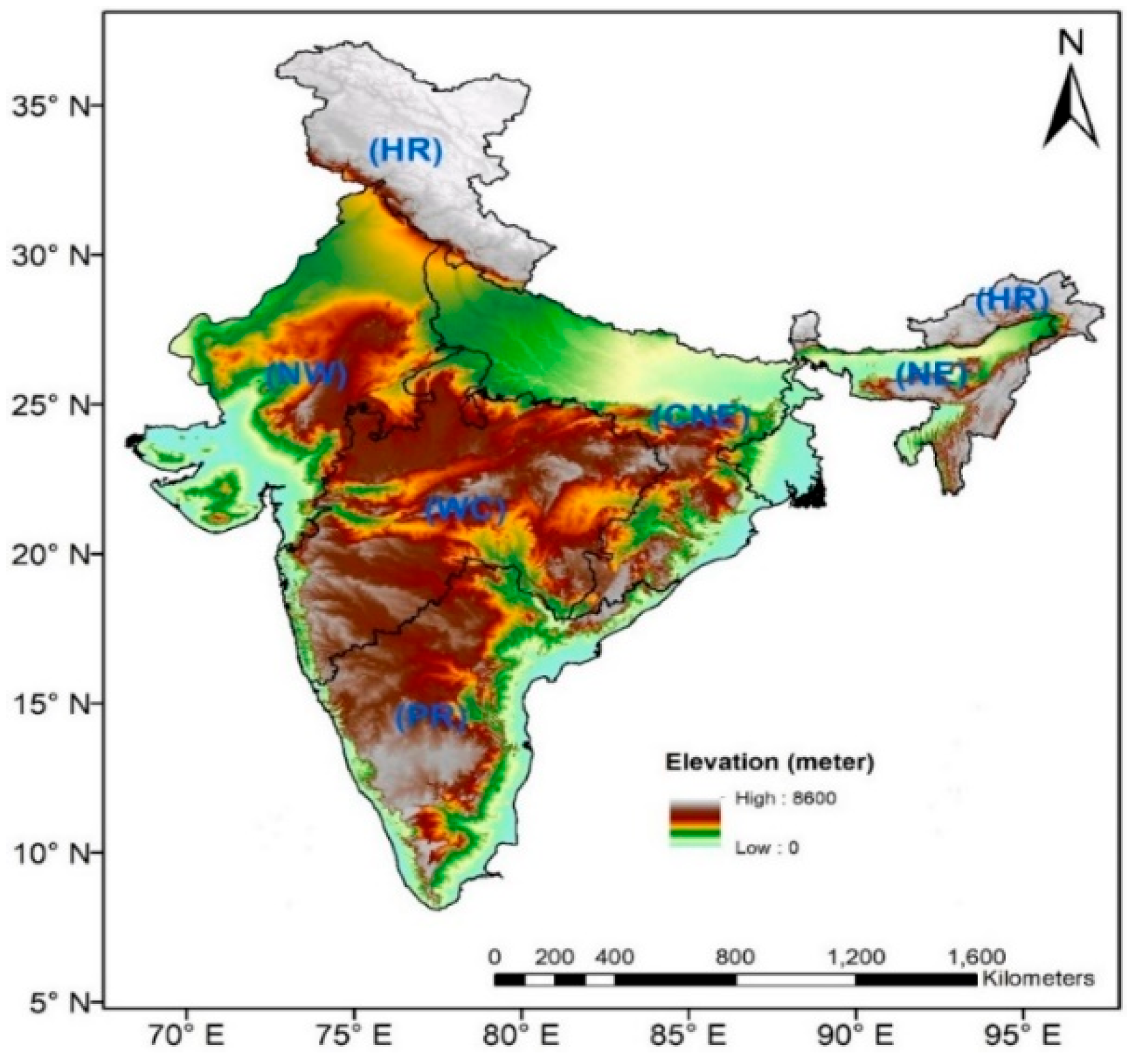
Figure 4.
Multi-model mean percentage change in rainfall relative to the historical baseline during the Near Future (NF; a–b), Mid-Future (MF; c–d), and Far Future (FF; e–f) periods under (left column) SSP2–4.5 and (right column) SSP5–8.5 scenarios. The color shading represents the magnitude of projected precipitation anomalies (%), with warmer colors indicating enhanced rainfall. Stippled regions denote areas where projected changes are statistically significant at the 95% confidence level based on historical variability.
Figure 4.
Multi-model mean percentage change in rainfall relative to the historical baseline during the Near Future (NF; a–b), Mid-Future (MF; c–d), and Far Future (FF; e–f) periods under (left column) SSP2–4.5 and (right column) SSP5–8.5 scenarios. The color shading represents the magnitude of projected precipitation anomalies (%), with warmer colors indicating enhanced rainfall. Stippled regions denote areas where projected changes are statistically significant at the 95% confidence level based on historical variability.
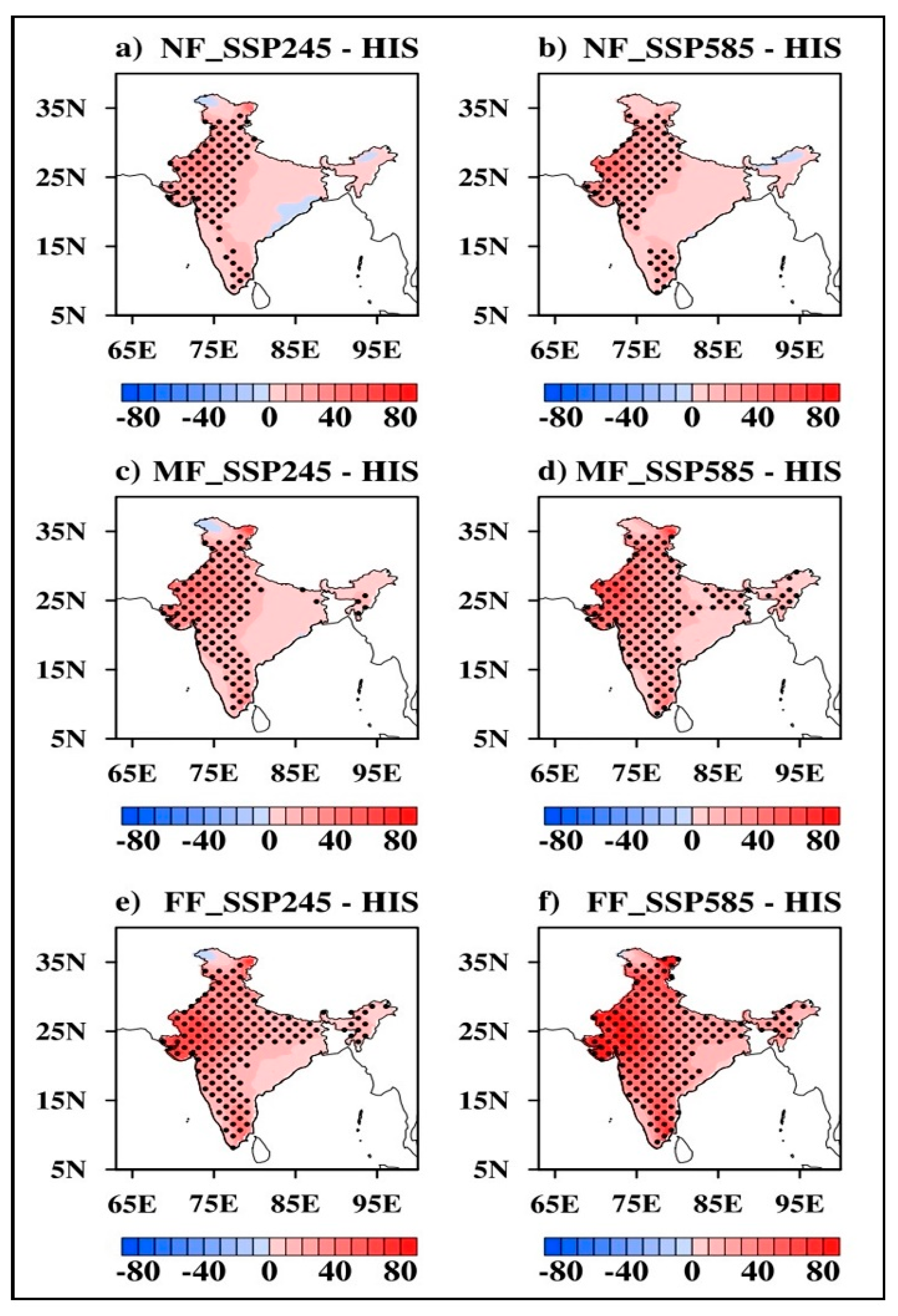
Figure 5.
Decadal precipitation trend (mm/10 years) during the JJAS monsoon season over the period 2021–2100 under (a) SSP2-4.5 and (b) SSP5-8.5. Stippled areas indicate trends significant at the 95% confidence level.
Figure 5.
Decadal precipitation trend (mm/10 years) during the JJAS monsoon season over the period 2021–2100 under (a) SSP2-4.5 and (b) SSP5-8.5. Stippled areas indicate trends significant at the 95% confidence level.
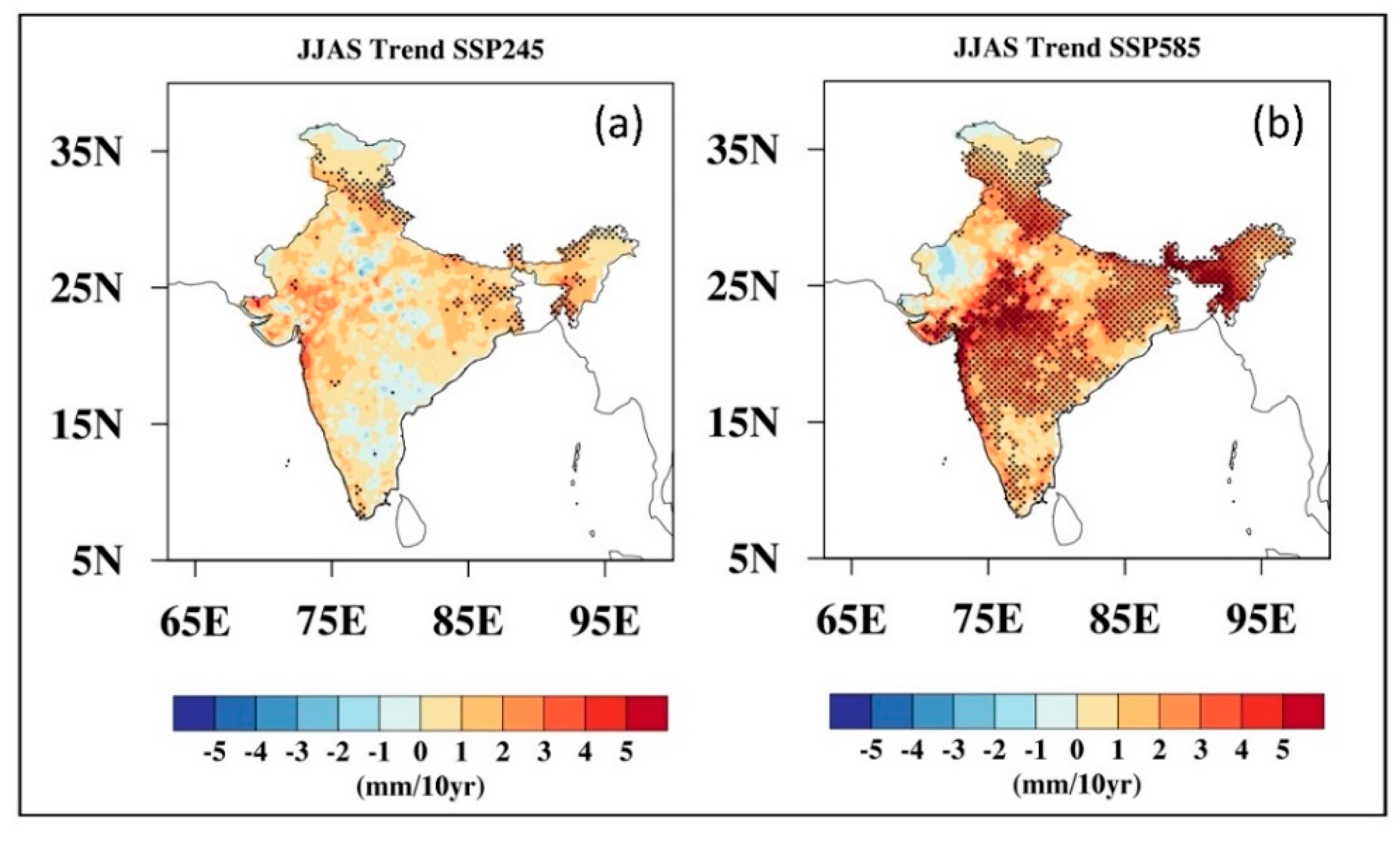
Figure 6.
Spatial distribution of SPI-12-based drought characteristics under SSP2-4.5 for the historical period (1985–2014), near future (NF: 2021–2050), mid future (MF: 2051–2080), and far future (FF: 2081–2100). Rows show drought severity (a1–a4), duration (b1–b4), and intensity (c1–c4), derived from the selected skilful GCM ensemble over India.
Figure 7.
Spatial distribution of SPI-12-based drought characteristics under SSP5-8.5 for the historical period (1985–2014), near future (NF: 2021–2050), mid future (MF: 2051–2080), and far future (FF: 2081–2100). Rows show drought severity (a1–a4), duration (b1–b4), and intensity (c1–c4), derived from the selected skilful GCM ensemble over India.
Figure 7.
Spatial distribution of SPI-12-based drought characteristics under SSP5-8.5 for the historical period (1985–2014), near future (NF: 2021–2050), mid future (MF: 2051–2080), and far future (FF: 2081–2100). Rows show drought severity (a1–a4), duration (b1–b4), and intensity (c1–c4), derived from the selected skilful GCM ensemble over India.
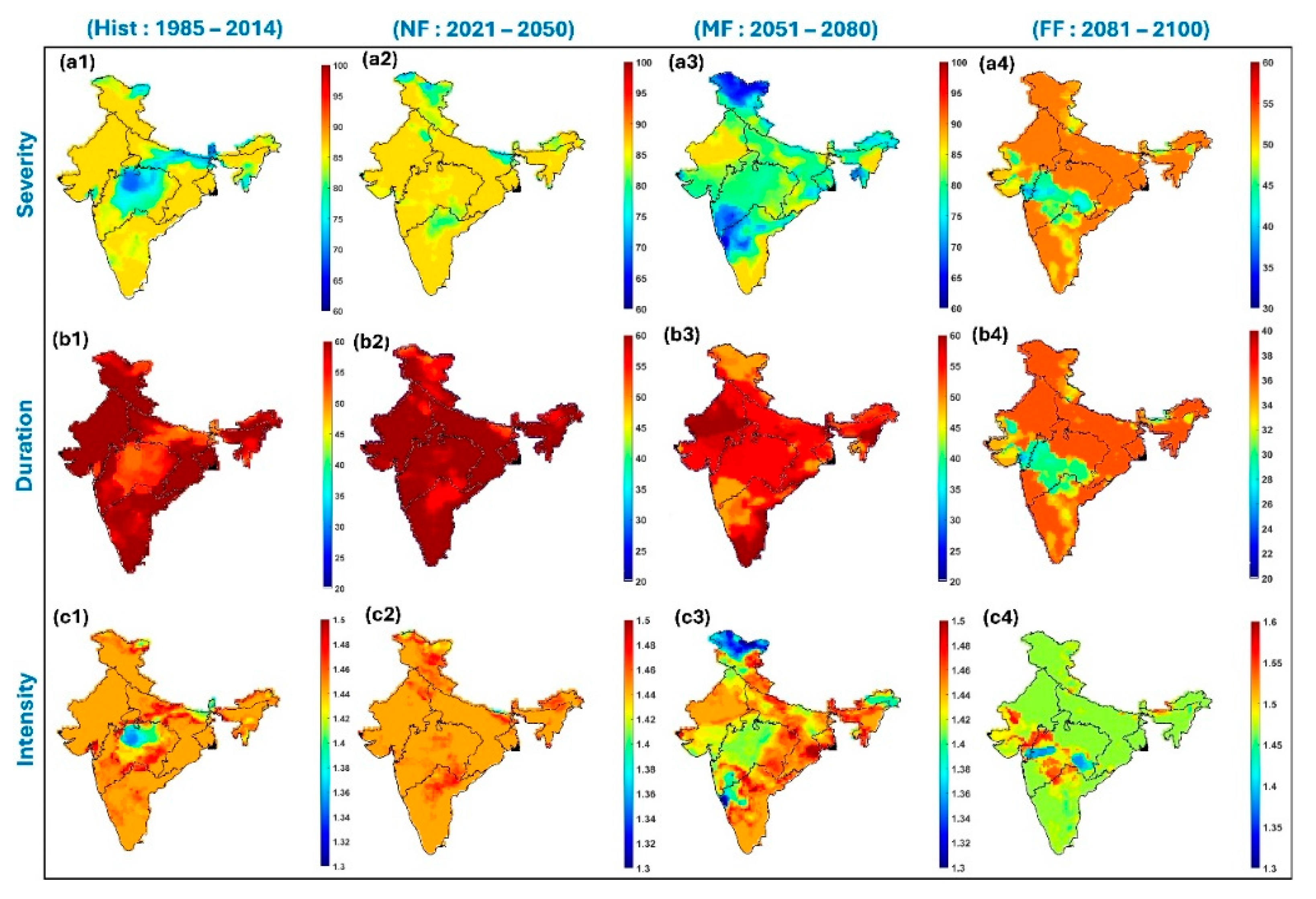
Table 2.
CMIP6 models used in this study with their Annual and Seasonal (JJAS) Pattern Correlation Coefficient (PCC) and Root Mean Square Error (RMSE) values relative to IMD observations for the period 1985–2014.
Table 2.
CMIP6 models used in this study with their Annual and Seasonal (JJAS) Pattern Correlation Coefficient (PCC) and Root Mean Square Error (RMSE) values relative to IMD observations for the period 1985–2014.
| Model ID | Annual | Season (JJAS) | ||
|---|---|---|---|---|
| PCC | RMSE | PCC | RMSE | |
| ACCESS-CM2 | 0.655 | 3.474 | 0.800 | 2.80 |
| ACCESS-ESM-1-5 | 0.664 | 3.340 | 0.799 | 2.80 |
| BCC-CSM2-MR | 0.653 | 3.451 | 0.797 | 2.82 |
| CESM2 | 0.674 | 3.436 | 0.794 | 2.84 |
| CMCC-CM2-SR5 | 0.699 | 3.154 | 0.800 | 2.78 |
| CMCC-ESM2 | 0.662 | 3.408 | 0.795 | 2.82 |
| CNRM-CM6-1-HR | 0.677 | 3.248 | 0.800 | 2.74 |
| CNRM-ESM2-1 | 0.652 | 3.475 | 0.790 | 2.83 |
| EC-Earth3-Veg-LR | 0.694 | 3.230 | 0.800 | 2.77 |
| EC-EARTH3 CC | 0.651 | 3.503 | 0.790 | 2.85 |
| GFDL ESM4 | 0.690 | 3.033 | 0.800 | 2.77 |
| IITM ESM | 0.647 | 3.440 | 0.790 | 2.82 |
| INM-CM4-8 | 0.662 | 3.479 | 0.790 | 2.86 |
| INM-CM5-0 | 0.695 | 3.233 | 0.810 | 2.72 |
| MIROC6 | 0.655 | 3.462 | 0.790 | 2.83 |
| MPI-ESM1-2-LR | 0.660 | 3.368 | 0.790 | 2.84 |
| MPI-ESM1-2-HR | 0.684 | 3.209 | 0.800 | 2.76 |
| MRI-ESM 2-0 | 0.662 | 3.159 | 0.780 | 2.85 |
| TaiESM1 | 0.672 | 3.376 | 0.800 | 2.74 |
Disclaimer/Publisher’s Note: The statements, opinions and data contained in all publications are solely those of the individual author(s) and contributor(s) and not of MDPI and/or the editor(s). MDPI and/or the editor(s) disclaim responsibility for any injury to people or property resulting from any ideas, methods, instructions or products referred to in the content. |
© 2026 by the authors. Licensee MDPI, Basel, Switzerland. This article is an open access article distributed under the terms and conditions of the Creative Commons Attribution (CC BY) license (http://creativecommons.org/licenses/by/4.0/).
Copyright: This open access article is published under a Creative Commons CC BY 4.0 license, which permit the free download, distribution, and reuse, provided that the author and preprint are cited in any reuse.


