

Submitted:
03 June 2026
Posted:
04 June 2026
You are already at the latest version
Abstract
Background: To investigate the feasibility of a telemedicine-enabled functional assessments using a patient-reported outcome questionnaire based on the International Classification of Functioning Disability (ICF) and Health on elderly subjects following a program of early home discharge for femur fracture. Design: A questionnaire consisting of 59 items associated with the appropriate ICF categories and including the condition of functioning, activity and participation, and relevant contextual factors was developed to define the patient function profile one month after hospital discharge Subjects/Patients: Elderly patients who underwent surgery for femur fracture were recruited from an orthopedic unit of the Hospital. Methods: The questionnaire, together with an assessment of patient’s satisfaction was administered through a telemedicine platform Results: Only 75.9% (22 subjects, age=79±9.7 years, 73% female) of the recruited participants completed the questionnaire within the designated timeframe. Walking impairments and difficulty in climbing stairs were reported as the most affected activities. Regarding the patients' satisfaction, most of the patients were satisfied with the proposed tele-evaluation, although 73% were against further remote evaluation. Conclusions: The findings emphasize the challenges of elderly patients' adherence to tele-evaluation, highlighting difficulties in the use of new technologies within specific patient cohorts.
Keywords:
international classification of functioning
; disability and health
; telemedicine
; telerehabilitation
; femoral fractures
; physical therapy modalities
; rehabilitation
1. Introduction
With the increasing average life expectancy, healthcare must adapt by implementing personalized, citizen-centered care models and exploiting technological innovations to meet the needs of fragile patients [1,2,3]. In older adults recovering from hip fracture surgery, telerehabilitation has progressively emerged as a promising model of care, enabling remote interaction between patients and healthcare professionals through digital technologies [4]. By delivering structured rehabilitation support in home or community settings, it addresses key limitations of traditional in-person care while improving accessibility, particularly for older patients with reduced mobility or those living in rural and underserved areas. In these patients, in addition to telerehabilitation interventions, also functional outcomes might be assessed remotely, facilitating the timely identification of rehabilitation needs without relying on assistive measures or in-person evaluations.In the metropolitan area of Bologna, Italy, specific pathways of care and programs that integrate social and health responses (i.e., diagnostic and therapeutic care pathways [DTCPs]) for high-frequency conditions, as femoral fracture in elderly have been established. These DTCPs are conceived to ensure continuity of care and facilitate the transition between hospital and community [5]. Managing the care of elderly and fragile patients effectively in challenging [6,7]. , and options to reduce hospital stay are being explored. Early Supported Discharge (ESD) pathways are a viable solution, facilitating the transition of patients to home-based rehabilitative treatments immediately after discharge [8,9]. Notably, home-based rehabilitation programs are proven to reduce disability [4] and secondary falls after hip fractures [10]. Despite its benefits, implementing ESD pathways is challenging due to issues like patient compliance, caregiver support, and quality of remote care, necessitating reliable methods to monitor patient outcomes post-discharge [11,12]. Telerehabilitation services aligns with the recent directives of the Italian National Health Service and local regulations stemming from the Next Generation EU program. Specifically, the 2021 National Recovery and Resilience Plan [13] includes the digitalization of public sectors, representing an organizational innovation in care processes, and enhancing the continuity of care representing a transformative approach to healthcare, especially in the management of chronic and acute conditions. However, telemedicine feasibility and effectiveness within the ESD need thorough evaluation. For orthopedic patients, particularly those recovering from femur fractures, receiving continuous care without the need to remain hospitalized improves their recovery experience and outcomes [14]. Therefore, the objectives of this study were: 1) to evaluate the feasibility of remote administration of a clinical questionnaire in patients with femur fractures who had undergone ESD; 2) to develop from the administered questionnaire an International Classification of Functioning, Disability and Health (ICF) [15,16] profile to gain insights on the problems, barriers and facilitators experienced one month after discharge; 3) to provide insights into how telemedicine can enhance patient engagement and satisfaction.
2. Materials and Methods
2.1. Study Design and Ethical Approval
The reporting of this prospective observational study followed the STROBE checklist for cohort studies [17]. This study protocol was approved by the Ethics Committee of the IRCCS Istituto Ortopedico Rizzoli, Bologna (CE AVEC 1062/2021/Oss/IOR). Patients signed a written informed consent before any study-related procedures.
2.2. Subjects
Subjects were recruited consecutively from an orthopedic unit of the IRCCS Istituto Ortopedico Rizzoli, Bologna, Italy, between July 2022 and July 2023, if they met the following inclusion criteria: aged ≥65 years who underwent surgery for a proximal femur fracture due to fragility and completed home rehabilitation with continuity in the territorial rehabilitation network within the ESD. Subjects were excluded if they presented bed rest prior to the surgery, had severe comorbidities (e.g., cognitive impairment) that could interfere with the rehabilitation, without a caregiver to support home-based rehabilitation or previous placement in a nursing home or protected facility.
2.3. Procedures
Demographic (i.e., age, sex), clinical (i.e., type of surgery, an entity of load at discharge, length of hospitalization) and functional (i.e., premorbid Standard Audit of Hip Fracture in Europe (SAHFE) score [18], Iowa Level of Assistance Scale (ILOA) [19] Rehabilitation Complexity Scale – Extended (RCS-E) [20], Barthel Index (BI) [21], Cumulative illness rating scale (CIRS) [22]; 6-Item Cognitive Impairment Test (CIT-6) [23]( data were collected.
2.4. Outcomes
2.4.1. Feasibility
The feasibility of administering our telemedicine-based questionnaire was defined as the proportion of patients who complete the questionnaires within the designated timeframe. The endpoint for this outcome was set at 80%.
2.4.2. Assessment of Functioning and Environmental Factors
The developed questionnaire consisted of 59 items and was administer 1 month after discharge. These items have been derived from the following instruments:
Using standard ICF linking techniques, the items of this questionnaire have been associated with the appropriate ICF categories to describe the condition of functioning, activity and participation, and relevant contextual factors. Its purpose was to develop a patient function profile in accordance with the ICF. The items in the administered questionnaire explore the “b” (body functions), “d” (activity and participation) and “e” (contextual factors) components of the ICF. Based on the MDS item format (“how much of a problem is it for you to perform this activity?”), the response scoring for these items used was a 5-point Likert scale (i.e., 0=no problem, 1=mild problem, 2=moderate problem, 3=serious problem, 4=extreme problem). This question and response format was extended to all items from the other scales, standardizing the entire questionnaire to facilitate completion. For questions investigating the “e” component (contextual factors), the values ranged from -4 to 4 points (-4=extreme facilitation, -3=important facilitation, -2=moderate facilitation, -1=mild facilitation, 0=neither problem nor facilitation, 1=mild problem, 2=moderate problem, 3=serious problem, 4=extreme problem). For items in the questionnaire that are not applicable to the respondent’s life conditions (e.g., participation in work activities for a retired person), code 9 (=not applicable) was used. The availability of the ICF category and the first qualifier for each question allows for the generation of an ICF code that describes the patients’ disability experience from their perspective regarding the considered concept. Organizing the generated ICF codes into a specific graphical format, a “patient ICF profile” was created. This profile enables a quick assessment of the patient’s disability experience and the contextual factors impacting it from the patient’s (or caregiver’s) perspective.This questionnaire was administered through telemedicine and was aimed at evaluating the patient’s functional and disability profile approximately one month after hospital discharge.
2.4.3. Assessment of the Patient’s Satisfaction
This questionnaire was developed based on the conceptual constructs of the Telehealth Usability Questionnaire, TUQ [28] with the objective of investigating the patient’s satisfaction and difficulties in filling out the form. Along with the items regarding satisfaction and future use (items A, B, E, and F), we have added a question on the ease of use (item C) and one on the reliability component (item D) of the TUQ. The patient could be required to express own degree of disagreement or agreement with some statements concerning (i.e., the difficulty in filling out the questionnaire, satisfaction with the tele-evaluation compared to the traditional visit and willingness to repeat in the future). The scoring of these items is composed of a 4-point Likert scale (1=totally in disagreement, 2=partially in disagreement, 3=partially in agreement, 4=totally in agreement). Data were collected online via the HealthMeeting® telemedicine platform (Wezen Technologies s.r.l., Bologna, Italy), ensuring accessibility and ease of use for patients. The HealthMeeting® software was utilized for the tele-evaluation. The software was customized to include electronic versions of the questionnaires, links for patients to complete the questionnaires, and tools for generating an ICF profile based on the patient’s responses.
2.5. Data Analysis
Descriptive statistics were used to describe the collected variables. For the development of the median ICF profile, the scores of each item were described using the median with the first and second quartile; moreover, the count for each score of each item was calculated. All statistical analyses were performed with SPSS software (Version 20 for Windows; SPSS Inc., Chicago, IL, USA).
3. Results
3.1. Feasibility
About 109 eligible patients, 29 of them (26.6%) agreed to participate in the study and, of those, 22 (75.9%) completed the questionnaire. The mean age wase qual to 79.2±9.7 years, and the majority was female (72.7%). Most subjects had a hip replacement (45.5%) and had partial load at the discharge (81.8%). Subject’s demographic and clinical characteristics are shown in Table 1.
3.2. Functioning and Environmental Factor Profile
The median ICF profile of the included subjects obtained from questionnaires for the body functions, activities participation, and contextual factors are reported in Table 2 and Table 3, respectively. Specifically, 14 items explored the “b component” (body functions), 25 the “d component” (activities and participation), and 20 the “e component” (contextual factors) of the ICF. Data from the “mental functions”, “sensory functions and pain”, and “motor functions” domains (i.e., body functions) showed median serious problems regarding “sleep functions” (item#3), “attentions functions” (item#4), and “memory functions” (item#5): moreover, the median moderate problem was present in “energy level” (item#1) “range of emotion (sadness and depression)” (item#6), “binocular acuity of distant vision” (item#9), “binocular acuity of near vision” (item#10), “sensation of pain” (item#13), and “involuntary movement reaction functions” (item#14). Subjects reported the other ICF categories as either mild problems or no problems (Table 2). Data from the “learning and applying knowledge”, “mobility”, “activities of daily living”, and “social participation” domains (i.e., activities and participation) reported median moderate problems with “maintaining body position” (item#17), “walking” (item#20), “moving around” (item#21) and “other specific domestic life” (item#34). Subjects reported the other items as either mild problems or no problems; no ICF category was rated as serious or extreme problems (Table 2). Data from the “products and technology”, “natural environment and human-made changes to the environment”, “support and relationships”, “attitudes”, and “health services, systems and policies” domains (i.e., contextual factors) showed that “immediate family” (item#50) were assessed as important facilitation. Moreover, “products or substances for personal consumption” (item#40), “assistive products and technology for personal indoor and outdoor mobility and transportation” (item#43), “assistive products and technology for personal indoor and outdoor mobility and transportation” (item#44), “assets” (item#48), “personal care providers and personal assistants” (item#52) and “individual attitudes of immediate family members” (item#53) were assessed as moderate facilitation. Subjects reported the other ICF categories as either mild facilitation or neither problem nor facilitation; no ICF category was rated as a problem (Table 3).
3.3. Patients’ Satisfaction
Out of the twenty-two recruited patients, twenty-one completed the satisfaction questionnaires. Figure 1 displays the frequency distribution of the responses. About half of the patients (n=10, 47.6%) partially agreed and partially disagreed that they were equally satisfied between telemedicine and a traditional visit (item#A). Most of the patients (n=17, 81.0%) felt comfortable and relaxed during the telemedicine evaluation (item#B). Most of the patients (n=13, 61.9%) partially disagreed that filling out the questionnaire was easy (item#C). Sixteen (76.2%) patients partially agreed that the information in the questionnaire could be useful to the clinician for a better understanding of their health status (item#D). Sixteen (76.2%) patients disagreed (partially or totally) that they were willing to fill out the questionnaire again in a subsequent evaluation (item#E). Finally, 12 (57.1%) subjects partially agreed that they were satisfied with the telemedicine evaluation (item#F), while 8 (38.1%) patients disagreed. These results were analyzed using a chi-square test, resulting in statistical significance value (p<0.0001, χ2 =60.35, df=15).
4. Discussion
In the present study we have investigated the feasibility of a remote assessment of functional information using a questionnaire based on ICF. We reported, that in a specific population of elderly patients who underwent surgery for femur fracture and were discharged home, only 75.9% of the recruited participants completed the questionnaire within the designated timeframe failing the minimum target for feasibility. Several factors may have contributed to this outcome. The effectiveness of technology in healthcare and rehabilitation, relies also on the end user, and digital literacy, caregiver involvement, and technical or physiotherapist support, are relevant particularly for seniors. Unlike other studies on telerehabilitation after hip fracture surgery in the elderly [4,29,30] which included motivational feedback or physiotherapist guidance, patients in our study did not receive reminders or follow-up contact to complete the form. We believe this aspect could have affected our results and that in future studies an automatic phone reminder or a protocol-based follow-up call should be improved. The questionnaire we have developed is in line with the ICF categories previously identified to tailor post-hip fracture surgery rehabilitation programs [31]. The questionnaire provides a multidimensional framework of a selected population of aged patients recovering from femur fractures. Indeed, since the patient cohort in this study was enrolled in specific pathways designed to ease the transition between hospital and community care, our focus encompassed both physical functioning (activity and participation aspects) and environmental contextual factors. The mental functions categories are considered essential components in post-hip fracture rehabilitation [31] since 42% of aged patients with femur fractures are cognitively impaired [32]. Although cognitively impaired subjects (6-CIT>7) were excluded from the present study, patients declared serious problems with attention (item#4), memory (item#5), and sleep (item#3). They complained of depressive mood (item#6), reporting the questionnaire worst scores in these areas. Hospitalization, decreased mobility, loss of self-sufficiency, and social isolation following femur fracture place stress on mental functions and contribute to the decline of age-related cognitive function. These aspects have a greater impact on the quality of life of the patients. Answers to item#13 (pain) and item#14 (balance) showed that both aspects represent a problem in these patients, in most cases moderate. Proper control of pain is a central point in rehabilitation to gain the recovery of hip range of motion and ambulation. Correct balance is linked to the recovery of lost muscle mass and walking ability, providing a means to evaluate rehabilitative progress while also assessing the risk of future falls. Notably, acquiring new skills (item#16) was perceived as a minor challenge, allowing patients to follow rehabilitation programs successfully. According to the literature, the most frequently reported positive outcomes in hip fracture rehabilitation are associated with measures of ambulatory ability and mobility [33]. As expected, most our patients reported moderate difficulty, specifically walking long distances (item#20) and stair climbing (item#21), in line with the timing of recovery from femur fracture (i.e., medium term). Patients reported the restoration of walking abilities and activities of daily living, including postural transitions and transfers, dressing and personal hygiene care. The mobility dataset is particularly valuable when compared to the information and measurements gathered at recruitment and prior to discharge (BI, RCS-E, SAHFE and ILOA), as it aids in monitoring outcomes within this patient group. Regarding social participation, the subjects rated taking care of the family and the home as a moderate challenge. This finding may seem unexpected, but it reflects a selected older population, primarily composed of women who were largely independent prior to their femur fracture. Analyzed contextual factors were never rated as a problem; indeed, patients perceive family and caregivers as moderate to extreme facilitators. Notably, all the patients have had a solid social context since they returned home with family members or caregiver assistance. Also, technology for mobility (item#43, item#44) is considered a moderate facilitator. Only a few patients reported encountering barriers when accessing public or private buildings. Regarding the satisfaction, half of the patients were pleased with the proposed remote evaluation, while the other half were not. Additionally, more than half of the patients reported difficulty in completing the computer-based questionnaire. Overall, the responses suggested that patients were satisfied with the proposed tele-evaluation, even in comparison to traditional visits, indicating that they felt they had sufficient attention and were comfortable and at ease during self-assessment. Nevertheless, aged patients reported difficulties in completing the questionnaire. Their unfamiliarity with the technology and the effort needed to answer the 59 questions negatively affected their willingness to participate in future telemedicine evaluations (item#E). In its current format, envisioning a monitoring system reliant on administering evaluation questionnaires via telemedicine is challenging, especially for this group of elderly patients. Indeed, patients stated that they would be unwilling to complete the questionnaire or engage in a tele-visit in the future. Conversely, a previous study on breast cancer patients in a clinical setting reported high acceptability of using computer-based questionnaires for self-assessing health conditions and quality of life [34] and similar findings were reported for telemedicine follow-up in endometrial cancer patients [35]. Our observation also differs from other studies in which telemedicine visit was considered a valid alternative [36,37]. A possible explanation could be that, in these studies, the subjects affected by cancer and typically require ongoing care and likely appreciated the chance to avoid frequent hospital visits. In contrast, the enrolled patients experienced an acute event and needed only one or a few standard follow-up visits. Another reason for the observed differences may be the older mean age of the patients in the present study (78.5 years), as they are generally less familiar with new technologies compared to the patients in the other studies. We found a low engagement of patients in the proposed research. Only 26.6% of patients who met the inclusion criteria (among others, with no cognitive impairment) agreed to participate in the study, and 7 of them did not complete the questionnaire. However, the primary challenge arises from the use of technology and the self-administered questionnaire, which requires the activation of an internet-connected electronic device and, more critically, maintaining focused attention for approximately 15 minutes. Regarding the patient satisfaction [28], the proposed service of tele-evaluation was appreciated. However, either the technology or the layout of the questionnaire represented a barrier for the cohort of aged patients under study. Notably, the response to item#D indicates that even a remote approach fosters a sense of continuity in care. Since teleservices will be increasingly used in territorial care due to their advantages in cost limiting, service and personnel management, easier and more friendly tools should be developed, especially for specific categories of patients. A limitation of this study is the small number of patients we were able to enroll, as only one in five eligible patients agreed to participate. Therefore, it was not possible to perform statistical analysis to associate perceived barriers with either physical independence or mental status. Furthermore, the median ICF profile obtained in the study does not accurately represent the population and should be interpreted with caution. Low participation in this study is primarily attributed to patients’ age, as noted in other studies, and the lack of support from caregivers. Another possible reason could be a sense of disappointment due to the shift from an in-person visit to a tele-visit, which might be perceived as a format that reduces attention to the patients.
5. Conclusions
The proposed self-assessment tool needs adjustments to increase aged patients’ compliance (e.g., fewer questions, simpler questionnaire layout). Nevertheless, it is cost-effective, fast, and fair. It may allow for the early identification of patients who need further attention in terms of in-person evaluation and possible continuation of rehabilitative treatment. Finally, future research should explore implementation strategies to facilitate technology adoption for elderly patients and assess whether remote self-evaluation after femur fractures results in clinically and economically significant interventions compared to in-person visits for this patient cohort.
Author Contributions
Conceptualization: D.P., R.T. and F.L.P.; methodology: D.P., S.O., A.O.M. and F.L.P.; formal analysis: D.P., R.T. and L.P.; data Collection: R.T and D.P.; writing—original draft preparation: D.P, F.V. and R.T.; writing—review and editing: D.P., R.T., L.B. and F.L.P; supervision: D.P. All authors have read and agreed to the published version of the manuscript.
Funding
This research has been funded by the Fondazione Cassa di Risparmio di Bologna (ID 19143-2020).
Data Availability Statement
Ethical Clearance and Trial details: This study protocol was approved by the Ethics Committee of the IRCCS Istituto Ortopedico Rizzoli, Bologna (CE AVEC 1062/2021/Oss/IOR).
Acknowledgments
We dedicate this paper to the memory of Prof. Maria Grazia Benedetti, who recently passed away, in recognition of her contributions to much of the work presented here, as well as her invaluable scientific support and expertise in research. She was the Director of the Physical Medicine and Rehabilitation Unit, IRCCS Rizzoli Orthopedic Institute, and Full Professor in Physical and Rehabilitation Medicine at Alma Mater Studiorum University of Bologna.
Conflicts of Interest
The authors declare no conflicts of interest.
References
- Chen, C.; Ding, S.; Wang, J. Digital Health for Aging Populations. Nat. Med. 2023, 29, 1623–1630. [Google Scholar] [CrossRef] [PubMed]
- Hunt, M.R.; Ells, C. A Patient-Centered Care Ethics Analysis Model for Rehabilitation. Am. J. Phys. Med. Rehabil. 2013, 92, 818–827. [Google Scholar] [CrossRef] [PubMed]
- Leach, E.; Cornwell, P.; Fleming, J.; Haines, T. Patient Centered Goal-Setting in a Subacute Rehabilitation Setting. Disabil. Rehabil. 2010, 32, 159–172. [Google Scholar] [CrossRef]
- Yang, C.; Fu, Y.; Du, D.; Li, X.; Zhou, Q.; Yang, Y.; Luo, T. Application of Telerehabilitation in Home Care for Older Adult Patients with Postoperative Hip Fractures: A Scoping Review. PLoS ONE 2026, 21, e0342110. [Google Scholar] [CrossRef]
- Lisk, R.; Krasuski, M.; Watters, H.; Parsons, C.; Yeong, K. Home Is Where Our Journey Begins - Getting More Patients Home after a Hip Fracture with an Orthopaedic Supportive Discharge Team. Future Healthc. J. 2017, 4, 131–133. [Google Scholar] [CrossRef]
- Ryder, T.; Close, J.; Harris, I.; Cameron, I.D.; Seymour, H.; Armstrong, E.; Bell, J.; Hurring, S.; Mitchell, R. ANZHFR Steering Group Patient and Hospital Factors Influencing Discharge Destination Following Hip Fracture. Australas. J. Ageing 2021, 40. [Google Scholar] [CrossRef] [PubMed]
- for the GIOG study group; Ferrara, M.C.; Andreano, A.; Tassistro, E.; Rapazzini, P.; Zurlo, A.; Volpato, S.; Mussi, C.; Corsi, M.; Lunardelli, M.L.; et al. Three-Year National Report from the Gruppo Italiano Di Ortogeriatria (GIOG) in the Management of Hip-Fractured Patients. Aging Clin. Exp. Res. 2020, 32, 1245–1253. [Google Scholar] [CrossRef]
- Hollingworth, W.; Todd, C.; Parker, M.; Roberts, J.A.; Williams, R. Cost Analysis of Early Discharge after Hip Fracture. BMJ 1993, 307, 903–906. [Google Scholar] [CrossRef]
- Gonçalves-Bradley, D.C.; Iliffe, S.; Doll, H.A.; Broad, J.; Gladman, J.; Langhorne, P.; Richards, S.H.; Shepperd, S. Early Discharge Hospital at Home. Cochrane Database Syst. Rev. 2017, 2021. [Google Scholar] [CrossRef]
- Pidani, A.S.; Sabzwari, S.; Ahmad, K.; Mohammed, A.; Noordin, S. Effectiveness of Home-Based Rehabilitation Program in Minimizing Disability and Secondary Falls after a Hip Fracture: Protocol for a Randomized Controlled Trial. Int. J. Surg. Protoc. 2020, 22, 24–28. [Google Scholar] [CrossRef]
- Berggren, M.; Karlsson, Å.; Lindelöf, N.; Englund, U.; Olofsson, B.; Nordström, P.; Gustafson, Y.; Stenvall, M. Effects of Geriatric Interdisciplinary Home Rehabilitation on Complications and Readmissions after Hip Fracture: A Randomized Controlled Trial. Clin. Rehabil. 2019, 33, 64–73. [Google Scholar] [CrossRef]
- Warhurst, S.; Labbe-Hubbard, S.; Yi, M.; Vella-Brincat, J.; Sammon, T.; Webb, J.; McCullough, C.; Hooper, G.; Gilchrist, N. Patient Characteristics, Treatment Outcomes and Rehabilitation Practices for Patients Admitted with Hip Fractures Using Multiple Data Set Analysis. N Z. Med. J. 2020, 133, 31–44. [Google Scholar]
- Fabbrini, F. Italy’s National Recovery and Resilience Plan: Context, Content and Challenges. J. Mod. Ital. Stud. 2022, 27, 658–676. [Google Scholar] [CrossRef]
- Latham, N.K.; Harris, B.A.; Bean, J.F.; Heeren, T.; Goodyear, C.; Zawacki, S.; Heislein, D.M.; Mustafa, J.; Pardasaney, P.; Giorgetti, M.; et al. Effect of a Home-Based Exercise Program on Functional Recovery Following Rehabilitation After Hip Fracture: A Randomized Clinical Trial. JAMA 2014, 311, 700. [Google Scholar] [CrossRef]
- Stucki, G.; Melvin, J. The International Classification of Functioning, Disability and Health: A Unifying Model for the Conceptualdescription of Physical and Rehabilitation Medicine. Acta Derm. Venereol. 2007, 39, 286–292. [Google Scholar] [CrossRef]
- Hoang-Kim, A.; Beaton, D.; Bhandari, M.; Kulkarni, A.V.; Schemitsch, E. The Need to Standardize Functional Outcome in Randomized Trials of Hip Fracture: A Review Using the ICF Framework. J. Orthop. Trauma 2013, 27, e1–e8. [Google Scholar] [CrossRef] [PubMed]
- Von Elm, E.; Altman, D.G.; Egger, M.; Pocock, S.J.; Gøtzsche, P.C.; Vandenbroucke, J.P. The Strengthening the Reporting of Observational Studies in Epidemiology (STROBE) Statement: Guidelines for Reporting Observational Studies. The Lancet 2007, 370, 1453–1457. [Google Scholar] [CrossRef] [PubMed]
- Parker, M.J.; Currie, C.T.; Mountain, J.A.; Thorngren, K.-G. Standardised Audit of Hip Fracture in Europe (SAHFE). HIP Int. 1998, 8, 10–15. [Google Scholar] [CrossRef]
- Shields, R.K.; Enloe, L.J.; Evans, R.E.; Smith, K.B.; Steckel, S.D. Reliability, Validity, and Responsiveness of Functional Tests in Patients With Total Joint Replacement. Phys. Ther. 1995, 75, 169–176. [Google Scholar] [CrossRef]
- Rodà, F.; Agosti, M.; Corradini, E.; Lombardi, F.; Maini, M.; Brianti, R. Cross-Cultural Adaptation and Preliminary Test-Retest Reliability of the Italian Version of the Complexity Rehabilitation Scale-Extended (13th Version). Eur. J. Phys. Rehabil. Med. 2015, 51, 439–446. [Google Scholar] [PubMed]
- Dos Reis, N.F.; Figueiredo, F.C.X.S.; Biscaro, R.R.M.; Lunardelli, E.B.; Maurici, R. Psychometric Properties of the Barthel Index Used at Intensive Care Unit Discharge. Am. J. Crit. Care 2022, 31, 65–72. [Google Scholar] [CrossRef]
- Linn, B.S.; Linn, M.W.; Gurel, L. CUMULATIVE ILLNESS RATING SCALE. J. Am. Geriatr. Soc. 1968, 16, 622–626. [Google Scholar] [CrossRef]
- Brooke, P.; Bullock, R. Validation of a 6 Item Cognitive Impairment Test with a View to Primary Care Usage. Int. J. Geriatr. Psychiatry 1999, 14, 936–940. [Google Scholar] [CrossRef]
- WHO 1, Model Disability Survay (WHO). Available online: Https://Www.Who.Int/News-Room/Questions-and-Answers/Item/Model-Disability-Survey.
- Collin, C.; Wade, D.T.; Davies, S.; Horne, V. The Barthel ADL Index: A Reliability Study. Int. Disabil. Stud. 1988, 10, 61–63. [Google Scholar] [CrossRef] [PubMed]
- WHO 2, WHO Disability Assessment Schedule 2.0 (WHODAS 2.0). Available online: Https://Www.Who.Int/Classifications/International-Classification-of-Functioning-Disability-and-Health/Who-Disability-Assessment-Schedule.
- Juvalta, S.; Post, M.; Charlifue, S.; Noreau, L.; Whiteneck, G.; Dumont, F.; Reinhardt, J. Development and Cognitive Testing of the Nottwil Environmental Factors Inventory in Canada, Switzerland, and the USA. J. Rehabil. Med. 2015, 47, 618–625. [Google Scholar] [CrossRef]
- Parmanto, B.; Lewis, A.N., Jr.; Graham, K.M.; Bertolet, M.H. Development of the Telehealth Usability Questionnaire (TUQ). Int. J. Telerehab 2016, 8, 3–10. [Google Scholar] [CrossRef]
- Bedra, M.; Finkelstein, J. Feasibility of Post-Acute Hip Fracture Telerehabilitation in Older Adults. Stud. Health Technol. Inf. 2015, 210, 469–473. [Google Scholar]
- Li, C.T.; Hung, G.K.; Fong, K.N.; Gonzalez, P.C.; Wah, S.; Tsang, H.W. Effects of Home-Based Occupational Therapy Telerehabilitation via Smartphone for Outpatients after Hip Fracture Surgery: A Feasibility Randomised Controlled Study. J. Telemed. Telecare 2022, 28, 239–247. [Google Scholar] [CrossRef]
- Lin, C.-L.; Liao, C.-D.; Lee, Y.-H.; Escorpizo, R.; Liou, T.-H.; Huang, S.-W. Delphi-Based Consensus to Determine Core Aspects of Post-Hip-Fracture Surgery Rehabilitation Based on the International Classification of Functioning, Disability, and Health. IJERPH 2022, 19, 15988. [Google Scholar] [CrossRef] [PubMed]
- Seitz, D.P.; Adunuri, N.; Gill, S.S.; Rochon, P.A. Prevalence of Dementia and Cognitive Impairment Among Older Adults With Hip Fractures. J. Am. Med. Dir. Assoc. 2011, 12, 556–564. [Google Scholar] [CrossRef]
- Chudyk, A.M.; Jutai, J.W.; Petrella, R.J.; Speechley, M. Systematic Review of Hip Fracture Rehabilitation Practices in the Elderly. Arch. Phys. Med. Rehabil. 2009, 90, 246–262. [Google Scholar] [CrossRef]
- Kanakubo, A.; Mizuno, M.; Asano, Y.; Inoue, Y. Acceptability to Making a Self-Assessment Using a Tablet Computer and Health-Related Quality of Life in Ambulatory Breast Cancer Patients. Asia-Pac. J. Oncol. Nurs. 2022, 9, 105–112. [Google Scholar] [CrossRef]
- Williamson, S.; Beaver, K.; Gardner, A.; Martin-Hirsch, P. Telephone Follow-up after Treatment for Endometrial Cancer: A Qualitative Study of Patients’ and Clinical Nurse Specialists’ Experiences in the ENDCAT Trial. Eur. J. Oncol. Nurs. 2018, 34, 61–67. [Google Scholar] [CrossRef] [PubMed]
- Wynter-Blyth, V.; MacKinnon, T. Streamlining Perioperative Care for Oesophago-Gastric Cancer Surgery Patients Using Home Remote Monitoring. Prim. Health Care 2017, 27, 27–31. [Google Scholar] [CrossRef]
- Nugteren, I.C.; Duineveld, L.A.M.; Wieldraaijer, T.; Van Weert, H.C.P.M.; Verdonck-de Leeuw, I.M.; Van Uden-Kraan, C.F.; Wind, J. Need for General Practitioner Involvement and eHealth in Colon Cancer Survivorship Care: Patients’ Perspectives. FAMPRJ 2017, cmw139. [Google Scholar] [CrossRef] [PubMed]
Figure 1.
Results regarding the patients satisfaction. Legend: A) Compared to the traditional visit with outpatient access in presence, I am equally satisfied; B) During the visit I felt comfortable and relaxed; C) Filling out the questionnaire was easy; D) I think the information provided in the questionnaire was useful for the Physician in better understanding my health problems; E) I am available to fill in the questionnaire again in the future for a face-to-face visit and/or a tele-evaluation; F) Overall, I am satisfied with today’s remote evaluation.
Figure 1.
Results regarding the patients satisfaction. Legend: A) Compared to the traditional visit with outpatient access in presence, I am equally satisfied; B) During the visit I felt comfortable and relaxed; C) Filling out the questionnaire was easy; D) I think the information provided in the questionnaire was useful for the Physician in better understanding my health problems; E) I am available to fill in the questionnaire again in the future for a face-to-face visit and/or a tele-evaluation; F) Overall, I am satisfied with today’s remote evaluation.
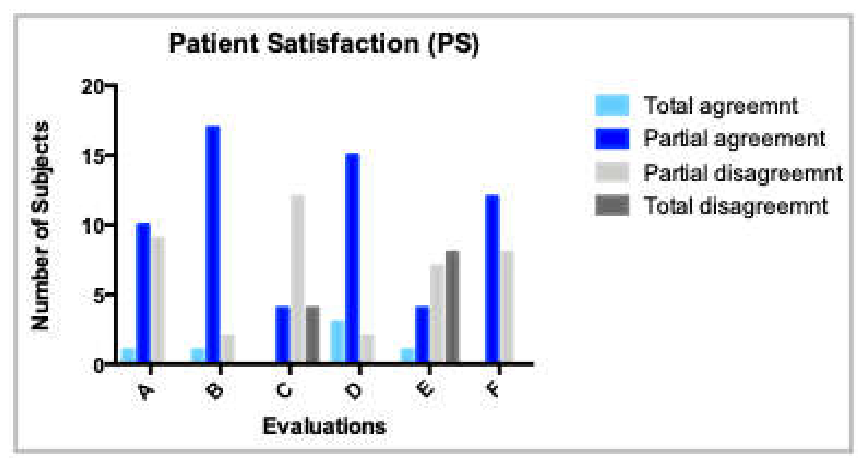

Table 1.
Demographic, clinical and functional characteristics of the included subjects (n=22).
| Variable | N (%) | Mean±SD | Median (1°, 3° quartile) |
|---|---|---|---|
| Age (years) | 79.2±9.7 | ||
| Sex | |||
| Female | 16 (72.7) | ||
| Male | 6 (27.3) | ||
| Type of surgery | |||
| Hip arthroplasty (THA, endoprosthesis) | 11 (50.0) | ||
| Intramedullary nail | 8 (36.4) | ||
| Other (osteosintesis, revision) | 3(13.6) | ||
| Entity of weight bearing at discharge | |||
| Partial (30-50%) | 18 (81.8) | ||
| None | 3 (13.6) | ||
| Other (0-30%) | 1 (4.6) | ||
| LoS (days) | 9.3±3.0 | ||
| SAHFE | 1 (1, 2) | ||
| BI | 71 (64.3, 8.28) | ||
| RCS-E | 6.6 (4, 9) | ||
| CIRS | 1.3 (1.2, 1.5) | ||
| ILOA at five days | 35 (31.5, 37.8) |
Abbreviations: N, number; %, percentage; SD, standard deviation; THA, total hip arthroplasty; LoS, length of stay; SAHFE, Standardised Audit of Hip Fracture in Europe; BI, Barthel Index; RCS-E, Rehabilitation Complexity Scale – Extended; CIRS, Cumulative Illness Rating Scale; ILOA, Iowa Level of Assistance.
Table 2.
Median ICF profile of the included subjects obtained from the questionnaire for functions and activities. For each score category (no problem, mild problem, moderate problem, serious problem, extreme problem), the frequencies of the responses of each subject are reported. Furthermore, in the last three columns, the median with the first and third quartile for the responses to each item is reported. Finally, the black cell corresponding to the highest score represents the median.
Table 2.
Median ICF profile of the included subjects obtained from the questionnaire for functions and activities. For each score category (no problem, mild problem, moderate problem, serious problem, extreme problem), the frequencies of the responses of each subject are reported. Furthermore, in the last three columns, the median with the first and third quartile for the responses to each item is reported. Finally, the black cell corresponding to the highest score represents the median.
| N |
ICF Cat |
Content |
Item |
No problem |
Mild problem |
Moderate problem |
Serious problem |
Extreme problem |
1° Q |
Med |
3° Q |
|
|---|---|---|---|---|---|---|---|---|---|---|---|---|
| 0 | 1 | 2 | 3 | 4 | ||||||||
| Mental functions | 1 | b1300 | Energy level | How much of a problem is it for you to feel tired and lacking energy? | 0 | 1 | 17 | 4 | 0 | 2 | 2 | 2 |
| 2 | b1302 | Appetite | How much of a problem is loss of appetite or increased appetite for you? | 2 | 11 | 8 | 1 | 0 | 1 | 1 | 2 | |
| 3 | b134 | Sleep functions | How much of a problem is it for you not being able to sleep or sleeping badly? | 1 | 0 | 7 | 13 | 1 | 2 | 3 | 3 | |
| 4 | b140 | Attention functions | How much of a problem is poor concentration or distractibility for you? | 0 | 3 | 6 | 13 | 0 | 2 | 3 | 3 | |
| 5 | b144 | Memory functions | How much of a problem is the lack of memory for you? | 1 | 2 | 2 | 15 | 2 | 2.8 | 3 | 3 | |
| 6 | b1522 | Range of emotion (sadness and depression) | How much of a problem is it for you to feel sad or depressed? | 3 | 3 | 4 | 11 | 1 | 1 | 3 | 3 | |
| 7 | b1522 | Range of emotion (nervousness and worry) | How much of a problem is it for you to feel nervous or worried? | 1 | 9 | 11 | 1 | 0 | 1 | 2 | 2 | |
| 8 | b164 | Higher-level cognitive functions | How much of a problem is it for you to find solutions to problems in everyday life? | 12 | 6 | 2 | 2 | 0 | 0 | 0 | 1 | |
| Sensory functions and pain | 9 | b21000 | Binocular acuity of distant vision | How much of a problem is it for you to see from afar? | 2 | 7 | 13 | 0 | 0 | 1 | 2 | 2 |
| 10 | b21002 | Binocular acuity of near vision | How much of a problem is it for you to see up close (for example, at arm’s length)? | 2 | 9 | 7 | 4 | 0 | 1 | 1.5 | 2 | |
| 11 | b230 | Hearing functions | How much of a problem is it for you to hear what another person says while conversing with them? | 7 | 6 | 9 | 0 | 0 | 0 | 1 | 2 | |
| 12 | b240 | Vestibular functions | How much of a problem is dizziness for you? | 9 | 4 | 6 | 3 | 0 | 0 | 1 | 2 | |
| 13 | b280 | Sensation of pain | How much of a problem is pain for you in your daily life? | 1 | 1 | 16 | 4 | 0 | 2 | 2 | 2 | |
| Motor functions | 14 | b755 | Involuntary movement reaction functions | How much of a problem is losing balance for you? | 4 | 4 | 6 | 7 | 0 | 1 | 2 | 3 |
| Learning and applying knowledge | 15 | d160 | Focusing attention | How much of a problem is it for you to concentrate on doing something for ten minutes? | 8 | 8 | 6 | 0 | 0 | 0 | 1 | 2 |
| 16 | d155 | Acquiring skills | How much of a problem is it for you to learn new things, like, for example, learning to get to a new place? | 11 | 6 | 4 | 1 | 0 | 0 | 0.5 | 1.3 | |
| Mobility | 17 | d415 | Maintaining body position | How much of a problem is it for you to stand for a long time, as 30 minutes? | 3 | 8 | 8 | 3 | 0 | 1 | 1.5 | 2 |
| 18 | d420 | Transferring oneself | How much of a problem is it for you to transfer from bed to wheelchair and vice versa? | 7 | 8 | 5 | 2 | 0 | 0 | 1 | 2 | |
| 19 | d450 | Mobility | How much of a problem is it for you to walk at least 50 meters? | 4 | 10 | 5 | 3 | 0 | 1 | 1 | 2 | |
| 20 | d450 | Walking | How much of a problem is it for you to walk a long distance, as a mile? | 1 | 4 | 10 | 5 | 2 | 1.8 | 2 | 3 | |
| 21 | d455 | Moving around | How much of a problem is stair climbing (going up and down a flight of stairs) for you? | 6 | 9 | 2 | 5 | 0 | 1 | 2 | 3.3 | |
| 22 | d465 | Moving around using equipment | How much of a problem is it for you to use the wheelchair (making turns, changing direction, approaching the table, the bed, the toilet, etc. )? | 12 | 3 | 6 | 1 | 0 | 0 | 0 | 2 | |
| Activities of daily living | 23 | d510 | Washing oneself | How much of a problem is it for you to take a bath or shower? | 3 | 12 | 5 | 2 | 0 | 1 | 1 | 2 |
| 24 | d510 | Washing oneself | How much of a problem is it for you to wash your whole body? | 3 | 9 | 9 | 1 | 0 | 1 | 1 | 2 | |
| 25 | d520 | Caring for body parts | How much of a problem is it for you to take care of your personal hygiene (for example, washing your hands, face, teeth, combing your hair, etc. )? | 7 | 9 | 6 | 0 | 0 | 0 | 1 | 2 | |
| 26 | d530 | Toileting | How much of a problem is it for you to go to the bathroom and use the toilet (sit on the toilet, take off and put on your clothes again without getting dirty, use toilet paper)? | 8 | 10 | 3 | 1 | 0 | 0 | 1 | 1 | |
| 27 | d5300 | Regulating urination | How much of a problem is it for you to check your urine? | 12 | 7 | 1 | 2 | 0 | 0 | 0 | 1 | |
| 28 | d5301 | Regulating defecation | How much of a problem is it for you to check your stool? | 14 | 6 | 1 | 1 | 0 | 0 | 0 | 1 | |
| 29 | d540 | Dressing | How much of a problem is it for you to get dressed (put on all clothing, including shoes and corsets or prosthetics if you use them)? | 5 | 13 | 3 | 1 | 0 | 0.8 | 1 | 1 | |
| 30 | d540 | Dressing | How much of a problem is getting dressed for you? | 9 | 9 | 3 | 1 | 0 | 0 | 1 | 1 | |
| 31 | d550 | Eating | How much of a problem is eating for you? | 20 | 1 | 1 | 0 | 0 | 0 | 0 | 0 | |
| 32 | d560 | Drinking | How much of a problem is drinking for you? | 21 | 0 | 1 | 0 | 0 | 0 | 0 | 0 | |
| 33 | d570 | Looking after one’s health | How much of a problem are your emotions for you in relation to your health? | 15 | 5 | 2 | 0 | 0 | 0 | 0 | 1 | |
| Social participation | 34 | d698 | Other specified domestic life | How much of a problem is it for you to take care of your home and family as far as it is your responsibility? | 5 | 6 | 8 | 1 | 2 | 0.8 | 1.5 | 2 |
| 35 | d730 | Relating with strangers | How much of a problem is it for you to interact with people you do not know? | 19 | 2 | 1 | 0 | 0 | 0 | 0 | 0 | |
| 36 | d750 | Informal social relationships | How much of a problem is it for you to maintain a friendship? | 20 | 1 | 1 | 0 | 0 | 0 | 0 | 0 | |
| 37 | d839 | Education, other specified and unspecified | How much of a problem is it for you to carry out daily study activities? | 21 | 0 | 0 | 1 | 0 | 0 | 0 | 0 | |
| 38 | d845 | Acquiring, keeping and terminating a job | How much of a problem is it for you to carry out your daily work activities? | 18 | 4 | 0 | 0 | 0 | 0 | 0 | 0 | |
| 39 | d999 | Community, social and civic life, unspecified | How much of a problem is it for you to participate in community activities (e.g., parties, religious or other activities) like everyone else? | 20 | 1 | 0 | 1 | 0 | 0 | 0 | 0 |
Table 3.
Median ICF profile of the included subjects obtained from the questionnaire for contextual factors. For each score category (extreme facilitation, important facilitation, moderate facilitation, mild facilitation, neither problem nor facilitation, mild problem, moderate problem, serious problem, extreme problem), the frequencies of the responses of each subject are reported. Furthermore, in the last three columns, the median with the first and third quartile for the responses to each item is reported. Finally, the black cell corresponding to the highest score represents the median.
Table 3.
Median ICF profile of the included subjects obtained from the questionnaire for contextual factors. For each score category (extreme facilitation, important facilitation, moderate facilitation, mild facilitation, neither problem nor facilitation, mild problem, moderate problem, serious problem, extreme problem), the frequencies of the responses of each subject are reported. Furthermore, in the last three columns, the median with the first and third quartile for the responses to each item is reported. Finally, the black cell corresponding to the highest score represents the median.
| N |
ICF Cat |
Content |
Item | Facilitation | Neutral | Problem | 1° Q | Med | 3° Q | |||||||
|---|---|---|---|---|---|---|---|---|---|---|---|---|---|---|---|---|
| Extreme | Imp. | Mod. | Mild | Mild | Mod. | Serios | Extreme | |||||||||
| -4 | -3 | -2 | -1 | 0 | 1 | 2 | 3 | 4 | ||||||||
| Products and technology | 40 | e110 | Products or substances for personal consumption | How much do the drugs you take regularly make your life easier or more difficult? | 4 | 5 | 11 | 2 | 0 | 0 | 0 | 0 | 0 | -3 | -2 | -2 |
| 41 | e115 | Products and technology for personal use in daily living | If you regularly use consumables for care (for example, diapers, catheters, etc.), how much do they make your life easier or more difficult? | 0 | 3 | 6 | 5 | 7 | 0 | 1 | 0 | 0 | -2 | -1 | 0 | |
| 42 | e1200 | General products and technology for personal indoor and outdoor mobility and transportation | How much does public transport make your life easier or more complicated? | 0 | 0 | 1 | 5 | 15 | 0 | 0 | 0 | 0 | -1 | 0 | 0 | |
| 43 | e1201 | Assistive products and technology for personal indoor and outdoor mobility and transportation | If you use walking aids such as a walker or wheelchair, how much do they make your life easier or more difficult? | 2 | 4 | 6 | 4 | 6 | 0 | 0 | 0 | 0 | -3 | -2 | 0 | |
| 44 | e1201 | Assistive products and technology for personal indoor and outdoor mobility and transportation | How much do the wheelchair and walking aids you use make your life easier or more difficult? | 3 | 3 | 7 | 1 | 8 | 0 | 0 | 0 | 0 | -3 | -2 | 0 | |
| 45 | e125 | Products and technology for communication | How much do the communication products you use make your life easier or more complicated? | 0 | 0 | 3 | 2 | 17 | 0 | 0 | 0 | 0 | -0.3 | 0 | 0 | |
| 46 | e150 | Design, construction and building products and technology of buildings for public use | How much do the ways of accessing public places make your life easier or more complicated? | 0 | 0 | 1 | 3 | 17 | 1 | 0 | 0 | 0 | 0 | 0 | 0 | |
| 47 | e155 | Design, construction and building products and technology of buildings for private use | How much do the methods of access to private places (for example, family or friends’ homes) facilitate or complicate your life? | 0 | 0 | 0 | 2 | 18 | 2 | 0 | 0 | 0 | 0 | 0 | 0 | |
| 48 | e165 | Assets | How much does the amount of economic resources you have to make your life easier or more difficult? | 0 | 5 | 12 | 2 | 2 | 0 | 1 | 0 | 0 | -2.3 | -2 | -1.8 | |
| Natural environment and human-made changes to the environment | 49 | e225 | Climate | How much do climatic conditions make your life easier or more complicated? | 0 | 1 | 2 | 3 | 16 | 0 | 0 | 0 | 0 | -1 | 0 | 0 |
| Support and relationships | 50 | e310 | Immediate family | How much does your immediate family make your life easier or more difficult? | 2 | 10 | 8 | 1 | 1 | 0 | 0 | 0 | 0 | -3 | -3 | -2 |
| 51 | e320 | Friends | How much do your friends make your life easier or more complicated? | 0 | 0 | 2 | 4 | 16 | 0 | 0 | 0 | 0 | -1 | 0 | 0 | |
| 52 | e340 | Personal care providers and personal assistants | How much does the staff who provide help or assistance make your life easier or more difficult? | 2 | 4 | 5 | 2 | 9 | 0 | 0 | 0 | 0 | -3 | -1.5 | 0 | |
| Attitudes | 53 | e410 | Individual attitudes of immediate family members | How much do the individual attitudes of your immediate family make your life easier or more difficult? | 0 | 8 | 4 | 2 | 8 | 0 | 0 | 0 | 0 | -3 | -2 | 0 |
| 54 | e420 | Individual attitudes of friends | How much do your friends’ individual attitudes make your life easier or more complicated? | 0 | 0 | 2 | 2 | 18 | 0 | 0 | 0 | 0 | 0 | 0 | 0 | |
| 55 | e425 | Individual attitudes of acquaintances, peers, colleagues, neighbors and community members | How much do the individual attitudes of colleagues make your life easier or more complicated? | 0 | 0 | 0 | 0 | 22 | 0 | 0 | 0 | 0 | 0 | 0 | 0 | |
| 56 | e460 | Societal attitudes | How much do society’s attitudes make your life easier or more complicated? | 0 | 0 | 0 | 2 | 19 | 1 | 0 | 0 | 0 | 0 | 0 | 0 | |
| Health services, systems and policies | 57 | e570 | Social security services, systems and policies | How much do social and welfare support services make your life easier or more complicated? | 0 | 1 | 0 | 6 | 15 | 0 | 0 | 0 | 0 | -1 | 0 | 0 |
| 58 | e580 | Health services, systems and policies | How much do supportive health services make your life easier or more difficult? | 0 | 2 | 7 | 9 | 4 | 0 | 0 | 0 | 0 | -2 | -1 | -1 | |
| 59 | e595 | Political services, systems and policies | How much do national, regional or local legal rules make your life easier or more complicated? | 0 | 0 | 2 | 10 | 10 | 0 | 0 | 0 | 0 | -1 | -1 | 0 | |
Disclaimer/Publisher’s Note: The statements, opinions and data contained in all publications are solely those of the individual author(s) and contributor(s) and not of MDPI and/or the editor(s). MDPI and/or the editor(s) disclaim responsibility for any injury to people or property resulting from any ideas, methods, instructions or products referred to in the content. |
© 2026 by the authors. Licensee MDPI, Basel, Switzerland. This article is an open access article distributed under the terms and conditions of the Creative Commons Attribution (CC BY) license (http://creativecommons.org/licenses/by/4.0/).
Copyright: This open access article is published under a Creative Commons CC BY 4.0 license, which permit the free download, distribution, and reuse, provided that the author and preprint are cited in any reuse.


