

Submitted:
03 June 2026
Posted:
04 June 2026
You are already at the latest version
Abstract
Autonomous and semi-autonomous advanced driver-assistance systems (ADAS) are highly proficient at tracking upright pedestrians under standard environmental conditions. However, individuals in non-upright positions—such as fallen, collapsed, or prostrate vulnerable road users (VRUs)—face a severe safety deficit owing to the classification limits of standard visual-spectrum perception suites. This review examines the intersection of three structural domains required to resolve this edge case: multi-modal multispectral sensor fusion, international automotive safety governance (ISO 26262 and ISO 21448), and post-collision multi-body kinematic reconstruction. By analysing the field’s shift from reactive crash mitigation to predictive temporal perception, this paper provides a high-level blueprint for an integrated safety pipeline capable of transforming unclassified urban anomalies into manageable safety events.
Keywords:
vulnerable road users (VRUs)
; multi-modal sensor fusion
; ISO 26262
; SOTIF (ISO 21448)
; prostrate pedestrians
; accident reconstruction
1. Introduction
Modern vehicle safety frameworks have made significant progress in reducing passenger fatalities, yet vulnerable road users (VRUs) continue to represent a disproportionately high share of global traffic injuries. Whilst current Advanced Driver Assistance Systems (ADAS) perform exceptionally well on structured motorways, complex urban centres present unpredictable spatial edge cases that routinely cause standard computer vision pipelines to fail.
The most critical of these edge cases involves the non-upright or prostrate human target. When a pedestrian collapses owing to a medical crisis, sudden intoxication, or an initial slip-and-fall, their geometric bounding box changes drastically. Standard vision-based deep learning models, trained almost exclusively on datasets of upright walking pedestrians, exhibit severe miss rates when a human body is lying on the carriageway, particularly under poor lighting or adverse weather conditions.
Historically, vehicle development has addressed this challenge in distinct engineering siloes:
- • Perception Systems: Prioritising raw neural network precision and sensory coverage.
- • Functional Safety: Restricting system behaviour through deterministic safety limits to prevent false-activation hazards.
- • Forensic Biomechanics: Analysing impact physics retrospectively to adjust passive vehicle crash safety guidelines.
This review presents a high-level perspective on how these parallel tracks can be synthesised into a continuous safety loop. Bridging pre-collision multi-modal sensing with automotive safety compliance and post-impact forensics creates a unified framework that can protect the most vulnerable road users.
2. Multi-Modal Sensor Fusion and the Non-Upright Perception Gap
Relying on single-modality sensors, such as visible-spectrum cameras, introduces single points of failure under headlight glare, thick fog, or complete darkness. To build an uninterrupted perception layer, multi-sensor architectures must fuse disparate regions of the electromagnetic spectrum.
2.1. The Role of Public Multispectral Datasets
The development of robust machine learning algorithms for non-upright pedestrian safety relies heavily on public multispectral datasets. Foundations laid by the KAIST Multispectral Pedestrian Dataset demonstrated that combining a colour stream with a thermal stream drastically reduces the average miss rate compared with visible-only systems [4]. Subsequent public benchmarks, including the FLIR Starter Thermal Dataset and the extreme low-light LLVIP Dataset, have enabled deep networks to generalise across complex urban noise, reflections, and crowded nocturnal environments [8]. More recent work in bias-corrected spectral detection has proposed causal multiplexing architectures to further improve cross-modal generalisation [12].
2.2. Architectural Blueprint of a Multi-Modal Perception Layer
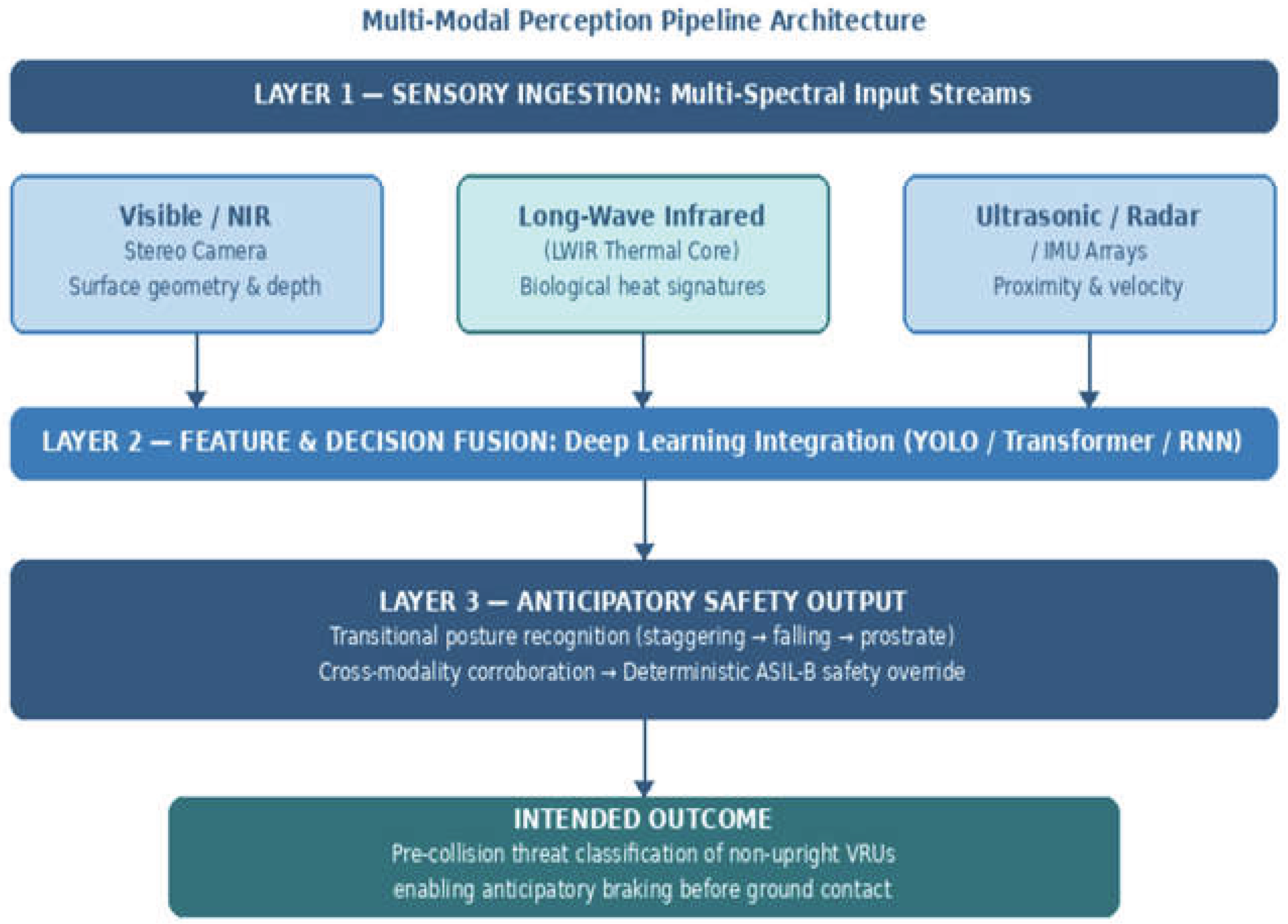
To avoid processing bottlenecks whilst maintaining system resilience, modern multi-modal perception pipelines follow a structured, layered processing hierarchy [4,5]:
- • Sensory Ingestion Layer — Synchronised capture of complementary physical spectra. Visible/NIR stereo delivers surface geometry and depth; LWIR isolates biological heat signatures independent of ambient illumination; Ultrasonic/Radar/IMU arrays provide high-frequency proximity and velocity confirmation.
- • Feature and Decision-Level Fusion — Spatial convolutional networks extract localised object co-ordinates, whilst recurrent networks or spatial-temporal transformers analyse movement patterns over successive frames to identify gait instability before an impact occurs [4].
- • Intended Outcome — Movement from a purely reactive system to an anticipatory safety profile that identifies transitional postures (staggering, falling, or collapsing) before a pedestrian reaches the ground.
Figure 1.
Architecture of a three-layer multi-modal perception pipeline for non-upright VRU detection.
Figure 1.
Architecture of a three-layer multi-modal perception pipeline for non-upright VRU detection.
3. Reconciling AI Probabilities with Automotive Safety Standards
Even highly optimised deep learning models are inherently probabilistic, producing predictions based on statistical confidence intervals rather than absolute certainty. Deploying these systems into safety-critical automotive control paths requires strict alignment with international functional safety standards.
ISO 26262 vs. ISO 21448 (SOTIF)
Whilst ISO 26262 has long governed automotive electrical and electronic (E/E) safety, its methodology focuses on systemic and random hardware or software faults—managing component failures rather than behavioural uncertainty [6]. It is not designed to address the unique functional limitations intrinsic to artificial intelligence. To bridge this gap, the automotive industry relies on ISO 21448, known as SOTIF (Safety of the Intended Functionality) [7]. SOTIF focuses on preventing hazards caused by functional insufficiencies—scenarios in which sensors and algorithms operate exactly as designed but yield unsafe outputs due to environmental triggers, such as uncorroborated thermal reflections or highly unusual pedestrian poses.

Table 1.
Comparison of ISO 26262, ISO 21448 (SOTIF), and a Unified Architecture for VRU Safety Systems.
Table 1.
Comparison of ISO 26262, ISO 21448 (SOTIF), and a Unified Architecture for VRU Safety Systems.
| Standard / Framework | Primary Risk Vector | Target Application Phase | Mitigation Strategy |
|---|---|---|---|
| ISO 26262 | E/E Hardware & Software Failures | System Design & Redundancy | ASIL Decomposition, Fail-Operational Pathways |
| ISO 21448 (SOTIF) | Functional Insufficiencies & Edge Cases | Perception & AI Reasoning | Cross-Modality Corroboration, ODD Restriction |
| Unified Architecture | Probabilistic AI Blindspots | Real-Time Threat Assessment | Dynamic Confidence-Weighting & In-Lane Braking |
By leveraging a structured architecture oriented around an Automotive Safety Integrity Level (ASIL) B or higher target, engineers can implement cross-modality verification logic [8]. In this approach, deterministic safety overrides validate AI outputs, preventing dangerous phantom braking events whilst protecting vulnerable road users through fault-tolerant sensor validation [6].
4. Post-Collision Kinematics and Forensic Data Continuity
When a vehicle’s Operational Design Domain (ODD) boundaries are exceeded, or a collision becomes physically unavoidable owing to kinematic limits, the safety data pipeline must not simply shut down. The pre-impact sensor record constitutes a critical evidentiary and medical asset [12].
4.1. Classical Multi-Body Dynamics
Traditional forensic accident reconstruction relies on empirical bilinear and multi-body models to piece together pedestrian–vehicle conflicts [9,10]. As established by foundational crash literature, a pedestrian impact event is broken into three strict physical phases:
- • The Contact Phase: The primary impact in which the bumper, bonnet, and windscreen strike the pedestrian’s lower limbs, pelvis, and head [10].
- • The Flight Phase: The airborne trajectory (forward projection, wrap, or wing-panel vault) governed by momentum transfer.
- • The Sliding/Rolling Phase: Deceleration owing to ground friction until the body comes to rest [11].
4.2. State Estimation Under Uncertainty
A major challenge in traditional forensic reconstruction is the loss of the pre-impact kinematic record. Investigators are forced to calculate initial impact velocities from highly uncertain post-crash metrics using the throw-distance approximation:
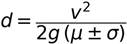 where d = pedestrian throw distance, v = calculated impact velocity, g = gravitational acceleration, μ ± σ = friction coefficient with variance
By deploying a physics-grounded multi-modal sensor fusion framework, the vehicle’s onboard pre-impact telemetry—fused data from LiDAR, high-frequency IMUs, and multispectral vision arrays—acts as an automated state estimator [12]. This telemetry bridges the gap between pre-collision perception and post-crash medical forensics. The pre-impact posture data enables precise biomechanical simulation, informing trauma surgeons of likely injury patterns and providing automotive manufacturers with ground-truth data to continuously optimise pedestrian-protecting crumple zones and external airbag deployments.
5. Conclusions
The path towards a safer automotive ecosystem demands an immediate end to the fragmented development of vehicle subsystems. For decades, perception, functional safety compliance, and crash kinematics have progressed along parallel tracks without real-time cross-functional synthesis. As demonstrated throughout this review, a truly resilient safety infrastructure requires a continuous pipeline in which probabilistic AI models are strictly governed by deterministic safety architectures and verified by post-collision kinematic models [4,8,12].
This integrated approach offers a direct technical response to the World Health Organisation (WHO) and United Nations Decade of Action for Road Safety mandate, which targets a 50% reduction in road traffic deaths and injuries by 2030. Achieving this target is impossible if vehicles remain blind to non-upright or falling pedestrians in urban edge cases—a population that current ADAS architectures consistently fail to detect.
Future engineering efforts must focus on translating this unified paradigm into high-throughput, automotive-grade embedded edge computing architectures. By prioritising robust data-logging pipelines, cross-modality verification, and physics-informed modelling, the automotive industry can significantly advance towards zero pedestrian fatalities, transforming complex urban edge cases into preventable, survivable safety events.
Conflicts of Interest
The author declares no conflicts of interest.
References
- Hwang, S.; Park, J.; Kim, N.; Choi, Y.; Kweon, I.S. Multispectral Pedestrian Detection: Benchmark Dataset and Baseline. In Proceedings of the IEEE Conference on Computer Vision and Pattern Recognition (CVPR), Boston, MA, USA, 2015; pp. 1037–1045. [Google Scholar]
- Jia, X.; Zhu, C.; Li, M.; Tang, W.; Zhou, W. LLVIP: A Visible-Infrared Paired Dataset for Low-Light Vision. In Proceedings of the IEEE/CVF International Conference on Computer Vision (ICCV) Workshops, Montreal, QC, Canada, 2021; pp. 3496–3504. [Google Scholar]
- Kim, S. Causal Mode Multiplexer: A Novel Framework for Unbiased Multispectral Pedestrian Detection. In Proceedings of the IEEE/CVF Conference on Computer Vision and Pattern Recognition (CVPR), Seattle, WA, USA, 2024; pp. 11412–11421. [Google Scholar]
- Barua, N.; Hitosugi, M. Advanced Multi-Modal Sensor Fusion System for Detecting Falling Humans: Quantitative Evaluation for Enhanced Vehicle Safety. Vehicles 2025, 7, 149. [Google Scholar] [CrossRef]
- Luo, Y.; Al-Shuka, H.F. A Review of Multi-Sensor Fusion in Autonomous Driving. Sensors 2025, 25(19), 6033. [Google Scholar] [CrossRef] [PubMed]
- Salay, R.; Czarnecki, K. An Analysis of ISO 26262: Using Machine Learning Safely in Automotive Software. In Proceedings of the IEEE International Systems Conference (SysCon), Vancouver, BC, Canada, 2018; pp. 1–6. [Google Scholar]
- International Organization for Standardization. ISO 21448:2022 Road Vehicles — Safety of the Intended Functionality (SOTIF); ISO: Geneva, Switzerland, 2022. [Google Scholar]
- Barua, N. Integrated Safety Architectures: Leveraging Multi-Modal AI and ISO 26262 to Protect Vulnerable Road Users. SSRN Electron. J. 2026. [Google Scholar] [CrossRef]
- Eubanks, J.J.; Hait, P.A.; Limpert, R. Pedestrian Accident Reconstruction and Litigation; Lawyers & Judges Publishing Company: Tucson, AZ, USA, 2015. [Google Scholar]
- Măruşchievici, G.A.; Cioca, L.I. The Contact Phase in Vehicle–Pedestrian Accident Reconstruction. Appl. Sci. 2023, 13(16), 9404. [Google Scholar] [CrossRef]
- Zou, T.; Wu, C.; Soni, A. Kinetic and Kinematic Features of Pedestrian Avoidance Behaviour in Motor Vehicle Conflicts. Front. Bioeng. Biotechnol. 2021, 9, 765505. [Google Scholar] [CrossRef]
- Barua, N.; Hitosugi, M. A Physics-Grounded Multi-Modal Sensor Fusion Framework for Pedestrian Impact Kinematic Reconstruction Under Uncertainty: Phase 1 Design and Theoretical Evaluation. Sensors 2026, 26, 3387. [Google Scholar] [CrossRef]
Disclaimer/Publisher’s Note: The statements, opinions and data contained in all publications are solely those of the individual author(s) and contributor(s) and not of MDPI and/or the editor(s). MDPI and/or the editor(s) disclaim responsibility for any injury to people or property resulting from any ideas, methods, instructions or products referred to in the content. |
© 2026 by the authors. Licensee MDPI, Basel, Switzerland. This article is an open access article distributed under the terms and conditions of the Creative Commons Attribution (CC BY) license (http://creativecommons.org/licenses/by/4.0/).
Copyright: This open access article is published under a Creative Commons CC BY 4.0 license, which permit the free download, distribution, and reuse, provided that the author and preprint are cited in any reuse.