

Submitted:
02 June 2026
Posted:
03 June 2026
You are already at the latest version
Abstract
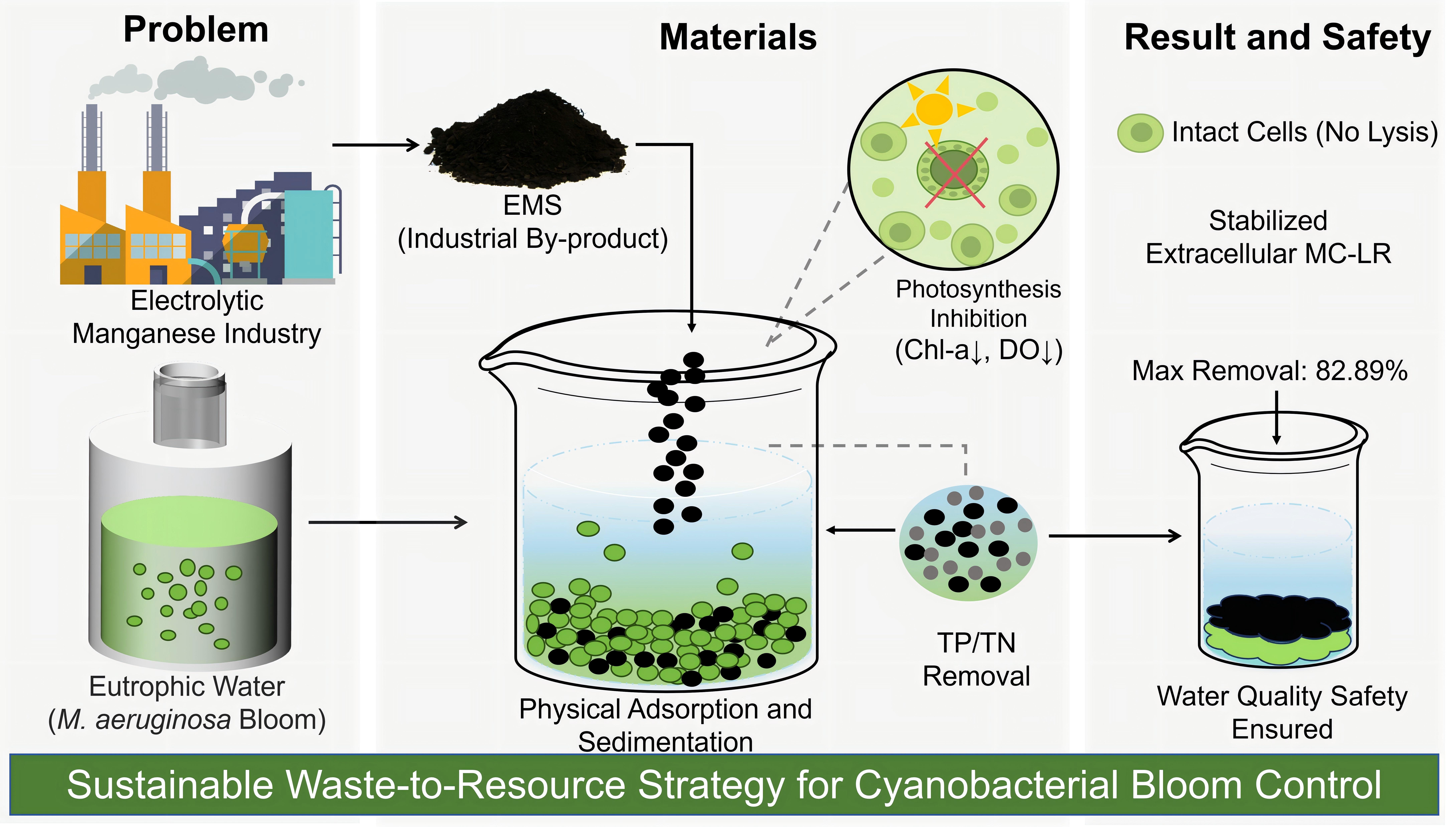
Harmful cyanobacterial blooms are increasing in frequency and severity due to fresh-water eutrophication. This study systematically evaluated the feasibility of repurposing electrolytic manganese slag (EMS), an industrial by-product, as a functional material for controlling the bloom-forming cyanobacterium Microcystis aeruginosa. The effects of key operational parameters including EMS dosage, algal density, light, temperature, and pH on chlorophyll-a removal efficiency were systematically investigated. EMS achieved a maximum chlorophyll-a removal efficiency of approximately 83% at 2.0 g·L⁻1, with enhanced performance under optimal light conditions and moderate temperatures. Physiological analyses revealed that EMS exposure significantly impaired photosynthetic activity by inhibiting the biosynthesis of essential pigments, concomitant with a marked reduction in dissolved oxygen evolution. Moreover, EMS treatment effectively removed total phosphorus and nitrogen from the water and promoted algal sedimentation without significant cell lysis. Notably, the treatment mitigated secondary pollution risks by stabilizing extracellular microcystin-LR levels and reducing intracellular toxin concentrations over time, while limiting the release of extracellular organic matter. Together, these results demonstrate that EMS can effectively remove M. aeruginosa without compromising water quality, validating its potential as a sustainable waste-to-resource strategy for cyanobacterial bloom control.
Keywords:
electrolytic manganese slag
; waste valorization
; Microcystis aeruginosa
; harmful algal blooms
1. Introduction
The rising incidence of freshwater eutrophication has intensified the global proliferation of cyanobacterial blooms in lakes and reservoirs, including those serving as critical drinking water sources [1]. Under warm, nutrient-rich conditions, Microcystis aeruginosa frequently emerges as the dominant bloom-forming species due to its high adaptability [2]. While primarily phosphorus-limited, its proliferation can lead to increased microcystin production under environmental stress, raising significant ecological and public health concerns [3,4]. These blooms induce hypoxia, disrupt biogeochemical cycles, compromise drinking-water treatment, and release toxins such as microcystins (MCs) [5], which are linked to liver failure and potential carcinogenicity [2,3]. Therefore, developing an effective and sustainable approach to control cyanobacterial blooms is imperative.
Current strategies for mitigating algal blooms encompass chemical, biological, and physical methods [5]. Chemical methods, such as coagulation and oxidation, are favored for their rapid response and operational simplicity. Positively charged coagulants, e.g., aluminium or iron salts combined with polyacrylamide [6], and polymer-clay based composites [7,8], can effectively aggregate negatively charged algal cells. Oxidants including copper sulphate [9], chlorine [10], potassium permanganate [11], and hydrogen peroxide [12,13], can rapidly inactivate algae but risk secondary pollution from cell rupture and toxin release. Although biological controls (e.g., allelopathy [14], activated sludge systems [15], and constructed wetlands [16]) are more environmentally benign, when confronted with a sudden outbreak they act slowly and are management-intensive. Physical removal techniques such as filtration [17] or coagulation-assisted separation [18] have emerged as prominent solutions for emergency mitigation, but material availability is often limited due to associated costs. A common challenge across these methods is balancing effectiveness with environmental safety and economic feasibility.
Recent studies have highlighted the potential of natural minerals in algal control. For instance, sericite inhibits the growth of M. aeruginosa by inducing cellular stress and suppressing photosynthetic activity, with transcriptomic analyses revealing disruptions in ion transport, metabolism, and energy conversion [19]. Clay minerals, composed primarily of SiO2 and Al2O3, have emerged as cost-effective and environmentally friendly agents for algal removal [7,19,20]. However, the tendency of clay–algae flocs to resuspend under hydrodynamic disturbances poses a significant challenge to long-term removal efficiency [21]. Notably, Mn(II)-activated sodium percarbonate pre-oxidizes M. aeruginosa through a Fenton-like mechanism, achieving remarkable removal via in situ formation of MnO2, which mediates charge neutralization, coagulation, and adsorption while simultaneously controlling algal organic matter release and disinfection by-product formation [22]. This underscores the potential of manganese-containing materials for targeted algal control. Nevertheless, the high cost and secondary risks of pure chemical reagents limit their practical application. As an alternative, industrial by-products, rich in active components, offer a more sustainable and economical approach.
Electrolytic manganese slag (EMS), a bulk by-product of manganese processing rich in SiO2, Fe2O3, Al2O3, and MnO [23,24,25], represents a promising, cost-effective candidate for large-scale applications. Its adsorption performance has been demonstrated to be comparable to traditional materials like bentonite and activated alumina, with high adsorption capacity for anionic contaminants such as dyes [26], arsenic [27], and phosphate [28]. Given that M. aeruginosa cells possess a negatively charged surface, analogous to many anionic contaminants, the direct use of EMS for algal removal is theoretically feasible. However, despite its availability and low cost, the practical efficacy of EMS for cyanobacterial control, and more importantly, its impact on algal physiology, toxin dynamics, and overall water quality safety, remains largely unverified. This knowledge gap limits the deployment potential of EMS as a sustainable, waste-derived material in water treatment processes.
This study therefore systematically evaluated the potential of EMS for M. aeruginosa removal, with a particular emphasis on the process engineering aspects critical for practical application. The removal performance was assessed under varying operational parameters, including EMS dosage, algal density, light, temperature, and pH. Furthermore, the underlying mechanisms were elucidated through integrated analysis of photosynthetic pigment synthesis, nutrient removal, cell morphology, and membrane integrity. Special attention was placed on water quality safety, including the fate of microcystins and extracellular organic matter, factors often overlooked in material-based algal removal studies. By establishing a waste-to-resource pathway for EMS, this work not only provides scientific insight into slag-based cyanobacterial control, but also proposes a practical strategy aligned with the principles of sustainable water process engineering.
2. Materials and Methods
2.1. Materials
The cyanobacterium M. aeruginosa (strain FACHB-905) was obtained from the Institute of Hydrobiology, Chinese Academy of Sciences (Wuhan, China). Electrolytic manganese slag (EMS) was sourced from a manganese mine in Hubei Province, China. The raw EMS was ground and sieved to pass through a 100-mesh sieve. Propidium iodide (PI) was purchased from Sigma-Aldrich (St. Louis, MO, USA). All other chemicals (analytical grade or higher) were obtained from Sinopharm Chemical Reagent Co., Ltd. (China). Ultrapure water was used throughout the experiments.
2.2. EMS Characterization
The crystal structure of EMS was analyzed by X-ray diffraction (XRD; D/max2500, Rigaku, Japan) using Cu Kα radiation over a 2θ range of 5–70o. Elemental composition was determined by X-ray fluorescence (XRF; Shimadzu 1800X, Japan). Functional groups were identified using Fourier transform infrared spectroscopy (FTIR; Nicolet IS50, Thermo Fisher Scientific, USA). The specific surface area and pore properties were analyzed via N2 adsorption-desorption isotherms using a surface area analyzer (JW-BK112, Beijing Jingwei Gaobo, China).
2.3. Algal Removal Experiment
M. aeruginosa was cultivated in BG-11 medium at 25±1 °C under a 12/12 h light/dark cycle with a light intensity of 2000 lx. Cells in the exponential growth phase were harvested by centrifugation at 3000 rpm for 10 min at 4 °C, and resuspended in fresh BG-11 medium.
Batch experiments were conducted in 250 mL Erlenmeyer flasks containing 200 mL of algal suspension. The effects of key parameters, including initial algal density (1×10⁶–15×106 cells·mL⁻1), solution pH (5.5–9.5), temperature (15–35 oC), light intensity (0–2000 lx), and EMS dosage (0.5–2.5 g·L⁻1), were investigated individually while keeping other parameters constant. All experiments were performed in duplicate over a 24 h period, and chlorophyll-a removal efficiency was used as the primary performance indicator.
To elucidate the removal mechanism, a set of standardized experiments was conducted under the following conditions: initial algal density of 2×10⁶ cells·mL⁻1, EMS dosage of 2.0 g·L⁻1, pH 7.50, and temperature 25 °C, under illumination. After 24 h of exposure, changes in photosynthetic pigments, dissolved oxygen, nutrient concentrations, cell membrane integrity, morphology, and microcystin release were analyzed.
2.4. Analytical Methods
Chlorophyll-a and carotenoid concentrations were determined spectrophotometrically as described in Text S1. Phycobiliproteins and dissolved oxygen were quantified following the procedures outlined in Texts S2 and S3, respectively. Cell membrane integrity was assessed by flow cytometry (BD FACSVerse, USA) after staining with PI (Text S4). Algal cell morphology was examined by scanning electron microscopy (SEM; JSM-7500F, JEOL, Japan) according to Text S5. Extracellular organic matter was analyzed by three-dimensional fluorescence spectroscopy (F-4600, Hitachi, Japan) as described in Text S6. Microcystins were extracted and quantified following the procedure in Text S7.
3. Results and Discussion
3.1. Physicochemical Characterization of EMS
Figure 1a shows the XRD pattern of EMS. EMS mainly consists of quartz, muscovite, jacobsite, gypsum and szmikite, as well as small amounts of pyrite and brushite [23,29]. XRF analysis shows that the major oxides, including SiO2, SO3, Al2O3, MnO, MgO, CaO, and Fe2O3, account for 96.71% of the total mass (Table S1), indicating a predominantly clay-type mineral composition. The high SO3 content is mainly attributable to CaSO4·2H2O, while SiO2 reaches 31.49%, confirming that EMS is an industrial solid waste enriched in silicate and sulfate phases. The pH of the slag suspension was 6.3, indicating a weakly acidic nature.
FTIR spectra of EMS before and after reaction are presented in Figure 1b. For the pristine sample, characteristic bands are observed at 3561.52 cm–1 and 3399.03 cm–1 (hydroxyl groups), 1620.29 cm–1 (interlayer or hydration water), 1001.19 cm–1 (Si-O bond vibrations in silica tetrahedra), 796.42 cm–1 (quartz), and 518.23 cm–1 (Al-O and Si-O bond vibrations). The band at 1430.52 cm–1 is assigned to carbonate, indicating the presence of calcite or related carbonate phases [29], consistent with the XRD results. The band at 662.06 cm–1 corresponds to the bending vibration of SO42–, while the band at 467.59 cm–1 likely arises from lattice vibrations involving Si-O-Al or Si-O-Fe bonds in minerals such as muscovite and kaolinite, also detected by XRD. After treatment, the asymmetric Si-O stretching band shows a redshift of approximately 11 cm–1 relative to the pristine sample.
The textural properties of the EMS were characterized using N2 adsorption–desorption isotherms. For both pristine and reacted samples, the adsorption and desorption branches overlap at relative pressures (P/P₀) ≤ 0.50, indicating the presence of micropores and predominantly monolayer adsorption behavior (Figure 1c). At P/P0 > 0.50, a sharp increase in N2 uptake is observed, suggesting slit-shaped pore structures. Compared to the pristine slag, the reacted sample shows a higher specific surface area and a larger desorption pore volume. These textural features, together with the mineral phases identified above, likely facilitate interactions between EMS and algal cells.
3.2. Algal Removal Performance
3.2.1. Optimization of EMS Dosage and Algal Density
The effect of EMS dosage on the chlorophyll-a removal of M. aeruginosa is shown in Figure 2a. EMS exhibited a significant inhibitory effect on algal growth, with chlorophyll-a removal increasing initially and then decreasing at higher dosages. The maximum removal efficiency of 82.89% was achieved at a dosage of 2.0 g·L⁻1. Further increases in dosage did not enhance algal removal, likely due to the saturation of available interaction sites between algal cells and the slag material at a fixed algal biomass. This plateau effect is commonly observed in adsorption-dominated processes [30]. Therefore, a dosage of 2.0 g·L⁻1 was determined to be optimal for subsequent experiments.
The impact of algal density on removal performance is presented in Figure 2b. Given the considerable variability of algal abundance in natural waters across different seasons and locations [31], the performance of EMS was evaluated over a range of cell densities. As algal density increased, chlorophyll-a removal efficiency markedly decreased. At densities below 2×10⁶ cells·mL⁻1, removal efficiencies exceeded 81.60%. However, at higher densities (5×10⁶, 10×106, and 15×106 cells·mL⁻1), the removal efficiencies dropped to 58.52%, 40.97%, and 34.98%, respectively. This trend can be attributed to the progressive saturation of adsorption sites on the slag surface, which limits further algal capture at elevated cell concentrations [32].
3.2.2. Influence of Environmental Conditions
The effect of light intensity on algal removal is depicted in Figure 2c. Under dark conditions, chlorophyll-a removal efficiency was 48.02%. Increasing light intensity significantly enhanced removal efficiency, reaching a maximum of 83.10%. This improvement suggests that EMS exhibits light-responsive activity, where illumination may promote the generation of reactive species, enhancing algal aggregation and sedimentation [33].
Figure 2d illustrates the influence of pH on algal removal performance. In eutrophic lakes, pH levels commonly increase due to CO2 consumption during algal photosynthesis [34], exhibiting pronounced diurnal and bloom-stage fluctuations. Within the tested pH range of 5.5 to 9.5, EMS maintained stable removal efficiencies between 71.42% and 88.29%. The highest removal efficiency (88.29%) was observed at pH 5.5, likely due to the inhibited growth of M. aeruginosa under mildly acidic conditions [35]. Efficiency slightly decreased under alkaline conditions (pH 7.5–9.5), consistent with the enhanced physiological adaptability of M. aeruginosa blooms [36]. Notably, practical pH adjustment via acid addition has been demonstrated to be feasible and economically viable for bloom control [37].
The effect of temperature on algal removal is shown in Figure 2e. An increase in temperature generally led to higher chlorophyll-a removal efficiency. Elevated temperatures can enhance molecular motion and collision frequency between algal cells and slag particles, thus promoting adsorption and aggregation processes [37]. Interestingly, a relatively high removal efficiency of 82.90% was also observed at 15 °C. This may be attributed to the suppression of algal metabolic activity and growth under lower temperature conditions [38].
In summary, the efficacy of EMS in removing M. aeruginosa is highly dependent on key operational and environmental conditions. Optimizing these parameters, particularly EMS dosage, algal density, and light exposure, can significantly enhance removal performance. This understanding provides a critical foundation for developing tailored and effective EMS-based strategies to mitigate cyanobacterial blooms in diverse aquatic systems.
3.3. Effects on Algal Photosynthetic Pigments and Physiology
Chlorophyll-a and carotenoids are essential indicators for assessing the photosynthetic activity of M. aeruginosa, as they play a crucial role in capturing and transferring light energy during photosynthesis [39]. In particular, chlorophyll-a serves as a key indicator of photosynthetic activity and cell viability. Both pigments are widely recognized as the most important photosynthetic pigments in M. aeruginosa and are vital for evaluating the primary productivity of aquatic ecosystems [40].
Figure 3a illustrates the changes in chlorophyll-a and carotenoid levels during the interaction between EMS and algae. As the reaction progressed, the removal rates of chlorophyll-a and carotenoids gradually increased, reaching 83.66% and 72.88%, respectively, after 24 h of treatment. This increase can primarily be attributed to the inhibitory effects of EMS on the synthesis of these pigments. Consequently, this suppression leads to reduced algal growth and reproduction, resulting in a significant decline in photosynthetic capacity [41].
In addition to chlorophyll-a and carotenoids, phycobiliproteins, including phycoerythrin (PE), phycocyanin (PC), and allophycocyanin (APC), are important photosynthetic accessory pigments that facilitate the photosynthesis process. These pigments are formed when phycobilins bind to soluble proteins, enabling them to transfer absorbed light energy to chlorophyll-a, which subsequently utilizes it in photosynthesis [42]. Figure 3b depicts the removal rates of these phycobiliproteins during EMS treatment. Over the 24 h period, all three phycobiliproteins were affected to varying degrees, with APC showing the most pronounced decline and reaching a removal rate of over 85%. The concurrent reductions in chlorophyll-a, carotenoids, and phycobiliproteins indicate that EMS imposes considerable physiological stress on the photosynthetic system of M. aeruginosa.
3.4. Mechanisms Underlying EMS-Induced Physiological Responses
The addition of EMS significantly increased the zeta potential of the algal suspension (Figure 4a), indicating effective adsorption of negatively charged M. aeruginosa cells onto the positively charged EMS particles. Monitoring DO levels provides an indirect assessment of algal physiological activity [41]. As shown in Figure 4b, DO concentrations in the control group gradually increased over time, whereas those in the EMS-treated group continuously decreased. These results suggest that EMS treatment suppresses photosynthetic oxygen evolution in M. aeruginosa, reflecting substantial impairment of its photosynthetic activity and overall physiological function.
Nitrogen (N) and phosphorus (P) are essential nutrients for algal growth, and controlling their concentrations is crucial for mitigating eutrophication [42,43]. Various minerals, including zeolite [44], iron oxide tailings [45], and sludge ash [46], which share similar components (e.g., SiO2, Al2O3, Fe2O3) with EMS, have been demonstrated to exhibit effective nutrient adsorption capabilities. Given that EMS is rich in these metal oxides as well as MnO and CaSO4·2H2O, and possesses a high specific surface area with abundant adsorption sites (Section 3.1), it is expected to facilitate the removal of nitrogen and phosphorus from the medium. To evaluate this capacity, changes in nitrogen and phosphorus concentrations in BG-11 medium were monitored. As shown in Figure 4c, EMS treatment achieved removal efficiencies of total phosphorus (TP) and total nitrogen (TN) of 51.03% and 10.96%, respectively, within just one hour. In contrast, under normal algal growth conditions, the removal efficiencies were significantly lower, at only 2.59% for TP and 1.58% for TN. These findings indicate that EMS not only reduces algal cell populations but also effectively lowers TP and TN levels in the medium, thereby depriving algae of essential nutrients and inhibiting their growth.
The morphological changes in M. aeruginosa cells following EMS treatment are presented in Figure 5. Under normal growth conditions, the cells appear intact with smooth surfaces (Figure 5a and Figure 5b). After EMS treatment (Figure 5c and Figure 5d), the algal cells are covered with slag particles while largely retaining a smooth, rounded shape without visible rupture. This phenomenon is likely attributed to the hard, plate-like nature of EMS, which physically deposits on the cell surfaces and adheres loosely to the cells. The increased cell density promotes sedimentation, leading to loss of viability [47]. These observations are consistent with previous SEM studies, such as those by Zhao et al. [48], who described similar surface interactions between reduced graphene oxide sheets and M. aeruginosa cells.
The integrity of the M. aeruginosa cell membranes following EMS treatment was further assessed using flow cytometry with propidium iodide (PI) staining. As shown in Figure 5e, the majority of cells in the control group were PI-negative, indicating intact membranes, and the viability rate was calculated to be 97.59%. In contrast, after EMS treatment (Figure 5f), a subset of cells showed a positive PI signal, suggesting membrane disruption and cell death, with a corresponding death rate of 12.03% among the treated cells. These results indicate that although EMS treatment induced membrane damage in a fraction of M. aeruginosa cells, the majority retained their structural integrity.
3.5. Water Quality Safety Assessment of Algal Cells Treated with EMS
3.5.1. Mn2+ Release
As shown in Figure 6a, Mn2+ release from the EMS material increased progressively over time. After 24 h, the amount of Mn2+ released into deionized water was 1.5 times higher than that observed in BG-11 medium. This difference can be attributed to the alkaline nature of the BG-11 medium, which supports the growth of M. aeruginosa. In alkaline environments, Mn2+ can be converted into poorly soluble species such as Mn(OH)2, Mn3O4, MnO2, and MnOOH [49,50]. These findings suggest that under the physicochemical conditions typical of algal bloom waters, manganese released from EMS may undergo natural immobilization, thereby mitigating the risks associated with elevated Mn2+ concentrations.
3.5.2. Variations in Intracellular and Extracellular Algal Toxins
To evaluate potential risks associated with toxin release, the intracellular and extracellular concentrations of microcystin-LR (MC-LR) in M. aeruginosa were monitored during exposure to EMS. As shown in Figure 6b and Figure S1, extracellular MC-LR levels slightly decreased by 23.06% during the first day and then remained relatively stable, indicating that EMS treatment did not cause immediate, large-scale cell lysis. In parallel, intracellular MC-LR levels exhibited a continuous decline over the three-day treatment (Figure S1), with a maximum reduction of 55.77% observed at 1 h (Figure 6c). This trend suggests that EMS neither stimulated microcystin biosynthesis nor triggered toxin release [51], which aligns with apoptosis-like behavior in Section 3.4.
In contrast to our findings, previous studies have reported that certain algicidal stresses, particularly those induced by allelopathic compounds, can lead to decreased extracellular microcystin concentrations while simultaneously enhancing intracellular microcystin synthesis and interconversion in toxin-producing Microcystis [52], thereby increasing the risk of delayed toxin release. By comparison, the stable extracellular and progressively decreasing intracellular MC-LR concentrations observed in this study suggest that EMS effectively suppresses toxin accumulation without inducing compensatory microcystin production, highlighting its advantage in mitigating secondary ecological risks.
It is well established that MC-LR production is strongly influenced by physicochemical water conditions and the physiological state of algae [53]. Additionally, extracellular microcystins are predominantly released following cell lysis, posing substantial threats to aquatic ecosystem safety [54]. Consistent with the membrane integrity results presented in Section 3.4, the stable extracellular and declining intracellular MC-LR levels observed here confirm that EMS treatment poses a low risk of toxin release, underscoring its suitability for environmentally safe cyanobacterial bloom mitigation.
3.5.3. Changes in Extracellular Organic Matter
Three-dimensional fluorescence spectroscopy is a sensitive technique commonly used to identify and classify low-concentration dissolved organic matter in aquatic environments. According to the classical classification proposed by Coble [55], fluorescence spectra can be divided into five characteristic zones, each defined by distinct excitation-emission wavelength pairs. These zones are generally associated with specific classes of fluorophores, including protein-like substances (e.g., tyrosine and tryptophan), fulvic acid-like materials, and humic acid-like components. In natural waters, the predominant fluorescence peaks typically correspond to tryptophan-like, tyrosine-like, and humic/fulvic-like substances, with detailed spectral assignments summarized in Table 1.
The impact of EMS on the release of organic matter from algal cells was analyzed using three-dimensional fluorescence characteristics, as illustrated in Figure 7. The spectrum of the control algal suspension (Figure 7a) reveals characteristic peaks in three specific zones: the T zone (Ex/Em 270-280/320-350 nm, corresponding to tryptophan-like substances), the A zone (Ex/Em 250-260/380-460 nm, associated with ultraviolet humic acid-like materials), and the C zone (Ex/Em 320-360/420-460 nm, indicative of visible humic acid-like components) [56].
After 24 h of EMS treatment (Figure 7b), a significant reduction in fluorescence intensities was observed in both the T and A zones. This attenuation coincides with the apoptosis-like response described in Section 3.4, suggesting that EMS treatment helps maintain algal cell membrane integrity [57]. The preservation of membrane integrity inhibits the leakage of intracellular dissolved organic matter while promoting the partial degradation of certain extracellular components. Consequently, the decreased fluorescence intensity of both protein-like and humic-like components indicates that EMS treatment effectively restricts the release of algal organic matter. This reduction ultimately mitigates the risk of secondary pollution during algal bloom control, highlighting the potential of EMS as a sustainable strategy for managing this environmental challenge.
4. Conclusions
This study demonstrates that EMS, an industrial by-product, is an effective and environmentally benign material for controlling cyanobacterial blooms in freshwater systems. Unlike conventional algicides that induce cell lysis and secondary toxin release, EMS achieves algal removal primarily through adsorption and sedimentation. At an optimal dosage of 2.0 g·L⁻1, EMS achieved a chlorophyll a removal efficiency of 82.89% for M. aeruginosa. Key influencing factors included algal density, light intensity, temperature, and pH. Beyond physical removal, EMS induced significant physiological stress in cyanobacteria by suppressing photosynthetic pigment synthesis and reducing oxygen evolution, thereby substantially impairing photosynthetic activity. The primary removal mechanism involves adsorption and sedimentation with minimal cell lysis, which prevents the release of intracellular toxins and organic matter while facilitating the concurrent removal of phosphorus and nitrogen. The stability of extracellular microcystin-LR, together with the observed decline in intracellular toxin concentrations, further confirms the low risk of secondary pollution associated with EMS application. Given its low cost, abundance, and operational simplicity, EMS represents a scalable and sustainable waste-to-resource strategy for mitigating cyanobacterial blooms in eutrophic waters. Collectively, this work validates EMS as a multifunctional, waste-derived material for effective algal control that also supports water quality safety and ecological restoration.
Supplementary Materials
The following supporting information can be downloaded at the website of this paper posted on Preprints.org, Text S1: Determination of Chlorophyll a and carotenoids; Text S2: Assay of phycobiliproteins; Text S3: Determination of dissolved oxygen; Text S4: Cell integrity test; Text S5: Observation of algal cell surfaces; Text S6: Extraction and determination of extracellular organic matter; Text S7: Extraction and analysis of microcystins; Figure S1: (a) Extracellular and (b) intracellular microcystin concentrations in M. aeruginosa mediated by EMS.; Table S1: The chemical composition of EMS determined by XRF.
Author Contributions
Conceptualization, R.L.; validation, H.L.; formal analysis, B.Z.; investigation, B.Z.; resources, Y.H.; data curation, B.Z.; writing—original draft preparation, M.C. and Y.W.; writing—review and editing, R.L. and D.H.; visualization, M.C. and Y.W.; supervision, R.L.; project administration, Y.H.; funding acquisition, D.H., H.L., and Y.H. All authors have read and agreed to the published version of the manuscript.
Funding
This research was funded by National Natural Science Foundation of China (grant number 22176110, 22406106, 22136003), the Hubei Provincial Natural Science Foundation and Innovation Development Joint Fund Project of China (grant number 2025AFD296) and Open Foundation of the Hubei Field Scientific Observation and Research Station for the Ecosystem of the Three Gorges Reservoir (China Three Gorges University) (grant number 2025KF07).
Conflicts of Interest
The authors declare that they have no known competing financial interests or personal relationships that could have appeared to influence the work reported in this paper.
References
- Wang, Y.; Zhao, D.; Woolway, R.I.; Yan, H.; Paerl, H.W.; Zheng, Y.; Zheng, C.; Feng, L. Global elevation of algal bloom frequency in large lakes over the past two decades. Natl. Sci. Rev. 2025, 12, nwaf011. [Google Scholar] [CrossRef] [PubMed]
- Merder, J.; Harris, T.; Zhao, G.; Stasinopoulos, D.M.; Rigby, R.A.; Michalak, A.M. Geographic redistribution of microcystin hotspots in response to climate warming. Nat. Water 2023, 1, 844–854. [Google Scholar] [CrossRef]
- Huo, D.; Gan, N.; Geng, R.; Cao, Q.; Song, L.; Yu, G.; Li, R. Cyanobacterial blooms in China: diversity, distribution, and cyanotoxins. Harmful Algae 2021, 109, 102106. [Google Scholar] [CrossRef]
- Cui, X.; Yang, N.; Cui, H.; Yang, Q.; Wu, Z.; Shao, B.; Zhao, Y.; Tong, Y. Interspecific competition enhances microcystin production by Microcystis aeruginosa under the interactive influences of temperature and nutrients. Water Res. 2024, 265, 122308. [Google Scholar] [CrossRef] [PubMed]
- Kordahi, M.A.; Ayoub, G.M.; Zayyat, R.M. A critical review of current research on cyanobacterial cells and associated toxins in aquatic environments: Occurrence, impact, and treatment methods. J. Environ. Chem. Eng. 2024, 12, 113931. [Google Scholar] [CrossRef]
- Nie, Y.; Zhang, R.; Li, S.; Xia, W.; Ma, J. Removal of Microcystis aeruginosa and its extracellular organic matters by using covalently bonded coagulant: An alternative choice in enhanced coagulation for algae-polluted water treatment. J. Clean. Prod. 2023, 419, 138337. [Google Scholar] [CrossRef]
- Gardi, I.; Mishael, Y.-G.; Lindahl, M.; Muro-Pastor, A.M.; Undabeytia, T. Coagulation-flocculation of Microcystis aeruginosa by polymer-clay based composites. J. Clean. Prod. 2023, 394, 136356. [Google Scholar] [CrossRef]
- Rytwo, G.; Tsveher, Y.; Viner-Mozzini, Y.; Sukenik, A. Application of Clay–Polymer Nanocomposites for the Removal of Toxic Cyanobacteria and Other Phytoplankton from Water—A Laboratory Scale Study. Water 2026, 18, 1301. [Google Scholar] [CrossRef]
- Watson, S.E.; Taylor, C.H.; Bell, V.; Bellamy, T.R.; Hooper, A.S.; Taylor, H.; Jouault, M.; Kille, P.; Perkins, R.G. Impact of copper sulphate treatment on cyanobacterial blooms and subsequent water quality risks. J. Environ. Manag. 2024, 366, 121828. [Google Scholar] [CrossRef]
- Li, X.; Chen, S.; Zeng, J.; Song, W.; Yu, X. Comparing the effects of chlorination on membrane integrity and toxin fate of high- and low-viability cyanobacteria. Water Res. 2020, 177, 115769. [Google Scholar] [CrossRef]
- Wang, H.-Q.; Mao, T.-G.; Xi, B.-D.; Zhang, L.-Y.; Zhou, Q.-H. KMnO4 pre-oxidation for Microcystis aeruginosa removal by a low dosage of flocculant. Ecol. Eng. 2015, 81, 298–300. [Google Scholar] [CrossRef]
- Huo, X.; Chang, D.W.; Tseng, J.H.; Burch, M.D.; Lin, T.F. Exposure of Microcystis aeruginosa to Hydrogen Peroxide under Light: Kinetic Modeling of Cell Rupture and Simultaneous Microcystin Degradation. Environ. Sci. Technol. 2015, 49, 5502–5510. [Google Scholar] [CrossRef]
- Choi, J.-H.; Shin, J.; Yoon, S.; Jang, T.; Lee, J.; Kim, H.-K.; Park, J.-A. Bacteria and Cyanobacteria Inactivation Using UV-C, UV-C/H2O2, and Solar/H2O2 Processes: A Comparative Study. Water 2024, 16, 2392. [Google Scholar] [CrossRef]
- Sun, R.; Sun, P.; Zhang, J.; Esquivel-Elizondo, S.; Wu, Y. Microorganisms-based methods for harmful algal blooms control: a review. Bioresour. Technol. 2018, 248, 12–20. [Google Scholar] [CrossRef] [PubMed]
- Biliani, S.E.; Manariotis, I.D. Formation of algal flocs from activated sludge in synthetic medium and secondary treated wastewater. J. Chem. Technol. Biotechnol. 2022, 97, 2143–2148. [Google Scholar] [CrossRef]
- Gupta, S.; Srivastava, P.; Yadav, A.K. Simultaneous removal of organic matters and nutrients from high-strength wastewater in constructed wetlands followed by entrapped algal systems. Environ. Sci. Pollut. Res. 2019, 27, 1112–1117. [Google Scholar] [CrossRef]
- Truttmann, L.; Su, Y.; Lee, S.; Burkhardt, M.; Brynjólfsson, S.; Chong, T.H.; Wu, B. Gravity-driven membrane (GDM) filtration of algae-polluted surface water. J. Water Process Eng. 2020, 36, 101257. [Google Scholar] [CrossRef]
- Ren, B.; Weitzel, K.A.; Duan, X.; Nadagouda, M.N.; Dionysiou, D.D. A comprehensive review on algae removal and control by coagulation-based processes: mechanism, material, and application. Sep. Purif. Technol. 2022, 293, 121106. [Google Scholar] [CrossRef]
- Yu, H.; Kim, S.-J.; Ryu, J.; Cho, D.-W.; Nam, I.-H. Effects of mineral resources on the growth of the harmful algal species Microcystis aeruginosa: From screening to understanding the underlying mechanisms. J. Environ. Manag. 2025, 395, 127653. [Google Scholar] [CrossRef]
- Nie, X.; Yu, Z.; Li, Y.; Ouyang, S.; Wang, Z.; Wang, G. Simultaneous removal of cyanobacteria and algal organic matter (AOM) by CaCO3 precipitation combined with Polyaluminum chloride (PACl) flocculation. J. Water Process Eng. 2024, 66, 105994. [Google Scholar] [CrossRef]
- Li, Y.; Hondzo, M.; Yang, J.Q. Clay-based HAB mitigation: the role of turbulence in aggregate formation and settling. Environ. Fluid Mech. 2025, 25, 44. [Google Scholar] [CrossRef]
- Li, N.; Chen, F.; Xu, S.; Zhu, S.; Bu, L.; Deng, L.; Shi, Z.; Zhou, S. Removal of Microcystis aeruginosa by manganese activated sodium percarbonate: Performance and role of the in-situ formed MnO2. Chemosphere 2023, 341, 140054. [Google Scholar] [CrossRef]
- Wang, D.; Wang, Q.; Xue, J. Reuse of hazardous electrolytic manganese residue: Detailed leaching characterization and novel application as a cementitious material. Resour. Conserv. Recycl. 2020, 154, 104645. [Google Scholar] [CrossRef]
- He, D.; Shu, J.; Wang, R.; Chen, M.; Wang, R.; Gao, Y.; Liu, R.; Liu, Z.; Xu, Z.; Tan, D.; et al. A critical review on approaches for electrolytic manganese residue treatment and disposal technology: Reduction, pretreatment, and reuse. J. Hazard. Mater. 2021, 418, 126235. [Google Scholar] [CrossRef]
- Su, H.; Zhou, W.; Lyu, X.; Liu, X.; Gao, W.; Li, C.; Li, S. Remediation treatment and resource utilization trends of electrolytic manganese residue. Miner. Eng. 2023, 202, 108264. [Google Scholar] [CrossRef]
- Li, C.; Zhong, H.; Wang, S.; Xue, J.; Zhang, Z. Removal of basic dye (methylene blue) from aqueous solution using zeolite synthesized from electrolytic manganese residue. J. Ind. Eng. Chem. 2015, 23, 344–352. [Google Scholar] [CrossRef]
- Lan, J.; Sun, Y.; Guo, L.; Du, Y.; Du, D.; Zhang, T.C.; Li, J.; Ye, H. Highly efficient removal of As(V) with modified electrolytic manganese residues (M-EMRs) as a novel adsorbent. J. Alloys Compd. 2019, 811, 151973. [Google Scholar] [CrossRef]
- Parida, K.M.; Mallick, S.; Dash, S.S. Studies on manganese nodule leached residues: 2. Adsorption of aqueous phosphate on manganese nodule leached residues. J. Colloid Interface Sci. 2005, 290, 22–27. [Google Scholar] [CrossRef]
- Dehmani, Y.; Bentahar, I.; Lgaz, H.; El-Kordy, A.; Aldalbahi, A.; Alrashdi, A.A.; Dehbi, A.; Lamhasni, T.; Hammouti, B.; Sadik, A. A critical review of natural clay minerals: Structural characterization, textural properties, and adsorption mechanisms for sustainable wastewater treatment. Mater. Today Adv. 2026, 29, 100682. [Google Scholar] [CrossRef]
- Jiang, K.; Yu, Z.; Cao, X.; Song, X.; Zang, X.; Chi, L.; Jiang, W. An optimization strategy for highly efficient flocculation and capture of algal cells: Controlling dosing patterns of modified clay. Environ. Technol. Inno. 2023, 32, 103359. [Google Scholar] [CrossRef]
- Li, D.; Chang, F.; Wen, X.; Duan, L.; Zhang, H. Seasonal Variations in Water Quality and Algal Blooming in Hypereutrophic Lake Qilu of Southwestern China. Water 2022, 14, 2611. [Google Scholar] [CrossRef]
- Markeb, A.A.; Llimós-Turet, J.; Ferrer, I.; Blánquez, P.; Alonso, A.; Sánchez, A.; Moral-Vico, J.; Font, X. The use of magnetic iron oxide based nanoparticles to improve microalgae harvesting in real wastewater. Water Res. 2019, 159, 490–500. [Google Scholar] [CrossRef] [PubMed]
- Qi, J.; Lan, H.; Liu, R.; Liu, H.; Qu, J. Efficient Microcystis aeruginosa removal by moderate photocatalysis-enhanced coagulation with magnetic Zn-doped Fe3O4 particles. Water Res. 2020, 171, 115448. [Google Scholar] [CrossRef]
- Verspagen, J.M.; Van de Waal, D.B.; Finke, J.F.; Visser, P.M.; Van Donk, E.; Huisman, J. Rising CO2 levels will intensify phytoplankton blooms in eutrophic and hypertrophic lakes. PLoS ONE 2014, 9, e104325. [Google Scholar] [CrossRef]
- Tao, C.; Niu, X.; Zhang, D.; Liu, Y.; Zhou, L.; Han, Y.; Mo, Y.; Wu, K.; Lin, Y.; Lin, Z. Inhibitory effect of malonic acid on Microcystis aeruginosa: Cell morphology, oxidative stress and gene expression. Algal Res. 2024, 80, 103513. [Google Scholar] [CrossRef]
- Wei, S.; Zhuang, G.; Cheng, L.; Wang, S. The proliferation rule of Microcystis aeruginosa under different initial pH conditions and its influence on the pH value of the environment. Environ. Sci. Pollut. 2021, 29, 13835–13844. [Google Scholar] [CrossRef]
- Saenchan, S.; Shimizu, K.; Iwami, N.; Angalika, M.W.S.; Maseda, H.; Minh, N.B.; Vu, H.V.; Truc-Ly, L.-H.; Itayam, T. Effects of pH and ultrasonication for decomposition of Microcystis formed colony in a bloom sample from a reservoir. Desalin. Water Treat. 2025, 322, 101203. [Google Scholar] [CrossRef]
- Fu, C.; Wang, X.; Yu, J.; Cui, H.; Hou, S.; Zhu, H. From winter dormancy to spring bloom: Regulatory mechanisms in Microcystis aeruginosa post-overwintering recovery. Water Res. 2025, 269, 122807. [Google Scholar] [CrossRef]
- Croce, R.; van Amerongen, H. Light harvesting in oxygenic photosynthesis: Structural biology meets spectroscopy. Science 2020, 369, aay2058. [Google Scholar] [CrossRef]
- Niu, X.; Zhang, D.; Zhang, R.; Song, Q.; Li, Y.; Wang, M. Physiological and biochemical responses of Microcystis aeruginosa to phosphine (PH3) under elevated CO2. J. Environ. Sci. 2020, 94, 171–178. [Google Scholar] [CrossRef] [PubMed]
- Medrano, E.A.; Uittenbogaard, R.; Van De Wiel, B.; Pires, L.D.; Clercx, H. An alternative explanation for cyanobacterial scum formation and persistence by oxygenic photosynthesis. Harmful Algae 2016, 60, 27–35. [Google Scholar] [CrossRef]
- Conley, D.J.; Paerl, H.W.; Howarth, R.W.; Boesch, D.F.; Seitzinger, S.P.; Havens, K.E.; Lancelot, C.; Likens, G.E. Controlling Eutrophication: Nitrogen and Phosphorus. Science 2009, 323, 1014–1015. [Google Scholar] [CrossRef] [PubMed]
- Miao, Y.; Zheng, S.; Lu, X.; Zhang, K.; Fan, J. Investigation on Lanthanum Modified Kaolinite for Control of Cyanobacterial Growth and Microcystin Production. Water 2025, 17, 428. [Google Scholar] [CrossRef]
- Wu, D.; Hu, Z.; Wang, X.; He, S.; Kong, H. Use of zeolitized coal fly ash in the simultaneous removal of ammonium and phosphate from aqueous solution. Front.Environ.Sci.Eng.China 2007, 1, 213–220. [Google Scholar] [CrossRef]
- Zeng, L.; Li, X.; Liu, J. Adsorptive removal of phosphate from aqueous solutions using iron oxide tailings. Water Res. 2004, 38, 1318–1326. [Google Scholar] [CrossRef]
- Shen, H.; Zhou, C.; Xu, S.; Huang, Y.; Shi, J.; Liu, G. Adsorption of nitrogen and phosphorus from wastewater by modified sludge/biomass ash ceramsite: Preparation, adsorption mechanism, and sustainable analysis. Water Environ. Res. 2023, 95, e10905. [Google Scholar] [CrossRef]
- Ho, Q.N.; Fettweis, M.; Hur, J.; Desmit, X.; Kim, J.I.; Jung, D.W.; Lee, S.D.; Lee, S.; Choi, Y.Y.; Lee, B.J. Flocculation kinetics and mechanisms of microalgae- and clay-containing suspensions in different microalgal growth phases. Water Res. 2022, 226, 119300. [Google Scholar] [CrossRef] [PubMed]
- Zhao, J.; Cao, X.; Wang, Z.; Dai, Y.; Xing, B. Mechanistic understanding toward the toxicity of graphene-family materials to freshwater algae. Water Res. 2017, 111, 18–27. [Google Scholar] [CrossRef]
- Luo, Y.; Wang, Y.; Liu, L.; Yang, X.; Wang, L.; Qiu, G. Interaction mechanism of hausmannite and Mn2+ under oxic conditions: Catalytic oxidation of Mn2+ to low-valence manganese oxides and mineral phase transformation. Appl. Geochem. 2022, 145, 105426. [Google Scholar] [CrossRef]
- Morgan, J.J.; Schlautman, M.A.; Bilinski, H. Rates of Abiotic MnII Oxidation by O2: Influence of Various Multidentate Ligands at High pH. Environ. Sci. Technol. 2021, 55, 14426–14435. [Google Scholar] [CrossRef]
- Fan, J.; Hobson, P.; Ho, L.; Daly, R.; Brookes, J. The effects of various control and water treatment processes on the membrane integrity and toxin fate of cyanobacteria. J. Hazard. Mater. 2014, 264, 313–322. [Google Scholar] [CrossRef]
- Guo, Z.; Hu, J.; Li, J.; Xia, X. Unraveling the effects of allelopathic algicide on Microcystis population: microcystin pollution risk assessment and proteomic-metabolomic insights into the sensitivity of toxigenic and non-toxigenic strains. J. Hazard. Mater. 2025, 495, 138671. [Google Scholar] [CrossRef] [PubMed]
- Massey, I.Y.; Al Osman, M.; Yang, F. An overview on cyanobacterial blooms and toxins production: their occurrence and influencing factors. Toxin Rev. 2022, 41, 326–346. [Google Scholar] [CrossRef]
- Menezes, I.; Capelo-Neto, J.; Pestana, C.J.; Clemente, A.; Hui, J.; Irvine, J.T.S.; Nimal Gunaratne, H.Q.; Robertson, P.K.J.; Edwards, C.; Gillanders, R.N.; et al. Comparison of UV-A photolytic and UV/TiO2 photocatalytic effects on Microcystis aeruginosa PCC7813 and four microcystin analogues: A pilot scale study. J. Environ. Manag. 2021, 298, 113519. [Google Scholar] [CrossRef] [PubMed]
- Coble, P.G. Characterization of marine and terrestrial DOM in seawater using excitation-emission matrix spectroscopy. Mar. Chem. 1996, 51, 325–346. [Google Scholar] [CrossRef]
- Wen, C.; Paul, W.; A., L.J.; Karl, B. Fluorescence Excitation−Emission Matrix Regional Integration to Quantify Spectra for Dissolved Organic Matter. Environ. Sci. Technol. 2003, 37, 5701–5710. [Google Scholar] [CrossRef]
- Pan, X.; Liu, J.; Song, W.; Zhang, D. Biosorption of Cu(II) to extracellular polymeric substances (EPS) from Synechoeystis sp.: a fluorescence quenching study. Front. Environ. Sci. Eng. 2012, 6, 493–497. [Google Scholar] [CrossRef]
Figure 1.
(a) XRD pattern of EMS. (b) Infrared spectra and (c) BET plots of EMS before and after reaction with M. aeruginosa.
Figure 1.
(a) XRD pattern of EMS. (b) Infrared spectra and (c) BET plots of EMS before and after reaction with M. aeruginosa.
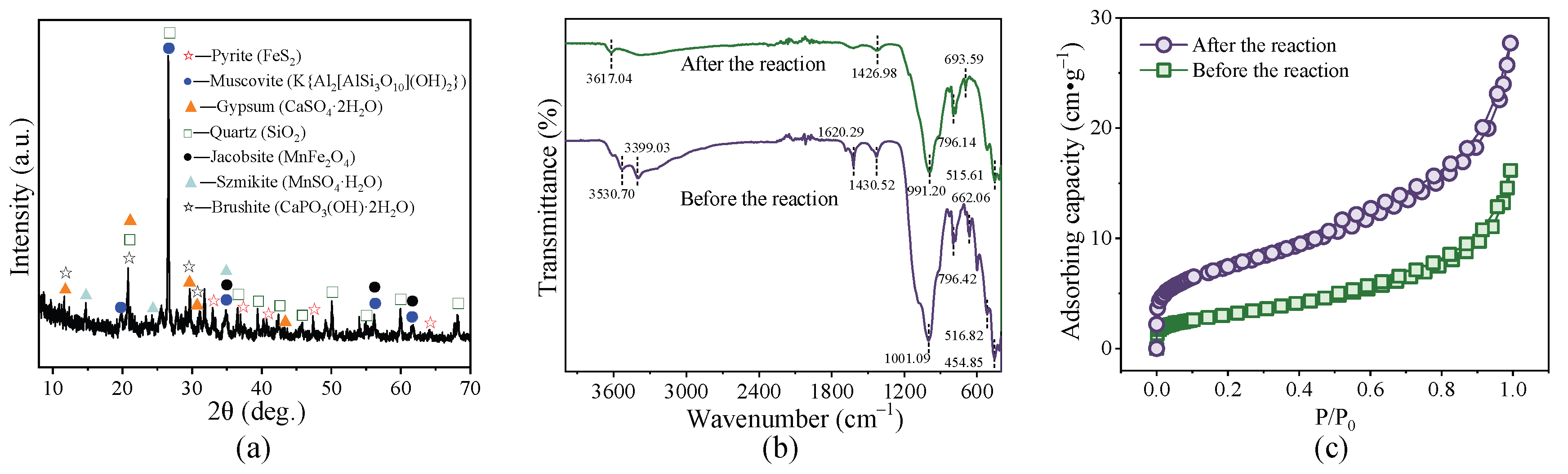
Figure 2.
Effects of (a) EMS dosage, (b) algal density, (c) light intensity, (d) medium pH, and (e) temperature on chlorophyll-a (Chl-a) removal.
Figure 2.
Effects of (a) EMS dosage, (b) algal density, (c) light intensity, (d) medium pH, and (e) temperature on chlorophyll-a (Chl-a) removal.
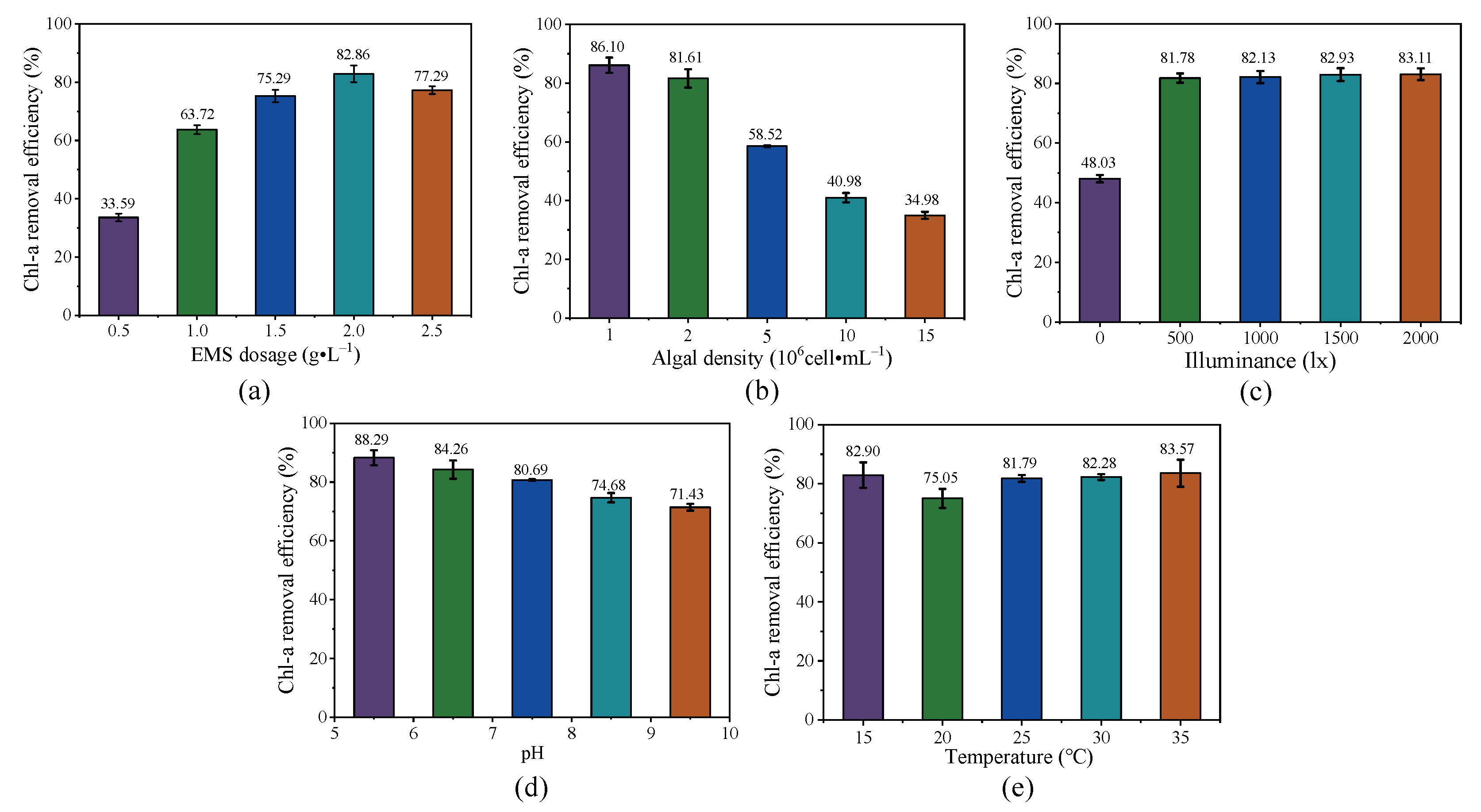
Figure 3.
Removal rates of (a) chlorophyll-a (Chl-a) and carotenoids (Caro), and (b) phycocyanin (PC), allophycocyanin (APC) and phycoerythrin (PE) in M. aeruginosa treated with EMS.
Figure 3.
Removal rates of (a) chlorophyll-a (Chl-a) and carotenoids (Caro), and (b) phycocyanin (PC), allophycocyanin (APC) and phycoerythrin (PE) in M. aeruginosa treated with EMS.
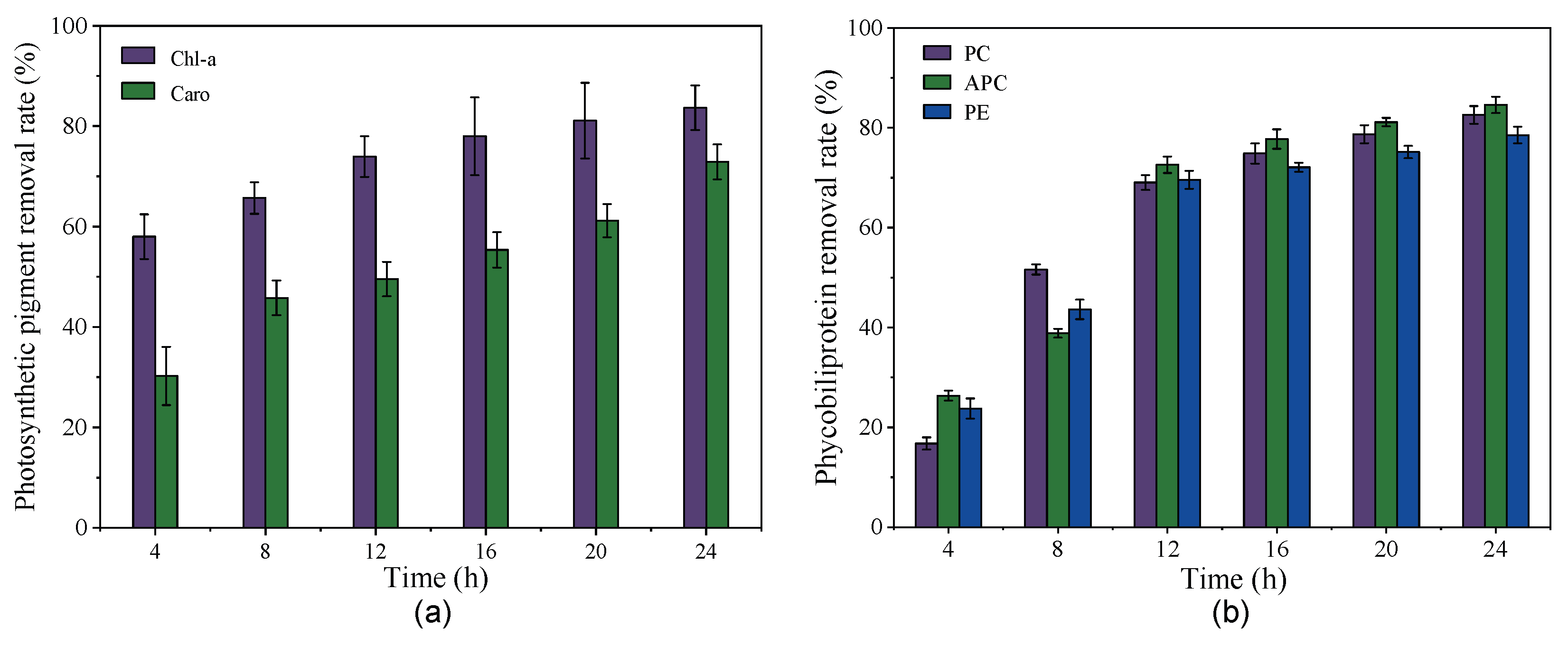
Figure 4.
Changes in (a) the zeta potential of the EMS-algae system, (b) dissolved oxygen (DO) concentration, and (c) removal rate of total phosphorus (TP) and total nitrogen (TN) in BG-11 medium during the treatment of M. aeruginosa with EMS.
Figure 4.
Changes in (a) the zeta potential of the EMS-algae system, (b) dissolved oxygen (DO) concentration, and (c) removal rate of total phosphorus (TP) and total nitrogen (TN) in BG-11 medium during the treatment of M. aeruginosa with EMS.
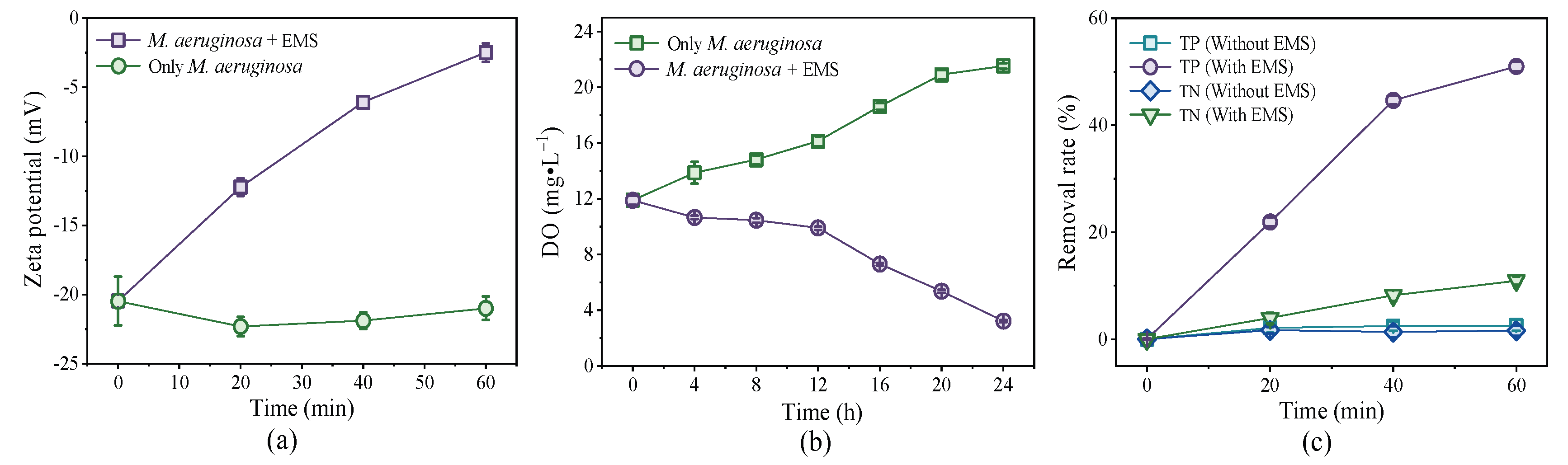
Figure 5.
SEM images of M. aeruginosa cells before (a, b) and after (c, d) EMS treatment, and flow cytometry plots before (e) and after (f) EMS treatment.
Figure 5.
SEM images of M. aeruginosa cells before (a, b) and after (c, d) EMS treatment, and flow cytometry plots before (e) and after (f) EMS treatment.
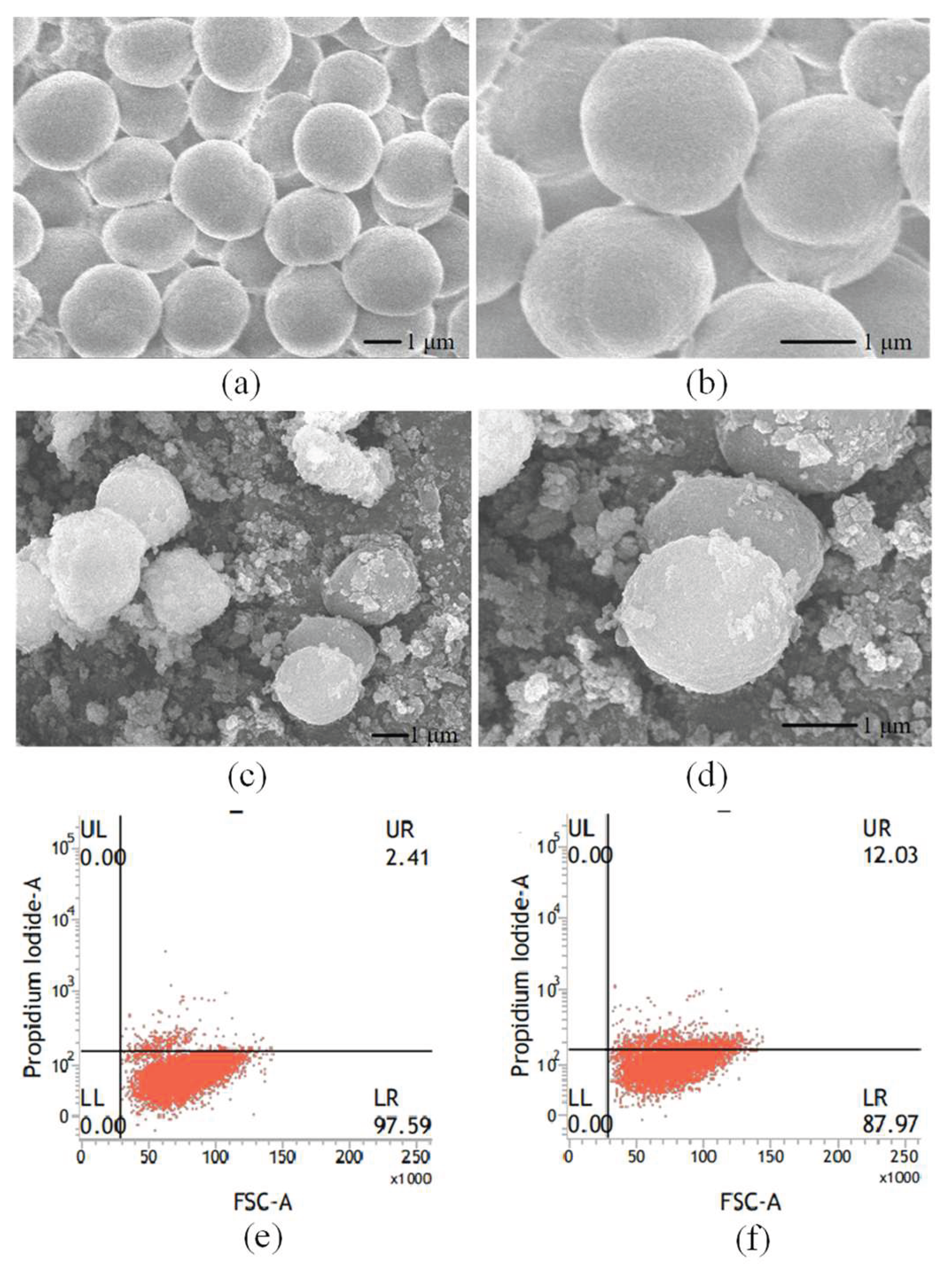
Figure 6.
(a) Mn2+ release under different reaction conditions, and variation ratios of (b) extracellular extracellular microcystin concentrations and (c) intracellular microcystin concentrations in M. aeruginosa mediated by EMS.
Figure 6.
(a) Mn2+ release under different reaction conditions, and variation ratios of (b) extracellular extracellular microcystin concentrations and (c) intracellular microcystin concentrations in M. aeruginosa mediated by EMS.
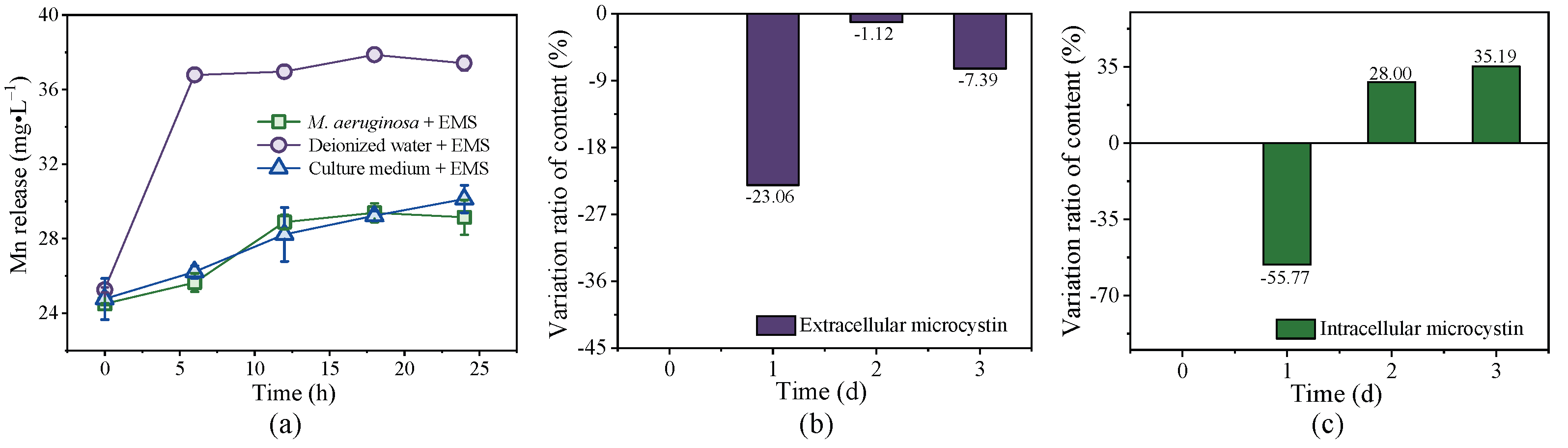
Figure 7.
Three-dimensional fluorescence spectra of algal cells (a) before and (b) after 24 h EMS treatment.
Figure 7.
Three-dimensional fluorescence spectra of algal cells (a) before and (b) after 24 h EMS treatment.
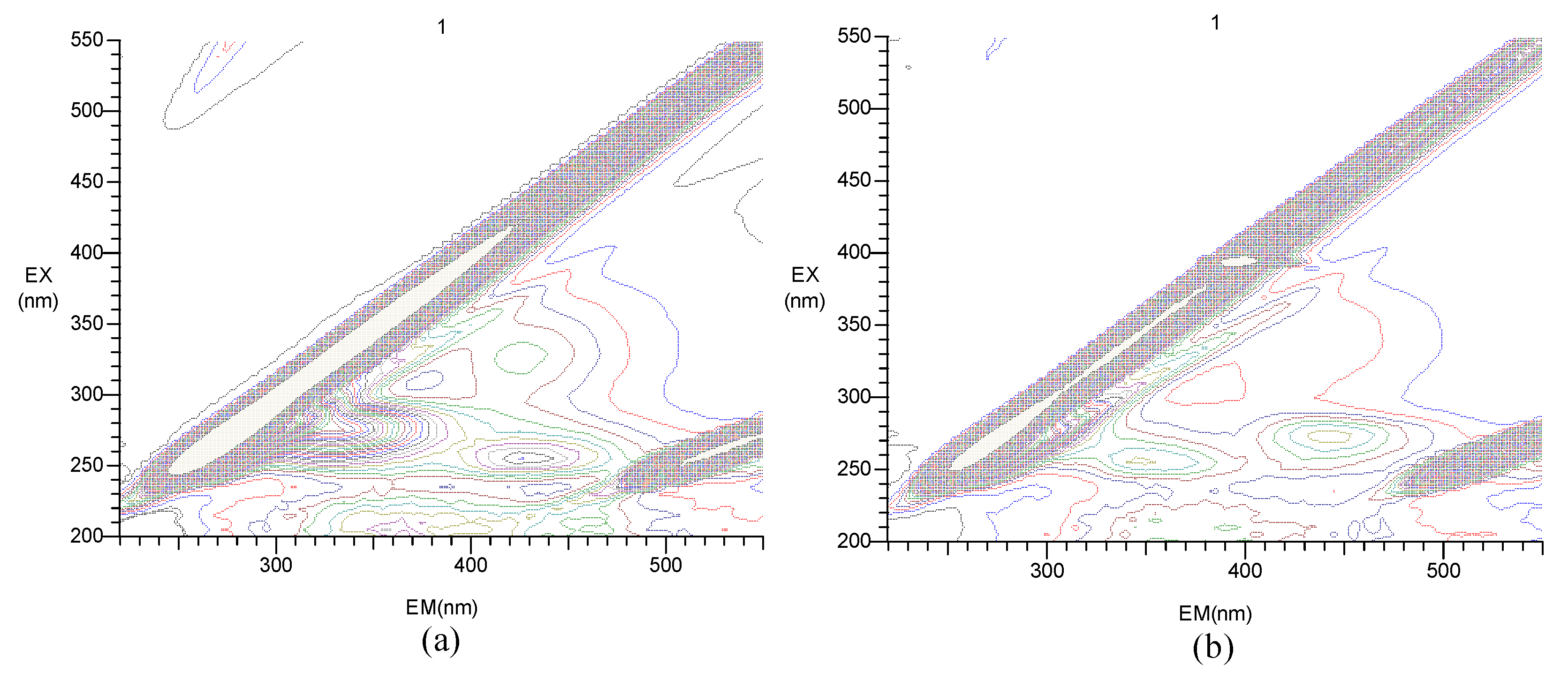

Table 1.
Characteristic fluorescence peaks and their spectral assignments in aquatic systems.
| Fluorescence Peak | Peak Type | Excitation Wavelength (Ex) | Emission Wavelength (Em) |
|---|---|---|---|
| B | Tyrosine-like (high excitation wavelength) | 207-280 nm | 300-310 nm |
| D | Tyrosine-like (low excitation wavelength) | 220-230 nm | 300-310 nm |
| T | Tryptophan-like (high excitation wavelength) | 270-280 nm | 320-350 nm |
| S | Tryptophan-like (low excitation wavelength) | 220-230 nm | 320-350 nm |
| A | Humic-like (UV region) | 250-260 nm | 380-460 nm |
| C | Humic-like (visible region) | 320-360 nm | 420-460 nm |
| M | Marine humic-like | 290-310 nm | 370-420 nm |
Disclaimer/Publisher’s Note: The statements, opinions and data contained in all publications are solely those of the individual author(s) and contributor(s) and not of MDPI and/or the editor(s). MDPI and/or the editor(s) disclaim responsibility for any injury to people or property resulting from any ideas, methods, instructions or products referred to in the content. |
© 2026 by the authors. Licensee MDPI, Basel, Switzerland. This article is an open access article distributed under the terms and conditions of the Creative Commons Attribution (CC BY) license (http://creativecommons.org/licenses/by/4.0/).
Copyright: This open access article is published under a Creative Commons CC BY 4.0 license, which permit the free download, distribution, and reuse, provided that the author and preprint are cited in any reuse.


