

Submitted:
02 June 2026
Posted:
03 June 2026
You are already at the latest version
Abstract
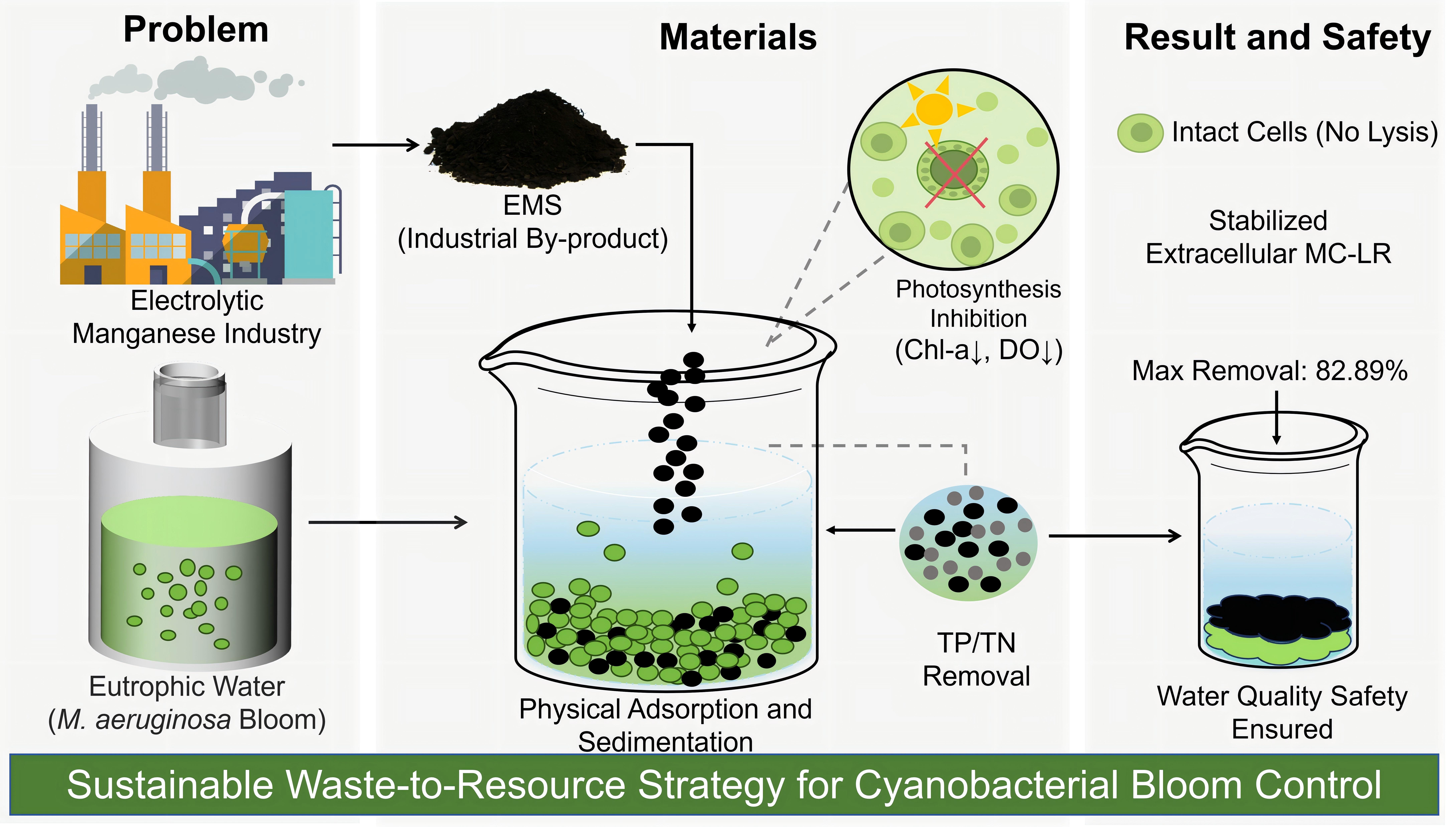
Harmful cyanobacterial blooms are increasing in frequency and severity due to fresh-water eutrophication. This study systematically evaluated the feasibility of repurposing electrolytic manganese slag (EMS), an industrial by-product, as a functional material for controlling the bloom-forming cyanobacterium Microcystis aeruginosa. The effects of key operational parameters including EMS dosage, algal density, light, temperature, and pH on chlorophyll-a removal efficiency were systematically investigated. EMS achieved a maximum chlorophyll-a removal efficiency of approximately 83% at 2.0 g·L⁻1, with enhanced performance under optimal light conditions and moderate temperatures. Physiological analyses revealed that EMS exposure significantly impaired photosynthetic activity by inhibiting the biosynthesis of essential pigments, concomitant with a marked reduction in dissolved oxygen evolution. Moreover, EMS treatment effectively removed total phosphorus and nitrogen from the water and promoted algal sedimentation without significant cell lysis. Notably, the treatment mitigated secondary pollution risks by stabilizing extracellular microcystin-LR levels and reducing intracellular toxin concentrations over time, while limiting the release of extracellular organic matter. Together, these results demonstrate that EMS can effectively remove M. aeruginosa without compromising water quality, validating its potential as a sustainable waste-to-resource strategy for cyanobacterial bloom control.
Keywords:
electrolytic manganese slag
; waste valorization
; Microcystis aeruginosa
; harmful algal blooms
Copyright: This open access article is published under a Creative Commons CC BY 4.0 license, which permit the free download, distribution, and reuse, provided that the author and preprint are cited in any reuse.


