

Submitted:
02 June 2026
Posted:
03 June 2026
You are already at the latest version
Abstract
The global proliferation of dam and reservoir cascades, which are crucial for water security, has transformed river flow and sediment dynamics, creating new flood hazards. This review consolidates evidence on "Medium Flood, High Water Levels" (MFHWL), where medium discharges cause historically elevated water levels. An analysis of 97 studies shows that the MFHWL is a systemic risk, not just a hydro-geomorphic issue. It arises from two drivers: (1) channel incision and sediment depletion from reservoir impoundment, which increases hydraulic efficiency and water levels during medium floods, and (2) asymmetrical management of multi-reservoir systems, where conflicting priorities and poor data sharing lead to uncoordinated releases, worsening hazards in altered channels. We propose a model framing the MFHWL as a coupled human-natural system, highlighting the feedback between physical processes and managerial decisions. These findings call for a shift in flood risk management, advocating non-stationary hydraulic models and adaptive governance of reservoir cascades to mitigate this threat in engineered river systems. While the Flood Risk Amplifier loop is substantiated by direct empirical evidence from multiple basins, the Management Amplifier loop, although conceptually grounded in governance theory, is supported by comparatively weaker empirical evidence and should be regarded as a provisional framework necessitating further testing.
Keywords:
Medium Flood High Water Level
; systemic risk
; reservoir cascades
; asymmetrical management
; channel incision
; coupled human-natural systems
1. Introduction
Dams and reservoirs are integral components of the contemporary hydrological landscape and function as essential infrastructures for global water security, hydropower generation, and flood management (Lehner et al., 2011; Ren et al., 2015; Ren et al., 2017; Ahmadianfar et al., 2019; Hanazaki et al., 2022; He et al., 2024; Moridi & Yazdi, 2017). This engineering endeavor represents a large-scale experiment in river management, wherein multi-reservoir systems, although designed to mitigate hydrological extremes, have fundamentally altered the natural flow regimes and sediment dynamics that sustain riverine ecosystems (Graf, 2006; Best, 2019; Chen et al., 2017; Toosi & Samani, 2014; Hu et al., 2024; Lobera et al., 2016; Tonkin et al., 2021; Zhang et al., 2023). These modifications, including sediment depletion, channel incision, and artificial suppression of high-flow events, generate cascading risks throughout the river basins (Ali et al., 2016; Di Baldassarre et al., 2018; Bilskie et al., 2021; Garrick et al., 2018).
Recent research indicates that anthropogenic alterations generate novel flood hazards, thereby modifying the relationship between discharge and river stages (Mandarino et al., 2021; Slater & Villarini, 2018; Su et al., 2020; Mandarino et al., 2021; Swarnkar et al., 2021; Wang et al., 2019). In heavily engineered river systems, these emerging flood hazards pose challenges to traditional flood management paradigms that are predicated on stationary hydrological assumptions and intricate socio-hydrological feedback mechanisms (Sivapalan & Blöschl, 2015; Wing et al., 2018; Blöschl et al., 2019; Kellner, 2021; Michaelis et al., 2020).
This review examines the medium flood, high water level (MFHWL) phenomenon, which signifies a disjunction between flood discharge magnitude and water stage, as observed in the Middle Yangtze River Basin. The MFHWL paradigm characterizes systemic risk, where medium-magnitude flood discharges yield water levels comparable to or surpassing historical maxima values. This transformation is a significant threat to public safety, infrastructure, and agricultural land (Hu et al., 2021; Chai et al., 2020; Hu et al., 2022; Jiao et al., 2020; Qi et al., 2022; Sun et al., 2017). This creates a "safety-drag" effect, where the protection provided by upstream reservoirs is compromised by elevated downstream water stages for equivalent discharges. This paradox is most consequential in the Middle Yangtze, where the world's largest reservoir cascade, including the Three Gorges Dam, has induced profound geomorphic transformations (Dai & Liu, 2013; Wang et al., 2017; Dai et al., 2021; Hu et al., 2022; Yu et al., 2013, 2018).
Channel incision and sediment depletion enhance the hydraulic capacity of rivers, leading to diminished baseline water levels during periods of low-flow. This has resulted in the development of steeper and more efficient channels that facilitate the conveyance of medium floods with increased stages and flow velocities (Li et al., 2019; Slater & Villarini, 2018; Li et al., 2022; Call et al., 2017; Hu et al., 2024; Wang et al., 2019). This dynamic pose significant challenges to flood control protocols, infrastructure design standards, and risk perceptions, necessitating a re-evaluation of reservoir operations and flood management strategies in asymmetrically managed basins (Sivapalan & Blöschl, 2015; Post et al., 2024; Qiu et al., 2019).
Extensive research has elucidated the immediate physical factors contributing to MFHWL by quantifying the effects of sediment depletion, channel incision, and floodplain disconnection (Lai et al., 2021; Li et al., 2019; Marren et al., 2014; Nelson & Dubé, 2015; Nichols & Viers, 2017). Simultaneously, a distinct body of literature has focused on optimizing reservoir operations, often modeling individual dams or hypothetical, ideally coordinated cascades to maximize specific objectives such as hydropower production or flood control (Giuliani et al., 2022; Giuliani et al., 2021).
Despite the significance of this issue, a comprehensive synthesis is yet to be conducted. Current research frequently overlooks the integration of hydro-morphological drivers with the complexities of 'asymmetrical management,' which is characterized by uncoordinated actions across reservoir cascades, thereby posing system-wide risks. This review defines "asymmetrical management" as a condition prevalent in large transboundary or multi-jurisdictional river systems, characterized by conflicting operational priorities, fragmented governance, and a lack of coordinated real-time data sharing among entities (Akamani & Wilson, 2013; Diao et al., 2022; Akamani & Wilson, 2011; De Stefano et al., 2012; Lu et al., 2021; Tran & Tortajada, 2022). Such fragmentation results in blind spots, where the localized optimization of reservoirs triggers cascading responses, such as altered sediment fluxes or untimely flow releases, which are amplified through adjusted channels, thereby exacerbating downstream MFHWL risks (Pahl-Wostl, 2019; Larkin et al., 2020). This deficiency is due to an inadequate understanding of feedback loops between channel alterations and misaligned human operations, a nexus that must be elucidated to mitigate this hazard (Adams et al., 2017; Rajah et al., 2024; Ramaswamy & Saleh, 2020).
This review advances beyond isolated disciplinary perspectives by introducing a novel conceptualization of the MFHWL problem as an emergent property of coupled human–natural systems. We contend that a comprehensive understanding of its formation necessitates an examination of the feedback loops between the physical channel evolution and asymmetrical operational protocols governing multireservoir cascades. Although physical processes, such as channel incision, create the potential for elevated water levels during medium floods, the human system, particularly the uncoordinated timing and magnitude of releases from multiple reservoirs with competing priorities, trigger and amplify this risk into a tangible hazard (Wallington et al., 2020; Wei et al., 2021; Liu et al., 2007; Pahl-Wostl, 2019).
This study introduces an integrated framework designed to synthesize various components from the literature. The framework establishes a connection between the geomorphic trajectory of a river, which is influenced by long-term sediment imbalance, and short-term operational decisions made by dam operators. This linkage demonstrates how their interactions generate systemic risk, which remains undetected when sectors are examined separately (Sivapalan, 2015; Brenna et al., 2020; Lee et al., 2022; Lyu et al., 2020). By analyzing the MFHWL from a coupled systems perspective, we developed a structure to diagnose the underlying causes of this paradox beyond its physical drivers. This approach identifies critical leverage points for mitigating emergent risks in heavily engineered river basins worldwide (Milly et al., 2008; Bennett et al., 2018; Taylor & Owens, 2009; Verschuur et al., 2024).
2. Materials and Methods
This systematic review was conducted to synthesize evidence concerning the formation mechanisms of the "Medium Flood, High Water Level" (MFHWL) phenomenon, with a particular focus on the influence of asymmetrical management on emergent systemic risk. The methodology adhered to the Preferred Reporting Items for Systematic Reviews and Meta-Analyses (PRISMA) 2020 guidelines to ensure a comprehensive, transparent, and reproducible process (Page et al., 2021; Hill et al., 2023; Orimoogunje & Aniramu, 2025). The protocol is structured around four primary objectives: synthesizing hydrogeomorphic drivers, deconstructing asymmetrical management, developing an integrated conceptual model, and identifying priorities for future research.
2.1. Search Strategy
A thorough literature review was conducted using four primary academic databases: Scopus, Web of Science, PubMed, and Engineering Village. These databases were selected because of their extensive interdisciplinary coverage, which includes environmental science, engineering, water resources, and social governance. The search methodology incorporated a combination of keywords and Boolean operators relevant to three main thematic areas: (1) flood phenomena and hydrology, (2) river basin management and infrastructure, and (3) systemic risk and socio-hydrological systems. Key search terms included "medium flood," "high water level," "discharge-stage relationship," "flood paradox," "reservoir cascade," "asymmetrical management," "sediment starvation," "channel incision," "systemic risk," and "coupled human-natural system." A systematic database search was conducted until December 2024 across the Web of Science, Scopus, and Google Scholar, encompassing all publications available until that date. Following the systematic search, during the peer-review revision process (January–March 2025), the authors sought expert recommendations from six researchers who specialize in MFHWL governance. This supplementary process identified four additional 2024 publications that satisfied all inclusion criteria and were incorporated into the final corpus. All papers included in this review were published no later than December 2024.
2.2. Eligibility Criteria and Study Selection
The studies were evaluated using a two-phase process: Phase I screened the titles and abstracts, and Phase II reviewed the full text. The inclusion criteria were (i) empirical or theoretical analysis of discharge-stage changes in regulated rivers, (ii) quantitative or qualitative assessment of reservoir impacts on downstream flood dynamics or geomorphology, (iii) examination of governance or operational challenges in multi-reservoir management, and (iv) frameworks for analyzing risks in coupled human-water systems. The exclusion criteria were as follows: (i) studies on natural, unregulated catchments; (ii) research focused solely on meteorological or coastal flooding unrelated to river management; (iii) purely methodological studies without case applications; and (iv) conference proceedings, books, or non-peer-reviewed works. The Covidence Software was used for the selection process by two independent reviewers to reduce bias. Discrepancies were resolved by discussion or by a third reviewer. The process is summarized in the PRISMA flowchart (Figure 1). Following PRISMA 2020, we did not search for research registries because of the lack of centralized registration platforms in environmental science and water resource management. Instead, we comprehensively searched major interdisciplinary databases for peer-reviewed literature.
2.3. Data Extraction and Synthesis
Data from the eligible studies were systematically extracted using a standardized coding form in Microsoft Excel. The extracted elements comprised (1) bibliographic details, (2) study region and scale, (3) primary methodology (e.g., numerical modeling, field measurements, policy analysis), (4) key hydrogeomorphic findings, such as channel incision rates and sediment load changes; (5) aspects of asymmetrical management, including conflicting objectives and governance structures; and (6) proposed conceptual or numerical risk models. Given the interdisciplinary nature of the evidence, narrative synthesis was employed instead of meta-analysis (Maden & Kotas 2016). The synthesis adhered to the study objectives: initially, categorizing physical drivers to discern patterns and their contributions to the MFHWL phenomenon; subsequently, classifying asymmetrical management factors into thematic domains (institutional, economic, operational) according to water governance frameworks (Pahl-Wostl, 2019); and ultimately, these components are integrated into a novel conceptual model that illustrates feedback loops between physical and human urban subsystems.
2.4. Quality Assessment
The methodological quality of the included studies was assessed using a modified version of the Mixed Methods Appraisal Tool (MMAT) (Hong et al., 2018), which evaluates five criteria based on study design (qualitative, quantitative, or mixed methods). The ratings ranged from ★ (medium quality, with two or fewer criteria met) to ★★★★ (high quality, with all criteria satisfied). Two reviewers independently conducted the assessments and resolved any discrepancies through discussions. The studies were evaluated based on the clarity of the research question, appropriateness of the methodology, transparency of the data, and justification of conclusions.
A quality assessment was conducted to interpret the findings and evaluate the robustness of the evidence, rather than to exclude studies, in accordance with best practices for complex systematic reviews (Maden & Kotas, 2018). The quality of studies influenced the synthesis in the following ways: 1) high-quality studies (★★★★) served as the foundation for core conclusions regarding hydro-geomorphic drivers; 2) medium-quality studies (★★–★★★) were included but interpreted with caution, particularly when methodologies or sampling were limited; and 3) themes predominantly supported by medium-quality evidence, such as governance fragmentation, require further validation.
3. Results
A systematic search and screening process identified 97 studies that satisfied the eligibility criteria for this review. A PRISMA flow diagram illustrating this process is shown in (Figure 1). The subsequent sections provide a narrative synthesis of the findings organized according to the primary aims of the review.
3.1. Synthesizing the Hydro-Geomorphic Drivers of MFHWL
The phenomenon of MFHWL in marine environments is primarily driven by physical processes, with alterations in sediment regimes being a critical factor in the Middle Yangtze and other regulated systems. Following impoundment, the Middle Yangtze experienced a reduction of over 70% in suspended sediments downstream of the Three Gorges Dam and its associated reservoirs (Huang et al., 2019; Lai et al., 2017; Li et al., 2009). This depletion of sediment has led to extensive channel incision, resulting in the lowering of bed levels by more than 10 m in certain areas (Li et al., 2009; Hu et al., 2022).
This geomorphic alteration affects the stage-discharge relationship. Incised sediment-deficient channels reduce water levels during low- and medium-flow periods by enhancing water conveyance. This phenomenon is frequently misinterpreted as a reduced flood risk (Wang et al., 2017). In the context of medium floods, larger channels result in increased water gradients and flow velocities, rendering previously manageable discharges more hazardous (Lai et al., 2021; Li et al., 2022). Levee systems exacerbate this issue by obstructing floodplain storage and concentrating flood energy within main channels (Di Baldassarre et al., 2018; Ferdous et al., 2020). Table 1 provides a summary of the principal hydrogeomorphic drivers and evidence quality ratings.
3.2. Deconstructing the Dimensions of Asymmetrical Management
This review identifies three critical aspects of asymmetrical management that exacerbate hydrogeomorphic risks, thereby transforming them into systemic MFHWL hazards.
1. Reservoir cascades are managed by entities with divergent objectives: hydropower companies focus on maximizing their heads and maintaining steady releases, whereas flood control agencies require pre-release and storage capacity (Wu et al., 2021; Qin et al., 2024; Wang et al., 2024; Zhang et al., 2022). This conflict was evident in the Middle Yangtze River, where uncoordinated pre-releases during forecasted rainfall combined with natural runoff resulted in hazardous peak discharge downstream (Ge et al., 2023; Liu et al., 2024; Chai et al., 2020; Hu et al., 2022).
2. The governance of transboundary rivers, such as the Mekong and Nile, is characterized by fragmentation across national, provincial, and sectoral agencies that lack binding coordination mechanisms (Hensengerth et al., 2024; Pahl-Wostl, 2019; Tran et al., 2022; Gebrehiwot et al., 2018; Grumbine, 2017; Hirsch, 2006; Lu et al., 2021; Mirumachi, 2015; Tran & Tortajada, 2022; Williams, 2018). This fragmentation hinders the development of integrated operational rules that adequately consider downstream impacts (Garrick et al., 2018; Gilbertson et al., 2014; Rivers-Moore et al., 2016).
3. The absence of real-time data sharing and integrated modeling results in decision making based on incomplete information regarding reservoir status and plans, leading to suboptimal and potentially hazardous releases (Che & Mays, 2020; Rougé et al., 2021; Xu et al., 2015; Ramaswamy & Saleh, 2020; Saavedra Valeriano et al., 2010; Xu et al., 2022).
3.3. An Integrated Conceptual Model of MFHWL Formation
In synthesizing these findings, this review introduces a conceptual model (Figure 2) that characterizes MFHWL as an emergent property of a coupled human–natural system. The model delineates two reinforcing feedback loops: Feedback Loop A termed the Geomorphic Trap, initiated with reservoir impoundment, resulting in sediment deprivation and channel incision. This process modifies the stage-discharge relationship, elevating the stage for medium flood events and increasing flood risk, thereby prompting the demand for structural protection. These measures diminish floodplain connectivity and exacerbate the stage rise during floods. Feedback Loop B, identified as a Management Amplifier, involves asymmetrical management characterized by conflicting priorities and fragmented governance. This leads to uncoordinated reservoir releases and concentrated medium discharges, which exacerbate the high-stage events. Consequently, this heightens the perception of management failure, reinforces institutional silos, and suboptimal operational practices. The model's principal insight is the cross-coupling between Loops A and B. Physical alterations in Loop A heightened susceptibility to management failures in Loop B, while uncoordinated releases from Loop B intensified the physical risks in Loop A.
3.4. Yangtze River Basin's 'Medium Flood, High Water Level' Paradigm
The Middle Yangtze River exemplifies the MFHWL phenomenon, in which geomorphic adjustments and reservoir operations create systemic risks. Section 3.1 explains the physical preconditions (Loop A), while recorded water levels during medium discharge are exacerbated by asymmetrical management practices (Loop B). This section examines the basin-specific managerial dimensions.
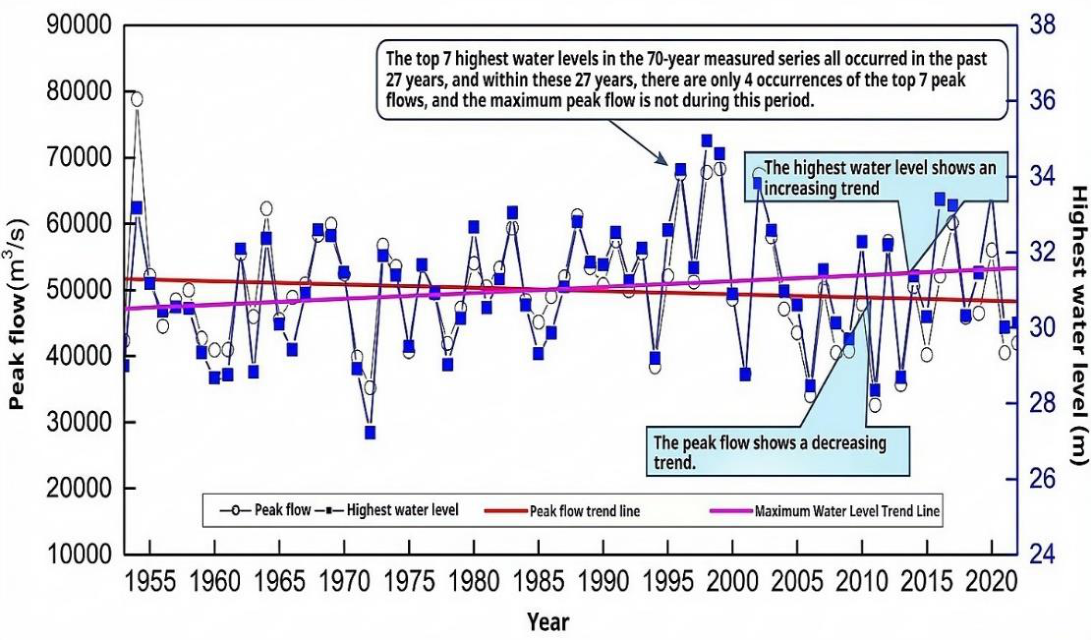
Following the Three Gorges Dam (TGD) and upstream cascade systems, the Middle Yangtze River has shown significant changes in stage-discharge relationships. At the monitoring stations from Yichang to Datong, the water levels for medium-range discharge increased compared to the pre-dam conditions (Figure 4). This change stems from sediment depletion (70% reduction downstream of the TGD) and channel incision exceeding 10 m, which increases hydraulic efficiency during moderate floods (Lai et al., 2017; Li et al., 2009). The 2020 basin-wide flood demonstrates this: while the peak discharge at Luoshan (56,000 m³/s) was 29% lower than the 1954 peak, the water stage nearly matched the historical maximum (Figure 5). This created a geomorphic "trap" (Loop A), allowing management interventions to have outsized impacts. Managerial fragmentation worsens physical vulnerability to hazards. Recent studies have shown the involvement of Loop B in these processes.
1. Uncoordinated Releases Creating Artificial Flood Peaks: The priorities of hydropower generation (high head) and flood control (pre-release and storage) frequently conflict. During the 2020 flood, analyses showed that uncoordinated pre-releases from upstream reservoirs coincided with natural rainfall-runoff peaks (Ge et al., 2023; Liu et al., 2024). This created a concentrated "pulse" of medium-level discharge (40,000–60,000 m³/s) down the incised channels. The hydraulic efficiency of the channel translated this discharge into record-breaking water stages at Luoshan and Hankou (Chai et al. 2020). This demonstrates the "Management Amplifier," where operations directly influence the hydrodynamic input to geomorphically sensitive systems.
2. Fragmented Governance Hindering Integrated Response: The Yangtze flood management system encompasses multiple provincial jurisdictions, including Hubei, Hunan, and Jiangxi, as well as sectoral agencies, such as those responsible for water resources, hydropower, and transport. In addition, it was overseen by the Yangtze River Water Resources Commission. Research has indicated that this fragmentation can result in sub-basin optimization, wherein the reservoir pre-release strategy of one province may intensify flood peaks for a downstream province without any binding mechanism for real-time basin-wide compromise (Lu et al., 2021; Wang et al., 2022). This institutional framework is indicative of the "conflicting priorities and fragmented governance" nodes in Figure 2.
3. Data and Modeling Gaps Impeding Coordination: Operational analyses of the 2020 and 2016 flood events underscore the absence of a cohesive, real-time data-sharing platform and a comprehensive cascade simulation model encompassing all major reservoirs, which constitutes a significant deficiency (Xu et al., 2022; Ramaswamy & Saleh, 2020). Consequently, decisions are frequently made with incomplete information regarding the real-time status and planned operations of other critical reservoirs, resulting in reactive, rather than proactive, system-optimal release patterns.
The Middle Yangtze case provides evidence for both feedback loops. Loop A is supported by geomorphic monitoring, whereas Loop B is shown through operational analyses documenting conflicts and information gaps causing uncoordinated releases. Cross-coupling between untimely releases (B) and incised channels (A), producing extreme stages, has been demonstrated in events such as the 2020 flood (Ge et al., 2023). However, studies using coupled quantitative models to simulate the feedback between institutional behavior, operations, and channel evolution over the past few decades remain limited. The 2020 event validated the model's premise that management actions interact with altered physical systems to generate new risks. Figure 3 shows a map of the Middle Yangtze River.
This system encompasses the most extensive integrated flood control infrastructure worldwide. Its primary components include the Three Gorges Reservoir (TGR), which possesses a flood-control capacity of 22.15 billion cubic meters; 42 flood-retention areas with a total retention capacity of 58.999 billion cubic meters, categorized as key (Jingjiang Flood Diversion Area), important (13 areas), general (14 areas), and reserved (15 areas); 707 floodplain dikes with a retention capacity of 17.43 billion cubic meters; and 70 large drainage pumping stations with a design drainage capacity of 6,530 cubic meters per second. These facilities have influenced the high-water-level flow dynamics in the middle and lower Yangtze River in China. An analysis of key control stations along the middle Yangtze River revealed significant alterations in the stage-discharge relationship. Data post-1998 indicated a leftward shift in rating curves at Zhicheng, Shashi, Jianli, Luoshan, Hankou, Jiujiang, Hukou, and Datong (Figure 4), suggesting elevated water levels for the given discharges in recent decades.
Figure 4.
Illustrates the temporal variations in the maximum stage–discharge relationship at the primary flood control stations along the Yangtze River, indicating a progressive increase in water level over time.
Figure 4.
Illustrates the temporal variations in the maximum stage–discharge relationship at the primary flood control stations along the Yangtze River, indicating a progressive increase in water level over time.
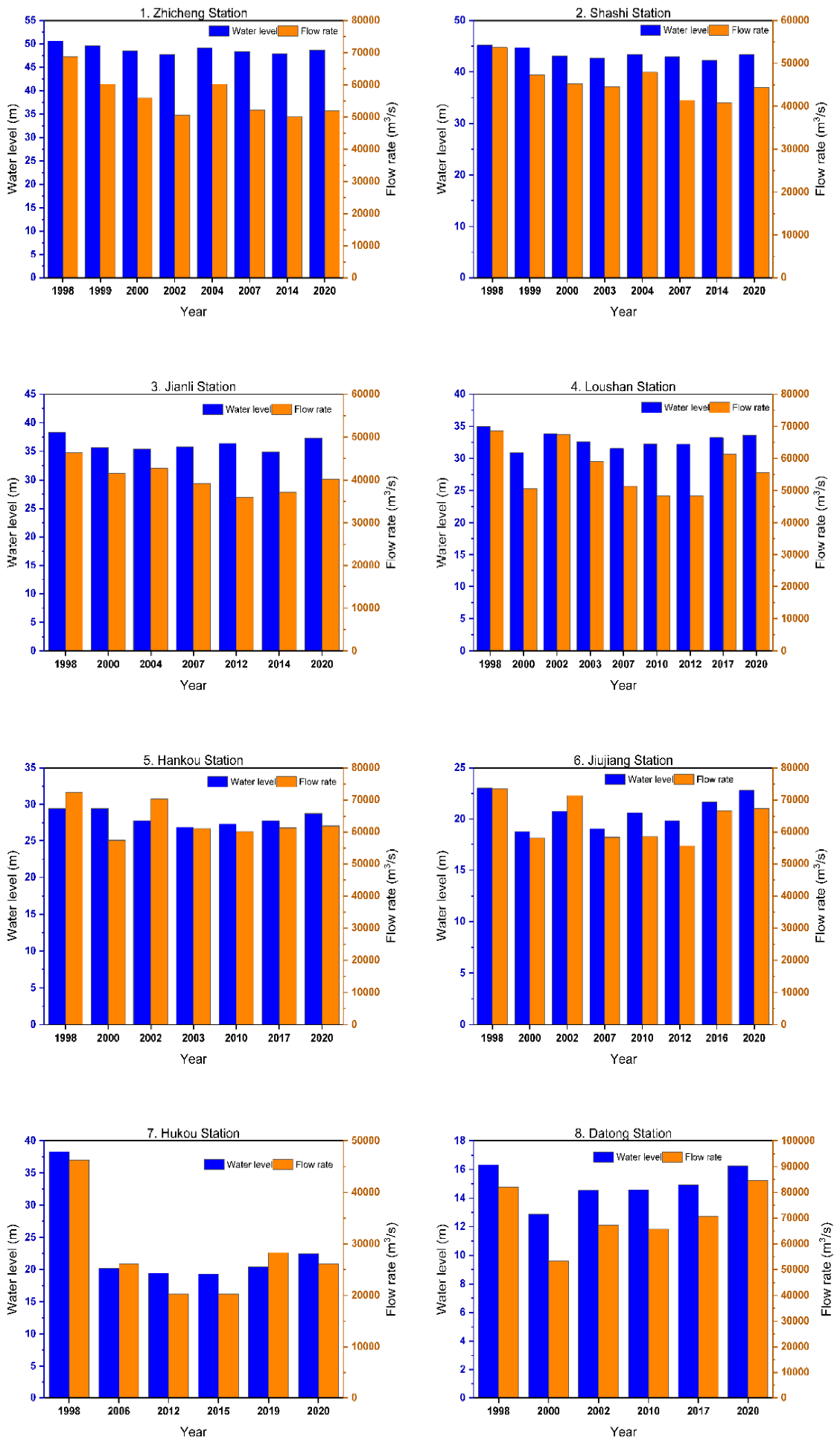
The spatial distribution of the stage-discharge shift (Figure 4) was non-uniform. The most pronounced leftward shift was observed at stations downstream of the Three Gorges Dam, specifically at Zhicheng and Shashi, which correspond to regions that experienced significant sediment depletion and channel incision (Li et al., 2009; Yang et al., 2022). This shift diminished further downstream from Jianli to Luoshan and Hankou and was influenced by channel widening, sediment input from the Han River, and interactions with the floodplain. This shift remained detectable at Datong station, indicating transformation at the basin scale. The minor shift in Jiujiang may be attributed to channel stabilization or the backwater effect of Poyang Lake. This spatial variation indicates that, while the MFHWL signal persists throughout, its intensity varies according to local geomorphic and anthropogenic factors. Although the peak discharge generally declined, the frequency of unusually high-water levels increased. Notably, the seven highest recorded water levels at Luoshan Station over the past 70 years occurred within the last 27 years. The 2020 flood exemplifies this pattern: Luoshan's peak discharge of 56,000 m³/s was 29% lower than the 78,800 m³/s recorded in 1954, although the water levels were comparable (Figure 5).
Figure 5.
Shows a comparative analysis of the peak discharge and corresponding water levels at the Luoshan Station during the 1954 and 2020 flood events.
Figure 5.
Shows a comparative analysis of the peak discharge and corresponding water levels at the Luoshan Station during the 1954 and 2020 flood events.
3.5. Global Patterns of MFHWL Preconditions
Although the Middle Yangtze River serves as a prime example of the fully coupled MFHWL phenomenon, a comprehensive review reveals that similar hydrogeomorphic and managerial conditions are emerging in engineered river basins worldwide. Evidence from 97 studies suggests that the drivers of Loops A and B reflect a common pattern of anthropogenic river transformation. Table 2 presents the major river basins with documented sediment depletion and channel incision downstream of dams, institutional fragmentation in multi-reservoir management, and alterations in stage-discharge relationships with flood-stage amplification. The strength of the evidence was assessed on the basis of the number of studies, methodology, and consistency. A 'high' rating indicates multiple quantitative studies, 'moderate' denotes clear evidence with constraints, and emerging ' refers to projected conditions or early indicators.
4. Discussion
4.1. The Emergent Nature of Systemic Flood Risk
The synthesized evidence substantiates that the MFHWL phenomenon cannot be understood solely from a hydrogeomorphic or managerial perspective. This represents an emergent risk resulting from the interplay between the altered channels and inadequate management systems. This highlights the shortcomings of traditional flood management approaches, which regard reservoirs as isolated control points and depend on historical rating curves (Fusinato et al., 2024; di Baldassarre et al., 2014; Hartmann et al., 2014; Slater & Villarini, 2018; Milly et al., 2008; Mondal & Patel, 2018; Slater & Villarini, 2017; Hartmann et al., 2019; Mondal & Eaton, 2018). The "safety-drag" effect emerges from this interaction, and the system exhibits behaviors imperceptible to its individual components. The Middle Yangtze River exemplifies a paradigmatic case because of its dam cascade, sediment depletion, and multijurisdictional governance. These conditions are increasingly observed in other major regulated basins globally, such as the Mekong (Kondolf et al., 2014; Lu et al., 2021), Ganges-Brahmaputra (Best, 2019), and Paraná (Agostinho et al., 2015) Basins. Although the complete MFHWL phenomenon has not been documented outside of the Yangtze River, these conditions suggest a potential systemic risk.
This conceptual model offers a diagnostic framework for assessing the vulnerabilities of other engineered systems. Future studies are crucial for validating the applicability of the model to these basins. The model is particularly applicable to large sediment-rich river basins with extensive damming and fragmented institutional arrangements. In basins lacking these conditions, the MFHWL dynamics may be diminished or replaced by alternative paradigms. The model emphasizes reinforcing feedback mechanisms that amplify systemic risk, consistent with evidence of hazard escalation, rather than successful mitigation. However, we recognize the potential for balancing feedback through human adaptation, including integrated operating rules and enhanced coordination. The relative strength of these feedbacks determines whether a basin faces escalating risk or improves resilience. Identifying the conditions for activating balanced feedback remains a critical research priority.
4.2. Implications for Flood Risk Management and Governance
The findings of this study have several important practical implications. First, flood hazard mapping and infrastructure design standards must be urgently updated. The assumption of a stationary stage-discharge relationship is no longer valid (Milly et al., 2008; Maranzoni et al., 2022; Wang et al., 2019; Zin et al., 2018). The design criteria for levees, bridges, and floodwalls must incorporate nonstationary hydraulic models that account for channel evolution and reservoir operation effects (Feng et al., 2020; Ferdous et al., 2020; Serra-Llobet et al., 2021, 2022).
Second, reservoir cascade governance requires a shift from isolated controls to adaptive and integrated management strategies. This demands institutional innovation beyond technical solutions. The key requirements include data-sharing platforms and joint forecasting centers for cascade reservoirs (Zhu et al., 2017; Chen et al., 2012; He et al., 2019; Lee & Huynh Nguyen, 2024; Liu et al., 2011; Liu et al., 2024; Serra-Llobet et al., 2016; Wu et al., 2016). Operating rules must optimize multiple system-wide objectives, including sediment management and downstream stage mitigation (Calamita et al., 2021; Gonzalez et al., 2021; Lu et al., 2021; Wheeler et al., 2021; Wheeler et al., 2018). Transboundary coordination bodies should be established to implement these rules (Grafton et al., 2013; Schoon, 2013; Thornton et al., 2017).
4.3. Limitations and Future Research Agenda
In alignment with the PRISMA 2020 statement, a search of research registers was not performed because of the absence of a centralized platform for the registration of study protocols in hydrogeomorphic systems and water resource management. Our search focused on peer-reviewed literature from major interdisciplinary databases to identify the primary evidence. This study has some limitations. The focus on peer-reviewed literature may have omitted relevant grey literature from government sources. The use of qualitative narrative synthesis does not provide quantitative estimates of driver strength across basins. Given these gaps, we proposed a transdisciplinary research agenda.
1. Quantitative Modeling of integrated socio-hydrological-geomorphic models to simulate feedback mechanisms within our framework, exploring future scenarios and evaluating operational policies.
2. Social Science Integration through political and institutional analyses to identify barriers to coordination and enabling conditions for collaborative governance in major river basins.
3. Remote sensing applications use high-resolution satellite data and artificial intelligence to monitor channel evolution and reservoir operations at the basin scale.
4. In global comparative studies, the MFHWL framework should be systematically applied to other engineered basins to discern common patterns and context-specific vulnerabilities.
Although this review identified consistent patterns, the varying methods used prevented a meta-analysis of the quantitative parameters. Future research should prioritize standardized data collection across basins to facilitate meta-analyses of the MFHWL risk thresholds. The conceptual model in Figure 2 synthesizes evidence into a causal framework for the emergence of MFHWL. While Loop A's hydrogeomorphic drivers are well documented for the Middle Yangtze and Loop B's managerial dysfunctions are detailed in governance studies, integrated operations require a comprehensive empirical study. Validation requires tracing the causal chain from reservoir operations, through hydrograph modifications, to geomorphic changes and institutional responses. The Middle Yangtze data environment offers an ideal opportunity for validation.
4.4. Limitations of the Evidence Base
The findings and models presented in this review are based on literature of varying methodological quality, which impacts the robustness of our conclusions. Among the 97 studies included, 85% were of high quality (MMAT ★★★–★★★★), including well-controlled observational studies, validated models, and long-term monitoring analyses. These studies primarily focused on hydrogeomorphic drivers, such as sediment starvation, channel incision, and altered stage–discharge relationships. The components of the MFHWL phenomenon are supported by strong evidence.
Research on the institutional, governance, and operational dimensions of asymmetrical management predominantly derives from qualitative case studies and policy analyses, which have been assigned medium-quality ratings (MMAT ★★–★★★). Although these studies offer valuable insights into the human aspects of systemic risk, their findings are often context specific. The feedback mechanisms within Loop B (Management Amplifier) of our model, while plausible, are supported by less robust evidence than those in Loop A (Geomorphic Trap). This suggests that the connections between fragmented governance and flood-stage outcomes are indicative, rather than definitive.
The geographical distribution of the evidence is uneven, with the Middle Yangtze Basin accounting for most high-resolution quantitative studies. Although this provides valuable insights into a paradigmatic case, it restricts the applicability of the MFHWL framework to other engineered basins, such as the Mekong, Paraná, and Mississippi basins, where institutional contexts and sediment dynamics differ significantly. The general applicability of the proposed feedback loops across various systems requires validation through comparative basin-specific studies that integrate both physical and governance analyses.
4.5. Insights from Systems Exhibiting Balancing Feedbacks
The conceptual model (Figure 2) incorporates reinforcing feedback loops that exacerbate systemic MFHWL risks and identifies potential intervention points. Case studies from managed basins have demonstrated that policy, operational, and physical interventions can establish balancing feedback to mitigate these loops (Pahl-Wostl, 2019; Serra-Llobet et al., 2022). These strategies correspond to the key nodes within the MFHWL framework.
The Rhine River's response to the catastrophic floods of 1993 and 1995 involved the implementation of the "Room for the River" program, which marked a transition from traditional flood defense mechanisms to integrated spatial planning (Disse & Engel, 2001; Middelkoop et al., 2004). This strategy, encompassing levee setbacks, floodplain restoration, and the establishment of water-retention areas, addresses the "Loss of Floodplain Connectivity" driver in Loop A. By restoring natural floodwater storage, it creates a balancing feedback mechanism that reduces flood stages, thereby mitigating the effects of channelized systems.
The management of the Colorado River serves as a paradigm for interventions that address both the institutional and physical determinants of water scarcity in the United States. The 2007 Interim Guidelines and Drought Contingency Plans established a comprehensive basin-wide framework for the coordinated operation of reservoirs during periods of water shortage, thereby representing a structural innovation aimed at reducing operational fragmentation (USBR 2007; Wheeler et al. 2018). Additionally, high-flow releases from the Glen Canyon Dam have been executed to restore downstream sediments and riparian habitats (Melis, 2011; Mueller et al., 2014), functioning as a managerial strategy to counteract sediment depletion and restore biophysical processes.
The establishment of the Murray-Darling Basin Authority in Australia, as mandated by the Water Act 2007, exemplifies a systemic institutional strategy aimed at addressing governance fragmentation through the implementation of an integrated Basin Plan (Connell & Grafton, 2011; Hart, 2015). By instituting sustainable diversion limits and allocating water for environmental flows across various states, this framework seeks to establish a balancing feedback Loop B. It harmonizes cross-jurisdictional management priorities with the basin’s long-term health, thereby mitigating the institutional factors that contribute to conflicting operational decisions and uncoordinated water release.
These interventions are partial and ongoing, rather than complete reversals of entrenched dynamics, and their efficacy remains a subject of debate (Poff, 2017). However, they provided evidence that the reinforcing loops in the model are not deterministic. They validated the key leverage points for MFHWL mitigation by reconnecting floodplains, managing sediments, coordinating operations, and strengthening governance as the foundation for effective management. These initiatives demonstrate the need to shift from static sectoral control to dynamic integrated governance, which builds resilience in engineered river basins.
5. Conclusions
This systematic review identifies the "Medium Flood, High Water Level" (MFHWL) phenomenon as a significant and escalating systemic risk in the Anthropocene, underscoring the critical shortcomings of conventional siloed river basin management approaches. Our analysis reveals that the MFHWL is not merely a hydrological anomaly, but an emergent characteristic of a complex, coupled human-water system. It is primarily driven by a feedback loop between a geomorphically altered river channel characterized by scour, incision, and disconnection from its floodplain due to sediment starvation and a fragmented management paradigm marked by asymmetrical operations across reservoir cascades.
The conceptual model developed in this study provides a crucial framework for diagnosing this paradox, illustrating how the interplay between physical processes and managerial decisions sustains the trajectory of increasing risk. The perceived safety afforded by upstream reservoirs induces a hazardous "safety-drag" effect, wherein uncoordinated releases are intensified through the more efficient incised channel, ultimately elevating water levels for medium-level discharges and compromising flood control objectives.
Addressing these challenges requires a fundamental paradigm shift in this field. Progress requires a decisive transition from static stationarity-based engineering to dynamic adaptive system governance. This transition entails (1) the prompt adoption of non-stationary flood hazard maps and design standards that reflect evolving stage-discharge relationships, (2) the development of integrated operating protocols for reservoir cascades that explicitly optimize downstream stage mitigation and sediment continuity alongside traditional goals, such as peak flow reduction and hydropower generation, and (3) the establishment of robust institutional mechanisms for real-time data sharing and transboundary coordination. Failure to address these interconnected feedback loops exacerbates this paradox, ensuring that the infrastructure intended to secure water resources becomes a principal source of vulnerability.
A significant limitation of this synthesis is the asymmetry of the evidence between the two feedback loops. The Flood Risk Amplifier (Loop A) is directly supported by hydrological time series, flood frequency analyses, and documented infrastructure responses across the Rhine, Colorado, and Murray-Darling basins. In contrast, the Management Amplifier (Loop B) is primarily inferred from governance case studies, expert interviews, and secondary sources; no study in our corpus directly quantified a complete 'adaptation → risk perception → further adaptation' feedback cycle. Therefore, we present Loop B as a hypothesis-generating framework rather than an empirically confirmed mechanism. Future research should prioritize longitudinal, mixed-methods designs capable of testing the causal validity and magnitude of the Management Amplifier relative to Loop A.
Author Contributions
Lungelo Thando Dlamini: Conceptualization, Methodology, Software, Writing – Original Draft Preparation, Writing – Review and Editing. Changwen Li: Resources, Supervision, Project Administration, Funding Acquisition. Xueren Wang: Visualization. Wenhui Li: Validation. Guanghui Wu: Formal Analysis. Chenxi Du: Project Administration. Jeba Fariha Islam: Formal analysis.
Funding
This research was supported by the following funding agencies and institutions: (1) Open Research Fund of the National Engineering Research Center of Water Resources Efficient Utilization and Engineering Safety: Study on the risk transfer mechanism of flood regulation for giant water engineering groups (GJGCZX-JJ-202422). (2) Key Science and Technology Project of the Ministry of Water Resources: Study on Collaborative Response Strategies for Extreme Flood Disasters in Watersheds Under Changing Environments (SKS-2022003). (6) This work was Supported by the Open Research Fund of Hubei Key Laboratory of Construction and Management in Hydropower Engineering, China Three Gorges University (2024KSD20). (7) China Three Gorges University Science Fund: Research and Development of Smart Emergency Flood Control and Risk Avoidance Technology (2024KTZB04).
Data Availability Statement
All data, models, or code that support the findings of this study are available from the corresponding author upon reasonable request.
Acknowledgments
The authors gratefully acknowledge the support of funding agencies and institutions, which made this research possible.
Conflicts of Interest
The authors declare that the manuscript is original. The authors declare that they have no conflicts of interest.
References
- Adams, L. E., O’Rear, T. A., Lund, J. R., Moyle, P. B., Quiñones, R. M., & Herman, J. D. (2017). Environmental hedging: A theory and method for reconciling reservoir operations for downstream ecology and water supply. *Water Resources Research, 53*(9), 7816–7831. [CrossRef]
- Agostinho, A. A., Gomes, L. C., Santos, N. C. L., Ortega, J. C. G., & Pelicice, F. M. (2015). Fish assemblages in Neotropical reservoirs: Colonization patterns, impacts and management. *Fisheries Research, 173*, 26–36. [CrossRef]
- Ahmadianfar, I., Bozorg-Haddad, O., & Chu, X. (2019). Optimizing Multiple Linear Rules for Multi-Reservoir Hydropower Systems Using an Optimization Method with an Adaptation Strategy. *Water Resources Management, 33*(12), 4265–4286. [CrossRef]
- Akamani, K., & Wilson, P. I. (2011). Toward the adaptive governance of transboundary water resources. *Conservation Letters, 4*(6), 409–416. [CrossRef]
- Ali, K., Bajracharya, R., & Koirala, H. (2016). A Review of Flood Risk Assessment. *International Journal of Environment, Agriculture and Biotechnology, 1*, 1065–1077. [CrossRef]
- Bennett, K. E., Middleton, R. S., Xu, C., Solander, K., Mcdowell, N. G., Bohn, T. J., & Vivoni, E. (2018). Climate-driven disturbances in the San Juan River sub-basin of the Colorado River. *Hydrology and Earth System Sciences, 22*(1), 709–725. [CrossRef]
- Best, J. (2019). Anthropogenic stresses on the world’s big rivers. *Nature Geoscience, 12*(1), 7–21. [CrossRef]
- Bilskie, M. V., Hagen, S. C., Atkinson, J., Zhao, H., Cobell, Z., & Resio, D. (2021). Enhancing Flood Hazard Assessments in Coastal Louisiana Through Coupled Hydrologic and Surge Processes. *Frontiers in Water, 3*. [CrossRef]
- Blöschl, G., Hall, J., Viglione, A., Perdigão, R. A. P., Parajka, J., Merz, B., Lun, D., Arheimer, B., Aronica, G. T., Bilibashi, A., Boháč, M., Bonacci, O., Borga, M., Čanjevac, I., Castellarin, A., Chirico, G. B., Claps, P., Frolova, N., Ganora, D., … Živković, N. (2019). Changing climate both increases and decreases European river floods. *Nature, 573*(7772), 108–111. [CrossRef]
- Brandt, S. A. (2000). Classification of geomorphological effects downstream of dams. *CATENA, 40*(4), 375–401. [CrossRef]
- Brenna, A., Surian, N., & Mao, L. (2020). Response of A Gravel-Bed River To Dam Closure: Insights From Sediment Transport Processes And Channel Morphodynamics. *Earth Surface Processes and Landforms, 45*(3), 756–770. [CrossRef]
- Calamita, E., Vanzo, D., Wehrli, B., & Schmid, M. (2021). Lake Modeling Reveals Management Opportunities for Improving Water Quality Downstream of Transboundary Tropical Dams. *Water Resources Research, 57*(4). [CrossRef]
- Call, B. C., Schmidt, J. C., Belmont, P., & Wilcock, P. R. (2017). Changes in floodplain inundation under nonstationary hydrology for an adjustable, alluvial river channel. *Water Resources Research, 53*(5), 3811–3834. [CrossRef]
- Connell, D., & Grafton, R. Q. (2011). Water reform in the Murray-Darling Basin. Water Resources Research, 47(12). [CrossRef]
- Chai, Y., Yang, Y., Deng, J., Sun, Z., Li, Y., & Zhu, L. (2020). Evolution characteristics and drivers of the water level at an identical discharge in the Jingjiang reaches of the Yangtze River. *Journal of Geographical Sciences, 30*(10), 1633–1648. [CrossRef]
- Chai, Y., Zhu, L., Yang, Y., Li, Y., Sun, Z., & Deng, J. (2020). Evolution characteristics and drivers of the water level at an identical discharge in the Jingjiang reaches of the Yangtze River. *Journal of Geographical Sciences, 30*(10), 1633–1648. [CrossRef]
- Chang, J., Lu, C., Zhou, Y., Deng, C., Li, J., Zhu, X., & Lu, D. (2010). The hydrological effect between Jingjiang River and Dongting Lake during the initial period of Three Gorges Project operation. *Journal of Geographical Sciences, 20*(5), 771–786. [CrossRef]
- Che, D., & Mays, L. W. (2015). Development of an Optimization/Simulation Model for Real-Time Flood-Control Operation of River-Reservoirs Systems. *Water Resources Management, 29*(11), 3987–4005. [CrossRef]
- Chen, J., Liu, P., Guo, S., Li, Y., & Zhou, Y. (2012). Joint Operation and Dynamic Control of Flood Limiting Water Levels for Cascade Reservoirs. *Water Resources Management, 27*(3), 749–763. [CrossRef]
- Chen, J., Zhong, P. A., Zhang, Y., Navar, D., & Yeh, W. W. G. (2017). A decomposition-integration risk analysis method for real-time operation of a complex flood control system. *Water Resources Research, 53*(3), 2490–2506. [CrossRef]
- Cheng, H., Wang, T., & Yang, D. (2024). Quantifying the Regulation Capacity of the Three Gorges Reservoir on Extreme Hydrological Events and Its Impact on Flow Regime in a Changing Climate. *Water Resources Research, 60*(6). [CrossRef]
- Dai, X., Yang, G., Yu, Z., Xu, C., & Wan, R. (2021). Investigation of inner-basin variation: Impact of large reservoirs on water regimes of downstream water bodies. *Hydrological Processes, 35*(5). [CrossRef]
- Dai, Z., & Liu, J. T. (2013). Impacts of large dams on downstream fluvial sedimentation: An example of the Three Gorges Dam (TGD) on the Changjiang (Yangtze River). *Journal of Hydrology, 480*, 10–18. [CrossRef]
- Davidson, S. L., & Eaton, B. C. (2018). Beyond Regime: A Stochastic Model of Floods, Bank Erosion, and Channel Migration. *Water Resources Research, 54*(9), 6282–6298. [CrossRef]
- De Stefano, L., Dinar, S., Wolf, A. T., Duncan, J., Stahl, K., & Strzepek, K. M. (2012). Climate change and the institutional resilience of international river basins. *Journal of Peace Research, 49*(1), 193–209. [CrossRef]
- Diao, Y., Ma, H., Wang, H., Wang, J., Li, S., Li, X., Pan, J., & Qiu, Q. (2022). Optimal Flood-Control Operation of Cascade Reservoirs Using an Improved Particle Swarm Optimization Algorithm. *Water, 14*(8). [CrossRef]
- di Baldassarre, G., Kooy, M., Kemerink, J. S., & Brandimarte, L. (2013). Towards understanding the dynamic behaviour of floodplains as human-water systems. *Hydrology and Earth System Sciences, 17*(8), 3235–3244. [CrossRef]
- di Baldassarre, G., Kemerink, J. S., Kooy, M., & Brandimarte, L. (2014). Floods and societies: the spatial distribution of water-related disaster risk and its dynamics. *Wiley Interdisciplinary Reviews: Water, 1*(2), 133–139. [CrossRef]
- di Baldassarre, G., Kreibich, H., Vorogushyn, S., Aerts, J., Arnbjerg-Nielsen, K., Barendrecht, M., Bates, P., Borga, M., Botzen, W., Bubeck, P., de Marchi, B., Llasat, C., Mazzoleni, M., Molinari, D., Mondino, E., Mård, J., Petrucci, O., Scolobig, A., Viglione, A., & Ward, P. J. (2018). Hess Opinions: An interdisciplinary research agenda to explore the unintended consequences of structural flood protection. *Hydrology and Earth System Sciences, 22*(11), 5629–5637. [CrossRef]
- Disse, M., & Engel, H. (2001). Flood Events in the Rhine Basin: Genesis, Influences and Mitigation. Natural Hazards, 23(2–3), 271–290. [CrossRef]
- Feng, Y., Chen, C., Dong, F., Mou, S., Shi, P., & Qu, S. (2020). Nonstationary flood coincidence risk analysis using time-varying copula functions. *Scientific Reports, 10*(1). [CrossRef]
- Ferdous, M. R., Brandimarte, L., Di Baldassarre, G., & Wesselink, A. (2020). The interplay between structural flood protection, population density, and flood mortality along the Jamuna River, Bangladesh. *Regional Environmental Change, 20*(1). [CrossRef]
- Formetta, G., & Feyen, L. (2019). Empirical evidence of declining global vulnerability to climate-related hazards. *Global Environmental Change, 57*, 101920. [CrossRef]
- Fuchs, S., Thaler, T., Maris, F., Karagiorgos, K., Paparrizos, S., & Kitikidou, K. (2017). Flood risk perception and adaptation capacity: a contribution to the socio-hydrology debate. *Hydrology and Earth System Sciences, 21*(6), 3183–3198. [CrossRef]
- Fusinato, E., Han, S., Kobiyama, M., & de Brito, M. M. (2024). Safe development paradox: evidence and methodological insights from a systematic review. *Natural Hazards, 120*(15), 13693–13714. [CrossRef]
- Gaeuman, D., Schmidt, J., & Wilcock, P. (2005). Complex channel responses to changes in stream flow and sediment supply on the lower Duchesne River, Utah. *Geomorphology, 64*, 185–206. [CrossRef]
- Garrick, D. E., De Stefano, L., Schlager, E., & Villamayor-Tomas, S. (2018). Managing the Cascading Risks of Droughts: Institutional Adaptation in Transboundary River Basins. *Earth’s Future, 6*(6), 809–827. [CrossRef]
- Ge, H., & Zhu, L. (2023). Extreme Flood Levels during the Operation of Cascade Reservoirs: A Case Study of the Lower Yangtze River in 2020. *Water, 15*(5). [CrossRef]
- Gebrehiwot, S. G., Bishop, K., Inogwabini, B., Bewket, W., Seleshi, Y., & Ellison, D. (2018). The Nile Basin waters and the West African rainforest: Rethinking the boundaries. *WIREs Water, 6*(1). [CrossRef]
- Gilbertson, L. M., Busnaina, A. A., Eckelman, M. J., Zimmerman, J. B., & Isaacs, J. A. (2014). Life cycle impacts and benefits of a carbon nanotube-enabled chemical gas sensor. *Environmental Science & Technology, 48*(19), 11360–11368. [CrossRef]
- Giuliani, M., Lamontagne, J. R., Reed, P. M., & Castelletti, A. (2021). A State-of-the-Art Review of Optimal Reservoir Control for Managing Conflicting Demands in a Changing World. *Water Resources Research, 57*(12). [CrossRef]
- Gonzalez, J. M., Obuobie, E., Mul, M., Sheffield, J., Pettinotti, L., Gebrechorkos, S. H., Smith, D. M., Bottacin-Busolin, A., Harou, J. J., Matrosov, E. S., & Dalton, J. (2021). Quantifying Cooperation Benefits for New Dams in Transboundary Water Systems Without Formal Operating Rules. *Frontiers in Environmental Science, 9*. [CrossRef]
- Gumiero, B., Mant, J., Hein, T., Elso, J., & Boz, B. (2013). Linking the restoration of rivers and riparian zones/wetlands in Europe: Sharing knowledge through case studies. Ecological Engineering, 56, 36–50. [CrossRef]
- Grafton, R. Q., Pittock, J., Davis, R., Williams, J., Fu, G., Warburton, M., Udall, B., Mckenzie, R., Yu, X., Che, N., Connell, D., Jiang, Q., Kompas, T., Lynch, A., Norris, R., Possingham, H., & Quiggin, J. (2013). Global insights into water resources, climate change and governance. *Nature Climate Change, 3*(4), 315–321. [CrossRef]
- Graf, W. L. (2006). Downstream hydrologic and geomorphic effects of large dams on American rivers. *Geomorphology, 79*(3), 336–360. [CrossRef]
- Grumbine, R. E. (2017). Using transboundary environmental security to manage the Mekong River: China and South-East Asian Countries. *International Journal of Water Resources Development, 34*(5), 792–811. [CrossRef]
- Hanazaki, R., Yamazaki, D., & Yoshimura, K. (2022). Development of a Reservoir Flood Control Scheme for Global Flood Models. *Journal of Advances in Modeling Earth Systems, 14*(3). [CrossRef]
- Hart, B. T. (2015). The Australian Murray–Darling Basin Plan: challenges in its implementation (part 1). International Journal of Water Resources Development, 32(6), 819–834. [CrossRef]
- Hartmann, T., Slavíková, L., & Mccarthy, S. (2019). Nature-Based Solutions in Flood Risk Management (pp. 3–8). Springer. [CrossRef]
- He, S., Guo, S., Zhou, Y., Liu, D., Chen, K., & Yang, G. (2019). Optimizing Operation Rules of Cascade Reservoirs for Adapting Climate Change. *Water Resources Management, 34*(1), 101–120. [CrossRef]
- He, Y., Liu, J., Zhou, Y., Chen, H., Xiong, L., Zhu, D., Xu, C.-Y., & Guo, S. (2024). Boosting hydropower generation of mixed reservoirs for reducing carbon emissions by using a simulation–optimization framework. *Hydrology Research, 55*(2), 144–160. [CrossRef]
- Hensengerth, O. (2024). Inclusive governance of hydropower on shared rivers? Toward an international legal geography of the Lower Mekong basin. *Frontiers in Climate, 6*. [CrossRef]
- Hirsch, P. (2006). Water Governance Reform and Catchment Management in the Mekong Region. *The Journal of Environment & Development, 15*(2), 184–201. [CrossRef]
- Hong, Q. N., Fàbregues, S., Bartlett, G., Boardman, F., Cargo, M., Dagenais, P., Gagnon, M.-P., Griffiths, F., Nicolau, B., O’Cathain, A., Rousseau, M.-C., Vedel, I., & Pluye, P. (2018). The Mixed Methods Appraisal Tool (MMAT) version 2018 for information professionals and researchers. *Education for Information, 34*(4), 285–291. [CrossRef]
- Hu, B., Yang, Z., Wang, H., Sun, X., Bi, N., & Li, G. (2009). Sedimentation in the Three Gorges Dam and the future trend of Changjiang (Yangtze River) sediment flux to the sea. *Hydrology and Earth System Sciences, 13*(11), 2253–2264. [CrossRef]
- Hu, Y., Li, D., Zhou, J., Wang, C., Deng, J., Lu, X., & Li, Y. (2024). Shifted Flood and Ecology Regimes Due to Channel Bar Greening and Increased Flow Resistance in a Large Dammed River. *Geophysical Research Letters, 51*(20). [CrossRef]
- Hu, Y., Yue, Y., Li, D., Li, Y., Deng, J., Chai, Y., & Zhou, J. (2022). Mechanisms Controlling Water-Level Variations in the Middle Yangtze River Following the Operation of the Three Gorges Dam. *Water Resources Research, 58*(10). [CrossRef]
- Huang, L., Li, X., Fang, H., Yin, D., Si, Y., Wei, J., Liu, J., Hu, X., & Zhang, L. (2019). Balancing social, economic and ecological benefits of reservoir operation during the flood season: A case study of the Three Gorges Project, China. *Journal of Hydrology, 572*, 422–434. [CrossRef]
- Huang, S., Xia, J., Wang, Y., Wang, W., Zeng, S., She, D., & Wang, G. (2022). Coupling Machine Learning into Hydrodynamic Models to Improve River Modeling with Complex Boundary Conditions. *Water Resources Research, 58*(10). [CrossRef]
- Jacobson, R. B., & Galat, D. L. (2006). Flow and form in rehabilitation of large-river ecosystems: An example from the Lower Missouri River. Geomorphology, 77(3–4), 249–269. [CrossRef]
- Jiao, D., Wang, D., & Lv, H. (2020). Effects of human activities on hydrological drought patterns in the Yangtze River Basin, China. *Natural Hazards, 104*(1), 1111–1124. [CrossRef]
- Jing, Z., Zhang, R., Bao, H., & Zhang, S. (2022). Joint flood control scheduling strategy of large cascade reservoirs: A case study of the cascade reservoirs in the upper reaches of the Yangtze River in China. *Journal of Flood Risk Management, 15*(3). [CrossRef]
- Karim, F., Arthington, A. H., Pearson, R. G., Kinsey-Henderson, A., & Wallace, J. (2011). Modelling wetland connectivity during overbank flooding in a tropical floodplain in north Queensland, Australia. *Hydrological Processes, 26*(18), 2710–2723. [CrossRef]
- Kellner, E. (2021). The controversial debate on the role of water reservoirs in reducing water scarcity. *WIREs Water, 8*(3). [CrossRef]
- Kondolf, G. M., Gao, Y., Annandale, G. W., Morris, G. L., Jiang, E., Zhang, J., Cao, Y., Carling, P., Fu, K., Guo, Q., Hotchkiss, R., Peteuil, C., Sumi, T., Wang, H., Wang, Z., Wei, Z., Wu, B., Wu, C., & Yang, C. T. (2014). Sustainable sediment management in reservoirs and regulated rivers: Experiences from five continents. *Earth’s Future, 2*(5), 256–280. [CrossRef]
- Khan, H. M., & Rahman, M. M. (2022). Transboundary River Management of the Ganges–Brahmaputra–Meghna (GBM) Delta: Environmental Challenges and Strategies (pp. 495–530). Springer. [CrossRef]
- Lai, X., Liang, Q., Huang, Q., Jiang, J., & Lu, X. X. (2016). Numerical evaluation of flow regime changes induced by the Three Gorges Dam in the Middle Yangtze. *Hydrology Research, 47*(S1), 149–160. [CrossRef]
- Lan, L., Xu, Y., Mei, Y., Ren, Y., Tian, Y., & Zhang, X. (2022). Optimized flood control for the Three Gorges Reservoir considering evolving flood propagation trends in the Jingjiang Reach of the Yangtze River. *Frontiers in Environmental Science, 10*. [CrossRef]
- Larkin, Z. T., Tooth, S., Carthey, A. J. R., Fryirs, K. A., & Ralph, T. J. (2020). Identifying threshold responses of Australian dryland rivers to future hydroclimatic change. *Scientific Reports, 10*(1). [CrossRef]
- Lee, F.-Z., & Huynh Nguyen, N. L. (2024). Application of artificial countermeasures to enhance desilting efficiency in a reservoir under normal and extreme events. *Journal of Water and Climate Change, 15*(6), 2648–2664. [CrossRef]
- Lee, F.-Z., Sumi, T., & Lai, J.-S. (2022). Reservoir Sediment Management and Downstream River Impacts for Sustainable Water Resources—Case Study of Shihmen Reservoir. *Water, 14*(3), 479. [CrossRef]
- Lehner, B., Reidy Liermann, C., Revenga, C., Vörösmarty, C., Fekete, B., Crouzet, P., Doell, P., Endejan, M., Frenken, K., Magome, J., Nilsson, C., Robertson, J., Rödel, R., Sindorf, N., & Wisser, D. (2011). High-resolution mapping of the world’s reservoirs and dams for sustainable river-flow management. *Frontiers in Ecology and the Environment, 9*(9), 494–502. [CrossRef]
- Li, B., Yang, G., Wan, R., Wang, Y., Xu, C., Wang, D., & Mi, C. (2022). Unraveling the Importance of the Yangtze River and Local Catchment on Water Level Variations of Poyang Lake (China) After the Three Gorges Dam Operation: Insights from Random Forest Modeling. *Frontiers in Earth Science, 10*. [CrossRef]
- Li, D., Chen, S., Zhen, Z., Bu, S., & Li, Y. (2021). Coupling a 1D-local inertia 2D hydraulic model for flood dispatching simulation in a floodplain under joint control of multiple gates. *Natural Hazards, 109*(2), 1801–1820. [CrossRef]
- Li, R., Xiong, L., Zha, X., Xiong, B., Liu, H., Chen, J., Zeng, L., & Li, W. (2022). Impacts of climate and reservoirs on the downstream design flood hydrograph: a case study of Yichang Station. *Natural Hazards, 113*(3), 1803–1831. [CrossRef]
- Li, Y., Liu, Y., Sun, Z., & Deng, J. (2009). Channel Degradation Downstream from the Three Gorges Project and Its Impacts on Flood Level. *Journal of Hydraulic Engineering, 135*(9), 718–728. [CrossRef]
- Li, Y., Yang, G., Li, B., Wan, R., Duan, W., & He, Z. (2016). Quantifying the effects of channel change on the discharge diversion of Jingjiang Three Outlets after the operation of the Three Gorges Dam. *Hydrology Research, 47*(S1), 161–174. [CrossRef]
- Liao, S., Zhang, X., Ji, R., Wang, C., Wang, Z., Chen, N., & Wang, W. (2024). Balancing Flood Control and Economic Development in Flood Detention Areas of the Yangtze River Basin. *ISPRS International Journal of Geo-Information, 13*(4), 122. [CrossRef]
- Liu, J., Dietz, T., Carpenter, S. R., Folke, C., Alberti, M., Redman, C. L., Schneider, S. H., Ostrom, E., Pell, A. N., Lubchenco, J., Taylor, W. W., Ouyang, Z., Deadman, P., Kratz, T., & Provencher, W. (2007). Coupled human and natural systems. *Ambio, 36*(8), 639–649. [CrossRef]
- Liu, P., Xu, X., Guo, S., & Chen, J. (2011). Derivation of Aggregation-Based Joint Operating Rule Curves for Cascade Hydropower Reservoirs. *Water Resources Management, 25*(13), 3177–3200. [CrossRef]
- Liu, Y., Hou, G., Wang, B., Xu, Y., Tian, R., Wang, T., & Qin, H. (2024). Many-Objective Hierarchical Pre-Release Flood Operation Rule Considering Forecast Uncertainty. *Water, 16*(5), 785. [CrossRef]
- Lobera, G., Batalla, R. J., López-Tarazón, J. A., Vericat, D., & Muñoz, I. (2016). Effects of flow regulation on river bed dynamics and invertebrate communities in a Mediterranean river. *Hydrobiologia, 784*(1), 283–304. [CrossRef]
- Lu, Y., Patil, R., Liu, D., Tian, F., Yu, D. J., Guo, L., Sivapalan, M., Borzì, I., Wei, J., & Wei, Y. (2021). Socio-hydrologic modeling of the dynamics of cooperation in the transboundary Lancang–Mekong River. *Hydrology and Earth System Sciences, 25*(4), 1883–1903. [CrossRef]
- Lyu, Y., Zheng, S., Tan, G., Shu, C., & Fagherazzi, S. (2020). Enhanced hysteresis of suspended sediment transport in response to upstream damming: An example of the middle Yangtze River downstream of the Three Gorges Dam. *Earth Surface Processes and Landforms, 45*(8), 1846–1859. [CrossRef]
- Ma, H., Nittrouer, J. A., Fu, X., Parker, G., Zhang, Y., Wang, Y., Wang, Y., Lamb, M. P., Cisneros, J., Best, J., Parsons, D. R., & Wu, B. (2022). Amplification of downstream flood stage due to damming of fine-grained rivers. *Nature Communications, 13*(1). [CrossRef]
- Maden, M., & Kotas, E. (2016). Evidence Based Library and Information Practice (Vol. 11, Issue 2). [CrossRef]
- Mandarino, A., Luino, F., & Faccini, F. (2021). Flood-induced ground effects and flood-water dynamics for hydro-geomorphic hazard assessment: the 21–22 October 2019 extreme flood along the lower Orba River (Alessandria, NW Italy). *Journal of Maps, 17*(3), 136–151. [CrossRef]
- Maranzoni, A., Rizzo, C., & D’Oria, M. (2022). Quantitative flood hazard assessment methods: A review. *Journal of Flood Risk Management, 16*(1). [CrossRef]
- Marren, P. M., Stewardson, M. J., Grove, J. R., & Webb, J. A. (2014). The Potential for Dams to Impact Lowland Meandering River Floodplain Geomorphology. *The Scientific World Journal, 2014*(6), 1–24. [CrossRef]
- Mateo, C. M., Hanasaki, N., Komori, D., Tanaka, K., Kiguchi, M., Champathong, A., Sukhapunnaphan, T., Yamazaki, D., & Oki, T. (2014). Assessing the impacts of reservoir operation to floodplain inundation by combining hydrological, reservoir management, and hydrodynamic models. *Water Resources Research, 50*(9), 7245–7266. [CrossRef]
- Merz, B., Aerts, J., Arnbjerg-Nielsen, K., Baldi, M., Becker, A., Bichet, A., Blöschl, G., Bouwer, L. M., Brauer, A., Cioffi, F., Delgado, J. M., Gocht, M., Guzzetti, F., Harrigan, S., Hirschboeck, K., Kilsby, C., Kron, W., Kwon, H.-H., Lall, U., … Nied, M. (2014). Floods and climate: emerging perspectives for flood risk assessment and management. *Natural Hazards and Earth System Sciences, 14*(7), 1921–1942. [CrossRef]
- Michaelis, T., Brandimarte, L., & Mazzoleni, M. (2020). Capturing flood-risk dynamics with a coupled agent-based and hydraulic modelling framework. *Hydrological Sciences Journal, 65*(9), 1458–1473. [CrossRef]
- Melis, T. S. (2011). Effects of three high-flow experiments on the Colorado River ecosystem downstream from Glen Canyon Dam, Arizona. Us Geological Survey. [CrossRef]
- Melis, T. S., Walters, C. J., & Korman, J. (2015). Surprise and Opportunity for Learning in Grand Canyon: the Glen Canyon Dam Adaptive Management Program. Ecology and Society, 20(3). [CrossRef]
- Middelkoop, H., Van Asselt, M. B. A., Van’ T Klooster, S. A., Van Deursen, W. P. A., Kwadijk, J. C. J., & Buiteveld, H. (2004). Perspectives on flood management in the Rhine and Meuse rivers. River Research and Applications, 20(3), 327–342. [CrossRef]
- Milly, P. C. D., Betancourt, J., Falkenmark, M., Hirsch, R. M., Kundzewicz, Z. W., Lettenmaier, D. P., & Stouffer, R. J. (2008). Stationarity Is Dead: Whither Water Management? *Science, 319*(5863), 573–574. [CrossRef]
- Mirumachi, N. (2015). *Transboundary Water Politics in the Developing World*. Routledge. [CrossRef]
- Mondal, S., & Patel, P. P. (2018). Examining the utility of river restoration approaches for flood mitigation and channel stability enhancement: a recent review. *Environmental Earth Sciences, 77*(5). [CrossRef]
- Moridi, A., & Yazdi, J. (2017). Optimal Allocation of Flood Control Capacity for Multi-Reservoir Systems Using Multi-Objective Optimization Approach. *Water Resources Management, 31*(14), 4521–4538. [CrossRef]
- Mueller, E. R., Grams, P. E., Schmidt, J. C., Hazel, J. E., Kaplinski, M., Alexander, J. A., & Kohl, K. (2014). Monitoring and research to describe geomorphic effects of the 2011 controlled flood on the Green River in the Canyon of Lodore, Dinosaur National Monument, Colorado and Utah (Scientific Investigations Report). [CrossRef]
- Nelson, A., & Dubé, K. (2015). Channel response to an extreme flood and sediment pulse in a mixed bedrock and gravel-bed river. *Earth Surface Processes and Landforms, 41*(2), 178–195. [CrossRef]
- Nichols, A. L., & Viers, J. H. (2017). Not all breaks are equal: Variable hydrologic and geomorphic responses to intentional levee breaches along the lower Cosumnes River, California. *River Research and Applications, 33*(7), 1143–1155. [CrossRef]
- Ollier, C. (2012). Tropical rivers and geomorphology. Finisterra, 20(40). [CrossRef]
- Opperman, J. J., Luster, R., Mckenney, B. A., Roberts, M., Meadows, A. W., & Wrona, A. (2010). Ecologically Functional Floodplains: Connectivity, Flow Regime, and Scale. *Journal of the American Water Resources Association, 46*(2), 211–226. [CrossRef]
- Page, M. J., McKenzie, J. E., Bossuyt, P. M., Boutron, I., Hoffmann, T. C., Mulrow, C. D., Shamseer, L., Tetzlaff, J. M., Akl, E. A., Brennan, S. E., Chou, R., Glanville, J., Grimshaw, J. M., Hróbjartsson, A., Lalu, M. M., Li, T., Loder, E. W., Mayo-Wilson, E., McDonald, S., … Moher, D. (2021). The PRISMA 2020 statement: An updated guideline for reporting systematic reviews. *Journal of Clinical Epidemiology, 134*, 178–189. [CrossRef]
- Pahl-Wostl, C. (2019). Governance of the water-energy-food security nexus: A multi-level coordination challenge. *Environmental Science & Policy, 92*, 356–367. [CrossRef]
- Pinter, N., & Heine, R. (2005). Hydrodynamic and Morphodynamic Response to River Engineering Documented by Fixed-Discharge Analysis, Lower Missouri River, USA. *Journal of Hydrology, 302*, 70–91. [CrossRef]
- Pinter, N., Ickes, B. S., Wlosinski, J. H., & van der Ploeg, R. R. (2006). Trends in flood stages: Contrasting results from the Mississippi and Rhine River systems. *Journal of Hydrology, 331*(3–4), 554–566. [CrossRef]
- Poff, N. L. (2017). Beyond the natural flow regime? Broadening the hydro-ecological foundation to meet environmental flows challenges in a non-stationary world. Freshwater Biology, 63(8), 1011–1021. [CrossRef]
- Post, R., Quintero, F., & Krajewski, W. F. (2024). On the Optimized Management of Activated Distributed Storage Systems: A Novel Approach to Flood Mitigation. *Water, 16*(11), 1476. [CrossRef]
- Qi, W., Liu, J., Wang, L., Chen, D., Zheng, Y., Feng, L., Shi, H., & Yang, H. (2022). Economic growth dominates rising potential flood risk in the Yangtze River and benefits of raising dikes from 1991 to 2015. *Environmental Research Letters, 17*(3), 034046. [CrossRef]
- Qin, Y., Wang, F., Zhang, S., Tu, Y., Chen, C., & Yang, Y. (2024). Impacts of cascade hydropower development on aquatic environment in middle and lower reaches of Jinsha River, China: a review. *Environmental Science and Pollution Research, 31*(42), 54363–54380. [CrossRef]
- Qiu, J., Zhang, X., Yang, Q., Huang, M., Malek, K., & Adam, J. C. (2019). Implications of water management representations for watershed hydrologic modeling in the Yakima River basin. *Hydrology and Earth System Sciences, 23*(1), 35–49. [CrossRef]
- Rajah, J. K., Tang, C., Atkins, A. E. P., Bax, K., Langarudi, S. P., Wilkerson, B., & Fernald, A. G. (2024). Understanding Hydrologic, Human, and Climate System Feedback Loops: Results of a Participatory Modeling Workshop. *Water, 16*(3), 396. [CrossRef]
- Ramaswamy, V., & Saleh, F. (2020). Ensemble Based Forecasting and Optimization Framework to Optimize Releases from Water Supply Reservoirs for Flood Control. *Water Resources Management, 34*(3), 989–1004. [CrossRef]
- Ren, M., He, X., Kan, G., Wang, F., Zhang, H., Li, H., Cao, D., Wang, H., Sun, D., Jiang, X., Wang, G., & Zhang, Z. (2017). A comparison of flood control standards for reservoir engineering for different countries. *Water, 9*(3). [CrossRef]
- Rivers-Moore, N., Dallas, H., Mantel, S., & Ramulifo, P. (2016). A disconnectivity index for improving choices in managing protected areas for rivers. *Aquatic Conservation: Marine and Freshwater Ecosystems, 26*(S1), 29–38. [CrossRef]
- Rottler, E., Bronstert, A., Bürger, G., & Rakovec, O. (2023). Rhine flood stories: Spatio-temporal analysis of historic and projected flood genesis in the Rhine River basin. Hydrological Processes, 37(6). [CrossRef]
- Rougé, C., Reed, P. M., Grogan, D. S., Zuidema, S., Prusevich, A., Glidden, S., Lamontagne, J. R., & Lammers, R. B. (2021). Coordination and control-limits in standard representations of multi-reservoir operations in hydrological modeling. *Hydrology and Earth System Sciences, 25*(3), 1365–1388. [CrossRef]
- Saavedra Valeriano, O. C., Wang, L., Li, X., Yang, K., Koike, T., Graf, T., & Han, X. (2010). Decision support for dam release during floods using a distributed biosphere hydrological model driven by quantitative precipitation forecasts. *Water Resources Research, 46*(10). [CrossRef]
- Schoon, M. (2013). Governance in Transboundary Conservation: How Institutional Structure and Path Dependence Matter. *Conservation and Society, 11*(4), 420. [CrossRef]
- Serra-Llobet, A., Conrad, E., & Schaefer, K. (2016). Governing for Integrated Water and Flood Risk Management: Comparing Top-Down and Bottom-Up Approaches in Spain and California. *Water, 8*(10), 445. [CrossRef]
- Serra-Llobet, A., Kondolf, G. M., Magdaleno, F., & Keenan-Jones, D. (2021). Flood diversions and bypasses: Benefits and challenges. *WIREs Water, 9*(1). [CrossRef]
- Serra-Llobet, A., Montané, A., Buffin-Belanger, T., & Tourment, R. (2022). Managing residual flood risk behind levees: Comparing USA, France, and Quebec (Canada). *Journal of Flood Risk Management, 15*(2). [CrossRef]
- Sivapalan, M., & Blöschl, G. (2015). Time scale interactions and the coevolution of humans and water. *Water Resources Research, 51*(9), 6988–7022. [CrossRef]
- Sivapalan, M., Savenije, H., & Blöschl, G. (2012). Socio-hydrology: A new science of people and water. *Hydrological Processes, 26*(8), 1270–1276. [CrossRef]
- Sklar, L., Fadde, J., Venditti, J., Nelson, P., Wydzga, M., Cui, Y., & Dietrich, W. (2009). Translation and dispersion of sediment pulses in flume experiments simulating gravel augmentation below dams. *Water Resources Research, 45*(8). [CrossRef]
- Slater, L., & Villarini, G. (2016). Recent trends in U.S. flood risk. *Geophysical Research Letters, 43*(9), 4334–4342. [CrossRef]
- Slater, L., Singer, M., & Kirchner, J. (2015). Hydrologic versus geomorphic drivers of trends in flood hazard. *Geophysical Research Letters, 42*(2), 370–376. [CrossRef]
- Su, Z., Ho, M., Hao, Z., Lall, U., Sun, X., Chen, X., & Yan, L. (2020). The impact of the Three Gorges Dam on summer streamflow in the Yangtze River Basin. *Hydrological Processes, 34*(3), 705–717. [CrossRef]
- Sun, Z., Zhang, J., Zhu, X., & Pan, Y. (2017). Assessing Terrestrial Water Storage and Flood Potential Using GRACE Data in the Yangtze River Basin, China. *Remote Sensing, 9*(10), 1011. [CrossRef]
- Surian, N., & Rinaldi, M. (2002). Morphological response to river engineering and management in alluvial channels in Italy. Geomorphology, 50(4), 307–326. [CrossRef]
- Swarnkar, S., Mujumdar, P., & Sinha, R. (2021). Modified hydrologic regime of upper Ganga basin induced by natural and anthropogenic stressors. *Scientific Reports, 11*(1). [CrossRef]
- Taylor, K. G., & Owens, P. N. (2009). Sediments in urban river basins: a review of sediment–contaminant dynamics in an environmental system conditioned by human activities. *Journal of Soils and Sediments, 9*(4), 281–303. [CrossRef]
- Thornton, D. H., Peatt, A., Wirsing, A. J., Scrafford, M. A., King, T. W., Squires, J. R., Larsen, K. W., Lopez-Gonzalez, C., Fisher, S., Murray, D. L., Scully, A. E., & Moen, R. A. (2017). Asymmetric cross-border protection of peripheral transboundary species. *Conservation Letters, 11*(3). [CrossRef]
- Tockner, K., Pusch, M., Borchardt, D., & Lorang, M. S. (2010). Multiple stressors in coupled river–floodplain ecosystems. *Freshwater Biology, 55*(1), 135–151. [CrossRef]
- Tonkin, J. D., Reynolds, L. V., Olden, J. D., Rogosch, J. S., Merritt, D. M., & Lytle, D. A. (2021). Designing flow regimes to support entire river ecosystems. *Frontiers in Ecology and the Environment, 19*(6), 326–333. [CrossRef]
- Toosi, S. L. R., & Samani, J. M. V. (2014). A new integrated MADM technique combined with ANP, FTOPSIS and fuzzy max-min set method for evaluating water transfer projects. *Water Resources Management, 28*(12), 4257–4272. [CrossRef]
- Tran, T. A., & Tortajada, C. (2022). Responding to transboundary water challenges in the Vietnamese Mekong Delta: In search of institutional fit. *Environmental Policy and Governance, 32*(4), 331–347. [CrossRef]
- Tull, N., Passalacqua, P., & Moodie, A. J. (2024). River-floodplain connectivity and residence times controlled by topographic bluffs along a backwater transition. *Frontiers in Water, 5*. [CrossRef]
- USBR. (2007). Colorado River Interim Guidelines for Lower Basin Shortages and Coordinated Operations for Lake Powell and Lake Mead Draft EIS Available for Review and Comment Public Hearing Dates and Locations. http://www.usbr.gov/lc/region/programs/strategies.html.
- Verschuur, J., Fernández-Pérez, A., Greco, S. F., Becher, O., Voskaki, A., Nirandjan, S., Koks, E. E., Stankovski, A., Pant, R., Hall, J. W., Mühlhofer, E., Borgomeo, E., & Oughton, E. J. (2024). Quantifying climate risks to infrastructure systems: A comparative review of developments across infrastructure sectors. *PLOS Climate, 3*(4), e0000331. [CrossRef]
- Vörösmarty, C., McIntyre, P., Gessner, M., Dudgeon, D., Proussevitch, A., Green, P., Glidden, S., Bunn, S., Sullivan, C., Reidy Liermann, C., & Davies, P. (2010). Global Threats to Human Water Security and River Biodiversity. *Nature, 468*(7321), 334–334. [CrossRef]
- Wallington, K., & Cai, X. (2020). Feedback Between Reservoir Operation and Floodplain Development: Implications for Reservoir Benefits and Beneficiaries. *Water Resources Research, 56*(4). [CrossRef]
- Wang, J., Dai, Z., Mei, X., Yaying, L., Wei, W., & Ge, Z. (2017). Immediately downstream effects of Three Gorges Dam on channel sandbars morphodynamics between Yichang-Chenglingji Reach of the Changjiang River, China. *Journal of Geographical Sciences, 28*(5), 629–643. [CrossRef]
- Wang, R. Y., van Rijswick, M., & Dai, L. (2022). Improving connectivity in water governance: the implementation of water cooperation mechanisms in disparate political and social contexts. *International Journal of Water Resources Development, 38*(4), 545–553. [CrossRef]
- Wang, X., Yan, X., Duan, H., Liu, X., & Huang, E. (2019). Experimental study on the influence of river flow confluences on the open channel stage–discharge relationship. *Hydrological Sciences Journal, 64*(16), 2025–2039. [CrossRef]
- Wang, Z., Yu, S., Xu, Y., Tao, Z., Liu, D., Ma, J., Zhang, J., Xiao, R., & Wei, H. (2024). Analysis of Water Temperature Variations in the Yangtze River’s Upper and Middle Reaches in the Context of Cascade Hydropower Development. *Water, 16*(12), 1669. [CrossRef]
- Ward, P. J., Blauhut, V., Bloemendaal, N., Daniell, J. E., de Ruiter, M. C., Duncan, M. J., Emberson, R., Jenkins, S. F., Kirschbaum, D., Kunz, M., Mohr, S., Muis, S., Riddell, G. A., Schäfer, A., Stanley, T., Veldkamp, T. I. E., & Winsemius, H. C. (2020). Review article: Natural hazard risk assessments at the global scale. *Natural Hazards and Earth System Sciences, 20*(4), 1069–1096. [CrossRef]
- Wei, J., Dong, N., Fersch, B., Arnault, J., Wagner, S., Laux, P., Zhang, Z., Yang, Q., Yang, C., Shang, S., Gao, L., Yu, Z., & Kunstmann, H. (2021). Role of reservoir regulation and groundwater feedback in a simulated ground-soil-vegetation continuum: A long-term regional scale analysis. *Hydrological Processes, 35*(8). [CrossRef]
- Wei, Y., Wei, J., Li, G., Wu, S., Yu, D., Ghoreishi, M., Lu, Y., Souza, F. A. A., Sivapalan, M., & Tian, F. (2022). A socio-hydrological framework for understanding conflict and cooperation with respect to transboundary rivers. *Hydrology and Earth System Sciences, 26*(8), 2131–2146. [CrossRef]
- Wheeler, K. G., Smith, R., Kasprzyk, J. R., Abdo, G. M., Hall, J. W., Zagona, E. A., & Dadson, S. J. (2018). Exploring Cooperative Transboundary River Management Strategies for the Eastern Nile Basin. *Water Resources Research, 54*(11), 9224–9254. [CrossRef]
- Williams, J. M. (2018). Stagnant Rivers: Transboundary Water Security in South and Southeast Asia. *Water, 10*(12), 1819. [CrossRef]
- Wing, O. E. J., Bates, P. D., Smith, A. M., Sampson, C. C., Johnson, K. A., Fargione, J., & Morefield, P. (2018). Estimates of present and future flood risk in the conterminous United States. *Environmental Research Letters, 13*(3). [CrossRef]
- Wu, C., Wang, Z., Yue, P., Lai, Z., & Wang, Y. (2024). Research on Optimal Operation of Cascade Reservoirs under Complex Water-Level Flow Output Constraints. *Water, 16*(20). [CrossRef]
- Wu, X., Zeng, Y., Lund, J. R., & Cheng, C. (2016). Centralized versus Distributed Cooperative Operating Rules for Multiple Cascaded Hydropower Reservoirs. *Journal of Water Resources Planning and Management, 142*(11). [CrossRef]
- Xia, J., & Chen, J. (2020). A new era of flood control strategies from the perspective of managing the 2020 Yangtze River flood. *Science China Earth Sciences, 64*(1), 1–9. [CrossRef]
- Xia, J., Deng, S., Lu, J., Xu, Q., Zong, Q., & Tan, G. (2016). Dynamic channel adjustments in the Jingjiang Reach of the Middle Yangtze River. *Scientific Reports, 6*(1). [CrossRef]
- Xia, J., Xu, Q., Deng, S., Zhou, M., & Lu, J. (2016). Geomorphic response of the Jingjiang Reach to the Three Gorges Project operation. *Earth Surface Processes and Landforms, 42*(6), 866–876. [CrossRef]
- Xu, B., Huang, X., Mo, R., Zhong, P., Qingwen, L., Zhang, H., Si, W., Xiao, J., & Sun, Y. (2021). Integrated real-time flood risk identification, analysis, and diagnosis model framework for a multireservoir system considering temporally and spatially dependent forecast uncertainties. *Journal of Hydrology, 600*, 126679. [CrossRef]
- Xu, B., Sun, Y., Huang, X., Zhong, P. an, Zhu, F., Zhang, J., Wang, X., Wang, G., Ma, Y., Lu, Q., Wang, H., & Guo, L. (2022). Scenario-Based Multi objective Robust Optimization and Decision-Making Framework for Optimal Operation of a Cascade Hydropower System Under Multiple Uncertainties. *Water Resources Research, 58*(4). [CrossRef]
- Yang, Y., Zheng, J., Zhang, H., Chai, Y., Zhu, Y., & Wang, C. (2022). Impact of the Three Gorges Dam on riverbed scour and siltation of the middle reaches of the Yangtze River. *Earth Surface Processes and Landforms, 47*(6), 1514–1531. [CrossRef]
- Yang, Y., Zheng, J., Zhang, M., & Zhu, L. (2023). Sediment sink-source transitions in the middle and lower reaches of the Yangtze River estuary. *Frontiers in Marine Science, 10*. [CrossRef]
- 151. Ye, X., Xu, C. Y., Li, Y., Li, X., & Zhang, Q. (2017). Change of annual extreme water levels and correlation with river discharges in the middle-lower Yangtze River: Characteristics and possible affecting factors. *Chinese Geographical Science, 27*(2), 325–336. [CrossRef]
- Yu, L., Wu, X., Wu, S., Jia, B., Han, G., Xu, P., Dai, J., Zhang, Y., Wang, F., Yang, Q., & Zhou, Z. (2021). Multi-objective optimal operation of cascade hydropower plants considering ecological flow under different ecological conditions. *Journal of Hydrology, 601*, 126599. [CrossRef]
- Yu, M., Li, Q., Bai, X., Xie, W., Cai, T., & Lu, G. (2013). Investigation into the Impacts of the Gezhouba and the Three Gorges Reservoirs on the Flow Regime of the Yangtze River. *Journal of Hydrologic Engineering, 18*(9), 1098–1106. [CrossRef]
- Yu, M., Li, Q., & Liu, X. (2018). Impacts of the Three Gorges Reservoir on its immediate downstream hydrological drought regime during 1950–2016. *Natural Hazards, 96*(1), 413–430. [CrossRef]
- Yuan, X., Wang, J., He, D., Lu, Y., Sun, J., Li, Y., Guo, Z., Zhang, K., & Li, F. (2022). Influence of cascade reservoir operation in the Upper Mekong River on the general hydrological regime: A combined data-driven modeling approach. *Journal of Environmental Management, 324*. [CrossRef]
- Yun, X., Tang, Q., Wang, J., Liu, X., Zhang, Y., Lu, H., Wang, Y., Zhang, L., & Chen, D. (2020). Impacts of Climate Change and Reservoir Operation on Streamflow and Flood Characteristics in the Lancang-Mekong River Basin. *Journal of Hydrology, 590*, 125472. [CrossRef]
- Zarfl, C., Lumsdon, A. E., Berlekamp, J., Tydecks, L., & Tockner, K. (2015). A global boom in hydropower dam construction. *Aquatic Sciences, 77*(1), 161–170. [CrossRef]
- Zhang, D., Lin, J., Peng, Q., Wang, D., Yang, T., Sorooshian, S., Liu, X., & Zhuang, J. (2018). Modeling and simulating of reservoir operation using the artificial neural network, support vector regression, deep learning algorithm. *Journal of Hydrology, 565*, 720–736. [CrossRef]
- Zhang, G., Gong, J., Li, Y., Sun, J., Xu, B., Zhang, D., Zhou, J., Guo, L., Shen, S., & Yin, B. (2020). An efficient flood dynamic visualization approach based on 3D printing and augmented reality. *International Journal of Digital Earth, 13*(11), 1302–1320. [CrossRef]
- Zhang, H., Dou, Y., Ye, L., Zhang, C., Yao, H., Bao, Z., Tang, Z., Wang, Y., Huang, Y., Zhu, S., Xie, M., Wu, J., Shi, C., Ren, Y., Zhang, D., Wu, B., & Chen, Y. (2022). Realizing the full reservoir operation potential during the 2020 Yangtze River floods. *Scientific Reports, 12*(1). [CrossRef]
- Zhang, T., Ni, J., Li, D., Kettner, A. J., East, A. E., Best, J., & Lu, X. (2023). Shifted sediment-transport regimes by climate change and amplified hydrological variability in cryosphere-fed rivers. *Science Advances, 9*(45). [CrossRef]
- Zhang, W., Yuan, J., Han, J., Huang, C., & Li, M. (2016). Impact of the Three Gorges Dam on sediment deposition and erosion in the middle Yangtze River: a case study of the Shashi Reach. *Hydrology Research, 47*(S1), 175–186. [CrossRef]
- Zhang, X., Dong, Z., Gupta, H., Wu, G., & Li, D. (2016). Impact of the three gorges dam on the hydrology and ecology of the Yangtze River. *Water, 8*(12). [CrossRef]
- Zhang, X., Wu, G., Dong, Z., Li, D., & Gupta, H. (2016). Impact of the Three Gorges Dam on the Hydrology and Ecology of the Yangtze River. *Water, 8*(12), 590. [CrossRef]
- Zhu, F., Zhong, P. A., Sun, Y., & Yeh, W. W. G. (2017). Real-Time Optimal Flood Control Decision Making and Risk Propagation Under Multiple Uncertainties. *Water Resources Research, 53*(12), 10635–10654. [CrossRef]
- Zin, W. W., Htun, K. Z., Kawasaki, A., San, Z. M. L. T., Aye, T. H., Takeuchi, W., & Win, S. (2018). Flood Hazard Assessment of Bago River Basin, Myanmar. *Journal of Disaster Research, 13*(1), 14–21. [CrossRef]
Figure 1.
The PRISMA flow diagram illustrates the phases of identification, screening, exclusion, and inclusion in this systematic review.
Figure 1.
The PRISMA flow diagram illustrates the phases of identification, screening, exclusion, and inclusion in this systematic review.
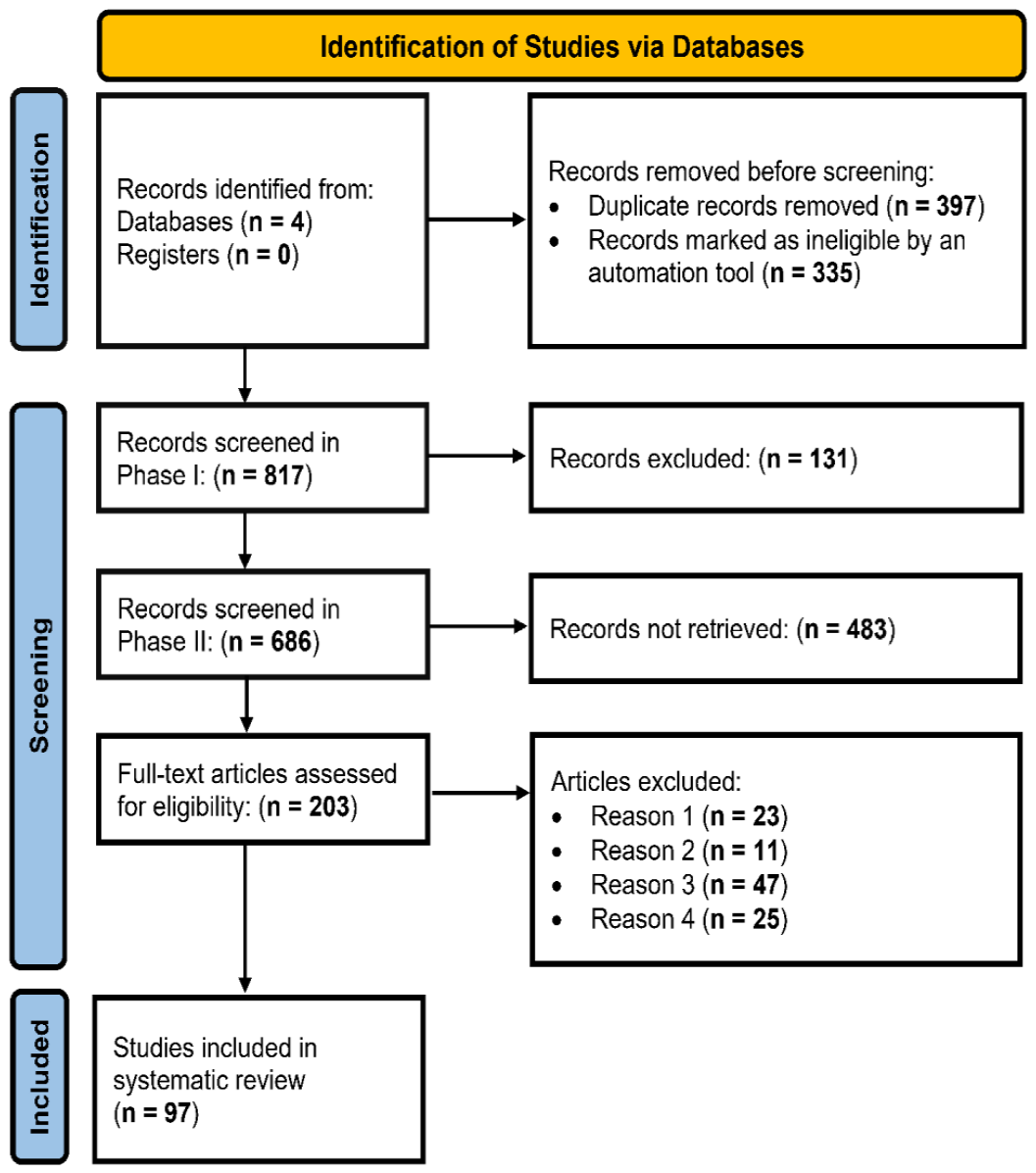
Figure 2.
Presents an integrated conceptual model that illustrates the formation of the MFHWL.
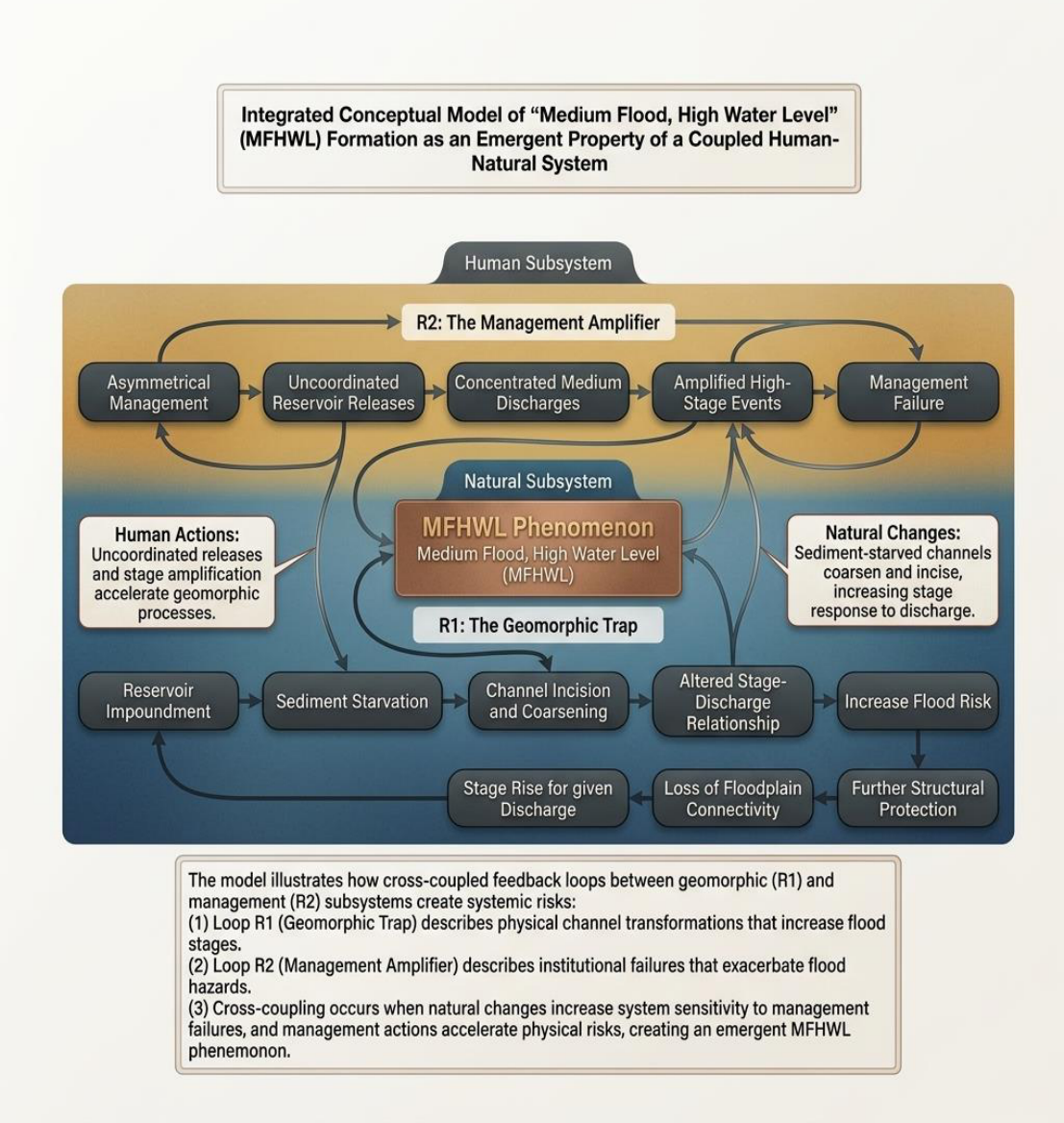
Figure 3.
Presents a schematic of the Middle Yangtze River, highlighting significant engineering structures: (A) the Yangtze River Basin; (B) the section extending from the Three Gorges Dam to the estuary; (C) the Three Gorges Dam; and (D) the Yangtze Estuary (adapted from Yang et al., 2023).
Figure 3.
Presents a schematic of the Middle Yangtze River, highlighting significant engineering structures: (A) the Yangtze River Basin; (B) the section extending from the Three Gorges Dam to the estuary; (C) the Three Gorges Dam; and (D) the Yangtze Estuary (adapted from Yang et al., 2023).
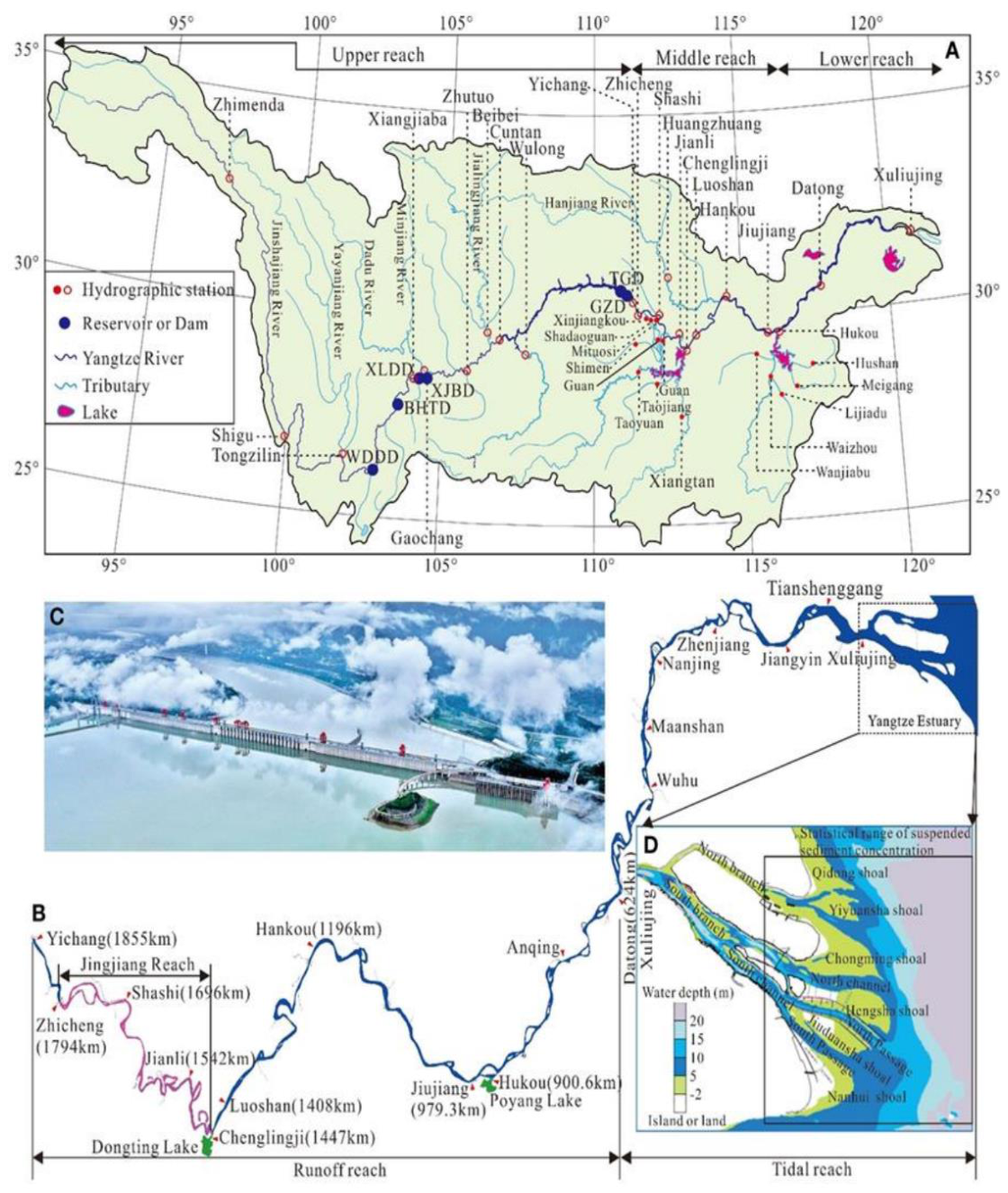

Table 1.
Synthesized Hydro-Geomorphic Drivers of the MFHWL Phenomenon.
| Basin (Country/Region) | Documented MFHWL Preconditions | Key Supporting References (From Review) | Strength of Evidence and Notes |
|---|---|---|---|
| 1. Middle Yangtze (China) | Sediment starvation (>70% reduction), sustained channel incision (>10 m), altered stage-discharge relationship (marked leftward shift), asymmetrical management (uncoordinated cascade operations). | Lai et al. (2017); Li et al. (2009); Yang et al. (2022); Ge et al. (2023); Liu et al. (2024) | Very High. All preconditions and the integrated MFHWL outcome are extensively documented through long-term monitoring, modeling, and operational analysis. Serves as the paradigmatic case. |
| 2. Mekong River (South East Asia) | Major sediment starvation from upstream dams, emerging channel incision, highly fragmented transboundary governance with conflicting operational priorities. | Kondolf et al. (2014); Lu et al. (2021); Yun et al. (2020) | Moderate-High. Sediment and governance dynamics are well-studied. Direct evidence of significant stage-discharge shifts is still emerging; however, the preconditions for systemic risk are strongly established. |
| 3. Lower Missouri River (USA) | Historical channel incision and simplification from bank stabilization, loss of floodplain connectivity due to levees, creating an entrenched, hydraulically efficient channel. | Pinter & Heine (2005); Jacobson & Galat (2006) | High. Physical drivers are well-quantified. Management is relatively coordinated under the USACE, but multi-objective conflicts (flood control, navigation, ecology) persist, representing a moderated form of asymmetrical management. |
| 4. Po River (Italy) | Significant sediment starvation (mining and dam retention), widespread channel incision, engineered disconnection from floodplain. | Surian & Rinaldi (2003); Gumiero et al. (2013) | Moderate. Strong evidence for physical drivers (incision, sediment deficit). Comprehensive studies explicitly linking these to flood stage amplification for medium events are less common. Governance involves complex EU-national-local interplay. |
| 5. Ganges-Brahmaputra (South Asia) | Major sediment transport, with increasing sediment trapping by planned/ existing dams, highly complex transboundary governance with numerous competing stakeholders. | Best (2019); Khan & Rahman, 2022 | Moderate (Emerging). Sediment starvation is a projected, high-certainty impact of ongoing dam development. The basin exhibits extreme asymmetry in management capacity and data sharing among co-riparian states, creating high potential for future MFHWL-type risks. |
| 6. Paraná River (South America) | Sediment retention by large reservoirs, channel adjustment, and multi-national management challenges. | (Ollier, 2012); Agostinho et al. (2016) | Moderate. Evidence points to sediment imbalance and morphological change. Quantitative analysis of stage-discharge relationship changes and explicit study of operational fragmentation in the cascade are identified as research gaps. |
| 7. Rhine River (Europe) | Historical channel incision and simplification, large-scale loss of floodplain connectivity. Management has recently shifted toward floodplain restoration to mitigate these drivers ("Room for the River"). | Middelkoop et al. (2004); Disse & Engel (2001); Rottler et al., 2023 |
High. Physical preconditions are well-documented. This basin is a leading example of implementing balancing feedbacks (e.g., levee setbacks) to actively counteract the "Loss of Floodplain Connectivity" driver, thereby reducing stages for a given discharge. |
| 8. Colorado River (USA) | Complete sediment retention by major dams, regulated flow regime, institutional complexity (federal, state, tribal, Mexican agreements). Managed high-flow experiments aim to mitigate sediment starvation. | Melis et al. (2015); Wheeler et al. (2018) | High. A premier example of attempting to manage both physical (sediment) and institutional (operational rules) drivers. It demonstrates intentional, though partial, creation of balancing feedbacks against key MFHWL preconditions. |
| 9. Murray-Darling (Australia) | Sediment and flow regime alteration by dams and diversions, extreme multi-jurisdictional governance challenges historically. Establishment of a basin-wide authority aims to create integrated management. | Connell & Grafton (2011); Hart (2015) | High (for governance). Provides a seminal case of institutional innovation (the Basin Plan) designed to counteract governance fragmentation—a core component of Loop B. Physical channel changes are documented, but their direct link to flood stage anomalies is less studied. |
Table 2.
Presents the major river basins with documented patterns of MFHWL preconditions.
| Basin (Country/Region) | Documented MFHWL Preconditions | Key Supporting References (From Review) | Strength of Evidence and Notes |
|---|---|---|---|
| 10. Middle Yangtze (China) | Sediment starvation (>70% reduction), sustained channel incision (>10 m), altered stage-discharge relationship (marked leftward shift), asymmetrical management (uncoordinated cascade operations). | Lai et al. (2017); Li et al. (2009); Yang et al. (2022); Ge et al. (2023); Liu et al. (2024) | Very High. All preconditions and the integrated MFHWL outcome are extensively documented through long-term monitoring, modeling, and operational analysis. Serves as the paradigmatic case. |
| 11. Mekong River (South East Asia) | Major sediment starvation from upstream dams, emerging channel incision, highly fragmented transboundary governance with conflicting operational priorities. | Kondolf et al. (2014); Lu et al. (2021); Yun et al. (2020) | Moderate-High. Sediment and governance dynamics are well-studied. Direct evidence of significant stage-discharge shifts is still emerging; however, the preconditions for systemic risk are strongly established. |
| 12. Lower Missouri River (USA) | Historical channel incision and simplification from bank stabilization, loss of floodplain connectivity due to levees, creating an entrenched, hydraulically efficient channel. | Pinter & Heine (2005); Jacobson & Galat (2006) | High. Physical drivers are well-quantified. Management is relatively coordinated under the USACE, but multi-objective conflicts (flood control, navigation, ecology) persist, representing a moderated form of asymmetrical management. |
| 13. Po River (Italy) | Significant sediment starvation (mining and dam retention), widespread channel incision, engineered disconnection from floodplain. | Surian & Rinaldi (2003); Gumiero et al. (2013) | Moderate. Strong evidence for physical drivers (incision, sediment deficit). Comprehensive studies explicitly linking these to flood stage amplification for medium events are less common. Governance involves complex EU-national-local interplay. |
| 14. Ganges-Brahmaputra (South Asia) | Major sediment transport, with increasing sediment trapping by planned/ existing dams, highly complex transboundary governance with numerous competing stakeholders. | Best (2019); Khan & Rahman, 2022 | Moderate (Emerging). Sediment starvation is a projected, high-certainty impact of ongoing dam development. The basin exhibits extreme asymmetry in management capacity and data sharing among co-riparian states, creating high potential for future MFHWL-type risks. |
| 15. Paraná River (South America) | Sediment retention by large reservoirs, channel adjustment, and multi-national management challenges. | (Ollier, 2012); Agostinho et al. (2016) | Moderate. Evidence points to sediment imbalance and morphological change. Quantitative analysis of stage-discharge relationship changes and explicit study of operational fragmentation in the cascade are identified as research gaps. |
| 16. Rhine River (Europe) | Historical channel incision and simplification, large-scale loss of floodplain connectivity. Management has recently shifted toward floodplain restoration to mitigate these drivers ("Room for the River"). | Middelkoop et al. (2004); Disse & Engel (2001); Rottler et al., 2023 |
High. Physical preconditions are well-documented. This basin is a leading example of implementing balancing feedbacks (e.g., levee setbacks) to actively counteract the "Loss of Floodplain Connectivity" driver, thereby reducing stages for a given discharge. |
| 17. Colorado River (USA) | Complete sediment retention by major dams, regulated flow regime, institutional complexity (federal, state, tribal, Mexican agreements). Managed high-flow experiments aim to mitigate sediment starvation. | Melis et al. (2015); Wheeler et al. (2018) | High. A premier example of attempting to manage both physical (sediment) and institutional (operational rules) drivers. It demonstrates intentional, though partial, creation of balancing feedbacks against key MFHWL preconditions. |
| 18. Murray-Darling (Australia) | Sediment and flow regime alteration by dams and diversions, extreme multi-jurisdictional governance challenges historically. Establishment of a basin-wide authority aims to create integrated management. | Connell & Grafton (2011); Hart (2015) | High (for governance). Provides a seminal case of institutional innovation (the Basin Plan) designed to counteract governance fragmentation—a core component of Loop B. Physical channel changes are documented, but their direct link to flood stage anomalies is less studied. |
Disclaimer/Publisher’s Note: The statements, opinions and data contained in all publications are solely those of the individual author(s) and contributor(s) and not of MDPI and/or the editor(s). MDPI and/or the editor(s) disclaim responsibility for any injury to people or property resulting from any ideas, methods, instructions or products referred to in the content. |
© 2026 by the authors. Licensee MDPI, Basel, Switzerland. This article is an open access article distributed under the terms and conditions of the Creative Commons Attribution (CC BY) license (http://creativecommons.org/licenses/by/4.0/).
Copyright: This open access article is published under a Creative Commons CC BY 4.0 license, which permit the free download, distribution, and reuse, provided that the author and preprint are cited in any reuse.


