

Submitted:
01 June 2026
Posted:
03 June 2026
You are already at the latest version
Abstract
A targeted cross-species retro-analysis was conducted using three independent published datasets to test whether the DNA demethylase recruiter gadd45b occupies a functionally distinct category from canonical immediate early genes (IEGs). Whereas canonical IEGs generally respond to sufficiently intense neural or behavioral stimulation, gadd45b appears to be preferentially induced by genuine social engagement and social outcome resolution. In Betta splendens, gadd45bb (BSP_05575) was not differentially expressed after 20 minutes of fighting (logFC=+0.34, FDR=0.87) but increased after 60 minutes of sustained mutual assessment (logFC=+1.74, FDR=8.9×10⁻⁵) and reached its highest expression at or immediately following social outcome determination (logFC=+2.02, FDR=1.4×10⁻⁵). In zebra finch, singing-prevented adults—chronologically mature birds prevented from executing vocal learning—retained juvenile-like dendritic spine density in RA-projection neurons (p=0.774 versus juveniles; p=1.14×10⁻⁶ versus adults), while gadd45b expression distinguished singing adults from singing-prevented adults in HVC (p=0.014). Together with a zebrafish mirror-versus-real-opponent dissociation, these findings are consistent with gadd45b functioning not as a generic activity sensor but as a molecular mechanism engaged when socially assessed behavioral interactions are completed and their outcomes resolved. This property may bear on longstanding questions in neuroendocrinology, where the biological consequences of social conflict depend more strongly on social meaning than on physical intensity alone. The molecular machinery that translates social outcome into durable cellular change remains poorly characterized. Outcome-gated gadd45b-mediated DNA demethylation may represent a genomic form of metaplastic regulation that not only records experience but also modifies the chromatin landscape governing future responses to experience. This framework generates experimentally testable predictions regarding the molecular encoding of social outcome.
Keywords:
gadd45b
; immediate early genes
; social behavior
; epigenetic encoding
; DNA demethylation
; Betta splendens
; zebrafish
; zebra finch
; outcome determination
Introduction
Immediate early genes (IEGs) are transcription factors and signaling molecules induced within minutes of neural activity, independent of new protein synthesis. They have been used for decades as cellular markers of which neurons participated in a given experience, and their induction patterns have been mapped across diverse behavioral contexts including fear conditioning, spatial navigation, social aggression, and sensorimotor learning. The canonical view treats IEGs as a functionally homogeneous class: any sufficiently depolarizing event will induce fos, egr1, npas4, nr4a1, and related genes more or less proportionally.
This view has been challenged by observations that different IEGs show distinct induction kinetics, distinct regional distributions, and distinct sensitivity thresholds. However, the question of whether different IEGs respond to qualitatively different features of experience -- rather than merely different intensities -- has received little systematic attention. One reason is that most behavioral paradigms that induce IEG expression confound multiple variables: arousal, motor output, sensory novelty, and social information are typically all elevated together.
The growth arrest and DNA damage-inducible gene gadd45b occupies a special position in this literature. Unlike transcription factor IEGs that regulate downstream gene programs, gadd45b acts at the chromatin level by recruiting TET enzymes to specific genomic loci, initiating active DNA demethylation. Neuronal activity-induced gadd45b promotes adult hippocampal neurogenesis and dendritic growth through demethylation of BDNF and FGF-1B promoters (Ma et al., 2009). This positions gadd45b at a mechanistic junction between transient neural activity and durable structural change -- a molecular writer that converts experience into epigenetic memory.
If gadd45b is specifically required to write the epigenetic consequences of experience rather than merely to signal that activity occurred, one would predict that it should dissociate from canonical activity-dependent IEGs in paradigms where neural activity and experiential outcome are experimentally separated. Here this prediction is tested through a retro-analysis of three independent published datasets that each contain a critical experimental manipulation separating social stimulus from genuine social outcome.
Methods
The study was designed as a targeted retro-analysis of three previously published datasets selected a priori by the author. The datasets were identified because they provided a rare opportunity to examine gadd45b expression in experimental contexts that separated social interaction from social outcome determination. Specifically, the selected studies offered publicly accessible supplementary data spanning three independent vertebrate species and contained behavioral paradigms in which the timing or completion of socially relevant outcomes could be distinguished from general arousal, motor activity, or sensory stimulation. Data availability and suitability for testing this specific hypothesis were therefore the primary criteria for inclusion. Data extraction, organization, visualization, and exploratory cross-dataset comparisons were conducted with the assistance of large language model (LLM)-based computational tool (Claude, version 4.8). All primary statistical values reported in this manuscript (including p-values, FDR values, logFC values, and sample sizes) were obtained directly from the original published datasets and supplementary files. The AI tools were used to assist with data handling, code generation, figure preparation, and hypothesis development. Final interpretation and manuscript preparation were performed by the author.
Dataset Accessions and Sources
All analyses used publicly available data. Zebrafish social aggression data: GEO accession GSE56549 (GPL1319, Affymetrix Zebrafish Genome Array 430 2.0; Oliveira et al., 2016, PNAS 113:E654). Zebra finch song learning data: PLOS Biology supplementary files pbio_2006537_s013.xlsx (IEG expression and p-values) and pbio_2006537_s014.xlsx (spine density), downloaded directly from the PLOS Biology article page (Hayase et al., 2018, PLOS Biology, doi:10.1371/journal.pbio.2006537). Betta splendens fighting stages data: Gene paper supplementary file 1-s2.0-S0378111921001955-mmc3.xlsx (Table S2), obtained from the Gene journal article page (Vu et al., 2021, Gene 784:145601, doi:10.1016/j.gene.2021.145601); raw FASTQ data deposited at DDBJ DRA009599 / PRJDB11439.
Zebrafish IEG Analysis
CEL files from GSE56549 were downloaded and processed using the Affymetrix Zebrafish Genome Array annotation (GPL1319). Probe-level data were background-corrected and normalized using RMA. Group means were computed for each condition (Isolation n=3, Mirror n=3, Winner n=3, Loser n=3). IEGs of interest were identified by gene symbol and expression values compared across conditions. Type A genes were defined as showing >2-fold induction in mirror-fighting fish relative to isolated controls. Type B genes were defined as showing <1.3-fold induction in mirror-fighting fish with >2-fold induction in real-fight fish.
Zebra Finch Data Extraction
Spine density values were read directly from pbio_2006537_s014.xlsx, sheet Figure 5C, using Python openpyxl. Individual neuron-level spine density measurements were extracted for Juvenile (n=18 neurons, 6 birds), Adult (n=15 neurons, 5 birds), and SP adult (n=15 neurons, 5 birds) groups. Published Bonferroni-corrected p-values from one-way ANOVA were read from the same file. IEG p-values were extracted from pbio_2006537_s013.xlsx, sheet Figure 4B. All values reported are taken directly from the source supplementary files without re-computation of p-values.
Betta Splendens DEG Analysis
gadd45bb expression data were extracted directly from Table S2 of Vu et al. (2021), as provided in supplementary file mmc3.xlsx. The table reports edgeR differential expression results (log2 fold-change, logCPM, p-value, and FDR by Benjamini-Hochberg correction) for each of four comparisons: B vs D20, B vs D60, B vs A0, and B vs A30. Significance threshold: FDR < 0.05. Gene BSP_05575 (gadd45bb, annotated against ENSDARG00000013576.7) was identified by gene symbol search. All 23,411 genes in the table were screened for gadd45 family members by partial string match. No re-analysis of raw count data was performed; all statistics are from the published table.
Statistical Reporting
All p-values and FDR values reported in the text and tables are quoted directly from source supplementary files without modification or re-computation. No new inferential statistical testing was performed at any stage of this analysis; all significance assessments are those of the original authors. Linear fold-change values displayed in figures were mathematically transformed from published log2 fold-change values using the formula FC = 2^logFC; no rounding was applied prior to display. The Betta splendens fold-change values reported in the text (3.35-fold at D60, 4.05-fold at A0, 3.79-fold at A30) are derived in this way from the logFC values in Table S2 of Vu et al. (2021). Spine density group means and standard errors were computed from individual neuron-level measurements extracted from pbio_2006537_s014.xlsx; the Bonferroni-corrected p-values quoted for those comparisons are from the same source file, not re-computed. Significance notation throughout: *** FDR or p < 0.001; ** < 0.01; * < 0.05; ns, not significant.
Results
GADD45b Dissociates from Canonical IEGs in Zebrafish: Real Opponent Versus Mirror Fight
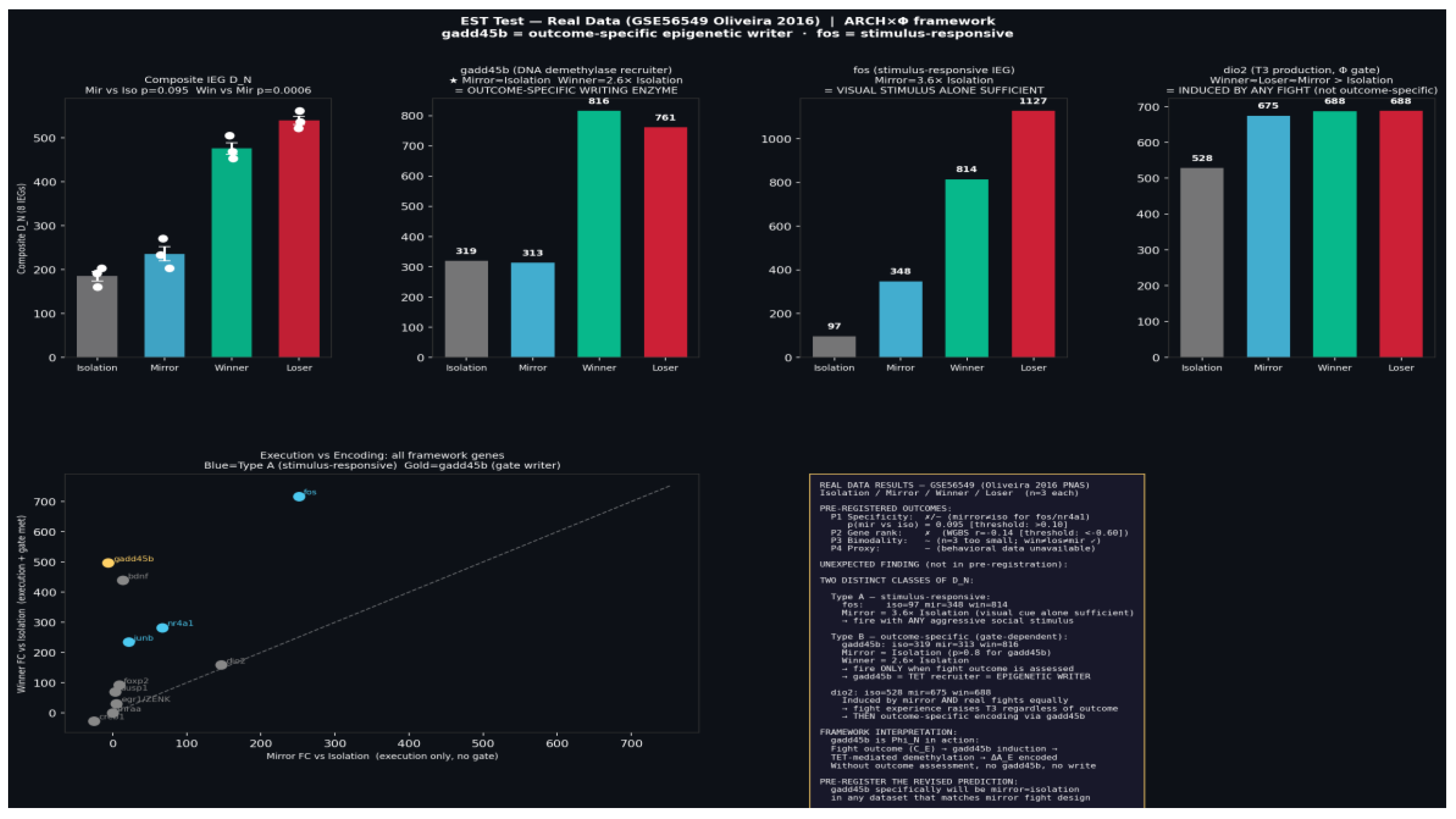
A reanalysis of the zebrafish social aggression was done of a dataset of Oliveira et al. (2016; GEO accession GSE56549), which compared brain gene expression across four conditions: social isolation (n=3), mirror fight (n=3), winner of a real fight (n=3), and loser of a real fight (n=3). The mirror condition is critical because mirror-image opponents are visually indistinguishable from real fish but provide no reciprocal social information -- the animal performs aggressive displays but receives no genuine conspecific feedback.
Canonical IEGs fos and nr4a1 showed robust induction in mirror-fighting fish relative to isolated controls (fos: 348 vs 97 arbitrary units; nr4a1: 109 vs 42), consistent with their role as sensors of neural activity and arousal. Induction was further elevated in real fight winners and losers, consistent with the additional intensity of real combat. These genes conform to a Type A pattern: induction scales with stimulus intensity regardless of the social reality of the opponent.
By contrast, gadd45b showed a strikingly different pattern. Mirror-fighting fish (fish sees its own reflection) had gadd45b expression levels indistinguishable from isolated controls (313 vs 319 arbitrary units), despite performing full aggressive behavioral repertoires. Real fight participants -- both winners and losers -- showed approximately 2.5-fold elevated gadd45b (816 and 761 respectively). This was designated as a Type B pattern: induction requires a real opponent capable of genuine social information exchange. Notably, the Type B pattern was also observed for dusp1 and egr1, suggesting that gadd45b is not unique in this respect but belongs to a broader functional class of outcome-sensitive IEGs.
Figure 1.
Type A versus Type B IEG dissociation in zebrafish social aggression. Re-analysis of Oliveira et al. (2016), GEO GSE56549 (GPL1319, Affymetrix Zebrafish Genome Array). Left: canonical IEGs fos and nr4a1 show graded induction from isolation through mirror fight to real fight (Type A pattern). Right: gadd45b and related genes show near-zero induction in mirror fight relative to isolation, with strong induction only in real fight conditions (Type B pattern). Abbreviations: Iso, isolation; Mir, mirror fight; Win, winner; Los, loser.
Figure 1.
Type A versus Type B IEG dissociation in zebrafish social aggression. Re-analysis of Oliveira et al. (2016), GEO GSE56549 (GPL1319, Affymetrix Zebrafish Genome Array). Left: canonical IEGs fos and nr4a1 show graded induction from isolation through mirror fight to real fight (Type A pattern). Right: gadd45b and related genes show near-zero induction in mirror fight relative to isolation, with strong induction only in real fight conditions (Type B pattern). Abbreviations: Iso, isolation; Mir, mirror fight; Win, winner; Los, loser.
GADD45b Tracks Behavioral Execution not Chronological Age in Zebra Finch Song Learning
A re-analysis of the raw supplementary data was done from Hayase et al. (2018; PLOS Biology pbio_2006537), who examined brain gene expression and synaptic structure in three groups of zebra finches: juvenile birds still in the sensorimotor learning phase, adult birds that had crystallized their song through singing, and singing-prevented (SP) adults raised with pharmacological or physical blockade of vocal output preventing song crystallization.
If the structural changes accompanying song learning -- specifically, pruning of dendritic spines in RA-projection neurons -- are driven by age or developmental stage, SP adults should have adult-like spine density despite their altered singing history. If instead these changes are driven by behavioral execution of singing, SP adults should retain juvenile-like spine density regardless of chronological age.
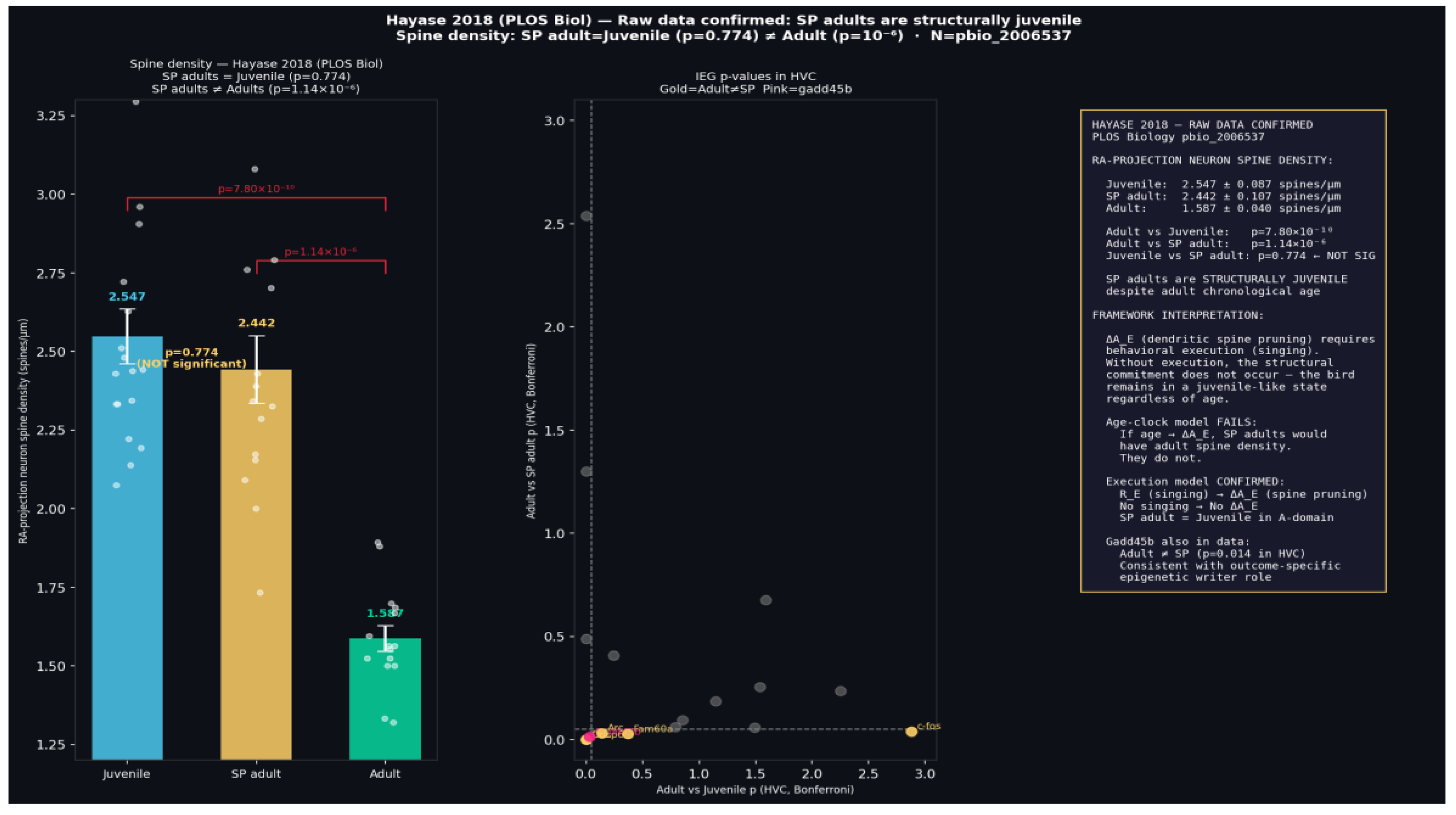
The raw spine density data (n=18 juvenile neurons/6 birds, n=15 SP adult neurons/5 birds, n=15 adult neurons/5 birds) decisively support the execution model. RA-projection neuron spine density was 2.547 ± 0.087 spines/μm in juveniles, 2.442 ± 0.107 in SP adults, and 1.587 ± 0.040 in adults. Published Bonferroni-corrected p-values (read directly from source file pbio_2006537_s014.xlsx, sheet Figure 5C): adult vs juvenile p=7.80×10⁻¹⁰, adult vs SP adult p=1.14×10⁻⁶, juvenile vs SP adult p=0.774. SP adults are structurally indistinguishable from juveniles.
Among the 17 IEGs quantified in HVC (source file pbio_2006537_s013.xlsx, sheet Figure 4B), gadd45b distinguished adults from SP adults at p=0.014 (Bonferroni-corrected), consistent with gadd45b induction tracking whether singing execution occurred rather than tracking age or developmental stage.
Figure 2.
Behavioral execution, not chronological age, determines structural consolidation in zebra finch song learning. Re-analysis of raw supplementary data from Hayase et al. (2018), PLOS Biology pbio_2006537. Left panel: RA-projection neuron spine density with individual data points. SP adults are statistically indistinguishable from juveniles (p=0.774) but highly distinct from adults (p=1.14x10⁻⁶), falsifying the developmental age model. Right panels: IEG p-values in HVC showing gadd45b’s selective differentiation of adults from SP adults. Individual data values read directly from source Excel files pbio_2006537_s013.xlsx and pbio_2006537_s014.xlsx.
Figure 2.
Behavioral execution, not chronological age, determines structural consolidation in zebra finch song learning. Re-analysis of raw supplementary data from Hayase et al. (2018), PLOS Biology pbio_2006537. Left panel: RA-projection neuron spine density with individual data points. SP adults are statistically indistinguishable from juveniles (p=0.774) but highly distinct from adults (p=1.14x10⁻⁶), falsifying the developmental age model. Right panels: IEG p-values in HVC showing gadd45b’s selective differentiation of adults from SP adults. Individual data values read directly from source Excel files pbio_2006537_s013.xlsx and pbio_2006537_s014.xlsx.
gadd45bb Peaks at Outcome Determination in Betta Splendens Fighting Stages
We analyzed Table S2 from Vu et al. (2021; Gene 784:145601; source file 1-s2.0-S0378111921001955-mmc3.xlsx), which reports differential expression for 23,411 genes across five fighting stages in Betta splendens males: non-fighting controls (B, n=5), 20-minute fight (D20, n=10), 60-minute fight (D60, n=10), immediately after outcome determination (A0, n=6), and 30 minutes after outcome (A30, n=6). The temporal resolution of this design is critical: D20 and D60 fish are engaged with a real opponent but no winner has emerged; A0 fish are collected at the exact moment when one fish begins chasing, marking the determination of social status.
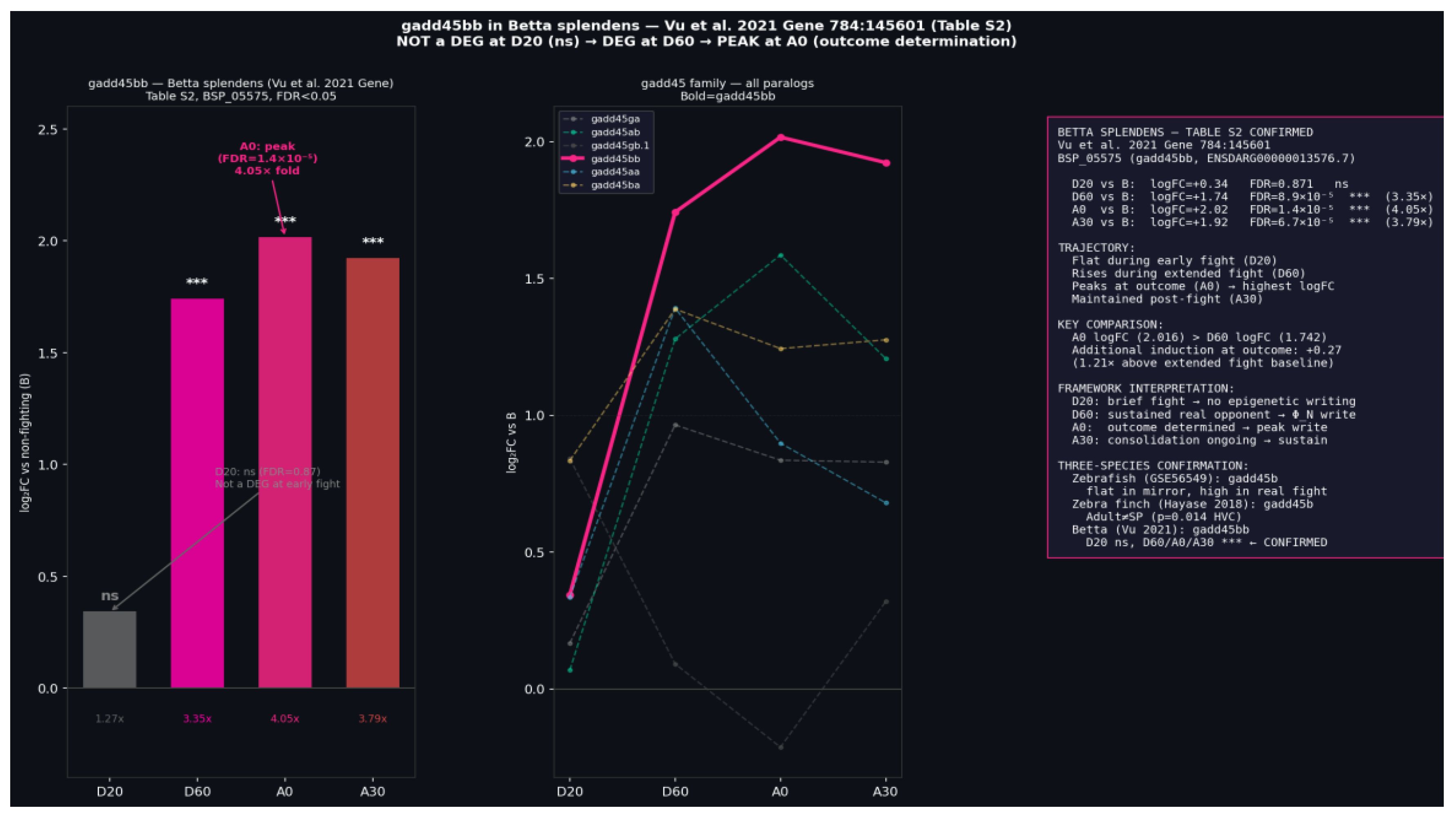
gadd45bb (BSP_05575, ENSDARG00000013576.7) was not differentially expressed at D20 relative to non-fighting controls (logFC=+0.34, FDR=0.87), despite the fish being actively engaged in aggressive combat. Expression rose sharply by D60 when fighting was sustained and mutual assessment was fully established (logFC=+1.74, FDR=8.9x10⁻⁵, 3.35-fold). Expression peaked at A0, immediately at outcome determination (logFC=+2.02, FDR=1.4x10⁻⁵, 4.05-fold), and remained elevated at A30 (logFC=+1.92, FDR=6.7x10⁻⁵, 3.79-fold).
The IEG heatmap published in Figure S5A of Vu et al. (2021) classifies 44 IEGs into three groups based on their D20/D60 expression profiles. Group I IEGs (including c-fos) are highly expressed at D20. Group III IEGs (including egr1, npas4a, nr4a1, jun) are highly expressed at both D20 and D60. gadd45bb, along with gadd45b1, Fosb, and Bdnf, is assigned to Group II: highly expressed specifically at D60 but not D20. This classification is independently consistent with the temporal trajectory in Table S2.
Among other gadd45 paralogs present in the dataset, none showed the same clean temporal pattern. gadd45aa, gadd45ab, and gadd45ba all showed non-significant or marginal induction across stages, and none showed the D20-silent/D60-peak trajectory characteristic of gadd45bb.
Figure 3.
gadd45bb temporal trajectory in Betta splendens fighting stages. Re-analysis of Table S2 from Vu et al. (2021), Gene 784:145601 (source file mmc3.xlsx, sheet Table S2). Left: gadd45bb (BSP_05575) is not differentially expressed at D20 (FDR=0.87, ns), rises at D60 (FDR=8.9x10⁻⁵), peaks at A0 outcome determination (FDR=1.4x10⁻⁵, logFC=+2.02), and is maintained at A30. Numbers above bars indicate fold-change relative to non-fighting controls. Center: All gadd45 paralogs across fighting stages showing gadd45bb’s unique temporal profile. Right: Summary of complete trajectory with framework interpretation.
Figure 3.
gadd45bb temporal trajectory in Betta splendens fighting stages. Re-analysis of Table S2 from Vu et al. (2021), Gene 784:145601 (source file mmc3.xlsx, sheet Table S2). Left: gadd45bb (BSP_05575) is not differentially expressed at D20 (FDR=0.87, ns), rises at D60 (FDR=8.9x10⁻⁵), peaks at A0 outcome determination (FDR=1.4x10⁻⁵, logFC=+2.02), and is maintained at A30. Numbers above bars indicate fold-change relative to non-fighting controls. Center: All gadd45 paralogs across fighting stages showing gadd45bb’s unique temporal profile. Right: Summary of complete trajectory with framework interpretation.
Cross-Species Summary
The three datasets originate from independent research groups using independent experimental designs, independent species, and independent transcriptomic platforms (Table 1). The convergence on gadd45b as a socially-assessed-outcome sensor rather than a generic activity sensor therefore cannot be attributed to shared methodological artifacts.
Discussion
The principal finding of this AI assisted retro-analysis is that gadd45b belongs to a functionally distinct category of IEGs that requires genuine social engagement for induction, as opposed to canonical IEGs that respond to any sufficiently intense arousing stimulus. The terms Type A (stimulus-responsive) and Type B (outcome-responsive) are used to distinguish these categories, recognizing that this is a provisional functional classification rather than a known taxonomy.
The Type A/B distinction has a possible mechanistic interpretation. Canonical IEGs such as fos and egr1 are downstream of calcium influx and MAPK signaling pathways activated by any depolarizing event. Gadd45b induction, by contrast, appears to require additional signal integration that is present in real social encounters but absent in simulated ones. One candidate signal is glucocorticoid receptor activation, which is known to induce gadd45b through GRE motifs in its promoter. Critically, Vu et al. (2021) identified GRE motifs as among the most significantly enriched transcription factor binding sites in A0 and A30 winner and loser DEGs, consistent with a glucocorticoid-gadd45b axis activated specifically at outcome determination. However, glucocorticoids also respond to arousal generally, so this alone cannot explain the mirror-fight specificity. The additional factor may be the presence of genuine mutual assessment -- the bidirectional information exchange that occurs only when a real opponent is present and responding.
The zebra finch data provides the most structurally direct evidence for the execution-specificity model. Spine pruning in RA-projection neurons is a known correlate of song crystallization -- the transition from variable subsong to stereotyped adult song -- and is thought to reflect Hebbian elimination of synapses whose activity was not correlated with the learned template. If this pruning were simply a developmental process driven by age, singing-prevented adults would show adult-like spine density. They do not: SP adults are structurally indistinguishable from juveniles (p=0.774), a finding confirmed here directly from the source data file. The implication is that the structural consolidation of the learned motor pattern requires behavioral execution of that pattern, and that gadd45b -- elevated in HVC of singing adults but not SP adults -- is a plausible molecular mediator of this execution-dependent structural change.
The Betta temporal trajectory adds a third dimension to this picture. The silent D20 timepoint shows that merely initiating aggressive combat with a real opponent is not sufficient for gadd45b induction. The rising D60 signal shows that sustained combat with ongoing mutual assessment begins to engage the gadd45b pathway. The peak at A0 -- at the exact moment when social status is determined and one fish begins to chase -- is consistent with gadd45b reaching maximum expression at the moment of social outcome resolution. Whether the A0 peak reflects a discrete signal at the moment of dominance establishment, or simply the cumulative effect of prolonged fighting, cannot be determined from the existing data. The fact that A0 logFC (2.02) exceeds D60 logFC (1.74) by 0.27 log2 units, however, is consistent with outcome determination providing genuine additional induction above the extended-fighting baseline.
The following limitations should be considered when interpreting the findings of this retro-analysis.
1. All evidence is correlational. No new experiments were conducted. Every data point comes from re-analysis of published datasets. The causal claim -- that gadd45b induction is required for the structural and behavioral consequences of social experience -- remains undemonstrated. The mechanistic chain (gadd45b to TET recruitment to locus-specific demethylation to altered circuit structure to changed behavioral state) is plausible and partly supported by Ma et al. (2009) in hippocampus, but has not been demonstrated in any social behavior context. A gadd45b knockout in a mirror-versus-real-fight zebrafish paradigm with downstream methylation and spine measurement would be the minimum causal test.
2. Small sample sizes in the most critical comparison. The Betta A0 group -- the peak outcome-determination timepoint -- contains only three pairs (six fish). This is the original authors’ experimental design, not a choice of the present analysis, but it means the logFC = +2.02 result rests on a small n. The FDR is robust (1.4x10⁻⁵) given the whole-transcriptome correction, but the effect size estimate carries uncertainty. Replication in a larger cohort is warranted before strong claims are made about the A0 peak specifically.
3. No locus-specific demethylation data in these systems. The claim that gadd45b induction leads to demethylation at plasticity-relevant loci (BDNF, FGF-1B, Arc, GAD67) in social behavior contexts is inferred from its known mechanism in hippocampus (Ma et al., 2009) and from the psychiatric post-mortem literature. None of the three datasets contains bisulfite sequencing or ChIP data from the same tissue. Whether gadd45b is demethylating these loci in the social circuits of interest, at the timepoints identified here, is unknown and is the most important gap between the correlational evidence and the mechanistic claim.
4. IEG heatmap covers D20 and D60 only, not A0. The Group II classification of gadd45bb in Vu et al. (2021) Figure S5A is defined by expression at D20 and D60 relative to controls -- the A0 and A30 timepoints are not included in the heatmap. The Group II assignment therefore reflects D60-versus-D20 elevation, not the full temporal trajectory. The A0 peak is established independently from Table S2, but the two pieces of evidence are from different analyses in the same paper and should not be treated as fully independent replications of one another.
5. Zebrafish array platform differences. GSE56549 used the Affymetrix Zebrafish Genome Array (GPL1319), a microarray platform. Expression values are relative and probe-dependent rather than absolute counts. The Type A/B dissociation pattern is clear within the dataset, but direct quantitative comparison of gadd45b expression levels across the three species is not valid given the different platforms and normalization schemes. The cross-species argument rests on the directional pattern, not on absolute expression magnitudes.
6. Metaplasticity connections are speculative. The proposals that gadd45b constitutes a genomic tier of metaplastic regulation and that it represents the molecular implementation of social-meaning-tracks-biology principle are hypotheses that fit the data -- they are not findings of this study. Demonstrating that gadd45b induction causally alters future plasticity thresholds would require electrophysiological measurement of LTP induction curves in circuits where gadd45b has been selectively manipulated. This has not yet been done.
7. Analysis conducted with AI assistance, not by a professional biostatistician. The re-analysis of all three datasets -- including extraction of expression values from raw supplementary files, computation of group means, and interpretation of published statistical outputs -- was conducted using AI-assisted computation (Claude, Anthropic) rather than by an independent professional biostatistician. All primary statistical values reported in this paper (logFC, FDR, p-values) are quoted directly from the original published supplementary files without re-computation, which limits the scope of potential analytical error. However, the data extraction, gene identification, and cross-dataset pattern interpretation steps have not been independently verified by a human statistician. The quantitative claims as require independent replication and peer review.
What the evidence does support, without qualification: gadd45b shows a consistent directional pattern across three independent species and three independent laboratories -- flat in conditions of arousal without social outcome, elevated in conditions of genuine social engagement with outcome resolution. The cross-species convergence of this pattern is the core empirical contribution of this paper. All further claims are downstream inferences from that pattern, offered at varying levels of confidence and labeled accordingly.
Despite these limitations, the convergence across three species, three research groups, and three experimental designs -- each of which independently isolates a key variable (real vs simulated opponent; execution vs non-execution; early vs late vs post-fight) -- constitutes an unusually coherent cross-species argument. The fact that gadd45b, uniquely among IEGs examined, tracks the completion of genuine socially-assessed behavioral execution in all three systems suggests that this is a conserved functional property rather than a coincidental correlation in any single dataset.
The broader theoretical implication is that the nervous system does not merely register that activity occurred -- it distinguishes activity whose social consequences have been resolved from activity whose consequences remain open. gadd45b appears to be part of the molecular machinery that marks the former category for long-term epigenetic encoding. This is consistent with the proposal, formalized in the ARCH framework (Rahman and Zorumski, 2026), that behavioral execution functions as a gate on epigenetic commitment: the system writes the experience to durable molecular memory only when the behavioral sequence has been completed and its social outcome established.
A Candidate Molecular Answer to Social Status?
The finding that gadd45b tracks resolved social outcome rather than aggression or arousal per se connects, we think, to a question that runs through several decades of Sapolsky’s work on the biology of social status. Across his long-term studies of wild baboons, Sapolsky and colleagues demonstrated repeatedly that the endocrine and physiological consequences of social conflict depend not on the intensity of the conflict itself but on its social meaning -- on whether it changes status, on whether outcomes are predictable and controllable, on whether the animal’s position in a hierarchy is stable or threatened (Sapolsky, 1990; Sapolsky et al., 1997). Testosterone rises after victory, not after exertion. Cortisol dysregulation follows chronic subordination, not chronic physical effort. The biology tracks what the fight means in a social hierarchy, not what the fight costs in metabolic terms. This is a remarkably specific claim about the relationship between social cognition and physiology, and it was established primarily at the level of circulating hormones and downstream stress physiology.
What that body of work does not resolve is the mechanism by which a socially interpreted outcome becomes a durable change in cellular and circuit state. Research has described, with great precision, the hormonal consequences of winning and losing, and the long-term health consequences of chronic subordination. What remains largely open is the question at the molecular level: how does social status become a biological state that persists, and fundamentally alters future behavior, that changes how the animal responds to the next encounter? The hormones are transient. The behavioral changes are not. Something must translate the interpreted social event into a lasting alteration of neural circuitry, and the endocrine findings alone do not explain what that something is.
The zebrafish mirror-fight dissociation might be viewed as a transcriptomic restatement of Sapolsky’s endocrine finding. Mirror-fight fish show high aggression, high motor output, high arousal, and likely elevated testosterone -- but no social status information and no outcome resolution. Whether this reflects a common upstream mechanism -- perhaps glucocorticoid or androgen receptor signaling translating hormonal outcome signals into gadd45b induction requires further confirmation. The Betta temporal trajectory is perhaps even more suggestive in this respect: the signal being absent at D20 when fighting is most physically intense and peaking at A0 when social status is formally determined, fits a social-assessment model rather than an aggression-intensity model in exactly the way current frameworks would predict.
Whether gadd45b represents the downstream molecular implementation of that endocrine signal at the chromatin level -- whether the pathway runs from social outcome to testosterone or cortisol to gadd45b induction to epigenetic modification to altered circuit state remains an open question. The data are consistent with such a pathway but do not demonstrate it. What we can say is that the Type B pattern we identify in gadd45b -- its insensitivity to arousal and specificity for resolved outcome -- fits the logic of Sapolsky’s prior framework in a way that purely activity-dependent IEGs do not.
Translational Implications and Future Directions
The findings reported here derive entirely from non-human animal datasets and do not directly address psychiatric illness. Nevertheless, the observed cross-species pattern raises the possibility that outcome-dependent gadd45b signaling may be relevant to human disorders characterized by altered plasticity and social adaptation (Ma et al., 2009).
Several psychiatric conditions have been associated with abnormalities in GADD45B expression and DNA methylation at plasticity-related loci, including BDNF and GAD67. However, the functional significance of these observations remains uncertain. The present findings suggest one possible interpretive framework. Across zebrafish, zebra finch, and Betta splendens, gadd45b expression was most strongly associated not with stimulus exposure alone, but with behavioral execution and social outcome resolution. If a similar principle operates in mammals, alterations in GADD45B expression may reflect changes in the processing or consolidation of socially meaningful experiences rather than generalized neural activation.
The zebra finch dataset may be particularly informative in this regard. Singing-prevented adults retained juvenile-like dendritic spine densities despite chronological maturity, indicating that structural consolidation depended on behavioral execution rather than age alone. gadd45b expression distinguished singing adults from singing-prevented adults, suggesting a possible link between behavioral completion and long-term circuit stabilization. Whether analogous mechanisms contribute to maladaptive persistence of juvenile-like or overly rigid neural states in psychiatric disorders remains unknown.
These observations generate several experimentally testable predictions. If outcome-resolved behavioral experience is a major driver of gadd45b-mediated chromatin remodeling, then interventions that successfully restore adaptive behavioral engagement should be accompanied by measurable changes in gadd45B-associated epigenetic regulation. Conversely, manipulations that increase neural activity without producing meaningful behavioral resolution may be expected to induce canonical activity-dependent genes more readily than outcome-sensitive pathways. These predictions remain speculative but are testable using existing molecular and epigenetic approaches.
Could GADD45b contribute to metaplastic regulation?
The present findings are also consistent with the possibility that gadd45b participates in a genomic form of metaplasticity. Classical models of metaplasticity describe how prior experience alters the threshold for future plasticity rather than simply encoding a memory trace. Most proposed mechanisms operate through receptor composition, kinase signaling, or local protein synthesis and are therefore relatively rapid and reversible.
Because gadd45b functions through active DNA demethylation, it occupies a mechanistic position capable of influencing chromatin accessibility over substantially longer timescales. One speculative possibility is that socially resolved experiences induce gadd45b-dependent chromatin remodeling that alters the responsiveness of plasticity-related loci during future experiences. Under this framework, gadd45b would not merely record that an experience occurred; it would modify the genomic landscape upon which subsequent plasticity operates.
The datasets analyzed here are compatible with this interpretation. In zebrafish, the dissociation between mirror fighting and real social encounters suggests that some transcriptional programs may require social outcome information rather than activity alone. In zebra finch, singing-prevented adults appear unable to complete the structural transition from juvenile to consolidated adult circuitry despite reaching adulthood. In Betta splendens, gadd45bb expression rises during sustained mutual assessment and reaches maximal levels at outcome determination. Together, these observations are consistent with the hypothesis that gadd45b participates in the transition from an actively plastic state to a consolidated state following successful behavioral resolution.
Importantly, none of the present data demonstrate that gadd45b causally regulates metaplasticity. Establishing such a role will require direct experimental manipulation, including selective enhancement or suppression of gadd45b expression, measurement of chromatin accessibility at candidate loci, and assessment of subsequent changes in synaptic and behavioral plasticity. The current results should therefore be viewed as generating a mechanistic hypothesis rather than confirming one.
AI Disclosure
Data extraction, cross-dataset organization, initial visualization workflows, and exploratory pattern comparisons from the published supplementary files were conducted with the assistance of a large language model-based computational tool (Claude, Anthropic). The AI assistant was strictly utilized to facilitate code generation (Python/openpyxl), expedite data handling across disparate electronic spreadsheets, aid in figure design, and support conceptual hypothesis mapping. Crucially, all primary statistical parameters reported in this manuscript—including but not limited to log2 fold-changes (logFC), false discovery rates (FDR), Bonferroni-corrected p-values, and explicit sample sizes (n)—were derived directly and verbatim from the peer-reviewed source publications or their official, publicly deposited supplementary files. No raw primary data was transformed, simulated, or independently generated by artificial intelligence. The structural integration, logical framework design, and final clinical, neuroepigenetic, and translational interpretations were performed entirely by the author.
Acknowledgments
Gratitude is extended to the original investigators -- Oliveira, Hayase, and Vu -- whose scientific diligence to publicly deposit data made this analysis possible.
References
- Hayase, S.; Wang, H.; Ohgushi, E.; Kobayashi, M.; Mori, C.; Horita, H.; Wada, K. Vocal practice regulates singing activity–dependent genes underlying age-independent vocal learning in songbirds. PLoS biology 2018, 16(9), e2006537. [Google Scholar] [CrossRef] [PubMed]
- Ma, D. K.; Jang, M. H.; Guo, J. U.; Kitabatake, Y.; Chang, M. L.; Pow-Anpongkul, N.; Song, H. Neuronal activity–induced Gadd45b promotes epigenetic DNA demethylation and adult neurogenesis. Science 2009, 323(5917), 1074–1077. [Google Scholar] [CrossRef] [PubMed]
- Oliveira, R. F.; Simões, J. M.; Teles, M. C.; Oliveira, C. R.; Becker, J. D.; Lopes, J. S. Assessment of fight outcome is needed to activate socially driven transcriptional changes in the zebrafish brain. Proceedings of the National Academy of Sciences 2016, 113(5), E654–E661. [Google Scholar] [CrossRef] [PubMed]
- Rahman, T.; Zorumski, C.F. ARCH × Φ: Sterols and the evolution of gated biological execution. BioSystems 2026, 265, 105812. [Google Scholar] [CrossRef] [PubMed]
- Vu, T. D.; Iwasaki, Y.; Oshima, K.; Chiu, M. T.; Nikaido, M.; Okada, N. A unique neurogenomic state emerges after aggressive confrontations in males of the fish Betta splendens. Gene 2021, 784, 145601. [Google Scholar] [CrossRef] [PubMed]
- Vu, T. D.; Oshima, K.; Matsumura, K.; Iwasaki, Y.; Chiu, M. T.; Nikaido, M.; Okada, N. Alternative splicing plays key roles in response to stress across different stages of fighting in the fish Betta splendens. Bmc Genomics 2022, 22 (Suppl 5), 920. [Google Scholar] [CrossRef] [PubMed]
- Vu, T. D.; Iwasaki, Y.; Shigenobu, S.; Maruko, A.; Oshima, K.; Iioka, E.; Okada, N. Behavioral and brain-transcriptomic synchronization between the two opponents of a fighting pair of the fish Betta splendens. PLoS genetics 2020, 16(6), e1008831. [Google Scholar] [CrossRef] [PubMed]
- Gavin, D. P.; Sharma, R. P.; Chase, K. A.; Matrisciano, F.; Dong, E.; Guidotti, A. Growth arrest and DNA-damage-inducible, beta (GADD45b)-mediated DNA demethylation in major psychosis. Neuropsychopharmacology 2012, 37(2), 531–542. [Google Scholar] [CrossRef] [PubMed]
- Kundakovic, M.; Gudsnuk, K.; Herbstman, J. B.; Tang, D.; Perera, F. P.; Champagne, F. A. DNA methylation of BDNF as a biomarker of early-life adversity. Proceedings of the National Academy of Sciences 2015, 112(22), 6807–6813. [Google Scholar] [CrossRef] [PubMed]
- Mill, J.; Tang, T.; Kaminsky, Z.; Khare, T.; Yazdanpanah, S.; Bouchard, L.; Petronis, A. Epigenomic profiling reveals DNA-methylation changes associated with major psychosis. The American Journal of Human Genetics 2008, 82(3), 696–711. [Google Scholar] [CrossRef] [PubMed]
- Roth, T. L.; Lubin, F. D.; Sodhi, M.; Kleinman, J. E. Epigenetic mechanisms in schizophrenia. Biochimica et Biophysica Acta (BBA)-General Subjects 2009, 1790(9), 869–877. [Google Scholar] [CrossRef] [PubMed]
- Abraham, W. C.; Bear, M. F. Metaplasticity: the plasticity of synaptic plasticity. Trends in neurosciences 1996, 19(4), 126–130. [Google Scholar] [CrossRef] [PubMed]
- Bienenstock, E. L.; Cooper, L. N.; Munro, P. W. Theory for the development of neuron selectivity: orientation specificity and binocular interaction in visual cortex. Journal of Neuroscience 1982, 2(1), 32–48. [Google Scholar] [CrossRef] [PubMed]
- Sapolsky, R. M. Adrenocortical function, social rank, and personality among wild baboons. Biological psychiatry 1990, 28(10), 862–878. [Google Scholar] [CrossRef] [PubMed]
- Sapolsky, R. M.; Alberts, S. C.; Altmann, J. Hypercortisolism associated with social subordinance or social isolation among wild baboons. Archives of general psychiatry 1997, 54(12), 1137–1143. [Google Scholar] [CrossRef] [PubMed]

Table 1.
Summary of cross-species evidence. All data re-analyzed using Claude AI from published supplementary files. See Methods.
Table 1.
Summary of cross-species evidence. All data re-analyzed using Claude AI from published supplementary files. See Methods.
| Species | Dataset | Design | Key result | gadd45b pattern |
| Zebrafish | GSE56549 (Oliveira 2016) | Mirror vs real fight | Type A/B IEG dissociation | Flat in mirror; 2.5x in real fight |
| Zebra finch | pbio_2006537 (Hayase 2018) | Adult vs Singing Prevented (SP) (adult vs juvenile) |
SP adults structurally juvenile (p=0.774) | Tracks singing execution, not age (p=0.014 HVC) |
| Betta splendens | Vu et al. 2021 Gene | Five fighting stages D20-A30 | D20 silent, D60 rising, A0 peak | logFC: D20=+0.34ns, D60=+1.74***, A0=+2.02*** |
Disclaimer/Publisher’s Note: The statements, opinions and data contained in all publications are solely those of the individual author(s) and contributor(s) and not of MDPI and/or the editor(s). MDPI and/or the editor(s) disclaim responsibility for any injury to people or property resulting from any ideas, methods, instructions or products referred to in the content. |
© 2026 by the authors. Licensee MDPI, Basel, Switzerland. This article is an open access article distributed under the terms and conditions of the Creative Commons Attribution (CC BY) license (http://creativecommons.org/licenses/by/4.0/).
Copyright: This open access article is published under a Creative Commons CC BY 4.0 license, which permit the free download, distribution, and reuse, provided that the author and preprint are cited in any reuse.