

Submitted:
01 June 2026
Posted:
03 June 2026
You are already at the latest version
Abstract
Polycyclic aromatic hydrocarbons (PAHs) are widespread environmental pollutants with established carcinogenic properties traditionally linked to genotoxicity, oxidative stress, and DNA adduct formation. Emerging evidence, however, suggests that PAHs also function as chronotoxic agents capable of disrupting circadian homeostasis through transcriptional and epigenetic reprogramming of core clock genes. This review critically examines the molecular interplay between PAH exposure, circadian clock dysregulation, and the initiation and progression of lung and breast cancers. Central to this interaction is the activation of the aryl hydrocarbon receptor (AhR), which exhibits functional crosstalk with circadian regulators including CLOCK and BMAL1. Sustained AhR activation, coupled with oxidative stress, inflammatory signaling, and epigenetic modifications such as DNA methylation, histone remodeling, and non-coding RNA dysregulation, contributes to altered rhythmic expression of key circadian genes including PER, CRY, BMAL1, and CLOCK. These alterations impair DNA repair, cell-cycle regulation, apoptosis, and metabolic homeostasis, thereby creating a permissive environment for tumorigenesis. The review further highlights tissue-specific mechanisms underlying PAH-induced chronodisruption in lung and breast tissues and discusses the translational relevance of circadian biomarkers in cancer prognosis and therapy. Finally, emerging therapeutic strategies including chronotherapy, circadian-targeted interventions, and epigenetic modulation are explored as potential approaches for mitigating environmentally induced carcinogenesis. Collectively, this review positions environmental chronotoxicology as a critical framework for understanding the temporal dimension of cancer development associated with PAH exposure.
Keywords:
polycyclic aromatic hydrocarbons (PAHs)
; circadian disruption
; AhR signaling
; environmental chronotoxicology
; epigenetic reprogramming
; lung and breast cancer
1. Introduction
Environmental exposures are increasingly recognized as critical determinants of human health, particularly in the context of chronic diseases such as cancer [1]. Among environmental pollutants, polycyclic aromatic hydrocarbons (PAHs) have attracted significant attention due to their widespread distribution and well-established carcinogenic potential [2]. At the same time, the circadian rhythm, an endogenous timekeeping system that orchestrates physiological processes over a 24-hour cycle, has emerged as a key regulator of cellular homeostasis. Disruption of circadian timing, often referred to as chronodisruption, has been implicated in the pathogenesis of multiple diseases, including metabolic disorders and cancer [3]. The integration of these two domains has led to the emergence of environmental chronotoxicology, a field that examines how environmental toxicants interact with biological timing systems to influence disease risk and progression [4,5].
Recent advances suggest that PAHs may exert part of their carcinogenic effects by interfering with circadian clock machinery through molecular pathways involving the aryl hydrocarbon receptor (AhR), oxidative stress signaling, and epigenetic modifications. These interactions can disrupt rhythmic gene expression, thereby altering key cellular processes such as DNA repair, cell cycle regulation, and apoptosis, which are tightly controlled by the circadian system [6]. Understanding this interplay is essential for elucidating the mechanisms linking environmental exposures to cancer initiation and progression.
1.1. Overview of Polycyclic Aromatic Hydrocarbons Exposure
Polycyclic aromatic hydrocarbons (PAHs) are a diverse class of organic compounds composed of multiple fused aromatic rings, primarily formed during the incomplete combustion of organic materials [7]. These compounds are ubiquitous in the environment, originating from both natural and anthropogenic sources. Industrial activities such as petrochemical processing, aluminum production, and waste incineration represent major contributors to environmental PAH contamination. In addition, combustion-related processes, including vehicle emissions, fossil fuel burning, and biomass combustion, significantly elevate atmospheric PAH levels, particularly in urban settings. Tobacco smoke also constitutes a major indoor source of PAHs, while dietary intake through consumption of grilled or smoked foods represents another important exposure pathway [8,9].
Human exposure to PAHs occurs predominantly through inhalation, ingestion, and dermal contact. Inhalation is considered the primary route, especially in polluted environments where PAHs are bound to airborne particulate matter [10,11] . Ingestion of contaminated food and water contributes substantially to total exposure, particularly in populations with high consumption of charred foods. Dermal exposure is also relevant in occupational settings, such as in workers handling asphalt, coal tar, or industrial by-products (Figure 1) [12,13]. Following entry into the body, PAHs are readily absorbed due to their lipophilic nature and distributed to various tissues, with a tendency to accumulate in lipid-rich compartments. They undergo metabolic activation primarily via cytochrome P450 enzymes, especially CYP1A1 and CYP1B1, resulting in the formation of reactive intermediates capable of forming DNA adducts and inducing mutagenesis. This metabolic activation is a key step in PAH-induced carcinogenesis (Table 1) [14].
1.2. The Biology of the Circadian Rhythm
The circadian rhythm is an intrinsic timekeeping system that enables organisms to anticipate and adapt to daily environmental changes [17]. This approximately 24-hour cycle regulates a wide range of physiological processes, including sleep–wake patterns, hormone secretion, metabolism, immune responses, and cellular repair mechanisms. In mammals, the circadian system is hierarchically organized, with a central pacemaker located in the suprachiasmatic nucleus (SCN) of the hypothalamus. The SCN synchronizes peripheral clocks present in nearly all tissues, including the liver, lung, and breast, thereby ensuring coordinated regulation of tissue-specific functions. External environmental cues, known as zeitgebers, such as light, feeding cycles, and temperature, play a crucial role in entraining the circadian system to the external environment [18,19].
At the molecular level, circadian rhythms are governed by interconnected transcriptional–translational feedback loops involving a set of core clock genes and proteins [19,20]. The transcription factors CLOCK and BMAL1 form heterodimers that drive the expression of target genes, including the period (PER1–3) and cryptochrome (CRY1–2) genes. The PER and CRY proteins accumulate in the cytoplasm, translocate back to the nucleus, and inhibit CLOCK–BMAL1 activity, thereby forming a negative feedback loop (Figure 2). Additional regulatory loops involving nuclear receptors such as REV-ERB and ROR further stabilize and fine-tune circadian oscillations. These molecular oscillations generate rhythmic gene expression patterns that regulate downstream biological processes essential for maintaining cellular homeostasis. Disruption of these tightly regulated feedback mechanisms can lead to profound physiological consequences, including increased susceptibility to disease (Table 2) [21,22].
1.3. Concept of Chronotoxicity and Cancer Linkage
Chronotoxicity refers to the time-dependent variation in the toxicity of chemical agents, reflecting the influence of circadian rhythms on the absorption, distribution, metabolism, and excretion of xenobiotics. A closely related concept, chronodisruption, describes the disturbance of normal circadian organization due to environmental, behavioral, or physiological factors. Such disruptions can manifest as altered sleep–wake cycles, hormonal imbalances, and loss of rhythmic gene expression, ultimately leading to systemic physiological dysregulation [25].
Emerging evidence indicates that environmental toxicants, including PAHs, can function as chronotoxic agents by interfering with circadian clock function at multiple levels [26,27]. Mechanistically, PAHs activate the aryl hydrocarbon receptor (AhR), a ligand-activated transcription factor that shares structural and functional similarities with circadian regulators such as CLOCK and BMAL1. This interaction enables competitive or cooperative binding to DNA regulatory elements, thereby altering circadian gene expression. In addition, PAHs induce oxidative stress and inflammatory signaling pathways, including reactive oxygen species (ROS) production and NF-κB activation, which can further disrupt redox-sensitive components of the circadian machinery. Epigenetic modifications, such as DNA methylation and histone remodeling, also contribute to sustained alterations in circadian gene expression following toxicant exposure [28,29,30,31].
The link between circadian disruption and cancer is supported by both experimental and epidemiological evidence. Circadian clock genes regulate critical cellular processes, including DNA damage response, cell cycle progression, and apoptosis [21,32]. Disruption of these regulatory mechanisms can lead to genomic instability, uncontrolled cell proliferation, and impaired programmed cell death, all of which are hallmarks of cancer [33]. Epidemiological studies, particularly those involving shift workers, have demonstrated an increased risk of cancers such as lung and breast cancer, leading to the classification of circadian disruption as a probable carcinogen by the International Agency for Research on Cancer [4,34,35,36,37,38,39,40]. In this context, PAH-induced chronodisruption represents a mechanistic bridge linking environmental exposure to cancer initiation and progression, highlighting the importance of integrating temporal biology into toxicological and carcinogenic risk assessment.
2. Molecular Mechanisms of PAH-Induced Circadian Disruption
The ability of polycyclic aromatic hydrocarbons (PAHs) to perturb circadian homeostasis is mediated through a complex network of molecular pathways that integrate xenobiotic sensing, transcriptional regulation, redox signaling, and inflammatory responses. Central to this process is the activation of the aryl hydrocarbon receptor (AhR), a ligand-activated transcription factor that serves as a key mediator of environmental chemical signaling. The convergence of AhR signaling with circadian clock machinery, alongside oxidative stress and inflammatory cascades, creates a multifaceted mechanism through which PAHs disrupt circadian rhythmicity at both molecular and physiological levels [6,26,41,42].
2.1. Activation of Aryl Hydrocarbon Receptor (AhR) Signaling
The aryl hydrocarbon receptor (AhR) is a cytosolic transcription factor that plays a central role in the detection and metabolic processing of environmental toxicants, including PAHs. In its inactive state, AhR resides in the cytoplasm in association with chaperone proteins such as heat shock protein 90 (HSP90), XAP2, and p23 [43]. Upon exposure to PAHs, lipophilic ligands readily diffuse across the cell membrane and bind to AhR, inducing a conformational change that facilitates its dissociation from the chaperone complex. This ligand-bound AhR then translocates into the nucleus, where it dimerizes with the aryl hydrocarbon receptor nuclear translocator (ARNT) [14,44].
Once in the nucleus, the AhR–ARNT complex binds to specific DNA sequences known as xenobiotic response elements (XREs), initiating the transcription of a battery of target genes involved in xenobiotic metabolism, including cytochrome P450 enzymes such as CYP1A1, CYP1A2, and CYP1B1 [43]. While this pathway is essential for detoxification, it also leads to the metabolic activation of PAHs into reactive intermediates capable of inducing DNA damage. Importantly, emerging evidence suggests that AhR signaling extends beyond xenobiotic metabolism to influence broader transcriptional networks, including those governing circadian regulation. The structural similarity between AhR and core circadian transcription factors enables functional overlap and potential interference with circadian gene expression programs [30,45,46,47].
2.2. Crosstalk Between AhR and Circadian Clock Machinery
A critical mechanism underlying PAH-induced circadian disruption is the molecular crosstalk between AhR signaling and the circadian clock system. Both AhR and core circadian proteins such as CLOCK and BMAL1 belong to the basic helix–loop–helix PER-ARNT-SIM (bHLH-PAS) family of transcription factors, which allows them to share common dimerization partners and DNA-binding motifs. This structural homology provides a basis for direct interaction and competition between these pathways [6,48,49].
Experimental studies have demonstrated that activation of AhR can interfere with the formation and activity of the CLOCK–BMAL1 heterodimer, the central transcriptional activator of circadian gene expression. AhR may compete with CLOCK or BMAL1 for binding to ARNT, thereby limiting the availability of this cofactor for circadian transcriptional complexes. In addition, AhR activation has been shown to repress the transcription of key circadian genes such as PER1, PER2, and BMAL1, either directly through promoter interactions or indirectly via downstream signaling pathways [6,30,41].
Conversely, circadian clock components can also regulate AhR signaling, indicating a bidirectional relationship [6]. CLOCK–BMAL1 complexes may modulate the rhythmic expression of AhR target genes, thereby influencing the temporal dynamics of xenobiotic metabolism. This reciprocal regulation underscores the integration of environmental sensing with circadian timing systems. However, sustained activation of AhR by persistent environmental pollutants such as PAHs can overwhelm this balance, leading to prolonged disruption of circadian transcriptional networks and loss of rhythmic gene expression (Figure 3) [30,41,50].
2.3. Oxidative Stress and Inflammatory Signaling
In addition to direct transcriptional interference, PAHs contribute to circadian disruption through the induction of oxidative stress and inflammatory signaling pathways. The metabolic activation of PAHs via cytochrome P450 enzymes generates reactive oxygen species (ROS), leading to a state of redox imbalance within the cell. Elevated ROS levels can damage cellular macromolecules, including DNA, lipids, and proteins, and also act as signaling molecules that modulate gene expression [28,51,52,53]. Circadian clock components are highly sensitive to cellular redox status, as several clock proteins contain redox-responsive domains that influence their stability and activity [54,55]. Oxidative stress can therefore alter the function of key circadian regulators such as CLOCK, BMAL1, and PER proteins, resulting in disrupted oscillatory patterns. Furthermore, ROS-mediated activation of signaling pathways such as nuclear factor kappa B (NF-κB) plays a significant role in linking inflammation to circadian dysregulation. NF-κB is a transcription factor that regulates the expression of pro-inflammatory cytokines and has been shown to interact with circadian clock genes, either by directly binding to their promoters or by modulating their transcriptional activity [56,57,58,59].
Chronic activation of inflammatory pathways further exacerbates circadian disruption by creating a feedback loop in which inflammation and clock dysfunction reinforce each other. Pro-inflammatory cytokines such as tumor necrosis factor-alpha (TNF-α) and interleukin-6 (IL-6) can suppress the expression of core clock genes, leading to a sustained loss of circadian rhythmicity [60,61]. This interplay between oxidative stress, inflammation, and circadian regulation represents a key mechanism through which PAHs exert their chronotoxic effects (Figure 4).
2.4. Temporal Disruption and Loss of Circadian Oscillation
The cumulative effects of AhR activation, transcriptional interference, oxidative stress, and inflammation ultimately manifest as alterations in the temporal organization of circadian rhythms [6]. One of the hallmark features of PAH-induced circadian disruption is phase shifting, in which the timing of peak gene expression is advanced or delayed relative to the normal circadian cycle. Such phase shifts can desynchronize internal biological clocks from external environmental cues, leading to physiological misalignment [62,63,64]
Another critical consequence is the reduction in amplitude of circadian oscillations, characterized by diminished fluctuations in gene expression levels over the 24-hour cycle [26,28]. Reduced amplitude reflects a weakening of the underlying transcriptional feedback loops and is often associated with impaired physiological function. In more severe cases, sustained exposure to PAHs can lead to arrhythmicity, a complete loss of circadian oscillations, resulting in the breakdown of temporal regulation across multiple biological systems [5].
At the cellular level, these temporal disruptions have profound implications for processes such as DNA repair, cell cycle progression, and metabolic regulation, all of which are under circadian control. The loss of coordinated timing can therefore create a permissive environment for genomic instability and tumorigenesis (Table 3). Importantly, the extent of circadian disruption may depend on factors such as the duration and timing of exposure, highlighting the importance of temporal dynamics in environmental toxicology [33,65].
3. Epigenetic and Transcriptional Rewiring of Circadian Clock Genes
The disruption of circadian rhythms by polycyclic aromatic hydrocarbons (PAHs) extends beyond transient signaling interference to encompass stable and heritable changes in gene expression mediated through epigenetic and transcriptional mechanisms [26]. Epigenetic regulation including DNA methylation, histone modifications, and non-coding RNA activity plays a central role in maintaining the rhythmic expression of circadian clock genes [66]. However, environmental toxicants such as PAHs can alter these regulatory layers, leading to persistent reprogramming of circadian transcriptional networks. This epigenetic rewiring not only disrupts temporal homeostasis but also contributes to pathological processes, including carcinogenesis, by affecting genes involved in cell proliferation, apoptosis, and DNA repair [67,68,69,70,71].
3.1. DNA Methylation and Histone Modifications
DNA methylation and histone modifications are key epigenetic mechanisms that regulate gene expression by altering chromatin accessibility and transcriptional activity [72,73]. DNA methylation is the addition of a methyl group to the fifth carbon of cytosine residues within CpG dinucleotides, catalyzed by DNA methyltransferases (DNMT1, DNMT3A, and DNMT3B), this modification commonly occurs in gene promoter regions and is generally linked to transcriptional repression [74]. In the context of circadian regulation, proper methylation patterns are essential for maintaining the rhythmic expression of core clock genes. However, exposure to PAHs has been shown to induce aberrant DNA methylation patterns, particularly hypermethylation of promoter regions of circadian genes such as BMAL1 and PER2, leading to their transcriptional silencing [26,75,76]
In addition to DNA methylation, histone modifications including acetylation, methylation, phosphorylation, and ubiquitination, play a critical role in regulating chromatin structure and gene expression [77,78]. Histone acetylation, typically associated with transcriptional activation, is dynamically regulated by histone acetyltransferases (HATs) and histone deacetylases (HDACs), many of which are themselves under circadian control. PAH exposure has been reported to disrupt the balance between these enzymes, leading to altered histone modification patterns at circadian gene loci [26,28]. For instance, reduced histone acetylation at CLOCK and BMAL1 promoters can limit transcriptional activation, while aberrant histone methylation may further reinforce gene silencing. These chromatin remodeling events contribute to long-term disruption of circadian oscillations and may persist even after cessation of exposure [67,79,80,81].
3.2. Non-Coding RNA Regulation of Circadian Genes
Non-coding RNAs, particularly microRNAs (miRNAs), represent another important layer of post-transcriptional regulation influencing circadian gene expression [82]. miRNAs are short non-coding RNA sequences (~22 nucleotides), endogenous RNA molecules that bind to complementary sequences in target messenger RNAs (mRNAs), leading to mRNA degradation or translational repression. Several miRNAs have been identified as key regulators of circadian clock genes, forming intricate regulatory networks that fine-tune circadian rhythms [83,84].
Exposure to PAHs has been shown to alter the expression profiles of numerous miRNAs, thereby affecting circadian gene regulation. For example, certain PAH-induced miRNAs can target transcripts of PER, CRY, and BMAL1, reducing their expression and disrupting the balance of the circadian feedback loop [85]. Additionally, miRNAs such as miR-34a, miR-132, and miR-155 have been implicated in both circadian regulation and inflammatory signaling, suggesting a convergence of pathways through which PAHs exert their effects [68,86]. Beyond miRNAs, long non-coding RNAs (lncRNAs) also contribute to circadian regulation by interacting with chromatin-modifying complexes and transcription factors, further influencing gene expression patterns [87,88,89]. The dysregulation of these non-coding RNAs by PAHs adds another layer of complexity to circadian disruption and highlights the importance of post-transcriptional mechanisms in environmental chronotoxicology.
3.3. Transcriptional Reprogramming of Core Clock Genes
The combined effects of epigenetic alterations and non-coding RNA regulation culminate in the transcriptional reprogramming of core circadian clock genes [66,90]. Central components of the circadian machinery, including CLOCK, BMAL1, PER (PER1–3), and CRY (CRY1–2), exhibit altered expression patterns following PAH exposure. These changes may manifest as either upregulation or downregulation, depending on the context, duration of exposure, and cellular environment [5,26,28].
The CLOCK gene, which encodes a transcription factor essential for initiating circadian gene expression, may be functionally impaired through reduced transcriptional activity or altered protein stability [91,92]. Similarly, BMAL1, a critical partner of CLOCK, is frequently downregulated in response to epigenetic silencing or transcriptional repression, leading to diminished activation of downstream target genes [93]. The PER and CRY genes, which form the negative feedback arm of the circadian loop, are also susceptible to dysregulation [66,94]. Reduced expression of these genes can impair feedback inhibition, resulting in destabilization of circadian oscillations (Figure 5). Conversely, aberrant overexpression of certain clock genes may lead to asynchronous signaling and further disrupt rhythmicity. These transcriptional alterations collectively represent a reprogramming of the circadian system, shifting it from a tightly regulated oscillatory network to a dysregulated state [22].
3.4. Functional Consequences of Gene Upregulation and Downregulation
The epigenetic and transcriptional rewiring of circadian clock genes has significant functional consequences for cellular physiology. One of the most prominent outcomes is the loss of rhythmic gene expression, characterized by diminished or absent oscillations in clock-controlled genes. This loss of rhythmicity disrupts the temporal coordination of essential biological processes, including metabolism, DNA repair, and cell cycle progression. As a result, cells may experience increased susceptibility to damage and reduced capacity for recovery, creating a permissive environment for disease development [19,33,95,96,97].
Disruption of circadian homeostasis also affects cellular signaling pathways that regulate cell proliferation, apoptosis, metabolism DNA repair [98,99]. For instance, downregulation of PER and CRY genes has been associated with impaired DNA damage response and reduced apoptosis, allowing damaged cells to survive and proliferate. Similarly, altered expression of BMAL1 can influence metabolic pathways and oxidative stress responses, further contributing to cellular dysfunction. The cumulative effect of these alterations is a breakdown of cellular homeostasis, which not only facilitates tumor initiation but also promotes tumor progression and resistance to therapy. Importantly, these changes are often sustained through epigenetic memory, highlighting the long-term impact of environmental exposures on circadian regulation and disease risk (Figure 6) [67,68,100,101,102,103].

Table 4.
Epigenetic Modifications of Circadian Clock Genes Induced by PAHs [68,105,106,107,108,109].
| Epigenetic Mechanism | Target Genes | Types of Modification | Effect on Expression | Functional Outcome |
| Histone Modification | CLOCK, BMAL1 | Reduced acetylation, altered methylation | Decreased transcription | Impaired feedback loops |
| miRNA Regulation | PER, CRY, BMAL1 | miRNA-mediated repression | mRNA degradation/inhibition | Disrupted oscillatory balance |
| lncRNA Interaction | Multiple clock genes | Chromatin remodeling | Variable expression changes | Long-term transcriptional reprogramming |
| Epigenetic Memory | Global circadian network | Persistent modifications | Sustained dysregulation | Increased disease susceptibility |
4. Implications for Lung and Breast Cancer Initiation and Progression
The intersection between polycyclic aromatic hydrocarbon (PAH) exposure and circadian disruption has profound implications for cancer biology, particularly in tissues such as the lung and breast that exhibit heightened susceptibility to environmental and hormonal perturbations [26]. The ability of PAHs to induce DNA damage, alter epigenetic landscapes, and disrupt circadian regulation creates a multifactorial framework that promotes tumor initiation and progression. Importantly, circadian clock genes are not merely passive timekeepers but active regulators of cellular processes that maintain genomic integrity and tissue homeostasis. Their dysregulation therefore represents a critical mechanistic link between environmental toxicants and carcinogenesis [5,101].
4.1. Tissue-Specific Susceptibility to PAHs
The lung represents one of the primary targets of PAH toxicity due to its direct exposure to airborne pollutants [110]. Inhalation of PAH-containing particulate matter allows these compounds to deposit in the respiratory epithelium, where they undergo metabolic activation to form reactive intermediates capable of inducing DNA adducts and mutations. The high expression of cytochrome P450 enzymes such as CYP1A1 in lung tissue further enhances the bioactivation of PAHs, increasing the risk of carcinogenic transformation. Additionally, circadian regulation of pulmonary function and xenobiotic metabolism suggests that disruption of clock genes in lung cells may exacerbate susceptibility to PAH-induced damage, thereby promoting lung carcinogenesis (Figure 7) [9,101].
In contrast, the breast exhibits susceptibility to PAHs through mechanisms linked to endocrine and metabolic regulation [111]. Breast tissue is highly responsive to hormonal signaling, particularly estrogen, which itself is subject to circadian control. Estrogen receptors (ERα) are present in normal breast epithelial cells and exhibit variable activity, with their expression regulated in a circadian manner by molecular clock components, including the induction of PER2 [112,113,114,115]. PAHs have been shown to possess endocrine-disrupting properties, capable of interfering with estrogen receptor (ER) signaling and altering hormone metabolism [116,117]. Furthermore, lipophilic PAHs can accumulate in adipose-rich breast tissue, prolonging exposure and increasing the likelihood of cellular damage. Circadian disruption in breast tissue can impair hormonal regulation and metabolic homeostasis, creating conditions that favor tumor initiation and progression (Figure 8). This dual influence of environmental exposure and hormonal sensitivity underscores the vulnerability of breast tissue to PAH-induced carcinogenesis [38,107,118,119].
4.2. Circadian Regulation of Cell Cycle, DNA Repair, and Apoptosis
Circadian clock genes play a fundamental role in regulating key cellular processes that safeguard genomic integrity, including cell cycle progression, DNA repair, and apoptosis. These processes are tightly coordinated in a time-dependent manner to ensure that DNA replication and repair occur under optimal conditions [21,101,120]. To date, at least nine core circadian clock genes have been identified, including PER1, PER2, PER3, CLOCK, CRY1, CRY2, BMAL1, CK1ε, and TIM [121]. Core circadian regulators such as BMAL1, CLOCK, PER, and CRY influence the expression of genes involved in cell cycle checkpoints, including p53, p21, and cyclins, thereby controlling the timing of cell division [5].
Disruption of circadian regulation by PAHs can impair these protective mechanisms. For instance, downregulation of PER and CRY genes has been associated with defective DNA damage response pathways, leading to inefficient repair of DNA lesions. Similarly, alterations in BMAL1 expression can affect the transcriptional regulation of tumor suppressor genes, compromising their ability to control cell proliferation. The circadian clock also modulates apoptotic pathways, ensuring the elimination of damaged cells (Table 5). However, its disruption may result in reduced apoptosis and increased survival of genetically compromised cells. Collectively, these alterations contribute to genomic instability, a hallmark of cancer development [33,101,122,123].
4.3. Mechanisms of Tumor Initiation
Tumor initiation in the context of PAH exposure and circadian disruption is driven by the accumulation of genetic and epigenetic alterations. The metabolic activation of PAHs generates reactive intermediates that form DNA adducts, leading to mutations if not properly repaired [128,129]. In the presence of circadian disruption, the efficiency of DNA repair mechanisms is compromised, allowing these mutations to persist and accumulate over time. This process is further exacerbated by oxidative stress, which introduces additional DNA damage and promotes mutagenesis [14,28,130].
Epigenetic silencing of protective genes represents another critical mechanism in tumor initiation. Aberrant DNA methylation and histone modifications induced by PAHs can suppress the expression of tumor suppressor genes and circadian regulators such as PER2 and BMAL1 [131,132,133]. The loss of these protective functions disrupts normal cellular control mechanisms, facilitating uncontrolled cell proliferation and the early stages of tumorigenesis. Importantly, these epigenetic changes may be stable and heritable, contributing to long-term cancer risk even after exposure has ceased [67].
4.4. Tumor Progression and Metastasis
Beyond initiation, circadian disruption plays a significant role in tumor progression and metastasis. Dysregulation of circadian genes can enhance cellular proliferation by altering the expression of growth-promoting pathways, including those involving MYC and AKT signaling. Reduced expression of PER and CRY genes has been linked to increased tumor cell proliferation and resistance to apoptosis, enabling tumor expansion [5,33,104,134,135].
Circadian disruption also influences the tumor microenvironment, which plays a crucial role in cancer progression. Alterations in circadian regulation can affect immune responses, angiogenesis, and metabolic pathways within the tumor microenvironment [136]. Dysregulated circadian signaling may impair immune surveillance, allowing tumor cells to evade detection and destruction. Additionally, changes in metabolic rhythms can support the increased energy demands of rapidly proliferating tumor cells. These factors collectively contribute to enhanced invasion and metastasis, particularly in aggressive cancers such as lung and breast cancer [38,81].
While PER and CRY genes are predominantly downregulated, contributing to loss of circadian control and tumor suppression, components such as CLOCK and certain nuclear receptors (REV-ERB and ROR) may exhibit context-dependent upregulation, thereby facilitating tumor-promoting transcriptional and metabolic reprogramming [137,138,139,140].
4.5. Circadian Genes as Biomarkers in Cancer
Circadian clock genes are increasingly being recognized as valuable biomarkers for cancer diagnosis, prognosis, and therapeutic response [142]. Altered expression patterns of genes such as BMAL1, PER2, and CRY1 have been observed in both lung and breast cancers, with correlations to tumor stage, aggressiveness, and patient survival. Disruption or reduced expression of PER2 has been associated with poor prognosis in breast cancer (BC), while genetic loss or dysregulation of BMAL1 and per2 has been linked to tumor progression in lung cancer [122,126,143].
The potential of circadian genes as biomarkers extends to their use in precision medicine. Understanding the circadian profile of tumors may enable the development of time-based therapeutic strategies, optimizing the timing of drug administration to maximize efficacy and minimize toxicity [144,145]. Additionally, targeting circadian pathways may offer novel therapeutic approaches for cancer treatment. As research in this area continues to evolve, integrating circadian biology into clinical practice holds promise for improving cancer diagnosis and treatment outcomes [101,135].
A growing body of experimental and epidemiological evidence supports the mechanistic link between PAH exposure, circadian gene dysregulation, and cancer development. As summarized in Table 6, studies across cellular, animal, and human systems consistently demonstrate that disruption of core clock genes such as PER2, BMAL1, and CRY contributes to tumor initiation and progression, particularly in lung and breast tissues.
5. Therapeutic Implications and Future Directions
The growing recognition that circadian disruption is a central mediator of environmental carcinogenesis has opened new avenues for therapeutic intervention. In the context of polycyclic aromatic hydrocarbon (PAH)-induced toxicity, where molecular crosstalk between xenobiotic signaling, epigenetic remodeling, and circadian dysregulation drives disease progression, targeting temporal biology offers a promising strategy for improving cancer prevention and treatment. The integration of chronobiology into oncology has given rise to innovative approaches such as chronotherapy, circadian-based drug targeting, and epigenetic modulation, all of which aim to restore physiological rhythmicity and enhance therapeutic efficacy [101,145,179,180].
5.1. Chronotherapy and Circadian-Based Treatment Strategies
Chronotherapy refers to the strategic timing of drug administration in alignment with the body’s circadian rhythms to maximize therapeutic efficacy while minimizing toxicity [181]. This approach is based on the understanding that pharmacokinetics and pharmacodynamics are influenced by circadian oscillations in metabolism, hormone levels, and cellular sensitivity [182,183]. In cancer therapy, the timing of chemotherapeutic agents can significantly affect treatment outcomes, as tumor cells and healthy tissues often exhibit distinct circadian patterns of proliferation and repair [184].
In the context of circadian disruption induced by PAHs, chronotherapy holds particular relevance. Restoring or aligning treatment schedules with residual circadian rhythms may help counteract the deleterious effects of chronodisruption [26,28,185]. Furthermore, targeting circadian pathways directly represents an emerging therapeutic strategy. Pharmacological modulators of core clock components, including agonists or antagonists of REV-ERBα (NR1D1), REV-ERBβ (NR1D2) and ROR nuclear receptors, have shown potential in preclinical models for regulating metabolic and inflammatory pathways associated with cancer progression. By modulating circadian regulators, these approaches aim to re-establish rhythmic gene expression and suppress tumor-promoting processes [179,186].
5.2. Epigenetic Therapeutics and Clock Gene Modulation
Given the prominent role of epigenetic alterations in PAH-induced circadian disruption, epigenetic therapeutics offer a compelling avenue for intervention. DNA methylation inhibitors, such as DNA methyltransferases (DNMTs), including 5-azacytidine (marketed as Vidaza) and 5-Aza-2′-deoxycytidine (decitabine), have been widely studied for their ability to reverse aberrant promoter hypermethylation and restore the expression of silenced tumor suppressor genes such as (TP53) (p53), (BRCA1/2), (RB1) (Rb), and (PTEN), and circadian regulators such as PER2 and BMAL1. By reactivating these genes, DNA methylation inhibitors may help re-establish normal circadian function and inhibit tumor growth [93,187,188,189,190].
Similarly, drugs targeting histone modifications, including histone deacetylase (HDAC) inhibitors and histone methyltransferase inhibitors, can modulate chromatin structure and gene expression. HDAC inhibitors, in particular, have been shown to enhance histone acetylation at circadian gene promoters, thereby promoting transcriptional activation and restoring rhythmicity. These agents may also exert anticancer effects by inducing cell cycle arrest and apoptosis [191,192]. Importantly, the interplay between epigenetic regulation and circadian control suggests that combining epigenetic therapies with chronotherapy could provide synergistic benefits, enhancing treatment efficacy while reducing adverse effects [67,80,81,193].
5.3. Emerging Biomarkers and Clinical Translation
Circadian clock genes and their downstream targets are increasingly being explored as biomarkers for cancer diagnosis, prognosis, and therapeutic response. Altered expression patterns of genes such as BMAL1, PER2, and CRY1 have been associated with tumor progression and patient outcomes in lung and breast cancers. The integration of circadian biomarkers into clinical practice could improve early detection strategies by identifying individuals at high risk due to environmental exposures and circadian disruption [122,126,143].
Advances in high-throughput technologies have facilitated the identification of circadian signatures at the genomic, transcriptomic, and epigenomic levels. These signatures can be leveraged to develop personalized medicine approaches, in which treatment strategies are tailored based on an individual’s circadian profile and molecular characteristics. Determining the optimal timing of drug administration based on a patient’s circadian rhythm may enhance therapeutic outcomes. Additionally, monitoring circadian gene expression could provide insights into treatment response and disease progression, enabling more precise and adaptive clinical management [101,185].
5.4. Knowledge Gaps and Future Research Directions
Despite significant advances in understanding the relationship between PAH exposure, circadian disruption, and cancer, several knowledge gaps remain. One major limitation is the lack of longitudinal studies that track the temporal dynamics of circadian disruption and its long-term impact on disease development [194]. Most existing studies rely on cross-sectional or short-term experimental models, which may not fully capture the chronic effects of environmental exposures.
Mechanistic studies are also needed to further elucidate the complex interactions between AhR signaling, epigenetic regulation, and circadian clock machinery. In particular, the integration of multi-omics approaches including genomics, epigenomics, transcriptomics, proteomics, and metabolomics will be essential for providing a comprehensive understanding of these interactions. Systems biology frameworks can help model the dynamic networks underlying circadian regulation and identify key nodes for therapeutic targeting [6,195].
Additionally, there is a need to investigate the influence of exposure timing on PAH toxicity, as the concept of chronotoxicity suggests that the biological impact of toxicants may vary depending on the time of exposure. Understanding these temporal aspects could inform both risk assessment and intervention strategies. Finally, translating findings from experimental models to human populations remains a critical challenge, highlighting the importance of interdisciplinary research that bridges basic science, clinical studies, and public health.
5.5. Conclusion
The interplay between PAHs exposure and circadian disruption represents a critical axis in the pathogenesis of lung and breast cancer. PAHs exert their carcinogenic effects not only through direct genotoxic mechanisms but also by reprogramming circadian clock systems via AhR signaling, oxidative stress, inflammatory pathways, and epigenetic modifications. This disruption leads to the loss of rhythmic gene expression, impaired DNA repair, and dysregulation of cell cycle and apoptotic pathways, thereby facilitating tumor initiation and progression in lung and breast respectively.
The integration of circadian biology into environmental toxicology provides a more comprehensive framework for understanding cancer development and highlights novel opportunities for intervention. Therapeutic strategies such as chronotherapy, circadian pathway targeting, and epigenetic modulation offer promising avenues for improving cancer treatment outcomes. Furthermore, the identification of circadian biomarkers and the application of personalized medicine approaches have the potential to enhance early detection and optimize therapeutic strategies.
Ultimately, advancing our understanding of environmental chronotoxicology will require interdisciplinary efforts that integrate molecular biology, toxicology, chronobiology, and clinical research. By bridging these fields, it may be possible to develop more effective strategies for preventing and treating cancers (especially in lung and breast) associated with environmental exposures, thereby improving public health outcomes and advancing precision oncology (Figure 9).
Author Contributions
Adeoye B. Awolesi: Conceptualization; writing—original draft preparation; writing—review and editing. The author has read and agreed to the published version of the manuscript.
Funding
This research received no external funding.
Institutional Review Board Statement
Not applicable.
Informed Consent Statement
Not applicable.
Conflicts of Interest
The author declares no conflicts of interest.
Clinical trial number
Not applicable.
References
- Ajayi RO, Ogunjobi TT. Environmental exposures and cancer risk: a comprehensive review. Medinformatics. 2025;2(2):80–92. [CrossRef]
- Rengarajan T, Rajendran P, Nandakumar N, Lokeshkumar B, Rajendran P, Nishigaki I. Exposure to polycyclic aromatic hydrocarbons with special focus on cancer. Asian Pacific journal of tropical biomedicine. 2015;5(3):182–9. [CrossRef]
- Surti M, Gupta A, Janiyani K, Adnan M, Patel M. The role of circadian disruption, sleep dysregulation, lifestyle factors, and metabolic reprogramming in the pathogenesis and progression of ovarian cancer. Journal of the National Cancer Center. 2026;6(2):189–203. [CrossRef]
- Haus EL, Smolensky MH. Shift work and cancer risk: Potential mechanistic roles of circadian disruption, light at night, and sleep deprivation. Sleep Medicine Reviews. 2013 Aug 1;17(4):273–84. [CrossRef]
- Fu L, Kettner NM. The circadian clock in cancer development and therapy. Progress in molecular biology and translational science. 2013;119:221–82. [CrossRef]
- Salminen A. Aryl hydrocarbon receptor (AhR) impairs circadian regulation: Impact on the aging process. Ageing Research Reviews. 2023;87:101928. [CrossRef]
- Patel AB, Shaikh S, Jain KR, Desai C, Madamwar D. Polycyclic Aromatic Hydrocarbons: Sources, Toxicity, and Remediation Approaches. Front Microbiol. 2020 Nov 5;11:562813. [CrossRef]
- Boström CE, Gerde P, Hanberg A, Jernström B, Johansson C, Kyrklund T, et al. Cancer risk assessment, indicators, and guidelines for polycyclic aromatic hydrocarbons in the ambient air. Environmental health perspectives. 2002;110(Suppl 3):451. [CrossRef]
- Kim KH, Jahan SA, Kabir E, Brown RJ. A review of airborne polycyclic aromatic hydrocarbons (PAHs) and their human health effects. Environment international. 2013;60:71–80. [CrossRef]
- Gao P, da Silva E, Hou L, Denslow ND, Xiang P, Ma LQ. Human exposure to polycyclic aromatic hydrocarbons: Metabolomics perspective. Environment international. 2018;119:466–77. [CrossRef]
- Venkatraman G, Giribabu N, Mohan PS, Muttiah B, Govindarajan VK, Alagiri M, et al. Environmental impact and human health effects of polycyclic aromatic hydrocarbons and remedial strategies: A detailed review. Chemosphere. 2024 Mar 1;351:141227. [CrossRef]
- Barbosa F, Rocha BA, Souza MCO, Bocato MZ, Azevedo LF, Adeyemi JA, et al. Polycyclic aromatic hydrocarbons (PAHs): Updated aspects of their determination, kinetics in the human body, and toxicity. Journal of Toxicology and Environmental Health, Part B. 2023 Jan 2;26(1):28–65. [CrossRef]
- Duan X, Shen G, Yang H, Tian J, Wei F, Gong J, et al. Dietary intake polycyclic aromatic hydrocarbons (PAHs) and associated cancer risk in a cohort of Chinese urban adults: Inter- and intra-individual variability. Chemosphere. 2016 Feb 1;144:2469–75. [CrossRef]
- Shimada T, Fujii-Kuriyama Y. Metabolic activation of polycyclic aromatic hydrocarbons to carcinogens by cytochromes P450 1A1 and1B1. Cancer Science. 2004;95(1):1–6. [CrossRef]
- Montano L, Baldini GM, Piscopo M, Liguori G, Lombardi R, Ricciardi M, et al. Polycyclic Aromatic Hydrocarbons (PAHs) in the Environment: Occupational Exposure, Health Risks and Fertility Implications. Toxics. 2025 Feb 23;13(3):151. [CrossRef]
- Ravindra K, Sokhi R, Van Grieken R. Atmospheric polycyclic aromatic hydrocarbons: source attribution, emission factors and regulation. Atmospheric environment. 2008;42(13):2895–921. [CrossRef]
- Yerushalmi S, Green RM. Evidence for the adaptive significance of circadian rhythms. Ecology Letters. 2009 Sep;12(9):970–81. [CrossRef]
- Dibner C, Schibler U, Albrecht U. The Mammalian Circadian Timing System: Organization and Coordination of Central and Peripheral Clocks. Annu Rev Physiol. 2010 Mar 17;72(1):517–49. [CrossRef]
- Takahashi JS. Transcriptional architecture of the mammalian circadian clock. Nature Reviews Genetics. 2017;18(3):164–79. [CrossRef]
- Jonathan SY, Díaz NM, D’Souza S, Buhr ED. The molecular clockwork of mammalian cells. In: Seminars in cell & developmental biology [Internet]. Elsevier; 2022 [cited 2026 May 5]. p. 87–96. Available from: https://www.sciencedirect.com/science/article/pii/S1084952121000446. [CrossRef]
- Fagiani F, Di Marino D, Romagnoli A, Travelli C, Voltan D, Di Cesare Mannelli L, et al. Molecular regulations of circadian rhythm and implications for physiology and diseases. Sig Transduct Target Ther. 2022 Feb 8;7(1):41. [CrossRef]
- Partch CL, Green CB, Takahashi JS. Molecular architecture of the mammalian circadian clock. Trends in cell biology. 2014;24(2):90–9. [CrossRef]
- Cox KH, Takahashi JS. Circadian clock genes and the transcriptional architecture of the clock mechanism. Journal of Molecular Endocrinology. 2019 Nov 1;63(4):R93–102. [CrossRef]
- Su Y, Wang M, Chen J, Bao Y, Wen R, Ren HW, et al. Progress in understanding how clock genes regulate aging and associated metabolic processes. Front Physiol. 2025 Sep 23;16:1654369. [CrossRef]
- Erren TC, Reiter RJ. Defining chronodisruption. Journal of Pineal Research. 2009 Apr;46(3):245–7. [CrossRef]
- Teglas T, Marcos AC, Torices S, Toborek M. Circadian control of polycyclic aromatic hydrocarbon-induced dysregulation of endothelial tight junctions and mitochondrial bioenergetics. Science of the Total Environment. 2024;952:175886. [CrossRef]
- Li H, Kilgallen AB, Münzel T, Wolf E, Lecour S, Schulz R, et al. Influence of mental stress and environmental toxins on circadian clocks: Implications for redox regulation of the heart and cardioprotection. British J Pharmacology. 2020 Dec;177(23):5393–412. [CrossRef]
- Koh YC, Pan MH. Food-Borne Polycyclic Aromatic Hydrocarbons and Circadian Disruption. ACS Omega. 2024 Jul 23;9(29):31298–312. [CrossRef]
- Tian J, Feng Y, Fu H, Xie HQ, Jiang JX, Zhao B. The Aryl Hydrocarbon Receptor: A Key Bridging Molecule of External and Internal Chemical Signals. Environ Sci Technol. 2015 Aug 18;49(16):9518–31. [CrossRef]
- Jaeger C, Tischkau SA. Role of Aryl Hydrocarbon Receptor in Circadian Clock Disruption and Metabolic Dysfunction. Environ�Health�Insights. 2016 Jan;10:EHI.S38343. [CrossRef]
- Sondermann NC, Faßbender S, Hartung F, Hätälä AM, Rolfes KM, Vogel CF, et al. Functions of the aryl hydrocarbon receptor (AHR) beyond the canonical AHR/ARNT signaling pathway. Biochemical pharmacology. 2023;208:115371. [CrossRef]
- Zeng Y, Guo Z, Wu M, Chen F, Chen L. Circadian rhythm regulates the function of immune cells and participates in the development of tumors. Cell death discovery. 2024;10(1):199. [CrossRef]
- Umer H, Mumtaz T. The Role of Circadian Rhythm Disruption in Cancer Progression: Molecular Mechanisms, Impact on Tumor Biology, and Therapeutic Insights. Asian Pacific Journal of Cancer Nursing. 2025;20250806–20250806. [CrossRef]
- IARC Working Group on the Evaluation of Carcinogenic Risks to Humans. Definition and Occurrence of Exposure. In: Painting, Firefighting, and Shiftwork [Internet]. International Agency for Research on Cancer; 2010 [cited 2026 May 5]. Available from: https://www.ncbi.nlm.nih.gov/books/NBK326824/.
- Erren TC, Falaturi P, Morfeld P, Knauth P, Reiter RJ, Piekarski C. Shift Work and Cancer. Dtsch Arztebl Int. 2010 Sep;107(38):657–62. [CrossRef] [PubMed] [PubMed Central]
- Stevens RG, Hansen J, Costa G, Haus E, Kauppinen T, Aronson KJ, et al. Considerations of circadian impact for defining ‘shift work’ in cancer studies: IARC Working Group Report. Occupational and Environmental Medicine. 2011 Feb 1;68(2):154–62. [CrossRef] [PubMed]
- Dun A, Zhao X, Jin X, Wei T, Gao X, Wang Y, et al. Association between night-shift work and cancer risk: updated systematic review and meta-analysis. Frontiers in oncology. 2020;10:1006. [CrossRef]
- Hansen J. Night Shift Work and Risk of Breast Cancer. Curr Envir Health Rpt. 2017 Sep;4(3):325–39. [CrossRef]
- Kamdar BB, Tergas AI, Mateen FJ, Bhayani NH, Oh J. Night-shift work and risk of breast cancer: a systematic review and meta-analysis. Breast Cancer Res Treat. 2013, 138, 291–301. [CrossRef]
- Gehlert S, Clanton M, Group on behalf of the SW and BCSA. Shift Work and Breast Cancer. International Journal of Environmental Research and Public Health. 2020 Dec 20;17(24):9544. [CrossRef]
- Xu CX, Krager SL, Liao DF, Tischkau SA. Disruption of CLOCK-BMAL1 Transcriptional Activity Is Responsible for Aryl Hydrocarbon Receptor–Mediated Regulation of Period1 Gene. Toxicol Sci. 2010 May 1;115(1):98–108. [CrossRef]
- Tischkau SA. Mechanisms of circadian clock interactions with aryl hydrocarbon receptor signalling. Eur J of Neuroscience. 2020 Jan;51(1):379–95. [CrossRef]
- Wright EJ, De Castro KP, Joshi AD, Elferink CJ. Canonical and non-canonical aryl hydrocarbon receptor signaling pathways. Current opinion in toxicology. 2017;2:87–92. [CrossRef]
- Stockinger B, Meglio PD, Gialitakis M, Duarte JH. The Aryl Hydrocarbon Receptor: Multitasking in the Immune System. Annu Rev Immunol. 2014 Mar 21;32(1):403–32. [CrossRef]
- Larigot L, Juricek L, Dairou J, Coumoul X. AhR signaling pathways and regulatory functions. Biochimie Open. 2018 Dec 1;7:1–9. [CrossRef]
- Rakateli L, Huchzermeier R, van der Vorst EP. AhR, PXR and CAR: from xenobiotic receptors to metabolic sensors. Cells. 2023;12(23):2752. doi:https://www.mdpi.com/journal/cells.
- Bock KW. Aryl hydrocarbon receptor (AHR): From selected human target genes and crosstalk with transcription factors to multiple AHR functions. Biochemical pharmacology. 2019;168:65–70. [CrossRef]
- Kondratov RV, Kondratova AA, Gorbacheva VY, Vykhovanets OV, Antoch MP. Early aging and age-related pathologies in mice deficient in BMAL1, the core componentof the circadian clock. Genes Dev. 2006 Jul 15;20(14):1868–73. [CrossRef] [PubMed]
- Shimba S, Watabe Y. Crosstalk between the AHR signaling pathway and circadian rhythm. Biochemical pharmacology. 2009;77(4):560–5. [CrossRef]
- Khazaal AQ, Jaeger CD, Bottum KM, Tischkau SA. Environmental factors act through aryl hydrocarbon receptor activation and circadian rhythm disruption to regulate energy metabolism. Journal of Receptor, Ligand and Channel Research. 2018 May 25;10:13–24. [CrossRef]
- Nebert DW, Dalton TP, Okey AB, Gonzalez FJ. Role of aryl hydrocarbon receptor-mediated induction of the CYP1 enzymes in environmental toxicity and cancer. Journal of biological chemistry. 2004;279(23):23847–50. [CrossRef]
- Stading R, Chu C, Couroucli X, Lingappan K, Moorthy B. Molecular role of cytochrome P4501A enzymes in oxidative stress. Current opinion in toxicology. 2020;20:77–84. [CrossRef]
- Jeng HA, Pan CH, Diawara N, Chang-Chien GP, Lin WY, Huang CT, et al. Polycyclic aromatic hydrocarbon-induced oxidative stress and lipid peroxidation in relation to immunological alteration. Occupational and Environmental Medicine. 2011;68(9):653–8. [CrossRef]
- Sutton E, Pekovic-Vaughan V. Time to Reset: The Interplay Between Circadian Rhythms and Redox Homeostasis in Skeletal Muscle Ageing and Systemic Health. Antioxidants. 2025 Sep 17;14(9). [CrossRef]
- O’Siorain JR, Curtis AM. Circadian Control of Redox Reactions in the Macrophage Inflammatory Response. Antioxidants & Redox Signaling. 2022 Oct;37(10–12):664–78. [CrossRef]
- Cavadini G, Petrzilka S, Kohler P, Jud C, Tobler I, Birchler T, et al. TNF-α suppresses the expression of clock genes by interfering with E-box-mediated transcription. Proc Natl Acad Sci USA. 2007 Jul 31;104(31):12843–8. [CrossRef]
- Bevinakoppamath S, Ramachandra SC, Yadav AK, Basavaraj V, Vishwanath P, Prashant A. Understanding the Emerging Link Between Circadian Rhythm, Nrf2 Pathway, and Breast Cancer to Overcome Drug Resistance. Front Pharmacol. 2022 Jan 19;12. [CrossRef]
- Musiek ES, Lim MM, Yang G, Bauer AQ, Qi L, Lee Y, et al. Circadian clock proteins regulate neuronal redox homeostasis and neurodegeneration. J Clin Invest. 2013 Nov 25;123(12). [CrossRef]
- Putker M, O’Neill JS. Reciprocal control of the circadian clock and cellular redox state-a critical appraisal. Molecules and cells. 2016;39(1):6–19. [CrossRef]
- Yoshida K, Hashimoto T, Sakai Y, Hashiramoto A. Involvement of the Circadian Rhythm and Inflammatory Cytokines in the Pathogenesis of Rheumatoid Arthritis. Journal of Immunology Research. 2014;2014:1–6. [CrossRef]
- Morena Da Silva F, Esser KA, Murach KA, Greene NP. Inflammation o’clock: interactions of circadian rhythms with inflammation-induced skeletal muscle atrophy. The Journal of Physiology. 2024 Dec;602(23):6587–607. [CrossRef]
- Makrinioti H, Chun S. Circadian clock gene expression: a key player in inflammation underlying chronic lung disease? ERJ Open Research [Internet]. European Respiratory Society; 2025 [cited 2026 May 5]. Available from: https://publications.ersnet.org/content/erjor/11/3/01066-2024. [CrossRef]
- Joshi A, Sundar IK. Circadian Disruption in Night Shift Work and Its Association with Chronic Pulmonary Diseases. Advanced Biology. 2023;7(11):2200292. [CrossRef]
- Giri A, Wang Q, Rahman I, Sundar IK. Circadian molecular clock disruption in chronic pulmonary diseases. Trends in Molecular Medicine. 2022;28(6):513–27. [CrossRef]
- Ashok Kumar PV, Dakup PP, Sarkar S, Modasia JB, Motzner MS, Gaddameedhi S. It’s About Time: Advances in Understanding the Circadian Regulation of DNA Damage and Repair in Carcinogenesis and Cancer Treatment Outcomes. Yale J Biol Med. 2019 Jun 27;92(2):305–16. [PubMed] [PubMed Central]
- Mao W, Ge X, Chen Q, Li JD. Epigenetic Mechanisms in the Transcriptional Regulation of Circadian Rhythm in Mammals. Biology. 2025 Jan 8;14(1). [CrossRef]
- Jirtle RL, Skinner MK. Environmental epigenomics and disease susceptibility. Nature reviews genetics. 2007;8(4):253–62. [CrossRef]
- Kalkan R, Reinach PS, Harvanek Z, Yan D. Editorial: Epigenetic basis of circadian rhythm and metabolism. Front Epigenet Epigenom. 2025 Nov 18;3:1736716. [CrossRef]
- Ho SM, Johnson A, Tarapore P, Janakiram V, Zhang X, Leung YK. Environmental epigenetics and its implication on disease risk and health outcomes. ILAR journal. 2012;53(3–4):289–305. [CrossRef]
- Kim M, Bae M, Na H, Yang M. Environmental Toxicants—Induced Epigenetic Alterations and Their Reversers. Journal of Environmental Science and Health, Part C. 2012 Oct;30(4):323–67. [CrossRef]
- Svoboda LK, Perera BPU, Morgan RK, Polemi KM, Pan J, Dolinoy DC. Toxicoepigenetics and Environmental Health: Challenges and Opportunities. Chem Res Toxicol. 2022 Aug 15;35(8):1293–311. [CrossRef]
- Miller JL, Grant PA. The Role of DNA Methylation and Histone Modifications in Transcriptional Regulation in Humans. In: Kundu TK, editor. Epigenetics: Development and Disease [Internet]. Dordrecht: Springer Netherlands; 2013 [cited 2026 May 5]. p. 289–317. (Subcellular Biochemistry). Available from: https://link.springer.com/10.1007/978-94-007-4525-4_13. [CrossRef]
- Lim DHK, Maher ER. DNA methylation: a form of epigenetic control of gene expression. The Obstetric & Gynaecologis. 2010 Jan;12(1):37–42. [CrossRef]
- Lanata CM, Chung SA, Criswell LA. DNA methylation 101: what is important to know about DNA methylation and its role in SLE risk and disease heterogeneity. Lupus science & medicine. 2018;5(1):e000285. [CrossRef]
- Ruiz-Hernandez A, Kuo CC, Rentero-Garrido P, Tang WY, Redon J, Ordovas JM, et al. Environmental chemicals and DNA methylation in adults: a systematic review of the epidemiologic evidence. Clin Epigenetics. 2015 Apr 29;7(1):55. [CrossRef] [PubMed] [PubMed Central]
- Alvarado-Cruz I, Alegría-Torres JA, Montes-Castro N, Jiménez-Garza O, Quintanilla-Vega B. Environmental epigenetic changes, as risk factors for the development of diseases in children: a systematic review. Annals of global health. 2018;84(2):212. [CrossRef]
- Liu R, Wu J, Guo H, Yao W, Li S, Lu Y, et al. Post-translational modifications of histones: Mechanisms, biological functions, and therapeutic targets. MedComm. 2023 Jun;4(3):e292. [CrossRef]
- Kolady AJ, Wang S. The role of histone modifications in transcription regulation upon DNA damage. FEBS Letters. 2026;600(4):418–38. [CrossRef]
- Katada S, Sassone-Corsi P. The histone methyltransferase MLL1 permits the oscillation of circadian gene expression. Nature structural & molecular biology. 2010;17(12):1414–21. [CrossRef]
- Sahar S, Sassone-Corsi P. Circadian rhythms and memory formation: regulation by chromatin remodeling. Frontiers in molecular neuroscience. 2012;5:37. [CrossRef]
- Sahar S, Sassone-Corsi P. Regulation of metabolism: the circadian clock dictates the time. Trends in Endocrinology & Metabolism. 2012;23(1):1–8. [CrossRef]
- Mehta N, Cheng HYM. Micro-managing the circadian clock: The role of microRNAs in biological timekeeping. Journal of molecular biology. 2013;425(19):3609–24. [CrossRef]
- Cheng HYM, Papp JW, Varlamova O, Dziema H, Russell B, Curfman JP, et al. microRNA modulation of circadian-clock period and entrainment. Neuron. 2007;54(5):813–29. [CrossRef]
- Pegoraro M, Tauber E. The role of microRNAs (miRNA) in circadian rhythmicity. J Genet. 2008 Dec;87(5):505–11. [CrossRef]
- Catalanotto C, Cogoni C, Zardo G. MicroRNA in Control of Gene Expression: An Overview of Nuclear Functions. International Journal of Molecular Sciences. 2016 Oct 12;17(10):1712. [CrossRef]
- Letelier P, Saldías R, Loren P, Riquelme I, Guzmán N. MicroRNAs as Potential Biomarkers of Environmental Exposure to Polycyclic Aromatic Hydrocarbons and Their Link with Inflammation and Lung Cancer. International Journal of Molecular Sciences. 2023 Nov 30;24(23):16984. [CrossRef]
- Kyung J, Kim M, Shin HR, Kim E, Oh HJ. Multi-layered gene regulation by long non-coding RNAs: from chromatin to genome architecture. BMB reports. 2026;59(2):112. [CrossRef]
- Mosig RA, Kojima S. Timing without coding: How do long non-coding RNAs regulate circadian rhythms? In: Seminars in cell & developmental biology [Internet]. Elsevier; 2022 [cited 2026 May 6]. p. 79–86. Available from: https://www.sciencedirect.com/science/article/pii/S1084952121000938. [CrossRef]
- Chinnapaiyan S, Dutta RK, Devadoss D, Chand HS, Rahman I, Unwalla HJ. Role of Non-Coding RNAs in Lung Circadian Clock Related Diseases. International Journal of Molecular Sciences. 2020 Apr 23;21(8):3013. [CrossRef]
- Saad L, Zwiller J, Kalsbeek A, Anglard P. Epigenetic Regulation of Circadian Clocks and Its Involvement in Drug Addiction. Genes. 2021 Aug 18;12(8):1263. [CrossRef]
- Ozburn AR, Purohit K, Parekh PK, Kaplan GN, Falcon E, Mukherjee S, et al. Functional implications of the CLOCK 3111T/C single-nucleotide polymorphism. Frontiers in psychiatry. 2016;7:67. [CrossRef]
- Ren Q, Gu M, Fan X. Circadian clock genes and insomnia: molecular mechanisms and therapeutic implications. Annals of Medicine. 2025 Dec 31;57(1):2576643. [CrossRef]
- Taniguchi H, Fernández AF, Setién F, Ropero S, Ballestar E, Villanueva A, et al. Epigenetic inactivation of the circadian clock gene BMAL1 in hematologic malignancies. Cancer research. 2009;69(21):8447–54. [CrossRef]
- Sukumaran S, Almon RR, DuBois DC, Jusko WJ. Circadian rhythms in gene expression: Relationship to physiology, disease, drug disposition and drug action. Advanced drug delivery reviews. 2010;62(9–10):904–17. [CrossRef]
- Zha K, Mi B, Xiong Y, Wu S, Lu L, Zhang S, et al. Circadian Rhythm: Biological Functions, Diseases, and Therapeutic Targets. MedComm. 2025 Nov;6(11):e70435. [CrossRef]
- Hudec M, Dankova P, Solc R, Bettazova N, Cerna M. Epigenetic Regulation of Circadian Rhythm and Its Possible Role in Diabetes Mellitus. International Journal of Molecular Sciences. 2020 Apr 23;21(8):3005. [CrossRef]
- Qureshi IA, Mehler MF. Epigenetics of Sleep and Chronobiology. Curr Neurol Neurosci Rep. 2014 Mar;14(3):432. [CrossRef]
- Lee Y. Roles of circadian clocks in cancer pathogenesis and treatment. Experimental & molecular medicine. 2021;53(10):1529–38. [CrossRef]
- Zhang Y, Zhang Q, Liu R, Zhang D, Hu G, Chen X. Circadian disruption in cancer and regulation of cancer stem cells by circadian clock genes: An updated review. Cancer Letters. 2025;611:217391. [CrossRef]
- Hlady RA, Robertson KD. Epigenetic memory of environmental exposures as a mediator of liver disease. Hepatology. 2024;80(2):451–64. [CrossRef]
- Sancar A, Lindsey-Boltz LA, Kang TH, Reardon JT, Lee JH, Ozturk N. Circadian clock control of the cellular response to DNA damage. FEBS letters. 2010;584(12):2618–25. [CrossRef]
- Yin L, Liu W, Xia H, Jia X, Leavesley D. Down-regulation of PER2 increases apoptosis of gliomas after X-ray irradiation. Chemotherapy. 2017;6(2):Article-number.
- Zheng H, Lin Z, Wang D, Zhang J, Zeng T, Shen J, et al. BMAL1-depletion remodels ceramide metabolism to regulate ferroptosis and sorafenib chemosensitivity in acute myeloid leukemia. Iscience. 2025;28(4):112054. [CrossRef]
- Sulli G, Lam MTY, Panda S. Interplay between circadian clock and cancer: new frontiers for cancer treatment. Trends in cancer. 2019;5(8):475–94. [CrossRef]
- Orozco-Solis R, Sassone-Corsi P. Epigenetic control and the circadian clock: linking metabolism to neuronal responses. Neuroscience. 2014;264:76–87. [CrossRef]
- Bellet MM, Sassone-Corsi P. Mammalian circadian clock and metabolism – the epigenetic link. J Cell Sci. 2010 Nov 15;123(22):3837-3848. [CrossRef]
- Kochan DZ, Kovalchuk O. Circadian disruption and breast cancer: An epigenetic link? Oncotarget. 2015 Jul 9;6(19):16866–82. [CrossRef] [PubMed] [PubMed Central]
- Guo M, Liu Y, Zhou J, Lei Y. The epigenetic mechanism of sleep disorders related cognitive impairment. Neurochemistry International. 2025 Dec 1;191:106079. [CrossRef]
- Alves TC, Musílek K, Monti B. Interplay between circadian rhythms and epigenetics in neural stem cells and Alzheimer’s disease. Progress in Neurobiology. 2025 Sep 1;252:102808. [CrossRef]
- Sombiri S, Balhara N, Attri D, Kharb I, Giri A. An overview on occurrence of polycyclic aromatic hydrocarbons in food chain with special emphasis on human health ailments. Discov Environ. 2024 Jul 23;2(1):87. [CrossRef]
- Pirsaheb M, Amini J, Goftari S, Najafi F, Fattahi N, Payandeh M, et al. Polycyclic Aromatic Hydrocarbons in Breast Adipose Tissue and Their Association with Breast Cancer and Demographic Factors: A Case-Control Study in Iranian Women. Results in Engineering. 2025;107860. [CrossRef]
- Li S, Ao X, Wu H. The role of circadian rhythm in breast cancer. Chinese Journal of Cancer Research. 2013;25(4):442. [CrossRef]
- Rossetti S, Corlazzoli F, Gregorski A, Azmi NHA, Sacchi N. Identification of an estrogen-regulated circadian mechanism necessary for breast acinar morphogenesis. Cell Cycle. 2012 Oct;11(19):3691–700. [CrossRef]
- Lin HH, Farkas ME. Altered circadian rhythms and breast cancer: from the human to the molecular level. Frontiers in endocrinology. 2018;9:219. [CrossRef]
- Xiao L, Chang AK, Zang MX, Bi H, Li S, Wang M, et al. Induction of the CLOCK gene by E2-ERα signaling promotes the proliferation of breast cancer cells. PloS one. 2014;9(5):e95878. [CrossRef]
- Lee S, Hong S, Liu X, Kim C, Jung D, Yim UH, et al. Endocrine disrupting potential of PAHs and their alkylated analogues associated with oil spills. Environmental Science: Processes & Impacts. 2017;19(9):1117–25. [CrossRef]
- Vondráček J, Pivnička J, Machala M. Polycyclic aromatic hydrocarbons and disruption of steroid signaling. Current Opinion in Toxicology. 2018;11:27–34. [CrossRef]
- Korsh J, Shen A, Aliano K, Davenport T. Polycyclic aromatic hydrocarbons and breast cancer: a review of the literature. Breast Care. 2015;10(5):316–8. [CrossRef]
- Niehoff N, White AJ, McCullough LE, Steck SE, Beyea J, Mordukhovich I, et al. Polycyclic aromatic hydrocarbons and postmenopausal breast cancer: an evaluation of effect measure modification by body mass index and weight change. Environmental research. 2017;152:17–25. [CrossRef]
- Su Z, Hu Q, Li X, Wang Z, Xie Y. The influence of circadian rhythms on DNA damage repair in skin Photoaging. International Journal of Molecular Sciences. 2024;25(20):10926. [CrossRef]
- Tan XM, Ye H, Yang K, Chen D, Wang QQ, Tang H, et al. Circadian variations of clock gene Per2 and cell cycle genes in different stages of carcinogenesis in golden hamster buccal mucosa. Scientific reports. 2015;5(1):9997. [CrossRef]
- Savvidis C, Koutsilieris M. Circadian rhythm disruption in cancer biology. Molecular medicine. 2012;18(9):1249–60. [CrossRef]
- Hernández-Rosas F, López-Rosas CA, Saavedra-Vélez MV. Disruption of the Molecular Circadian Clock and Cancer: An Epigenetic Link. Biochem Genet. 2020 Feb;58(1):189–209. [CrossRef]
- Fortin BM, Mahieu AL, Fellows RC, Kang Y, Lewis AN, Ead AS, et al. The diverse roles of the circadian clock in cancer. Nature cancer. 2025;6(5):753–67. [CrossRef]
- Li DD, Zhou T, Gao J, Wu GL, Yang GR. Circadian rhythms and breast cancer: from molecular level to therapeutic advancements. J Cancer Res Clin Oncol. 2024 Sep 12;150(9):419. [CrossRef]
- Papagiannakopoulos T, Bauer MR, Davidson SM, Heimann M, Subbaraj L, Bhutkar A, et al. Circadian Rhythm Disruption Promotes Lung Tumorigenesis. Cell Metabolism. 2016 Aug 9;24(2):324–31. [CrossRef] [PubMed]
- Guan D, Lazar MA. Interconnections between circadian clocks and metabolism. The Journal of clinical investigation. 2021;131(15):e148278. [CrossRef]
- Xia G, Zhou G, Jiang W, Chu C, Wang L, Moorthy B. Attenuation of Polycyclic Aromatic Hydrocarbon (PAH)-Induced Carcinogenesis and Tumorigenesis by Omega-3 Fatty Acids in Mice In Vivo. International Journal of Molecular Sciences. 2024 Mar 28;25(7):3781. [CrossRef]
- Pratt MM, John K, MacLean AB, Afework S, Phillips DH, Poirier MC. Polycyclic Aromatic Hydrocarbon (PAH) Exposure and DNA Adduct Semi-Quantitation in Archived Human Tissues. International Journal of Environmental Research and Public Health. 2011 Jun 28;8(7):2675–91. [CrossRef]
- Stading R, Gastelum G, Chu C, Jiang W, Moorthy B. Molecular mechanisms of pulmonary carcinogenesis by polycyclic aromatic hydrocarbons (PAHs): Implications for human lung cancer. In: Seminars in cancer biology [Internet]. Elsevier; 2021 [cited 2026 May 6]. p. 3–16. Available from: https://www.sciencedirect.com/science/article/pii/S1044579X21001954. [CrossRef]
- Gery S, Komatsu N, Kawamata N, Miller CW, Desmond J, Virk RK, et al. Epigenetic silencing of the candidate tumor suppressor gene Per1 in non–small cell lung cancer. Clinical cancer research. 2007;13(5):1399–404. [CrossRef]
- Gery S, Virk RK, Chumakov K, Yu A, Koeffler HP. The clock gene Per2 links the circadian system to the estrogen receptor. Oncogene. 2007;26(57):7916–20. [CrossRef]
- Wang H, Liu B, Chen H, Xu P, Xue H, Yuan J. Dynamic changes of DNA methylation induced by benzo(a)pyrene in cancer. Genes and Environ. 2023 Jul 1;45(1):21. [CrossRef]
- Zhao B, Nepovimova E, Wu Q. The role of circadian rhythm regulator PERs in oxidative stress, immunity, and cancer development. Cell Commun Signal. 2025 Jan 16;23(1):30. [CrossRef]
- El-Tanani M, Rabbani SA, Ali AA, Alfaouri IGA, Al Nsairat H, Al-Ani IH, et al. Circadian rhythms and cancer: implications for timing in therapy. Discov Onc. 2024 Dec 18;15(1):767. [CrossRef]
- Xuan W, Khan F, James CD, Heimberger AB, Lesniak MS, Chen P. Circadian regulation of cancer cell and tumor microenvironment crosstalk. Trends in cell biology. 2021;31(11):940–50. [CrossRef]
- Gomatou G, Karachaliou A, Veloudiou OZ, Karvela A, Syrigos N, Kotteas E. The Role of REV-ERB Receptors in Cancer Pathogenesis. International Journal of Molecular Sciences. 2023 May 18;24(10):8980. [CrossRef]
- Sun X, Qin L, Liang X, Wang D. Circadian rhythm in immunotherapy and cellular therapy: impacts on the tumor microenvironment. Acta Biochim Biophys Sin (Shanghai). 2026 Jan 25;58(1):90–105. [CrossRef] [PubMed] [PubMed Central]
- Albaqami A. Unravelling the link between circadian clock genes and brain tumors: From pathological disruptions to potential therapeutic interventions. Frontiers in Pharmacology. 2025;16:1617713.
- Wang J, Pan H, Wang X, Ren Y, Huang Y, Liu Y, et al. Circadian-driven transcriptional programs govern metastatic progression. Cancer Biology & Medicine [Internet]. 2026 [cited 2026 May 10]. Available from: https://www.cancerbiomed.org/content/early/2026/04/10/j.issn.2095-3941.2025.0491.abstract.
- Shivshankar P, Fekry B, Eckel-Mahan K, Wetsel RA. Circadian clock and complement immune system—complementary control of physiology and pathology? Frontiers in cellular and infection microbiology. 2020;10:418. [CrossRef]
- Liu H, Liu Y, Hai R, Liao W, Luo X. The role of circadian clocks in cancer: Mechanisms and clinical implications. Genes & Diseases. 2023;10(4):1279–90. [CrossRef]
- Duan Y, Zhang H, Zhang H, Huang J, Zhang X, Alexandro A, et al. Lack of circadian regulator PER2 enhances breast cancer susceptibility and progression via immunosuppression. Cancer Research. 2026;86(7_Supplement):610–610. [CrossRef]
- Dose B, Yalçin M, Dries SP, Relógio A. TimeTeller for timing health: the potential of circadian medicine to improve performance, prevent disease and optimize treatment. Frontiers in digital health. 2023;5:1157654. [CrossRef]
- Zhou J, Wang J, Zhang X, Tang Q. New insights into cancer chronotherapies. Frontiers in Pharmacology. 2021;12:741295. [CrossRef]
- Schmitt EE, Barhoumi R, Metz RP, Porter WW. Circadian regulation of benzo [a] pyrene metabolism and DNA adduct formation in breast cells and the mouse mammary gland. Molecular Pharmacology. 2017;91(3):178–88. [CrossRef]
- Chen PM, Huang YH, Li CY. Lung Cancer in Never-Smokers: Risk Factors, Driver Mutations, and Therapeutic Advances. Diagnostics. 2026 Jan 12;16(2). [CrossRef]
- Hamouchene H, Arlt VM, Giddings I, Phillips DH. Influence of cell cycle on responses of MCF-7 cells to benzo[a]pyrene. BMC Genomics. 2011 Dec;12(1):333. [CrossRef]
- Haberzettl P. Circadian toxicity of environmental pollution. Inhalation of polluted air to give a precedent. Current opinion in physiology. 2018;5:16–24. [CrossRef]
- Xu S, Li J, Yang S, Yang P, Niu Y, Ge Y, et al. Effects of Benzo [a] Pyrene Exposure on Lung Cancer: A Mechanistic Study of Epigenetic m6A Levels and YTHDF1. Toxics. 2025;13(4):280. [CrossRef]
- Schernhammer ES, Laden F, Speizer FE, Willett WC, Hunter DJ, Kawachi I, et al. Rotating night shifts and risk of breast cancer in women participating in the nurses’ health study. Journal of the national cancer institute. 2001;93(20):1563–8. [CrossRef]
- Abdul Bari AB, Samuel PJ. The Link Between Circadian Rhythm and ROS-Induced Cancer. In: Handbook of Oxidative Stress in Cancer: Therapeutic Aspects [Internet]. Springer, Singapore; 2022 [cited 2026 May 3]. p. 3839–56. Available from: https://link.springer.com/rwe/10.1007/978-981-16-5422-0_215. [CrossRef]
- Gao X, Tang M, Tian S, Li J, Liu W. Identification of a circadian gene signature that predicts overall survival in lung adenocarcinoma. PeerJ. 2021 Jul 8;9:e11733. [CrossRef]
- Zhang J, Lv H, Ji M, Wang Z, Wu W. Low circadian clock genes expression in cancers: A meta-analysis of its association with clinicopathological features and prognosis. PLoS One. 2020;15(5):e0233508. [CrossRef]
- Blakeman V, Williams JL, Meng QJ, Streuli CH. Circadian clocks and breast cancer. Breast Cancer Res. 2016 Sep 2;18(1):89. [CrossRef]
- Filipski E, King VM, Li X, Granda TG, Mormont MC, Liu X, et al. Host circadian clock as a control point in tumor progression. Journal of the National Cancer Institute. 2002;94(9):690–7. [CrossRef]
- Yoshida K, Sato M, Hase T, Elshazley M, Yamashita R, Usami N, et al. TIMELESS is overexpressed in lung cancer and its expression correlates with poor patient survival. Cancer science. 2013;104(2):171–7. [CrossRef]
- Gery S, Komatsu N, Baldjyan L, Yu A, Koo D, Koeffler HP. The Circadian Gene Per1 Plays an Important Role in Cell Growth and DNA Damage Control in Human Cancer Cells. Molecular Cell. 2006 May 5;22(3):375–82. [CrossRef] [PubMed]
- Brady JJ, Chuang CH, Greenside PG, Rogers ZN, Murray CW, Caswell DR, et al. An Arntl2-driven secretome enables lung adenocarcinoma metastatic self-sufficiency. Cancer cell. 2016;29(5):697–710. [CrossRef]
- Sahar S, Sassone-Corsi P. Metabolism and cancer: the circadian clock connection. Nature Reviews Cancer. 2009;9(12):886–96. [CrossRef]
- Zhang H, Liu R, Zhang B, Huo H, Song Z. Advances in the Study of Circadian Genes in Non-Small Cell Lung Cancer. Integr Cancer Ther. 2022 Jan;21:15347354221096080. [CrossRef]
- Wang Y, Guo H, He F. Circadian disruption: from mouse models to molecular mechanisms and cancer therapeutic targets. Cancer Metastasis Rev. 2023 Mar;42(1):297–322. [CrossRef]
- Zhu Y, Zheng Y, Dai R, Gu X. Crosstalk between circadian rhythm dysregulation and tumorigenesis, tumor metabolism and tumor immune response. Aging and disease. 2024;16(4):2073. [CrossRef]
- Savvidis C, Kallistrou E, Kouroglou E, Dionysopoulou S, Gavriiloglou G, Ragia D, et al. Circadian rhythm disruption and endocrine-related tumors. World J Clin Oncol. 2024 Jul 24;15(7):818–34. [CrossRef] [PubMed] [PubMed Central]
- Albrecht U. Timing to perfection: the biology of central and peripheral circadian clocks. Neuron. 2012;74(2):246–60. [CrossRef]
- Blask DE, Dauchy RT, Dauchy EM, Mao L, Hill SM, Greene MW, et al. Light exposure at night disrupts host/cancer circadian regulatory dynamics: impact on the Warburg effect, lipid signaling and tumor growth prevention. PLoS One. 2014;9(8):e102776. [CrossRef]
- Giatromanolaki A, Koukourakis MI, Sivridis E, Turley H, Wykoff CC, Gatter KC, et al. DEC1 (STRA13) protein expression relates to hypoxia-inducible factor 1-alpha and carbonic anhydrase-9 overexpression in non-small cell lung cancer. The Journal of Pathology: A Journal of the Pathological Society of Great Britain and Ireland. 2003;200(2):222–8. [CrossRef]
- Thorp KE. Energy Dynamics in Breast Cancer: Fields, Hormones & the Menstrual Cycle. THE GAZETTE OF MEDICAL SCIENCES Учредители: Inovacus Publication. 2024;5(1):169–249. [CrossRef]
- Mitchell MI, Engelbrecht AM. Circadian Rhythms and Breast Cancer: The Role of Per2 in Doxorubicin-Induced Cell Death. Journal of Toxicology. 2015;2015:1–11. [CrossRef]
- Xiang R, Cui Y, Wang Y, Xie T, Yang X, Wang Z, et al. Circadian clock gene Per2 downregulation in non-small cell lung cancer is associated with tumour progression and metastasis. Oncology reports. 2018;40(5):3040–8. [CrossRef]
- Lesicka M, Jabłońska E, Wieczorek E, Pepłońska B, Gromadzińska J, Seroczyńska B, et al. Circadian gene polymorphisms associated with breast cancer susceptibility. International journal of molecular sciences. 2019;20(22):5704. [CrossRef]
- Zienolddiny S, Haugen A, Lie JAS, Kjuus H, Anmarkrud KH, Kjærheim K. Analysis of polymorphisms in the circadian-related genes and breast cancer risk in Norwegian nurses working night shifts. Breast Cancer Res. 2013 Jul 3;15(4):R53. [CrossRef]
- Matsumoto CS, Almeida LO, Guimarães DM, Martins MD, Papagerakis P, Papagerakis S, et al. PI3K-PTEN dysregulation leads to mTOR-driven upregulation of the core clock gene BMAL1 in normal and malignant epithelial cells. Oncotarget. 2016;7(27):42393. [CrossRef]
- Rabstein S, Harth V, Justenhoven C, Pesch B, Plöttner S, Heinze E, et al. Polymorphisms in circadian genes, night work and breast cancer: Results from the GENICA study. Chronobiology International. 2014 Dec;31(10):1115–22. [CrossRef]
- Lin P, Chang H, Tsai WT, Wu MH, Liao YS, Chen JT, et al. Overexpression of Aryl Hydrocarbon Receptor in Human Lung Carcinomas. Toxicol Pathol. 2003 Jan;31(1):22–30. [CrossRef]
- Mihelakis M, Flore T, Schönfelder G, Oelgeschläger M, Ertych N. SP1 and p23 play a crucial role in the circadian target gene induction of activated aryl hydrocarbon receptor in human breast cells. Cell Biol Toxicol. 2025 Sep 12;41(1):130. [CrossRef]
- Huang P, Ceccatelli S, Rannug A. A study on diurnal mRNA expression of CYP1A1, AHR, ARNT, and PER2 in rat pituitary and liver. Environmental Toxicology and Pharmacology. 2002;11(2):119–26. [CrossRef]
- Ha NH, Long J, Cai Q, Shu XO, Hunter KW. The circadian rhythm gene Arntl2 is a metastasis susceptibility gene for estrogen receptor-negative breast cancer. PLoS genetics. 2016;12(9):e1006267. [CrossRef]
- Ballesta A, Innominato PF, Dallmann R, Rand DA, Lévi FA. Systems chronotherapeutics. Pharmacological reviews. 2017;69(2):161–99. [CrossRef]
- Albuquerque T, Neves AR, Quintela T, Costa D. Exploring the link between chronobiology and drug delivery: effects on cancer therapy. J Mol Med. 2021 Oct;99(10):1349–71. [CrossRef]
- Cardinali DP, Brown GM, Pandi-Perumal SR. Chronotherapy. Handbook of clinical neurology. 2021;179:357–70. [CrossRef]
- Nahmias Y, Androulakis IP. Circadian Effects of Drug Responses. Annu Rev Biomed Eng. 2021 Jul 13;23(1):203–24. [CrossRef]
- Musiek ES, FitzGerald GA. Molecular Clocks in Pharmacology. In: Kramer A, Merrow M, editors. Circadian Clocks [Internet]. Berlin, Heidelberg: Springer Berlin Heidelberg; 2013 [cited 2026 May 10]. p. 243–60. (Handbook of Experimental Pharmacology). Available from: http://link.springer.com/10.1007/978-3-642-25950-0_10. [CrossRef]
- Lévi F, Okyar A, Dulong S, Innominato PF, Clairambault J. Circadian Timing in Cancer Treatments. Annu Rev Pharmacol Toxicol. 2010 Feb 1;50(1):377–421. [CrossRef]
- Sancar A, Van Gelder RN. Clocks, cancer, and chronochemotherapy. Science. 2021 Jan;371(6524):eabb0738. [CrossRef]
- Sulli G, Rommel A, Wang X, Kolar MJ, Puca F, Saghatelian A, et al. Pharmacological activation of REV-ERBs is lethal in cancer and oncogene-induced senescence. Nature. 2018;553(7688):351–5. [CrossRef]
- Jones PA, Issa JPJ, Baylin S. Targeting the cancer epigenome for therapy. Nature Reviews Genetics. 2016;17(10):630–41. [CrossRef]
- Tomita T, Kurita R, Onishi Y. Epigenetic regulation of the circadian clock: role of 5-aza-2′-deoxycytidine. Bioscience Reports. 2017;37(3):BSR20170053. [CrossRef]
- Hagemann S, Heil O, Lyko F, Brueckner B. Azacytidine and decitabine induce gene-specific and non-random DNA demethylation in human cancer cell lines. PloS one. 2011;6(3):e17388. [CrossRef]
- Kim DJ. The role of the DNA methyltransferase family and the therapeutic potential of DNMT inhibitors in tumor treatment. Current Oncology. 2025;32(2):88. [CrossRef]
- Eckschlager T, Plch J, Stiborova M, Hrabeta J. Histone Deacetylase Inhibitors as Anticancer Drugs. International Journal of Molecular Sciences. 2017 Jun 30;18(7). [CrossRef]
- Feng J, Meng X. Histone modification and histone modification-targeted anti-cancer drugs in breast cancer: Fundamentals and beyond. Frontiers in pharmacology. 2022;13:946811.
- Masri S, Sassone-Corsi P. The emerging link between cancer, metabolism, and circadian rhythms. Nature medicine. 2018;24(12):1795–803. [CrossRef]
- Namgyal D, Lim CS. Circadian Rhythm Dysfunction in Neurodegenerative Diseases: A Bidirectional Perspective and Therapeutic Potential. Nature and Science of Sleep. 2025 Nov 18;17:2969–89. [CrossRef]
- Aguilar-Arnal L, Sassone-Corsi P. The circadian epigenome: how metabolism talks to chromatin remodeling. Current opinion in cell biology. 2013;25(2):170–6. [CrossRef]
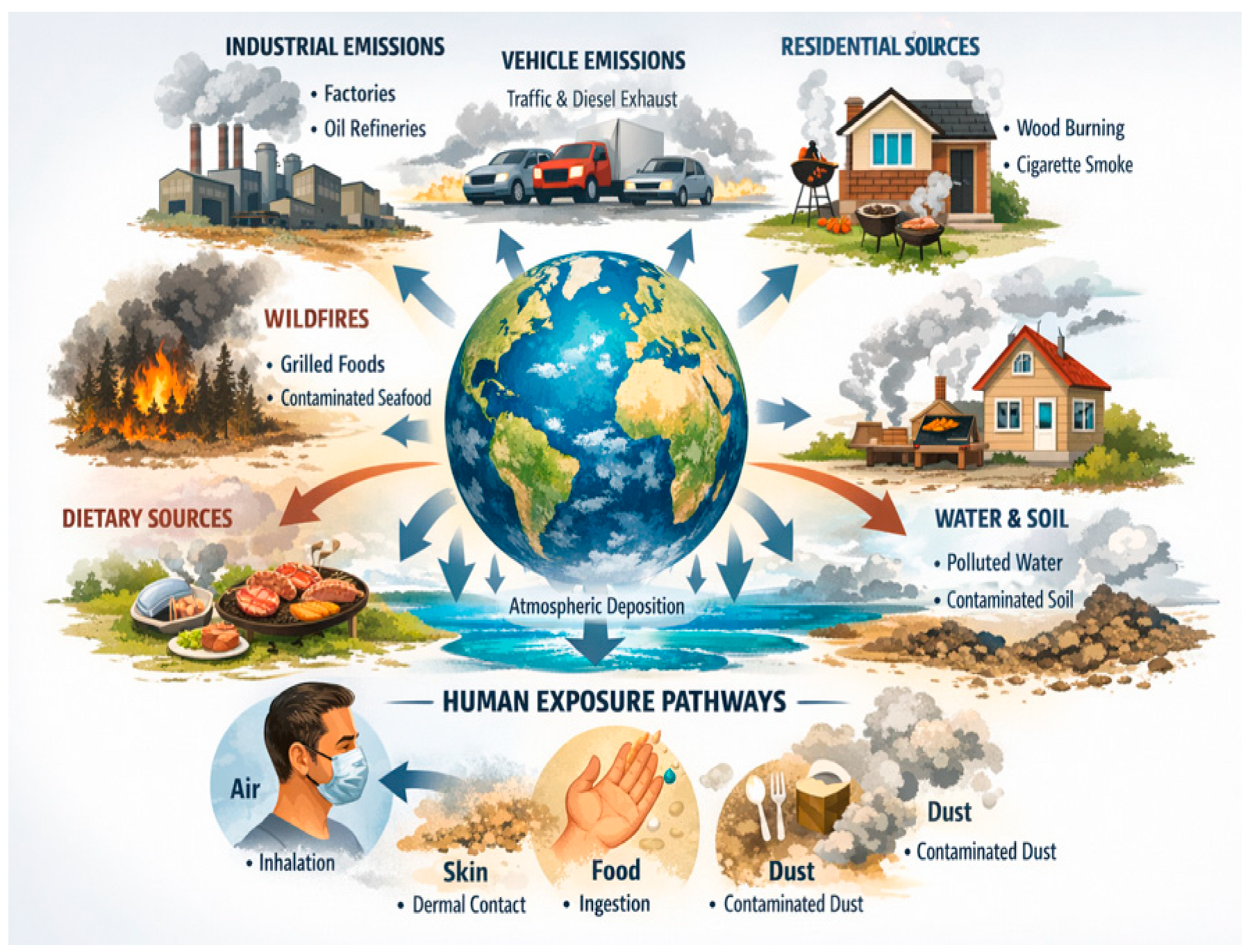
Figure 2.
Molecular Architecture of the Mammalian Circadian Clock System [19].
Figure 2.
Molecular Architecture of the Mammalian Circadian Clock System [19].
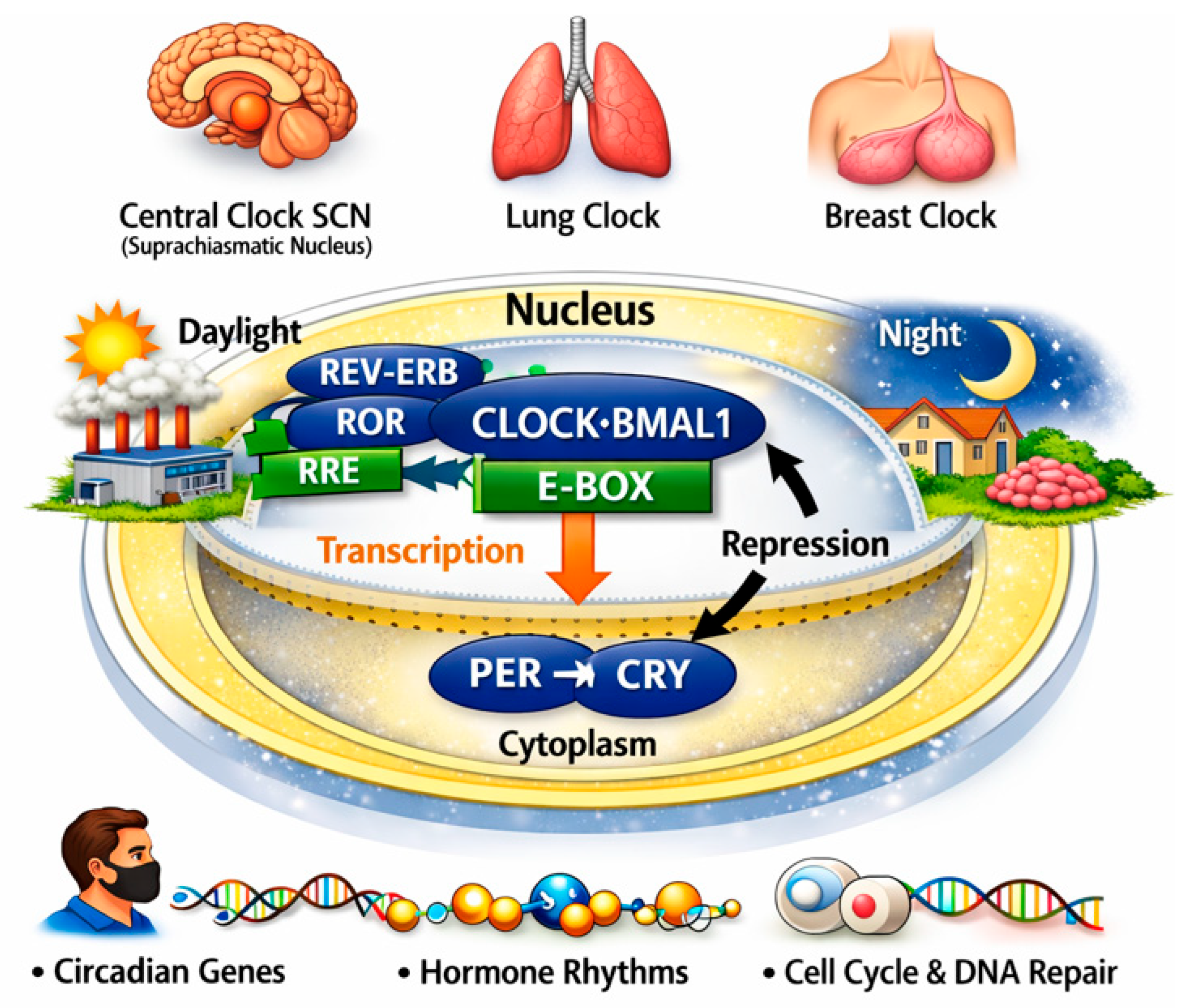
Figure 3.
Mechanistic model of PAH-induced circadian disruption via AhR–clock crosstalk [42].
Figure 3.
Mechanistic model of PAH-induced circadian disruption via AhR–clock crosstalk [42].
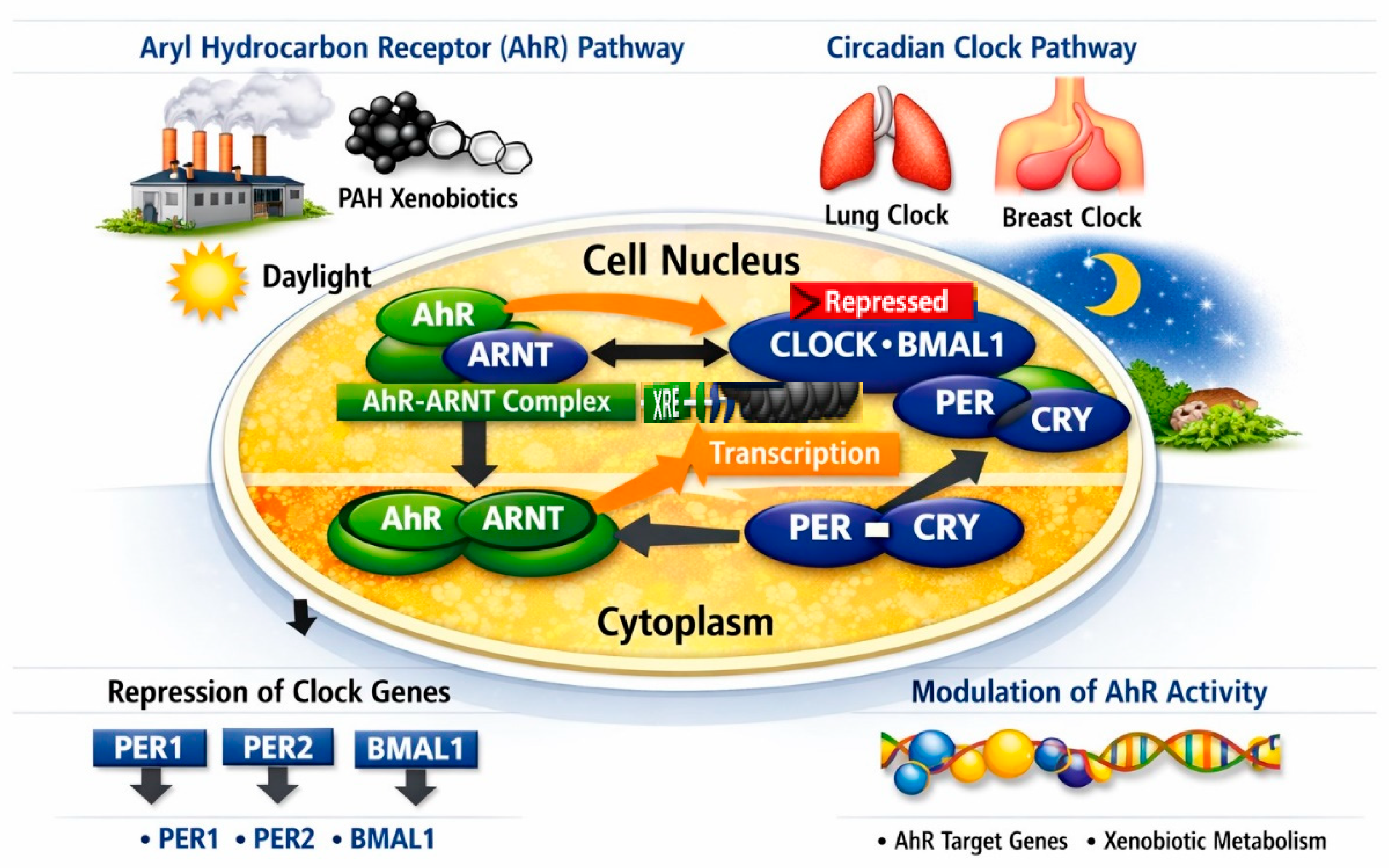
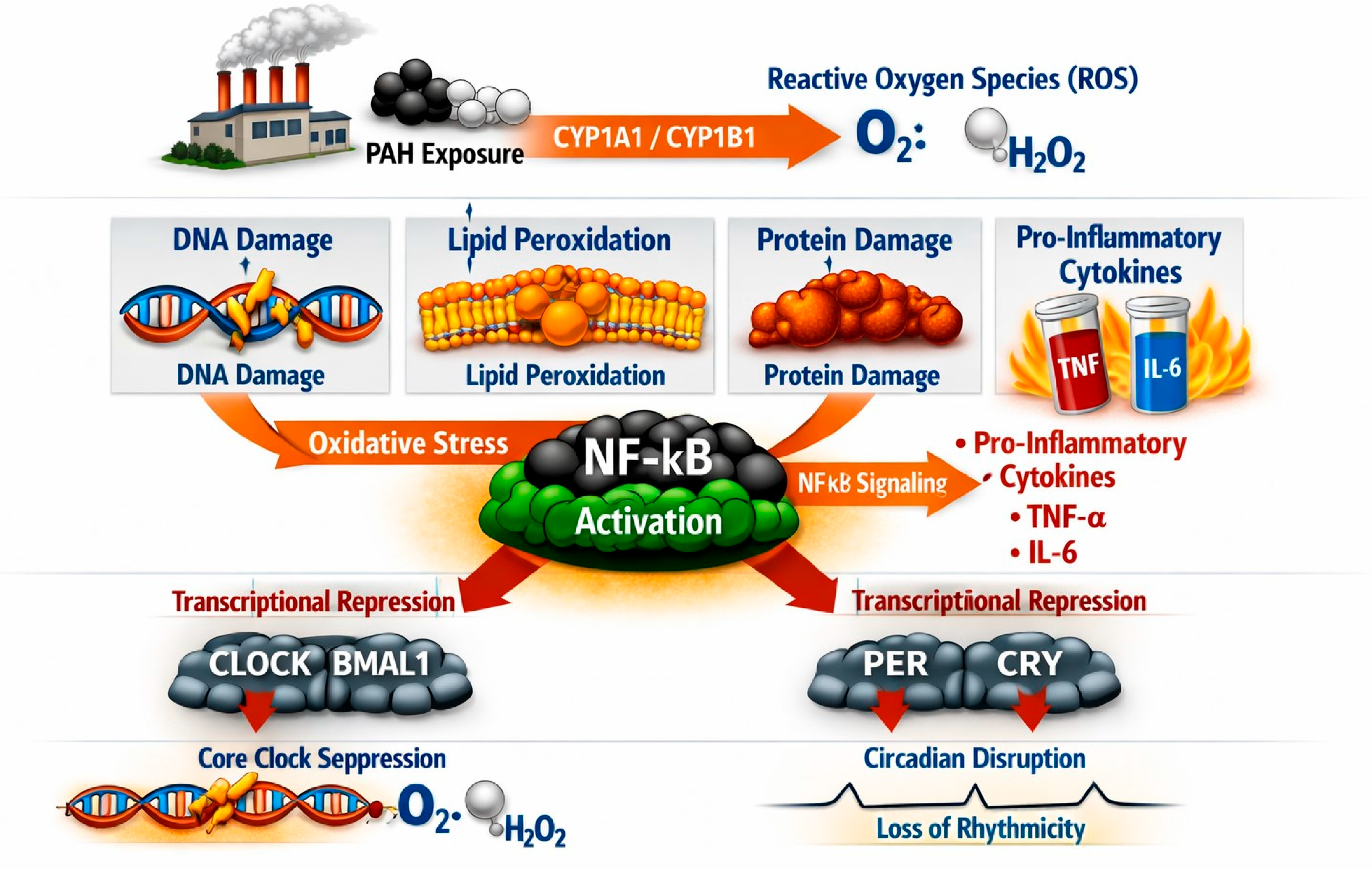
Figure 5.
Epigenetic Modulation of Circadian Clock Genes by Polycyclic Aromatic Hydrocarbons [66].
Figure 5.
Epigenetic Modulation of Circadian Clock Genes by Polycyclic Aromatic Hydrocarbons [66].
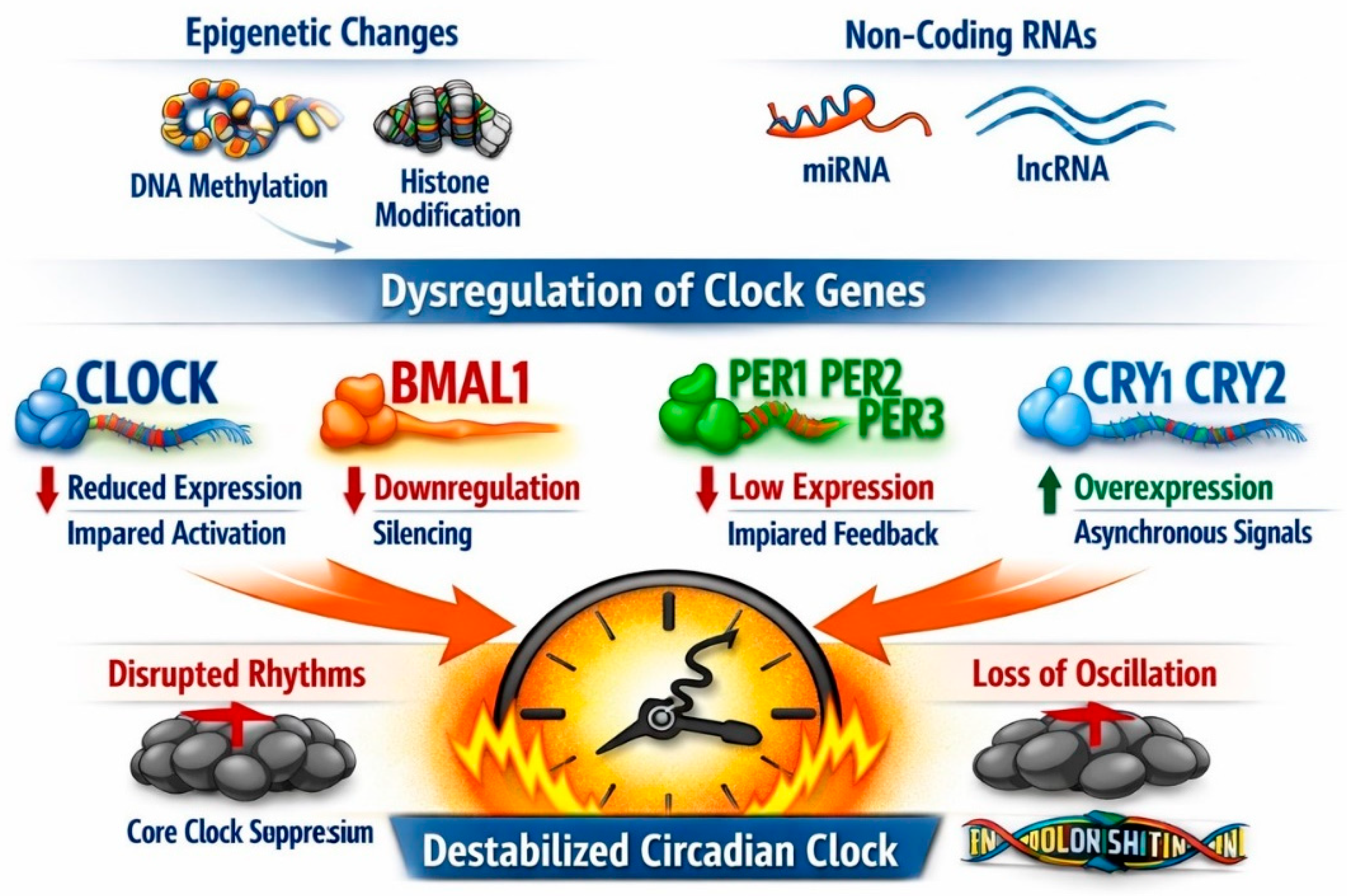
Figure 6.
Transcriptional Rewiring and Loss of Circadian Oscillation in Exposed Cells [104].
Figure 6.
Transcriptional Rewiring and Loss of Circadian Oscillation in Exposed Cells [104].
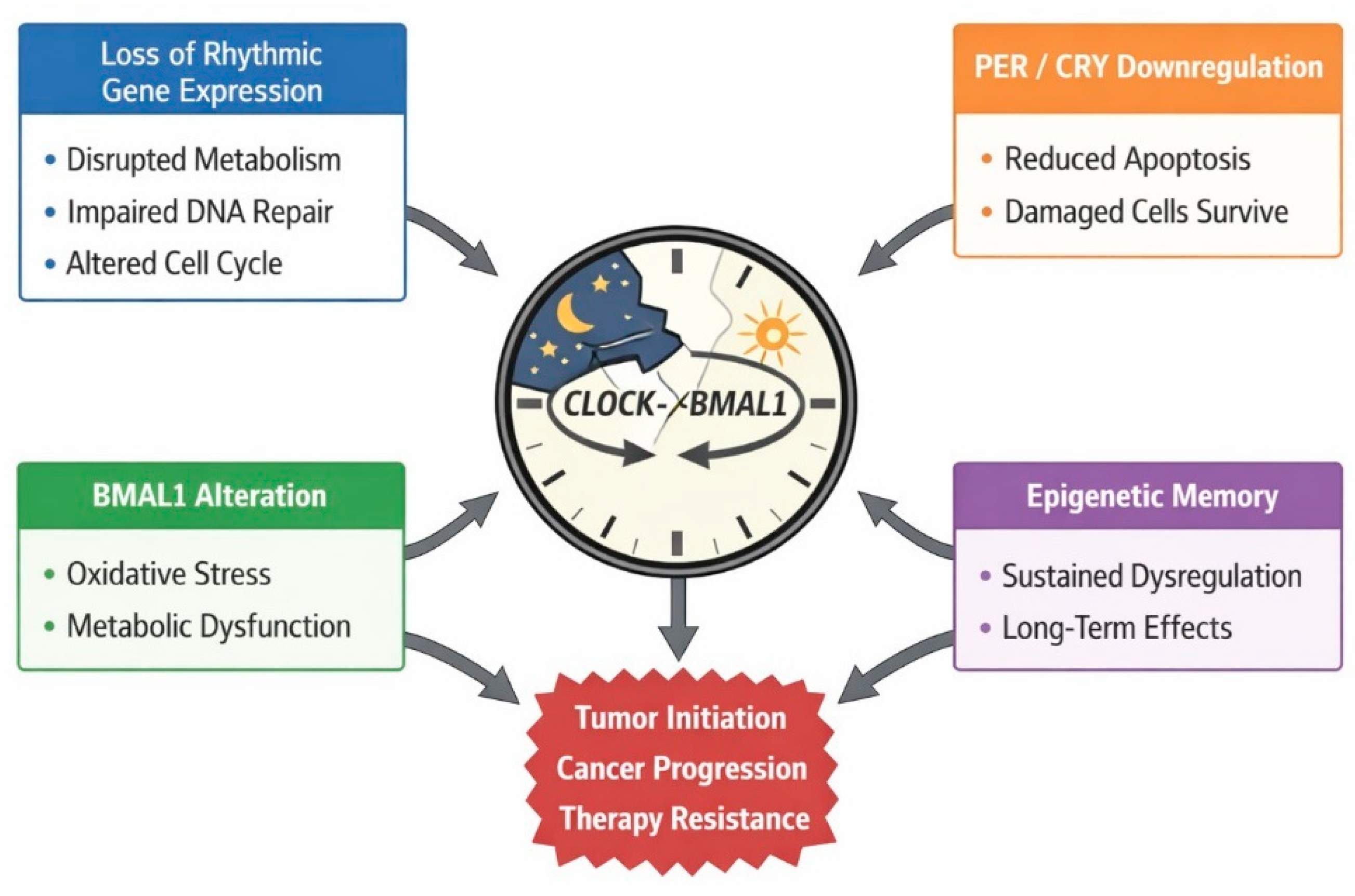
Figure 7.
Integrated Mechanistic Pathway Linking PAHs, Circadian Disruption, and Lung Carcinogenesis [14,34,101,122,141].
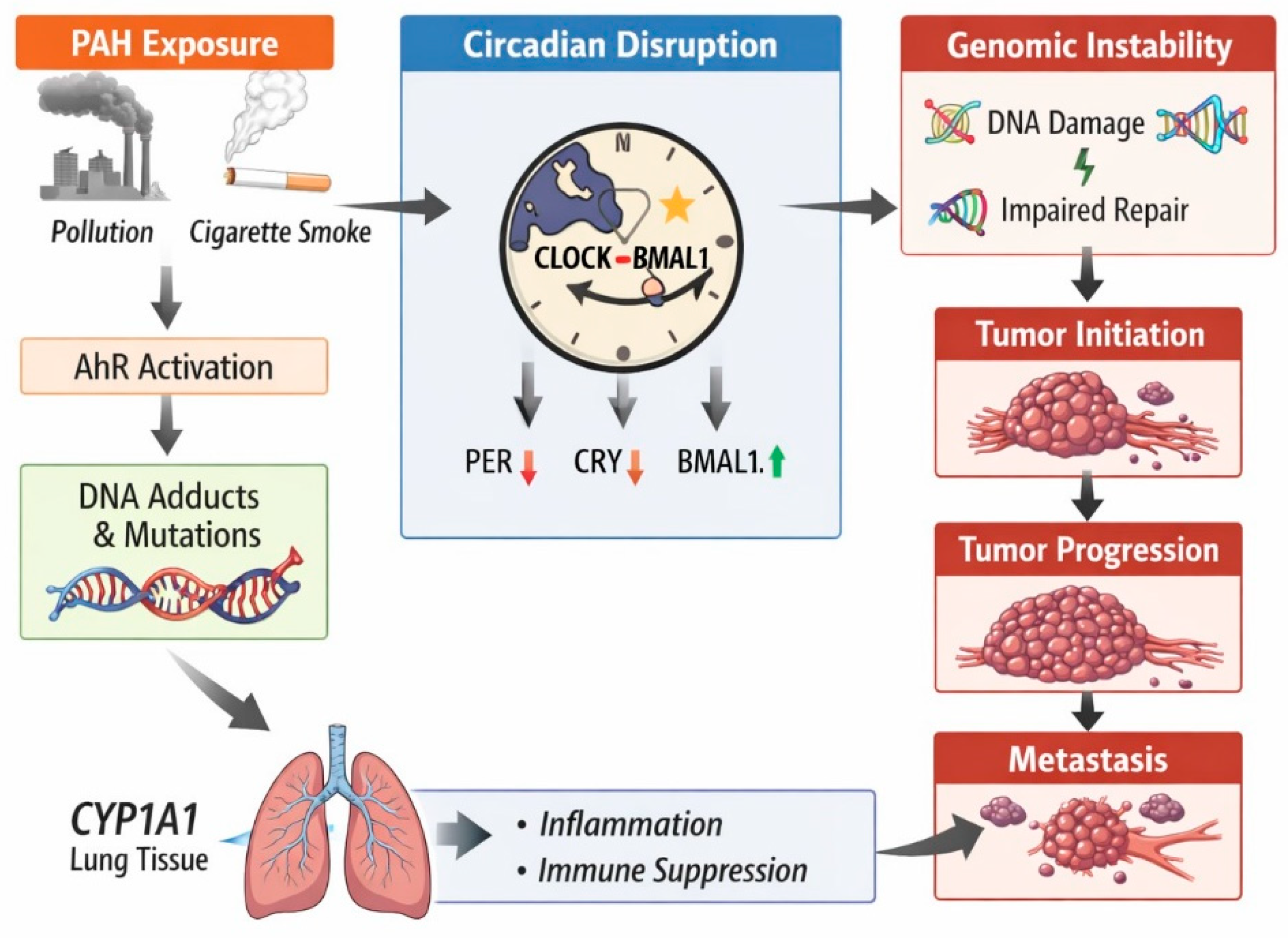
Figure 8.
Circadian Clock Dysregulation and Hormonal Signaling in Breast Cancer Development [38,107,113,117].
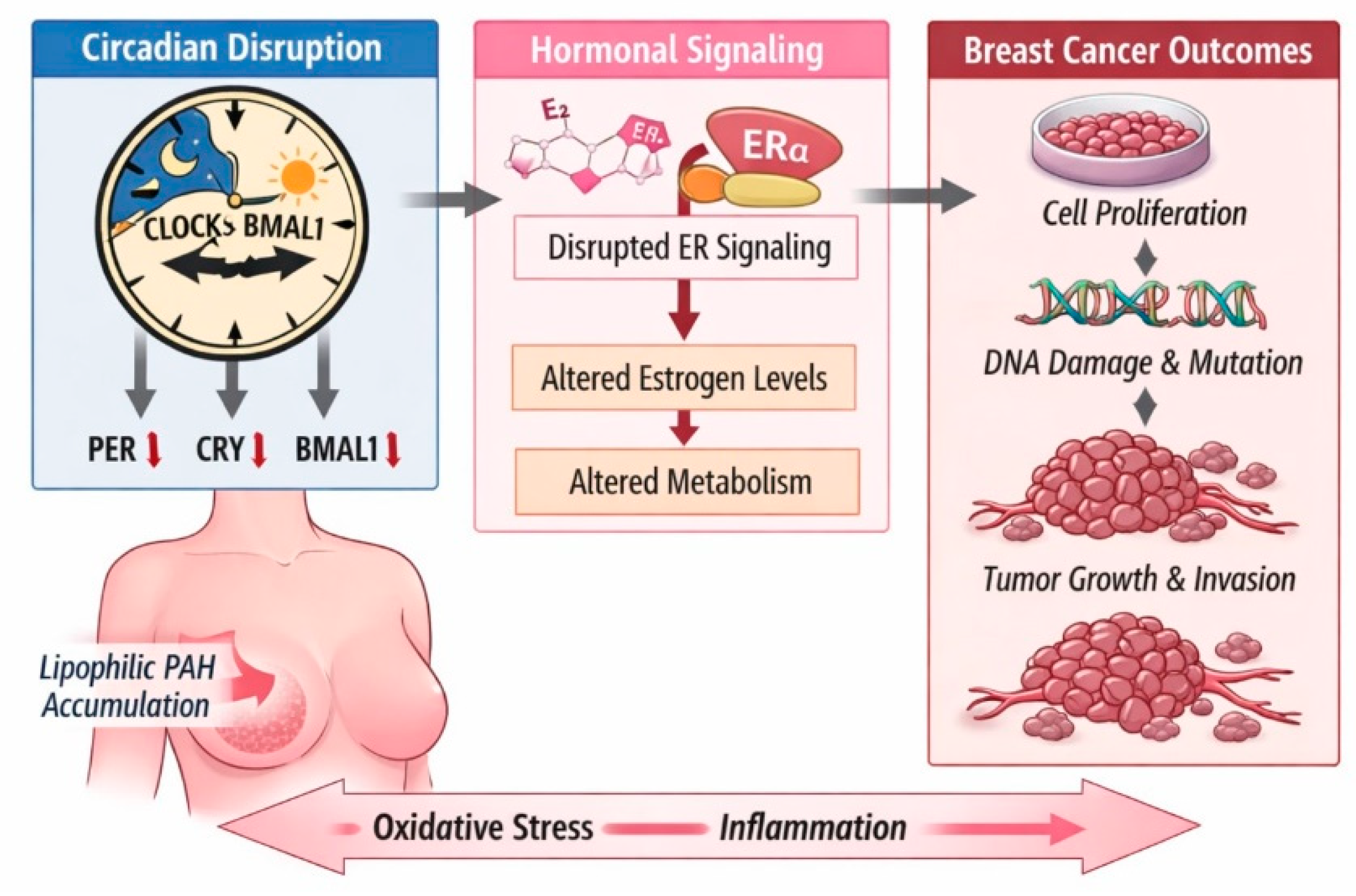
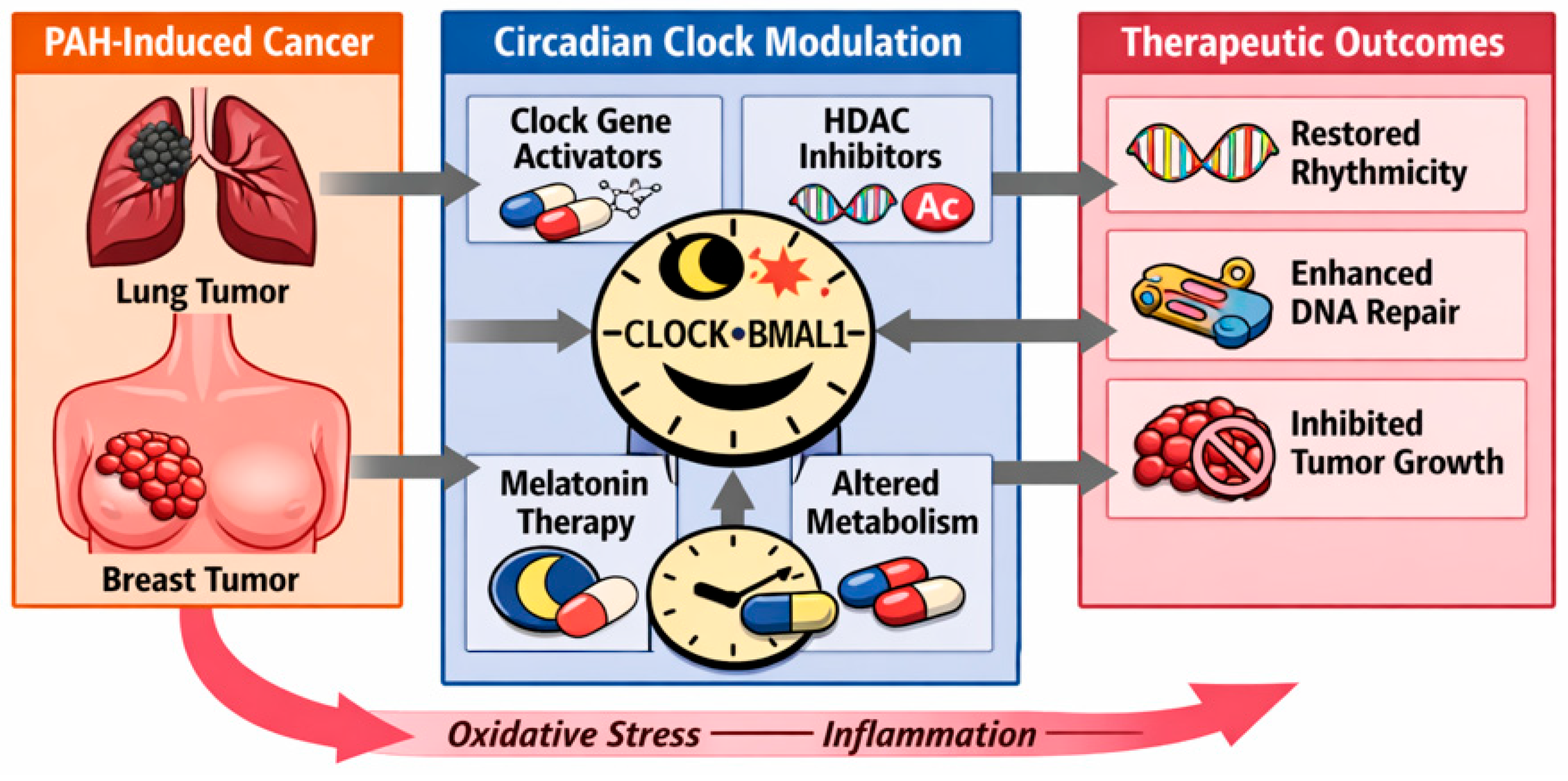
Table 1.
Major Sources, Exposure Routes, and Toxicokinetics of Polycyclic Aromatic Hydrocarbons [7,15].
| Category | Details | Examples/Mechanisms |
| Sources | Industrial emissions | Petrochemical plants, coke ovens |
| Combustion processes | Vehicle exhaust, biomass burning | |
| Tobacco smoke | Cigarette smoke | |
| Dietary intake | Grilled, smoked foods | |
| Exposure Routes | Inhalation | Airborne particulate-bound PAHs i.e. particulate matter (PM) |
| Ingestion | Contaminated food and water | |
| Dermal | Occupational exposure | |
| Absorption | Rapid uptake | Lung and gastrointestinal tract |
| Distribution | Lipophilic | Accumulates in fatty tissues |
| Metabolism | Phase I activation | CYP1A1, CYP1B1 via AhR pathway |
| Excretion | Phase II conjugation | (Glucuronidation, Sulphation and GSH conjugation). Excreted in urine and bile |
| Gene/Protein | Function | Physiological Role |
| CLOCK | Transcriptional activator | Initiates circadian gene expression |
| BMAL1 | Core regulator | Forms heterodimer with CLOCK |
| PER (PER1–3) | Negative regulator | Inhibits CLOCK:BMAL1 |
| CRY (CRY1–2) | Repressor protein | Maintains feedback loop stability |
| REV-ERBα/β | Nuclear receptor | Regulates BMAL1 transcription |
| RORα/β/γ | Nuclear receptor | Activates circadian gene expression |
| CK1ε/δ | Kinase | Controls protein stability and timing |
| Pathway | Key Components | Mechanism of Disruption | Effect on Circadian System |
| AhR Signaling | AhR, ARNT, CYP1A1 | Ligand activation and nuclear translocation | Alters transcription of clock genes |
| Transcriptional Crosstalk | CLOCK, BMAL1, PER, CRY | Competition for cofactors and DNA binding | Disrupts feedback loops |
| Oxidative Stress | ROS, CYP enzymes | Redox imbalance | Modifies clock protein function |
| Inflammatory Signaling | NF-κB, TNF-α, IL-6 | Cytokine-mediated transcriptional changes | Suppresses circadian gene expression |
| Epigenetic Regulation | DNA methylation, histones | Chromatin remodeling | Long-term alteration of rhythmicity |
| Temporal Dysregulation | Phase shift, amplitude loss | Desynchronization of oscillators | Arrhythmic gene expression |
Table 5.
Roles of Circadian Clock Gene Dysregulation in Lung and Breast Cancer Pathogenesis Adapted from Lee [98], Fortin et al. [124], Li et al. [125], Papagiannakopoulos et al. [126], and Guan & Lazar [127].
| Circadian Gene | Type of Dysregulation | Molecular Effect | Cancer Outcome |
| BMAL1/ARNTL | Downregulation | Reduced transcription of target genes | Increased proliferation, metabolic dysregulation |
| CLOCK | Functional alteration | Impaired transcriptional activation | Disrupted circadian rhythm, tumor growth |
| PER (PER1–3) | Downregulation | Loss of feedback inhibition | Genomic instability, reduced apoptosis |
| CRY (CRY1–2) | Downregulation | Impaired repression of CLOCK–BMAL1 | Enhanced tumor progression |
| REV-ERB | Dysregulation | Altered metabolic and inflammatory signaling | Tumor microenvironment changes |
| ROR | Dysregulation | Impaired circadian gene activation | Loss of rhythmic homeostasis |
Table 6.
Expanded Experimental and Epidemiological Evidence Linking PAHs, Circadian Gene Dysregulation, and Lung/Breast Cancer.
Table 6.
Expanded Experimental and Epidemiological Evidence Linking PAHs, Circadian Gene Dysregulation, and Lung/Breast Cancer.
| Study (Author) |
Model/ System |
PAHs / Exposure Contex | Circadian Gene / Pathway Affected | Molecular Effect | Cancer Type / Outcome | Key Findings |
| Schmitt et al. [146] |
Mouse mammary gland + breast cells | Benzo[a]Pyrene (BaP) | PER, BMAL1, CLOCK (AhR-linked) | Circadian regulation of metabolism and DNA adduct formation | Breast cancer initiation risk | BaP disrupts circadian-controlled metabolic pathways and enhances DNA adduct formation in mammary tissue |
| Chen et al. [147] |
Human NSCLC cohort | Smoking-related PAH exposure | EGFR, PIK3CA, OS9, MET, and STK11 mutations linked to the disruption of CLOCK genes |
Circadian genes disruption | Lung cancer progression | CLOCK overexpression associated with increased proliferation and poor prognosis |
| Hamouchene et al. [148] | MCF-7 breast cancer cells | BaP exposure | AHR–CYP1A1 axis (clock-related PAS pathway) | Cell cycle disruption + transcriptional reprogramming | Breast cancer progression | BaP activates AhR–CYP1A1 signaling leading to transcriptional reprogramming and proliferation changes |
| Koh and Pan [28] |
Lung cancer mechanistic review | Benzo[a]pyrene (BaP) | AhR–CLOCK/BMAL1 interaction | BMAL1 Dysregulation | Lung carcinogenesis | BaP-activated AhR disrupts circadian transcriptional machinery |
| Haberzettl [149] |
Human lung tissues | Air pollution (PAHs)/Diet/Light | BMAL1, CLOCK PER, CRY genes | Circadian genes Dysregulation | Lung cancer susceptibility | Chronic PAH exposure reduces circadian gene expression and increases pulmonary cancer risk |
| Tan et al. [121] | Hamster buccal mucosa | - | PER2 oscillation disrupted | Loss of rhythmic expression during tumor stages | Lung and Breast cancer (Head & epithelial cancer progression) |
Loss of PER2 rhythmicity correlates with tumor development and progression |
| Xu et al. [150] |
HBE-P35 (B[a]P-transformed bronchial epithelial cells) and A549 lung cancer cells; NSCLC patient tissues | Benzo[a]pyrene (B[a]P) exposure (air pollutant) | m6A RNA modification pathway (YTHDF1; indirect link to circadian-regulated translational control) | Upregulation of YTHDF1; m6A-dependent enhancement of CDK6 and MAP3K6 translation; regulation by miR-139-5p | Lung cancer | B[a]P induces malignant transformation and increases m6A levels; YTHDF1 is overexpressed in NSCLC and correlates with poor survival; YTHDF1 promotes tumor progression by enhancing translation of CDK6 and MAP3K6, while miR-139-5p negatively regulates YTHDF1 |
| Schernhammer et al. [151] | Women Nurses | light exposure during night shift (PAH proxy exposure) | Melatonin downregulation | Chronic circadian and melatonin production disruption | Increased breast cancer risk | Chronic circadian disruption from night work increases breast cancer incidence risk |
| Abdul Bari and Samuel [152] |
Literature review / mechanistic synthesis | Environmental carcinogens (smoking, UV radiation, alcohol, oxidative stress-related exposures including PAHs) | Circadian clock network and redox-regulated pathways | Circadian disruption increases ROS generation, oxidative stress, transcriptional remodeling, and metabolic dysregulation | Multiple cancers including lung cancer | Circadian dysregulation and oxidative stress act synergistically to promote cancer initiation, progression, and malignant transformation through shared molecular pathways involving redox imbalance and altered cellular metabolism |
| Hansen [38] | Epidemiological study | Shift work + environmental toxins | PER, CRY suppression | Chronodisruption | Breast cancer risk increase | Night work shift is strongly associated with increased breast cancer risk |
| Gao et al. [153] |
LUAD patient cohorts (TCGA, GSE72094 datasets) | - | Multigene circadian clock signature (5 DEGs) | Differential expression associated with cell proliferation, DNA repair, and immune pathways | Lung adenocarcinoma (LUAD) prognosis | A five-gene circadian signature independently predicts overall survival; high-risk patients show significantly reduced survival, suggesting circadian genes as prognostic biomarkers and therapeutic targets |
| Zhang et al. [154] |
Meta-analysis of 36 studies (7,476 cancer cases) | - | PER1, PER2, PER3, CRY1, CRY2, BMAL1, NPAS2, CLOCK | Low expression of PER1, PER2, and NPAS2 associated with poor differentiation, advanced stage, and metastasis | Lungs/Breastcancer | Reduced PER1 and PER2 expression correlates with poor prognosis and survival; circadian gene downregulation serves as a negative prognostic biomarker in cancers |
| Blakeman et al. [155] |
Human breast cancer review | Environmental circadian disruption | BMAL1, PERs, CRYs, CLOCK | Altered rhythmic expression | Breast cancer progression | Reduced expression circadian clock genes is linked to tumor aggressiveness |
| Papagiannakopoulos et al. [126] |
Mouse tumor model | Circadian disruption + carcinogens | BMAL1, PER2 | Tumor suppression loss | Lung tumor promotion | Loss of BMAL1/PER2 enhances tumor growth and metabolic dysregulation |
| Filipski et al. [156] | Mouse tumor model | Circadian disruption | Host circadian clock genes | Altered tumor growth timing | Solid tumor progression | Timing of circadian disruption significantly alters tumor growth rate |
| Yoshida et al. [157] |
Lung cancer cell lines (NSCLC & SCLC), patient tumor tissues | - | TIMELESS (TIM; circadian-associated gene) | Overexpression; promotes proliferation, clonogenic growth; inhibits apoptosis | Lung cancer (NSCLC & SCLC) progression | TIMELESS is markedly overexpressed in lung cancer and correlates with poor survival; its knockdown suppresses tumor growth, indicating diagnostic, prognostic, and therapeutic relevance |
| Gery et al. [158] |
human cancer cells | Circadian gene disruption and apoptosis | PER1 | Dysregulated expression of cell cycle regulators | Cancer progression | Circadian rhythms are closely linked to essential cellular processes, supporting the hypothesis that disruption of core clock genes may contribute to cancer development |
| Gery et al. [132] |
Breast cancer cell lines | Endogenous + hormonal (ER signaling influenced by environmental factors) CLOCK–BMAL1 interference |
PER2 | Tumor suppressor downregulation | Breast cancer | PER2 acts as tumor suppressor; its loss enhances cell proliferation |
| Brady et al. [159] |
Lung adenocarcinoma samples | Environmental carcinogens | ARNTL2 (BMAL family) | Upregulation | Lung cancer metastasis | ARNTL2 promotes invasion and metastatic potential |
| Sahar & Sassone-Corsi [160] | Molecular study | General carcinogen response | CLOCK–BMAL1 axis | Transcriptional dysregulation | Cancer susceptibility | CLOCK–BMAL1 regulates metabolic and proliferative genes relevant to cancer |
| Zhang et al. [161] | Review of Non-Small Cell Lung Cancer (NSCLC) clinical and molecular studies |
Environmental pollutants | PER1-3, CRY, TIMELESS BMAL1/ ARNTL-1, CLOCK, ROR, DEC, NR1D1(REV-ERB) | Dysregulated expression (mostly downregulated PER/CRY) | Lung cancer progression | Circadian gene dysregulation is strongly associated with NSCLC progression |
| Sancar et al. [101] |
Mammalian cells | Environmental toxins and light exposure | PER, BMAL1, CLOCK, CRY | Impaired DNA repair timing | Cancer risk | Circadian system regulates DNA repair efficiency and genomic stability |
| Wang et al. [162] | Mouse models, cell culture, and human cancer systems | lifestyle factors such as PAHs exposure, shift work, jet lag, and sleep deprivation | Core circadian clock genes (CLOCK, BMAL1, PER, CRY) and oncogenic signaling pathways | Disruption alters metabolism, immune response, and cell proliferation via circadian misalignment | Multiple cancers including lung and breast cancer | Circadian disruption contributes broadly to tumor initiation and progression |
| Zhu et al. [163] | Review article (tumor biology, metabolism, immunology) | Circadian rhythm disruption (shift work, jet lag, lifestyle factors) | Core circadian clock genes (CLOCK, BMAL1, PER, CRY) | Dysregulation affects tumor metabolism, immune surveillance, and cell proliferation | Multiple cancers including lung cancer relevance | Circadian rhythm disruption promotes tumorigenesis by altering metabolism, immune response, and cell cycle regulation; clock genes play a central role in tumor progression and response to therapy |
| Savvidis & Koutsilieris [122] | Molecular review (Human and animal models) | Painting and Firefighting (form of PAHs exposure)/ night-shift workers | PER1, PER2, CRY2, BMAL1 | Apoptosis inhibition | Breast and lung cancer | Loss of PER2 and BMAL1 promotes cell survival and tumor growth |
| Savvidis et al. [164] | Review article (endocrine tumor systems) | Circadian disruption (shift work, lifestyle factors; indirect environmental exposure) | PER genes, CLOCK, BMAL1, CRY, and broader circadian network | Dysregulation affects cell cycle control, DNA repair, metabolism, immune response, and tumor microenvironment | Multiple endocrine-related cancers (breast, ovarian, prostate, thyroid, adrenal, pituitary) with relevance to lung cancer mechanisms | Circadian disruption contributes to tumor initiation and progression through regulation of metabolism, immune function, and DNA repair; PER and CLOCK genes influence tumor growth, drug resistance, and prognosis; chronotherapy proposed as a therapeutic strategy |
| Albrecht [165] | mammalian circadian system | Xenobiotic exposure (light and food) | CLOCK-BMAL1, PER and CRY | Transcriptional suppression | Cancer initiation | Xenobiotics interfere with CLOCK/BMAL1 transcriptional activity |
| Salminen [6] |
Mechanistic review | Environmental toxicants | AhR–circadian (BMAL1-CLOCK) interaction | Crosstalk disruption, DNA methylation and age-related tissue degeneration | Cancer susceptibility | AhR directly interacts with circadian machinery disrupting rhythmicity |
| Kim et al. [9] | Environmental health study | PAH exposure | Indirect circadian effects | Oxidative stress + DNA damage | Lung cancer risk | PAHs induce oxidative stress contributing to DNA damage and cancer risk |
| Boström et al. [8] | Toxicology review focusing human model | PAHs (BaP, DBA, BbF, BkF, IP, DBalP) | Circadian-linked metabolism enzymes | DNA adduct formation | Carcinogenesis (Lungs and Breast) | PAHs form DNA adducts leading to mutation and cancer initiation |
| Blask et al. [166] |
Human model | Light-at-night + environmental toxins | Melatonin–CLOCK axis | Hormonal circadian disruption | Breast cancer progression | Disrupted melatonin signaling enhances tumor growth and progression |
| Giatromanolaki et al. [167] | Lung cancer tissues | Environmental stressors | DEC1 | Downregulation | Lung cancer progression | Loss of DEC1 associated with poor tumor differentiation |
| Thorp [168] |
Human + molecular analysis | environmental toxins ad nocturnal light | Melatonin supression | Circadian and hormonal disruption | Breast cancer | Loss of circadian gene oscillation correlates with cancer progression |
| Mitchell & Engelbrecht, [169] | Breast epithelial & cancer cells (cell culture) |
Chemotherapeutic stress (circadian relevance) | PER2 | Silencing enhances chemoresistance | Breast cancer | Investigate the function of Per2 in normal breast epithelial cells (MCF-12A) and ER-negative breast cancer cells (MDA-MB-231), as well as to assess its involvement in doxorubicin-induced cell death. PER2 modulates DNA damage response and apoptosis; reduced expression increases survival of cancer cells |
| Xiang et al. [170] |
Human NSCLC tissues | Environmental carcinogen exposure (PAH-related) | PER2 | Downregulation | Lung cancer metastasis | Reduced PER2 expression correlates with metastasis and advanced tumor stage |
| Lesicka et al. [171] | Human breast cancer patients | Environmental + genetic (circadian SNPs linked to exposure risk) | BMAL1, PER1, PER2, CRY2 | Altered expression & polymorphisms | Breast cancer | Circadian gene polymorphisms (PER, CRY, BMAL1) are associated with increased breast cancer susceptibility |
| Zienolddiny et al. [172] | Epidemiological (Norwegian nurses working night shifts) | Circadian disruption (proxy for environmental exposure) | Multiple clock genes | Gene–environment interaction | Breast cancer | Circadian gene variants increase susceptibility to breast cancer under environmental/circadian stress |
| Matsumoto et al. [173] |
Lung epithelial cancer cells | PI3K/PTEN dysregulation (environmental carcinogenesis link) | BMAL1 | Upregulation via oncogenic signaling | Lung cancer progression | BMAL1 upregulation contributes to tumor cell survival and proliferation |
| Rabstein et al. [174] | Case–control in night shift workers (GENICA study) | Circadian disruption + environmental exposure | Clock genes (PER, CRY, others) | Genetic polymorphisms | Breast cancer | Interaction between circadian gene variants and environmental factors contributes to breast cancer risk |
| Lin et al. [175] | Human lung carcinoma tissues | PAH exposure (AhR activation) | AhR (circadian-related PAS protein family) | Upregulation | Lung cancer | AhR is overexpressed in lung tumors, linking PAH exposure to carcinogenesis and circadian-related signaling pathways |
| Mihelakis et al. [176] | Human breast cells (mechanistic study) | AhR activation by environmental pollutants (PAH-like) | AhR + circadian-regulated genes | Circadian-dependent transcriptional activation | Breast cancer | AhR target gene induction is under circadian control, linking toxicant exposure to circadian dysregulation |
| Huang et al. [177] |
Rat liver & pituitary (in vivo) | Xenobiotic metabolism (PAH-related pathway) | AHR, ARNT, PER2 | Opposing rhythmic expression | - | Demonstrates molecular overlap between AhR signaling and circadian gene PER2 regulation |
| Ha et al. [178] | Breast cancer models (ER-negative) | Circadian gene-driven metastasis | ARNTL2 (BMAL family) | Upregulation promotes metastasis | Breast cancer | ARNTL2 identified as a metastasis susceptibility gene in breast cancer |
| Letelier et al. [86] | Review of human, cellular, and environmental exposure studies | Atmospheric PAHs and air pollution | miRNAs (non-coding RNAs; epigenetic regulators linked to circadian and inflammatory pathways) | Altered miRNA expression regulates inflammation, gene expression, and tumor-related pathways | Lung inflammation and lung cancer | PAH exposure modulates miRNA expression, contributing to inflammation and lung carcinogenesis; miRNAs show strong potential as biomarkers of environmental exposure and early cancer detection |
Disclaimer/Publisher’s Note: The statements, opinions and data contained in all publications are solely those of the individual author(s) and contributor(s) and not of MDPI and/or the editor(s). MDPI and/or the editor(s) disclaim responsibility for any injury to people or property resulting from any ideas, methods, instructions or products referred to in the content. |
© 2026 by the authors. Licensee MDPI, Basel, Switzerland. This article is an open access article distributed under the terms and conditions of the Creative Commons Attribution (CC BY) license (http://creativecommons.org/licenses/by/4.0/).
Copyright: This open access article is published under a Creative Commons CC BY 4.0 license, which permit the free download, distribution, and reuse, provided that the author and preprint are cited in any reuse.