

Submitted:
01 June 2026
Posted:
03 June 2026
You are already at the latest version
Abstract
Many models exist to describe the nature of sloshing, an intricate phenomena, including the linear mechanical model and the Duffing oscillator. This paper attempts to provide an alternative model that describes the maximum slosh wave height (MSWH) of different sloshing liquids, to more accurately predict the nuanced phenomena as well as to better understand the inherent nature of sloshing. We explore three different models, the classical linear mechanical model, the non-linear Duffing model and finally the novel fractional visco-elastic model. The latter illustrates promising results after being validated via experimentation. The paper leads to the conclusion that sloshing of liquids, particularly low-viscosity fluids, is better described to have a spectrum of fractional-order visco-elastic forces at near and post resonant excitation frequencies rather than independent viscous and elastic forces as assumed by the linear and non-linear mechanical models.
Keywords:
sloshing
; fractional calculus
; visco-elastic model
; linear mechanical model
; non-linear mechanical model
; Duffing oscillator
1. Introduction
Sloshing is a naturally occurring phenomenon that takes place when a container, partially filled with a liquid, experiences horizontal or vertical excitations. This can be observed in situations, including liquid rocket fuel tanks during lift off or tanker lorries when accelerating, to name a few. The effect of sloshing may appear to be minimal, but in worst cases, when the frequency of periodic excitations matches the natural frequency of the sloshing system, it can lead to disasters due to resonance, such as, losing control over tanker lorries when applying brakes. Hence, it is important to find these frequencies to ensure the working frequency of the system is below the sloshing natural frequency to avoid such incidents. For example, the liquid fuels on NASAs space vehicle Saturn V have a fundamental slosh frequency of 0.3–0.4Hz [1]. Considering a safety factor, the vehicle was designed to work at a frequency of 0.16Hz, thus being able to safely lift off without resonant sloshing [1].
The maximum slosh wave height, hereinafter MSWH, of the liquid also pertains significance, particularly in the context of designing tanks to carry liquids safely, ensuring vehicle stability, predicting overflows or spillovers and in the design of baffles or anti-slosh devices. Presently, the most popular methods used by engineers to compute the MSWH include computational fluid dynamics (CFD) or smoothed particle hydrodynamics (SPH), two resource- and time-intensive tasks, a major setback for engineers. Hence, there is the need for a fast, simple and precise model to predict MSWH and thereby reduce design time and cost.
During the rapid development of rockets, with increased caution and focus on stability, the necessity to develop simple models to predict sloshing had arisen. Previous models based on fluid dynamics, derived from Navier-Stokes equations required excessive computational power at the time, emphasising the need for simpler models. Authors, including Abramson et al. [1] and Vikas Sharma et al. [2], have endeavoured in depth into studies of sloshing equivalent mechanical models, including multi-degree of freedom models, in the context of rocketry. However, there still remain opportunities to study the use of equivalent non-linear mechanical models, due to the inherent non-linear nature of sloshing.
Adding on, authors such as Y. Kim and Makoto et al., have used models from fluid dynamics to numerically simulate sloshing in 2D and 3D, both in the context of cargo in freight [3,4]. Kim additionally investigated the effect of load impact on sloshing, which results in forced excitation [3], and Makoto et al. particularly examined how LNG carrier tank’s length-to-breadth ratio impacted sloshing. In the 2011 paper, Rafiee et al. investigated liquid sloshing using numerical methods, including SPH, and verified them experimentally in a very similar setup to the one presented in this paper [5]. While the results from both papers generally show agreement, their simulations may be viewed as resource-intensive.
Many have also explored the reliability of stochastic models in sloshing, including Fillon et al. and Cetin et al. [6,7]. However, the caveat of these approaches is that they require a lot of data before being statistically fitted. For example, Fillon et al. required 480 hours of sloshing data to construct their model [6].
Recently, the use of fractional calculus in modelling natural phenomena, arising particularly in engineering disciplines, has gained a lot of interest, especially because it seems to explain many anomalies arising in traditional models. For example, Riewe was among the first to apply fractional calculus to model non-conservative forces like friction, which appeared to improve predictions over the Lagrangian and Hamiltonian mechanics [8]. In liquid dynamics, a spring-mass-damper system is often used as a model for sloshing. P. Stinga, in his survey of the applications of fractional calculus, argues that not all fluids return to their original shape nor deform indefinitely, as assumed by the elastic and viscous terms in the classical models [9]. This makes fractional models promising, because they can predict behaviour of materials with memory [9]. As opposed to the traditional spring-mass-damper system the concept of a spring-pot was introduced and tested by many author’s, including Pirrota et al., in the context of FEM analysis [10]. Authors like R.C. Koeller were the first to propose the use of fractional calculus to model visco-elastic behaviour [11], and authors like F.C. Meral et al. [12] were among the first to verify such models experimentally. It is, thus, clear that while classical mechanical models use ordinary differential equations to govern the laws of motion, there is no need to restrict oneself with integer-order calculus if nature is intrinsically fractional. This means that one could replace the time-derivative in evolution equations with fractional derivatives, as done by Riewe [8]. Previously, authors like Matteo et al. [13] have modelled U-tube Tuned Liquid Column Damper (TLCD) using fractional calculus, as existing integer-order differential equations do not accurately predict liquid motion [13]. However, there still exists room for the application of fractional models to more general container geometries. Other related works, such as the one by Spanos and Evangelatos, have pointed out that changing the degree of the fractional derivatives in the fractional differential equation can alter the resonant frequency and degree of damping [14], which gives potential to modelling frequency-response of various liquids, particularly near-resonant behaviour, with fractional calculus.
In this paper, a comprehensive study of linear, non-linear and fractional mechanical models, with which MSWH can be calculated or computed, will be assessed and validated with experimental results. The domain of the paper will be restricted to a horizontally excited vertical cylindrical tank, although similar methods can be used for various different orientations and geometries. The different methods will be compared and contrasted with one another to find an ideal method to predict the MSWH at particular frequencies. We first derive the solutions to the linear, non-linear mechanical, and finally fractional models. Then, we present experimental data (setup similar to [3] and [5]) across five liquids with different viscosities and proceed to compare the three models with each other.
2. Linear Mechanical Model
We may assume sloshing exhibits a pattern analogous to that of a single degree of freedom spring-mass-damper (SMD) system, a system forming a mechanical model often used to emulate a vibrating system. Sloshing is similar to a SMD system as both approximately exhibit similar harmonic response to forced oscillations, resonance phenomena, damping effects and phase lag between oscillations and response [1,2]. Figure 1 illustrates how a sloshing liquid can be modelled by a SMD system.
As the container oscillates from left to right by some forcing function , the liquid begins to form peaks, whose maximum is the MSWH. The model attempts to capture this behaviour by splitting the liquid into two masses: the passive mass that remains static during sloshing and the active mass that shifts positions, forming the peaks. By meticulously adjusting the spring stiffness and damping coefficient, the model can be used to predict the MSWH of the liquid at particular frequencies.
By applying Newtons Second Law to Figure 1, the equation of motion can be found.
The expression can be simplified by using the natural frequency of the sloshing system and the damping ratio .
For the scope of this paper, we assume the sloshing liquid is an underdamped system, wherein and when let to oscillate freely, the liquid oscillates at its natural frequency and comes to a stop gradually. Only for a minority of certain liquids with very high viscosity, the system may behave as an overdamped system, where . Nonetheless, for an underdamped system, the steady state solution to (1) as a function of time is,
where is the magnification factor and is the phase lag, given as [15],
Maximising will give the MSWH.
Note, the frequency ratio is given by . This equation can be validated using experimentation.
3. Non-Linear Mechanical Model
Sloshing is inherently a non-linear phenomena. The non-linearities arise due to liquid compressions, change in centre of gravity and many more [16,17]. As a result, the use of a non-linear mechanical model may be better suited to simulate a sloshing system. The non-linear model is simply a perturbed version of the equation of motion (1), by a non-linear term . A schematic is illustrated in Figure 2
This form, otherwise known as the Duffing oscillator, can be solved using the harmonic balance method. It has a general steady-state solution of the following approximation [18].
where is the phase lag and A is the solution to the following amplitude expression [18],
The MSWH is thus given by maximising (3), i.e.
which can be found by solving (4). For A is the solution to a polynomial function, simple numerical methods, such as Brent’s method or Newton-Raphson’s method, can be used to find the roots.
4. Fractional Model
The fractional derivative has many definitions, including the most well-known Riemann-Liouville, and Caputo derivatives, that has many applications in Physics and Engineering. However, since we are working with periodic functions (as the vertical displacement of the mass is periodic), it is quite natural that the best suitable fractional derivative for this model should be based on differentiation on the Fourier space. The following is the definition of the fractional derivative, which works well with the Fourier transform [19].
Definition 1.
(Fractional Derivative via Fourier Transform) For all real functions with ,
These definitions were used by many author’s when solving differential equations. In his 2020 paper, Bagarello specifically analyses this Fourier definition of the fractional derivative on functions in and its applications to quantum mechanics.
We are particularly interested in the fractional derivative of elementary trigonometric functions, which can easily be derived with the Fourier transform definition of the fractional derivative [21,23].
Previously, the non-linear mechanical model modelled the liquid as a perfect SMD system with non-linearities. However, this is often an oversimplification of nature, for which we shall consider the cases of liquids exhibiting both viscous and elastic properties. There are altogether many ways one could use fractional derivatives to model this behaviour, but provided is the specific model that most closely resembles the experimental results obtained.
4.1. Fractional Visco-Elastic Model
The model to be considered assumes the liquid behaves in a hybrid manner; it shows semi-elastic and semi-viscous properties, along with some extent of memory [11]. While we normally use the null-th time-derivative to represent a spring, and the first time-derivative to represent a damper, we use the fractional derivative to represent a spring-pot. We choose some , and use the fractional th order derivative to model visco-elastic behaviour.
Here we let be an unknown arbitrary function, wherein we substitute for . We now assume the solution takes form , since we know that x is a periodic function. Solving equation (5), and collecting the sin and cos terms, we get the system of equations
The model has been solved by fitting the data for a and b, by converting the above into a system of linear equation,
The solution to this model is illustrated in the following figures, and includes experimental data for water, sunflower oil, rapeseed oil, engine oil and honey (see Figure 3).
5. Experimental Validation
5.1. Slosh Rig Setup
An upright cylinder was setup on a horizontal shake table, as illustrated on Figure 4. The frequency of the shake table was varied and the corresponding MSWH was measured by video footage and frame-by-frame analysis.
5.2. Experimental Parameters
Table 1 lists the parameters of the experiment and the setup. The liquids used in the experiment include water, sunflower oil, rapeseed oil, engine oil and honey.
5.3. Results
Figure 3 displays the frequency-response curves for the various liquids.
6. Conclusions
In this paper, a shake table attached to a motor was designed to convert angular motion into linear harmonic motion that drives the sloshing in an upright cylindrical container. We strive to determine the maximum slosh wave height (MSWH) by observing and making measurements utilising camera footage. Various models were fitted, including the linear, non-linear (Duffing) and fractional mechanical models.
The results presented in this paper show clearly that each model is successful in its own ways, and that neither can be classified as superior to one another. Regarding the fractional visco-elastic model, the relaxation constant or memory parameter, which is related to the order of the fractional derivative, for the visco-elastic fluids should be in the range 0.05-0.35, as suggested by Koeller [11]. This matches the results presented in this paper, ranging from 0.19-0.35.
Overall, both the Duffing and fractional models elicit greatest accuracy at resonance and post-resonance frequencies. More specifically, for water, sunflower oil, engine oil and honey, the fractional visco-elastic model presents a nearly perfect fit for post-resonance frequencies, making it generally a useful model to predict post-resonance MSWH. However, the fractional visco-elastic model tends to diverge away from experimental results at the lower sub-resonance frequencies.
Nevertheless, the behaviour of all the liquids near and post resonant driving frequencies is very close to the fractional model. A possible extension would be to explore how well the fractional model can predict the liquid response at frequencies higher than resonance. Furthermore, one could explore what factors affect the fractional order, for example, the container’s aspect ratio, or changing the overall geometry of the container.
Furthermore, the results presented in this paper reveal the inherent non-linear but also variable and volatile nature of a sloshing system. The sloshing liquid can neither be classified as a system with linear nor non-linear damping as it is heavily dependent on the viscosity of the liquid. This can be verified by the empirical equation given by Abrahmson et. al [27].
where is the kinematic viscosity. From this equation, it can be recognised that the fractional term of the fractional model is impacted by the kinematic viscosity of the liquid. For that particular reason, it is also observed that the fractional order is not fixed for all liquids and the RMSE is typically very low, other than in the case of Honey, where RMSE is meaningless. Furthermore, this hints on the continuous nature of sloshing liquids in terms of viscous and elastic forces.
For example, water, which has a relatively low dynamic viscosity, see (Table 2), is best described using the fractional visco-elastic model, whereas for sunflower oil, which has greater viscosities, the non-linear Duffing oscillator better fits the frequency-response. These observations empirically identify the variable nature of sloshing and its dependence on viscosity.
Some anomalies found in the fractional visco-elastic model include the unanticipated high MSWH at lower frequencies.
In conclusion, the fractional visco-elastic model serves as an important model that attempts to mimic the convoluted nature of sloshing. Showing very promising results for certain liquids at particular frequencies, it indicates the inherent fractional nature of damping and its dependence on the viscosity of the sloshing liquid, as well as the continuous nature between viscous and elastic behaviour of sloshing liquids.
References
- Abramson, H.N.; Chu, W.H.; Ransleben, G.E., Jr. Representation of fuel sloshing in cylindrical tanks by an equivalent mechanical model. ARS J. 1961, 31, 1697–1705. [Google Scholar] [CrossRef]
- Sharma, V.; Arun, C.; Krishna, I.P. Development and validation of a simple two degree of freedom model for predicting maximum fundamental sloshing mode wave height in a cylindrical tank. J. Sound. Vib. 2019, 461, 114906. [Google Scholar] [CrossRef]
- Kim, Y. Numerical simulation of sloshing flows with impact load. Appl. Ocean Res. 2001, 23, 53–62. [Google Scholar] [CrossRef]
- Arai, M.; Makiyama, H.; Cheng, L.Y.; Kumano, A.; Ando, T.; Imakita, A. Numerical and Experimental Study of 3-D Sloshing in Tanks of LNG Carriers. Proceedings of the International Conference on Offshore Mechanics and Arctic Engineering - OMAE 2006, 2006. [Google Scholar] [CrossRef]
- Rafiee, A.; Pistani, F.; Sharman; Krish, T. Study of liquid sloshing: Numerical and experimental approach. Comput. Mech. 2011, 47, 65–75. [Google Scholar] [CrossRef]
- Fillon, B.; Henry, J.; Diebold, L.; Derbanne, Q. Extreme values theory applied to sloshing pressure peaks. In Proceedings of the ISOPE International Ocean and Polar Engineering Conference; ISOPE, 2013; pp. ISOPE–I. [Google Scholar]
- Cetin, E.C.; Kim, S.; Kim, Y. Analysis of sloshing impact pressures using different extreme statistical theories. In Proceedings of the ISOPE International Ocean and Polar Engineering Conference; ISOPE, 2017; pp. ISOPE–I. [Google Scholar]
- Riewe, F. Nonconservative Lagrangian and Hamiltonian mechanics. Phys. Rev. E 1996, 53, 1890–1899. [Google Scholar] [CrossRef] [PubMed]
- Stinga, P. Fractional derivatives: Fourier, elephants, memory effects, viscoelastic materials and anomalous diffusions. American Mathematical Society 2022. [Google Scholar] [CrossRef]
- Pirrotta, A.; Cutrona, S.; Di Lorenzo, S. Fractional visco-elastic Timoshenko beam from elastic Euler–Bernoulli beam. Acta Mech. 2015, 226. [Google Scholar] [CrossRef]
- Koeller, R.C. Applications of Fractional Calculus to the Theory of Viscoelasticity. J. Appl. Mech. 1984, 51, 299–307. [Google Scholar] [CrossRef]
- Meral, F.; Royston, T.; Magin, R. Fractional calculus in viscoelasticity: An experimental study. Commun. Nonlinear Sci. Numer. Simul. 2010, 15, 939–945. [Google Scholar] [CrossRef]
- Di Matteo, A.; Lo Iacono, F.; Navarra, G.; Pirrotta, A. Innovative modeling of Tuned Liquid Column Damper motion. Commun. Nonlinear Sci. Numer. Simul. 2015, 23, 229–244. [Google Scholar] [CrossRef]
- Evangelatos, G. Response of a non-linear system with restoring forces governed by fractional derivatives—Time domain simulation and statistical linearization solution. Soil Dyn. Earthq. Eng. 2010, 30, 811–821. [Google Scholar] [CrossRef]
- Bottega, W.J. Engineering Vibrations, 2nd ed.; CRC Press: Boca Raton, FL, 2014. [Google Scholar]
- Ibrahim, R.A. Liquid sloshing dynamics; Cambridge University Press: Cambridge, England, 2009. [Google Scholar]
- Ibrahim, R.A.; Pilipchuk, V.N. Recent Advances in Liquid Sloshing Dynamics. Appl. Mech. Rev. 2001, 54, 133–199. [Google Scholar] [CrossRef]
- Jordan, D.W.; Smith, P. Nonlinear Ordinary Differential Equations: An Introduction for Scientists and Engineers, 4th ed.; Oxford University Press: Oxford, 2007. [Google Scholar]
- Bayın, S. Consistency problem of the solutions of the space fractional Schrödinger equation. J. Math. Phys. 2013, 54, 092101. [Google Scholar] [CrossRef]
- Bagarello, F. Fourier transforms, fractional derivatives, and a little bit of quantum mechanics. Rocky Mt. J. Math. 2020, 50, 415–428. [Google Scholar] [CrossRef]
- Samko, S.G.; Kilbas, A.A.; Marichev, O.I. Fractional integrals and derivatives: theory and applications; Gordon and Breach Science Publishers: Switzerland;Philadelphia, Pa., USA, 1993. [Google Scholar]
- Luchko, Y. Fractional Fourier transform. In Volume 1 Basic Theory; Kochubei, A., Luchko, Y., Eds.; De Gruyter: Berlin, Boston, 2019; pp. 225–240. [Google Scholar] [CrossRef]
- Luchko, Y.; Matrínez, H.; Trujillo, J. Fractional Fourier transform and some of its applications. Fract. Calc. Appl. Anal. (FCAA) 2008, 11. [Google Scholar]
- Yanniotis, S.; Skaltsi, S.; Karaburnioti, S. Effect of moisture content on the viscosity of honey at different temperatures. J. Food Eng. 2006, 72, 372–377. [Google Scholar] [CrossRef]
- Diamante, L.M.; Lan, T. Absolute Viscosities of Vegetable Oils at Different Temperatures and Shear Rate Range of 64.5 to 4835 s-1. J. Food Process. 2014, 2014, 234583. [Google Scholar] [CrossRef]
- Rumble, J.R. (Ed.) CRC Handbook of Chemistry and Physics, 105th ed.; CRC Press: Boca Raton, FL, 2024. [Google Scholar]
- Abramson, H.N. The Dynamic Behavior of Liquids in Moving Containers, Vol. NASA-SP106, The Dynamic Behavior of Liquids in Moving Containers with Applications to Space Vehicle Technology; NASA, 1966.
Figure 1.
Sloshing equivalent linear 1-DoF SMD model.
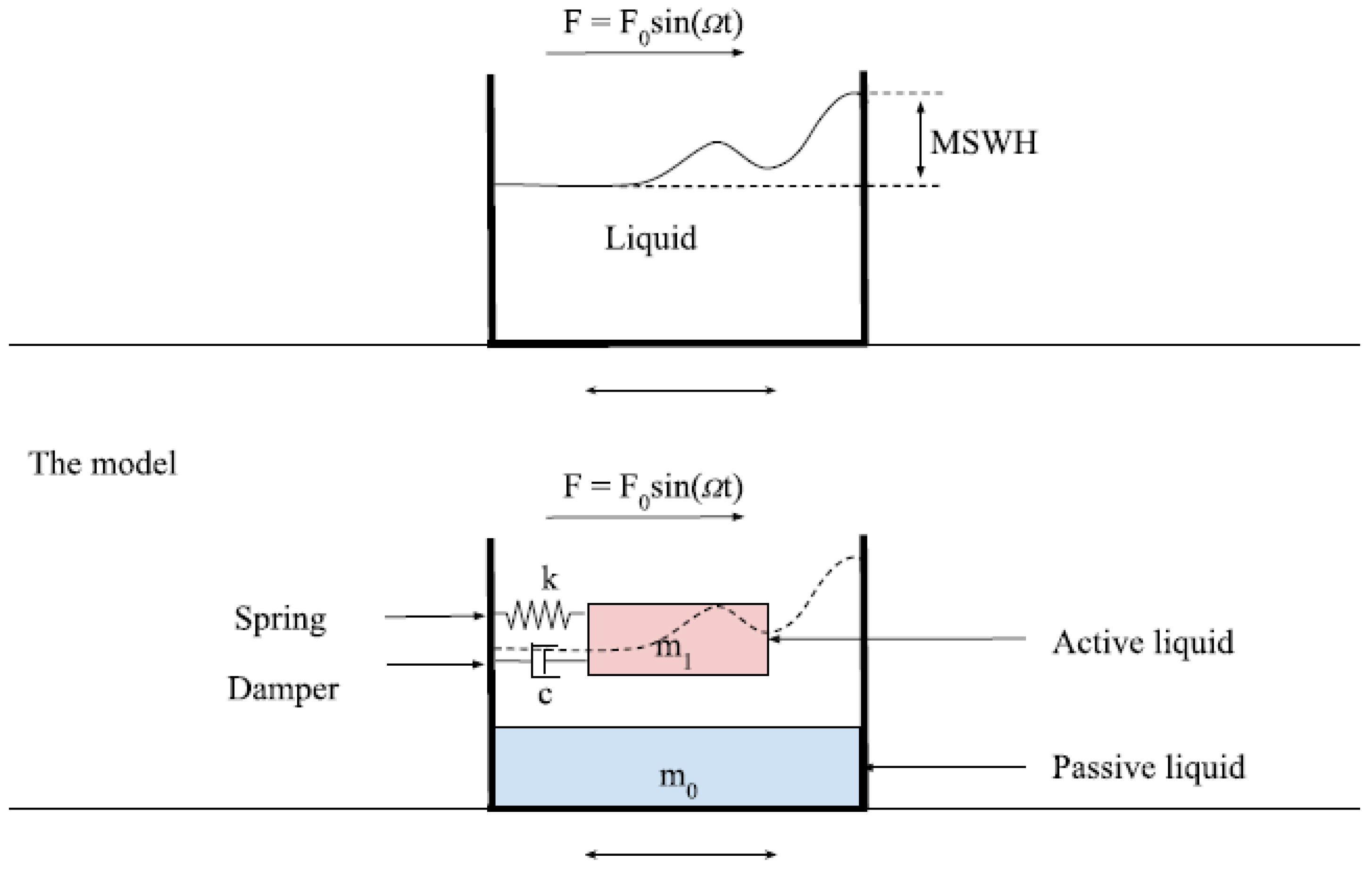
Figure 2.
Sloshing equivalent non-linear mechanical model.
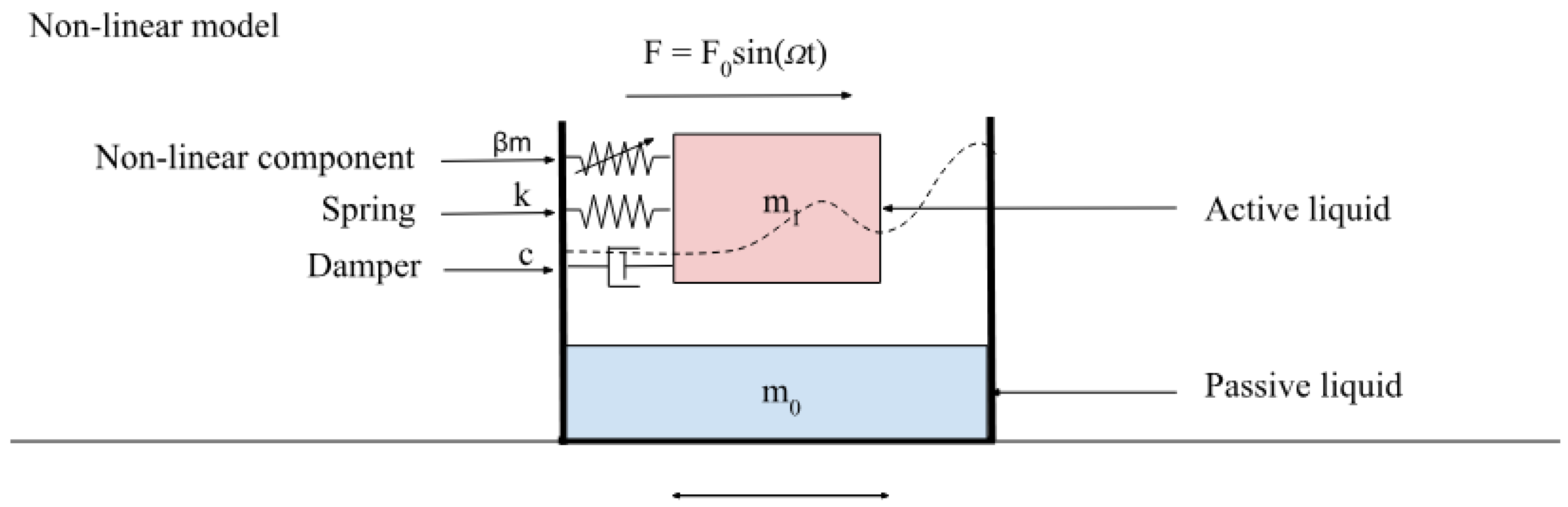
Figure 3.
Frequency-response curves comparing fractional visco-elastic model, Duffing model and 1-DOF SMD System.
Figure 3.
Frequency-response curves comparing fractional visco-elastic model, Duffing model and 1-DOF SMD System.
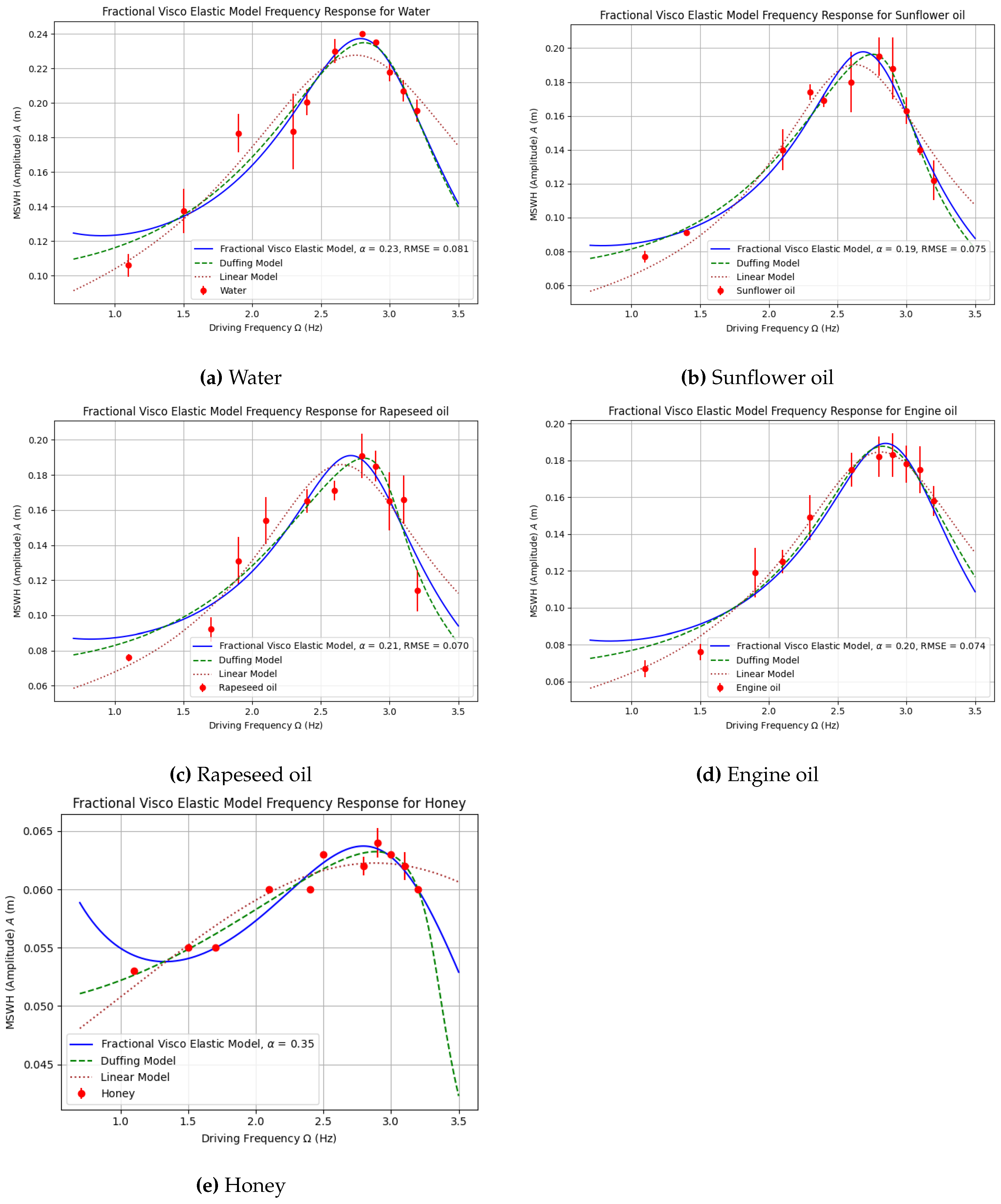
Figure 4.
Slosh rig experimental setup.
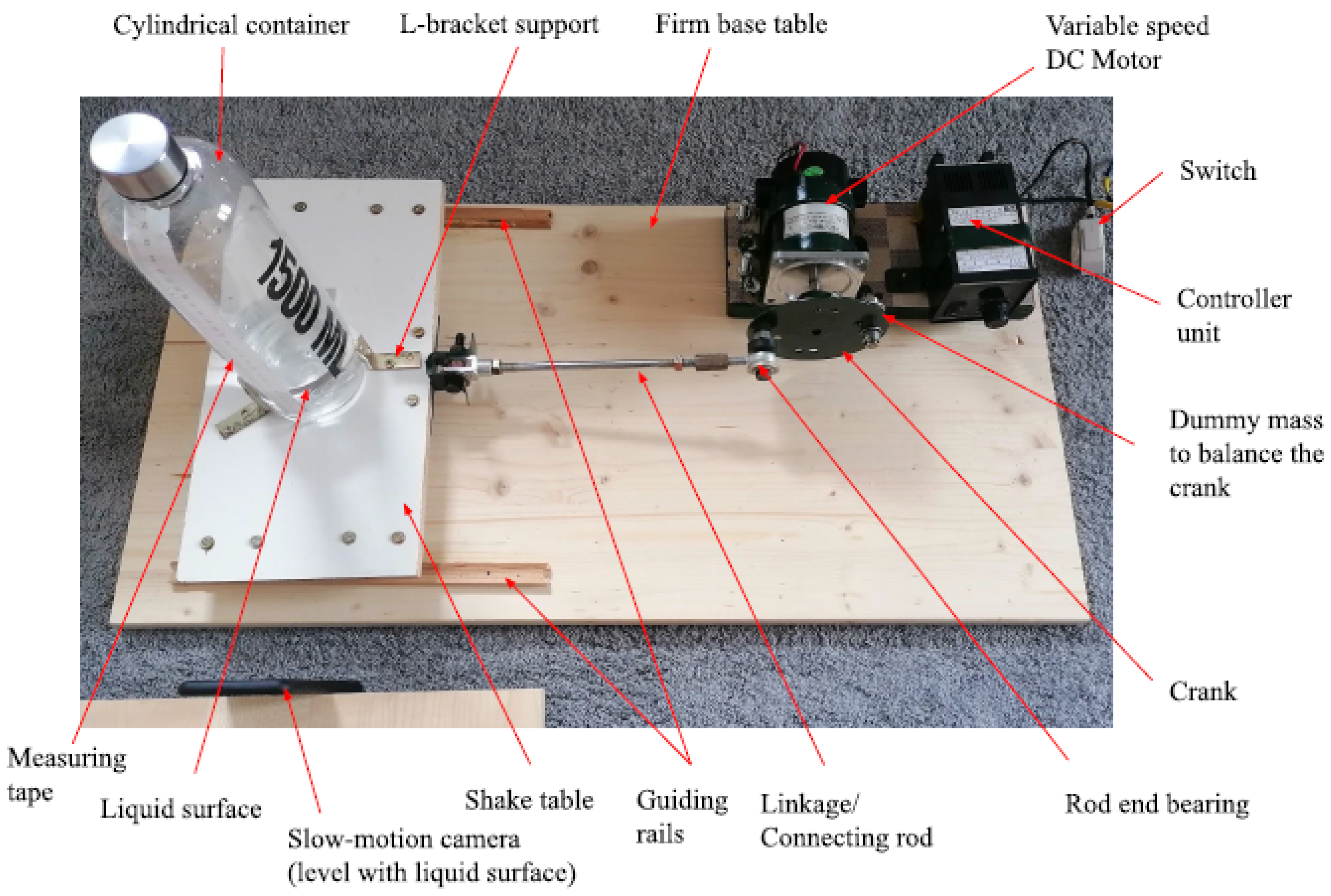

Table 1.
Parameters of the experiment.
| Parameters | Values |
| Height of liquid h | 5 cm |
| Radius of container R | 4.4 cm |
| Amplitude of oscillation/crank radius | 4.5 cm |
| Motor torque | 0.2 Nm |
| Force of oscillations | 4.44 N |
Disclaimer/Publisher’s Note: The statements, opinions and data contained in all publications are solely those of the individual author(s) and contributor(s) and not of MDPI and/or the editor(s). MDPI and/or the editor(s) disclaim responsibility for any injury to people or property resulting from any ideas, methods, instructions or products referred to in the content. |
© 2026 by the authors. Licensee MDPI, Basel, Switzerland. This article is an open access article distributed under the terms and conditions of the Creative Commons Attribution (CC BY) license (http://creativecommons.org/licenses/by/4.0/).
Copyright: This open access article is published under a Creative Commons CC BY 4.0 license, which permit the free download, distribution, and reuse, provided that the author and preprint are cited in any reuse.


