

Submitted:
01 June 2026
Posted:
02 June 2026
You are already at the latest version
Abstract
The systemic effects of dental focal infections are well documented; however, chronic tonsillar disease remains underrecognized as a potential source of systemic symptoms. We report a 32-year-old woman with chronic oral foci and severe gastrointestinal symptoms, profound weight loss, and pregnancy loss. Over two years, she lost 27 kg. Extensive medical evaluation, including laboratory testing, revealed no clear abnormality. During this period, a dark-field microscopic test was reported as positive for Borrelia burgdorferi, which led to referral to our outpatient service, where Borrelia infection was excluded. Otolaryngological and dental evaluation identified a significant tonsillar residuum despite childhood tonsillectomy, along with prior root canal treatments and periodontitis. After dental treatment and tonsillectomy, her condition improved steadily and her weight normalized. This case suggests a possible association between chronic oral focal infections and severe systemic manifestations, including gastrointestinal symptoms and adverse reproductive outcomes.
Keywords:
focal infection
; pregnancy loss
; chronic Lyme disease
; chronic periodontitis
; chronic tonsillitis
; Lyme borreliosis
; post treatment Lyme disease syndrome (PTLDS)
; gastrointestinal symptoms
; chronic oral focal infection
Introduction
About 15-20 years ago, our suspicion began to grow at the Center for Tick-borne Disease Outpatient Service, Budapest that many patients were presenting with remarkably similar, mostly subjective complaints. In many cases, either their physicians or the patients themselves raised the possibility of chronic Lyme disease or post-treatment Lyme disease syndrome (PTLDS) as the underlying cause. However, based on our investigations, these diagnoses could regularly be excluded. It became evident that patients with these many similar symptoms and complaints were in fact suffering from the same condition. The most common complaints/symptoms included joint pain, fatigue, cognitive decline (“brain fog”), paresthesia, myalgia, and several others [1]. The most severe complaints were joint pain and fatigue, which often led to a loss of work capacity. Despite the severe subjective symptoms suggestive of inflammation, objective abnormalities were almost never found. Laboratory results were nearly always normal. It became our standard practice to conduct a thorough examination of the oral cavity in these patients. For patients showing signs of periodontitis or who had undergone root canal treatment, we recommended dental CT imaging; in cases where chronic tonsillitis was suspected, we requested an otolaryngological examination along with compression of the tonsils.
Behind the diverse yet remarkably similar clinical symptoms, we found dental and/or ENT focal infections in almost every case. In the aforementioned study, 15% of our patients experienced diarrhea. However, this had never been a leading complaint [1,2]. Here, we present a case of a dental and tonsillar focal infection associated with severe gastrointestinal symptoms and pregnancy loss. While the identification and treatment of dental foci generally posed no difficulty [3,4,5], the role of the tonsils as a source of focal infection was less readily accepted by colleagues. Therefore, patients often spent years visiting multiple clinics, taking excessive antibiotics, and collecting numerous test results. Sooner or later, they would receive a false-positive Borrelia antibody result, which is how they eventually ended up at our clinic [1,2].
Case Presentation
The patient, a 32-year-old Hungarian woman, first developed symptoms in autumn 2022, beginning with severe acne vulgaris. Dental and gynecological examinations revealed no pathological findings. Abdominal pain appeared in early 2023. By spring 2023, she experienced recurrent episodes of vertigo and chills. These progressed to severe vertigo and vomiting, at times rendering her unable to walk to the toilet. She was on sick leave for six weeks. She also developed severe abdominal pain and continuous diarrhea and was barely able to climb a flight of stairs. Later, she attempted walking but developed dyspnea after a short distance. By the end of spring 2023, she had lost 15 kg. Treatment with metronidazole resulted in partial improvement: vomiting ceased, but other symptoms persisted. Acne resolved and fatigue temporarily decreased (May 2023). However, abdominal pain, chills, and vomiting recurred during the summer of 2023, accompanied by fatigue and vertigo.
MRI revealed intervertebral disc degeneration. ENT, ophthalmological, and neurological examinations showed no abnormalities. Severe fatigue persisted into autumn 2023. Over the course of the year, the patient lost a total of 27 kg. Additional symptoms included hair loss, sleep disturbances, severe fatigue, persistent chills, and a yellowish coating of the tongue, as well as headache, paresthesia, and ear pain. She received multiple antibiotic treatments without definitive benefit: rifaximin (twice, in May and July 2023), ciprofloxacin (September 2023), and amoxicillin-clavulanate for tonsillitis (October 2023). Spontaneous abortion occurred in April 2024 during her first pregnancy.
Dental examination revealed multiple focal infections, including periodontitis and previously root-canal treated teeth. Otolaryngological evaluation identified tonsillar remnants consistent with chronic tonsillar disease, despite prior childhood tonsillectomy.
Tonsillectomy was performed in September 2024. Following these interventions, the patient’s symptoms gradually resolved. Her weight and functional status normalized, and laboratory abnormalities almost normalized. Most dental foci were eliminated starting in June 2024; the last remaining focus was extracted recently (March 2026). Since the dental and ENT treatments, she has gradually become symptom-free, and her weight and physical strength have normalized. She conceived again in December 2025, and the pregnancy has progressed normally.
Hereunder we report her normal test results: On 2024-03-14, the throat swab culture was negative. ACTH was measured, as well as food allergy IgE to 20 nutrients and food allergy IgG to 46 nutrients. Investigations included gastric biopsy with histology and Helicobacter testing during esophagogastroduodenoscopy, and thoracic and abdominal X-ray. Hormonal and related tests included TSH, estradiol, LH, FSH, progesterone, albumin, FT3, FT4, prolactin, DHEA-sulfate (dehydroepialdosterone sulfate) total, free and active testosterone, SHBG (Sex Hormone-Binding Globulin) and AMH (Anti-Müllerian hormone). Further examinations comprised colonoscopy with colon histology; measurements of vitamin D, ACTH, and AST; Borrelia Western blot; and brain MRI. On 2023-11-23, a neurology report concluded no illness, with a diagnostic consideration of bartonellosis or babesiosis. On 2024-02-08, abdominal and pelvic ultrasound was negative. On 2023-09-01 B12, TSH, T4, and T3 were checked. Stool studies assessed blood, fat, protein, water, sugar, and pancreatic elastase. Microbiological testing showed Salmonella, Shigella, Yersinia, and Campylobacter cultures were negative; Clostridioides difficile antigen and toxin detected directly from stool by immunochromatographic method were negative; Cryptosporidium, Giardia, and Entamoeba histolytica antigens were negative; and microscopic examination of stool for helminth eggs and protozoa were negative. On 2024-02-20 CRP was tested, and complement C4, serum sodium, potassium, and magnesium were measured, along with liver and kidney function tests; all these results were normal. Enzymes and proteins tested included serum amylase, lipase, pseudocholinesterase, total serum protein, albumin, and serum protein electrophoresis, as well as tumor markers; all were negative or within reference ranges. On 2025-01-16, a complete blood count was normal (CRP not performed, ferritin normal). Additional tests included iron, chromogranin, and magnesium, all of which were within normal limits. Immunological and related studies included serum IgG, IgA, IgM, paraprotein, rheumatoid factor, serum iron, transferrin, transferrin saturation, total iron-binding capacity, thyroglobulin, urinalysis, ANA-HEp-2 panel, and a celiac disease panel, all were negative or unremarkable.
Abnormal results are listed in Table 1.
Discussion
The systemic impact of dental infections is well established [3,4,5], whereas chronic tonsillar disease remains less clearly characterized. One contributing factor may be inconsistent terminology. Based on a systematic review of 68 papers, the consensus was that the term “chronic tonsillitis” is obsolete, and the preferred term for repeated episodes of acute bacterial tonsillitis is recurrent acute tonsillitis [6]; however, this classification does not fully account for the clinical entity observed in our patients.
Chronic infection is defined as the prolonged persistence, often months to years, of an infectious agent with ongoing immune response [7]. Our observations suggest the existence of a chronic tonsillar condition distinct from acute recurrent infections [2].
The different histological forms of tonsillar disorders, including caseous tonsillitis, detritus accumulation, tonsilloliths, and keratin cysts, may share a common origin, represent a spectrum of the same disease, and reflect progressive, temporally interrelated processes [8]. These conditions involve microbial accumulation and biofilm formation, which may undergo calcification, as demonstrated in tonsilloliths [9]. Many studies suggest that tonsillar stones are benign conditions which resolve spontaneously [10]. Even when it causes halitosis, conservative treatments are regularly suggested [11]. On the contrary, recent studies have demonstrated associations between tonsilloliths and periodontal disease, suggesting interaction between oral focal sites [12,13]. This supports the concept of a unified oral focal infection system.
It can be hypothesized that microbial waste products entering the circulation may adhere to fascia, joints, muscles, tendons, and along nerves. In a hyperimmunized host, the body might attempt to eliminate these deposits, which could potentially contribute to the diverse systemic symptoms observed. However, these processes do not appear to produce laboratory-detectable inflammatory responses, and direct evidence for this mechanism is currently lacking.
If the term “chronic tonsillitis” is considered inappropriate, an alternative designation such as tonsillar chronic focal infection may be preferable. This condition differs from acute processes not only in the absence of local symptoms or signs of local or generalized inflammation, but also in its potential to cause severe, chronic systemic subjective complaints. Oral foci, including dental and tonsillar foci, can mutually influence each other [12]. In the present case, elimination of dental and tonsillar foci was followed by dramatical clinical improvement, including resolution of severe gastrointestinal symptoms and normalization of body weight and the pathological laboratory test result. Although causality cannot be established, the temporal association is notable. Pregnancy loss in this case may also be related to chronic infection. Previous studies have suggested associations between periodontal disease and adverse pregnancy outcomes, as well as between tonsillar disease and reproductive pathology [14,15,16,17].
Limitations of this study include its observational nature which does not allow causal inference, and the fact that the proposed mechanisms remain hypothetical. A direct causal relationship between chronic oral infections and severe systemic subjective symptoms cannot be established, but when considered alongside our previous publications [1,2], there is strengthened suspicion of a potential association. At present, it is not feasible to substantiate this hypothesis using double-blind trials.
In the patient presented here, in addition to dental foci, chronic tonsillitis may also have contributed to the severe systemic symptoms. These were almost identical to those long observed in our other similar patients, including severe fatigue, visual disturbances, limb paresthesia, dizziness, chills, abdominal pain, hair loss, vertigo and headache.
Although a causal relationship cannot be definitively established, it can be considered plausible, as tonsillectomy and dental treatments resulted in clinical recovery. Dental treatment was significantly prolonged, and therefore its effect was less apparent compared to the otolaryngological intervention.
Conclusions
Although we encounter numerous patients who have suffered for years from very similar symptoms, a chronic focal oral infection can often be identified, and its elimination is followed by marked clinical improvement or complete recovery. The present case is notable for the resolution of severe gastrointestinal symptoms, including 27 kg weight loss, after tonsillectomy performed for chronic tonsillitis. One limitation in diagnosing chronic tonsillitis is the conceptual ambiguity of the term. A terminology based on clinical presentation, such as chronic tonsillar focal infection, may therefore be worth considering. Chronic oral focal infections, including dental and tonsillar sources, may be associated with severe systemic symptoms. Greater conceptual clarity regarding chronic tonsillar disease may improve recognition and management of similar cases.
Human subject: Informed consent for treatment and open access publication was obtained by the patient in this study.
Animal subjects: All authors have confirmed that this study did not involve animal subjects or tissue.
Conflicts of interest: In compliance with the ICMJE uniform disclosure form, all authors declare the following:.
Payment/services info: All authors have declared that no financial support was received from any organization for the submitted work.
Financial relationships: All authors have declared that they have no financial relationships at present or within the previous three years with any organizations that might have an interest in the submitted work.
Other relationships: All authors have declared that there are no other relationships or activities that could appear to have influenced the submitted work.
- The co-authors are aware of and agree to open access posting on Preprints.org and Preprints.org’s policies.
- Authors confirm that any journals they intend to submit accept preprints.
- All authors understand the Preprints.org withdrawal policy and that preprints cannot be completely removed once online.
- Authors confirm that any experiments with animals, humans, or plants are properly reported and have received ethical approval.
- Authors confirm that the work will not violate any rights of any person or entity, including, but not limited to, any breaches of copyright, patents, trade secrets, privacy, or any other rights.
- Patient consent statement. The patient in this paper gave written informed consent to Dr. Lakos to use her data and describe his illness in a way in which his identity is not revealed. The written and signed consent form is on file with the corresponding author (Dr. Lakos) of this manuscript.
- Ethical approval. The manuscript conforms to the standards currently applied in Hungary. The study does not include factors necessitating ethical committee approval. Manuscripts containing research conducted on human follows the Declaration of Helsinki.
- Research data are available.
- The corresponding author will inform all co-authors of the submission to Preprints.org. and manage correspondence between Preprints.org and co-authors, keeping the full co-author group informed throughout the submission, announcement, and update process, he ensure that all co-authors understand Preprints.org’s policies (including such items as publication ethics, data and supplementary material deposition, conditions for withdrawal, copyright, and licenses..
- He will take full responsibility for answering questions/comments regarding the announced preprint, as well as providing data or materials requested.
Author Contributions: Concept and design, Laboratory testing: András Lakos, Gyöngyi Nagy. Acquisition, analysis, or interpretation of data: András Lakos, Gyöngyi Nagy, Manó Lakos. Drafting of the manuscript: András Lakos, Manó Lakos. Critical review of the manuscript for important intellectual content: András Lakos, Gyöngyi Nagy, Manó Lakos. Supervision: András Lakos.
Authors used Chat GPT for language correction but supervised its advices.
All authors agree to the following statements:
- I grant Preprints.org a perpetual, non-exclusive license to distribute this preprint.
- I certify that I have the right to grant this license.
- I understand that submissions cannot be completely removed once accepted by Preprints.org and may appear on websites other than Preprints.org.
References
- Lakos, A.; Nagy, G.; Varga, Z.; Rásonyi-Kovács, P.; Hornok, S. Reassessing chronic Lyme disease and post-treatment Lyme disease syndrome as focal infections. Cureus 2025, 17, 91246. [Google Scholar] [CrossRef] [PubMed]
- Lakos A: Chronic tonsillitis as a focal infection: a decade-long case involving severe systemic symptoms. Cureus 2026, 6, 100929. [CrossRef]
- Lohiya, D.V.; Mehendale, A.M.; Lohiya, D.V.; Lahoti, H.S.; Agrawal, V.N. Effects of periodontitis on major organ systems. Cureus 2023, 15, 46299. [Google Scholar] [CrossRef]
- Fowler, E.B.; Breault, L.G.; Cuenin, M.F. Periodontal disease and its association with systemic disease. Mil. Med. 2001, 166, 85–89. [Google Scholar] [CrossRef]
- Moutsopoulos, N.M.; Madianos, P.N. Low-grade inflammation in chronic infectious diseases: paradigm of periodontal infections. Ann. N Y Acad. Sci. 2006, 251–264. [Google Scholar] [CrossRef] [PubMed]
- Guntinas-Lichius, O.; Geißler, K.; Mäkitie, A.A.; et al. Treatment of recurrent acute tonsillitis—a systematic review and clinical practice recommendations. Front Surg. 2023, 10, 1221932. [Google Scholar] [CrossRef]
- Jameson, J.L.; Fauci, A.S.; Kasper, D.L.; Hauser, S.L.; Longo, D.L.; Loscalzo, J. (Eds.) Harrison’s Principles of Internal Medicine, 21st ed.; McGraw-Hill Education: New York, 1 2022; Available online: https://www.mheducation.com/highered/mhp/product/harrison-s-principles-internal-medicine-twenty-first-edition-vol-1-v...
- Nitek, S.; Legatowicz-Koprowska, M.; Chmielik, L.P. Differential diagnosis of tonsillitis, tonsillar detritus accumulation, and tonsillar keratin cysts. Med. Res. Arch. 2017, 5, 1–12. [Google Scholar] [CrossRef]
- Stoodley, P.; Debeer, D.; Longwell, M.; Nistico, L.; Hall-Stoodley, L.; Wenig, B. Krespi YP: Tonsillolith: not just a stone but a living biofilm. Otolaryngol. Head. Neck Surg. 2009, 141, 316–321. [Google Scholar] [CrossRef] [PubMed]
- Smith, K.L.; Hughes, R.; Myrex, P. Tonsillitis and tonsilloliths: diagnosis and management. Am. Fam. Physician 2023, 107, 35–41. [Google Scholar] [PubMed]
- Ferguson, M.; Aydin, M.; Mickel, J. Halitosis and the tonsils: a review of management. Otolaryngol. Head. Neck Surg. 2014, 151. [Google Scholar] [CrossRef] [PubMed]
- Oda, M.; Yoshii, S.; Wakasugi-Sato, N.; et al. Correlation between the presence of tonsilloliths and the bone defects by periodontitis on imaging analysis: a pilot study. BMC Oral Health 2024, 24, 6. [Google Scholar] [CrossRef] [PubMed]
- Gurbuz, E.; Gungor, M.; Hatipoglu, H. Radiographic detection of the relationship between tonsilloliths and dental plaque-related pathologies. Med. Princ. Pract. 2022, 31, 149–155. [Google Scholar] [CrossRef] [PubMed]
- Sánchez, A.R.; Kupp, L.I.; Sheridan, P.J.; Sánchez, D.R. Maternal chronic infection as a risk factor in preterm low birth weight infants. J. Int. Acad. Periodontol. 2004, 6, 89–94. [Google Scholar] [PubMed]
- Ryabova, M.; Shumillova, N.; Pestakova, L. Pregnancy and chronic tonsillitis. Vrach 2017, 28, 47–48. [Google Scholar]
- Filipeva, P.V.; Svistushkin, V.M.; Kiryushchenkov, P.A.; Zolotova, A.V. The role of chronic tonsillitis in recurrent pregnancy loss. Aspir. Vestn. Povolzhiya 2025, 25, 40–44. [Google Scholar] [CrossRef]
- AN: The role of chronic tonsillitis in the development of reproductive pathology in women of child-bearing age. Vestn. Otorinolaringol. 2009, 40, 19738590.
Figure 1.
Periapical abscess (red circles) of the presented patient (Photo: Dr. Zoltán Varga).
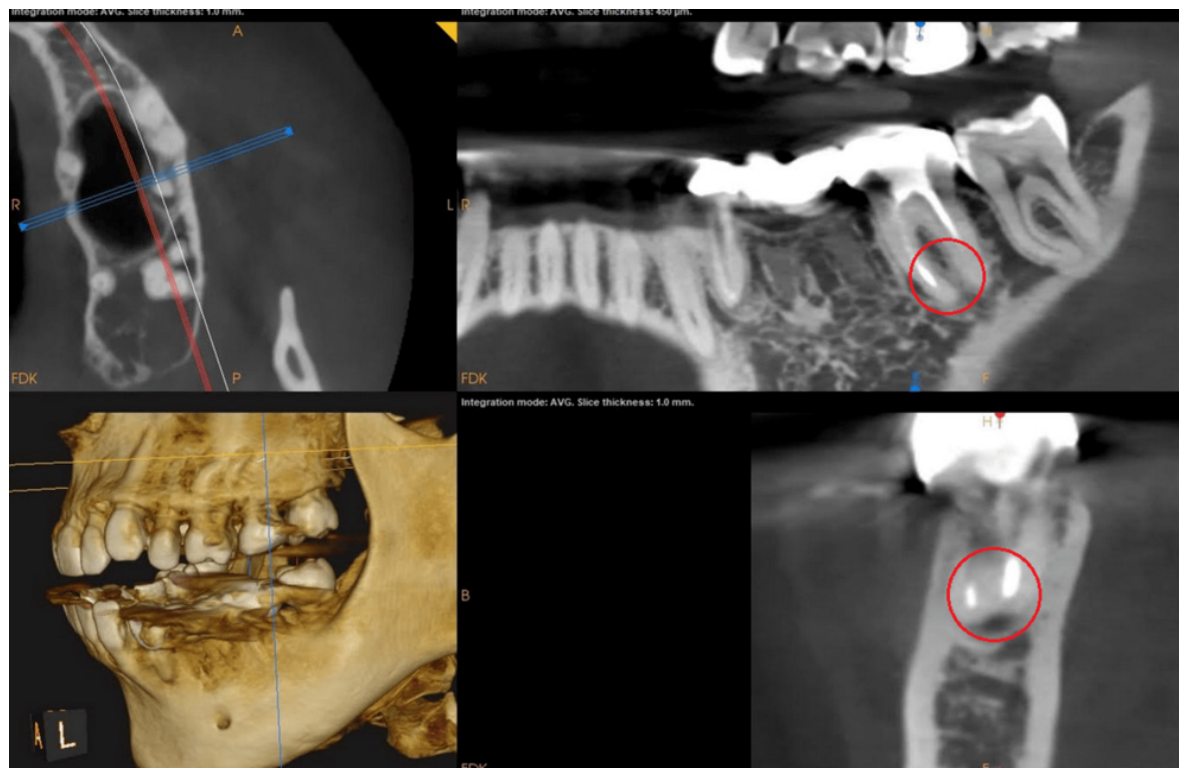
Figure 2.
Periapical abscess (red circles) of the presented patient (Photo: Dr. Zoltán Varga).
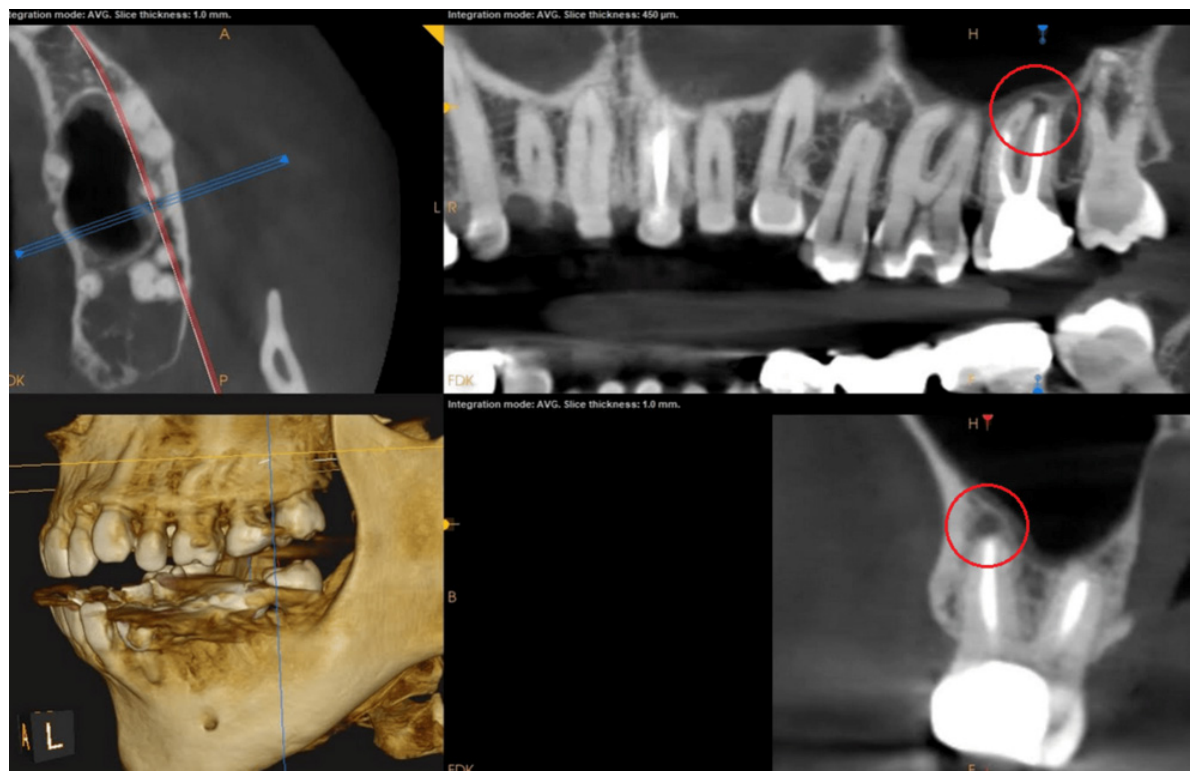

Table 1.
Pathological results and interventions.
| Date | Intervention / Test / Parameter | Result | Reference Range / Comments |
| 1997 | Tonsillectomy | ||
| 2023-07-22 | Stool culture | Candida albicans 105 | negative |
| 2023-08-24 | Lactulose Breath Test (SIBO: Small Intestinal Bacterial Overgrowth) | H₂ >72 ppm | <20 ppm |
| 2023-09-01 | Egg IgG | positive | negative |
| 2023-09-01 | C-reactive Protein (CRP) | 5.7 mg/l | <5.0 |
| 2023-11-08 | Ferritin | 249 µg/l | 15-150 |
| 2024-02-02 | DualDur (scientifically unproven dark-field microscopic test from blood) | Borrelia, Bartonella positive | |
| 2024-02-14 | Total Bilirubin | 21.7 µmol/l | 5-21.0 |
| 2024-02-14 | Conjugated Bilirubin | 5.6 | <5.1 |
| 2024-02-14 | Estimated Glomerular Filtration Rate (eGFR) | 86 ml/min/1.73m² | >90 |
| 2024-02-14 | Complement C3 | 0.75 g/l | 0.80-1.60 |
| 2024-02-14 | Ferritin | 201 ng/ml | 10-120 |
| 2024-02-14 | Uric Acid | 354 µmol/l | 181-353 |
| 2024-03-19 | Cortisol | 708.1 nmol/l | <619.4 |
| 2024-03-26 | Neck MRI | Incipient polydiscopathy | |
| 2024-04-15 | Abortus spontaneous | ||
| 2024-04-26 | Stool zonulin (leaky gut syndrome) | 2921.8 µU/g | <60.1 |
| from 2024-06-25 | Most of the dental foci have been cleared. | ||
| 2024-09-18 | Tonsillectomy, | Histology: Tonsillitis chronica | |
| 2025-01-16 | Anti-Thyroid Peroxidase (Anti-TPO) | 121 IU/ml | <60 |
| 2025-01-16 | Anti-thyroglobulin (Anti-Tg) | 5.2 IU/ml | <4.5 |
| 2025-01-16 | Stool Zonulin | 111.8 ng/ml | 14-108 |
| 2025-08-18 | Thyroid-Stimulating Hormone (TSH) | 5.15 | 0.35-4.94 |
| 2025-08-22 | Anti-Thyroid Peroxidase (Anti-TPO) | 223.6 IU/ml | <13.8 |
| 2025-08-22 | Anti-thyroglobulin (Anti-Tg) | 8.7 IU/ml | <4.5 |
Disclaimer/Publisher’s Note: The statements, opinions and data contained in all publications are solely those of the individual author(s) and contributor(s) and not of MDPI and/or the editor(s). MDPI and/or the editor(s) disclaim responsibility for any injury to people or property resulting from any ideas, methods, instructions or products referred to in the content. |
© 2026 by the authors. Licensee MDPI, Basel, Switzerland. This article is an open access article distributed under the terms and conditions of the Creative Commons Attribution (CC BY) license.
Copyright: This open access article is published under a Creative Commons CC BY 4.0 license, which permit the free download, distribution, and reuse, provided that the author and preprint are cited in any reuse.


