Preprint
Article

This version is not peer-reviewed.

Computational Evaluation of Bioavailability, Pharmacokinetics, and Toxicological Properties of Selected Dual Inhibitors of Acetylcholinesterase and Monoamino Oxidase‐B for the Treatment of Alzheimer’s Disease

Submitted:

01 June 2026

Posted:

02 June 2026

You are already at the latest version

Abstract

Background/Objectives: Alzheimer’s disease (AD) is a neurodegenerative disorder with a complex pathomechanism. Acetylcholinesterase (AChE) and monoamine oxidase-B (MAO-B) are key targets regulating neurotransmitter levels, and dual inhibitors (compounds 1–46) were designed as experimental candidates for AD therapy. Methods: Drug-likeness parameters were estimated using pkCSM, SwissADME web tools, and MoloVol software (v1.2.0). SwissADME predicted gastrointestinal absorption and blood–brain barrier penetration, whereas pkCSM evaluated P-glycoprotein recognition and CYP450 inhibition. Toxicological profiles of compounds (1–46) were assessed with DataWarrior software (v06.05.04), which classified them as mutagenic, carcinogenic, reproductive, or irritant. Results: Most compounds complied with Lipinski’s rule (excluding 12 and 35) indicating favorable absorption and permeability. All compounds showed TPSA < 140 Å2, indicating good intestinal absorption, while compounds 1, 3–6, 8, 11-16, 18, 19, 27, 30, 31, 34, 36-38, and 44–46 displayed TPSA < 60 Å2, suggesting blood–brain barrier penetration. The majority of compounds were predicted P-glycoprotein substrates, potentially limiting oral absorption and blood-brain barrier penetration. Metabolic profiling revealed inhibition of CYP1A2, 2C19, 2C9, 2D6, and 3A4, highlighting drug–drug interaction risks. Toxicological analysis identified mutagenicity (compounds 4, 5, 19, 20 and 27), carcinogenicity (compounds 4, 5, 8, 18 and 19), reproductive toxicity (compounds 15, 16 and 19–23), and irritant effects (compounds 7, 11, 17 and 20). Conclusions: Computational findings support further in vitro and in vivo evaluation of compounds 1, 3, 6, 13, 14, 30, 31, 34, 36–38, and 44–46 as dual AChE/MAO-B inhibitors and potentially new drugs for AD treatment.

Keywords: 
;  ;  ;  ;  ;  ;  ;  ;  

1. Introduction

Alzheimer’s disease (AD) is a progressive neurological disorder with a multifactorial etiology. It represents the most prevalent form of dementia, accounting for 60–70% of all cases and affecting more than 50 million individuals worldwide [1].
The “one drug, one target” approach has proven ineffective in AD because of its intricate pathomechanism. Multi-target-directed ligands (MTDLs), designed as single multifunctional molecules that act on several pathogenic pathways, have therefore emerged as a more promising alternative. In contrast to conventional combination therapy, MTDLs maintain diverse pharmacodynamic actions while lowering the risk of adverse effects, simplifying dosing schedules, and reducing drug–drug interactions [2]. Dual inhibitors of acetylcholinesterase (AChE) and monoamine oxidase-B (MAO-B) are among the most extensively investigated MTDLs, as they simultaneously counteract cholinergic dysfunction and monoaminergic imbalance [3]. The strategy of dual AChE/MAO-B inhibition has consequently gained significant attention, leading to the development of numerous compounds through the MTDL approach [4]. Concurrent targeting of both enzymes may provide synergistic benefits, since AChE inhibitors enhance acetylcholine transmission, whereas MAO-B inhibitors reduce oxidative stress and neuroinflammation [5,6].
Based on contemporary literature [7], dual inhibitors of AChE and MAO-B enzymes (compounds 1–46) were selected for in silico screening, with the aim of identifying derivatives that may serve as subjects for of investigations and potential therapeutic agents in the treatment of AD.
With regard to our research, the primary objective is the computational analysis and estimation of the bioavailability of dual inhibitors of AChE and MAO-B enzymes (compounds 1-46), based on the calculation of drug similarity parameters. The secondary objective is to assess the pharmacokinetic and toxicological properties of these compounds as potential therapeutic agents for the treatment of AD.

2. Material and Methods

2.1. Lipinski’s Rule

Lipinski’s Rule of Five indicates that compounds possessing more than five hydrogen bond donors, over ten hydrogen bond acceptors, a molecular weight above 500 D, or a calculated log P value greater than 5 are likely to exhibit poor absorption and permeability. Molecules that violate two or more of these parameters generally demonstrate reduced bioavailability. This rule applies specifically to drugs that pass through cell membranes via passive diffusion, while those utilizing active transport mechanisms are not subject to its constraints [8]. The decimal logarithm of the octanol–water partition coefficient (log P) serves as a measure of molecular hydrophobicity. Hydrophobicity influences drug absorption, bioavailability, receptor–ligand hydrophobic interactions, metabolism, and toxicity [8].
Prediction of log P was performed using the pkCSM platform. pkCSM employs a graph-based signature approach, encoding molecules as graphs with atoms as nodes and bonds as edges. Atom–distance patterns are converted into numerical signatures, which are used to train regression models on large datasets of experimentally measured logP values. This enables the system to learn correlations between molecular structure and lipophilicity, providing data-driven estimates of experimental logP rather than direct physicochemical calculations [9].

2.2. Topological Polar Surface Area (TPSA)

The polar surface area (PSA) of a molecule denotes the portion of its surface occupied by polar atoms, most commonly nitrogen, oxygen, and their bound hydrogen atoms. This parameter plays a key role in drug transport across biological membranes and is associated with favorable intestinal absorption as well as penetration through the blood–brain barrier (BBB). For fast and straightforward estimation, the topological polar surface area (TPSA) is employed. The calculation relies on summing tabulated surface values assigned to the molecule’s polar fragments (atoms and their immediate environment) [10].

2.3. Number of Rotatable Bonds (Nrotb)

The number of rotatable bonds, together with the topological polar surface area (TPSA) and the total count of hydrogen bonds (sum of acceptors and donors), are molecular descriptors that serve as key indicators of favorable oral bioavailability, independent of molecular volume. Nevertheless, both the number of rotatable bonds and hydrogen bonds tend to increase with molecular volume, which itself may be regarded as a valid parameter for evaluating oral bioavailability. A rotatable bond is defined as a single bond not bound to a ring and attached to a non-terminal heavy atom (not hydrogen-bonded) [11].

2.4. Calculation of Drug-Likeness Parameters

For 46 selected derivatives, drug-likeness parameters were calculated to assess their potential oral bioavailability. The pkCSM web tool was applied to predict the log P value as a drug-likeness descriptor [12]. In addition, the SwissADME platform [13,14] was employed to determine several parameters, including topological polar surface area (TPSA), number of heavy atoms (Natoms), molecular weight (MW), number of hydrogen bond acceptors (nON), number of hydrogen bond donors (nOHNH), number of Lipinski’s rule violations (Nviolations), and number of rotatable bonds (Nrotb). Furthermore, molecular volume (Volume) was computed using MoloVol software, version 1.2.0 [15].

2.5. Estimation of Pharmacokinetic Properties

The pharmacokinetic properties of compounds 1–46 were evaluated using the SwissADME web tool [13,14] and the pkCSM platform [9,12]. Predictions of gastrointestinal (GIT) absorption and blood–brain barrier (BBB) permeability were derived from the graphical BOILED-Egg model [16].
The pkCSM platform, which applies graph-based molecular signatures to construct predictive models of small-molecule pharmacokinetics, was employed to evaluate two key endpoints [9,12]. Firstly, pkCSM predicts whether compounds are P-glycoprotein substrates, thereby indicating their likelihood of being actively transported out of cells by this efflux protein—a process that significantly influences drug absorption and tissue distribution [8]. Secondly, pkCSM estimates the potential of compounds to inhibit cytochrome P450 isoenzymes, the principal metabolic enzymes in the liver, thus identifying possible risks of pharmacokinetic drug-drug interactions [13]. These predictions are generated by encoding molecular structures into distance-based graph signatures and applying validated statistical models trained on experimental datasets, thereby enabling reliable assessment of how compounds may behave in vivo [9,12].

2.6. Assessment of Toxicological Properties

The toxicological evaluation of compounds 1–46 was conducted using DataWarrior software v.06.05.04 [17]. The compounds were classified into four principal categories of toxicity: mutagenicity, carcinogenicity, reproductive toxicity and irritant effects. The risk assessment was based on identifying structural fragments within each molecule that suggest a potential for toxic activity. Fragment lists corresponding to each toxicity class were obtained from the RTECS database, which contains compounds known to be active in specific categories (e.g., carcinogenicity). For predictive purposes, both a reference set of toxic compounds (RTECS database) and a set of non-toxic compounds (marketed drugs) were employed [18].

3. Results

All investigated compounds, except for 7–10, 12, 13, 20, 24, 32–35, 44, and 45, contain no more than five hydrogen bond donors, no more than ten hydrogen bond acceptors, have molecular weights below 500 D, and calculated logP values under 5. As a result, no deviation from Lipinski’s rule is noticed which predicts good absorption and permeability. Compounds 7 and 9 possess molecular weights above 500 D, accounting for a single violation of Lipinski’s rule, yet they are still expected to demonstrate acceptable absorption and permeability. Compounds 8, 10, 13, 20, 24, 32–34, 44, and 45 show calculated logP values greater than 5, also corresponding to one violation of Lipinski’s rule, but nevertheless suggesting favorable absorption and permeability. In contrast, compounds 12 and 35 exhibit molecular weights exceeding 500 D together with logP values above 5, resulting in two violations of Lipinski’s rule and thus indicating poor absorption and permeability.
Drug-likeness parameters for compounds 1–46 were calculated using pkCSM, SwissADME web tools, and MoloVol software (v.1.2.0). The majority of the analyzed compounds complied with Lipinski’s rule, showing no violations. Exceptions were observed for compounds 7–10, 13, 20, 24, 32–34, 44, and 45, each presenting a single violation. Additionally, compounds 12 and 35 exhibited two violations. Table 1 provides a summary of the calculated drug-likeness parameters for compounds 1–46.
All of the investigated compounds possess TPSA values lower than 140 Å2, a property consistent with good intestinal absorption. In addition, compounds 1, 3–6, 8, 11–16, 18, 19, 27, 30, 31, 34, 36–38, and 44–46 display TPSA values under 60 Å2, a threshold that may indicate advantageous penetration across the blood–brain barrier. With the exception of compounds 7–9, 32, and 33, all tested molecules contain no more than ten rotatable bonds, suggesting the potential for good oral bioavailability. Furthermore, all compounds (excluding 7–9 and 35) exhibit molecular volumes not exceeding 500 Å3, a parameter supportive of favorable bioavailability following oral administration.
According to the SwissADME web tool, the predicted absorption and distribution parameters for compounds 1–46 indicate that all compounds, apart from 12 and 35, exhibit good intestinal absorption. In addition, compounds 1–6, 11, 13–19, 21, 22, 27, 30, 31, 34, 36–38, and 43–46 are likely to show preferable penetration across the blood–brain barrier, whereas compounds 7–10, 12, 20, 23–26, 28, 29, 32, 33, 35, and 39–42 are predicted to possess poor permeability through the blood–brain barrier.
Based on the pkCSM web tool, the greater part of the investigated compounds are predicted to act as substrates of P-glycoprotein, including compounds 7–11, 14–16, 19–26, 28, 30–36, and 38–45. In contrast, compounds 1–6, 12, 13, 17, 18, 27, 29, 37, and 46 are not expected to function as P-glycoprotein substrates. Table 2 presents a summary of the predicted absorption and distribution characteristics for compounds 1–46.
With respect to the predicted metabolic characteristics of the investigated compounds using the pkCSM web tool, the majority of the compounds are potential inhibitors of the CYP450 1A2 isoenzyme (29 compounds). Additionally, 22 compounds are anticipated to inhibit CYP450 2C19, while 16 may inhibit CYP450 2C9. In addition to this, 16 compounds are identified as inhibitors of CYP450 2D6. Moreover, 25 compounds are predicted to exhibit inhibitory activity against CYP450 3A4. The predicted metabolic profiles of compounds 1–46 are summarized in Table 3. Table 2 and Table 3 present the pharmacokinetic properties of the tested compounds 1–46.
The toxicological evaluation performed using DataWarrior sofware (v06.05.04) revealed that compound 19 exhibited mutagenic potential at a low level, while compounds 4, 5, 20, and 27 were predicted to show mutagenicity at a high level. Carcinogenicity was identified for compounds 4, 5, 8, 18, and 19, all at a high level. Regarding reproductive toxicity, compounds 15 and 16 demonstrated low-level effects, whereas compounds 19–23 were associated with high-level reproductive toxicity. Finally, irritant effects were observed at a low level for compound 17, while compounds 7, 11, and 20 displayed high-level irritant activity. Table 4 displays the predicted toxicological properties of the investigated compounds 1–46.

4. Discussion

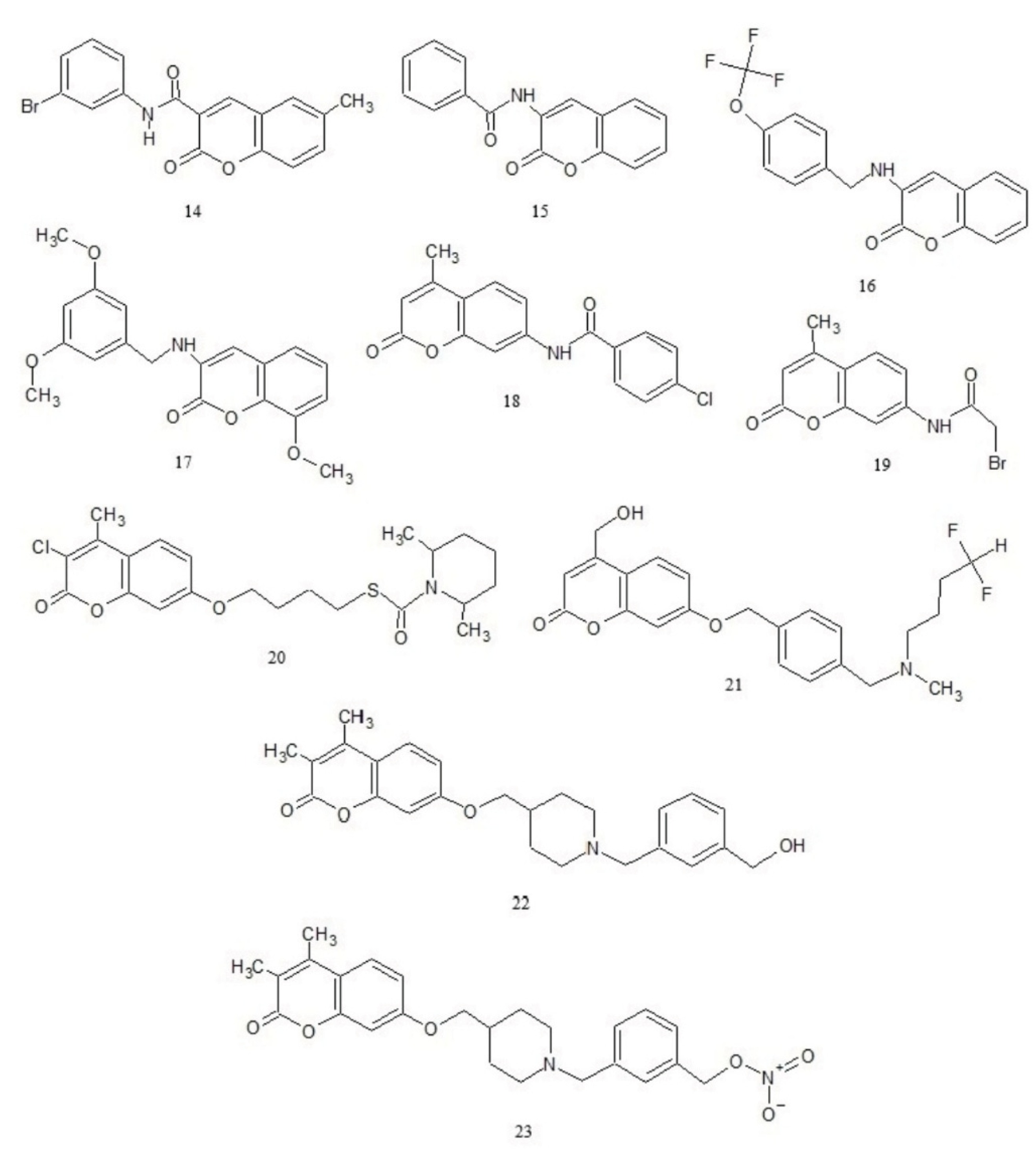
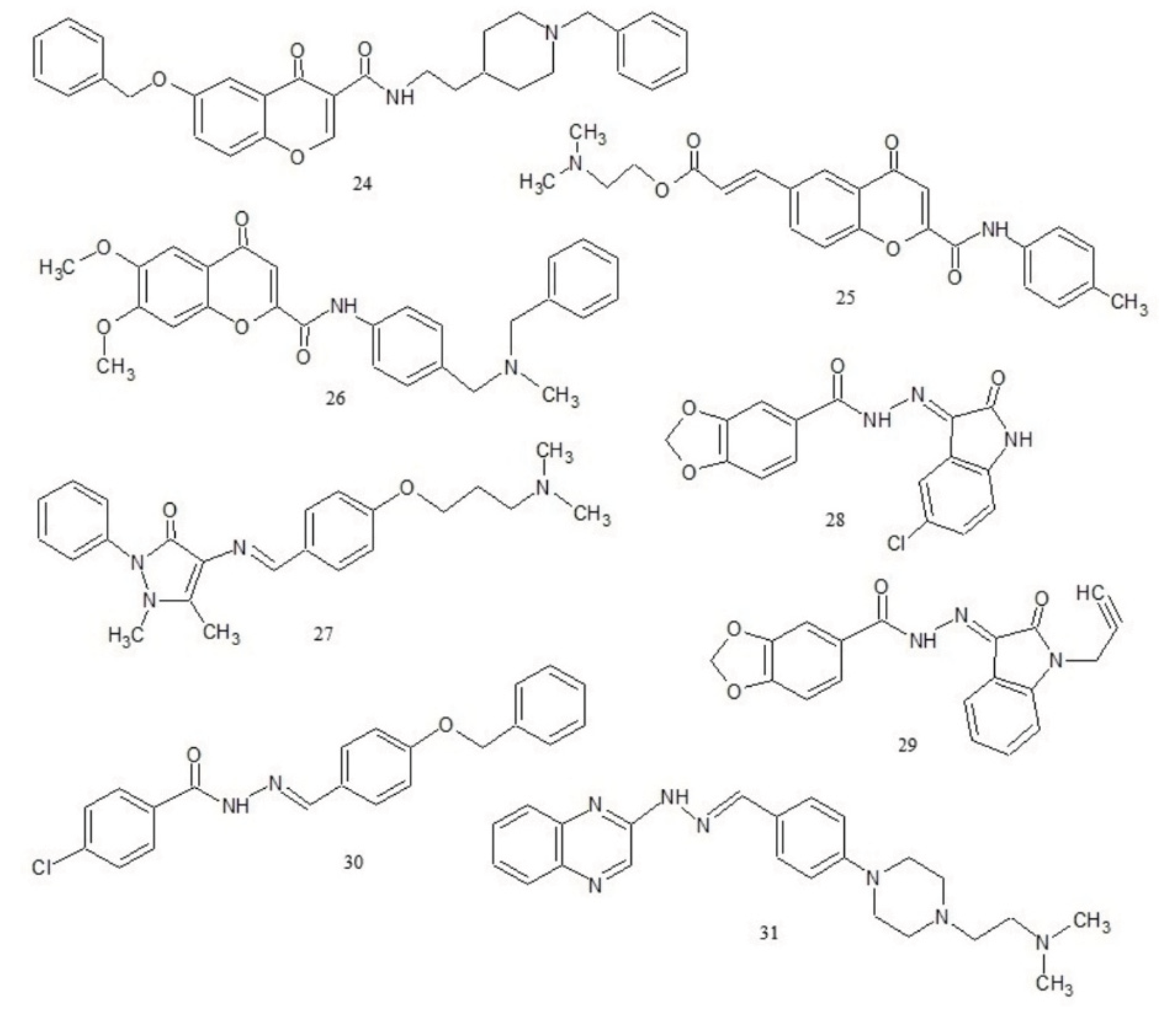
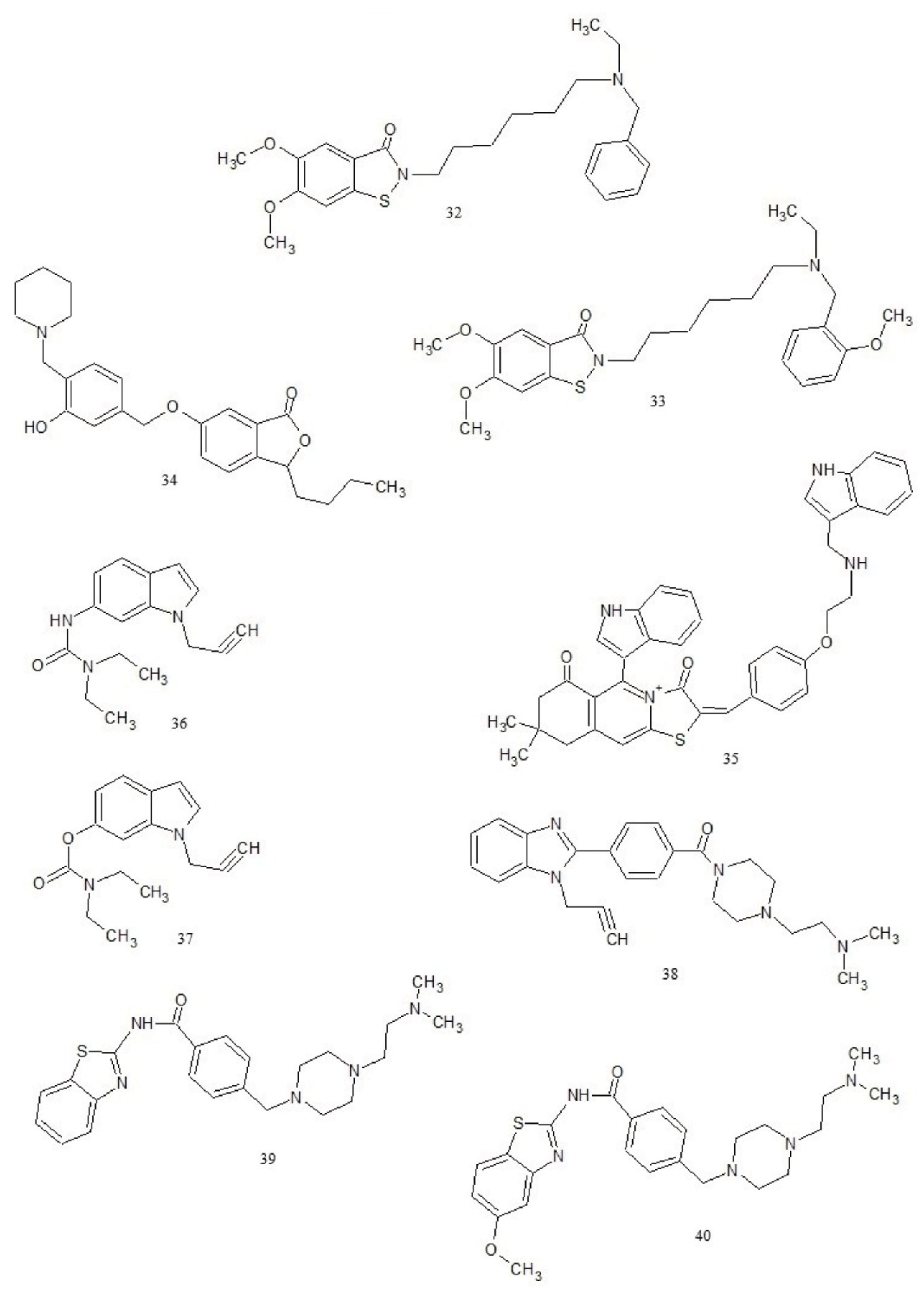
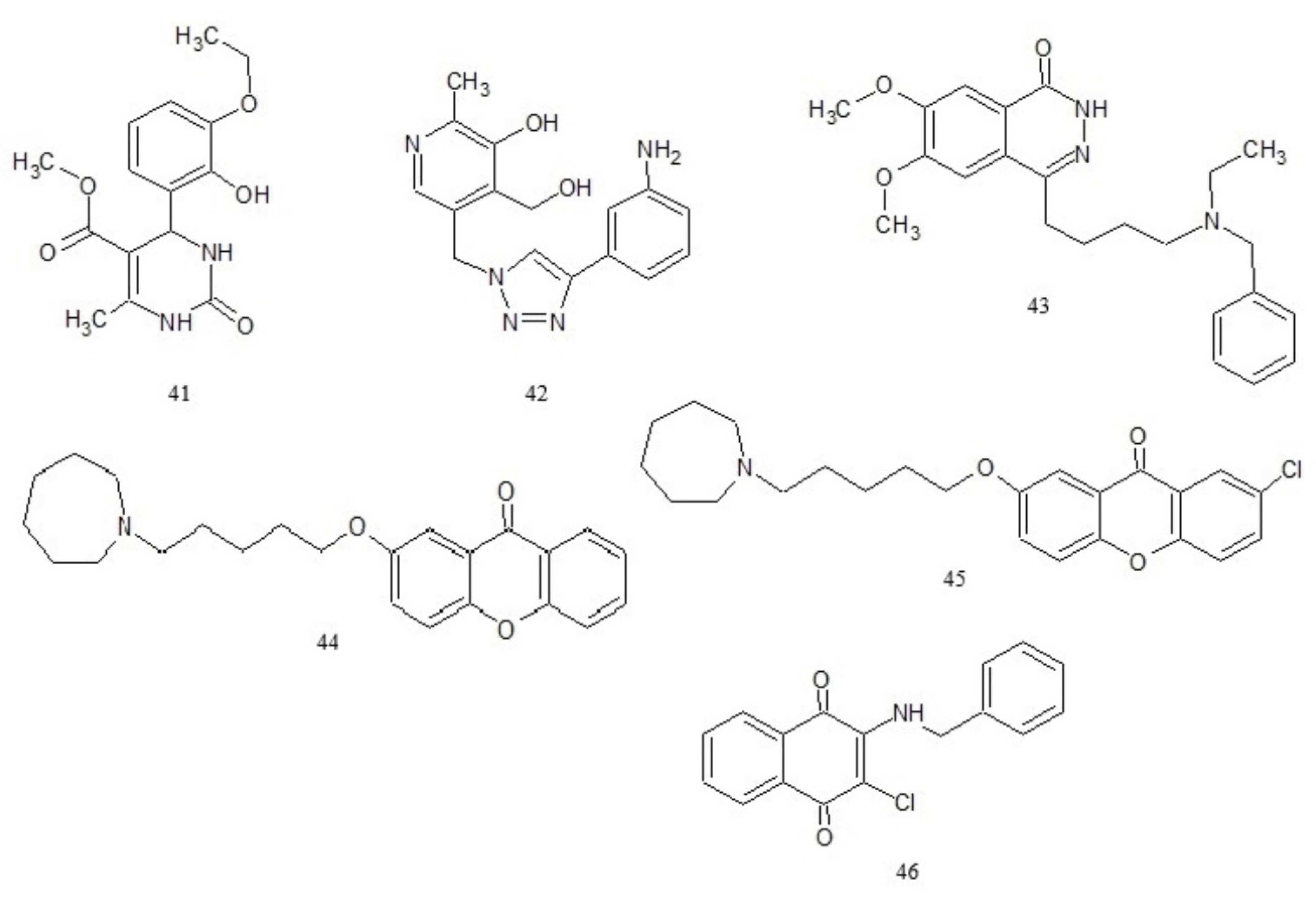
The subject of the in silico screening comprises compounds 1–46, which are dual inhibitors of AChE and MAO-B enzymes, designed as potential experimental therapeutic agents for AD. Based on literature data [7], compounds 1–13 are chalcone derivatives, compounds 14–23 are coumarin derivatives, compounds 24–26 are chromone derivatives, compounds 27–31 are imine and hydrazone derivatives, compounds 32–40 are aromatic heterocyclic-based derivatives as well as compounds 41–46 represent diverse scaffold-based dual inhibitors.
Figure 1 shows chemical structures of chalcone derivatives (1-13). Figure 2 exhibits chemical structures of coumarin derivatives (14-23). Figure 3 displays chemical structures of chromone derivatives (24-26) as well as imine and hydrazone derivatives (27-31). Figure 4 illustrates chemical structures of aromatic heterocyclic-based derivatives (32-40). Figure 5 depicts chemical structures of diverse scaffold-based dual inhibitors (41-46).
By employing pkCSM, SwissADME web tools, and MoloVol software (v.1.2.0), drug-likeness parameters for compounds 1–46 were calculated and summarized in Table 1. Most of the examined compounds complied with Lipinski’s rule of five, showing no violations. Exceptions were noted for compounds 7–10, 13, 20, 24, 32–34, 44, and 45, each presenting a single violation. In contrast, compounds 12 and 35 demonstrated two violations of Lipinski’s rule, indicating that these molecules may possess poor absorption and permeability.
Pharmacokinetic absorption and distribution properties of compounds 1–46 were predicted using the SwissADME web tool. With the exception of compounds 12 and 35, all molecules demonstrated favorable gastrointestinal absorption. Furthermore, compounds 1–6, 11, 13–19, 21, 22, 27, 30, 31, 34, 36–38, and 43–46 were predicted to possess good blood–brain barrier penetration. Table 2 presents a summary of the predicted absorption and distribution profiles for compounds 1–46.
Compounds with TPSA values below 140 Å2 are generally predicted to exhibit good intestinal absorption, whereas those with TPSA values under 60 Å2 are expected to cross the blood–brain barrier [10,16]. Detailed analysis of the parameters in Table 1 shows that all investigated compounds (1–46) possess TPSA values below 140 Å2, consistent with favorable intestinal absorption. In contrast, compounds 1, 3–6, 8, 11-16, 18, 19, 27, 30, 31, 34, 36-38, and 44–46 display TPSA values below 60 Å2, a threshold indicative of enhanced ability to penetrate the blood–brain barrier.
P-glycoprotein (P-gp) is an ATP-dependent efflux transporter that actively expels substrates from cells, thereby reducing oral absorption and restricting penetration into the brain. This characteristic has implications for drug bioavailability and distribution [8]. Based on predictions generated with the pkCSM web tool, the majority of the analyzed compounds, specifically compounds 7–11, 14–16, 19–26, 28, 30–36, and 38–45, are identified as P-gp substrates. Table 2 summarizes the predicted absorption and distribution properties of compounds 1–46.
The pkCSM platform predicts the potential of small molecules to inhibit cytochrome P450 (CYP450) isoenzymes, which are the principal enzymes involved in drug metabolism. Importantly, such inhibition constitutes a common mechanism underlying pharmacokinetic drug–drug interactions [13]. In relation to the predicted metabolic properties, 29 compounds were identified as potential inhibitors of CYP1A2, 22 compounds of CYP2C19, and 16 compounds of CYP2C9. Moreover, 16 compounds were classified as CYP2D6 inhibitors, while 25 compounds were predicted to inhibit CYP3A4. Consequently, the detailed metabolic properties of the investigated compounds (1–46) are presented in Table 3. In addition to this, Table 2 and Table 3 provide an overview of the pharmacokinetic characteristics of the tested compounds.
Toxicological evaluation of compounds 1–46 was performed using DataWarrior software v.06.05.04. The analysis addressed four principal categories of toxicity and associated risk levels: mutagenicity, carcinogenicity, reproductive toxicity, and irritant effects [17,18]. Compound 19 exhibited low-level mutagenic potential, whereas compounds 4, 5, 20, and 27 were predicted to display mutagenicity at a high level. High-level carcinogenicity was identified for compounds 4, 5, 8, 18, and 19. In terms of reproductive toxicity, compounds 15 and 16 showed low-level effects, while compounds 19–23 were associated with high-level reproductive toxicity. Additionally, compound 17 demonstrated low-level irritant activity, whereas compounds 7, 11, and 20 exhibited high-level irritant effects. Table 4 summarizes the predicted toxicological properties of the investigated compounds 1–46.

5. Conclusions

This in silico investigation assessed the bioavailability, pharmacokinetic, and toxicological characteristics of dual AChE and MAO-B inhibitors (compounds 1–46), designed as experimental therapeutic agents for AD. Most compounds adhered to Lipinski’s rule of five, indicating favorable absorption and permeability, with exceptions observed for compounds 12 and 35. TPSA values confirmed good intestinal absorption across all molecules, while 24 compounds demonstrated potential blood–brain barrier penetration based on their TPSA thresholds. The ability of the investigated compounds to cross the blood–brain barrier is a prerequisite for their potential application in the treatment of AD. Furthermore, the majority of compounds were predicted to be P-glycoprotein substrates, a property that may reduce oral absorption and restrict brain access. Metabolic profiling revealed inhibitory activity against several CYP450 isoenzymes, particularly CYP1A2 and CYP3A4, underscoring possible drug–drug interaction risks. Toxicological evaluation indicated mutagenicity for compounds 4, 5, 19, 20, and 27; carcinogenicity for compounds 4, 5, 8, 18, and 19; reproductive toxicity for compounds 15, 16, and 19–23; and also irritant effects for compounds 7, 11, 17, and 20.
In conclusion, these computational results provide a rationale for advancing compounds 1, 3, 6, 13, 14, 30, 31, 34, 36–38, and 44–46 into subsequent in vitro and in vivo investigations, as prospective therapeutic candidates for Alzheimer’s disease acting as dual inhibitors of AChE and MAO-B enzymes.

Author Contributions

Conceptualization, P.Dž. and B.M.; methodology, P.Dž.; investigation, P.Dž.; formal analysis, P.Dž. and M.V.; writing-original draft preparation, P.Dž.; and writing-review and editing, B.M. and M.V. All author have read and agreed to the published version of the manuscript.

Funding

This research was funded by the Ministry of Science, Technological Development and Innovation of the Republic of Serbia, grant number 451-03-34/2026-03/200113.

Institutional Review Board Statement

Not applicable.

Data Availability Statement

The original contributions presented in this study are included in the article/supplementary material. Further inquiries can be directed to the corresponding author.

Conflicts of Interest

The authors declare no conflict of interest. The funders had no role in the design of the study; in the collection, analyses, or interpretation of data; in the writing of the manuscript; or in the decision to publish the results.

Abbreviations

The following abbreviations are used in this manuscript:
AD Alzheimer’s disease
MTDL Multi-target-directed ligand
AChE Acetylcholinesterase
MAO-B Monoamine oxidase-B
BBB Blood–brain barrier
GIT Gastrointestinal tract
P-gp P-glycoprotein
CYP450 Cytochrome P450 enzyme
D Daltons
P Partition coefficient between n-octanol and water
Log P Predicted LogP value
PSA Polar surface area
TPSA Topological polar surface area
Natoms Number of heavy atoms
MW Molecular weight
nOH Number of hydrogen bond acceptors
nOHNH Number of hydrogen bond donors
Nviolations Number of Lipinski’s rule violations
Nrotb Number of rotatable bonds
Volume Molecular volume
RTECS Registry of toxic effects of chemical substances
ATP Adenosine triphosphate

References

  1. Scheltens, P.; De Strooper, B.; Kivipelto, M.; Holstege, H.; Chételat, G.; Teunissen, C.E.; Cummings, J.; van der Flier, W.M. Alzheimer’s Disease. Lancet 2021, 397, 1577–1590. [Google Scholar] [CrossRef] [PubMed]
  2. Kumar, N.; Kumar, V.; Anand, P.; Kumar, V.; Dwivedi, A.R.; Kumar, V. Advancements in the Development of Multi-Target Directed Ligands for the Treatment of Alzheimer’s Disease. Bioorg. Med. Chem. 2022, 61, 116742. [Google Scholar] [CrossRef] [PubMed]
  3. Marco-Contelles, J.; Unzeta, M.; Bolea, I.; Esteban, G.; Ramsay, R.R.; Romero, A.; Martinez-Murillo, R.; Carreiras, M.C.; Ismaili, L. ASS234, As a New Multi-Target Directed Propargylamine for Alzheimer’s Disease Therapy. Front. Neurosci. 2016, 10, 294. [Google Scholar] [CrossRef] [PubMed]
  4. Zou, D.; Liu, R.; Lv, Y.; Guo, J.; Zhang, C.; Xie, Y. Latest Advances in Dual Inhibitors of Acetylcholinesterase and Monoamine Oxidase B Against Alzheimer’s Disease. J. Enzym. Inhib. Med. Chem. 2023, 38, 2270781. [Google Scholar] [CrossRef] [PubMed]
  5. Vecchio, I.; Sorrentino, L.; Paoletti, A.; Marra, R.; Arbitrio, M. The State of the Art on Acetylcholinesterase Inhibitors in the Treatment of Alzheimer’s Disease. J. Centr. Nerv. Sys. Dis. 2021, 13, 1–13. [Google Scholar] [CrossRef] [PubMed]
  6. Zhang, C.; Lv, Y.; Bai, R.; Xie, Y. Structural Exploration of Multifunctional Monoamine Oxidase B Inhibitors as Potential Drug Candidates against Alzheimer’s Disease. Bioorg. Chem. 2021, 114, 105070. [Google Scholar] [CrossRef] [PubMed]
  7. Asim, A.; Jastrzębski, M.K.; Kaczor, A.A. Dual Inhibitors of Acetylcholinesterase and Monoamine Oxidase-B for the Treatment of Alzheimer’s Disease. Molecules 2025, 30, 2975. [Google Scholar] [CrossRef] [PubMed]
  8. Lipinski, C.A.; Lombardo, F.; Dominy, B.W.; Feeney, P.J. Experimental and Computational Approaches to Estimate Solubility and Permeability in Drug Discovery and Development Settings. Adv. Drug Deliv. Rev. 2001, 46, 3–26. [Google Scholar] [CrossRef] [PubMed]
  9. Pires, D.E.V.; Blundell, T.L.; Ascher, D.B. pkCSM: Predicting Small-Molecule Pharmacokinetic Properties Using Graph-Based Signatures. J. Med. Chem. 2015, 58, 4066–4072. [Google Scholar] [CrossRef] [PubMed]
  10. Ertl, P.; Rohde, B.; Selzer, P. Fast Calculation of Molecular Polar Surface Area as a Sum of Fragment-Based Contributions and Its Application to the Prediction of Drug Transport Properties. J. Med. Chem. 2000, 43, 3714–3717. [Google Scholar] [CrossRef] [PubMed]
  11. Veber, D.F.; Johnson, S.R.; Cheng, H.Y.; Smith, B.R.; Ward, K.W.; Kopple, K.D. Molecular Properties That Influence the Oral Bioavailability of Drug Candidates. J. Med. Chem. 2002, 11 45, 2615–2623. [Google Scholar] [CrossRef] [PubMed]
  12. 12. pkCSM web tool. Available online: https://biosig.lab.uq.edu.au/pkcsm/prediction (accessed on 25th May 2026).
  13. Daina, A.; Michielin, O.; Zoete, V. SwissADME: a Free Web Tool to Evaluate Pharmacokinetics, Drug-Likeness and Medicinal Chemistry Friendliness of Small Molecules. Sci. Rep. 2017, 7, 42717. [Google Scholar] [CrossRef] [PubMed]
  14. 14. SwissADME web tool. Available online: https://swissadme.ch/ (accessed on 25th May 2026).
  15. 15. MoloVol software version 1.2.0. Available online: https://molovol.com/download.html (accessed on 25th May 2026).
  16. Daina, A.; Zoete, V. A. BOILED-Egg to Predict Gastrointestinal Absorption and Brain Penetration of Small Molecules. ChemMedChem 2016, 16 11, 1117–1121. [Google Scholar] [CrossRef] [PubMed]
  17. Datawarrior software v.06.05.04. Available online: https://www.openmolecules.org/datawarrior/download.html (accessed on 25th May 2026).
  18. Registry of Toxic Effects of Chemical Substances (RTECS). Available online: https://www.cdc.gov/niosh/docs/97-119/default.html (accessed on 25th May 2026).
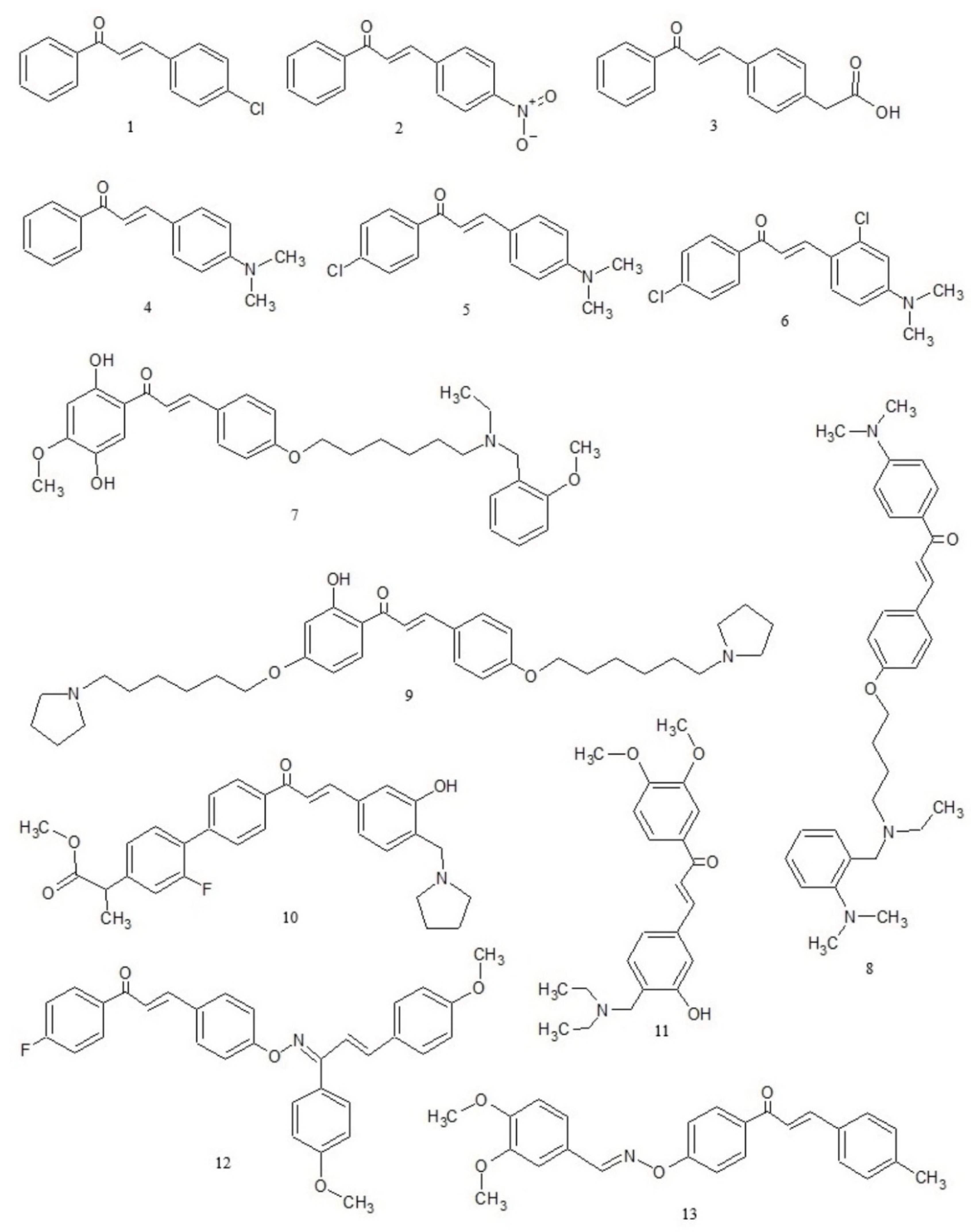
Figure 1. Chemical structures of chalcone derivatives (1-13).
Preprints 216472 g001
Figure 2. Chemical structures of coumarin derivatives (14-23).
Preprints 216472 g002
Figure 3. Chemical structures of chromone derivatives (24-26) as well as imine and hydrazone derivatives (27-31).
Preprints 216472 g003
Figure 4. Chemical structures of aromatic heterocyclic-based derivatives (32-40).
Preprints 216472 g004
Figure 5. Chemical structures of diverse scaffold-based dual inhibitors (41-46).
Preprints 216472 g005
Table 1. The calculated values of drug-likeness parameters for compounds 1–46.
No. LogP 1 TPSA 2
2)
Natoms 3 MW 4
(g/mol)
nON 5 nOHNH 6 Nviolations 7 Nrotb 8 Volume 9
3)
1 4.24 17.07 17 242.70 1 0 0 3 228.50
2 3.49 62.89 19 253.25 3 0 0 4 234.60
3 3.21 54.37 20 266.29 3 1 0 5 259.24
4 3.65 20.31 19 251.32 1 0 0 4 262.24
5 4.30 20.31 20 285.77 1 0 0 4 275.46
6 4.95 20.31 21 320.21 1 0 1 4 291.84
7 1.47 88.46 39 533.36 7 2 1 16 532.02
8 6.40 36.02 37 499.69 3 0 1 14 504.02
9 3.80 62.24 41 562.78 6 1 1 19 593.32
10 5.97 66.84 36 487.56 6 1 0 9 457.58
11 4.15 59.00 27 369.45 5 1 0 9 370.66
12 7.23 57.12 38 507.55 6 0 2 10 485.35
13 5.32 57.12 30 401.45 5 0 0 8 395.58
14 4.12 59.31 22 358.19 3 1 0 3 226.21
15 3.04 59.31 20 265.26 3 1 0 3 203.34
16 4.30 51.47 24 335.28 6 1 0 5 236.99
17 3.43 69.93 25 341.36 5 1 0 6 268.22
18 4.01 59.31 22 313.74 3 1 0 3 233.22
19 2.43 59.31 17 296.12 3 1 0 3 185.52
20 6.03 85.05 29 437.98 4 0 0 8 416.29
21 4.34 62.91 30 417.45 7 1 0 10 380.62
22 4.19 62.91 30 407.50 5 1 0 6 406.96
23 4.41 97.73 33 452.50 7 0 0 8 402.68
24 5.40 71.78 37 496.60 5 1 0 10 490.65
25 3.47 88.85 31 420.46 6 1 0 9 405.07
26 4.69 81.01 34 458.51 6 1 0 9 400.29
27 3.56 51.76 29 329.49 4 0 0 8 411.56
28 2.15 89.02 24 343.72 5 2 0 3 256.67
29 1.53 80.23 26 347.32 5 1 0 4 279.12
30 4.68 50.69 26 364.82 3 1 1 7 346.79
31 2.76 59.89 30 403.52 5 1 0 7 346.35
32 5.16 71.94 30 428.59 4 0 0 12 410.98
33 5.17 81.17 32 458.61 5 0 0 13 437.40
34 5.36 59.00 30 409.52 5 1 0 8 408.55
35 7.71 116.16 47 639.79 4 3 1 8 601.51
36 3.15 37.27 20 269.34 1 1 0 6 215.22
37 3.11 34.47 20 270.33 2 0 0 6 213.74
38 2.66 44.61 31 415.53 4 0 0 7 427.81
39 3.23 79.95 30 423.57 5 1 0 8 402.31
40 3.24 89.18 32 453.60 6 1 0 9 430.95
41 1.59 96.89 22 306.31 5 3 0 5 291.90
42 1.48 110.08 23 311.34 5 3 0 4 292.73
43 3.78 67.45 29 395.49 5 1 0 10 402.46
44 5.37 42.68 28 379.49 4 0 0 7 387.78
45 6.02 42.68 29 413.94 4 0 0 7 401.34
46 3.31 46.17 21 297.74 2 1 0 3 269.30
1 predicted logP values. 2 topological polar surface area. 3 number of heavy atoms. 4 molecular weight. 5 number of hydrogen bond acceptors (O and N atoms). 6 number of hydrogen bond donors (OH i NH groups). 7 number of Lipinski’s rule violations. 8 number of rotatable bonds. 9 molecular volume.
Table 2. Predicted absorption and distribution properties of the investigated compounds 1–46.
Absorption properties The investigated compounds
Good GIT 1 absorption 1-11,13-34,36-46
Poor GIT absorption 12,35
Good blood-brain permeability 1-6,11,13-19,21,22,27,30,31,34,36-38,43-46
Poor blood-brain permeability 7-10,12,20,23-26,28,29,32,33,35,39-42
Substrate for P-gp 2 7-11,14-16,19-26,28,30-36,38-45
Not a substrate for P-gp 1-6,12,13,17,18,27,29,37,46
1 gastrointestinal tract. 2 P-glycoprotein.
Table 3. Predicted metabolic properties of the investigated compounds 1-46.
Metabolic properties The investigated compounds
CYP1A2 inhibitor 1-7, 12,14-19,21,22,24,27,30,32,35-37,39,42-46
CYP2C19 inhibitor 1,2,4-6,8,12-18,20,21,25,26,30,36,37,43,46
CYP2C9 inhibitor 1,4-6,12-15,17,18,20,24-26,30,46
CYP2D6 inhibitor 8,9,18,21,22,24,26,27,34,35,38-40,44-46
CYP3A4 inhibitor 6,8,10-14,16,20-27,30,32-34,40,42-45
Table 4. Predicted toxicological properties of the investigated compounds 1-46.
Toxicological properties Results
Mutagenicity 19 (low level), 4, 5, 20, 27 (high level)
Carcinogenicity 4, 5, 8, 18, 19 (high level)
Reproductive toxicity 15, 16 (low level), 19-23 (high level)
Irritant effect 17 (low level), 7, 11, 20 (high level)
Disclaimer/Publisher’s Note: The statements, opinions and data contained in all publications are solely those of the individual author(s) and contributor(s) and not of MDPI and/or the editor(s). MDPI and/or the editor(s) disclaim responsibility for any injury to people or property resulting from any ideas, methods, instructions or products referred to in the content.
Copyright: This open access article is published under a Creative Commons CC BY 4.0 license, which permit the free download, distribution, and reuse, provided that the author and preprint are cited in any reuse.
Prerpints.org logo

Preprints.org is a free preprint server supported by MDPI in Basel, Switzerland.

Subscribe

Disclaimer

Terms of Use

Privacy Policy

Privacy Settings

© 2026 MDPI (Basel, Switzerland) unless otherwise stated