

Submitted:
01 June 2026
Posted:
02 June 2026
You are already at the latest version
Abstract
Background/Objectives: Frailty and postoperative symptom burden are prevalent in older adults undergoing colorectal cancer (CRC) surgery, but their temporal, within-person interplay remains unclear. We aimed to investigate this bidirectional relationship using a Random Intercept Cross-Lagged Panel Model (RI-CLPM) to overcome the limitations of conventional models that conflate between-person and within-person variances. Methods: This prospective longitudinal study enrolled 242 older patients (≥60 years) undergoing CRC surgery. Frailty and symptom burden were evaluated preoperatively and at 1 week, 1, 3, 6, and 12 months postoperatively. An RI-CLPM was applied to decompose variance and estimate bidirectional cross-lagged effects across these six time points. Results: Both frailty and symptom burden peaked at 1 week postoperatively. The RI-CLPM demonstrated good fit (CFI = 0.984; RMSEA = 0.063). At the between-person level, frailty and symptom burden were strongly correlated (r = 0.90, p < 0.001). At the within-person level, greater symptom burden significantly predicted subsequent frailty worsening from 1 to 3 months (β = 0.268, p = 0.033) and 3 to 6 months (β = 0.378, p = 0.004) postoperatively. Conversely, frailty did not significantly predict subsequent symptom changes at any time point. Additionally, conventional CLPM yielded biased cross-lagged estimates compared to the RI-CLPM. Conclusions: The within-person longitudinal relationship between frailty and symptom burden is unidirectional. Elevated symptom burden prospectively predicts frailty worsening between 1 and 6 months postoperatively, whereas frailty does not drive subsequent symptom changes. This 1-to-6-month window represents a critical period for targeted symptom management to attenuate frailty progression in older CRC survivors.
Keywords:
frailty
; symptom burden
; colorectal cancer
; older adults
; random intercept cross-lagged panel model
; longitudinal study
1. Introduction
Colorectal cancer (CRC) is among the most common malignancies globally, with the majority of cases diagnosed in adults aged 60 years and older [1,2]. Surgical resection remains the primary curative strategy; however, elderly patients are particularly vulnerable to adverse postoperative outcomes [3]. Frailty—a multidimensional syndrome characterized by diminished physiological reserve and increased vulnerability to stressors—affects 20%–50% of elderly CRC surgical candidates and is associated with elevated morbidity, mortality, and impaired health-related quality of life (HRQoL) [4,5,6]. Postoperative symptom burden, encompassing pain, fatigue, sleep disturbance, and psychological distress, is equally prevalent and clinically consequential in this population, with persistent symptoms documented up to one year following surgery [7,8].
The relationship between frailty and symptom burden is theoretically bidirectional: frailty may amplify symptom severity through depleted physiological reserve and an attenuated stress response, while a high symptom burden may reciprocally accelerate frailty progression by restricting physical activity, compromising nutritional status, and undermining rehabilitation engagement [9,10]. However, existing studies have predominantly employed cross-sectional designs or conventional cross-lagged panel models (CLPMs), which conflate stable between-person differences with genuine within-person temporal dynamics, thereby precluding accurate individual-level causal inference [11,12].
The Random Intercept Cross-Lagged Panel Model (RI-CLPM) overcomes this limitation by explicitly separating between-person variance from within-person fluctuations, enabling the unbiased estimation of individual-level temporal dynamics [13]. To date, no study has applied the RI-CLPM to investigate the bidirectional relationship between frailty and symptoms in elderly CRC surgical patients using a comprehensive longitudinal design. Therefore, this study examined within-person bidirectional associations between frailty and postoperative symptom burden across six time points—preoperatively (T0) and at one week (T1), one month (T2), three months (T3), six months (T4), and one year (T5) postoperatively—using the RI-CLPM framework. Ultimately, this study demonstrates that this within-person relationship is unidirectional, highlighting that elevated symptom burden during the 1-to-6-month postoperative window prospectively predicts frailty worsening, whereas frailty does not drive subsequent symptom changes.
2. Materials and Methods
2.1. Study Design and Setting
This was a single-center, prospective longitudinal study conducted at Shanghai Tenth People’s Hospital (Affiliated Tenth People’s Hospital of Tongji University) from February 2025 to May 2026. Written informed consent was obtained from all participants prior to enrollment.
2.2. Participants and Sample Size
Patients were considered eligible if they met the following inclusion criteria: (1) aged 60 years or older; (2) pathologically confirmed colorectal cancer; and (3) capable of communicating effectively and completing the questionnaires. The exclusion criteria were: (1) severe cognitive impairment or psychiatric disorders; (2) presence of other active malignancies; (3) distant metastasis or multi-organ dysfunction; and (4) severe cardiac, hepatic, renal, or hematological diseases.
The sample size was determined based on the established rule of thumb for Structural Equation Modeling (SEM), which recommends a ratio of 10 to 20 participants per observed variable to achieve adequate statistical power and model stability [14]. For our Random Intercept Cross-Lagged Panel Model (RI-CLPM), comprising 12 observed variables (2 constructs × 6 measurement waves), the required sample size ranged from 120 to 240. To maximize model robustness and accommodate an anticipated attrition rate of approximately 10% over the one-year follow-up period, we conservatively targeted a final enrollment of 260 participants.
2.3. Data Collection and Procedures
Data were prospectively collected at six specific time points: preoperatively (T0) and at one week (T1), one month (T2), three months (T3), six months (T4), and one year (T5) postoperatively. Trained case managers administered standardized questionnaires using uniform instructions. Assessments were primarily conducted face-to-face during hospitalization or scheduled clinic visits; telephone interviews were utilized for participants who were unable to return to the hospital. To ensure data accuracy, all completed questionnaires were independently verified by two researchers prior to data entry.
2.4. Outcome Measures
2.4.1. Frailty Assessment
Frailty was assessed using the Groningen Frailty Indicator (GFI), a widely validated instrument for older adults [15]. The GFI consists of 15 items evaluating frailty across physical, cognitive, social, and psychological domains. Total scores range from 0 to 15, with higher scores indicating greater frailty severity. In the current study, the GFI demonstrated good internal consistency, with a Cronbach’s α of 0.82.
2.4.2. Postoperative Symptom Burden
The M.D. Anderson Symptom Inventory (MDASI) was utilized to measure symptom severity and interference [16]. It encompasses 19 items (e.g., pain, fatigue, nausea, sleep disturbance, and appetite loss), each rated on a numeric scale from 0 to 10. A composite symptom burden score was calculated as the mean of all items. The Chinese version of the MDASI has been well-validated in cancer populations [17]. In this study, the Cronbach’s α for the MDASI was 0.89.
2.5. Covariates
Sociodemographic variables included age, sex, educational level, income, occupation, marital status, and Body Mass Index (BMI). Clinical variables comprised comorbidities, tumor location, histological type, TNM stage, surgical approach, chemotherapy regimen and cycles, relevant laboratory indices, and the Nutritional Risk Screening 2002 (NRS 2002) score [18].
2.6. Statistical Analysis
2.6.1. Model Specification and Estimation
Descriptive statistics and baseline comparisons were performed using SPSS version 27.0. The RI-CLPM was fitted using the lavaan package (version 0.6-19) [14] in R software (version 4.4.2; R Core Team, Vienna, Austria). In this model, each observed variable at each time point was decomposed into a time-invariant between-person component (random intercept) and a time-varying within-person component. Two random intercepts—one for frailty (GFI total score) and one for symptom burden (MDASI composite score)—were specified, with factor loadings constrained to unity across all six waves to ensure model identification.
At the within-person level, autoregressive paths (reflecting the carry-over of individual deviations from one’s own expected mean) and cross-lagged paths (reflecting prospective within-person spillover effects between the two constructs) were freely estimated for each consecutive time interval (T0→T1, T1→T2, T2→T3, T3→T4, T4→T5). This unconstrained approach was selected given the unequal time spacing between measurement occasions. Within-time residual covariances between frailty and symptom burden were also estimated at each wave to account for concurrent associations not explained by the lagged effects.
Crucially, because the RI-CLPM inherently controls for all time-invariant unobserved and observed inter-individual differences via the random intercepts [12], the aforementioned sociodemographic and clinical covariates were solely utilized for baseline descriptive statistics and to assess potential attrition bias, thereby preserving model parsimony. Model parameters were estimated using Maximum Likelihood with Robust standard errors (MLR) to accommodate potential non-normality in the data. Missing data were handled via Full Information Maximum Likelihood (FIML) under the assumption of Missing at Random (MAR) [19].
2.6.2. Model Fit Evaluation
Model fit was evaluated using the Comparative Fit Index (CFI), Tucker–Lewis Index (TLI), Root Mean Square Error of Approximation (RMSEA) with its 90% confidence interval (CI), and Standardized Root Mean Square Residual (SRMR). A good fit was defined as CFI and TLI ≥ 0.95, RMSEA ≤ 0.06, and SRMR ≤ 0.08; an adequate fit was defined as CFI and TLI ≥ 0.90, RMSEA ≤ 0.08, and SRMR ≤ 0.08 [20].
2.6.3. Sensitivity Analyses
A conventional CLPM without random intercepts was fitted for comparison to evaluate the impact of separating between-person variance on the path estimates. A two-tailed pp-value of < 0.05 was considered statistically significant.
3. Results
3.1. Participant Characteristics
Baseline enrollment included 260 patients. The final analytic sample comprised 242 participants; the baseline characteristics of these participants are detailed in Table 1. The overall attrition rate was 7.4% (n = 18). Specifically, 8 patients were lost to follow-up between T1 and T2, and 10 patients were lost between T2 and T3. Reasons for attrition included the refusal of further follow-up (n = 7), disease progression (n = 8), a revised non-CRC diagnosis (n = 2), and death (n = 1).
3.2. Descriptive Statistics of Frailty and Symptom Burden Across Time Points
Descriptive statistics for GFI and MDASI across the six time points are presented in Table 2. Both frailty and symptom burden peaked at postoperative week 1 (T1: GFI = 4.60 ± 2.20, MDASI = 37.69 ± 22.58) and progressively declined thereafter, with the lowest values observed at 12 months (T5: GFI = 2.53 ± 2.72, MDASI = 18.53 ± 23.54).
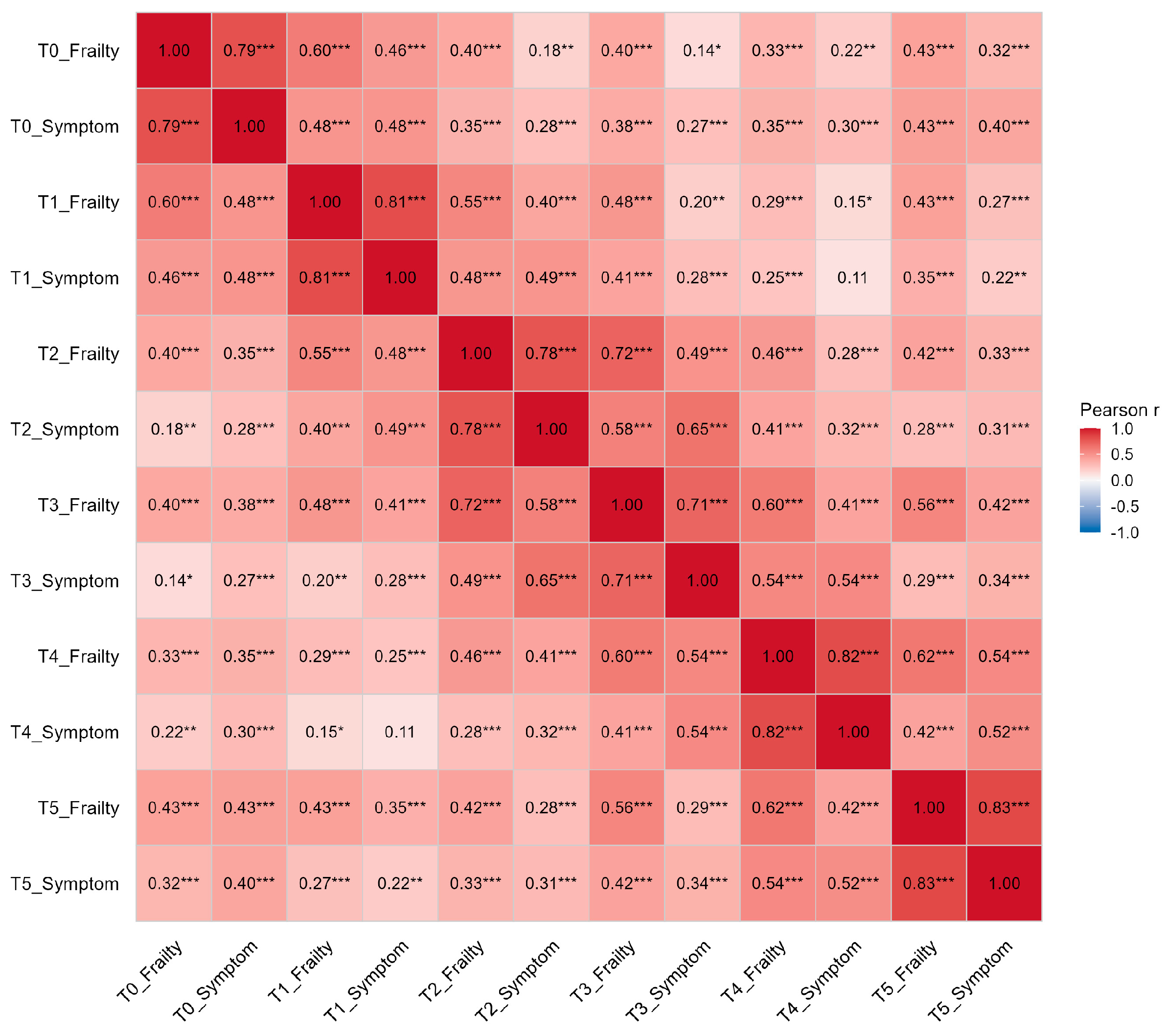
As illustrated in Figure 2 and the correlation matrix, strong cross-sectional associations were observed between frailty and symptom burden at each time point (r range: 0.71–0.83). Moderate to strong lagged correlations between the two constructs across adjacent time intervals (r range: 0.40–0.60) and substantial temporal stability within each variable (r ≥ 0.48) were evident, supporting the subsequent use of cross-lagged panel modeling.
Figure 1.
Heat map of symptom burden and frailty association at different times.
3.3. RI-CLPM Results
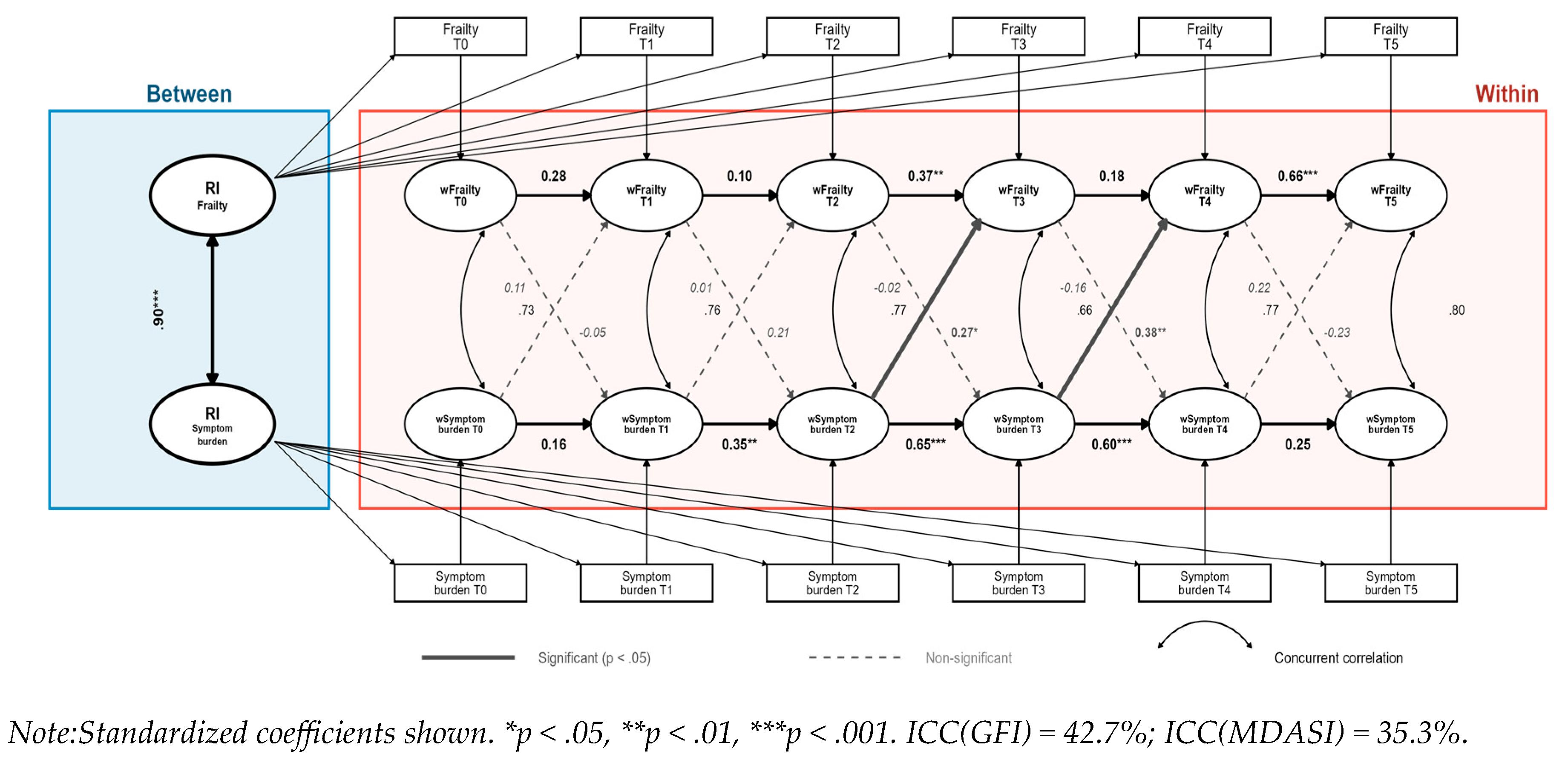
The RI-CLPM demonstrated a good fit to the data: χ²(37) = 72.209, p < 0.001; CFI = 0.984; TLI = 0.972; RMSEA = 0.063 (90% CI: 0.041–0.084); SRMR = 0.077, meeting the recommended thresholds for an adequate fit (CFI/TLI ≥ 0.90; RMSEA ≤ 0.08; SRMR ≤ 0.08). The full parameter estimates are presented in Table 3.
3.3.1. Between-Person Effects: Stable Individual Differences in Frailty and Symptom Burden
The random intercept variances were significant for both frailty (σ² = 0.389, SE = 0.053, p < 0.001) and symptom burden (σ² = 0.232, SE = 0.047, p < 0.001). The resulting Intraclass Correlation Coefficients (ICCs) were 42.7% for frailty and 35.3% for symptom burden, indicating that substantial proportions of the total variance reflected stable between-person differences rather than temporal fluctuations. The between-person correlation between frailty and symptom burden was strong (r = 0.90, p < 0.001), confirming that individuals with chronically elevated frailty consistently reported a higher symptom burden across the entire one-year follow-up period. Within-person concurrent correlations were also strong at each time point (standardized r range: 0.66–0.80, all p < 0.001).
3.3.2. Within-Person Cross-Lagged Effects: Frailty Predicting Subsequent Symptom Burden
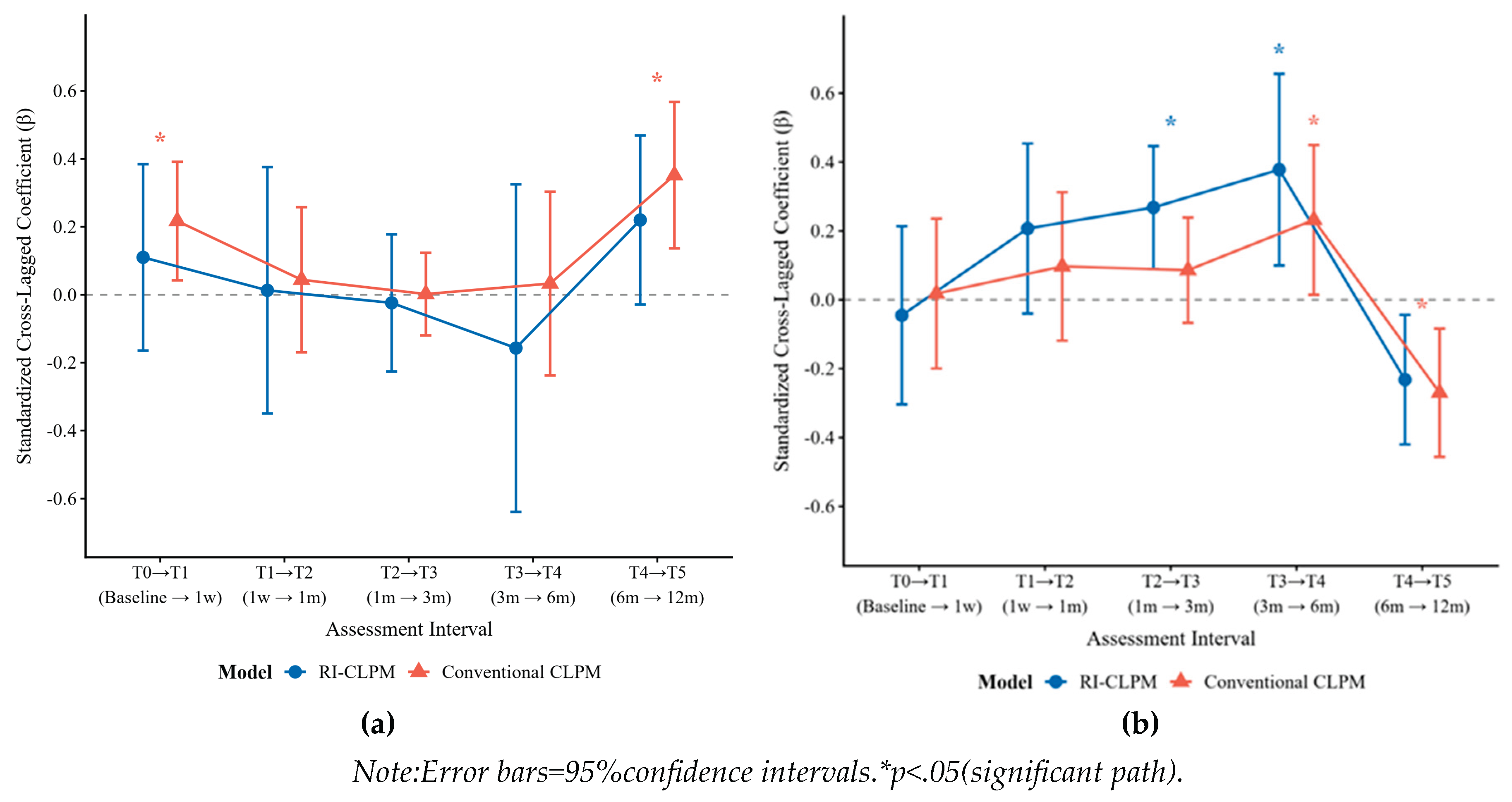
After partitioning out stable between-person variance, all five cross-lagged paths from frailty to subsequent symptom burden were non-significant: T0→T1 (β = 0.110, p = 0.407), T1→T2 (β = 0.013, p = 0.912), T2→T3 (β = −0.024, p = 0.787), T3→T4 (β = −0.157, p = 0.271), and T4→T5 (β = 0.220, p = 0.154). No confidence interval excluded zero. Therefore, transient within-person elevations in frailty did not predict subsequent changes in symptom burden at any postoperative interval.
3.3.3. Within-Person Cross-Lagged Effects: Symptom Burden Predicting Subsequent Frailty
The reverse direction revealed a temporally specific pattern. Cross-lagged paths were non-significant during the acute perioperative phase: T0→T1 (β = −0.045, p = 0.754) and T1→T2 (β = 0.207, p = 0.094). However, significant predictive effects emerged during the intermediate recovery window: T2→T3 (β = 0.268, p = 0.033, 95% CI: 0.016–0.373) and T3→T4 (β = 0.378, p = 0.004, 95% CI: 0.131–0.686). The late-phase path T4→T5 was non-significant (β = −0.232, p = 0.077). Thus, within-person elevations in symptom burden at 1 and 3 months postoperatively prospectively predicted worsening frailty at the subsequent assessment points.
3.3.4. Within-Person Autoregressive Effects
Within-person frailty carry-over was non-significant in the acute phase (T0→T1: β = 0.284, p = 0.069; T1→T2: β = 0.099, p = 0.489), became significant at T2→T3 (β = 0.365, p = 0.002), was again non-significant at T3→T4 (β = 0.177, p = 0.198), and was strongest at T4→T5 (β = 0.660, p < 0.001). Conversely, within-person symptom burden stability increased progressively across the mid-recovery period: T1→T2 (β = 0.354, p = 0.003), T2→T3 (β = 0.645, p < 0.001), and T3→T4 (β = 0.602, p < 0.001), before attenuating at T4→T5 (β = 0.254, p = 0.070). For both variables, the initial T0→T1 autoregressive paths were non-significant (GFI: p = 0.069; MDASI: p = 0.194).
Figure 2.
Random Intercept Cross−Lagged Panel Model (RI−CLPM).
3.4. Sensitivity Analysis Results
The conventional CLPM yielded a substantially poorer fit: χ²(40) = 132.673; CFI = 0.958; TLI = 0.931; RMSEA = 0.098; SRMR = 0.102, with both RMSEA and SRMR exceeding acceptable thresholds. Three key discrepancies with the RI-CLPM findings were identified. First, two GFI→MDASI paths that were significant in the CLPM (T0→T1: β = 0.217, p = 0.022; T4→T5: β = 0.352, p = 0.007) were non-significant in the RI-CLPM, representing false-positive findings attributable to between-person confounding. Second, the MDASI→GFI path at T2→T3, which was non-significant in the CLPM (β = 0.086, p = 0.341), reached significance in the RI-CLPM (β = 0.268, p = 0.033), representing a false-negative masked by between-person variance in the traditional model. Third, the negative T4→T5 MDASI→GFI path that was significant in the CLPM (β = −0.270, p = 0.014) became non-significant in the RI-CLPM (β = −0.232, p = 0.077).
Figure 3.
Comparison of Standardized Cross-Lagged Coefficients: RI-CLPM vs. CLPM. (a) Panel A: GFI→MDASI(Frailty predicting Symptom Burden); (b) Panel B: MDASI→GFI(Symptom Burden predicting Frailty).
Figure 3.
Comparison of Standardized Cross-Lagged Coefficients: RI-CLPM vs. CLPM. (a) Panel A: GFI→MDASI(Frailty predicting Symptom Burden); (b) Panel B: MDASI→GFI(Symptom Burden predicting Frailty).
4. Discussion
4.1. Symptom Burden, Not Frailty, Drives Within-Person Postoperative Decline
Applying the RI-CLPM to a six-wave, one-year dataset, we found that the longitudinal relationship between frailty and postoperative symptom burden is unidirectional at the within-person level: elevated symptom burden during postoperative months 1–6 predicted subsequent frailty worsening, whereas frailty did not predict subsequent symptom changes at any time point. This finding directly challenges the commonly assumed bidirectional reinforcement between frailty and symptoms—a premise that underlies much of the current rationale for perioperative frailty interventions [21,22].
The strong cross-sectional association between frailty and symptoms documented in prior studies (r = 0.50–0.80) is replicated at the between-person level in our study (r = 0.90). However, the RI-CLPM reveals that this association reflects shared stable characteristics—such as comorbidity, nutritional deficits, and sarcopenia—rather than one construct temporally driving the other. Earlier longitudinal studies using conventional CLPMs have reported significant frailty→symptom paths in cancer populations [23,24,25,26]; our sensitivity analysis reproduced those effects, but subsequently demonstrated that they disappear when between-person confounding is explicitly partitioned out.
4.2. The Unidirectional Impact of Symptom Burden on Frailty in the Intermediate Recovery Phase
The symptom→frailty predictive effects were exclusively confined to the T2→T3 (1→3 months, β = 0.268) and T3→T4 (3→6 months, β = 0.378) intervals, and were absent both in the acute phase and after 6 months. This temporal specificity is interpretively coherent. During the first postoperative week, surgical trauma simultaneously elevates both constructs through shared pathways—acute inflammation, catabolism, and enforced immobility—leaving no residual cross-lagged variance for one to predict the other. By 12 months, natural recovery has substantially reduced overall symptom levels (MDASI composite score fell from 37.69 at T1 to 18.53 at T5), limiting their potential to further drive frailty.
The 1-to-6-month window is distinct: patients have transitioned out of the acute surgical phase but have not yet consolidated their recovery. Persistent symptoms during this period likely drive frailty through at least three converging mechanisms. First, sustained pain and fatigue restrict physical activity, producing progressive deconditioning and muscle loss consistent with Fried’s cycle of frailty [27]. Second, appetite loss and nausea impair nutritional repletion during a period of heightened catabolic demand, thereby exacerbating sarcopenia. Third, psychological symptoms—such as distress and sleep disruption—reduce adherence to rehabilitation and sustain the activation of the hypothalamic–pituitary–adrenal (HPA) axis, both of which promote the inflammatory milieu implicated in frailty pathogenesis [28,29,30,31,32]. The autoregressive data reinforce this picture: symptom burden became progressively self-reinforcing across this exact window (β increased from 0.354 to 0.645 across T1→→T4), indicating that unresolved symptoms not only persisted but simultaneously drove the progression of frailty.
The absence of frailty→symptom within-person effects may reflect the fact that postoperative symptom severity is more proximally determined by treatment-specific factors—such as analgesic adequacy, chemotherapy regimens, and surgical complications—that fluctuate independently of an individual’s within-person frailty deviations. Frailty’s influence on symptoms appears structural rather than dynamic: it operates through stable physiological depletion captured at the between-person level, not through short-interval temporal spillover.
4.3. Clinical Target: Extend Structured Symptom Management to Months 1–6
Current perioperative care models, including Enhanced Recovery After Surgery (ERAS) protocols [33,34,35], primarily concentrate resources within the acute hospital stay. Our findings make a specific case for extension: structured symptom monitoring and intervention during postoperative months 1–6 may prevent downstream frailty progression. In practice, this entails scheduled MDASI reassessments at 1- and 3-month outpatient follow-ups, utilizing protocolized response thresholds to trigger the multimodal management of persistent pain, fatigue, and nutritional deficits. The strong between-person correlation (r = 0.90) additionally supports preoperative GFI screening to identify patients at a high baseline risk for persistent symptom burden, thereby enabling targeted prehabilitation before surgery.
The consolidation of frailty carry-over effects between 6 and 12 months (a5: β = 0.660, pp < 0.001) suggests that frailty deviations established during the recovery period become increasingly resistant to change. This underscores the necessity of intervening during the 1-to-6-month window, before frailty trajectories permanently stabilize.
4.4. RI-CLPM Corrects Both False Positives and False Negatives
The conventional CLPM produced two spurious GFI→MDASI effects (T0→T1, T4→T5) and missed the true MDASI→GFI effect at T2→T3, alongside yielding fit indices that exceeded acceptable thresholds (RMSEA = 0.098; SRMR = 0.102). The direction of this bias follows predictably from the between-person structure: the high trait-level correlation (r = 0.90) inflated paths in the direction of shared variance while masking genuine within-person effects in the opposite direction. This methodological finding has implications beyond the present study. Longitudinal analyses of frailty and symptom-related outcomes in older cancer cohorts routinely involve high between-person heterogeneity; thus, our results suggest that published conclusions based on conventional CLPMs in this literature warrant reexamination.
4.5. Limitations
This study has several limitations. First, it was a single-center study conducted at a tertiary hospital in Shanghai, which may limit the generalizability of the findings. Second, both constructs relied on self-report; objective markers (grip strength, inflammatory biomarkers) would strengthen inference. Third, the unequal measurement intervals may have missed dynamic effects operating on finer time scales. Fourth, while the RI-CLPM perfectly controls for stable between-person variance, it cannot entirely exclude unmeasured time-varying confounders, such as fluctuations in social support or medication changes. Finally, we did not examine specific symptom clusters or frailty subdomains, which may exhibit differential longitudinal dynamics.
4.6. Future Directions
Future research should prioritize multicenter replication to enhance generalizability, and integrate objective frailty indicators such as grip strength and inflammatory biomarkers alongside patient-reported outcomes. Denser assessment schedules within the critical postoperative 1–6 month window would better capture the timing of symptom-driven frailty progression. Examining specific symptom clusters and frailty subdomains may further reveal differential longitudinal dynamics. Ultimately, and most directly translatable, randomized controlled trials targeting structured, protocolized symptom management during postoperative months 1–6 are warranted to establish whether reducing symptom burden causally attenuates frailty progression, thereby converting the present observational findings into evidence-based clinical intervention.
5. Conclusions
In older adults undergoing colorectal cancer surgery, the within-person relationship between frailty and postoperative symptom burden is unidirectional: an elevated symptom burden during postoperative months 1–6 prospectively drives frailty worsening, whereas frailty does not predict subsequent symptom changes. The strong between-person association (rr = 0.90) reflects shared stable determinants rather than temporal causation. Conventional cross-lagged models generate both false-positive and false-negative conclusions in this setting; thus, the RI-CLPM is necessary to accurately recover within-person dynamics. For clinical practice, these findings identify the 1-to-6-month postoperative window as a critical period for targeted symptom interventions to prevent frailty progression.
Author Contributions
Conceptualization, P.L., L.G. and Q.W.; methodology, P.L. and Ya.L.; software, P.L. and L.G.; validation, Ya.L., K.L. and T.W.; formal analysis, P.L. and L.G.; investigation, K.L., T.W., Q.F., Y.D. and Yu.L.; resources, Q.W.; data curation, Q.F., Y.D. and Yu.L.; writing—original draft preparation, P.L. and L.G.; writing—review and editing, Ya.L. and Q.W.; visualization, P.L.; supervision, Q.W.; project administration, Q.W.; funding acquisition, Q.W. All authors have read and agreed to the published version of the manuscript.
Funding
This research was funded by the Nursing Talent Cultivation Project of Shanghai Tenth People’s Hospital, grant number 2023YJXHS002; the Shanghai Medical and Health Development Foundation (Shanghai “Rising Stars of Medical Talent” Youth Development Program), grant number YJXHS-002; and the Clinical Research Project of the Three-Year Action Plan for Discipline Construction from the School of Nursing, Tongji University, grant number JS2210327. The APC was funded by the Nursing Department of Shanghai Tenth People’s Hospital.
Institutional Review Board Statement
The study was conducted in accordance with the Declaration of Helsinki, and approved by the Medical Ethics Committee of Shanghai Tenth People’s Hospital (protocol code: SHSY-IEC-6.0/25K2/PO1 and date of approval: 26 February 2025.)
Informed Consent Statement
Informed consent was obtained from all subjects involved in the study.
Data Availability Statement
The data presented in this study are available on request from the corresponding author. The data are not publicly available due to privacy and ethical restrictions regarding patient confidentiality.
Conflicts of Interest
The authors declare no conflicts of interest. The funders had no role in the design of the study; in the collection, analyses, or interpretation of data; in the writing of the manuscript; or in the decision to publish the results.
References
- Xia, C.; Dong, X.; Li, H.; Cao, M.; Sun, D.; He, S.; Yang, F.; Yan, X.; Zhang, S.; Li, N.; et al. Cancer Statistics in China and United States, 2022: Profiles, Trends, and Determinants. Chin. Med. J. (Engl) 2022, 135, 584–590. [Google Scholar] [CrossRef]
- Bray, F.; Laversanne, M.; Sung, H.; Ferlay, J.; Siegel, R.L.; Soerjomataram, I.; Jemal, A. Global Cancer Statistics 2022: GLOBOCAN Estimates of Incidence and Mortality Worldwide for 36 Cancers in 185 Countries. CA Cancer J. Clin. 2024, 74, 229–263. [Google Scholar] [CrossRef]
- Hubbard, J.M. Management of Colorectal Cancer in Older Adults. Clin. Geriatr. Med. 2016, 32, 97–111. [Google Scholar] [CrossRef]
- Włodarczyk, J. Molecular Mechanisms and Clinical Implications of Complex Prehabilitation in Colorectal Cancer Surgery: A Comprehensive Review. Int. J. Mol. Sci. 2025, 26, 7242. [Google Scholar] [CrossRef] [PubMed]
- Davey, M.G.; Joyce, W.P. Impact of Frailty on Oncological Outcomes in Patients Undergoing Surgery for Colorectal Cancer - A Systematic Review and Meta-Analysis. Surgeon 2023, 21, 173–180. [Google Scholar] [CrossRef]
- Han, C.J.; Ning, X.; Burd, C.E.; Spakowicz, D.J.; Tounkara, F.; Kalady, M.F.; Noonan, A.M.; McCabe, S.; Von Ah, D. Chemotoxicity and Associated Risk Factors in Colorectal Cancer: A Systematic Review and Meta-Analysis. Cancers 2024, 16, 2597. [Google Scholar] [CrossRef]
- Shi, J.; Luo, J.; Liu, Y.; Xu, H.; Li, M.; Jin, Y.; Wu, S.; Jin, T. Symptom Clusters and Sentinel Symptoms in Patients With Colorectal Cancer: A Network Analysis. Nurs. Health Sci. 2025, 27, e70122. [Google Scholar] [CrossRef] [PubMed]
- Versluis, M.A.J.; Raijmakers, N.J.H.; Baars, A.; van den Beuken-van Everdingen, M.H.J.; de Graeff, A.; Hendriks, M.P.; de Jong, W.K.; Kloover, J.S.; Kuip, E.J.M.; Mandigers, C.M.P.W.; et al. Trajectories of Health-Related Quality of Life and Symptom Burden in Patients with Advanced Cancer towards the End of Life: Longitudinal Results from the eQuiPe Study. Cancer 2024, 130, 609–617. [Google Scholar] [CrossRef]
- Xu, Y.; Chen, F.; Zhang, H.; Wang, X. Targeted Therapies in Lung Cancer: Personalizing Treatment across the Age Spectrum. Front Oncol. 2026, 16, 1743620. [Google Scholar] [CrossRef] [PubMed]
- Ahmadzadeh, S.; Duplechin, D.P.; Haynes, A.T.; Hollander, A.V.; Rieger, R.; Jean Baptiste, C.; Varrassi, G.; Shekoohi, S.; Kaye, A.D. Evolving Clinical Management of Postoperative Delirium: A Narrative Review. Cureus 2025, 17, e92927. [Google Scholar] [CrossRef]
- Hoffman, L.; Hall, G.J. Considering Between- and within-Person Relations in Auto-Regressive Cross-Lagged Panel Models for Developmental Data. J. Sch. Psychol. 2024, 102, 101258. [Google Scholar] [CrossRef]
- Wang, Y.; Wang, Z.; Wang, Y.; Yu, J.; Xia, S.; Li, Y.; Che, Y.; Wang, Y.; Li, X.; Liu, Y.; et al. The Bidirectional Relationships among Multimorbidity, Depression, and Catastrophic Health Expenditures in Middle-Aged and Older Chinese Adults: Random-Intercept, Cross-Lagged Panel Model. BMC Public Health 2026. [Google Scholar] [CrossRef] [PubMed]
- Vedder, A.; O’Connor, M.; Boelen, P.A. Emotional vs. Social Loneliness and Prolonged Grief: A Random-Intercept Cross-Lagged Panel Model. Eur. J. Psychotraumatol 2025, 16, 2488101. [Google Scholar] [CrossRef]
- Cheung, S.F.; Lai, M.H.C. Semfindr: An R Package for Identifying Influential Cases in Structural Equation Modeling. Multivar. Behav. Res. 2026, 1–9. [Google Scholar] [CrossRef]
- Midao, L.; Duarte, M.; Sampaio, R.; Almada, M.; Dias, C.C.; Paúl, C.; Costa, E. FRAILSURVEY-an mHealth App for Self-Assessment of Frailty Based on the Portuguese Version of the Groningen Frailty Indicator: Validation and Reliability Study. JMIR Form. Res. 2025, 9, e51975. [Google Scholar] [CrossRef] [PubMed]
- Sailors, M.H.; Bodurka, D.C.; Gning, I.; Ramondetta, L.M.; Williams, L.A.; Mendoza, T.R.; Agarwal, S.; Sun, C.C.; Cleeland, C.S. Validating the M. D. Anderson Symptom Inventory (MDASI) for Use in Patients with Ovarian Cancer. Gynecol. Oncol. 2013, 130, 323–328. [Google Scholar] [CrossRef]
- Fong, T.C.T.; Ho, R.T.H. Mindfulness Facets Predict Quality of Life and Sleep Disturbance via Physical and Emotional Distresses in Chinese Cancer Patients: A Moderated Mediation Analysis. Psychooncology 2020, 29, 894–901. [Google Scholar] [CrossRef]
- Kwag, S.-J.; Kim, J.-G.; Kang, W.-K.; Lee, J.-K.; Oh, S.-T. The Nutritional Risk Is a Independent Factor for Postoperative Morbidity in Surgery for Colorectal Cancer. Ann. Surg. Treat. Res. 2014, 86, 206–211. [Google Scholar] [CrossRef] [PubMed]
- Kamp, C.B.; Dankiewicz, J.; Harboe Olsen, M.; Holgersson, J.; Saxena, M.; Young, P.; Niemelä, V.H.; Hästbacka, J.; Levin, H.; Lilja, G.; et al. Sedation, Temperature and Pressure after Cardiac Arrest and Resuscitation-The STEPCARE Trial: A Statistical Analysis Plan. Acta Anaesthesiol. Scand. 2025, 69, e70033. [Google Scholar] [CrossRef]
- Liao, Y.; Yang, J. Status of Nutrition Labeling Knowledge, Attitude, and Practice (KAP) of Residents in the Community and Structural Equation Modeling Analysis. Front Nutr. 2023, 10, 1097562. [Google Scholar] [CrossRef]
- Haase, K.R.; Sattar, S.; Hall, S.; McLean, B.; Wills, A.; Gray, M.; Kenis, C.; Donison, V.; Howell, D.; Puts, M. Systematic Review of Self-Management Interventions for Older Adults with Cancer. Psychooncology 2021, 30, 989–1008. [Google Scholar] [CrossRef]
- Kirkhus, L.; Šaltytė Benth, J.; Grønberg, B.H.; Hjermstad, M.J.; Rostoft, S.; Harneshaug, M.; Selbæk, G.; Wyller, T.B.; Jordhøy, M.S. Frailty Identified by Geriatric Assessment Is Associated with Poor Functioning, High Symptom Burden and Increased Risk of Physical Decline in Older Cancer Patients: Prospective Observational Study. Palliat. Med. 2019, 33, 312–322. [Google Scholar] [CrossRef]
- Cuthbert, C.A.; O’Sullivan, D.E.; Boyne, D.J.; Brenner, D.R.; Cheung, W.Y. Patient-Reported Symptom Burden and Supportive Care Needs of Patients With Stage II-III Colorectal Cancer During and After Adjuvant Systemic Treatment: A Real-World Evidence Study. JCO Oncol. Pract. 2023, 19, e377–e388. [Google Scholar] [CrossRef]
- Hirani, V.; Naganathan, V.; Blyth, F.; Le Couteur, D.G.; Seibel, M.J.; Waite, L.M.; Handelsman, D.J.; Cumming, R.G. Longitudinal Associations between Body Composition, Sarcopenic Obesity and Outcomes of Frailty, Disability, Institutionalisation and Mortality in Community-Dwelling Older Men: The Concord Health and Ageing in Men Project. Age Ageing 2017, 46, 413–420. [Google Scholar] [CrossRef] [PubMed]
- Miao, X.; Guo, Y.; Chen, Y.; Xu, X.; Ding, L.; Hu, J.; Zhao, K.; Lu, J.; Zhu, H.; Chen, L.; et al. Exploration of Frailty Trajectories and Their Associations with Health Outcomes in Older Gastric Cancer Survivors Undergoing Radical Gastrectomy: A Prospective Longitudinal Observation Study. Eur. J. Surg. Oncol. 2024, 50, 107934. [Google Scholar] [CrossRef] [PubMed]
- Seligman, B.; Kim, D.H.; Orkaby, A. Associations of Summary Measures of Longitudinal Frailty Assessments with Health Outcomes. J. Gerontol. A Biol. Sci. Med. Sci. 2026, 81, glaf161. [Google Scholar] [CrossRef] [PubMed]
- Dent, E.; Martin, F.C.; Bergman, H.; Woo, J.; Romero-Ortuno, R.; Walston, J.D. Management of Frailty: Opportunities, Challenges, and Future Directions. Lancet 2019, 394, 1376–1386. [Google Scholar] [CrossRef]
- Candow, D.G.; Chilibeck, P.D.; Forbes, S.C.; Fairman, C.M.; Gualano, B.; Roschel, H. Creatine Supplementation for Older Adults: Focus on Sarcopenia, Osteoporosis, Frailty and Cachexia. Bone 2022, 162, 116467. [Google Scholar] [CrossRef]
- Gielen, E.; Dupont, J.; Dejaeger, M.; Laurent, M.R. Sarcopenia, Osteoporosis and Frailty. Metabolism 2023, 145, 155638. [Google Scholar] [CrossRef]
- Olmos Martínez, J.M.; Hernández Martínez, P.; González Macías, J. Frailty, Sarcopenia and Osteoporosis. Med. Clin. (Barc) 2024, 163, e17–e23. [Google Scholar] [CrossRef]
- Sato, R.; Vatic, M.; Peixoto da Fonseca, G.W.; Anker, S.D.; von Haehling, S. Biological Basis and Treatment of Frailty and Sarcopenia. Cardiovasc Res. 2024, 120, 982–998. [Google Scholar] [CrossRef]
- Al-Maisary, S.; Mustafi, M.; Romano, G.; Karck, M.; Arif, R.; Kraft, P.; Guzman-Ruvalcaba, M.J. Clinical Outcomes of Cardiac Implantable Electronic Device Infections in Octogenarians: A 20-Year Retrospective Cohort Study. J. Clin. Med. 2026, 15, 2996. [Google Scholar] [CrossRef]
- Gillis, C.; Ljungqvist, O.; Carli, F. Prehabilitation, Enhanced Recovery after Surgery, or Both? A Narrative Review. Br. J. Anaesth. 2022, 128, 434–448. [Google Scholar] [CrossRef] [PubMed]
- Forsmo, H.M.; Pfeffer, F.; Rasdal, A.; Sintonen, H.; Körner, H.; Erichsen, C. Pre- and Postoperative Stoma Education and Guidance within an Enhanced Recovery after Surgery (ERAS) Programme Reduces Length of Hospital Stay in Colorectal Surgery. Int. J. Surg. 2016, 36, 121–126. [Google Scholar] [CrossRef] [PubMed]
- Kannan, V.; Ullah, N.; Geddada, S.; Ibrahiam, A.; Munaf Shakir Al-Qassab, Z.; Ahmed, O.; Malasevskaia, I. Impact of “Enhanced Recovery After Surgery” (ERAS) Protocols vs. Traditional Perioperative Care on Patient Outcomes after Colorectal Surgery: A Systematic Review. Patient Saf. Surg. 2025, 19, 4. [Google Scholar] [CrossRef] [PubMed]

Table 1.
Baseline Characteristics of Participants (N = 242).
| Characteristic | N = 2421 |
| Sex, n (%) | |
| Male | 138 (57.0%) |
| Female | 104 (43.0%) |
| Age, years | 69.87 ± 7.61 |
| Residence, n (%) | |
| Shanghai | 179 (74.0%) |
| Other provinces | 63 (26.0%) |
| Education level, n (%) | |
| Junior high school or below | 140 (57.8%) |
| Senior high school | 72 (29.8%) |
| College/associate degree or above | 30 (12.4%) |
| Marital status, n (%) | |
| Married | 193 (79.8%) |
| Other | 49 (20.2%) |
| Diagnosis, n (%) | |
| Colon/sigmoid cancer | 160 (66.1%) |
| Rectal cancer | 82 (33.9%) |
| BMI, kg/m² | 23.43 ± 3.12 |
| NRS 2002 score | 1.54 ± 0.95 |
| Nutritional risk (NRS 2002), n (%) | |
| Low risk (NRS<3) | 215 (88.8%) |
| At risk (NRS≥3) | 27 (11.2%) |
| Stoma, n (%) | |
| Yes | 40 (16.5%) |
| No | 202 (83.5%) |
| Postoperative complications, n (%) | |
| Yes | 12 (5.0%) |
| No | 230 (95.0%) |
| Hemoglobin, g/L | 117.42 ± 24.09 |
| Albumin, g/L | 38.45 ± 4.32 |
| Total protein, g/L | 65.56 ± 7.30 |
1 n (%); Mean ± SD.
Table 2.
Descriptive statistics for frailty (GFI) and symptom burden (MDASI) across six time points.
Table 2.
Descriptive statistics for frailty (GFI) and symptom burden (MDASI) across six time points.
| Time Point | Frailty | Symptom Burden | ||
| GFI(Mean ± SD) | N | MDASI(Mean ± SD) | N | |
| T0 | 2.83 ± 2.48 | 242 | 26.51 ± 20.76 | 242 |
| T1 | 4.60 ± 2.20 | 242 | 37.69 ± 22.58 | 242 |
| T2 | 3.48 ± 2.49 | 233 | 32.27 ± 24.97 | 233 |
| T3 | 2.98 ± 2.17 | 223 | 29.64 ± 23.39 | 223 |
| T4 | 3.41 ± 2.83 | 211 | 28.82 ± 30.56 | 210 |
| T5 | 2.53 ± 2.72 | 205 | 18.53 ± 23.54 | 204 |
Note: T0, baseline, preoperative; T1, postoperative week 1; T2, postoperative month 1; T3, postoperative month 3; T4, postoperative month 6; T5, postoperative month 12. GFI, Groningen Frailty Indicator; MDASI, MD Anderson Symptom Inventory. Values are presented as mean ± standard deviation. N indicates sample size at each time point. Both GFI and MDASI peaked at T1 and progressively declined thereafter, with lowest values at T5.
Table 3.
RI-CLPM Parameter Estimates: Within-Person Cross-Lagged and Autoregressive Path.
| Path | Interval | B (SE) | 95% CI | Std. β | p |
| GFI → MDASI | |||||
| c1: T0→T1 | Baseline → 1 week | 0.116 (0.140) | [−0.159, 0.392] | 0.110 | .407 |
| c2: T1→T2 | 1 week → 1 month | 0.020 (0.185) | [−0.342, 0.383] | 0.013 | .912 |
| c3: T2→T3 | 1 month → 3 months | −0.028 (0.103) | [−0.230, 0.174] | −0.024 | .787 |
| c4: T3→T4 | 3 months → 6 months | −0.271 (0.246) | [−0.754, 0.212] | −0.157 | .271 |
| c5: T4→T5 | 6 months → 12 months | 0.181 (0.127) | [−0.068, 0.430] | 0.220 | .154 |
| MDASI → GFI | |||||
| d1: T0→T1 | Baseline → 1 week | −0.041 (0.132) | [−0.301, 0.218] | −0.045 | .754 |
| d2: T1→T2 | 1 week → 1 month | 0.212 (0.126) | [−0.036, 0.459] | 0.207 | .094 |
| d3: T2→T3 | 1 month → 3 months | 0.194 (0.091) | [0.016, 0.373] | 0.268 | .033* |
| d4: T3→T4 | 3 months → 6 months | 0.409 (0.142) | [0.131, 0.686] | 0.378 | .004** |
| d5: T4→T5 | 6 months → 12 months | −0.169 (0.096) | [−0.357, 0.018] | −0.232 | .077 |
| GFI Autoregressive | |||||
| a1: T0→T1 | 0.238 (0.131) | [−0.018, 0.494] | 0.284 | .069 | |
| a2: T1→T2 | 0.128 (0.185) | [−0.235, 0.491] | 0.099 | .489 | |
| a3: T2→T3 | 0.309 (0.102) | [0.109, 0.509] | 0.365 | .002** | |
| a4: T3→T4 | 0.261 (0.203) | [−0.136, 0.658] | 0.177 | .198 | |
| a5: T4→T5 | 0.564 (0.115) | [0.338, 0.790] | 0.660 | <.001*** | |
| MDASI Autoregressive | |||||
| b1: T0→T1 | 0.188 (0.145) | [−0.096, 0.472] | 0.159 | .194 | |
| b2: T1→T2 | 0.423 (0.141) | [0.147, 0.699] | 0.354 | .003** | |
| b3: T2→T3 | 0.636 (0.079) | [0.482, 0.790] | 0.645 | <.001*** | |
| b4: T3→T4 | 0.763 (0.198) | [0.376, 1.151] | 0.602 | <.001*** | |
| b5: T4→T5 | 0.178 (0.098) | [−0.015, 0.371] | 0.254 | .070 |
Note. Unstandardized coefficients (B) with robust standard errors in parentheses (MLR estimator). Std. β = fully standardized coefficient. 95% CI based on unstandardized estimates. GFI = Groningen Frailty Indicator; MDASI = M.D. Anderson Symptom Inventory. *p < .05; **p < .01; ***p < .001.
Disclaimer/Publisher’s Note: The statements, opinions and data contained in all publications are solely those of the individual author(s) and contributor(s) and not of MDPI and/or the editor(s). MDPI and/or the editor(s) disclaim responsibility for any injury to people or property resulting from any ideas, methods, instructions or products referred to in the content. |
© 2026 by the authors. Licensee MDPI, Basel, Switzerland. This article is an open access article distributed under the terms and conditions of the Creative Commons Attribution (CC BY) license (http://creativecommons.org/licenses/by/4.0/).
Copyright: This open access article is published under a Creative Commons CC BY 4.0 license, which permit the free download, distribution, and reuse, provided that the author and preprint are cited in any reuse.


