

Submitted:
01 June 2026
Posted:
02 June 2026
You are already at the latest version
Abstract
Brake pad wear is governed by coupled thermo-mechanical interactions in which degradation alters braking behaviour. This altered braking behaviour, in turn, affects vehicle dynamics, which, in turn, influences future wear evolution. Existing diagnostic and prognostic approaches typically neglect this dynamics-wear coupling, potentially limiting their ability to accurately predict remaining useful life under evolving operating conditions. This work proposes a digital twin framework for brake wear prognosis that integrates state estimation, parameter adaptation, and dynamics-aware degradation modelling. The approach combines brake pad volume estimation from vehicle operational data, online identification of the brake wear coefficient through inverse modelling, and forward propagation of degradation using a wear-dependent dynamics model. The proposed digital twin predicive maintenance framework is evaluated using simulated run-to-failure datasets for a mining load-haul-dumper and compared against data-driven and physics-based predictive maintenance models. Results show that the digital twin approach improves the accuracy and stability of remaining useful life prediction, particularly under anomalous degradation conditions, and achieves earlier convergence to practically useful predictions. These findings demonstrate that accurate brake wear prognosis requires integrating degradation modelling with vehicle dynamics and online parameter updating. The proposed digital twin provides a practical pathway towards more reliable predictive maintenance in systems where degradation and system behaviour are strongly coupled.
Keywords:
digital twin
; brake wear
; prognosis
; hybrid methods
1. Introduction
Brake pad wear is a critical phenomenon due to its implications for vehicle safety, performance, and non-exhaust particulate emissions. Wear processes are governed by complex tribological interactions influenced by operating conditions such as load, sliding velocity, material properties, and particularly temperature, which strongly affects friction behaviour and material degradation [1,2]. Based on this understanding, extensive research has focused on diagnosing brake condition through estimation of wear rate and friction characteristics. These approaches include physics-based models capturing thermo-mechanical interactions [3], data-driven methods that learn relationships between operating conditions and wear behaviour [4,5,6,7], and hybrid approaches combining both paradigms [8].
While these methods provide accurate estimates of current brake condition, they do not directly address the prediction of future behaviour. Prognostic approaches have therefore been developed, including Bayesian degradation models [9,10], data-driven extrapolation of braking behaviour [11,12], and multiphysics frameworks for life prediction [13]. However, these methods typically rely on pre-calibrated degradation models and assume that wear evolves independently of changes in system behaviour, limiting their ability to capture nonlinear end-of-life effects.
A more fundamental limitation across both diagnostic and prognostic approaches is the lack of coupling between brake wear and system dynamics. In practice, degradation alters braking performance, which in turn influences future wear evolution. Existing methods generally predict wear based on local conditions or historical trends, without accounting for this coupled interaction. Although digital twin concepts have been explored, current implementations primarily replicate wear under known operating conditions rather than enabling long-term prognosis under evolving system behaviour [14]. These models rely solely on pre-calibrated trends, assuming wear evolves independently from the system dynamics.
This work addresses these limitations by proposing a digital twin framework that models the coupled evolution of brake wear and vehicle dynamics over the full asset life. In contrast to existing approaches, wear-related parameters are continuously estimated from operational data and their effects are propagated through a vehicle dynamics model. This enables more realistic prediction of remaining useful life and supports predictive maintenance, even when underlying wear mechanisms are uncertain or vary across materials.
The remainder of this paper is structured as follows: Section 2 presents the data-generation methodology, the construction of various predictive maintenance methods (including the digital twin), and describes the experimental setup to test these methods. Section 3 reports the results of these experiments, Section 4 discusses the findings of these results, and Section 5 concludes the work.
2. Materials and Methods
This study follows a structured methodology comprising brake degradation dataset construction, model development, and model evaluation.
Brake degradation data is generated using a physics-based simulation of a mining vehicle coupled with an Archard wear formulation. The use of simulated data is critical to this study, enabling full control over operating conditions and providing access to ground truth degradation states, which are essential for evaluating predictive maintenance models. In addition, simulated data allows rapid generation of multiple degradation scenarios at significantly lower cost than experimental testing.
The datasets are produced using a calibrated multi-physics co-simulation framework, in which brake wear and vehicle dynamics evolve simultaneously. This ensures that the generated data captures the physical interaction between degradation and system response. The simulated data is treated as operational data collected from a vehicle equipped with a standard sensor suite, including brake temperature, wheel speed, brake line pressure, vehicle mass, and vehicle inclination. Braking events are identified when the brake line pressure exceeds a predefined threshold, and summary statistics are recorded for each event. Where direct measurements are not available, these quantities may be inferred from related signals, as demonstrated in the literature [12].
Using these datasets, three predictive maintenance approaches are constructed and evaluated: a data-driven model, a physics-based model, and a digital twin model. Each approach uses the same underlying degradation data but differs in how the brake state is inferred and how future degradation is propagated.
The remainder of this section describes the brake degradation dataset construction process, followed by the formulation of the predictive maintenance models, and finally the experimental procedure used for evaluation of these predictive maintenance models.
2.1. Brake Degradation Dataset Construction
Brake degradation data is generated using a multi-physics simulation framework that captures the coupled evolution of brake wear and vehicle dynamics. The coupled dynamics-wear evolution is illustrated in Figure 1 and comprises five key steps which are repeatedly performed until a brake pad failure is reached. The following sections outline each step in detail.
2.1.1. Step 1: High-fidelity Vehicle and Brake Simulation
Given the industrial relevance of brake wear monitoring in the mining industry, an Epiroc Scooptram ST14 SG load-haul-dumper (LHD) is utilised to demonstrate the digital twin methodology. While this specific vehicle serves as the case study, the modelling procedure remains applicable to any vehicle. The vehicle dynamics are discretised into a multibody system of interconnected rigid bodies linked by kinematic joints and interacting through spring-damper force elements. The resulting model comprises 11 active degrees of freedom (DOFs): six for the spatial motion of the chassis, four for independent wheel rotations, and one for the articulated steering joint. Auxiliary DOFs associated with the bucket assembly are included in the model hierarchy but remain inactive for the scope of this study. The Simscape vehicle dynamics model is illustrated in Figure 2.
Brake dynamics are captured using a thermo-mechanical subsystem within Simscape (see Figure 3), which introduces a braking torque acting on the wheel rotational degrees-of-freedom. Although the underlying vehicle dynamics are parameterised from the ST14 platform, the brake architecture is adapted to meet the research objectives of this paper. Specifically, the physical ST14 typically employs a wet-braking system; however, for this study, it is replaced with a dry-friction rotor-disc system. Consequently, while the simulated performance is not an exact replication of the ST14 product specifications, the model remains phenomenologically correct in its coupling of thermal behaviour, friction variation, and wear evolution. By prioritising phenomenological accuracy over platform-specific replication, the study provides a robust environment for evaluating the digital twin methodology while ensuring generalisability to other vehicle classes.
In this framework, braking performance is primarily governed by the brake friction coefficient. As established in literature [1,15,16,17,18,19], this coefficient is highly sensitive to the interface temperature. To capture this relationship, the temperature-dependent brake torque within the Simscape model is calculated as follows [20]:
where is the temperature-dependent friction coefficient, is the number of brake pads, is the actuator bore diameter, and is the effective friction radius. In this work, we employ the temperature-dependent friction relationship outlined in Yevtushenko et al. [15]:
The friction parameters to this formulation are outlined in Table 1. Note that the aforementioned relationship assumes temperature in degrees Celsius.
The rate of heat generation during braking is given by
where is the heat generation rate and is the relative angular velocity between the brake pad and the brake disc.
The resulting brake pad temperature evolution is governed by
where T is the brake temperature and is the thermal mass of the brake system. The thermal mass is defined as
where is the mass of the brake pads and is the specific heat capacity of the brake material. In this study, is assumed constant across all operating conditions.
Importantly, varies throughout the degradation process as brake pad material is worn away, resulting in a reduction in . This reduction in thermal mass leads to faster temperature increases during braking, which in turn reduces the effective friction coefficient (brake fade). Consequently, brake pad wear directly affects braking performance, establishing a key coupling between degradation (volume loss) and system dynamics (lower friction, longer stopping distance).
2.1.2. Step 2: Construction of High-Fidelity Maps and Atlas
To enable efficient simulation of brake degradation over long time horizons, a brake performance atlas is constructed. The atlas serves as a high-speed surrogate model for the coupled Simscape dynamics-wear simulations in the form of a lookup table. It comprises a collection of high-fidelity lookup maps, where each lookup map corresponds to a discrete brake pad volume state. In this work, a new lookup map is constructed for each 1% reduction in brake pad volume.
For each lookup map, high-fidelity Simscape simulations are conducted over a grid of operating conditions and summarised into interpolants:
where E is the vehicle kinetic energy, is the terrain slope, V is the brake pad volume of interest, T is the average brake pad temperature and d is the stopping distance. Therefore, this lookup map returns the expected vehicle behaviour (stopping distance and mean brake temperature) for a given set of vehicle inputs (kinetic energy and vehicle slope) and brake wear state (brake volume), without needing to simulate said event. Rather, the event can be interpolated between known high-fidelity simulation results.
The use of kinetic energy () in this lookup table is motivated by both physical and computational considerations. Kinetic energy captures the combined effect of vehicle mass and velocity on braking. This reduces the interpolation problem from three dimensions to two , improving computational efficiency and robustness of the interpolation process.
To simulate real-world measurement uncertainties, additive white Gaussian noise is injected into each sensor channel. For each simulated sensor measurement , the noisy observation is defined as:
where the standard deviation for each channel was selected to represent approximately 5% of its nominal operational magnitude. Specifically, the noise levels were defined with values of 5.0 K for temperature, 1.0 m for stopping distance, 2000 J for energy, and 0.01 rad for vehicle slope.
Each lookup map is constructed using twelve representative simulated braking scenarios, summarised in Table 2.
2.1.3. Step 3: Sampling Operating Conditions from Atlas Maps
For each braking event, vehicle operating conditions (speed, mass and slope) are sampled with equal probability from a range of possible values in the active lookup map. The lookup map is then queried to obtain the corresponding braking response, namely mean brake temperature and stopping distance for the given sample. These sampled values represent realistic braking behaviour without requiring repeated high-fidelity simulation, dramatically speeding up brake wear simulation.
2.1.4. Step 4: Wear Calculation Using Archard Law
For each sampled braking event, brake wear is computed using the Archard wear formulation. Due to the strong influence of temperature on braking behaviour, tribochemical effects have been shown to cause the effective hardness of brake pad materials to vary with temperature. Therefore, a modified, temperature-dependent Archard formulation is used in this work:
where is the volumetric wear rate at brake pad temperature T, K is the dimensionless wear coefficient, P is the normal contact force between the brake pad and rotor, v is the relative sliding velocity between the brake pad and rotor, and is the temperature-dependent hardness of the brake pad material.
The hardness term is calculated from the parameterised formulation given in Yevtushenko et al. [15]:
The hardness parameters to this formulation are outlined in Table 3. Note that the aforementioned relationship assumes temperature in degrees Celsius.
The wear increment is calculated based on the sampled braking response, and the brake pad volume is updated accordingly 1. This process is repeated until the brake pad volume reaches the next discrete volume level corresponding to another lookup map within the atlas.
2.1.5. Step 5: Map Update and Co-Simulation Loop
Once the brake pad volume crosses a threshold, the corresponding high-fidelity map is updated by modifying the brake thermal mass. Steps 1–5 are then repeated, ensuring that degradation and vehicle dynamics remain coupled throughout the simulation.
2.1.6. Training and Testing Dataset Compilation
Multiple co-simulation loops need to be completed and compiled to construct training and testing run-to-failure (RTF) datasets. In this work, ten RTF samples are used for training models, and two sets of ten RTF samples are used for testing the models. The first test set corresponds to RTF data with failure times similar to those of the training set. This is referred to as in-distribution (ID) testing data, and represents normal historical wear rates. The second testing set corresponds to RTF data with failure times that are dramatically faster or slower compared to those in the training set. This is referred to as out-of-distribution (OOD) testing data, and represents anomalously resilient (slower failure) brake pads, or anomalously sensitive (faster failure) brake pads. The OOD dataset is constructed to test the predictive maintenance models’ ability to accurately estimate failure times of brake pads that wear in some anomalous fashion.
To introduce variability between degradation trajectories, the Archard wear coefficient is sampled from a normal distribution,
where and are used in this work. Training and ID test datasets are generated using this distribution, while the OOD test dataset is constructed by shifting the mean by . Five OOD samples are selected from six standard deviations below the training and ID mean (i.e. slower wear rates), and five OOD samples are selected from six standard deviations above the training and ID mean (i.e. higher wear rates).
The simulated degradation trajectories are illustrated in Figure 4. A summary of the information contained in each of these trajectories is illustrated in Figure 4. Note that the trajectories stop at around 18% remaining brake pad volume. During simulation, this was seen to be the point at which, under extreme braking, the brakes failed and could not bring the vehicle to a stop.
Notice that the degradation curves are non-linear. Recall that wear rates are fixed during dataset generation. This suggests that although a linear Archard wear model is used with a fixed degradation rate, the overall wear rate of the brakes accelerates over the life of the brakes due to dynamics-wear coupling effects. The lower brake pad volume leads to higher mean braking temperature, which in turn leads to a lower mean brake friction coefficient, ultimately increasing the number of wheel rotations required to stop the vehicle. This leads to higher amounts of wear near the end of life of the brake pad.
These results showcase that prognosis of brake pad wear is not as simple as propagating the wear model forward in time, as non-linear dynamics-wear coupling effects may drastically alter the behaviour of brake wear.
2.2. Data-Driven Model Construction
The data-driven approach estimates the remaining useful life (RUL) of the brake pads directly from measured operating data using a neural network. In contrast to the physics-based and digital twin approaches (described shortly), no explicit degradation law is imposed. Instead, the model learns a direct regression from braking-event measurements to the corresponding RUL.
Each run-to-failure trajectory is decomposed into individual braking events, and each event forms one supervised training sample. For braking event k within trajectory i, the operational input vector is defined as
where is the braking event index, is the stopping distance, is the vehicle kinetic energy at the onset of braking, is the vehicle slope, and is the peak brake temperature.
The corresponding regression target is the true remaining useful life,
The training dataset consists of multiple run-to-failure trajectories, each with a different number of braking events. Let index the trajectories, and let denote the number of events in trajectory i. The full training dataset is then defined as
where in this study.
The neural network therefore learns a mapping
where denotes the neural network with parameters , and is the predicted RUL for event k in trajectory i.
Before training, each input feature is normalised using the statistics of the training set:
where and are the feature-wise mean and standard deviation computed across all trajectories and events in , and ⊘ denotes element-wise division.
The regression model is implemented as a feedforward neural network with two hidden layers of 20 and 10 neurons, respectively, followed by a single output neuron for RUL prediction. The network parameters are trained by minimising the discrepancy between predicted and true RUL values across all training samples. The optimisation problem is defined as
where is the regression loss function, and denotes the optimal network parameters.
Figure 5 illustrates the training process. The model receives only event-level operational measurements and returns a direct RUL estimate, without producing an intermediate estimate of brake pad volume or degradation parameter.
A key consequence of this modelling choice is that the degradation mechanism is inferred implicitly from the data rather than represented explicitly. Under the continuous data acquisition assumption considered in this work, no direct brake pad volume measurement is available to the network. The model must therefore rely entirely on correlations between observable operating variables and the degradation state. Its performance is consequently governed by the representativeness of the training data and its ability to generalise to degradation behaviour not previously observed.
2.3. Physics-Based Model Construction
The physics-based approach models brake degradation by explicitly representing the underlying wear mechanism and propagating it into the future. In this work, the standard Archard wear law (the same form as in Eq. (8), but without temperature dependence) is used to describe the evolution of brake pad volume as a function of operating conditions. The model behaviour is outlined in Figure 6.
For braking event k within trajectory i, the brake pad volume is denoted by . The wear evolution is governed by
where is the wear increment, represents the operating conditions, and K is the wear coefficient. describes the Archard wear formulation from Eq. (8), but with temperature-dependency removed. The hardness value used in this formulation is calculated from Eq. (9) at .
The wear coefficient K is calibrated using the available run-to-failure training trajectories. Let denote the degradation parameter associated with trajectory i. The calibrated parameter is obtained as the mean value across all training trajectories,
Once calibrated, this parameter is fixed and used for all subsequent predictions.
Future degradation is simulated by generating sequences of operating conditions based on historical data. At each simulated braking event, operating variables are sampled from the admissible ranges defined by the dataset, and used to evaluate the wear model. Denoting the sampled operating conditions by , the forward simulation may be written as
where denotes simulated future quantities. This process is repeated until the brake pad volume reaches a predefined failure threshold.
In a similar fashion to many works listed in the introduction, a key modelling assumption of this approach is that the vehicle response used to generate operating conditions remains fixed throughout the degradation process. As a result, the simulated degradation trajectory evolves independently of changes in brake condition.
The simulated degradation trajectory provides both a predicted brake pad volume profile and an associated remaining useful life (RUL). For a given braking event with index , the predicted RUL is obtained by comparing the current event index to the total simulated lifetime:
where is the simulated failure event at which the brake volume reaches the threshold.
Because the degradation parameter remains fixed after calibration, the model does not incorporate new in-service data. Furthermore, the model assumes that the underlying wear behaviour and operating conditions remain consistent with those observed during calibration, limiting its ability to capture variations in degradation behaviour or end-of-life effects.
2.4. Digital Twin Construction
The digital twin is formulated as a coupled state estimation (diagnosis) and state propagation (prognosis) framework. Its purpose is twofold: first, to infer the current brake degradation state from operational data, and second, to propagate that state into the future while accounting for the fact that brake wear alters subsequent vehicle behaviour. This is achieved by combining the Archard wear formulation introduced previously with the brake performance atlas, yielding a model that is both physically grounded and computationally efficient. The summarised methodology is illustrated in Figure 7, and described in following sections.
2.4.1. Brake Degradation State Estimation (Diagnosis)
The brake performance atlas acts as a surrogate for the high-fidelity vehicle and brake simulation model. Recall that for a discrete set of brake pad volume states , and for given operating inputs , the atlas returns the corresponding braking response, . Each atlas layer therefore represents the expected vehicle response at a specific brake wear state.
For braking event k within trajectory i, the digital twin receives measured quantities
where and denote the measured brake temperature and stopping distance, respectively. The first diagnosis task of the digital twin is to infer the current brake pad volume, denoted . This is achieved through reverse inference using the atlas. Since each atlas layer corresponds to a known brake volume, the twin determines the volume that best explains the observed braking temperature from the vehicle inputs2:
where is the atlas-predicted temperature. An illustration of this process is shown in Figure 8.
The second diagnosis task is the online calibration of the wear model. The wear evolution follows the Archard formulation in Eq. (8), but unlike that model, the degradation parameter is continuously updated. This update is also formulated as an inverse problem.
At a given update event, the digital twin has access to an initial reference volume , an inferred current volume , and the number of elapsed braking events . The objective is to determine the wear parameter such that the wear model reproduces the observed degradation over events. This is expressed as
where denotes the number of simulated braking events required to degrade from to under the wear model. This quantity is evaluated using the atlas-based degradation simulation.
In practice, this optimisation is solved numerically by iteratively simulating degradation trajectories for candidate values of K until the simulated degradation time matches the observed event count. This effectively inverts the wear model, allowing the digital twin to identify the degradation parameter that is consistent with the observed system behaviour.
2.4.2. Brake Degradation State Propagation (Prognosis)
Starting from the current estimated state , the twin simulates future braking events by repeatedly querying the atlas corresponding to the current wear state, computing wear increments, and updating the brake volume:
where denotes forecast quantities. Note that in this instance, refers to the temperature-modified version outlined in Eq. (8), with the mean braking temperature from the lookup map used to calculate a mean brake pad hardness, .
In implementation, the forward simulation is performed in batches of 100 braking events at a time. For each batch, operating conditions are sampled from the admissible range of the currently active atlas layer, and the corresponding brake temperatures and stopping distances are obtained from the atlas. These responses are then passed through the Archard wear model to accumulate the total wear over the batch. After each batch, the brake volume is updated and compared against the atlas’s discrete volume levels. If the updated volume crosses into the next degradation interval, the active atlas layer is switched before the next batch is simulated. In this way, the prognosis remains computationally efficient while still allowing the predicted vehicle response to evolve with brake wear. An illustration of this process is depicted in Figure 9.
This process continues until a predefined failure threshold is reached, at which point the remaining useful life is determined as the number of braking events remaining.
The digital twin therefore introduces three key capabilities. First, it performs cycle-by-cycle estimation of brake pad volume through reverse inference. Second, it continuously updates the degradation parameter using operational data through an inverse modelling procedure. Third, it propagates degradation through a wear-dependent dynamics model, ensuring that future behaviour reflects the evolving condition of the brake system. Together, these elements enable the digital twin to capture the coupled evolution of brake wear and vehicle dynamics, which is not possible with purely data-driven or physics-based approaches.
2.5. Experiment Construction
The experimental design is constructed to evaluate how the three predictive maintenance models behave under both nominal and anomalous degradation conditions. All three models are trained on the same ten run-to-failure (RTF) training samples outlined in Section 2.1.6, and evaluated on the ten identical ID and OOD test datasets to ensure fair comparison. After training, four complementary performance measures are used to evaluate the three models:
- 1.
- Brake pad volume estimation accuracy is assessed for the physics-based and digital twin models, since these are the only two approaches that maintain an explicit degradation state.
- 2.
- Wear coefficient estimation is assessed for the digital twin, as it is the only model that updates the degradation parameter online.
- 3.
- Remaining useful life (RUL) estimation accuracy is assessed for all three models.
- 4.
- A convergence sensitivity meta-analysis is performed in which an acceptable RUL error threshold is defined and the number of braking events required for each model to converge within that threshold is recorded.
For the first three measures, a single OOD test sample with an accelerated wear rate will be selected to demonstrate the performance characteristics of each technique. This representative sample is selected to highlight model behaviour under severe degradation conditions, where differences between approaches are most pronounced. However, to ensure all results are reported, all predictive maintenance models’ predictions will be summarised using the root mean square error (RMSE) metric for each run.
To truly assess the generalisability of the models, the fourth investigation will showcase the RUL performance of the three models across all ten ID and OOD samples. In this fourth investigation, the focus is on determining which methods converge to low-error RUL predictions over various planning horizon lengths as quickly as possible. This ability is assesed by utilising the RUL error between model predictions and reality.
For a given testing sample trajectory i and braking event k in the test set, the instantaneous RUL prediction error is defined as
where is the model-predicted remaining useful life, and is the true remaining useful life. If an acceptable tolerance is prescribed, then the convergence event for a model is defined as the earliest braking event for which
This provides a practical measure of the earliest point at which a model becomes sufficiently accurate for maintenance decision-making, at accuracy level for various planning horizon points.
The resulting experimental framework therefore evaluates not only pointwise prediction accuracy, but also the stability, interpretability, and practical usefulness of the different modelling approaches under both nominal and anomalous wear scenarios.
3. Results
This section presents the performance of the three predictive maintenance models across the four evaluation criteria defined previously.
3.1. Brake Volume Estimation Performance
The volume predictions for representative in-distribution (ID) and out-of-distribution (OOD) test samples are illustrated in Figure 10. The selected OOD sample corresponds to a case with an elevated wear rate relative to the training dataset.
3.2. Wear Coefficient Estimation Performance
Only the digital twin model performs online estimation of the wear coefficient. The physics-based method relies on a fixed parameter obtained from historical data and is therefore not included in this analysis. The estimated Archard wear coefficient for representative ID and OOD test samples is shown in Figure 11.
3.3. Remaining Useful Life (RUL) Estimation Performance
RUL predictions for all three models are illustrated in Figure 12. The results are shown for representative ID and OOD test samples, with the latter corresponding to a significantly accelerated wear scenario.
Summarised root mean square error (RMSE) values for all runs are reported in Table 4.
3.4. Rul Convergence Sensitivity Meta-Analysis
While the previous results focus on individual trajectories, the convergence sensitivity analysis evaluates model performance across all test samples. In this analysis, all ten ID and ten OOD trajectories are considered. The mean convergence behaviour is reported, with shaded regions representing half a standard deviation.
Each model is evaluated based on the braking event at which its RUL prediction remains within a prescribed error tolerance for the remainder of the trajectory. The results are shown in Figure 13.
4. Discussion
This section interprets the observed results in the context of the modelling assumptions underlying each predictive maintenance approach, with particular focus on their ability to capture degradation behaviour under both nominal and anomalous conditions.
4.1. Brake Volume Estimation Performance
The brake volume estimation results for the physics-based and digital twin models (Figure 10) highlight a fundamental limitation of static, physics-based degradation models: the inability to adapt to changing operating conditions.
For the in-distribution dataset, the physics-based model tracks the degradation trajectory with acceptable accuracy, as expected, since the test sample is representative of the training data used to calibrate the wear coefficient. However, under out-of-distribution conditions with elevated wear rates, the physics-based model significantly overestimates the remaining brake volume. This is a direct consequence of using a fixed degradation parameter that no longer represents the true system behaviour.
In contrast, the digital twin maintains accurate volume estimates for both in-distribution and out-of-distribution scenarios. This performance can be attributed to three key mechanisms:
- 1.
- State updating: The digital twin continuously updates its estimate of brake volume through reverse inference, ensuring consistency with observed system behaviour.
- 2.
- Parameter adaptation: The Archard wear coefficient is updated online, allowing the model to adjust to changing degradation rates.
- 3.
- Dynamics-wear coupling: Unlike the physics-based model, the digital twin captures the interaction between degradation and system dynamics, enabling accurate prediction of non-linear wear behaviour from dynamics-wear coupling.
The ability to capture this non-linear degradation behaviour represents a key advantage of the digital twin approach.
4.2. Wear Coefficient Estimation
Only the digital twin model can estimate the underlying Archard wear coefficient from operational data. This is enabled by the coupling between system dynamics and degradation, which allows the wear parameter to be inferred through inverse modelling.
As shown in Figure 11, the digital twin converges towards the true wear coefficient for both in-distribution and out-of-distribution datasets. For in-distribution data, convergence occurs relatively early in the brake life, since the initial parameter estimate, derived from historical data, is already close to the true value. For out-of-distribution data, convergence occurs later, but still sufficiently before failure to enable meaningful prognosis.
This result demonstrates that the digital twin can infer latent degradation parameters that are not directly measurable in practice. This reduces reliance on extensive experimental calibration and enables adaptation to changing wear conditions during operation.
4.3. Rul Estimation Performance
The RUL estimation results follow directly from the observed volume estimation behaviour. The physics-based model, which underestimates the wear rate under out-of-distribution conditions, produces overly optimistic RUL predictions. In contrast, the digital twin provides accurate RUL estimates across both datasets.
For out-of-distribution scenarios, the digital twin initially exhibits optimistic RUL predictions due to model initialisation based on training data with longer lifetimes. However, the model rapidly corrects this bias as additional operational data becomes available, demonstrating its ability to converge to accurate predictions even when initial assumptions are incorrect.
The data-driven model exhibits an RUL prediction accuracy limitation. While it generally captures the overall trend of degradation, its predictions are significantly more variable. This variability arises from the fact that RUL is inferred directly from instantaneous sensor measurements, which may correspond to multiple plausible degradation states. As a result, the model produces noisy predictions and struggles to provide stable estimates, particularly under out-of-distribution conditions. Furthermore, the increased variability observed in out-of-distribution scenarios indicates limited generalisation capability, as the model has not learned the underlying degradation physics required to extrapolate beyond the training data.
When referring to the summary statistics for all runs in Table 4, it is clear that the digital twin and data-driven methods perform similarly for in-distribution test datasets. However, as discussed above, the digital twin vastly outperforms the data-driven and physics-based methods for the out-of-distribution test dataset.
4.4. Rul Convergence Sensitivity
The convergence sensitivity analysis in Figure 13 provides a more practical evaluation of model performance by assessing how soon reliable RUL predictions are obtained.
For all models, convergence occurs earlier and with lower variability under in-distribution conditions compared to out-of-distribution conditions. This highlights the increased difficulty of predicting degradation behaviour that deviates from historical trends.
Across all thresholds, the digital twin consistently outperforms both the physics-based and data-driven approaches. It achieves accurate RUL predictions significantly earlier in the asset life, and maintains lower variability across different trajectories. Even under out-of-distribution conditions, the digital twin converges to practically useful accuracy levels well before failure.
The physics-based model shows poor convergence performance under out-of-distribution conditions, reflecting its inability to adapt to changing degradation rates. The data-driven model exhibits poor convergence performance due to the stochastic nature of its predictions. However, when considering the data-driven method’s overall trend-tracking results in Figure 12, smoothing strategies could improve its practical performance.
These results demonstrate that the primary advantage of the digital twin lies not only in improved final accuracy, but also in earlier and more reliable convergence to actionable predictions. The digital twin-based approach undoubtedly outperforms all other predictive maintenance methodologies.
4.5. Implications of the Results
The results highlight several important implications for predictive maintenance modelling.
First, the data generation process demonstrates that coupled dynamics-wear modelling leads to inherently non-linear degradation behaviour. This has significant implications for prognosis, as simple forward propagation of wear models with fixed parameters may lead to substantial errors. The poor performance of the physics-based predictive maintenance implementation is a testament to this fact.
Second, the comparison between modelling approaches highlights the limitations of single-paradigm methods. Data-driven models are inherently stochastic and struggle to generalise beyond the training distribution, while physics-based models are unable to correct modelling errors during operation. Furthermore, to improve data-driven performance, additional training data would be required, which is often scarce in industrial environments.
The digital twin approach addresses these limitations by combining data-driven adaptation with physics-based structure, enabling both interpretability and adaptability. In addition, the inclusion of dynamics-wear coupling allows the model to capture multi-scale interactions that are critical for accurate long-term prognosis.
5. Conclusions
This work addressed the problem of brake wear prognosis in cases where degradation and vehicle dynamics evolve in a coupled manner over the asset life. Existing brake wear approaches have largely focused on diagnosis or on prognosis using fixed degradation assumptions, and therefore do not adequately represent the feedback between wear, thermal behaviour, friction loss, and subsequent braking performance. To address this limitation, a digital twin framework was proposed in which brake pad volume is inferred from operational data, the underlying wear coefficient is updated online, and future degradation is propagated through a wear-dependent vehicle dynamics model.
Using a simulated mining vehicle case study, the proposed digital twin was compared against data-driven and physics-based predictive maintenance models. The results showed that the digital twin produced the most accurate brake volume estimates, was able to infer the underlying Archard wear coefficient from operational data, and delivered the most stable and accurate remaining useful life predictions. This advantage was especially evident under out-of-distribution degradation conditions, where the digital twin converged to useful predictions substantially earlier than the benchmark approaches.
The main contribution of this study is therefore not only the use of a digital twin for brake wear prognosis, but the demonstration that accurate prognosis requires three elements to act together: online state estimation, online degradation-parameter identification, and explicit propagation through a dynamics-wear coupled model. The results further showed that, even when the underlying wear law is initialised from historical averages, continual updating allows the model to adapt to anomalous degradation behaviour and recover meaningful prognostic accuracy.
Although the study was developed for the brakes of a mining load-haul-dumper, the underlying methodology is more broadly applicable to degradation problems in which system response evolves with accumulated damage. The proposed framework is therefore not limited to braking systems, but can be extended to other assets where strong coupling exists between physical degradation and system dynamics.
Future work should focus on experimental validation of the proposed framework. This remains challenging, as capturing full life-cycle degradation data is required to observe the coupled effects identified in this study. Accelerated testing strategies, such as evaluating system behaviour at discrete degradation levels corresponding to the atlas maps, may provide a practical pathway to bridge this gap.
Further model development could incorporate additional dependencies of friction and wear on operating conditions such as speed and braking pressure, as suggested in existing literature. In addition, the choice of wear formulation remains an open question. Alternative approaches, such as entropy-based models [19], predict different end-of-life behaviour compared to mechanics-based formulations. Future studies should therefore investigate which degradation mechanisms best represent real brake systems to further improve the fidelity of digital twin-based prognosis.
Author Contributions
Conceptualization, Luke van Eyk, Brian Ellis, Stephan Schmidt and Stephan Heyns.; methodology, Luke van Eyk.; validation, Luke van Eyk, Hanno Moes.; formal analysis, Luke van Eyk.; investigation, Luke van Eyk.; resources, Hanno Moes.; data curation, Luke van Eyk.; writing—original draft preparation, Luke van Eyk.; writing—review and editing, Luke van Eyk, Hanno Moes, Brian Ellis, Stephan Schmidt, Stephan Heyns.; visualization, Luke van Eyk, Hanno Moes.; supervision, Stephan Schmidt, Stephan Heyns.; project administration, Stephan Heyns.; funding acquisition, Stephan Heyns. All authors have read and agreed to the published version of the manuscript.
Funding
This research was funded by the Mandela Mining Precinct under the South African Mining Extraction Research, Development & Innovation (SAMERDI) Mechanised Mining Systems (MMS) and Real-time Information Management Systems (RTIMS) programmes.
Data Availability Statement
The models used to generate the data for this work are the intellectual property of Epiroc. Therefore, the data in this work are available from the authors, with Epiroc’s permission.
Acknowledgments
We would like to acknowledge the key role that the Real-time Information Management Systems (RTIMS) programme played in prompting, guiding and overseeing large parts of this research through their call for proposals on Equipment Condition Monitoring. We would also like to acknowledge Epiroc for allowing a model of their load-haul-dumper to be used to perform the brake wear analysis.
Conflicts of Interest
The authors declare no conflicts of interest. The funders had no role in the design of the study; in the collection, analyses, or interpretation of data; in the writing of the manuscript; or in the decision to publish the results.
References
- Kalhapure, V.A.; Khairnar, D.H.P. Wear mechanism and modelling for automotive brakes with influence of pressure, temperature and sliding Velocity: A review article. Eur. J. Adv. Eng. Technol. 2018, 5. [Google Scholar] [CrossRef]
- Voloacă, S.; Badea-Romero, A.; Badea-Romero, F.; Toma, M.F. Motor vehicle brake pad wear - A review. Vehicles 2025, 7. [Google Scholar] [CrossRef]
- Xie, G.; Huang, C.; Li, Z.; Xiang, Z.; Tang, B.; Wang, X.; He, D. A coupled thermal-wear computational method and its application in high-speed train braking systems. Tribol. Int. 2026, 219. [Google Scholar] [CrossRef]
- Aleksendrić, D. Neural network prediction of brake friction materials wear. Wear 2010, 268, 117–125. [Google Scholar] [CrossRef]
- Chen, J.; Yu, C.; Cheng, Q.; Guan, Y.; Zhang, Q.; Li, W.; Ouyang, F.; Wang, Z. Research on friction performance and wear rate prediction of high-speed train brake pads. Wear 2023, 514–515. [Google Scholar] [CrossRef]
- Yu, C.; Li, W.; Guo, Y.; Sun, X.; Hong, F.; Sun, N.; Zhang, Q. Research on wear rate of train brake pads driven by small sample data. Wear 2024, 536–537. [Google Scholar] [CrossRef]
- Zheng, K.; Le, Q.; Pan, L.; Huang, J. Friction and wear prediction of copper-free resin-based brake materials: A hybrid PSO-FPA-BP neural network approach. Wear 2026, 589. [Google Scholar] [CrossRef]
- Li, Y.; Liu, B.; Zhang, Z.; Ouyang, W.; Shi, W.; Chang, Z.; Hu, Z.; Zhang, K.; Wei, B. Physics-informed machine learning for explainable prediction of friction and wear in carbon-ceramic composites. Ceram. Int. 2025, 51, 56400–56416. [Google Scholar] [CrossRef]
- Ferreiro, S.; Arnaiz, A. Prognostics applied to aircraft line maintenance: Brake wear prediction based on Bayesian Networks. IFAC Proc. Vol. 2010, 43, 146–151. [Google Scholar] [CrossRef]
- Guerin, F.; Barreau, M.; Cloupet, S.; Hersant, J.; Hambli, R. Bayesian estimation of degradation model defined by a Wiener process - Application on disc brake wear. IFAC Proc. Vol. 2010, 43, 74–79. [Google Scholar] [CrossRef]
- Jensen, K.M.; Santos, I.F.; Corstens, H.J.P. Estimation of brake pad wear and remaining useful life from fused sensor system, statistical data processing, and passenger car longitudinal dynamics. Wear 2024, 538–539. [Google Scholar] [CrossRef]
- Jensen, K.M.; Santos, I.F.; Corstens, H.J.P. Prediction of brake pad wear and remaining useful life considering varying vehicle mass and an experimental holistic approach. Wear 2024, 552-553, 205433. [Google Scholar] [CrossRef]
- Wang, Y.; Yang, X.; Huang, Y.; Sun, C.; Shi, W. Thermo-stress-wear multiphysics coupling mechanism in drum brakes: A comparative study on material fatigue life through simulation and experiment. Tribol. Int. 2025, 212. [Google Scholar] [CrossRef]
- Rajesh, P.; Manikandan, N.; Ramshankar, C.; Vishwanathan, T.; Sathishkumar, C. Digital twin of an automotive brake pad for predictive maintenance. Procedia Computer Science 2019, 165, 18–24. 2nd International Conference on Recent Trends in Advanced Computing ICRTAC -DISRUP - TIV INNOVATION , 2019 November 11-12, 2019. [CrossRef]
- Yevtushenko, A.; Topczewska, K.; Kuciej, M. Analytical determination of the brake temperature mode during repetitive short-term braking. Materials 2021, 14. [Google Scholar] [CrossRef] [PubMed]
- Bellini, C.; Di Cocco, V.; Iacoviello, D.; Iacoviello, F. Temperature influence on brake pad friction coefficient modelisation. Materials 2023, 17. [Google Scholar] [CrossRef] [PubMed]
- Saiz, C.B.; Ingrassia, T.; Nigrelli, V.; Ricotta, V. Thermal stress analysis of different full and ventilated disc brakes. Frat. Ed. Integrità Strutt. 2015. [Google Scholar] [CrossRef]
- Marko, M.D.; Kyle, J.P.; Wang, Y.S.; Terrell, E.J. Tribological investigations of the load, temperature, and time dependence of wear in sliding contact. PLoS One 2017, 12, e0175198. Marko, Matthew David Kyle, Jonathan P Wang, Yuanyuan Sabrina Terrell, Elon J eng 2017/04/21 PLoS One. 2017 Apr 20;12(4):e0175198. doi: 10.1371/journal.pone.0175198. eCollection 2017. 12 12, 4, e0175198. [CrossRef]
- Koottaparambil, L.; Khonsari, M. A unified treatment of tribo-components degradation using thermodynamics framework: A review on adhesive wear. Entropy 2021, 23, 1329. [Google Scholar] [CrossRef] [PubMed]
- MathWorks. Disc Brake Block. 2025. Available online: https://www.mathworks.com/help/sdl/ref/discbrake.html (accessed on 2026-03-30).
| 1 | Sampled values are only interpolated between the known conditions of the current map, although future versions of the proposed data generation framework may consider doing a second linear interpolation across maps, to account for fractional brake pad volumes not captured by the atlas maps. |
| 2 | In theory, both stopping distance and temperature may be used to perform reverse inference. However, after initial experimentation, it was seen that only temperature values monotonically increased with increased brake wear, and therefore, stopping distance is not a reliable reverse inference parameter. Therefore, only temperature was used for the reverse inference task. |
Figure 1.
Five-step co-simulation framework used to generate data. Step 1: High fidelity simulation of vehicle braking behaviour. Step 2: Summarise braking behaviour into mean braking temperature and stopping distance. Repeat for all high fidelity simulation scenarios and create a lookup surface. Step 3: Sample brake temperatures and stopping distances from lookup surface. Step 4: Calculate brake wear for each sampled event using Archard’s wear law. Continue sampling until brake pad volume reaches next high fidelity threshold. Step 5: Update high fidelity model thermal mass. Repeat steps 1-5 until brake pad volume is below threshold, at which point a new map is constructed. Repeat this process until brake pad failure is reached.
Figure 1.
Five-step co-simulation framework used to generate data. Step 1: High fidelity simulation of vehicle braking behaviour. Step 2: Summarise braking behaviour into mean braking temperature and stopping distance. Repeat for all high fidelity simulation scenarios and create a lookup surface. Step 3: Sample brake temperatures and stopping distances from lookup surface. Step 4: Calculate brake wear for each sampled event using Archard’s wear law. Continue sampling until brake pad volume reaches next high fidelity threshold. Step 5: Update high fidelity model thermal mass. Repeat steps 1-5 until brake pad volume is below threshold, at which point a new map is constructed. Repeat this process until brake pad failure is reached.
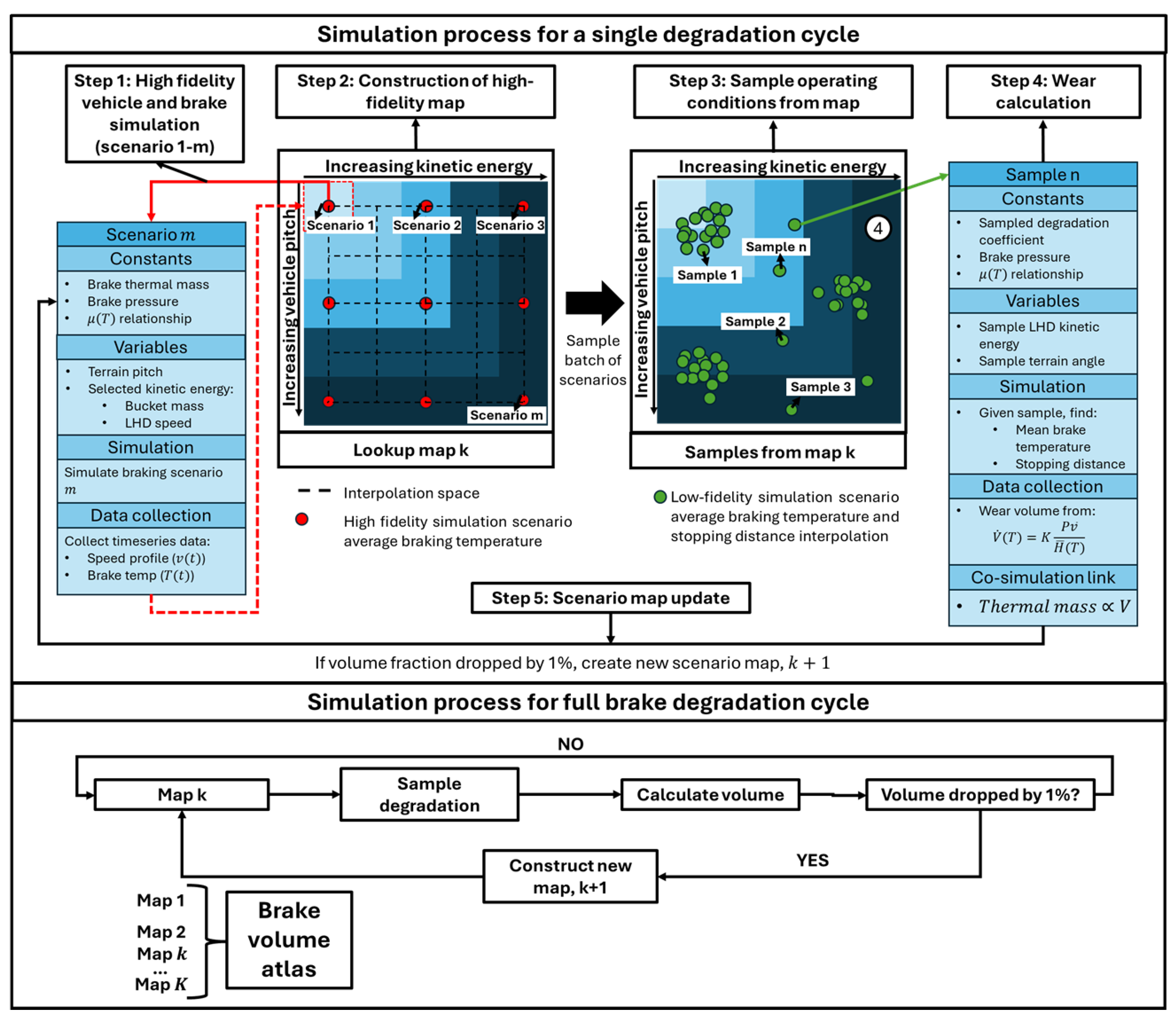
Figure 2.
Schematic layout of the multi-degree-of-freedom Simscape vehicle dynamics model.
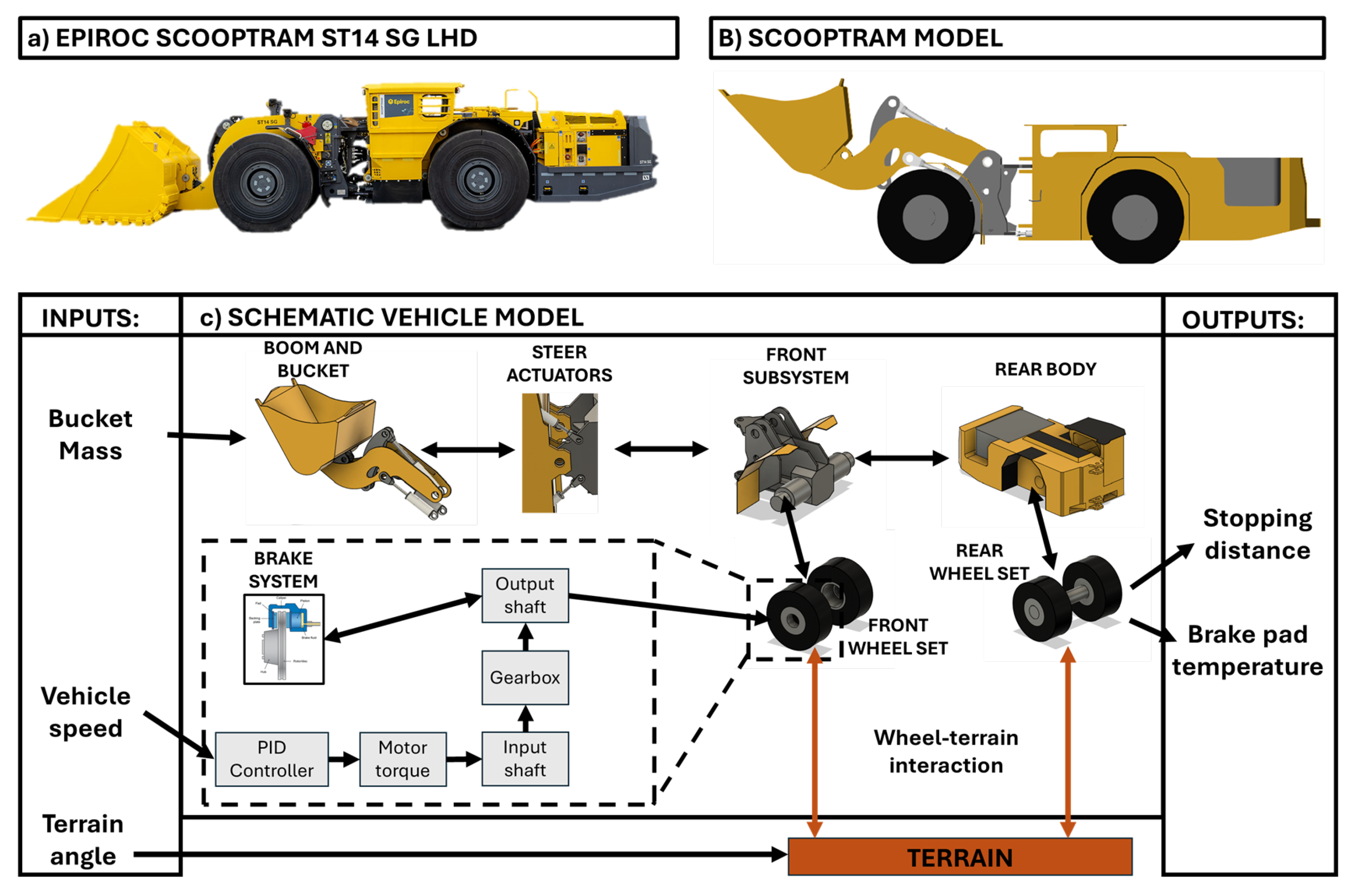
Figure 3.
Thermo-mechanical Simscape brake model interacting with the vehicle model.
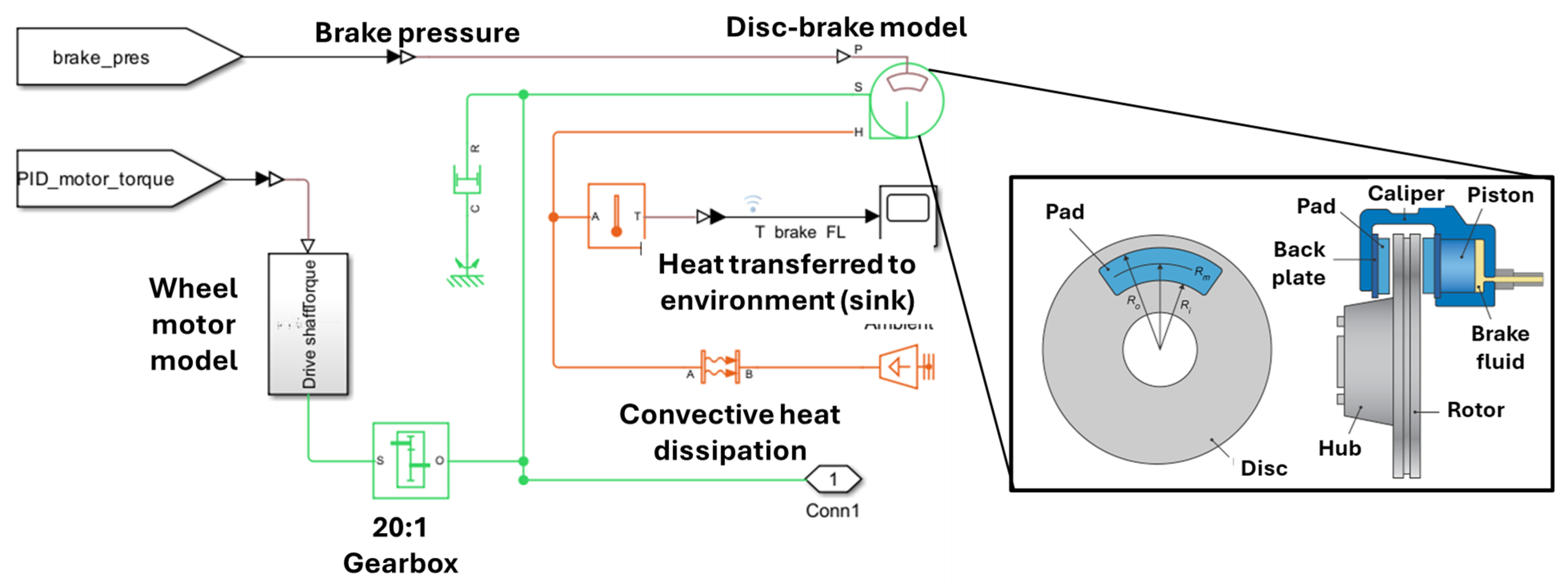
Figure 4.
Comprehensive view of the Archard dataset simulations and individual trace structure. (a) Simulated run-to-failure data. Ten training, ten in-distribution and ten out-of-distribution run-to-failure runs are illustrated. (b) Braking data contained in a single run-to-failure trace. The trace is constructed of multiple braking events, each capturing the event ID, wheel speed, vehicle slope, vehicle mass, stopping distance and brake pad temperature. The remaining useful life (RUL) is added to this data after brake pad replacement.
Figure 4.
Comprehensive view of the Archard dataset simulations and individual trace structure. (a) Simulated run-to-failure data. Ten training, ten in-distribution and ten out-of-distribution run-to-failure runs are illustrated. (b) Braking data contained in a single run-to-failure trace. The trace is constructed of multiple braking events, each capturing the event ID, wheel speed, vehicle slope, vehicle mass, stopping distance and brake pad temperature. The remaining useful life (RUL) is added to this data after brake pad replacement.
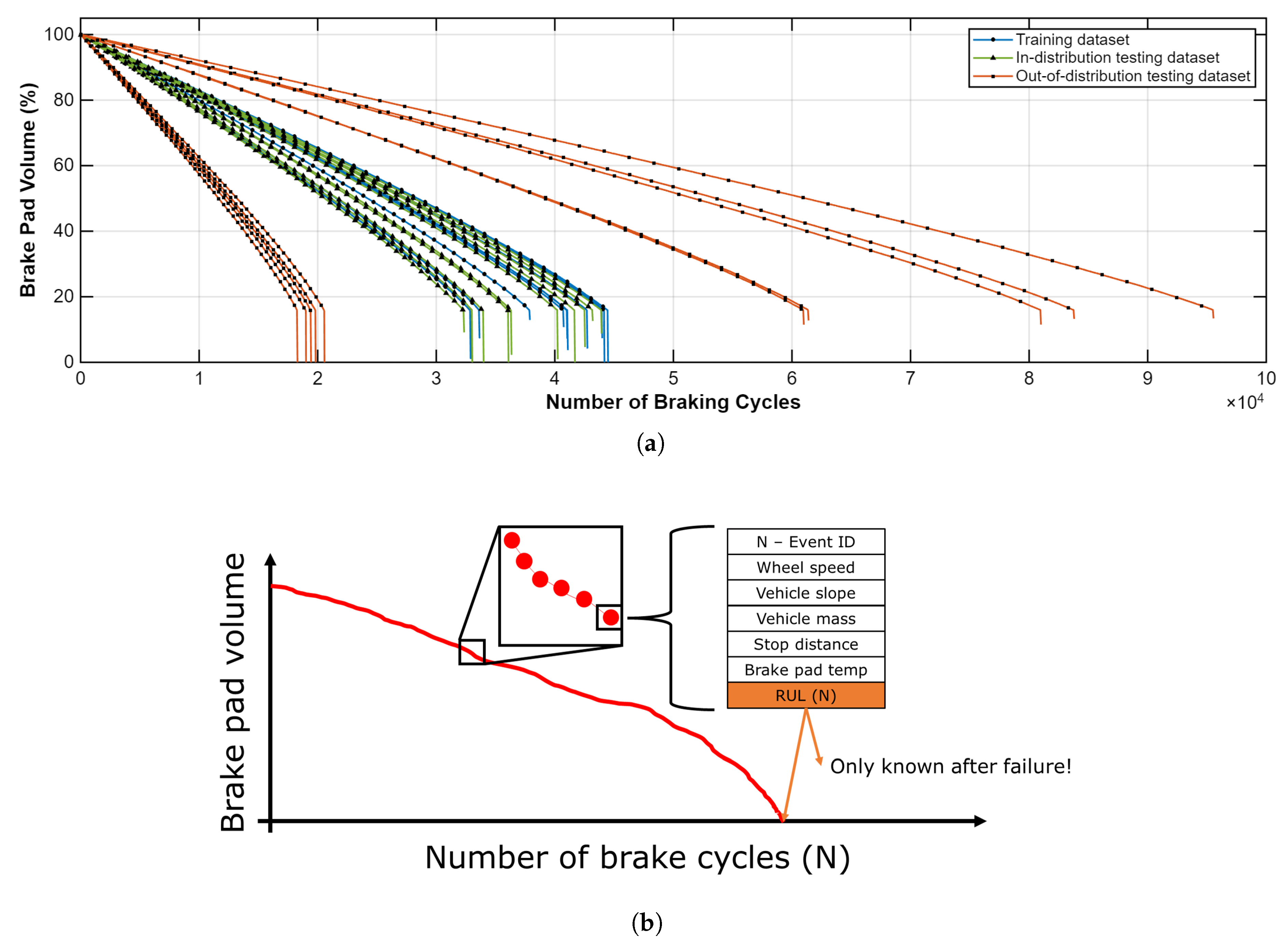
Figure 5.
Data-driven structure used in this study. Each run-to-failure trajectory is decomposed into individual braking events. For each event, the measurable operating variables are passed to the neural network, which outputs a direct RUL estimate. The prediction is compared to the true RUL, and the network parameters are updated iteratively during training.
Figure 5.
Data-driven structure used in this study. Each run-to-failure trajectory is decomposed into individual braking events. For each event, the measurable operating variables are passed to the neural network, which outputs a direct RUL estimate. The prediction is compared to the true RUL, and the network parameters are updated iteratively during training.
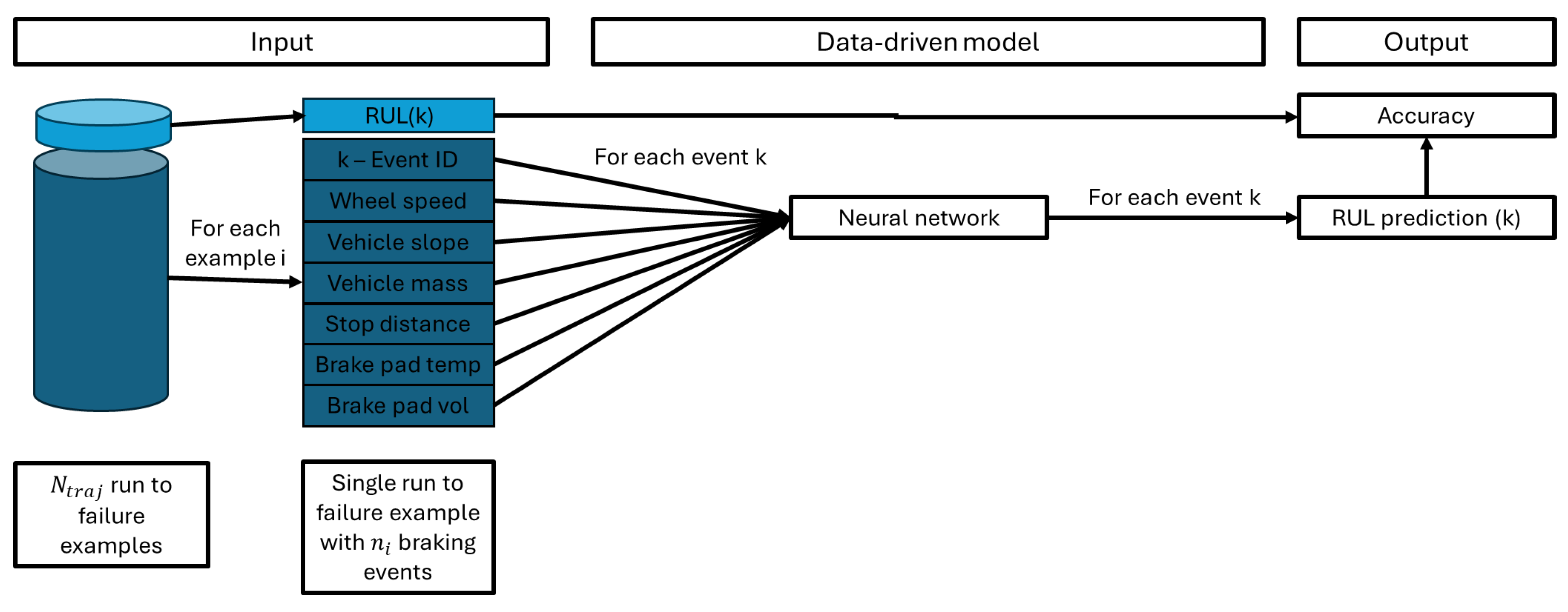
Figure 6.
Physics-based structure used in this study. A fixed wear parameter is first calibrated from training trajectories. The wear model is then propagated forward using sampled operating conditions derived from historical data. The vehicle response is assumed constant, corresponding to an unworn brake state, resulting in a degradation trajectory that does not depend on the evolving brake condition.
Figure 6.
Physics-based structure used in this study. A fixed wear parameter is first calibrated from training trajectories. The wear model is then propagated forward using sampled operating conditions derived from historical data. The vehicle response is assumed constant, corresponding to an unworn brake state, resulting in a degradation trajectory that does not depend on the evolving brake condition.
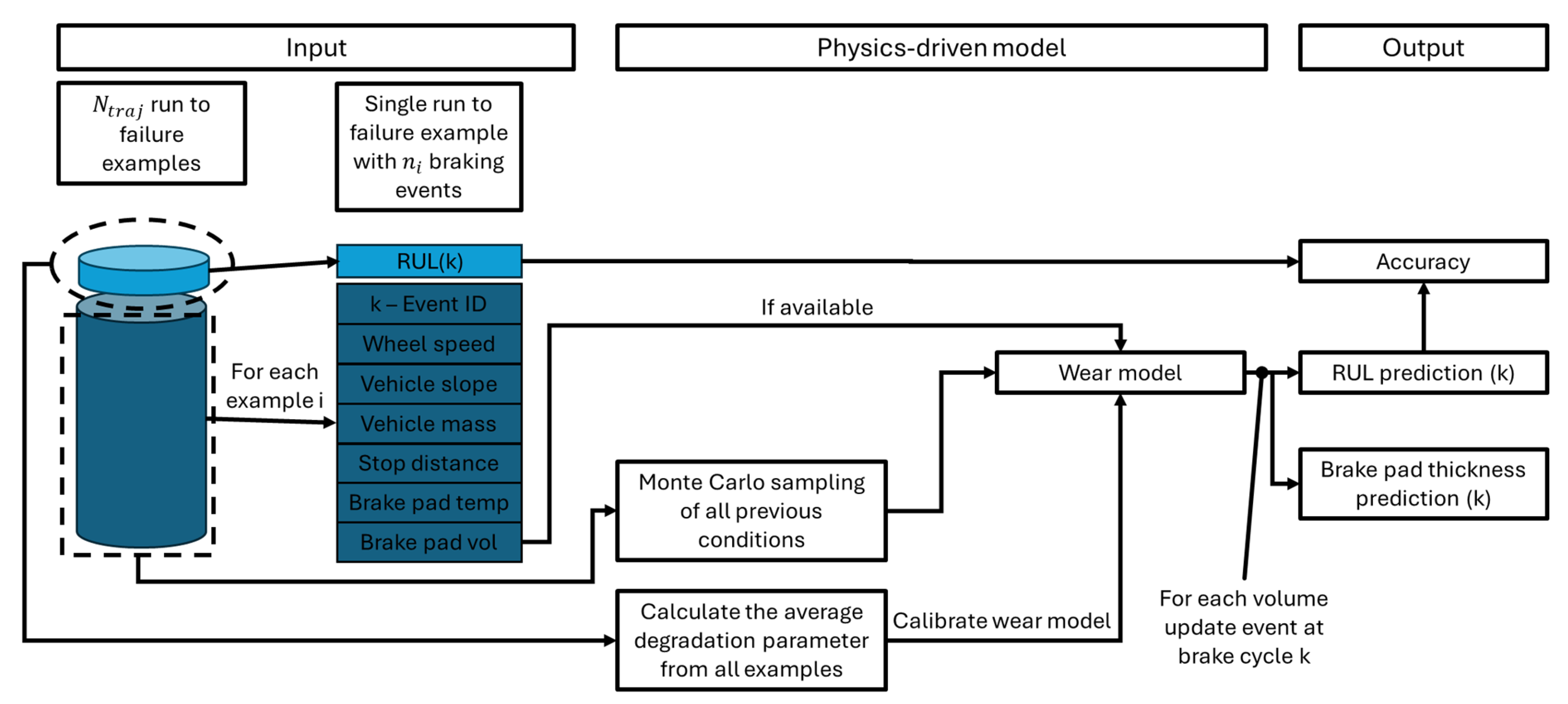
Figure 7.
Digital twin structure used in this study. At each braking event, measured operating variables are used to infer the current brake pad volume through the atlas. This inferred state is used both to update the wear model parameter and to initialise forward degradation simulation. The degradation model is iteratively coupled with the atlas, allowing the vehicle response to evolve with brake wear.
Figure 7.
Digital twin structure used in this study. At each braking event, measured operating variables are used to infer the current brake pad volume through the atlas. This inferred state is used both to update the wear model parameter and to initialise forward degradation simulation. The degradation model is iteratively coupled with the atlas, allowing the vehicle response to evolve with brake wear.
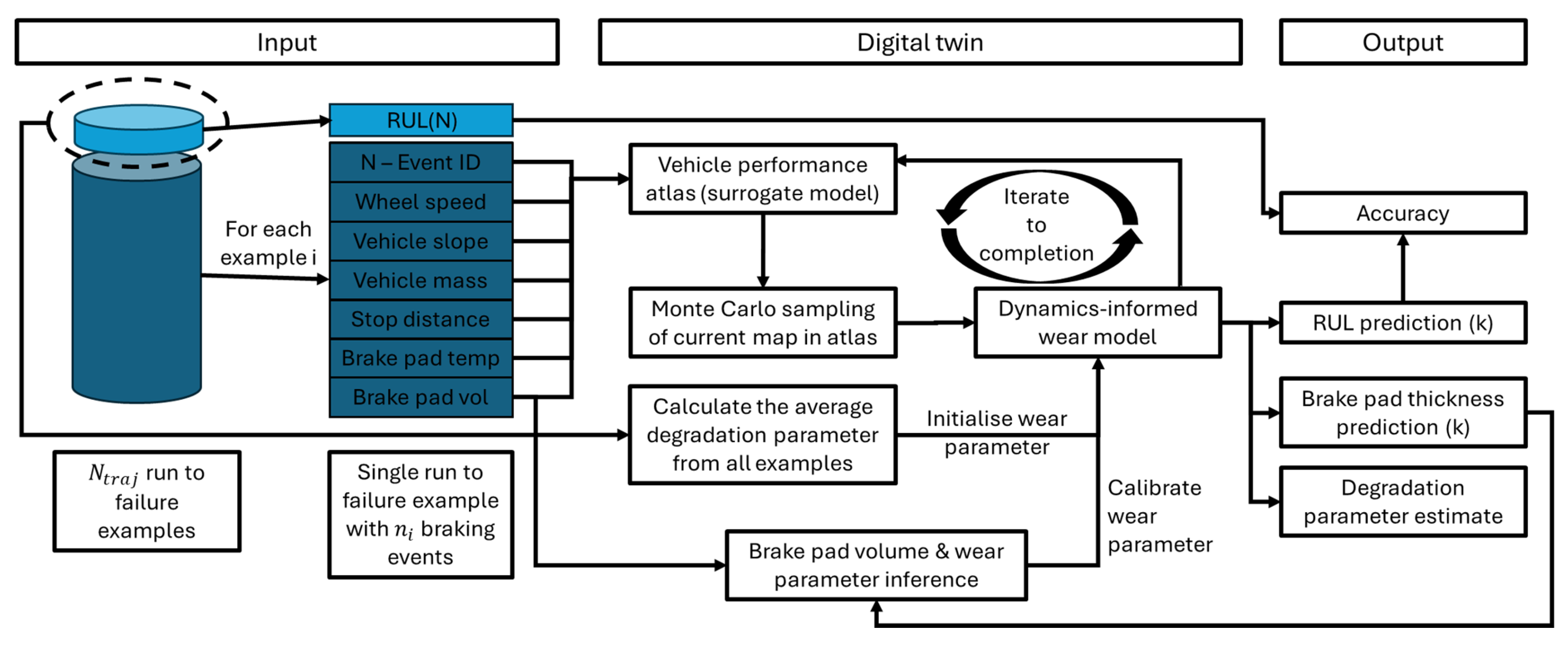
Figure 8.
Reverse inference using the atlas. The measured brake temperature is compared against atlas predictions across all wear states, and the brake pad volume is inferred from the minimum-error match.
Figure 8.
Reverse inference using the atlas. The measured brake temperature is compared against atlas predictions across all wear states, and the brake pad volume is inferred from the minimum-error match.
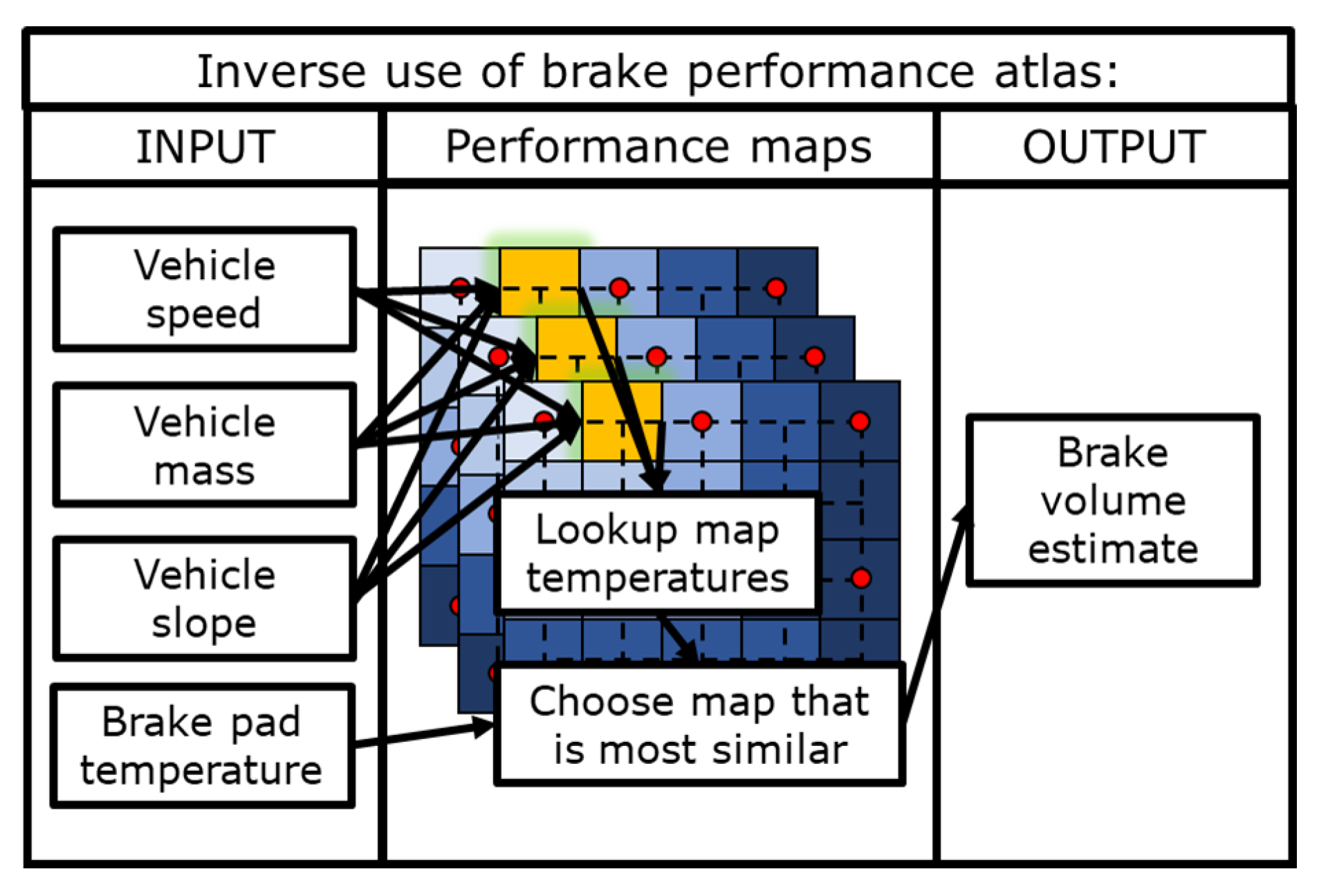
Figure 9.
Atlas-driven degradation prognosis loop used in the digital twin. Starting from the current inferred brake state, the twin simulates future degradation in batches of 100 braking events. For each batch, braking conditions are sampled from the active atlas layer, the corresponding thermal and braking responses are obtained, and the accumulated wear is computed. The brake volume is then updated, and the active atlas layer is changed whenever the forecast brake state crosses into the next degradation interval. The user defines a brake failure volume percentage, m, which terminates the forward propagation at map M.
Figure 9.
Atlas-driven degradation prognosis loop used in the digital twin. Starting from the current inferred brake state, the twin simulates future degradation in batches of 100 braking events. For each batch, braking conditions are sampled from the active atlas layer, the corresponding thermal and braking responses are obtained, and the accumulated wear is computed. The brake volume is then updated, and the active atlas layer is changed whenever the forecast brake state crosses into the next degradation interval. The user defines a brake failure volume percentage, m, which terminates the forward propagation at map M.
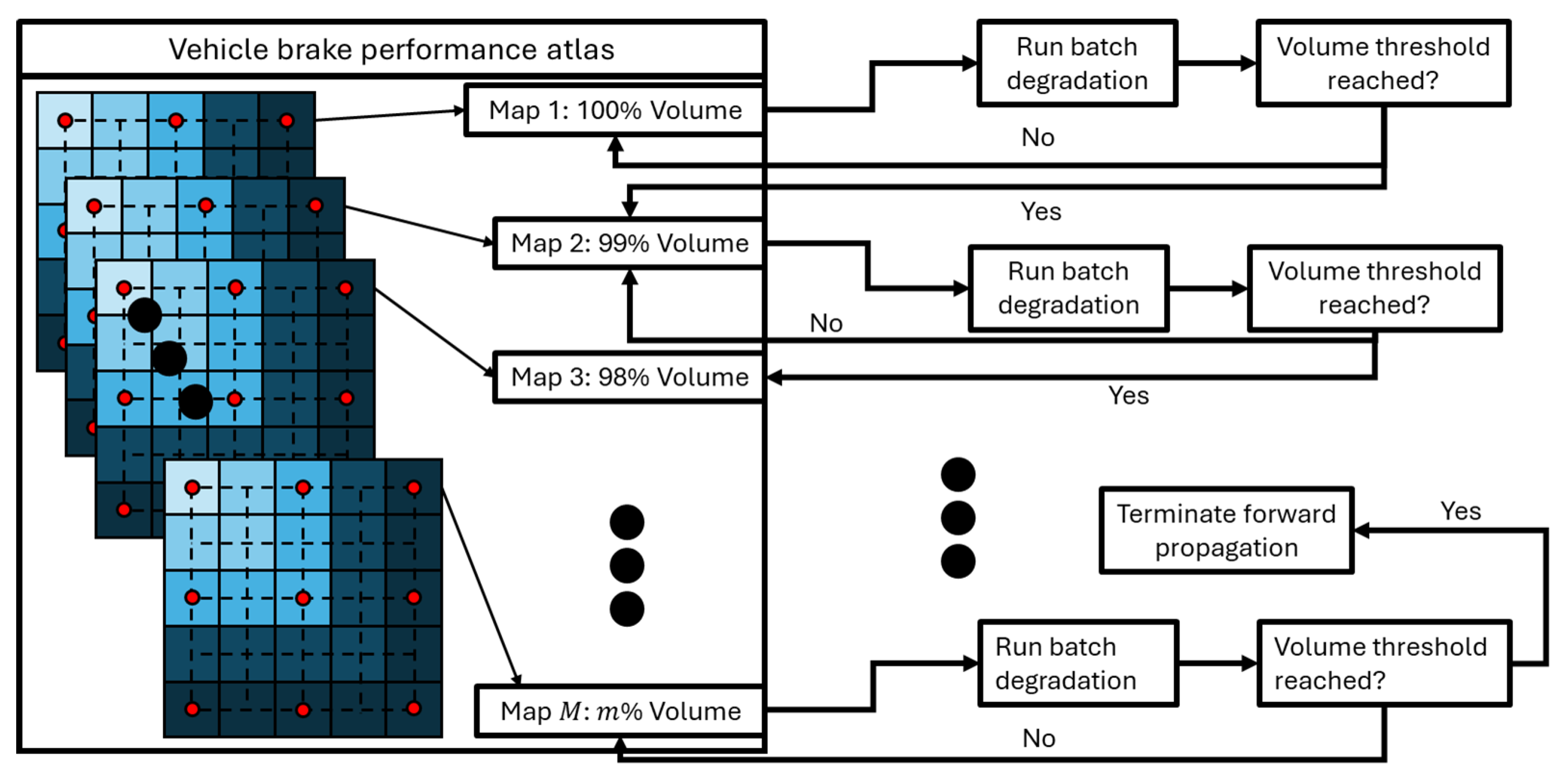
Figure 10.
Brake pad volume estimates for the physics-based and digital twin predictive maintenance models. The top plot shows in-distribution test data with wear behaviour similar to the training dataset, while the bottom plot shows out-of-distribution test data with a significantly higher wear rate.
Figure 10.
Brake pad volume estimates for the physics-based and digital twin predictive maintenance models. The top plot shows in-distribution test data with wear behaviour similar to the training dataset, while the bottom plot shows out-of-distribution test data with a significantly higher wear rate.
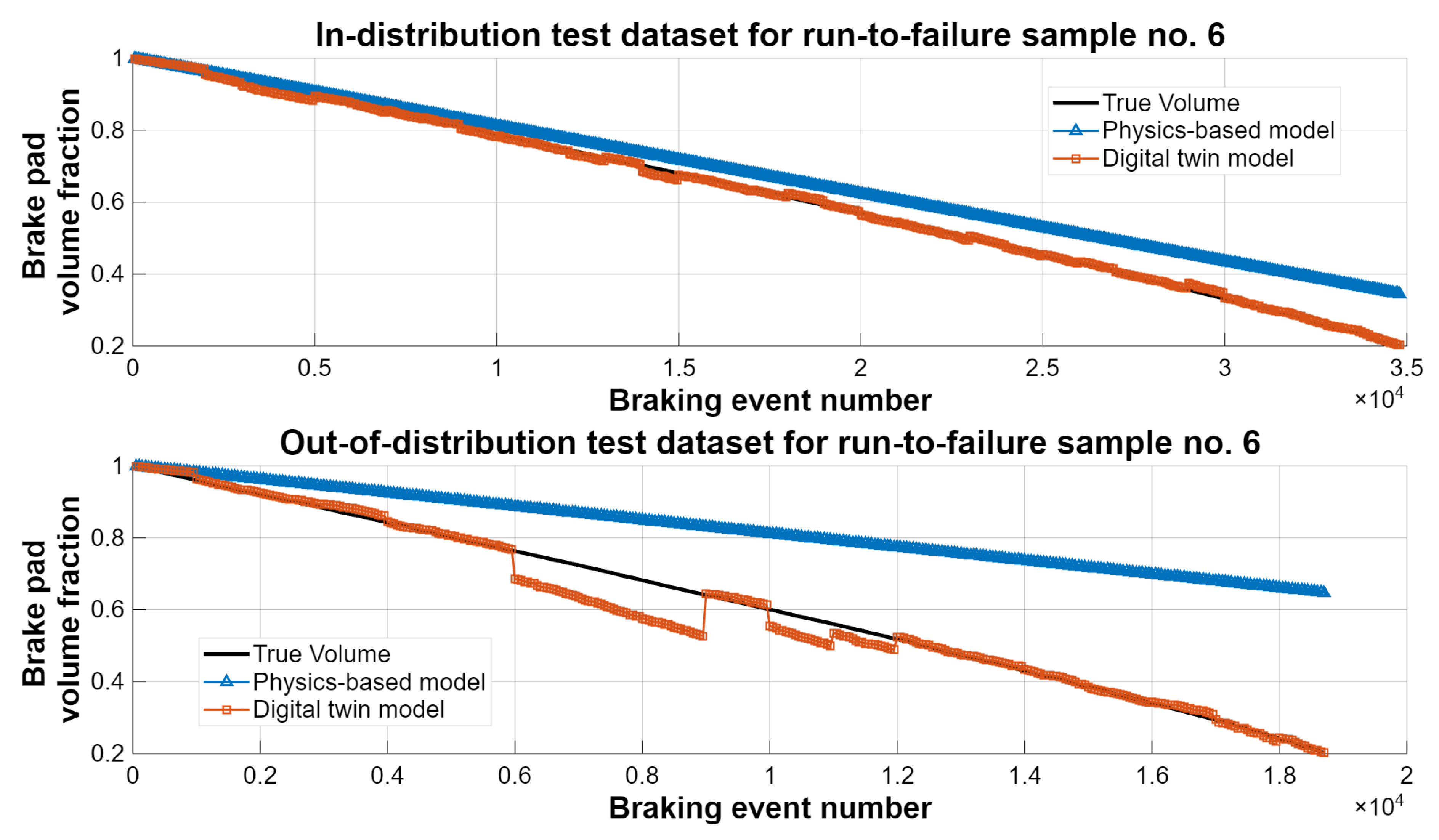
Figure 11.
Archard wear coefficient estimates for the digital twin. The top plot corresponds to in-distribution test data, while the bottom plot corresponds to out-of-distribution data. Parameter updates are performed every 1000 braking events, as the reverse inference process is expensive to compute.
Figure 11.
Archard wear coefficient estimates for the digital twin. The top plot corresponds to in-distribution test data, while the bottom plot corresponds to out-of-distribution data. Parameter updates are performed every 1000 braking events, as the reverse inference process is expensive to compute.
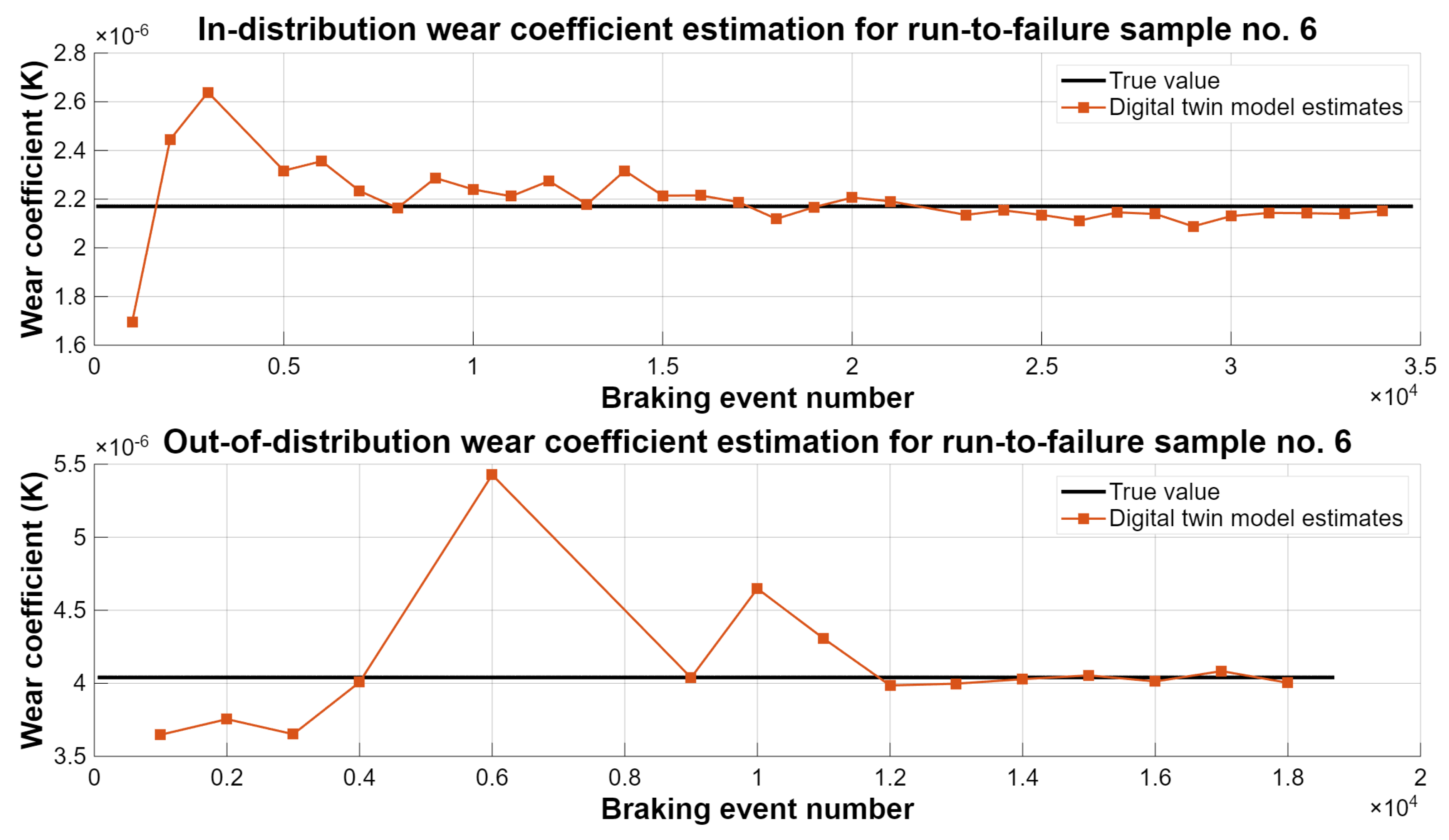
Figure 12.
Remaining useful life estimates for the data-driven, physics-based, and digital twin models. The top plot shows an in-distribution test sample with typical degradation behaviour, while the bottom plot shows an out-of-distribution sample with accelerated wear.
Figure 12.
Remaining useful life estimates for the data-driven, physics-based, and digital twin models. The top plot shows an in-distribution test sample with typical degradation behaviour, while the bottom plot shows an out-of-distribution sample with accelerated wear.
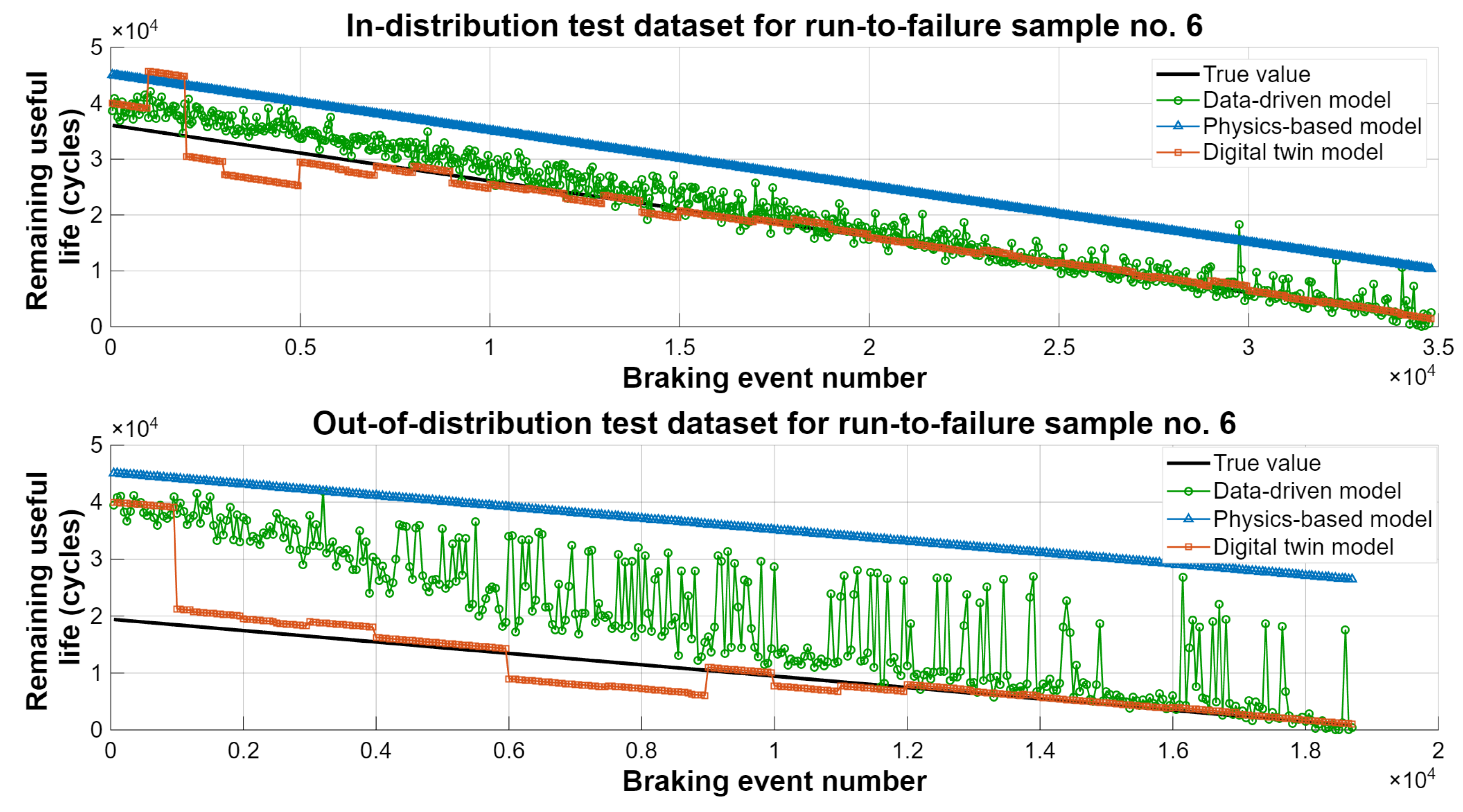
Figure 13.
RUL convergence sensitivity for the data-driven, physics-based, and digital twin models. The top plot shows results for in-distribution test samples, while the bottom plot shows results for out-of-distribution samples. Shaded regions indicate variability corresponding to half a standard deviation.
Figure 13.
RUL convergence sensitivity for the data-driven, physics-based, and digital twin models. The top plot shows results for in-distribution test samples, while the bottom plot shows results for out-of-distribution samples. Shaded regions indicate variability corresponding to half a standard deviation.
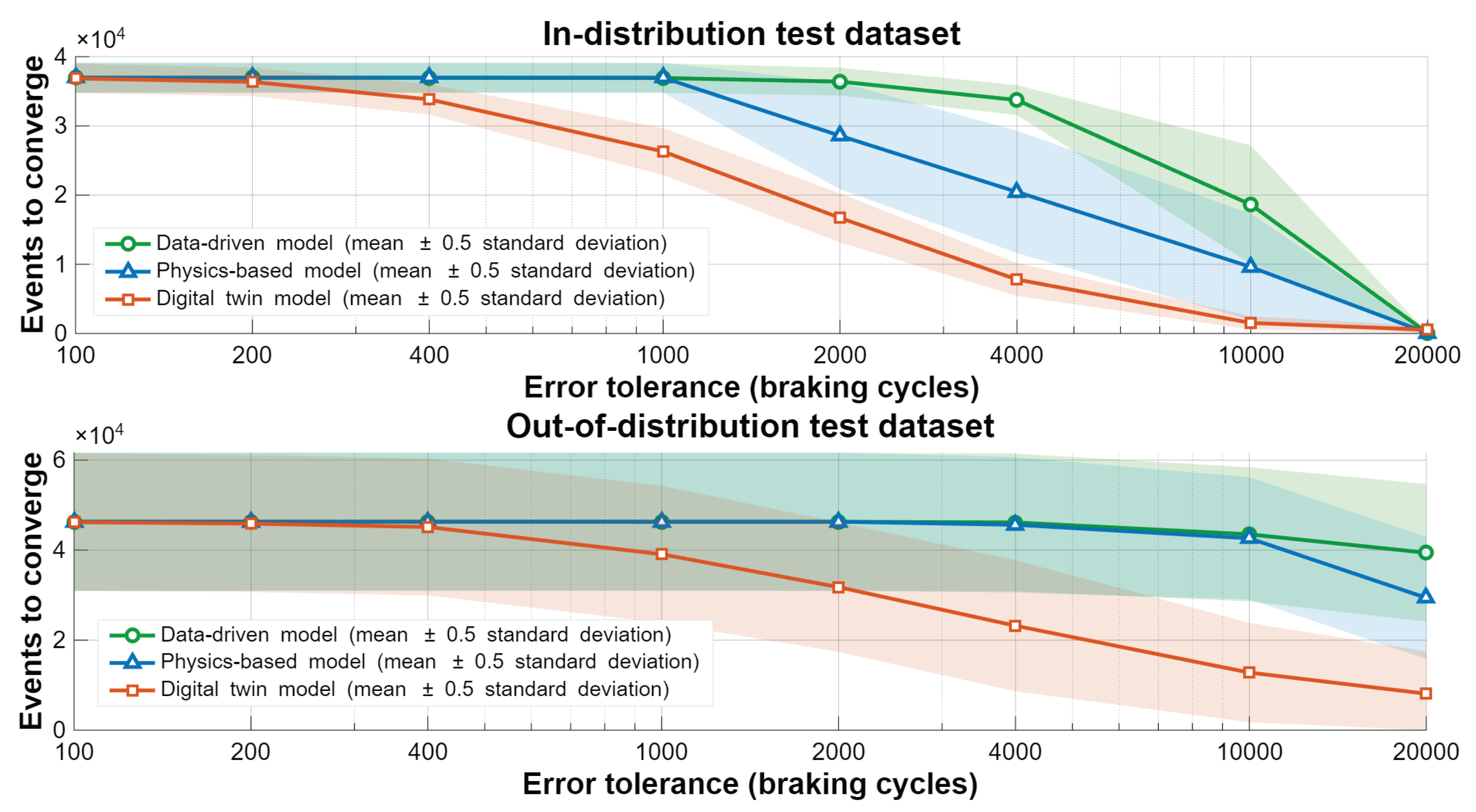

Table 1.
Friction parameters as outlined in Yevtushenko et al. [15].
Table 1.
Friction parameters as outlined in Yevtushenko et al. [15].
| 0.45 | 0.01 | 1.07 | 0.0015 |
Table 2.
High-fidelity braking scenarios used to construct each atlas map. Note that variations in vehicle mass occur due to variations in the loaded mass in the LHD bucket.
Table 2.
High-fidelity braking scenarios used to construct each atlas map. Note that variations in vehicle mass occur due to variations in the loaded mass in the LHD bucket.
| Run ID | Speed [km/h] | Vehicle Mass [kg] | Slope [deg] |
| 1 | 4.5 | 42000 | |
| 2 | 15.0 | 42000 | |
| 3 | 4.5 | 54000 | |
| 4 | 15.0 | 54000 | |
| 5 | 4.5 | 42000 | 0 |
| 6 | 15.0 | 42000 | 0 |
| 7 | 4.5 | 54000 | 0 |
| 8 | 15.0 | 54000 | 0 |
| 9 | 4.0 | 42000 | 10 |
| 10 | 8.5 | 42000 | 10 |
| 11 | 4.0 | 54000 | 10 |
| 12 | 7.2 | 54000 | 10 |
Table 3.
Hardness parameters as outlined in Yevtushenko et al. [15].
Table 3.
Hardness parameters as outlined in Yevtushenko et al. [15].
| 137 | -0.93 | 0.83 | 0.00234 | 546 | 2.02 | 0.002 |
Table 4.
Root mean square error (RMSE) performance leaderboard for remaining useful life (RUL) predictions across ten individual runs for in-distribution (ID) and out-of-distribution (OOD) test sets.
Table 4.
Root mean square error (RMSE) performance leaderboard for remaining useful life (RUL) predictions across ten individual runs for in-distribution (ID) and out-of-distribution (OOD) test sets.
| Model Name | R1 | R2 | R3 | R4 | R5 | R6 | R7 | R8 | R9 | R10 | Mean |
|---|---|---|---|---|---|---|---|---|---|---|---|
| In-Distribution (ID) Test Set | |||||||||||
| Physics-Based Model | 1175.00 | 4875.00 | 2575.00 | 8775.00 | 12775.00 | 9025.00 | 11125.00 | 12075.00 | 3425.00 | 1925.00 | 6775.00 |
| Data-Driven Model | 2308.80 | 1261.61 | 1625.98 | 2660.43 | 4668.73 | 2730.95 | 3782.12 | 4265.18 | 1365.51 | 1897.22 | 2656.65 |
| Digital Twin Model | 2825.82 | 6409.74 | 2627.00 | 1889.20 | 3270.93 | 2560.07 | 2149.38 | 5100.67 | 1536.28 | 3474.40 | 3184.35 |
| Out-of-Distribution (OOD) Test Set | |||||||||||
| Physics-Based Model | 14688.08 | 32733.00 | 41295.64 | 30642.70 | 15020.99 | 25675.00 | 25275.00 | 24525.00 | 26825.00 | 26075.00 | 26275.54 |
| Data-Driven Model | 11542.92 | 24698.06 | 32066.39 | 22823.37 | 11474.44 | 12392.06 | 11653.21 | 11277.23 | 12804.44 | 12136.86 | 16286.90 |
| Digital Twin Model | 3952.08 | 13117.18 | 10100.63 | 37815.11 | 5573.15 | 5081.98 | 4994.25 | 4440.19 | 5224.15 | 6003.57 | 9630.23 |
Disclaimer/Publisher’s Note: The statements, opinions and data contained in all publications are solely those of the individual author(s) and contributor(s) and not of MDPI and/or the editor(s). MDPI and/or the editor(s) disclaim responsibility for any injury to people or property resulting from any ideas, methods, instructions or products referred to in the content. |
© 2026 by the authors. Licensee MDPI, Basel, Switzerland. This article is an open access article distributed under the terms and conditions of the Creative Commons Attribution (CC BY) license (http://creativecommons.org/licenses/by/4.0/).
Copyright: This open access article is published under a Creative Commons CC BY 4.0 license, which permit the free download, distribution, and reuse, provided that the author and preprint are cited in any reuse.


