
Submitted:
29 May 2026
Posted:
01 June 2026
You are already at the latest version
Abstract
Methane emissions from plugged and unplugged abandoned wells dilute rapidly with air, causing conventional detection methods to underestimate methane leaks. We introduce here a new method for outdoor testing and show how the flux chamber detection limit is progressively reduced from 700 g/h to 2 g/h and ultimately to 1 g/h, meeting the US Department of the Interior (DOI) standard for monitoring equipment used on abandoned wells. Field deployment on an actual abandoned well also revealed intermittent emissions, which may serve as an indicator of deteriorating well integrity over time when monitored periodically. To forecast the emission event timing and intensity, a Liquid Time-Constant (LTC) and a gated recurrent neural network were trained on methane concentration time series collected during field deployment. As available well sites for physical testing are limited and atmospheric conditions are not controllable, a computational fluid dynamics (CFD) simulation framework integrated with machine learning (ML) was developed to optimize wellhead chamber geometry and size for both detectability and safety.
Keywords:
methane emissions
; abandoned wells
; static flux chamber
; internet of things
; Liquid Time-Constant neural network
; computational fluid dynamics
; machine learning
; well integrity
1. Introduction
According to the 2024 Orphaned Wells Program Annual Report to Congress [1], 141,959 wells have been reported as orphaned by the Interstate Oil and Gas Compact Commission. As orphaned wells do not have an operator other than the federal government or states responsible for them, they are not tested for integrity issues or leaks as regularly as other wells. This lack of testing makes a low-cost, scalable testing method urgently necessary. An orphaned well, by its technical definition, is a well that does not have an assigned operator, which is distinct from a plugged and abandoned well, where the well has been sealed using cement and flow barriers. This study targets abandoned wells, defined as wells that have been left in either plugged or unplugged state, regardless of their ownership. Estimated numbers of potential sources are reported by several studies: Townsend-Small et al. (2016) [2] estimate at least 2.3 million abandoned wells in the onshore United States, the California Council on Science and Technology [3] reports 2.5 million non-productive wells, and Kang et al. (2014) [4] cite an estimated 3 million abandoned wells nationwide. The differences among these estimates are due to incomplete historical records and wells that were drilled before the advent of regulatory documentation requirements.
Commonly used methods in methane emission detection and measurement vary in detection limit and coverage area. This variance can fundamentally change the usefulness of each case. Methane detection satellites such as TROPOMI cover a larger land area but have high detection limits (tons of methane per hour per pixel scale), which is unsuitable for abandoned wells with low emission rates [5]. Aerial technologies, including LiDAR-based airborne methods, detect emissions in the 100–1,000 kg/h range at high altitude, with sensitivity improving to approximately 0.5 kg/h in close proximity to the source [5]. Ground surveys carried out by high-flow samplers and static flux chambers are useful for detecting emissions at 1 g/h or lower [5].
Qi et al. (2021) [6] examined the time required for gas to migrate to the top of a low-permeability cement column. Simulations covered different API gravity oils and vertical permeabilities. Results demonstrated that vertical permeability in the cement works as a path for gas emission to the top of the well.
The U S Department of the Interior Methane Measurement Guidelines [5] classify wells into four types based on measurement feasibility. Type 1 well, by definition, is a well that can be easily covered by a portable chamber. This research focuses only on Type 1 wells, which lack wellhead assemblies or production lines. The guidelines set the minimum detection limit for measurement equipment used on abandoned wells at 1 g/h. Previous ground-based studies report wide-ranging emission rates from abandoned wells. Townsend-Small et al. (2016) [2] measured a national average leak rate of 1.38 g/h across 138 plugged and unplugged wells using flux chambers and high-flow samplers, with only 1 of the plugged wells and 8 of 20 unplugged wells showing detectable emissions. Kang et al. (2014) [4] reported an average of 0.27 kg/d using a static flux chamber, though this value was strongly influenced by a small number of super-emitting wells, as the mean leak rate of all tested wells exceeded the median by three orders of magnitude. Riddick et al. (2020) [7] observed that emissions at individual wells varied over 24-hour periods with rates ranging from 0.2 to 81,000 mg of CH4/h. The average of the recorded emission rates varied by a factor of 18, with variability ranging from factors of 1.1 to 142 across different wells.
Haase et al. (2025) [11] demonstrated that burying the edges of a rigid flux chamber to a depth of at least 18 cm, combined with wetting the surrounding soil to reduce pore volume and improve compaction, significantly reduced gas leakage around the chamber base and improved measurement reliability. Consistent with these findings, the edges of our chamber were similarly buried in wet soil to minimize lateral gas escape and ensure a tight seal around the well.
Currently, no existing method provides continuous, low-cost monitoring of type 1 wells at detection limits consistent with DOI standards. This study fills this gap through three contributions. First, it presents the iterative process of physical design of a smart static flux chamber, progressing through controlled outdoor experiments and optimized by analyzing the data collected during the experiments to achieve a detection limit of 1 g/h, which was later validated on an abandoned well. Second, it demonstrates the use of a recurrent neural network, such as a Liquid Time-Constant neural network, to forecast leak event timing and intensity using live data collected in the field, enabling the chamber to function without the need for long-term or permanent installation. Third, it provides a computational fluid dynamics framework combined with machine learning-based optimization of chamber geometry for both detectability and safety. Results of simulation and optimization are used to design a chamber tailored to each well’s dimensions. The prototype tested in this study is inexpensive and can be redeployed on multiple wells, reducing per-well monitoring costs, which can be further lowered through mass production.
2. Materials and Methods
The methodology follows four phases: (1) sensor development through controlled indoor and outdoor testing for iterative chamber design, (2) field deployment on an abandoned well, (3) time-series forecasting using neural networks on field recorded data, and (4) computational fluid dynamics simulation coupled with machine learning optimization. Throughout this paper, the terms ’static flux chamber’ and ’canopy’ are used interchangeably; ’static flux chamber’ is the standard terminology used in the methane monitoring literature, while ’canopy’ refers to the specific ventilated structure developed in this study.
2.1. Sensor Development and Smart Integration
The methane sensor used in this study is a Molecular Property Spectrometer (MPS) type sensor with a micromachined silicon transducer that measures the molecular properties of air to identify its composition. The sensor model is MPS003 (NevadaNano) with a lower detection limit of 50 parts per million (ppm) according to the specification provided by the manufacturer. This sensor is programmed to sample at a 3-second rate. The sensor was calibrated in the laboratory using a pure methane high-pressure flux chamber before deployment in the field and requires no further field calibration.
A wind sensor manufactured by Calypso Instruments (Ultra-Low-Power Ultrasonic Wind Meter PRO, ULP PRO) was used to measure wind speed. This sensor was always deployed within 2 m of the methane sensor at 85 cm height from the ground to reduce near-ground wind speed noise and to approximate the height of the chamber opening. The sensor covers a wind speed range of 0.5–45 m/s.
Both sensors were integrated into a communication system that transmits data to a USC-owned cloud storage platform via cellular network or local gateway. Figure 1 shows the antenna connected to the local gateway, as cellular coverage was not available at the field test location. When cellular coverage is available, the sensor connects to the cloud via a SIM card and operates on a power bank with solar power generation capabilities. When cellular coverage is unavailable, a local antenna and lithium battery pack are required. The sensor system is estimated to last approximately 2 months without solar power generation, which far exceeds the 4–7 h data collection sessions conducted in this study.
2.2. Controlled Outdoor Testing: Iterative Design Optimization
Because the chamber performance must be evaluated under varying wind speeds and gusts, the testing was conducted outdoors. A high-pressure methane canister with 99.9% purity (GASCO) was connected to high-precision rotameters (FM-1050 Series, MATHESON, ±5% full-scale accuracy) to simulate a leaking well and optimize chamber geometry before field deployment on an abandoned well. Different chamber configurations were tested to determine how detection performance varies with design parameters.
2.2.1. First Design: Suspended Sensors
The first attempt at methane detection was through sensors that were hung on tripods at different heights around leak sources to establish the baseline of methane detection capability of our sensor without an isolating chamber. Figure 2 shows the three sensors on tripods positioned 25–35 cm from the leaking rotameters at 150 cm above ground level. Based on this configuration, partial isolation of the emission source by a chamber was determined to be necessary to reduce the rate of methane–air mixing.
2.2.2. Second Design: Aluminum Ventilation Chamber
The next major variation tested was a 32-gallon aluminum cylindrical chamber with a circular lid (21 inches in diameter) placed on top of the chamber. The top of the chamber has a punched hole covered by the lid (different punched hole radii were tested, covering 10–75% of the lid radius), with a 1–5 cm height difference between the top of the chamber and the lid; this configuration is shown in Figure 3.
2.2.3. Third Design: Wind-Shielded Configuration
To address signal fluctuation observed in the second design and to accommodate the possibility of intermittent emissions at real well sites, a steel sheet was wrapped around the wind cap to further limit methane–air mixing. The wind cap is a Dura-Vent model with a 10.5-inch outer diameter, wrapped in a steel sheet with a 1 mm air gap between the vent and the wrapping. The methane sensor was suspended within the wind cap at 15 inches from the top of the wind cap which is approximately 3 inches lower than the punched hole opening. The communication kit and battery pack were mounted atop the wind cap, as shown in Figure 4. Different chamber configurations were tested at 10 distinct methane leak rate steps over 40 hours of outdoor controlled testing, with a minimum duration of 20 minutes per testing step. Chamber geometry and methane leak rate were controlled variables in these experiments, while wind speed varied naturally with ambient atmospheric conditions.
2.3. Field Deployment on Abandoned Well
Site selection criteria included a publicly accessible location and a visible surface with dimensions matching the Type 1 category of the DOI guidelines. The tested well is located in Los Angeles and was abandoned in 1951 using partial cementing and a wooden plug, according to CalGEM WellFinder records. The well exhibited gas bubbling and fresh crude seepage at the time of testing. As the chamber could not be left at the well site overnight, the well was tested during multiple sessions lasting 4–7 h within a 6-month period. The lower detection limit of the methane sensor (50 ppm), combined with the sensor being positioned inside the chamber, reduces the risk of interference from methane plumes originating from nearby sources other than the well itself. Figure 5 shows the condition of this well, including oil seepage and gas bubbling.
2.4. Time-Series Forecasting with Neural Networks
Permanent chamber installation increases theft risk and potential methane accumulation in addition to large physical footprint. As permanent installation or long-term testing is not possible, time-series forecasting models were developed to predict methane leak events from limited field data to capture the statistical profile of each well that enables assessment of well integrity degradation with time through periodic monitoring.
Two recurrent neural network architectures were evaluated: Gated Recurrent Unit (GRU) and Liquid Time-Constant (LTC) networks [8,9]. Both models were trained during a deployment session (6,279 samples, 7 h and 11 min) using an 80–20 train–test split. Data were normalized to the 0–1 range prior to training. The deployment sensor recorded methane concentration, temperature, pressure, and relative humidity at a programmed interval of 3 s. Initial training attempts incorporated all environmental features alongside methane concentration, which showed no performance improvement; therefore, in the final model, the methane concentration time series was used as the sole input.
To improve model performance, hyperparameter optimization was performed using the Optuna framework with 30 trials per model configuration. Table 1 summarizes parameters that were optimized using the hyperparameter optimizer over the range specified and Table 2 presents specific information regarding the final architecture of the models used.
2.5. COMSOL-MATLAB-ML Optimization Framework
As most wells are unavailable for testing in Southern California, and atmospheric conditions such as wind speed are not controllable, optimizing chamber geometry to enhance detection capability while minimizing unsafe methane concentration buildup was conducted through computational fluid dynamics sweep simulations across all design parameters.
2.5.1. Computational Model (COMSOL Multiphysics 6.4)
A cylindrical chamber was modeled in the center of a rectangular domain (5 m × 2 m × 2 m) in the COMSOL Multiphysics geometry environment; a well was placed inside the chamber cylinder, and a hole was placed on top of the chamber cylinder. Wind enters from one side of the domain under an inflow velocity boundary condition. Initial methane concentration was set to zero throughout the domain at . The bottom of the chamber and the domain was assigned a closed (no-slip) boundary condition, while all other surfaces (except the inlet) were set to zero gauge pressure. The computational domain, including the well and chamber geometry, is shown in Figure 6. Species transport was modeled using a methane–air binary diffusion coefficient of 0.221 cm2/s at standard temperature (298 K) and atmospheric pressure (101.325 kPa) with gravity enabled, as reported in NIST Technical Note 2279 Burgess, 2024 [10]. The simulations in this study employ a laminar flow model, which accounts for both convective transport by the velocity field and molecular diffusion. In practice, ventilation systems typically produce turbulent flow, where additional mixing occurs due to velocity fluctuations and eddies that are absent in laminar flow. Karim et al. (1987) [12] showed experimentally that methane disperses into air significantly faster under turbulent conditions. Diffusion coefficient in turbulent airflow is three to four orders of magnitude larger than molecular diffusion due to these turbulent eddies. As the laminar model does not capture this additional turbulent mixing, it will overestimate local methane concentrations compared to what would occur under turbulent conditions. As a result, the danger zones identified in this study represent conservative estimates, and the recommended flux chamber designs carry a built-in safety margin when applied to actual field conditions where turbulent mixing is present.
The seven governing design parameters are shown in Figure 7. Simulating methane dispersion under the chamber requires modeling both convection and diffusion, which is achieved using the Laminar Flow (spf) and Transport of Concentrated Species (tcs) modules in COMSOL Multiphysics 6.4.
The laminar flow module solves the incompressible Navier–Stokes equations for the velocity field. The momentum and continuity equations are given by Equation (1) (Incompressible Navier–Stokes COMSOL, 2024):
where is the fluid density (kg/m3), is the velocity vector (m/s), t is time (s), p is the pressure (Pa), is the identity matrix, is the viscous stress tensor defined for a Newtonian incompressible fluid as with being the dynamic viscosity (Pa·s), is the volume force vector (N/m3), and is the gravitational acceleration vector (m/s2). Gravity is enabled in the simulation with a reference pressure of 1 atm and a reference temperature of 293.15 K.
The Transport of Concentrated Species module solves a mass balance equation governing the diffusion of methane into air. The nonconservative form of the species transport equation, as implemented in COMSOL (COMSOL, 2024), is given by Equation (3):
where is the mass fraction of species i (dimensionless), is the diffusive mass flux vector of species i (kg/(m2s)), and is the reaction rate for species i (kg/(m3s)). In this study, no chemical reactions occur between methane and air; therefore .
2.5.2. Two-Phase Parametric Study
Three objectives were formulated based on the fraction of the 1,000 observation points falling within each methane concentration zone at min. The primary objective of this part of our research is to maximize the fraction of space inside of the chamber to fall within the detection window (50–50,000 ppm). This window is based on the sensor’s detection limit and lower explosive limit of methane (50,000 ppm) which ensures leaked methane is detected safely. Another optimization constraint in this task is minimizing the fraction of space inside the chamber that is above the lower explosive limit (LEL ≥ 50,000 ppm). Minimizing space above this threshold prevents unsafe methane accumulation inside the chamber. The last objective of this optimization is to minimize volumetric fraction below detection limit (< 50 ppm) which reduces the probability of missed detection events.
The safety constraint is treated as a hard constraint and takes more weight over the two other objectives. Among feasible designs satisfying the safety constraint, the primary detection objective governs the optimization, with the secondary objective used to distinguish between designs of equivalent primary performance. Table 3 is demonstrating each parameter baseline and range. Baseline is only used in phase 1 (35 simulations) of the simulation attempt where one parameter is swept and others are kept at the baseline. Phase 2 (193 simulations) of the simulations uses latin hypercube sampling technique to randomly choose one specific set of parameters for each simulation. Two geometric feasibility constraints were enforced during sampling: flux chamber height must exceed well height by at least 1 cm (C_height > W_height + 0.01 m), and flux chamber radius must exceed well radius by at least 1 cm (C_r > W_r + 0.01 m). The opening radius was sampled as a fraction of the flux chamber radius (PH_r = [0.10 to 0.90] × C_r) to maintain geometric proportionality.
2.5.3. Machine Learning Design Optimization Model
One recurrent neural network (GRU) was trained to predict the fraction of observation points falling within each concentration level (over LEL, detection window, and below detection limit) within the chamber as a function of the seven design parameters and time rather than predicting raw concentration values. The outputs of this model are indicators of optimization performance in fulfilling the objectives.
The network takes an eight-dimensional input at each of the 11 timesteps, corresponding to the seven design parameters (A_q, C_height, W_height, C_r, W_r, PH_r, M_q) and time. The input is processed by two stacked GRU layers with 128 and 64 hidden units respectively, each followed by batch normalization and dropout (rates of 0.3 and 0.2). The GRU output is then passed through two time-distributed dense layers of 32 and 16 neurons with ReLU activation and dropout (rates of 0.2 and 0.1), followed by a three-neuron softmax output layer that ensures the three predicted zone fractions sum to 100% at each timestep. The network was compiled with the Adam optimizer (initial learning rate = 0.0005, loss function = categorical crossentropy) and trained for up to 500 epochs with a batch size of 16. Early stopping (patience = 40 epochs) and learning rate reduction on plateau (factor = 0.5, patience = 15 epochs, minimum learning rate = ) were applied to prevent overfitting and ensure convergence. The simulation dataset was partitioned into training (80%), validation (10%), and test (10%) sets using random splitting with a fixed seed for reproducibility.
2.5.4. Design Recommendation Software
A design recommendation tool was developed based on the trained model that is computationally cheaper, faster, and easier to use for field operators without requiring knowledge of computational fluid dynamics or machine learning. The tool accepts two inputs, which are well radius (W_r) and well height (W_height). These two parameters are the only parameters known by the operators prior to the deployment. The results of this optimization are the chamber radius, chamber height, and punched hole radius for the given well. Optimization was performed using differential evolution, a global optimization algorithm well-suited to multi-parameter design spaces, applied over the full feasible parameter ranges defined in Table 3.
One recommended design is a conservative configuration, which prioritizes the safety objective, while the second design recommendation is a detection optimized configuration that prioritizes the maximization of space under the chamber that falls in the detection window. The optimization software uses two inputs, which are well radius and well height, and the output of the software is the rest of the design parameters, such as chamber radius, chamber height, and punched hole radius, which are optimized by objective functions. Objective functions demonstrated by Equation (4) and Equation (5) space are:
Conservative design minimizes:
Detection-optimized design minimizes:
Where , , and are the predicted number of observation points (out of 1,000) in the above-LEL, detection-window, and below-detection zones, respectively. The conservative design applies a 1,000-fold penalty to unsafe zone points and only a 0.5-fold reward to detection, prioritizing elimination of explosive risk. The detection-optimized design reduces the LEL penalty to 50-fold while increasing the detection reward to 10-fold, allowing the optimizer to accept marginally higher LEL risk in exchange for substantially improved detection coverage. In both formulations, below-detection points carry a unit penalty. The workflow of this optimization is demonstrated in Figure 8, which is a combination of COMSOL Multiphysics and its MATLAB LiveLinks interface and recurrent neural networks.
Model codes are available in the depository (link to this depository can be found in the data availability section).
3. Results
3.1. Controlled Outdoor Testing
The DOI has published guidelines that set methane detection from plugged and unplugged wells at 1 g/h; this standard shaped our goal for designing our static flux chamber. The progression of design iterations produced a decrease in detection limit from 700 g/h to 1 g/h. The first design, consisting of sensors mounted on poles, achieved detection only at 700 g/h of continuous methane leak and only when wind speed was below 1 m/s and blowing toward the sensors. The second design incorporated an aluminum chamber, which reduced the detection limit to 2 g/h. This design was highly unstable, showing washout and fluctuations. The third design achieved the target detection limit of 1 g/h with improved signal stability, making it suitable for testing on an abandoned well. Washout happens when methane dilutes with air and falls below the sensor’s detection limit. After a washout, the methane concentration needs to build back up to reach a detectable limit again, which can leave some leak events undetected during the buildup process. Methane washout and signal fluctuation in the second design are visible in Figure 9, while the third design shows no evidence of washout and reduced fluctuation, as shown in Figure 10.
3.2. Field Deployment Results
A third variation of the chamber was deployed on a plugged and abandoned well in the Los Angeles area. This test, which was redone multiple times, showed that recorded methane leaks have an intermittent pattern. This intermittency was initially expected by our research team in designing the chamber. It is important to mention that the observed intermittency in the recorded data is compounded by the well integrity, wind speed, and the chamber design. Proving that the well is the source of all recorded intermittency is not feasible due to the static chamber design and uncontrollable wind conditions. This discovery fundamentally shaped the subsequent direction of the research toward time-series forecasting.
Table 4 shows the statistical information about the recorded leak events. The first recorded leak event (154 ppm) was recorded 35 min after deployment began, with 93.1% of all recorded data showing zero concentration.
Results of the test conducted on September 20, 2023, are shown in Figure 11. Another test conducted at the same location with the same configuration is shown in Figure 12, which lacks wind data due to a technical failure of the wind sensor. These tests demonstrate the successful performance of the designed chamber in the field environment in detecting and monitoring methane emissions from plugged and unplugged wells.
3.3. Emission Forecasting Results
Performance of the two models used for time series forecasting of methane leak data is shown in Table 5, with LTC achieving a 2.7% better accuracy than GRU. Higher marginal accuracy of the LTC model came at a substantial computational cost (58-fold time difference). Leak events timing is predicted successfully, as shown in Figure 13 for both models. Undershooting of the predicted leak events is seen in both models, with predicted values averaging 15–25% below recorded leaks. In cases in which computational resources are limited, the GRU model can work ideally, but if the precision of the predictions is the priority, the LTC model is a better choice. Limited collected live data is one of the shortcomings of our models, which does not allow for the temporal and seasonal behavior of the leak profile.
3.4. COMSOL-ML Optimization Results
3.4.1. Neural Network Accuracy
A recurrent neural network was trained to predict the fraction of observation points falling within each of the three concentration zones which are below detection, detection window or in range and above LEL. The first detection window is between 50 ppm and 50,000 ppm (in range), and unsafe zones, which are above 50,000 ppm (above LEL), are considerably larger concentration ranges than the below-detection zone (< 50 ppm), which causes greater variance in training targets and makes them inherently more challenging to predict accurately. In every simulation, 1000 observation points are placed inside the chamber to record the concentration in 1 minute of transient simulation in 0.1 of a minute time steps. Recorded concentrations in each time step are used to train the neural network on effect of each design parameter (methane leak rate, windspeed, chamber radius, chamber height, punched hole radius, well radius and well height).
This is reflected in the test set performance reported in Table 6, where below-detection predictions achieved the highest accuracy. RMSE and MAE represent the average prediction error in the number of observation points (out of 1,000) that were misclassified into the wrong concentration zone per simulation per timestep. The training achieved early stopping at 212 epochs, which its results are shown in Figure 14. Once trained, the surrogate model replaces direct COMSOL evaluation during optimization, reducing design computation time from approximately 6–8 h per simulation to 5–10 minutes for a complete optimization run.
3.4.2. Design Trade-offs
This difference in optimization function weights produces two different sets of designs, as demonstrated in Table 7 for an example well with a radius of 0.07 m and height 0.3 m. The conservative design recommends a larger chamber radius (0.8675 m versus 0.7322 m) and a taller chamber height (0.8614 m versus 0.6397 m), providing a greater enclosed volume that reduces peak methane concentrations within the chamber. Conservative design lowers LEL risk from 1.1% to 0.9% at the cost of reducing detection coverage from 93.3% to 90.1%. The detection-optimized design achieves higher detection coverage by using a smaller, more compact chamber that keeps methane in the detectable range, reducing the below-detection percentage from 9% to 5.6%. The larger chamber volume in the conservative design allows more spacing for methane to disperse, which keeps concentrations within the safer but less detectable lower range. Operators with higher safety risk tolerance or working with wells exhibiting lower leak rates may prefer the detection-optimized design, while the conservative design is recommended for high-leak-rate scenarios or sites with limited ventilation. The surrogate model produces both designs in approximately 5 min, compared to the 6–8 h required per single COMSOL simulation on the same hardware [18 core Intel Xeon (R) CPU, 256 GB of RAM].
4. Discussion
California had one of the biggest oil producing fields which caused an economic boom especially in the southern California encouraging mass number of individuals to move to California for better economic incentives. As cities in California expanded and productivity of the active fields declined over time, oil and gas assets were abandoned to end responsibility of the asset’s operators and to provide land for the rapidly expanding southern California cities. Many of these wells were drilled and abandoned before modern abandonment regulations and some have been left without any plugging and are now located underneath our homes, parks, parking lots, schools and critical infrastructure such as ports and airports. Because these wells were abandoned without modern plugging techniques — and even those plugged using better methods have shown integrity deterioration over time — open pathways are now available for crude and more importantly methane gas from these wells to leak to the surface.
Every year more operators in California and the United States leave their wells to become orphaned due to financial issues which leaves states and the federal government responsible for the costly plug and abandonment which is not performed in a timely manner due to lack of funds and professional abandonment personnel. This issue continues to grow every year in size leaving our communities at risk while it adds to worsening global hazards of methane leaks as well.
Methane is a colorless and odorless gas with significant global warming potency which could explode if it reached a lower explosive limit concentration. Several explosions have been tied to abandoned oil and gas wells one of them being in Wheatley which is located in Canada’s Ontario province. Since the methane leak from these plugged and unplugged wells is reported to be intermittent with low leak rates, detection of these leaks is very challenging and costly with the commonly used methane emission detection techniques such as thermal and lidar cameras or airborne monitoring systems. While wells that leak higher amount of methane are discoverable with older techniques many of the leaking assets are falsely flagged as non-leaking due to the shortcoming of technology and methane diluting with air immediately after release leaving the concentration undetectable.
In this project a static flux chamber with an internet of things capability that records methane leak events from the plugged and unplugged type 1 abandoned wells up to 1 g/h at a considerably lower cost was tested and designed by analyzing and processing recorded methane concentration, wind speed, pressure, temperature and humidity from indoor and outdoor controlled test to design the canopy to lower the methane and air dilution speed while leaving room for the canopy to be open to atmosphere so the methane can leave the canopy area and not accumulate to dangerous concentration level. The canopy was deployed after extensive controlled tests on a plugged and abandoned well in the Los Angeles County which showed signs of fresh crude and gas leaks. After several deployments on this wellsite, the recorded dataset was used for AI assisted timeseries forecasting. This forecasting analysis helps extract statistical profile of the methane leak for a well allowing for periodic deployments instead of permanent installation. Periodic testing is a crucial capability of the canopy designed as it reduced theft risk, methane accumulation risk and physical footprint on potential thousands of wells that can be tested using this canopy. In addition to reducing the risks periodic testing can answer the question of well’s integrity declining rate with time. Cement based plugging materials commonly used in oil and gas abandonment operations perform well at the time when the well is abandoned but their integrity can be compromised with time due to tectonic movements and chemical reactions in the brine and oil bearing formations which cement and wells casing come in contact with, this has left a crucial question of how fast a plugged well’s integrity can be compromised causing methane and crude to leak to the surface, this question can be answered using the designed canopy with timeseries forecasting.
Plugged or unplugged abandoned wells can have different height and diameters due to well drilling time difference, targeted depth and socio-economic issues at the time of drilling or abandonment. These differences bring up an important question of what physical design parameters of the canopy should ideally be to perform in detectability and safety when well height and radius differ from one site to the other. The second important question is how can a canopy be designed to perform well in safely detecting methane leaks as safety and detectability are two contradicting goals.
In Southern California many well sites are located under buildings or on privately owned land which makes accessing them for testing challenging, in addition to the accessible sites issue methane leak rate and wind speed are two main factors that testing team has no control on during testing. Because of the mentioned issues ideal canopy shape based on the well height and radius can only be determined through computational fluid dynamics simulations.
There are two main governing principles that a simulation of the canopy must account for, the first principle is advection force due to methane buoyancy and release and diffusion which governs general dispersion of methane into air. In the series of simulations conducted laminar flow acts as the governing equation for the advection principle and transport of concentrated species (TCS in COMSOL) accounts for diffusion principle. Laminar flow equation is Navier Stokes equation and TCS equation is a mass balance controlled by the binary diffusion coefficient of methane and air.
Real world wind consists of local eddies and is multi directional due to topographic and urban area effects which makes diffusion of methane and air much faster than a laminar flow. In the simulations air flow is assumed to be laminar which is a shortcoming because wind around the canopy structure reaches turbulent flow and it causes more pressure drop around the wind cap. A turbulent flow in the simulator is computationally very expensive (10 times more time taking than a laminar flow) and it is much more likely not to converge by the end of simulation in a sweep simulation. The main goal of the simulation is to ensure canopy is designed for safety and since turbulent flow makes methane and air dilution faster it does not account for the most extreme and worst-case scenarios, thus a laminar flow was used instead of the turbulent flow for the air.
Next shortcoming of this methodology and system is that it has been designed to serve as the best possible system for type 1 wells (according to DOI guideline (2024) [1]), which means that the structure of the canopy is a rigid plastic made structure. Abandoned wells come in different shapes and heights for which a rigid structure is not practically a suitable solution. Future research on the non-rigid structure canopies can expand this work beyond type 1 wells and fit different well sizes.
Due to the resource limitations no emergency vents were added to the canopy design. Vent locations and mechanisms can push the canopy shape focused on detectability making the overall footprint and mobility of the canopy better. This project has been focused on establishing the methodology and shedding light on the physical principles important in methane air dilution modeling rather than producing a market ready product. A market ready product can benefit from emergency vents based on the operator and electricity resources of the wellsite.
Local wind sensor developed and used in this project malfunctioned in the field due to excessive heat and physical shape of the wind sensor itself. Wind is one of the most important parameters in canopy design and detection of the methane leak events. As wind touches the sides of the canopy and its wind cap it causes venturi effect. This effect causes the methane to leak out of the canopy while wind is also entering the canopy and diluting the methane plume. Completely sealed canopy design showed to perform poorly in methane emission detection as not enough buoyant forces are available between leaked methane and air under canopy to stop methane leakage from the canopy bottom and through soil. Wind speed entering the canopy and the pressure drop caused by the wind at the canopy opening are the most important parameters in designing a canopy’s shape; thus, developing and using a wind sensor small enough to fit inside the wind cap can ensure that the overall design is based on accurately recorded wind speed.
Simulating outdoor and field wind speeds is very challenging unless the canopy structure and methane source are in a wind tunnel where wind speed and environmental conditions such as temperature and relative humidity can be fully controlled. This step ensures that the simulations are accurately validated. Due to the limited resources and lack of experience in working with wind tunnels design of the canopy in this project was done without a wind tunnel.
One of the main requirements of making this solution a scalable solution is reducing the cost of the detection system. Due to mechanical complexity and need for personnel previously proposed solutions had higher cost which makes using them at scale challenging with the high number of potential leaking sources that are increasing every year. This canopy costs 250 US Dollars as a prototype with more than 80% of the cost allocated to the system’s sensor. The most affordable solution other than this canopy is marketed at 6000 USD which needs to be placed permanently at the wellsite making an immobile and non-temporary solution. Cost of storing, analyzing and communication of each canopy is calculated to be $8 per month per well if installed permanently. Research on using less expensive analogue methane emission detection sensors with lower detection limit is currently going on at USC Viterbi school of Engineering Electrical department that can decrease the acquiring and prototype price of this canopy even lower making it a marketable and scalable solution.
Atmospheric and geographic conditions such as temperature, rain, humidity and accessibility in the oil and gas industry can pose problems for the systems that operate on valves, high pressure gas canisters, high-capacity batteries and any system that has complex mechanical components built into it. Operators need a user-friendly system that can be safely maintained in the field with basic tools and limited experience. Canopy design in this project incorporated minimum number of components needed for a detection system to cover field conditions and operator’s resources. Lack of experienced personnel who need to be actively on site for the tests is one major issue that our designed canopy fixes with its IoT and real-time monitoring capability. Reducing the number of personnel needed per testing site reduces the funds needed for methane emission detection of all plugged and unplugged wells significantly.
Because scalable solutions were not available to test a large number of wells with a standard method, existing data sets lack in size of tests conducted and confidence in accuracy. Designed canopy in this project expands the opportunity for testing large number of wells with a standard testing protocol that can result in a comprehensive national and international data set which can later be used for data analysis tasks.
Many regulatory organizations and operators have limited resources to allocate across many wells that require abandonment at a time thus a pre-screening solution using this canopy can help them allocate their limited resources to the wells that require the most attention faster than the ones that are not posing an immediate safety and financial risk. In the voluntary carbon credit markets buyers are increasingly asking for long term monitoring. The abandoned assets need to be monitored in a cost effective, safe and easy to interpret way. This canopy also provides the right tool for this market as it can be permanently installed on an abandoned well.
The shortcomings of this canopy and project mentioned above can be studied in future work. One of the most important future studies would be examining canopy shape in a wind tunnel that can actively leak methane using a given frequency which can shed light on the venturi effect importance and also validate CFD simulations. Another important topic that can help in the canopy design is studying the sinking effect of high permeability loose soil where the canopy is deployed. Experimental results from our indoor, outdoor and field level tests in addition to Haase et al. (2025) [11] show that a considerable amount of gas can sink to the soil or leak from the canopy sides if the canopy is not buried in the soil or the soil is not wet. A sealing material that can be deployed on the canopy’s bottom can also increase methane detection performance.
Due to limited resources and the lead time required to source a suitable flow meter, no flow meter was installed inside the canopy to record the methane flow rate leaving it. Instead, an MPS methane sensor was used to record concentration during leak events, which can be complex and intermittent. Incorporating a flow meter in the canopy when a controllable wind source such as wind tunnel is available can help build the right relationship between the leak rate, wind speed effect and concentration.
Using this canopy and incorporating future studies on the methane emission detection from plugged, unplugged, orphaned and abandoned wells can ensure the safety of our cities in proximity to historical well sites, increase methane emission inventory accuracy and allocate states and federal government funds efficiently in a timely manner.
This comprehensive paper consolidates and substantially extends content from several SPE conference papers presented by the authors as the project progressed [13,14,15]. The present manuscript integrates the prior chamber design iterations, field deployment results, and computational fluid dynamics work into a single unified framework with new outdoor testing iterations, time-series forecasting, and machine-learning-based design optimization not included in those earlier publications.
Supplementary Materials
The following supporting information have been added as a .tex and can be downloaded at: Preprints.org, Mesh Independence Study including parameters, results table, and discussion of mesh convergence.
Author Contributions
Dr. Nima Daneshvarnejad is the lead researcher of this project in experimental, artificial intelligence and computational fluid dynamic simulations tasks. Yash Pragnesh Gandhi assisted with the time series prediction modeling task. Dr. Young Cho is the lead scientist behind sensor and communication kit development. Dr. Rajiv Kalia has been the supervisor behind artificial intelligence models. Dr. Shahram Farhadi, Dr. Iraj Ershaghi and Dr. Donald Paul have been supervising all of the project steps.
Funding
This research was funded by Beyond Limits, University of Southern California and Ershaghi Center for Energy Transition.
Institutional Review Board Statement
not applicable.
Data Availability Statement
All source code, trained machine learning model weights, and simulation configuration files generated during this study are publicly available at the StaticFlowChamber repository [https://doi.org/10.5281/zenodo.19770457]. Experimental calibration data, field deployment records, and full COMSOL simulation datasets are available from the corresponding author upon reasonable request, as file sizes exceed repository storage limitations.
Acknowledgments
The authors gratefully acknowledge the Ershaghi Center for Energy Transition at the University of Southern California and Beyond Limits for providing the platform and resources for this research. We also acknowledge Dr. Pooya Khodaparast, Dr. Cyrus Ashayeri, and Tedrik Hayrapetian for their mentorship and efforts in this research. During the preparation of this manuscript, the authors used Claude (Anthropic, Claude Opus 4.7) for manuscript conversion from Microsoft Word to LaTeX format, grammar and language editing, and code debugging. The authors have reviewed and edited the output and take full responsibility for the content of this publication.
Conflicts of Interest
The authors declare no conflicts of interest.
Abbreviations
The following abbreviations are used in this manuscript:
| CFD | Computational fluid dynamics |
| DOI | Department of the Interior |
| GRU | Gated Recurrent Unit |
| IoT | Internet of Things |
| LEL | Lower explosive limit |
| LHS | Latin Hypercube Sampling |
| LTC | Liquid Time-Constant |
| ML | Machine learning |
| PPM | Parts per million |
| SPE | Society of Petroleum Engineers |
| RNN | Recurrent neural network |
References
- U.S. Department of the Interior; Orphaned Wells Program Office. FY 2024 Orphaned Wells Program Annual Report to Congress; U.S. Department of the Interior: Washington, DC, USA, 2024. Available online: https://www.doi.gov/sites/default/files/documents/2024-11/fy-2024-owpo-annual-congressional-reportfinal-publishing.pdf (accessed on 18 February 2026).
- Townsend-Small, A.; Ferrara, T.W.; Lyon, D.R.; Fries, A.E.; Lamb, B.K. Emissions of Coalbed and Natural Gas Methane from Abandoned Oil and Gas Wells in the United States. Geophys. Res. Lett. 2016, 43, 2283–2290. [Google Scholar] [CrossRef]
- California Council on Science and Technology. Orphan Wells in California: An Initial Assessment of the State’s Potential Liabilities to Plug and Decommission Orphan Oil and Gas Wells; CCST: Sacramento, CA, USA, 2020; Available online: https://ccst.us/wp-content/uploads/CCST-Orphan-Wells-in-California-An-Initial-Assessment.pdf (accessed on 18 February 2026).
- Kang, M.; Kanno, C.M.; Reid, M.C.; Zhang, X.; Mauzerall, D.L.; Celia, M.A.; Chen, Y.; Onstott, T.C. Direct Measurements of Methane Emissions from Abandoned Oil and Gas Wells in Pennsylvania. Proc. Natl. Acad. Sci. USA 2014, 111, 18173–18177. [Google Scholar] [CrossRef] [PubMed]
- U.S. Department of the Interior; Orphaned Wells Program Office. Assessing Methane Emissions from Orphaned Wells to Meet Reporting Requirements of the 2021 Infrastructure Investment and Jobs Act: Methane Measurement Guidelines; U.S. Department of the Interior: Washington, DC, USA . 2023. Available online: https://www.doi.gov/sites/default/files/orphaned-wells-methane-measurement-guidelines-july-2023-version.pdf.
- Qi, Q.; Khoja, G.; Ershaghi, I. Reservoir Engineering and Geomechanical Aspects of Well Plugging and Abandonment. In Proceedings of the SPE Middle East Oil & Gas Show and Conference, Manama, Bahrain, 28 November–1 December 2021. [Google Scholar] [CrossRef]
- Riddick, S.N.; Mauzerall, D.L.; Celia, M.A.; Kang, M.; Bandilla, K. Variability Observed over Time in Methane Emissions from Abandoned Oil and Gas Wells. Int. J. Greenh. Gas. Control 2020, 100, 103116. [Google Scholar] [CrossRef]
- Hasani, R.; Lechner, M.; Amini, A.; Rus, D.; Grosu, R. Liquid Time-Constant Networks. In Proceedings of the AAAI Conference on Artificial Intelligence, Virtual, 2–9 February 2021; Volume 35, pp. 7657–7666. [Google Scholar] [CrossRef]
- Hasani, R.; Lechner, M.; Amini, A.; Liebenwein, L.; Ray, A.; Tschaikowski, M.; Teschl, G.; Rus, D. Closed-Form Continuous-Time Neural Networks. Proc. AAAI Conf. Artif. Intell. 2021, 35, 7909–7917. [Google Scholar] [CrossRef]
- Burgess, D.R. NIST Technical Note 2279 . National Institute of Standards and Technology: Gaithersburg, MD, USA, 2024. Available online: https://nvlpubs.nist.gov/nistpubs/TechnicalNotes/NIST.TN.2279.pdf (accessed on 12 March 2025).
- Haase, K.B.; Gianoutsos, N.J. Evaluating Mass Flow Meter Measurements from Chambers for Greenhouse Gas Emissions from Orphan Wells and Other Point Sources. Atmos. Meas. Tech. 2025, 18, 4207–4226. [Google Scholar] [CrossRef]
- Karim, G.A.; Lam, H.T.; Petela, R.; Rowe, R. Experimental and Analytical Investigation of the Convective Diffusion of Methane Into Air. J. Energy Resour. Technol. 1987, 109, 230–234. [Google Scholar] [CrossRef]
- Daneshvarnejad, N.; Khodaparast, P.; Cho, Y.; Paul, D.; Farhadi, S.; Ershaghi, I. A Method for Detection of Methane Leaks from Idle and Orphaned Wells Using High-Precision Sensor and a Ventilation Canopy. In Proceedings of the SPE Canadian Energy Technology Conference and Exhibition, Calgary, Alberta, Canada, 12–13 March 2024; p. SPE-218022-MS. [Google Scholar] [CrossRef]
- Daneshvarnejad, N.; Khodaparast, P.; Cho, Y.; Paul, D.; Hauser, M.; Farhadi, S.; Ershaghi, I. Monitoring Low and Intermittent Methane Emission from Orphaned and Idle Wells. In Proceedings of the SPE Western Regional Meeting, Palo Alto, California, USA, 16–18 April 2024; p. SPE-218839-MS. [Google Scholar] [CrossRef]
- Daneshvarnejad, N.; Gandhi, Y.P.; Kalia, R.; Cho, Y.; Paul, D.; Ershaghi, I. AI-Driven Computational Fluid Dynamic Simulations and Experiments to Predict Methane Emission: Applications to Idle and Abandoned Wells. In Proceedings of the SPE Western Regional Meeting, Garden Grove, California, USA, 8–10 April 2025; p. SPE-224153-MS. [Google Scholar] [CrossRef]
Figure 1.
Field deployment of the IoT communication system. The local antenna (left) is positioned near the edge of the valley for optimal connectivity to the flux chamber deployed at the well location (center). A mobile power unit (right) connects the modem and gateway to the antenna.
Figure 1.
Field deployment of the IoT communication system. The local antenna (left) is positioned near the edge of the valley for optimal connectivity to the flux chamber deployed at the well location (center). A mobile power unit (right) connects the modem and gateway to the antenna.
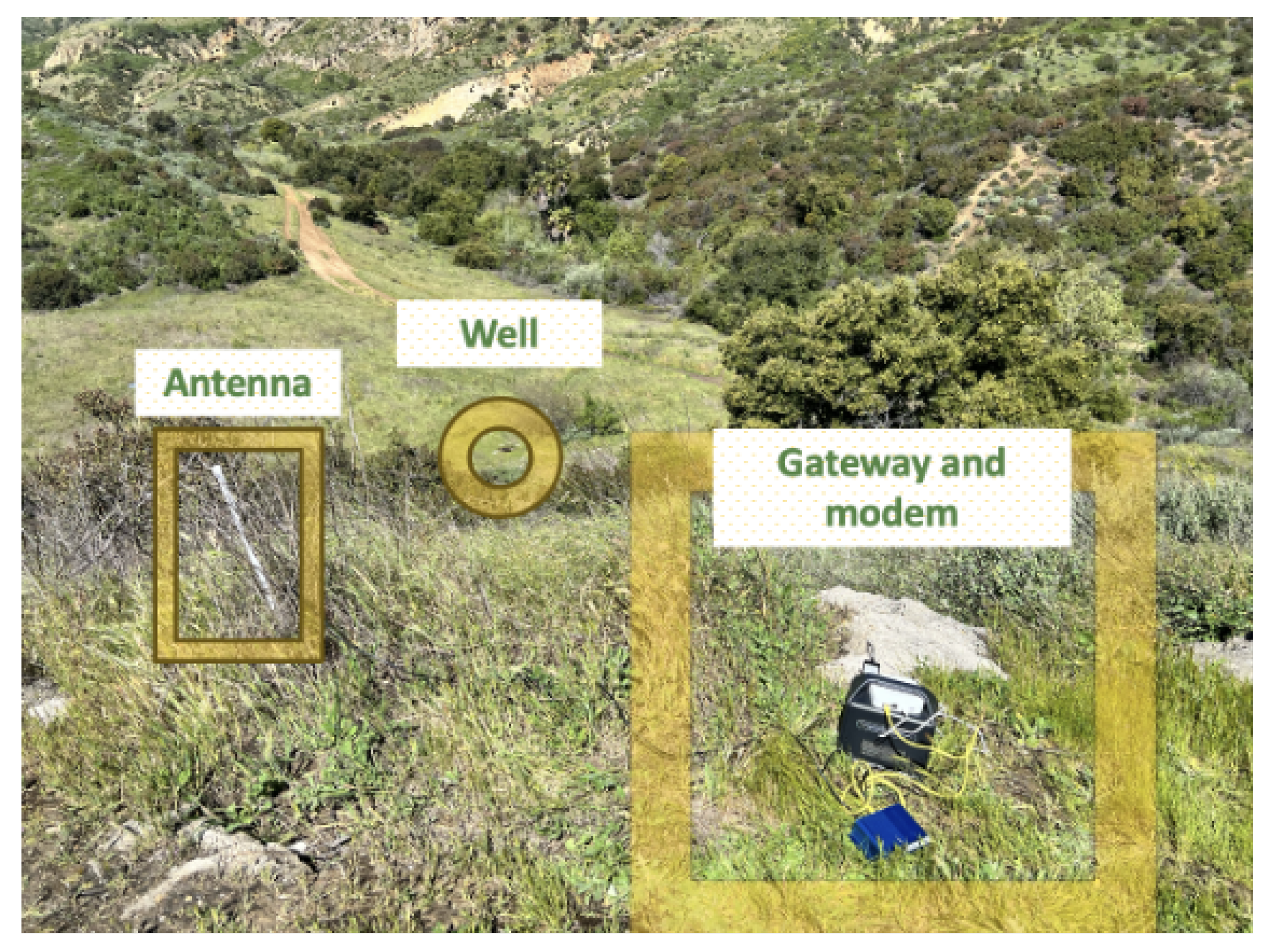
Figure 2.
Baseline detection configuration with sensors mounted on tripods at 15–25 cm horizontal distance from the leak sources and 150 cm above ground level. Two rotameters (left) are placed on a table, one can leak at 0.5–70 g/h and the other at 50–1,200 g/h.
Figure 2.
Baseline detection configuration with sensors mounted on tripods at 15–25 cm horizontal distance from the leak sources and 150 cm above ground level. Two rotameters (left) are placed on a table, one can leak at 0.5–70 g/h and the other at 50–1,200 g/h.
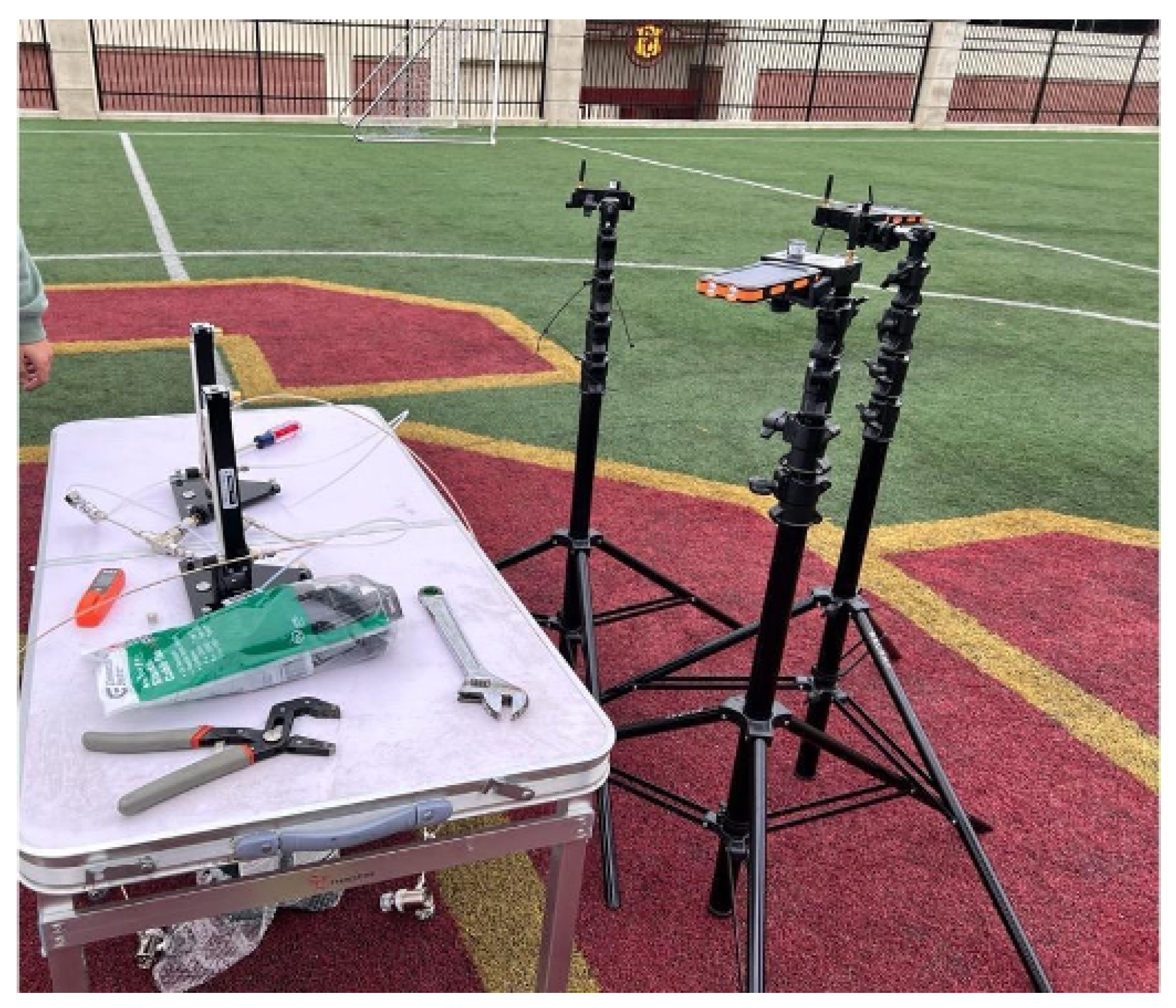
Figure 3.
The aluminum chamber with its lid (right). The chamber top has a punched hole, and the lid has a slight height difference, allowing air inside and methane outside of the chamber. The methane canister connected to rotameters (left) simulates a continuously leaking well.
Figure 3.
The aluminum chamber with its lid (right). The chamber top has a punched hole, and the lid has a slight height difference, allowing air inside and methane outside of the chamber. The methane canister connected to rotameters (left) simulates a continuously leaking well.
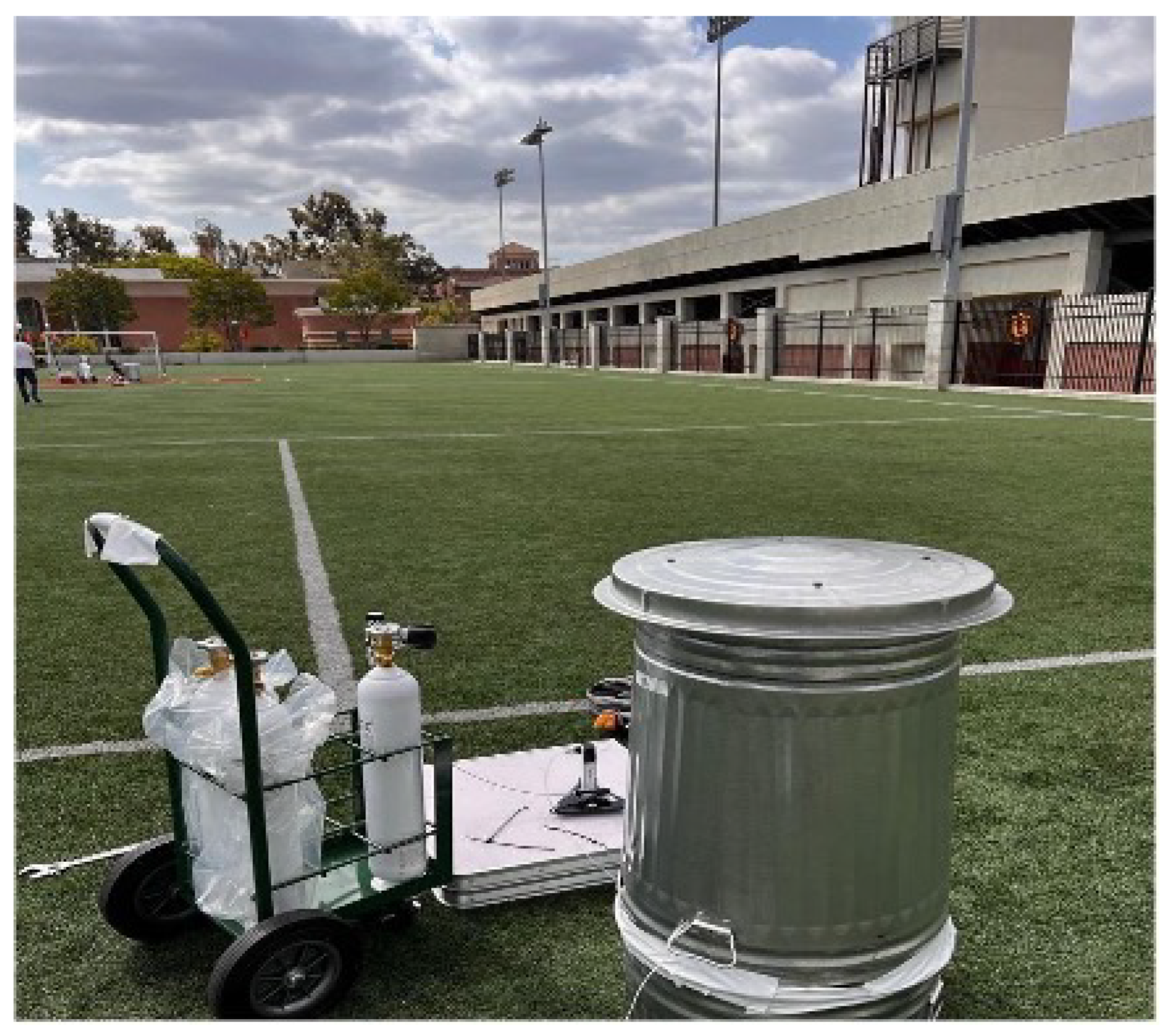
Figure 4.
The third chamber design, constructed from plastic for improved portability with a steel-wrapped wind cap on top. The wind cap provides ventilation so that the space under the chamber is not isolated from the atmosphere. The methane sensor is housed inside the wind cap (not visible), while the communication kit and battery pack are mounted on top.
Figure 4.
The third chamber design, constructed from plastic for improved portability with a steel-wrapped wind cap on top. The wind cap provides ventilation so that the space under the chamber is not isolated from the atmosphere. The methane sensor is housed inside the wind cap (not visible), while the communication kit and battery pack are mounted on top.
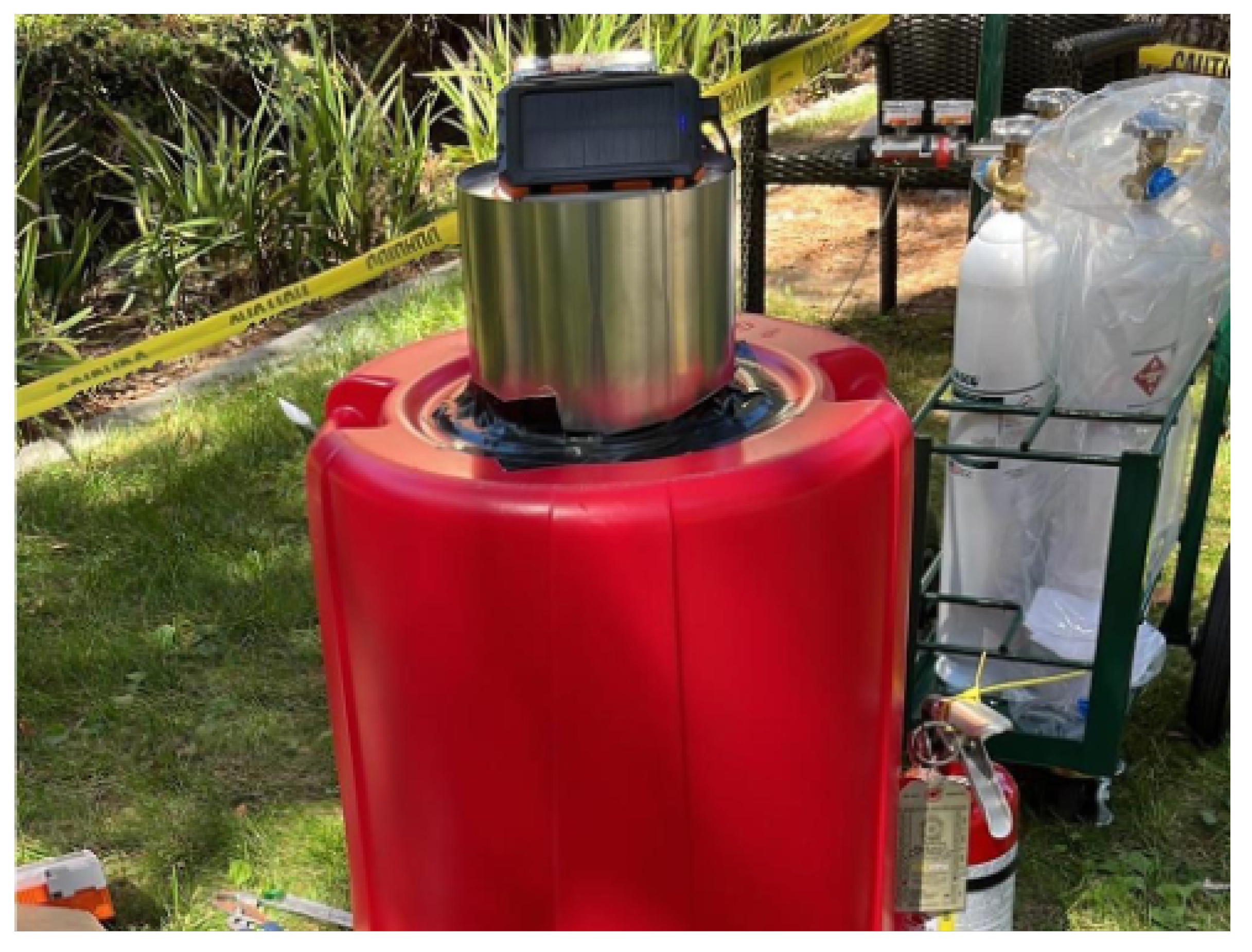
Figure 5.
The abandoned well used for field testing, showing crude oil seepage and gas bubbling at the surface. The site is located in the Los Angeles area on a publicly accessible hiking path.
Figure 5.
The abandoned well used for field testing, showing crude oil seepage and gas bubbling at the surface. The site is located in the Los Angeles area on a publicly accessible hiking path.
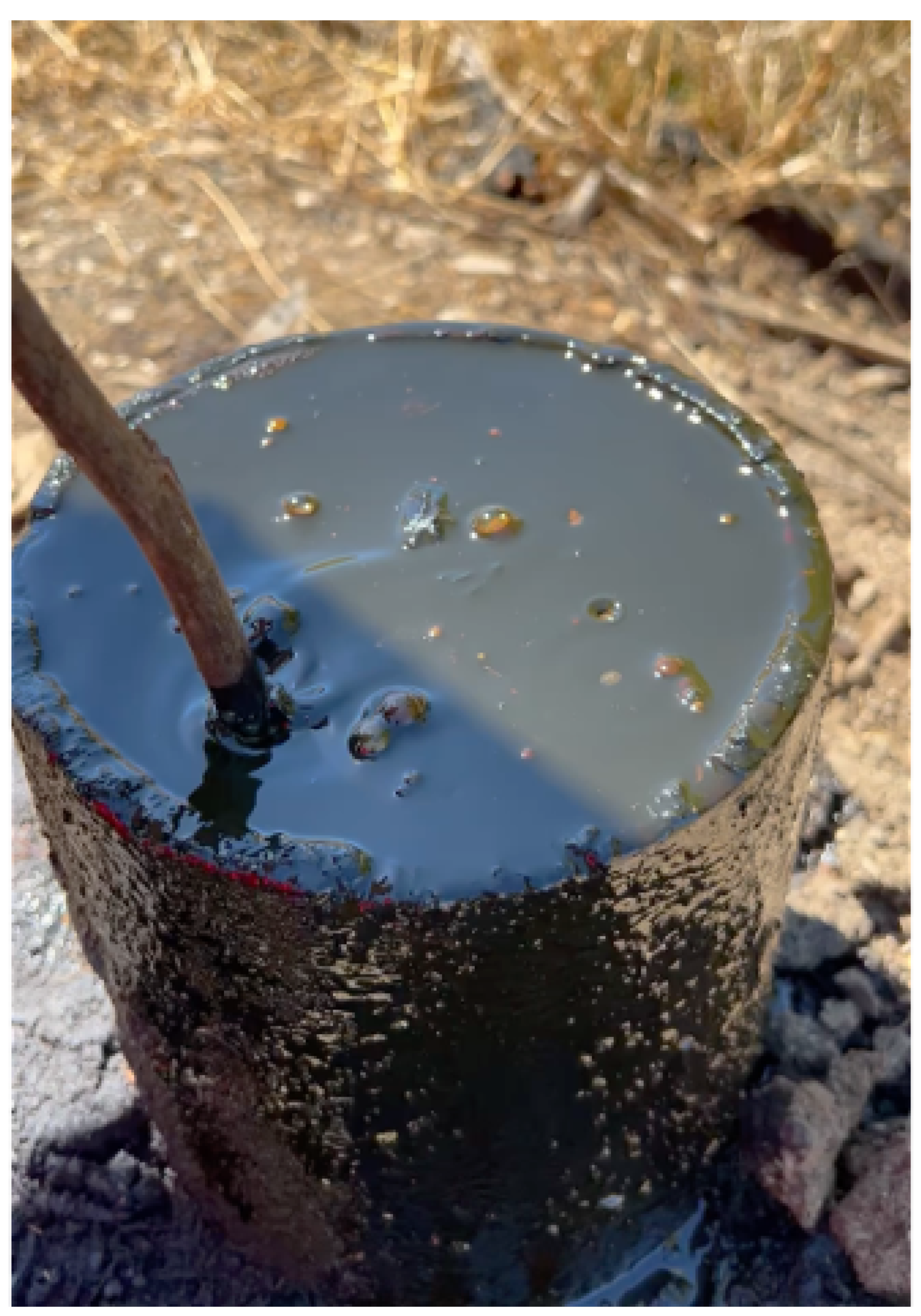
Figure 6.
Computational domain used in COMSOL Multiphysics simulations. The dark blue surface indicates the wind inlet boundary with an inflow velocity condition. The domain bottom is assigned a closed boundary, and all remaining surfaces are set to zero gauge pressure.
Figure 6.
Computational domain used in COMSOL Multiphysics simulations. The dark blue surface indicates the wind inlet boundary with an inflow velocity condition. The domain bottom is assigned a closed boundary, and all remaining surfaces are set to zero gauge pressure.
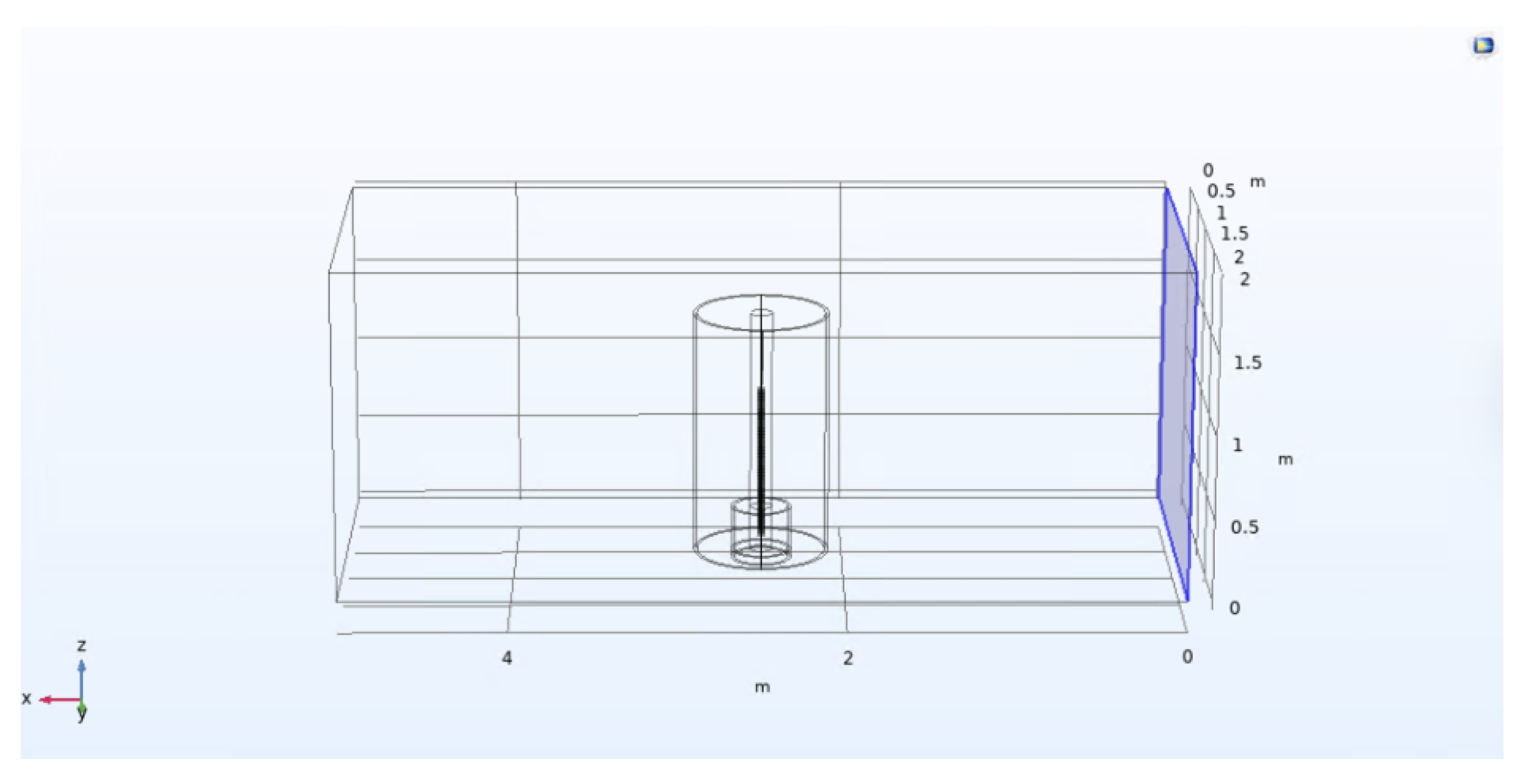
Figure 7.
The seven governing design parameters for chamber optimization. Well height (W_height) and well radius (W_r) are the only parameters known to the operator; wind speed (A_q) and methane leak rate (M_q) are not under operator control. The remaining three parameters (C_height, C_r, PH_r) are determined through optimization.
Figure 7.
The seven governing design parameters for chamber optimization. Well height (W_height) and well radius (W_r) are the only parameters known to the operator; wind speed (A_q) and methane leak rate (M_q) are not under operator control. The remaining three parameters (C_height, C_r, PH_r) are determined through optimization.
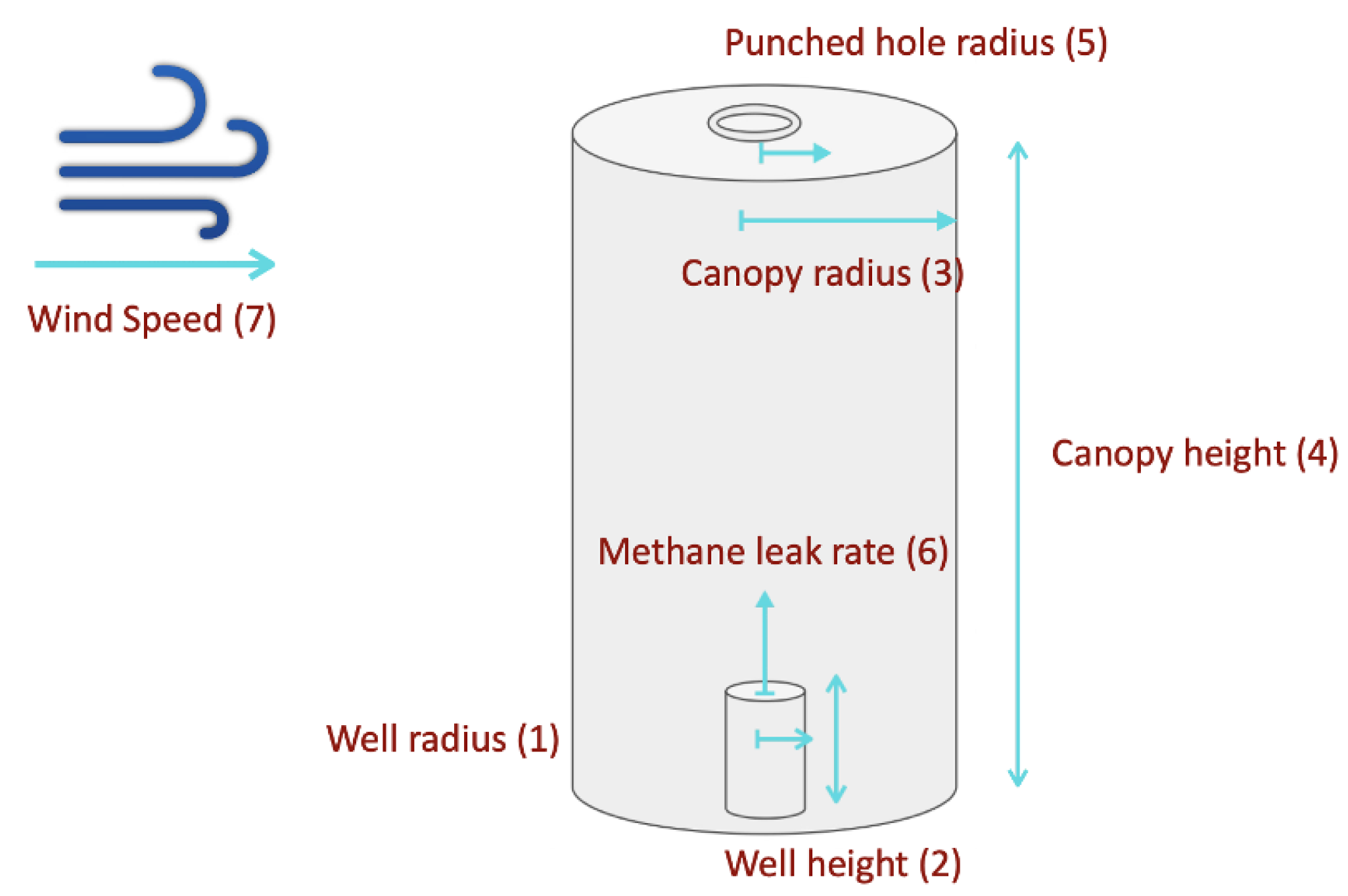
Figure 8.
The integrated COMSOL–MATLAB–ML optimization workflow. Parameter combinations are generated via Latin Hypercube Sampling and evaluated through automated COMSOL simulations using MATLAB Livelink, producing 1,000 spatially distributed methane concentration observations per run. The resulting dataset trains one recurrent neural network to predict concentration zone distributions. The trained surrogate model is subsequently used by the design optimization software to recommend chamber configurations within minutes.
Figure 8.
The integrated COMSOL–MATLAB–ML optimization workflow. Parameter combinations are generated via Latin Hypercube Sampling and evaluated through automated COMSOL simulations using MATLAB Livelink, producing 1,000 spatially distributed methane concentration observations per run. The resulting dataset trains one recurrent neural network to predict concentration zone distributions. The trained surrogate model is subsequently used by the design optimization software to recommend chamber configurations within minutes.
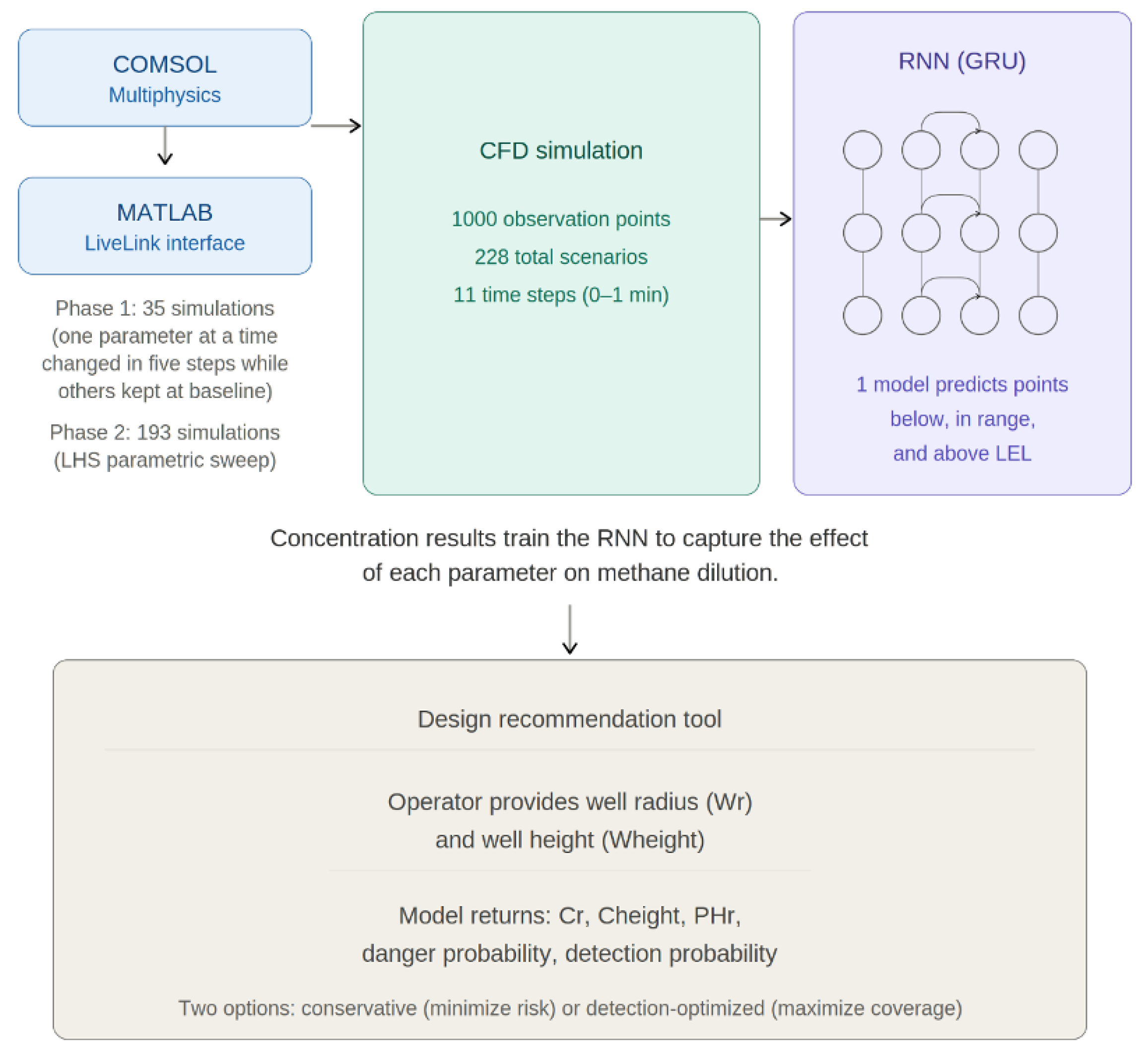
Figure 9.
Time-series methane concentration measurements from the second chamber design under varying leak rates, illustrating signal instability and washout behavior. As the leak rate decreases from 5 g/h to 2 g/h, the signal becomes increasingly intermittent and unstable, consistent with wind-driven dilution effects within the chamber. At 1 g/h, the methane concentration falls entirely below the sensor detection threshold, rendering the leak undetectable with this design.
Figure 9.
Time-series methane concentration measurements from the second chamber design under varying leak rates, illustrating signal instability and washout behavior. As the leak rate decreases from 5 g/h to 2 g/h, the signal becomes increasingly intermittent and unstable, consistent with wind-driven dilution effects within the chamber. At 1 g/h, the methane concentration falls entirely below the sensor detection threshold, rendering the leak undetectable with this design.
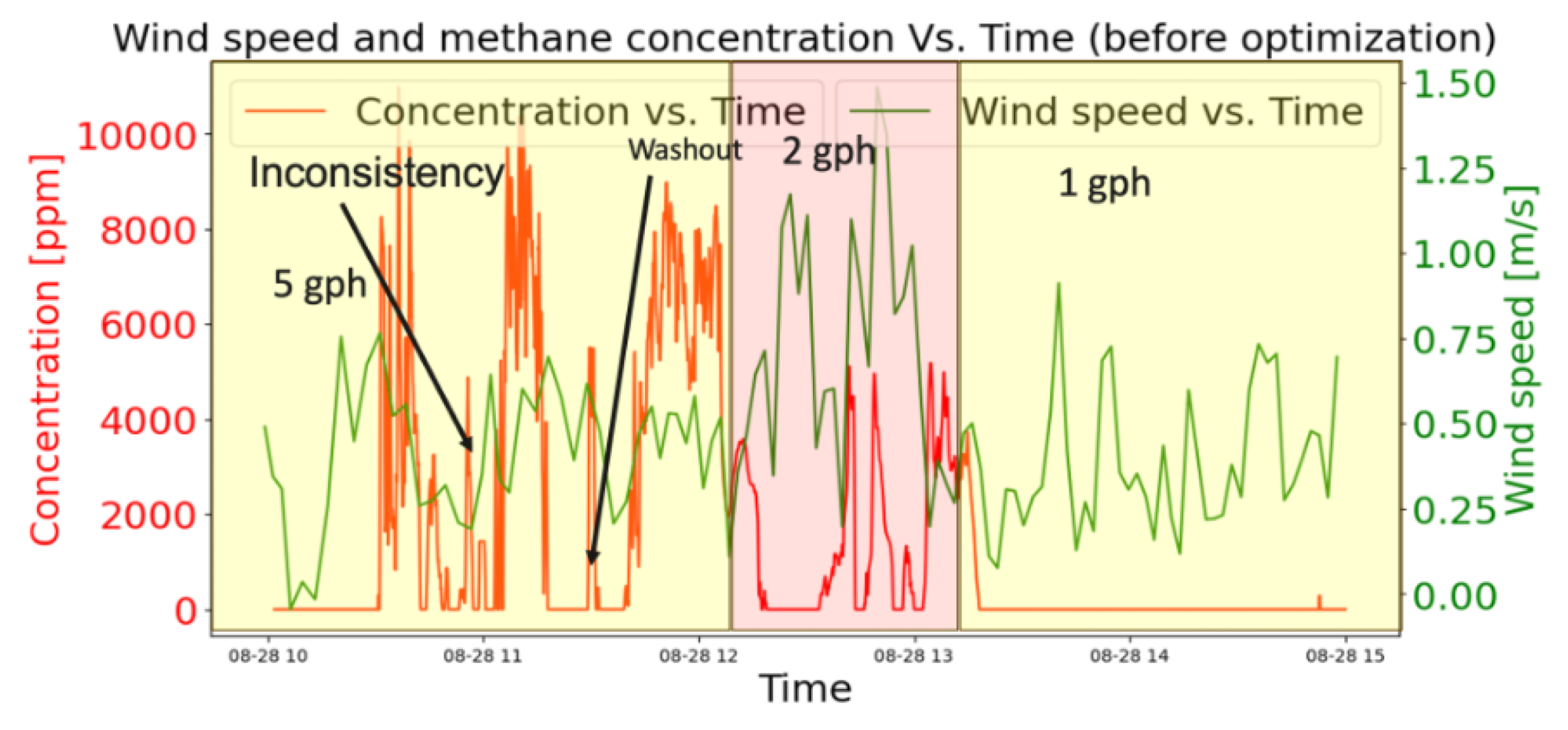
Figure 10.
Methane concentration (red) and wind speed (green) time series for the third chamber design at a 1 g/h leak rate, recorded during controlled outdoor testing. Concentration remains consistently within the detection window (50–50,000 ppm) throughout the measurement period with no washout events observed.
Figure 10.
Methane concentration (red) and wind speed (green) time series for the third chamber design at a 1 g/h leak rate, recorded during controlled outdoor testing. Concentration remains consistently within the detection window (50–50,000 ppm) throughout the measurement period with no washout events observed.
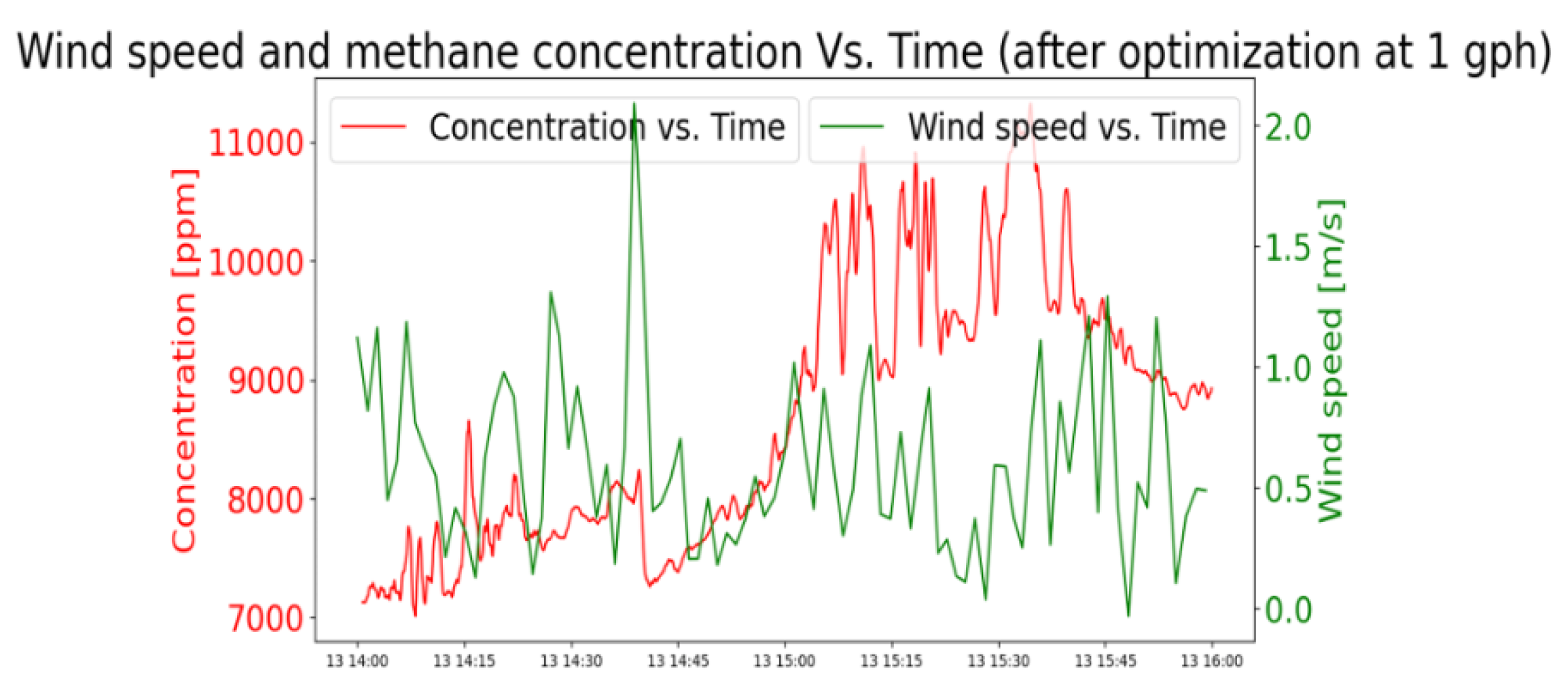
Figure 11.
Simultaneous methane concentration (red, left axis, ppm) and wind speed (green, right axis, m/s) recorded during the September 20, 2023 field deployment session at Canoga Park, spanning 7 h and 11 min from 09:19 AM to 4:31 PM. The co-plotted wind speed record demonstrates that emission spikes do not correlate consistently with any single wind speed condition.
Figure 11.
Simultaneous methane concentration (red, left axis, ppm) and wind speed (green, right axis, m/s) recorded during the September 20, 2023 field deployment session at Canoga Park, spanning 7 h and 11 min from 09:19 AM to 4:31 PM. The co-plotted wind speed record demonstrates that emission spikes do not correlate consistently with any single wind speed condition.
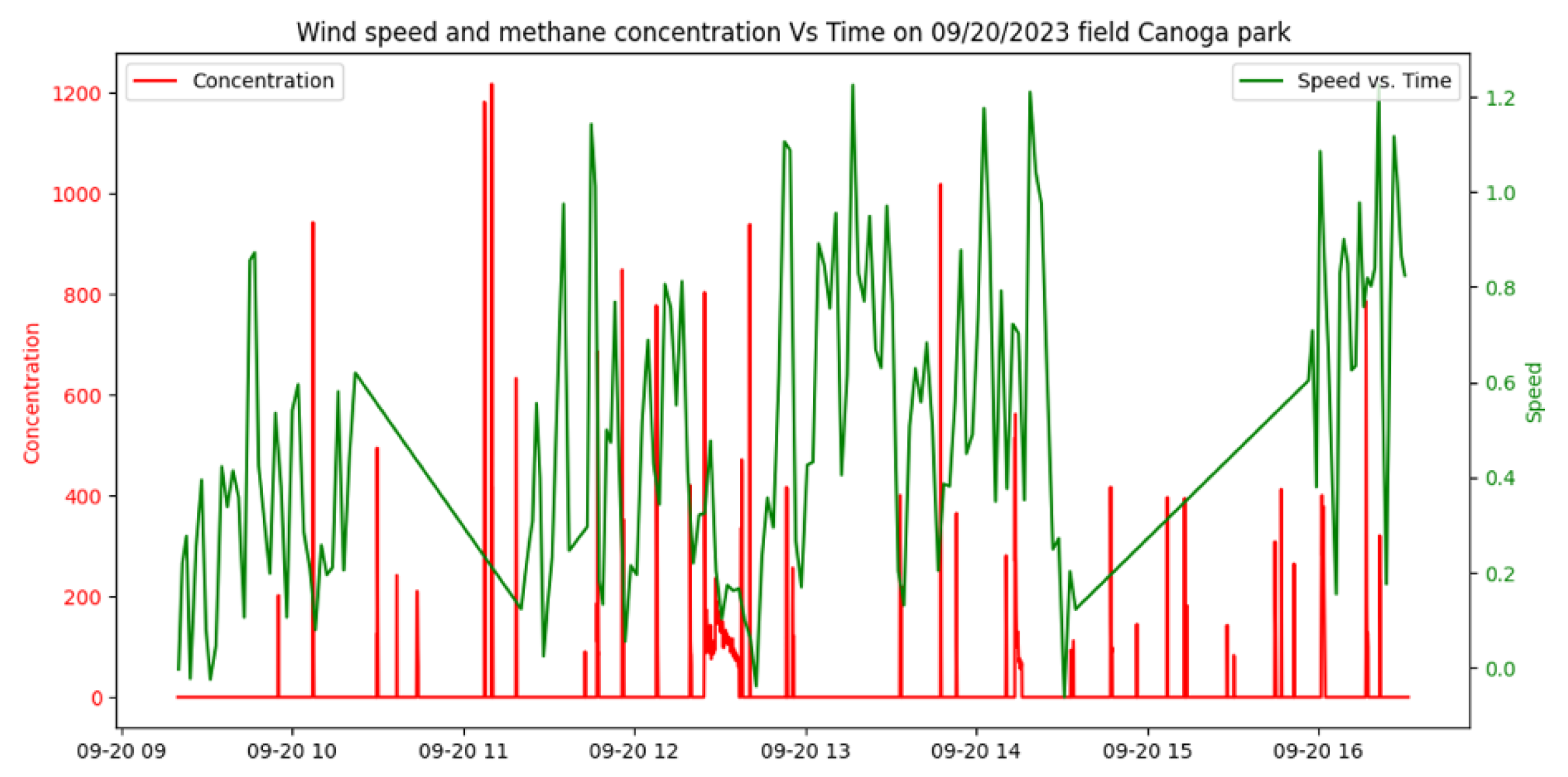
Figure 12.
Methane concentration time series recorded during a 4 h field deployment session, showing highly intermittent emission spikes with no regular periodicity. Wind speed data are unavailable for this session due to a technical malfunction of the ultrasonic wind sensor. Peak concentrations exceeding 1,000 ppm were recorded alongside extended periods of zero concentration, highlighting rapid mixing of methane and air.
Figure 12.
Methane concentration time series recorded during a 4 h field deployment session, showing highly intermittent emission spikes with no regular periodicity. Wind speed data are unavailable for this session due to a technical malfunction of the ultrasonic wind sensor. Peak concentrations exceeding 1,000 ppm were recorded alongside extended periods of zero concentration, highlighting rapid mixing of methane and air.
Figure 13.
Predicted (orange) versus measured (blue) methane concentration on the held-out test set for the GRU (top) and LTC (bottom) models. Both models capture the timing and general pattern of intermittent emission events. Systematic under-prediction of peak concentrations (15–25% below measured values) is observed in both architectures. The LTC model achieves marginally lower prediction error (RMSE = 35.52 ppm, R2 = 0.6553) but reaches this error level earlier in training compared to GRU (RMSE = 36.49 ppm, R2 = 0.6362).
Figure 13.
Predicted (orange) versus measured (blue) methane concentration on the held-out test set for the GRU (top) and LTC (bottom) models. Both models capture the timing and general pattern of intermittent emission events. Systematic under-prediction of peak concentrations (15–25% below measured values) is observed in both architectures. The LTC model achieves marginally lower prediction error (RMSE = 35.52 ppm, R2 = 0.6553) but reaches this error level earlier in training compared to GRU (RMSE = 36.49 ppm, R2 = 0.6362).
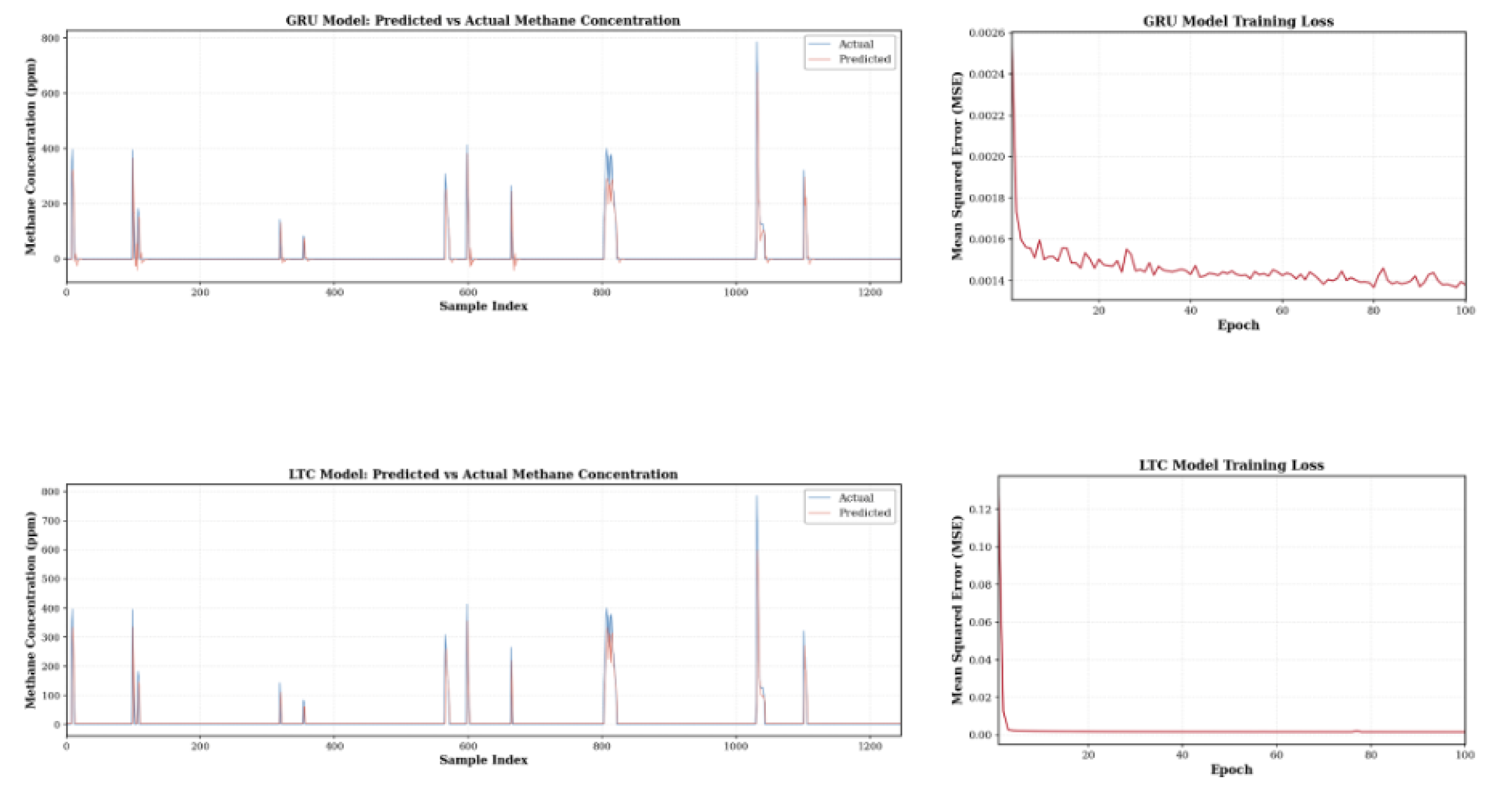
Figure 14.
RNN model training performance for all three concentration zone predictors: (a) training versus validation loss curves showing smooth convergence without overfitting, with dashed vertical lines indicating the best validation epoch for the model; (b) predicted versus actual scatter plots on the held-out test set, with dashed lines indicating perfect prediction.
Figure 14.
RNN model training performance for all three concentration zone predictors: (a) training versus validation loss curves showing smooth convergence without overfitting, with dashed vertical lines indicating the best validation epoch for the model; (b) predicted versus actual scatter plots on the held-out test set, with dashed lines indicating perfect prediction.
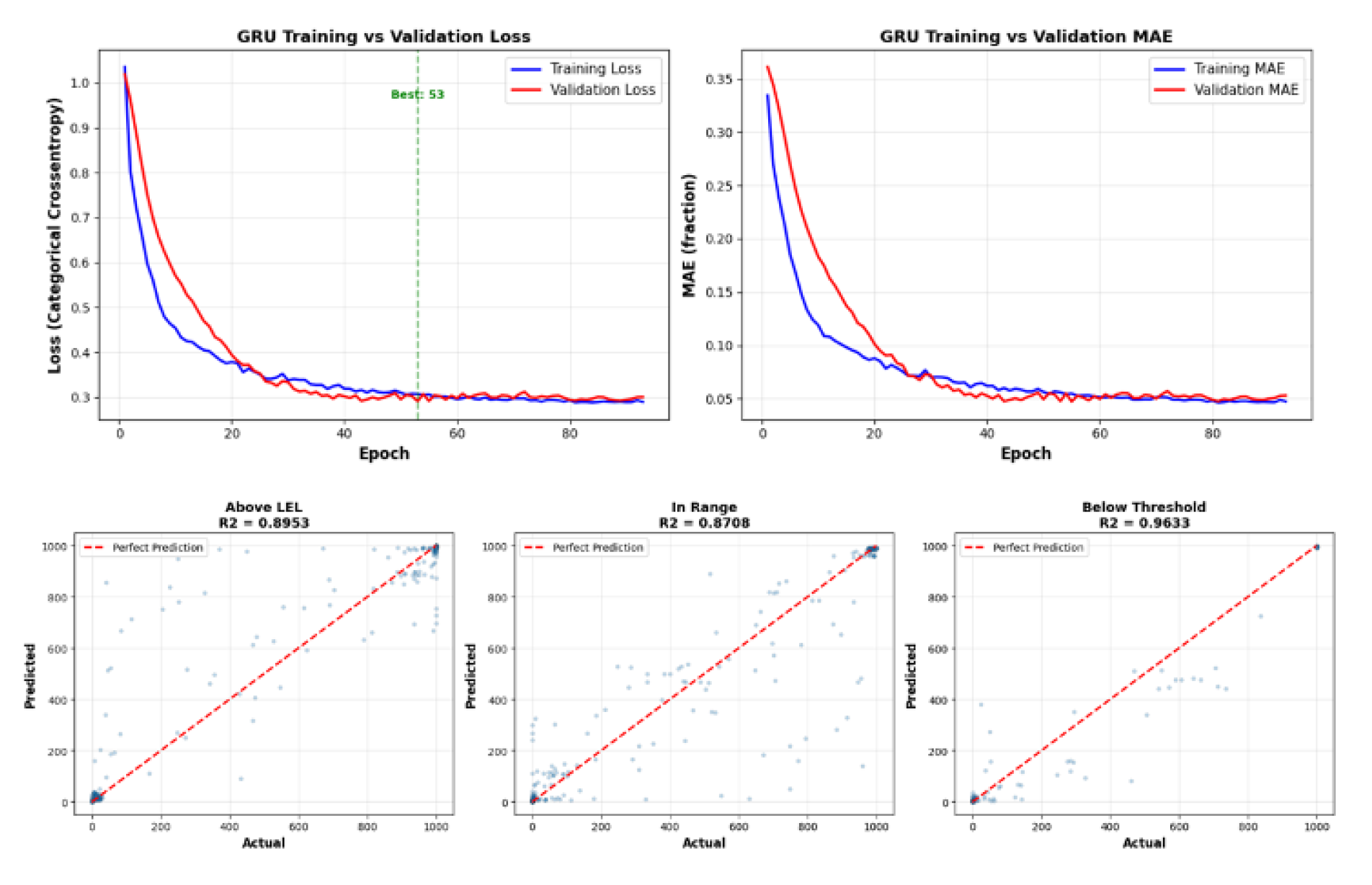

Table 1.
Hyperparameter Search Configuration (Applied to All Models).
| Parameter | Value |
|---|---|
| Optimization Framework | Optuna |
| Trials per Model | 30 |
| Learning Rate Search Range | to |
| Early Stopping Patience | 10–15 epochs |
Table 2.
Optimized Models Configuration.
| Parameter | GRU | LTC |
|---|---|---|
| Hidden Nodes | 128 | 24 |
| Recurrent Layers | 1 | 1 |
| Learning Rate | 0.00194 | 0.0001 |
| Batch Size | 32 | 32 |
| Wiring Architecture | — | AutoNCP (Neural Circuit Policies) |
| Time-Awareness | No | Yes (elapsed time as secondary input) |
Table 3.
Parameter baselines and ranges used in the two-phase parametric study. Baseline values are used in Phase 1, where one parameter is swept while all others are held constant. Phase 2 uses Latin Hypercube Sampling to simultaneously vary all parameters across the full range. All simulations are time-dependent and range from 0 to 1 min in 0.1 min steps.
Table 3.
Parameter baselines and ranges used in the two-phase parametric study. Baseline values are used in Phase 1, where one parameter is swept while all others are held constant. Phase 2 uses Latin Hypercube Sampling to simultaneously vary all parameters across the full range. All simulations are time-dependent and range from 0 to 1 min in 0.1 min steps.
| Parameter | Symbol | Baseline | Minimum and Maximum | Units |
|---|---|---|---|---|
| Chamber height | C_height | 1.00 | 0.50 to 1.50 | m |
| Well height | W_height | 0.15 | 0.15 to 0.35 | m |
| Chamber radius | C_r | 0.60 | 0.20 to 0.90 | m |
| Well radius | W_r | 0.05 | 0.05 to 0.25 | m |
| Opening radius | PH_r | 0.396 | 0.10 × C_r to 0.90 × C_r | m |
| Methane leak rate | M_q | 0.05 | 0.01 to 0.25 | kg/h |
| Wind speed | A_q | 0.95 | 0 to 1.25 | m/s |
Table 4.
Statistical information of the recorded leak events on September 20th, 2023.
| Statistic | Value |
|---|---|
| Percentage of recorded nonzero leaks | 6.9% |
| Mean concentration | 212.9 ppm |
| Maximum concentration | 1,218 ppm |
| Variance | 24,725.7 ppm2 |
| Frequency | 6.11 events/hour |
Table 5.
Performance comparison of GRU and LTC forecasting models.
| Model | RMSE (ppm) | MAE (ppm) | R2 | Training Time |
|---|---|---|---|---|
| GRU | 36.49 | 8.67 | 0.6362 | 35 s |
| LTC | 35.52 | 8.19 | 0.6553 | 2,052 s (34 min) |
Table 6.
RNN model test set performance. The splits are approximately 80% train, 10% validation and 10% test (total of 228 simulations each containing 1000 observation points and 10 timesteps).
Table 6.
RNN model test set performance. The splits are approximately 80% train, 10% validation and 10% test (total of 228 simulations each containing 1000 observation points and 10 timesteps).
| Prediction range | R2 | RMSE | MAE |
|---|---|---|---|
| Above LEL (≥ 50,000 ppm) | 0.8953 | 147.31 | 62.88 |
| Detection window (50–50,000 ppm) | 0.8708 | 151.55 | 70.44 |
| Below detection (<50 ppm) | 0.9633 | 59.39 | 20.46 |
Table 7.
Example design recommendations for well radius = 0.07 m, well height = 0.30 m under worst-case wind and leak rate conditions.
Table 7.
Example design recommendations for well radius = 0.07 m, well height = 0.30 m under worst-case wind and leak rate conditions.
| Design | Chamber Radius (m) | Chamber Height (m) | Opening Radius or PHr (m) | LEL Risk (%) | Detection (%) | Below Detection (%) |
|---|---|---|---|---|---|---|
| Conservative | 0.8675 | 0.8614 | 0.3989 | 0.9 | 90.1 | 9 |
| Detection-optimized | 0.7322 | 0.6397 | 0.2958 | 1.1 | 93.3 | 5.6 |
Disclaimer/Publisher’s Note: The statements, opinions and data contained in all publications are solely those of the individual author(s) and contributor(s) and not of MDPI and/or the editor(s). MDPI and/or the editor(s) disclaim responsibility for any injury to people or property resulting from any ideas, methods, instructions or products referred to in the content. |
© 2026 by the authors. Licensee MDPI, Basel, Switzerland. This article is an open access article distributed under the terms and conditions of the Creative Commons Attribution (CC BY) license (http://creativecommons.org/licenses/by/4.0/).
Copyright: This open access article is published under a Creative Commons CC BY 4.0 license, which permit the free download, distribution, and reuse, provided that the author and preprint are cited in any reuse.


