
Submitted:
29 May 2026
Posted:
01 June 2026
You are already at the latest version
Abstract
This paper studies an optimal consumption-investment problem in a multi-asset financial market where risky assets returns incorporate returns history. Preferences are modelled using Epstein-Zin recursive utility, allowing a separation between risk aversion and intertemporal substitution. Using the well-known martingale optimality principle and forward-backward stochastic differential equations (FBSDEs), we obtain explicit closed-form solutions for the optimal strategy and value function. A sensitivity analysis illustrates the dependence of optimal policies and value function on key parameters, including risk aversion, elasticity of intertemporal substitution (EIS), memory horizon, learning intensity, and wealth-history parameters. The findings provide new insights into the interaction between behavioural features and dynamic portfolio choice in a multi-asset setting.
Keywords:
optimal consumption-investment
; Epstein-Zin utility
; bounded memory
; behavioural finance
1. Introduction
The problem of optimal consumption and investment has long been one of the central topics in mathematical finance and stochastic control theory. Since the pioneering work of Merton, a vast literature has investigated how rational investors should dynamically allocate wealth between consumption and financial assets in order to maximise their lifetime utility. In the classical framework, investors continuously rebalance their portfolios between a risk-free asset and one or several risky assets while simultaneously determining an optimal consumption stream. Such models have provided fundamental insights into portfolio allocation, intertemporal decision-making, and equilibrium asset pricing. Nevertheless, despite their mathematical tractability and economic relevance, classical expected utility models remain limited in their ability to capture realistic investor behaviour and preference dynamics.
One of the major shortcomings of the standard expected utility framework lies in the fact that it links risk aversion and intertemporal substitution through a single parameter. In particular, within the constant relative risk aversion (CRRA) specification, the coefficient of relative risk aversion is the reciprocal of the elasticity of intertemporal substitution (EIS). Economically, this implies that an investor’s willingness to smooth consumption across uncertain states of nature is inseparable from the willingness to substitute consumption over time. However, empirical studies suggest that these two aspects of preferences are fundamentally distinct and should not necessarily move together. To overcome this restriction, Epstein and Zin (1989) introduced the recursive utility framework now commonly referred to as Epstein-Zin utility. This utility specification allows risk aversion and intertemporal substitution to be disentangled, thereby offering greater flexibility for modelling long-term investment decisions and asset pricing dynamics. Since then, Epstein-Zin preferences have become an important tool in dynamic portfolio optimisation; see, for example, Kraft et al. (2017); Xing (2017); Herdegen et al. (2023); Feng et al. (2025), and the references therein.
Alongside the development of recursive utility models, another important direction in modern financial modelling concerns the incorporation of behavioural effects, learning mechanisms, and memory dependence into portfolio choice problems. In practice, investors rarely make decisions solely on the basis of current market information. Instead, past performance, historical gains and losses, and previous investment experiences often influence future decisions. Empirical evidence from behavioural finance suggests that investors exhibit path-dependent behaviours such as momentum trading, trend-following, overreaction, and contrarian investment strategies. These observations challenge the classical Markovian paradigm in which only the current state variable matters for decision-making.
To account for such features, several recent studies have introduced delay equations, learning effects, and bounded-memory structures into stochastic control and portfolio optimisation problems. For instance, Chang et al. (2011) considered a stochastic portfolio optimisation model with bounded memory, where investment decisions depend on delayed wealth dynamics. More recently, Zhou and Yongjun (2024) investigated a consumption and portfolio optimisation problem with information learning under stochastic interest rates, while Wang et al. (2025) studied utility maximisation problems incorporating life insurance purchase, information learning and behavioural effects. See also Zhu and Zhang (2025) for the use of bounded memory in the context of robust Nash equilibrium for defined contribution pension games. These contributions and the references therein demonstrate that delayed information and learning mechanisms can substantially alter optimal investment behaviour and generate economically meaningful patterns consistent with observed investor behaviour. However, to the best of our knowledge, no research has ever considered the bounded memory effect when investors have recursive preferences.
Motivated by these developments, the present paper studies an optimal consumption and investment problem in an incomplete financial market where investors exhibit bounded memory and information-learning behaviour while evaluating outcomes through Epstein-Zin recursive preferences. More precisely, we consider a market consisting of a money market account and several risky assets, where the risky assets dynamics are influenced not only by standard market factors but also by delayed information variables linked to past wealth performance. In contrast to standard delay models based solely on historical wealth levels, our framework introduces an integrated delayed wealth variable defined through exponentially weighted gains and losses relative to a benchmark wealth level. This formulation provides a more realistic representation of bounded rationality and behavioural learning, since investors are often more sensitive to relative performance and recent experiences than to absolute wealth levels accumulated far in the past.
The model incorporates two distinct channels of historical information. The first is an integrated delay information variable that captures the exponentially weighted deviation of past wealth from the initial benchmark over a fixed memory horizon. This component reflects gradual learning and bounded-memory effects, giving greater importance to more recent observations while preserving the influence of historical performance. The second is a pointwise delayed wealth variable, corresponding to a lagged observation of wealth at a specific past time. Economically, this variable can be interpreted as a reference point or a delayed signal used by investors to update beliefs and revise strategies. Together, these two components provide a richer and more flexible representation of information learning and behavioural feedback effects in portfolio selection.
From a mathematical perspective, incorporating memory effects into dynamic portfolio optimisation increases the complexity of the problem. The resulting wealth dynamics become non-Markovian and involve delay terms that interact with recursive utility preferences. To address these difficulties, we formulate the optimisation problem through a system of forward-backward stochastic differential equations (FBSDEs). By introducing a suitable ansatz for the value process, we derive explicit representations for the optimal consumption and investment strategies, as well as the associated value function. The explicit solvability of the model enables a detailed analysis of how preference parameters and memory effects jointly shape optimal decision-making.
The main contributions of this paper can be summarised as follows.
- 1.
- We formulate and solve an optimal consumption and investment problem with bounded memory under Epstein-Zin recursive utility. The latter framework naturally generalises the classical CRRA utility case as a particular specification of the preference parameters; see Remark 1.
- 2.
- We introduce a multi-asset incomplete-market model in which each risky asset is influenced by two distinct information-learning mechanisms: an integrated delayed wealth variable reflecting exponentially weighted past performance and a pointwise delayed wealth state representing lagged wealth information. Compared with existing bounded-memory models, our formulation focuses on exponentially weighted gains and losses relative to a benchmark wealth level rather than on absolute historical wealth or on pure average gains and losses.
- 3.
- Using an FBSDE approach together with an explicit ansatz for the value function, we derive closed-form expressions for the optimal consumption and portfolio strategies, as well as the associated value function; see Theorem 1. These explicit formulas make it possible to perform a detailed sensitivity analysis with respect to the memory horizon, learning parameters, risk aversion coefficient, and elasticity of intertemporal substitution.
- 4.
- We provide an economic interpretation of the resulting optimal strategies and show how behavioural learning effects can generate different investment patterns across risky assets. In particular, the analysis highlights the interaction between delayed information, recursive preferences, and dynamic portfolio allocation.
The remainder of the paper is organised as follows. Section 2 introduces the financial market model, the bounded-memory structure, and the associated wealth dynamics. Section 3 formulates the Epstein-Zin optimisation problem and presents the main theoretical results, including the explicit solution of the associated forward-backward stochastic differential equation system. Section 4 investigates the effects of the model parameters on the optimal investment and consumption policies through a sensitivity analysis. Finally, the paper concludes with a summary of the main findings and a discussion of possible directions for future research.
2. Model and Problem Formulation
2.1. Probability Setting and Wealth Process of the Investors
We consider a filtered probability space generated by a n-dimensional Brownian motion . The filtration is assumed to satisfy the usual conditions of completeness and right-continuity, so that we can take càdlàg versions for semi-martingales. We define some known spaces of stochastic processes.
- Let be the set of non-negative progressively measurable processes on .
- Let denote the space of càdlàg adapted -valued processes such that .
- Let denote the space of predictable -valued processes such that .
We consider a dynamic financial environment with k risky assets (think of stock, bond, mutual fund) and a money market account. We assume that investors in such a financial market consider historical investment data when choosing their current investment strategies. In particular, they take into account the performance of past strategies. Let h be the information learning horizon, be the level of wealth of the investor at the current time t, and its initial wealth. To accurately evaluate the profits and losses of historical performance, we consider a refinement of the information variables proposed by Chang et al. (2011); Zhou and Yongjun (2024), as follows
Here, and represent the average parameter and the delay parameter, respectively, and represents the integrated delayed information of the investor’s wealth process on the past horizon . captures the past performance relative to the benchmark while ensuring that only gains and losses, not arbitrary wealth levels (as in Chang et al. (2011)), drive the dynamics. The exponential weighting introduces a realistic decay in memory (contrary to Zhou and Yongjun (2024)), giving greater importance to recent results while still retaining a smooth influence of the past. We assume that the investor is endowed with an initial wealth at time and does not start investing until time 0; that is, for all . In that case, .
Following Chang et al. (2011), we assume that the investment dynamics of the stock exhibits an information learning effect, influenced not only by the integrated delayed information variable over the time period , but also by the pointwise delayed information state
Moreover, as in Zhou and Yongjun (2024), we assume that investors choose, from the money market account, a consumption rate at time . Hence, the investment dynamics for the money market account and the k-vector of risky assets are governed by the stochastic differential equations
where and , denote the amounts invested in the money market account and the i-th risky asset, respectively, denote the interest rate earned by the money market account, and denote the risk premium vector and the volatility matrix of the risky assets, respectively, and and denote the information learning parameters for and , respectively, with the components and , associated with the i-th risky asset. Although both and reflect aspects of the historical dynamics of wealth, they serve complementary behavioural roles in the model. More precisely, describes the average deviation of wealth from the initial benchmark over a recent period, reflecting bounded memory or trend-based learning, while is constructed as a pointwise time snapshot of past wealth, serving as a proxy for updating immediate belief. As in Zhou and Yongjun (2024), it should be noted that when is positive, the investor exhibits momentum behaviour and tends to follow past winners. On the other hand, when is negative, the investor exhibits contrarian behaviour and tends to follow past losers; we refer the reader to Zhou and Yongjun (2024) Figure 1) for a graphical view of the information learning mechanism.
Assumption 1.
The volatility matrix satisfies is invertible, with being the transpose of the matrix σ.
Using Equations (4) and (5), the wealth process X of investors evolves according to the stochastic differential equation
where , and . Due to Assumption A1, the risk premium is well-defined. Note that working with does not always ensure that we can come back to (because the matrix is not necessarily symmetric). To guaranty the reversed relation, must take values in for .
3. Main Results
3.1. The Epstein-Zin Utility Maximisation with Bounded Memory
To capture investors’ preferences, we consider the Epstein-Zin stochastic differential utility. We specify the utility via an aggregator f and a bequest utility function g, defined as
where c represents a positive consumption rate, the discounting rate, the elasticity of intertemporal substitution coefficient (EIS) and the relative risk aversion. Hence, the Epstein-Zin utility process is given by
We consider the parameters’ specification
We give a remark on the relation between the stochastic differential utility defined by (7)-(8) and the classical stochastic differential utility introduced by Duffie and Epstein (1992) (see also Epstein and Zin (1989)).
Remark 1.
- (i)
- Equations (7)-(8) provide a reformulation of the standard Epstein-Zin utility, denoted here by . The standard utility has a terminal value given by , and its generator is defined in the difference form: (see, e.g., Xing (2017, Eq.(2.1)-(2.2))). Note that, corresponds to the standard Epstein-Zin utility if and only if coincides with the utility process defined by Equations (7)-(8). In particular, this implies .
- (ii)
- With the function f parameterised as above, one readily recognises the CRRA utility as a special case corresponding to the parameter configuration (in that case ).
We consider the following set of admissible consumption streams:
(See, for example, [Def. 1.46 on p.11 Jacod and Shiryaev (2013) for the notion of class (D)). The set defined by Equation (10) aligns with those considered in Matoussi and Xing (2018), as well as Herdegen et al. (2023). All known sufficient conditions for the existence of Epstein–Zin utility over a finite time horizon are summarised in [Prop. 2.1 Matoussi and Xing (2018), which, in particular, ensures that .
Hence, a pair of consumption-investment strategy is admissible if , for , , and Equation (6) admits a unique strong solution. Investors aim to maximise their utility in the class of admissible strategies. Following, for example, Feng et al. (2025); Aurand et al. (2023) and Xing (2017), we later restrict admissible consumption-investment strategies to a permissible set (see Equation (25)), and solve the stochastic optimisation problem of investors on this permissible set. Moreover, following Chang et al. (2011), we consider a situation in which investors derive utility from the perceived wealth. That is, we incorporate an additional term that reflects historical investment performance. That way, we allow the model to take into account non-financial drivers of satisfaction and reflect learning behaviours (meaning, investors care not just about wealth outcomes, but also how they are achieved). In this sense, it bridges the gap between standard financial modelling and behavioural modelling. Thus, the goal of investors is to find some strategy that achieves the optimal value
where is the unique solution to Equation (8), with .
3.2. The Ansatz
Motivated by the decomposition of the Epstein-Zin utility in Kuissi-Kamdem (2025) (compare with Aurand et al. (2023); Xing (2017)), we speculate that the optimal utility process takes the form
where and X are solutions to the SDEs (2) and (6), respectively, and is the solution to the BSDE
for some generator to be determined. From Equations (13) and (8), we deduce that the process
should be a local supermartingale for any and a local martingale for an optimal strategy . Itô’s formula applied to gives
Hence, expecting the drift in Equation (15) to be non-positive for any and zero for an optimal strategy , we obtain
The optimisers to the two optimisation problems in Equation (16) are
Substituting into (16) and (6) we obtain
and
For the heuristic derivation above to make sense, we should first prove existence of a solution to the linear forward-backward stochastic differential equation (1), (19) and (13), with the generator of the backward stochastic differential equation given by Equation (16). For easier reference, we summarise the latter FBSDE as follows
To obtain an explicit solution to the FBSDE (20) and to the optimal control problem (Section 3.1), we consider the following
Assumption A2.
The interest rate r as well as the parameters and h satisfy
Remark 2.
We want to point out that Assumption A2 is consistent with a similar condition for the particular case of constant relative risk aversion (CRRA) utility (corresponding to ) as in Chang et al. (2011) (for ) and Zhou and Yongjun (2024) and Wang et al. (2025) (for and ).
We define the process by
and the constants
Proposition 1.
Proof.
See Appendix A. □
3.3. Solution to the Stochastic Optimisation Problem
With the strategy , given by Equation (17), well defined (due to Proposition 1), it remains to prove its optimality among a suitable set of strategies. We consider the permissible set
As already mentioned in Section 3.1, restricting the set of admissible strategies to a set of permissible ones has also been considered in, for example, Feng et al. (2025); Aurand et al. (2023) and Xing (2017). We refer the reader to Aurand et al. (2023, Rmk. 3.6) for details on the motivation for such restriction. In the present paper, for the motivation for our definition of , we use arguments similar to those of Aurand et al. (2023, Rmk. 3.6).
We are now ready to give an explicit expression for the solution to the stochastic optimisation problem (11).
Theorem 1.
Proof.
See Appendix B □
4. Sensitivity Analysis
To illustrate the general results from the previous sections, we analyse the sensitivity of the value function, and the optimal consumption and investment strategies with respect to some parameters. For simplicity, we fix (two risky assets) and (two independent Brownian motions). Following Escobar-Anel et al. (2022), unless otherwise stated, the basic model parameters are summarised in Table 1.
In this setting, the matrix , and the vectors and are given by
where , and is the correlation coefficient between the two risky assets. Recall the definition of and in Equation (23). From Equations (26) and (28), we deduce that the optimal consumption and investment strategies are given by
Figure 1 illustrates the evolution of the optimal investment and consumption strategies over time. The figure shows that these strategies are monotonic functions of time. In particular, Figure 1a,b indicate that when the weight parameter associated with the pointwise delayed wealth, , is negative, the optimal investment in risky asset 1 decreases over time, whereas the optimal investment in risky asset 2 increases over time. By contrast, when is non-negative, the opposite pattern is observed: the investment in risky asset 1 increases over time while the investment in risky asset 2 decreases over time.
Furthermore, Figure 1c,d show that optimal consumption increases over time regardless of the sign of . This suggests that investors progressively raise their consumption levels as they approach the terminal horizon, independently of the influence of delayed wealth effects.
Figure 2 illustrates the influence of the average parameter on the optimal investment and consumption strategies. As shown in Figure 2c, for a fixed value of , optimal consumption increases over time. Moreover, for any given time t, higher values of the average parameter lead to higher consumption levels. A similar behaviour can be observed in Figure 2a for the investment in risky asset 1, where larger values of are associated with greater investment allocations.
In contrast, Figure 2b reveals an inverse relationship for risky asset 2: the allocation to this asset decreases as the average parameter increases.
Figure 3 exhibit trends similar to those observed in Figure 2, with the average parameter replaced by the delay parameter h.
Figure 4 shows that the risk aversion coefficient influences the optimal investment and consumption strategies in a qualitatively similar pattern to the average parameter .
Figure 5 illustrates the influence of the elasticity of intertemporal substitution (EIS) parameter on the optimal strategies. The figure highlights three main features. First, the allocation to risky asset 1 increases both over time, for a fixed value of , and with higher values of at any given time t. Second, the investment in risky asset 2 exhibits the opposite behaviour, decreasing with both time and the EIS parameter. Third, the optimal consumption strategy rises over time while declining as increases.
5. Conclusions
This paper develops a consumption–investment framework that integrates bounded memory and information learning within an Epstein-Zin utility setting. By incorporating both integrated and pointwise delayed wealth variables, the model captures realistic behavioural features such as trend-following and contrarian strategies.
Using martingale optimality principle with forward-backward stochastic differential equations, we obtain explicit solutions for optimal consumption and portfolio allocation under structural assumptions. These solutions reveal how memory effects and learning parameters directly influence investment behaviour and welfare.
The sensitivity analysis reveals that the optimal consumption and investment strategies are strongly influenced by investors’ learning behaviour, memory effects, and preference parameters. In particular, the weight assigned to delayed wealth information, represented by , significantly affects portfolio allocation dynamics, generating opposite investment patterns across the two risky assets depending on whether past performance enters negatively or positively into investors’ perceived wealth.
The analysis further shows that the memory-related parameters, namely the average parameter and the delay horizon h, play an important role in shaping optimal decisions. Higher values of these parameters generally increase allocations to risky asset 1 and consumption levels, while reducing the proportion invested in risky asset 2. Similar effects are observed for the risk aversion coefficient , highlighting the close interaction between investors’ preferences and learning mechanisms.
Finally, the elasticity of intertemporal substitution parameter exhibits differentiated effects on investment and consumption behaviour. Larger values of increase the allocation to risky asset 1 but decrease both the allocation to risky asset 2 and the consumption rate. These findings demonstrate that incorporating information learning and bounded memory alters optimal consumption-investment decisions and provides a richer behavioural interpretation of dynamic portfolio choice in incomplete markets. Future research could extend this framework to include stochastic interest rates, market frictions, or heterogeneous agents, further enhancing its applicability.
Author Contributions
Conceptualization, Methodology, W.K.-K. and M.N.; Writing—original draft preparation, W.K.-K.; Writing—review and editing, W.K.-K. and M.N.; Supervision, M.N. All authors have read and agreed to the published version of the manuscript.
Funding
This work was supported by a grant from the African Institute for Mathematical Sciences, with financial support from the Government of Canada, provided through Global Affairs Canada, and the International Development Research Centre.
Conflicts of Interest
The authors declare no conflicts of interest.
Appendix A. Proof of Proposition 1
We show that the quadruple given by (24) satisfies the FBSDE (20). Applying Itô’s formula to Y we obtain
Using successive plugging of Equations (22) and (23) into Equation (A1) we obtain
Hence, using the first and last equalities of Equation (24) and the definition of given in Equation (23), we have
Thus, using Assumption A2 and the definition of given in Equation (23), Equation (A3) becomes the BSDE associated with the FBSDE (20).
Appendix B. Proof of Theorem 1
We start by showing that is strictly positive and finite; that is, . This yields a strictly positive and finite and a well-defined . On the one hand, because , we have and . Thus,
On the other hand, for , we have . Then, and . Thus,
Hence, if and only if . If , then . Thus, . If , then and . Thus, . Therefore, . Moreover, if is finite, then is also finite. To prove that is finite, we only need to do it for . We have . Hence, if and only if . However, . Then, (finite) when . Therefore, is finite.
The next step is to show that is permissible; that is, (see Equation (10) for the definition of the set ), for , Equation (6) admits a unique strong solution, and the process , is of class (D) on .
- Using Seiferling and Seifried (2016, Thm. 3.1) (see also Kraft et al. (2017, on p.191)), if then for all . This yields the class (D) property of . Recall that . For , we haveBesides,where the last equality holds due to the process , being a martingale. Hence,
- This follows directly from , with ; see right below Equation (6).
- Plugging the expressions of and , the dynamics of the wealth becomeswith the processes and given by Equations (1) and (3), respectively, and Y and Z given by Equation (24). Hence, the wealth process is solution of a stochastic differential equation of type similar to the one studied by Mohammed (1998). Using Mohammed (1998, Thm. I.1), we deduce that the wealth equation admits a unique strong solution.
-
Hence, the process , is of class (D) on as a product of a bounded function and a martingale.
The final step is to show that is optimal. The proof follows similar arguments as in the proof of proposition in Feng et al. (2025).
References
- Aurand, Joshua, and Yu-Jui Huang. 2023. Epstein-Zin utility maximization on a random horizon. Mathematical Finance 33: 1370–1411. [Google Scholar] [CrossRef]
- Bai, Yanfei, Zhongbao Zhou, Helu Xiao, Riu Gao, and Feimin Zhong. 2022. A hybrid stochastic differential reinsurance and investment game with bounded memory. European Journal of Operational Research 296: 717–737. [Google Scholar] [CrossRef]
- Chang, Mou-Hsiung, Tao Pang, and Yipeng Yang. 2011. A stochastic portfolio optimization model with bounded memory. Mathematics of Operations Research 36: 604–619. [Google Scholar] [CrossRef]
- Duffie, Darrell, and Larry G. Epstein. 1992. Stochastic differential utility. Econometrica 00: 353–394. [Google Scholar] [CrossRef]
- Epstein, Larry G, and Stanley E. Zin. 1989. Substitution, Risk Aversion, and the Temporal Behavior of Consumption and Asset Returns: A Theoretical Framework. Econometrica 57: 937–969. [Google Scholar] [CrossRef]
- Escobar-Anel, Marcos, Yevhen Havrylenko, Michel Kschonnek, and Rudi Zagst. 2022. Decrease of capital guarantees in life insurance products: Can reinsurance stop it? Insurance: Mathematics and Economics 105: 14–40. [Google Scholar] [CrossRef]
- Feng, Zixin, Dejian Tian, and Harry Zheng. 2025. Consumption–investment optimization with Epstein-Zin utility in unbounded non-Markovian markets. Stochastic Processes and their Applications 2025: 104805. [Google Scholar] [CrossRef]
- Herdegen, Martin, David Hobson, and Joseph Jerome. 2023. The infinite-horizon investment–consumption problem for Epstein–Zin stochastic differential utility. I: Foundations. Finance and Stochastics 27: 127–158. [Google Scholar] [CrossRef]
- Jacod, Jean, and Albert Shiryaev. 2013. Limit Theorems for Stochastic Processes. Springer Science. [Google Scholar]
- Kraft, Holger, Thomas Seiferling, and Frank Thomas Seifried. 2017. Optimal consumption and investment with Epstein–Zin recursive utility. Finance and Stochastics 21: 187–226. [Google Scholar] [CrossRef]
- Kuissi-Kamdem, Wilfried. 2025. Asset-liability management with Epstein-Zin utility under stochastic interest rate and unknown market price of risk. arXiv arXiv:2511.02158. [Google Scholar]
- Matoussi, Anis, and Hao Xing. 2018. Convex duality for Epstein–Zin stochastic differential utility. Mathematical Finance 28: 991–1019. [Google Scholar] [CrossRef]
- Mohammed, Salah-Eldin A. 1998. Stochastic differential systems with memory: theory, examples and applications. Stochastic Analysis and Related Topics VI: Proceedings of the Sixth Oslo—Silivri Workshop Geilo 1996, 1–77. [Google Scholar]
- Seiferling, Thomas, and Frank-Thomas Seifried. 2016. Epstein-Zin stochastic differential utility: Existence, uniqueness, concavity, and utility gradients. ssrn, 2625800. [Google Scholar]
- Wang, Hao, Tak Kuen Siu, Ning Wang, and Rongming Wang. 2017. Utility maximization of household with information learning and health shocks. Finance Research Letters 2025: 108241. [Google Scholar] [CrossRef]
- Xing, Hao. 2017. Consumption–investment optimization with Epstein–Zin utility in incomplete markets. Finance and Stochastics 21: 227–262. [Google Scholar] [CrossRef]
- Zhou, Minna, and Yongjun Liu. 2024. Dynamic consumption and portfolio choice considering information learning and stochastic interest rate. Finance Research Letters 65: 105494. [Google Scholar] [CrossRef]
- Zhu, Huainian, and Yumo Zhang. 2025. Robust Nash equilibrium for defined contribution pension games with delay under multivariate stochastic covariance models. Insurance: Mathematics and Economics 120: 236–268. [Google Scholar] [CrossRef]
Figure 1.
Consumption-investment policies against time for different signs of .
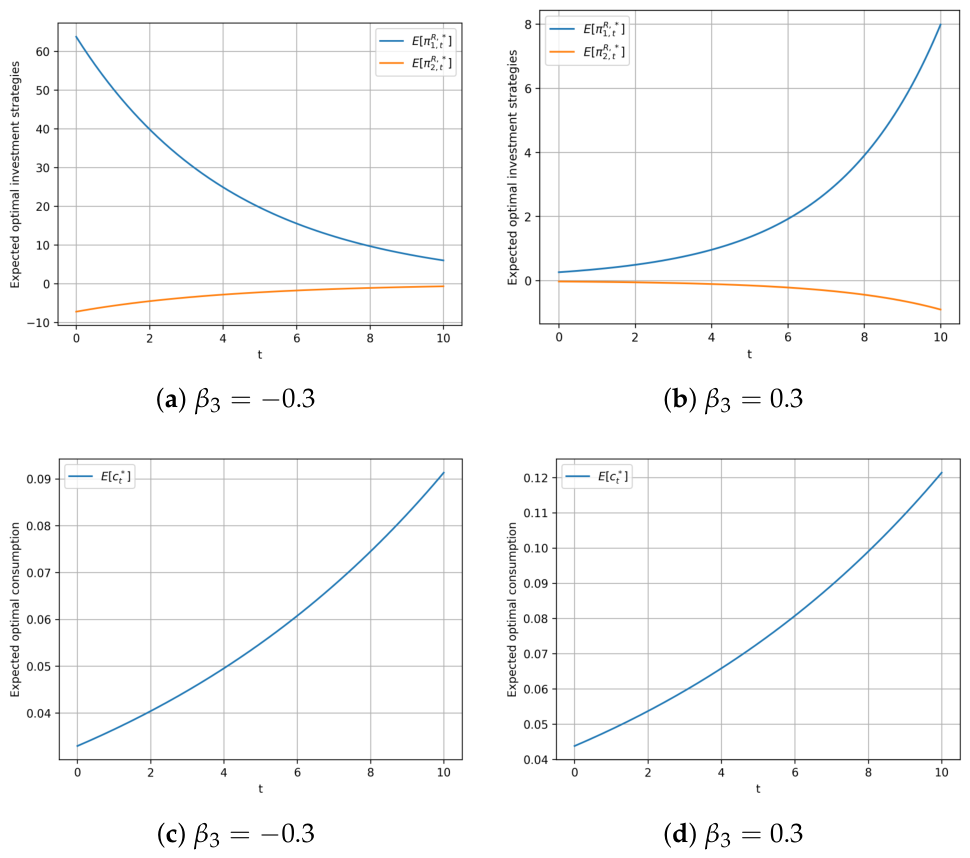
Figure 2.
Effects of the average parameter on optimal investment-consumption strategies.
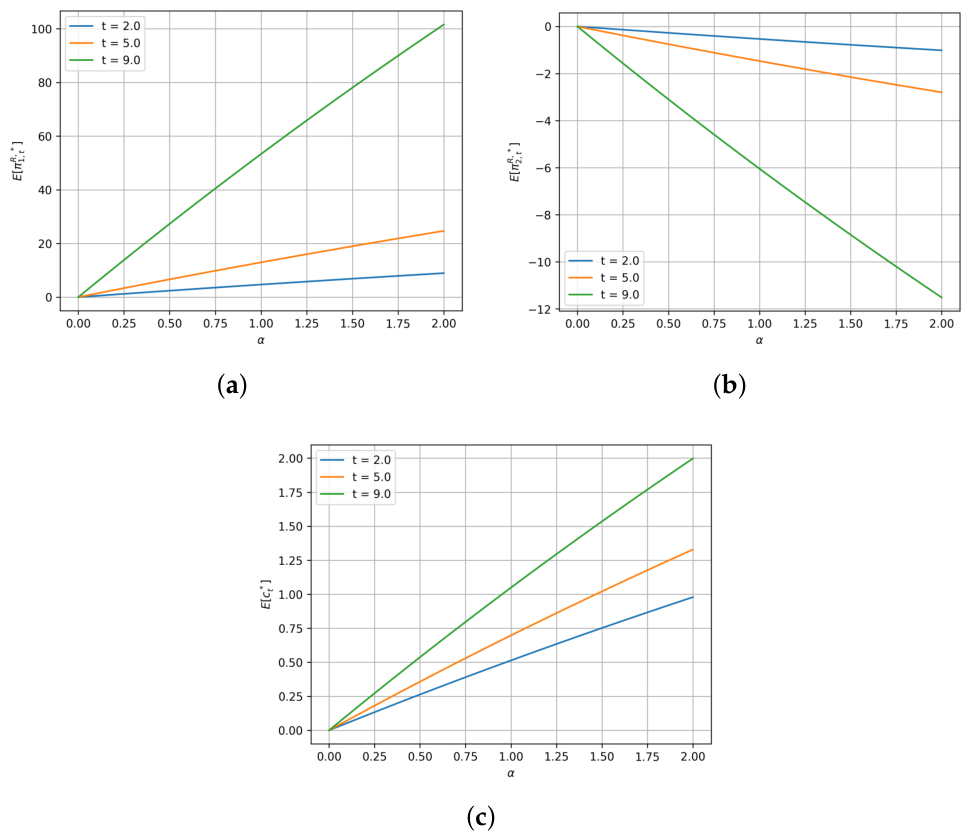
Figure 3.
Effects of the delay time parameter h on optimal investment-consumption strategies.
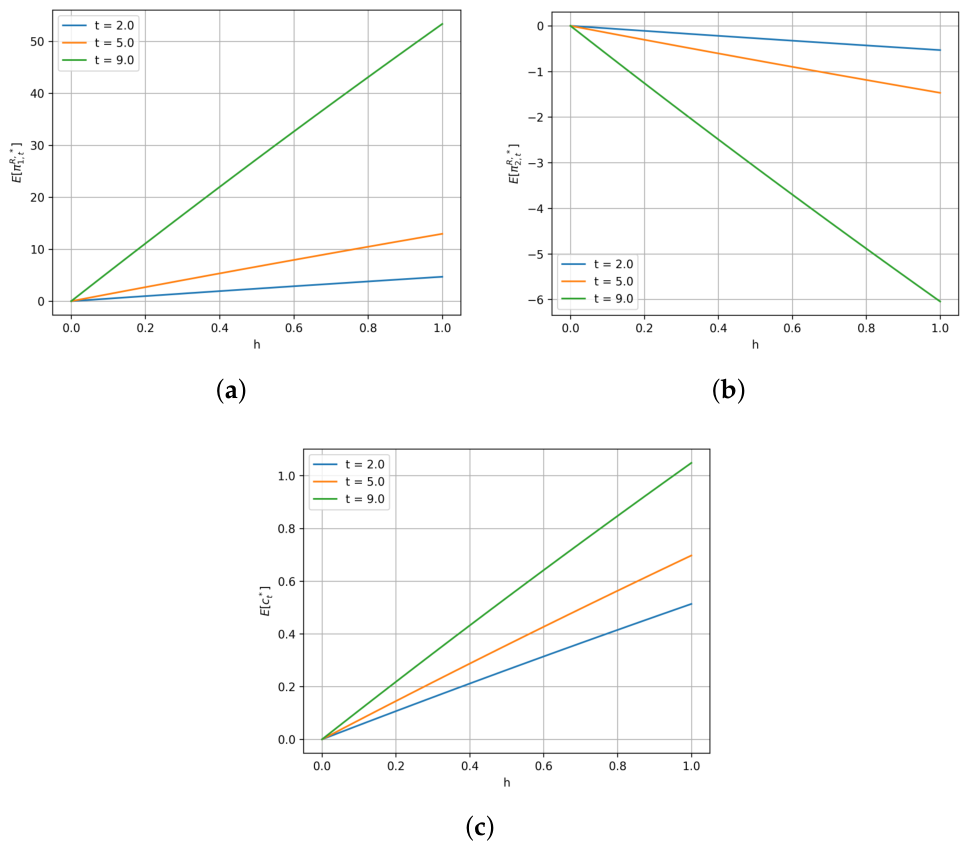
Figure 4.
Effects of the risk aversion coefficient on optimal investment-consumption strategies.
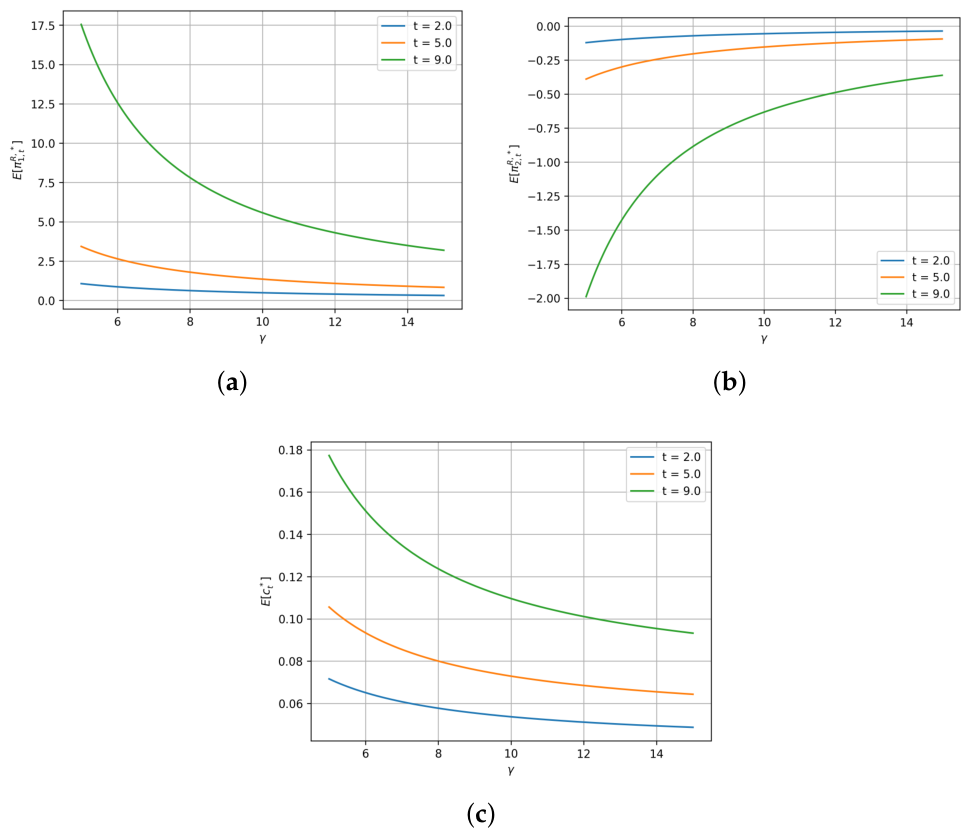
Figure 5.
Effects of the EIS coefficient on optimal investment-consumption strategies.
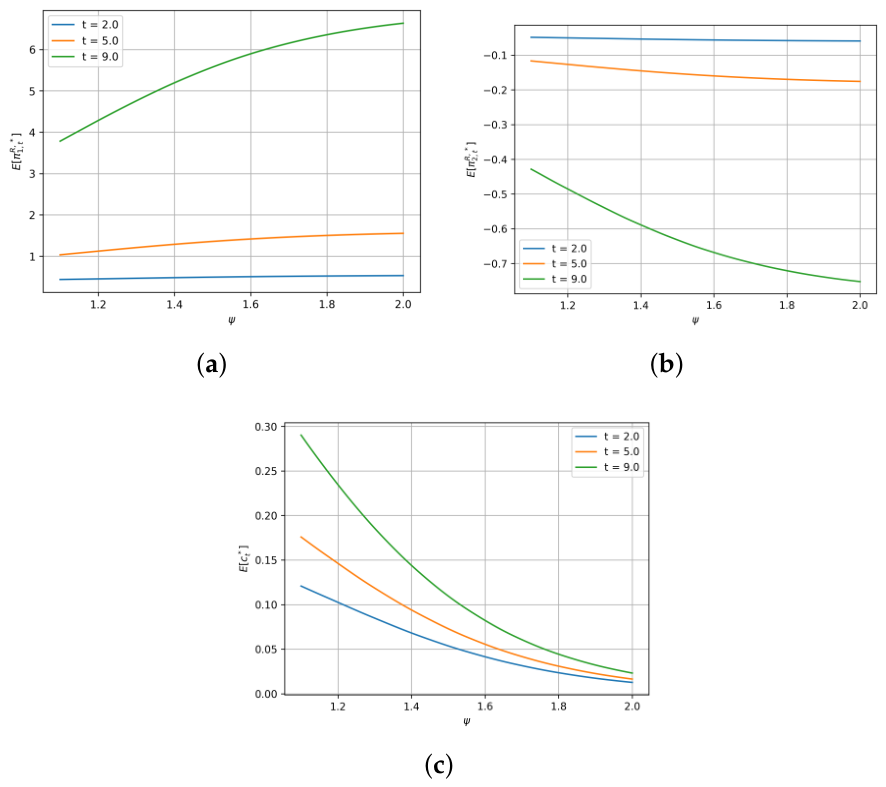

Table 1.
Model parametrisation.
| Parameter | Symbol | Values |
| Interest rate | r | |
| Risk premium of risky asset 1 | ||
| Risk premium of risky asset 2 | ||
| Volatility of risky asset 1 | ||
| Volatility of risky asset 2 | ||
| Correlation coefficient between risky assets | ||
| Terminal time | T | 10 |
| Initial wealth | 100 | |
| Risk aversion coefficient | 10 | |
| Elasticity of Intertemporal Substitution (EIS) | ||
| Time preference rate | ||
| Average parameter | ||
| Information learning horizon | h | |
| Information learning parameter for the pointwise delayed wealth | ||
| Information learning parameter for the integrated delayed wealth | ||
| Weight parameter for the pointwise delayed wealth |
Disclaimer/Publisher’s Note: The statements, opinions and data contained in all publications are solely those of the individual author(s) and contributor(s) and not of MDPI and/or the editor(s). MDPI and/or the editor(s) disclaim responsibility for any injury to people or property resulting from any ideas, methods, instructions or products referred to in the content. |
© 2026 by the authors. Licensee MDPI, Basel, Switzerland. This article is an open access article distributed under the terms and conditions of the Creative Commons Attribution (CC BY) license (http://creativecommons.org/licenses/by/4.0/).
Copyright: This open access article is published under a Creative Commons CC BY 4.0 license, which permit the free download, distribution, and reuse, provided that the author and preprint are cited in any reuse.


