

Submitted:
28 May 2026
Posted:
01 June 2026
You are already at the latest version
Abstract
The annual costs associated with corrosion damage in companies under-score the necessity of implementing efficient measures to prevent corro-sion. This study investigates the deposition of Ni-N thin films using three radio-frequency (r.f.) power sputtering levels: 150, 175, and 200 W. Top-surface color, thickness, roughness, structural, mechanical, and elec-trochemical analyses were evaluated using an optical microscope, pro-filometry, atomic force microscopy, X-ray diffractometer, nanoindentation, and potentiostat. Top-surface color changes in relation to variations in thickness linked to increasing r.f.-power. Increasing r.f.-power promoted smoother surfaces. The greatest thickness was revealed at r.f.-200W, and the highest roughness was exhibited under r.f.-150W. XRD analysis iden-tified three main phases corresponding to Ni3N hexagonal structure (HCP) for r.f.-150W. However, for r.f.-175W and r.f.-200W two phase tran-sitions are identified from dual-phase Ni4N Face-Centered Cubic (FCC), and Ni3N Hexagonal Close-Packed (HCP) crystalline structures. Notably, the highest hardness values were observed at r.f.-150W during nanoindentation experiments at 5, 10, and 20 mN loads. These results highlight the impact of radio-frequency (r.f.) power on the characteristics of Ni-N thin films, providing valuable information for the optimization of corrosion-resistant coatings intended for industrial use. Significant rela-tionships between surface roughness, deposition parameters, and corro-sion resistance are revealed by the electrochemical behavior of Ni-N thin films. Smoother surfaces are produced by higher radio-frequency powers, which generally improve the coating's corrosion-resistance. On the other hand, minor differences in double-layer resistance highlight how crucial coating uniformity and deposition quality are to overall corrosion perfor-mance.
Keywords:
Ni-N thin film
; r.f. power optimization
; mechanical properties
; electrochemical evaluation
1. Introduction
The annual global expense associated with corrosion-related damage is immense, representing a significant percentage of national and international economies. In addition to the direct costs of corrosion, such as material degradation and maintenance, indirect expenditures, including production losses and safety risks, can substantially amplify the financial impact. These challenges underscore the pressing need to implement efficient and durable corrosion prevention measures across industries worldwide [1]. However, the cost of corrosion might also include additional indirect expenditures of up to $551.4 billion due to the end user's potential to double the financial impact [1]. Corrosion is the process by which pure metals undergo transformation chemically into more stable compounds, including oxides (O2), hydroxides (OH‒), or sulfides (S‒2), resulting in the deterioration of metal surfaces [2]. Anions such as sulphates (SO4-2), nitrates (NO3‒), chlorides (Cl‒), and thiosulfates (O3S2‒2) can speed up corrosion of iron alloys in industrial settings, drastically lowering their lifespan [3,4,5,6]. Additionally, it is widely recognized that marine environments contribute to corrosion, affecting structures such as bridges, buildings, and industrial facilities, with corrosion rates ranging from 10 μm/year to 0.10 mm/year [7]. Using inhibitors and protective coatings has been shown to be one of the most successful ways to prevent corrosion [3,8,9,10]. Employing organic corrosion inhibitors may be hazardous to the environment and could have cytotoxic or mutagenic effects on biological systems [3,11]. For metallic materials, surface coatings including micro- and nanostructures can provide efficient corrosion protection. However, poor long-term protection may result from the brittle oxide layer's low adherence to the underlying metal [3,11,12]. Consequently, appropriate surface treatments, such as mechanical pre-treatment or thermochemical procedures, are necessary for effective corrosion resistance in addition to a carefully constructed coating structure [13]. In this regard, it is well known that Transition Metal Nitride (TMN) has low electrical resistivity, strong hydrogen bonding, and exceptional corrosion resistance [14,15,16]. Nickel (Ni) is considered the best TMN candidate for varying applications due to its remarkable characteristics, which include toughness, wear resistance, magnetic behavior, and hardness [17]. Ni has attracted more attention from researchers and has been frequently employed in sputtering-deposited films [18]. Compared to other transition metal compounds, TMN have superior mechanical characteristics and stability due to their unique combination of covalent, ionic, and metallic bonds [19]. Due to their high electrical conductivity, they are especially appreciated in electrochemical applications, albeit they might not be as successful in resisting oxidizing and hydrofluoric acids [20]. Ni-based alloys can withstand high temperatures due to their exceptional mechanical strength and oxidation resistance [21]. Taylor (2001) mentioned that to obtain maximum effective corrosion protection on metallic substrates, the Ni coating thickness should be 120–130 μm [22]; however, it is well known that increasing the coating thickness reduces the interfacial shear strength and interfacial adhesion performance [23]. Ni exhibits two allotropic phases: one stable phase corresponding to a Face-Centered Cubic (FCC) structure, and a metastable Hexagonal Close-Packed (HCP) structure [24]. A third phase may exist; however, it has not been found in reactive magnetron sputtering procedures; instead, it has been observed using chemical synthesis techniques, according to a recent study [25]. Ni-based alloys such as Ni3N exhibit an HCP structure; Ni2N a Body-Centered Cubic (BCC) structure; and Ni4N I and II FCC structures. All these phases can form sequentially from the pure Ni FCC phase during reactive sputtering of nickel in an Ar-N2 gas mixture as nitrogen partial pressure increases [26,27].
It is noteworthy that no published research on the electrochemical performance of Ni-alloy thin films deposited by sputtering has been found. Ni-alloy films such as nitrides, boron, and oxides have revealed good electrochemical performance in an artificial electrolyte solution containing 3.5 wt.% NaCl. For example, Sahu et al. [28] used a platinum sheet as the auxiliary electrode and a silver chloride (Ag/AgCl) electrode as the reference in corrosion studies. Table 1 shows the electrochemical behavior of Ni, nitride, boron, and oxide films. The findings indicate that Ti-N and Ni films display the lowest corrosion rates (Rcorr), at 0.02 and 1.23 mm/year × 10⁻², respectively, and therefore the best corrosion protection. The Ni-B film, on the other hand, demonstrated poor protection with a Rcorr of 21.83 × 10⁻² mm/year. According to Sarp et al. (2022), corrosion resistance is adversely affected by an increase in boron content, as the production of passive oxide films is inhibited and the sample's corrosion resistance diminishes as boron content increases. Thin nitride films are often applied to carbon steel using the reactive sputtering process. However, compared to other metal nitrides, nickel nitride (Ni-N) has not been as thoroughly investigated, and limited information is available about its synthesis and characteristics. Reactive sputtering has been the method of choice to produce Ni-N in selected investigations.
2. Materials and Methods
2.1. Substrate Selection and Preparation
The American Iron and Steel Institute (AISI) 1016 is a low-carbon steel whose elemental composition expressed in wt.% corresponds to 0.16% C, 0.8% Mn, 0.2% Si, 0.02% P, 0.012% S, and balance Fe [34]. AISI 1016 low-carbon steel is an inexpensive material used in manufacturing machine parts not subjected to high mechanical stress, such as shafts, chain links, pins, cemented bushes, standard screws, flanges, and gears for low-stress chain drives [34,35]. Substrate preparation began by cutting samples from a commercial metal sheet to dimensions of 1 × 1 × 0.12 inches. Subsequently, the substrates were ground using Silicon Carbide (SiC) papers of various grit sizes — 100, 400, 600, 1000, and 1500 grains/cm². Afterward, the substrates were polished using an aluminum oxide (Al2O3) aqueous solution. The metallic and silicon substrates were then cleaned with deionized water and subjected to an ultrasonic bath for 20 minutes in an isopropyl alcohol heating system at 40°C. For surface roughness and electrochemical performance evaluations, AISI 1016 substrates were used. For XRD, Scanning Electron Microscopy (SEM), and nanoindentation assessments, Si wafer p-type (111) substrates defined by the Miller index were used.
2.2. Deposition of Ni-N Thin Films
Ni-N thin films were deposited on AISI 1016 carbon steel using a radio-frequency (r.f.) magnetron sputtering system (13.56 MHz, Trinus Vacuum, Spain). The deposition was carried out using a commercial Ni target (purity 99.99%), with a diameter of 2 in and a thickness of 0.125 in. For the formation of Ni-N thin films, nitrogen (N2) gas with a purity of 99.99% was injected into the chamber. To sustain the sputtering plasma, Argon (Ar) gas with a purity of 99.90% was used. The gas flow rates were controlled using mass flow controllers (Cole-Palmer, USA), and flow measurements were expressed in Standard Cubic Centimeters per Minute (SCCM). Prior to deposition, the sputtering chamber was evacuated to a residual pressure (rp) of ~8.2 × 10⁻² mbar using a primary pump, which was subsequently reduced to 2.3 × 10⁻⁵ – 1.9 × 10⁻⁵ mbar using a turbomolecular pump. The working pressure (wp) was monitored between 6.0 × 10⁻³ and 5.2 × 10⁻³ mbar. Various experiments were conducted by adjusting the r.f.-power on the target using levels of 150 W, 175 W, and 200 W, under an Ar/N2 gas mixture ratio of 20/7 SCCM. The target-to-substrate distance was set to 70 mm. The deposition time was set at 10 minutes for the Ni buffer layer, and 110 minutes for the Ni-N monolayer thin films, with no external substrate heating. Table 2 summarizes the deposition conditions for the Ni-N thin films.
2.3. Characterization
Photomicrographs of the Ni-N thin films were captured using a portable USB Digital Microscope (JNYZ59419) with a frame rate of 30 fps, a resolution of 2 megapixels, and a focusing range of 15–40 mm at a maximum magnification of 50×. The surface profile and thickness of the Ni-N thin films were measured over a 500 µm span using a DEKTAK 150 stylus profilometer (Veeco Instruments, Plainview, NY, USA). The thickness was determined by measuring the step height between the deposited film and the uncoated substrate, using a stylus with a 12.5 µm radius.
For topography imaging and surface roughness measurement of the Ni-N thin films, an Atomic Force Microscope (AFM) Workshop model TT-AFM (Capital Drive, South Carolina, USA) was used. A silicon tip (n-type Si) was used, and the images were acquired in contact mode at a scanning frequency of 0.7 Hz. The image dimensions selected for evaluation were 10 × 10 μm, 20 × 20 μm, and 50 × 50 μm. The images were processed using Gwyddion 2.48 (free development version, with 3D OpenGL rendering). These measurements were used to determine the root mean square roughness (RMS) and the average roughness (Ra). The phase structure of the samples was analyzed using X-Ray Diffraction (XRD) with a D8 Advance Bruker diffractometer, utilizing Cu Kα radiation (λ = 1.54059 Å) at 30 kV. The scans were performed at a rate of 0.01°/s across a 2θ range from 20° to 100°.
Nanoindentation tests were carried out using a TTX-NHT nanoindenter (S/N: 10000, Anton Paar, USA). The test conditions included an acquisition rate of 10.0 Hz, with linear loading from 5 to 20 mN maximum load, and a holding period of 10.0 seconds at maximum load. The loading rate was established according to the applied load. A Berkovich diamond indenter (serial B-T 83) was used for all indentations.
To evaluate the corrosion behavior of the Ni-N thin films, a potentiostat-galvanostat (Bio-Logic, Seyssinet-Pariset, France) was employed. Potentiodynamic polarization curves were recorded using a three-electrode electrochemical cell, where the exposed sample area was 1 cm², for both bare substrates and thin film samples. A platinum wire served as the counter-electrode, while an Ag/AgCl electrode was used as the reference. The electrolyte used was a 3.5 wt.% NaCl solution. The corrosion potential (Ecorr) was monitored over 10 minutes, and polarization curves were measured by sweeping the potential from −100 to +350 mV at a scan rate of 0.5 mV/s. Electrochemical Impedance Spectroscopy (EIS) studies were also carried out using the same three-electrode configuration. EIS measurements were performed with an amplitude of 10 mV at the open circuit potential (OCP), spanning a frequency range from 100,000 Hz to 0.1 Hz. The analysis included key parameters such as double-layer capacitance and charge transfer resistance, which were used to evaluate corrosion resistance efficiency and understand corrosion mechanisms. This approach provides a comprehensive assessment of the films' protective behavior in aggressive environments.
3. Results
3.1. Review Top-Color Surface by Optical Microscope
Figure 1(a–c) shows the surface properties of Ni-N thin films deposited on AISI 1016 carbon steel, as observed with a portable optical microscope using a 0.15 mm scale bar and 50× magnification. At r.f.-150W, the film surface shows a mix of blue, black, and light gold hues in small growth zones. However, when r.f.-power increases to 175W, the surface color transitions to a brownish-gold shadow. These color changes are consistent with findings reported by [35] for TiN films deposited by magnetron sputtering. This behavior occurs because varying the N2 flow relative to the selected Ar flow allows stoichiometry control, and stoichiometry-dependent color changes are a typical and widely observed phenomenon in refractory metal nitrides due to composition-dependent shifts in the screened plasma frequency [36]. Marulanda et al. [34] described that the color transition can be attributed to the interaction between N2 gas and the bombarding Ni atoms on the substrate surface. Richards et al. (2022) reported that N2 molecules and N atoms are highly vibrationally excited in the r.f. plasma due to the lower reduced electric field and higher discharge power [36]. When r.f.-power is increased to 200W, the surface color changes to dark blue. Klumdoung et al. [37] deposited ZrN thin films at high Ar flow rates by reactive DC magnetron sputtering and reported that at lower N2 flows (1.5 SCCM) the film color is brown, changing to dark blue when N2 flow is increased to 6.0 SCCM. Other authors attribute surface color changes in post-deposition thin films to variations in film size and thickness; for example, Selçuk [38] found a relationship between deposition time, film thickness, and color, showing that increased deposition time leads to significant color changes. Similarly, [39] attributed color changes in thin films to optical interference effects.
They explained that when a plane wave of light from a medium with a refractive index n₁ strikes a thin film with a refractive index n₂ and thickness d, the reflected light waves interfere with each other, resulting in a new wave pattern. The thickness values expressed in nm (see Table 3) reveal the relationship between film thickness and r.f.-power on the target, consistent with the optical interference theory described above.
3.2. Thickness and Surface Roughness Analyses
3.2.1. Thickness of Ni-N Thin Films on Si Wafer
Table 3 presents the thickness and roughness values of Ni-N thin films deposited on Si wafers with a (111) orientation, measured by stylus profilometry. It is observed that when r.f.-power increases from 150 to 175 W, the film thickness values are similar [40]. In contrast, when applying an r.f.-power of 200 W on the Ni target, the thickness approximately doubles. It is well known that film thickness increases with sputtering r.f.-power, as the sputtering rate increases due to the greater number of atoms deposited onto the substrate [41]. It is also observed that surface roughness decreases when r.f.-power increases to 200 W. Increasing r.f.-power generally reduces the average roughness of thin films, leading to improved surface morphology. However, higher deposition rates associated with increased r.f.-power can also result in greater surface roughness under certain conditions [42,43]. It should be noted that the large standard deviations in thickness reported in Table 3 reflect the spatial variability inherent in step-height profilometry measurements, which include scans positioned within the mask-edge transition zone where local film thickness ramps to zero due to geometric shadowing during deposition. Measurements taken exclusively over the central plateau region of each sample yielded thickness values with coefficients of variation below 15%, confirming that the deposited films are laterally uniform across the central deposition area.
3.2.2. Surface Roughness of Ni-N Thin Films on AISI 1016
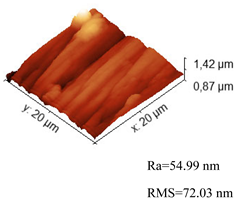
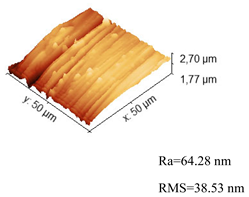
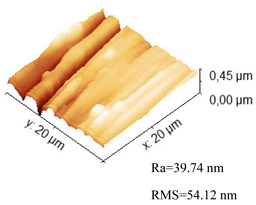
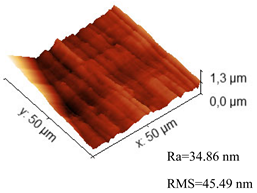
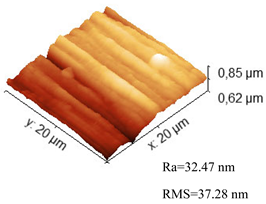
Table 4 presents the surface roughness analysis of Ni-N thin films deposited on AISI 1016 steel, obtained at different r.f.-powers using AFM at scan scales of 10, 20, and 50 μm. The average roughness parameters, including Root Mean Square (RMS) and average roughness (Ra) values, were observed to decrease with increasing r.f.-power at the lower scales (10 and 20 μm). Specifically, at the 10 μm scale, the Ra values were 834.3, 1044, and 96.6 nm for r.f.-powers of 150, 175, and 200 W, respectively. At the 20 μm scale, Ra values were 54.99, 39.74, and 32.47 nm, and at the 50 μm scale, values of 64.28, 34.86, and 20.62 nm were obtained for 150, 175, and 200 W, respectively. RMS values exhibited a similar trend across all scales. These results indicate that films deposited at higher r.f.-powers have smoother surfaces and improved surface quality [44]. This behavior is attributed to the higher kinetic energy of sputtering particles at increased r.f.-power, which promotes more uniform grain orientation and reduces grain size variability, ultimately leading to smoother film surfaces. This inverse relationship between surface roughness and r.f.-power has been reported by several authors [45]. Similarly, both r.f.power and film thickness have been shown to influence surface roughness [46].
3.2. Ray Diffraction Analysis of Ni-N Thin Films
Figure 2 presents the XRD diffractograms of Ni-N thin films deposited on Si wafers at r.f.-powers of 150, 175, and 200 W, collected over a 2θ range of 20°–100°.
For the film deposited at r.f.-150W, the diffractogram reveals two diffraction peaks corresponding to the Ni3N hexagonal close-packed (HCP) structure, at 2θ ≈ 43° and 83°, indexed as the (111) and (220) planes, respectively. The Si substrate peak is also identified. This result confirms a monocrystalline-like Ni3N HCP phase with preferential orientation at r.f.-150W.
At r.f.-175W, the pattern shows a significantly more intense Si substrate peak, along with the emergence of additional phases. The diffractogram reveals the coexistence of Ni3N (HCP) and Ni4N face-centered cubic (FCC) phases, indicating a dual-phase microstructure promoted by the increase in r.f.-power.
At r.f.-200W, the diffractogram exhibits the richest phase composition. The identified phases include: Ni3N (HCP) peaks indexed as (002) and (110); Ni4N (FCC) peaks indexed as (111) and (200) and (220); NiO peaks indexed as (100) and (111); and NiSi peaks. The increased ion bombardment energy at 200W promotes partial transformation of the Ni3N HCP phase toward the more thermodynamically stable Ni4N FCC phase, consistent with published reactive sputtering phase diagrams for the Ni-N system [26,27].
The structural evolution observed — from a predominantly Ni3N HCP phase at 150W toward a multi-phase system including Ni4N FCC and NiO at higher r.f.-powers — directly supports the mechanical and electrochemical behavior reported in Section 3.3 and Section 3.4. Specifically, the presence of the HCP phase at 150W is linked to the pop-in events observed during nanoindentation, as the restricted slip systems of HCP structures promote dislocation burst nucleation under localized loading [57,58].
3.3. Nanohardness of Ni-N Thin Films
Table 5 shows the performance of Ni-N thin films evaluated by nanoindentation at varying force loads of 5, 10, and 20 mN. It is observed that hardness values are relatively consistent across loading forces. On average, the hardness of the r.f.-150W film was 11.80 ± 3.34 GPa. When r.f.-power was increased to 175W, the hardness exhibited a slight increase to 14.18 ± 1.20 GPa. The hardness then decreased to 12.19 ± 0.58 GPa when r.f.-power was further increased to 200W. The reduced modulus of elasticity (Er) shows that the film deposited at r.f.-150W (143.26 ± 26.48 GPa) exhibits the lowest rigidity among the three conditions, followed by r.f.-200W and r.f.-175W, which display progressively higher moduli. It should be noted that the differences among the three Er values are not statistically significant given the associated standard deviations, and a clear monotonic trend as a function of r.f.-power cannot be conclusively established. The literature mentions that when increasing r.f.-power, the content of amorphous phase rises and crystal grains are refined, promoting a tendency for nanohardness and elastic modulus of coatings to first increase and then decrease [55]. In the present case, the calculated elastic modulus values are similar across conditions and do not follow this trend clearly, so a direct correspondence with the literature cannot be confirmed. The contact depth values show a generally positive tendency, except for r.f.-150W under a loading force of 10 mN. This anomaly is likely related to surface film defects promoted by the sputtering process, such as pinholes arising from stress in the Ni-N film. Depending on the working gas pressure, this stress can be either compressive or tensile [56].
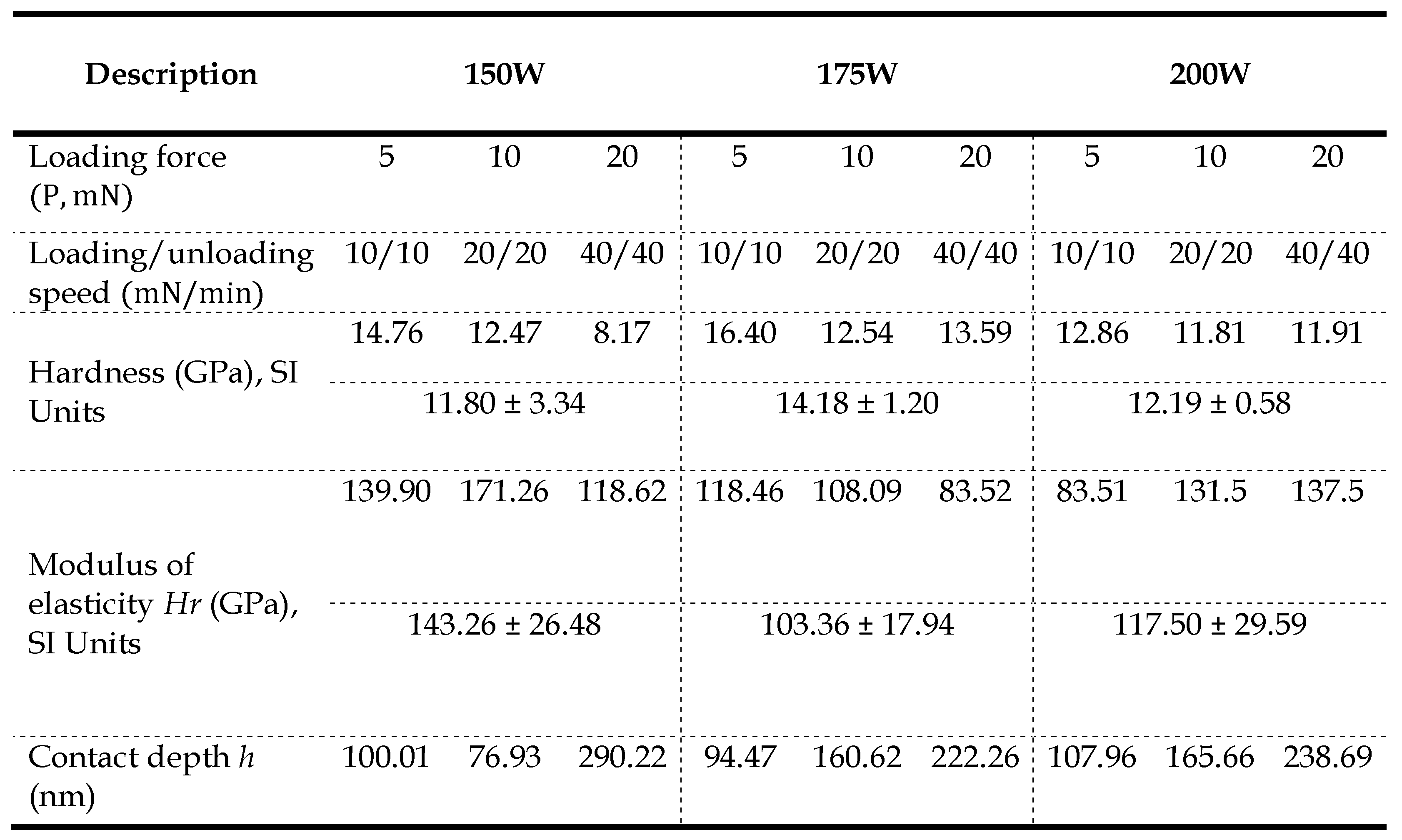
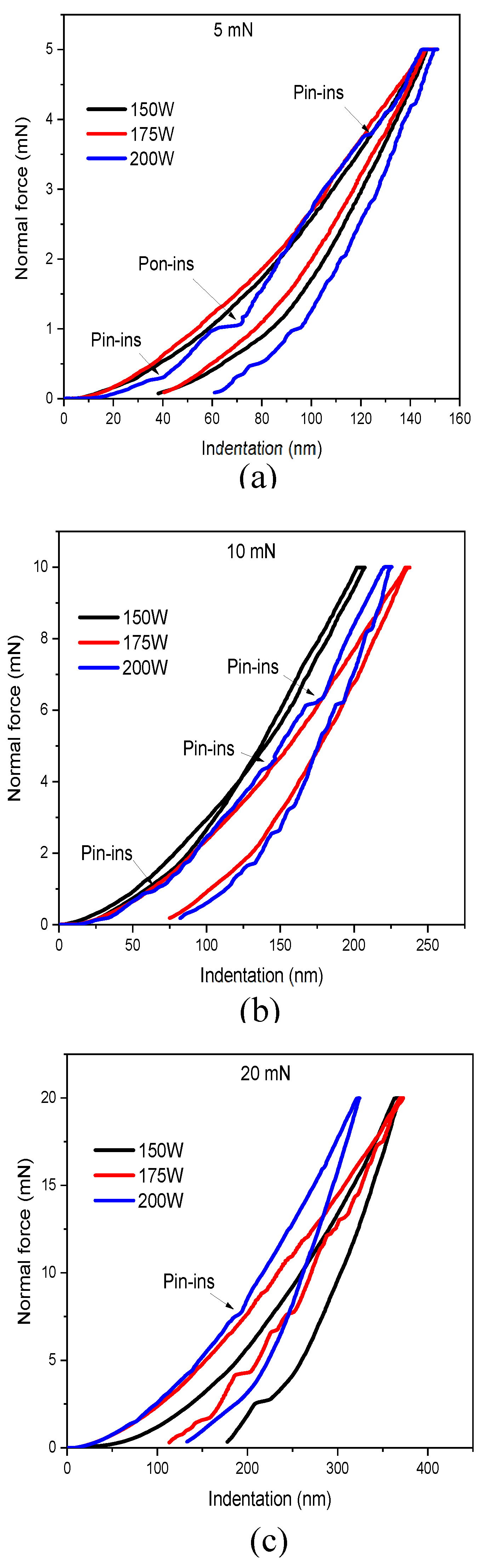
Figure 3.
(a–c) presents the typical load-displacement curves for Ni-N thin films under varying indentation loads of 5, 10, and 20 mN, obtained at loading/unloading rates of 10/10, 20/20, and 40/40 mN/min, respectively. At a load of 20 mN, irregularities in plastic deformation are observed along the load-displacement curve, characterized by multiple discontinuities at specific penetration depths (indicated by red arrows), commonly referred to as "pop-ins" [57]. Pop-ins are defined as sudden, abrupt increases in indenter displacement at nearly constant load, and are well-recognized indicators of discrete plastic deformation events in crystalline materials.
Figure 3.
(a–c) presents the typical load-displacement curves for Ni-N thin films under varying indentation loads of 5, 10, and 20 mN, obtained at loading/unloading rates of 10/10, 20/20, and 40/40 mN/min, respectively. At a load of 20 mN, irregularities in plastic deformation are observed along the load-displacement curve, characterized by multiple discontinuities at specific penetration depths (indicated by red arrows), commonly referred to as "pop-ins" [57]. Pop-ins are defined as sudden, abrupt increases in indenter displacement at nearly constant load, and are well-recognized indicators of discrete plastic deformation events in crystalline materials.
Figure 3.
Typical nanoindentation load versus penetration depth curves for Ni-N thin films on silicon wafer (111) at room temperature: (a) 5 mN (loading/unloading rate: 10/10 mN/min), (b) 10 mN (loading/unloading rate: 20/20 mN/min), and (c) 20 mN (loading/unloading rate: 40/40 mN/min). A holding period of 10 s was applied at maximum load in all cases..The relationship between applied load (P) and indentation depth (h) for Ni-N films under a maximum load of 20 mN reveals typical elastic-plastic behavior. The load-depth (P-h) curves exhibit perturbations and irregularities, including discontinuities associated with pop-in events. These irregularities suggest the presence of dislocation burst nucleation, deformation twinning, and cracking. Previous studies [59,60] have attributed these irregularities in load-displacement curves to oscillations indicative of undulatory elastic-plastic deformation of the material under localized shear stress.
Figure 3.
Typical nanoindentation load versus penetration depth curves for Ni-N thin films on silicon wafer (111) at room temperature: (a) 5 mN (loading/unloading rate: 10/10 mN/min), (b) 10 mN (loading/unloading rate: 20/20 mN/min), and (c) 20 mN (loading/unloading rate: 40/40 mN/min). A holding period of 10 s was applied at maximum load in all cases..The relationship between applied load (P) and indentation depth (h) for Ni-N films under a maximum load of 20 mN reveals typical elastic-plastic behavior. The load-depth (P-h) curves exhibit perturbations and irregularities, including discontinuities associated with pop-in events. These irregularities suggest the presence of dislocation burst nucleation, deformation twinning, and cracking. Previous studies [59,60] have attributed these irregularities in load-displacement curves to oscillations indicative of undulatory elastic-plastic deformation of the material under localized shear stress.
In the present films, the occurrence of pop-ins is attributed to the hexagonal crystal structure (HCP) of the Ni3N phase identified by XRD at r.f.-150W. In HCP materials, dislocation glide is confined to specific slip systems along the basal and pyramidal planes, which leads to intermittent dislocation bursts when the resolved shear stress on those planes is overcome, resulting in the observed step-like displacement increments [58]. Furthermore, as the applied load increases from 10 to 20 mN, multiple pop-ins are observed, which have been associated in the literature with deformation twinning in addition to dislocation nucleation [57]. The absence of pronounced pop-ins at 5 mN (Figure 3a) is consistent with purely elastic or incipient elastic-plastic deformation at lower penetration depths. These observations are consistent with prior reports on HCP nitride thin films deposited by r.f. magnetron sputtering and support the microstructural interpretation provided by the XRD analysis detailed in Section 3.2 [58,59,60].
3.4. Electrochemical Behavior
Figure 4(a–b) illustrates the electrochemical behavior of Ni-N thin films deposited at r.f.-powers of 150, 175, and 200 W by r.f. magnetron sputtering, evaluated using Open Circuit Potential (OCP) measurements and Tafel polarization curves. In Fig. 4a, the OCP results highlight equilibrium conditions and variations in passive potential influenced by homogeneous reactions. The observed stabilization of Ecorr values for all samples in NaCl solution is consistent with findings reported in [60], which attribute this behavior to a stabilizing layer that regulates the corrosion rate, driven primarily by the diffusion of chemical species. Increasing r.f.-power appears to induce higher polarization levels, potentially linked to chloride ion interaction at the film surface [62]. These results emphasize how the stabilization of corrosion potential in Ni-N thin films reflects their ability to form a more protective layer over time.
The Tafel analysis (b) and the corrosion parameters extracted from the polarization curves (Table 6) provide a quantitative assessment of the corrosion behavior of each sample. The corrosion current density (Icorr) values offer a direct measure of the instantaneous corrosion rate at the corrosion potential. The films deposited at 150W and 175W exhibit Icorr values of 2.51 × 10⁻⁵ and 2.23 × 10⁻⁵ A·cm⁻², respectively, which are higher than that of bare AISI 1016 steel (1.58 × 10⁻⁵ A·cm⁻²). Consequently, the corresponding corrosion rates (Vcorr) of 0.2920 and 0.2595 mm/year for 150W and 175W, respectively, exceed that of bare steel (0.1838 mm/year). This indicates that films deposited at these conditions do not provide net kinetic corrosion protection compared to bare steel. The elevated Icorr at 150W and 175W is attributed to their higher surface roughness, which increases the electrochemically active surface area and promotes more active corrosion sites, offsetting the barrier effect of the coating. Nevertheless, these films exhibit a more noble Ecorr than bare steel (−605 mV and −668 mV vs. −780 mV for bare steel), indicating a reduction in the thermodynamic driving force for corrosion initiation.
In contrast, the film deposited at r.f.-200W achieves an Icorr of 7.94 × 10⁻⁶ A·cm⁻², approximately 50% lower than bare steel and nearly three times lower than the 150W and 175W samples, with a corresponding Vcorr of 0.0924 mm/year. This significant reduction is attributed to the denser film microstructure and smoother surface morphology at 200W (Ra = 20.62 nm at 50 μm scale), which reduce the density of active corrosion sites and limit chloride ion penetration to the substrate. These findings align with prior studies suggesting that higher nickel content and smoother surfaces in Ni-N films enhance corrosion resistance in saline environments [63].
Overall, the results demonstrate that r.f.-power is a critical parameter governing the corrosion performance of Ni-N thin films. While all coated samples exhibit a more noble Ecorr than bare steel, only the film deposited at r.f.-200W provides superior kinetic corrosion protection, representing the optimal deposition condition for corrosion-resistant applications on carbon steel substrates. These findings highlight the importance of optimizing deposition parameters to achieve durable, corrosion-resistant coatings for industrial applications [54].
Table 6 presents the corrosion parameters extracted from the Tafel polarization curves for bare AISI 1016 steel and Ni-N thin film-coated samples. Bare steel exhibits a significantly more negative corrosion potential (Ecorr = −780 mV) compared to the Ni-N coated samples, which range from −605 mV to −645 mV. This indicates that all Ni-N coatings shift the corrosion potential in the noble direction, reducing the thermodynamic driving force for corrosion initiation. However, as discussed in Section 3.4, a more noble Ecorr does not necessarily correlate with lower corrosion current density (Icorr) or corrosion rate (Vcorr). The films deposited at 150W and 175W exhibit higher Icorr values than bare steel, attributed to their greater surface roughness increasing the active electrochemical area. Only the film deposited at r.f.-200W achieves both a noble Ecorr and a reduced Icorr, confirming it as the condition offering the most effective corrosion protection.
Figure 5(a–b) illustrates the EIS behavior of the Ni-N thin film system. The Nyquist diagram (Fig. 5a) and the corresponding equivalent circuit (Fig. 5b) reveal two distinct time constants, indicating the presence of two separate electrochemical processes at the electrode-electrolyte interface. The first time constant, observed at higher frequencies, is associated with the response of the Ni-N thin film, related to charge transfer resistance and double-layer capacitance at the film surface [64]. The second time constant, observed at lower frequencies, is linked to the diffusion of electroactive species through the film. This diffusional behavior is influenced by film porosity, microstructure, and interaction with the electrolyte [65].
It should be noted that the Nyquist plot for the bare AISI 1016 steel reference sample exhibits a low-frequency inductive loop, a well-documented feature of actively corroding carbon steel in chloride media attributed to the relaxation of adsorbed corrosion intermediates (FeCl⁺ads, Fe(OH)ads) at the steel surface [64,65]. To model this behavior rigorously, an inductance-resistance branch (L-RL) should be incorporated in the low-frequency arm of the equivalent circuit. In the present work, the simplified circuit in Fig. 5b was applied uniformly to all samples for consistent comparative analysis of the film-related impedance parameters. Accordingly, the charge transfer resistance (Rct) and solution resistance (Rs) values extracted for bare steel represent an approximation and should not be directly compared with those of the coated samples on a quantitative basis. Notably, the inductive feature is absent in all three Ni-N coated samples, confirming that the deposited films suppress the active dissolution mechanism responsible for this behavior.
Fitting the equivalent circuit (Fig. 5b) yields quantitative electrochemical parameters such as Rct and Rs, which assess the performance of the Ni-N thin films in preventing corrosion [66]. Additionally, the presence of a diffusive element highlights the film's barrier capability, which helps delay the corrosion process and is crucial for applications in aggressive environments [67].
Overall, lower surface roughness (achieved at higher r.f.-powers) generally correlates with higher double-layer resistance values (Rdl), as shown in Table 7. This increased double-layer resistance suggests enhanced corrosion protection, as smoother surfaces provide fewer sites for corrosion initiation. However, it is noteworthy that the Rdl value for r.f.-200W is lower than for r.f.-150W, despite its lower roughness. This may indicate that other factors, such as film homogeneity or deposition quality, also influence the impedance response. As roughness decreases, Rdl also tends to decrease, suggesting that smoother surfaces are associated with a less ideal double layer. This could be attributed to the presence of fewer but more impactful defects on smoother surfaces, which may exert a greater influence on double-layer uniformity [70]. It should be noted that the Rdl values extracted for bare steel from the equivalent circuit fitting are approximate, as discussed in Section 3.4, due to the presence of the inductive loop in the bare steel Nyquist response.
4. Conclusions
Ni-N thin films were successfully deposited on AISI 1016 carbon steel and silicon (111) wafers by reactive r.f. magnetron sputtering at three power levels (150, 175, and 200 W). Increasing r.f.-power produced systematic changes in surface color — from blue-black-gold at 150W to brownish-gold at 175W and dark blue at 200W — consistent with variations in film thickness ranging from ~25.0 to 50.7 nm. XRD analysis revealed that films deposited at 150W exhibit a monocrystalline Ni3N hexagonal close-packed (HCP) structure with preferential orientation at 2θ ≈ 42.5°, corresponding to the (111) plane. Films deposited at 175W and 200W display a dual-phase microstructure comprising Ni3N (HCP), Ni4N face-centered cubic (FCC), and residual NiO phases, with additional NiSi peaks identified at 200W. AFM analysis showed that surface roughness decreases with increasing r.f.-power, with Ra values at the 50 μm scale decreasing from 64.28 nm (150W) to 20.62 nm (200W). Nanoindentation results indicated that the film deposited at r.f.-150W exhibited the highest average hardness of 11.80 ± 3.34 GPa under normal loads of 5, 10, and 20 mN, while load-displacement curves at 20 mN exhibited pop-in events attributed to dislocation burst nucleation and deformation twinning in the HCP Ni3N lattice.
Electrochemical characterization in 3.5 wt.% NaCl solution demonstrated that the film deposited at r.f.-200W provides superior corrosion resistance, evidenced by the lowest corrosion current density (Icorr = 7.94 × 10⁻⁶ A·cm⁻²) and corrosion rate (Vcorr = 0.0924 mm/year), approximately 50% lower than bare AISI 1016 steel. Films deposited at 150W and 175W exhibited higher Icorr values than bare steel, attributed to their greater surface roughness increasing the electrochemically active area. EIS analysis confirmed two time constants associated with charge-transfer resistance at the film surface and diffusional transport through the film, with the inductive loop observed exclusively in the bare steel response. Overall, r.f.-power is a critical parameter governing the phase composition, surface morphology, mechanical properties, and corrosion resistance of Ni-N thin films deposited by reactive magnetron sputtering, and r.f.-200W represents the optimal condition for corrosion-protective applications on carbon steel substrates.
Author Contributions
González-Hernández: Conceptualization, Methodology, Formal Analysis, Investigation. Barragán-Ramírez: Data Curation, Writing – Original Draft, Writing – Review & Editing, Visualization. Rodríguez: Writing – Review & Editing. Onofre-Bustamante: Validation, Resources, Supervision. Flores-Martínez: Project Administration, Writing – Review & Editing. W. Aperador: Formal Analysis, Writing – Original Draft, Writing – Review & Editing.
Data Availability Statement
No data was used for the research described in the article.
Acknowledgments
González-Hernández acknowledges the support from the Universidad Autónoma de Tamaulipas. W. Aperador acknowledges the support from the Universidad Militar Nueva Granada.
Conflicts of Interest
The authors declare that they have no known competing financial interests or personal relationships that could have appeared to influence the work reported in this paper.
References
- Gerhardus, H.; Koch, Michiel P.H.; Brongers, N. G.; Thompson, Y.; Virmani, P.; Payer, J. H. Chapter 1 - Cost of corrosion in the United States. In Handbook of Environmental Degradation of Materials; Kutz, Myer, Ed.; William Andrew Publishing, 2005; pp. 3–24. ISBN 9780815515005. [Google Scholar] [CrossRef]
- Harsimran, S.; Santogli, K.; Rakash, K. Overview of corrosion and its control: A Critical Review. Proc. Eng. Sci. 2021, 3, 13–24. [Google Scholar] [CrossRef]
- Majeed, M. N.; Yousif, Qahtan. A.; Bedair, M.A. Study of the Corrosion of Nickel–Chromium Alloy in an Acidic Solution Protected by Nickel Nanoparticles. ACS Omega 2022, 7(34), 29850–29857. [Google Scholar] [CrossRef]
- Fadel, Z.; Yousif, Q. A. (2S,3R)-2-((1-(4-Amionophenyl)Ethylidene)Amino)-3-HydroxybutanoicAcid as a Novel and Eco-FriendlyCorrosionInhibitorfor the CarbonSteel (X56) Used inIraq’s Oil Installations. J. Phys. Conf. Ser. 2020, 1664, No. 012093. [Google Scholar] [CrossRef]
- Tiwari, A.; Goyal, S.; Luxami, V.; Chakraborty, M. K.; Gundlapalli, P. Evaluation of Inhibition Efficiency of Generic Compounds with Additional Heteroatomin Simulated Concrete Pore Solution and Migration Potentialin Concrete. J. Build.Eng. 2021, 43, No. 102490. [Google Scholar] [CrossRef]
- Hassan, A.; Heakal, B.; Younis, A.; Bedair, M.; El - Billy, Z.; Mohamed, M. Synthesis of Some Triazole Schiff Base Derivatives and Their Metal Complexes under Microwave Irradiation and Evaluation of Their Corrosion Inhibition and Biological Activity. Egypt.J. Chem. 2019, 62, 1603−1624. [Google Scholar] [CrossRef]
- Nugent, M.A.; Khan, Z.A. The effects of corrosion rate and manufacturing in the prevention of stress corrosion cracking on structural members of steel bridges. JCSE 2014, 7, 16. [Google Scholar]
- Gangan, A.; ElSabbagh, M.; Bedair, M.; El-Sabbah, M.; Fahmy, A. Plasma Power Impact on Electrochemical Performance of Low Carbon Steel Coated by Plasma Thin TEOS films. Al-AzharBull. Sci. 2020, 31, 51−58. [Google Scholar] [CrossRef]
- Elaryian, H. M.; Bedair, M. A.; Bedair, A. H.; Aboushahba, R.M.; Fouda, A. E.-A. S. Synthesis, Characterization of Novel Coumarin Dyes as Corrosion Inhibitors for Mild Steel in Acidic Environment:Experimental,Theoretical, and Biological Studies. J. Mol. Liq. 2022, 346, No. 118310. [Google Scholar] [CrossRef]
- Abbas, M. A.; Arafa, E. I.; Gad, E. S.; Bedair, M. A.; El-Azabawy, O. E.; Al-Shafey, H. I. Performance Assessment by Experimental and Theoretical Approaches of Newly Synthetized Benzyl Amide Derivatives as Corrosion Inhibitors for Carbon Steel in1.0 M Hydrochloric Acid Environment. Norg. Chem.Commun. 2022, 143, No. 1097. [Google Scholar] [CrossRef]
- Fahmy, A.; Sabbagh, M. El.; Bedair, M.; Gangan, A.; El-Sabbah, M.; El-Bahy, S. M.; Friedrich, J. F. One-Step Plasma Deposited Thin SiO x C y Films for Corrosion Resistance of Low Carbon Steel. J.Adhes.Sci. Technol. 2020, 35, 1734−1751. [Google Scholar] [CrossRef]
- Gangan, A.; ElSabbagh, M.; Bedair, M. A.; Ahmed, H. M.; El-Sabbah, M.; El-Bahy, S. M.; Fahmy, A. Influence of PH Values on the Electrochemical Performance of Low Carbon Steel Coated by Plasma Thin SiOxCy Films. Arab. J. Chem. 2021, 14, No. 1033. [Google Scholar] [CrossRef]
- Fenker, M.; Balzer, M.; Kappl, H. Corrosion protection with hard coatings on steel: Past approaches and current research efforts. Surf. Coat. Technol. 2014, 257, 182–205. [Google Scholar] [CrossRef]
- Fan, H.; Huang, J.; Chen, G.; Chen, W.; Zhang, R.; Chu, S.; Wang, X.; Li, C.; Ostrikov, K. K. Hollow Ni-V-Mo Chalcogenide Nanopetals as Bifunctional Electrocatalyst for Overall Water Splitting, ACS. Sustain. Chem. Eng. 2019, 7, 1622–1632. [Google Scholar] [CrossRef]
- Chu, S.; Chen, W.; Chen, G.; Huang, J.; Zhang, R.; Song, C.; Wang, X.; Li, C.; Ostrikov, K. K. Holey Ni-Cu Phosphide Nanosheets as a Highly Efficient and Stable Electrocatalyst for Hydrogen Evolution. Appl. Catal. B. Environ. 2019, 243, 537–545. [Google Scholar] [CrossRef]
- Li, G.; Wu, X.; Guo, H.; Guo, Y.; Chen, H.; Wu, Y.; Zheng, J.; Li, X. Plasma transforming Ni(OH)2 Nanosheets into porous nickel nitride sheets of alkaline hydrogen evolution. ACS Appl. Mater. Interfaces 2020, 12(5), 5951–5957. [Google Scholar] [CrossRef]
- DongEung, K.; Shun-Li, S.; Zi-Kui, L. Effects of alloying elements on elastic properties of Ni by first-principles calculations. Comput. Mater. Sci. 2009, 47, 254–260. [Google Scholar] [CrossRef]
- Bhatti, J.; Chandio, A. D.; Quazi, M.M.; Bashir, M.N.; Rizwan, M.; Iftikhar, A. C.; Jamali, A. R.; Katper, F. H.; Ali, I. Mechanical and Morphological Characteristics of Nickel, Chromium and Nitride-Based Coatings Formed via Electrodeposition and Magnetron Sputtering Techniques on Mild Steel. An Overview. Chem. Eng. 2023, 10(3), 1466–8858. [Google Scholar] [CrossRef]
- Yin, M.; Liang, W.; Miao, Q.; Yu, H.; Jin, H.; Blackwood, D. J. Dependence of the M choice on the properties of Hf(M)SiCN (M = Nb, Ta, Ti, Zr) ceramic coatings: ab-initio and experimental study. Tribol. Int. 2024, 196, 109675. [Google Scholar] [CrossRef]
- Peri, R.; Bhagavathiachari, M.; Balasubramanian, S.A. Detailed study on the electrochemical properties of transition metal-based carbide/nitride thin films in energy conversion and storage devices. Electrochimica Acta 2022, 427, 140860. [Google Scholar] [CrossRef]
- Li, D.; Chen, J.; Etim, I. P.; Liu, Y.; Wu, C.; Wang, J.; Su, X. High temperature oxidation behavior of Ni-based superalloy Nimonic95 and the effect of pre oxidation treatment. Vacuum 2021, 194, 110582. [Google Scholar] [CrossRef]
- Taylor, S.R. Coatings for Corrosion Protection: Metallic. In Encyclopedia of Materials: Science and Technology; Buschow, K.H. Jürgen, Cahn, Robert W., Flemings, Merton C., Ilschner, Bernhard, Kramer, Edward J., Mahajan, Subhash, Veyssière, Patrick, Eds.; Elsevier, 2001; pp. 1–5. ISBN 9780080431529. [Google Scholar] [CrossRef]
- Teng, Z.; Huan, C.; Ya-nan, Y.; Xiu-yang, F.; Rui-qian, Z.; Xiong, G.; Zhen-bing, C. Effect of coating thickness on interfacial adhesion and mechanical properties of Cr-coated zircaloy. Trans. Nonferrous Met. Soc. China 2023, 33(9), 2672–2686. [Google Scholar] [CrossRef]
- Keraudy, J.; Athouël, L.; Hamon; Girault, J. B.; Gloaguen, D.; Richard-Plouet; Jouan, M. P.-Y. Electrochemical Characteristics of NixN thin films deposited by DC and HiPIMS reactive magnetron sputtering. Thin Solid Films 2019, 669, 659–664. [Google Scholar] [CrossRef]
- Gong, X.; Li, Z.; Pattamatta, A.S.L.S.; Wen, T.; Srolovitz, D.J. An accurate and transferable machine learning interatomic potential for nickel. Commun. Mater. 2024, 5, 157. [Google Scholar] [CrossRef]
- Nishihara, H. A.F.N.; Suzuki, K.; Umetsu, R.Y.; Kanomata, T.; Kaneko, T.; Zhou, M.Y.; Tsujikawa, M.; Shirai, M.; Sakon, T.; Wada, T.; Terashima, K.; Imada, S. Magnetic properties of Ni2N. Phys. B 2014, 449, 85–89. [Google Scholar] [CrossRef]
- Dorman, G.J.W.R.; Sikkens, M. Structure of reactively sputtered nickel nitride films. Thin Solid Films 1983, 105(3), 251–258. [Google Scholar] [CrossRef]
- Sahu, B. P.; Ray, M.; Mitra, R. Structure, and properties of Ni1-xTixN thin films processed by reactive magnetron co-sputtering. Mater. Charact. 2020, 169, 110604. [Google Scholar] [CrossRef]
- Wardan, R.; Shamsudin, S. R.; Sampasivam, T.; Wahid, M. F. M.; Yati, M. S. D. Effects of different pH of 3.5% NaCl solution on steel under zero charge corrosion protection technique. J. Phys. Conf. Ser. 2021, 2080, 012021. [Google Scholar] [CrossRef]
- Subramanian, B.; Ashok, K.; Sanjeeviraja, C.; Kuppusami $, P.; Jayachandran, M. Reactive DC Magnetron Sputtered Zirconium Nitride (ZrN) Thin Film and its Characterization. J. Phys. Conf. Ser. 2008, 114, 012039. [Google Scholar] [CrossRef]
- Shakoor, R. A.; Waware, U. S.; Kahraman, R.; Popelka, A.; Yusuf, Moinuddin M. Corrosion Behavior of Electrodeposited Ni-B Coatings Modified with SiO2 Particles. Int. J. Electrochem. Sci. 2017, 12, 4384–4391. [Google Scholar] [CrossRef]
- Kumaradhas, P.; Sivapragash, M. Comparison of corrosion behaviour of heat treated, ZrO2 and ZrN PVD coated AZ91D Mg alloy. Mater. Today Proc. 2022, 56(Part 1), 527–532. [Google Scholar] [CrossRef]
- Pathak, D.; Singh, R. P.; Gaur, S.; Balu, V. Influence of groove angle on hardness and reinforcement height of shielded metal arc welded joints for low carbon AISI 1016 steel plates. Mater. Today Proc. 2021, 38(Part 1), 40–43. [Google Scholar] [CrossRef]
- Marulanda, D.M.; Cuellar, J.; Rojas, C.; Acosta, L.M. Microstructure and mechanical properties of cold drawn AISI 1016 steel processed by ECAP. Univ. Sci. 2014, 19(2), 139–146. [Google Scholar] [CrossRef]
- Nieborek, M.; Jastrzębski, C.; Płociński, T.; et al. Optimization of the plasmonic properties of titanium nitride films sputtered at room temperature through microstructure and thickness control. Sci. Rep. 2024, 14, 5762. [Google Scholar] [CrossRef]
- Richards, C.; Jans, E.; Gulko, I.; Orr, K.; Adamovich, I. N2 vibrational excitation in atmospheric pressure Ns pulse and RF plasma jets. Plasma Sci. Techology 2022, 31(3), P.p 1–24. [Google Scholar] [CrossRef]
- Klumdounga, P.; Buranawongb, A.; Chaiyakunb, S.; Limsuwana, P. Variation of color in Zirconium nitride thin films prepared at high Ar flow rates with reactive dc magnetron sputtering. 2013. [Google Scholar]
- Selçuk, B.; Ipek, R.; Karamiş, M.B. A study on friction and wear behaviour of carburized, carbonitrided and borided AISI 1020 and 5115 steels. J. Mater. Process. Technol. 2003, 141, 189–196. [Google Scholar] [CrossRef]
- Huang, Mei-Lin; Wu, Ying-Zhu; Yi, Ning-Bo; Lu, Sheng-Guo. Structural colouration on textile fabrics with thin-film coating via magnetron sputtering: A review. Surf. Eng. 2022, 38, 830–845. [Google Scholar] [CrossRef]
- Eadi, S.B.; Song, H.-S.; Song, H.-D.; Oh, J.; Lee, H.-D. Nickel Film Deposition with Varying RF Power for the Reduction of Contact Resistance in NiSi. Coatings 2019, 9, 349. [Google Scholar] [CrossRef]
- Thao, C.P.; Kuo, D.-H.; Tuan, T.T.A.; Tuan, K.A.; Vu, N.H.; Via Sa Na, T.T.; Nhut, K.V.; Sau, N.V. The Effect of RF Sputtering Conditions on the Physical Characteristics of Deposited GeGaN Thin Film. Coatings 2019, 9, 645. [Google Scholar] [CrossRef]
- Othman, N. A.; Nayan, N.; Mustafa, M. K.; Azman, Z.; Hasnan, M. M. I. M.; Jaafar, S. N.; Bakri, A. S.; Mamat, M. H.; Yusop, M. Z. M.; Bakar, A. S. A.; Ahmad, M. Y. Effects of radio-frequency power on structural properties and morphology of AlGaN thin film prepared by co-sputtering technique. 2021, 20, 14–18. Available online: www.elektrika.utm.my. [CrossRef]
- Ullah, Q.; Wang, I.; Ahmad; Usman, M. Irradiation effects on Nd and W doped Aluminum Nitride thin films. Phys. B Condens. Matter 2020, 586, 412086. [Google Scholar] [CrossRef]
- Eadi, S.B.; Song, H.-S.; Song, H.-D.; Oh, J.; Lee, H.-D. Nickel Film Deposition with Varying RF Power for the Reduction of Contact Resistance in NiSi. Coatings 2019, 9, 349. [Google Scholar] [CrossRef]
- Zhong, Y.; Ni, Z.; Li, J.; Li, X.; C., W.; Wang, W.; Zhong, X.; Qing, X.; C., J.; Liang, J. Influence mechanism of RF bias on microstructure and superconducting properties of sputtered niobium thin films. Vacuum 2023, 207. [Google Scholar] [CrossRef]
- Potlog, T.; Ghimpu, L.; Suman, V.; Pantazi, A.; Enachescu, M. Influence of RF sputtering power and thickness on structural and optical properties of NiO thin film. Mater. Res. Express 2019, 6, 096440. [Google Scholar] [CrossRef]
- Abdulrahman, A. F.; Barzinjy, A. A.; Hamad, S.M.; Almessiere, M.A. Impact of Radio Frequency Plasma Power on the Structure, Crystallinity, Dislocation Density, and the Energy Band Gap of ZnO Nanostructure. ACS Omega 2021, 6(47), 31605–31614. [Google Scholar] [CrossRef]
- Abenus-Acuña, J.R.; Pérez, I.; Sosa, V.; Gamboa, F.; Elizalde, J.T.; Farias, R.; Carrillo, D.; Enrique, J.L.; Burrola, A.; Ramos, M.; Netro, J.; Mani, P. Sputtering power effects on the electrochromic properties of NiO films. Optik 2021, 231, 166509. [Google Scholar] [CrossRef]
- Prasad, S.; Durai, G.; Devaraj, D.; Alsalhi, M.S.; Theerthagiri, J.; Arunachalam, P.; Gurulakshmi, M.; Raghavender, M.; Kuppusami, P. 3D nano rhombus nickel nitride as stable and cost-effective counter electrodes for dye-sensitized solar cells and supercapacitor applications. RSC Adv. 2018, 8, 8828–8835. [Google Scholar] [CrossRef]
- Kayani, Z.N.; Riaz, S.; Naseem, S. Study of nickel nitride thin films deposited by Sol-Gel Route. Trans. Indian Inst. Met. 2017, 70, 1097–1101. [Google Scholar] [CrossRef]
- Kawamura, M.; Abe, Y.; Sasaki, K. Formation process of Ni-N films by reactive sputtering at different substrate temperatures. Vacumm 2000, 59, 721–726. [Google Scholar] [CrossRef]
- Liu, Wei-Ren; Wu, Nae-Lih; Shieh, Deng-Tswen; Wu, Hung-Chun; Yang, b Mo-Hua; Korepp, b Christiane; Besenhard, c J. O.; Winterc, Martin. Synthesis and Characterization of Nanoporous NiSi-Si Composite Anode for Lithium-Ion Batteries. J. Electrochem. Soc. 154, A97. [CrossRef]
- Song, F.; Li, W.; Yang, J.; Han, G.; Liao, P.; Sun, Y. Interfacing nickel nitride and nickel boosts both electrocatalytic hydrogen evolution and oxidation reactions. Nat. Commun. 2018, 9, 4531. [Google Scholar] [CrossRef] [PubMed]
- Pandey, N.; Gupta, M.; Stahn, J. Structure, Thermal Stability, and Magnetism of Ni4N Thin Films. Phys. Status Solidi RRL 2020, 14, 2000294. [Google Scholar] [CrossRef]
- Zugang, M.; Yeong-Cheol, K.; Hi-Deok, L.; Praneet, A.; Seidman, D. N. NiSi crystal structure, site preference, and partitioning behavior of palladium in NiSi(Pd)/Si(100) thin films: Experiments and calculations.
- Zhang, X.; Zeng, X.; Liu, Y.; Liu, J.; Pogrebnjak, A.; Pelenovich, V.; Wan, Q.; Liu, X.; Wang, H.; Lei, Y.; Yang, B. Effects of RF magnetron sputtering power on the structure and nanohardness of high-entropy alloys (TiVCrNbSiTaBY)N hard coatings. Ceram. Int. 2023, 49, 33418–33424. [Google Scholar] [CrossRef]
- Sharma, Balram. Re: Does anybody faced the problem of pin holes in magnetron sputtered Mo thin film on glass after removal of sample from vacuum chamber? 2015. Available online: https://www.researchgate.net/post/Does_anybody_faced_the_problem_of_pin_holes_in_magnetron_sputtered_Mo_thin_film_on_glass_after_removal_of_sample_from_vacuum_chamber2/55e6fcd75cd9e339d68b456a/citation/download.
- Seo, E. J.; Kim, J. K.; Cho, L.; Mola, J.; Oh, C. Y.; Bruno Cooman, C. Micro-plasticity of medium Mn austenitic steel: Perfect dislocation plasticity and deformation twinning. Acta Mater. 2017, 135, 112–123. [Google Scholar] [CrossRef]
- Yonenaga, I.; Ohkubo, Y.; Deura, M.; Kutsukake, K.; Tokumoto, Y.; Ohno, Y.; Yohikawa, A.; AND WANg, X.Q. eLAStic. Elastic properties of indium nitrides grown on sapphire substrates determined by nano-indentation: In comparison with other nitrides. AIP Adv. 2015, 5, 077131. [Google Scholar] [CrossRef]
- Croitor, L.; Granco, D.Z.; Coropceanu, E.B.; Pyrtsac, C.; Fonari, M.S. Structure and mechanical features of one-dimensional coordination polymer Catena (µ2-adipato-O, O)-bus (pyridine-4-aldoxime)-copper(II). CrystEngComm 2015, 17, 2. [Google Scholar] [CrossRef]
- Brotzu, A.; Filipro, B. D.; Zortea, S. N. L. Corrosion behavior of shape memory alloy in NaCl environment and deformation recovery maintenance in Cu-Zn-Al system. Frat. Ed. Integrità Strutt. 2022, xx, 64–74. [Google Scholar] [CrossRef]
- Alvarado-Ávila, M. I.; Toledo-Carillo, E.; Dutta, J. Improved chlorate production with platinum nanoparticles deposited on fluorinated actinated carbon cloth electrodes. Clean. Eng. Technol. 2020, 1, 100016. [Google Scholar] [CrossRef]
- Efeoglu, I.; Arnell, R.D.; Tinston, S.F.; Teer, D.G. The mechanical and tribological properties of titanium aluminum nitride coatings formed in a four-magnetron closed-field sputtering system. Surf. Coat. Technol. 1993, 57, 117–121. [Google Scholar] [CrossRef]
- Savaloni, M. H. Influence of Ni deposition and subsequent N+ ion implantation at different substrate temperatures on nano-structure and corrosion behaviour of type 316 and 304 stainless steels. Appl. Surf. Sci. 2011, Volume 258(Issue 1), 103–112. [Google Scholar] [CrossRef]
- Wang, Linqian; Snihirova, Darya; Deng, Min; Wang, Cheng; Vaghefinazari, Bahram; Wiese, Gert; Langridge, Mark; Hoeche, Daniel; Lamaka, Sviatlana V; Zheludkevich, Mikhail. Insight into physical interpretation of high frequency time constant in electrochemical impedance spectra of Mg. Corros. Sci. 2021, 187, 109501. [Google Scholar] [CrossRef]
- Lazanas, A. Ch.; Prodromidis, M. I. Electrochem. Impedance Spectrosc. Tutor. ACS Meas. Sci. Au 2023, 3(3), 162–193. [CrossRef]
- Creus, J.; Mazille, H.; Idrissi, H. Porosity evaluation of protective coatings onto steel, through electrochemical techniques. Surf. Coat. Technol. 2000, 130(2–3), 224–232. [Google Scholar] [CrossRef]
- Alabtah, F. G.; Alkhouzaam, A. A.; Eliyan, F. F.; Ansari, N.; Alhamidi, Y.; Khraisheh, M. Advancing the industrial utilization of additive manufacturing: Understanding early-stage corrosion dynamics through advanced electrochemical and microstructural characterization. J. Mater. Res. Technol. 2025, 35, 2525–2546. [Google Scholar] [CrossRef]
- Hagen, C.M.H.; Hognestad, A.; Knudsen, O.Ø.; Sørby, K. The effect of surface roughness on corrosion resistance of machined and epoxy coated steel. Prog. Org. Coat. 2019, 130, 17–23. [Google Scholar] [CrossRef]
- Walter, R.; Kannan, M. Bobby. Influence of surface roughness on the corrosion behaviour of magnesium alloy. Mater. Des. 2011, 32(4), 2350–2354. [Google Scholar] [CrossRef]
- Wei, J.; Li, Y.; Dai, D.; Zhang, F.; Zou, H.; Yang, X.; Ji, Y.; Li, B.; Wei, X. Surface Roughness: A Crucial Factor To Robust Electric Double Layer Capacitors. ACS Appl. Mater. Interfaces 2020, 12(5), 5786–5792. [Google Scholar] [CrossRef] [PubMed]
Figure 1.
Top-surface micrographs of Ni-N thin films deposited on AISI 1016 carbon steel by r.f. magnetron sputtering, captured at a 0.15 mm scale bar with 50× magnification: (a) r.f.-150W; (b) r.f.-175W; (c) r.f.-200W.
Figure 1.
Top-surface micrographs of Ni-N thin films deposited on AISI 1016 carbon steel by r.f. magnetron sputtering, captured at a 0.15 mm scale bar with 50× magnification: (a) r.f.-150W; (b) r.f.-175W; (c) r.f.-200W.
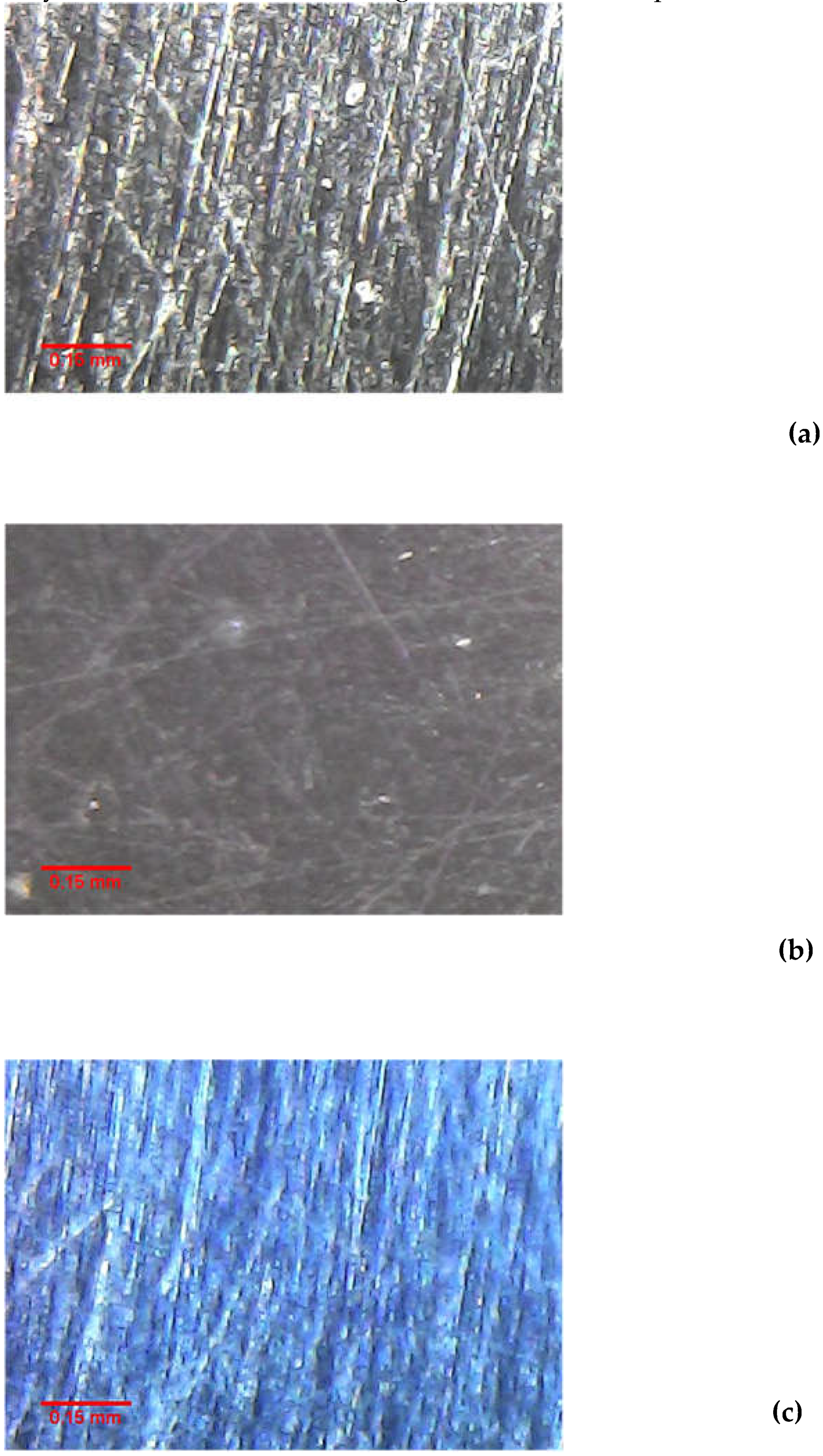
Figure 2.
XRD diffractograms of Ni-N thin films deposited on Si wafer (111) at r.f.-powers of 150, 175, and 200 W. Phase identification symbols: ■ Ni3N, ▲ Ni4N, ● NiO, ○ NiSi, □ Si substrate.
Figure 2.
XRD diffractograms of Ni-N thin films deposited on Si wafer (111) at r.f.-powers of 150, 175, and 200 W. Phase identification symbols: ■ Ni3N, ▲ Ni4N, ● NiO, ○ NiSi, □ Si substrate.
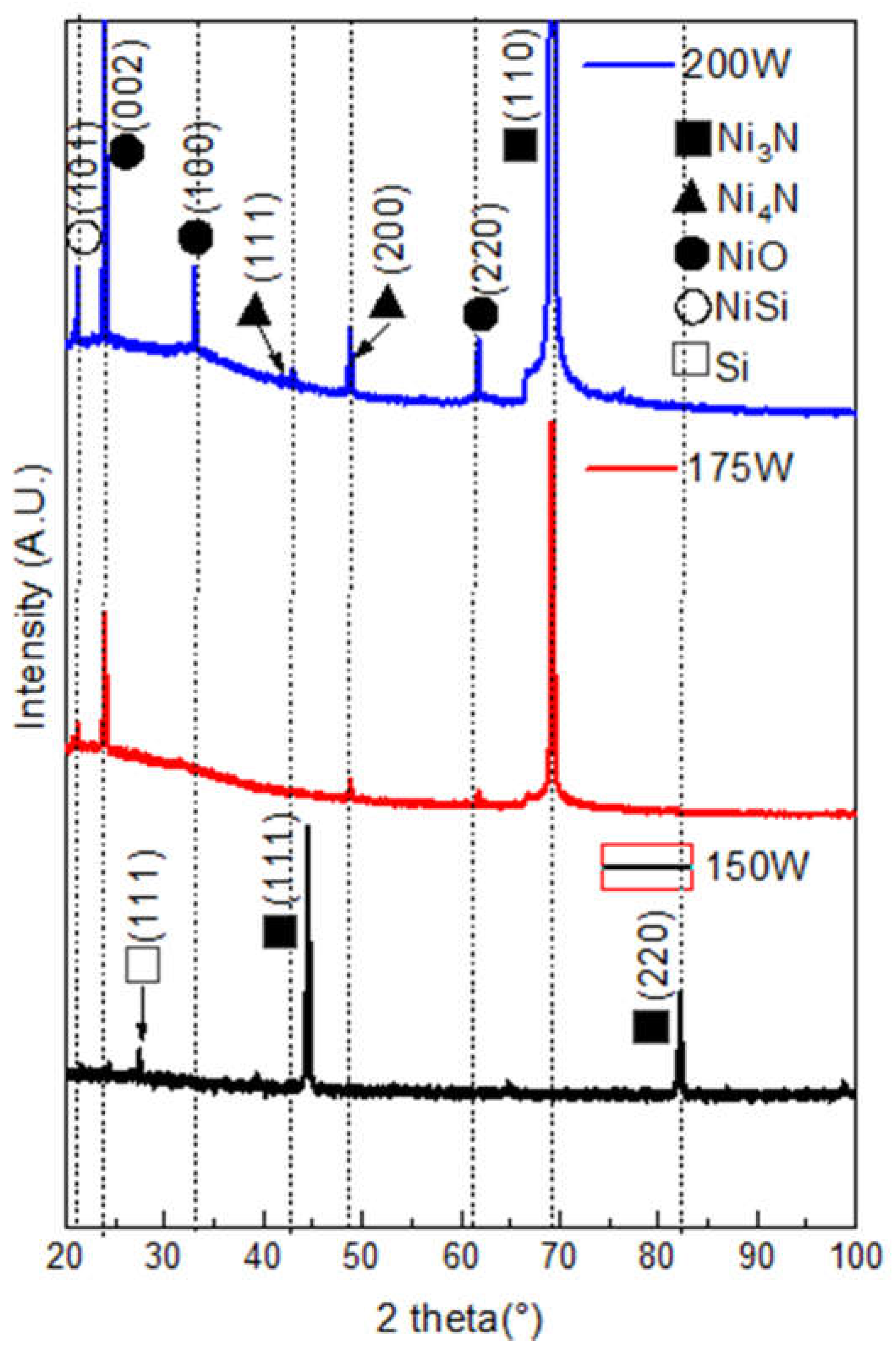
Figure 4.
Electrochemical behavior of Ni-N thin films: (a) Open Circuit Potential (OCP) and (b) Tafel polarization curves, evaluated in a 3.5 wt.% NaCl solution.
Figure 4.
Electrochemical behavior of Ni-N thin films: (a) Open Circuit Potential (OCP) and (b) Tafel polarization curves, evaluated in a 3.5 wt.% NaCl solution.
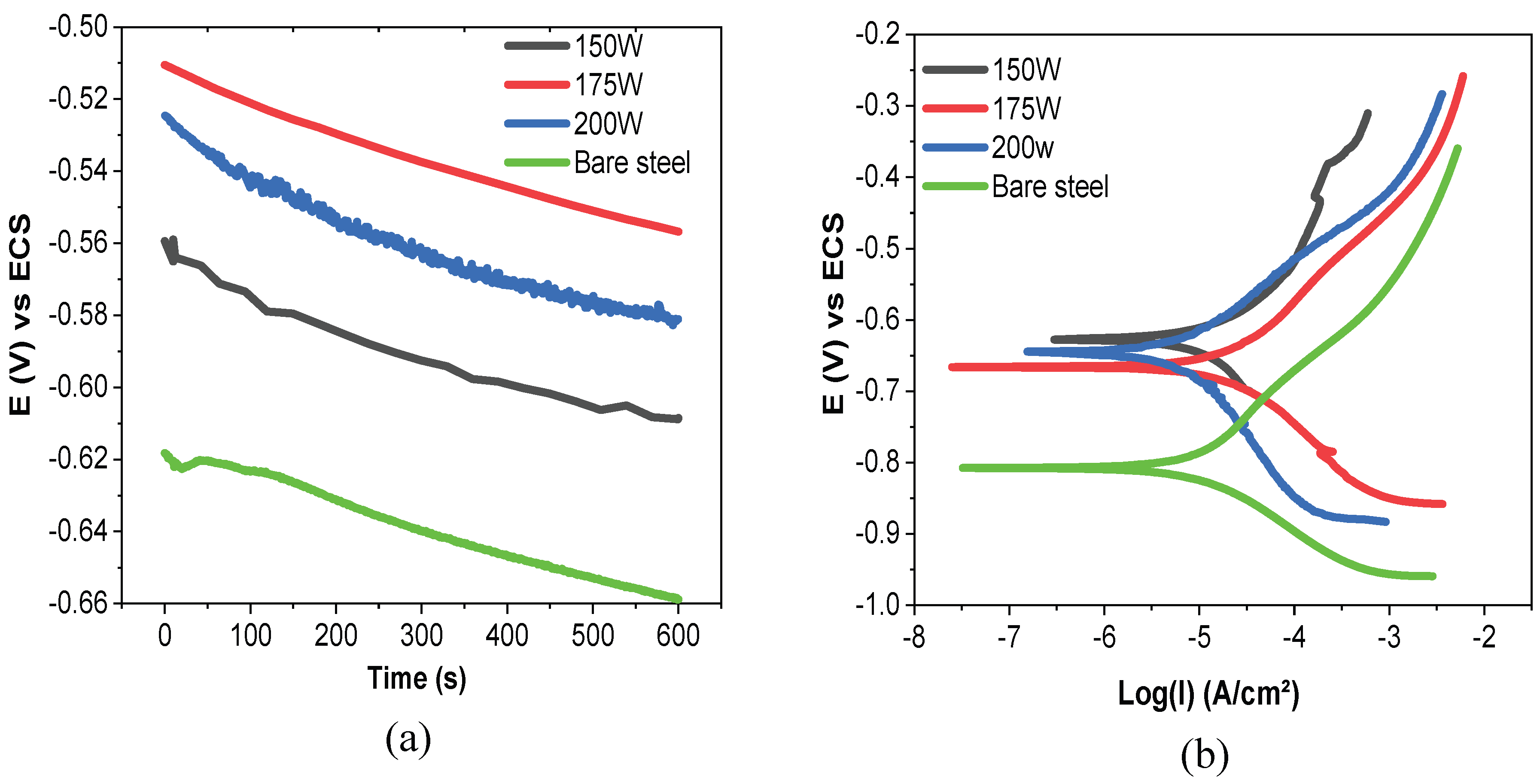
Figure 5.
EIS results: (a) Nyquist plot and (b) equivalent circuit used, evaluated in a 3.5 wt.% NaCl solution.It is well known that surface roughness directly affects the corrosion properties of Ni-N thin films. Smoother surfaces generally expose less area to corrosive agents, potentially improving corrosion resistance [68]. This is because lower surface roughness reduces nucleation sites for corrosion and minimizes corrosive penetration into the film microstructure [69]. The reduction in Ra and RMS values with increasing r.f.-power, as shown by the AFM analysis, indicates that Ni-N thin films deposited at higher r.f.-power levels have smoother surfaces. This observation correlates with improved corrosion resistance, as smoother surfaces present fewer imperfections and defects that could initiate corrosion.
Figure 5.
EIS results: (a) Nyquist plot and (b) equivalent circuit used, evaluated in a 3.5 wt.% NaCl solution.It is well known that surface roughness directly affects the corrosion properties of Ni-N thin films. Smoother surfaces generally expose less area to corrosive agents, potentially improving corrosion resistance [68]. This is because lower surface roughness reduces nucleation sites for corrosion and minimizes corrosive penetration into the film microstructure [69]. The reduction in Ra and RMS values with increasing r.f.-power, as shown by the AFM analysis, indicates that Ni-N thin films deposited at higher r.f.-power levels have smoother surfaces. This observation correlates with improved corrosion resistance, as smoother surfaces present fewer imperfections and defects that could initiate corrosion.
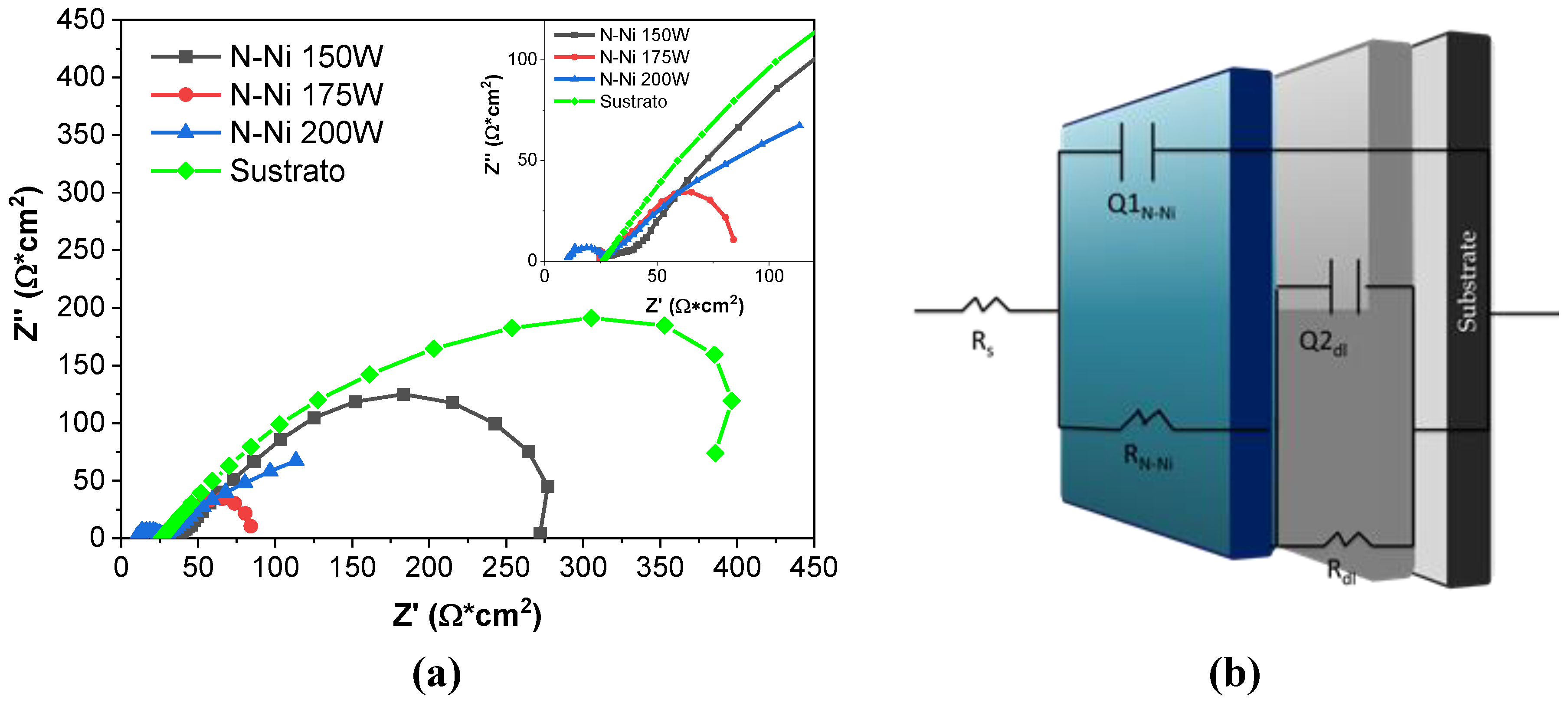

Table 1.
Data obtained from an electrochemical analysis of materials submerged in a 3.5% NaCl solution.
Table 1.
Data obtained from an electrochemical analysis of materials submerged in a 3.5% NaCl solution.
| Material | ||||
|---|---|---|---|---|
| AISI 1016 [29] | -0.57 | 1.51 | -0.52 | 1.78 |
| Ni [29,30] | -0.27 | 0.56 | -0.38 | 1.23 |
| Ti-N [30] | -0.65 | 0.03 | -0.55 | 0.02 |
| Ni-B [31] | -0.42 | 18.20 | 505 | 21.83 |
| Zr-N [30] | -0.65 | 1.34 | -0.32 | 2.32 |
| Zr-O2 [32] | -0.21 | 0.03 | 0.17 | 1.72 |
Table 2.
Experimental conditions for the deposition of Ni-N thin films onto AISI 1016 carbon steel and Si wafers were achieved using r.f. magnetron sputtering.
Table 2.
Experimental conditions for the deposition of Ni-N thin films onto AISI 1016 carbon steel and Si wafers were achieved using r.f. magnetron sputtering.
| Parameter condition | Sample / value experimental | ||
|---|---|---|---|
| 150 W | 175 W | 200 W | |
| Rp, turbo-molecular pump (mbar). | 1.9 | 2.3 | 2.3 |
| Wp, after injection gas (mbar). | 6.0 | 5.2 | 5.2 |
| Gate-valve opening during the deposition (%). | 100 | ||
| Duration of deposition (min.). | 120 | ||
| Ar flow (sccm). | 20 | ||
| N2 flow (sccm). | 7 | ||
| Ts-distance (mm). | 70 | ||
| r.f.-power supply (W) | 150 | 175 | 200 |
Table 3.
Thickness measurements of Ni-N thin films on Si wafers with (111) orientation, obtained using the stylus profilometer.
Table 3.
Thickness measurements of Ni-N thin films on Si wafers with (111) orientation, obtained using the stylus profilometer.
| Sample (r.f.Watts) | Thickness (nm) | Roughness (Ra, nm) | Roughness (Rq, nm) |
|---|---|---|---|
| 150W | 31.3 ± 19.3 | 64.5 ± 3.2 | 86.4 ± 4.3 |
| 175W | 25.0 ± 13.5 | 65.0 ± 3.3 | 80.8 ± 4.0 |
| 200W | 50.7 ± 25.0 | 37.5 ± 1.9 | ± 2.4 |
Table 4.
Surface Roughness Measurements of Ni-N thin films on AISI 1016 Steel, Analyzed by AFM.
| Sample | 10 μm scale | 20 μm scale | 50 μm scale |
| 150W | 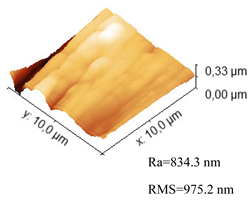 |
 |
 |
| 175W | 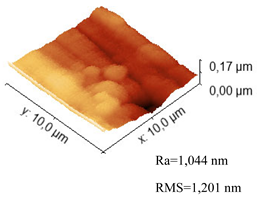 |
 |
 |
| 200W | 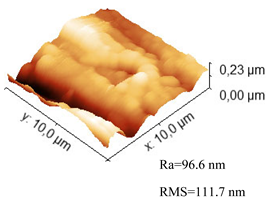 |
 |
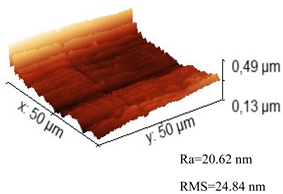 |
Table 5.
Behavior of nanohardness of Ni-N thin films tested by nanoindentation.
| Description | 150W | 175W | 200W | ||||||
|---|---|---|---|---|---|---|---|---|---|
| Loading force (P, mN) | 5 | 10 | 20 | 5 | 10 | 20 | 5 | 10 | 20 |
| Loading/unloading rate (mN/min) | 10/10 | 20/20 | 40/40 | 10/10 | 20/20 | 40/40 | 10/10 | 20/20 | 40/40 |
| Hardness H (GPa) | 14.76 | 12.47 | 8.17 | 16.40 | 12.54 | 13.59 | 12.86 | 11.81 | 11.91 |
| Hardness H (GPa), SI Units (mean ± SD) | 11.80 ± 3.34 | 14.18 ± 1.20 | 12.19 ± 0.58 | ||||||
| Reduced modulus Er (GPa) | 139.90 | 171.26 | 118.62 | 118.46 | 108.09 | 83.52 | 83.51 | 131.5 | 137.5 |
| Reduced modulus Er (GPa), SI Units (mean ± SD) | 143.26 ± 26.48 | 103.36 ± 17.94 | 117.50 ± 29.59 | ||||||
| Contact depth h (nm) | 100.01 | 76.93 | 290.22 | 94.47 | 160.62 | 222.26 | 107.96 | 165.66 | 238.69 |
Table 6.
Electrochemical parameters obtained from Tafel polarization analysis.
| Sample | Ecorr (V) |
Βa (mV) |
Βc (mV) |
Icorr (A.cm-2) |
Vcorr mmy |
|---|---|---|---|---|---|
| Bare steel | - 780 | 140 | 120 | 1.58E-5 | 0.1838 |
| 150W | - 605 | 130 | 145 | 2 51E-5 | 0.2920 |
| 175W | - 668 | 130 | 125 | 2.23E-5 | 0.2595 |
| 200W | - 645 | 120 | 140 | 7.94E-6 | 0.0924 |
Table 7.
Fitting parameters obtained from EIS analysis.
| Sample | Rs (Ω·cm²) | RNi-N (Ω·cm²) | Rdl (Ω·cm²) | QNi-N (F·s^(a-1)) | Qdl (F·s^(a-1)) | nNi-N | ndl |
|---|---|---|---|---|---|---|---|
| Reference | 25.00 | — | 652.8 | — | 8.19×10⁻³ | — | 0.875 |
| 150W | 24.23 | 21.38 | 320.5 | 1.49×10⁻³ | 4.93×10⁻³ | 0.49 | 0.94 |
| 175W | 24.75 | 11.72 | 178.1 | 3.83×10⁻² | 1.46×10⁻¹² | 0.54 | 0.79 |
| 200W | 20.52 | 17.52 | 298.5 | 64.41×10⁻⁶ | 1.94×10⁻² | 0.762 | 0.56 |
Disclaimer/Publisher’s Note: The statements, opinions and data contained in all publications are solely those of the individual author(s) and contributor(s) and not of MDPI and/or the editor(s). MDPI and/or the editor(s) disclaim responsibility for any injury to people or property resulting from any ideas, methods, instructions or products referred to in the content. |
© 2026 by the authors. Licensee MDPI, Basel, Switzerland. This article is an open access article distributed under the terms and conditions of the Creative Commons Attribution (CC BY) license (http://creativecommons.org/licenses/by/4.0/).
Copyright: This open access article is published under a Creative Commons CC BY 4.0 license, which permit the free download, distribution, and reuse, provided that the author and preprint are cited in any reuse.


