
Submitted:
29 May 2026
Posted:
29 May 2026
You are already at the latest version
Preprints on COVID-19 and SARS-CoV-2
Abstract
Tele-exercise (TEF) is an option for maintaining the vitality of people who have difficulty exercising outside the home and in confinement situations. The aim of the present study was to determine the effect of TEF in Tai Chi (CT) compared to strength training (ST) on muscle mass and strength in older Mexican adults. The following groups were formed: (i) CT Group (CTG) n=42; (ii) ST Group (STG) n=41; (iii) Control Group (CG) n=40. Skeletal muscle mass index (SMMI), %FM (percentage of fat mass), handgrip strength (HF), and sit-stand test (SST) were assessed before and after the intervention. Both TEF groups showed an increase in SMMI, GTC (+0.73 ± 1 kg/m², p 0.009) and GEF (+0.45 ± 0.9 kg/m², p 0.03) in contrast to the GC (-0.49 ± 0.5, p 0.05). Likewise, both groups showed a significant decrease in %FM (GTC, -4.32 ± 6, p<0.01; GEF, -4.24 ± 6, p<0.01) compared to the GC (2.12 ± 7, p=0.04). An increase was also found in HS: TCG (+4 ± 7, p=0.08) and GEF (+5 ±3, p=0.08), along with a decrease in STST time in both groups (GTC, -2.19±3, p<0.01; GEF, -3.48 ± 3, p<0.001). The tele-exercise in tai chi or strength training has a similar positive effect on SMMI, %FM, HS, and STST, and an option for older adults in confinement situations.
Keywords:
Tele-exercise
; tai chi
; strength training
; older adults
; body composition
; handgrip strength
1. Introduction
When the first case of coronavirus disease (COVID-19) was reported in Wuhan Province, China, in late 2019, no one could have predicted that we were facing one of the greatest health crises of our time [1]. Given that this disease is transmitted from person to person through respiratory droplets, one of the measures taken to slow its rapid spread was social isolation to reduce the rate of infection and mortality associated with the SARS-CoV-2 virus, especially in vulnerable groups such as people over 65 years of age, those with obesity, smokers, those with more than one chronic disease (diabetes and hypertension, among others), those who are physically inactive, or those with low lung capacity [1,2,3]. For this reason, it was essential to propose alternatives to continue physical exercise programs, especially to avoid immobility in older adults, which is the main risk factor for the prevalence and incidence of sarcopenia [4,5].
One alternative for older adults to continue exercising and maintaining social interaction was tele-exercise using information technologies, specifically computers and mobile devices for remote training and monitoring via platforms like Zoom and Google Meet [6]. However, in our context, there are several challenges in using this technology, such as low educational levels, lack of training, fear and negative attitudes toward technology, insecurity regarding the use of personal data, limited economic resources or inadequate infrastructure, and unsuitable applications for older adults [7,8]. Nevertheless, population groups with access to this resource could benefit from this approach, as positive results have been reported through digital health or telehealth interventions [9].
Sarcopenia is a chronic musculoskeletal disease associated with aging, making it highly prevalent in older adults [4,5,10]. This condition is characterized by a loss of skeletal muscle mass coupled with decreased strength, affecting physical functional capacity and negatively impacting the ability to perform basic, instrumental, and advanced activities of daily living [10]. It also increases the risk of falls, fractures, frailty, and physical dependence, affecting quality of life, as well as family and social finances, and placing enormous pressure on the healthcare system [9,10,11].
Although a physiological loss of muscle mass occurs at a rate of 3 to 8% per decade starting around age 30, accelerating after age 50, while visceral fat tends to progressively increase and compromise muscle quality by infiltrating it (myosteatosis), these changes are accelerated and exacerbated by sedentary lifestyles [12]. In this regard, the magnitude of sarcopenia depends on the measurement method and the characteristics of the population studied. In this sense, prevalence rates ranging from 5% to 40% have been reported in different countries [13].
Therefore, one of the priority strategies for achieving healthy aging is the regular practice of physical exercise, considering tele-exercise as an option for the confinement experienced during the COVID-19 pandemic. In this regard, the most recommended types of physical exercise in old age to prevent or limit the progression of sarcopenia are strength training (ST) and tai chi (TC). In this sense, a systematic review that included fourteen randomized controlled trials (RCTs) on the effect of ST on skeletal muscle mass (SMM), grip strength, and physical performance in older adults with sarcopenia without comorbidity found a statistically significant positive effect on all variables except SMM [14].
Likewise, Yang et al. (2025), in a systematic review conducted in older adults with sarcopenia that included eleven randomized controlled trials (RCTs), reported a statistically significant positive effect after cardiopulmonary exercise training on gait speed, muscle strength, and grip strength; however, they did not find significant changes in SMM [15]. In this regard, it is important to note that most RCTs on the effect of ST and TC on SMM and grip strength are conducted in older adults with sarcopenia.
Within this framework, the purpose of the present study was to determine the effect of tele-training of TC compared to ST on muscle mass and strength in older adults without sarcopenia in the context of the COVID-19 pandemic.
2. Materials and Methods
2.1. Participants and Design
After obtaining informed consent, a quasi-experimental study was conducted in a convenience sample, following the guidelines of TREND (Transparent Reporting of Evaluations with Nonrandomized Designs) [16]. The protocol was approved by the ethics committee of the Faculty of Higher Studies Zaragoza, UNAM (FESZ/DEPI/CI/03920) and registered on a clinical trials platform (ISRCTN48485253) [17].
The sample consisted of 123 adults aged 60 to 74 years from Mexico City who had a stable Wi-Fi connection and a device for making video calls, without severe cognitive impairment (Montreal Cognitive Assessment, MoCA score ≥ 23), and who did not engage in regular physical exercise in the last 6 months (<60 minutes per week). Individuals with a history of decompensated chronic diseases for whom physical exercise was contraindicated were excluded.
The exercise groups were randomly assigned, and the control group consisted of individuals who, for personal reasons, did not agree to participate in the exercise program but agreed to meet remotely each week to share their experiences of confinement: (i) Tai Chi Group (TCG) n=42; (ii) Strength Training Group (STG) n=41; (iii) Control Group (CG) n=40. The TCG and STG groups participated in a formal exercise training program for six months (4 days/week/60 minutes) supervised by trained instructors. The CG participated in weekly 60-minute meetings coordinated by a member of the research team. During the intervention, several participants dropped out of the study for different reasons (n=20 TCG; n=19 STG, and n=19 CG (Figure 1).
An initial interview was conducted with all participants to collect sociodemographic characteristics and clinical data. They were also assessed before and six months after the intervention on anthropometric parameters, dietary intake, body composition, grip strength, and physical performance.
2.2. Anthropometric Measurements
To determine the patients' body dimensions, a calibrated medical scale (SECA®, Hamburg, Germany) was used for body weight and a wall-mounted stadiometer (SECA®, Hamburg, Germany) for height. Patients were asked to stand with their heels together, their head erect in the Frankfort plane and in contact with the stadiometer. Both measurements were used to calculate BMI using the following formula: weight (kilograms) / height² (meters) [18]. All measurements were performed by trained researchers from our working group.
2.3. Dietary Intake
Dietary intake was determined using the 24-hour recall technique performed by trained nutritionists. To ensure portion sizes, household sample measures (cups and spoons) were used. Analysis was subsequently performed using FoodProcessor® 2016 software [19].
2.4. Body Composition
Bioelectrical impedance analysis (BIA) was performed to assess muscle mass using a four-pole, single-frequency device (50 kHz, Quantum X, RJL System®). One pair of electrodes was placed on the back of the hand and another pair on the foot on the right side of the body to record resistance and reactance. Skeletal muscle mass (SMM) was estimated using the Janssen equation [20,21]. Where SMM (kg): [(height cm2/resistance] × 0.401) + (sex × 3.825) + (age × − 0.071) + 5.102. For sex, males = 1 and females = 0, and age is measured in years. To obtain the Skeletal Muscle Mass Index (SMMI), SMM (in kilograms) was divided by height2/(in meters). Fat-Free Mass (FFM) was estimated using the following equation:
FFM = (0.7374*((height2) /R)) x (0.1763 x (weight)) – (0.1773 x (age)) + (0.1198 (Xc)) - 2.4658
Subsequently, the percentage of FFM (% FFM) was calculated as follows: (FFM x 100) / weight. Finally, the percentage of Fat Mass (%FM) was estimated: % FM = 100 - % FFM
2.5. Grip Strength
To measure grip strength, a Jamar hydraulic dynamometer, adjustable to hand width, with a measurement range of 0 to 100 kg, was used. The participant had to stand with their arms extended parallel to their torso, holding the dynamometer in their hand, and, without support, was asked to exert maximum force. Three alternating measurements were obtained for each arm, with a one-minute rest between each. The value of each measurement was recorded, and the maximum value was considered [22,23].
2.6. Phase Angle (PA)
The PA was estimated using the following formula [24]:
PhA = arctangent (reactance/resistance) × (180°/π)
2.7. Physical Performance
Physical performance was assessed using the Short Physical Performance Battery (SPPB), which evaluates balance, gait, strength, and endurance. This test consists of three subtests: (i) Balance in three positions: feet together, semi-tandem, and tandem, each held for 10 seconds; (ii) Lower limb strength: time required to stand up from and sit down from a chair five consecutive times, as quickly as possible; (iii) Gait speed: time taken to walk 4 meters at a normal pace. The total score classifies physical performance as low (≤8 points) or high (≥9 points) [25].
2.8. Physical Tele-Exercise Program
Prior to the implementation of the physical tele-exercise program, participating older adults received training via Zoom on the use of the digital tools that would be used in the program, such as: (i) use of computers, tablets, and/or smartphones; (ii) use of Zoom; (iii) Google Forms and QR code readers; (iv) WhatsApp and email. They were provided with a manual and a video. The program was implemented synchronously with real-time supervision by a trained researcher [26].
The instructors were standardized to deliver the tele-exercise training by specialists from the Department of Sports Activities at the Faculty of Health Sciences Zaragoza, UNAM. All interventions were conducted online with the support of the Zoom application; for the exercise groups, the Borg scale of perceived exertion was used.
2.8.1. Tai Chi Training
The remote Tai Chi training program followed the guidelines established by Li et al. (2003) for the practice of "Eight Forms Tai Chi for Older Adults" [27], which was conducted remotely and supervised via Zoom four days a week, in 60-minute sessions for 6 months. Participants performed a 10-minute warm-up, practiced simple Tai Chi movements and postures for 40 minutes, and finished with a 10-minute cool-down (Suppl. Table S1).
2.8.2. Strength Training
Participants completed a strength training program designed by the Gerontology Research Unit, consisting of three phases: (i) warm-up and activation (10 minutes), (ii) main session (40 minutes), and (iii) cool-down (10 minutes); four sessions per week (WHO, 2020) [28]. Participants performed their routines remotely and under the supervision of a qualified instructor via Zoom (Suppl. Table S2).
2.8.3. Control Group
Weekly 60-minute meetings were scheduled in which the participants of this group shared their experiences of the COVID-19 pandemic, and the coordinators also gave some talks on healthy aging.
2.9. Statistical Analysis
Data are expressed as mean ± standard deviation. A repeated-measures analysis of variance (ANOVA) was performed (TCG & STG vs. CG; TCG vs. STG), and the mean difference (MD) was calculated. Additionally, paired-sample t-tests were conducted to determine within-group changes, and the percentage change from baseline was calculated. To interpret the results of Eta-squared (η2): a partial η2 Eta value close to ≥0.01 is considered low, ≥0.06 medium, and a value greater than ≥0.14 large [29]. Differences were considered statistically significant at a 95% confidence level (p < 0.05). Statistical significance was set at p < 0.05 for all tests using SPSS version 25.
3. Results
The sociodemographic characteristics and health status of the study population are presented in Table 1. The adherence of the groups during the physical exercise training and follow-up of the GC was 80%, however, a high percentage of the three groups did not agree to participate in the second post-intervention measurement for different reasons (Figure 1).
3.1. Nutrition
Changes in dietary intake regarding total caloric energy and fat consumption were observed after 6-months of intervention. In all three groups, a decrease was observed within groups, especially in the STG group with a statistically significant trend (fat -11g, p=0.08). However, the difference between groups was not statistically significant (p>0.05). The other nutrients did not show statistically significant changes within or between groups (p>0.05) (Table 2).
3.2. Body Composition
TCG and STG showed a statistically significant changes in comparison to the CG in SMM (TCG: +1.71 ± 2.49; STG: +1.52 ± 2.38, p<0.001); SMMI (TCG: +0.73 ± 1 Kg/m2; STG: +0.45 ± 0.9 Kg/m2, p < 0.001); FM(%) (TCG: -4.32 ± 6; STG: -4.24 ± 6, p<0.001) and FM/FFM (TCG: -0.15 ± 0.17; STG: -0.12 ± 0.18, p<0.001) (Table 3).
3.3. Physical Performance and Grip Strength
The overall SPPB sub-test score showed an increase, although only it was observed a change statistically significant in STST time (TCG: -2.19 ± 3; STG:-3.48 ± 3, p <0.001) (Table 4).
3.4. Percentage Change after Intervention
TCG and STG showed statistically significant percentage changes in physical performance compared with CG. Specifically, reductions in time for STST (TCG -14%; STG -25%). Likewise, both group showed a decrease in FM (%) (TCG & STG -9%); FM/FFM (TCG -15%; STG -14%); SMM (TCG +9%; STG +8%) and SMMI (TCG +10%; STG +6%). Regard PA only STG showed an increase (+13%) (Figure 2).
3.5. Effect Size Per Group (Eta-Squared, η2)
Regarding the effect size, TCG showed large effects (≥0.14) on body composition parameters (Weight, BMI, SMMI, SMM, and FM%), SPPB (score), STST and HS. Likewise STG showed large effects (≥0.14) on body composition parameters (Weight, BMI, SMMI, SMM, and FM%), STST and HS (Table 5).
4. Discussion
Home-based tele-exercise (HBTE) is a viable and effective alternative for maintaining healthy physical activity in people who have limitations or difficulties performing it in community spaces outside the home [30]. In this sense, the confinement situation experienced during COVID-19 was a period that warranted the implementation of remote interventions for the control of chronic diseases and the promotion of healthy aging [31,32,33,34,35].Authors should discuss the results and how they can be interpreted from the perspective of previous studies and of the working hypotheses. The findings and their implications should be discussed in the broadest context possible. Future research directions may also be highlighted.
4.1. Adherence
Adherence to HBTE programs is the first challenge we face when implementing intervention programs in older adults, especially when the duration is several months. In our study, the intervention was synchronous, with supervision by a trained researcher. This resulted in adherence rates of over 80% in all three groups. However, many participants (in all three groups, with proportional similarity) did not accept the second measurement, which represents a limitation of the study. In this regard, the motivation fostered by the trainer, recognizing the participants' consistency and progress in performing the exercises, was a determining factor in maintaining adherence, as observed by Fuente-Vidal et al. (2025) [36]. Likewise, the participants' physical functional capacity, which allowed them adequate mobility to perform the physical exercises, was a key factor. Significant adherence has been reported in interventions with individuals with some physical limitation [37,38]. It is important to consider that the data analysis is by protocol with a high dropout rate in all groups for reasons unrelated to the intervention; however, the confinement situation, which initially may have mitigated stress and favored adherence, can be exhausted by the uncertainty generated by experiencing a threatening situation, which should be investigated in more studies with similar confinement situations.
4.2. Nutrition
Although all three study groups were encouraged to adopt a healthy diet to maintain or improve muscle mass, including reduced consumption of carbohydrates and saturated fats, and increased intake of fruits and vegetables high in antioxidants, no statistically significant changes were observed between the groups after the intervention. In this regard, it has been shown that combined interventions, including physical exercise and adequate nutrition, are more effective than isolated programs of either physical exercise or nutrition.<sup>38</sup> Therefore, it is necessary to include precise, supervised guidelines to ensure significant dietary changes to maintain or increase skeletal muscle mass in old age, combined with HBTE.
4.3. Body Composition
Maintaining skeletal muscle mass and strength during the aging process is one of the challenges of healthy aging. Maintaining physical functional capacity allows older adults the mobility required to perform activities of daily living. In this regard, one of the best strategies is the adoption and maintenance of regular physical exercise programs, preferably supervised [39]. While resistance exercise is often cited as the most effective type of exercise for maintaining muscle mass in old age, the results are inconsistent. In our study, we found a statistically significant decrease in FM (%), along with an increase in SMM and SMMI in both experimental groups. These results are consistent with those reported in several studies [40,41]. However, the results contrast with the systematic review conducted by Chen et al. (2021), they did not find statistically significant positive effects on SMM with physical exercise in the sum of 14 studies analyzed in healthy older adults [14]. Similarly, in the systematic review conducted by Yang et al. (2025), who reviewed 11 clinical trials of older adults with sarcopenia, no significant effects on SMMI were found [15]. In contrast, significant decreases in FM(%) have been reported in obese subjects who have undergone CT scans [42]. It is important to highlight the positive effects reported on skeletal muscle mass and muscle strength in the interventions carried out through digital health interventions in the systematic review of 11 clinical trials by Chen et al. (2025) [43].
The inconsistencies reported in several studies may be due to constitutional factors and the degree of muscle mass loss at the beginning of the study, in addition to intervening variables such as age, sex, diet, sleep, and gut microbiota, which are linked to the hallmarks of sarcopenia [44].
Another factor that must be considered in the variability of body composition results is the measurement method. In our study, body composition assessment was carried out through BIA with RJL System®, whose method is an appropriate tool for community-based screening when DXA is not feasible, as in the case of confinement due to the pandemic, enabling rapid, non-invasive, and low-cost estimation of lean and fat mass with acceptable agreement relative to DXA, thereby supporting early identification of body composition alterations associated with intrinsic capacity decline [45,46].
4.4. Physical Performance
Adequate physical performance reflects the strength, endurance, coordination, speed, and flexibility necessary to maintain optimal muscle capacity for continued independence. The SPPB test is often used to predict the risk of loss of independence and is a standard measure in research and clinical practice [5]. In this regard, Pavasini et al. (2016), through a systematic review and meta-analysis of 17 studies, demonstrated that a SPPB test score below 10 points is predictive of all-cause mortality, making maintaining this level throughout life beneficial for healthy aging [47].
Our findings showed no significant differences in the final score between groups; however, the TCG showed a large within-group effect (η2 ≥0.14), especially in the STST score (η2 =0.21). Similarly, STG showed a large within-group effect in 4MWT(s) () and in STST(s) (η2 =0.56). In this regard, it should be considered that the sample size is not representative and a high dropout rate was observed, therefore it is necessary to carry out more studies, preferably randomized clinical trials.
4.5. Grip Strength
One of the most relevant physiological changes associated with aging is the decrease in muscle strength, so increasing or maintaining it is a key objective for preventing or slowing the progression of sarcopenia in older adults. In our study, no statistically significant differences were observed in the analysis between groups; however, the intra-group effect showed a large change (η2: TCG = 0.34; STG = 66). These findings support the hypothesis that tele-training of exercise, especially of STG, could improve or maintain grip strength. However, it is necessary to carry out more randomized clinical trials in confinement contexts to confirm the possible effect, since at the community level it has been shown that face-to-face physical effectiveness training is effective in maintaining or improving grip strength. In this sense, Uratsha et al. (2020) investigated the effectiveness of a multicomponent exercise program (MCEP) on frailty, physical performance, and inflammatory biomarkers in older adults living in the community, and reported statistically significant results after 24 weeks of face-to-face intervention on TUG scores and frailty; there were also improvements in grip strength with a non-statistically significant trend [48]. Likewise, Yang et al. (2025), found statistically significant effects of Tai Chi practice on muscle strength and speed in this population, the latter being associated with physical performance, being a clinical variable to be considered in the evaluation of mobility [49].
5. Strengths and Limitations
The main strength of the study is that it was conducted remotely via tele-exercise during an emergency lockdown in the context of the COVID-19 pandemic, in a vulnerable population such as older adults. This unprecedented situation allowed for the quasi-experimental trial, albeit with many logistical and methodological limitations. Regarding these limitations, the sample was not representative, group assignments were not randomized, and the control group consisted of individuals who refused to participate, resulting in selection bias. Furthermore, the percentage of participants who did not complete the study (refused the second measurement) was very high, although the reasons for this were unrelated to the intervention.
In this context, it is advisable to conduct more randomized clinical trials of tele-exercise under conditions similar to and different from those experienced during the COVID-19 pandemic lockdown, to demonstrate the usefulness of tele-exercise programs for older adults, especially in populations in lockdown situations.
6. Conclusions
Our findings suggest that tele-training of tai chi or strength training in a confinement situation have a similar positive effect on SMM, SMMI and a decrease FM(%), and therefore may be an option for older adults to promote healthy aging in similar confinement situations. However, further clinical trials are needed in older adult populations with varying health conditions, as well as asynchronous testing and mixed tele-exercise interventions.
Supplementary Materials
The following supporting information can be downloaded at: Preprints.org.
Author Contributions
Conceptualization, N.V-B; V.M.M-N; methodology, L.C-M; J.G-E; J.A-C; G-G-G; C.F-B; E.C-M; formal analysis, N.V-B; V.M.M-N; X.X.; L.C-M; J.G-E; E.C-M: investigation, N.V-B; J.A-C; C.F-B; writing—original draft preparation, N.V-B; writing—review and editing, V.M.M-N; supervision, E-C-M; C.F-B; J.G-E; L.C-M, X.X.; V.M.M-N. All authors have read and agreed to the published version of the manuscript.
Funding
We appreciate the support from the General Directorate of Academic Personnel Affairs, National Autonomous University of Mexico (DGAPA-UNAM) PAPIIT Project: IN306121.
Institutional Review Board Statement
The protocol was approved by the ethics committee of the Faculty of Higher Studies Zaragoza, UNAM (FESZ/DEPI/CI/03920) and registered on a clinical trials platform (ISRCTN48485253).
Informed Consent Statement
The study was conducted in accordance with the Declaration of Helsinki, and approved by Ethics Committee of the Faculty of Higher Studies Zaragoza, UNAM (Approval: FESZ/DEPI/CI/03920).
Data Availability Statement
Data presented in this study are available on request from the corresponding author. Our university states that research results information can only be provided when formally requested from the project manager.
Acknowledgments
This work was supported by the SECIHTI that sponsored the scholarship CVU 779263 for Nayeli Anai Vaquero Barbosa during his Ph D. in the “Programa de Maestrıa y Doctorado en Ciencias Médicas, Odontológicas y de la Salud-UNAM.”.
Conflicts of Interest
The authors declare no conflicts of interest.
Abbreviations
The following abbreviations are used in this manuscript:
| TCG | Tai Chi Group |
| STG | Strength Training Group |
| CG | Control Group |
| ($) | Mexican pesos |
| SAH | Systemic Arterial Hypertension |
| SBP | Systolic Blood Pressure |
| DBP | Diastolic Blood Pressure |
| BMI | Body Mass Index |
| SMM | Skeletal Muscle Mass |
| SMMI | Skeletal Muscle Mass Index |
| PA | Phase angle |
| FM (%) | Fat Mass Percentage |
| FFM | Fat-free Mass |
| SPPB | Short Physical Performance Battery |
| 4MWT(s) | 4-Meter Walk Test |
| STST(s) | Sit-to-Stand Test |
References
- Kurrey, R.; Saha, A. An Overview of SARS-CoV-2 and Technologies for Detection and Ongoing Treatments: A Human Safety Initiative. COVID 2022,2(6),731-751. [CrossRef]
- Mahroum, N.; Seida, I.; Esirgün, S.N.; Bragazzi, N.L. The COVID-19 pandemic – How many times were we warned before? Eur. J. Intern. Med. 2022,105,8-14.
- Costanzo, S.; Flores, A. COVID-19 Contagion Risk Estimation Model for Indoor Environments. Sensors 2022,22(19), 7668. [CrossRef]
- Donini, L.M.; Busetto, L.; Bischoff, S.C.; Cederholm, T.; Ballesteros-Pomar, M.D.; Batsis, J.A.; et al. Definition and Diagnostic Criteria for Sarcopenic Obesity: ESPEN and EASO Consensus Statement. Obes. Facts 2022,15(3),321-35.
- Cruz-Jentoft, A.J.; Bahat, G.; Bauer, J.; Boirie, Y.; Bruyère, O.; Cederholm, T.; et al. Sarcopenia: revised European consensus on definition and diagnosis. Age Ageing 2019,48(1),16-31.
- Leale, I.; Figlioli, F.; Giustino, V.; Brusa, J.; Barcellona, M.; Nocera, V.; et al. Telecoaching as a new training method for elderly people: a systematic review. Aging Clin. Exp. Res. 2024, 36(1), 18. [CrossRef]
- Bertolazzi, A.; Quaglia, V.; Bongelli, R. Barriers and facilitators to health technology adoption by older adults with chronic diseases: an integrative systematic review. BMC Public Health 2024, 24(1), 506. [CrossRef]
- Peng, R.;Li, X.; Guo,Y.; Ning, H.; Huang, J.; Jiang, D.; Feng, H.; Liu, Q.; Barriers and facilitators to acceptance and implementation of eMental-health intervention among older adults: A qualitative systematic review. Digit Health 2024, 10, 20552076241234628. [CrossRef]
- Chen, W.; Yao, J.; Wang, H.; Jia, S.; Zhu, X.; Mao, L. Effects of digital health interventions on muscle mass, muscle strength, and physical function in older adults with sarcopenia: a systematic review and meta-analysis. Front. Public Health 2025, 13,1711514. [CrossRef]
- Prokopidis, K.; Tessier, A.; Ragusa, F.; Ferrini, K.; Garlisi, M.; Testa, G.; Barbagallo, M.; Veronese, N. Comprehensive geriatric assessment markers in older adults with and without sarcopenia: A systematic review and meta-analysis. Arch Gerontol. Geriatr. 2025, 138, 105982. [CrossRef]
- Beaudart, C.; Rizzoli, R.; Bruyère, O.; Reginster, J.; Biver, E. Sarcopenia: burden and challenges for public health. Arch. Public Health 2014, 72, 45. [CrossRef]
- Doherty, T. Aging and sarcopenia. J. Appl. Physiol. 2003, 95, 1717– 1727. [CrossRef]
- Papadopoulou, SK. Sarcopenia: A Contemporary Health Problem among Older Adult Populations. Nutrients 2020, 12(5), 1293. [CrossRef]
- Chen, N.; He, X.; Feng, Y.; Ainsworth, B.; Liu, Y. Effects of resistance training in healthy older people with sarcopenia: a systematic review and meta-analysis of randomized controlled trials. Eur. Rev. Aging Phys. Act. 2021, 18(1), 23. [CrossRef]
- Yang, S.; Chen, S.; Zhang, Y.; Zhou, Z.; Li, D.; Zeng, P. Effects of Tai Chi and Baduanjin on muscle mass, muscle function, and activities of daily living in individuals with sarcopenia: a systematic review and meta-analysis. Front. Public Health 2025, 13, 1636857. [CrossRef]
- Des-Jarlais, D.; Lyles, C.; Crepaz, N. Trend Group. Improving the Reporting Quality of Nonrandomized Evaluations of Behavioral and Public Health Interventions: The TREND Statement.Am. J. Public Health 2004, 94, 362-366. https://stacks.cdc.gov/view/cdc/149677.
- International Standard Randomised Controlled Trial Number. Benefits of tai chi training vs strength training combined with the mentalstimulation of an ICOPE program on physical and mental functional capacityin older adults. United Kingdom: ISRCTN. Available from: . [CrossRef]
- Secretaría de Salud, Toma de medidas clínicas y antropométricas en el adulto y adulto mayor. Mexico City, (Mexico): Subsecretaría de Prevención y Protección de la Salud, 2002. https://epifesz.files.wordpress.com/2016/08/6manual-de-procedimientos-toma-de-medidas-clinicas-y-antropometricas.pdf.
- Thompson, F.; Byers, T.; Dietary assessment resource manual. J. Nutr. 1994, 124(11), 2245S-2317S. [CrossRef]
- Kyle, U.; Bosaeus, I.; De Lorenzo, A.; Deurenberg, P.; Elia, M.; Gómez, J.; Lilienthal Heitmann B.;et al. ESPEN. Bioelectrical impedance analysis-part II: utilization in clinical practice. Clin. Nutr. 2004, 23(6),1430-53. [CrossRef]
- Macias, N.; Alemán-Mateo, H.; Esparza-Romero, J.; Valencia, M.E. Body fat measurement by bioelectrical impedance and air displacement plethysmography: A cross-validation study to design bioelectrical impedance equations in Mexican adults.Nutr. J. 2007, 6, 18. [CrossRef]
- Bohannon, R. W.; Hand-grip dynamometry predicts future outcomes in aging adults, J. Geriatr. Phys. Ther. 2008, 31(1), 3-10. [CrossRef]
- García-Peña, C.; García-Fabela, L.C.; Gutiérrez-Robledo, L.M.; García-González J.J.; Arango-Lopera, VE.; Pérez-Zepeda, M.U. Handgrip strength predicts functional decline at discharge in hospitalized male elderly: a hospital cohort study. PloS One 2013, 8(7), e69849. [CrossRef]
- da Silva, B.R.; Orsso, C.E.; Gonzalez, M.C.; Sicchieri, J.M.; Mialich, M.S.; Jordao, A.A.; Prado, C.M. Phase angle and cellular health: inflammation and oxidative damage. Rev. Endocr. Metab. Disord. 2023, 24(3), 543-562. [CrossRef]
- Flores-Bello, C.; Correa-Muñoz, E.; Sánchez-Rodríguez, M.A.; Mendoza-Núñez, V.M. Effect of Exercise Programs on Physical Performance in Community-Dwelling Older Adults with and without Frailty: Systematic Review and Meta-Analysis. Geriatrics 2024 8, 9(1), 8. [CrossRef]
- Chan, S.; Li, L.; Torous, J.; Gratzer, D.; Yellowlees, P.M. Review of Use of Asynchronous Technologies Incorporated in Mental Health Care. Curr. Psychiatry Rep. 2018, 20(10), 85. [CrossRef]
- Li, F.; Fisher, K.J.; Harmer, P.; Shirai, M. A Simpler Eight-Form Easy Tai Chi for Elderly Adults. J. Aging Phys Act. 2003, 11(2), 206-218. [CrossRef]
- World Health Organization. WHO Guidelines on Physical Activity and Sedentary Behaviour; World Health Organization: Geneva, Switzerland, 2020, Available online: https://www.who.int/publications/i/item/9789240015128 (accessed on 3 August 2020).
- Richardson, J.T.E. Eta squared and partial eta squared as measures of effect size in educational research. Educ. Res. Rev. 2011, 6, 135–147. [CrossRef]
- Amorese, A.J.; Ryan, A.S. Home-Based Tele-Exercise in Musculoskeletal Conditions and Chronic Disease: A Literature Review. Front. Rehabil Sci. 2022, 3, 811465. [CrossRef]
- Nguyen, T.H.;Yamamoto, T.; Cho, D.; Nguyen, T.L.; Goldman, P.; Dolezal, B.A. Five Years Later-The Impact of the COVID-19 Pandemic on Physical Performance and Cardiometabolic Health Using a Smart Home Gym: An Ecological Case Study. Int. J. Environ Res. Public Health 2025, 22(5), 762. [CrossRef]
- Ho, V.; Merchant; R.A. The Acceptability of Digital Technology and Tele-Exercise in the Age of COVID-19: Cross-sectional Study. JMIR Aging 2022, 5(2), e33165. [CrossRef]
- Ausserhofer, D.; Piccoliori, G.; Engl, A.; Mahlknecht, A.; Plagg, B.; Barbieri, V.; et al. Community-Dwelling Older Adults' Readiness for Adopting Digital Health Technologies: Cross-Sectional Survey Study. JMIR form Res. 2024, 8:e54120. [CrossRef]
- Doraiswamy, S.; Jithesh, A.; Mamtani, R.; Abraham, A.; Cheema, S. Telehealth Use in Geriatrics Care during the COVID-19 Pandemic-A Scoping Review and Evidence Synthesis. Int. J. Environ. Res. Public Health 2021,18(4), 1755. [CrossRef]
- Fucarino, A.; Fabbrizio, A.; Garrido, N.D.; Iuliano, E.; Reis, V.M.; Sausa, M.; Vilaça-Alves, J.; Zimatore, G.; Baldari, C.; Macaluso, F.; Giorgio, A.; Cantoia, M. Emerging Technologies and Open-Source Platforms for Remote Physical Exercise: Innovations and Opportunities for Healthy Population-A Narrative Review. Healthcare (Basel) 2024, 12(15), 1466. [CrossRef]
- Fuente-Vidal, A.; Blanco, R.; Prat, R.; Jerez-Roig, J.; Fernandes-Ribeiro, A.S.; Montane, J.; Arribas-Marin, J.M. Analyzing motivation for tele-exercise in adult fitness app users. Mhealth 2025, 11,50. [CrossRef]
- Costa, R.; Dorneles, J.R.; Veloso, J.H.; Gonçalves, C.W.; Neto, F.R. Synchronous and asynchronous tele-exercise during the coronavirus disease 2019 pandemic: Comparisons of implementation and training load in individuals with spinal cord injury. J. Telemed. Telecare 2023, 29(4), 308-317. [CrossRef]
- Gomes-Costa, R.; Ramos, B.L.; Ribeiro-Neto, F.; Winckler, C. Tele-exercise in individuals with spinal cord injury: a systematic review. Mhealth 2025, 11, 19. [CrossRef]
- Yang, Y.; Pan, N.; Luo, J.; Liu, Y.; Ossowski, Z. Exercise and Nutrition for Sarcopenia: A Systematic Review and Meta-Analysis with Subgroup Analysis by Population Characteristics. Nutrients 2025, 17(14), 2342. [CrossRef]
- Izquierdo, M.; de Souto Barreto, P.; Arai, H.; Bischoff-Ferrari, H.A.; Cadore, E.L.; Cesari, M.; et al. Global consensus on optimal exercise recommendations for enhancing healthy longevity in older adults (ICFSR). J. Nutr. Health Aging 2025, 29(1), 100401. [CrossRef]
- Morral, A.; Cazorla, J.; Alòs, F.; Puig-Torregrosa, J.; Buela-Castell, M.; Romaguera, M. Prescripción de actividad física y ejercicio físico en atención primaria: situación actual y retos de implementación. Aten. Primaria 2025, 57(9), 103308. [CrossRef]
- Yu, T.; Lin, J.; Gao, H.; Lin, J.; Pan, L.; Shao, X.; Zhu, X.; Tan, Z.; Fan, K.; Zhao, T.; Yao Q. Effectiveness of Traditional Chinese Exercise for Obesity and Overweight: A Systematic Review and Network Meta-Analysis. Public Health Nurs. 2025, 42(4), 1564-1574. [CrossRef]
- Chen, W.; Yao, J.; Wang, H.; Jia, S.; Zhu, X.; Mao, L. Effects of digital health interventions on muscle mass, muscle strength, and physical function in older adults with sarcopenia: a systematic review and meta-analysis. Front. Public Health 2025,13,1711514. [CrossRef]
- Granic, A.; Suetterlin, K.; Shavlakadze, T.; Grounds, M.D.; Sayer, A.A. Hallmarks of ageing in human skeletal muscle and implications for understanding the pathophysiology of sarcopenia in women and men. Clin. Sc.i (Lond) 2023, 137(22), 1721-1751. [CrossRef]
- Klement, R.J.; Joos, F.T.; Reuss-Borst, M.A.; Kämmerer, U. Measurement of body composition by DXA, BIA, Leg-to-leg BIA and near-infrared spectroscopy in breast cancer patients—Comparison of the four methods. Clin. Nutr. ESPEN 2023, 54, 443–452. [CrossRef]
- Tinsley, G.M.; Moore, M.L.; Rafi, Z.; Griffiths, N.; Harty, P.S.; Stratton, M.T.; Benavides, M.L.; Dellinger, J.R.; Adamson, B.T. Explaining Discrepancies Between Total and Segmental DXA and BIA Body Composition Estimates Using Bayesian Regression. J. Clin. Densitom. 2021, 24, 294–307. [CrossRef]
- Pavasini, R.; Guralnik, J.; Brown, J.C.; di Bari, M.; Cesari, M.; Landi, F.; et al. Short Physical Performance Battery and all-cause mortality: systematic review and meta-analysis. BMC Med. 2016, 14, 215. [CrossRef]
- Kim, S.-W.; Park, H.-Y.; Jung, W.-S.; Lim, K. Effects of Twenty-Four Weeks of Resistance Exercise Training on Body Composition, Bone Mineral Density, Functional Fitness and Isokinetic Muscle Strength in Obese Older Women: A Randomized Controlled Trial.Int. J. Environ. Res. Public Health 2022, 19,14554. [CrossRef]
- Yang, S.; Chen, S.; Zhang, Y.; Zhou, Z.; Li, D.; Zeng, P. Effects of Tai Chi and Baduanjin on muscle mass, muscle function, and activities of daily living in individuals with sarcopenia: a systematic review and meta-analysis. Front. Public Health 2025,13,1636857. [CrossRef]
Figure 1.
Flowchart of the participant tracking process.
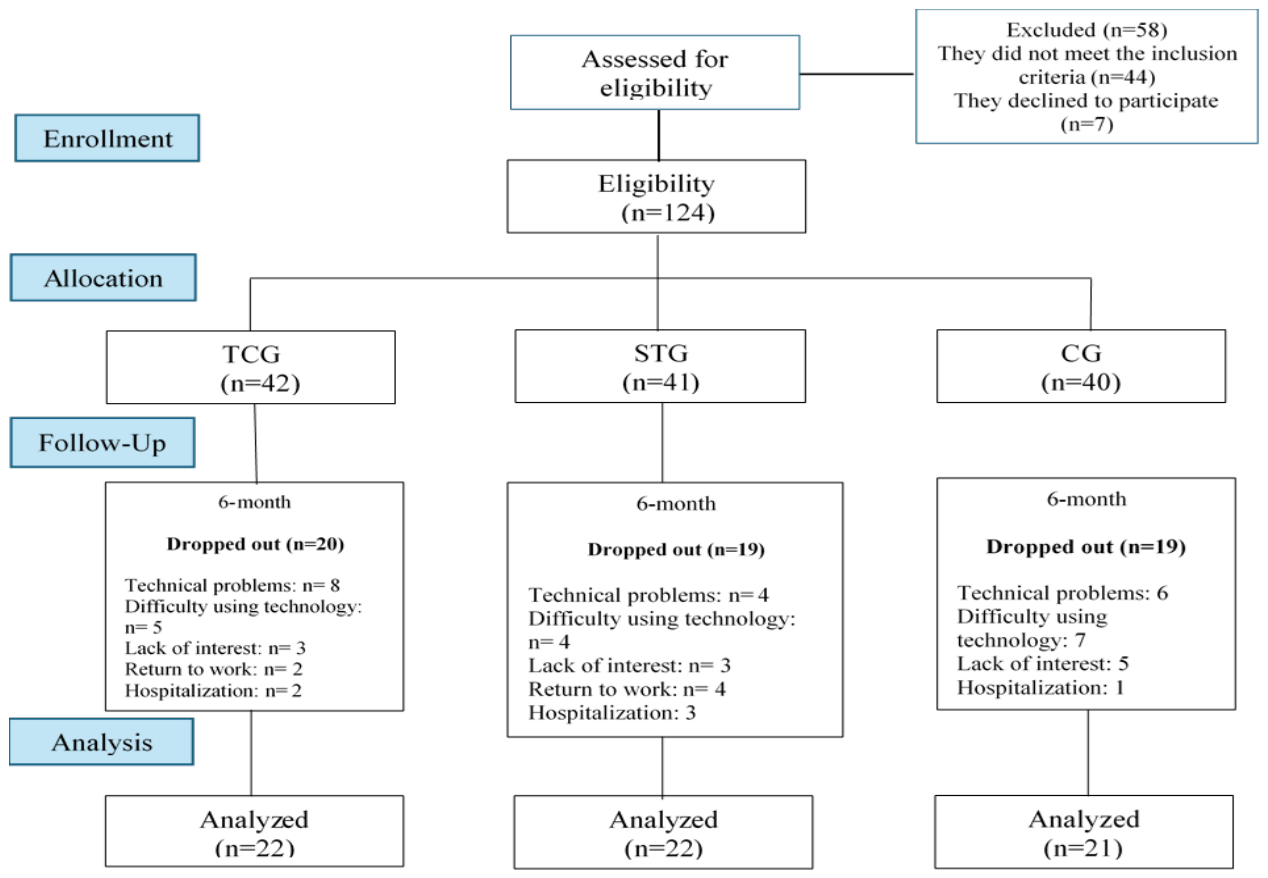
Figure 2.
Abbreviations: BMI, Body Mass Index; SMM, Skeletal Muscle Mass; SMMI, Skeletal Muscle Mass Index; PA,. Phase angle; FM, percentage of fat mass;FFM, fat-free mass; FM/FFM, fat-free mass ratio; SPPB, Short Physical Perfor-mance Battery; 4MWT, 4-Meter Walk Test; STST, Sit-to-Stand test; HS, handgrip strength. A.TCG, Tai Chi Group; B.STG, Strength Training Group; C.CG, Control Group. Percentage changes [∆% = (Post-pre)/pre∗100] in parameters following a six-month intervention. *p<0.05 (TCG vs. CG & STG vs. CG).
Figure 2.
Abbreviations: BMI, Body Mass Index; SMM, Skeletal Muscle Mass; SMMI, Skeletal Muscle Mass Index; PA,. Phase angle; FM, percentage of fat mass;FFM, fat-free mass; FM/FFM, fat-free mass ratio; SPPB, Short Physical Perfor-mance Battery; 4MWT, 4-Meter Walk Test; STST, Sit-to-Stand test; HS, handgrip strength. A.TCG, Tai Chi Group; B.STG, Strength Training Group; C.CG, Control Group. Percentage changes [∆% = (Post-pre)/pre∗100] in parameters following a six-month intervention. *p<0.05 (TCG vs. CG & STG vs. CG).
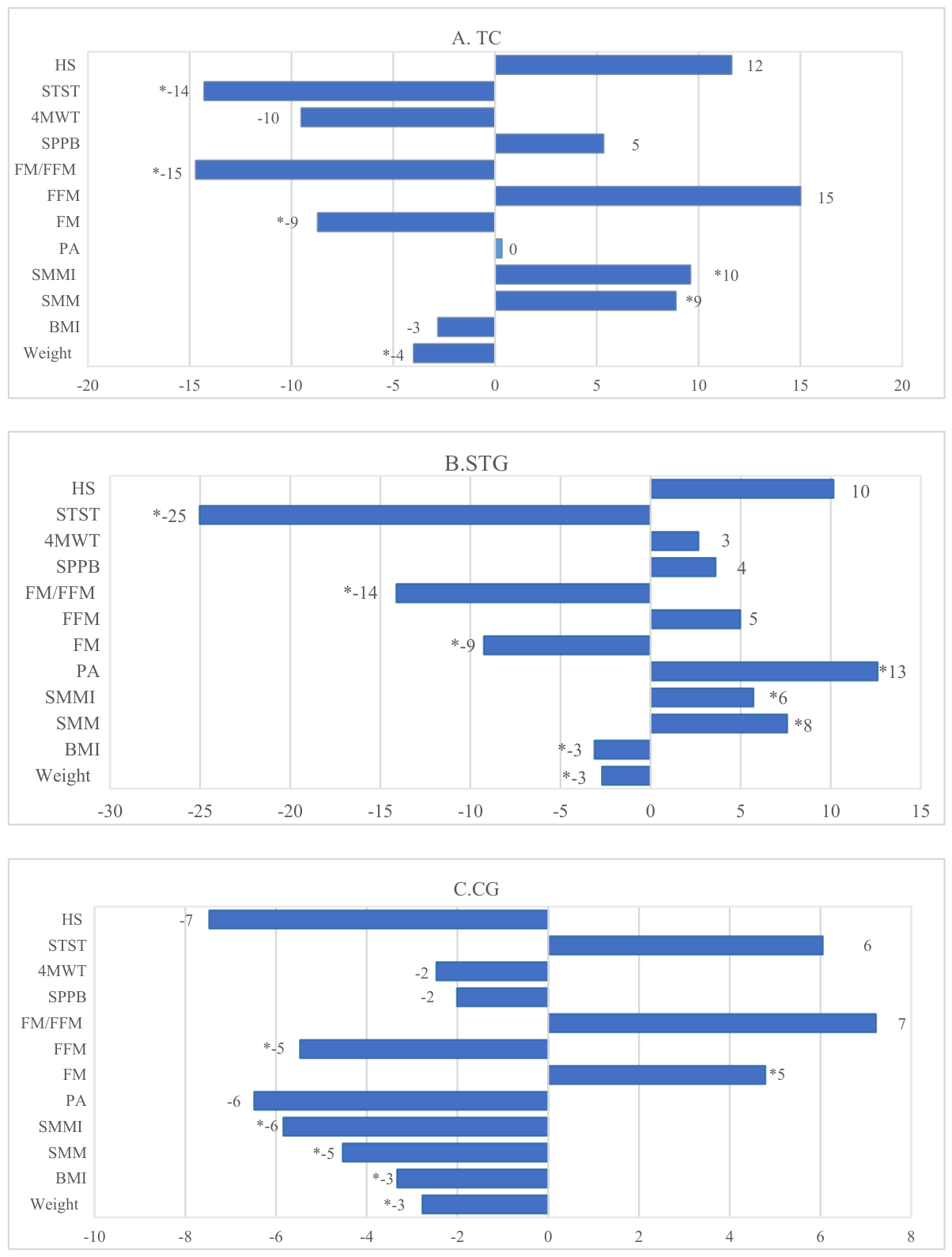

Table 1.
Sociodemographic characteristics and health status by study group.
| Variable | TCG n=22 |
STG n=22 |
CG n=21 |
P-value* |
|---|---|---|---|---|
| Age (years) | 65 ± 4 | 64 ± 3 | 66 ± 4 | 0.15 |
| Sex, Female (%) | 19 (86) | 19 (86) | 14 (64) | 0.15 |
| Schooling (years) | 11 ± 5 | 14 ± 6* | 10 ± 5 | 0.02 |
| Living with (%) | 16 (73) | 18 (82) | 16 (76) | 0.70 |
| Number of people they live with | 4 ± 3* | 2 ± 1.86 | 2 ± 1.83 | 0.03 |
| Economic income ($) | 6000 (3000-8000) | 10000 (5000-18250) | 5694 (2000-8000) | 0.016 |
| Diabetes Mellitus Type 2 n (%) | 8 (36) | 3 (14) | 2 (9) | 0.04 |
| SAH n (%) | 12 (55) | 7 (30) | 9 (41) | 0.26 |
| Joint disorder n (%) | 4 (20) | 7 (30) | 4 (18) | 0.58 |
| Heart disease n (%) | 1 (5) | 0 (0) | 2 (9) | 0.34 |
| Polypharmacy n (%) | 1 (5) | 4 (17) | 5 (23) | 0.17 |
| SBP mm Hg | 138 ± 16 | 123 ± 18* | 143 ± 20 | 0.03 |
| DBP mm Hg | 85 ± 12 | 77 ± 9* | 80 ± 8 | 0.03 |
Abbreviations: TCG, Tai Chi Group; STG, Strength Training Group;CG, Control Group; ($) Mexican pesos; SAH: Systemic Arterial Hypertension, SBP: Systolic Blood Pressure, DBP: Diastolic Blood Pressure, ANOVA one way * P < 0.05.
Table 2.
Nutrient intake by study group.
| Nutrient | TCG | STG | CG | P-value* | |
|---|---|---|---|---|---|
| Energy (kcal) | |||||
| Basal | 1624 (1316-2205) | 1736 (1359-2378) | 1723(1415-2254) | ||
| 6-months | 1760 (1268-2485) | 1587 (1170-1926) | 1418 (1077-1796) | ||
| Effect (Δ) | -28 (-227 - 495) | -28 (-227 - 495) | -28 (-227 - 495) | 0.45 | |
| Protein (g) | |||||
| Basal | 64 (54-99) | 72 (59-104) | 77 (54-96) | ||
| 6-months | 70 (53-104) | 71 (54-91) | 69 (47-77) | ||
| Effect (Δ) | 8.6 (-11.64 – 22.9) | -13 (-25 – 23) | -4.6 (-35 – 24) | 0.56 | |
| Carbohydrates (g) | |||||
| Basal | 238 (169-294) | 230 (175-296) | 250 (182-336) | ||
| 6-months | 263 (176-340) | 210 (160-245) | 183 (151-251) | ||
| Effect (Δ) | 21 (-60 - 94) | -39 (-79 - 80) | -62 (-151 - 12) | 0.26 | |
| Fat (g) | |||||
| Basal | 54 (34-95) | 55 (46-67) | 52 (44-70) | ||
| 6-months | 49 (31-74) | 50 (39-71) | 44 (31-72) | ||
| Effect (Δ) | -4 (-21 - 14) | -11 (-28 - 7) | -7 (-2 – 14) | 0.60 | |
| Fiber (g) | |||||
| Basal | 22 (13-34) | 26 (16-36) | 24 (14-31) | ||
| 6-months | 26 (19-32) | 23 (17-32) | 16 (13-29) | ||
| Effect (Δ) | 7 (-2.2 - 14) | 1 (-11 – 10) | 2 (-14 – 8) | 0.46 | |
| Sugar (g) | |||||
| Basal | 73 (43-105) | 65 (48-93) | 94 (66-130) | ||
| 6-months | 80 (68-123) | 66 (52-84) | 69 (48-99) | ||
| Effect (Δ) | 16 (-16 – 59) | -8 (-41 – 27) | -18 (-50 – 13) | 0.09 | |
Abbreviations: TCG, Tai Chi Grup; STG, Strength Training Group; CG, Control Group. Friedman y Kruskal Wallis; Effect (Δ), the difference in changes before and after the intervention. *P-value, between grups.
Table 3.
Body composition changes by study group.
| Variable | TCG n=22 |
STG n=22 |
CG n=21 |
P-value |
|---|---|---|---|---|
| Weight (Kg) | ||||
| Basal | 75 ± 15 | 74 ± 12 | 72 ± 14 | |
| 6-months | 72 ± 13 | 72 ± 15 | 70 ± 12 | |
| Effect (Δ) | -2.2 ± 2 | -2.08 ± 2 | -2.16 ± 3 | 0.99 |
| BMI (Kg/m2) | ||||
| Basal | 31.34 ± 5.39 | 29.82 ± 5.47 | 30 ± 4.4 | |
| 6-months | 30.46 ± 4.66 | 28.89 ± 5.02 | 29 ± 4.18 | |
| Effect (Δ) | -0.87 ±1.1 | -0.89 ± 0.9 | -0.83 ± 1 | 0.98 |
| SMM (kg) | ||||
| Basal | 18 ± 4.6 | 19.9 ± 4.8 | 20.96 ± 5.6 | |
| 6-months | 19.6 ± 5.15 | 21.41 ± 5.6 | 20.01 ± 5.6 | |
| Effect (Δ) | 1.71± 2.49* | 1.52 ± 2.38* | -0.96 ± 1.24 | <0.001 |
| SMMI (Kg/m2) | ||||
| Basal | 7.60 ± 1.42 | 7.87 ± 1.42 | 8.39 ± 1.3 | |
| 6-months | 8.33 ± 1.48 | 8.32 ± 1.65 | 7.9 ± 1.31 | |
| Effect (Δ) | 0.73 ±1* | 0.45± 0.9* | -0.49 ± 0.5 | <0.001 |
| PA (°) | ||||
| Basal | 5.86 ± 1.13 | 5.63 ± 0.79 | 5.86 ± 0.5 | |
| 6-months | 5.88 ± 1.1 | 6.34 ± 2 | 5.48 ± 0.75 | |
| Effect (Δ) | 0.02 ± 0.2 | 0.71 ± 0.65 | -0.32 ± 0.3 | 0.09 |
| FM(%) | ||||
| Basal | 49.57 ± 7.8 | 45.79 ± 6.79 | 44.26 ± 10.87 | |
| 6-months | 45.25 ± 9.8 | 41.55 ± 8.16 | 46.38 ± 10.42 | |
| Effect (Δ) | -4.32 ± 6* | -4.24 ± 6* | 2.12± 7 | <0.001 |
| FFM (Kg) | ||||
| Basal | 37.3 ± 8.3 | 40.35 ± 7.4 | 40.2 ± 9 | |
| 6-months | 38.3 ±8.9 | 42.36 ± 9.5 | 38 ± 8.5 | |
| Effect (Δ) | 1.89 ± 4.33 | 2 ± 5.3 | -2.16 ± 2.54 | 0.06 |
| FM/FFM | ||||
| Basal | 1.02 ± 0.28 | 0.85 ± 0.21 | 0.83 ± 0.28 | |
| 6-months | 0.87 ± 0.30 | 0.73 ± 0.15 | 0.89 ± 0.30 | |
| Effect (Δ) | -0.15 ± 0.17* | -0.12 ± 0.18* | 0.06± 0.13 | <0.001 |
Abbreviations: TCG, Tai Chi Grup; STG, Strength Training Group; CG, Control Group. BMI, Body Mass Index; SMM, Skeletal Muscle Mass, SMMI; Skeletal Muscle Mass Index; PA, Phase angle,; FM (%); percentage of fat mass; FFM, fat-free mass; FM/FFM ratio. One-Way ANOVA,Post-Hoc *P-value, pre-post differences between groups (* TCG vs. CG & STG vs. CG).
Table 4.
Changes in physical performance and grip strength by study group.
| Variable | TCG n=22 |
STG n=22 |
CG n=21 |
P-value* | |
|---|---|---|---|---|---|
| SPPB (Score) | |||||
| Basal | 9.18 ± 1.17 | 10.50± 1.47 | 10.42 ± 1.08 | ||
| 6-months | 9.67 ± 2.1 | 10.88 ± 1.45 | 10.21 ± 1.25 | ||
| Effect (Δ) | 0.49 ± 2 | 0.38 ± 2 | -0.21 ± 2 | 0.78 | |
| 4MWT(s) | |||||
| Basal | 1.05 ± 0.29 | 0.75 ± 0.17 | 0.81 ± 0.19 | ||
| 6-months | 0.95 ± 0.3 | 0.77 ± 0.20 | 0.79 ± 0.17 | ||
| Effect (Δ) | -0.10 ± 0.3 | 0.02 ±0.3 | -0.02±0.4 | 0.70 | |
| STST(s) | |||||
| Basal | 15.32 ± 4.08 | 13.90 ± 3.92 | 12.39 ± 2.59 | ||
| 6-months | 13.13 ± 4.19 | 10.42 ± 2.18 | 13.14 ± 2.95 | ||
| Effect (Δ) | -2.19 ± 3* | -3.48 ± 3* | 0.75± 3 | <0.001 | |
| HS (Kg) | |||||
| Basal | 21.5 ± 6.92 | 24.19± 7.12 | 23.94 ± 8.11 | ||
| 6-months | 24 ± 5.59 | 26.65 ± 9.2 | 22.15 ± 8.21 | ||
| Effect (Δ) | 3.71 ± 7 | 4.73 ± 4 | -0.95 ± 9 | 0.08 | |
Abbreviations: TCG, Tai Chi Grup; STG, Strength Training Group; CG, Control Group. SPPB: Short Physical Performance Battery; 4MWT(s) (4-Meter Walk Test); STST(s) (Sit-to-Stand test); HS (Kg)(handgrip strength). One-way ANOVA, Post Hoc Tukey. *P-value, pre-post differences between groups (TCG vs, CG & STG vs. CG).
Table 5.
Effect size per study group.
| TCG | STG | CG | |
|---|---|---|---|
| Weight (Kg) | 0.36 | 0.50 | 0.23 |
| BMI (Kg/m2) | 0.35 | 0.49 | 0.23 |
| SMMI (Kg/m2) | 0.35 | 0.17 | 0.53 |
| PA (°) | 0.09 | 0.07 | 0.26 |
| FM(%) | 0.30 | 0.31 | 0.37 |
| SPPB (Score) | 0.17 | 0.04 | 0.01 |
| 4MWT(s) | 0.12 | 0.36 | 0.46 |
| STST(s) | 0.21 | 0.56 | 0.04 |
| HS (Kg) | 0.34 | 0.66 | 0.12 |
Abbreviation: TCG, Tai Chi Group; STG, Strength Training Group; CG, Control Group; BMI, Body Mass Index; SMMI, Skeletal Muscle Mass Index; FM (%), Fat Mass Percentage; SPPB, Short Physical Performance Battery; 4MWT, 4-Meter Walk Test; STST, sit-to-stand test; HS, handgrip strength. Eta-squared (η2): A partial η2 Eta value close to ≥0.01 is considered low, ≥0.06 medium, and a value greater than ≥0.14 large.
Disclaimer/Publisher’s Note: The statements, opinions and data contained in all publications are solely those of the individual author(s) and contributor(s) and not of MDPI and/or the editor(s). MDPI and/or the editor(s) disclaim responsibility for any injury to people or property resulting from any ideas, methods, instructions or products referred to in the content. |
© 2026 by the authors. Licensee MDPI, Basel, Switzerland. This article is an open access article distributed under the terms and conditions of the Creative Commons Attribution (CC BY) license (http://creativecommons.org/licenses/by/4.0/).
Copyright: This open access article is published under a Creative Commons CC BY 4.0 license, which permit the free download, distribution, and reuse, provided that the author and preprint are cited in any reuse.


