

Submitted:
26 May 2026
Posted:
01 June 2026
You are already at the latest version
Abstract
Smart-city infrastructure planning requires decision-support models that can evaluate urban mobility, power-grid readiness, land-use constraints, and accessibility under in-terdependent conditions. In electric-vehicle charging-station siting, traffic demand and grid capacity are not independent, since high demand becomes practically valuable only when adequate power infrastructure is available. This study proposes the Nonlin-ear Interaction-Einstein Aggregation (NI-EA) model as an interaction-aware MCDM framework for siting EV charging stations in smart cities. The model combines a linear baseline score, pairwise criterion interaction terms, a unit-interval nonlinear transfor-mation, and an Einstein aggregation component within one interpretable decision structure. Three diagnostic indicators, namely the Interaction Strength Index (ISI), the Weighted Interaction Strength Index (WISI), and the Active Interaction Strength Index (AISI), are introduced to characterize the interaction structure before final ranking. Benchmark cases and an illustrative smart-city EV charging-station application show that NI-EA preserves stable rankings when the decision structure is clear, improves score discrimination among close alternatives, and reveals meaningful ranking changes when traffic flow and grid capacity interact. The results indicate that NI-EA can sup-port transparent and reusable smart-city infrastructure decisions involving interde-pendent criteria. The framework is reusable across related smart-city decisions involv-ing mobility-grid interactions and urban energy infrastructure.
Keywords:
smart cities
; EV charging-station siting
; smart mobility
; smart grid
; multi-criteria decision-making
; interaction-aware decision support
; Einstein aggregation
; urban infrastructure planning
1. Introduction
Multi-criteria decision-making (MCDM) provides a structured basis for evaluating alternatives when several conflicting criteria must be considered simultaneously. It has been widely used in engineering, energy planning, infrastructure development, sustainability assessment, supplier selection, and technology evaluation because it allows decision-makers to compare alternatives using multiple quantitative or qualitative indicators [1,2]. In many practical applications, however, the decision environment is not purely linear. Criteria may interact with one another, reinforce one another, or weaken one another depending on the structure of the problem. This makes the choice of aggregation model a critical part of the decision-making process.
In smart-city planning, EV charging infrastructure represents a critical intersection between smart mobility, power-grid readiness, land-use management, and data-driven decision support. Charging-station siting decisions therefore require models that capture not only the individual performance of cost, traffic, grid, land, and distance criteria, but also the interaction between demand-related and infrastructure-related factors. In this context, the siting of EV charging stations becomes a smart-city decision problem rather than a purely transportation or electrical-infrastructure problem, because the quality of a location depends on the joint behavior of mobility demand, grid readiness, spatial accessibility, and urban land-use constraints.
Classical MCDM approaches, including weighted-sum aggregation, AHP, TOPSIS, and related ranking methods, usually rely on additive structures in which criteria are assumed to contribute independently to the final decision score. These methods are attractive because they are simple, transparent, and easy to implement. However, their additive nature can be restrictive when the performance of one criterion depends on the presence or strength of another. For example, in infrastructure planning, high demand may be valuable only when sufficient technical capacity exists, and low cost may not be sufficient when service potential is weak. Such relationships cannot always be adequately represented by independent linear contributions.
The limitations of purely additive aggregation have motivated the development of nonlinear and interaction-aware decision models. Empirical work on human decision behavior suggests that decision-makers do not always combine criteria linearly; rather, the perceived importance of criteria may vary across the decision domain [3]. In addition, evidential reasoning has introduced recursive, nonlinear aggregation mechanisms to handle uncertainty in multi-attribute decision analysis [4]. Interaction-aware aggregation functions, including Choquet-type models, further demonstrate that synergy and redundancy among criteria can significantly influence decision outcomes [5]. These developments show that nonlinear and interaction-sensitive aggregation can provide a more realistic representation of complex decision problems.
Uncertainty modeling has also received considerable attention in the MCDM literature. Fuzzy set theory and its extensions have been widely used to represent vagueness, ambiguity, and hesitation in decision-making problems [6]. Later developments, including intuitionistic fuzzy sets, picture fuzzy sets, spherical fuzzy sets, and cubical fuzzy environments, have expanded the ability of MCDM models to represent complex forms of uncertain information [7,8]. In parallel, Einstein aggregation operators have been used to provide smooth nonlinear fusion of fuzzy information and to reduce excessive compensation compared with ordinary additive aggregation [9]. Nevertheless, many of these approaches focus mainly on the mathematical aggregation operator or the uncertainty representation, rather than integrating nonlinear response, interaction effects, and an interpretable decision structure into a single model.
This study addresses this gap by proposing the Nonlinear Interaction-Einstein Aggregation (NI-EA) model for MCDM problems with interacting criteria. The proposed framework begins with a conventional linear baseline, introduces pairwise criterion interaction terms, applies a unit-interval nonlinear transformation, and then integrates the resulting nonlinear interaction component with an Einstein aggregation component. In this way, the model preserves interpretability while allowing the final NI-EA score Sᵢ to reflect both individual criterion performance and interaction-driven effects. Unlike aggregation operators designed primarily for fuzzy score fusion, the proposed NI-EA framework is intended as an interpretable interaction-aware decision-support structure for smart-city infrastructure planning.
The practical relevance of the proposed model is demonstrated through a smart-city EV charging-station siting application. EV charging-station planning requires the simultaneous consideration of cost, traffic flow, grid capacity, land availability, and distance. These criteria are not always independent, since demand-related variables and infrastructure-related variables may reinforce one another in determining site suitability [10,11,12]. Therefore, smart-city EV charging-station siting provides an appropriate context for evaluating an interaction-aware nonlinear aggregation framework.
For methodological clarity, the proposed framework is hereafter referred to as the Nonlinear Interaction-Einstein Aggregation (NI-EA) model. This name reflects the two main components of the decision structure: nonlinear interaction modeling and Einstein-based aggregation.
The main contributions of this study are threefold. First, it proposes NI-EA as an interaction-aware decision-support framework for siting smart-city EV charging stations. Second, it introduces ISI, WISI, and AISI as diagnostic indicators for sparse, weighted, and active criterion interactions before final ranking. Third, it demonstrates how mobility-grid interdependence can produce interpretable rank shifts while maintaining a transparent and reusable MCDM structure.
The remainder of this paper is organized as follows. Section 2 reviews the relevant literature on classical MCDM, fuzzy decision-making, interaction-aware aggregation, and Einstein aggregation operators. Section 3 presents the proposed NI-EA model. Section 4 provides numerical validation, benchmark comparison, sensitivity analysis, and the EV charging-station siting application. Section 5 concludes the paper and outlines possible directions for future research.
2. Literature Review
2.1. Classical MCDM and Linear Aggregation
Multi-criteria decision-making methods provide systematic tools for evaluating alternatives under multiple criteria. Classical approaches such as weighted-sum aggregation, AHP, TOPSIS, VIKOR, and related ranking techniques have been widely used in engineering, energy planning, sustainability assessment, supplier selection, and infrastructure decision-making. These methods are attractive because they are transparent, easy to implement, and capable of producing interpretable rankings for decision-makers [1,2].
Despite their practical usefulness, many classical MCDM methods rely on additive aggregation. In an additive model, each criterion contributes independently to the final score, and the total performance of an alternative is obtained by summing weighted criterion values. This assumption simplifies computation, but it may not accurately represent decision problems where criteria influence one another.
2.2. Nonlinear Aggregation in Decision-Making
The limitations of linear aggregation have motivated the development of nonlinear aggregation models. Nonlinear aggregation allows the contribution of criteria to vary with the decision context, the level of criterion performance, or the relationships among criteria. Empirical work on human multi-criteria decision-making has shown that decision-makers may evaluate alternatives in a nonlinear manner, with the importance of criteria varying across the decision domain [3].
Nonlinear aggregation has also been studied through evidential reasoning frameworks. [4] introduced a nonlinear information aggregation mechanism for multi-attribute decision analysis under uncertainty. Their approach shows that recursive nonlinear aggregation can support decision-making when information is incomplete, uncertain, or distributed across several attributes.
2.3. Interaction-Aware Aggregation and Criterion Interdependence
Many real-world decision problems involve interdependent criteria. In such cases, the value of one criterion may depend on the value of another. Interaction-aware aggregation methods have been developed to address this issue. The Choquet integral is one of the most widely discussed tools for modeling criterion interdependence because it can represent synergy and redundancy among criteria.
Ref. [5] reviewed aggregation functions that consider criterion interrelationships in fuzzy multi-criteria decision-making. Their work highlights that interaction among criteria can significantly influence ranking outcomes and should not be ignored in complex decision problems. However, interaction-aware models may require additional parameters, such as fuzzy measures or capacity functions, that can be difficult to estimate in practice.
2.4. Fuzzy MCDM and Uncertainty Representation
Uncertainty is another major challenge in MCDM. In many decision problems, criterion values, expert judgments, or preference information may be vague, incomplete, or linguistic. Fuzzy set theory provides a foundation for representing this type of uncertainty [6]. Since its introduction, fuzzy set theory has been extended into several forms to capture more complex types of uncertainty and hesitation.
Fuzzy MCDM methods have been widely applied because they enable decision-makers to handle imprecise information. Picture fuzzy sets and cubical fuzzy environments have expanded the ability of MCDM models to represent complex forms of uncertain information [7,8]. However, many fuzzy MCDM methods focus primarily on representing uncertain information rather than on the internal structure of aggregation.
2.5. Einstein Aggregation Operators
Einstein aggregation operators have been introduced as smooth nonlinear alternatives to ordinary algebraic aggregation. They are based on Einstein t-norms and t-conorms and have been widely used in fuzzy decision-making environments. Compared with simple addition or multiplication, Einstein operators can reduce excessive compensation and provide smoother aggregation behavior [9].
Although Einstein aggregation is mathematically useful, many Einstein-based studies focus mainly on the operator itself. They often emphasize aggregation properties such as monotonicity, smoothness, and score fusion, but they do not always provide a full decision structure that includes explicit interaction modeling, nonlinear transformation, and practical interpretability.
2.6. Smart-City EV Charging-Station Siting as an Interaction-Based MCDM Problem
Smart-city EV charging-station siting is a practical example of a decision problem involving multiple interacting urban and infrastructure criteria. Site selection decisions usually consider cost, traffic flow, grid capacity, land availability, accessibility, and distance from demand centers. These criteria are not always independent. A location with high traffic flow may be attractive only when the grid can support charging demand.
Previous studies on EV charging infrastructure have shown that charging-station planning requires balancing transportation demand and power-system constraints. [10] examined the optimal deployment of public charging stations while considering the requirements of plug-in hybrid electric vehicles. [11] reviewed major trends in EV charging infrastructure planning and emphasized the need to consider technical, spatial, and demand-related factors. [12] highlighted the importance of considering both urban traffic and power grid constraints in charging station planning.
2.7. Research Gap and Position of This Study
The literature shows that MCDM research has developed in several important directions. Classical methods provide simple and interpretable ranking mechanisms, but they usually rely on additive independence assumptions. Fuzzy methods improve uncertainty representation, but they often focus more on vagueness than on interaction structure. Interaction-aware methods can capture synergy and redundancy, but they may require complex parameter estimation. Einstein aggregation provides smooth nonlinear fusion, but it is often used as an operator rather than as part of a complete decision framework.
To address these gaps, this study proposes the Nonlinear Interaction-Einstein Aggregation (NI-EA) model, which combines a linear baseline, pairwise interaction terms, a unit-interval nonlinear transformation, and an Einstein aggregation component. The final NI-EA score Sᵢ integrates these components into one interpretable decision structure.
3. Proposed NI-EA Decision-Support Framework for Interaction-Aware Smart-City Siting
3.1. Problem Formulation
Consider a multi-criteria decision-making problem with a set of alternatives:
that are evaluated over a set of criteria:
Each alternative Aᵢ is evaluated using a normalized criterion value xᵢⱼ ∈ [0,1], forming the decision matrix:
The criterion weights satisfy:
The classical linear score of alternative Aᵢ is defined as:
This linear score provides a baseline evaluation. However, it assumes that criteria contribute independently and additively to the final decision outcome. In many real-world decision environments, this assumption is restrictive because some criteria may reinforce or weaken the influence of others. Therefore, an interaction-aware formulation is introduced to represent the combined influence of related criteria.
3.2. Interaction-Aware Score
To capture relationships between criteria, a pairwise interaction coefficient is introduced:
A positive value of ρⱼₖ indicates synergy between criteria Cⱼ and Cₖ, while a negative value indicates conflict or redundancy. A zero value indicates no direct interaction.
The pairwise interaction contribution for alternative Aᵢ is:
The total interaction contribution for alternative Aᵢ is:
The interaction-aware computational score is then defined as:
where λ controls the influence of the interaction term. When λ = 0, the pairwise interaction contribution becomes inactive and the intermediate computational score becomes Zᵢ = Lᵢ. However, the final NI-EA score does not necessarily reduce to the classical weighted-sum score, as the nonlinear normalization and Einstein aggregation components remain active. As λ increases, the effect of criterion interaction becomes stronger. The value Zᵢ is treated as an intermediate computational score and is not directly reported as the final decision score.
3.3. Unit-Interval Nonlinear Transformation
To place the interaction-aware score on a comparable unit scale, a nonlinear transformation is applied. First, the exponential response is computed as:
where γ controls the sensitivity of the nonlinear response. Larger values of γ increase the separation between alternatives.
The normalized nonlinear interaction score is then defined as:
where ε > 0 is a small numerical constant used to avoid division by zero. This transformation maps the nonlinear interaction response onto the unit interval:
If all alternatives have identical Ψᵢ values, the nonlinear interaction component does not provide additional ranking information. In this special case, the same neutral value Nᵢ = 0.5 may be assigned to all alternatives.
3.4. Einstein Aggregation Component
In addition to the nonlinear interaction component, Einstein aggregation is used to combine weighted criterion contributions through a smooth nonlinear operator. For two values a, b ∈ [0,1], the Einstein sum is defined as:
The weighted criterion contribution is defined as:
The Einstein aggregation score for alternative Aᵢ is computed recursively as:
The final Einstein aggregation component is:
Thus, Eᵢ represents the weighted Einstein-based aggregation score of alternative Aᵢ.
3.5. Final Proposed Score and Ranking
The final proposed score combines the normalized nonlinear interaction score and the Einstein aggregation score:
where α controls the balance between the nonlinear interaction component and the Einstein aggregation component.
Since
then the final proposed score satisfies:
The best alternative is selected as:
All reported numerical results in the tables and figures refer to the final proposed score Sᵢ. The intermediate values Iᵢ, Zᵢ, and Nᵢ are used only for internal computation and interpretation.
3.6. Parameter Setting
To ensure reproducibility, the main model parameters are specified before the numerical analysis. The interaction coefficient ρⱼₖ represents the strength and direction of interaction between criteria. In the illustrative applications, active pairwise interactions are assigned ρⱼₖ = 0.3, which represents moderate positive synergy. Interactions that are not considered relevant may be assigned ρⱼₖ = 0.
The interaction scaling factor λ controls the contribution of the interaction term. In the EV charging-station siting application, λ = 0.4 is used for the main analysis, while λ = 0, λ = 0.2, and λ = 0.4 are used in the sensitivity analysis.
The nonlinear sensitivity parameter is set to γ = 1, which provides a moderate nonlinear response without excessive amplification.
The integration parameter α determines the relative contributions of the nonlinear interaction and Einstein aggregation components. Unless otherwise specified, α = 0.5 is used to give equal importance to both components. In practical decision-making cases, α may also be selected using expert judgment, calibration data, or sensitivity analysis.
3.7. Formal Definition, Diagnostic Interaction Indices, and Theoretical Properties of the NI-EA Model
To provide a clear methodological identity and to facilitate future reference, the proposed framework is formally named the Nonlinear Interaction-Einstein Aggregation (NI-EA) model. The name reflects the two core components of the decision structure: a nonlinear, interaction-aware transformation that captures pairwise criterion reinforcement or conflict, and an Einstein aggregation mechanism that provides a smooth, nonlinear fusion of weighted contributions from the criteria.
The following indicators are introduced as diagnostic measures of the interaction structure. They are not additional ranking tools. Rather, they describe the degree and location of criterion interaction before applying the full NI-EA computation procedure.
The Interaction Strength Index (ISI) measures the average absolute interaction intensity across all possible criterion pairs:
The Weighted Interaction Strength Index (WISI) accounts for the relative importance of criteria through their weights:
The active interaction set contains only criterion pairs with nonzero interaction coefficients:
The Active Interaction Strength Index (AISI) measures the average strength of active interactions only:
If no active interaction pairs are present, namely || = 0, the AISI is defined as 0 to avoid division by zero.
The ISI takes values in the unit interval and reflects the average interaction intensity across all possible criterion pairs. The WISI gives more influence to interactions involving highly weighted criteria. The AISI is useful when only a small subset of criterion pairs is active, because it separates the density of interactions from the intensity of active interactions.
Proposition 1 (Boundedness).If 0 ≤ Nᵢ ≤ 1, 0 ≤ Eᵢ ≤ 1, and 0 ≤ α ≤ 1, then the final NI-EA score satisfies 0 ≤ Sᵢ ≤ 1 for every alternative Aᵢ.
Proof. The final score Sᵢ = αNᵢ + (1 − α)Eᵢ is a convex combination of two unit-interval quantities. Therefore, Sᵢ cannot be smaller than 0 or larger than 1.
Proposition 2 (Non-Interaction Consistency).When λ = 0, the interaction contribution is removed from Zᵢ, so the interaction-aware computational score becomes Zᵢ = Lᵢ. The full model does not reduce to the weighted-sum baseline, as the nonlinear normalization and Einstein aggregation components remain active.
Proposition 3 (Interaction Interpretability).A positive value of ρⱼₖ represents synergy or reinforcement between criteria Cⱼ and Cₖ, a negative value represents conflict or redundancy, and a zero value represents no active pairwise interaction. Thus, the sign and magnitude of ρⱼₖ provide a direct interpretation of the interaction structure.
Algorithm 1 makes the model reproducible and implementable in spreadsheet software, Python, MATLAB, or similar computational environments. The diagnostic indicators support interpretation, while the final ranking is determined only by the NI-EA score Sᵢ.
| Algorithm 1. NI-EA computation procedure. | |
| Step | Computation |
| Input | Normalized decision matrix X = [xᵢⱼ], criterion weights wⱼ, pairwise interaction coefficients ρⱼₖ, and parameters λ, γ, α, and ε. |
| 1 | Check the parameter conditions: xᵢⱼ ∈ [0,1], wⱼ ≥ 0, Σwⱼ = 1, ρⱼₖ ∈ [−1,1], 0 ≤ λ ≤ 1, γ > 0, and 0 ≤ α ≤ 1. |
| 2 | Compute the diagnostic interaction indicators ISI, WISI, and AISI. |
| 3 | Compute the linear baseline score Lᵢ. |
| 4 | Compute the pairwise interaction contribution Iᵢ. |
| 5 | Compute the interaction-aware computational score Zᵢ = Lᵢ + λIᵢ. |
| 6 | Apply the nonlinear transformation Ψᵢ = exp(γZᵢ). |
| 7 | Normalize Ψᵢ to obtain the nonlinear interaction score Nᵢ. |
| 8 | Compute the weighted criterion contributions uᵢⱼ = wⱼxᵢⱼ. |
| 9 | Compute the Einstein aggregation component Eᵢ recursively. |
| 10 | Compute the final NI-EA score Sᵢ = αNᵢ + (1 − α)Eᵢ and rank alternatives in descending order of Sᵢ. |
| Output | Final NI-EA scores Sᵢ, ranking of alternatives, and diagnostic interaction indicators. |
4. Numerical Validation and Comparative Analysis
4.1. Overview of the Validation Strategy
This section evaluates the proposed nonlinear aggregation model using benchmark decision-making problems and an illustrative electric-vehicle charging-station siting application. The purpose of the numerical analysis is not only to compare final rankings, but also to examine whether the proposed model behaves consistently under different decision structures.
The validation proceeds through four levels of analysis. First, the model is tested on a benchmark cellular tower allocation problem to examine whether it preserves stable rankings while improving score discrimination. Second, the model is compared across benchmark cases from fuzzy decision-making, TOPSIS, and evidential reasoning to evaluate its adaptability across different aggregation environments. Third, the proposed model is positioned against existing methods in the literature to clarify its methodological contribution. Finally, an EV charging-station siting application is presented to show how interaction effects can influence practical infrastructure decisions.
All reported values in this section represent the final proposed score Sᵢ defined in Section 3. The intermediate quantities Iᵢ, Zᵢ, and Nᵢ are used only in the computational process and are not reported as final decision scores.
4.2. Benchmark Evaluation and Ranking Consistency
The first validation case uses a cellular tower allocation benchmark adapted from the literature on Einstein aggregation operators for p-, q-, and r-fractional fuzzy sets. This case provides a structured benchmark in which the original ranking is already stable. Therefore, the purpose of this test is to examine whether the proposed model can preserve the original ranking while improving numerical separation among alternatives.

Table 1.
Cellular tower allocation results.
| Alternative | Literature Score | Final Proposed Score Sᵢ | Difference |
|---|---|---|---|
| K₁ | 0.4191 | 0.452 | +0.0329 |
| K₂ | 0.4338 | 0.471 | +0.0372 |
| K₃ | 0.4941 | 0.538 | +0.0439 |
| K₄ | 0.3559 | 0.392 | +0.0361 |
The proposed model preserves the benchmark ranking:
At the same time, the final proposed scores show greater numerical separation between alternatives. This indicates that the proposed model does not disturb stable decision structures, but it improves discrimination among alternatives by incorporating nonlinear response and interaction-aware scoring.
This behavior is important because a useful aggregation model should not create artificial ranking changes when the original decision structure is already clear. Instead, it should preserve consistent rankings while providing more informative score differences.
4.3. Cross-Validation across Benchmark Problems
To further evaluate the flexibility of the proposed model, three additional benchmark cases are considered: (i) a picture fuzzy decision-making case adapted from [7]; (ii) a car selection case based on fuzzy TOPSIS from[16]; and (iii) a supplier selection case based on evidential reasoning from [4]. These cases represent different decision environments, including fuzzy uncertainty, classical ranking, and nonlinear aggregation under interdependent attributes.
Table 2.
Numerical comparison across benchmark problems.
| Case | Alternative | Literature Score | Final Proposed Score Sᵢ | Rank |
|---|---|---|---|---|
| Investment | A₁ | −0.0087 | 0.312 | 1 |
| Investment | A₂ | −0.0703 | 0.287 | 2 |
| Investment | A₃ | −0.1537 | 0.251 | 3 |
| Car Selection | A₁ | 0.52 | 0.91 | 3 |
| Car Selection | A₂ | 0.68 | 0.97 | 1 |
| Car Selection | A₃ | 0.45 | 0.88 | 4 |
| Car Selection | A₄ | 0.60 | 0.93 | 2 |
| Supplier Selection | S₁ | 0.71 | 0.84 | 2 |
| Supplier Selection | S₂ | 0.68 | 0.85 | 1 |
| Supplier Selection | S₃ | 0.60 | 0.81 | 3 |
The results show that the proposed model adapts to different decision structures. It preserves rankings when the benchmark structure is stable, improves discrimination when alternatives are close, and allows ranking changes when interaction effects are strong enough to justify a different decision outcome.
4.4. Comparison with Existing Methods
Multi-criteria decision-making methods have been widely used to support complex decisions involving multiple conflicting criteria. Classical approaches provide simple and interpretable ranking mechanisms but usually rely on additive assumptions. Fuzzy MCDM methods improve decision modeling by incorporating uncertainty and imprecision. Interaction-aware methods capture synergy and redundancy, while Einstein-based aggregation methods provide smooth nonlinear aggregation.
The proposed model is positioned as a complementary approach. It combines linear baseline scoring, pairwise interaction modeling, nonlinear transformation, and Einstein aggregation within a single interpretable structure.
Table 3 shows that existing methods usually address one or two aspects of the decision problem. Classical methods provide clear rankings but assume independence. Fuzzy methods address uncertainty but may not fully capture interaction effects. Einstein aggregation improves nonlinear fusion but is often used as an operator rather than as part of a complete decision structure.
The proposed model contributes by integrating these components into one framework. It is not intended to replace all existing MCDM methods. Rather, it provides an additional tool for decision problems where interaction effects, nonlinear response, and interpretability are all important.
A useful comparison can also be made with the Choquet integral, one of the most established tools for modeling interactions among criteria. The Choquet integral can represent synergy and redundancy through a capacity or fuzzy measure. However, its practical implementation often requires estimating a relatively large number of subset-based parameters, especially as the number of criteria increases. In contrast, the NI-EA model uses explicit pairwise interaction coefficients ρⱼₖ, which are easier to interpret and can be estimated through expert judgment, correlation analysis, or calibration data. Therefore, the proposed model does not replace the Choquet integral; rather, it provides a simpler, more directly parameterized alternative for applications where pairwise interaction among criteria is the main concern.
4.5. Smart-City EV Charging-Station Siting under Mobility-Grid Interdependence
Smart-city electric-vehicle charging-station siting involves several interconnected criteria, including installation cost, traffic flow, grid capacity, land availability, and distance from demand centers. In many practical applications, these criteria are treated independently. However, this assumption may be unrealistic. For example, a location with high traffic flow becomes more attractive when it also has strong grid capacity. Similarly, a low-cost location may not be suitable if expected demand is weak or infrastructure support is limited.
To demonstrate the practical relevance of the proposed model for smart-city infrastructure planning, five candidate charging-station locations are evaluated using five criteria: C1 installation cost, C2 traffic flow, C3 grid capacity, C4 land availability, and C5 distance. Installation cost and distance are treated as cost criteria, while traffic flow, grid capacity, and land availability are treated as benefit criteria.
All criteria are normalized to the unit interval [0,1]. For benefit criteria, the normalized value is computed as:
For cost criteria, the normalized value is computed as:
The results are presented in Table 4.
For the illustrative EV charging-station case, the primary active interaction is defined between traffic flow and grid capacity because this pair captures the demand-infrastructure relationship. With five criteria, the number of possible criterion pairs is n(n − 1)/2 = 10. If the only active coefficient is ρ₂₃ = 0.3, then ISI = 0.03, whereas AISI = 0.3. Thus, the overall interaction density is low because only one out of ten pairs is activated, but the active traffic-flow-grid-capacity interaction has moderate intensity.
The EV charging-station dataset is intentionally illustrative and is designed to demonstrate the interaction-aware behavior of the NI-EA framework rather than to provide a city-scale optimization study. The selected variables and ranges are consistent with criteria commonly reported in EV infrastructure planning literature [11,12].
For the EV charging-station case, the raw indicators are first converted according to the cost-benefit normalization rules in Equations (27) and (28). The active interaction matrix is sparse: ρ₂₃ = 0.3 and ρⱼₖ = 0 for all other criterion pairs. The baseline scores Lᵢ reported in Table 4 are normalized linear suitability scores used for the illustrative comparison with the final NI-EA scores Sᵢ.
For the illustrative EV charging-station case, the cost criteria are installation cost and distance, while the benefit criteria are traffic flow, grid capacity, and land availability. The primary active interaction is defined between traffic flow and grid capacity, with and for all other criterion pairs. The main NI-EA parameters used in this case are , , and . The criterion weights are application-specific and are used to compute the normalized baseline suitability scores . In this illustrative case, the reported values are used to compare the linear baseline with the final NI-EA scores .
Under the linear model, L₅ is selected as the best location, primarily because it offers a favorable distance and a competitive cost structure. This outcome reflects the behavior of additive scoring, where each criterion contributes independently to the final score.
When the proposed model is applied, L₃ becomes the top-ranked location. This shift is mainly explained by the combined influence of traffic flow and grid capacity. Although L₃ has a higher cost and longer distance, it also has the strongest traffic flow and grid capacity among the candidate locations. The interaction-aware part of the model therefore identifies L₃ as more suitable from a demand–infrastructure alignment perspective.
The resulting ranking is:
This result suggests that the best charging-station location is not necessarily the cheapest or closest option. Instead, a location with strong expected demand and sufficient grid support may provide a more effective long-term infrastructure decision.
4.6. Sensitivity Analysis
To examine the influence of interaction strength, the parameter λ is varied from 0 to 0.4. When λ = 0, the interaction term is inactive and the intermediate score follows the linear baseline structure. As λ increases, the interaction-aware component becomes more influential.
Table 5.
Sensitivity analysis of interaction-adjusted decision scores under varying λ.
| Location | λ = 0 | λ = 0.2 | λ = 0.4 |
|---|---|---|---|
| L₁ | 0.81 | 0.84 | 0.88 |
| L₂ | 0.69 | 0.71 | 0.74 |
| L₃ | 0.80 | 0.87 | 0.94 |
| L₄ | 0.68 | 0.70 | 0.72 |
| L₅ | 0.82 | 0.86 | 0.90 |
The sensitivity results show a gradual and interpretable change in the scores. At λ = 0, L₅ remains the best location because the interaction term is inactive and the intermediate score follows the linear baseline structure. At λ = 0.2, L₃ already becomes the top-ranked alternative, slightly exceeding L₅. This indicates that the ranking reversal occurs under moderate interaction strength rather than only under the highest tested interaction level. At λ = 0.4, L₃ remains the preferred alternative with a clearer interaction-aware advantage.
This behavior confirms that the model responds smoothly to changes in interaction strength. It does not produce unstable or abrupt ranking changes. Instead, the ranking shift occurs gradually as the interaction effect becomes strong enough to influence the final decision.
In addition to λ, the roles of γ and α should be interpreted carefully. The parameter γ controls the strength of the exponential nonlinear transformation, while α controls the balance between the normalized nonlinear interaction component Nᵢ and the Einstein aggregation component Eᵢ. Because the current illustrative dataset reports only the main λ-based sensitivity values, no uncalculated numerical robustness claim is made for γ or α. Instead, Table 6 summarizes the methodological effect of each parameter and indicates how future empirical calibration can extend the sensitivity analysis.
4.7. Discussion of Numerical Findings and Score Decomposition
The numerical analysis provides several important findings. First, the benchmark evaluation shows that the proposed model can preserve stable rankings while improving score discrimination. This is important because a nonlinear model should not change a ranking unless there is a meaningful interaction-based reason to do so.
Second, the cross-validation cases show that the model adapts to different decision structures. In stable problems, it preserves the original ranking. In problems with stronger criterion relationships, it can produce a different ranking that better reflects interaction effects.
Third, the EV charging-station siting application demonstrates the model's practical value. The linear model selects L₅, while the proposed model selects L₃. This difference is meaningful because L₃ has the strongest combination of traffic flow and grid capacity. From an infrastructure planning perspective, this combination is important because charging-station performance depends not only on cost and distance, but also on the relationship between demand and power availability.
Finally, the sensitivity analysis confirms that the effect of λ is gradual and interpretable. The model becomes more interaction-sensitive as λ increases, but the changes remain stable and explainable.
Figure 1 decomposes the EV charging-station scores into the linear baseline Lᵢ and the net nonlinear adjustment (Sᵢ − Lᵢ). The figure shows that all candidate locations receive a positive nonlinear adjustment, but the magnitude of the adjustment differs across locations. The largest adjustment occurs for L₃, where the final proposed score increases from 0.80 to 0.94. This reflects the strong combined effect of high traffic flow and strong grid capacity.
By contrast, L₄ receives only a small adjustment because it has weaker traffic and grid values. Although it has favorable cost and land availability, the interaction between demand and infrastructure is not strong enough to improve its rank.
The score decomposition therefore supports the interpretation that the proposed model does not simply increase all scores uniformly. Instead, it gives greater improvement to locations where related criteria reinforce one another.
Overall, the results support the main argument of this study: interaction-aware nonlinear aggregation can provide more informative decision support than purely additive models, especially in applications where criteria are structurally related.
The diagnostic interaction indicators provide an additional interpretation of the EV charging-station case. The ISI value is low because only one out of ten possible criterion pairs is activated. However, the AISI value indicates that the active traffic-flow-grid-capacity interaction has moderate intensity. Therefore, the overall interaction density is low, but the active interaction intensity is moderate. This interpretation explains why the ranking shift is not arbitrary: it is linked to the active demand-infrastructure relationship represented in the interaction matrix.
4.8. Practical Reusability and Benchmarking Implications
Beyond the numerical ranking results, the NI-EA model is designed as a reusable interaction-aware decision framework. The purpose of this section is to clarify how the model can be transferred to related MCDM applications without substantially altering the scope of the current study. The goal is to strengthen methodological clarity, interpretability, and practical reusability while maintaining consistency with the currently validated numerical results.
Figure 2.
NI-EA methodological workflow for interaction-aware smart-city infrastructure decision support.
Figure 2.
NI-EA methodological workflow for interaction-aware smart-city infrastructure decision support.
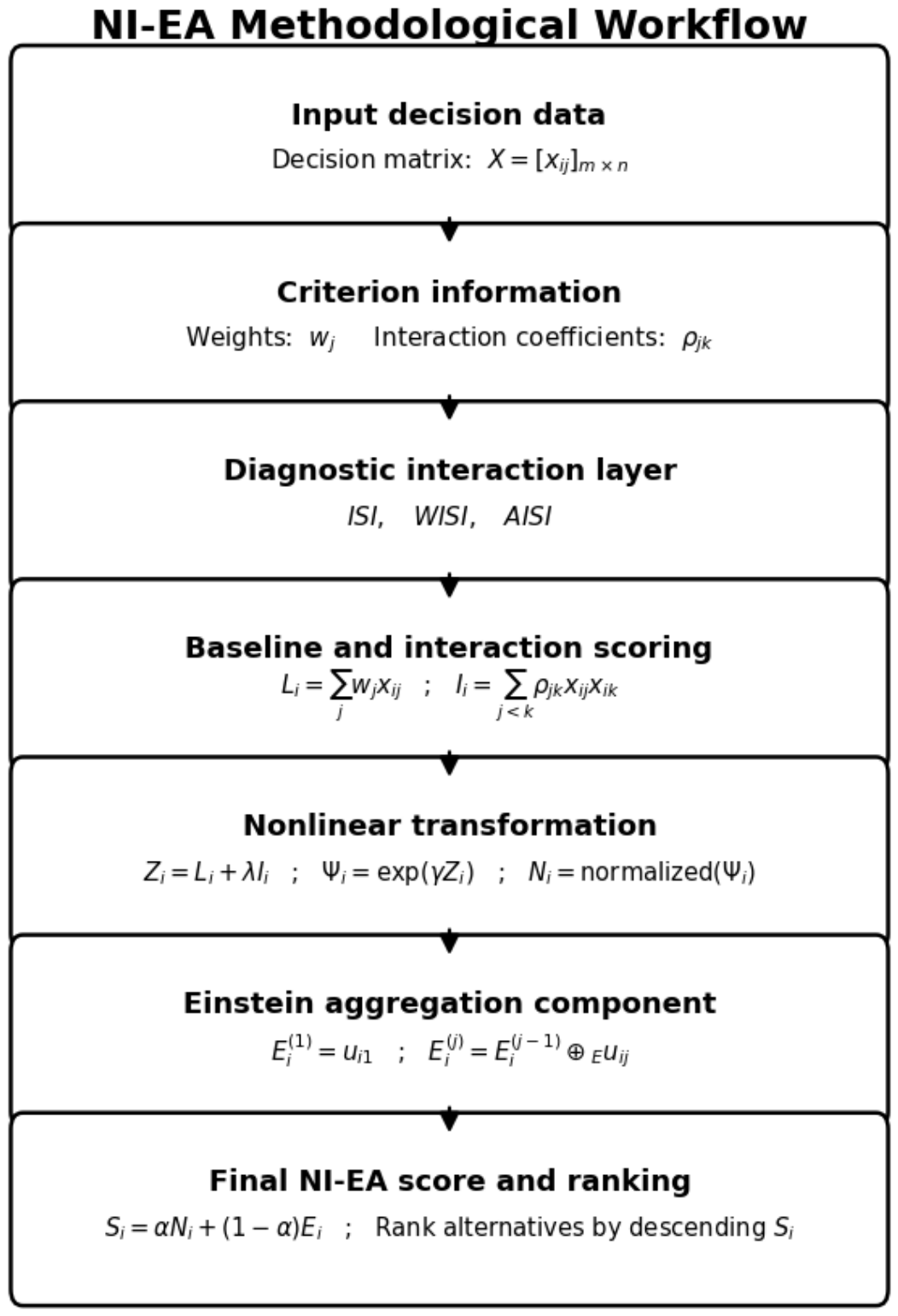
Table 7 positions NI-EA as a complementary framework rather than a universal replacement for established MCDM methods. Its main advantage is strongest when the decision problem includes interpretable pairwise-criterion interactions that should be reflected in the final ranking.
Table 8 clarifies why the EV case should not be interpreted as globally interaction-dense. Only one pair is active, but that active pair is decision-relevant and strong enough to influence the final ranking under the selected interaction strength.
Table 8.
EV diagnostic interaction profile.
| Item | Value | Interpretation |
|---|---|---|
| Number of criteria | n = 5 | Five smart-city siting criteria are considered. |
| Possible criterion pairs | 10 | The number of possible pairs is n(n - 1)/2. |
| Active interaction pair | C2-C3 | Traffic flow-grid capacity interaction. |
| Active coefficient | rho23 = 0.3 | Moderate positive synergy between demand and infrastructure support. |
| Interaction density | 1/10 = 0.10 | The interaction structure is sparse. |
| ISI | 0.03 | Low average interaction intensity across all possible pairs. |
| AISI | 0.30 | Moderate average intensity among active interactions only. |
| WISI | Depends on the selected weights | Reported when the criterion weight vector is explicitly specified. |
| Main implication | Rank shift toward L3 | The preference shift is linked to demand-infrastructure alignment rather than arbitrary score inflation. |
Table 9.
Computational complexity of the NI-EA model.
| Component | Main operation | Complexity |
|---|---|---|
| Linear scoring | Compute Lᵢ for all alternatives | O(mn) |
| Pairwise interaction | Evaluate active or full criterion pairs | O(mn²), or O(m|ₐ|) for sparse active pairs |
| Nonlinear transformation | Compute Ψᵢ and normalize Nᵢ | O(m) |
| Einstein recursion | Compute Eᵢ from weighted contributions | O(mn) |
| Overall NI-EA model | Dominated by pairwise interaction computation | O(mn²) |
The overall computational burden is therefore polynomial and dominated by the pairwise interaction term when all criterion pairs are evaluated. When only active interaction pairs are evaluated, the interaction step can be reduced from O(mn²) to O(m|ₐ|), where |ₐ| is the number of active criterion pairs. This supports the practical use of NI-EA in medium-scale engineering and infrastructure decision problems, while avoiding the exponential subset-parameter burden associated with full capacity-based interaction models.
The present study does not claim Monte Carlo robustness, ablation superiority, or numerical dominance over all advanced MCDM methods. Those extensions require dedicated computational experiments and are therefore treated as future research directions rather than uncalculated claims in the current manuscript.
4.9. Smart-City Planning Implications
For smart-city planning, the main implication is that EV charging infrastructure should not be evaluated as a set of independent cost, mobility, grid, and land-use indicators. The NI-EA framework supports planners by explicitly representing the interaction between urban demand and infrastructure readiness, especially the relationship between traffic flow and grid capacity.
The diagnostic indicators provide an additional planning layer. A low ISI may indicate that the overall interaction structure is sparse, while a moderate AISI can show that a specific active interaction is still decision-relevant. This distinction is useful for municipal planning teams because it separates interaction density from the strength of the active demand-infrastructure relationship.
Although the present application is illustrative, the same framework can be adapted to smart mobility hubs, public charging corridors, microgrid-connected parking facilities, and other urban energy infrastructure decisions where criteria are structurally interdependent. Therefore, the proposed framework can be used as a planning-level screening tool before detailed techno-economic, traffic-simulation, or grid-load-flow studies are conducted.
5. Conclusions
This study developed the Nonlinear Interaction-Einstein Aggregation (NI-EA) model as an interaction-aware decision-support framework for smart-city MCDM problems involving interdependent criteria. The proposed framework addresses the limitations of purely additive aggregation by integrating a linear baseline score, pairwise interaction terms, nonlinear unit-interval transformation, and Einstein aggregation within one interpretable decision structure. In addition, the study introduced ISI, WISI, and AISI as diagnostic indicators for evaluating the interaction structure before applying the final NI-EA ranking procedure.
The numerical results show that the NI-EA model preserves stable rankings when the decision structure is clear, improves score discrimination among close alternatives, and identifies meaningful ranking changes when interaction effects are present. In the smart-city EV charging-station siting application, the model shifts the preferred alternative from the location favored by the linear baseline to the location with stronger traffic-flow and grid-capacity alignment. This confirms that interaction-aware aggregation can provide more informative decision support for smart mobility and urban infrastructure planning.
The theoretical properties of boundedness, non-interaction consistency, and interaction interpretability support the mathematical soundness of the proposed framework. The algorithmic formulation further improves reproducibility and allows the model to be implemented in spreadsheet software, MATLAB, Python, or other computational environments. Future work may extend the NI-EA model through Monte Carlo robustness testing, ablation analysis, data-driven estimation of pairwise interaction coefficients ρⱼₖ, fuzzy and picture-fuzzy NI-EA variants, dynamic interaction modeling, open-source implementation, and comparative validation against Choquet integral, VIKOR, PROMETHEE, DEMATEL, and other advanced MCDM methods. These extensions should be developed with dedicated numerical experiments rather than introduced as uncalculated claims in the present study.
Author Contributions
Conceptualization, G.M.; methodology, G.M.; software, G.M.; validation, G.M., A.A., A.A.E., A.O., S.B., B.H., M.A. and A.Ab.; formal analysis, G.M.; investigation, G.M.; resources, G.M.; data curation, G.M.; writing-original draft preparation, G.M.; writing-review and editing, all authors; visualization, G.M.; project administration, G.M. All authors have read and agreed to the published version of the manuscript.
Funding
The APC was funded by the Higher Colleges of Technology (HCT), United Arab Emirates.
Institutional Review Board Statement
Not applicable.
Informed Consent Statement
Not applicable.
Data Availability Statement
The data used in this study are presented within the article. Additional supporting calculations can be made available upon reasonable request.
Acknowledgments
The authors acknowledge the academic literature and computational tools that supported the development and formatting of this manuscript.
Conflicts of Interest
The authors declare no conflicts of interest.
References
- Siksnelyte-Butkiene, I.; Zavadskas, E.K.; Streimikiene, D. Multi-Criteria Decision-Making (MCDM) for the Assessment of Renewable Energy Technologies in a Household: A Review. Energies 2020, 13, 1164. [Google Scholar] [CrossRef]
- Zavadskas, E.K.; Turskis, Z. Multiple Criteria Decision Making (MCDM) Methods in Economics: An Overview. Technol. Econ. Dev. Econ. 2011, 17, 397–427. [Google Scholar] [CrossRef]
- Piegat, A.; Sałabun, W. Nonlinearity of Human Multi-Criteria in Decision-Making. J. Theor. Appl. Comput. Sci. 2012, 6, 36–49. [Google Scholar]
- Yang, J.-B.; Xu, D.-L. Nonlinear Information Aggregation via Evidential Reasoning in Multiattribute Decision Analysis under Uncertainty. IEEE Trans. Syst. Man. Cybern. A Syst. Hum. 2002, 32, 376–393. [Google Scholar] [CrossRef]
- Sun, L.; Dong, H.; Liu, A.X. Aggregation Functions Considering Criteria Interrelationships in Fuzzy Multi-Criteria Decision Making: State-of-the-Art. IEEE Access 2018, 6, 68104–68136. [Google Scholar] [CrossRef]
- Zadeh, L.A. Fuzzy Sets. Inf. Control 1965, 8, 338–353. [Google Scholar] [CrossRef]
- Khan, S.; Abdullah, S.; Ashraf, S. Picture Fuzzy Aggregation Information Based on Einstein Operations and Their Application in Decision Making. Math. Sci. 2019, 13, 213–229. [Google Scholar] [CrossRef]
- Zaman, T.; Khan, A.; Movaheedi, Z. An Innovative Approach to Decision-Making through Cubical Fuzzy Einstein Hybrid Aggregation Operators. J. Big Data 2026, 13, 3. [Google Scholar] [CrossRef]
- Wang, W.; Liu, X. Intuitionistic Fuzzy Geometric Aggregation Operators Based on Einstein Operations. Int. J. Intell. Syst. 2011, 26, 1049–1075. [Google Scholar] [CrossRef]
- He, F.; Wu, D.; Yin, Y.; Guan, Y. Optimal Deployment of Public Charging Stations for Plug-In Hybrid Electric Vehicles. Transp. Res. Part B Methodol. 2013, 47, 87–101. [Google Scholar] [CrossRef]
- Deb, S.; Tammi, K.; Kalita, K.; Mahanta, P. Review of Recent Trends in Charging Infrastructure Planning for Electric Vehicles. Wiley Interdiscip. Rev. Energy Environ. 2018, 7, e306. [Google Scholar] [CrossRef]
- Xu, D.; Pei, W.; Zhang, Q. Optimal Planning of Electric Vehicle Charging Stations Considering User Satisfaction and Charging Convenience. Energies 2022, 15, 5027. [Google Scholar] [CrossRef]
- Malkawi, G.O.; Alfifi, H.Y. The Consistency of Positive Fully Fuzzy Linear System. In AIP Conference Proceedings; AIP Publishing LLC: Melville, NY, USA, 2017; p. 020004. [Google Scholar]
- Malkawi, G.; Ahmad, N.; Ibrahim, H. A Note on “The Nearest Symmetric Fuzzy Solution for a Symmetric Fuzzy Linear System”. Ser. Mat. 2015, 23, 173–177. [Google Scholar] [CrossRef]
- Chen, C.-T. Extensions of the TOPSIS for Group Decision-Making under Fuzzy Environment. Fuzzy Sets Syst. 2000, 114, 1–9. [Google Scholar] [CrossRef]
- Abdullah, L. Fuzzy Multi Criteria Decision Making and Its Applications: A Brief Review of Category. Procedia Soc. Behav. Sci. 2013, 97, 131–136. [Google Scholar] [CrossRef]
- Balezentiene, L.; Streimikiene, D.; Balezentis, T. Fuzzy Decision Support Methodology for Sustainable Energy Crop Selection. Renew. Sustain. Energy Rev. 2013, 17, 83–93. [Google Scholar] [CrossRef]
- Fahmi, A.; Amin, F.; Abdullah, S.; Ali, A. Cubic Fuzzy Einstein Aggregation Operators and Its Application to Decision-Making. Int. J. Syst. Sci. 2018, 49, 2385–2397. [Google Scholar] [CrossRef]
- Puzhakkara, T.J.; Jose, S. Einstein Aggregation Operators for p-, q-, and r-Fractional Fuzzy Sets: A Framework for Decision-Making in Cellular Tower Allocation. J. Fuzzy Ext. Appl. 2026, 7, 175–199. [Google Scholar]
Figure 1.
Decomposition of final proposed scores Sᵢ for EV charging-station siting. The lower segment represents the linear baseline Lᵢ, while the upper segment represents the net nonlinear adjustment (Sᵢ − Lᵢ).
Figure 1.
Decomposition of final proposed scores Sᵢ for EV charging-station siting. The lower segment represents the linear baseline Lᵢ, while the upper segment represents the net nonlinear adjustment (Sᵢ − Lᵢ).
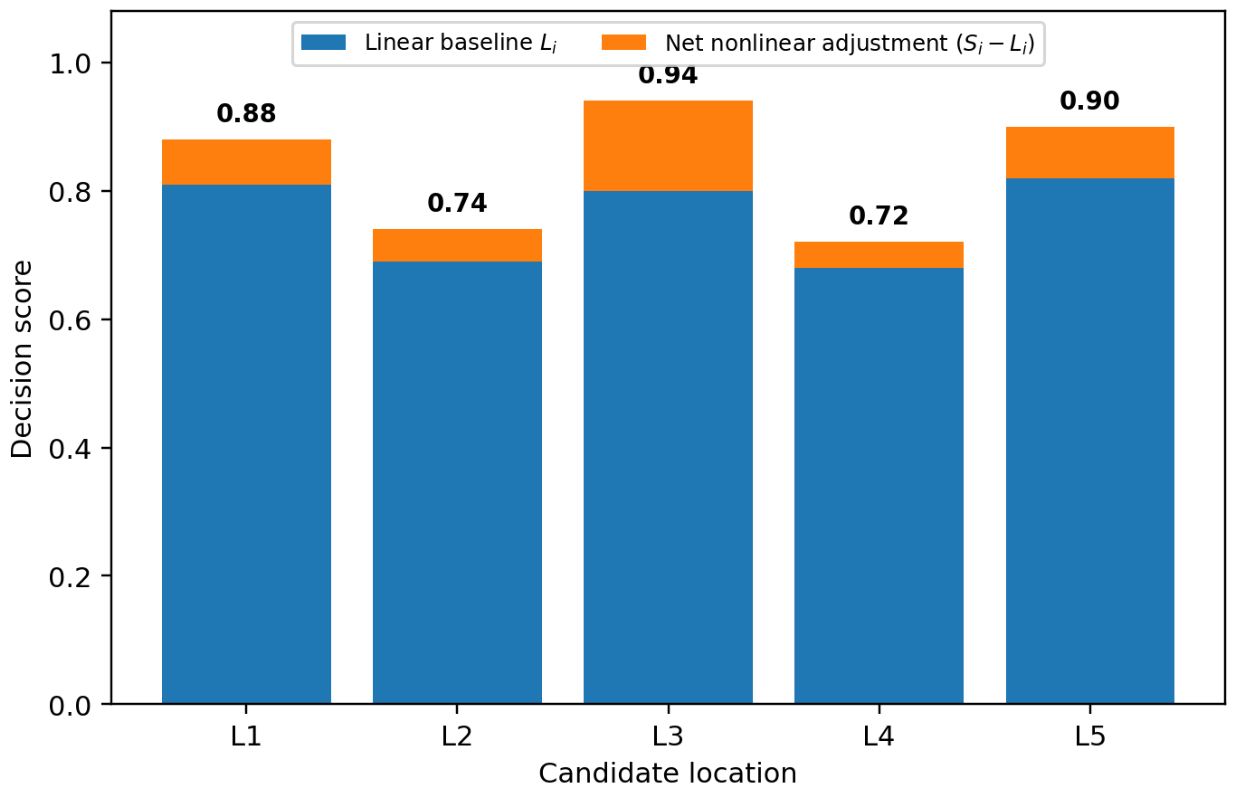
Table 3.
Comparison with existing MCDM approaches.
| Study | Method | Main capability | Ranking behavior | Main limitation |
|---|---|---|---|---|
| [17] | Fuzzy MCDM | Handles uncertainty | Stable | Ranking-focused |
| [18] | Fuzzy MULTIMOORA | Fuzzy sustainability evaluation | Stable | No interaction modeling |
| [16] | TOPSIS | Distance-based ranking | Stable | Linear and additive |
| [7] | Picture Fuzzy Einstein | Einstein-based fuzzy aggregation | Stable | Aggregation-focused |
| [4] | Evidential Reasoning | Nonlinear uncertain aggregation | Case-dependent | Partial interaction integration |
| [5] | Interaction-aware aggregation | Criteria interrelationship modeling | Case-dependent | Complex implementation |
| [19] | Einstein Aggregation | Smooth nonlinear fusion | Stable | Aggregation only |
| [20] | Fractional Fuzzy Einstein | Fractional fuzzy aggregation | Stable | No unified decision structure |
| This study | NI-EA model | Nonlinear interaction-Einstein integration | Adaptive | — |
Table 4.
Integrated dataset and model results for EV charging-station siting.
| Loc. | Cost | Traffic | Grid | Land | Dist. | Lᵢ | Sᵢ | Rank |
|---|---|---|---|---|---|---|---|---|
| L₁ | 500 | 18,000 | 4.5 | 60 | 2.0 | 0.81 | 0.88 | — |
| L₂ | 420 | 12,000 | 3.2 | 75 | 3.5 | 0.69 | 0.74 | — |
| L₃ | 600 | 25,000 | 5.0 | 55 | 5.0 | 0.80 | 0.94 | 3 to 1 |
| L₄ | 380 | 9,000 | 2.8 | 80 | 4.2 | 0.68 | 0.72 | — |
| L₅ | 470 | 15,000 | 4.0 | 65 | 1.8 | 0.82 | 0.90 | 1 to 2 |
Table 6.
Methodological interpretation of NI-EA sensitivity parameters.
| Parameter | Role in the NI-EA model | Interpretation | Numerical status in this study |
|---|---|---|---|
| λ | Controls the contribution of the interaction term Iᵢ | Higher λ increases the influence of criterion interactions on Zᵢ and Sᵢ | Calculated in Table 5 for λ = 0, 0.2, and 0.4 |
| γ | Controls the nonlinear amplification in Ψᵢ = exp(γZᵢ) | Higher γ increases score separation after the nonlinear transformation | Reported methodologically; numerical testing requires the full computational dataset |
| α | Balances Nᵢ and Eᵢ in the final score | Higher α gives more influence to the normalized nonlinear interaction component | Reported methodologically; numerical testing requires the full computational dataset |
Table 7.
Practical use guidelines for the NI-EA model.
| Decision situation | Recommended approach | Rationale |
|---|---|---|
| Criteria are approximately independent and transparency is the main priority | Weighted Sum / SAW | A simple additive model is sufficient when interaction effects are negligible. |
| Alternatives are mainly evaluated by distance from an ideal or compromise solution | TOPSIS / VIKOR | Distance-based methods are useful when the decision structure does not require explicit pairwise interaction modeling. |
| Pairwise synergy, conflict, or reinforcement is expected among criteria | NI-EA | The model explicitly represents pairwise interaction through ρⱼₖ and interprets the structure using ISI, WISI, and AISI. |
| Complex subset-based interactions must be modeled | Choquet-integral methods | Choquet models are powerful for higher-order interaction but require capacity or fuzzy-measure estimation. |
| Decision data include uncertainty, hesitation, or linguistic assessments | Fuzzy MCDM / future fuzzy NI-EA extension | Uncertain inputs may be handled through fuzzy extensions while preserving the NI-EA interaction diagnostics. |
| Smart-city infrastructure planning with mobility-grid dependency | NI-EA as an interaction-aware decision-support framework | Captures demand-capacity interaction in EV charging, smart mobility, and urban energy infrastructure. |
Disclaimer/Publisher’s Note: The statements, opinions and data contained in all publications are solely those of the individual author(s) and contributor(s) and not of MDPI and/or the editor(s). MDPI and/or the editor(s) disclaim responsibility for any injury to people or property resulting from any ideas, methods, instructions or products referred to in the content. |
© 2026 by the authors. Licensee MDPI, Basel, Switzerland. This article is an open access article distributed under the terms and conditions of the Creative Commons Attribution (CC BY) license (http://creativecommons.org/licenses/by/4.0/).
Copyright: This open access article is published under a Creative Commons CC BY 4.0 license, which permit the free download, distribution, and reuse, provided that the author and preprint are cited in any reuse.


