

Submitted:
28 May 2026
Posted:
29 May 2026
You are already at the latest version
Abstract
High-entropy transition metal carbides combine ultrahigh hardness, excellent thermal stability, and intrinsic structural disorder, making them attractive for extreme-environment applications. Using density functional theory in the generalized gradient approximation (GGA-PBE) as implemented in the ABINIT package, we systematically calculate the electronic structure and bulk modulus B of a series of (TiZrHf-X)C compositions (X = Sc, V, Nb, Ta, Mo, W) with varying average d-electron count per metal site (ndest). A 24-atom rock-salt (B1) supercell with numerical-annealing relaxation of atomic positions is employed. The calculated DOS for group IV carbides TiC, ZrC, and HfC reveals a strikingly similar electronic structure: in all three cases the Fermi level is located within a wide pseudogap—responsible for the wide carbon nonstoichiometry range—and falls precisely on a small local peak resembling a Van Hove singularity, which promotes vacancy formation even at low temperatures. Qualitatively similar DOS profiles are found for all HECs studied, indicating that this electronic stabilization mechanism persists in multi-component systems. The bulk modulus increases monotonically with ndest from 209±1 GPa for (TiZrHfSc)C to 269±2 GPa for (TiZrHfW)C. At fixed ndest, heavier homologue metals (Ta > Nb > V; W > Mo) yield higher B due to greater core-electron Pauli repulsion. A single metal vacancy reduces B by approximately 21–35 GPa and simultaneously increases configurational entropy, suggesting that metal vacancies function as an additional thermodynamic stabilizing component of the high-entropy compound.
Keywords:
high-entropy carbides
; electronic structure
; density of states
; pseudogap
; bulk modulus
; first-principles calculations
; configurational entropy
1. Introduction
High-entropy transition metal carbides (HECs) are single-phase multi-component refractory ceramics containing five or more metallic elements in near-equimolar ratios on the cation sublattice of a rock-salt (B1) structure [1,2]. The entropy-forming-ability (EFA) descriptor proposed by Sarker et al. [2] correctly predicts synthesizability of disordered five-metal carbides from first principles and opened the systematic search for these materials. The representative compound (HfTaZrNb)C exhibits a nanoindentation hardness of ~36 GPa (approximately 30% above the rule-of-mixtures prediction), while (HfZrTaNbTi)C displays metallic-like electrical resistivity (~0.09 mΩ·cm), comparable to binary TiC [1]. These properties, together with stability above 2000 °C and intrinsic carbon vacancies that further enhance electron scattering, make HECs highly attractive for thermal-protection coatings, hard tooling, and aerospace structural applications, as reviewed in [1].
The outstanding properties of binary transition metal carbides (TMCs) have been studied for decades [8,9]. Group IV–VI monocarbides (TiC, ZrC, HfC, VC, NbC, TaC) all adopt the NaCl-type structure, combining metallic conductivity with mixed covalent–ionic bonding [7,9]. A systematic DFT study showed that their cohesive energies are directly related to the bonding–antibonding gap in the DOS, with a C 2s band shift relative to diamond indicating partial ionic character [7]. A key feature of the DOS is the pronounced pseudogap—a deep minimum near the Fermi level—separating bonding from antibonding states. Our previous ab initio studies of substoichiometric TiCᵥ [5] and TiC–TiB₂ composites [6] demonstrated that the Fermi level position relative to this pseudogap governs both the equilibrium carbon-vacancy concentration and the elastic moduli. Group IV carbides exhibit wide homogeneity ranges (e.g., TiC0.64-0.98, ZrC0.79-0.99, HfC0.80-0.99) because carbon vacancies shift EF toward the pseudogap minimum, reducing the electronic subsystem energy [5,8,9]. Comprehensive treatments of vacancy ordering and nonstoichiometry are given in [8,9].
The relationship between valence electron concentration (VEC) and HEC mechanical properties has been established by high-throughput DFT combined with experiment [2,3,4]. Sangiovanni et al. [3] showed that VEC ≥ 9.4 electrons per formula unit activates transformation-induced plasticity, substantially improving fracture resistance. Temperature-dependent elastic moduli of multi-component carbides (Ti,Zr,Hf,Ta,W)C and (V,Nb,Ta,Mo,W)C determined by ab initio molecular dynamics and sound-velocity measurements confirm that B and G track VEC trends [4]. Despite this progress, the role of transition metal vacancies as simultaneous electronic and entropic stabilizers in HECs has received limited attention. In the present work we systematically calculate the DOS and bulk modulus for a series of HECs with varying composition and examine the effect of a single metal vacancy, introducing ndest—the average nominal d-electron count per metal site—as a practical design descriptor.
2. Computational Methods
All calculations were performed within DFT-GGA using the PBE functional [10] as implemented in ABINIT [11] with norm-conserving pseudopotentials. Valence configurations explicitly treated: C (2s, 2p); Ti, V (3d, 4s); Zr, Nb, Mo (4d, 5s); Sc (3d, 4s); Hf, Ta, W (5d, 6s). The plane-wave cutoff was 45 Hartree; Brillouin-zone integration used a 6×6×6 Monkhorst–Pack k-mesh (56 irreducible k-points for the 24-atom cell). SCF convergence: 10⁻⁸ Hartree in energy.
The B1 supercell contains 24 atoms: three (111) close-packed planes of 4 metal atoms each (A, B, C stacking) and three analogous carbon planes. For multi-component carbides the 12 metal sites were populated to minimize clustering of like atoms under periodic boundary conditions. Validity was confirmed by comparison with a 96-atom supercell with random site occupation: bulk modulus values agreed within 2 GPa and DOS features were qualitatively unchanged. Atomic positions were relaxed by numerical annealing following the algorithm of [5,6]; convergence: 10⁻⁶ Hartree in energy and 10⁻³ Hartree/Bohr in forces.
The bulk modulus B was determined from the linear relation B = −V₀(∂P/∂V) by computing the first-principles pressure at 7–9 isotropically strained volumes (±3% range) and fitting P vs. ΔV/V₀ by least squares; uncertainties are ±1–2 GPa.
The descriptor ndest is defined as the sum of nominal atomic d-electron counts (Sc: 1; Ti, Zr, Hf: 2; V, Nb, Ta: 3; Mo, W: 4) divided by the total number of metal sites (including any vacancy). It is important to emphasise that ndest is an estimated, rather than exact, quantity. The actual d-electron count at a given metal site differs from the free-atom value for two reasons. First, in the metallic environment of a carbide the broad s-subband overlaps with the narrower, partially filled d-subband, leading to s→d electron transfer: for early transition metals such as Ti, Zr, and Hf the true d-electron count therefore exceeds the free-atom value of 2. Second, the M–C bond has a partial ionic character, so electron density is transferred from the metal atom toward the more electronegative carbon atom [5,7], reducing the total electron count on the metal site. These two effects partially compensate each other, but their magnitudes differ across the transition-metal series. Consequently, ndest correctly reflects only the trend of d-electron filling upon compositional change and should not be interpreted as the true local d-electron count.
3. Results and Discussion
3.1. Electronic Structure of Binary Group IV Carbides
Figure 1 shows the calculated DOS for TiC, ZrC, and HfC—the three group IV monocarbides (the spectra are plotted on the same energy scale and shifted vertically for clarity). A strikingly similar electronic structure is observed in all three cases, in full agreement with the detailed analysis performed earlier for TiC [5]. The common features are the following.
(i) The Fermi level (marked by a vertical arrow for each compound) is located within a wide pseudogap—a pronounced minimum in the DOS that separates predominantly bonding states at lower energies from antibonding states at higher energies. The presence of this wide pseudogap determines the thermodynamic stability of carbon-deficient compositions and is directly responsible for the wide homogeneity ranges observed on the phase diagrams of group IV carbides [5,8,9] (Table 1): carbon vacancies shift EF toward the pseudogap minimum, lowering the band-structure energy and thereby offsetting the enthalpy cost of vacancy formation.
(ii) The Fermi level falls precisely on a small local DOS peak whose shape is reminiscent of a Van Hove singularity. Such a peak arises when the electronic dispersion has a flat region—which can be induced by partial fulfilment of Bragg diffraction conditions in the fcc metal sublattice near the Brillouin zone boundary—causing a sharp accumulation of states in a narrow energy window. Because this peak lies exactly at EF, even a modest reduction in electron count (i.e., even a low concentration of carbon vacancies) lowers the total energy by shifting EF off the peak into the pseudogap minimum. This explains why group IV carbides contain a non-negligible equilibrium concentration of carbon vacancies even at comparatively low temperatures [5,8].
In contrast, group VI carbides (WC, MoC) have a higher d-electron count, placing EF well above the pseudogap minimum, and accordingly exhibit virtually no carbon nonstoichiometry [8,9].
Table 1 summarises the experimental melting points and homogeneity ranges; the progressive narrowing from group IV to group VI is fully consistent with this electronic structure picture.
3.2. Electronic Structure of HECs: Effect of Composition and Vacancies
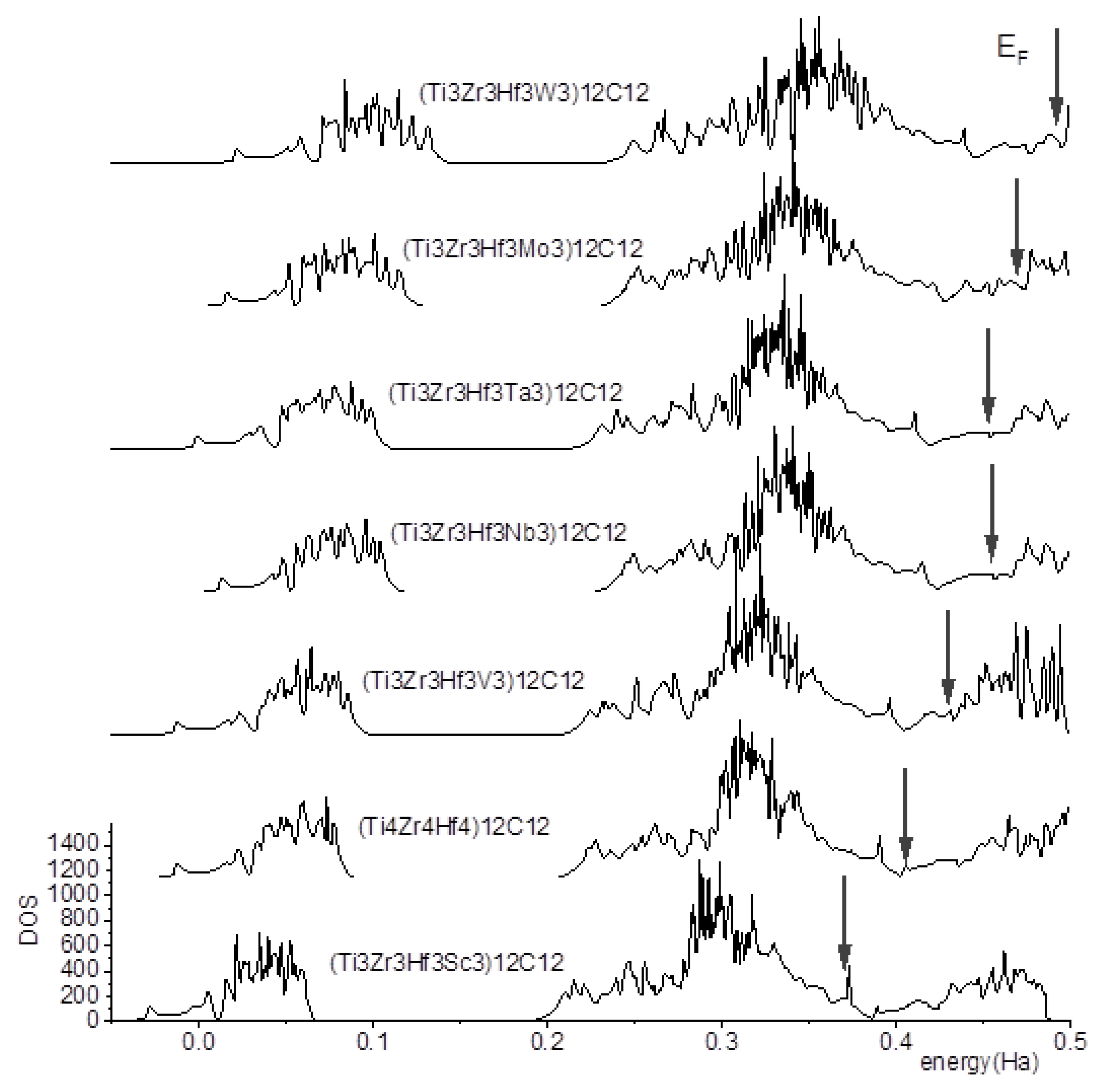
Figure 2 presents the calculated DOS for all HEC compositions without vacancies, arranged by increasing ndest from 1.75 to 2.5 (spectra plotted on the same energy scale and shifted vertically for clarity). All compositions retain a recognizable pseudogap, confirming that the electronic stabilization mechanism for carbon vacancies operative in binary group IV carbides (Section 3.1) persists in multi-component systems. As ndest increases, the DOS shifts slightly to lower energies while EF shifts more strongly to higher energies, moving progressively farther from the pseudogap minimum. This behaviour departs from a strict rigid-band model [3]: charge redistribution accompanying the addition of group V or VI elements modifies the DOS shape, leading to widening and shallowing of the pseudogap at higher ndest.
In supercells with a single metal vacancy, EF shifts toward the pseudogap minimum, but by less than predicted by the rigid-band model. We attribute the discrepancy to vacancy-induced localized states that partially fill the pseudogap. The detailed structure of these states is conditioned by the ordered vacancy arrangement in our supercell and may not quantitatively represent real materials where vacancies are distributed randomly.
From a thermodynamic standpoint, a metal vacancy contributes both electronically (reduction of band-structure energy as EF approaches the pseudogap minimum) and entropically. Treating the vacancy as an additional “component,” the ideal configurational entropy Smixing = −RΣ(xᵢ lnxᵢ) increases (xᵢ—atomic fraction of the i-th component); for example, adding one vacancy per 12-site supercell in an equimolar 4-metal HEC raises Smixing from ~1.39R to ~1.55R per mole of metal sites. At high synthesis temperatures (T > 2000 °C), the term −TΔS can drive equilibrium metal-vacancy formation [1,2]. Direct experimental quantification of metal-vacancy concentrations in HECs remains an open challenge.
3.3. Bulk Modulus: Composition and Vacancy Effects
Table 2 presents the calculated bulk moduli. For vacancy-free HECs, B increases monotonically with ndest from 209±1 GPa (ndest = 1.75) to 269±2 GPa (ndest = 2.5), reflecting progressive filling of metal–carbon bonding states [3,4,7]. At fixed ndest = 2.25, the ordering (TiZrHfV)C < (TiZrHfNb)C < (TiZrHfTa)C (239 → 254 → 260 GPa) follows the increase in filled inner electron shells: 3d → 4d → 5d metal increases core-electron Pauli repulsion, raising resistance to compression [4,7]. The same principle explains why (TiZrHfW)C (269 GPa, 5d W) exceeds (TiZrHfMo)C (256 GPa, 4d Mo) at ndest = 2.5. These values are consistent with AIMD-derived bulk moduli of (Ti,Zr,Hf,Ta,W)C (~230–255 GPa) from [4].
A single metal vacancy consistently reduces B by 21–35 GPa (Table 2), because the vacancy removes six M–C bonds and introduces local lattice distortion [5]. This softening must be accounted for when comparing DFT predictions with experimental measurements on inevitably non-stoichiometric samples. For compositional design: ndest ≈ 2.0–2.3 with 5d metals (Hf, Ta, W) maximizes stiffness, while ndest ≥ 2.3 (incorporating Mo or W) is preferable when improved fracture resistance is required, in line with the VEC ≥ 9.4 criterion [3].
4. Conclusions
First-principles GGA-DFT calculations of the electronic structure and bulk modulus for a systematic series of (TiZrHf–X)C high-entropy carbides (X = Sc, V, Nb, Ta, Mo, W) with and without metal vacancies lead to the following principal conclusions:
- The DOS of all three binary group IV monocarbides TiC, ZrC, and HfC (Figure 1) shows a strikingly similar electronic structure: the Fermi level lies within a wide pseudogap (governing the wide carbon homogeneity range) and sits precisely on a Van Hove singularity-like local peak (promoting vacancy formation even at low temperatures). This electronic stabilization mechanism extends to all HEC compositions studied, which retain a recognizable pseudogap in the DOS (Figure 2).
- The descriptor ndest correlates strongly with the bulk modulus: B increases from 209 to 269 GPa as ndest rises from 1.75 to 2.5. At fixed ndest, heavier homologue metals yield higher B due to greater core-electron Pauli repulsion. Note that ndest is a nominal quantity; the true d-electron count is modified by s–d redistribution and M→C charge transfer [5,7].
- Metal vacancies shift EF toward the pseudogap minimum and simultaneously increase configurational entropy, functioning as an additional thermodynamic stabilizing component. Their presence reduces B by ~21–35 GPa, a correction relevant for interpreting experimental data on non-stoichiometric HEC samples.
Funding
This research received no external funding
Conflicts of Interest
The authors declare no conflict of interest
References
- L. Feng, W. G. Fahrenholtz, and D. W. Brenner, Annu. Rev. Mater. Res., 51: 1 (2021). [CrossRef]
- P. Sarker, T. Harrington, C. Toher, C. Oses, M. Samiee, J.-P. Maria, D. W. Brenner, K. S. Vecchio, and S. Curtarolo, Nat. Commun., 9: 4980 (2018). [CrossRef]
- D. G. Sangiovanni, K. Kaufmann, and K. S. Vecchio, Sci. Adv., 9: eadi2960 (2023). [CrossRef]
- D. G. Sangiovanni, F. Tasnádi, T. Harrington, M. Odén, K. S. Vecchio, and I. A. Abrikosov, Mater. Des., 204: 109634 (2021). [CrossRef]
- I. V. Plyushchay, T. L. Tsaregradska, and O. I. Plyushchay, Metallofiz. Noveishie Tekhnol., 40, No. 8: 1113 (2018) (in Ukrainian). [CrossRef]
- V. Plyushchay, T. V. Gorkavenko, T. L. Tsaregradskaya, A. I. Plyushchay, and O. O. Kalenyk, Metallofiz. Noveishie Tekhnol., 43, No. 9: 1257 (2021) (in Ukrainian). [CrossRef]
- F. Viñes, C. Sousa, P. Liu, J. A. Rodriguez, and F. Illas, J. Chem. Phys., 122: 174709 (2005). [CrossRef]
- A. I. Gusev, A. A. Rempel, and A. J. Magerl, Disorder and Order in Strongly Nonstoichiometric Compounds: Transition Metal Carbides, Nitrides and Oxides (Berlin: Springer: 2001).
- L. E. Toth, Transition Metal Carbides and Nitrides (New York: Academic Press: 1971).
- J. P. Perdew, K. Burke, and M. Ernzerhof, Phys. Rev. Lett., 77: 3865 (1996). [CrossRef]
- A. H. Romero, D. C. Allan, B. Amadon, G. Antonius, T. Applencourt, L. Baguet, J. Bieder, F. Bottin, J. Bouchet, E. Bousquet, F. Bruneval, G. Brunin, D. Caliste, M. Côté, J. Denier, C. Dreyer, P. Ghosez, M. Giantomassi, Y. Gillet, O. Gingras, D. R. Hamann, G. Hautier, F. Jollet, G. Jomard, A. Martin, H. P. C. Miranda, F. Naccarato, G. Petretto, N. A. Pike, V. Planes, S. Prokhorenko, T. Rangel, F. Ricci, G.-M. Rignanese, M. Royo, M. Stengel, M. Torrent, M. J. van Setten, B. Van Troeye, M. J. Verstraete, J. Wiktor, J. W. Zwanziger, and X. Gonze, J. Chem. Phys., 152: 124102 (2020). [CrossRef]
Figure 1.
Electronic density of states of group IV monocarbides TiC, ZrC, and HfC. For each compound the Fermi level is indicated by a vertical arrow. The spectra are plotted on the same energy scale and shifted vertically for clarity.
Figure 1.
Electronic density of states of group IV monocarbides TiC, ZrC, and HfC. For each compound the Fermi level is indicated by a vertical arrow. The spectra are plotted on the same energy scale and shifted vertically for clarity.
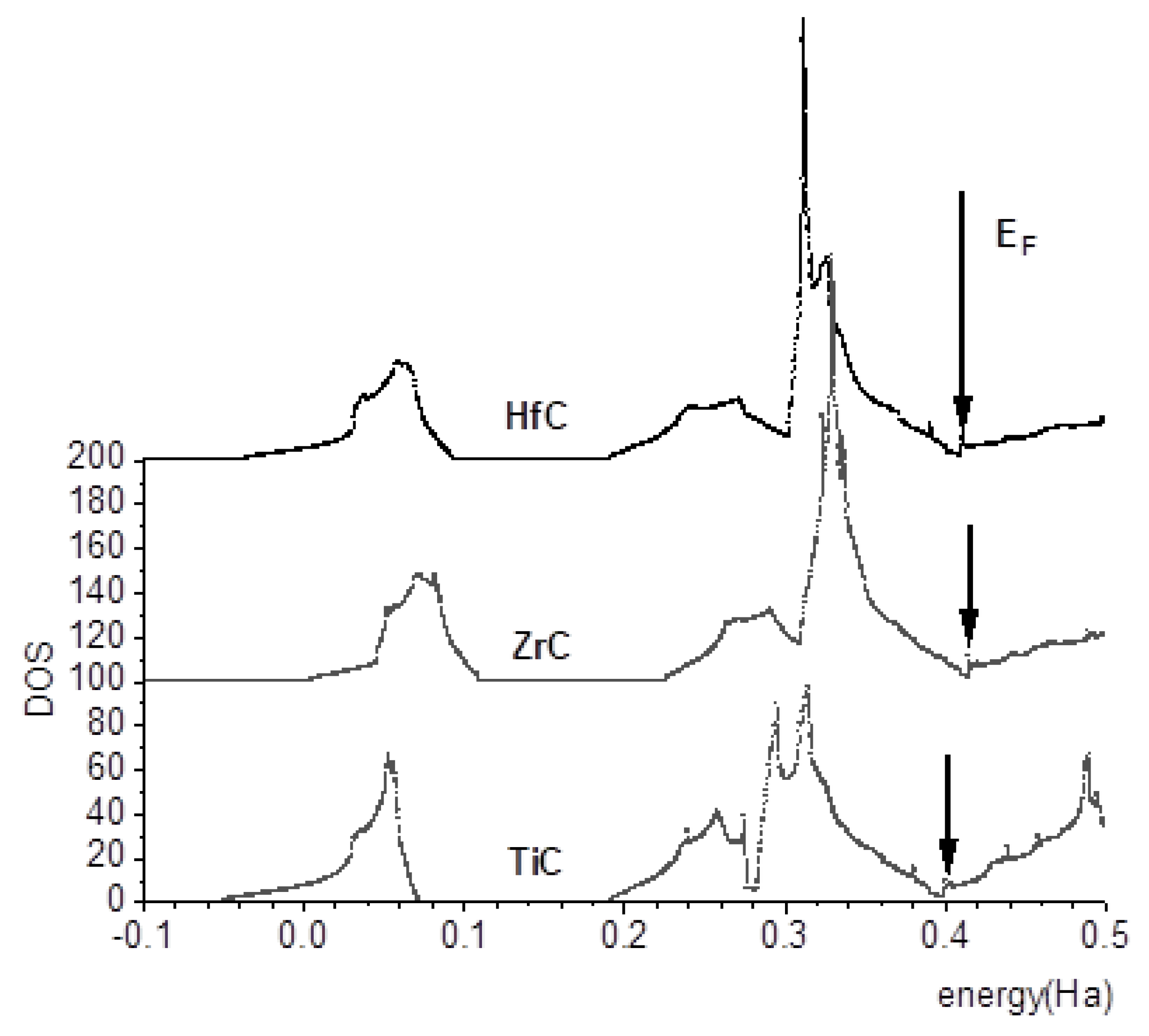
Figure 2.
Calculated density of states for high-entropy transition metal carbides without vacancies, arranged by increasing ndest. The spectra are plotted on the same energy scale and shifted vertically for clarity. For each composition the vertical arrow indicates the position of the Fermi level.
Figure 2.
Calculated density of states for high-entropy transition metal carbides without vacancies, arranged by increasing ndest. The spectra are plotted on the same energy scale and shifted vertically for clarity. For each composition the vertical arrow indicates the position of the Fermi level.

| Carbide | Tₘ (°C) | C content (at.%) |
|---|---|---|
| TiC | 3160 | 32–49 |
| ZrC | 3530 | 39.5–49.5 |
| HfC | 3950 | 40.2–49.7 |
| VC | 2830 | 41.8–46.8 |
| NbC | 3610 | 42.5–49.8 |
| TaC | 3985 | 43.7–50 |
| MoC | 2690 | 39–44* |
| WC | 2870 | 50–66.7* |
Table 2.
Calculated bulk modulus B and ndest for HECs without (left) and with one metal vacancy □ (right).
Table 2.
Calculated bulk modulus B and ndest for HECs without (left) and with one metal vacancy □ (right).
| Composition (no vac.) |
ndest | B (GPa) | Composition (with vac.) |
ndest | B (GPa) |
|---|---|---|---|---|---|
| (Ti₃Zr₃Hf₃Sc₃)₁₂C₁₂ | 1.75 | 209.4±1.1 | — | — | — |
| (Ti₄Zr₄Hf₄)₁₂C₁₂ | 2.00 | 233.2±1.5 | — | — | — |
| (Ti₃Zr₃Hf₃V₃)₁₂C₁₂ | 2.25 | 239.4±1.2 | (Ti₃Zr₃Hf₃V₂□)₁₁C₁₂ | 2.00 | 218.4±1.3 |
| (Ti₃Zr₃Hf₃Nb₃)₁₂C₁₂ | 2.25 | 253.5±1.1 | (Ti₃Zr₃Hf₃Nb₂□)₁₁C₁₂ | 2.00 | 221.0±1.4 |
| (Ti₃Zr₃Hf₃Ta₃)₁₂C₁₂ | 2.25 | 259.7±1.3 | (Ti₃Zr₃Hf₃Ta₂□)₁₁C₁₂ | 2.00 | 224.6±1.2 |
| (Ti₃Zr₃Hf₃Mo₃)₁₂C₁₂ | 2.50 | 255.7±1.5 | (Ti₃Zr₃Hf₃Mo₂□)₁₁C₁₂ | 2.16 | 231.1±1.3 |
| (Ti₃Zr₃Hf₃W₃)₁₂C₁₂ | 2.50 | 269.4±1.5 | (Ti₃Zr₃Hf₃W₂□)₁₁C₁₂ | 2.16 | 240.0±1.4 |
Disclaimer/Publisher’s Note: The statements, opinions and data contained in all publications are solely those of the individual author(s) and contributor(s) and not of MDPI and/or the editor(s). MDPI and/or the editor(s) disclaim responsibility for any injury to people or property resulting from any ideas, methods, instructions or products referred to in the content. |
© 2026 by the authors. Licensee MDPI, Basel, Switzerland. This article is an open access article distributed under the terms and conditions of the Creative Commons Attribution (CC BY) license (http://creativecommons.org/licenses/by/4.0/).
Copyright: This open access article is published under a Creative Commons CC BY 4.0 license, which permit the free download, distribution, and reuse, provided that the author and preprint are cited in any reuse.


