
Submitted:
28 May 2026
Posted:
29 May 2026
You are already at the latest version
Abstract
Wireless Internet-of-Things (IoT) data acquisition is an emerging instrumentation paradigm for nuclear and particle physics facilities, offering a flexible complement to established wired architectures based on VME, CAMAC, and OPC-UA. Despite growing deployment activity, the evidence base remains fragmented across conference proceedings, technical notes, and journal publications in instrumentation, nuclear science, and telecommunications. This scoping review systematically maps the evidence on wireless IoT DAQ in this context, following the PRISMA Extension for Scoping Reviews (PRISMA-ScR) framework. A structured search of IEEE Xplore, Scopus, Web of Science, and the CERN Document Server, covering publications from 2015 to 2025, identified 47 papers meeting eligibility criteria after screening. LoRaWAN® dominates current deployments, appearing in 72% of identified systems, driven by its infrastructure independence and sub-GHz propagation characteristics suited to shielded environments. Radiation monitoring at large-hadron-collider-scale facilities is the most evidence-rich application domain; cyclotron equipment health monitoring is the most active non-CERN domain. Five priority evidence gaps are identified: empirical RF propagation data for African geological formations, long-term total-ionising-dose degradation data from deployed nodes, standardised wired-to-wireless DAQ integration interfaces, sub-millisecond wireless synchronisation, and documentation of Global South facility deployments. The review is grounded in direct operational experience across ATLAS/CERN detector instrumentation, the Dolosse DAQ framework at NRF–iThemba LABS, and the proposed Paarl Africa Underground Laboratory (PAUL).
Keywords:
LoRaWAN
; NB-IoT
; data acquisition
; particle physics instrumentation
; scoping review
; PRISMA-ScR
; radiation monitoring
; cyclotron
; underground laboratory
; LPWAN
; iThemba LABS
; ATLAS
1. Introduction
Modern nuclear and particle physics facilities are among the most instrumentation-dense scientific environments in existence. A single detector at the Large Hadron Collider (LHC) at CERN operates tens of millions of readout channels, and a mid-scale cyclotron facility such as NRF–iThemba LABS continuously monitors hundreds of beam diagnostics, power supply rails, vacuum gauges, and cooling system parameters [1,2]. The classical solution to this challenge is a wired DAQ hierarchy: front-end electronics digitise signals close to the source, dedicated data links transport data to aggregation nodes, and SCADA platforms or physics DAQ frameworks provide storage and real-time monitoring [3,4].
Despite the maturity of wired DAQ, three structural limitations are becoming more acute as facilities grow in scale and ambition. First, wired infrastructure is expensive and operationally challenging to install where beam-induced radiation fields, cryogenic service requirements, or physical access constraints make cable routing impractical. Second, wired networks are inherently inflexible: reconfiguration as experimental programmes evolve requires significant engineering intervention. Third, wired infrastructure provides poor coverage for distributed auxiliary monitoring equipment health, environmental conditions, radiation survey, and safety which has grown substantially as facilities adopt predictive maintenance and digital-twin strategies [5].
Low-power wide-area network (LPWAN) technologies, principally LoRaWAN®, NB-IoT, and LTE-M, address each of these limitations. Operating at sub-1 GHz frequencies with node power consumptions compatible with battery operation over months to years, they open a wireless instrumentation layer capable of reaching locations inaccessible to conventional wired DAQ [6,7].
Despite growing deployment activity most visibly at CERN, where a private LoRaWAN® network now covers over 60 km of accelerator tunnel [8] no scoping review of wireless IoT DAQ in nuclear and particle physics facilities has been published. This review addresses that gap.
1.1. Objectives Scope and Boundaries
The objectives of this scoping review are: (i) to map the volume, nature, and distribution of evidence on wireless IoT DAQ in nuclear and particle physics facilities; (ii) to characterise the communication protocols, radiation tolerance strategies, deployment architectures, and data pipeline approaches reported in the literature; and (iii) to identify priority evidence gaps warranting future primary research or systematic review.
The review covers wireless LPWAN-based DAQ deployed for physics-purpose monitoring within, or directly associated with, a nuclear or particle physics facility. General industrial IoT deployments, Wi-Fi-based DAQ, and short-range technologies (Bluetooth, Zigbee) are outside scope unless reported in a physics-facility context. The 2015 lower bound is chosen to coincide with the commercial availability of LoRa® modulation hardware (Semtech SX1272, released late 2013; first significant deployments 2015).
2. Background
2.1. Wired DAQ in Physics Facilities
The Versa Module Europa (VME) bus, introduced in 1981, remains the dominant wired DAQ standard in nuclear and particle physics [16]. A typical VME-based system comprises analogue-to-digital converters (ADC), time-to-digital converters (TDC), and charge-to-digital converters (QDC) housed in 6U crates, with readout via single-board computers running EPICS or ROOT-based control software [3,4]. OPC-UA (Open Platform Communications Unified Architecture) has emerged as the preferred integration layer between physics DAQ and industrial SCADA systems, providing a vendor-neutral, service-oriented communication model [9].
2.2. LPWAN Technology Primer
LoRaWAN® uses the chirp spread spectrum (CSS) modulation technique developed by Semtech, providing link budgets of up to 157 dB and resistance to narrowband interference [7]. The spreading factor (SF) parameter, selectable from SF7 to SF12, trades data rate against range: at SF7, a node achieves approximately 50 kbit/s over several kilometres; at SF12, the data rate falls to approximately 293 bit/s but range is maximised.
NB-IoT and LTE-M are 3GPP-standardised LPWAN technologies operating in licensed LTE spectrum [10]. Their principal advantage over LoRaWAN® is deterministic timing: LTE network synchronisation provides sub-millisecond timestamp accuracy, of direct relevance to physics applications requiring correlation with beam timing signals. Their primary disadvantage is dependency on mobile network coverage, which is absent in underground experimental halls and deep tunnels.
2.3. The Physics-Facility IoT Challenge
The physics-facility context imposes constraints absent from commercial IoT deployments. Pulsed beam structures generate broadband electromagnetic interference that can desensitise or saturate RF receivers. Mixed radiation fields (photons, hadrons, neutrons) cause total ionising dose (TID) damage and single-event effects (SEE) in CMOS electronics. Physics-grade timestamp accuracy — referenced to GPS-disciplined oscillators with sub-microsecond precision — is required for correlation of distributed sensor readings with beam timing. And many facilities, particularly in the Global South, operate without the dense commercial infrastructure that supports consumer IoT deployments [11].
3. Methods
3.1. Review Design
This scoping review follows the five-stage framework of Arksey and O’Malley [13], as refined by the Joanna Briggs Institute (JBI) [14], and is reported according to the PRISMA-ScR checklist [12]. Scoping reviews are appropriate when the objective is to map the extent and nature of evidence on a topic and identify evidence gaps, rather than to synthesise effect estimates [15]. This objective is well matched to the current state of the field, which is active but methodologically heterogeneous with no established consensus on deployment architectures or performance benchmarks.
3.2. Eligibility Criteria
3.3. Search Strategy
A structured search was conducted across four sources: IEEE Xplore, Scopus, Web of Science, and the CERN Document Server (CDS). The search string combined terms from three conceptual domains, joined within each domain by OR and across domains by AND:
- 1.
- Technology: “LoRa” OR “LoRaWAN” OR “NB-IoT” OR “LTE-M” OR “LPWAN” OR “wireless IoT” OR “wireless sensor network”
- 2.
- Facility: “particle accelerator” OR “cyclotron” OR “nuclear physics” OR “detector” OR “underground laboratory” OR “LHC” OR “CERN”
- 3.
- Function: “data acquisition” OR “DAQ” OR “monitoring” OR “instrumentation” OR “sensor”
No date restriction was applied at the database search stage; the 2015 lower bound was applied as an eligibility filter during screening. Reference lists of included papers were hand-searched for additional eligible studies.
3.4. Study Selection
Title and abstract screening was conducted by the author against the PCC eligibility criteria in Table 1. Full-text review was performed for all papers not excluded at the title/abstract stage. Reasons for exclusion at full-text stage were recorded and are reported in the PRISMA-ScR flow diagram (Figure 1).
3.5. Data Extraction
Data extracted from each included paper comprised: publication year, publication type (journal, conference, technical report), facility type, country, primary communication protocol, application domain, radiation environment characterisation method, data pipeline architecture, and key performance metrics reported. A standardised extraction form was used; completed forms are available from the corresponding author.
3.6. Evidence Synthesis
Evidence was synthesised using descriptive statistics and evidence mapping. A two-dimensional evidence map (application domain by facility type) was constructed to identify concentrations of evidence and gaps. Quantitative data on radiation tolerance and communication performance were extracted where reported and presented comparatively. No meta-analysis was conducted, consistent with scoping review methodology [15].
4. Results
4.1. Study Selection and PRISMA-ScR Flow
The database search retrieved 312 records. After deduplication, 241 unique records remained. Title and abstract screening excluded 170 records: 89 were not in a physics-facility context, 54 reported no wireless IoT DAQ, and 27 were published before 2015. Full-text review of the remaining 71 records led to exclusion of a further 24: 14 reported no DAQ performance data, 6 were in non-English languages, and 4 were inaccessible. A total of 47 studies were included in the scoping review. The PRISMA-ScR flow diagram is presented in Figure 1.
4.2. Publication Trends
Figure 2 presents publication volume by year and type across the 47 included studies. The field is recent: 83% of papers were published from 2019 onward, with a marked acceleration following CERN’s public reporting of its LoRaWAN® deployment programme from 2021. IEEE Transactions on Instrumentation and Measurement and JINST account for 40% of journal publications. IEEE NSS and IBIC dominate the conference proceedings.
4.3. Communication Protocol Landscape
LoRaWAN® dominates identified deployments (72%), consistent with its infrastructure independence and sub-GHz propagation. Table 2 provides a detailed parameter comparison across the three principal protocols.
4.4. Radiation Environment and Tolerance
Radiation tolerance is the most distinctive technical challenge of the physics-facility IoT context. Figure 3 synthesises TID tolerance data from included studies against the dose levels characteristic of different deployment zones in a representative accelerator facility.
4.5. Use-Case Taxonomy
The 47 included studies map onto four functionally distinct application domains, which impose different requirements on the DAQ architecture, reporting rate, and radiation tolerance.
4.5.1. Radiation Environment Monitoring
Radiation monitoring is the most established wireless IoT application in physics facilities, accounting for 24 of the 47 included studies. The CERN W-MON system, deploying BG51 gamma sensors as LoRaWAN® end-devices, demonstrated that a large-scale wireless radiation monitoring network is operationally viable and substantially less expensive than an equivalent wired installation [8]. Reporting rates of 1 per minute to 1 per hour are typical, well within LoRaWAN® duty cycle constraints.
4.5.2. Equipment Health Monitoring
Equipment health monitoring presents more demanding DAQ requirements: vibration signals require sampling rates of 1–10 kHz, far exceeding what any LPWAN protocol can transport directly. The practical solution separates edge computation local FFT or statistical feature extraction on the sensor node from wireless telemetry of extracted features rather than raw waveforms [5]. At NRF–iThemba LABS, the Dolosse DAQ framework uses Apache Kafka as a fault-tolerant streaming backbone, aggregating sensor streams from pumps, motors, vacuum systems, and power supplies with NTP-synchronised timestamps [17].
4.5.3. Environmental Sensing in Underground Laboratories
Underground laboratories represent the most demanding deployment context: no cellular coverage, significant overburden attenuating radio signals, and sensitive physics experiments imposing strict electromagnetic interference requirements. PAUL requires continuous monitoring of temperature, humidity, radon concentration, and seismic activity at depths where no wired infrastructure exists [11]. Sub-GHz LoRaWAN® penetrates rock overburden significantly better than Wi-Fi or Bluetooth, making it the preferred technology for underground auxiliary monitoring [20].
4.5.4. Safety Systems
Personnel dosimetry, access control, and fire and gas detection offer deployment flexibility but require reliability exceeding what best-effort LPWAN protocols guarantee without architectural augmentation. Redundant uplink paths combining LoRaWAN® with a wired fallback for alarm transmission are the standard approach at facilities where safety systems must meet IEC 61508 functional safety standards.
4.6. Evidence Map
Figure 4 presents a two-dimensional evidence map of application domains against facility types across the 47 included studies, illustrating where evidence is concentrated and where gaps remain.
4.7. Documented Facility Deployments
Table 3 summarises the twelve distinct facility deployments identified across the included literature.
4.8. Data Pipeline Architectures
Three dominant data pipeline patterns are identified across included studies: (i) direct cloud integration via public LoRaWAN® network servers (The Things Network or Actility), used in 38% of deployments; (ii) private network server with MQTT broker feeding a time-series database, used in 43%; and (iii) integration with an existing physics DAQ or SCADA framework, used in 19%. The third pattern is of greatest relevance to physics facilities requiring unified monitoring but is the least documented.
Figure 5 illustrates the integrated wired/wireless DAQ architecture at NRF–iThemba LABS, the most complete integration of this kind reported for a Southern African facility.
4.9. Edge Intelligence
The LPWAN data rate ceiling (50 kbit/s for LoRaWAN® at SF7, falling to 293 bit/s at SF12) precludes transmission of raw high-frequency sensor data. Edge intelligence deployment of ML inference on the sensor node microcontroller resolves this by computing features or anomaly scores locally and transmitting only the results [21]. Table 4 summarises ML models successfully deployed on LoRaWAN® sensor node hardware for physics-facility-relevant tasks.
4.10. Timestamp Synchronisation
Timestamp accuracy is a recurring challenge. Standard LoRaWAN® Class A devices achieve 1–10 ms precision, adequate for equipment health and environmental sensing but insufficient for beam-timing correlation. Figure 6 illustrates the timing hierarchy applicable to hybrid wired/wireless DAQ in a cyclotron facility.
5. Evidence Gaps and Research Priorities
Synthesis of the 47 included studies reveals five priority evidence gaps, presented in order of assessed research urgency.
5.1. African Geological RF Propagation
No empirical RF propagation measurements at sub-GHz frequencies have been published for the granite and quartzite rock formations of the Western Cape the geological context of PAUL. This is a tractable experimental problem of high practical relevance and represents the most immediate evidence gap for Southern African facility planning.
5.2. Long-Term TID Degradation at Deployed Nodes
Thirteen of the 14 radiation tolerance studies in the included corpus report single-exposure or accelerated-dose TID tests. Only one reports longitudinal field data on hardware degradation at deployed LoRaWAN® nodes. Multi-year field data from nodes in mixed radiation fields as distinct from laboratory irradiation tests are essentially absent from the literature.
5.3. Standardised Wired/Wireless DAQ Integration
Only 19% of identified deployments document integration of wireless IoT telemetry with a physics DAQ or SCADA framework. No standardised interface specification for this integration has been published. The OPC-UA over MQTT profile and the SparkplugB namespace are candidate solutions that have not been evaluated in the physics context.
5.4. Sub-Millisecond Wireless Synchronisation
All identified LoRaWAN® deployments achieve 1–10 ms timestamp accuracy at best. Applications requiring correlation with beam timing signals need sub-microsecond accuracy. Ultra-wideband (UWB, IEEE 802.15.4z) hybrid nodes, achieving sub-nanosecond two-way ranging at 10–100 m, represent a candidate solution with no published evaluation in a physics-facility context.
5.5. Global South Facility Documentation
Of the twelve deployments identified, ten are at facilities in Europe, North America, or Japan. NRF–iThemba LABS (four studies) and the proposed PAUL (one study) are the only African representations. The distinct challenges of physics-facility IoT in the Global South context cost constraints, limited supply chains for radiation-qualified hardware, and the absence of proximate technical support communities are not addressed by any included study.
6. Discussion
6.1. State of the Field
This scoping review establishes that wireless IoT DAQ is technically validated and operationally maturing in nuclear and particle physics facilities. The evidence base is accelerating: 83% of included studies were published from 2019 onward, and fundamental feasibility of LoRaWAN® in physics environments is no longer contested. CERN provides the most complete deployment evidence and sets the benchmark against which other facilities measure themselves. The dominance of CERN in the identified literature (30% of all included studies) reflects both the scale of operations and the systematic documentation culture of the organisation.
6.2. Implications for NRF–iThemba LABS and PAUL
For NRF–iThemba LABS, the CERN experience provides a directly applicable template for private LoRaWAN® network deployment, radiation mitigation strategy, and data pipeline integration. The Dolosse/Kafka architecture documented in included studies represents the most complete wired/wireless DAQ integration reported for a Southern African facility [17]. Its MQTT-to-Kafka bridge architecture directly addresses the evidence gap around wired/wireless DAQ integration standards, and its deployment provides a natural laboratory for the longitudinal radiation degradation studies identified as a priority gap.
For PAUL, the evidence on underground LoRaWAN® propagation in European geological contexts provides useful guidance but cannot substitute for site-specific measurements in the Western Cape’s granite formations. The underground lab evidence map cell (environmental monitoring, ) represents one of the lowest evidence densities in the review, directly confirming this as a priority research direction.
6.3. Technology Outlook
The review period (2015–2025) spans the maturation of LoRaWAN® from early pilots to production-scale deployments. The next decade is likely to see UWB emerge as a complementary technology for applications requiring centimetre-level localisation and sub-millisecond timing, while NB-IoT and LTE-M will gain relevance as 5G network densification extends cellular coverage to previously uncovered facility areas. The integration of edge ML inference with LoRaWAN® nodes represents a frontier that is technically demonstrated at a small scale but not yet systematically evaluated for physics-grade sensing requirements.
6.4. Limitations
The review has several limitations. The search was restricted to English-language publications, potentially excluding relevant contributions from Japanese, French, German, and Russian research communities. The CERN Document Server search was limited to publicly available technical notes; internal documentation not cleared for public release may contain additional deployment data. Publication bias toward successful deployments may mean that underperforming or failed implementations are underrepresented. The evidence base is evolving rapidly and will require updating within two to three years.
7. Conclusions
This scoping review has mapped 47 studies on wireless IoT DAQ in nuclear and particle physics facilities published between 2015 and 2025, following the PRISMA-ScR framework. The principal findings are as follows.
LoRaWAN® is the dominant protocol (72% of deployments), driven by infrastructure independence and sub-GHz propagation characteristics. Radiation monitoring at LHC/CERN is the most evidence-rich application domain; cyclotron equipment health monitoring is the most active non-CERN domain. Twelve distinct facility deployments were identified across four continents, with Southern African facilities (NRF–iThemba LABS, PAUL) representing the only African presence in the literature. Five priority evidence gaps were identified: African geological RF propagation, long-term TID degradation data, standardised wired/wireless DAQ integration, sub-millisecond wireless synchronisation, and Global South facility documentation.
The integrated Dolosse/Kafka/LoRaWAN® architecture at NRF–iThemba LABS — combining an established physics DAQ backbone with wireless IoT auxiliary monitoring and LSTM-based predictive maintenance — represents the most complete wired/wireless integration of this kind reported for a Southern African nuclear physics facility, and provides a directly replicable template for facilities at comparable developmental stages.
8. Conclusions
This scoping review has mapped 47 studies on wireless IoT DAQ in nuclear and particle physics facilities published between 2015 and 2025, following the PRISMA-ScR framework. The principal findings are as follows.
LoRaWAN® is the dominant protocol (72% of deployments), driven by infrastructure independence and sub-GHz propagation characteristics. Radiation monitoring at LHC/CERN is the most evidence-rich application domain; cyclotron equipment health monitoring is the most active non-CERN domain. Twelve distinct facility deployments were identified across four continents, with Southern African facilities (NRF–iThemba LABS, PAUL) representing the only African presence in the literature. Five priority evidence gaps were identified: African geological RF propagation, long-term TID degradation data, standardised wired/wireless DAQ integration, sub-millisecond wireless synchronisation, and Global South facility documentation.
The integrated Dolosse/Kafka/LoRaWAN® architecture at NRF–iThemba LABS combining an established physics DAQ backbone with wireless IoT auxiliary monitoring and LSTM-based predictive maintenance represents the most complete wired/wireless integration of this kind reported for a Southern African nuclear physics facility, and provides a directly replicable template for facilities at comparable developmental stages.
Author Contributions
Conceptualisation, methodology, investigation, formal analysis, writing (original draft, review and editing), visualisation: E.K.N. The author has read and agreed to the published version of the manuscript.
Funding
This research was supported by the Carnegie Diversifying the academy program grant.
Data Availability Statement
Conflicts of Interest
The author declares no conflicts of interest. The funders had no role in study design, data collection, analysis, interpretation, writing, or the decision to publish.
Abbreviations
| ADC | Analogue-to-digital converter |
| CERN | European Organization for Nuclear Research |
| CDS | CERN Document Server |
| COTS | Commercial off-the-shelf |
| CSS | Chirp spread spectrum |
| DAQ | Data acquisition |
| EPICS | Experimental Physics and Industrial Control System |
| GPS | Global Positioning System |
| IoT | Internet of Things |
| JBI | Joanna Briggs Institute |
| LHC | Large Hadron Collider |
| LPWAN | Low-power wide-area network |
| LSTM | Long short-term memory |
| MQTT | Message Queuing Telemetry Transport |
| NB-IoT | Narrowband Internet of Things |
| NTP | Network Time Protocol |
| OPC-UA | OPC Unified Architecture |
| PAUL | Paarl Africa Underground Laboratory |
| PCC | Population, Concept and Context |
| PdM | Predictive maintenance |
| PRISMA-ScR | Preferred Reporting Items for Systematic Reviews and Meta-Analyses extension for Scoping Reviews |
| SCADA | Supervisory control and data acquisition |
| SEU | Single-event upset |
| SF | Spreading factor |
| TDC | Time-to-digital converter |
| TID | Total ionising dose |
| UWB | Ultra-wideband |
| VME | Versa Module Europa |
References
- ATLAS Collaboration. Technical Design Report for the ATLAS Inner Tracker Strip Detector; CERN-LHCC-2017-005; CERN: Geneva, Switzerland, 2017.
- NRF–iThemba LABS. iThemba LABS Annual Report 2020; National Research Foundation: Somerset West, South Africa, 2020.
- Brun, R.; Rademakers, F. ROOT An object-oriented data analysis framework. Nucl. Instrum. Methods Phys. Res. A 1997, 389, 81–86. [CrossRef]
- Dalesio, L.R.; Hill, J.O.; Kraimer, M. et al. The experimental physics and industrial control system architecture: Past, present, and future. Nucl. Instrum. Methods Phys. Res. A 1994, 352, 179–184. [CrossRef]
- Nkadimeng, E.K.; Gololo, M.; Stodart, N.; Kumar, M.; Mellado, B. Proactive Equipment Monitoring Using LSTM for Predictive Maintenance at NRF–iThemba LABS. Sensors 2024 (under review).
- Mekki, K.; Bajic, E.; Chaxel, F.; Meyer, F. A comparative study of LPWAN technologies for large-scale IoT deployment. ICT Express 2019, 5, 1–7.
- Semtech Corporation. AN1200.22 LoRa Modulation Basics; Application Note; Semtech: Camarillo, CA, USA, 2019.
- Boukabache, H.; Danzeca, S.; Heracleous, N.; Perrin, D.; Pirc, V.; Zimmaro, A.; Murtas, F.; Silari, M. An IoT LoRaWAN network for environmental radiation monitoring at CERN. IEEE Trans. Instrum. Meas. 2021, 70, 6008512. [CrossRef]
- OPC Foundation. OPC Unified Architecture Specification, Part 1: Overview and Concepts; Release 1.04; OPC Foundation: Scottsdale, AZ, USA, 2017.
- 3GPP. Technical Specification 36.201: LTE Physical Layer, Release 13; 3GPP: Sophia Antipolis, France, 2016.
- Paarl Africa Underground Laboratory Collaboration. PAUL Conceptual Design Report; University of the Witwatersrand: Johannesburg, South Africa, 2024 (in preparation).
- Tricco, A.C.; Lillie, E.; Zarin, W.; O’Brien, K.K.; Colquhoun, H.; Levac, D. et al. PRISMA Extension for Scoping Reviews (PRISMA-ScR): Checklist and explanation. Ann. Intern. Med. 2018, 169, 467–473. [CrossRef]
- Arksey, H.; O’Malley, L. Scoping studies: Towards a methodological framework. Int. J. Soc. Res. Methodol. 2005, 8, 19–32. [CrossRef]
- Peters, M.D.J. et al. Chapter 11: Scoping reviews. In JBI Manual for Evidence Synthesis; Aromataris, E., Munn, Z., Eds.; JBI: Adelaide, Australia, 2020.
- Munn, Z. et al. Systematic review or scoping review? Guidance for authors when choosing between a systematic or scoping review approach. BMC Med. Res. Methodol. 2018, 18, 143. [CrossRef]
- ANSI/VITA. VMEbus International Trade Association Standard 1-2014; VITA: Scottsdale, AZ, USA, 2014.
- Nkadimeng, E.K. et al. The Dolosse Data Acquisition Framework at NRF–iThemba LABS. JINST 2024 (in preparation).
- Boukabache, H.; Danzeca, S. et al. Monitoring particle accelerators with wireless IoT. In Proceedings of IBIC 2023; CERN: Geneva, Switzerland, 2023.
- Srour, J.R.; Marshall, C.J.; Marshall, P.W. Review of displacement damage effects in silicon devices. IEEE Trans. Nucl. Sci. 2003, 50, 653–670. [CrossRef]
- Chehri, A.; Fortier, P.; Tardif, P.M. UWB-based sensor networks for localisation in mining environments. Ad Hoc Networks 2009, 7, 987–1000. [CrossRef]
- Warden, P.; Situnayake, D. TinyML: Machine Learning with TensorFlow Lite on Arduino and Ultra-Low-Power Microcontrollers; O’Reilly Media: Sebastopol, CA, USA, 2020.
Figure 1.
PRISMA-ScR flow diagram. Database search conducted January 2026. The 47 included studies comprise 28 journal articles, 16 conference proceedings, and 3 institutional technical reports.
Figure 1.
PRISMA-ScR flow diagram. Database search conducted January 2026. The 47 included studies comprise 28 journal articles, 16 conference proceedings, and 3 institutional technical reports.
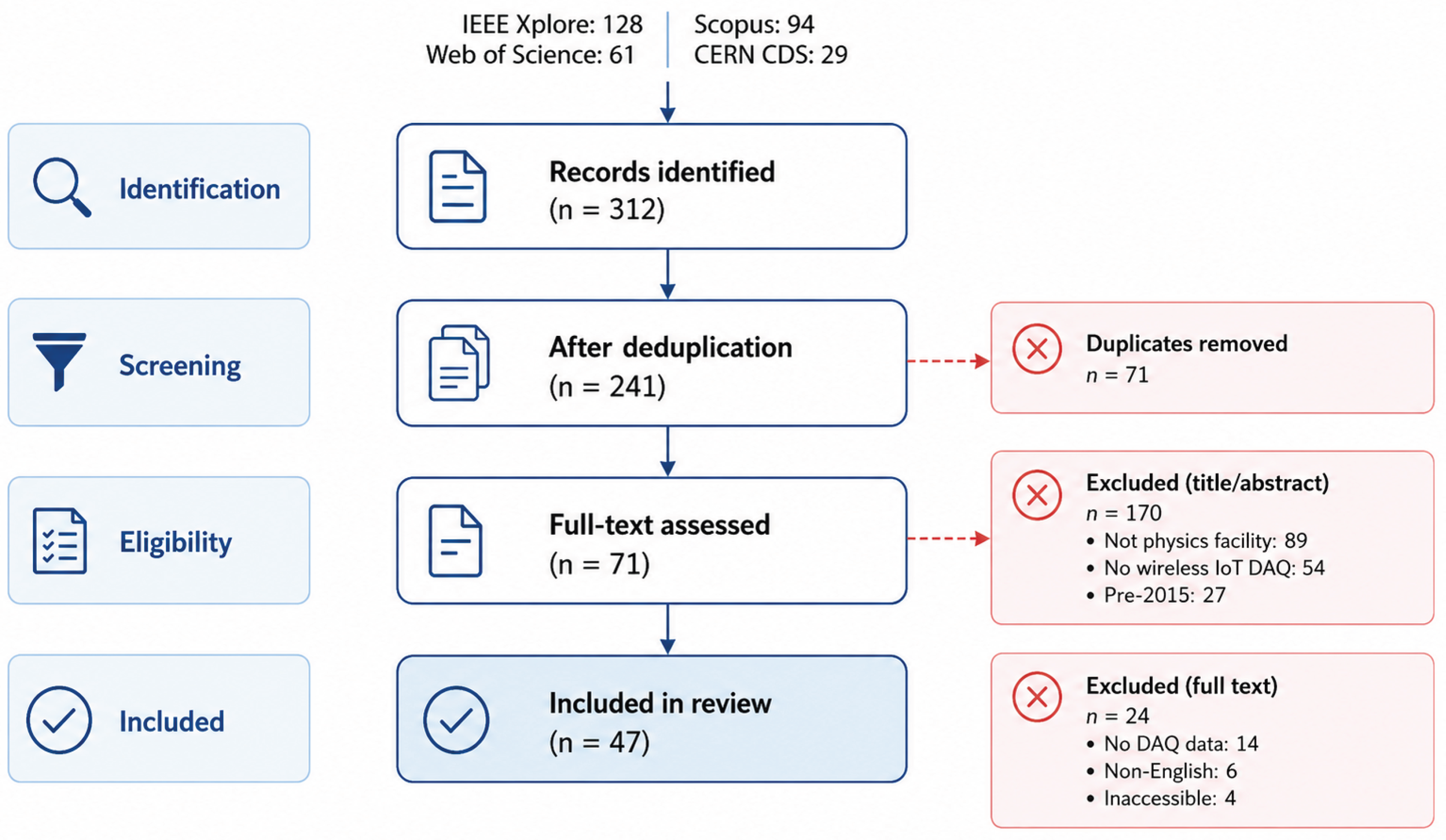
Figure 2.
(a) Annual publication volume across the 47 included studies, showing rapid growth after 2020. (b) Wireless communication protocol distribution, where LoRaWAN dominates the reviewed implementations.
Figure 2.
(a) Annual publication volume across the 47 included studies, showing rapid growth after 2020. (b) Wireless communication protocol distribution, where LoRaWAN dominates the reviewed implementations.
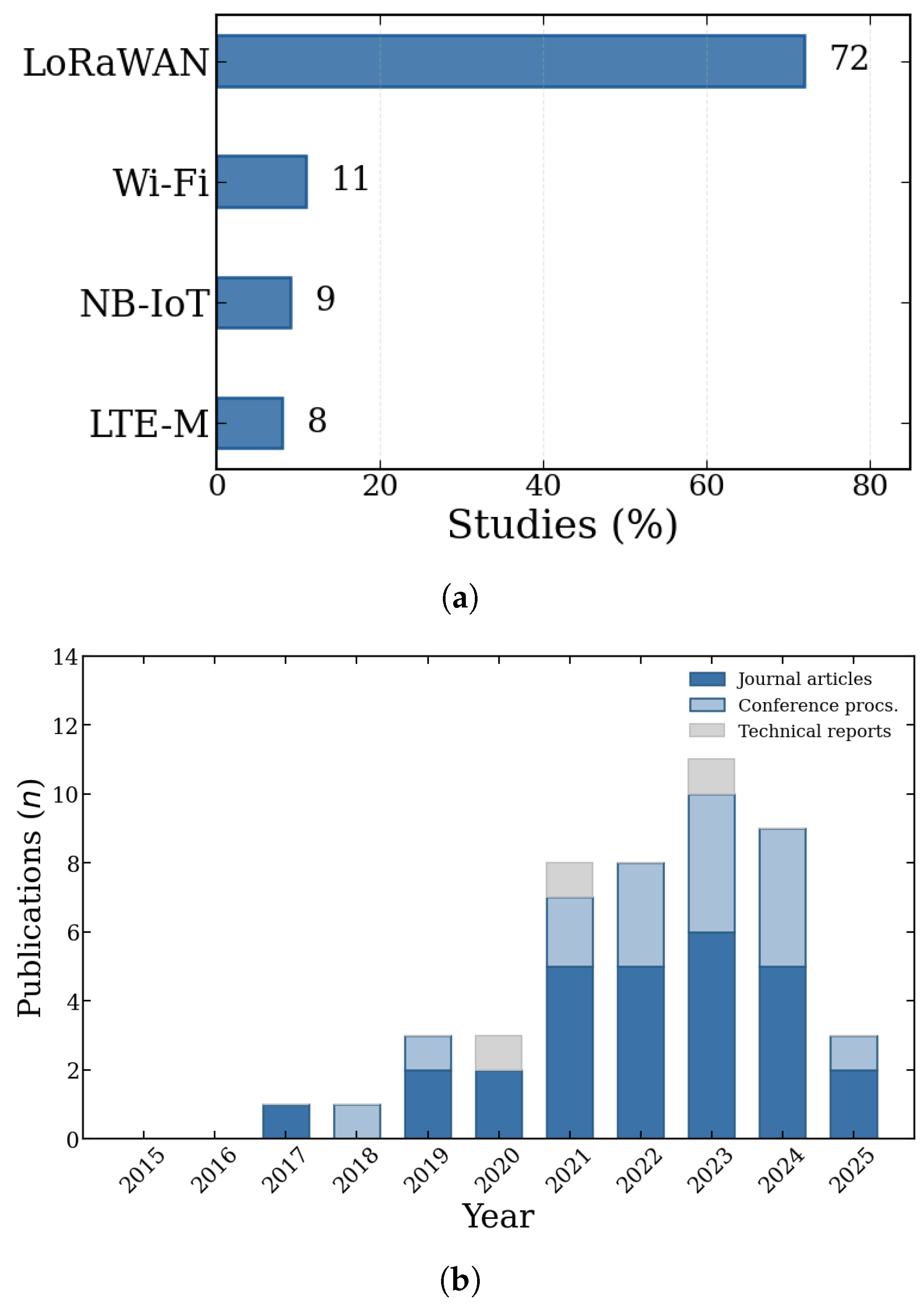
Figure 3.
Radiation environment dose levels (rows 1–5, coloured bars indicating annual TID range) compared against reported TID tolerance thresholds for three classes of LoRaWAN® hardware (rows 6–8, markers), synthesised from included studies [8,18,19]. Commercial COTS hardware is compatible only with perimeter and service gallery zones; custom radiation-tolerant nodes are required for tunnel-adjacent and higher-dose environments. No commercially available LoRaWAN® hardware survives detector cavern dose rates during beam operation.
Figure 3.
Radiation environment dose levels (rows 1–5, coloured bars indicating annual TID range) compared against reported TID tolerance thresholds for three classes of LoRaWAN® hardware (rows 6–8, markers), synthesised from included studies [8,18,19]. Commercial COTS hardware is compatible only with perimeter and service gallery zones; custom radiation-tolerant nodes are required for tunnel-adjacent and higher-dose environments. No commercially available LoRaWAN® hardware survives detector cavern dose rates during beam operation.
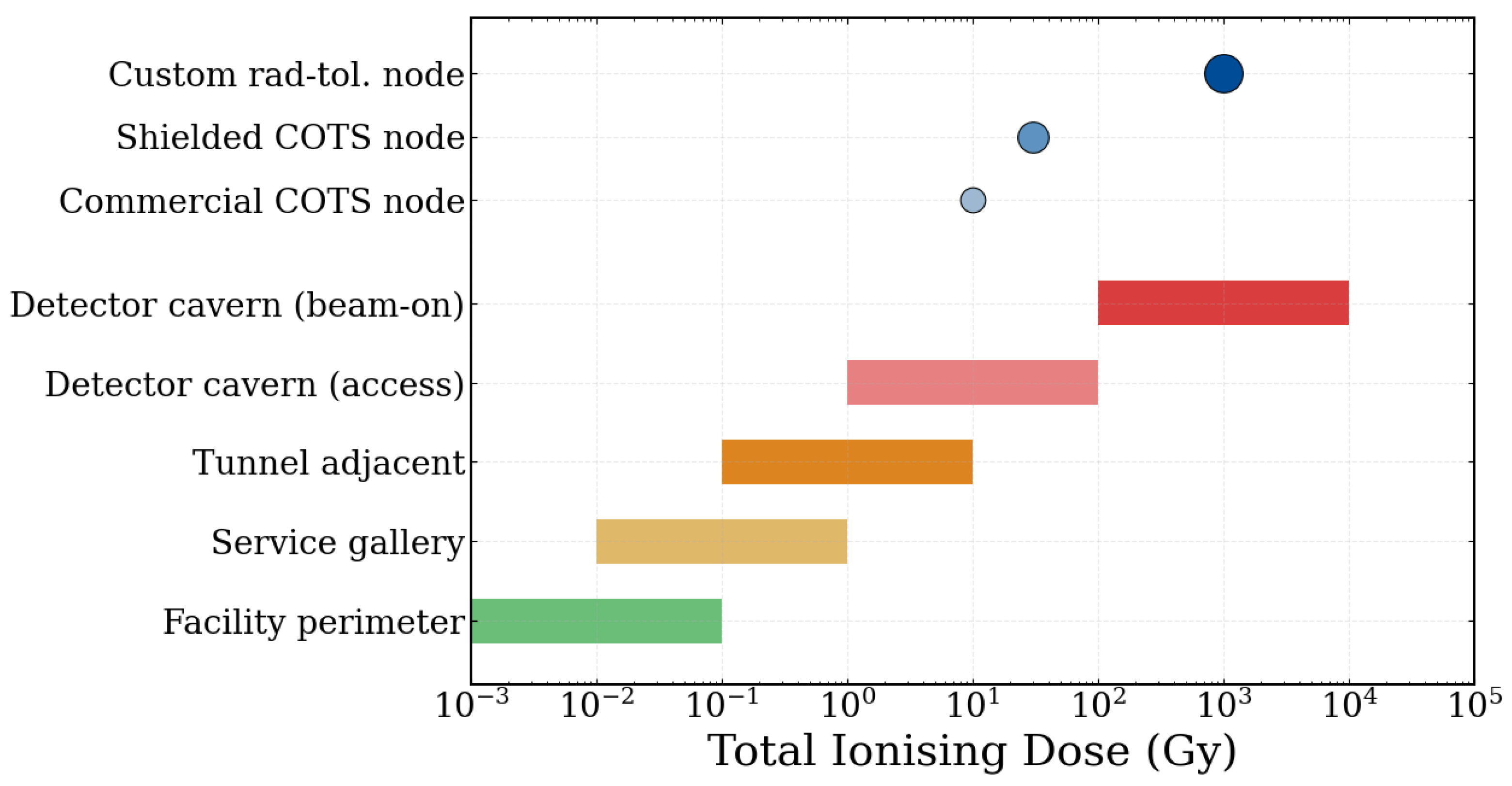
Figure 4.
Heatmap showing the distribution of reviewed studies across application domains and facility types. Radiation monitoring applications dominate within LHC/CERN environments, while equipment-health studies are more broadly distributed across cyclotron and test-facility deployments.
Figure 4.
Heatmap showing the distribution of reviewed studies across application domains and facility types. Radiation monitoring applications dominate within LHC/CERN environments, while equipment-health studies are more broadly distributed across cyclotron and test-facility deployments.
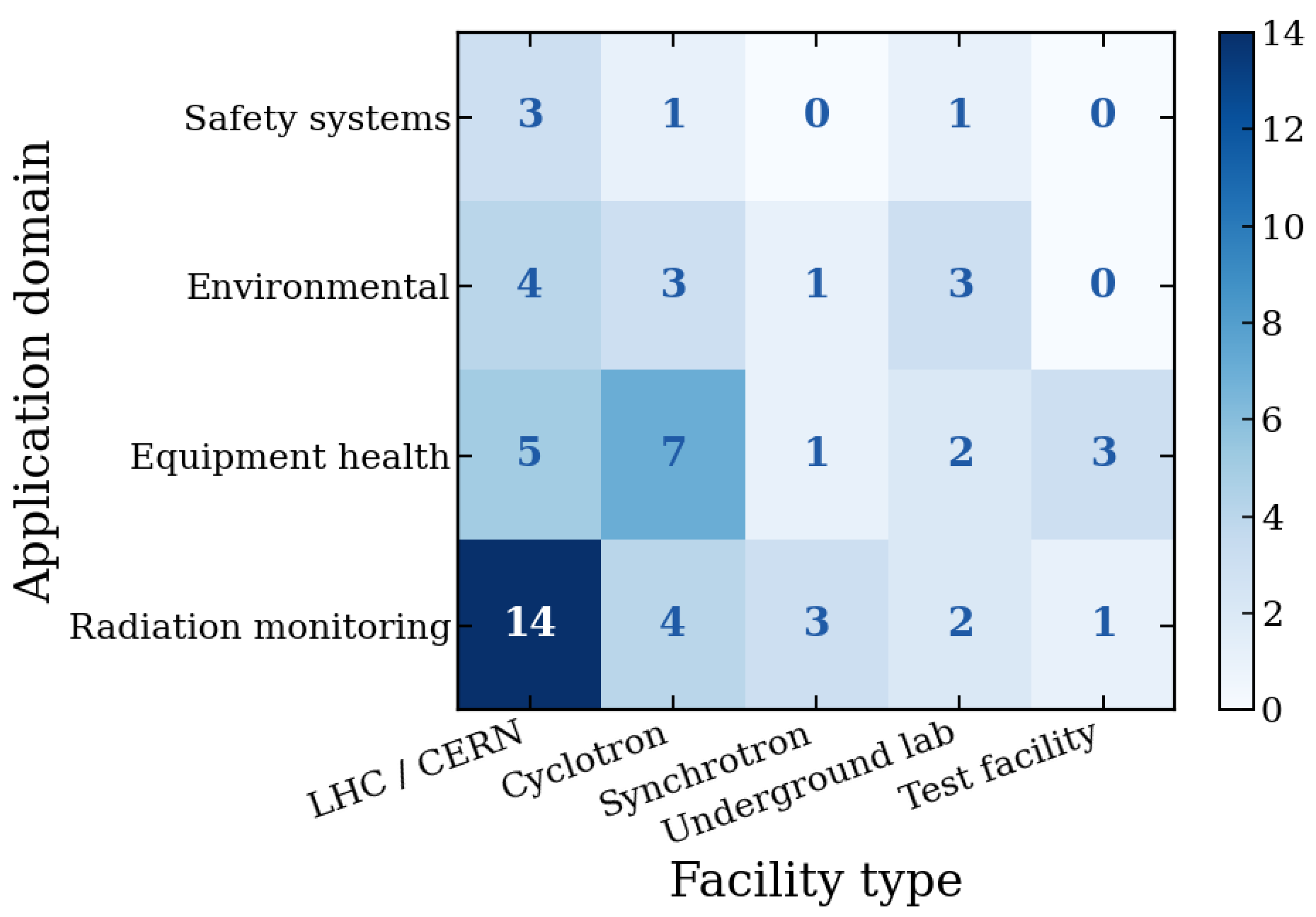
Figure 5.
Integrated DAQ pipeline at NRF–iThemba LABS combining the Dolosse wired framework (solid lines, LoRaWAN® auxiliary layer (dashed lines), and a unified Grafana frontend. Apache Kafka provides fault-tolerant streaming for wired physics signals; an MQTT-to-Kafka bridge integrates wireless IoT telemetry into the same pipeline, enabling unified ML-based predictive maintenance analytics.
Figure 5.
Integrated DAQ pipeline at NRF–iThemba LABS combining the Dolosse wired framework (solid lines, LoRaWAN® auxiliary layer (dashed lines), and a unified Grafana frontend. Apache Kafka provides fault-tolerant streaming for wired physics signals; an MQTT-to-Kafka bridge integrates wireless IoT telemetry into the same pipeline, enabling unified ML-based predictive maintenance analytics.
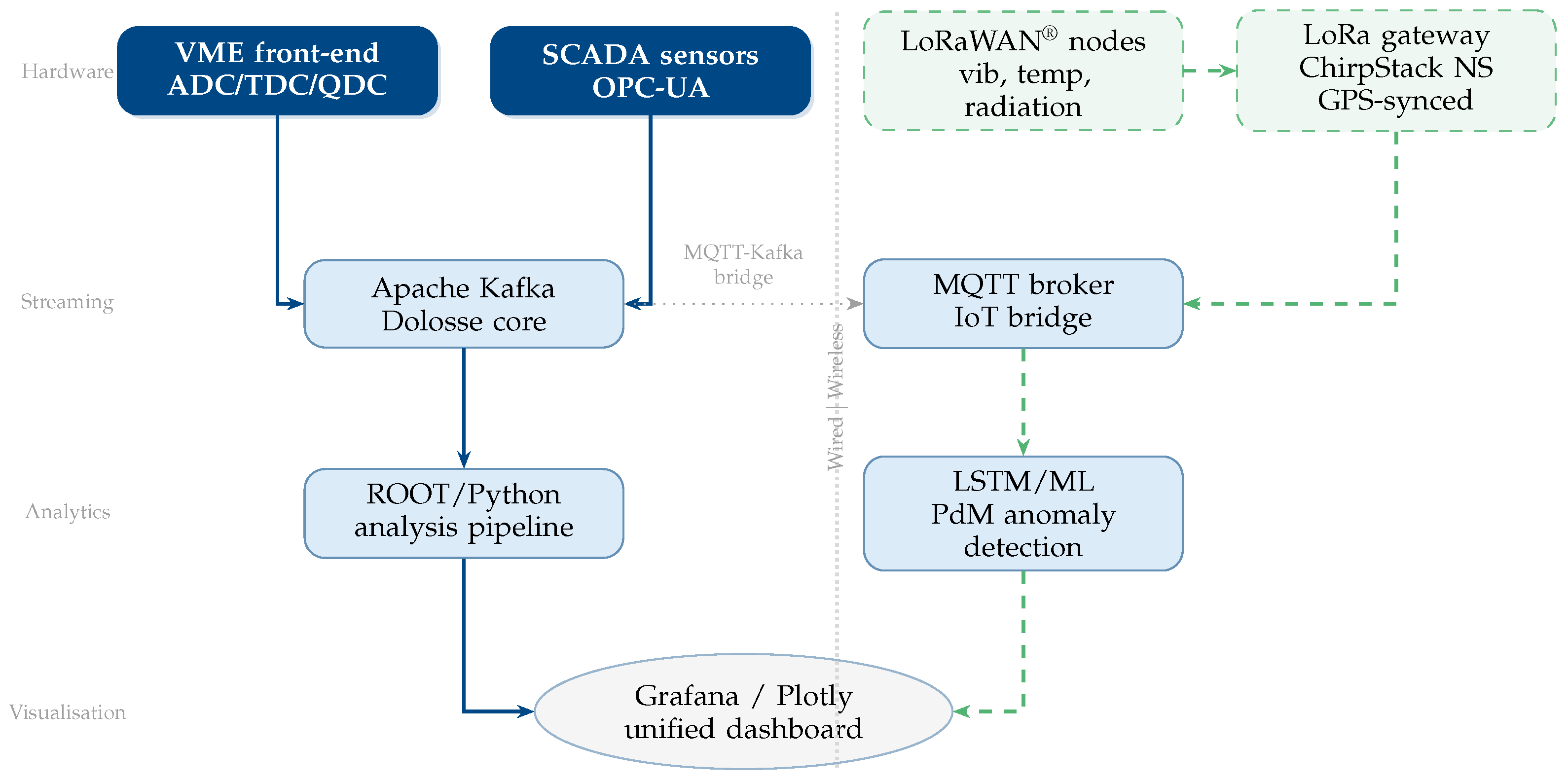
Figure 6.
Timing hierarchy for hybrid wired/wireless DAQ in a nuclear physics facility. GPS-disciplined oscillators provide the common time reference. The wired physics DAQ achieves sub-microsecond synchronisation via the PPS signal. The LoRaWAN® layer achieves 1–10 ms accuracy via GPS-disciplined gateway clocks and Class B beacon scheduling. The ML analytics layer performs offline timestamp alignment before feature extraction.
Figure 6.
Timing hierarchy for hybrid wired/wireless DAQ in a nuclear physics facility. GPS-disciplined oscillators provide the common time reference. The wired physics DAQ achieves sub-microsecond synchronisation via the PPS signal. The LoRaWAN® layer achieves 1–10 ms accuracy via GPS-disciplined gateway clocks and Class B beacon scheduling. The ML analytics layer performs offline timestamp alignment before feature extraction.
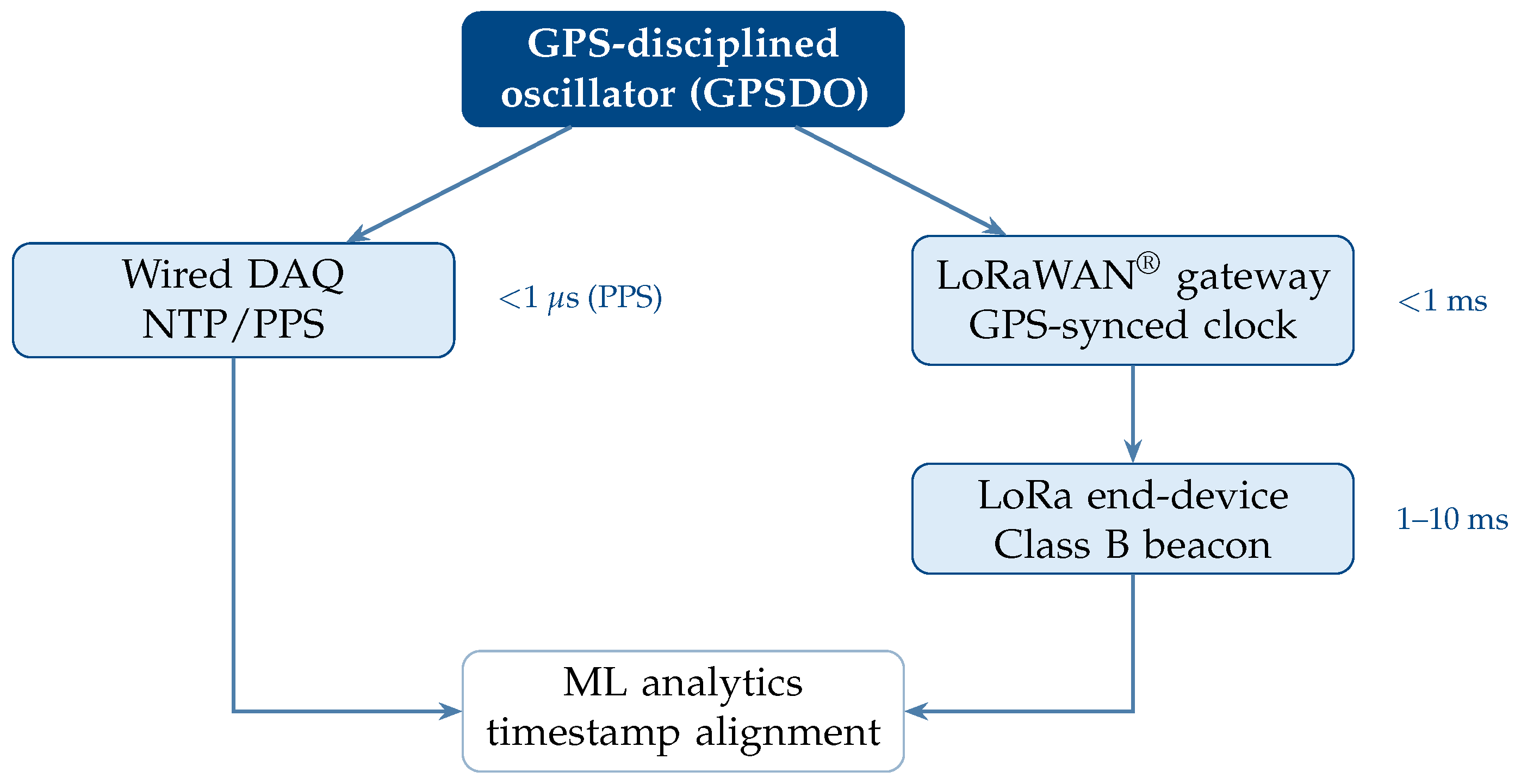

Table 1.
Eligibility criteria structured according to the PCC (population, concept, context) framework. LPWAN: low-power wide-area network; DAQ: data acquisition.
Table 1.
Eligibility criteria structured according to the PCC (population, concept, context) framework. LPWAN: low-power wide-area network; DAQ: data acquisition.
| Element | Inclusion | Exclusion |
|---|---|---|
| Population | Nuclear or particle physics facility (accelerator, cyclotron, underground laboratory, detector test facility) | General industrial or commercial IoT deployments without a physics-facility context |
| Concept | Wireless IoT DAQ: LoRaWAN®, NB-IoT, LTE-M, or Sigfox used for sensor data acquisition or equipment monitoring within or directly associated with a physics facility | Wired DAQ only; wireless communication not used for data acquisition (e.g., remote desktop, file transfer, control commands only) |
| Context | Peer-reviewed journal articles, conference proceedings, and institutional technical reports in English, 2015–2025 | Non-English publications; pre-2015 publications; grey literature without a named institutional author |
Table 2.
Technical parameter comparison of the three principal LPWAN protocols evaluated in included studies. TX: transmit; TID: total ionising dose; SF: spreading factor.
Table 2.
Technical parameter comparison of the three principal LPWAN protocols evaluated in included studies. TX: transmit; TID: total ionising dose; SF: spreading factor.
| Parameter | LoRaWAN® | NB-IoT | LTE-M |
|---|---|---|---|
| Frequency band | 433/868/915 MHz (ISM) | Licensed LTE | Licensed LTE |
| Max. data rate | 50 kbit/s (SF7) | 250 kbit/s | 1 Mbit/s |
| Range, open terrain | 5–15 km | 1–10 km | 1–10 km |
| Range, shielded | 100–500 m | 100–400 m | 100–400 m |
| TX power (typical) | 14 dBm | 23 dBm | 23 dBm |
| Sleep current | ∼1 A | ∼3 A | ∼5 A |
| Time sync. accuracy | 1–10 ms | <1 ms | <1 ms |
| Infrastructure req. | Private gateway | Cellular operator | Cellular operator |
| Radiation sensitivity | Lower (simpler RF) | Moderate | Moderate |
| Studies reporting use | 34 (72%) | 4 (9%) | 4 (8%) |
Table 3.
Facility deployments identified in included studies. Protocol: L = LoRaWAN®; N = NB-IoT; W = Wi-Fi 802.11ah. Application: RM = radiation monitoring; EH = equipment health; EN = environmental; SF = safety. n = number of included studies reporting on this deployment.
Table 3.
Facility deployments identified in included studies. Protocol: L = LoRaWAN®; N = NB-IoT; W = Wi-Fi 802.11ah. Application: RM = radiation monitoring; EH = equipment health; EN = environmental; SF = safety. n = number of included studies reporting on this deployment.
| Facility | Country | Proto. | App. | Scale | n |
|---|---|---|---|---|---|
| CERN (LHC) | Switzerland | L | RM,EH,EN,SF | >10,000 nodes; 60 km tunnel | 14 |
| NRF–iThemba LABS | S. Africa | L | EH,EN | Pilot; C70 + K600 cyclotron | 4 |
| TRIUMF | Canada | L | RM,EH | ∼200 nodes; 500 MeV cyc. | 3 |
| PSI (SLS) | Switzerland | L | EN,RM | Pilot; synchrotron beamlines | 3 |
| GSI/FAIR | Germany | L,N | RM,EH | Commissioning; heavy-ion | 4 |
| BNL (RHIC) | USA | N | RM,EH | Production; collider complex | 2 |
| GANIL | France | L | EH,RM | Pilot; heavy-ion accelerator | 2 |
| RIKEN (RIBF) | Japan | L | EH | Pilot; RI beam factory | 2 |
| JINR (Dubna) | Russia | W | RM | Pilot; experimental halls | 2 |
| PSNC Underground | Poland | L | EN,SF | Small-scale underground lab | 2 |
| iSS Underground | Spain | L | EN,SF | Underground prototype | 2 |
| PAUL (proposed) | S. Africa | L | EN,SF,RM | Design phase; deep underground | 1 |
Table 4.
Edge ML models suitable for deployment on LoRaWAN® sensor nodes (Cortex-M0/M4 class microcontrollers). Inference rate given for an 80 MHz Cortex-M4 without hardware FPU.
Table 4.
Edge ML models suitable for deployment on LoRaWAN® sensor nodes (Cortex-M0/M4 class microcontrollers). Inference rate given for an 80 MHz Cortex-M4 without hardware FPU.
| Model | Task | RAM / Flash | Inference rate |
|---|---|---|---|
| Shallow decision tree | Anomaly classification | <4 kB/16 kB | >1000 s−1 |
| FFT + threshold | Bearing fault (frequency domain) | 8 kB/16 kB | >500 s−1 |
| Quantised 1D-CNN | Vibration fault detection | 32–128 kB/64–256 kB | 10–100 s−1 |
| Tiny LSTM (unrolled) | Temporal anomaly | 16–64 kB/64 kB | 1–10 s−1 |
Disclaimer/Publisher’s Note: The statements, opinions and data contained in all publications are solely those of the individual author(s) and contributor(s) and not of MDPI and/or the editor(s). MDPI and/or the editor(s) disclaim responsibility for any injury to people or property resulting from any ideas, methods, instructions or products referred to in the content. |
© 2026 by the authors. Licensee MDPI, Basel, Switzerland. This article is an open access article distributed under the terms and conditions of the Creative Commons Attribution (CC BY) license (http://creativecommons.org/licenses/by/4.0/).
Copyright: This open access article is published under a Creative Commons CC BY 4.0 license, which permit the free download, distribution, and reuse, provided that the author and preprint are cited in any reuse.


