
Submitted:
28 May 2026
Posted:
29 May 2026
You are already at the latest version
Abstract
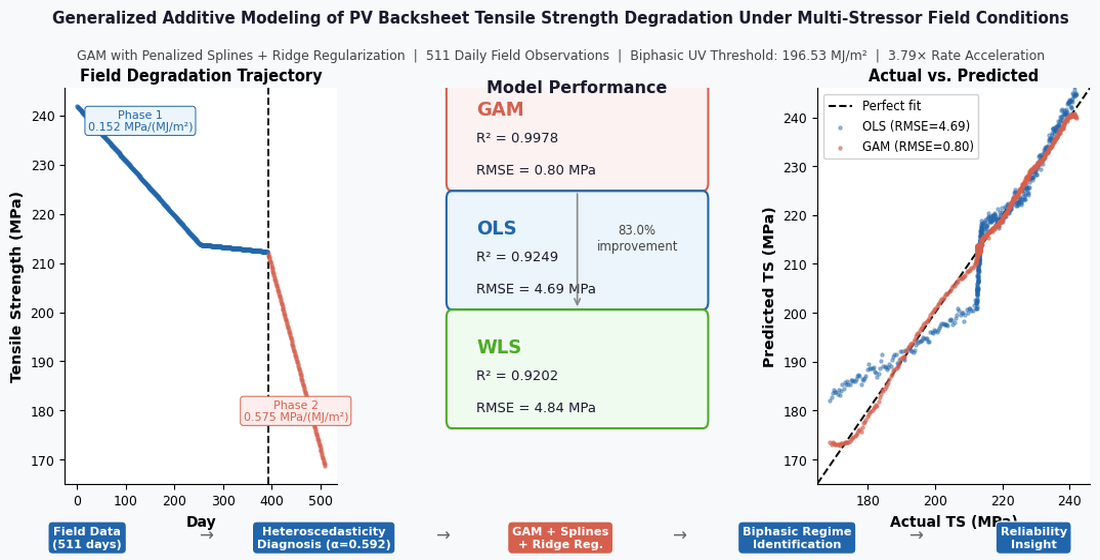
Photovoltaic (PV) backsheet polymers degrade over time when exposed to the UV, especially the loss of tensile strength in multilayer polyethylene terephthalate/ethylene vinyl acetate (PET/EVA). The traditional OLS and WLS regressions do not account for the regime dependence and nonlinearity of the kinetics. The 511 daily field measurements of a commercial PET/PET/EVA backsheet were used in this study to fit a Generalized Additive Model (GAM) with penalized thin-plate regression splines and ridge regularization. The GAM significantly outperformed benchmarks: in-sample R² = 0.9978 and RMSE = 0.80 MPa, compared to OLS (R² = 0.9249, RMSE = 4.69 MPa) and WLS (R² = 0.9202, RMSE = 4.84 MPa). The residual variance analysis revealed that the residual variance scaled with the cumulative UV dose (α = 0.5917, p < 0.001) and varied by 13.4-fold. A key finding was biphasic degradation: 0.152 MPa/(MJ/m²) in Phase 1 (UV < 196.53 MJ/m²), accelerating 3.79× to 0.575 MPa/(MJ/m²) in Phase 2. Over 511 days, tensile strength dropped 73.17 MPa (30.2% loss from 241.93 MPa initial). The results show that GAMs are a better method for modeling the reliability of PV backsheets.
Keywords:
photovoltaic backsheet
; tensile strength degradation
; generalized additive model
; penalized splines
; ridge regularization
; heteroscedasticity
Copyright: This open access article is published under a Creative Commons CC BY 4.0 license, which permit the free download, distribution, and reuse, provided that the author and preprint are cited in any reuse.


