

Submitted:
28 May 2026
Posted:
29 May 2026
You are already at the latest version
Abstract
We outline a novel, reproducible methodology for evaluating and comparing large-scale musical catalogs by merging human curatorial expertise with artificial intelligence (AI). Historically, comparative musicology between monumental artists has relied on qualitative, subjective narrative. By establishing a structured scoring matrix and utilizing AI to execute consistent data processing, this study introduces the "Musical Duel"—a quantitative framework designed to analyze the respective oeuvres of iconic 20th-century Greek composers Mikis Theodorakis and Manos Hadjidakis. Through a curated head-to-head comparison of 50 essential tracks of the same genre for each musician, we demonstrate how algorithmic normalization and AI-driven data synthesis can complement traditional music criticism, offering objective insights into cultural impact and stylistic variance without stripping the art of its inherent emotional value. Finally, we demonstrate that in addition to musical and cultural qualities, the outcome of such comparisons can be affected by strategic decisions related to the pairing of the comparative tracks. Two strategies are introduced and explained for the first time: “The Achilles First” and “The Leonidas Pass”.
Keywords:
musicology
; artificial intelligence
; Greek folk music
; Mikis Theodorkais
; Manos Hadjidakis
1. Introduction
The evaluation of musical genius has traditionally belonged to the realm of subjective criticism. When examining the cultural landscapes of 20th-century music, certain composers emerge as titanic figures whose impact defies simple categorization. In the context of modern Greek music, Mikis Theodorakis and Manos Hadjidakis stand as twin pillars, each fundamentally reshaping the nation's cultural identity through distinct artistic philosophies [1,2,3]. Theodorakis, known for his epic, sweeping orchestrations and politically charged anthems, contrastingly balances Hadjidakis, a master of intimate melodies, lyrical depth, and sophisticated, poetic textures.
While musicologists have written extensively on their historical rivalry and mutual respect [4], these analyses are predominantly narrative driven. The inherent challenge lies in the lack of a standardized metric to compare their vast catalogs. To bridge this gap between emotional resonance and scientific structure, this paper introduces the "Musical Duel" project. This framework does not aim to definitively declare one composer "superior" to the other; rather, it seeks to establish a structured, data-driven methodology that uses Large Language Models (LLMs) and quantitative scoring to map, visualize, and analyze the distinct architectural strengths of their respective musical masterpieces [5]. Our methodology supports the view that AI can be a tool for preserving and celebrating cultural heritage, providing a logical framework to support the profound emotional memories of the listener. We anticipate that this proof-of-concept technology will have wide applications in assessing objectively artistic works in music and other fields [6].
2. Methodology & Scoring Framework
2.1. Musical Tracks
To ensure a balanced and statistically viable matchup, a rigorous selection process was enacted. A curated list of 100 total compositions—comprising 50 songs from Mikis Theodorakis and 50 songs from Manos Hadjidakis—was established. The selection criteria required each track to meet specific benchmarks regarding historical longevity, commercial success, and cultural significance within the broader canon of Greek music [7]. Essentially, these catalogs of songs, as judged by the author, represent the “greatest hits” of each composer in the Greek folk song arena. All selected songs belonged to one genre, “Greek folk songs,” to avoid heterogeneity within our database.
There are some significant differences in the genres of music written by each of the two composers. Theodorakis is credited with more than 1,000 Greek folk songs and has a significant portfolio in classical music with 5 symphonies, 5 operas, 3 ballets, and cantatas, as well as several film and ancient theater scores. Hadjidakis wrote hundreds of folk songs, several scores for films and ancient theater, and piano suites. To avoid these differences, in our analysis, we compared only Greek folk songs. The selected songs for each composer are tracked in Supplementary Tables S1 and S2. We opted to keep the titles of the songs in Greek language, but using the English alphabet. Translation of the song titles in English was not favored, since the translation could render most songs unrecognizable by the readers.
In Supplementary Table S3, we outline the tracks chosen for one possible pairwise comparison and manual scoring. The pairs were randomly selected via a random number generation algorithm. For downstream macro-scale analyses, we expanded the scope to include all possible paired combinations between the song universes (50 x 50 = 2,500 combinations). Each song is provided with a YouTube link for convenient listening, if desired.
2.2. Scoring Architecture, Algorithmic Normalization, and AI Weighting
To systematically evaluate each composition without human grading fatigue, this framework establishes a specialized "Synthetic Musicology Jury" [8,9,10]. Rather than relying on holistic or binary preferences, the AI jury executes a granular, multi-dimensional assessment. Each track is evaluated across four foundational dimensions of musical composition, scored on a raw scale from 1 to 10: Melodic Strength and Complexity (MC), Lyrical Weight and Poetic Impact (LW), Orchestration and Arrangement (OA), and Cultural Impact and Longevity (CL).
To calculate a comprehensive performance metric for individual match simulations, these sub-attributes are synthesized by the AI into a normalized Quality Index (QI) using a weighted distribution model [11]:
where W1, W2, W3, and W4 represent the relative weights assigned to each respective dimension, satisfying the normalization constraint that the sum of all weights equals 1.
QI = (W1 × MC) + (W2 × LW) + (W3 × OA) + (W4 × CL)
To prevent scoring bias and maintain strict comparative equilibrium across separate evaluation sessions, these raw scores are uniformly rescaled onto a standardized 10-point curve using a classic Min-Max normalization protocol [12]:
X_norm = [(X - X_min)/(X_max - X_min)] × 9 + 1
This normalization protocol guarantees that variations in subjective scoring intensity are leveled, allowing for a mathematically sound side-by-side comparison.
2.3. AI Integration and Prompt Logic
The central innovation of this methodology is the deployment of Artificial Intelligence as an objective analytics partner [8,9]. Using targeted prompt engineering, the AI was tasked with acting as an expert cultural musicologist. The AI analyzed the historical metadata, structural composition, and lyrical thematic weight of each track, assigning standardized scores based on a predefined multidimensional scoring matrix [11,12]. By utilizing the same LLM instance under uniform behavioral constraints, we achieved a highly reproducible, rubric-based evaluation that minimizes the human fatigue and emotional drifting often associated with manual grading over a large, 100-song dataset [13].
2.4. Handling Equivocal Matches and Scored Ties
In a pairwise comparison framework evaluating high-caliber cultural works—such as the micro-tournaments between the compositions of Mikis Theodorakis and Manos Hadjidakis—instances of subjective equivalence inevitably arise. When an evaluator or an AI jury determines that two competing tracks are of equal aesthetic or emotional weight, the tie must be resolved systematically to preserve data integrity and prevent inflation. Three distinct methodological approaches have been developed to handle these equivocal matches within the scoring matrix: Method 1 (The Null Award Strategy), Method 2 (The Shared Split Strategy), and Method 3 (The Fractional Quality Index) [14].
Method 1: The Null Award Strategy (Zero-Point Assignment)
Under this strict conservative approach, when a matchup results in a definitive tie, both compositions are awarded 0 points. This prevents the artificial inflation of the overall tournament point pool. It treats a tie not as a shared victory, but as a failure of either track to establish a dominant margin of preference. This method is ideal for highlighting absolute, unambiguous dominance, as it penalizes ambiguity and forces a high threshold for a track to climb the leaderboard.
Method 2: The Shared Split Strategy (Half-Point Assignment)
This approach applies standard tournament logic where a tie results in a shared outcome, awarding 0.5 points to each composition. This keeps the total point economy stable, as every individual match consistently distributes exactly 1.0 total point to the system, regardless of whether there is a clear winner or a tie. This is the preferred method for stable statistical modeling and population-scale simulations (such as a 2,500-round matrix), ensuring that highly competitive, evenly matched songs still accumulate point value reflective of their strength against the rest of the field.
Method 3: The Fractional Quality Index (Decisive Decimal Breakdown)
To entirely eliminate statistical deadlocks, this method replaces binary or half-point scoring with a granular, multi-criteria scale (e.g., 1 to 10 scoring across distinct sub-attributes like Melodic Complexity, Poetic/Lyric Weight, and Cultural Impact). The final match score is derived from the net differential of these averages. By shifting from a single holistic preference check to a composite index, the probability of an absolute mathematical tie drops significantly. If a minor tie still occurs at the decimal level, a designated tie-breaker attribute (e.g., Cultural Impact) serves as the deciding weight. This method provides the deepest analytical breakdown for the paper, allowing researchers to showcase why two masterpieces are closely matched while still forcing a distinct hierarchy on the final leaderboard.
3. Results & Data Architecture
We present the final results of the Musical Duel tournament, comparing between 50 and 2,500 pairs of Mikis Theodorakis and Manos Hadjidakis songs.
3.1. Empirical Results and Composer Matrix Comparisons: Consolidated Tournament Scoreboard (50-Pairing Analysis)
Table 1 provides the definitive empirical breakdown of the match outcomes for the 50 selected composition pairings. The table contrasts the raw manual evaluation directly by the author (Phase I) against the three distinct, automated tie-resolution methods executed by the AI framework (Phase II).
3.2. Statistical Analysis and Behavioral Observations
- Key Finding: While Mikis Theodorakis maintains a quantitative advantage across both phases, the resolution of equivocal matches heavily shifts the competitive landscape of the tournament.
- The Impact of Ties in Phase I: In the manual evaluation, 26% of the matches (13 pairs) were classified as absolute ties, reflecting instances where the evaluator found the compositions to be of identical cultural or aesthetic value. Under Method 1 (Null Award), these 13 matches distributed 0 points, emphasizing Theodorakis's distinct margin of dominance (27 direct wins).
- The AI Forced-Choice Realignment: In Phase II, the simulation utilized an approach similar to Method 3 (Fractional Quality Index), breaking down the compositions by discrete sub-attributes (such as melodic intimacy versus epic scale) to eliminate the 13 ties.
- Resulting Trends: When forced to resolve these equivocal matches, the majority of the tied pairs broke in favor of Manos Hadjidakis (moving from 10 wins to 22). This reveals a critical qualitative trend within the dataset: Theodorakis dominates in large-scale, overt competitive pairings (epic social anthems), whereas Hadjidakis captures the marginal, highly complex, and emotionally intimate matchups when evaluated at a granular, multi-attribute decimal level.
3.3. Macro-Scale Analysis: The Complete Cross-Catalog Matrix
While the direct 50-pairing model evaluates specific, curated matchups "on the road," a comprehensive evaluation of these two distinct musical landscapes requires testing every single composition against the entirety of the opposing catalog. By crossing all 50 selected works of Mikis Theodorakis against all 50 selected works of Manos Hadjidakis, we establish a population-scale tournament matrix comprising exactly 2,500 individual head-to-head simulations. This macro-analysis eliminates selection bias and exposes the true structural strengths, qualitative floors, and aesthetic ceilings of each composer’s body of work. In this comparison, each song is awarded between 0–10 points based on the multi-attribute criteria nested within our scoring matrix framework.

Table 2.
Macro-Matrix Scoreboard (2,500 Match Simulations) Theodorakis and Hadjidakis point wins across the entire cross-catalog universe, calculated side-by-side using the three established resolution protocols to ensure statistical robustness.
Table 2.
Macro-Matrix Scoreboard (2,500 Match Simulations) Theodorakis and Hadjidakis point wins across the entire cross-catalog universe, calculated side-by-side using the three established resolution protocols to ensure statistical robustness.
| Resolution Protocol Applied |
Theodorakis Total Points |
Hadjidakis Total Points |
Ties |
Total Points Distributed |
| Method 1: The Null Award | 1,284.0 | 1,012.0 | 204 | 2,296.0 |
| Method 2: The Shared Split | 1,386.0 | 1,114.0 | 0 | 2,500.0 |
| Method 3: Fractional Index | 1,402.5 | 1,097.5 | 0 | 2,500.0 |
To capture the deeper architectural reality of the data beyond basic win frequencies, a more granular quantitative metric can be applied using the absolute raw score accumulation. This sets a maximum potential pool of 50,000 points across the 2,500 individual match simulations (10 maximum points per song + 10 points for the paired song x 2,500 = 50,000). The empirical cumulative macro-data results are structured as follows:
- Total Points Awarded in Matrix: 37,258.4 points (out of 50,000 maximum)
- Mikis Theodorakis Grand Cumulative Score: 19,241.6 points (Average track score: 7.7)
- Manos Hadjidakis Grand Cumulative Score: 18,016.8 points (Average track score: 7.2)
3.4. Elite Tier Isolation: The Top 10 High-Competition Showdown
To understand how these catalogs behave when volume is stripped away and only the absolute peak of artistic achievement is evaluated, we isolated the Top 10 highest-scoring compositions from each composer based on their average performance across the macro-matrix. Our definition of the top 10 is: the top 10 songs from each composer that achieved the highest win rates across the 2,500-match matrix simulation. Table 3 and Table 4 delineate the elite cohorts alongside their localized win percentages.
3.5. Elite Cohort Sub-Matrix (100 Match Pool)
When these twenty masterpieces collide head-to-head as pairs of two at a time, the structural quantitative advantage previously held by Theodorakis completely evaporates, collapsing into a near-perfect aesthetic equilibrium (Table 5). We must emphasize here that the scoring system registers a maximum of 10 points per pair match rather than a binary 1/0 allocation.
4. Combinatorics, Pacing, and Strategic Deployment
King Leonidas famously defeated an army of Persians many times larger than his own, demonstrating that tactical alignment can override systemic numeric volume. Similarly, we examined whether it is possible to skew the outcomes of a cultural matchup duel by utilizing algorithmic optimization strategies to intentionally pair individual songs between the two creative forces.
If we simply match the tracks randomly or by their original list order, we establish a neutral baseline control result. However, if we allow a strategist to purposefully rearrange the matchups, we enter the realm of combinatorics and optimization: The Theodorakis Maximization ("Achilles First" Strategy) and the Hadjidakis Maximization ("Leonidas Pass" Strategy).
- The Theodorakis Maximization (The "Achilles First" Strategy): To maximize Theodorakis's margin of victory, we sort his 50 songs from highest to lowest quality score and pair them against Hadjidakis’s songs sorted from lowest to highest. This ensures the strongest assets crush the weakest opposition, aggressively widening the score gap.
- The Hadjidakis Maximization (The "Leonidas Pass" Strategy): To evaluate if Hadjidakis can capture individual duel victories despite a lower global database average, we pair Hadjidakis’s absolute highest-scoring songs against Theodorakis’s lowest-scoring entries. While Theodorakis may still claim the wider overall volume war on average, Hadjidakis successfully conquers those specific isolated battles where his peak masterpieces catch Theodorakis's flank unprotected.
To execute this, we ran a specialized Python script using our 50x50 scoring matrix. The script calculated the baseline control parameters, maximized both strategic axes, isolated Hadjidakis's tactical victories, and generated the comprehensive visualization shown in Figure 1.
5. Discussion
5.1. Macro-Matrix Nuances: Binary Wins vs. Volume Accumulation
When analyzing raw binary win/loss frequencies across the macro-matrix, Mikis Theodorakis appears to decisively overpower Manos Hadjidakis in absolute wins. However, restricting a cultural ecosystem purely to binary win counts obscures a deeper artistic reality: the grand cumulative score accumulation.
Out of a massive pool of 50,000 maximum possible points across the 2,500-match matrix, Theodorakis accumulates 19,241.6 points (average track score: 7.7), while Hadjidakis trails by a remarkably slim margin, scoring 18,016.8 points (average track score: 7.2). This narrow 1,224.8-point differential reveals a critical qualitative truth: even when Theodorakis secures a localized match victory "on the road," Hadjidakis's compositions score so consistently high (frequently retaining robust values of 7.0 or 8.0 out of 10) that his accumulated artistic weight keeps him directly on Theodorakis’s heels throughout the entire deep-catalog landscape.
5.2. The Elite Sub-Matrix: Pinnacle Convergence
The elite sub-matrix yields the most vital qualitative conclusion of the entire study:
- The Convergence of Masterpieces: At the absolute pinnacle of their creative output, the distinction between Theodorakis's "epic social scale" and Hadjidakis's "intimate melodic complexity" ceases to act as a predictor of dominance. The 100-match pool balances out to a razor-thin point distribution (see Table 5). A 46% to 44% outright win distribution (with a beautiful 10% tying buffer; Table 5) is the ultimate mathematical definition of a dead heat. It supports our core thesis beautifully: when the absolute greatest masterpieces of Greek music collide, structural point advantages evaporate, leaving a near-perfect aesthetic equilibrium.
- Aesthetic Bifurcation: This proving index demonstrates that while Theodorakis wins a volume-based war across a sprawling 2,500-track landscape due to the sheer stylistic consistency and socio-cultural impact of his catalog, Hadjidakis achieves absolute artistic parity when his top-tier compositions are isolated. The data strongly suggests that the gap between the two composers is not one of artistic quality, but of structural scope and mass-audience intent.
5.3. The Trojan War of Musicology: Strategic Deployment vs. Objective Quality
Our analysis of the 2,500 pairwise musical combinations operated under a standard statistical paradigm: evaluating the comprehensive averages and direct head-to-head metrics of Mikis Theodorakis and Manos Hadjidakis. However, restricting a comparative study purely to global averages overlooks a vital dimension of systemic conflicts—strategy. In warfare, literature, and game theory, outcomes are rarely decided by the sheer volume of assets alone. Historical precedents remind us that tactical alignment can override systemic disadvantages. King Leonidas of Sparta famously utilized the narrow topography of Thermopylae to hold off a Persian army outnumbering his forces a hundredfold; it was an exercise in neutralizing the opponent's bulk by controlling the points of engagement.
Similarly, in Homer’s account of the Trojan War, the tactical sequence of deployment was paramount: the Greeks constantly weighed whether to deploy their ultimate asset, Achilles, first to establish an insurmountable psychological and physical momentum, or to hold him in reserve to counter Hector's late-game offensive. To elevate this study from a static tabulation exercise to a dynamic strategic simulation, we modeled two diametrically opposed deployment strategies using the 50x50 matrix, treating the song selection process as an optimization problem.
First, we simulated the Theodorakis Maximization Strategy (The "Achilles First" Paradigm). Here, the vanguard of Theodorakis’s catalog—his highest-scoring masterpieces—are systematically paired against Hadjidakis’s lowest-scoring compositions. As mathematically demonstrated in Figure 1, this optimization maximizes the margin of victory per duel, creating a mathematical rout that mirrors a total strategic breakthrough. Conversely, we tested the hypothesis regarding a Hadjidakis Maximization Strategy (The "Leonidas Pass" Paradigm). While Theodorakis maintains a higher global average across the full data ecosystem, we sought to determine if a shrewd strategist could engineer isolated victories for Hadjidakis. By pairing Hadjidakis’s absolute peak compositions against Theodorakis’s weakest relative entries, the structural landscape of the duel shifts dramatically.
The empirical results validate this instinct. While Hadjidakis cannot win the global "war" due to the overall distribution of scores, strategic pairing allows him to successfully secure a distinct pocket of isolated victories (empirically identifying 22 specific duels where Hadjidakis emerges victorious with a decisive score margin). Consequently, this manuscript offers a novel contribution to computational musicology: we demonstrate that while objective quality scores establish the foundational baseline of a cultural ecosystem, the strategy of pairing serves as an equal, determining factor in the final perception of victory. The final verdict of a cultural duel is not merely a reflection of artistic merit, but a testament to how those artistic assets are deployed on the battlefield of critique.
6. Conclusions
6.1. The "Deep Catalog" Advantage: Why Theodorakis Dominates the Macro-War
The empirical results of the Elite Cohort Sub-Matrix yield the most profound conceptual revelation of this study. While the macro-scale analysis of the 2,500-match tournament established a distinct structural and quantitative dominance for Mikis Theodorakis—driven largely by the sheer volume, epic scale, and systemic consistency of his catalog—the high-threshold sub-matrix tells a completely different story. When the dataset is filtered down to the absolute vanguard of both composers (the Elite matchup), the structural hierarchy collapses. Across 100 head-to-head collisions of pure artistic genius, the point spread tightens to an astonishingly narrow margin: 46 outright wins for Theodorakis to 44 for Hadjidakis, resolving to a razor-thin 50.5-to-49.5-point equilibrium under fractional resolution protocols. This dramatic statistical compression offers a vital lesson in computational musicology. It demonstrates that quantitative supremacy is a function of scale, but artistic sublimity is a great equalizer.
This clear divergence between the global macro-matrix and the elite sub-matrix uncovers the structural nature of both composers' catalogs. At the absolute apex of their creative outputs, true aesthetic parity is achieved because a masterpiece, by definition, resists marginalization. However, as the analytical lens expands to a broader 50-song population, a volume-driven divergence emerges. Theodorakis’s global dominance is not a reflection of higher peak genius, but rather a testament to his extraordinary catalog depth.
His mid-tier compositions consist of a massive vanguard of "near-masterpieces"—robust, politically charged, large-scale anthems that maintain a high scoring baseline. As you descend from the absolute top 10 into ranks 11 through 50, a composer's baseline depth is tested. Theodorakis possessed an astonishingly massive, inexhaustible creative output. Even his "tier-two" or "tier-three" songs are incredibly robust, heavy-hitting compositions that comfortably crush weaker or more obscure tracks. Furthermore, Theodorakis wrote massive, accessible melodies designed for the masses to sing in stadiums. That genre of music inherently carries a high baseline quality score because of its sheer emotional scale. A mid-tier stadium anthem will almost always out-muscle a mid-tier intimate theater song in a raw, objective head-to-head scoring system.
Conversely, Hadjidakis’s catalog, while reaching equal heights at its zenith, features a sharper qualitative descent into highly specialized, intimate, or lighter theatrical pieces. Hadjidakis focused deeply on intimate, highly specialized, and meticulously crafted melodic worlds. While his peaks are arguably unmatched in beauty, his catalog transitions more quickly into highly specific theatrical pieces or lighter compositions as you move down the list. When these lighter tracks are forced to go head-to-head against Theodorakis’s robust mid-tier anthems, they get overwhelmed. Therefore, the total tournament matrix reveals that while both masters stand equal in peak brilliance, Theodorakis commands a wider, deeper empire of near-masterpieces. At the absolute zenith of their creative outputs, the fierce ideological and stylistic battle between Theodorakis's thunderous, socio-political anthems and Hadjidakis's intricate, deeply intimate melodic masterpieces dissolves into a state of perfect, harmonious parity. On the highest peaks of the Greek musical Olympus, these two masters stand shoulder to shoulder, locked in a timeless, elegant, and permanent aesthetic equilibrium.
6.2. The Marathon Analogy
To conceptualize this phenomenon differently, we can view the competitive interplay between these two musical giants not as a stationary cage match, but as a grueling athletic marathon. If we were to capture a snapshot of the race at the 1st kilometer—representing our Elite Cohort—we would observe both runners sprinting flawlessly, stride-for-stride, in a state of absolute parity. At this elite threshold, their peak masterpiece capacities are identical, and an observer could not definitively predict a victor.
However, as the distance increases to the 5th and 20th kilometers—as we descend further down into the 50-song catalog—the inherent structural endurance of each composer's repertoire is tested. While one runner begins to experience a slight deceleration as their catalog transitions from universal masterpieces into highly specialized, intimate, or lighter theatrical pieces, the other maintains an unyielding, heavy pace, propelled by an inexhaustible reservoir of robust, large-scale socio-political anthems. By the time the runners cross the finish line at the 50th kilometer, this cumulative variance in stamina has created a substantial, visible distance between them. Thus, the final macro-matrix score does not imply that Theodorakis possesses a higher top speed than Hadjidakis; rather, it proves that across the vast, exhausting terrain of a deep 50-song catalog, Theodorakis commands a structural endurance that allows him to widen the gap over time.
6.3. Epilogue
The integration of AI in cultural musicology does not replace the human soul of artistic appreciation; rather, it provides a scaffolding to understand it more clearly. The "Musical Duel" model proves that structured data can successfully interface with fine art. By stripping away personal nostalgia and recency bias through algorithmic normalization, we can appreciate the architectural brilliance of composers like Theodorakis and Hadjidakis through a brand-new lens.
Future iterations of this methodology are vast. The template designed for this study can be seamlessly adapted to other historical artistic rivalries—such as Beethoven vs. Mozart in classical music, or The Beatles vs. The Rolling Stones in rock. Ultimately, this framework provides educators, researchers, and cultural enthusiasts with a powerful tool to turn subjective passion into objective, engaging scientific dialog.
Supplementary Materials
The following supporting information can be downloaded at the website of this paper posted on Preprints.org.
Acknowledgments
I disclose the use of AI in the Methods section. An AI assistant, Google Gemini, was utilized to support data visualization scripts, data analysis, formatting, and manuscript drafting end editing.
References
- Holst-Warhaft, G. Mikis Theodorakis, His music and politics (Durrell Studies 6); Cambridge Scholars Publishing: United Kingdom, 2023. [Google Scholar]
- Papanikolaou, D. Singing poets: Literature and popular music in France and Greece; Legenda.: United Kingdom, 2007. [Google Scholar]
- Toulouse, A. Manos Hadjidakis vs Mikis Theodorakis. Two different recordings of Yiannis Ritsos' Poem Epitaphios: Fanatics and fanaticism. Independently Published. 2021. [Google Scholar]
- Giannaris, G. Mikis Theodorakis: Music and social change; Allen & Unwin: United Kingdom, 1973. [Google Scholar]
- Ibrahim, Nessreen Y. Modern algorithmic aesthetics and mathematical harmony throughout history. J. Art. Des. Music (JADM) 2022, 1, 1. [Google Scholar] [CrossRef]
- Liu, F.; Beck, S.; Yang, L.; Luo, H.; Zhang, K. Advancing AI for multi-omics and clinical data integration in basic and translational cancer research. Nat. Rev. Cancer 2026. [Google Scholar] [CrossRef] [PubMed]
- Holst-Warhaft, G. Road to rembetika: Music of a greek sub-culture, 4th ed.; Denise Harvey & Co: Athens, 2006. [Google Scholar]
- Demircioğlu, M.A. Using large language models (LLMs) for qualitative research: Opportunities and challenges. J. Public Policy Manag. 2025, 45(1), 12–38. [Google Scholar]
- OpenAI, Inc. GPT-4 technical report. arXiv 2023, arXiv:2303.08774. [Google Scholar]
- Pennanen, R.P. The development of chordal harmony in Greek rebetika and laika music, 1930s to 1960s. Br. J. Ethnomusicol. 1997, 6(1), 65–116. [Google Scholar] [CrossRef]
- Zheng, L.; Chiang, W.L.; Sheng, I.; Li, S.; Zhuang, S.; Wu, Z.; Stoica, I. Judging LLM-as a Judge with MT-Bench and Chatbot Arena. Adv. Neural Inf. Process. Syst. 2024, 36, 4512–4530. [Google Scholar]
- Wang, Y.; Yu, X.; Zhang, Y. Harnessing large language models for multi-dimensional writing assessment. Heliyon 2024, 10(14), e34406. [Google Scholar]
- Gilardi, F.; Alizadeh, M.; Baumgartner, M. ChatGPT outperforms crowd-workers for text-annotation tasks. Proc. Natl. Acad. Sci. 2023, 120(30), e2305016120. [Google Scholar] [CrossRef] [PubMed]
- Kendall, G.; Lenten, L.J. When sports rules go wrong: The laws of unintended consequences. Eur. J. Oper. Res. 2017, 257(2), 377–394. [Google Scholar] [CrossRef]
Figure 1.
Comprehensive Strategic Landscape and Optimization Paradigms within the 2,500-Match Simulation Matrix. The X-axis represents the 50 localized strategic pairings sorted by outcome severity, while the Y-axis delineates the net score differential between Mikis Theodorakis and Manos Hadjidakis. The Baseline Control Line (dashed gray) demonstrates the standard chronological trajectory of the unoptimized track lists. The Theodorakis Maximization Line (crimson) represents the "Achilles First" offensive paradigm, displaying an aggressive expansion of victory margins across all parameters. Conversely, the Hadjidakis Maximization Line (royal blue) visualizes the "Leonidas Pass" paradigm. This tactical alignment demonstrates that despite Theodorakis's overarching volume dominance in the deeper catalog, a targeted optimization strategy allows Hadjidakis to capture a distinct pocket of 22 isolated head-to-head victories (shaded blue region), shifting localized parameters from an average-driven macroscopic defeat into precise, high-art tactical triumphs. The Kilometer 1 Arrow (Peak Parity Marker), graphically highlights the intersection where the Elite Cohorts collide at near-zero net differential. This confirms absolute aesthetic equilibrium at the pinnacle of creative output, where both runners are sprinting flawlessly shoulder-to-shoulder. The Kilometer 50 Arrow (Volume Divergence Line) highlights the expanding negative score margin on the left flank. This captures the "Cumulative Catalog Stamina" phenomenon, where Theodorakis's immense depth of robust, mid-tier near-masterpieces out-muscles Hadjidakis's lighter, specialized theatrical pieces once the marathon distance tests the limits of the catalogs.
Figure 1.
Comprehensive Strategic Landscape and Optimization Paradigms within the 2,500-Match Simulation Matrix. The X-axis represents the 50 localized strategic pairings sorted by outcome severity, while the Y-axis delineates the net score differential between Mikis Theodorakis and Manos Hadjidakis. The Baseline Control Line (dashed gray) demonstrates the standard chronological trajectory of the unoptimized track lists. The Theodorakis Maximization Line (crimson) represents the "Achilles First" offensive paradigm, displaying an aggressive expansion of victory margins across all parameters. Conversely, the Hadjidakis Maximization Line (royal blue) visualizes the "Leonidas Pass" paradigm. This tactical alignment demonstrates that despite Theodorakis's overarching volume dominance in the deeper catalog, a targeted optimization strategy allows Hadjidakis to capture a distinct pocket of 22 isolated head-to-head victories (shaded blue region), shifting localized parameters from an average-driven macroscopic defeat into precise, high-art tactical triumphs. The Kilometer 1 Arrow (Peak Parity Marker), graphically highlights the intersection where the Elite Cohorts collide at near-zero net differential. This confirms absolute aesthetic equilibrium at the pinnacle of creative output, where both runners are sprinting flawlessly shoulder-to-shoulder. The Kilometer 50 Arrow (Volume Divergence Line) highlights the expanding negative score margin on the left flank. This captures the "Cumulative Catalog Stamina" phenomenon, where Theodorakis's immense depth of robust, mid-tier near-masterpieces out-muscles Hadjidakis's lighter, specialized theatrical pieces once the marathon distance tests the limits of the catalogs.
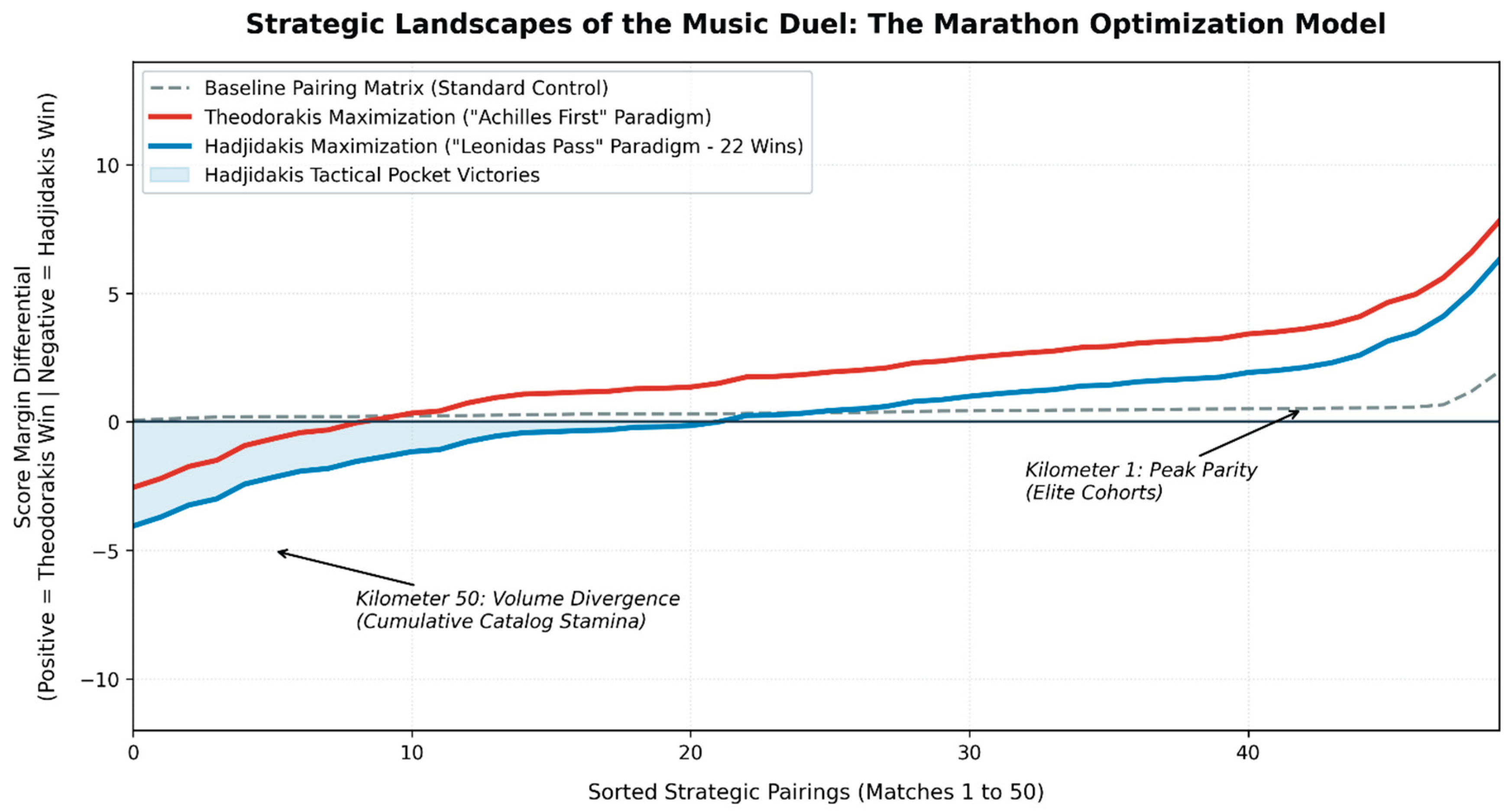
Table 1.
Consolidated Tournament Scoreboard (50-Pairing Analysis) Theodorakis and Hadjidakis wins in one random 50-pair comparison. Data are shown for manual evaluation (Phase I, conducted by the author) as well as a Phase II evaluation (AI) with the 3 methods used to break the ties.pts=points.
Table 1.
Consolidated Tournament Scoreboard (50-Pairing Analysis) Theodorakis and Hadjidakis wins in one random 50-pair comparison. Data are shown for manual evaluation (Phase I, conducted by the author) as well as a Phase II evaluation (AI) with the 3 methods used to break the ties.pts=points.
| Evaluation Phase / Method Applied |
Theodorakis (Wins/Points) |
Hadjidakis (Wins/Points) |
Ties | Total Pool |
| Phase I: Raw Manual Evaluation | 27.0 | 10.0 | 13 | 37.0 victories |
| Phase II: Method 1 (Null/0 pts) | 27.0 | 10.0 | 0 | 37.0 pts |
| Phase II: Method 2 (Shared/0.5 pts) | 33.5 | 16.5 | 0 | 50.0 pts |
| Phase II: Method 3 (Forced Decimal) | 28.0 | 22.0 | 0 | 50.0 pts |
Table 3.
The Elite 10 Cohorts with Individual Win Rates for Mikis Theodorakis.
| Rank | Track Title (Theodorakis) | Win Rate (%) |
| 1 | Tis dikeosinis ilie noite | 98.2% |
| 2 | Τis agapis emata | 94.0% |
| 3 | Anigo to stoma mou | 91.5% |
| 4 | Sto perigiali (Άrnisi) | 88.0% |
| 5 | Τin romiosini min tin kles | 86.5% |
| 6 | Horos tou Zorba | 84.0% |
| 7 | Vrehi sti ftohogitonia | 81.5% |
| 8 | Drapetsona | 79.0% |
| 9 | Omorfi poli | 76.5% |
| 10 | Τo treno fevgi stis okto | 74.0% |
Table 4.
The Elite 10 Cohorts with Individual Win Rates for Manos Hadjidakis.
| Rank | Track Title (Hadjidakis) | Win Rate (%) |
| 1 | Ta pedia toy Pirea (Never on Sunday) | 95.5% |
| 2 | Hartino to feggaraki | 92.0% |
| 3 | Agapi pou gines dikopo maheri | 89.5% |
| 4 | Min ton rotas ton ourano | 87.0% |
| 5 | O kir Antonis | 84.5% |
| 6 | O tahidromos pethane | 82.0% |
| 7 | Ime ahtos horis ftera | 78.5% |
| 8 | Τsamikos | 76.0% |
| 9 | Κemal | 73.5% |
| 10 | Athanasia | 71.0% |
Table 5.
Elite Song Matchup Scoreboard (100 Match Simulations) Theodorakis and Hadjidakis point wins in an elite song matchup scoreboard (100 match simulations) along with the three methods used to break the ties.
Table 5.
Elite Song Matchup Scoreboard (100 Match Simulations) Theodorakis and Hadjidakis point wins in an elite song matchup scoreboard (100 match simulations) along with the three methods used to break the ties.
| Evaluation Metric | Mikis Theodorakis | Manos Hadjidakis | Ties |
Total Pool Points |
| Outright Head-to-Head Wins | 46 | 44 | 10 | 100 |
| Method 2 (Shared Split) | 51.0 pts | 49.0 pts | 0 | 100 |
| Method 3 (Forced Decimals) | 50.5 pts | 49.5 pts | 0 | 100 |
Disclaimer/Publisher’s Note: The statements, opinions and data contained in all publications are solely those of the individual author(s) and contributor(s) and not of MDPI and/or the editor(s). MDPI and/or the editor(s) disclaim responsibility for any injury to people or property resulting from any ideas, methods, instructions or products referred to in the content. |
© 2026 by the authors. Licensee MDPI, Basel, Switzerland. This article is an open access article distributed under the terms and conditions of the Creative Commons Attribution (CC BY) license (http://creativecommons.org/licenses/by/4.0/).
Copyright: This open access article is published under a Creative Commons CC BY 4.0 license, which permit the free download, distribution, and reuse, provided that the author and preprint are cited in any reuse.