

Submitted:
28 May 2026
Posted:
29 May 2026
You are already at the latest version
Abstract
This study investigates the semantic friction between colloquial language and chemical discourse, exploring how technical terminology functions as a tool for “narrative technocracy.” Focusing on terms such as “law”, “energy”, “resonance,” the paper demonstrates how ostensibly familiar words, when adopted by science, acquire precise, often exclusionary meanings. This process can lead to either a false sense of understanding or an imperative of blind trust for non-expert audiences, thereby stabilizing expert authority. Using a qualitative analysis of a series of “Word-Cards” designed for LinkedIn, the study examines how visual mediation can navigate these interpretative contingencies. The findings suggest that deliberate linguistic reflection in science communication can mitigate semantic misalignments, transforming technical discourse from a barrier of authority into a platform for informed public engagement.
Keywords:
narrative technocracy
; Word-Cards
; semantic gap
; false comprehension
; trust in experts
1. Introduction
In the contemporary landscape of science communication, language does not merely serve as a neutral conduit for data transmission: it functions as a sophisticated mechanism of power [1]. For the lay public, the chemical and physical lexicon often manifests as a form of “narrative technocracy”: a discourse that appears inevitable, objective, and incontestable, precisely because it is shielded by layers of highly specialized meanings [2]. This phenomenon is particularly evident in the “black boxing” of scientific facts, where the complexity of the process is hidden behind a polished, authoritative terminology that discourages external questioning [3].
This technocracy emerges when scientific language, due to its inherent precision and perceived authority, is deployed in public discourse. It implicitly establishes a sense of unquestionable expertise, which can effectively marginalize democratic participation and public contestation [4]. As highlighted in the scholarship regarding the “boundary work” of science, technical terms such as “Resonance” or “Plasma” act as devices that stabilize knowledge within expert communities while simultaneously marginalizing those who do not possess the semiotic keys to the code. This is not necessarily a deliberate act of exclusion, but rather an emergent property of specialized communication [5]. The linguistic demarcation between “expert” and “layman” thus becomes a social barrier, where the scientist assumes the role of an epistemic gatekeeper who defines the boundaries of legitimate knowledge [1,5].
This dynamic creates a profound “semantic friction”: while the expert operates within a framework of formal rigor, the public interprets these same lexical entries through sensory, emotional, or cultural metaphors. This “semantic realignment” – a process where terms shift their core meaning upon adoption into a scientific register, rather than a deliberate “sequestration” – is not a mere misunderstanding but a political boundary [2]. It leads to two critical scenarios that underpin narrative technocracy: “Semantic False Friends” and False Comprehension. Many terms from everyday language are adopted by science but endowed with a radically precise and distinct meaning. When these terms (e.g., “Chaos,” “Affinity”) are used in public discourse, the non-expert, naturally reverting to their colloquial understanding, experiences a false comprehension. They believe they grasp the scientific concept, but are in fact applying a nuanced, and often incorrect, interpretation. This illusion of understanding can paradoxically strengthen the technocratic narrative, as the public perceives the scientific rationale as inherently sensible and beyond questioning, having supposedly “understood” it.
Conversely, many purely technical terms have no direct equivalent in everyday language. In these instances, the public is entirely excluded from direct comprehension, lacking any linguistic reference point. This forces an unconditional reliance on the expert, as decoding such language becomes an impossible task for the layperson.
While not generating false comprehension, this exclusion creates an impenetrable barrier, fostering passive acceptance rather than active engagement.
Both scenarios contribute to how the expert “owns” the authoritative definition, while the citizen is relegated to the periphery of the conversation, often excluded from debating scientific decisions that are framed as ontological certainties rather than socially embedded choices [6].
This paper investigates how this gap can be mediated with “Word-Cards”---visual lexical entries designed for LinkedIn. By analyzing eight pivotal terms---including Affinity, Chaos, Complex, and Law---we explore how visual mediation can transform technical discourse from a barrier of authority into a platform for informed public engagement [7]. These cards function as “Boundary Objects”, allowing different communities to inhabit a shared space of meaning without sacrificing their specific interpretive needs [8]. Through this approach, we aim to expose the gatekeeping mechanisms that regulate the interface between science and society, fostering a more symmetrical and democratic dialogue. Since the original Word-Cards were designed and disseminated in Italian, all visual materials presented in this study are accompanied by English translations. These translations aim to preserve the semantic nuances and the specific ‘technocratic’ weight of the original terms, ensuring that the friction between colloquial and scientific registers remains perceptible to an international audience. It is crucial to acknowledge that every language possesses its own ‘semantic false friends’---terms that inhabit both scientific and everyday lexicons but carry radically divergent epistemic weights. For instance, while this study focuses on Italian artifacts, the same logic applies to English terminology. A prime example is the word ‘Matter’: in a chemical-physical context, it denotes the fundamental substance of the universe; in colloquial English, however, it shifts toward the domain of concern or conflict (e.g., ‘What is the matter?’). This dualism further illustrates how narrative technocracy exploits the inherent ambiguity of these “semantic false friends”, transforming shared linguistic tools into specialized barriers. By presenting the Italian cards with English translations, the author does not merely translate words but rather highlights a universal cross-linguistic phenomenon: the tension between the ‘lived’ word and the ‘measured’ term.”
The choice of the “card” format is rooted in the concept of platform affordance [9]. Unlike a traditional scientific abstract or a long-form article, the Word-Card utilizes visual hierarchy and brevity to disrupt the linear, authoritative flow of the technocratic narrative. By isolating a single term and placing it within a high-contrast visual frame, the card forces a “cognitive pause.” This visual mediation acts as a semiotic intervention: it strips the technical term of its protective textual density, making the “semantic friction” visible and accessible. The affordance of the image-text hybrid thus transforms a complex linguistic barrier into a modular, shareable object of reflection.
2. Materials and Methods
To investigate the dynamics of narrative technocracy, this study employs a qualitative methodology based on the creation and dissemination of “Word-Cards” modular visual assets designed to deconstruct the semantic layers of scientific terminology. This approach is rooted in the theory of “Boundary Objects” [8], where the card serves as a flexible interface that allows experts and non-experts to negotiate shared meanings without compromising their respective epistemic backgrounds. The experiment of disseminating word-cards on social media, as Linkedin is ongoing and every week there are some new entries. In this work the first eight are discussed.
2.1. Design and Dissemination of the Word-Cards
A series of eight Word-Cards—specifically focusing on terms such as Affinity, Chaos, Law, and Resonance—were presented in this work to highlight the tension between colloquial usage and chemical-physical stabilization. In the following sections, they are presented without the original social media comments or engagement metrics (likes, shares) to avoid influencing the reader’s perception and to maintain a focus on the intrinsic semiotic tension of the design. The primary objective of the method is not merely the transmission of a definition, but the use of the card as a medium to expose the power dynamics of language. By visualizing the gap between the “lived experience” of a word and its “technical sequestration,” the Word-Cards allow the public to perceive the gatekeeping mechanisms inherent in scientific discourse [10]. This reflexive process transforms the audience from passive recipients of jargon into active participants in linguistic negotiation.
2.2. The Professional Ecosystem: LinkedIn as a Hybrid Space
The cards were disseminated on LinkedIn, chosen as a hybrid epistemic space [7]. This platform allows for “expert-to-expert” and “expert-to-public” communication to overlap. LinkedIn provides a unique sociotechnical environment for this study, distinct from other social networks. It operates as a hybrid epistemic space where “expert-to-expert” and “expert-to-public” communications overlap [10]. Within this professional ecosystem, the Word-Cards do not merely reach a passive audience; they engage a “plateau of peers” who often possess their own specialized lexicons. This allows for a unique form of horizontal validation and debate. By disseminating the cards here, the study captures how narrative technocracy is negotiated among professionals who are simultaneously “insiders” in their own fields but “laypersons” regarding the specific chemical-physical nuances being deconstructed.
3. Results and Discussion
The core of this investigation lies in the qualitative analysis of eight ‘Word-Cards’ designed to expose the mechanisms of narrative technocracy. Each card functions as a semiotic intervention, aimed at disrupting the authoritative ‘black box’ of specialized terminology by visualizing the ‘semantic friction’ between colloquial narratives and scientific stabilization. These entries—ranging from ‘Chaos’ to ‘Affinity’—do not merely provide definitions; they act as ‘reclaiming tools’ that acknowledge the public’s sensory experience while simultaneously explaining the expert’s framework. By placing these domains side-by-side, the cards transform technical jargon into a shared platform for engagement. Following this conceptual framework, the eight Word-Cards are presented below as raw data, providing a foundational overview for the subsequent detailed discussion on linguistic sequestration and power dynamics.
In everyday language, “Law” primarily denotes an imposed order—a codified set of norms, rules, and regulations designed to govern civil life, defining boundaries of permissible behavior. It is perceived as a human construct, sometimes binding, sometimes the indispensable foundation of coexistence. This concept highlights law as a product of human deliberation, contingent and perfectible.However, in science, particularly chemistry and natural sciences, the essence of “Law” fundamentally transforms. Here, a law is not decreed; it is discovered. It emerges from rigorous and repeated observation of reality. Scientific laws do not prescribe behaviors but describe them; they do not impose but unveil. For instance, laws governing gases or the conservation of mass are not obligations that matter must respect, but necessary manifestations of its inherent being. They reflect an intrinsic, human-independent order that scientific inquiry seeks to understand. This dimension portrays law as an expression of universal, immutable harmony. Thus, the same word encapsulates a dual soul: law as a fallible human elaboration, and law as an immutable universal expression. The human dimension is further underscored by mechanisms like referendums, through which a community can modify or revoke a law, demonstrating that human laws are not eternal but dynamic, adapting to time and collective consciousness. Finally, the Italian language introduces an elegant linguistic play: “LEGGE” is also the third-person conjugation of the verb “leggere” (to read). This suggests that law not only regulates or describes but also “reads” the world—interpreting its signs, collecting its phenomena, and translating them into order and understanding. This linguistic connection proposes a poetic insight: comprehending the laws of nature fundamentally means learning to read reality itself. Ultimately, the term “Law” is fascinating in its semantic breadth, suspended between what humanity institutes, what it discovers inherently within the universe, and what it gradually learns to read and comprehend.
This card explores the multifaceted term “Resonance,” tracing its evolution from a metaphorical concept in language and literature to precise scientific and medical applications, ultimately revealing a shared underlying principle of spread, distribution, and harmonious interaction.
In common language and literature, resonance evokes the idea of an echo that propagates and amplifies. This imagery has inspired countless works, from Ovid’s depiction of Echo’s voice to the subtle vibrations in Pascoli’s poetry, where sound becomes memory and reverberation. Rhetorical figures like assonance or alliteration embody this phenomenon, creating a persistent sonic effect capable of eliciting emotion. Here, resonance functions as a metaphor for lingering impact and emotional depth.
In chemistry, resonance reveals a profound and subtle beauty. A molecule, such as benzene, cannot be adequately described by a single Lewis structure; instead, it is represented as a resonance hybrid. In this hybrid, electrons are not confined between two nuclei but are delocalized over multiple atoms. This delocalization lowers the molecule’s energy and significantly increases its stability. The benzene ring, for example, displays an extraordinary symmetry and harmony, with electrons uniformly fluctuating rather than adhering to rigid single and double bonds. Here, resonance describes an enhanced stability achieved through electron distribution beyond localized bonds.
In medicine, resonance takes a rigorously physical form. Nuclear Magnetic Resonance (NMR), the basis for MRI, exploits the principle that atomic nuclei with spin, when placed in an external magnetic field, can absorb energy at specific frequencies—their resonance frequency. When these nuclei release the absorbed energy, they generate a measurable signal. This signal allows for the reconstruction of high-resolution images of bodily tissues, such as the brain. In this context, resonance is neither metaphor nor echo but a precise quantum interaction between matter and a magnetic field, translating microscopic properties into macroscopic diagnostic information.
Thus, across language, science, and medicine, resonance changes its manifestation but retains its essence. In every domain, it implies transcendence of a single point of origin, diffusion beyond a confined location, and a harmonious distribution—whether of sound, electrons, or atomic nuclei. This inherent characteristic underlines the term’s power to describe phenomena ranging from poetic reverberation to fundamental physical interactions.
3.1. Comparative Lexical Analysis
Table 1 summarizes the findings for the first terms analyzed in this study. It highlights the friction between the colloquial narrative—often rooted in sensory or emotional experience—and the chemical stabilization used by experts to secure technical authority.
3.2. Reclaiming Meaning: Analysis of the Lexical Entries
The selected terms—Chaos, Complex, Radical, Law, Resonance, Plasma, Suspension, and Affinity—demonstrate a recurring pattern of “semantic sequestration,” where the scientific domain narrows common words into precise, measurable variables. However, the Word-Cards disrupt this process by integrating literary registers that validate the “lived” meaning of the terms.
- Chaos and Complex: As illustrated in Figure 1 and Figure 2, these terms shift from subjective experiences of disorder to objective system properties. The technocratic narrative traditionally uses mathematical complexity to move the burden of understanding solely to the expert. The Word-Cards counter this by evoking Hesiod’s Theogony for “Chaos” and the image of a musical band for “Complex,” reminding the reader that disorder and intricacy have always been sources of creative emergence and social harmony, not just technical hurdles.
- Radical and Law: Figure 3 and Figure 4 highlight the shift from political/social spheres to empirical ones. While a scientific “Law” is often presented as an ontological inevitability, the card introduces a poetic linguistic play: in Italian, “Legge” also means “he/she reads”. This literary shift transforms the scientist from a legislative authority into an interpreter of reality, making the “Law” a dialogue with nature rather than an indisputable decree.
- Resonance and Plasma: These entries (Figure 5 and Figure 6) showcase the displacement of sensory metaphors. The “Resonance” card bridges the gap between electron delocalization and Ovid’s myth of Echo, or the vibrations in Pascoli’s poetry. By referencing the “memory and reverberation” of verse, the card validates the emotional resonance felt by the public, preventing the abstract quantum model from entirely erasing the human experience.
- Suspension and Affinity: In Figure 7, the temporal uncertainty of “being in suspense” is reclaimed through Italo Calvino’s concept of “Lightness”. This literary lens transforms a physical state of matter into a liminal space of potentiality. Similarly, the “Affinity” card (Figure 8) references Goethe’s Elective Affinities to reconnect thermodynamic tendency with human attraction. This prevents the “de-humanization” of the term, showing that even in its chemical stabilization, an “echo” of human inclination remains.
3.3. Deconstructing Narrative Technocracy Through Visual Media
The LinkedIn “Word-Card” format functions as a “Boundary Object”. By presenting colloquial, literary, and scientific definitions side-by-side, the cards strip away the “inevitability” of technical language. The use of emoticons and high-contrast visuals disrupts the linear, authoritative flow of the technocratic narrative, forcing a “cognitive pause”.
The analysis reveals that Narrative Technocracy is maintained by the unspoken nature of semantic gaps. When the cards acknowledge that “Resonance” or “Radical” possess vibrant lives in poetry and politics, the epistemic hierarchy is flattened. Visual mediation allows the non-expert to “see” the gatekeeping mechanism, fostering a symmetrical dialogue where the expert’s “measured term” and the citizen’s “lived word” coexist.
3.4. Discussion: From Sequestration to Engagement
The results indicate that the “Technocratic Effect” functions by reifying language, shifting words from the domain of human experience to measurable variables (e.g., Affinity as Gibbs free energy). This redefinition effectively “sequestrates” the term from public deliberation.
However, the Word-Card format acts as a reclaiming tool by making this sequestration visible. By presenting both meanings simultaneously, the card does not merely “correct” the public; it validates the colloquial and literary understanding as a legitimate framework. This dual-visibility is essential for breaking the technocratic narrative, moving science communication from a “Deficit Model” , where the public is seen as lacking knowledge, to a “Contextual Model”. In this new framework, scientific precision and literary evocativeness are acknowledged as two halves of a broader social-scientific negotiation.
4. Conclusion
The “Word-Card” project moves beyond the traditional boundaries of science popularization to address the structural power dynamics inherent in technical discourse. Our findings suggest that narrative technocracy is not an inevitable byproduct of scientific complexity, but rather a linguistic boundary that is continuously constructed and maintained through the sequestration of everyday terms. By stabilizing words like Affinity, Law, or Resonance into rigid chemical-physical definitions, the expert community unintentionally—but effectively—marginalizes the public’s lived experience, creating an epistemic “black box” that discourages democratic deliberation.
The methodology of visual mediation introduced here offers a potential path toward a more symmetrical science communication. By presenting the Word-Cards as isolated artifacts stripped of social media engagement to preserve analytical neutrality, this study highlights the intrinsic power of the image-text hybrid to disrupt technocratic authority. The “card” does not merely simplify; it exposes the friction. It allows the non-expert to navigate the semantic gap, recognizing the expert’s definition while simultaneously validating their own colloquial understanding. This process transforms the audience from passive recipients of jargon into active participants in a shared linguistic negotiation.
Furthermore, the choice of LinkedIn as a hybrid professional space proves that these discussions can, and should, occur within the heart of expert communities. The “plateau of peers” on such platforms represents a unique opportunity to foster a more reflexive scientific culture, where experts are encouraged to recognize the “narrative” nature of their own technical descriptions.
In conclusion, breaking the technocratic narrative requires more than just transparency; it requires the reclamation of language. Future research and practice should explore how these visual-lexical interventions can be scaled to other domains of public policy and scientific risk management. By making the mechanisms of gatekeeping visible, we can transition from a “deficit model” of communication to a truly participatory framework, ensuring that science remains a shared human endeavor rather than a secluded technocratic domain.
Ultimately, this study serves as an invitation for experts across all disciplines to test this methodology within their own native languages. While English remains the indisputable lingua franca of global scientific research, the practice of public engagement and ‘divulgazione’ is inherently a local endeavor, rooted in the specific linguistic and cultural fabrics of diverse countries. Each language carries its own unique set of semantic ‘false friends’ and historical nuances that shape how the public perceives authority and expertise. By deconstructing narrative technocracy in one’s own tongue, the communicator does not merely translate data; they perform an act of cultural mediation. Encouraging scientists to become reflexive ‘linguistic architects’ in their local contexts is essential for transforming science from a global, distant monolith into a shared, democratic conversation that respects and inhabits the everyday language of citizens.
Acknowledgments
“This research was funded the Italian Ministry of Environment and Energy Security through the “National Electric System Research” Programme – Project 1.5, 2025-2027 implementation plan.
References
- Bourdieu, P., (1991). Language and Symbolic Power. Harvard University Press. ISBN 9780674510401.
- Hilgartner, S., (1990). The Dominant View of Popularization: Conceptual Problems, Political Uses. Social Studies of Science 20(3), 519-539.
- Latour, B., (1987). Science in Action: How to Follow Scientists and Engineers Through Society. Harvard University Press. ISBN 9780674792265.
- Bucchi, M., (2004). Science in Society: An Introduction to Social Studies of Science. Routledge. ISBN 9780415321488.
- Gieryn, T. F., (1983). Boundary-work and the demarcation of science from non-science. American Sociological Review 48(6), 781-795.
- Nowotny, H., Scott, P., & Gibbons, M., (2001). Re-Thinking Science: Knowledge and the Public in an Age of Uncertainty. Polity. ISBN 9780745626086.
- Trench, B., (2008). Towards an analytical framework of science communication models. In Handbook of Public Communication of Science and Technology. Routledge. ISBN 9780415386173.
- Star, S. L., & Griesemer, J. R., (1989). Institutional Ecology, ‘Translations’ and Boundary Objects. Social Studies of Science 19(3), 387-420.
- Trench, B., & Bucchi, M., (2010). Science communication, an emerging discipline. Journal of Science Communication 9(1).
- Davies, S. R., & Horst, M., (2016). Science Communication: Culture, Identity and Citizenship. Palgrave Macmillan. ISBN 9781137503664.
Figure 1.
Word-Card: Caos Original Italian text: “ Chaos: Disorder or Hidden Order? A Multidisciplinary Perspective” “Author’s Translation: This word-card examines “Chaos” by comparing its everyday meaning of confusion with its scientific definition. In physics and chemistry, chaos describes systems highly sensitive to initial conditions, where small changes cause large effects. Nobel laureate Ilya Prigogine highlighted that chaos can be a source of new order, exemplified by oscillating chemical reactions that show self-organization. For Prigogine, chaos isn’t mere disorder but a dynamic state where fluctuations lead to “dissipative structures”—ordered configurations sustained by energy exchange. This perspective suggests that apparent disorder can be a process for natural organization and novelty, echoing ancient philosophical concepts of primeval chaos as a source of creation. The term thus challenges us to see beyond surface disorder to find deeper principles of emergence and complexity.
Figure 1.
Word-Card: Caos Original Italian text: “ Chaos: Disorder or Hidden Order? A Multidisciplinary Perspective” “Author’s Translation: This word-card examines “Chaos” by comparing its everyday meaning of confusion with its scientific definition. In physics and chemistry, chaos describes systems highly sensitive to initial conditions, where small changes cause large effects. Nobel laureate Ilya Prigogine highlighted that chaos can be a source of new order, exemplified by oscillating chemical reactions that show self-organization. For Prigogine, chaos isn’t mere disorder but a dynamic state where fluctuations lead to “dissipative structures”—ordered configurations sustained by energy exchange. This perspective suggests that apparent disorder can be a process for natural organization and novelty, echoing ancient philosophical concepts of primeval chaos as a source of creation. The term thus challenges us to see beyond surface disorder to find deeper principles of emergence and complexity.
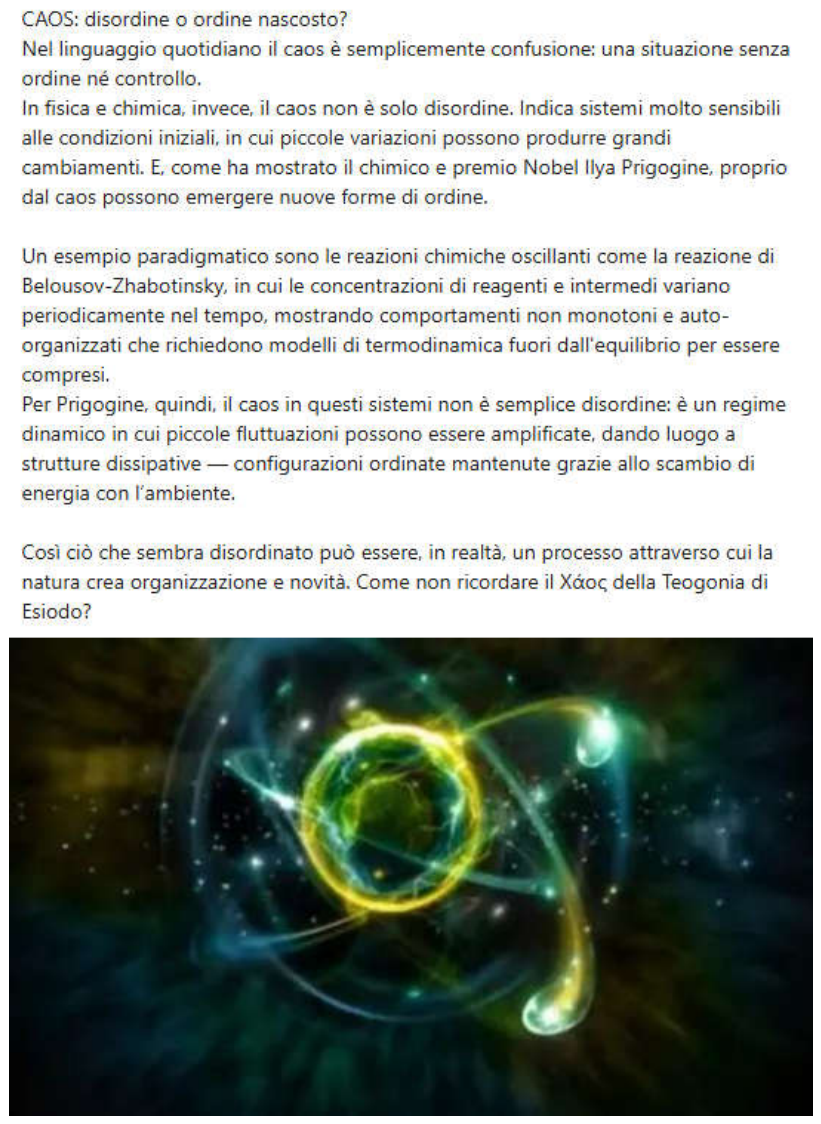
Figure 2.
Word-Card: complesso Original Italian text: “ Complesso: una parola, tre mondi” Author’s Translation: This card explores the word “Complex” across three distinct domains. Colloquially, it signifies something difficult or intricate. In music, a “complex” (band) represents the harmonious unity of diverse elements creating a unique whole. In chemistry, “complex” has two key meanings: a stable, defined structure like an organometallic compound (metal atom bonded to ligands), and the ephemeral “activated complex”—an unstable, transient intermediate state in a chemical reaction where bonds are breaking and forming. This duality highlights that “complex” doesn’t just mean complicated, but also refers to the act of holding different parts together, whether in a stable arrangement or a critical, fleeting transition. It underscores the concept that intricacy can lead to both stable formations and essential, temporary states.
Figure 2.
Word-Card: complesso Original Italian text: “ Complesso: una parola, tre mondi” Author’s Translation: This card explores the word “Complex” across three distinct domains. Colloquially, it signifies something difficult or intricate. In music, a “complex” (band) represents the harmonious unity of diverse elements creating a unique whole. In chemistry, “complex” has two key meanings: a stable, defined structure like an organometallic compound (metal atom bonded to ligands), and the ephemeral “activated complex”—an unstable, transient intermediate state in a chemical reaction where bonds are breaking and forming. This duality highlights that “complex” doesn’t just mean complicated, but also refers to the act of holding different parts together, whether in a stable arrangement or a critical, fleeting transition. It underscores the concept that intricacy can lead to both stable formations and essential, temporary states.
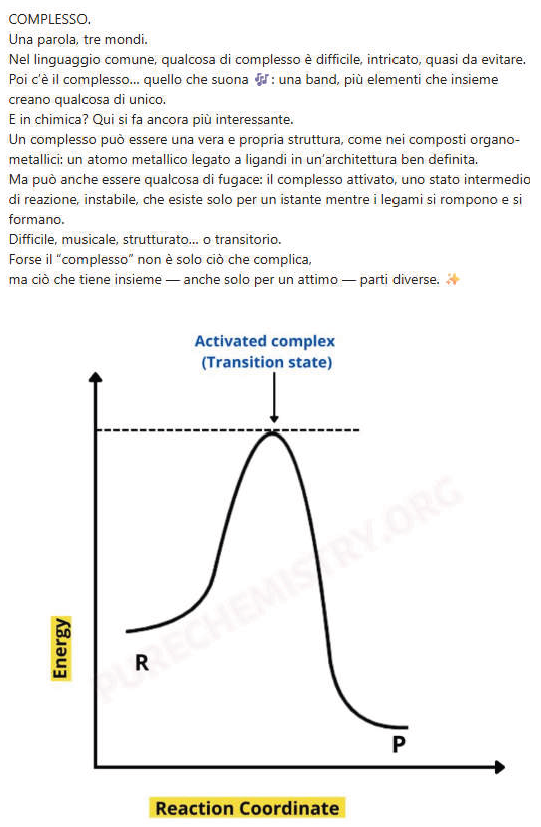
Figure 3.
Word-Card: radicale Original Italian text: “ Radicale” Author’s Translation: “Radical – Exploring its Essential Core Across Contexts”. This card dissects the term “Radical,” highlighting its shifting meanings while uncovering a shared underlying concept of “essence” or “origin.” In chemistry, a radical is an unstable, highly reactive species with unpaired electrons, driving transformations. Conversely, in botany, the “radical” refers to the plant’s root, representing its hidden, stable, and essential foundation. Other contexts include mathematics (the root symbol seeking a number’s origin), politics (advocating fundamental systemic changes), and common language (denoting something total or essential). Despite these varied applications—from dynamic change to steadfast origins, the word consistently points back to its “root,” signifying a return to the essential core or fundamental aspect of whatever it describes.
Figure 3.
Word-Card: radicale Original Italian text: “ Radicale” Author’s Translation: “Radical – Exploring its Essential Core Across Contexts”. This card dissects the term “Radical,” highlighting its shifting meanings while uncovering a shared underlying concept of “essence” or “origin.” In chemistry, a radical is an unstable, highly reactive species with unpaired electrons, driving transformations. Conversely, in botany, the “radical” refers to the plant’s root, representing its hidden, stable, and essential foundation. Other contexts include mathematics (the root symbol seeking a number’s origin), politics (advocating fundamental systemic changes), and common language (denoting something total or essential). Despite these varied applications—from dynamic change to steadfast origins, the word consistently points back to its “root,” signifying a return to the essential core or fundamental aspect of whatever it describes.
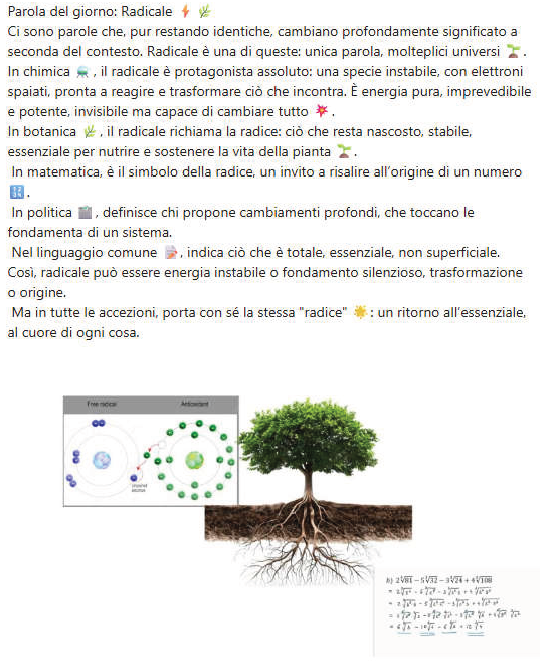
Figure 4.
Word-Card: legge Original Italian text: “ La parola “legge”: tra umano, universale… e un piccolo gioco linguistico” Author’s Translation: Law: Imposed Order, Discovered Truth, and Linguistic Play. This card investigates the word “Law,” dissecting its divergent meanings across common human constructs, scientific understanding, and a unique linguistic nuance in Italian. It reveals how a single term can encompass both human imposition and universal truth.
Figure 4.
Word-Card: legge Original Italian text: “ La parola “legge”: tra umano, universale… e un piccolo gioco linguistico” Author’s Translation: Law: Imposed Order, Discovered Truth, and Linguistic Play. This card investigates the word “Law,” dissecting its divergent meanings across common human constructs, scientific understanding, and a unique linguistic nuance in Italian. It reveals how a single term can encompass both human imposition and universal truth.
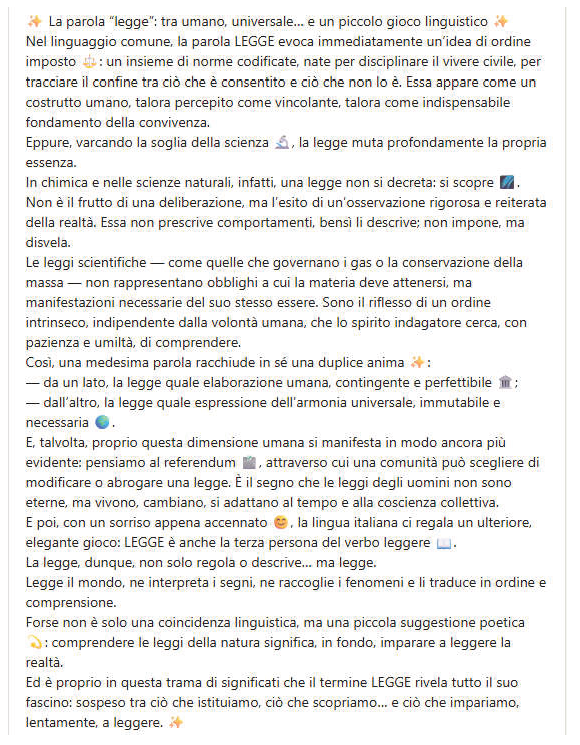
Figure 5.
Word-Card: Risonanza Original Italian text: “ parola del giorno: Risonanza” Author’s Translation: Resonance: From Poetic Echoes to Quantum Interactions.
Figure 5.
Word-Card: Risonanza Original Italian text: “ parola del giorno: Risonanza” Author’s Translation: Resonance: From Poetic Echoes to Quantum Interactions.
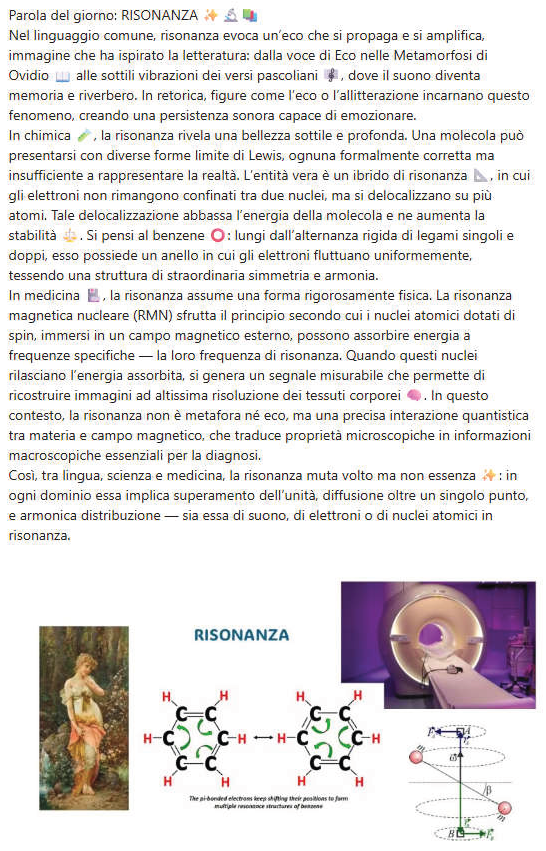
Figure 6.
Word-Card: Plasma Original Italian text: “ parola del giorno: PLASMA” Author’s Translation: Plasma: The Primordial State of Matter, Bridging Universe to Everyday Innovation. This card explores the term “Plasma,” tracing its meaning from its etymological roots to its profound implications across physics, chemistry, and medicine. Derived from the Greek plásma, “that which is molded,” the word carries a philosophical intuition of matter poised between potentiality and actualization, ready to be shaped. In physics, plasma is recognized as the fourth state of matter—an ionized gas where free electrons and ions exhibit collective behavior, primarily influenced by electromagnetic fields. It is the most prevalent state of matter in the universe, forming the core of stars, powering lightning, and illuminating auroras. This demonstrates plasma as an intrinsically dynamic and interactive form of matter. In chemistry, plasma functions as a highly reactive environment. Within it, chemical bonds rapidly break and reform, facilitating advanced syntheses and material transformations that are challenging to achieve under ordinary conditions. This highlights plasma’s role in enabling novel material creation. In medicine, “plasma” holds a concrete and vital significance, referring to the liquid component of blood. It serves as a crucial vehicle for nutrients, proteins, hormones, and clotting factors, essential for biological balance and inter-system communication. More recently, cold plasmas are finding clinical applications in sterilization, decontamination, and tissue regeneration, translating plasma’s reactivity into therapeutic benefits without damaging tissues. Across these diverse fields—language, science, technology, and medicine—“plasma” maintains a common core: it is not a fixed substance but a condition of controlled possibility. It represents a dynamic principle through which matter organizes, transforms, and becomes moldable. The author notes that understanding and manipulating plasma processes in their work is a concrete tool for innovation, enabling the synthesis of new materials with diverse properties and applications. This versatility supports collaborations across various fields, from technology and medicine to materials science and device engineering. The author concludes by likening chemical synthesis within plasma to an art form, where controlling reactions transforms potentiality into new creations.
Figure 6.
Word-Card: Plasma Original Italian text: “ parola del giorno: PLASMA” Author’s Translation: Plasma: The Primordial State of Matter, Bridging Universe to Everyday Innovation. This card explores the term “Plasma,” tracing its meaning from its etymological roots to its profound implications across physics, chemistry, and medicine. Derived from the Greek plásma, “that which is molded,” the word carries a philosophical intuition of matter poised between potentiality and actualization, ready to be shaped. In physics, plasma is recognized as the fourth state of matter—an ionized gas where free electrons and ions exhibit collective behavior, primarily influenced by electromagnetic fields. It is the most prevalent state of matter in the universe, forming the core of stars, powering lightning, and illuminating auroras. This demonstrates plasma as an intrinsically dynamic and interactive form of matter. In chemistry, plasma functions as a highly reactive environment. Within it, chemical bonds rapidly break and reform, facilitating advanced syntheses and material transformations that are challenging to achieve under ordinary conditions. This highlights plasma’s role in enabling novel material creation. In medicine, “plasma” holds a concrete and vital significance, referring to the liquid component of blood. It serves as a crucial vehicle for nutrients, proteins, hormones, and clotting factors, essential for biological balance and inter-system communication. More recently, cold plasmas are finding clinical applications in sterilization, decontamination, and tissue regeneration, translating plasma’s reactivity into therapeutic benefits without damaging tissues. Across these diverse fields—language, science, technology, and medicine—“plasma” maintains a common core: it is not a fixed substance but a condition of controlled possibility. It represents a dynamic principle through which matter organizes, transforms, and becomes moldable. The author notes that understanding and manipulating plasma processes in their work is a concrete tool for innovation, enabling the synthesis of new materials with diverse properties and applications. This versatility supports collaborations across various fields, from technology and medicine to materials science and device engineering. The author concludes by likening chemical synthesis within plasma to an art form, where controlling reactions transforms potentiality into new creations.
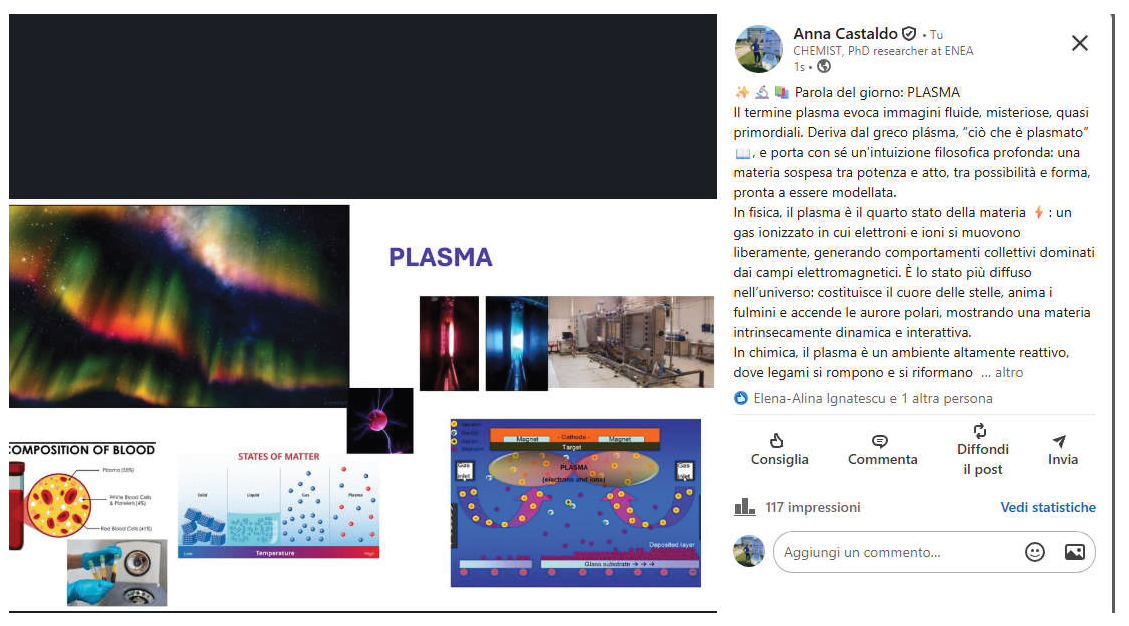
Figure 7.
Word-Card: Sospensione Original Italian text: “Sospensione” “Author’s Translation: “Suspension” In chemistry, “suspension” defines a heterogeneous system where solid particles are dispersed in fluid but remain undissolved. A key characteristic is the eventual sedimentation of these particles, which fundamentally differentiates it from a homogeneous solution. This precise scientific definition emphasizes a structural discontinuity in matter, observable and distinct. Moving beyond the scientific realm, the word “suspension” acquires a plurality of meanings, demonstrating its adaptability in non-specialist language. In legal and administrative fields, it signifies a temporary halt or deferment of an action or activity. In engineering, it refers to mechanical systems designed to absorb impact and ensure dynamic stability. From a socio-political perspective, “suspension” describes a temporary cessation of conflict, a fragile equilibrium where underlying forces are restrained rather than resolved, representing a period of potential but not actual change. In daily life, it denotes a pause, an interval, or a cyclical break from routine.The tension between these usages reveals the term’s profound nature. While chemistry uses “suspension” to denote a clear, stable distinction from a solution, non-specialist language suggests that such distinctions are often fluid and contingent. This highlights the concept of “lightness” (as described by Italo Calvino) as a state where matter and meaning are not yet rigidly defined, occupying an intermediate zone where outcomes are still unfolding. The word thus encapsulates a state of waiting, a “subtle threshold between what is visible and what is about to happen, but has not yet happened,” echoing literary concepts of liminality and anticipation. Analysis: Highlighting the friction between psychological uncertainty and physical sedimentation.
Figure 7.
Word-Card: Sospensione Original Italian text: “Sospensione” “Author’s Translation: “Suspension” In chemistry, “suspension” defines a heterogeneous system where solid particles are dispersed in fluid but remain undissolved. A key characteristic is the eventual sedimentation of these particles, which fundamentally differentiates it from a homogeneous solution. This precise scientific definition emphasizes a structural discontinuity in matter, observable and distinct. Moving beyond the scientific realm, the word “suspension” acquires a plurality of meanings, demonstrating its adaptability in non-specialist language. In legal and administrative fields, it signifies a temporary halt or deferment of an action or activity. In engineering, it refers to mechanical systems designed to absorb impact and ensure dynamic stability. From a socio-political perspective, “suspension” describes a temporary cessation of conflict, a fragile equilibrium where underlying forces are restrained rather than resolved, representing a period of potential but not actual change. In daily life, it denotes a pause, an interval, or a cyclical break from routine.The tension between these usages reveals the term’s profound nature. While chemistry uses “suspension” to denote a clear, stable distinction from a solution, non-specialist language suggests that such distinctions are often fluid and contingent. This highlights the concept of “lightness” (as described by Italo Calvino) as a state where matter and meaning are not yet rigidly defined, occupying an intermediate zone where outcomes are still unfolding. The word thus encapsulates a state of waiting, a “subtle threshold between what is visible and what is about to happen, but has not yet happened,” echoing literary concepts of liminality and anticipation. Analysis: Highlighting the friction between psychological uncertainty and physical sedimentation.
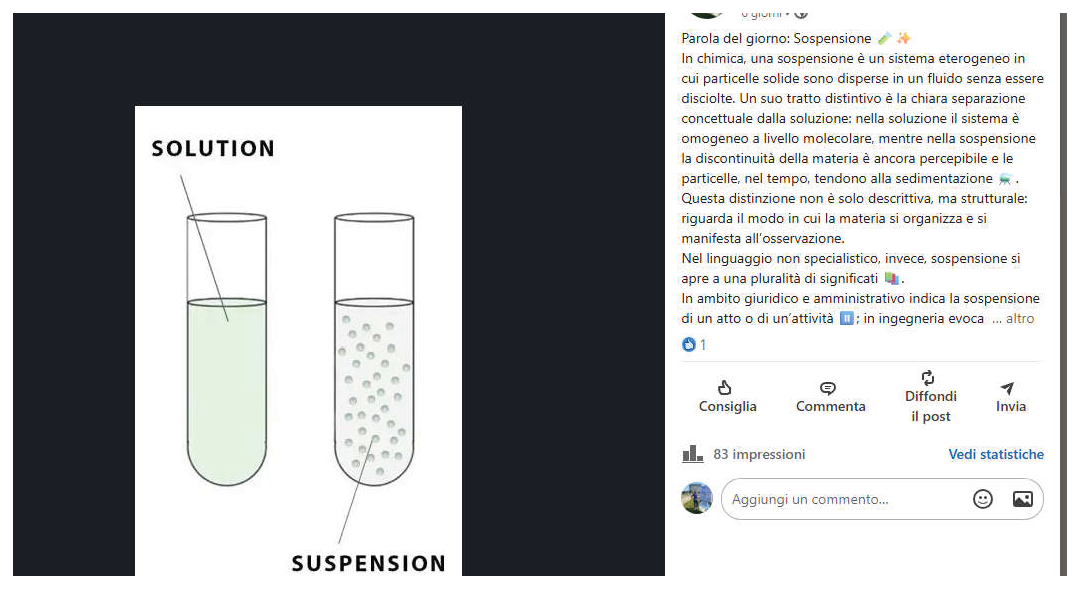
Figure 8.
Word-Card: Affinità Original Italian text: “parola del giorno : affinità” “Author’s Translation:Some words seem simple and everyday yet hide a deeper conceptual meaning. Affinity is one of them: we use it to describe similarities or connections, but it also has a precise scientific definition. In chemistry, electron affinity refers to the energy change that occurs when an isolated gaseous atom gains an electron. If energy is released, the process is energetically favorable, meaning the atom has a high electron affinity. This idea still echoes human language, as if certain entities are naturally “inclined” to connect. However, electron affinity should not be confused with electronegativity. The former concerns an isolated atom and a measurable energy process, while the latter describes how strongly an atom attracts electrons within a bond—more a relational property than an energetic one. This dual meaning appears in literature as well. In Elective Affinities by Johann Wolfgang von Goethe, a chemical concept is transformed into a reflection on human relationships, where people seem to attract or repel each other beyond pure will. More generally, when scientific language is used in literature or everyday speech, its meaning often shifts—from precise definition to evocative imagery. This is not a loss, but a change in communicative function: from accuracy to interpretive richness.
Figure 8.
Word-Card: Affinità Original Italian text: “parola del giorno : affinità” “Author’s Translation:Some words seem simple and everyday yet hide a deeper conceptual meaning. Affinity is one of them: we use it to describe similarities or connections, but it also has a precise scientific definition. In chemistry, electron affinity refers to the energy change that occurs when an isolated gaseous atom gains an electron. If energy is released, the process is energetically favorable, meaning the atom has a high electron affinity. This idea still echoes human language, as if certain entities are naturally “inclined” to connect. However, electron affinity should not be confused with electronegativity. The former concerns an isolated atom and a measurable energy process, while the latter describes how strongly an atom attracts electrons within a bond—more a relational property than an energetic one. This dual meaning appears in literature as well. In Elective Affinities by Johann Wolfgang von Goethe, a chemical concept is transformed into a reflection on human relationships, where people seem to attract or repel each other beyond pure will. More generally, when scientific language is used in literature or everyday speech, its meaning often shifts—from precise definition to evocative imagery. This is not a loss, but a change in communicative function: from accuracy to interpretive richness.
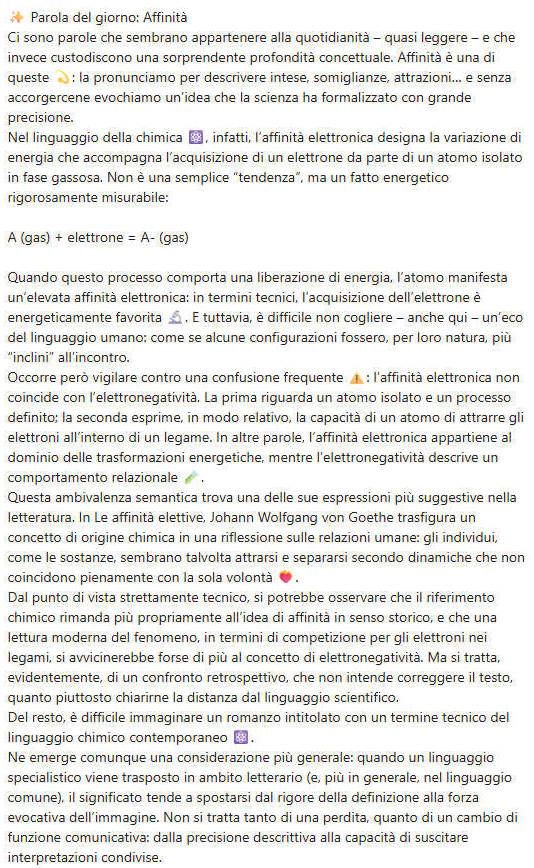

Table 1.
Lexical Analysis of Semantic Sequestration in Scientific discourse of Words disseminated through Linkedin.
Table 1.
Lexical Analysis of Semantic Sequestration in Scientific discourse of Words disseminated through Linkedin.
| Lexical Entry | The Colloquial Narrative | The Chemical Stabilization | The Technocratic Effect (via Semantic Re-alignment) |
| Chaos | Total disorder, confusion, lack of control. | Sensitivity to initial conditions in non-linear systems. | The idea of mere “randomness” is subtly replaced by a hidden, deterministic mathematical order, fostering a false sense of comprehensive understanding. |
| Complex | Complicated, intricate, difficult to understand. | A system whose components and interactions lead to emergent properties not predictable from individual parts. | Pure “complication” is elevated to a specific scientific domain, implying non-reducibility and the study of unforeseen behaviors rather than simple difficulty. This can lead to trusting the expert due to perceived complexity. |
| Radical | Extreme, drastic, politically subversive. | An atom or molecule with at least one unpaired electron. | A term of social change is neutralized into a description of molecular instability and reactivity, creating a disconnect between the apparent familiarity and the scientific nuance, thus enabling false comprehension. |
| Law | A rule imposed by authority; a social norm. | A descriptive generalization about how the physical world behaves. | An aura of “legal” ineluctability is projected onto nature, making scientific descriptions appear as non-negotiable decrees that demand trust, rather than being open to interpretation. |
| Resonance | Emotional harmony, “feeling on the same wavelength.” | Electron delocalization in molecular structures. | A familiar metaphor is replaced with an abstract, non-intuitive quantum model, which, if not fully explained, can lead to a superficial understanding or an imperative to trust. |
| Plasma | The clear, yellowish fluid part of blood, or a type of display screen. | An ionized gas consisting of free electrons and positive ions, the fourth state of matter. | A familiar biological fluid or technological object is transformed into a fundamental and energetic state of matter, far removed from common experience, demanding trust in its specialized definition. |
| Suspension | A state of pause, uncertainty, or “waiting.” | A heterogeneous mixture containing large solid particles that settle over time. | The focus shifts from a subjective state of “undecidability” to a purely physical, temporary state of matter. This redefinition can lead to false comprehension by conflating human experience with physical properties. |
| Affinity | Elective attraction, emotional choice or “sympathy.” | Thermodynamic tendency of chemical species to react. | “Attraction” is transformed into a structural necessity, removing the dimension of choice and re-aligning emotion with a measurable variable, potentially leading to a false sense of having understood its “reason.” |
Disclaimer/Publisher’s Note: The statements, opinions and data contained in all publications are solely those of the individual author(s) and contributor(s) and not of MDPI and/or the editor(s). MDPI and/or the editor(s) disclaim responsibility for any injury to people or property resulting from any ideas, methods, instructions or products referred to in the content. |
© 2026 by the authors. Licensee MDPI, Basel, Switzerland. This article is an open access article distributed under the terms and conditions of the Creative Commons Attribution (CC BY) license (http://creativecommons.org/licenses/by/4.0/).
Copyright: This open access article is published under a Creative Commons CC BY 4.0 license, which permit the free download, distribution, and reuse, provided that the author and preprint are cited in any reuse.