

Submitted:
27 May 2026
Posted:
29 May 2026
You are already at the latest version
Abstract
Artificial intelligence (AI) is increasingly integrated into emergency general surgery (EGS), where rapid diagnosis, accurate decision-making, and timely intervention are essential for improving patient outcomes. Recent advances in machine learning, deep learning, computer vision, and predictive analytics have enabled AI-assisted systems to support clinicians throughout the perioperative workflow. Current applications include radiologic image interpretation, diagnosis of acute abdominal conditions, surgical workflow recognition, intraoperative anatomical guidance, postoperative complication prediction, and intensive care monitoring. AI technologies may improve diagnostic accuracy, optimize operative planning, enhance surgical safety, and facilitate personalized perioperative management. In minimally invasive surgery, computer vision and real-time data analysis have shown promising results for intraoperative decision support and surgical education. However, important limitations remain, including concerns regarding data quality, algorithm transparency, ethical governance, regulatory approval, and implementation disparities between healthcare systems. In addition, much of the current evidence is derived from retrospective or highly specialized datasets, limiting broad clinical applicability. This narrative review summarizes the current clinical applications of AI in emergency general surgery and discusses emerging technologies, existing challenges, and future perspectives regarding the integration of AI into acute surgical care.
Keywords:
artificial intelligence
; emergency general surgery
; machine learning
; computer vision
; surgical decision-making
; predictive analytics
; minimally invasive surgery
; acute care surgery
; surgical safety
1. Introduction
Emergency General Surgery (EGS) is one of the most demanding and time-dependent fields of contemporary surgical practice, including a broad spectrum of acute abdominal, soft tissue and traumatic conditions that require prompt diagnosis, timely clinical decision-making and urgent operative intervention. Acute appendicitis, acute cholecystitis, gastrointestinal perforation, bowel obstruction, mesenteric ischemia, intra-abdominal sepsis and traumatic injuries are common emergency surgical pathologies, all of which are still associated with considerable morbidity, mortality, prolonged hospitalization and increased healthcare costs despite advances in perioperative management and minimally invasive surgery [1,2,3,4,5,6,7,8,9,10]. The dynamic and often unpredictable nature of emergency surgical care exposes clinicians to diagnostic uncertainty, rapidly evolving physiologic deterioration, and limited time for therapeutic planning, highlighting the increasing need for technologies that can improve diagnostic precision, perioperative coordination, and individualized patient management.
Artificial intelligence (AI) has emerged as one of the fastest growing technologies in healthcare, and is being incorporated into clinical workflows in many medical specialties [1,2,3,4,5]. AI generally refers to computer systems that can perform tasks normally requiring human cognitive abilities such as pattern recognition, predictive reasoning, image interpretation and data-driven decision-making. Modern AI applications in medicine are mainly based on ma-chine learning, deep learning, computer vision, and natural language processing algorithms that have been trained on large clinical and imaging datasets [2,3,4,11,12,13,14,15]. Progress in computing power, electronic health records, cloud storage and digital imaging platforms have contributed to the use of AI-assisted technologies in radiology, oncology, cardiology, gastroenterology, critical care, and surgery [11,12,13,14,15]. Moreover, the availability of large clinical datasets has resulted in the development of predictive models that can detect complex patterns that may not be apparent through conventional clinical assessment.
Surgery is an especially attractive application for AI integration, given the highly visual, data-driven, and workflow-oriented nature of the field. The widespread use of minimally invasive surgery has resulted in large operative video data-bases that enabled the development of computer vision algorithms for anatomical recognition, intraoperative navigation, analysis of surgical workflow, phase recognition, and operative difficulty prediction [16,17,18,19,20,21,22,23,24]. Recent studies demonstrated the ability of AI-assisted systems to improve intraoperative orientation in laparoscopic procedures, to help in automated recognition of important anatomical landmarks and to allow surgical education and technical training [17,18,19,20,21,22]. Moreover, encouraging results of machine learning models have been demonstrated in perioperative risk stratification, postoperative complication prediction, intensive care monitoring, and personalized surgical planning, which may result in enhanced surgical safety and optimized resource allocation [8,23,24].
In the field of emergency general surgery, AI applications are increasingly studied in the setting of acute abdominal pain assessment, emergency imaging interpretation, sepsis prediction, operative prioritization, and perioperative decision support [25,26,27,28,29,30]. Deep learning algorithms in thoracic and abdominal imaging can aid clinicians in identifying pathologic findings that require prompt surgical assessment. Advanced radiologic AI platforms demonstrated promising results in image classification and lesion detection [31,32,33,34]. At the same time, AI-enabled physiologic monitoring systems and predictive critical care models may allow for earlier detection of clinical deterioration and high-risk surgical patients through real-time analysis of physiologic and laboratory parameters [35,36]. These technologies could improve diagnostic accuracy, speed up triage procedures, and allow for more personalized perioperative management strategies in critically ill patients.
Despite these advances, several key limitations continue to constrain the large-scale adoption of AI in emergency surgical practice. Current issues include data heterogeneity, limited external validation, algorithm transparency, cyber-security risks, ethical governance and medico-legal uncertainty around clinical responsibility and decision ownership [37,38,39,40]. Furthermore, differences in technological infrastructure and resource availability across healthcare systems may pose additional challenges to the equitable integration of AI into routine emergency surgical care. The need for clinician oversight and human-centered decision-making in AI-assisted clinical workflows has also been highlighted by several authors [41,42,43,44]. More recent surgical reviews have emphasized the transformative potential as well as the current limitations of AI-driven systems in general surgery, particularly in terms of validation, reproducibility, and integration into real-world operative environments [45,46,47,48,49,50]. Furthermore, despite the demonstrated value of data-driven perioperative assessment through predictive models such as the ACS NSQIP Surgical Risk Calculator, wider implementation of AI-assisted systems remains contingent upon prospective validation, standardized regulatory frameworks, and multidisciplinary collaboration [51,52,53,54].
A recent literature focused on emergency general surgery indicates that AI is poised to impact acute surgical care in the future with enhanced diagnostic support, automated optimization of workflow, advanced computer vision platforms, and predictive perioperative analytics [55]. However, most of the currently available evidence is derived from retrospective datasets or from very specialized institutional experiences which limits generalizability across different healthcare environments. With the rapid development of AI-assisted technologies and their increasing relevance to emergency surgical practice, a comprehensive review of the current evidence is warranted. The aim of this narrative review is to present the current clinical applications of artificial intelligence in emergency general surgery, to assess the emerging technologies in the diagnostic, intraoperative, and postoperative aspects, and to discuss the main challenges, limitations, and future perspectives of artificial intelligence in acute surgical care.
Given the accelerating development of AI-assisted technologies and their growing relevance to emergency surgical practice, a comprehensive evaluation of current evidence is warranted (Figure 1).
2. Materials and Methods
The aim of this narrative review was to evaluate the current clinical applications, emerging technologies and future perspectives of artificial intelligence (AI) in emergency general surgery. A structured literature search was performed using the Pub-Med/MEDLINE, Scopus, Web of Science and Google Scholar databases to find relevant studies published from January 2017 to May 2026. The search strategy combined Medical Subject Headings (MeSH) terms and free-text key words including “artificial intelligence”, “machine learning”, “deep learning”, “computer vision”, “emergency general surgery”, “acute care surgery”, “laparoscopic surgery”, “surgical decision-making”, “predictive analytics”, “surgical workflow analysis”, “sepsis pre-diction” and “emergency surgery”.
Eligible studies included narrative reviews, systematic reviews, meta-analyses, observational studies, prospective clinical studies, retrospective cohort studies, technical reports, and landmark methodological papers on the use of AI technologies in surgical and emergency care settings. More references were obtained by manual cross-referencing of the relevant articles and recent bibliographies. Studies were excluded if they were mainly based on non-clinical experimental models, non-surgical specialties not directly related to emergency surgical care, editorial articles lacking scientific data, and duplicate publications. The selected literature was analyzed and clustered according to the main thematic domains in emergency general surgery, including diagnostic imaging and acute abdominal assessment, intraoperative guidance and computer vision, perioperative risk stratification, postoperative complication prediction, intensive care monitoring, ethical considerations, and future technological perspectives. Special attention was paid to studies evaluating clinically applicable AI-assisted systems, integration of minimally invasive surgery, predictive modelling and emergency workflow optimization. The illustrative figures reported in this manuscript were conceptually designed by the authors to summarize complex clinical and technological workflows described throughout the review . The authors only used artificial intelligence assisted image generation tools for the visual rendering and graphical enhancement of schematic figures under direct author supervision. All scientific concepts, figure layouts, annotations and clinical interpretations were independently prepared by the authors and reviewed and validated to ensure scientific accuracy and consistency with the reviewed literature.
This study is a narrative review of previously published literature and therefore does not require human participants, patient data collection or institutional ethical approval. The manuscript was prepared following the current recommendations for narrative reviews and scientific transparency. No artificial intelligence tools were used for data generation, statistical analysis, or autonomous scientific content creation during the preparation of this review.
3. Results
3.1. Artificial Intelligence in Emergency Surgical Diagnosis
Early and accurate diagnosis remains one of the most critical determinants of outcome in emergency general surgery. Acute abdominal pathologies frequently present with nonspecific symptoms, overlapping clinical manifestations, and rapidly evolving physiologic deterioration, creating substantial diagnostic complexity in emergency settings [1,2,3,4,5]. Delayed or inaccurate diagnosis may result in increased postoperative morbidity, septic complications, prolonged hospitalization, and mortality, particularly in elderly and critically ill patients. Consequently, significant research efforts have focused on the development of artificial intelligence-assisted diagnostic systems capable of improving clinical accuracy and accelerating emergency surgical decision-making.
Machine learning and deep learning algorithms have demonstrated promising results in the evaluation of patients presenting with acute abdominal pain [25,26,27,28,29,30]. By integrating clinical examination findings, laboratory parameters, physiologic variables, and imaging data, AI-assisted predictive models may support earlier identification of surgical emergencies requiring urgent intervention. Recent retrospective analyses showed that machine learning models can identify high-risk acute abdominal conditions with encouraging diagnostic performance, potentially facilitating more rapid triage and improved allocation of emergency surgical resources [29]. Similarly, AI-assisted systems have demonstrated increasing applicability in differentiating inflammatory, obstructive, ischemic, and perforative abdominal pathologies based on multimodal clinical datasets [25,26,27,28,29,30].
Radiologic imaging currently represents one of the most mature and clinically applicable domains of AI implementation in emergency surgical care [12,13,14,15]. Deep learning algorithms trained on large imaging databases have demonstrated high diagnostic accuracy for lesion detection, image classification, and automated interpretation of computed tomography and ultrasound examinations [12,13]. These technologies may improve the identification of radiologic findings associated with acute appendicitis, acute cholecystitis, bowel obstruction, perforated viscus, mesenteric ischemia, and intra-abdominal abscess formation. AI-assisted imaging systems may be particularly valuable in high-volume emergency departments, where rapid interpretation of imaging studies is essential for timely surgical management [31,32,33,34].
Several studies demonstrated that convolutional neural network models may achieve diagnostic performances comparable to experienced healthcare professionals in selected imaging tasks [12,31,32,33]. Automated radiologic interpretation platforms have shown promising results in detecting thoracic and abdominal abnormalities while simultaneously reducing interpretation time and supporting clinical prioritization [31]. Similarly, AI-assisted liver imaging systems may improve characterization of hepatobiliary lesions and optimize perioperative planning in complex emergency surgical cases [32,34]. The integration of computer vision technologies into emergency imaging workflows may therefore contribute to more efficient triage processes and earlier identification of patients requiring urgent operative management.
Artificial intelligence has also shown considerable potential in the early recognition of sepsis and physiologic deterioration in critically ill surgical patients [25,26,27,28]. Machine learning algorithms capable of continuously analyzing laboratory results, vital signs, and electronic health record data demonstrated encouraging performance for predicting septic shock, intensive care admission, and postoperative clinical deterioration before conventional clinical recognition occurs [25,26,27,28] [Table 1].
Early identification of high-risk patients may facilitate faster initiation of antimicrobial therapy, hemodynamic optimization, and surgical source control, potentially improving survival in emergency abdominal sepsis.
Despite these encouraging developments, several important limitations continue to affect the diagnostic implementation of AI in emergency general surgery. Many currently available algorithms rely on retrospective datasets, single-center experiences, or highly selected patient populations, limiting external reproducibility and broad clinical applicability [37,38,39,40]. In addition, variability in imaging protocols, data quality, and healthcare infrastructure may influence algorithmic performance across different institutions. Concerns regarding interpretability, overreliance on automated systems, and medico-legal accountability also remain incompletely resolved [38,39,40,53]. Although current evidence suggests substantial potential for AI-assisted diagnostic systems in emergency surgical care, further prospective multicenter validation studies are necessary before routine large-scale implementation can be achieved.
3.2. Artificial Intelligence in Perioperative Risk Stratification and Clinical Decision-Making
Perioperative risk assessment represents a fundamental component of emergency general surgery, particularly in critically ill patients presenting with advanced physiologic deterioration, sepsis, hemodynamic instability, or multiple comorbidities. Emergency surgical interventions are frequently associated with increased postoperative morbidity and mortality when compared with elective procedures, largely due to limited preoperative optimization and the urgent nature of operative decision-making [8,23,24]. In this context, artificial intelligence-assisted predictive analytics have emerged as promising tools for improving perioperative evaluation, individualized risk stratification, and clinical decision support.
Machine learning models are capable of integrating large volumes of clinical, laboratory, demographic, physiologic, and imaging data to identify complex nonlinear associations that may not be readily detectable through conventional statistical approaches [1,2,3,4,5,8]. Several AI-based predictive systems demonstrated encouraging performance in estimating postoperative complications, intensive care admission, prolonged hospitalization, reoperation, and mortality following surgical intervention [23,24]. These technologies may facilitate earlier identification of high-risk patients while supporting more individualized perioperative management strategies and resource allocation.
One of the most widely recognized predictive platforms in surgery is the ACS NSQIP Surgical Risk Calculator, which utilizes patient-specific clinical variables to estimate perioperative complication risk across multiple surgical procedures [51]. Although initially based on conventional predictive modeling, this system established the clinical importance of data-driven perioperative assessment and contributed to the development of more advanced AI-assisted predictive frameworks. More recently, machine learning-based systems such as MySurgeryRisk demonstrated the ability to predict major postoperative complications and mortality with high discriminatory performance by analyzing multidimensional perioperative datasets [23]. Such predictive models may improve perioperative planning, facilitate informed consent discussions, optimize postoperative monitoring intensity, and assist clinicians in selecting appropriate intensive care strategies.
Artificial intelligence-assisted perioperative analytics are particularly relevant in emergency general surgery, where rapid physiologic deterioration frequently limits the time available for traditional risk assessment. Several studies evaluating machine learning algorithms in critically ill populations demonstrated promising results for early prediction of septic shock, postoperative deterioration, and intensive care requirements [25,26,27,28]. Real-time analysis of laboratory values, vital signs, and electronic health record data may facilitate continuous patient monitoring and dynamic risk stratification during the perioperative period [25,26,27,28,35,36]. Early recognition of clinical deterioration through AI-assisted systems may allow more timely therapeutic intervention, improved hemodynamic optimization, and earlier surgical source control in patients with abdominal sepsis or other emergency surgical conditions.
Beyond complication prediction, AI technologies may also contribute to operative prioritization and emergency workflow optimization [8,24,30]. Predictive analytics platforms integrated into hospital information systems may assist clinicians in identifying patients requiring urgent operative intervention, prioritizing intensive care resources, and improving emergency department triage processes. In high-volume surgical centers, such systems may support more efficient allocation of operating room availability, critical care beds, and perioperative personnel, potentially improving overall healthcare system performance [24,30].
Despite these promising applications, several important limitations continue to affect the clinical implementation of AI-assisted perioperative risk stratification. Many predictive algorithms remain dependent on retrospective datasets with limited external validation, reducing reproducibility across different healthcare systems and patient populations [37,38,39,40]. Data heterogeneity, incomplete electronic health records, and variable institutional practices may further influence predictive performance. Additionally, concerns regarding algorithm transparency, interpretability, and medico-legal accountability remain incompletely resolved [38,39,40,53]. Although AI-assisted predictive systems may significantly enhance perioperative decision-making in emergency general surgery, prospective multicenter validation studies and standardized implementation frameworks remain necessary before widespread clinical adoption can be achieved.
3.3. Artificial Intelligence in Minimally Invasive and Intraoperative Surgery
Minimally invasive surgery represents one of the most rapidly evolving areas for the implementation of artificial intelligence in modern surgical practice. The increasing adoption of laparoscopic and robotic procedures has generated extensive intraoperative video datasets, facilitating the development of computer vision, deep learning, and workflow recognition systems capable of assisting surgeons during operative interventions [16,17,18,19,20,21,22,23,24]. In emergency general surgery, where operative decisions frequently occur under time pressure and unfavorable inflammatory conditions, AI-assisted intraoperative technologies may contribute to improved anatomical orientation, enhanced surgical precision, and increased operative safety.
Computer vision systems constitute the core technological component of most intraoperative AI platforms. These systems utilize deep learning algorithms trained on operative video datasets to identify anatomical structures, recognize surgical phases, track instrument movements, and analyze intraoperative workflow patterns in real time [16,17,18,19,20,21,22,48,49]. Several studies demonstrated that convolutional neural network models may achieve high accuracy in surgical phase recognition during laparoscopic colorectal procedures and other minimally invasive operations [20,21]. Automated workflow recognition may improve operative standardization, facilitate performance assessment, and support surgical training by objectively evaluating technical progression throughout surgical procedures.
One of the most clinically relevant applications of intraoperative AI in emergency general surgery involves laparoscopic cholecystectomy. Bile duct injury remains one of the most feared complications of hepatobiliary surgery and is frequently associated with severe postoperative morbidity and long-term functional impairment. Recent deep learning-based computer vision systems demonstrated promising performance in automated recognition of the critical view of safety and intraoperative anatomical segmentation during laparoscopic cholecystectomy [17,18] (Figure 2)
AI-assisted identification of cystic duct and cystic artery anatomy may support safer dissection in difficult inflammatory conditions frequently encountered in acute cholecystitis and emergency biliary surgery. Furthermore, semantic segmentation technologies may facilitate real-time intraoperative guidance while reducing variability in operative interpretation among surgeons with different levels of experience [17,18].
Additional applications of intraoperative AI include automated instrument tracking, operative video annotation, technical skill assessment, and operative difficulty prediction [19,20,21,22,48,49,50]. Machine learning algorithms analyzing intraoperative video characteristics may identify procedural complexity patterns associated with prolonged operative duration, conversion to open surgery, or increased complication risk [21,50]. Such systems may support intraoperative decision-making, improve surgical planning, and facilitate more accurate prediction of operative outcomes in emergency settings. In colorectal surgery, AI-assisted workflow analysis demonstrated the potential to optimize procedural efficiency and improve technical training through objective evaluation of operative performance [20,21].
Artificial intelligence technologies are also increasingly incorporated into robotic surgical systems and digital operating room environments [45,46]. Emerging AI-assisted platforms may integrate computer vision, physiologic monitoring, imaging analysis, and predictive analytics into unified intraoperative support ecosystems capable of assisting surgeons during complex procedures. These technologies may facilitate enhanced situational awareness, improved operative coordination, and more efficient communication within multidisciplinary surgical teams [46,48]. Furthermore, AI-driven simulation and video-based educational systems may significantly contribute to surgical education and competency assessment by enabling automated feedback generation and objective technical evaluation [9,16,19,20].
Despite these promising developments, several limitations continue to restrict widespread clinical implementation of AI-assisted intraoperative systems. Current computer vision models frequently depend on highly curated operative video datasets generated in specialized centers, potentially limiting external reproducibility and real-world applicability [37,38,39,40]. Variability in operative technique, camera positioning, bleeding, inflammation, smoke generation, and tissue distortion may significantly affect algorithmic performance during emergency surgical procedures. In addition, important concerns remain regarding intraoperative reliability, algorithm transparency, surgeon dependence on automated guidance systems, and medico-legal accountability in the event of adverse outcomes [38,39,40,53]. Although AI-assisted intraoperative technologies demonstrate substantial promise for improving minimally invasive emergency surgery, prospective multicenter validation studies and standardized regulatory frameworks remain necessary before routine large-scale implementation can be safely achieved.
3.4. Artificial Intelligence in Surgical Education and Workflow Optimization
Artificial intelligence is increasingly being used in surgical education, operative assessment and management of healthcare workflow using computer vision, machine learning and automated data analysis systems [9,16,19,20]. In emergent general surgery, where quick decision-making and technical efficiency are critical, AI-assisted educational and workflow optimization platforms may contribute to improved surgical training, improved operative standardization and more efficient perioperative coordination. With the proliferation of minimally invasive surgery, large datasets of operative video have been generated that are amenable to automated analysis and educational applications [16,17,18,19,20,21,22]. Machine learning and computer vision algorithms are now able to recognize surgical phases, identify anatomical landmarks and track the movement of instruments and objectively evaluate technical performance during operative procedures [19,20,21]. These technologies may offer standardized ways to assess surgical training, reducing subjectivity and allowing for a more precise evaluation of operative competency. Automated video annotation systems may also help in the development of structured educational libraries and simulation-based learning platforms for residents and junior surgeons [9,16,20].
Educational systems assisted by artificial intelligence showed promising applications for laparoscopic training and procedural simulation [9,16,19]. Through the analysis of operative workflows and technical movements, AI platforms can provide personalized feedback on operative efficiency, handling of instruments, manipulation of tissues, and sequencing of procedures. Such systems may allow for accelerated acquisition of minimally invasive surgical skills while improving procedural reproducibility and reducing technical variability among trainees [9,20]. In emergency general surgery, where operative exposure can be variable and time is of the essence, AI-powered simulation tools can provide additional opportunities for technical preparation and competency building outside of the operating room environment.
Optimization of workflows is, in fact, one of the most important areas of AI implementation in surgical care systems [8,24,30,46]. Hospitals may use predictive analytics and machine learning algorithms to optimize operating room scheduling, emergency department prioritization, intensive care resource allocation, and perioperative logistics. AI-powered workflow systems could enhance coordination among surgical teams, anesthesiologists, radiologists, and intensive care units in high-volume emergency surgical centers, through real-time integration of clinical and operational data [24,30]. These technologies may lead to reduced delays in emergency operative management, more efficient patient flow and improved utilization of health care resources .
Computer vision systems embedded in digital operating room settings could be further utilized to enable intraoperative workflow standardization and procedural efficiency [48,49]. Automated recognition of surgical phases and procedural milestones may facilitate operative documentation, quality assessment and workflow analysis concurrent with supporting educational and research endeavors. Moreover, AI-assisted systems that can detect deviations from standard operative sequences may contribute to increased intraoperative safety and procedural consistency [20,48]. Furthermore, recent literature suggests that AI-supported educational technologies may have a more prominent role in future paradigms of surgical training [45,46]. The combination of virtual reality simulation, augmented reality guidance, computer vision and automated technical assessment may be a step towards more personalized and data-driven models of surgical training. Moreover, AI-enabled education platforms can potentially enable remote learning and worldwide distribution of surgical knowledge, especially in areas with limited access to advanced training facilities [46].
Despite these promising applications, several challenges continue to affect the implementation of AI-assisted educational and workflow optimization systems. High-quality operative video datasets remain necessary for reliable algorithm development, while variability in surgical techniques and institutional workflows may limit reproducibility across different healthcare environments [37,38,39,40]. Concerns also persist regarding data privacy, surgeon acceptance, technological costs, and the potential overreliance on automated assessment systems [38,39,40,53]. Although current evidence supports the growing role of AI in surgical education and workflow management, further prospective validation and standardization remain necessary before widespread routine implementation can be achieved. The principal current clinical applications of artificial intelligence in emergency general surgery are summarized in Table 2.
3.5. Ethical, Legal, and Implementation Challenges
Despite the rapidly expanding interest in artificial intelligence within emergency general surgery, significant ethical, legal, and practical challenges continue to limit widespread clinical implementation [37,38,39,40]. Although AI-assisted systems demonstrated promising results in diagnostic support, perioperative prediction, computer vision, and workflow optimization, concerns regarding reliability, transparency, accountability, and data governance remain incompletely resolved. The complex and high-risk nature of emergency surgical care further amplifies these concerns because clinical decisions frequently involve critically ill patients requiring urgent intervention under substantial time pressure.
One of the principal limitations of current AI systems involves data quality and dataset heterogeneity [37,38,39,40]. Many machine learning algorithms are developed using retrospective single-center datasets characterized by variable patient populations, imaging protocols, operative techniques, and electronic health record structures. Consequently, algorithmic performance may significantly decline when models are externally validated in different institutions or healthcare systems. Variability in demographic characteristics, healthcare infrastructure, and perioperative management strategies may further reduce reproducibility and generalizability across emergency surgical environments [37,38,39,40]. In addition, incomplete datasets, missing clinical variables, and inconsistent documentation practices may introduce bias into predictive models and compromise algorithmic accuracy.
Algorithm transparency and interpretability also represent major concerns regarding AI-assisted clinical decision-making [38,39,40,53]. Many deep learning systems function as “black-box” models, generating predictions without providing fully understandable explanations regarding the underlying decision-making process. In emergency general surgery, where operative decisions frequently carry life-threatening implications, limited interpretability may reduce clinician confidence and hinder widespread adoption. Surgeons may be reluctant to rely on automated recommendations when the reasoning behind algorithmic outputs cannot be adequately explained or independently verified [38,40]. Maintaining clinician oversight and preserving human-centered surgical judgment therefore remain essential principles during AI integration into acute care settings.
Ethical and medico-legal considerations further complicate the implementation of AI-assisted technologies in surgery [38,39,40]. Questions regarding responsibility and liability remain incompletely clarified in situations where algorithmic recommendations contribute to adverse clinical outcomes. The integration of AI into diagnostic interpretation, operative guidance, and perioperative decision-making raises important concerns regarding accountability among surgeons, healthcare institutions, software developers, and regulatory authorities. Furthermore, overreliance on automated systems may potentially contribute to reduced clinical vigilance or erosion of independent surgical judgment, particularly among less experienced clinicians.
Cybersecurity and data privacy constitute additional major implementation challenges [39,40]. AI-assisted systems frequently require access to large-scale imaging archives, operative videos, physiologic monitoring data, and electronic health records to maintain algorithmic performance and continuous learning capabilities. Consequently, concerns regarding patient confidentiality, unauthorized data access, cybersecurity breaches, and regulatory compliance remain particularly relevant. Secure data storage, anonymization strategies, and robust cybersecurity frameworks are therefore necessary prerequisites for safe AI integration into emergency surgical practice.
Financial and infrastructural limitations may also restrict equitable access to AI-assisted technologies across different healthcare systems [37,38,39,40]. [Table 3].
Advanced computational platforms, digital operating room infrastructure, cloud-based storage systems, and high-performance imaging technologies may not be universally available, particularly in low-resource or rural healthcare environments. Significant disparities in technological implementation may therefore contribute to unequal access to AI-enhanced surgical care. In addition, the costs associated with software development, maintenance, validation, and personnel training may further limit large-scale adoption.
Despite these challenges, current evidence suggests that many of these barriers may be progressively addressed through prospective multicenter validation studies, standardized regulatory frameworks, transparent algorithm development, and multidisciplinary collaboration between clinicians, engineers, data scientists, and healthcare policymakers [40,41,42,43,44,45,46,53,54,55]. Ethical AI integration in emergency general surgery will likely require balanced implementation strategies that prioritize patient safety, clinician oversight, data security, and evidence-based validation while preserving the central role of surgical expertise in acute clinical decision-making.
3.6. Future Perspectives of Artificial Intelligence in Emergency General Surgery
Artificial intelligence is expected to play an increasingly important role in the future evolution of emergency general surgery, with ongoing technological advances progressively expanding the capabilities of AI-assisted diagnostic, intraoperative, and perioperative systems [41,42,43,44,45,46,55]. Although current applications remain primarily focused on decision support and predictive analytics, emerging technologies suggest that future surgical ecosystems may incorporate highly integrated digital platforms capable of combining imaging analysis, physiologic monitoring, operative workflow recognition, and real-time predictive modeling into unified clinical support systems.
One of the most promising future directions involves the development of fully integrated digital operating room environments supported by computer vision and real-time intraoperative analytics [16,17,18,19,20,21,22,23,24,48,49,50]. Advanced AI-assisted platforms may eventually provide continuous anatomical recognition, automated identification of critical structures, dynamic operative guidance, and intraoperative complication prediction during minimally invasive procedures. Such systems may improve surgical precision and enhance operative safety, particularly during technically demanding emergency interventions performed in inflammatory or anatomically distorted operative fields. The integration of augmented reality and real-time image overlay technologies may further facilitate intraoperative orientation and improve surgeon situational awareness during complex emergency surgical procedures.
Robotic surgery is also expected to become increasingly interconnected with AI-assisted technologies in the coming years [45,46]. Although current robotic platforms remain entirely surgeon-controlled, future developments may include semi-autonomous assistance systems capable of supporting instrument positioning, tissue tracking, camera guidance, and workflow optimization. Machine learning algorithms trained on large operative datasets may contribute to improved robotic precision, reduction of technical variability, and more efficient execution of repetitive intraoperative tasks. However, fully autonomous emergency surgical procedures remain unlikely in the near future because emergency operations frequently require complex human judgment, adaptability, and intraoperative decision-making in rapidly changing clinical scenarios.
Artificial intelligence-driven predictive analytics may also significantly transform perioperative and critical care management in emergency surgery [23,24,25,26,27,28,29,30,35,36]. Future multimodal predictive systems capable of integrating imaging findings, laboratory values, physiologic monitoring, genomics, and electronic health record data may facilitate highly individualized perioperative management strategies and continuous dynamic risk assessment. (Figure 3)
Such technologies may support earlier identification of postoperative deterioration, optimization of intensive care allocation, and more personalized therapeutic interventions. In addition, AI-assisted hospital coordination systems may contribute to improved emergency department triage, operating room prioritization, and healthcare resource utilization during periods of increased clinical demand.
Surgical education and technical training are likewise expected to undergo substantial transformation through AI-assisted simulation and computer vision technologies [9,16,19,20]. Future educational platforms may incorporate automated technical assessment, personalized feedback systems, immersive virtual reality environments, and AI-guided procedural simulation. These technologies may facilitate objective competency evaluation and standardized technical training while improving accessibility to advanced surgical education in resource-limited environments. In parallel, global collaborative surgical databases and cloud-based operative video platforms may accelerate the development of increasingly accurate and generalizable AI algorithms for emergency surgical care.
Despite these promising perspectives, the future implementation of AI in emergency general surgery will require careful ethical oversight, prospective validation, and standardized regulatory frameworks [37,38,39,40,53]. Maintaining clinician supervision and preserving surgeon autonomy will remain essential during the integration of increasingly advanced AI-assisted systems into acute care environments. Future technological progress must therefore be accompanied by transparent algorithm development, robust cybersecurity measures, equitable healthcare accessibility, and multidisciplinary collaboration between surgeons, engineers, data scientists, and healthcare policymakers.
Overall, current evidence suggests that artificial intelligence may progressively evolve from a supplementary decision-support technology into a central component of future emergency surgical care [45,46,55]. Although substantial technical, ethical, and infrastructural challenges remain unresolved, AI-assisted systems demonstrate considerable potential to improve diagnostic accuracy, operative safety, perioperative prediction, workflow efficiency, and personalized patient management in emergency general surgery.
4. Discussion
Artificial intelligence is increasingly emerging as a significant supportive technology in emergency general surgery with rapidly growing applications across diagnostic evaluation, perioperative prediction, intraoperative guidance, surgical education and healthcare workflow optimization [1,2,3,4,5,6,7,8,9,10,11,12,13,14,15,16,17,18,19,20,21,22,23,24,25,26,27,28,29,30,31,32,33,34,35,36,37,38,39,40,41,42,43,44,45,46,47,48,49,50,51,52,53,54,55]. The existing literature supports that AI-assisted systems can improve the accuracy of diagnosis, enable earlier detection of critically ill patients, increase the safety of minimally invasive surgery, and provide more personalized perioperative management strategies. In particular, the application of machine learning algorithms for assessment of acute abdominal pain, interpretation of emergency imaging and prediction of sepsis showed promising potential to enhance clinical decision making in the time-critical surgical setting [25,26,27,28,29,30].
As one of the most clinically relevant findings identified throughout the reviewed literature, the integration of computer vision technologies into minimally invasive surgery is increasing [16,17,18,19,20,21,22,23,24,48,49,50]. Automated recognition of surgical phases, anatomical structures and critical operative landmarks might contribute to improved intraoperative orientation and procedural standardization especially during technically demanding emergency procedures such as laparoscopic cholecystectomy. Similarly, predictive analytics platforms, capable of integrating physiologic, laboratory and imaging data, may facilitate more accurate perioperative risk stratification and optimization of post-operative monitoring strategies [23,24,25,26,27,28,51].
Nevertheless, several important challenges limit the current implementation of AI in emergency surgical practice. Many current algorithms are still based on retrospective single-center datasets with limited external validation, thus compromising reproducibility and generalizability across different healthcare systems [37,38,39,40]. Moreover, issues of algorithm transparency, data privacy, cyber-security, ethical governance and medico-legal accountability are still not fully resolved. The dynamic and unpredictable nature of emergency surgery also requires maintenance of surgeon autonomy and clinician oversight throughout AI-assisted decision-making processes [38,39,40,53].
Another important factor is the disparity in the technology infrastructure among healthcare institutions. Although the increasingly widespread use of advanced digital operating rooms and AI-assisted imaging platforms may be of increasing benefit to highly specialized centers, the implementation in lower-resource emergency surgical environments may remain difficult due to financial, infrastructural, and logistical limitations [37,38,39,40]. Hence, future integration strategies should aim at scalable, clinically applicable, and cost-effective AI tools to support a wide array of emergency surgery systems.
The current evidence suggests that artificial intelligence has the potential to majorly impact the future development of emergency general surgery, through enhanced diagnostic support, increased operative safety, optimized perioperative prediction, and more efficient healthcare coordination [45,46,55]. Nevertheless, before this can be safely implemented widely in routine, prospective multicenter studies, standard validation frameworks, transparent algorithm development, and multidisciplinary collaboration are still required.
5. Conclusions
Artificial intelligence is rapidly emerging as a valuable supportive technology in emergency general surgery, with promising applications in diagnostic imaging, perioperative risk stratification, intraoperative guidance, postoperative monitoring, and surgical workflow optimization. Current evidence suggests that AI-assisted systems may improve diagnostic accuracy, enhance operative safety, and facilitate more personalized perioperative management in acute surgical care. However, important challenges related to validation, transparency, ethical governance, and implementation remain unresolved. Although widespread routine integration has not yet been achieved, ongoing technological advances and increasing clinical experience suggest that AI will likely become an increasingly important component of future emergency surgical practice.
Author Contributions
Conceptualization, C.D.C. and D.M.; methodology, C.D.C., V.O.B. and M.B.; literature investigation, C.D.C., V.O.B. and M.B.; data curation, C.D.C. and V.O.B.; writing—original draft preparation, C.D.C.; writing—review and editing, D.M., C.M. and M.B.; visualization, C.D.C. and V.O.B.; supervision, D.M. and C.M. All authors have read and agreed to the published version of the manuscript.
Funding
This research received no external funding.
Institutional Review Board Statement
Not applicable.
Informed Consent Statement
Not applicable.
Data Availability Statement
No new data were created or analyzed in this study. Data sharing is not applicable to this article.
Acknowledgments
The authors declare that the artificial-intelligence tool ChatGPT-5 (OpenAI, San Francisco, CA, USA) was used solely for linguistic refinement and limited graphical assistance during the final preparation stage of the manuscript. The tool provided support for English grammar correction, sentence rephrasing, readability optimization, and assistance in generating conceptual illustrative figure drafts under the direct supervision of the authors. No AI-generated scientific ideas, data, results, interpretations, or analytical conclusions were introduced into the study. All scientific concepts, literature synthesis, methodological interpretations, and final editorial decisions were entirely developed, validated, and approved by the authors. All figures and tables were critically reviewed, manually edited, and scientifically validated by the authors prior to submission to ensure methodological accuracy, transparency, and reproducibility. The authors confirm that every AI-assisted contribution complied with MDPI’s policy regarding the responsible and transparent use of artificial-intelligence tools in scholarly publishing.
Conflicts of Interest
The authors declare no conflicts of interest.
Abbreviations
The following abbreviations are used in this manuscript:
| ACS NSQIP | American College of Surgeons National Surgical Quality Improvement Program |
| AI | Artificial Intelligence |
| CT | Computed Tomography |
| CVS | Critical View of Safety |
| DL | Deep Learning |
| EGS | Emergency General Surgery |
| EHR | Electronic Health Record |
| ICU | Intensive Care Unit |
| ML | Machine Learning |
| NLP | Natural Language Processing |
| OR | Operating Room |
| US | Ultrasound |
References
- Topol, E.J. High-performance medicine: The convergence of human and artificial intelligence. Nat. Med. 2019, 25, 44–56. [CrossRef]
- Esteva, A.; Robicquet, A.; Ramsundar, B.; Kuleshov, V.; DePristo, M.; Chou, K.; Cui, C.; Corrado, G.; Thrun, S.; Dean, J. A guide to deep learning in healthcare. Nat. Med. 2019, 25, 24–29. [CrossRef]
- Rajpurkar, P.; Chen, E.; Banerjee, O.; Topol, E.J. AI in health and medicine. Nat. Med. 2022, 28, 31–38. [CrossRef]
- Yu, K.H.; Beam, A.L.; Kohane, I.S. Artificial intelligence in healthcare. Nat. Biomed. Eng. 2018, 2, 719–731. [CrossRef]
- Davenport, T.; Kalakota, R. The potential for artificial intelligence in healthcare. Future Healthc. J. 2019, 6, 94–98. [CrossRef]
- Hashimoto, D.A.; Rosman, G.; Rus, D.; Meireles, O.R. Artificial intelligence in surgery: Promises and perils. Ann. Surg. 2018, 268, 70–76. [CrossRef]
- Maier-Hein, L.; Vedula, S.S.; Speidel, S.; Navab, N.; Kikinis, R.; Park, A.; Eisenmann, M.; Feussner, H.; Forestier, G.; Giannarou, S.; et al. Surgical data science for next-generation interventions. Nat. Biomed. Eng. 2017, 1, 691–696. [CrossRef]
- Loftus, T.J.; Tighe, P.J.; Filiberto, A.C.; Efron, P.A.; Brakenridge, S.C.; Mohr, A.M.; Rashidi, P.; Upchurch, G.R.; Bihorac, A. Artificial intelligence and surgical decision-making. JAMA Surg. 2020, 155, 148–158. [CrossRef]
- Ward, T.M.; Mascagni, P.; Madani, A.; Padoy, N.; Perretta, S.; Hashimoto, D.A. Surgical data science and artificial intelligence for surgical education. J. Surg. Oncol. 2021, 124, 221–230. [CrossRef]
- Kelly, C.J.; Karthikesalingam, A.; Suleyman, M.; Corrado, G.; King, D. Key challenges for delivering clinical impact with artificial intelligence. BMC Med. 2019, 17, 195. [CrossRef]
- He, J.; Baxter, S.L.; Xu, J.; Xu, J.; Zhou, X.; Zhang, K. The practical implementation of artificial intelligence technologies in medicine. Nat. Med. 2019, 25, 30–36. [CrossRef]
- Liu, X.; Faes, L.; Kale, A.U.; Wagner, S.K.; Fu, D.J.; Bruynseels, A.; Mahendiran, T.; Moraes, G.; Shamdas, M.; Kern, C.; et al. A comparison of deep learning performance against healthcare professionals in detecting diseases from medical imaging: A systematic review and meta-analysis. Lancet Digit. Health 2019, 1, e271–e297. [CrossRef]
- Litjens, G.; Kooi, T.; Bejnordi, B.E.; Setio, A.A.A.; Ciompi, F.; Ghafoorian, M.; van der Laak, J.A.W.M.; van Ginneken, B.; Sánchez, C.I. A survey on deep learning in medical image analysis. Med. Image Anal. 2017, 42, 60–88. [CrossRef]
- Hosny, A.; Parmar, C.; Quackenbush, J.; Schwartz, L.H.; Aerts, H.J.W.L. Artificial intelligence in radiology. Nat. Rev. Cancer 2018, 18, 500–510. [CrossRef]
- Erickson, B.J.; Korfiatis, P.; Akkus, Z.; Kline, T.L. Machine learning for medical imaging. Radiographics 2017, 37, 505–515. [CrossRef]
- Mintz, Y., & Brodie, R. (2019). Introduction to artificial intelligence in medicine. Minimally Invasive Therapy & Allied Technologies, 28(2), 73–81. [CrossRef]
- Madani, A.; Namazi, B.; Altieri, M.S.; Hashimoto, D.A.; Rivera, A.M.; Pucher, P.H.; Navarrete-Welton, A.J.; Sankaranarayanan, G.; Brunt, L.M.; Okrainec, A.; et al. Artificial intelligence for intraoperative guidance: Using semantic segmentation to identify surgical anatomy during laparoscopic cholecystectomy. Ann. Surg. 2022, 276, 363–369. [CrossRef]
- Mascagni, P., Vardazaryan, A., Alapatt, D., Urade, T., Emre, T., Fiorillo, C., Pessaux, P., Mutter, D., Marescaux, J., Costamagna, G., Dallemagne, B., & Padoy, N. (2022). Artificial Intelligence for Surgical Safety: Automatic Assessment of the Critical View of Safety in Laparoscopic Cholecystectomy Using Deep Learning. Annals of surgery, 275(5), 955–961. [CrossRef]
- Twinanda, A.P.; Shehata, S.; Mutter, D.; Marescaux, J.; de Mathelin, M.; Padoy, N. EndoNet: A deep architecture for recognition tasks on laparoscopic videos. IEEE Trans. Med. Imaging 2017, 36, 86–97. [CrossRef]
- Garrow, C.R.; Kowalewski, K.F.; Li, L.; Wagner, M.; Schmidt, M.W.; Engelhardt, S.; Hashimoto, D.A.; Kenngott, H.G.; Bodenstedt, S.; Speidel, S.; et al. Machine learning for surgical phase recognition: A systematic review. Ann. Surg. 2021, 273, 684–693. [CrossRef]
- Kitaguchi, D., Takeshita, N., Matsuzaki, H., Takano, H., Owada, Y., Enomoto, T., Oda, T., Miura, H., Yamanashi, T., Watanabe, M., Sato, D., Sugomori, Y., Hara, S., & Ito, M. (2020). Real-time automatic surgical phase recognition in laparoscopic sigmoidectomy using the convolutional neural network-based deep learning approach. Surgical endoscopy, 34(11), 4924–4931. [CrossRef]
- Navarrete-Welton, A. J., & Hashimoto, D. A. (2020). Current applications of artificial intelligence for intraoperative decision support in surgery. Frontiers of medicine, 14(4), 369–381. [CrossRef]
- Bihorac, A.; Ozrazgat-Baslanti, T.; Ebadi, A.; Motaei, A.; Madkour, M.; Pardalos, P.M.; Lipori, G.; Hogan, W.R.; Efron, P.A.; Moore, F.A.; et al. MySurgeryRisk: Development and validation of a machine-learning risk algorithm for major complications and death after surgery. Ann. Surg. 2019, 269, 652–662. [CrossRef]
- Kenig, N., Monton Echeverria, J., & Muntaner Vives, A. (2024). Artificial Intelligence in Surgery: A Systematic Review of Use and Validation. Journal of clinical medicine, 13(23), 7108. [CrossRef]
- Nemati, S.; Holder, A.; Razmi, F.; Stanley, M.D.; Clifford, G.D.; Buchman, T.G. An interpretable machine learning model for accurate prediction of sepsis in the ICU. Crit. Care Med. 2018, 46, 547–553. [CrossRef]
- Delahanty, R.J.; Alvarez, J.; Flynn, L.M.; Sherwin, R.L.; Jones, S.S. Development and evaluation of a machine learning model for the early identification of patients at risk for sepsis. Ann. Emerg. Med. 2019, 73, 334–344. [CrossRef]
- Giannini, H.M.; Ginestra, J.C.; Chivers, C.; Draugelis, M.; Hanish, A.; Schweickert, W.D.; Fuchs, B.D.; Meadows, C.; Lynch, M.; Donnelly, P.J.; et al. A machine learning algorithm to predict severe sepsis and septic shock. Crit. Care Med. 2019, 47, 1485–1492. [CrossRef]
- Shimabukuro, D.W.; Barton, C.W.; Feldman, M.D.; Mataraso, S.J.; Das, R. Effect of a machine learning-based severe sepsis prediction algorithm on patient survival and hospital length of stay: A randomized clinical trial. BMJ Open Respir. Res. 2017, 4, e000234. [CrossRef]
- Gan, T., Liu, X., Liu, R., Huang, J., Liu, D., Tu, W., Song, J., Cai, P., Shen, H., & Wang, W. (2024). Machine learning based prediction models for analyzing risk factors in patients with acute abdominal pain: a retrospective study. Frontiers in medicine, 11, 1354925. [CrossRef]
- Ventura, C. A. I., Denton, E. E., & David, J. A. (2024). Artificial Intelligence in Emergency Trauma Care: A Preliminary Scoping Review. Medical devices (Auckland, N.Z.), 17, 191–211. [CrossRef]
- Hwang, E.J.; Park, S.; Jin, K.N.; Kim, J.I.; Choi, S.Y.; Lee, J.H.; Goo, J.M.; Aum, J.; Yim, J.J.; Cohen, J.G.; et al. Development and validation of a deep learning-based automated detection algorithm for major thoracic diseases on chest radiographs. JAMA Netw. Open 2019, 2, e191095. [CrossRef]
- Yasaka, K.; Akai, H.; Abe, O.; Kiryu, S. Deep learning with convolutional neural network for differentiation of liver masses at dynamic contrast-enhanced CT: A preliminary study. Radiology 2018, 286, 887–896. [CrossRef]
- Yamashita, R.; Nishio, M.; Do, R.K.G.; Togashi, K. Convolutional neural networks: An overview and application in radiology. Insights Imaging 2018, 9, 611–629. [CrossRef]
- Zhou, L.Q.; Wang, J.Y.; Yu, S.Y.; Wu, G.G.; Wei, Q.; Deng, Y.B.; Wang, Y.; Cui, X.W.; Dietrich, C.F. Artificial intelligence in medical imaging of the liver. World J. Gastroenterol. 2019, 25, 672–682. [CrossRef]
- Attia, Z.I.; Kapa, S.; Lopez-Jimenez, F.; McKie, P.M.; Ladewig, D.J.; Satam, G.; Pellikka, P.A.; Enriquez-Sarano, M.; Noseworthy, P.A.; Munger, T.M.; et al. Screening for cardiac contractile dysfunction using an artificial intelligence-enabled electrocardiogram. Nat. Med. 2019, 25, 70–74. [CrossRef]
- Aczon, M.; Ledbetter, D.; Ho, L.; Gunny, A.; Flynn, T.; Williams, J.; Wetzel, R. Dynamic mortality risk predictions in pediatric critical care using recurrent neural networks. Crit. Care Med. 2017, 45, 1698–1705. [CrossRef]
- Park, S.H.; Han, K. Methodologic guide for evaluating clinical performance and effect of artificial intelligence technology for medical diagnosis and prediction. Radiology 2018, 286, 800–809. [CrossRef]
- Char, D.S.; Shah, N.H.; Magnus, D. Implementing machine learning in healthcare—Addressing ethical challenges. N. Engl. J. Med. 2018, 378, 981–983. [CrossRef]
- Price, W.N.; Cohen, I.G. Privacy in the age of medical big data. Nat. Med. 2019, 25, 37–43. [CrossRef]
- Wiens, J.; Saria, S.; Sendak, M.; Ghassemi, M.; Liu, V.X.; Doshi-Velez, F.; Jung, K.; Heller, K.; Kale, D.; Saeed, M.; et al. Do no harm: A roadmap for responsible machine learning for healthcare. Nat. Med. 2019, 25, 1337–1340. [CrossRef]
- Hamet, P.; Tremblay, J. Artificial intelligence in medicine. Metabolism 2017, 69S, S36–S40. [CrossRef]
- Jiang, F.; Jiang, Y.; Zhi, H.; Dong, Y.; Li, H.; Ma, S.; Wang, Y.; Dong, Q.; Shen, H.; Wang, Y. Artificial intelligence in healthcare: Past, present and future. Stroke Vasc. Neurol. 2017, 2, 230–243. [CrossRef]
- Briganti, G.; Le Moine, O. Artificial intelligence in medicine: Today and tomorrow. Front. Med. 2020, 7, 27. [CrossRef]
- Kaul, V.; Enslin, S.; Gross, S.A. History of artificial intelligence in medicine. Gastrointest. Endosc. 2020, 92, 807–812. [CrossRef]
- Seifi S, Sahrai H, Safari Dehnavi N, et al. (May 21, 2026) Artificial Intelligence and Robotics in General Surgery: Opportunities and Challenges. Cureus 18(5): e109378. [CrossRef]
- Morris MX, Fiocco D, Caneva T, Yiapanis P and Orgill DP (2024) Current and future applications of artificial intelligence in surgery: implications for clinical practice and research. Front. Surg. 11:1393898. [CrossRef]
- Ranschaert, E.R.; Morozov, S.; Algra, P.R. Artificial Intelligence in Medical Imaging: Opportunities, Applications and Risks; Springer: Cham, Switzerland, 2019. [CrossRef]
- Mascagni, P., Alapatt, D., Sestini, L. et al. Computer vision in surgery: from potential to clinical value. npj Digit. Med. 5, 163 (2022). [CrossRef]
- Ward, T. M., Mascagni, P., Ban, Y., Rosman, G., Padoy, N., Meireles, O., & Hashimoto, D. A. (2021). Computer vision in surgery. Surgery, 169(5), 1253–1256. [CrossRef]
- Li, X., Zhou, Z., Zhu, B., Wu, Y., & Xing, C. (2024). Development and validation of machine learning models and nomograms for predicting the surgical difficulty of laparoscopic resection in rectal cancer. World journal of surgical oncology, 22(1), 111. [CrossRef]
- Bilimoria, K.Y.; Liu, Y.; Paruch, J.L.; Zhou, L.; Kmiecik, T.E.; Ko, C.Y.; Cohen, M.E. Development and evaluation of the universal ACS NSQIP surgical risk calculator. J. Am. Coll. Surg. 2013, 217, 833–842.e3. [CrossRef]
- Ting, D.S.W.; Carin, L.; Dzau, V.; Wong, T.Y. Digital technology and COVID-19. Nat. Med. 2020, 26, 459–461. [CrossRef]
- Yu, K.H.; Kohane, I.S. Framing the challenges of artificial intelligence in medicine. BMJ Qual. Saf. 2019, 28, 238–241. [CrossRef]
- Hashimoto, D.A.; Witkowski, E.; Gao, L.; Meireles, O.; Rosman, G. Artificial intelligence in anesthesiology: Current techniques, clinical applications, and limitations. Anesthesiology 2020, 132, 379–394. [CrossRef]
- Samarakoon, L.B.; Correa, E.; Chung, W.Y. The role of artificial intelligence in emergency general surgery: Trends, advances, and future directions. Clin. Surg. Oncol. 2025, 4, 100103. [CrossRef]
Figure 1.
Schematic overview of the principal applications of artificial intelligence across the emergency surgical workflow, including emergency department triage, clinical assessment, imaging interpretation, operative decision-making, intraoperative guidance, and postoperative monitoring. The figure illustrates the integration of machine learning, deep learning, predictive analytics, and computer vision technologies into emergency surgical care pathways, highlighting their potential impact on diagnostic accuracy, workflow optimization, operative safety, and perioperative patient management.
Figure 1.
Schematic overview of the principal applications of artificial intelligence across the emergency surgical workflow, including emergency department triage, clinical assessment, imaging interpretation, operative decision-making, intraoperative guidance, and postoperative monitoring. The figure illustrates the integration of machine learning, deep learning, predictive analytics, and computer vision technologies into emergency surgical care pathways, highlighting their potential impact on diagnostic accuracy, workflow optimization, operative safety, and perioperative patient management.
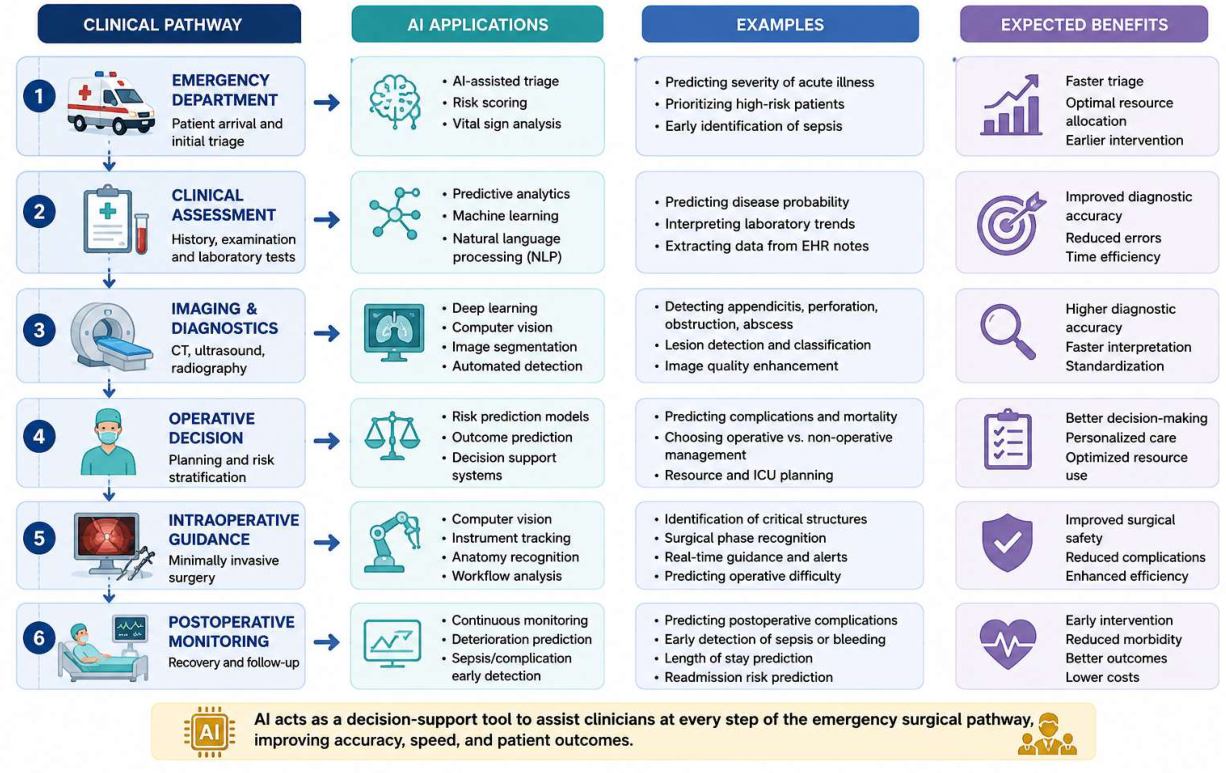
Figure 2.
Illustration of AI-assisted technologies integrated into minimally invasive emergency surgical workflows. The figure highlights the use of computer vision, anatomical recognition, workflow analysis, predictive analytics, and intraoperative decision-support systems during laparoscopic surgery. AI-assisted platforms may facilitate identification of critical anatomical structures, operative phase recognition, risk prediction, instrument tracking, automated documentation, and real-time surgical guidance, potentially contributing to improved operative safety, workflow optimization, and perioperative outcomes.
Figure 2.
Illustration of AI-assisted technologies integrated into minimally invasive emergency surgical workflows. The figure highlights the use of computer vision, anatomical recognition, workflow analysis, predictive analytics, and intraoperative decision-support systems during laparoscopic surgery. AI-assisted platforms may facilitate identification of critical anatomical structures, operative phase recognition, risk prediction, instrument tracking, automated documentation, and real-time surgical guidance, potentially contributing to improved operative safety, workflow optimization, and perioperative outcomes.
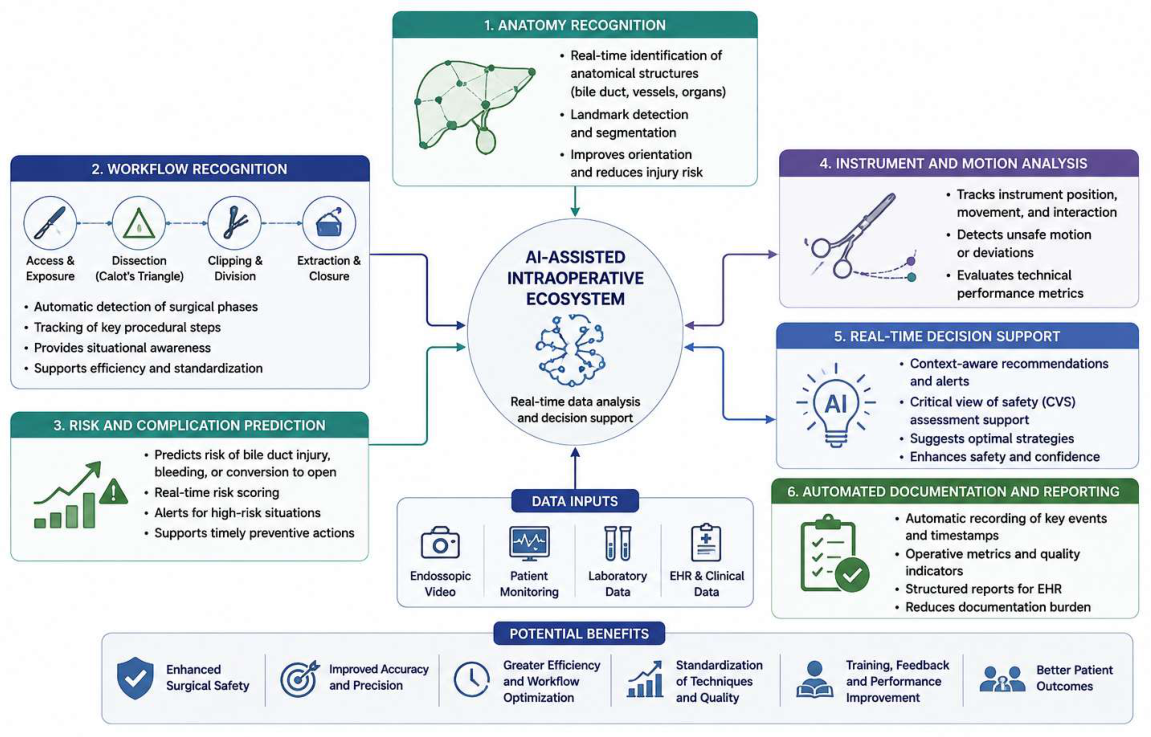
Figure 3.
Conceptual overview of emerging and future applications of artificial intelligence in emergency general surgery. The figure illustrates the potential integration of predictive analytics, AI-assisted triage, computer vision, digital operating rooms, robotic support systems, perioperative monitoring, cloud-based data integration, and AI-driven educational platforms into future emergency surgical ecosystems. These technologies may contribute to improved diagnostic accuracy, operative safety, workflow optimization, personalized perioperative management, and enhanced patient outcomes.
Figure 3.
Conceptual overview of emerging and future applications of artificial intelligence in emergency general surgery. The figure illustrates the potential integration of predictive analytics, AI-assisted triage, computer vision, digital operating rooms, robotic support systems, perioperative monitoring, cloud-based data integration, and AI-driven educational platforms into future emergency surgical ecosystems. These technologies may contribute to improved diagnostic accuracy, operative safety, workflow optimization, personalized perioperative management, and enhanced patient outcomes.
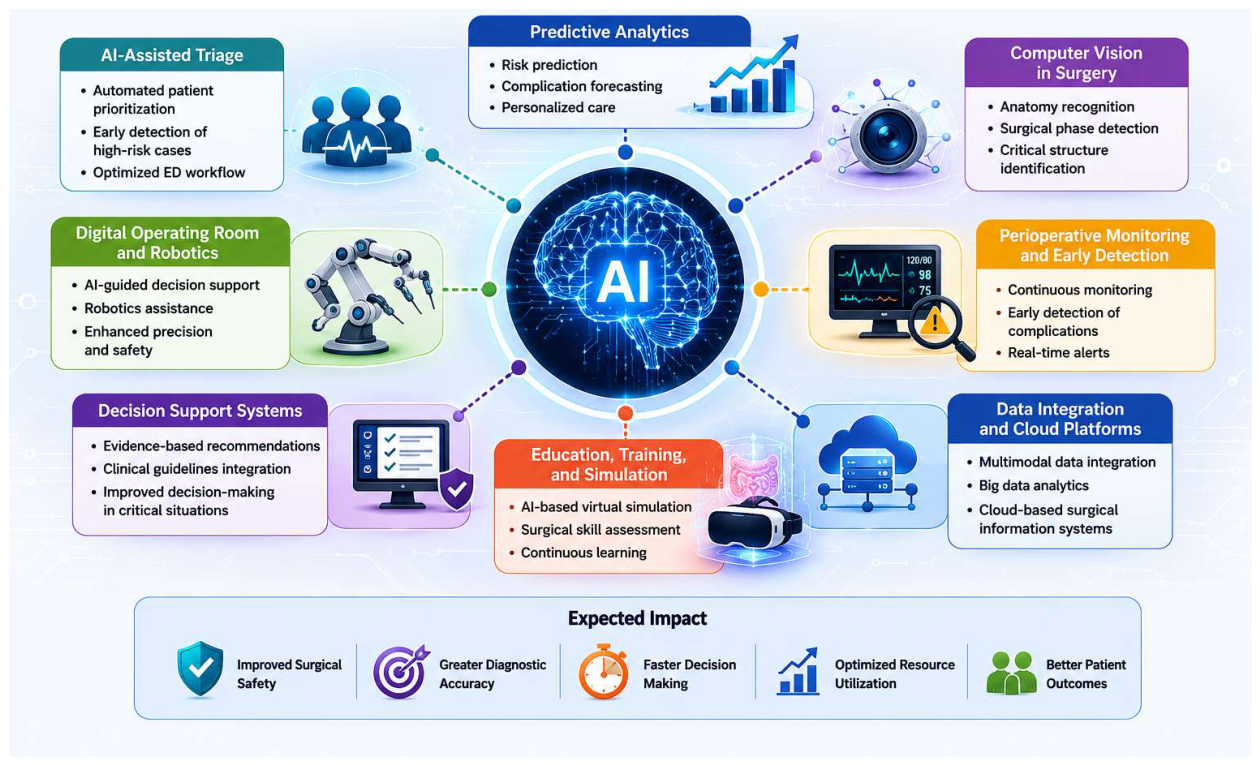

Table 1.
Main artificial intelligence technologies and their current clinical applications in emergency general surgery.
Table 1.
Main artificial intelligence technologies and their current clinical applications in emergency general surgery.
| Artificial Intelligence Technology | Principal Clinical Application | Potential Clinical Benefit |
|---|---|---|
| Machine learning | Perioperative risk stratification and outcome prediction | Early identification of high-risk patients and improved clinical decision-making |
| Deep learning | Diagnostic imaging interpretation and lesion detection | Improved diagnostic accuracy and faster emergency evaluation |
| Computer vision | Intraoperative anatomy recognition and workflow analysis | Enhanced operative safety and procedural standardization |
| Predictive analytics | Sepsis prediction and postoperative complication monitoring | Earlier intervention and optimized perioperative management |
|
Natural language processing (NLP) |
Electronic health record analysis and clinical data extraction | Improved workflow efficiency and data integration |
|
Neural network algorithms |
Continuous physiologic monitoring and deterioration prediction | Real-time risk assessment and intensive care optimization |
| Automated image segmentation | Identification of critical anatomical structures during minimally invasive surgery | Improved intraoperative orientation and surgical precision |
|
AI-assisted decision-support systems |
Emergency triage and operative prioritization | Optimized resource allocation and faster surgical coordination |
| Workflow recognition systems | Surgical phase detection and operative performance assessment | Improved training, operative efficiency, and quality control |
1 Overview of the principal AI methodologies currently investigated in emergency surgical care, including machine learning, deep learning, computer vision, predictive analytics, and natural language processing. The table summarizes their major clinical applications and potential contributions to diagnostic accuracy, perioperative management, operative safety, workflow optimization, and surgical education.
Table 2.
Main artificial intelligence technologies and their current clinical applications in emergency general surgery.
Table 2.
Main artificial intelligence technologies and their current clinical applications in emergency general surgery.
| Clinical Domain | AI Application | Current Clinical Status | Potential Benefit |
|---|---|---|---|
| Acute appendicitis | Diagnostic prediction models using clinical and imaging data | Emerging | Earlier diagnosis and reduced negative appendectomy rates |
| Acute cholecystitis | Computer vision and anatomy recognition during laparoscopic surgery | Advanced experimental implementation | Improved intraoperative orientation and surgical safety |
| Bowel obstruction | CT image analysis and predictive imaging algorithms | Emerging | Faster radiologic interpretation and operative prioritization |
| Gastrointestinal perforation | Automated imaging detection and sepsis prediction models | Early clinical investigation | Earlier diagnosis and rapid intervention |
| Abdominal sepsis | Machine learning-based physiologic monitoring and risk prediction | Moderate clinical development | Earlier recognition of deterioration and septic shock |
| Trauma and acute care surgery | AI-assisted triage and predictive analytics | Emerging | Improved emergency prioritization and workflow optimization |
| Intensive care monitoring | Continuous physiologic deterioration prediction | Moderate clinical development | Dynamic risk stratification and optimized ICU management |
| Minimally invasive surgery | Surgical phase recognition and workflow analysis | Advanced experimental implementation | Improved operative standardization and technical assessment |
| Operative risk assessment | Predictive perioperative analytics and complication prediction | Moderate clinical implementation | Individualized perioperative planning |
| Surgical education | AI-driven simulation and technical performance analysis | Emerging | Objective training assessment and workflow standardization |
1 Overview of the principal AI methodologies currently investigated in emergency surgical care, including machine learning, deep learning, computer vision, predictive analytics, and natural language processing. The table summarizes their major clinical applications and potential contributions to diagnostic accuracy, perioperative management, operative safety, workflow optimization, and surgical education.
Table 3.
Major challenges and limitations associated with the implementation of artificial intelligence in emergency general surgery.
Table 3.
Major challenges and limitations associated with the implementation of artificial intelligence in emergency general surgery.
| Challenge | Description | Potential Clinical Impact |
|---|---|---|
| Data heterogeneity | Variability in datasets, imaging protocols, and institutional practices | Reduced reproducibility and limited external validation |
| Retrospective dataset dependence | Many AI models are trained on retrospective single-center cohorts | Limited generalizability to real-world emergency settings |
| Algorithm transparency | “Black-box” decision-making processes in deep learning systems | Reduced clinician trust and interpretability |
| Limited prospective validation | Lack of large multicenter prospective clinical trials | Delayed routine clinical implementation |
| Cybersecurity risks | Vulnerability of digital healthcare systems and cloud-based platforms | Potential data breaches and system compromise |
| Patient privacy concerns | Use of large-scale clinical and imaging datasets | Ethical and regulatory challenges regarding confidentiality |
| Medico-legal uncertainty | Unclear responsibility in AI-assisted clinical decisions | Potential legal disputes and accountability concerns |
| Infrastructure limitations | Unequal access to advanced digital technologies | Restricted implementation in low-resource healthcare systems |
| Financial costs | High expenses associated with AI integration and maintenance | Limited accessibility and institutional adoption |
1 Overview of the principal technical, ethical, legal, infrastructural, and clinical barriers currently limiting the widespread implementation of AI-assisted technologies in emergency surgical care. The table summarizes the potential impact of these limitations on reproducibility, clinician acceptance, patient safety, and healthcare system integration.
Disclaimer/Publisher’s Note: The statements, opinions and data contained in all publications are solely those of the individual author(s) and contributor(s) and not of MDPI and/or the editor(s). MDPI and/or the editor(s) disclaim responsibility for any injury to people or property resulting from any ideas, methods, instructions or products referred to in the content. |
© 2026 by the authors. Licensee MDPI, Basel, Switzerland. This article is an open access article distributed under the terms and conditions of the Creative Commons Attribution (CC BY) license (http://creativecommons.org/licenses/by/4.0/).
Copyright: This open access article is published under a Creative Commons CC BY 4.0 license, which permit the free download, distribution, and reuse, provided that the author and preprint are cited in any reuse.


