

Submitted:
26 May 2026
Posted:
29 May 2026
You are already at the latest version
Abstract
This paper outlines a custom made Academic and Administrative Audit (AAA) mechanism designed specifically to suit polytechnic and technical engineering institutions. The framework is based on 15 criteria evaluation rubric (a granular 15-criteria) which is a self-regulated learning theory, grounded on a Plan-Do-Check-Act (PDCA) cycle and self-regulated learning theories. This decentralized model, as opposed to the generic accreditation models which tend to result in episodic compliance, uses objective mathematical formulations to help instill a sustained, internalized quality culture. The results suggest that combining the specified metrics, including the achievement of specific outcomes in Outcome-Based Education (OBE) and dynamic indexing by faculty will optimize resources and accelerate readiness to be offered external accreditations such as NBA and NAAC. This study offers a scalable template to technical institutions as a way of aligning academic delivery with the changing industrial needs through peer-driven accountability and measurable metrics.
Keywords:
academic and administrative audit
; PDCA
; quality improvement
; technical education
1. Introduction
The landscape of technical and vocational education and training (TVET) is undergoing profound transformation, driven by the imperatives of global economic integration, rapid technological advancement, and escalating industrial demand for highly skilled, employment-ready graduates. In rapidly developing economies such as India, the technical education ecosystem, comprising thousands of degree-granting engineering colleges and diploma-granting polytechnic institutes, faces the dual challenge of vastly expanding capacity while simultaneously elevating the quality of pedagogical delivery and institutional governance. The National Education Policy (NEP) 2020 and the establishment of the National Council for Vocational Education and Training (NCVET) underscore a national mandate to weave vocational and technical education into the mainstream, demanding a paradigm shift from fragmented rote-learning models to cohesive outcome-based education frameworks.
Traditionally, higher education quality assurance paradigms have relied heavily on episodic, externally mandated accreditation processes. Apex bodies such as the All India Council for Technical Education (AICTE), alongside accreditation councils like the National Board of Accreditation (NBA) and the National Assessment and Accreditation Council (NAAC), have established comprehensive benchmarks for institutional legitimacy in India. However, while these external audits establish vital baseline thresholds, they frequently create a culture of temporary compliance. Institutions often mobilize immense resources in the months preceding an external peer review, only to see quality assurance practices recede into the background once the accreditation is secured [1].
To rectify the prevailing disconnect between cyclical compliance and genuine, continuous educational quality, there has been a distinct shift toward continuous internal evaluation mechanisms, prominently the Academic and Administrative Audit (AAA). The AAA operates as a systematic, data-driven internal review that evaluates the effectiveness, efficiency, and quality of academic and administrative processes within an institution. The implementation framework of AAA is represented in Figure 1. Standard evaluation metrics designed for generic higher education institutions often fall short for polytechnic institutes, which occupy a critical niche in bridging the gap between theoretical engineering concepts and practical shop-floor applications. Polytechnics require quality assurance mechanisms that heavily emphasize hands-on laboratory utilization, direct and continuous industry linkages, rapid curriculum adaptability, and the development of specialized faculty [2].
This study presents a comprehensive blueprint for a tailor-made AAA mechanism, formatted and optimized for integration into the quality assurance protocols of polytechnic and technical institutes. By dissecting the structural framework of a customized 15-criterion audit system—encompassing everything from vision and mission alignment to faculty development, extension activities, and alumni ecosystems—this report explores how strategic self-assessment can function not merely as a precursor to external accreditation but as the foundational engine for institutional sustainability, dynamic resource allocation, and sustained student success. The subsequent sections review the literature on quality assurance and self-regulated learning, detail the methodology of the proposed AAA framework, present granular evaluation criteria, and discuss the strategic implications of deploying such a model in contemporary technical education.
2. Literature Review
The conceptual foundations of this research are built upon the intersection of quality assurance theories in higher education, principles of continuous improvement methodologies, and cognitive frameworks of self-regulated learning. Understanding the historical and theoretical contexts is essential for recognizing the necessity of a customized AAA mechanism.
2.1. The Evolution of Quality Assurance in Higher Education
Quality Assurance (QA) in higher education is a multidimensional construct involving the systematic review of educational programs to ensure that acceptable standards of education, scholarship, and infrastructure are consistently maintained and improved. Globally, the massification of higher education has necessitated robust QA frameworks to maintain public trust and ensure technical professionals’ global mobility. In the Indian context, the drive for institutional excellence was formally articulated in the National Policy on Education (NPE, 1986) and subsequently reinforced by the Rashtriya Uchchatar Shiksha Abhiyan (RUSA), which explicitly linked state funding to mandatory quality assurance frameworks and to accreditation.
The National Education Policy (NEP 2020) has signaled a paradigm shift, mandating reforms that emphasize multidisciplinary education, academic flexibility, and holistic, experiential learning. Within this context, the Academic and Administrative Audit (AAA) has transitioned from a periodic compliance exercise to a strategic necessity for institutional survival. The AAA is defined as a systematic, data-driven internal review that evaluates the effectiveness, efficiency, and quality of both academic and administrative processes. It aligns closely with national frameworks such as the National Assessment and Accreditation Council (NAAC) and the National Board of Accreditation (NBA), providing the internal structure needed to meet benchmarks in outcome-based education (OBE) and effective governance.
The regulatory environment for polytechnics is further defined by state-level bodies such as the Maharashtra State Board of Technical Education (MSBTE), which implements Curriculum Implementation and Assessment Norms (CIAAN). The Table 1 summarizes different regulatory bodies and framework related to polytechnic. These norms focus on key performance indicators (KPIs) related to faculty development, continuous assessment, and laboratory standards. Integrating these various regulatory demands into a tailor-made AAA mechanism allows an institution to identify its strengths and challenges while establishing concrete goals for continuous improvement.
Currently, the Indian technical education sector is predominantly governed by the NAAC and the NBA, which operate under distinct yet complementary paradigms. The NAAC uses a comprehensive, institution-level evaluation model based on a seven-criterion framework that assesses overall institutional health, including curricular aspects, teaching-learning, research, infrastructure, student support, governance, and institutional values.9 Conversely, the NBA is strictly program-centric, rooted deeply in the Outcome-Based Education (OBE) philosophy. It evaluates the attainment of Program Educational Objectives (PEOs), Program Outcomes (POs), and Course Outcomes (COs) to ensure technical competence in alignment with international standards, such as those prescribed by the Washington Accord, which facilitates the global recognition of engineering qualifications.
Despite the rigorous and comprehensive nature of these external audits, recent scholarship has revealed a significant systemic vulnerability: institutions frequently treat accreditation as a terminal event rather than a continuous, integrated process. Data synthesized from multiple institutional reviews indicate that the lack of an internalized, decentralized audit mechanism leads to friction. Critical non-academic support services, continuous curriculum gap identification, and regular faculty appraisals often languish between external accreditation cycles, highlighting the limitations of relying solely on external agencies for quality sustenance. At the state level, bodies such as the Maharashtra State Board of Technical Education (MSBTE) conduct External Academic Monitoring (EAMC); however, even these mechanisms often function primarily as punitive or compliance-checking tools rather than developmental self-assessment frameworks [3,4].
2.2. The Plan-Do-Check-Act (PDCA) Cycle in Educational Governance
To counteract the phenomenon of episodic compliance, the integration of Strategic Self-Assessment—operationalized via the AAA—is theoretically underpinned by the Plan-Do-Check-Act (PDCA) cycle, also known as the Deming wheel. Originally developed for manufacturing quality control, the PDCA cycle has been increasingly adapted as a quality enhancement tool in the higher education sector to facilitate systematic data collection, analysis, and continuous course and subject-design enhancement [5].
In the context of technical educational institutions, the PDCA cycle functions as an iterative loop of continuous improvement.
- ➢
- Plan: The institution establishes strategic plans, defines PEOs and POs in alignment with industry requirements, formulates academic calendars, and allocates financial budgets.
- ➢
- Do: The institution executes the teaching-learning process, implements pedagogical innovations, conducts laboratory sessions, facilitates industry interactions, and utilizes infrastructure resources.
- ➢
- Check: The institution undertakes an Academic and Administrative Audit (AAA) to rigorously measure deviations from planned outcomes, calculate CO-PO attainment levels, analyze student performance metrics, and solicit stakeholder feedback.
- ➢
- Act: Based on the empirical data gathered during the ‘Check’ phase, the institution implements corrective measures, organizes remedial and make-up classes, updates institutional policies, and redesigns the curriculum to bridge the identified gaps, thereby restarting the cycle at a higher baseline of quality.
2.3. Institutional Self-Regulated Learning (SRL) and Feedback Literacy
The AAA mechanism also borrows heavily from the psychological theory of self-regulated learning (SRL), which has traditionally been applied to individual students but is increasingly recognized as applicable to institutional entities. Self-regulation involves learners setting specific goals, monitoring their progress, generating internal feedback, and adapting their strategies to achieve the desired outcomes. Highly effective learners do not depend solely on external evaluators to judge their competence; they possess internal mechanisms to assess their work against established criteria.
By extrapolating this theory to the organizational level, a self-regulated institution utilizes the AAA to foster “institutional feedback literacy.” Feedback literacy refers to the capacity to seek, process, and utilize feedback from various sources to monitor and improve performance. When an institution establishes clear, customized AAA criteria, it internalizes these standards of excellence. This transforms quality enhancement from a periodic external imposition into a daily operational reality, cultivating an environment where academic and administrative units continuously reflect on their performance, identify deficiencies without defensiveness, and proactively implement remedial strategies to address them [6,7].
3. Methodology: Design of the Tailor-Made AAA Framework
The research methodology for developing this paper centers on the structural analysis and strategic conceptualization of a customized Academic and Administrative Audit rubric, specifically designed for Shivnagar Vidya Prasarak Mandal’s Institute of Technology and Engineering, a polytechnic institute in Maharashtra, India.
The primary objective of designing this framework was to create a tool that transcends generic institutional evaluation. The methodology involved mapping the stringent requirements of the NBA Diploma Tier-II accreditation manual and the NAAC Self-Study Report (SSR) guidelines onto the micro-operational processes of a polytechnic institute. The result is a highly granular, quantitative instrument comprising 15 primary evaluation criteria, further divided into highly specific subcriteria, yielding a comprehensive maximum score that reflects the total quality profile of the institution.
A critical methodological innovation in this framework is the assignment of a “Criteria Owner” to each primary section of the report. Historically, the burden of accreditation and quality audits has fallen disproportionately on a single individual, typically the principal or the Internal Quality Assurance Cell (IQAC) Coordinator, leading to bottlenecks and systemic fatigue. By designating specific roles, such as the Head of Department (HOD) for Academic Excellence, the Training and Placement Officer (TPO) for Industry Connect, and the Library In-charge for Learning Resources, the framework inherently decentralizes accountability. This methodological design ensures that data collection and quality enhancement are distributed processes that foster peer-driven accountability and reduce administrative friction.
4. Results: The 15-Criterion AAA Architecture
The tailor-made AAA framework evaluates institutions across 15 comprehensive criteria. The subsequent sections provide a deep dive into the architecture of this rubric, synthesizing the structured data with the qualitative rationale underlying each metric.
Structural Components of the Tailor-Made AAA Mechanism
The proposed AAA mechanism for polytechnics is designed as a two-tier peer-review process consisting of a comprehensive self-study and site visits by internal and external peers. This mechanism is structured around seven primary criteria derived from the NAAC while integrating the specific technical requirements of the MSBTE and NBA.
4.1. Institutional Governance, Administration, and Strategic Planning
Effective governance is the foundation of institutional stability and academic freedom. The AAA framework allocates specific, heavily weighted metrics to evaluate the structural integrity, transparency, and strategic foresight of an institute’s leadership. This domain is primarily owned by the principal. Table 2 represents the sub criteria, evaluation parameters and weightage of each sub criteria.
Analytical Insights: A critical inclusion in this tier is the heavy weighting (20 marks) assigned to the Performance Appraisal system. Empirical research indicates that staff resistance, perceived unfairness in evaluations, and structural bureaucracy are the primary barriers to sustaining a quality culture in Indian HEIs. By explicitly auditing the transparency and effectiveness of the appraisal system, the AAA ensures that individual faculty goals are directly aligned with overarching institutional objectives in a fair and verifiable manner.
Furthermore, the deliberate tracking of budget utilization (accounting for 10 out of the 15 budget formulation marks) ensures that the allocated funds directly translate into infrastructural and academic enhancements. This combats the common phenomenon of unutilized institutional capital, where budgets exist on paper, but administrative bottlenecks prevent actual expenditure on student development. The specific focus on the delegation of financial powers (20 marks in Criterion 13) guarantees that HODs possess the operational agility to make immediate improvements to their departments without waiting for centralized approvals, which is a hallmark of mature organizational governance.
4.2. Academic Excellence and the Teaching-Learning Process
The core of any educational institution is its pedagogical delivery system. Generic audits often measure teaching by input parameters (e.g., hours taught). This framework rigorously evaluates the teaching-learning process based on output and outcome parameters, aligning perfectly with NBA paradigms. This extensive criterion is owned by the Head of the Department (HOD). Academic and Teaching-Learning Process Metrics used in AAA is represented in Table 3.
Analytical Insights: The teaching-learning criteria demand rigorous mathematical validation of educational outcomes. For example, the AAA utilizes a precise scoring taxonomy for lesson plan adherence and syllabus coverage (awarding 5 marks for 100% coverage, scaling down to 0 marks for anything below 80%), which drastically reduces subjective evaluation biases.
In technical education, laboratories are the primary arenas for skill acquisition. Measuring the percentage of fully functional experimental setups, the calibration frequency of measuring instruments, and the adoption of the ‘5S’ methodology (Sort, Set in order, Shine, Standardize, Sustain) directly reflects the industrial ethos required in polytechnic education. This ensures that the environment where technical skills are honed mimics the rigorous safety and organizational standards of the modern manufacturing and engineering sectors, easing students’ transition into the workforce.
A particularly progressive element of this AAA is the formal assessment of “Social and Life Skill Implementation” within technical delivery (5 marks). This criterion bridges the critical gap between pure technical competency and the broader societal responsibilities of engineers, addressing a recognized deficit in traditional STEM curricula, where civic engagement and socioscientific reasoning have been historically neglected.
4.3. Student Performance, Mentoring, and Progression
The ultimate measure of institutional efficacy is the academic success, holistic development, and subsequent progression of its student body. Table 4 represents the evaluation criteria for student performance and mentoring.
Analytical Insights: The success rate without backlogs is quantified using a direct mathematical formula:
Marks= % of students completed diploma without backlog 30.2, capped at a maximum of 20 marks. This scalar, formulaic approach ensures that even incremental improvements in student retention and academic success are directly and proportionately reflected in the audit score, rewarding the continuous effort.
Furthermore, tracking geographical student diversity—specifically, the percentage of students originating from other districts and states-serves as a proxy indicator for the institution’s expanding brand equity and reputation. This is a vital parameter when an institution intends to compete in national benchmarking frameworks like the National Institutional Ranking Framework (NIRF), where “Outreach and Inclusivity” are major evaluative components. The structured approach to mentoring (Criterion 10) ensures that student support transcends informal interactions, requiring documented proof of efficacy and actions taken to resolve student grievances and academic hurdles.
4.4. Faculty Development, Qualifications, and Retention
High-quality pedagogy relies fundamentally on a motivated, stable, and continuously upgrading faculty cohort. The AAA framework deeply analyzes the demographics and professional momentum of the teaching staff, jointly overseen by the Principal and the HODs.
Mathematical Modeling for Faculty Qualification: To objectively measure the academic competency of the faculty cohort, AAA incorporates a specific algorithmic metric for Faculty Qualification (FQ):
FQ = 2.0 x [{10X +7Y}/F]
Where:
- ➢
- X represents the number of faculty members possessing a Master’s degree (e.g., M.Tech / M.E.).
- ➢
- Y represents the number of faculty members possessing a bachelor’s degree (e.g., B.Tech / B.E.).
- ➢
- F represents the total number of faculty required to comply with the standard 1:20 faculty-student ratio stipulated by the AICTE.
The maximum attainable score for this criterion was capped at 10 marks. Faculty development related criteria and evaluation metric is summarized in Table 5.
Analytical Insights: In polytechnic systems, the faculty frequently possesses only bachelor’s degrees. The proprietary FQ formula inherently incentivizes institutions to recruit or heavily upskill their faculty toward master’s and doctoral degrees by assigning a significantly heavier weight (10X) to postgraduate qualifications compared to undergraduate qualifications (7Y).
Crucially, by linking the denominator (F) to the mandated faculty-student ratio rather than the actual number of currently employed faculty, the metric mathematically penalizes institutions that operate with a skeletal, understaffed academic roster. An institute cannot artificially inflate its FQ score by employing only a few highly qualified individuals while leaving major teaching positions vacant. This ensures strict alignment with AICTE staffing norms while simultaneously driving the accumulation of intellectual capital. The faculty retention metric further emphasizes that a revolving door of educators is detrimental to the sustained execution of OBE frameworks, penalizing high-attrition rates.
4.5. Industry Connect, Placement, and Alumni Ecosystem
For technical institutes, industry relevance is crucial. Graduate employability is the primary return on investment for students, parents, and society.
Analytical Insights: A sophisticated leap in this quality assurance framework is the inclusion of the “Impact analysis of industrial training” alongside mere participation rates (percentage of students getting internships). The current literature suggests that while internships are universally acknowledged as vital for bridging the competence gap in engineering and diploma graduates, the actual pedagogical outcomes of these experiences are rarely rigorously assessed. By demanding an impact analysis, the AAA compels the institution to close the feedback loop, utilizing internship assessments to modify the on-campus curriculum, representing a perfect execution of the PDCA cycle.
Additionally, formalizing the role of alumni through specific financial and infrastructural metrics (e.g., funding laboratories and sponsoring capstone projects) shifts the perception of alumni. They are no longer viewed merely as passive past students attending annual reunions but as active institutional stakeholders, curriculum advisors, and critical revenue vectors. The criteria owner assigned under Industry connect, Placement are mentioned in Table 6.
4.6. Infrastructure, Learning Resources, and Research Innovation
A modern, dynamic technical curriculum cannot be delivered in an archaic environment. The framework rigorously audits both the physical and digital resources available to the academic community, alongside the institution’s commitment to knowledge creation.
Analytical Insights: Historically, polytechnic institutions have been viewed purely as teaching centers, heavily reliant on rote instruction, with genuine research relegated to universities and degree-granting engineering colleges. However, this AAA framework breaks the outdated mold by allocating a substantial 80 marks to Research and Innovation (Table 7).
Metrics evaluating publications in indexed journals (Scopus/Web of Science), patent acquisition, and the proactive pursuit of external funding (such as the AICTE’s MODROB - Modernization and Removal of Obsolescence scheme) signal a strategic pivot. Promoting a robust research culture at the polytechnic level ensures that the faculty remains at the absolute cutting edge of technological evolution. This research orientation directly enriches the content delivered to diploma students, moving the pedagogical approach from the transmission of historical facts to exploring contemporary industrial challenges. Measuring the Internal Revenue Generation (IRG) through lab testing and consultancy also drives the institution toward financial self-sustainability, reducing absolute dependence on student tuition fees and state grants.
4.7. Extension Activities, Professional Development, and Best Practices
Finally, the framework evaluates an institution’s outward societal impact, professional networking, and unique internal innovations.
- ➢
- Professional Development (30 marks): This criterion measures active participation in the broader academic community. It audits student club activities, faculty/student exchange programs, and the establishment of professional society chapters in the Institute. This ensures that the institute does not operate in an intellectual silo.
- ➢
- Extension Activities (45 Marks): Evaluates the execution of technical events, NSS/NCC activities, and critical outreach campaigns such as Swachh Bharat, AIDS awareness, and gender sensitization. Notably, the audit includes a highly specific metric for “Training provided to unskilled and semiskilled people in the nearby community (e.g., welding, computer literacy).” This perfectly aligns with the global mandate for technical institutions to act as engines for local socioeconomic upliftment, embodying the principles of corporate and educational social responsibility.
- ➢
- Best Practices (20 marks): Rewards the successful implementation of at least two unique, sustainable best practices that distinguish the institution from its peers (10 marks each). This encourages ground-up innovation and localized problem-solving, allowing the institution to develop specialized competencies rather than relying on cookie-cutter educational models.
5. Discussion: Strategic Implications and Systemic Impact
The implementation of a tailor-made AAA mechanism is not fundamentally an administrative exercise in record-keeping; it is a strategic intervention designed to alter the institutional ecology. The exhaustive nature of the 15-point framework outlined above offers several strategic advantages and actionable insights for higher-education administrators, policymakers, and external accreditors.
5.1. Bridging the Gap Between Micro-Operations and Macro-Accreditation
A fundamental challenge in technical education quality assurance is the severe disconnect between daily academic operations and the macro-level data required for NBA and NAAC accreditations. Institutions often engage in frantic, retrospective data compilation months prior to an external peer team visit, leading to data inaccuracies, immense faculty burnout, and a temporary halt to actual pedagogical innovation.
The proposed AAA framework resolves this crisis by embedding the exact requirements of these apex bodies directly into the micro-operational fabric of the institution. For instance, the NBA heavily scrutinizes the CO-PO attainment matrices, continuous evaluation rubrics, and curriculum gap analyses. By making these exact elements a continuously audited sub-criterion within the internal AAA (Criteria 2.12 and 2.13), the institution ensures that data is generated, verified, and analyzed in real-time, semester by semester. Consequently, when the time comes for an external NBA or NAAC review, the institution is perpetually audit-ready, having already undergone rigorous internal stress-testing, thereby reducing the compliance burden and focusing external reviews on genuine qualitative enhancements.
5.2. Cultivating Institutional Feedback Literacy and Overcoming Staff Resistance
The transition to a highly quantified, data-driven self-assessment model inevitably encounters organizational friction. Empirical research spanning multiple Higher Education Institutions (HEIs) highlights that staff resistance, entrenched structural bureaucracy, and perceived threats to academic autonomy are the primary barriers to establishing a sustainable quality culture. Faculty may view the AAA as a punitive surveillance tool designed to expose flaws rather than a developmental mechanism to support teaching.
To mitigate this deeply ingrained resistance, the AAA framework must be executed iteratively, drawing on the psychological principles of formative assessment. The designation of decentralized “Criteria Owners” is a masterful structural decision in this regard. By making the Training and Placement Officer formally responsible for Industry Connect, the Library In-charge responsible for Learning Resources, and Department Heads responsible for Academic Excellence, the audit effectively distributes power. It transforms the QA process from a top-down administrative mandate, often resented by faculty, into a collaborative, peer-reviewed ecosystem. This distribution of ownership directly fosters “institutional feedback literacy”—the capacity of the organization to effectively seek, process, and utilize data to monitor and improve its own performance without defensiveness. When faculty members own the metrics by which they are evaluated, engagement replaces compliance [8].
5.3. Empowering Data-Driven Resource Allocation
Resource constraint is a ubiquitous reality for technical institutions, particularly state-funded or tier-II private polytechnics operating in competitive markets. Administrators constantly face zero-sum decisions regarding budget allocation: should capital be deployed toward upgrading physical laboratory equipment, expanding digital library subscriptions, or funding faculty research incentives?
The AAA mechanism transforms budget allocation from a subjective, often highly politicized process into an objective, data-driven methodology. Because the audit generates a precise numerical score for every operational facet of the institution, administrators can identify exact areas of deficiency with surgical precision. If an institution scores 5/25 on digital access but 25/25 on physical library books, the strategic imperative becomes unequivocally clear: future capital expenditure must be diverted toward bandwidth expansion and ILMS integration rather than physical textbook acquisition. This strict alignment between audit findings and financial planning ensures the optimum utilization of scarce resources, preventing infrastructural bloat in areas that do not directly contribute to student outcomes.
5.4. Enhancing Industry Synchronization and Employability
The chronic mismatch between the theoretical competencies possessed by engineering and diploma graduates and the practical requirements of the modern industrial sector remains a persistent crisis in technical education. State-prescribed curricula often lag years behind cutting-edge industrial practices, leaving graduates unemployable without extensive retraining.
The tailor-made AAA confronts this challenge aggressively through its rigorous Industry Connect (Criterion 7) and Placement (Criterion 8) metrics. By demanding documented evidence of expert sessions on cutting-edge technologies, tracking the number of industries visited by faculty members, and auditing the interview hit rate of campus placements, the framework explicitly penalizes institutional isolation. Furthermore, by establishing target metrics for content delivered beyond the prescribed syllabus and mapping it to Program Outcomes, the AAA empowers faculty to bypass the slow bureaucratic machinery of state-level curriculum boards (such as the MSBTE). It allows them to inject real-time industrial knowledge directly into the classroom, ensuring that graduates are equipped with contemporary skills that guarantee immediate employability.
6. Conclusion
The pursuit of excellence in polytechnic and technical engineering education cannot be outsourced to episodic external accreditors; it must be cultivated internally through relentless, structured, and data-driven self-reflection. The tailor-made Academic and Administrative Audit (AAA) mechanism presented in this report provides a highly comprehensive, quantifiable, and strategically aligned framework to achieve this internalized quality culture.
By deconstructing institutional performance into 15 distinct, measurable criteria—spanning institutional governance, rigorous pedagogical evaluation, continuous faculty upskilling, dynamic industry integration, and proactive social responsibility—the framework captures the complex, multi-dimensional realities of modern technical education. The integration of precise mathematical benchmarks, such as the proprietary Faculty Qualification index and success rate scalars, ensures objective evaluation and removes administrative bias. Simultaneously, the decentralized architecture of criteria ownership fosters collaborative accountability and overcomes traditional staff resistance to quality audits.
Ultimately, the deployment of this customized AAA mechanism enables institutions to transcend mere compliance. It seamlessly operationalizes the Plan-Do-Check-Act (PDCA) cycle and the principles of institutional self-regulated learning, transforming raw institutional data into actionable, strategic intelligence. For polytechnic institutes seeking to enhance graduate employability, optimize scarce resource allocation, and secure apex accreditations like the NBA and NAAC in a highly competitive academic landscape, this robust model of strategic self-assessment serves as an indispensable blueprint for sustainable educational transformation. Future policy development should focus on incentivizing the adoption of such tailor-made internal frameworks, utilizing longitudinal data to continually refine the metrics to match the evolving demands of the global engineering and manufacturing sectors.
References
- Asiyai, R. I. Best practices for quality assurance in higher education: implications for educational administration. Int. J. Leadersh. Educ. 2022, 25(5), 843–854. [Google Scholar] [CrossRef]
- Accreditation manual for diploma engineering programmes (tier-ii) - nbaind.org. Available online: https://www.nbaind.org/Files/Diploma_Tier%20II%20-%20Manual.pdf (accessed on 2 May 2026).
- Top 5 challenges faced by Polytechnics in India - National Skills Network. Available online: https://nationalskillsnetwork.in/top-5-challenges-faced-by-polytechnics-in-india/ (accessed on 2 May 2026).
- Alenezi, S.; Al-Eadhy, A.; Barasain, R.; AlWakeel, T. S.; AlEidan, A.; Abohumid, H. N. Impact of external accreditation on students’ performance: Insights from a full accreditation cycle. Heliyon 2023, 9(5). [Google Scholar] [CrossRef] [PubMed]
- Nguyen, V.; Nguyen, N.; Schumacher, B.; Tran, T. Practical application of plan–do–check–act cycle for quality improvement of sustainable packaging: a case study. Appl. Sci. 2020, 10(18), 6332. [Google Scholar] [CrossRef]
- Diao, J.; Han, X.; Zhou, Q.; Wang, Y. Professional competencies in TVET: Framework, indicators and assessment instrument. In Handbook of Technical and Vocational Teacher Professional Development in the Digital Age; Springer Nature Singapore: Singapore, 2023; pp. 41–73. [Google Scholar]
- Mathur, A.; Sharan, M.; Chakraborty, S.; Mullick, S. Technical and vocational education and training: Examining changing conditions in India. Environ. Sci. Proc. 2022, 15(1), 31. [Google Scholar]
- Asamoah, M. K.; Ansong, J. D.; Mackin, E.; Agyekum, B. The influence of quality assurance on achieving development education ethical goals. 2025. [Google Scholar] [CrossRef]
Figure 1.
AAA implementation framework.
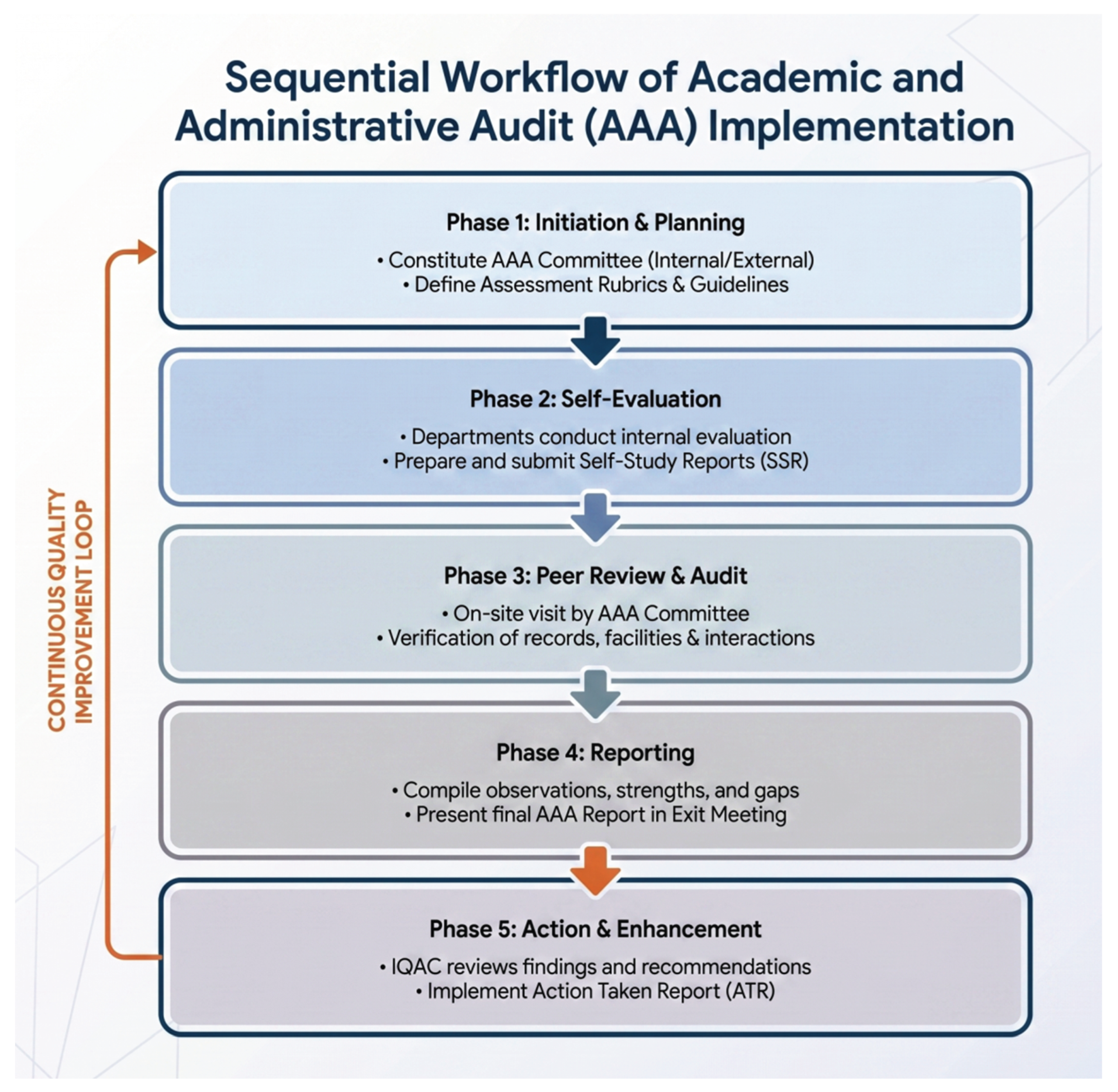
Figure 2.
Criteria wise weightage in AAA.
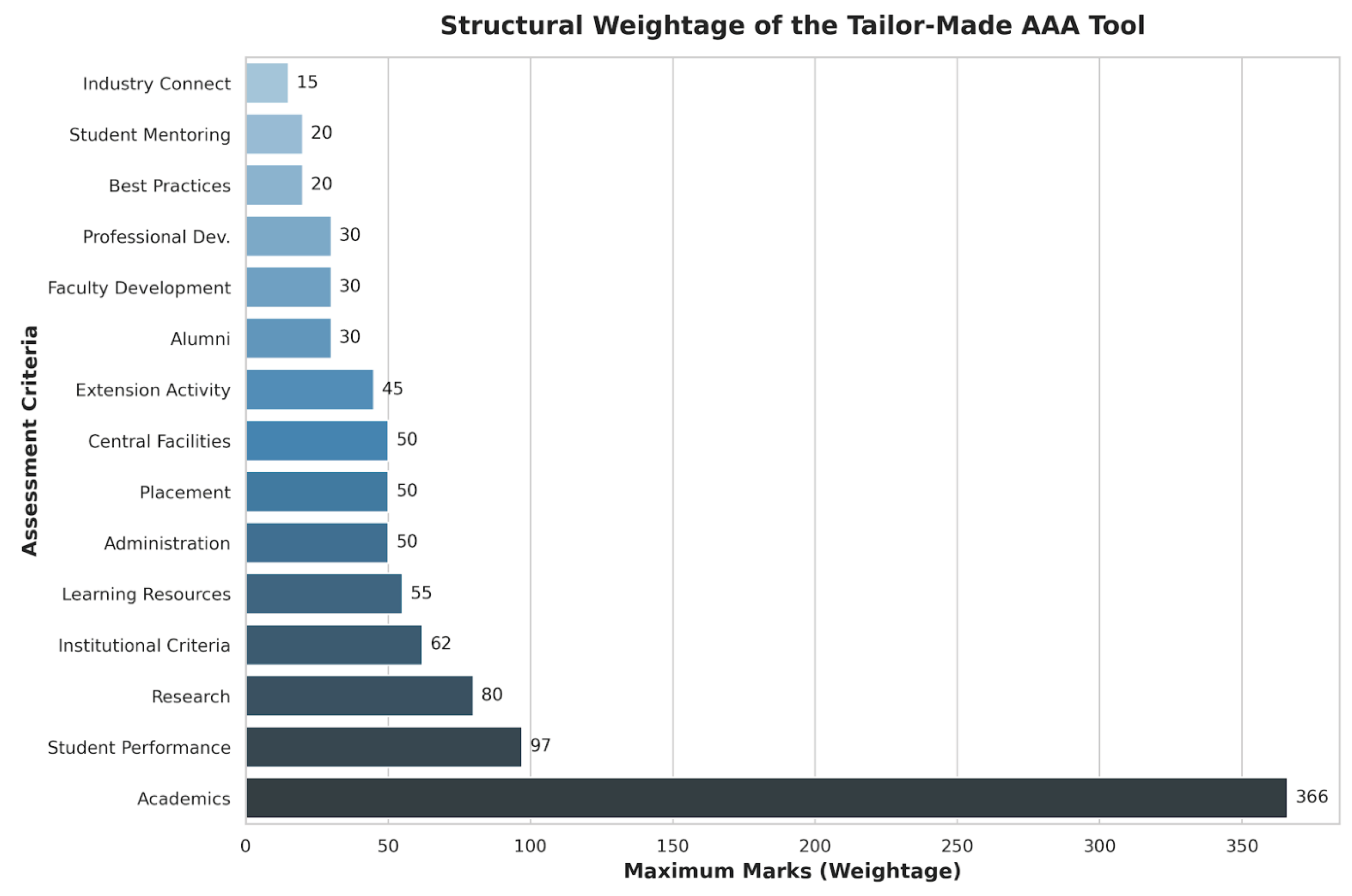

Table 1.
Role of Regulatory bodies/ Framework.
| Regulatory Body / Framework | Primary Focus | Methodology |
|---|---|---|
| AICTE | Norms and Standards | Approval and Regulation |
| NBA | Program Outcomes (OBE) | Accreditation (Tier I & II) |
| NAAC | Institutional Quality | 7 Criteria Framework |
| MSBTE (CIAAN) | Implementation Standards | Academic Monitoring |
| NEP 2020 | Holistic Development | Policy Transformation |
Table 2.
Institutional Governance and Administration Metrics (Criteria Owner- Principal).
| Criterion | Sub-Criterion | Evaluation Metrics | Max Marks |
|---|---|---|---|
| 1. Institutional Criteria | Vision & Mission | Availability, appropriateness, and consistency of statements with the overall institutional goals. | 5 |
| Governance | Formation and functionality of 13 statutory committees (e.g., BOG, CDC, IQAC, Anti-Ragging, SC/ST, EOC, Finance, Purchase, Women GRC). | 13 | |
| Strategic Plan | Availability of a formalized plan and evidence of effective implementation of the plan. | 5 | |
| Budget Formulation | Formulation processes, formal approval mechanisms, and percentage utilization of the allocated budget. | 15 | |
| Performance Appraisal | The existence of a well-defined system, implementation transparency, and measurable effectiveness. | 20 | |
| Accreditation Status | Formal recognitions and rankings from NIRF, NBA, ISO, and MSBTE, etc. (1 mark for each valid recognition). | 5 | |
| 13. Administration | Decentralization | Organization charts and explicit delegation of administrative powers to faculty members. | 10 |
| Financial Powers | Delegation and demonstrated utilization of financial powers by HODs and relevant in-charges. | 20 | |
| Grievance Redressal | Mechanism composition, accessibility, and meticulous maintenance of Action Taken Reports (ATR). | 10 | |
| Student Support | Efficiency, process mapping, and timely flow of admissions, examination forms, and general office services. | 10 |
Table 3.
Academic and Teaching-Learning Process Metrics.
| Criterion | Sub-Criterion | Evaluation Metrics | Max Marks |
|---|---|---|---|
| 2. Academics | Program Objectives | Availability, dissemination, and stakeholder awareness of PEOs, POs, and PSOs; Justification mapping matrices. | 55 |
| Academic Planning | Strict adherence to the academic calendar; Theory lesson plan execution (scaled: 100% adherence = 5 marks, <80% = 0 marks). | 8 | |
| Teaching Delivery | Maintenance of course files, use of ICT tools, integration of social/life skills, and frequency of expert industry lectures. | 20 | |
| Laboratory Ecosystem | Experimental setups in working condition (91-100% = 5 marks); 5S laboratory organization; Instrument calibration. | 25 | |
| Curriculum Gaps | Proactive steps to identify gaps in the prescribed curriculum and actions taken to bridge them (content beyond the syllabus). | 20 | |
| Evaluation Methods | Implementation of continuous laboratory assessment utilizing formalized laboratory rubrics. | 5 | |
| Attainment & Feedback | Comprehensive CO-PO matrix justification, continuous attainment records, and corrective action loops based on student feedback. | 65 |
Table 4.
Student Performance and Mentoring Metrics.
| Criterion | Sub-Criterion | Evaluation Metrics | Max Marks |
|---|---|---|---|
| 6. Student Performance | Enrollment & Merit | Average percentage of admissions to the first and direct second years ( ≥ 90% = 20 marks); Entry-level merit (average 10th/12th marks); Geographical diversity (out of region/state). | 37 |
| Success Rate | Percentage of all-clear students (90%+ = 10 marks); Allowed to Keep Term (ATKT) ratios (<10% = 5 marks). | 15 | |
| Progression | Percentage of students completing certification courses, admissions to higher studies (degree engineering), and government service qualifications. | 20 | |
| Entrepreneurship | Number of entrepreneurship awareness sessions conducted; percentage of alumni who became entrepreneurs. | 15 | |
| 10. Mentoring | Mentoring System | Efficacy of the individual mentoring system and availability of Action Taken Reports (ATR) for individual student issues. | 10 |
| Career Counseling | Specialized sessions were conducted for higher studies (degree engineering) and competitive examinations. | 10 |
Table 5.
Faculty Development and Demographic Metrics.
| Criterion | Sub-Criterion | Evaluation Metrics | Max Marks |
|---|---|---|---|
| 12.Faculty Development | Training | Completion rates of Short-Term Training Programs (STTP) and Faculty Development Programs (FDP) (100% completion = 10 marks). | 10 |
| Representation | Faculty representation on external Board of Studies (BOS), academic councils, and industry boards. | 5 | |
| Resource Persons | Faculty members serving as conference chairs, resource persons, or guest lecturers for external events. | 5 | |
| Qualification Upgrade | Percentage of faculty acquiring higher degrees (ME/PhD) annually (minimum 10% expected for full marks). | 5 | |
| 2.16 Retention | Staff Stability | Retention rate of the required faculty over the last three years ( ≥ 90% retention = 5 marks, scaled down accordingly). | 5 |
Table 6.
Industry Connect, Placement, and Alumni Metrics.
| Criterion | Sub-Criterion | Evaluation Metrics | Max Marks | Criteria Owner |
|---|---|---|---|---|
| 7. Industry Connect | MoUs | Number of active Memorandums of Understanding (MoUs) and explicit evidence of activities conducted under each MoU. | 10 | HOD |
| Sponsored Labs | Availability and utilization of industry-supported laboratories (one per program expected). | 5 | HOD | |
| 8. Placement | Placement Metrics | Percentage of students placed; Minimum, Average, and Highest salary package trends. | 20 | TPO |
| Industrial Training | Mandatory internships of more than two weeks; post-training assessment and impact analysis. | 10 | TPO | |
| Corporate Interaction | Number of industries visiting campus, interview hit rates, and number of strategic industries visited by the TPO. | 15 | TPO | |
| 14. Alumni | Alumni Engagement | Frequency of expert talks, webinars, and annual meets with documented feedback analysis and action taken. | 13 | Alumni Coordinator |
| Institutional Support | Alumni-sponsored projects, lab development initiatives, placement support, and financial aid for economically disadvantaged students. | 15 | Alumni Coordinator |
Table 7.
Infrastructure, Resources, and Research Metrics.
| Criterion | Sub-Criterion | Evaluation Metrics | Max Marks | Criteria Owner |
|---|---|---|---|---|
| 3. Central Facilities | Physical Ambience | Student-to-computer ratios, availability of interactive classrooms, sports facilities, and project labs. | 23 | Principal / Coordinator |
| Safety Protocols | Verification of fire and safety audit certificates; Display of SOPs and Do’s/Don’ts in laboratories. | 8 | Principal | |
| General Amenities | Adequacy of canteens, medical/ambulance facilities, consumer stores, and girls’/boys’ common rooms. | 10 | Principal | |
| 4. Learning Resources | Library Efficacy | Utilization rates by staff and students (footprints); Integrated Library Management Systems (ILMS) coding. | 15 | Library In-charge |
| Digital Access | Available Internet bandwidth as per AICTE norms; Campus Wi-Fi availability; digital library computer adequacy and utilization. | 25 | Library In-charge | |
| 5. Research | Publications & IPR | Number of high-impact publications (SCI/WoS/SCOPUS/UGC Care), patents filed and awarded, and copyrights. | 28 | Research Coordinator |
| Funded Projects | Sponsored research, MODROB funding volume (scaled: >20 Lakhs = 5 marks, down to <4 Lakhs = 1 mark). | 5 | Research Coordinator | |
| Consultancy | Revenue generated through formal consultancy and laboratory testing (Internal Revenue Generation [IRG] ). | 17 | Research Coordinator |
Table 8.
Structural Weightage of the Tailor-Made AAA Tool.
| Sr. No | Criteria | Primary Focus Area | Max Marks |
|---|---|---|---|
| 1 | Institutional Criteria | Governance (BOG, CDC, IQAC), Strategic Plan, Budget Utilization | 62 |
| 2 | Academics | Teaching-Learning, ICT, Course Files, Lab “5S”, CO-PO Attainment | 366 |
| 3 | Central Facilities | Computational Facility (6:1 ratio), Safety (Fire Audit), Interactive Classrooms | 50 |
| 4 | Learning Resources | Library Utilization, Digital Library (Min 6 PCs), Internet Bandwidth | 55 |
| 5 | Research | Scopus/UGC Care Publications, Patents, MODROB Funding, IRG | 80 |
| 6 | Student Performance | Enrollment, Entry Merit, Passing % without backlogs | 97 |
| 7 | Industry Connect | MoUs, Industry-Supported Laboratories | 15 |
| 8 | Placement | Training Hours, Average/Highest Package, Internship Impact | 50 |
| 9 | Professional Dev. | Faculty/Student Exchange, Professional Society Chapters | 30 |
| 10 | Student Mentoring | Career Counseling, Competitive Exam Support | 20 |
| 11 | Extension Activity | Social/NSS Activities, Community Training | 45 |
| 12 | Faculty Development | Training/FDP (100% target), Awards, Qualification Upgradation | 30 |
| 13 | Administration | Decentralization, Financial Power Delegation, Grievance Redressal | 50 |
| 14 | Alumni | Alumni-sponsored projects, Newsletter Publication | 30 |
| 15 | Best Practices | Implementation of two distinct institutional best practices | 20 |
Disclaimer/Publisher’s Note: The statements, opinions and data contained in all publications are solely those of the individual author(s) and contributor(s) and not of MDPI and/or the editor(s). MDPI and/or the editor(s) disclaim responsibility for any injury to people or property resulting from any ideas, methods, instructions or products referred to in the content. |
© 2026 by the authors. Licensee MDPI, Basel, Switzerland. This article is an open access article distributed under the terms and conditions of the Creative Commons Attribution (CC BY) license.
Copyright: This open access article is published under a Creative Commons CC BY 4.0 license, which permit the free download, distribution, and reuse, provided that the author and preprint are cited in any reuse.


