

Submitted:
27 May 2026
Posted:
28 May 2026
You are already at the latest version
Abstract
The transition toward a low-carbon and sustainable green economy requires energy-sector organizations to respond not only through technological modernization, regulatory compliance, and low-carbon investment, but also through employee-level behavioral adaptation. However, the micro-level mechanisms through which decarbonization and regulatory pressures are translated into employee green behavior remain insufficiently understood. Addressing this gap, this study introduces carbon anxiety as a transition-specific construct reflecting employees’ perception of organizational tension, uncertainty, and pressure associated with carbon reduction, emissions accountability, carbon reporting, and the operational consequences of decarbonization. Building on the psychological contract perspective, the article develops and tests a moderated mediation model in which psychological contract fulfillment for the environment mediates the relationships between carbon anxiety, perceived regulatory pressure, and employee green behavior, while pro-environmental consciousness strengthens the effect of environmental contract fulfillment on green behavior. The study is based on a cross-sectional quantitative design using an anonymous CAWI survey of 857 employees from Poland’s energy sector, including conventional energy companies, renewable energy firms, electricity and heat distribution operators, transmission entities, and organizations providing services and technologies for the sector. The hypotheses are tested using structural equation modeling, with additional diagnostic and robustness checks ac-counting for demographic, organizational, and subsectoral differences. The findings show that both carbon anxiety and perceived regulatory pressure are positively associated with psychological contract fulfillment for the environment, which in turn predicts employee green behavior. The results further indicate that this behavioral mechanism is stronger among employees with higher pro-environmental consciousness. The study contributes to research on the low-carbon transition and sustainable green economy by identifying relational and behavioral micro-foundations through which decarbonization and regulatory pressures become enacted inside energy organizations. It also extends psychological contract theory by situating environmental contract fulfillment in a carbon-intensive, regulation-driven sectoral transformation. Practically, the findings suggest that energy companies and policymakers should not rely on transition pressure alone, but should foster credible environmental commitments, green skills, and employee participation mechanisms that enable low-carbon organizational change to become embedded in everyday work practices.
Keywords:
carbon anxiety
; regulatory pressure
; employee green behavior
; psychological contract fulfillment for the environment
; pro-environmental consciousness
; low-carbon transition
; sustainable green economy
; Poland’s energy sector
; moderated mediation
1. Introduction
The transition toward a low-carbon and sustainable green economy is no longer understood merely as a technological substitution of fossil-fuel-based systems with renewable and low-carbon energy sources. It is a multidimensional transformation involving technological innovation, regulatory redesign, infrastructure modernization, market adaptation, social learning, and organizational change [1,2,3]. In this perspective, the low-carbon transition depends not only on investments, policy instruments, and green technologies, but also on how organizations and their employees interpret, absorb, and enact transition-related pressures in everyday work. This employee-level perspective is particularly relevant for the energy sector, where decarbonization, emissions accountability, energy security, and regulatory compliance have become core organizational challenges rather than peripheral environmental concerns [4,5,6].
Poland provides an especially important context for studying these processes. The Polish energy sector continues to operate under the legacy of carbon lock-in, shaped by historically developed infrastructures, institutional arrangements, economic dependencies, and organizational routines connected to carbon-intensive energy production [7]. At the same time, the sector is undergoing increasing pressure to decarbonize, improve energy efficiency, develop renewable energy sources, and respond to changing European and national regulatory frameworks. Recent studies on Polish energy clusters and local energy initiatives show that transition pathways are uneven, institutionally constrained, and dependent on the capacity of actors to creatively mobilize resources, respond to uncertainty, and build new forms of cooperation [8,9,10]. These findings suggest that the energy transition cannot be fully understood without considering the organizational and behavioral mechanisms through which macro-level pressures are translated into concrete practices inside energy-sector organizations.
Despite the growing literature on energy transition and sustainable green economy, much of the debate still concentrates on policy design, technological innovation, market mechanisms, investment frameworks, and governance models [2,3,11]. Less attention has been paid to the behavioral and relational micro-foundations of the transition, particularly to the role of employees as actors whose daily work practices can support or hinder low-carbon organizational change. This is a significant omission because the implementation of decarbonization strategies ultimately requires employees to adjust work routines, comply with new environmental procedures, support resource-efficient practices, share environmental knowledge, and engage in discretionary behaviors that go beyond formal job requirements. Employee green behavior (EGB), understood as work-related behavior that supports environmental goals and reduces negative environmental impact, therefore constitutes an important behavioral foundation of the low-carbon transition in energy-sector organizations [12,13,14].
To address this gap, the present study introduces the concept of carbon anxiety (CA) as a transition-specific construct. In this article, CA refers to employees’ perception of organizational tension, uncertainty, and pressure associated with carbon reduction, emissions accountability, carbon reporting, and the operational consequences of decarbonization. CA is not treated here as a psychological or individual mental-health condition, nor as a simple equivalent of general climate anxiety. Rather, it captures an organizationally situated perception of transition pressure that emerges when employees observe that their organization is exposed to increasing carbon-related expectations, costs, risks, and responsibilities. The construct is conceptually informed by research on climate anxiety, which shows that environmental threat may generate both mobilizing and inhibiting responses depending on perceived efficacy and available coping resources [15,16], as well as by studies on carbon management, environmental accountability, and organizational responses to decarbonization pressures [17].
A second key antecedent examined in this study is perceived regulatory pressure (RP). In the energy sector, regulation is one of the central drivers of organizational change. Environmental standards, emissions-related requirements, reporting obligations, sanctions, and policy incentives shape not only strategic decisions, but also employees’ perceptions of what is expected, legitimate, and valued within the organization. Prior research indicates that regulatory pressure can stimulate environmental strategies, pollution prevention, green innovation, and organizational environmental performance [18,19,20]. However, regulatory pressure does not automatically translate into employees’ green behavior. For employees, the behavioral effect of regulation may depend on whether organizational responses are perceived as credible, consistent, and embedded in genuine environmental commitments rather than limited to symbolic compliance.
This is where psychological contract fulfillment for the environment (PCFE) becomes theoretically important. Psychological contract theory explains employee behavior through perceived reciprocal obligations between employees and employers [21,22]. Extending this logic to the environmental domain, PCFE refers to employees’ perception that their organization fulfills its environmental obligations, commitments, and promises. Previous research in the Polish energy industry has shown that PCFE can serve as a relational mechanism linking pro-environmental leadership with employees’ pro-environmental work behavior [4]. Building on this insight, the present study shifts the focus from leadership-based antecedents to transition-related pressures. It argues that CA and RP may foster EGB when employees perceive that their organization responds to environmental and decarbonization demands in a credible and relationally meaningful way. In other words, PCFE may explain how transition-related pressures become translated into employee-level green behavior.
The study also considers pro-environmental consciousness (PEC) as a boundary condition of this mechanism. Employees are unlikely to respond uniformly to fulfilled environmental obligations. Individuals with stronger environmental awareness, concern, and sensitivity are more likely to notice, value, and reciprocate organizational environmental commitments. Prior studies indicate that environmental consciousness and related individual orientations strengthen pro-environmental attitudes, intentions, and behaviors [23,24,25]. Therefore, the behavioral effect of PCFE on EGB may be stronger among employees with higher PEC. This assumption is consistent with the broader argument that transition pressure becomes behaviorally effective not only through organizational signals, but also through employees’ individual readiness to interpret these signals as meaningful and actionable.
Against this background, the aim of this study is to examine how CA and RP are associated with EGB in the low-carbon transition of Poland’s energy sector, and whether these relationships operate through PCFE and depend on PEC. Specifically, the article tests a moderated mediation model in which PCFE mediates the effects of CA and RP on EGB, while PEC moderates the relationship between PCFE and EGB. The empirical analysis is based on a cross-sectional CAWI survey of 857 employees from Poland’s energy sector, including conventional energy companies, renewable energy firms, electricity and heat distribution operators, transmission entities, and organizations providing services and technologies for the sector. This sectoral design allows the study to account for differences in organizational exposure to decarbonization and regulatory pressure while contributing to the broader debate on behavioral and organizational mechanisms that enable a sustainable green economy.
The article contributes to the literature in four ways. First, it advances low-carbon transition research by identifying relational and behavioral micro-foundations through which decarbonization and regulatory pressures are enacted inside energy-sector organizations. Second, it introduces CA as a transition-specific construct and positions it as an employee-perceived organizational pressure related to carbon accountability and decarbonization uncertainty. Third, it extends psychological contract theory by showing how PCFE operates in a carbon-intensive and regulation-driven sectoral transformation, and how its behavioral effect depends on employees’ PEC. Fourth, it contributes to the sustainable green economy debate by showing that low-carbon transformation requires not only policies, technologies, and investments, but also credible environmental commitments within organizations that enable employees to participate meaningfully in everyday low-carbon practices. From a practical perspective, the study suggests that energy companies and policymakers should not assume that transition pressure alone will generate employee engagement. Instead, they should support transparent communication, green skills, participatory practices, and organizational commitments that make low-carbon change credible at the employee level.
The article first develops the theoretical rationale for linking CA and RP with EGB through PCFE, while also explaining why PEC may strengthen this behavioral mechanism. It then presents the empirical study conducted among employees of Poland’s energy sector and reports the results of the measurement and structural models, including additional diagnostic and robustness checks. The final part discusses the theoretical contribution of the findings to energy transition research and psychological contract theory, as well as their practical implications for energy-sector organizations and policymakers seeking to mobilize employees in low-carbon organizational change.
2. Literature Review and Hypotheses Development
This study integrates three streams of research that are usually discussed separately: sustainability transition theory, employee green behavior (EGB), and psychological contract fulfillment for the environment (PCFE). The starting point is that transition-related pressures do not automatically produce behavioral change inside organizations. Decarbonization requirements, regulatory expectations, and carbon-related uncertainty must first be interpreted by employees and translated into credible organizational commitments. This logic is particularly relevant to the sustainable green economy agenda, which assumes that low-carbon development requires changes not only in technologies and markets, but also in organizational routines, human capabilities, and everyday work practices. This section therefore develops a moderated mediation model in which carbon anxiety (CA) and perceived regulatory pressure (RP) are expected to shape EGB through PCFE, while pro-environmental consciousness (PEC) strengthens the behavioral effect of fulfilled environmental obligations.
2.1. Energy Transition and the Need for Employee-Level Micro-Foundations
Energy transition research increasingly treats low-carbon transformation as a socio-technical process rather than a linear replacement of fossil-fuel technologies with renewable energy sources. The multi-level perspective shows that transitions emerge through interactions between niches, socio-technical regimes, and broader landscape pressures [1]. In this view, energy transition involves not only technological innovation, but also changes in institutions, regulations, infrastructures, markets, organizational routines, competences, and social practices [2,3,26]. This broader understanding is important because the success of low-carbon transformation depends on how different actors interpret transition pressures and convert them into concrete forms of action [27,28].
The energy sector is particularly exposed to this multidimensional pressure. Energy organizations must simultaneously respond to decarbonization targets, emissions accountability, regulatory requirements, energy security concerns, system reliability, and growing expectations of sustainability and justice [4,5,29,30]. These demands are not only strategic or technical. They also influence internal organizational priorities, work processes, competence requirements, and employee expectations. Therefore, the transition toward a sustainable energy economy requires human and organizational capacities that enable employees to participate in low-carbon change. This issue is especially relevant in Poland, where the energy sector remains shaped by carbon lock-in, understood as the persistence of fossil-fuel-based infrastructures, interests, institutions, and routines that stabilize carbon-intensive pathways [6]. At the same time, Polish energy organizations are increasingly exposed to renewable energy development, regulatory change, decarbonization pressure, and debates on resilience and energy security. Studies on Polish energy clusters and local energy initiatives show that transition pathways are uneven and institutionally constrained, but also dependent on actors’ ability to mobilize resources, build cooperation, and translate external pressures into situated practices [8,9,10]. This suggests that the Polish energy transition must be analyzed not only at the level of policy and technology, but also at the level of organizational and employee behavior.
Employee green behavior (EGB) is therefore an important micro-foundation of energy-sector transformation. EGB includes both required and voluntary work behaviors that reduce environmental impact and support organizational environmental goals [12,31,32,33]. In energy-sector organizations, such behaviors may include following environmental procedures, reducing resource use, reporting inefficiencies, sharing environmental knowledge, supporting low-carbon routines, and participating in green initiatives. Prior research shows that EGB is shaped by organizational support, green HRM, environmental leadership, psychological green climate, employee values, and perceived opportunities for participation [13,14,34]. Thus, EGB is not simply an individual ecological preference, but a behavioral expression of how employees respond to organizational environmental commitments.
At the same time, transition studies and energy citizenship research show that actors involved in energy systems are not passive recipients of policy or technology. They participate in energy transition through everyday practices, material engagement, social innovation, learning, and new forms of cooperation [35,36,37]. This insight is directly relevant to employees in energy-sector organizations. Employees are not only implementers of low-carbon strategies; they are also actors who interpret, support, resist, or reshape transition-related change within their workplaces. For this reason, understanding EGB requires attention to the mechanisms that make transition pressures meaningful for employees.
The present study argues that such mechanisms are relational. Decarbonization and regulatory pressure may stimulate EGB only when employees perceive that their organization responds to environmental challenges credibly and fulfills its environmental obligations. Psychological contract fulfillment for the environment (PCFE) can therefore explain how transition-related pressures are translated into employee green behavior. This provides the basis for examining carbon anxiety (CA) and perceived regulatory pressure (RP) as transition-related antecedents of PCFE and EGB, and for considering pro-environmental consciousness (PEC) as a condition that strengthens employees’ behavioral response to fulfilled environmental obligations.
2.2. Carbon Anxiety as a Transition-Related Antecedent of Psychological Contract Fulfillment for the Environment
The low-carbon transition exposes organizations to growing pressure associated with emissions reduction, carbon accounting, regulatory compliance, and the operational consequences of decarbonization [2,3,17,30]. In carbon-intensive sectors, such as energy, these pressures may become visible to employees through changing organizational priorities, new reporting requirements, investment decisions, technological modernization, restructuring processes, and stronger expectations concerning environmental responsibility [4,6,18,19]. To capture this work-related perception, the present study introduces carbon anxiety (CA) as a transition-specific construct. CA refers to employees’ perception of organizational tension, uncertainty, and pressure resulting from carbon reduction, emissions accountability, carbon reporting, and the need to adapt organizational practices to decarbonization demands. It is therefore conceptualized as an organizationally situated perception of low-carbon transition pressure, not as a clinical or individual-level mental-health condition.
CA should be distinguished from general climate anxiety. Climate anxiety is usually conceptualized as an individual emotional response to the perceived threat of climate change, including worry, fear, helplessness, or concern about environmental degradation [15,38]. Prior research shows that climate-related anxiety may have ambivalent consequences: it can motivate environmental engagement when individuals perceive agency and meaningful response options, but it may also lead to avoidance, overload, or disengagement when perceived efficacy is low [16,40]. CA, as conceptualized in this study, does not refer to a psychological state or a general emotional reaction to climate change. Instead, it captures employees’ perception that their organization is under carbon-related pressure and must respond to the demands of low-carbon transition.
This distinction is important for the energy sector. Employees in energy organizations may observe that carbon-related issues are no longer abstract environmental concerns, but concrete organizational challenges linked to emissions measurement, carbon disclosure, technological change, operational efficiency, and future competitiveness [17,39]. Such pressure can increase the salience of the organization’s environmental obligations. When employees perceive that carbon-related demands are taken seriously, they are more likely to evaluate whether the organization fulfills its implicit and explicit environmental commitments. In this sense, CA can activate employees’ attention to the environmental side of the employment relationship.
The psychological contract perspective provides a useful explanation for this mechanism. Psychological contract fulfillment depends on employees’ perception that the organization honors its obligations and acts consistently with what it has promised or implied [21,22]. In the environmental domain, psychological contract fulfillment for the environment (PCFE) reflects the extent to which employees believe that their organization genuinely fulfills its environmental commitments [4]. CA may strengthen PCFE because carbon-related pressure makes environmental obligations more visible and more consequential. In organizations exposed to decarbonization demands, employees are more likely to interpret credible environmental actions, carbon-reduction efforts, and sustainability-oriented practices as evidence that the organization is fulfilling its environmental side of the psychological contract.
Accordingly, CA is expected to be positively associated with PCFE. The argument is not that anxiety itself automatically produces fulfillment. Rather, CA increases the perceived relevance of carbon-related obligations and directs employees’ attention to how the organization responds to transition pressure. When carbon-related pressure is embedded in visible organizational efforts to reduce emissions, improve accountability, and support environmental responsibility, employees should be more likely to perceive that the organization fulfills its environmental commitments. Therefore, the following hypothesis is proposed:
H1.
Carbon anxiety is positively related to psychological contract fulfillment for the environment
2.3. Regulatory Pressure as an Antecedent of Psychological Contract Fulfillment for the Environment
Regulatory pressure (RP) is a central driver of organizational adaptation in the energy transition. In highly regulated and carbon-intensive sectors, environmental rules, emissions standards, reporting requirements, sanctions, and policy incentives shape not only strategic decisions, but also internal organizational priorities and expectations concerning responsible behavior [18–20,41]. From the perspective of institutional theory, RP can be understood as a form of coercive pressure that encourages organizations to align their structures, practices, and routines with externally defined environmental requirements [42]. In the energy sector, such pressure is particularly consequential because regulation directly affects decarbonization pathways, investment decisions, operational procedures, and organizational legitimacy [4,5,43].
Previous research shows that RP may stimulate environmental management practices, pollution prevention, green innovation, and improved environmental performance [18–20,44]. Studies on institutional pressure also indicate that external environmental demands can affect organizational citizenship behavior for the environment when they are translated into internal green management practices [45]. This is important for the present study because it suggests that regulation does not influence employee behavior automatically. Rather, its effect depends on how organizations respond to regulatory demands and whether these responses are perceived by employees as credible, consistent, and meaningful. In energy-sector organizations, employees are likely to observe how their employer reacts to environmental regulation. They may see whether regulatory requirements are treated as minimal compliance obligations or whether they are translated into substantive environmental commitments, greener procedures, training, communication, and support for low-carbon work routines. When organizations respond to RP through visible and consistent environmental actions, employees may interpret these responses as evidence that the employer takes its environmental obligations seriously. Conversely, if regulation is addressed mainly through symbolic declarations or formal reporting, employees may perceive a gap between environmental rhetoric and organizational practice.
This difference is especially relevant in the Polish energy transition. The Polish energy sector remains shaped by carbon lock-in, regulatory fragmentation, infrastructural constraints, and uneven support for low-carbon initiatives [6,7,8,9]. In such a context, employees cannot simply assume that regulatory pressure will be translated into stable and meaningful organizational change. The credibility of the organization’s response becomes crucial. If employees perceive that their organization uses regulatory pressure as a basis for genuine environmental responsibility, RP may strengthen their perception of psychological contract fulfillment for the environment (PCFE).
PCFE captures employees’ belief that the organization fulfills its environmental obligations, commitments, and promises [4]. From the psychological contract perspective, employees interpret organizational actions as signals of whether the employer honors its side of the reciprocal relationship [21,22]. RP can therefore contribute to PCFE when it is enacted through organizational practices that confirm the employer’s environmental responsibility. In this sense, RP strengthens PCFE not because external rules automatically produce trust, but because credible organizational responses to regulation signal that environmental commitments are taken seriously within the employment relationship. Accordingly, perceived RP is expected to be positively associated with PCFE. Employees who perceive stronger regulatory pressure and observe that their organization responds to it through substantive environmental actions should be more likely to believe that the employer fulfills its environmental obligations. Therefore, the following hypothesis is proposed:
H2.
Perceived regulatory pressure is positively related to psychological contract fulfillment for the environment
2.4. Psychological Contract Fulfillment for the Environment as a Relational Mechanism
The psychological contract provides the central relational foundation for the model proposed in this study. Psychological contracts are commonly understood as employees’ subjective beliefs about reciprocal and often unwritten obligations between themselves and their employer [21,22]. Unlike formal employment contracts, they concern employees’ interpretation of organizational actions, promises, signals, and expectations. What matters, therefore, is not only what an organization formally declares, but whether employees perceive that the employer genuinely honors its side of the employment relationship. This logic is particularly useful for explaining employee behavior in contexts where formal compliance is insufficient to generate meaningful engagement. Prior research shows that psychological contract fulfillment is associated with positive employee attitudes and work outcomes, including trust, organizational identification, commitment, and willingness to contribute beyond formal role requirements [22,46,47]. Conversely, perceived breach or under fulfillment may weaken reciprocity and reduce employees’ readiness to engage in discretionary behavior [48]. The psychological contract therefore operates as an interpretive mechanism through which organizational conduct becomes behaviorally meaningful.
In environmental contexts, this mechanism can be extended to the domain of sustainability and organizational responsibility toward the natural environment. Psychological contract fulfillment for the environment (PCFE) refers to employees’ perception that their organization fulfills its environmental obligations, commitments, and promises [4]. This construct is especially relevant because environmental strategies and sustainability declarations may remain abstract or symbolic unless employees perceive them as credible and enacted in organizational practice. When employees believe that the employer genuinely supports environmental responsibility, they are more likely to interpret green organizational initiatives as part of a reciprocal relationship rather than as isolated compliance actions. PCFE is therefore expected to foster employee green behavior (EGB). From a social exchange perspective, employees who perceive that the organization fulfills its environmental obligations may feel a stronger reason to reciprocate through behaviors that support environmental goals [49]. In the energy sector, such reciprocity is particularly consequential because EGB contributes directly to the internal implementation of low-carbon change. Employees may respond to PCFE by following environmental procedures, conserving resources, supporting energy-efficient routines, reporting environmental inefficiencies, sharing green knowledge, and participating in transition-oriented initiatives [12,13,14,31,32,33,34]. Thus, PCFE can transform environmental commitments into concrete behavioral participation in the energy transition.
This argument is consistent with previous evidence from Poland’s energy sector, where PCFE mediated the relationship between pro-environmental inclusive leadership and employees’ pro-environmental work behavior [4]. The present study extends this logic by positioning PCFE not only as a leadership-related mechanism, but as a broader relational pathway through which transition-related pressures become behaviorally productive. When employees perceive that their organization credibly responds to carbon anxiety (CA) and perceived regulatory pressure (RP), PCFE should strengthen their willingness to engage in EGB. Accordingly, the following hypothesis is proposed:
H3.
Psychological contract fulfillment for the environment is positively related to employee green behavior
2.5. Pro-Environmental Consciousness as a Boundary Condition
Although psychological contract fulfillment for the environment (PCFE) is expected to foster employee green behavior (EGB), this relationship may not be equally strong for all employees. Employees differ in the extent to which they recognize environmental issues as personally important, morally relevant, and connected to their own work behavior. This individual orientation is captured by pro-environmental consciousness (PEC), understood as employees’ awareness of environmental problems, concern for environmental protection, and readiness to consider ecological consequences in their decisions and actions [23,24,50]. PEC is important because environmental organizational signals are not interpreted in the same way by all employees. Employees with higher PEC are more likely to notice and value organizational efforts aimed at environmental responsibility. They are also more likely to perceive fulfilled environmental obligations as meaningful and worthy of reciprocation through concrete green behavior. Prior research shows that environmental consciousness and related individual orientations are positively associated with pro-environmental attitudes, behavioral intentions, and environmentally responsible behavior [23–25,51]. In this sense, PEC can strengthen the behavioral consequences of PCFE by making employees more responsive to environmental commitments fulfilled by the organization.
This logic is consistent with social exchange theory and psychological contract theory [21,22,49]. PCFE signals that the organization honors its environmental obligations, but employees’ behavioral response depends on whether they consider such obligations personally and normatively important [23,24,50]. For employees with higher PEC, fulfilled environmental commitments are more likely to activate reciprocity in the form of EGB, such as reducing resource use, supporting low-carbon routines, sharing environmental knowledge, and participating in green initiatives [12,31–34]. For employees with lower PEC, the same organizational commitments may be noticed but may not translate as strongly into behavior because environmental issues are less central to their personal values and work-related priorities [24,51].
The moderating role of PEC is particularly relevant in the energy transition context. Employee green behavior in this study is not conceptualized as generic workplace greenness, but as behavior supporting low-carbon organizational change in the energy sector [12,13,14]. Such behavior requires not only awareness of organizational expectations, but also individual readiness to connect those expectations with broader environmental and transition-related goals [23,24,50,51]. Therefore, when employees perceive that their organization fulfills its environmental obligations, this perception should translate more strongly into EGB among employees with higher PEC.
Accordingly, the following hypothesis is proposed:
H4.
Pro-environmental consciousness moderates the relationship between psychological contract fulfillment for the environment and employee green behavior, such that this relationship is stronger when pro-environmental consciousness is higher
2.6. The Moderated Mediation Model
The preceding arguments suggest that carbon anxiety (CA) and perceived regulatory pressure (RP) should not be treated only as direct predictors of employee green behavior (EGB). Transition-related pressures may become behaviorally meaningful when employees perceive that their organization responds to environmental challenges in a credible and relationally consistent way. Psychological contract fulfillment for the environment (PCFE) is therefore expected to operate as the mechanism through which CA and RP are translated into EGB. This logic is consistent with social exchange theory, according to which employees reciprocate organizational actions that they perceive as credible, responsible, and supportive [21,22,49].
In the case of CA, employees’ perception of organizational tension and uncertainty related to carbon reduction may increase the salience of environmental obligations. However, such pressure is unlikely to produce green behavior by itself. It should foster EGB primarily when employees interpret organizational responses to carbon-related challenges as evidence that the employer fulfills its environmental commitments. Similarly, RP may encourage organizations to adopt environmental procedures, compliance routines, and low-carbon practices, but its behavioral consequences depend on whether employees perceive these responses as substantive rather than symbolic [18–20,45]. PCFE therefore connects transition pressure with employee behavior by transforming external and internal environmental demands into a perceived reciprocal obligation. This mediating role is particularly relevant in the energy transition context. Energy-sector employees operate in organizations where decarbonization, regulatory compliance, and environmental legitimacy are closely intertwined with everyday work practices [4,5,12,13,14]. When employees perceive that their organization fulfills its environmental obligations, they may be more willing to reciprocate through behaviors that support low-carbon organizational change, including resource conservation, adherence to environmental procedures, knowledge sharing, and participation in green initiatives [31,32,33,34]. Accordingly, CA and RP are expected to affect EGB indirectly through PCFE.
At the same time, this indirect mechanism is unlikely to be equally strong for all employees. As argued above, pro-environmental consciousness (PEC) should strengthen the relationship between PCFE and EGB because employees with higher PEC are more attentive to environmental commitments and more likely to respond to them behaviorally [23,24,50,51]. In methodological terms, this implies a moderated mediation model, in which the indirect effects of CA and RP on EGB through PCFE depend on the level of PEC [52,53]. More specifically, the indirect relationships should be stronger when employees report higher PEC, because fulfilled environmental obligations are then more likely to activate reciprocity in the form of EGB.
Accordingly, the following hypotheses are proposed:
H5a.
Psychological contract fulfillment for the environment mediates the relationship between carbon anxiety and employee green behavior
H5b.
Psychological contract fulfillment for the environment mediates the relationship between perceived regulatory pressure and employee green behavior
H6a.
Pro-environmental consciousness moderates the indirect relationship between carbon anxiety and employee green behavior through psychological contract fulfillment for the environment, such that the indirect relationship is stronger when pro-environmental consciousness is higher.
H6b.
Pro-environmental consciousness moderates the indirect relationship between perceived regulatory pressure and employee green behavior through psychological contract fulfillment for the environment, such that the indirect relationship is stronger when pro-environmental consciousness is higher.
Taken together, these hypotheses form a moderated mediation model in which CA and RP represent transition-related antecedents, PCFE serves as the relational mechanism, PEC functions as the boundary condition, and EGB represents the behavioral outcome of employee participation in low-carbon organizational change.
2.7. Conceptual Model
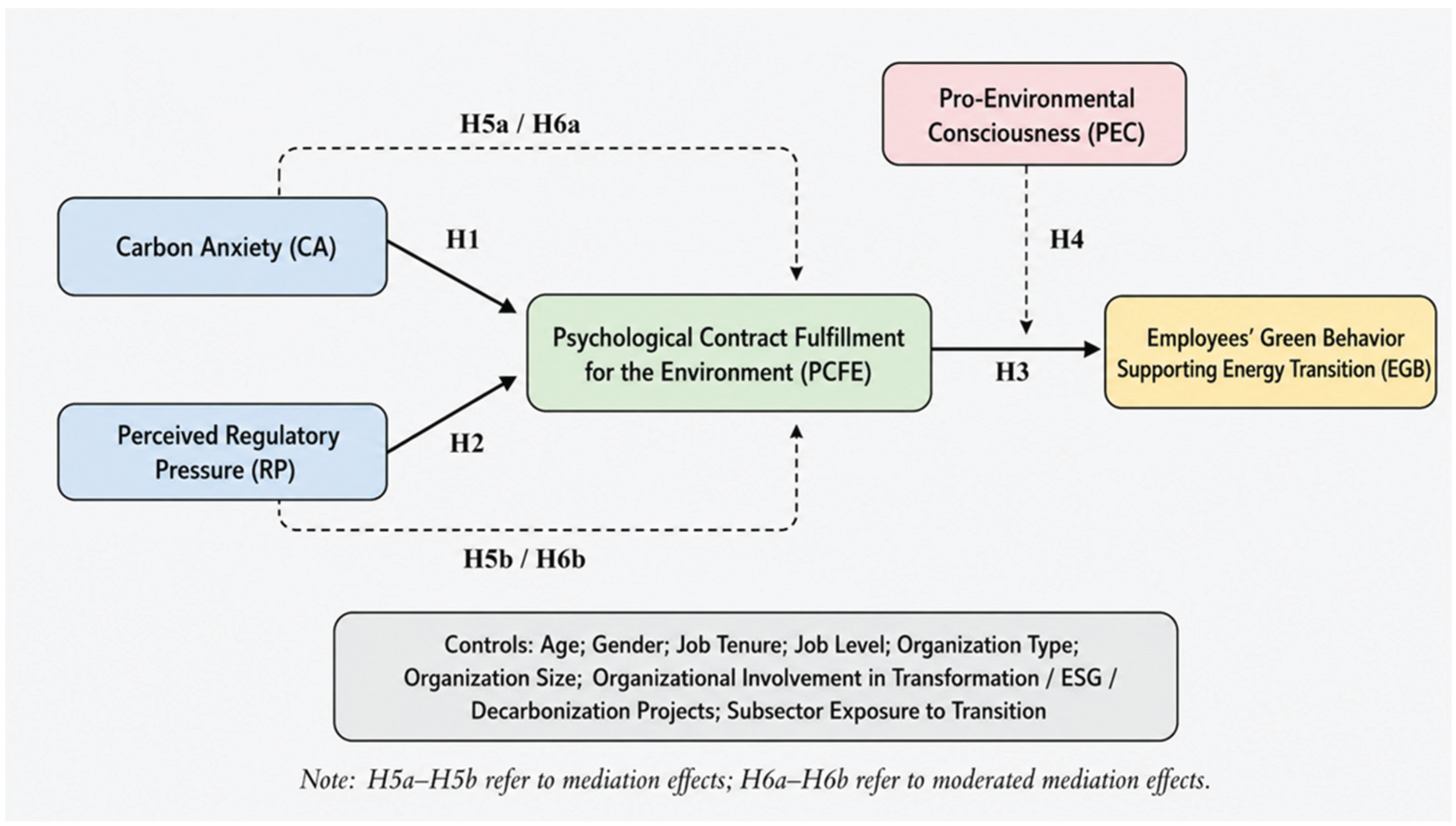
Taken together, the hypotheses form a moderated mediation model explaining how transition-related pressures are translated into employee green behavior (EGB) in Poland’s energy sector. Carbon anxiety (CA) and perceived regulatory pressure (RP) are conceptualized as two antecedents reflecting employees’ perceptions of carbon-related and regulatory pressures in the low-carbon transition. Psychological contract fulfillment for the environment (PCFE) is positioned as the relational mechanism through which these pressures become behaviorally meaningful, while pro-environmental consciousness (PEC) is conceptualized as an individual-level boundary condition strengthening employees’ response to fulfilled environmental obligations. In this way, the model links macro-level decarbonization and regulatory pressures with micro-level employee behavior, thereby addressing behavioral foundations of a sustainable green economy.
Figure 1.
Conceptual model of the study. Note: The dashed arrow represents the moderating effect of PEC on the relationship between PCFE and EGB. The model also implies conditional indirect effects of CA and RP on EGB through PCFE at different levels of PEC. Source: Authors’ own elaboration.
Figure 1.
Conceptual model of the study. Note: The dashed arrow represents the moderating effect of PEC on the relationship between PCFE and EGB. The model also implies conditional indirect effects of CA and RP on EGB through PCFE at different levels of PEC. Source: Authors’ own elaboration.
3. Materials and Methods
3.1. Research Design, Procedure, and Respondent Inclusion Criteria
This study employed a cross-sectional quantitative design based on an anonymous computer-assisted web interview (CAWI) survey. A web-based survey was appropriate because the study examined employee-level perceptions and behaviors across geographically dispersed organizations operating in different segments of Poland’s energy sector. CAWI also enabled standardized data collection across heterogeneous occupational groups, which is important when the aim is to compare perceptions of transition-related pressures, psychological contract fulfillment for the environment (PCFE), pro-environmental consciousness (PEC), and employees’ green behavior supporting energy transition (EGB) [54].
The research context was Poland’s energy sector, which is directly exposed to decarbonization pressure, regulatory change, emissions accountability, technological modernization, and the organizational consequences of low-carbon transformation [1–9,43]. The study covered employees from conventional energy companies, renewable energy firms, electricity and heat distribution operators, transmission entities, and energy-related service and technology organizations. This sectoral scope was intentional because transition-related pressures are not distributed evenly across the sector. Employees working in conventional, renewable, distributional, transmission, and technology-oriented organizations may differ in their exposure to carbon reduction, regulatory requirements, and organizational transformation. The unit of analysis was the individual employee. Respondents were included in the study if they met three criteria: they were currently employed in an organization operating in Poland’s energy sector; their organization belonged to one of the main sectoral segments listed above; and their work position allowed them to assess organizational environmental practices and report their own workplace behavior. The survey was open to managerial staff, technical specialists, administrative employees, and operational personnel. This decision was made to avoid limiting the analysis to managerial or office-based perspectives and to reflect the fact that EGB may occur across different organizational levels and work roles [12,31,32,33,34].
The survey was distributed online through organizational contacts, professional networks, and sector-related online channels targeting employees of energy-sector organizations. Participation was voluntary and anonymous. Respondents were informed about the academic purpose of the study, the confidentiality of data, and the aggregate form of reporting. These procedural safeguards were introduced to reduce evaluation apprehension and common method bias, which are important concerns in self-report organizational research [55,56]. According to institutional guidelines, formal ethical approval was not required because the study was anonymous, non-interventional, and did not collect sensitive personal data.
3.2. Sample Characteristics
The final sample consisted of 857 employees from Poland’s energy sector. The sampling strategy was purposive and sector-oriented. The aim was not to estimate population prevalence for the entire Polish energy-sector workforce, but to obtain a large and internally heterogeneous analytical sample suitable for testing the proposed moderated mediation model. Such a strategy is appropriate when a study focuses on theoretically specified relationships and requires variation across organizational and occupational contexts [57].
The sample was designed to reflect both employee-level and organizational heterogeneity. At the employee level, respondents differed in gender, age, job tenure, and occupational group. At the organizational level, they represented different subsectors, organization sizes, ownership forms, and degrees of involvement in transformation-, ESG-, or decarbonization-related projects. This structure was important because employees’ perceptions of carbon anxiety (CA), perceived regulatory pressure (RP), PCFE, PEC, and EGB may vary depending on both individual work experience and the organizational context in which transition-related pressures are encountered.
As shown in Table 1, the gender structure of the sample was relatively balanced, with women representing 45.7% and men 53.4% of respondents. The age distribution indicates that the largest group was composed of employees aged 40–49 years, followed by those aged 30–39 and 50–59 years. This age structure is consistent with the sectoral character of the study, as energy-sector organizations often employ workers with substantial professional experience and technical specialization. Job tenure was also diversified: the largest groups had 11–20 years and 6–10 years of work experience, while employees with shorter and longer tenure were also represented. The subsectoral distribution confirms that the study covered the main segments of Poland’s energy sector. Employees from conventional energy companies accounted for 27.0% of the sample, followed by renewable energy firms (22.1%), energy-related service and technology organizations (21.2%), electricity and heat distribution operators (20.5%), and transmission entities (9.2%). This distribution allowed the study to capture different forms of exposure to decarbonization, regulatory requirements, infrastructural constraints, and low-carbon transition opportunities [7–9,43]. The occupational composition of the sample was also diversified. Technical specialists formed the largest group (33.4%), followed by operational personnel (29.1%), administrative employees (21.5%), and managerial staff (16.1%). This is important because EGB is not restricted to managerial decisions or formal sustainability positions. It may also be enacted through technical, administrative, and operational practices, including energy saving, waste reduction, compliance with environmental procedures, reporting inefficiencies, and participation in green initiatives [12,31,32,33,34]. Most respondents were employed in large organizations with 250 or more employees (59.5%), which reflects the continued role of large enterprises in conventional generation, transmission, and distribution in Poland’s energy sector. However, medium-sized and small organizations were also represented, which enabled the study to include perspectives from more decentralized and flexible parts of the sector, including renewable energy and service-oriented firms. Ownership form was included because public, private domestic, and foreign or mixed-capital organizations may differ in their strategic priorities, resources, environmental proactivity, and responsiveness to regulatory and ESG-related demands [58]. Finally, 65.7% of respondents reported that their organizations were involved in transformation-, ESG-, or decarbonization-related projects, suggesting that the sample captured employees for whom transition-related issues were organizationally salient.
Overall, the sample provides sufficient variation across demographic, occupational, and organizational categories to test the hypothesized relationships in a heterogeneous sectoral context. This is particularly important for the present study because CA, RP, PCFE, PEC, and EGB are expected to be shaped not only by individual orientations, but also by the degree to which employees are embedded in organizations exposed to different forms of transition pressure.
3.3. Measures and Instrument Adaptation
All focal constructs were measured using multi-item scales adapted from prior literature and adjusted to the context of Poland’s energy sector. Multi-item scales were appropriate because the study examined latent constructs that cannot be fully captured by single indicators, such as CA, RP, PCFE, PEC, and EGB. This measurement approach is consistent with the requirements of structural equation modeling (SEM), which assumes that latent variables are represented by multiple observed indicators [59–61].
As the original measurement instruments were available in English, the questionnaire was adapted to the Polish linguistic and sectoral context. The adaptation process included translation into Polish, contextual modification of selected items, independent expert review, repeated completion of the questionnaire after a three-week interval, and test-retest verification. All item-level correlations were significant at p < 0.001, which supported the stability of the adapted instrument. Such procedures are recommended when adapting research instruments across languages, cultures, and organizational contexts, because they help maintain conceptual equivalence while ensuring that the items are understandable and meaningful for respondents [62]. The questionnaire included both 5-point and 7-point response scales, depending on the original instrument. This decision was made to preserve the measurement logic of the source scales. Before SEM analysis, variables measured on different response formats were standardized to ensure comparability in the structural model.
As shown in Table 2, the study used five main scales. The table reports construct definitions, instrument sources, number of items, example items or content domains, response formats, and reliability coefficients. In addition, it indicates the psychometric indicators used to assess the measurement model, including Cronbach’s alpha, standardized factor loadings, composite reliability (CR), and average variance extracted (AVE). Cronbach’s alpha coefficients ranged from 0.780 for EGB to 0.960 for CA, indicating acceptable to very high internal consistency.
CA was developed on the basis of the CDP Climate Change Questionnaire 2023 [39]. In the present study, this construct was defined as employees’ perception of organizational tension and uncertainty associated with carbon emissions inventorying, concerns about emission levels, carbon reporting, and operational challenges accompanying the pursuit of sustainability goals. This operationalization is consistent with the logic of treating CA as a transition-specific construct, while avoiding its reduction to individual climate anxiety.
RP was measured using a 5-item scale adapted from Huang et al. [63]. The items captured the perceived importance of environmental standards, legal requirements, government supervision, and sanctions as pressures affecting organizational adaptation. In the present study, this construct was adapted from the organizational-managerial level to the employee-perception level because the model focuses on how employees interpret regulatory pressure within their organization.
PCFE was measured using a 17-item scale drawing on established psychological contract measurement approaches [64,65] and adapted to the environmental context of the Polish energy sector [4]. The scale captured employees’ perceptions of whether environmental obligations, promises, and commitments were fulfilled by the organization.
PEC was measured with 8 items based on Huang et al. [66], reflecting environmental awareness and readiness to consider ecological consequences. EGB was measured using 7 items adapted from Robertson and Barling [67], with the construct interpreted as workplace behavior supporting low-carbon organizational change in the energy sector.
3.4. Control Variables
The empirical model included control variables at both the employee and organizational levels. At the employee level, the study controlled for age, gender, job tenure, and job level. These variables were included because employees’ environmental attitudes, perceptions of organizational obligations, and readiness to engage in EGB may differ across demographic and occupational groups [12,23,24,31,32,33,34].
At the organizational level, the study controlled for organization type, organization size, ownership form, organizational involvement in transformation-, ESG-, or decarbonization-related projects, and subsector exposure to transition. These variables were included because energy-sector organizations differ in their technological profiles, resource bases, ownership structures, and exposure to decarbonization and regulatory pressure [7–9,43,58]. The control variables are summarized in Table 3. Including them made it possible to verify whether the hypothesized relationships remained stable after accounting for individual and organizational heterogeneity.
The inclusion of these controls is important because the study examines employee perceptions in a structurally heterogeneous sector. By accounting for both individual characteristics and organizational conditions, the model reduces the risk that the hypothesized relationships are driven solely by demographic composition, occupational role, or subsectoral exposure to transition.
3.5. Data Analysis Strategy
The data were analyzed using structural equation modeling. SEM was appropriate because the study examined multiple latent constructs and tested a theoretically specified model including direct, indirect, moderating, and conditional indirect effects. Following the two-step approach recommended by Anderson and Gerbing [59], the analysis first assessed the measurement model and then tested the structural model. The measurement model was evaluated using confirmatory factor analysis (CFA). Internal consistency was assessed using Cronbach’s alpha and composite reliability (CR). Convergent validity was evaluated through standardized factor loadings and AVE, while discriminant validity was assessed using the Fornell–Larcker criterion [66]. Model fit was evaluated using standard indices, including χ2/df, comparative fit index (CFI), Tucker–Lewis index (TLI), root mean square error of approximation (RMSEA), and standardized root mean square residual (SRMR), following SEM reporting recommendations [61].
The structural model tested the hypothesized paths from CA and RP to PCFE, from PCFE to EGB, and the moderating effect of PEC on the PCFE–EGB relationship. Mediation was tested by estimating the indirect effects of CA and RP on EGB through PCFE. Bootstrapping was used to assess the statistical significance of indirect effects, as this approach is recommended when testing mediation and moderated mediation because it does not require the assumption of normality of indirect-effect distributions [52,53]. Moderated mediation was tested by examining whether the indirect effects of CA and RP on EGB through PCFE varied depending on the level of PEC [52,53]. The analytical steps are summarized in Table 4. This table is included to make the analytical logic transparent and to show how the measurement, structural, mediation, moderation, and robustness analyses were sequenced.
This analytical procedure allowed the study to move from measurement validation to hypothesis testing in a structured way. It also ensured that the direct, mediating, moderating, and conditional indirect relationships were tested within a coherent SEM framework rather than through separate, unrelated regression models.
3.6. Common Method Bias and Robustness Checks
Because the study used self-report survey data, procedural and statistical remedies were applied to reduce the risk of common method bias. Procedurally, the survey was anonymous, respondents were informed about the academic purpose of the study, and the questionnaire avoided suggesting desirable answers. The focal constructs were organized in separate item blocks, and respondents were assured that results would be analyzed only in aggregated form. These procedures are consistent with recommendations for reducing evaluation apprehension, social desirability bias, and consistency motifs in organizational survey research [55,56].
Statistically, common method bias was assessed using Harman’s single-factor test and additional model-based diagnostic checks. Although Harman’s single-factor test has limitations, it can be used as an initial diagnostic when combined with more rigorous procedures [55,56]. Therefore, the hypothesized multi-factor measurement model was compared with alternative model specifications to verify whether the proposed structure provided a better representation of the data than simpler or theoretically less appropriate models.
Robustness checks were conducted to examine whether the hypothesized relationships remained stable after including control variables. The structural model was estimated both with and without employee- and organizational-level controls. Additional comparisons were conducted across major subsectoral groups, including conventional energy, renewable energy, and distribution/transmission organizations. This strategy was justified because transition-related pressures and organizational responses may differ across segments of Poland’s energy sector [7,8,9]. These checks strengthened the analytical credibility of the study by verifying whether the proposed moderated mediation model remained stable across demographic, organizational, and subsectoral conditions.
4. Results
4.1. Descriptive Statistics, Reliability, and Correlations
The analysis began with descriptive statistics, reliability assessment, and correlations among the focal constructs. This step provided an initial overview of the data structure before testing the measurement and structural models. Internal consistency was assessed using Cronbach’s alpha and composite reliability (CR), while convergent validity was evaluated using average variance extracted (AVE), in line with standard SEM procedures [59–61].
As shown in Table 5, all constructs demonstrated satisfactory reliability. Cronbach’s alpha values ranged from 0.780 for employees’ green behavior supporting energy transition (EGB) to 0.960 for carbon anxiety (CA). CR values exceeded the recommended threshold of 0.70, and AVE values were above 0.50, indicating acceptable convergent validity. The correlation matrix showed positive relationships among CA, perceived regulatory pressure (RP), psychological contract fulfillment for the environment (PCFE), pro-environmental consciousness (PEC), and EGB. The strongest correlation was observed between PCFE and EGB, which is consistent with the theoretical assumption that fulfilled environmental obligations are associated with stronger employee green behavior.
The correlation coefficients did not indicate problematic multicollinearity, as all inter-construct correlations remained below critical thresholds. The pattern of associations justified proceeding to CFA and SEM.
4.2. Measurement Model
Confirmatory factor analysis (CFA) was conducted to assess whether the five latent constructs were empirically distinct. The measurement model included CA, RP, PCFE, PEC, and EGB. The model demonstrated a good fit to the data, with all main fit indices within acceptable ranges. As reported in Table 6, the five-factor measurement model fitted the data substantially better than the one-factor model, which supports the discriminant structure of the constructs and reduces concerns that the results are driven by a single common factor.
The five-factor model showed satisfactory fit, supporting the distinctiveness of CA, RP, PCFE, PEC, and EGB. The hypothesized structural model also demonstrated acceptable fit, which allowed for testing the direct, indirect, moderating, and conditional indirect effects.
4.3. Structural Model and Hypothesis Testing
The structural model tested the direct paths from CA and RP to PCFE, the effect of PCFE on EGB, and the moderating effect of PEC on the PCFE–EGB relationship. The model also tested whether PCFE mediated the effects of CA and RP on EGB and whether these indirect effects were conditional on PEC. Bootstrapping was used to estimate indirect effects and confidence intervals, following recommendations for mediation and moderated mediation analysis [52,53].
As shown in Table 7, CA was positively related to PCFE (β = 0.214, p < 0.001), supporting H1. RP also had a positive effect on PCFE (β = 0.286, p < 0.001), supporting H2. PCFE was positively associated with EGB (β = 0.381, p < 0.001), supporting H3. The interaction between PCFE and PEC was significant (β = 0.112, p = 0.008), supporting H4 and indicating that the effect of PCFE on EGB was stronger among employees with higher PEC. The mediation analysis showed that PCFE significantly mediated the relationship between CA and EGB (β = 0.082, 95% CI [0.037, 0.139]), supporting H5a. PCFE also mediated the relationship between RP and EGB (β = 0.109, 95% CI [0.058, 0.176]), supporting H5b. The moderated mediation analysis indicated that the conditional indirect effects were stronger at higher levels of PEC. The index of moderated mediation was significant for both CA and RP pathways, supporting H6a and H6b.
These results support the proposed moderated mediation model. CA and RP were positively associated with PCFE, and PCFE was positively related to EGB. Moreover, the indirect effects of CA and RP on EGB through PCFE were stronger when PEC was higher. This indicates that transition-related pressures are more likely to translate into green behavior when employees perceive that the organization fulfills its environmental obligations and when employees themselves have stronger environmental consciousness.
4.4. Robustness Checks and Additional Diagnostics
Robustness checks were conducted to verify whether the main findings remained stable after including control variables and whether the results could be attributed to common method bias. Because the study used cross-sectional self-report data, both procedural and statistical remedies were applied. Procedurally, the survey was anonymous, responses were confidential, and the questionnaire separated item blocks. Statistically, Harman’s single-factor test and model comparison were used as diagnostic checks [55,56].
The one-factor solution explained 36.8% of the total variance, which remained below the commonly used 50% threshold. This suggested that common method bias was unlikely to dominate the observed relationships. In addition, the one-factor model fitted the data substantially worse than the hypothesized five-factor model, as shown earlier in Table 6.
The robustness analysis also compared the baseline structural model with the full model including controls. As shown in Table 8, the inclusion of age, gender, job tenure, job level, organization type, organization size, ownership form, organizational involvement in transformation-, ESG-, or decarbonization-related projects, and subsector exposure to transition did not change the direction or significance of the main effects. The explained variance increased from R2 = 0.271 to R2 = 0.332 for PCFE and from R2 = 0.314 to R2 = 0.371 for EGB, indicating that the controls improved explanatory power without altering the theoretical logic of the model.
Taken together, the results indicate that the proposed model remained stable after accounting for individual and organizational controls. The robustness checks support the conclusion that CA and RP are associated with EGB through PCFE, and that this mechanism is stronger among employees with higher PEC.
5. Discussion
The purpose of this study was to explain how transition-related pressures are translated into employees’ green behavior supporting the low-carbon transition (EGB) in Poland’s energy sector. The results support the proposed moderated mediation model. Carbon anxiety (CA) and perceived regulatory pressure (RP) were positively associated with psychological contract fulfillment for the environment (PCFE), while PCFE was positively related to EGB. Pro-environmental consciousness (PEC) strengthened the relationship between PCFE and EGB and intensified the indirect effects of CA and RP on EGB through PCFE. These findings show that transition-related pressure does not become behavioral engagement automatically. It becomes meaningful for employees when it is embedded in credible environmental commitments and interpreted through the relational logic of the psychological contract. In this sense, the study demonstrates that the transition toward a sustainable green economy has an internal organizational dimension: it depends on whether employees perceive decarbonization and regulatory demands as credible, enacted, and reciprocally meaningful within their workplace.
5.1. Interpretation of the Findings
The positive relationship between CA and PCFE suggests that carbon-related tension may increase employees’ sensitivity to the environmental obligations of their organization. In the energy sector, carbon reduction is not an abstract sustainability issue, but a concrete organizational challenge involving emissions accountability, carbon reporting, technological modernization, investment decisions, and operational adaptation [17,39,69]. When employees perceive that their organization is exposed to such pressure, they are likely to observe more closely whether the organization responds in a credible and responsible way. In this sense, CA should not be interpreted only as a negative perception or a source of uncertainty. It can also function as a signal that carbon-related obligations have become organizationally salient. This interpretation is consistent with climate anxiety research, which shows that anxiety related to environmental threat may have both mobilizing and inhibiting effects depending on whether individuals perceive meaningful possibilities for action [15,16,40]. In the present study, CA operates at the level of employees’ perception of organizational pressure rather than as a psychological condition. The results suggest that such pressure can become productive when employees perceive that the organization takes carbon-related responsibilities seriously. This is an important distinction because it helps explain why pressure alone is insufficient: anxiety or uncertainty may raise attention, but PCFE determines whether that attention is converted into trust and reciprocal behavior.
The positive relationship between RP and PCFE confirms the relevance of institutional and regulatory conditions for employee perceptions. Prior research has shown that regulatory pressure can stimulate pollution prevention, environmental strategies, green innovation, and organizational environmental performance [18–20,44]. In the energy sector, such pressure is particularly strong because regulation directly affects investment choices, operational procedures, emissions accountability, and organizational legitimacy [4,6,43]. The present findings extend this argument by showing that regulatory pressure also shapes the employee–organization relationship. When employees perceive that regulation is translated into substantive organizational action rather than symbolic compliance, they are more likely to believe that the organization fulfills its environmental obligations.
The central role of PCFE confirms the value of psychological contract theory for understanding employee behavior in the energy transition. Psychological contract fulfillment has long been associated with trust, reciprocity, commitment, and discretionary employee contributions [21,22,46–49]. In this study, PCFE performs a more specific function: it explains how employees interpret organizational environmental commitments under conditions of decarbonization and regulatory pressure. This result is consistent with previous research in Poland’s energy industry, where PCFE mediated the relationship between pro-environmental inclusive leadership and pro-environmental work behavior [4]. The present study extends that logic by showing that PCFE is not only a leadership-related mechanism, but also a broader relational mechanism through which transition-related pressures become behaviorally effective.
The significant moderating role of PEC further shows that employees differ in their readiness to respond to fulfilled environmental obligations. Employees with stronger environmental consciousness are more likely to notice, value, and reciprocate organizational environmental commitments. This is consistent with research showing that environmental consciousness, environmental values, and related psychological resources shape pro-environmental attitudes and behavior [23–25,50,51]. The result is also consistent with broader evidence that environmental threat or climate-related concern is more likely to produce constructive behavioral responses when individuals possess psychological resources that support agency and action [16,24]. In the present study, PEC strengthens both the direct PCFE–EGB relationship and the indirect effects of CA and RP on EGB through PCFE. This means that organizational credibility and individual environmental consciousness operate together rather than separately.
5.2. Theoretical Contributions
This study contributes to low-carbon transition research by advancing a micro-foundational perspective on sustainable green economy and low-carbon organizational change. Transition studies have emphasized that energy transformation is a socio-technical process involving technologies, institutions, infrastructures, regulations, markets, practices, and social expectations [1,2,3,26,27,28]. However, less is known about how employees inside energy-sector organizations interpret and enact transition-related pressures. The present study addresses this gap by showing that CA and RP are translated into EGB through PCFE. In doing so, it connects macro- and meso-level transition pressures with micro-level behavioral action and shows that the sustainable green economy depends not only on external governance instruments, but also on internal relational mechanisms that make low-carbon commitments credible to employees.
The findings also refine the literature on EGB. Previous research has conceptualized EGB as required and voluntary workplace behavior that reduces environmental harm and supports organizational environmental goals [12,31,32,33,34]. In the energy sector, however, such behavior has a more specific meaning. It becomes part of the organization’s capacity to adapt to decarbonization, comply with environmental standards, improve energy efficiency, implement low-carbon routines, and support the behavioral transition required by a sustainable green economy [13,14]. The present study therefore positions EGB not as generic workplace greenness, but as an employee-level contribution to low-carbon transition. This framing is important because it aligns the dependent variable with the sectoral context of the study and with the broader debate on human capital, green skills, and employee participation in sustainable economic transformation.
The article also extends psychological contract theory by applying it to the environmental dimension of the employment relationship. PCFE captures employees’ perception that the organization fulfills its environmental obligations, commitments, and promises. The results show that this perception matters for EGB and mediates the effects of transition-related pressures. This suggests that environmental commitments become behaviorally consequential when employees interpret them as part of a credible reciprocal relationship. The study therefore adds to psychological contract research by showing that fulfillment is not limited to traditional employment issues, such as pay, security, development, or support, but may also concern environmental obligations in a transforming sector [21,22,46–49].
Another contribution concerns the conceptualization of CA. This study treats CA as a transition-specific construct reflecting employees’ perception of organizational tension, uncertainty, and pressure related to carbon reduction and emissions accountability. It is informed by climate anxiety research [15,16,38,40], but it is not identical to general climate anxiety. It refers to how employees perceive carbon-related pressure inside the organization and should be understood as an organizationally situated perception of low-carbon transition pressure rather than as a clinical or individual mental-health condition. This distinction allows the study to connect carbon management, regulatory accountability, and employee perceptions. It also opens a path for future research on how carbon accounting, climate disclosure, and decarbonization targets shape internal organizational relationships [17,39,69].
Finally, the moderated mediation findings contribute to a more conditional understanding of employee participation in low-carbon change. CA and RP are associated with EGB through PCFE, but this mechanism is stronger when PEC is higher. This result corresponds with the logic of moderated mediation, where indirect effects depend on individual-level boundary conditions [52,53]. It also suggests that organizational and individual explanations of green behavior should not be treated as competing. Credible environmental commitments create relational conditions for action, while PEC makes employees more responsive to those conditions. This insight is relevant to sustainable green economy research because it shows that transition policies and organizational practices become more effective when they are accompanied by employee-level awareness and agency.
5.3. Practical and Policy Implications
The findings have important implications for energy-sector organizations. They suggest that decarbonization pressure and regulatory requirements are not enough to mobilize employees. Pressure can increase attention, but it may also produce uncertainty, skepticism, or fatigue if employees do not see credible organizational responses. What matters is whether organizations translate transition pressure into visible environmental commitments, consistent managerial communication, and everyday practices that employees can recognize as genuine. PCFE appears to be a particularly important managerial lever. Employees are more likely to engage in EGB when they perceive that the organization fulfills its environmental obligations. For energy companies, this means that sustainability declarations, carbon reporting, and compliance procedures should be supported by concrete internal practices. Environmental training, transparent communication, participation in low-carbon initiatives, feedback on environmental performance, and support for resource-efficient work routines may help employees interpret the organization’s response as credible. Such practices are not merely HR instruments; they are part of the organizational infrastructure of the low-carbon transition. This is consistent with research showing that green training can strengthen employees’ knowledge, skills, and capacity to respond to environmental challenges [34,68]. It also aligns with studies indicating that institutional pressure becomes more effective when organizations develop internal mechanisms that translate external requirements into green practices and collaborative value creation [45,70].
The moderating role of PEC indicates that companies should also invest in environmental awareness and agency. Employees with higher PEC respond more strongly to fulfilled environmental obligations. This means that environmental education should not be treated as a peripheral communication activity. It should be linked to employees’ work roles, technical tasks, operational procedures, and opportunities to participate in low-carbon change. In technical and operational positions, this may be especially important because everyday decisions concerning energy use, materials, efficiency, reporting, maintenance, and process improvement can directly affect environmental outcomes. For managers responsible for sustainability, HRM, and operations, the practical message is therefore to combine credible environmental commitments with capability-building: employees need to see that the organization takes decarbonization seriously and that they have knowledge, skills, and opportunities to contribute.
The findings are also relevant for policymakers and regulators. Regulation remains essential for low-carbon transformation, but regulatory pressure does not implement itself inside organizations. Its employee-level effects depend on how organizations interpret and enact regulation internally. Policies supporting decarbonization should therefore be accompanied by instruments that encourage organizational learning, green skill development, employee participation, credible internal communication, and sectoral knowledge sharing. The Polish context gives these implications additional importance. Poland’s energy transition continues to unfold under conditions of carbon lock-in, infrastructural constraints, uneven subsectoral exposure, and institutional complexity [6–9,43]. Recent studies on Polish energy clusters and local low-carbon initiatives show that transition pathways depend not only on formal policy and technology, but also on situated capacities for cooperation, experimentation, and adaptation [8,9,10]. The present study adds that employees are part of this transition capacity. Their green behavior can help organizations embed low-carbon objectives in everyday routines, but this requires credible environmental relationships rather than pressure alone. For a sustainable green economy, policy effectiveness should therefore be assessed not only by formal compliance, but also by whether regulation stimulates organizational practices that enable employees to participate in low-carbon change.
5.4. Limitations and Future Research
The study should be read in light of several limitations. Its cross-sectional design limits causal inference. Although the theoretical model specifies directional relationships among CA, RP, PCFE, PEC, and EGB, future research should use longitudinal designs to examine how these relationships evolve as transition pressure intensifies and as organizations accumulate experience with decarbonization, carbon accounting, and regulatory adaptation.
The study also relied on self-report survey data. Procedural and statistical remedies were applied to reduce common method bias, and the robustness checks supported the stability of the findings. Nevertheless, future studies could combine employee surveys with supervisor ratings, organizational sustainability data, carbon reporting indicators, qualitative interviews, or case studies. Such designs would allow researchers to link perceived environmental contract fulfillment with more objective indicators of organizational environmental performance and transition implementation.
The sample was purposive and sector-oriented. It provided substantial variation across subsectors, occupational groups, organization sizes, ownership forms, and levels of involvement in transformation-related projects, but it should not be interpreted as statistically representative of all employees in Poland’s energy sector. Future research could use probability-based sampling, compare different national energy systems, or examine whether the model operates similarly in conventional energy, renewable energy, distribution, transmission, and energy technology organizations.
Future studies should also further validate CA as a transition-specific construct. It would be useful to examine whether CA operates similarly in other carbon-intensive sectors, such as manufacturing, transport, construction, heavy industry, and public utilities. Researchers could also investigate whether CA leads to constructive behavior only when employees perceive credible organizational responses, or whether it may generate disengagement, resistance, symbolic compliance, or transition fatigue when such responses are absent. This would help clarify the conditions under which carbon-related pressure becomes a mobilizing force rather than a source of overload.
Finally, future research could expand the model by including green HRM, green training, environmental leadership, environmental justice, perceived organizational support for sustainability, or green psychological climate. Such extensions would help explain which organizational mechanisms are most effective in translating carbon and regulatory pressures into employee participation in low-carbon change.
6. Conclusion
The study shows that employee green behavior in the low-carbon transition is not driven by pressure alone. CA and RP matter because they make environmental obligations more salient, but their behavioral effect depends on whether employees perceive that the organization fulfills those obligations. PCFE therefore functions as a relational mechanism through which transition-related pressures become employee-level action. PEC strengthens this mechanism by making employees more attentive and responsive to environmental commitments. In this sense, the article demonstrates that the transition toward a low-carbon and sustainable green economy is not only a technological, regulatory, or investment process. It is also a relational and behavioral transformation inside organizations, where credible environmental commitments, green skills, and employee consciousness jointly shape the everyday actions needed for low-carbon change.
Author Contributions
Conceptualization, AR_P.; methodology, AR_P.; software, AR_P. M_C; validation, AR_P.; formal analysis, AR_P., investigation, AR_P.; resources, AR_P.; data curation, AR_P.; writing—original draft preparation, AR_P.; writing—review and editing, AR_P. M_C; visualization, AR_P.; supervision, AR_P.; project administration, AR_P.; funding acquisition, AR_P. Author has read and agreed to the published version of the manuscript.
Funding
This research received no external funding.
Institutional Review Board Statement
This study involved adult human participants; however, it was a non-medical, non-interventional social science study based on voluntary participation and questionnaire data collection. No clinical procedures, biomedical interventions, or experimental manipulation were involved. The study was conducted in accordance with the Declaration of Helsinki. Participants were informed about the purpose of the study before participation, and the data were collected anonymously and analysed in aggregated form. Under the applicable institutional regulations, formal ethics committee approval was not required for this type of study.
Informed Consent Statement
Informed consent was obtained from all subjects involved in the study.
Data Availability Statement
The data presented in this study are available on request from the A.R.-P.
Conflicts of Interest
The author declares no conflict of interest.
References
- Geels, F.W. The multi-level perspective on sustainability transitions: Responses to seven criticisms. Environ. Innov. Soc. Transit. 2011, 1, 24–40. [Google Scholar] [CrossRef]
- Markard, J. The next phase of the energy transition and its implications for research and policy. Nat. Energy 2018, 3, 628–633. [Google Scholar] [CrossRef]
- Farla, J.; Markard, J.; Raven, R.; Coenen, L. Sustainability transitions in the making: A closer look at actors, strategies and resources. Technol. Forecast. Soc. Chang. 2012, 79, 991–998. [Google Scholar] [CrossRef]
- Rogozińska-Pawełczyk, A. What contributes to the greening of the Polish energy industry? Pro-environmental inclusive leadership and pro-environmental behavior—A moderation–mediation analysis. Energies 2024, 17, 4337. [Google Scholar] [CrossRef]
- Gadomska-Lila, K.; Rogozińska-Pawełczyk, A. The role of pro-innovative HR practices and psychological contract in shaping employee commitment and satisfaction: A case from the energy industry. Energies 2021, 15, 255. [Google Scholar] [CrossRef]
- Radtke, J. Understanding the complexity of governing energy transitions: Introducing an integrated approach of policy and transition perspectives. Environ. Policy Gov. 2025, 35, 595–614. [Google Scholar] [CrossRef]
- Unruh, G.C. Understanding carbon lock-in. Energy Policy 2000, 28, 817–830. [Google Scholar] [CrossRef]
- Stasik, A.; Dańkowska, A. Multiscalar institutional work of system-building sustainable entrepreneurs in transitioning coal regions: A case of an energy cluster. Soc. Entrep. Rev. 2024, 1, 60–82. [Google Scholar] [CrossRef]
- Dańkowska, A.; Stasik, A.; Niedziółka, T.; Dembek, A. Getting warmed up: Challenges to participatory decarbonization of a local residential heating system in Poland. Environ. Innov. Soc. Transit. 2025, 55, 100959. [Google Scholar] [CrossRef]
- Stasik, A.; Dańkowska, A.; Niedziółka, T.; Dembek, A. Transforming energy systems, transforming social science: Social researchers and collective experimentation in action. Stan Rzeczy 2024, 1, 26. [Google Scholar] [CrossRef]
- Aguilera, F.; Reyes, R.; Schueftan, A.; Zerriffi, H.; Sanhueza, R. Understanding the role of people’s preferences and perceptions in the analysis of residential energy transition: A meta-analysis. Energy Sustain. Dev. 2024, 82, 101534. [Google Scholar] [CrossRef]
- Norton, T.A.; Parker, S.L.; Zacher, H.; Ashkanasy, N.M. Employee green behavior: A theoretical framework, multilevel review, and future research agenda. Organ. Environ. 2015, 28, 103–125. [Google Scholar] [CrossRef]
- Piwowar-Sulej, K.; Austen, A.; Iqbal, Q. Fostering three types of green behavior through green HRM in the energy sector: The conditional role of environmental managerial support. Balt. J. Manag. 2023, 18, 509–524. [Google Scholar] [CrossRef]
- Ghosh, A.; Haque, S. Can the components of green intellectual capital influence employee green behavior? An empirical analysis on Indian energy sector using the partial least squares method. J. Intellect. Cap. 2023, 24, 632–652. [Google Scholar] [CrossRef]
- Clayton, S.; Karazsia, B.T. Development and validation of a measure of climate change anxiety. J. Environ. Psychol. 2020, 69, 101434. [Google Scholar] [CrossRef]
- Li, T.; Yang, Y.; Liu, X.; Zeng, S. The power of loss: Message framing, climate anxiety, and engagement in personal carbon trading. BMC Psychol. 2025, 13, 1381. [Google Scholar] [CrossRef]
- Doda, B.; Gennaioli, C.; Gouldson, A.; Grover, D.; Sullivan, R. Are corporate carbon management practices reducing corporate carbon emissions? Corp. Soc. Responsib. Environ. Manag. 2016, 23, 257–270. [Google Scholar] [CrossRef]
- Khanna, M.; Deltas, G.; Harrington, D.R. Adoption of pollution prevention techniques: The role of management systems and regulatory pressures. Environ. Resour. Econ. 2009, 44, 85–106. [Google Scholar] [CrossRef]
- Aragón-Correa, J.A.; Marcus, A.A.; Vogel, D. The effects of mandatory and voluntary regulatory pressures on firms’ environmental strategies: A review and recommendations for future research. Acad. Manag. Ann. 2020, 14, 339–365. [Google Scholar] [CrossRef]
- Ramanathan, R.; Poomkaew, B.; Nath, P. The impact of organizational pressures on environmental performance of firms. Bus. Ethics Eur. Rev. 2014, 23, 169–182. [Google Scholar] [CrossRef]
- Rousseau, D.M. Psychological and implied contracts in organizations. Employ. Responsib. Rights J. 1989, 2, 121–140. [Google Scholar] [CrossRef]
- Rousseau, D.M. Psychological Contracts in Organizations: Understanding Written and Unwritten Agreements; Sage: Newbury Park, CA, USA, 1995. [Google Scholar]
- Sharma, K.; Bansal, M. Environmental consciousness, its antecedents and behavioural outcomes. J. Indian Bus. Res. 2013, 5, 198–214. [Google Scholar] [CrossRef]
- Khan, A.N. Elucidating the effects of environmental consciousness and environmental attitude on green travel behavior: Moderating role of green self-efficacy. Sustain. Dev. 2024, 32, 2223–2236. [Google Scholar] [CrossRef]
- Afshar Jahanshahi, A.; Maghsoudi, T.; Shafighi, N. Employees’ environmentally responsible behavior: The critical role of environmental justice perception. Sustain. Sci. Pract. Policy 2021, 17, 1–14. [Google Scholar] [CrossRef]
- Köhler, J.; Geels, F.W.; Kern, F.; Markard, J.; Onsongo, E.; Wieczorek, A.; Alkemade, F.; Avelino, F.; Bergek, A.; Boons, F.; et al. An agenda for sustainability transitions research: State of the art and future directions. Environ. Innov. Soc. Transit. 2019, 31, 1–32. [Google Scholar] [CrossRef]
- Sovacool, B.K. How long will it take? Conceptualizing the temporal dynamics of energy transitions. Energy Res. Soc. Sci. 2016, 13, 202–215. [Google Scholar] [CrossRef]
- Wittmayer, J.M.; Hielscher, S.; Fraaije, M.; Avelino, F.; Rogge, K.S. A typology for unpacking the diversity of social innovation in energy transitions. Energy Res. Soc. Sci. 2022, 88, 102513. [Google Scholar] [CrossRef]
- Sovacool, B.K.; Dworkin, M.H. Energy justice: Conceptual insights and practical applications. Appl. Energy 2015, 142, 435–444. [Google Scholar] [CrossRef]
- IRENA. World Energy Transitions Outlook 2023: 1.5 °C Pathway; International Renewable Energy Agency: Abu Dhabi, United Arab Emirates, 2023; Available online: https://www.irena.org/Publications/2023/Jun/World-Energy-Transitions-Outlook-2023.
- Ones, D.S.; Dilchert, S. Environmental sustainability at work: A call to action. Ind. Organ. Psychol. 2012, 5, 444–466. [Google Scholar] [CrossRef]
- Daily, B.F.; Bishop, J.W.; Govindarajulu, N. A conceptual model for organizational citizenship behavior directed toward the environment. Bus. Soc. 2009, 48, 243–256. [Google Scholar] [CrossRef]
- Boiral, O.; Paillé, P. Organizational citizenship behaviour for the environment: Measurement and validation. J. Bus. Ethics 2012, 109, 431–445. [Google Scholar] [CrossRef]
- Dumont, J.; Shen, J.; Deng, X. Effects of green HRM practices on employee workplace green behavior: The role of psychological green climate and employee green values. Hum. Resour. Manag. 2017, 56, 613–627. [Google Scholar] [CrossRef]
- Chilvers, J.; Bellamy, R.; Pallett, H.; Hargreaves, T. A systemic approach to mapping participation with low-carbon energy transitions. Nat. Energy 2021, 6, 250–259. [Google Scholar] [CrossRef]
- Avelino, F.; Wittmayer, J.M.; Pel, B.; Weaver, P.; Dumitru, A.; Haxeltine, A.; Kemp, R.; Jørgensen, M.S.; Bauler, T.; Ruijsink, S.; et al. Transformative social innovation and dis/empowerment. Technol. Forecast. Soc. Chang. 2019, 145, 195–206. [Google Scholar] [CrossRef]
- Ryghaug, M.; Skjølsvold, T.M.; Heidenreich, S. Creating energy citizenship through material participation. Soc. Stud. Sci. 2018, 48, 283–303. [Google Scholar] [CrossRef]
- Plohl, N.; Lampret, A.; Smrke, U.; Krajnc, Ž.; Kos, T.; Musil, B. The relationship between psychological resilience, cognitive emotion regulation strategies, and climate anxiety: A systematic review. Curr. Psychol. 2026, 45, 161. [Google Scholar] [CrossRef]
- CDP. CDP Climate Change Questionnaire 2023; CDP Worldwide: London, UK, 2023; Available online: https://guidance.cdp.net/en/guidance?cid=46&ctype=theme&idtype=ThemeID&incchild=1µsite=0&otype=Guidance&tags=TAG-646%2CTAG-605%2CTAG-599%2CTAG-600.
- Lazarus, R.S.; Folkman, S. Stress, Appraisal, and Coping; Springer: New York, NY, USA, 1984. [Google Scholar]
- Huang, S.Z.; Chau, K.Y.; Chien, F.; Shen, H. The impact of startups’ dual learning on their green innovation capability: The effects of business executives’ environmental awareness and environmental regulations. Sustainability 2020, 12, 6526. [Google Scholar] [CrossRef]
- DiMaggio, P.J.; Powell, W.W. The iron cage revisited: Institutional isomorphism and collective rationality in organizational fields. Am. Sociol. Rev. 1983, 48, 147–160. [Google Scholar] [CrossRef]
- Dzikuć, M.; Gorączkowska, J.; Piwowar, A.; Dzikuć, M.; Smoleński, R.; Kułyk, P. The analysis of the innovative potential of the energy sector and low-carbon development: A case study for Poland. Energy Strategy Rev. 2021, 38, 100769. [Google Scholar] [CrossRef]
- Berrone, P.; Fosfuri, A.; Gelabert, L.; Gomez-Mejia, L.R. Necessity as the mother of ‘green’ inventions: Institutional pressures and environmental innovations. Strateg. Manag. J. 2013, 34, 891–909. [Google Scholar] [CrossRef]
- Wu, M.; Zhang, L.; Li, W.; Zhang, C. How institutional pressure affects organizational citizenship behavior for the environment: The moderated mediation effect of green management practice. Sustainability 2022, 14, 12086. [Google Scholar] [CrossRef]
- Coyle-Shapiro, J.A.-M.; Conway, N. The employment relationship through the lens of social exchange. In The Oxford Handbook of Human Resource Management; Boxall, P., Purcell, J., Wright, P., Eds.; Oxford University Press: Oxford, UK, 2007; pp. 643–668. [Google Scholar]
- Zhao, H.; Wayne, S.J.; Glibkowski, B.C.; Bravo, J. The impact of psychological contract breach on work-related outcomes: A meta-analysis. Pers. Psychol. 2007, 60, 647–680. [Google Scholar] [CrossRef]
- Morrison, E.W.; Robinson, S.L. When employees feel betrayed: A model of how psychological contract violation develops. Acad. Manag. Rev. 1997, 22, 226–256. [Google Scholar] [CrossRef]
- Blau, P.M. Exchange and Power in Social Life; Wiley: New York, NY, USA, 1964. [Google Scholar]
- Sarancha, I.; Fushtei, O. Conscious perception of environmental threats: The role of environmental psychology in the formation of environmental consciousness. Pers. Environ. Issues 2023, 2, 5–11. [Google Scholar] [CrossRef] [PubMed]
- Latif, B.; Gaskin, J.; Gunarathne, N.; Sroufe, R.; Sharif, A.; Hanan, A. Climate change risk perception and pro-environmental behavior: The moderating role of environmental values and psychological contract breach. Soc. Responsib. J. 2024, 20, 538–567. [Google Scholar] [CrossRef]
- Preacher, K.J.; Rucker, D.D.; Hayes, A.F. Addressing moderated mediation hypotheses: Theory, methods, and prescriptions. Multivar. Behav. Res. 2007, 42, 185–227. [Google Scholar] [CrossRef]
- Hayes, A.F. An index and test of linear moderated mediation. Multivar. Behav. Res. 2015, 50, 1–22. [Google Scholar] [CrossRef]
- Callegaro, M.; Manfreda, K.L.; Vehovar, V. Web Survey Methodology; Sage Publications: London, UK, 2015. [Google Scholar]
- Podsakoff, P.M.; MacKenzie, S.B.; Lee, J.Y.; Podsakoff, N.P. Common method biases in behavioral research: A critical review of the literature and recommended remedies. J. Appl. Psychol. 2003, 88, 879–903. [Google Scholar] [CrossRef] [PubMed]
- Chang, S.J.; van Witteloostuijn, A.; Eden, L. Common method variance in international business research. In Research methods in international business; Springer International Publishing: Cham, 2019. [Google Scholar]
- Cassell, C.; Cunliffe, A.L.; Grandy, G.; Saunders, M.; Townsend, K. Choosing participants. In The SAGE Handbook of Qualitative Business and Management Research Methods; Cassell, C., Cunliffe, A.L., Grandy, G., Eds.; Sage Publications: London, UK, 2018; pp. 480–492. [Google Scholar]
- Calza, F.; Profumo, G.; Tutore, I. Corporate ownership and environmental proactivity. Bus. Strategy Environ. 2016, 25, 369–389. [Google Scholar] [CrossRef]
- Anderson, J.C.; Gerbing, D.W. Structural equation modeling in practice: A review and recommended two-step approach. Psychol. Bull. 1988, 103, 411–423. [Google Scholar] [CrossRef]
- Fornell, C.; Larcker, D.F. Evaluating structural equation models with unobservable variables and measurement error. J. Mark. Res. 1981, 18, 39–50. [Google Scholar] [CrossRef]
- Kline, R.B. Principles and Practice of Structural Equation Modeling, 4th ed.; Guilford Press: New York, NY, USA, 2016. [Google Scholar]
- Behling, O.; Law, K.S. Translating Questionnaires and Other Research Instruments: Problems and Solutions; Sage Publications: Thousand Oaks, CA, USA, 2000. [Google Scholar]
- Huang, X.-X.; Hu, Z.-P.; Liu, C.-S.; Yu, D.-J.; Yu, L.-F. The relationships between regulatory and customer pressure, green organizational responses, and green innovation performance. J. Clean. Prod. 2016, 112, 3423–3433. [Google Scholar] [CrossRef]
- Rousseau, D.M.; Tijoriwala, S.A. Assessing psychological contracts: Issues, alternatives, and types of measures. J. Organ. Behav. 1998, 19, 679–695. [Google Scholar] [CrossRef]
- Guest, D.; Conway, N. Communicating the psychological contract: An employer’s perspective. Hum. Resour. Manag. J. 2002, 12, 22–38. [Google Scholar] [CrossRef]
- Huang, H.C.; Lin, T.H.; Lai, M.C.; Lin, T.L. Environmental consciousness and green customer behaviour: An examination of motivation crowding effect. Int. J. Hosp. Manag. 2014, 40, 139–149. [Google Scholar] [CrossRef]
- Robertson, J.L.; Barling, J. Greening organizations through leaders’ influence on employees’ pro-environmental behaviors. J. Organ. Behav. 2013, 34, 176–194. [Google Scholar] [CrossRef]
- Usman, M.; Rofcanin, Y.; Ali, M.; Ogbonnaya, C.; Babalola, M.T. Toward a more sustainable environment: Understanding why and when green training promotes employees’ eco-friendly behaviors outside of work. Hum. Resour. Manag. 2023, 62, 355–371. [Google Scholar] [CrossRef]
- Di Vaio, A.; Ali, T. Carbon Accounting for the Sustainable Transition: Accountability, Compliance, and Climate Change; Routledge: London, UK, 2025. [Google Scholar]
- Tian, H.H.; Huang, S.Z.; Cheablam, O. How green value co-creation mediates the relationship between institutional pressure and firm performance: A moderated mediation model. Bus. Strategy Environ. 2023, 32, 3309–3325. [Google Scholar] [CrossRef]

Table 1.
Sample characteristics (N = 857).
| Category | Group | n | % |
|---|---|---|---|
| Gender | Female | 392 | 45.7 |
| Male | 458 | 53.4 | |
| Other / prefer not to say | 7 | 0.8 | |
| Total | 857 | 100.0 | |
| Age | 18–29 years | 104 | 12.1 |
| 30–39 years | 238 | 27.8 | |
| 40–49 years | 276 | 32.2 | |
| 50–59 years | 183 | 21.4 | |
| 60 years and above | 56 | 6.5 | |
| Total | 857 | 100.0 | |
| Job tenure | Less than 1 year | 54 | 6.3 |
| 1–5 years | 214 | 25.0 | |
| 6–10 years | 231 | 27.0 | |
| 11–20 years | 243 | 28.4 | |
| More than 20 years | 115 | 13.4 | |
| Total | 857 | 100.0 | |
| Subsector | Conventional energy companies | 231 | 27.0 |
| Renewable energy firms | 189 | 22.1 | |
| Electricity and heat distribution operators | 176 | 20.5 | |
| Transmission entities | 79 | 9.2 | |
| Energy-related service and technology organizations | 182 | 21.2 | |
| Total | 857 | 100.0 | |
| Occupational group | Managerial staff | 138 | 16.1 |
| Technical specialists | 286 | 33.4 | |
| Administrative employees | 184 | 21.5 | |
| Operational personnel | 249 | 29.1 | |
| Total | 857 | 100.0 | |
| Organization size | Small organizations, up to 49 employees | 128 | 14.9 |
| Medium-sized organizations, 50–249 employees | 219 | 25.6 | |
| Large organizations, 250 or more employees | 510 | 59.5 | |
| Total | 857 | 100.0 | |
| Ownership form | State-owned / public majority | 346 | 40.4 |
| Private domestic | 281 | 32.8 | |
| Private foreign or mixed capital | 230 | 26.8 | |
| Total | 857 | 100.0 | |
| Organizational involvement in transformation-, ESG-, or decarbonization-related projects | Yes | 563 | 65.7 |
| No / limited | 294 | 34.3 | |
| Total | 857 | 100.0 |
Note: Percentages may not sum to 100.0 due to rounding. Source: Authors’ own elaboration.
Table 2.
Measurement scales, example items, and psychometric indicators.
| Construct | Definition in this study | Source / adaptation basis | No. of items | Example item / content domain | Response scale | Cronbach’s α | CFA indicators to be reported |
|---|---|---|---|---|---|---|---|
| Carbon anxiety | Employees’ perception of organizational tension, uncertainty, and pressure related to carbon reduction, emissions accountability, carbon reporting, and decarbonization demands | Developed on the basis of CDP Climate Change Questionnaire 2023 [39] | 12 | “The company’s board members lack expertise in climate-related issues”; carbon reporting, emissions accountability, transition preparedness | 7-point Likert agreement scale | 0.960 | Factor loadings, CR, AVE |
| Perceived regulatory pressure | Employees’ perception that the organization is exposed to environmental standards, legal requirements, government oversight, sanctions, and regulatory expectations | Adapted from Huang et al. [63] | 5 | Pressure from emissions standards, technology standards, legal risks, government supervision, and administrative penalties | 7-point Likert agreement scale | 0.823 | Factor loadings, CR, AVE |
| Psychological contract fulfillment for the environment | Employees’ perception that the organization fulfills its environmental obligations, commitments, and promises | Rousseau and Tijoriwala [64]; Guest and Conway [65]; environmental adaptation based on Rogozińska-Pawełczyk [4] | 17 | “How do you assess your supervisor’s fulfillment of promises and commitments to the environment?” | 7-point scale, 1 = not fulfilled at all to 7 = completely fulfilled | 0.845 | Factor loadings, CR, AVE |
| Pro-environmental consciousness | Employees’ awareness of environmental problems, concern for environmental protection, and readiness to consider ecological consequences in decisions and actions | Adapted from Huang et al. [66] | 8 | “I am aware of actions I can take to improve the environment.” | 5-point Likert scale, 1 = strongly disagree to 5 = strongly agree | 0.846 | Factor loadings, CR, AVE |
| Employees’ green behavior supporting energy transition | Workplace behaviors that support environmental goals, resource efficiency, and low-carbon organizational change in the energy sector | Adapted from Robertson and Barling [67] | 7 | “I print double-sided whenever possible”; resource saving, waste reduction, environmentally responsible work practices | 5-point Likert scale, 1 = strongly disagree to 5 = strongly agree | 0.780 | Factor loadings, CR, AVE |
Note: CR = composite reliability; AVE = average variance extracted. Source: Authors’ own elaboration.
Table 3.
Control variables included in the empirical model.
| Level | Control variable | Operational role in the model | Rationale for inclusion |
|---|---|---|---|
| Employee level | Age | Covariate | May influence environmental attitudes, work routines, and readiness to engage in EGB |
| Employee level | Gender | Covariate | May be associated with differences in environmental concern and pro-environmental behavior |
| Employee level | Job tenure | Covariate | May affect familiarity with organizational commitments and perceived fulfillment |
| Employee level | Job level | Covariate | Managers, specialists, administrative employees, and operational staff may differ in environmental responsibilities and opportunities for green action |
| Organizational level | Organization type / subsector | Covariate | Captures differences between conventional, renewable, distribution, transmission, and service-oriented organizations |
| Organizational level | Organization size | Covariate | Larger organizations may have more formalized environmental procedures and resources |
| Organizational level | Ownership form | Covariate | Ownership may affect environmental proactivity, strategic priorities, and responsiveness to regulation |
| Organizational level | Involvement in transformation-, ESG-, or decarbonization-related projects | Covariate | Indicates whether transition processes are organizationally salient |
| Organizational level | Subsector exposure to transition | Covariate | Captures differences in exposure to decarbonization and regulatory pressure across energy-sector segments |
Source: Authors’ own elaboration.
Table 4.
Analytical procedure.
| Step | Analysis | Purpose |
|---|---|---|
| 1 | Data screening | Verification of missing data, outliers, coding, and scale distributions |
| 2 | Reliability analysis | Assessment of Cronbach’s alpha and composite reliability |
| 3 | Descriptive statistics and correlations | Initial assessment of variable distributions and relationships among focal constructs |
| 4 | Confirmatory factor analysis | Evaluation of the measurement model |
| 5 | Convergent and discriminant validity tests | Verification of standardized factor loadings, AVE, CR, and Fornell–Larcker criterion |
| 6 | Structural equation modeling | Testing the direct paths CA → PCFE, RP → PCFE, and PCFE → EGB |
| 7 | Mediation analysis | Testing indirect effects of CA and RP on EGB through PCFE |
| 8 | Moderation analysis | Testing the interact effect of PCFE × PEC on EGB |
| 9 | Moderated mediation analysis | Testing whether the indirect effects of CA and RP on EGB through PCFE vary by PEC |
| 10 | Robustness checks | Testing models with controls and assessing stability across demographic, organizational, and subsectoral conditions |
Source: Authors’ own elaboration.
Table 5.
Descriptive statistics, reliability, validity indicators, and correlations.
| Variable | M | SD | α | CR | AVE | 1 | 2 | 3 | 4 | 5 |
|---|---|---|---|---|---|---|---|---|---|---|
| 1. Carbon Anxiety (CA) | 3.12 | 0.88 | 0.960 | 0.962 | 0.674 | 1.000 | ||||
| 2. Perceived Regulatory Pressure (RP) | 3.48 | 0.79 | 0.823 | 0.831 | 0.502 | 0.414*** | 1.000 | |||
| 3. PCFE | 3.67 | 0.73 | 0.845 | 0.852 | 0.516 | 0.286*** | 0.342*** | 1.000 | ||
| 4. PEC | 3.94 | 0.61 | 0.846 | 0.851 | 0.528 | 0.184** | 0.213** | 0.386*** | 1.000 | |
| 5. EGB | 3.74 | 0.66 | 0.780 | 0.792 | 0.501 | 0.218** | 0.263*** | 0.462*** | 0.314*** | 1.000 |
Note: M = mean; SD = standard deviation; α = Cronbach’s alpha; CR = composite reliability; AVE = average variance extracted; PCFE = psychological contract fulfillment for the environment; PEC = pro-environmental consciousness; EGB = employees’ green behavior supporting energy transition. ** p < 0.01; *** p < 0.001. Source: Authors’ own elaboration.
Table 6.
Model fit indices.
| Model | χ2 | df | χ2/df | CFI | TLI | RMSEA | SRMR | Interpretation |
|---|---|---|---|---|---|---|---|---|
| One-factor model | 4216.84 | 902 | 4.67 | 0.742 | 0.721 | 0.066 | 0.089 | Poor fit |
| Five-factor measurement model | 1648.37 | 892 | 1.85 | 0.946 | 0.938 | 0.032 | 0.041 | Good fit |
| Hypothesized structural model | 1716.52 | 901 | 1.91 | 0.941 | 0.934 | 0.033 | 0.044 | Good fit |
| Structural model with controls | 1842.19 | 928 | 1.99 | 0.936 | 0.929 | 0.034 | 0.046 | Acceptable/good fit |
Note: CFI = comparative fit index; TLI = Tucker–Lewis index; RMSEA = root mean square error of approximation; SRMR = standardized root mean square residual. Source: Authors’ own elaboration.
Table 7.
Direct, indirect, moderating, and moderated mediation effects.
| Effect / path | β | SE / Boot SE | t / z | p | 95% CI | Hypothesis |
|---|---|---|---|---|---|---|
| CA → PCFE | 0.214 | 0.051 | 4.20 | <0.001 | [0.116, 0.313] | H1 supported |
| RP → PCFE | 0.286 | 0.049 | 5.84 | <0.001 | [0.190, 0.381] | H2 supported |
| PCFE → EGB | 0.381 | 0.062 | 6.15 | <0.001 | [0.259, 0.502] | H3 supported |
| PCFE × PEC → EGB | 0.112 | 0.042 | 2.67 | 0.008 | [0.030, 0.194] | H4 supported |
| CA → PCFE → EGB | 0.082 | 0.027 | — | — | [0.037, 0.139] | H5a supported |
| RP → PCFE → EGB | 0.109 | 0.031 | — | — | [0.058, 0.176] | H5b supported |
| CA → PCFE → EGB at low PEC | 0.058 | 0.024 | — | — | [0.018, 0.112] | |
| CA → PCFE → EGB at high PEC | 0.106 | 0.035 | — | — | [0.049, 0.183] | H6a supported |
| RP → PCFE → EGB at low PEC | 0.077 | 0.028 | — | — | [0.030, 0.138] | |
| RP → PCFE → EGB at high PEC | 0.141 | 0.041 | — | — | [0.070, 0.232] | H6b supported |
| Index of moderated mediation: CA pathway | 0.024 | 0.011 | — | — | [0.006, 0.051] | H6a supported |
| Index of moderated mediation: RP pathway | 0.032 | 0.014 | — | — | [0.008, 0.066] | H6b supported |
Note: CA = carbon anxiety; RP = perceived regulatory pressure; PCFE = psychological contract fulfillment for the environment; PEC = pro-environmental consciousness; EGB = employees’ green behavior supporting energy transition. Bootstrap confidence intervals are based on 5000 resamples. Confidence intervals that do not include zero indicate significant indirect or conditional indirect effects. Source: Authors’ own elaboration.
Table 8.
Robustness checks and summary of hypothesis testing.
| Test / hypothesis | Result | Interpretation |
|---|---|---|
| Harman’s single-factor test | 36.8% of total variance | Below 50%; common method bias unlikely to dominate |
| CA → PCFE without controls | β = 0.214*** | Significant |
| CA → PCFE with controls | β = 0.196*** | Stable effect |
| RP → PCFE without controls | β = 0.286*** | Significant |
| RP → PCFE with controls | β = 0.271*** | Stable effect |
| PCFE → EGB without controls | β = 0.381*** | Significant |
| PCFE → EGB with controls | β = 0.354*** | Stable effect |
| PCFE × PEC → EGB without controls | β = 0.112** | Significant moderation |
| PCFE × PEC → EGB with controls | β = 0.101** | Stable moderation |
| R2 for PCFE | 0.271 → 0.332 | Increased after adding controls |
| R2 for EGB | 0.314 → 0.371 | Increased after adding controls |
Note: CA = carbon anxiety; RP = perceived regulatory pressure; PCFE = psychological contract fulfillment for the environment; PEC = pro-environmental consciousness; EGB = employees’ green behavior supporting energy transition. ** p < 0.01; *** p < 0.001. Source: Authors’ own elaboration.
Disclaimer/Publisher’s Note: The statements, opinions and data contained in all publications are solely those of the individual author(s) and contributor(s) and not of MDPI and/or the editor(s). MDPI and/or the editor(s) disclaim responsibility for any injury to people or property resulting from any ideas, methods, instructions or products referred to in the content. |
© 2026 by the authors. Licensee MDPI, Basel, Switzerland. This article is an open access article distributed under the terms and conditions of the Creative Commons Attribution (CC BY) license (http://creativecommons.org/licenses/by/4.0/).
Copyright: This open access article is published under a Creative Commons CC BY 4.0 license, which permit the free download, distribution, and reuse, provided that the author and preprint are cited in any reuse.


