
Submitted:
28 May 2026
Posted:
28 May 2026
You are already at the latest version
Abstract
Porcine sapelovirus (PSV), an emerging picornavirus, is increasingly recognized for its wide distribution and impact on swine health. While often subclinical, PSV can cause multisystemic disease and is frequently detected in co-infections with other porcine pathogens. However, the emergence and evolutionary dynamics of PSV in China are still not well characterized. This review consolidates recent progress on the origin and genetic evolution of PSV, with emphasis on genomic surveillance and recombination events. Studies reveal extensive genetic diversity and continuous adaptive evolution, driven largely by frequent recombination across the genome, with the 2A gene region identified as a key hotspot. This synthesis provides a timely theoretical foundation for understanding PSV evolution and informs future surveillance strategies. We emphasize the necessity of sustained genomic monitoring and call for focused research on the pathogenicity of circulating recombinants and their roles in co-infections, which is essential for developing effective countermeasures.
Keywords:
PSV
; genomic surveillance
; recombination
; evolutionary
; co‐infection
1. Introduction
The family Picornaviridae comprises a diverse group of small, non-enveloped, positive-sense single-stranded RNA viruses, many of which are significant pathogens in humans and animals. Historically, the classification of picornaviruses has undergone substantial revisions based on advancements in molecular biology. Before the establishment of the genus Sapelovirus, its members were often misclassified due to limited genomic information. For instance, viruses now known as sapeloviruses were initially grouped with enteroviruses or teschoviruses, primarily based on their clinical manifestations and host species. This historical context is crucial for understanding the taxonomic journey of the porcine sapelovirus (PSV). PSV belongs to the genus Sapelovirus within the family Picornaviridae [1]. Initially classified as a group Ⅱ porcine enterovirus (PEV), PSV was later differentiated through virus neutralization assays, which divided PEVs into 15 serotypes spanning three groups (I, II, and III), based on cytopathic effects (CPE) in porcine kidney cells, physicochemical traits, and host range [2,3]. PSV was first designated as PEV serotype 8 (PEV-8) under CPE type II and subsequently reassigned to the genus Enterovirus as PEV-A [3,4]. Distinct genomic features—including a type IV internal ribosomal entry site (IRES), a leader protein (L protein), and a conserved 2A protein—revealed significant divergence of PEV-8 from other enteroviruses [5]. Consequently, it was reclassified into the newly established genus Sapelovirus within the family Picornaviridae [6,7]. This genus currently comprises three members originating from simian, avian, and porcine hosts [7]. Avian and porcine sapeloviruses each comprise a single serotype, while simian sapelovirus encompasses three [8,9,10].
PSV infections in pigs can produce diverse clinical manifestations, including encephalomyelitis, diarrhea, pneumonia, respiratory distress, and reproductive failure, though asymptomatic infections are common [11,12,13]. In sows, infection may result in fetal death, stillbirth, mummification, or congenital malformations [14]. PSV primarily colonizes porcine intestinal epithelial cells, and even after clinical recovery, infected pigs may continue to shed the virus, serving as persistent reservoirs that maintain high prevalence in herds. Co-infections are frequent, particularly with porcine epidemic diarrhea virus (PEDV), porcine teschovirus (PTV), and porcine deltacoronavirus (PDCoV), often leading to increased pathogenicity due to synergistic interactions [15,16,17]. Although PSV is frequently subclinical [18], its potential risks demand careful attention.
Accordingly, this review not only summarizes recent findings on PSV origin, epidemiology, genetic evolution, recombination dynamics, and selective pressures in China, but also, for the first time, systematically integrates nationwide surveillance data to reveal a continuous upward trend in PSV prevalence and a shift in its epidemiological patterns. Furthermore, our analysis identifies the 2A gene region as a recombination hotspot and demonstrates the dominance of complex recombination events in driving PSV evolution in China. These integrated insights provide a novel, comprehensive framework for understanding PSV dynamics and inform future surveillance strategies.
2. Origin and Evolution of PSV
The emergence of PSV dates back to the 1960s, when it was first identified in the United Kingdom [19]. Since then, reports of PSV infections in both domestic and wild pigs have appeared from multiple countries, including Spain [20,21], Hungary [22,23], the Czech Republic [24], Brazil [15,25], South Korea [26,27], India [28], and the United States [29]. In China, PSV was first isolated from porcine intestinal samples in 2009 [30]. However, this marked the first formal identification, not necessarily the point of entry. The high genetic diversity observed among Chinese PSV isolates, with sequence homology ranging from 72.4% to 99.4% [30], strongly suggests a long and cryptic circulation history within the country. It is more plausible that PSV was not recently introduced, but rather remained undetected for a considerable period. This lack of prior detection is likely attributable to its predominantly subclinical nature, as evidenced by its higher prevalence in healthy pigs compared to those with clinical symptoms. Therefore, the increased reporting of PSV in recent years is more reflective of enhanced surveillance and diagnostic capabilities rather than a true emergence of a new pathogen in China. This conclusion is consistent with frequent detection of PSV in healthy pigs, emphasizing its potential for subclinical transmission. Since its initial identification, PSV has been increasingly reported across multiple provinces and regions of China, indicating broad and rising prevalence [17,31,32,33].
PSV was initially classified as PEV-8. To explore its origin and evolutionary trajectory, we constructed a temporal evolutionary tree of PEV genotypic subtypes using the maximum likelihood method in MEGA X, with 1000 bootstrap replicates [34]. Divergence times were estimated for all nodes using the RelTime with Dated Tips (RTDT) method [35]. The dataset included 54 viral strains (nine PEVs, two marmot sapeloviruses, one avian sapelovirus, and 42 PSVs) identified from 1958 to 2025. Phylogenetic inference indicated that PEV-1 emerged earliest (around 1958), followed sequentially by other genotypes: PEV-2 (1960) > PEV-11 (1963) > PEV-3 (1965) > PEV-7 and PEV-4 (1967) > PEV-6 (1976) > PEV-5 and PEV-12 (1994) (Figure 1). Within the genus Sapelovirus, the sapelovirus lineage (formerly PEV-8) appeared around 1968, whereas avian and marmot sapeloviruses emerged later, in 1985 and 2002, respectively. PSV diverged in 1985, with PSV-1 arising before PSV-2. Among PSV-1 strains, the earliest sequenced isolate in our dataset was a German isolate (AY392556) from 1997. This was followed by a Chinese isolate (KF631220, as referenced in the phylogenetic analysis of Lan et al., 2011) sampled in 2003. It is crucial to distinguish between the time of the first *viral isolation and characterization* in China (2009) and the time of the earliest *sample collection* for a strain that was later sequenced and deposited in GenBank (2003). The latter provides molecular evidence suggesting that PSV was likely circulating in China prior to its formal discovery in 2009, consistent with the high genetic diversity observed in the initial study. Other PSV-1 strains isolated from Japan, South Korea, and the United States were in 2005. By contrast, PSV-2 was first reported in Hungary in 2013 [36], with no subsequent detections, suggesting that PSV-1 remains the globally dominant subtype.
PSV thus exhibits a long evolutionary history, characterized by cross-regional transmission and substantial potential for latent infection. Temporal phylogenetic analysis positions PSV as a relatively late-diverging but rapidly evolving lineage within the genus Sapelovirus. Although Chinese PSV strains were detected later than European ones, retrospective epidemiological evidence supports earlier cryptic circulation in China, underscoring the importance of historical sample analysis for viral traceback. The global predominance of PSV-1, contrasted with the limited distribution of PSV-2, may reflect differences in biological fitness and transmissibility. Future studies should integrate spatiotemporal evolutionary analysis with host adaptation experiments to clarify PSV transmission routes and evolutionary drivers, thereby supporting evidence-based prevention and control strategies.
3. Current Epidemiological Status of PSV in China
Available surveillance data indicate that PSV is widely distributed across China, with detection reported in regions including Shanghai, Jiangsu, Zhejiang, Fujian, Hunan, Henan, Sichuan, Ningxia, Jilin, and Inner Mongolia [31,32,37,38,39]. However, significant differences exist in surveillance intensity and detection rates among provinces. The highest positivity rate has been documented in Ningxia (61.25%), followed by Hunan (42.21%–50%), Heilongjiang (44%), and Inner Mongolia (40%) (Figure 2A). Other regions showed considerable variability: 22.83%–55.96% in Henan, 12.5%–29.9% in Sichuan, 5.55%–22.3% in Anhui, 10.47%–34.1% in Shanghai, and 8.75%–20% in Jiangsu. Limited data from Zhejiang and Jiangxi revealed detection rates of 7.95% and 11.22%, respectively. Although no systematic epidemiological reports are available for Gansu, PSV sequences from this province have been deposited in GenBank, suggesting local circulation [40].
Over time, PSV prevalence in Chinese herds has steadily increased, from 17.4% (2009–2012) to 22.59% (2013–2016), 25.66% (2017–2020), and 27.69% (2021–2025) (Figure 2B). By production stage, weaned piglets showed the highest infection rate (43.35%), followed by fattening pigs (27.04%) and sows (25.00%), with suckling piglets showing the lowest rate (20.14%) (Figure 2C). PSV has also been frequently detected in apparently healthy pigs. In 2014, prevalence among healthy pigs (48.1%) was nearly three times higher than in diarrheic pigs (17.2%), with a ratio of ~2.8:1. By 2019, this ratio had reversed to 1:1.7, indicating a shift in epidemiological patterns (Figure 2D). This trend mirrors the overall rise in PSV prevalence and may signal increased viral adaptation and evolving pathogenicity [17].
In summary, PSV prevalence in China shows clear spatiotemporal heterogeneity and a continuous upward trend. Weaned piglets represent the highest-risk group, while the rising carrier rate in healthy pigs—together with the shifting ratio between healthy and diseased animals—illustrates the evolving epidemiology of PSV. These findings emphasize the importance of region-specific strategies and targeted interventions at critical production stages. Future priorities include expanded surveillance, standardized diagnostics, and investigation into the factors driving PSV progression from subclinical to clinical infection.
4. Coinfection of PSV and Other Diarrhea Pathogens in China
Systematic studies on mixed infections involving PSV are still limited, with most data reported sporadically. For example, Jiang et al. documented PSV/PEDV and PSV/PoSaV co-infection rates in Zhejiang Province of 7.7% and 2.2%, respectively [41], while PSV/PDCoV co-infection in Henan was reported at 13.8% [42].
Since 2018, our team has conducted continuous surveillance on large-scale pig farms in Shanghai. Results show that trends in single and mixed PSV infections generally overlapped, with the annual single infection rate consistently about twice that of mixed infections. From 2018 to 2025, both single and mixed PSV infection rates increased steadily (Figure 3A). By 2025, the rates approached near parity, with single infections at 47.17% and mixed infections at 44.34%. Regarding infection patterns, the distribution was: single infection (25.93%) > double infection (9.51%) > triple infection (5.83%) > quadruple infection (2.09%) > quintuple infection (0.18%) (Figure 3B). Notably, since 2023, the prevalence of triple infections has risen sharply, nearly matching that of double infections, reflecting the growing complexity of PSV co-infection profiles.
The most frequent double infections involved PSV/PAstV (17.33%), PSV/PEDV (9.71%), and PSV/PKoV (6.29%). The predominant triple combinations were PSV/PAstV/PKoV (18.56%), PSV/PEDV/PAstV (8.25%), and PSV/PEDV/PKoV (5.15%) (Figure 3C). These findings suggest that PSV frequently co-occurs with PEDV, PAstV, and PKoV. Previous studies reported that PKoV and PEDV co-infections can aggravate clinical symptoms in piglets, indicating potential synergistic effects among these viruses [43]. Our preliminary clinical observations align with this hypothesis, noting that cases of PSV and PEDV co-infection often present with more severe and prolonged diarrhea compared to PEDV mono-infections (unpublished data). However, quantitative data to statistically validate this correlation are currently lacking. Future controlled studies are urgently needed to confirm the synergistic pathogenic effect and to elucidate the underlying mechanisms. Thus, co-infections involving PSV with PEDV, PAstV, and PKoV may represent an important factor complicating diarrhea control in pigs.
In summary, mixed infections involving PSV—particularly with PEDV, PAstV, and PKoV—are widespread in Chinese pig herds, and co-infection complexity is increasing [44]. These multi-pathogen interactions not only complicate clinical diagnosis but may also enhance disease severity through synergistic effects. Future research should investigate mechanisms of pathogen synergy, advance multipathogen surveillance systems, and develop vaccines or therapeutics tailored to the complex diarrhea pathogen landscape.
5. Genetic Recombination in Prevalent PSV Strains in China
To systematically examine recombination patterns in PSV strains and their impact on viral evolution, we analyzed 74 Chinese isolates using the RDP software package. Results showed that 85.14% of strains displayed recombination events, whereas 14.86% exhibited none (Figure 4A). Among recombinant strains, 18.92% involved recombination between two parental strains, while complex events with three or more parental sequences accounted for 66.22% (Figure 4A), underscoring the high frequency and complexity of recombination among PSV strains in China. In Hunan Province, for example, only 2 of 29 isolates lacked evidence of recombination; 4 involved two parental strains, and 23 involved three or more, further emphasizing the prevalence of complex recombination in PSV dissemination.
Breakpoint analysis revealed a pronounced clustering within the 2A gene region (Figure 4B), suggesting this region functions as a hotspot for PSV recombination and evolution. To further characterize recombination, 21 strains confirmed positive by seven detection methods were mapped for recombination profiles. Results showed that 61.9% of events occurred across the genomic region spanning the L–VP1 segment to the 5′ portion of the 2A gene, with a distinct breakpoint localized in the 2A region, supporting its role as a recombination hotspot (Figure 4).
This study provides the first systematic evidence of the high frequency of recombination in PSV strains circulating in China, particularly involving complex multi-parent events, establishing recombination as a major evolutionary driver. Identification of the 2A gene as a recombination-functional region offers a promising target for future studies on recombination mechanisms and viral adaptation. These findings not only enhance our understanding of PSV diversity and evolution but also provide a theoretical basis and data framework for subsequent experimental studies, including recombination mechanism dissection, rational vaccine strain design, and precise molecular surveillance. Future investigations should integrate functional assays to clarify the mechanistic role of the 2A gene in recombination and its impact on viral phenotype.
6. Genetic and Evolutionary Analysis of Prevalent PSV Strains in China
According to the 10th report of the International Committee on Taxonomy of Viruses (ICTV), the genus Sapelovirus comprises two recognized species: Sapelovirus A and Sapelovirus B. Sapelovirus A contains a single serotype, designated as PSV-1 [6]. A novel genotype, PSV-2, was first identified in Hungary in 2013 through viral metagenomic analysis [23]. Comparative sequencing of the P1 gene, which encodes major neutralization epitopes, revealed substantial amino acid sequence divergence (0.215–0.239) between PSV-1 and PSV-2 [36]. Phylogenetic analysis based on the P1 region is considered a reliable method for picornavirus genotyping [45]. However, no PSV-2 strains have been isolated to date.
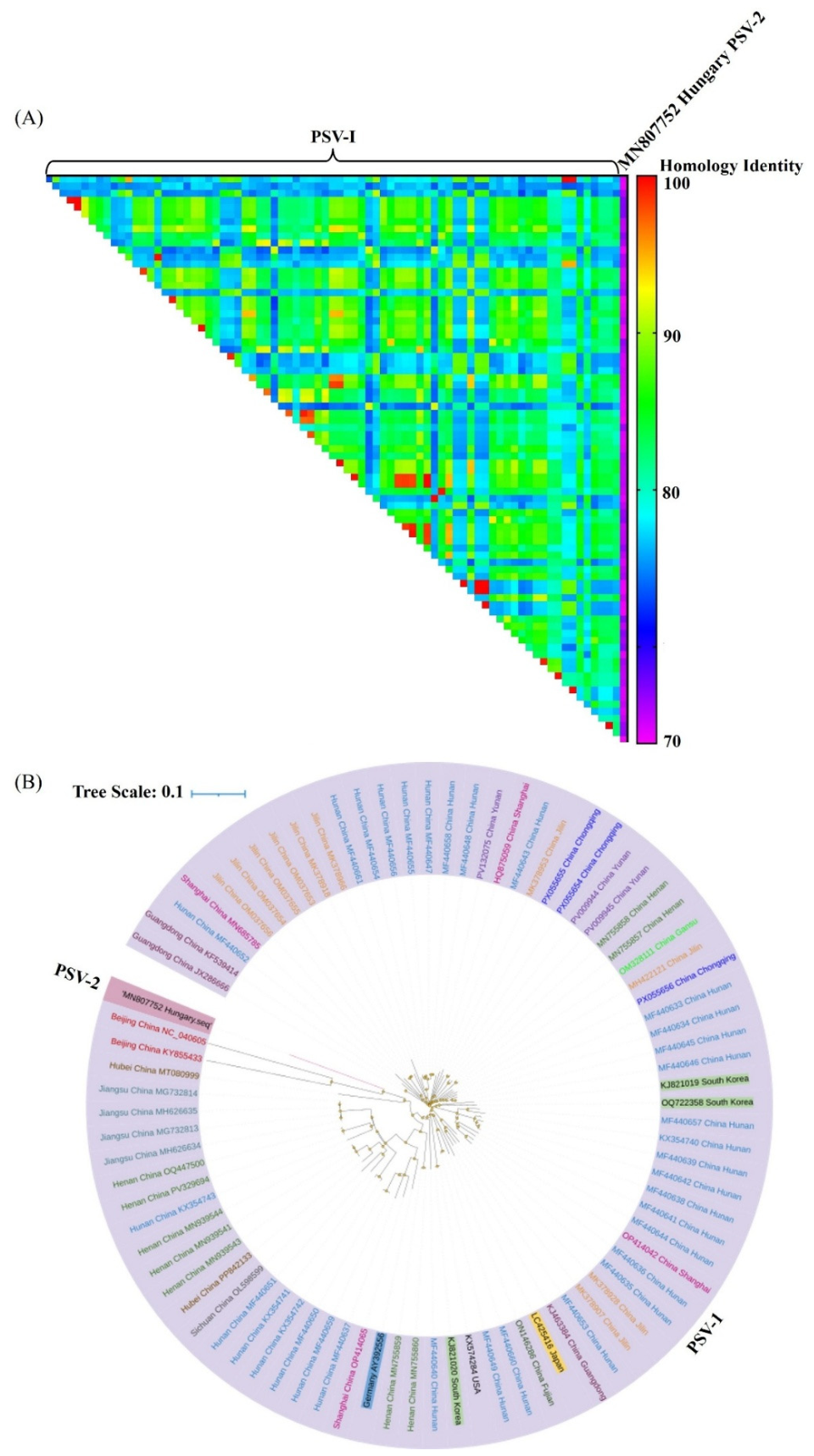
We retrieved 74 available Chinese PSV sequences from GenBank and performed genetic evolutionary analyses through P1 capsid-coding region homology comparison and phylogenetic reconstruction. Homology analysis categorized the PSV strains into four similarity ranges: <70% (2.47% of comparisons), 70–80% (38.37%), 80–90% (54.14%), and >90% (5.01%) (Figure 5A). All Chinese PSV-1 strains shared more than 70% whole-genome homology, whereas their similarity to representative PSV-2 strains ranged from 63.84% to 67.18%, confirming a clear genetic distinction between the two genotypes (Figure 5A).
Phylogenetic reconstruction demonstrated that the 74 Chinese PSV strains, together with isolates from South Korea, Japan, and the United States, clustered within PSV-1, forming lineages distinct from marmot sapelovirus and PSV-2. Interestingly, one Hubei strain (MT080999) exhibited closer phylogenetic affinity to PSV-2 (Figure 5B). To further investigate its relationship, we calculated the pairwise sequence identities. The complete genome of MT080999 shared 71.5% identity with the PSV-2 reference strain (e.g., KJ627638) and 73.2% with the PSV-1 reference strain (e.g., AY392556). Specifically, in the P1 region which determines serotype, MT080999 shared 78.1% identity with the PSV-2 reference and 75.4% with the PSV-1 reference. While its overall identity to PSV-2 is higher, the values still fall within the range that separates distinct genotypes. This unique genetic position raises the possibility that MT080999 could be an inter-genotype recombinant or represent a divergent lineage within PSV-1 that has acquired PSV-2-like genomic fragments. Further whole-genome recombination analysis and serological characterization would be necessary to determine whether it constitutes a new genotype. Chinese PSV strains did not form geographically distinct clusters. For instance, strains from Hunan Province appeared across multiple branches, intermixed with isolates from other regions. Likewise, four Shanghai strains were scattered throughout the PSV-1 clade, rather than clustering together, indicating extensive recombination among PSV-1 strains circulating in China.
When compared with global references, several Chinese strains showed close relationships with international isolates: three South Korean strains clustered with Hunan isolates; one Japanese strain (LC425416) grouped with a Fujian strain (ON146286); a German strain (AY392556) was most closely related to a Shanghai strain (OP414065); and one U.S. strain (KX574284) clustered with a Hunan strain (MF440649) (Figure 5B). These findings indicate that epidemic Chinese PSV strains share phylogenetic links with international isolates, suggesting either cross-border transmission or common evolutionary origins, thereby highlighting the global complexity of PSV dynamics.
Overall, systematic phylogenetic analysis of Chinese PSV strains reveals extensive genetic diversity and strong international connections. Both sequence homology and phylogenetic structure support the classification of PSV-1 and PSV-2 as distinct subtypes, with PSV-1 being the dominant lineage in China and exhibiting frequent recombination. These results provide important insights into PSV transmission and evolutionary history in China and globally, laying a foundation for future studies on recombination mechanisms, virulence, and cross-border transmission risks.
7. Conclusions and Future Prospects
PSV has emerged as an important enteric pathogen in swine populations worldwide, with its increasing prevalence posing a growing threat to the swine industry [45,46,47]. Infection can lead lead to a range of clinical outcomes, including diarrhea, neurological disorders, respiratory distress, and, in severe cases, death [48]. Frequent involvement in co-infections further complicates clinical presentation and diagnosis [16]. Despite its rising importance, critical knowledge gaps persist regarding PSV’s receptor, entry mechanisms, virus-host interactions, molecular pathogenesis, and effective control measures.
To address these gaps, this review provides the first comprehensive synthesis of PSV epidemiology and evolution in China. We analyze its origin, prevalence, co-infection patterns, genetic diversity, and recombination dynamics. Our analysis yields three key novel findings: (1) a continuous rise in PSV prevalence from 2009 to 2025, indicating an escalating threat; (2) a shift in detection ratios between healthy and diarrheic pigs, suggesting an evolution in pathogenicity; and (3) the identification of the 2A gene as a major recombination hotspot, with complex multi-parental recombination being the dominant evolutionary force among Chinese strains.
Collectively, these findings fill a critical knowledge gap and establish a new theoretical framework for understanding PSV’s cross-species transmission and genetic adaptation. On a practical level, this work provides essential data to support molecular surveillance, recombinant strain traceability, and the development of targeted vaccines, diagnostics, and control strategies. Future studies integrating molecular epidemiology, evolutionary analysis, and retrospective data mining will be crucial to further elucidate PSV dynamics and mitigate its impact on swine health and productivity.
Author Contributions
Conceptualization, L.H. and T.J.; methodology, L.B.; software, C.J.; validation, S.Y. and L.Q.; investigation, T.J.; resources, L.B.; data curation, C.J.; writing—original draft preparation, T.J.; writing—review and editing, C.J.; visualization, L.B.; supervision, L.H.; project administration, T.J.; funding acquisition, L.H. All authors have read and agreed to the published version of the manuscript.
Funding
This research was supported by the Shanghai Agricultural Science and Technology Innovation Program, China (K2024001) and the SAAS Program for Excellent Research Team (Grant No. [2022]012).
Data Availability Statement
Data sharing is not applicable to this article as no new data were created or analysed in this study.
Conflicts of Interest
The authors declare no conflicts of interest.
Abbreviations
The following abbreviations are used in this manuscript:
| PSV | Porcine sapelovirus |
| PEDV | Porcine epidemic diarrhea virus |
| PTV | Porcine teschovirus |
| PDCoV | Porcine deltacoronavirus |
| PAstV | Porcine astrovirus |
| PKoV | Porcine kobuvirus |
| CPE | Cytopathic effects |
References
- Ibrahim, Y.M.; Zhang, W.; Werid, G.M.; Zhang, H.; Feng, Y.; Pan, Y.; Zhang, L.; Li, C.W.; Lin, H.; Chen, H.Y.; et al. Isolation, Characterization, and Molecular Detection of Porcine Sapelovirus. Viruses 2022, 14, 349. [Google Scholar] [CrossRef]
- Knowles, N.J.; Buckley, L.S.; Pereira, H.G. Classification of porcine enteroviruses by antigenic analysis and cytopathic effects in tissue culture: description of 3 new serotypes. Arch. Virol. 1979, 62, 201–208. [Google Scholar] [CrossRef]
- Kaku, Y.; Sarai, A.; Murakami, Y. Genetic reclassification of porcine enteroviruses. J. Gen. Viro 2001, 82, 417–424. [Google Scholar] [CrossRef]
- Krumbholz, A.; Dauber, M.; Henke, A.; Birch-Hirschfeld, E.; Knowles, N.J.; Stelzner, A.; Zell, R. Sequencing of porcine enterovirus groups II and III reveals unique features of both virus groups. J. Virol. 2002, 76, 5813–5821. [Google Scholar] [CrossRef] [PubMed]
- Chard, L.S.; Bordeleau, M.E.; Pelletier, J.; Tanaka, J.; Belsham, G.J. Hepatitis C virus-related internal ribosome entry sites are found in multiple genera of the family Picornaviridae. J. Gen. Virol. 2006, 87, 927–936. [Google Scholar] [CrossRef]
- Zell, R.; Delwart, E.; Gorbalenya, A.E.; Hovi, T.; King, A.M.Q.; Knowles, N.J.; Lindberg, A.M.; Pallansch, M.A.; Palmenberg, A.C.; Reuter, G.; Simmonds, P.; et al. ICTV Virus Taxonomy Profile: Picornaviridae. J. Gen. Virol. 2017, 98, 2421–2422. [Google Scholar] [CrossRef] [PubMed]
- Tseng, C.H.; Tsai, H.J. Sequence analysis of a duck picornavirus isolate indicates that it together with porcine enterovirus type 8 and simian picornavirus type 2 should be assigned to a new picornavirus genus. Virus Res. 2007, 129, 104–114. [Google Scholar] [CrossRef]
- Zhang, W.; Kataoka, M.; Doan, H.Y.; Ami, Y.; Suzaki, Y.; Takeda, N.; Muramatsu, M.; Li, T.C. Characterization of a Novel Simian Sapelovirus Isolated from a Cynomolgus Monkey using PLC/PRF/5 Cells. Sci. Rep. 2019, 9, 20221. [Google Scholar] [CrossRef]
- Oberste, M.S.; Maher, K.; Pallansch, M.A. Molecular phylogeny and proposed classification of the simian picornaviruses. J. Virol. 2002, 76, 1244–1251. [Google Scholar] [CrossRef]
- Kim, D.S.; Kang, M.I.; Son, K.Y.; Bak, G.Y.; Park, J.G.; Hosmillo, M.; Seo, J.Y.; Kim, J.Y.; Alfajaro, M.M.; Solin, M.; et al. Pathogenesis of Korean SapelovirusA in piglets and chicks. J. Gen. Virol. 2016, 97, 2566–2574. [Google Scholar] [CrossRef] [PubMed]
- Forman, A.J.; Pass, D.A.; Connaughton, I.D. The characterisation and pathogenicity of porcine enteroviruses isolated in Victoria. Aust. Vet. J. 1982, 58, 136–142. [Google Scholar] [CrossRef]
- Chelli, E.; De Sabato, L.; Vaccari, G.; Ostanello, F.; Di Bartolo, I. Detection and Characterization of Porcine Sapelovirus in Italian Pig Farms. Animals 2020, 10, 966. [Google Scholar] [CrossRef] [PubMed]
- Masuda, T.; Sunaga, F.; Naoi, Y.; Ito, M.; Takagi, H.; Katayama, Y.; Omatsu, T.; Oba, M.; Sakaguchi, S.; Furuya, T.; et al. Whole genome analysis of a novel picornavirus related to the Enterovirus/Sapelovirus supergroup from porcine feces in Japan. Virus Res. 2018, 257, 68–73. [Google Scholar] [CrossRef] [PubMed]
- Dilovski, M.; Ognianov, D. [Isolation and identification of a virus causing abortions and stillbirths in swine (Preliminary report)]. Vet. Med. Nauk. 1975, 12, 52–53. [Google Scholar]
- Donin, D.G.; de Arruda Leme, R.; Alfieri, A.F.; Alberton, G.C.; Alfieri, A.A. First report of Porcine teschovirus (PTV), Porcine sapelovirus (PSV) and Enterovirus G (EV-G) in pig herds of Brazil. Trop. Anim. Health Prod. 2014, 46, 523–528. [Google Scholar] [CrossRef] [PubMed]
- Zhang, Y.F.; Li, Q.Q.; Si, L.L.; Gao, J.L.; Yuan, J.; Xia, L.; Hu, H. Isolation and Characterization of Porcine Sapelovirus from the PDCoV-Positive Sample and Its Molecular Epidemiology in Henan Province, China. Transbound. Emerg. Dis. 2023, 2023, 9943040. [Google Scholar] [CrossRef]
- Chen, Q.Y.; Sun, Z.H.; Che, Y.L.; Chen, R.J.; Wu, X.M.; Wu, R.J.; Wang, L.B.; Zhou, L.J. High Prevalence, Genetic Diversity, and Recombination of Porcine Sapelovirus in Pig Farms in Fujian, Southern China. Viruses 2023, 15, 1751. [Google Scholar] [CrossRef]
- Schyns, M.A.R.; van den Braak, R.; Peijnenborg, J.; Coppens, S.; Deijs, M.; Burggraaff, M.G.J.M.; Kuller, W.I.; Theuns, S.; van der Hoek, L.; de Groof, A. Characterization of the enteric virome of clinically healthy pigs around weaning on commercial farms in the Netherlands using next generation sequencing and qPCR. Porc. Health Manag 2025, 11, 41. [Google Scholar] [CrossRef]
- Lamont, P.H.; Betts, A.O. Enteroviruses in the pig. Nature 1958, 182, 608–609. [Google Scholar] [CrossRef]
- Buitrago, D.; Cano-Gomez, C.; Aguero, M.; Fernandez-Pacheco, P.; Gomez-Tejedor, C.; Jimenez-Clavero, M.A. A survey of porcine picornaviruses and adenoviruses in fecal samples in Spain. J. Vet. Diagn. Investig. 2010, 22, 763–766. [Google Scholar] [CrossRef]
- Cano-Gomez, C.; Garcia-Casado, M.A.; Soriguer, R.; Palero, F.; Jimenez-Clavero, M.A. Teschoviruses and sapeloviruses in faecal samples from wild boar in Spain. Vet. Microbiol. 2013, 165, 115–122. [Google Scholar] [CrossRef]
- Boros, A.; Pankovics, P.; Reuter, G. Characterization of a novel porcine enterovirus in domestic pig in Hungary. Infect. Genet Evol. 2011, 11, 1096–1102. [Google Scholar] [CrossRef]
- Boros, Á.; László, Z.; Pankovics, P.; Marosi, A.; Albert, M.; Cságola, A.; Bíró, H.; Fahsbender, E.; Delwart, E.; Reuter, G. High prevalence, genetic diversity and a potentially novel genotype of Sapelovirus A (Picornaviridae) in enteric and respiratory samples in Hungarian swine farms. J. Gen. Virol. 2020, 101, 609–621. [Google Scholar] [CrossRef]
- Prodelalova, J. The survey of porcine teschoviruses, sapeloviruses and enteroviruses B infecting domestic pigs and wild boars in the Czech Republic between 2005 and 2011. Infect. Genet Evol. 2012, 12, 1447–1451. [Google Scholar] [CrossRef] [PubMed]
- Hammerschmitt, M.E.; de Almeida, P.R.; de Cecco, B.S.; Lorenzett, M.P.; Schwertz, C.I.; da Cruz, R.A.S.; Caprioli, R.A.; Schuh, D.T.; Demoliner, M.; Eisen, A.K.A.; et al. Swine polioencephalomyelitis in Brazil: identification of Teschovirus A, Sapelovirus A, and Enterovirus G in a farm from Southern Brazil. Braz. J. Microbiol. 2021, 52, 1617–1622. [Google Scholar] [CrossRef]
- Kim, S.Y.; Park, C.K.; Park, G.N.; Choe, S.; Jang, M.K.; Lee, Y.H.; Cho, Y.S.; An, D.J. Seroprevalence, Genetic Characteristics, and Pathogenicity of Korean Porcine Sapeloviruses. Viruses 2025, 17, 870. [Google Scholar] [CrossRef] [PubMed]
- Son, K.Y.; Kim, D.S.; Kwon, J.; Choi, J.S.; Kang, M.I.; Belsham, G.J.; Cho, K.O. Full-length genomic analysis of Korean porcine Sapelovirus strains. PLoS ONE 2014, 9, e107860. [Google Scholar] [CrossRef]
- Ray, P.K.; Desingu, P.A.; Kumari, S.; John, J.K.; Sethi, M.; Sharma, G.K.; Pattnaik, B.; Singh, R.K.; Saikumar, G. Porcine sapelovirus among diarrhoeic piglets in India. Transbound. Emerg. Di 2018, 65, 261–263. [Google Scholar] [CrossRef]
- Arruda, P.H.; Arruda, B.L.; Schwartz, K.J.; Vannucci, F.; Resende, T.; Rovira, A.; Sundberg, P.; Nietfeld, J.; Hause, B.M. Detection of a novel sapelovirus in central nervous tissue of pigs with polioencephalomyelitis in the USA. Transbound. Emerg. Dis. 2017, 64, 311–315. [Google Scholar] [CrossRef] [PubMed]
- Lan, D.L.; Ji, W.H.; Yang, S.X.; Cui, L.; Yang, Z.B.; Yuan, C.L.; Hua, X.G. Isolation and characterization of the first Chinese porcine sapelovirus strain. Arch. Virol. 2011, 156, 1567–1574. [Google Scholar] [CrossRef]
- Yang, T.T.; Yu, X.L.; Yan, M.J.; Luo, B.Y.; Li, R.C.; Qu, T.L.; Luo, Z.; Ge, M.; Zhao, D. Molecular characterization of Porcine sapelovirus in Hunan, China. J. Gen. Virol. 2017, 98, 2738–2747. [Google Scholar] [CrossRef] [PubMed]
- Chen, J.N.; Suo, X.P.; Cao, L.Y.; Yuan, C.; Shi, L.; Duan, Y.Y.; Zheng, H.X.; Wang, Q. Virome Analysis for Identification of a Novel Porcine Sapelovirus Isolated in Western China. Microbiol. Spectr. 2022, 10, e0180122. [Google Scholar] [CrossRef]
- Li, N.N.; Tao, J.; Li, B.Q.; Cheng, J.H.; Shi, Y.; Shi, X.H.; Liu, H.L. Molecular characterization of a porcine sapelovirus strain isolated in China. Arch. Virol. 2021, 166, 2683–2692. [Google Scholar] [CrossRef] [PubMed]
- Tao, J.; Li, B.Q.; Cheng, J.H.; Shi, Y.; Qiao, C.T.; Lin, Z.; Liu, H.L. Genomic Divergence Characterization and Quantitative Proteomics Exploration of Type 4 Porcine Astrovirus. Viruses 2022, 14, 1383. [Google Scholar] [CrossRef]
- Tamura, K.; Battistuzzi, F.U.; Billing-Ross, P.; Murillo, O.; Filipski, A.; Kumar, S. Estimating divergence times in large molecular phylogenies. Proc. Natl. Acad. Sci. USA 2012, 109, 19333–19338. [Google Scholar] [CrossRef]
- Yang, T.Y.; Lu, Y.; Zhang, L. Proposed genotype definition of Porcine sapelovirus. Pol. J. Vet. Sci. 2021, 24, 307–312. [Google Scholar] [CrossRef] [PubMed]
- Zhu, P.; Li, Z.H.; Li, Z.R.; Meng, L.; Liu, P.; Sun, X.T.; Yang, Q.; Song, J.L. First Isolation and Characterization of Three Strains of Porcine Sapelovirus in Yunnan Province, China. Viruses 2025, 17, 505. [Google Scholar] [CrossRef]
- Chen, J.W.; Chen, F.; Zhou, Q.F.; Li, W.; Song, Y.H.; Pan, Y.F.; Zhang, X.B.; Xue, C.Y.; Bi, Y.Z.; Cao, Y.C. Complete genome sequence of a novel porcine Sapelovirus strain YC2011 isolated from piglets with diarrhea. J. Virol. 2012, 86, 10898. [Google Scholar] [CrossRef]
- Li, Y.; Du, L.Y.; Jin, T.; Cheng, Y.; Zhang, X.; Jiao, S.Y.; Huang, T.; Zhang, Y.T.; Yan, Y.; Gu, J.Y.; et al. Characterization and epidemiological survey of porcine sapelovirus in China. Vet. Microbiol. 2019, 232, 13–21. [Google Scholar] [CrossRef]
- Li, Q.X.; Jiang, J.F.; Li, J.H.; Zhang, W.; Xin, Y.X.; He, B.; He, S.; Tu, C.C.; Guo, Y.D.; Gong, W.J. Complexity of Diarrhea-Associated Viruses in Stunted Pigs Identified by Viral Metagenomics. Transbound. Emerg. Dis. 2025, 2025, 1974716. [Google Scholar] [CrossRef]
- Jiang, C.Y.; He, H.J.; Zhang, C.Y.; Zhang, X.J.; Han, J.F.; Zhang, H.B.; Luo, Y.; Wu, Y.; Wang, Y.; Ge, B.Q.; et al. One-step triplex reverse-transcription PCR detection of porcine epidemic diarrhea virus, porcine sapelovirus, and porcine sapovirus. J. Vet. Diagn. Investig. 2019, 31, 909–912. [Google Scholar] [CrossRef]
- Lu, S.J.; Ma, M.Y.; Yan, X.G.; Zhao, F.J.; Hu, W.Y.; Ding, Q.W.; Ren, H.J.; Xiang, Y.Q.; Zheng, L.L. Development and application of a low-priced duplex quantitative PCR assay based on SYBR Green I for the simultaneous detection of porcine deltacoronavirus and porcine sapelovirus. Vet. Med. 2023, 68, 106–115. [Google Scholar] [CrossRef]
- Wu, S.M.; Gou, F.; Meng, J.; Jin, X.; Liu, W.C.; Ding, W.S.; Xu, W.H.; Gu, C.Q.; Hu, X.Y.; Cheng, G.F.; et al. Porcine kobuvirus enhances porcine epidemic diarrhea virus pathogenicity and alters the number of intestinal lymphocytes in piglets. Vet. Microbiol. 2024, 293, 110100. [Google Scholar] [CrossRef] [PubMed]
- Li, B.Q.; Tao, J.; Li, X.; Cheng, J.H.; Shi, Y.; Tang, P.; Liu, H.L. Relevancy Prediction of the Emerging Pathogens with Porcine Diarrhea by Logistic Regression Model. Microorganisms 2025, 13. [Google Scholar] [CrossRef]
- Yang, T.T.; Lu, Y.M.; Zhang, L.Q.; Li, X.Y. Identification of novel genotypes belonging to the species Teschovirus A from indigenous pigs in western Jiangxi, China. Arch. Virol. 2020, 165, 993–1001. [Google Scholar] [CrossRef]
- Chen, Q.; Zheng, Y.; Guo, B.; Zhang, J.; Yoon, K.J.; Harmon, K.M.; Main, R.G.; Li, G.W. Complete Genome Sequence of Porcine Sapelovirus Strain USA/IA33375/2015 Identified in the United States. Genome Announc 2016, 4, e01055. [Google Scholar] [CrossRef] [PubMed]
- Capai, L.; Piorkowski, G.; Maestrini, O.; Casabianca, F.; Masse, S.; de Lamballerie, X.; Charrel, R.N.; Falchi, A. Detection of porcine enteric viruses (Kobuvirus, Mamastrovirus and Sapelovirus) in domestic pigs in Corsica, France. PLoS ONE 2022, 17, e0260161. [Google Scholar] [CrossRef]
- Kumari, S.; Ray, P.K.; Singh, R.; Desingu, P.A.; Varshney, R.; Saikumar, G. Pathological and molecular investigation of porcine sapelovirus infection in naturally affected Indian pigs. Microb. Pathog. 2019, 127, 320–325. [Google Scholar] [CrossRef] [PubMed]
Figure 1.
Temporal origin and evolutionary analysis of PSV. A time-scaled phylogenetic tree was reconstructed using MEGA X software (RelTime with Dated Tips method) based on the full-length genome sequences of 54 viruses, including 42 porcine sapeloviruses, nine porcine enteroviruses (PEV), two marmot sapeloviruses, and one avian sapelovirus. The PEV-1 strain (AB038528, red) was used as the outgroup. The sampling year of each sequence was applied as a calibration constraint. The estimated divergence time for each major branch is indicated.
Figure 1.
Temporal origin and evolutionary analysis of PSV. A time-scaled phylogenetic tree was reconstructed using MEGA X software (RelTime with Dated Tips method) based on the full-length genome sequences of 54 viruses, including 42 porcine sapeloviruses, nine porcine enteroviruses (PEV), two marmot sapeloviruses, and one avian sapelovirus. The PEV-1 strain (AB038528, red) was used as the outgroup. The sampling year of each sequence was applied as a calibration constraint. The estimated divergence time for each major branch is indicated.
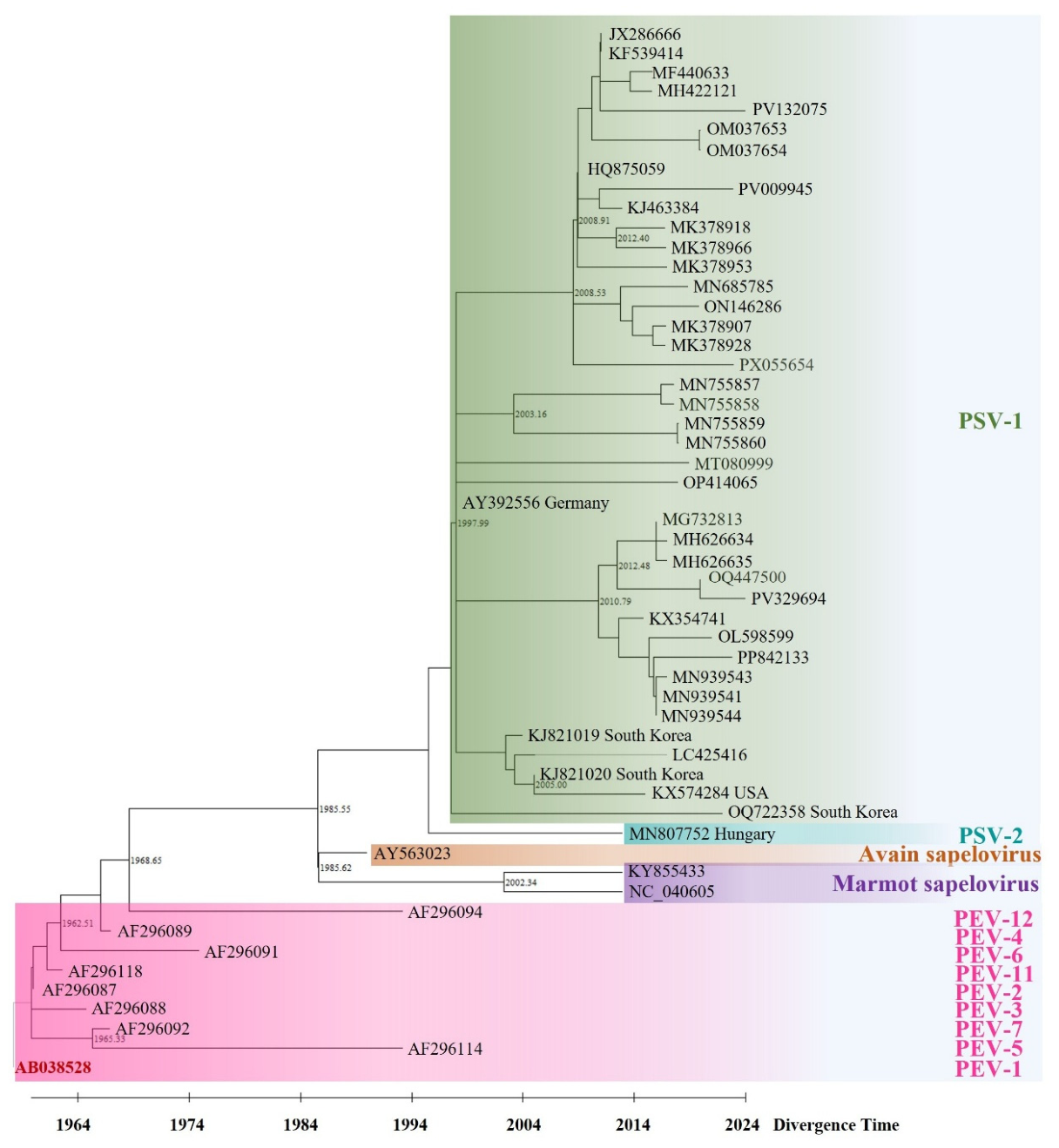
Figure 2.
Epidemiological survey of Porcine Sapelovirus (PSV) in China. (A) The geographic distribution of PSV infection rates among Chinese provinces. (B) The trend of PSV prevalence analyzed across different sampling years. (C) PSV infection rates stratified by the age groups of the pigs. (D) A comparison of PSV prevalence between herds with healthy pigs and those presenting diarrhea.
Figure 2.
Epidemiological survey of Porcine Sapelovirus (PSV) in China. (A) The geographic distribution of PSV infection rates among Chinese provinces. (B) The trend of PSV prevalence analyzed across different sampling years. (C) PSV infection rates stratified by the age groups of the pigs. (D) A comparison of PSV prevalence between herds with healthy pigs and those presenting diarrhea.
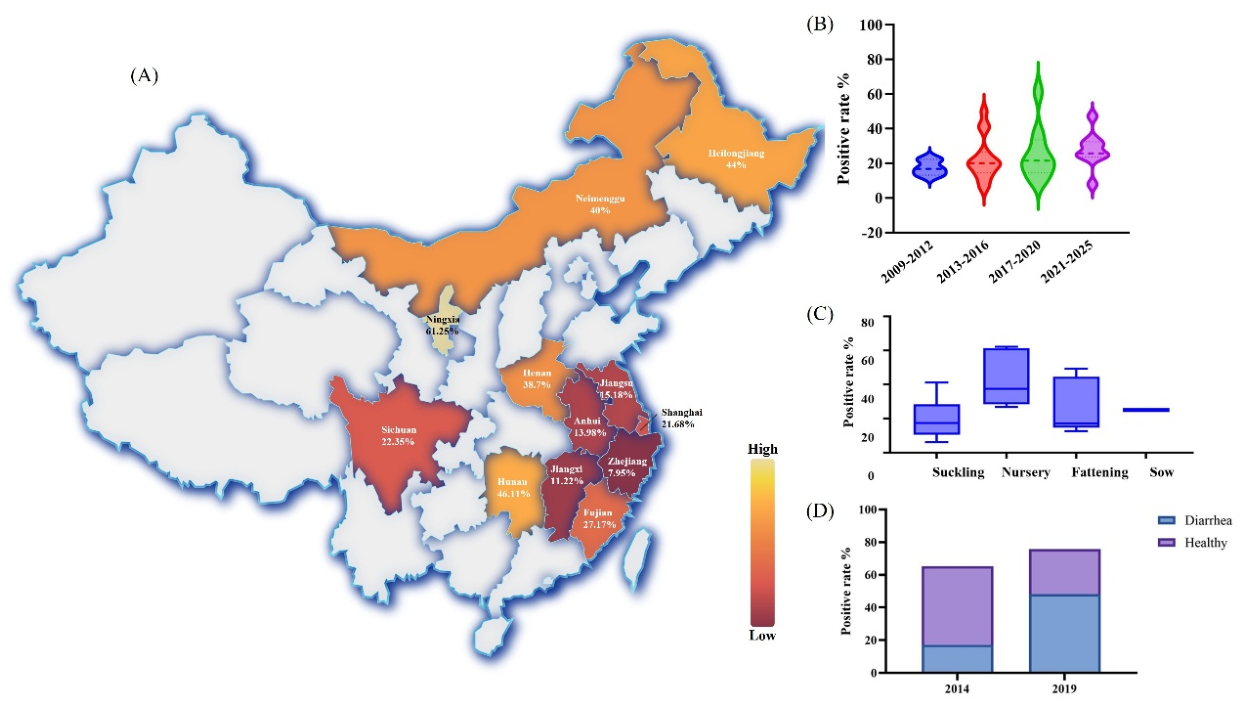
Figure 3.
Profile of PSV co-infections in China. (A) Comparison of single and co-infection trends. (B) Annual analysis of PSV infections. (C) Analysis of PSV co-infection patterns.
Figure 3.
Profile of PSV co-infections in China. (A) Comparison of single and co-infection trends. (B) Annual analysis of PSV infections. (C) Analysis of PSV co-infection patterns.
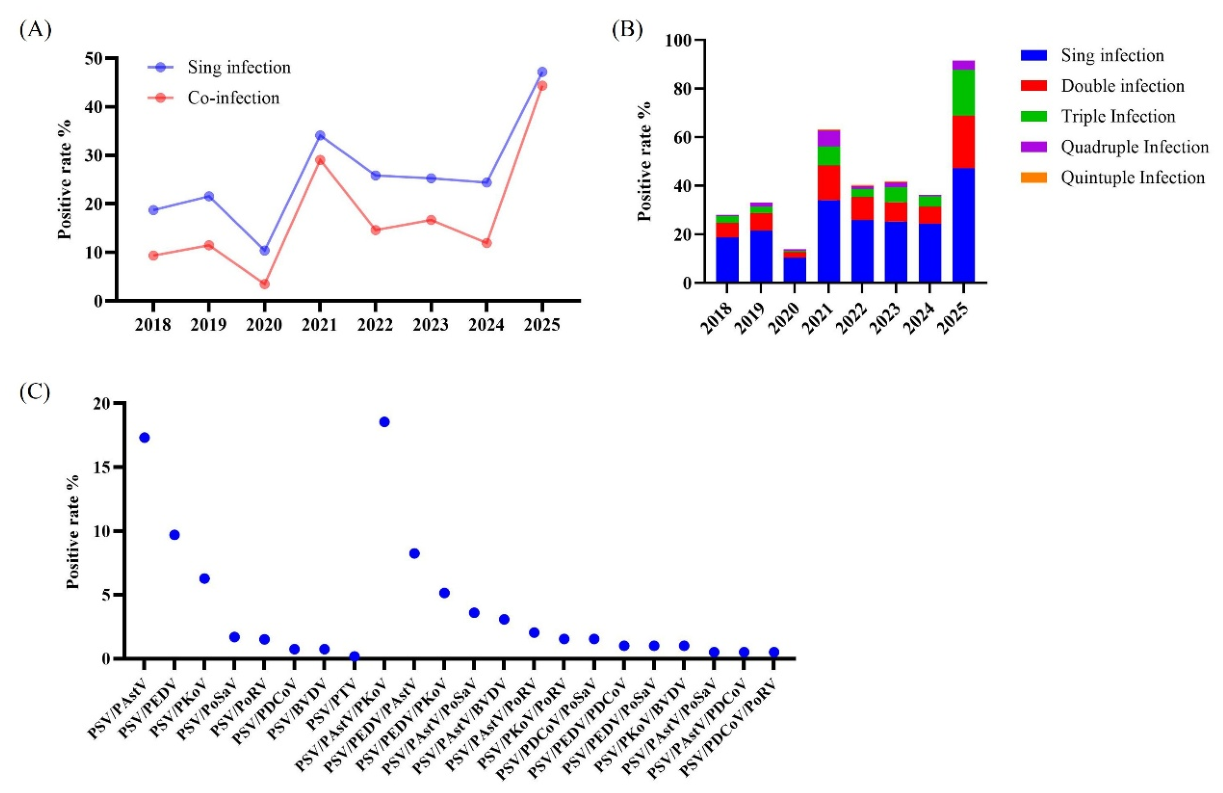
Figure 4.
Prediction and Analysis of Recombination Trends in PSV. Full-length genome sequences from 74 Chinese PSV isolates were analyzed for recombination using RDP4 software. Subsequent statistical analysis of recombination event proportions is shown in (A). Statistically significant recombination breakpoints identified from these events were compiled and visualized in a scatter plot (top panel, B). Twenty-one high-confidence recombination events, consistently detected by all seven algorithms (RDP, GENECONV, BootScan, MaxChi, Chimaera, SiScan, and 3Seq), were selected for detailed characterization. Their recombination maps are displayed in the bottom panel, aligned with a PSV genome schematic and the breakpoint scatter plot for comparative evaluation.
Figure 4.
Prediction and Analysis of Recombination Trends in PSV. Full-length genome sequences from 74 Chinese PSV isolates were analyzed for recombination using RDP4 software. Subsequent statistical analysis of recombination event proportions is shown in (A). Statistically significant recombination breakpoints identified from these events were compiled and visualized in a scatter plot (top panel, B). Twenty-one high-confidence recombination events, consistently detected by all seven algorithms (RDP, GENECONV, BootScan, MaxChi, Chimaera, SiScan, and 3Seq), were selected for detailed characterization. Their recombination maps are displayed in the bottom panel, aligned with a PSV genome schematic and the breakpoint scatter plot for comparative evaluation.
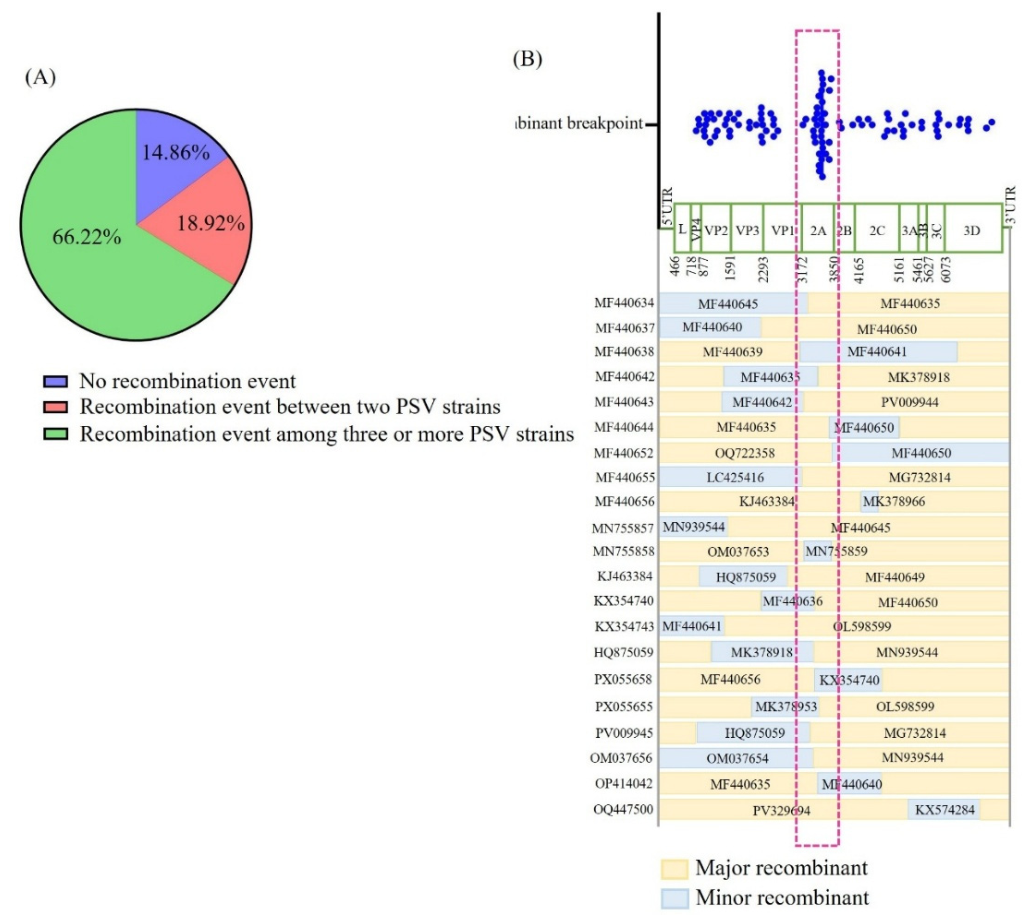
Figure 5.
Genetic relatedness analysis of epidemic PSV strains in China. (A) Nucleotide identity heatmap. A total of 74 available Chinese PSV strain sequences and 7 strains from abroad were obtained from the GenBank database. Sequence alignment and pairwise identity calculations were performed using MegAlign software. Percent identity is represented by the color gradient shown in the key to the right. (B) Phylogenetic analysis. The evolutionary tree was reconstructed based on the complete nucleotide sequences using the Neighbor-Joining method in MEGA X software. The analysis used the Kimura 2-parameter model with 1000 bootstrap replicates. PSV strains from the same geographic region are indicated by an identical font color, while foreign strains are marked by distinct background colors.
Figure 5.
Genetic relatedness analysis of epidemic PSV strains in China. (A) Nucleotide identity heatmap. A total of 74 available Chinese PSV strain sequences and 7 strains from abroad were obtained from the GenBank database. Sequence alignment and pairwise identity calculations were performed using MegAlign software. Percent identity is represented by the color gradient shown in the key to the right. (B) Phylogenetic analysis. The evolutionary tree was reconstructed based on the complete nucleotide sequences using the Neighbor-Joining method in MEGA X software. The analysis used the Kimura 2-parameter model with 1000 bootstrap replicates. PSV strains from the same geographic region are indicated by an identical font color, while foreign strains are marked by distinct background colors.
Disclaimer/Publisher’s Note: The statements, opinions and data contained in all publications are solely those of the individual author(s) and contributor(s) and not of MDPI and/or the editor(s). MDPI and/or the editor(s) disclaim responsibility for any injury to people or property resulting from any ideas, methods, instructions or products referred to in the content. |
© 2026 by the authors. Licensee MDPI, Basel, Switzerland. This article is an open access article distributed under the terms and conditions of the Creative Commons Attribution (CC BY) license (http://creativecommons.org/licenses/by/4.0/).
Copyright: This open access article is published under a Creative Commons CC BY 4.0 license, which permit the free download, distribution, and reuse, provided that the author and preprint are cited in any reuse.


