
Submitted:
27 May 2026
Posted:
28 May 2026
You are already at the latest version
Abstract
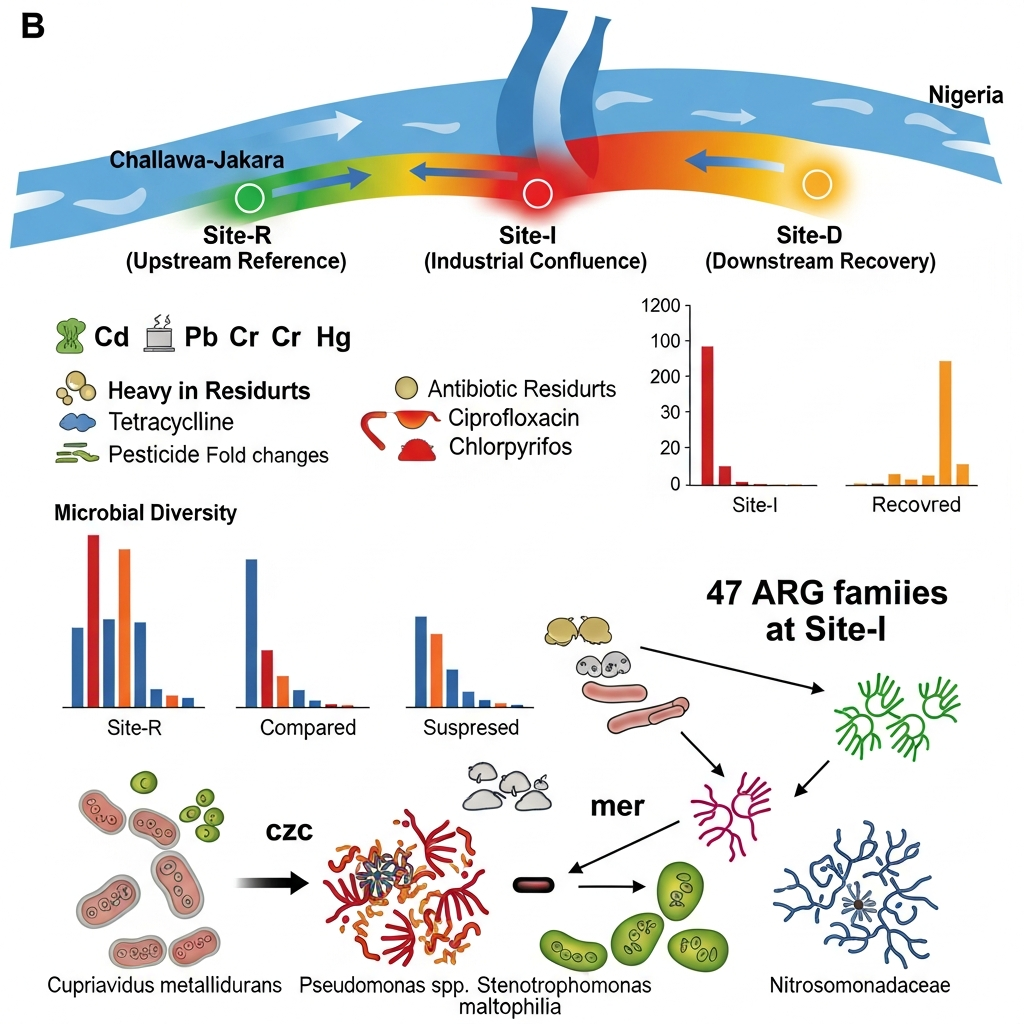
The Challawa and Jakara rivers of Kano State, Nigeria, receive complex multi-class toxic loads from over 300 tannery, textile, and pharmaceutical industries. Conventional physicochemical monitoring is insufficient to capture the cumulative ecological impact of co-occurring contaminants at the regulatory scale required for Sustainable Development Goal (SDG) 6.3 compliance. We applied a dual metagenomic framework; 16S rRNA V3–V4 amplicon sequencing and shotgun metagenomics to characterize microbial community structure, functional gene repertoires, metal resistance genes (MRGs), and antibiotic resistance genes (ARGs) across three hydrological zones of the corridor: upstream reference (Site-R), industrial confluence (Site-I), and downstream recovery (Site-D). Amplicon sequencing (DADA2; 1847 ASVs) revealed significant community restructuring along the contamination gradient; Shannon diversity declined from H′ = 4.2 ± 0.3 (Site-R) to H′ = 2.8 ± 0.2 (Site-I) (PERMANOVA R2 = 0.68, p = 0.001). Metal-tolerant Cupriavidus metallidurans (6.1%), Pseudomonas spp. (14.2%), and Stenotrophomonas maltophilia (8.7%) were selectively enriched at Site-I, while obligate nitrifiers (Nitrosomonadaceae) were suppressed to 0.9% (p < 0.001). Shotgun metagenomics (DESeq2) identified the czc efflux operon and mer volatilisation operon as 5.4-fold and 4.9-fold enriched, respectively, and strongly correlated with cadmium (Spearman ρ = 0.87) and mercury (ρ = 0.83) concentrations. Metal–antibiotic co-selection was confirmed by a partial Mantel test (ρ = 0.74, p = 0.003), with 47 ARG families at Site-I versus 12 at Site-R. A Random Forest classifier trained on normalized functional gene profiles achieved 91.4 ± 2.1% accuracy (AUC = 0.96), comparable to a full physicochemical panel. This metagenomic biosensor framework provides a scalable, cost-effective, and ecologically meaningful tool for SDG 6.3 compliance monitoring in resource-limited regulatory environments.
Keywords:
metagenomics
; microbial biosensors
; heavy metal resistance
; antibiotic resistance genes
; co-selection
; wastewater
; SDG 6
; Kano State
; Challawa River
; Random Forest classifier
Copyright: This open access article is published under a Creative Commons CC BY 4.0 license, which permit the free download, distribution, and reuse, provided that the author and preprint are cited in any reuse.


