
Submitted:
26 May 2026
Posted:
27 May 2026
You are already at the latest version
Abstract
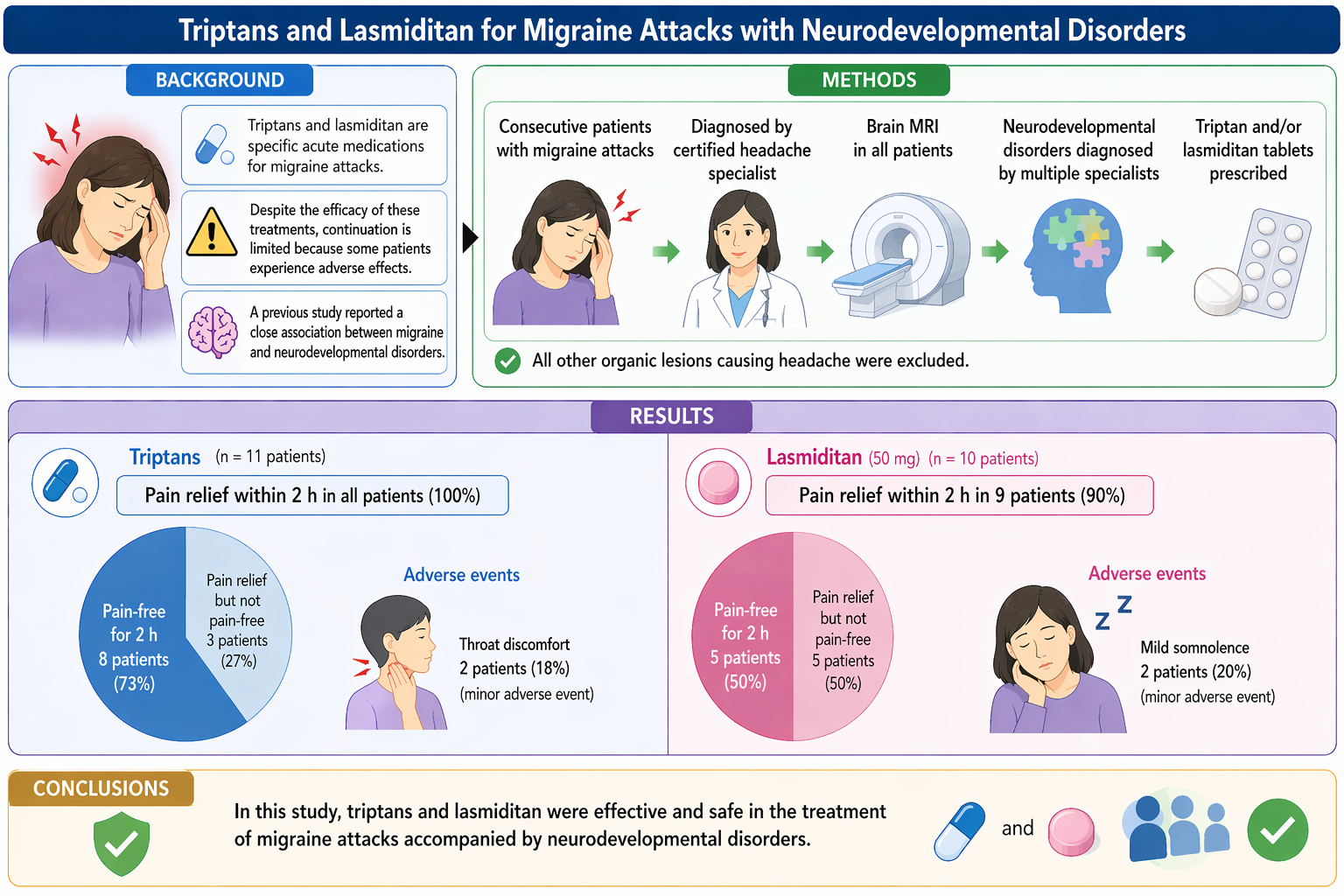
Background: Triptans and lasmiditan are considered specific acute medications for migraine attacks. Despite the efficacy of these treatments, continuation of these medications was limited because some patients experienced adverse effects. A previous study reported a close association between migraine and neurodevelopmental disorders. The present study investigated triptans and lasmiditan in the treatment of consecutive patients with migraine attacks accompanied by neurodevelopmental disorders. Methods: The enrolled patients were diagnosed with migraine by a certified headache specialist. Brain magnetic resonance imaging was performed in all patients, and all other organic lesions causing headache were excluded. Neurodevelopmental disorders were diagnosed by multiple specialists. Triptan and/or lasmiditan tablets were prescribed for all patients. Results: Triptans were effective in these patients, providing pain relief within 2 h in all patients, and eight patients (73%) were pain-free for 2 h. However, throat discomfort was detected in two patients, and it was regarded as a minor adverse event. Lasmiditan (50 mg) was prescribed to 10 patients, and it provided pain relief for 2 h in 9 patients (90%) and pain-free for 2 h in 5 patients (50%). Conversely, mild somnolence was detected in two patients. Conclusions: In this study, triptans and lasmiditan were effective and safe in the treatment of migraine attacks accompanied by neurodevelopmental disorders.
Keywords:
migraine
; triptan
; lasmiditan
; neurodevelopmental disorder
Copyright: This open access article is published under a Creative Commons CC BY 4.0 license, which permit the free download, distribution, and reuse, provided that the author and preprint are cited in any reuse.


