

Submitted:
26 May 2026
Posted:
27 May 2026
You are already at the latest version
Abstract
The construction industry is a major contributor to global climate change, particularly through concrete production. Reuse of construction products, in general, and concrete elements, in particular, has the potential to engender resource efficiency and to reduce CO2 emissions. Beside the advantages, this method is also associated with risks for all parties involved in a construction project. One of the factors hindering the reuse pertains to legal considerations. The authors analyzed the legal basis for reusing concrete elements and reviewed legislation, policy, and research literature with the systematic content analysis (SCA) method. The authors furthermore analyzed the legal situation under German law with regard to liability and burden of proof in projects in which concrete elements should be reused and developed a legal risk assessment model. The conclusion is that reuse of concrete elements can be increased by enhancing the awareness of project stakeholders regarding its legal risks. This enhancement in awareness should be accompanied by the development of skills to assess these risks and the acquisition of knowledge about potential limitations of liability. The paper provides a foundation for conducting an individual risk analysis and offers recommendations for behaviors that are deemed to be low risk.
Keywords:
concrete elements
; legal analysis
; reuse
; risks
; sustainability
1. Introduction
The issue of climate change is one of the most significant challenges currently facing the world. As the World Economic Forum [1] points out, the construction industry is responsible for 37% of global carbon emissions. Consequently, there are numerous ongoing initiatives worldwide with the aim of decarbonizing the building and construction sector. The United Nations (UN) has announced its intention to implement strategies with the aim of avoiding unnecessary extraction and production, shifting to regenerative materials, and improving the decarbonization of conventional materials [1]. The European Union, through the initiative known as the Green Deal, is endeavoring to position Europe as the world’s first climate-neutral continent by the year 2050 [3]. In accordance with this policy, countries worldwide have enacted new legislation to achieve the international climate goals established in the Paris Agreement [4].
The commonality between these actions is that they all motivate the reuse of materials or entire building elements (sometimes also termed ‘urban mining’). Moreover, the construction of new buildings is estimated to generate 50-75% fewer emissions than the construction of new buildings [2].
Concrete production is a particularly egregious example of this, accounting for approximately 8% of global carbon dioxide emissions [1]. Consequently, the reuse of concrete elements and the prevention of waste may contribute to the mitigation of climate change. Moreover, the financial aspects of the decision can prove to be a compelling factor in its favor [5].
In accordance with Article 3(13) of the European Directive 2008/98/EC on waste and the repeal of certain directives [6], the term “reuse” is defined as any operation whereby products or components that do not constitute waste are utilized once more for the same purpose for which they were originally designed. The German Recycling and Waste Management Act employs precisely the same definition in Article 3(21) [7]. In essence, elements that are composed of concrete, reinforced concrete, or prestressed concrete can be reutilized. The highest potential for reuse is observed in precast prestressed concrete elements, due to the fact that they typically exhibit a lack of cracks and consequently possess enhanced durability. Moreover, they are more amenable to dismantling [8].
The preconditions for the reuse of concrete elements are technical suitability and operability, compliance with codes or standards, and compliance with other legal requirements [9].
The following are potential scenarios for the reuse of building elements:
- The reutilization of materials within the confines of the same edifice, for instance in the context of revaluation initiatives, is a pertinent consideration.
- The integration of the existing element into a new construction at the same location is to be undertaken.
- The material under discussion should be reused in other construction projects in different locations.
The reutilization of extant elements has been demonstrated to be financially advantageous, whilst concurrently supporting heritage preservation by maintaining the historic appearance of monuments [9].
However, in contrast to the recycling of construction waste, the share of reusing existing elements such as windows, doors, stairs, floors, or façade elements is still low [10]. As Menn [10] point out, legal concerns are one of a number of factors which militate against the feasibility of reusing existing building elements. Accordingly, Park and Tucker [11] discovered a significant impediment to the reutilization of existing building materials and elements, namely concerns regarding liability and the fulfilment of legal stipulations. Byers et al. [12] found themselves reluctant to engage with reuse projects, citing the perceived necessity of expertise, the financial implications, and the responsibility for materials’ performance, given the paucity of data on their properties. In addition, the research findings of the authors, which were obtained from a self-administered survey, corroborated these concerns [13]. For instance, ensuring the quality and physical properties of reused concrete elements can prove challenging, which may result in delays and costly claims.
In light of the findings, it can be concluded that the utilization of reused concrete materials may be enhanced if the associated legal risks are clearly identified, accurately calculated, and effectively mitigated prior to stakeholders arriving at a rational decision regarding the reuse of concrete elements in a construction project.
To date, the extant literature on the legal risks associated with the implementation of contracts for the reuse of construction elements is limited in scope. This ambiguous legal predicament carries significant risks for all project stakeholders. In order to enhance the basis of knowledge and to provide project stakeholders with the necessary support to make rational decisions, the authors of this paper have provided a basis for individual risk analysis.
2. Materials and Methods
In order to assess the pertinence of the research topic, the authors conducted a legal desk research analysis, employing a systematic content analysis (SCA) technique to examine pertinent policy and legal regulations at the international, European, and German levels. The authors investigated and illustrated the intention of the policymakers and legislators, as indicated by the information contained therein. This approach, recognized as a prevalent technique in legal research, typically involves the examination and analysis of legal requirements, political documents, and judicial opinions [14]. In this case, the researcher collects a set of documents on a particular subject and systematically reads them, recording consistent features of each and drawing inferences about their use and meaning [15]. This method is useful to study questions related to the law, such as external causes and effects of the law and legal institutions [15].
In order to detect and review legal risk in reuse, and basing on the results, to develop supporting material, the authors conducted a legal risk analysis for reuse of construction elements, using the four essential steps of a risk management process [16]:
- Identify the risk
- Assess the risk
- Treat the risk
- Monitor and Report on the risk
The authors conducted a review of the potential legal risks associated with the reuse of concrete elements. This analysis employed a legal analysis technique to assess the legal implications of reusing concrete elements:
- Identification of the legal question
- Identification of the relevant law
- Determination of how the rule of law applies to the issue (sometimes referred to as the analysis step)
- Conclusion, as a summary of the results of the legal analysis [17].
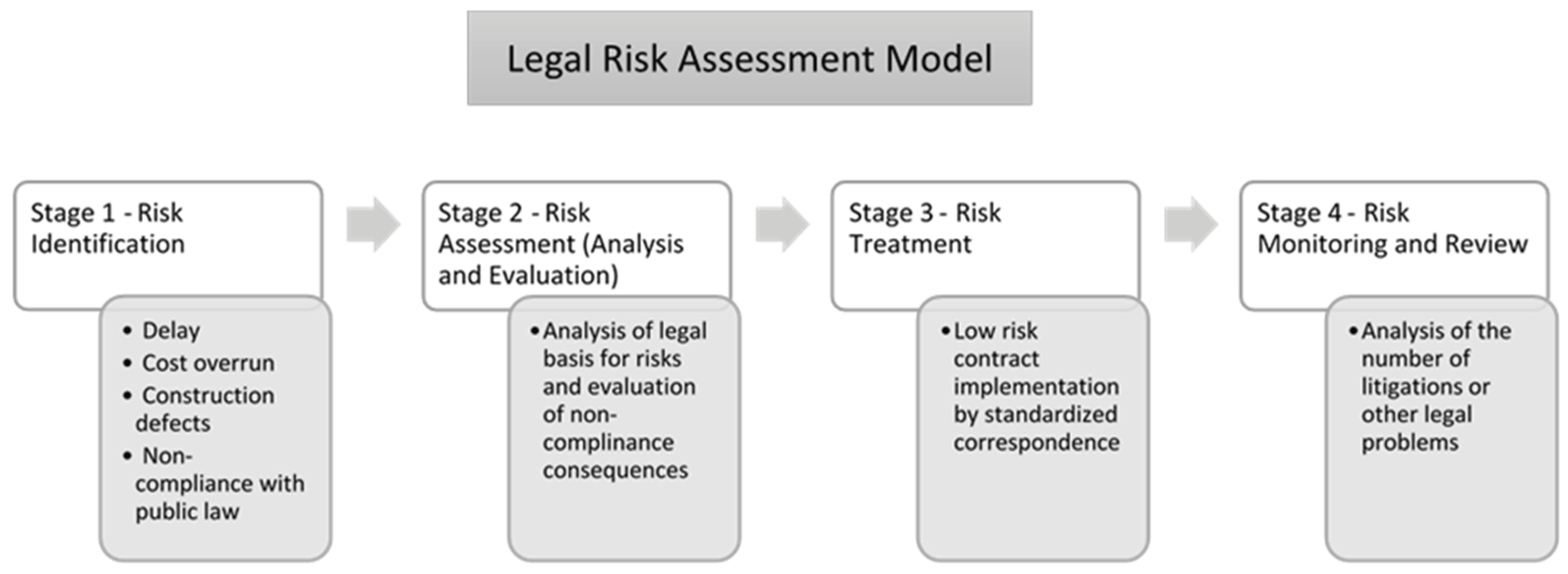
The authors of the study offer a framework for conducting a legal risk assessment and provide guidance on addressing liability issues in construction contracts. This guidance is presented through a legal risk assessment model (Figure 1) and recommendations for standardized communication.
The present study’s limitation is its focus on the reuse of existing concrete elements in Germany. The legal risks associated with the use of recycled concrete or the reuse of components from other materials were not examined in this study. In addition, the authors’ primary focus in the development of the model and formulation proposals was on employers and contractors as the principal stakeholders of a construction project. The legal analysis is based on German Private Construction Law and can be used for construction contracting and implementation under consideration of the German Construction Tendering and Contract Regulations, part B (VOB/B).
3. Results and Discussion
This section is divided according to the stages developed in the legal risk assessment model.
3.1. Legal Risk Analysis (Model Stage 1 and 2)
It is imperative for stakeholders to detect, analyze, and calculate the legal risks resulting from the reuse of concrete elements for each individual construction project, in order to facilitate a rational decision-making process. Despite the acknowledgement of the necessity of “Green Construction” by construction project stakeholders, concerns regarding legal risks from public and private construction law may emerge. The objective of conducting a risk analysis and formulating recommendations based on it is to ensure adherence to legal and contractual obligations. This objective can be achieved through the identification of legal risks, their subsequent assessment, and the formulation of legal compliance recommendations. The implementation of contracts that adhere to legal requirements can facilitate the mitigation of costly claims and disputes among construction project stakeholders.
The potential for legal complications in the context of German construction projects may stem from the intersection of public and private building legislation. The field of private construction law is concerned with the governance of contractual relationships among the various parties involved in the construction industry. The document under consideration delineates the rights and duties that arise from the construction contract. It also establishes the protocol for addressing issues that arise during the implementation of the contract, such as defects and delays. Moreover, the pertinent regulations concerning the allocation of liability and the onus of substantiation can be ascertained. The research demonstrated that the primary legal risks associated with the reuse of existing building materials or elements primarily stem from construction defects, delays, and cost overruns [19].
Following a comprehensive review of pertinent literature, legal regulations, and standard contracts in Germany, the authors conducted a general risk analysis that forms the basis for a legal risk assessment model. The model’s function is to provide support to construction process stakeholders in conducting their individual risk analysis for construction projects in Germany that involve the reuse of existing concrete elements. The present study constitutes a risk analysis, conducted for the purpose of investigating the potential risks involved in the hypothetical scenario of employer and contractor negotiating construction works (excluding the tendering process) for the reuse of existing concrete beams. The legal basis is constituted by a construction contract in accordance with the German Construction Tendering and Contract Regulations, part B (VOB/B) [18].
It is important to note that each construction project is unique, which makes it difficult to provide a solution that is applicable to all projects. Consequently, the authors developed a neutral legal risk assessment model (Figure 1) and standardized formulations that construction project stakeholders can readily utilize and modify to suit their individual construction projects. The authors of this study have a clear objective: namely, to provide support to stakeholders in construction projects so that they can overcome any concerns they may have. To this end, the authors propose a strategy of full disclosure regarding the potential risks involved in the reuse of existing concrete elements. In addition, they propose a method by which these risks can be assessed. In the context of construction contracts, which are characterized by their unique legal intricacies, it is imperative to undertake a meticulous examination of the legal risks faced by both the employer and the contractor. This analysis, undertaken by the authors of this study, is predicated on the recognition that the legal interests of the parties involved vary considerably.
3.1.1. Legal Risks of the Contractor
Reuse of elements carries with it a number of legal risks, including delays, cost overruns and/or construction defects resulting from the insufficient quality of the reuse material.
The VOB/B [18] places the liability for construction defects basing on building products to the contractor. Furthermore, in instances where the products are supplied by the employer, the contractor assumes responsibility for any defects in their work, with the understanding that these defects are attributable to the products provided. This principle is equally applicable to the reuse of existing elements. The contractor may only relieve themselves from this liability by conducting a reasonable examination of the elements and, if necessary, announcing concerns regarding the quality of the provided materials or elements, as outlined in Article 13(3) VOB/B [18]. It is imperative that the contractor undertakes a systematic and methodical examination of the quality of the provided elements and the existing structure prior to and throughout the implementation of the contract.
Should there be any concerns regarding the quality of extant materials and elements, or the planned execution of the project, the contractor must inform the employer promptly. It is imperative to articulate the concerns in meticulous detail and in written form. Furthermore, the contractor should stipulate a deadline within which the employer must declare whether they intend to continue with the construction works. In the event that the employer issues instructions for the works to proceed without modifications, the responsibility for construction defects arising from such directives shall be transferred to the employer.
In the event of issues or concerns pertaining to the quality of extant building materials or elements, the contractor may encounter unwarranted delays in the completion of their works. In the event that the delay is attributable to the employer, the contractor is obligated to inform the employer in a timely manner in writing, as stipulated in Article 6(1) VOB/B [18], with a view to safeguarding their rights.
The VOB/B stipulates that the contractor is liable for delivering a service that is free of defects until the employer accepts the work. Consequently, the contractor must assume the financial burden of fulfilling the contractual agreement. In the event of an inadequate service or observation of construction work, there is a possibility of liability for damages to the existing structure, as well as to other assets belonging to the employer. Furthermore, the contractor is obligated to provide compensation to the employer for any delays in delivering the contracted service. It is imperative that these risks be given due consideration prior to agreeing to construction works in existing buildings involving the reuse of onsite construction elements.
The primary risk confronting the contractor is the uncertainty surrounding the quality of the existing elements. Until acceptance of the construction works is complete, the contractor is responsible for proving that their performance is free from defects. In certain instances, contractors may encounter significant challenges or only limited capacity to meticulously examine existing materials or components prior to contracting. From a contractor’s perspective, there are a number of approaches that could be adopted in order to address the situation in question. Firstly, it is important to note that the contractor has the right to reject the order. Secondly, a thorough investigation of the existing structure could be conducted, with the aim of assessing the risk of latent quality issues prior to the initiation of any contractual agreements. Typically, this process is both time-consuming and costly. It is imperative that the parties involved in the contractual agreement reach a consensus on the matter of cost allocation prior to the initiation of the investigative process. In the event that the investigation of the quality of extant elements cannot be conducted in an appropriate manner, the contractor is obliged to inform the employer of any concerns or issues that arise during the construction works. Should the employer elect to proceed with construction works despite the contractor’s reservations, the contractor shall be absolved of any liability for defects arising from their services.
3.1.2. Legal Risks of the Employer
The employer faces legal risks when contracting for the reuse of concrete elements and implementing the contract. In instances where the employer furnishes the reuse elements, the primary legal risks pertain to delays in delivering the materials to the construction site and an inadequate quality of the reuse material.
In the event of a delay in the delivery of the reuse material, the employer is obligated to ensure an extension of the deadline for the contractor to deliver their services, as outlined in Article 6(2) VOB/B [18]. Moreover, the employer is obligated to indemnify the contractor for damages resulting from this delay, as stipulated in Article 6(6) VOB/B [18].
The contractor’s liability for defects in their work, as well as the employer’s liability for deficient building elements, is predicated on the provision of products that meet the requisite standards. This principle finds equal application in the reuse of existing elements. The employer’s liability for construction damages is contingent upon the expression of concerns by the contractor regarding the quality of the provided elements, subsequent to which the employer issues a directive for the continuation of construction works. This scenario is delineated in Article 13(3) VOB/B [18].
3.2. Recommendations for Low Risk Contract Implementation (Model Stage 3)
The authors developed recommendations for contract implementation in construction projects reusing existing concrete elements, which were derived from the legal risk analysis. It is imperative for the parties involved in construction contracts to exercise caution and discernment during the negotiation and execution of contracts when contemplating the reuse of existing building elements. Contract implementation entails an augmented degree of legal risk. Consequently, the authors of the study propose a set of guidelines to mitigate the risks associated with the reuse of existing building materials and elements.
3.2.1. Recommendations for Contractors
According to Articles 311(2) and 241(2) of the German Civil Code [20], contractors are obligated to disclose any potential issues or concerns related to the reuse of existing building elements prior to the initiation of a contract or subsequent to the identification of such concerns. Consequently, the contractor is obligated to assess the quality of the existing material and elements, meticulously documenting any observed issues and concerns. Furthermore, the contractor is expected to define the contracted service with utmost specificity and to apprise the employer of any potential risks. This principle finds application in construction contracts under consideration of VOB/B as well [18].
In the event that the contractor identifies issues with the reused elements or expresses reservations regarding the likelihood of delivering a service that is free of defects due to reuse, these concerns must be communicated to the employer without delay, as stipulated in Article 13(3) VOB/B [18]. It is strongly advised that these concerns be addressed in written form to ensure documentation for potential future litigation. The following formulation is proposed by the authors:
“With regard to the reuse of the existing concrete elements, I hereby express concerns regarding the quality of the existing elements. As you are aware, I am obliged by law to examine the construction materials provided, in this case the concrete elements, and to inform you of any concerns I may have. In detail, I have concerns regarding… [here describe the issue or concerns in as much detail as possible]. Please inform me promptly whether I should continue with the construction works despite my concerns or halt the works until a final decision about these concerns has been made. If you do not get in touch with me before [insert appropriate date – not too short], I will assume that you do not share my concerns and that you wish me to continue with the construction works.”
In instances where delays are attributable to issues and concerns regarding the quality of existing building elements, it is recommended that contractors employ the following formulation to ensure the safeguarding of their rights:
“I hereby inform you that I am unable to carry out my work to the required standard. This is due to the fact that the building elements provided by you do not meet the agreed quality standards. Please find below the reasons for this issue: … [here provide a detailed explanation of the reasons for the hindrance]. This is hindering my ability to continue working on the project. Please be advised that you will be charged for the resulting additional costs.”
This principle is equally applicable in instances of delay resulting from the employer’s delayed delivery of the material. The authors recommend the following formulation:
“Herewith I inform you that I am hindered in the proper execution of my work. The reasons for the hindrance are: … [here provide the reason for the hindrance as detailed as possible]. The building elements that were agreed upon were not delivered within the specified timeframe, which has hindered my ability to continue with the project. Please be advised that you will be held responsible for the resulting additional costs.”
3.2.2. Recommendations for Employers
In the event that the contractor addresses concerns regarding the quality of the provided elements by the employer, the authors recommend that the employer agrees to a quality check, even if it results in a certain expenditure of time and money. The following formulation is recommended by the authors:
“We have received your correspondence regarding the quality of the concrete elements provided. We will consider and examine your concerns. Nevertheless, we would like to reiterate our expectation that you will complete the agreed work in a timely manner and to the required standard. Should your concerns be found to be without foundation, you will be liable for the resulting delay costs and any additional costs incurred. We will inform you about the results of the quality check before the specified date and, if necessary, will arrange a meeting with you before then. If you have not received a response from us by the stated date or if a meeting has not been arranged, you may assume that we do not share your concerns. In this instance, it is imperative that the work is completed in accordance with the contractual agreement.”
In the event that the employer disregards the concerns and insists on the continuation of the construction works, the contractor will no longer be held liable for defects resulting from the utilization of substandard materials. In the event that the employer exhibits no concern regarding the elements’ quality, it is advisable for them to proceed with the works to avoid delay.
In the event that the contractor is obligated to provide concrete elements that fail to meet the stipulated quality requirements as outlined in the construction contract, the employer reserves the right to demand the removal of the substandard elements from the construction site, as stipulated in Article 4(6) of VOB/B [18]. In the event that the contractor fails to comply with this directive, the employer reserves the right to undertake the removal of the elements in question and to seek reimbursement of incurred expenses:
“I hereby request the removal of concrete elements that do not meet the contractual quality requirements from the construction site. This should take place by [insert appropriate date – not too short]. If the concrete elements are not removed until the aforementioned date, we will remove them at your cost.”
4. Conclusions
Reuse of existing concrete elements has been demonstrated to contribute to a reduction in demolition waste, raw material consumption, and greenhouse gas emissions. This subject has been acquiring increasing importance due to the ambitious sustainability objectives established by legislation and policy on a global scale. Furthermore, the reuse of existing building elements can contribute to heritage preservation by maintaining the historic appearance of an old building or monument.
However, before reusing existing elements, construction project stakeholders should carry out a due diligence process and analyze the risks of the individual construction project to make a rational decision about reusing existing elements. This objective can be achieved through the identification of legal risks, their subsequent assessment, and the formulation of legal compliance recommendations. The authors of the study presented the results of a legal analysis on the risks that could impede stakeholders from reusing concrete elements. This research was informed by a paucity of literature on the subject and led to the development of a legal risk assessment model and formulation proposals for contract implementation in projects that aim to reuse existing concrete elements. The objective of the authors was threefold: first, to address a research gap; second, to support contract parties in avoiding costly disputes and lawsuits; and third, to motivate construction project stakeholders to reuse existing concrete elements.
Author Contributions
Conceptualization, U.Q. and K.H.; methodology,U.Q.; investigation, U.Q.; writing—original draft preparation, U.Q.; writing—review and editing, K.H. All authors have read and agreed to the published version of the manuscript.
Funding
This research work has received funding from the project “Civil Engineering Research Centre” (agreement No S-A-UEI-23-5, ŠMSM).
Conflicts of Interest
The authors declare no conflicts of interest. The funders had no role in the design of the study; in the collection, analyses, or interpretation of data; in the writing of the manuscript; or in the decision to publish the results.
Abbreviations
The following abbreviations are used in this manuscript:
| SCA | Systematic content analysis |
| CO2 | Carbon dioxide |
| UN | United Nations |
| EU | European Union |
| VOB/B | Vergabe und Vertragsordnung für Bauleistungen, part B |
References
- World Economic Forum. “The Building Sector is Key to the Fight against Climate Change.”. 2024. Available online: https://www.weforum.org/stories/2024/06/building-sector-climate-change-construction-materials/ (accessed on 14 January 2026).
- United Nations. UN Plan Promises Massive Emission Cuts in the Construction Sector – the Most Polluting and Toughest to Decarbonise. 2023. Available online: https://www.unep.org/news-and-stories/press-release/un-plan-promises-massive-emission-cuts-construction-sector-most (accessed on 12 March 2026).
- European Commission 2020. EU Climate Target Plan 2030. Available online: https://ec.europa.eu/commission/presscorner/detail/en/fs_20_1609 (accessed on 17 March 2026).
- United Nations. Paris Agreement. 2015. Available online: https://unfccc.int/files/essential_background/convention/application/pdf/english_paris_agreement.pdf (accessed on 10 March 2026).
- Concular. „Wiederverwendung von Baumaterialien – Zirkularität im Bauwesen” [in German]. 2025. Available online: https://concular.de/wiederverwendung-von-baumaterialien-zirkularitaet-im-bauwesen/ (accessed on 10 March 2026).
- European Parliament and Council. Directive 2008/98/EC of 19 November 2008 on waste and repealing certain Directives, last amended 2024. 2024. Available online: https://eur-lex.europa.eu/legal-content/EN/TXT/?uri=CELEX%3A02008L0098-20240218 (accessed on 10 March 2026).
- Federal Republic of Germany. German Recycling and Waste Management Act of 24 February 2012 [in German], last amended 2023. 2023. Available online: https://www.gesetze-im-internet.de/krwg/BJNR021210012.html (accessed on 10 March 2026).
- VDI Zentrum Ressourceneffizienz. “Wiederverwendung von Bauprodukten” [in German]. 2025. Available online: https://www.ressource-deutschland.de/baumaterialien/wiederverwendung-von-bauprodukten/ (accessed on 10 March 2026).
- Federal Republic of Germany. Baufachliche Richtlinien Recycling [in German]. 2018. Available online: https://www.bfr-recycling.de/downloads/Baufachliche_Richtlinien_Recycling.pdf (accessed on 16 March 2026).
- Menn, A. Die Wiederverwendung von Bauteilen - Ein Überblick aus vertragsrechtlicher Perspektive. In Die Wiederverwendung von Bauteilen; (In German). Abegg, A., Streiff, O., Eds.; Dike Verlag: Zürich, Switzerland, 2021. [Google Scholar]
- Park, J.; Tucker, R. Overcoming barriers to the reuse of construction waste material in Australia: a review of the literature. Int. J. Constr. Manag. 2017, 17(3), 228–237. [Google Scholar] [CrossRef]
- Byers, B.S.; Raghu, D.; Olumo, A.; De Wolf, C.; Haas, C. From research to practice: A review on technologies for addressing the information gap for building material reuse in circular construction. Sustain. Prod. Consum. 2024, 45, 177–191. [Google Scholar] [CrossRef]
- Quapp, U.; Tamošaitienė, J.; Holschemacher, K. Barriers to Reusing Concrete Elements in Construction. In Modern Building Materials, Structures and Techniques - MBMST 2026 SPRINGER NATURE Conference Proceedings; Kaklauskas, G., Banaitis, A., Rimkus, A., Eds.; 2026. [Google Scholar]
- Salehijam, M. The Value of Systematic Content Analysis in Legal Research. Tilburg Law. Rev. 2018, 23(1), 34–42. [Google Scholar] [CrossRef]
- Hall, M.A.; Wright, R.F. Systematic Content Analysis of Judicial Opinions. 69 Calif. Law. Rev. 2008, 63. [Google Scholar]
- Naude, M.J.; Chiweshe, N. A proposed operational risk management framework for small and medium enterprises. South Afr. J. Econ. Manag. Sci. 2017, 20(1), a1621. [Google Scholar] [CrossRef]
- Putman, W.H. Legal Analysis and Writing, 4th ed.; Cengage Learning, Inc.: Delmar, USA, 2012; ISBN 1-1330-1654-5. [Google Scholar]
- Deutscher Vergabe- und Vertragsausschuss für Bauleistungen 2016. Vergabe und Vertragsordnung für Bauleistungen – VOB/B (German Construction Tendering and Contract Regulation part B) [in German] of 19 January 2016. Available online: https://www.verwaltungsvorschriften-im-internet.de/bsvwvbund_26062012_B15816361.htm (accessed on 17 March 2026).
- Quapp, U.; Tamošaitienė, J.; Holschemacher, K. Legal Risk Assessment of Re-using Building Materials and Elements in Historic Structures. In “Structural Analysis of Historical Constructions”; Saloustros, S., Beyer, K., Eds.; RILEM Bookseries, Springer: Cham, 2026; ISBN 978-3-032-13468-4. [Google Scholar]
- Federal Republic of Germany. German Civil Code of 18 August 1896, last amended 2026. 2024. Available online: https://www.gesetze-im-internet.de/englisch_bgb/index.html (accessed on 16 March 2026).
Figure 1.
Legal Risk Assessment Model for Minimizing Risks in Reusing Concrete Elements.
Disclaimer/Publisher’s Note: The statements, opinions and data contained in all publications are solely those of the individual author(s) and contributor(s) and not of MDPI and/or the editor(s). MDPI and/or the editor(s) disclaim responsibility for any injury to people or property resulting from any ideas, methods, instructions or products referred to in the content. |
© 2026 by the authors. Licensee MDPI, Basel, Switzerland. This article is an open access article distributed under the terms and conditions of the Creative Commons Attribution (CC BY) license (http://creativecommons.org/licenses/by/4.0/).
Copyright: This open access article is published under a Creative Commons CC BY 4.0 license, which permit the free download, distribution, and reuse, provided that the author and preprint are cited in any reuse.


