

Submitted:
26 May 2026
Posted:
27 May 2026
You are already at the latest version
Abstract
Background/Objectives: Electromagnetic pelvic floor stimulation is an emerging non-invasive treatment for urinary incontinence (UI), yet direct comparisons between devices of differing magnetic field strengths are lacking. This quality improvement study compared the clinical effectiveness of a 3 Tesla and an 8 Tesla electromagnetic device for the treatment of stress and mixed UI. Methods: In this prospective, single-blinded comparative quality improvement study with randomized allocation, 103 women (aged 35–77) with stress or mixed UI were randomly allocated to treatment with either a 3 Tesla device (Chair A, n = 52) or an 8 Tesla device (Chair B, n = 51). Each participant received six sessions over three weeks. Symptoms were assessed using a modified International Consultation on Incontinence Questionnaire (ICIQ) instrument at baseline, after each session, and at 2- and 4-week follow-up. Statistical analysis was performed independently by a biostatistician using SPSS v30. Results: Both devices produced statistically significant within-group improvements across all ICIQ domains (p < 0.001 to p < 0.05). Chair B demonstrated earlier onset of significant improvement (after 2 sessions vs. 3 sessions for Chair A) and significantly greater reduction in leakage frequency at 4-week follow-up (mean 1.02 ± 0.96 vs. 1.54 ± 1.19; p = 0.020; Cohen’s d = 0.48). One minor, self-limited adverse event was reported (transient low back pain, Chair A group). Conclusions: Both electromagnetic devices effectively reduced UI symptoms. The 8 Tesla device showed faster onset and greater sustained symptom reduction at 4 weeks, suggesting that higher magnetic field strength may enhance clinical outcomes for pelvic floor rehabilitation. Findings are reported in alignment with SQUIRE 2.0 guidelines for quality improvement research.
Keywords:
urinary incontinence
; electromagnetic stimulation
; pelvic floor
; quality improvement
; HIFEM
; comparative effectiveness
1. Introduction
Urinary incontinence (UI), defined as any involuntary leakage of urine, is a prevalent condition affecting an estimated 25–45% of adult women worldwide, with prevalence increasing with age, parity, and menopausal status [1,2]. The condition is broadly categorized into stress urinary incontinence (SUI), characterized by leakage during physical exertion; urge urinary incontinence (UUI), associated with sudden urgency; and mixed urinary incontinence (MUI), which encompasses symptoms of both [1].
The burden of UI extends well beyond physical discomfort. It is associated with reduced quality of life, social isolation, depression, and sexual dysfunction, yet remains widely underreported due to embarrassment and the misconception that it is an inevitable consequence of aging [2,3]. Conservative treatments including pelvic floor muscle training (PFMT), bladder training, and behavioral modifications are effective for some patients but require sustained adherence, and their long-term outcomes are variable [4]. Pharmacological therapies for UUI, including anticholinergics and beta-3 agonists, may be limited by side effects that reduce compliance [5]. Surgical interventions, while effective for severe SUI, carry inherent procedural risks.
In recent years, high-intensity electromagnetic (HIEM) technology has emerged as a non-invasive alternative for pelvic floor rehabilitation. HIEM devices generate a focused electromagnetic field that penetrates the pelvic floor musculature, inducing thousands of supramaximal contractions per session that are not achievable through voluntary exercise [6,7]. While early studies have demonstrated the efficacy and safety of individual HIEM devices [6,7,8,9], there is a notable absence of head-to-head comparative data between devices of differing specifications, particularly regarding magnetic field strength.
This quality improvement initiative was undertaken in a private medical practice to inform clinical decision-making regarding device acquisition and to optimize patient care. The objective was to prospectively compare the clinical effectiveness of two commercially available electromagnetic pelvic floor stimulation devices—a 3 Tesla system and an 8 Tesla system—in the treatment of stress and mixed urinary incontinence, using validated patient-reported outcome measures.
2. Materials and Methods
2.1. Study Design and Context
This was a prospective, single-blinded, comparative quality improvement study with randomized allocation, conducted at a private medical aesthetics and wellness clinic in Aurora, Ontario, Canada, between January and April 2025. The study was initiated as a clinical quality improvement initiative to systematically evaluate the comparative effectiveness of two electromagnetic pelvic floor stimulation devices in routine clinical use, with the aim of optimizing treatment protocols and informing evidence-based device selection. Findings are reported in alignment with the SQUIRE 2.0 reporting guidelines for quality improvement work.
Given the quality improvement origin of this project, prospective institutional ethics review was not obtained prior to data collection. All participants provided written informed consent, which included explicit consent for the collection and analysis of de-identified data for research and publication purposes. A retrospective advisory ethics review was subsequently obtained from Advarra IRB (Protocol Number: Pro00089334; review dated 15 August 2025). Advarra IRB did not provide a formal IRB determination; an advisory opinion was provided, which observed that the protocol would have met criteria as minimal-risk, non-exempt research had prospective institutional review been sought, on the basis that the dataset is anonymized (de-identified using unique study numbers) rather than truly anonymous. Participant data were anonymized using unique study identifiers, and no direct identifiers were retained in the analytic dataset. The study was conducted in accordance with the principles of the Declaration of Helsinki (1964; revised 2013). Trial registration was not applicable as this project was conducted as a quality improvement initiative and not a regulated clinical trial.
2.2. Participants
A total of 103 female participants were enrolled from the clinic’s patient population and through local community outreach. Eligibility required female sex, age between 20 and 80 years, and a clinical diagnosis of stress or mixed urinary incontinence, with willingness to comply with the study protocol. Exclusion criteria are summarized in Table 1. The mean age of enrolled participants was 54.78 ± 8.42 years (range 35–77).
2.3. Allocation and Blinding
Participants were randomly allocated in a 1:1 ratio to one of two treatment groups using a computer-generated random allocation sequence. The treating clinician was aware of the allocation; however, participants were blinded to the device specifications to the greatest extent practicable. Both devices were located in separate, identically configured treatment rooms. Devices were concealed with identical black draping, and room signage displayed only “Chair A” and “Chair B” without revealing device specifications or brand names.
2.4. Interventions
Both groups received a standardized protocol of six electromagnetic pelvic floor stimulation sessions, administered twice weekly over three consecutive weeks. Session duration was 28 minutes for Chair A and 30 minutes for Chair B, in accordance with each device’s standard clinical protocol. Electromagnetic stimulation intensity was titrated to the maximum tolerable level for each participant, consistent with standard clinical practice.
Chair A (Group A) was a 3 Tesla HIEM device (Emsella, BTL Industries, Framingham, MA, USA). Chair B (Group B) was an 8 Tesla HIEM device (B-Pulse, CPL Med Technology, Montreal, QC, Canada).
2.5. Outcome Measures
The primary outcome was the change in urinary incontinence symptoms as assessed by a modified questionnaire based on the International Consultation on Incontinence Questionnaire (ICIQ). The questionnaire comprised six items evaluating: (Q1) frequency of urine leakage (0–5 scale); (Q2) interference with everyday life (0–10 scale); (Q3) vaginal dryness–related discomfort (0–3 scale); (Q4) degree of bother from vaginal dryness (0–10 scale); (Q5) nocturnal urination frequency (0–4 scale); and (Q6) degree of bother from nocturnal urination (0–10 scale). Higher scores indicated greater symptom severity. The questionnaire was administered at baseline (pre-treatment), before each of the six treatment sessions, and at 2- and 4-week post-treatment follow-up. Licensed access to the ICIQ modules was obtained from the ICIQ group.
Secondary outcomes included time to clinically meaningful improvement (defined as the number of sessions required to achieve a statistically significant within-group reduction from baseline), adverse events, and the proportion of participants reporting any improvement at follow-up endpoints.
2.6. Statistical Analysis
Statistical analyses were performed by an independent biostatistician using SPSS version 30 (IBM Corp., Armonk, NY, USA). Descriptive statistics summarized participant demographics and baseline characteristics. Between-group comparisons of baseline characteristics used independent samples t-tests (or Mann–Whitney U-tests for skewed data) for continuous variables, and chi-square or Fisher’s exact tests for categorical variables.
Within-group improvements were assessed using paired-samples t-tests comparing post-treatment scores to baseline. Between-group comparisons of improvement were conducted using independent samples t-tests. A generalized estimating equations (GEE) model was employed to examine longitudinal changes in scores over time and between groups, accounting for repeated measures and within-subject correlation. Cohen’s d was calculated as a measure of effect size for significant findings. The significance threshold was set at p < 0.05; p-values between 0.05 and 0.10 were considered as approaching significance.
2.7. Use of Generative Artificial Intelligence
Language editing and formatting alignment with SQUIRE 2.0 reporting standards were assisted by a generative artificial intelligence tool (Claude, Anthropic; Opus 4.7, accessed May 2026). The AI tool was not used in any aspect of study design, data collection, statistical analysis, or scientific interpretation. All output was reviewed, edited, and verified by the authors, who take full responsibility for the content of this manuscript.
3. Results
3.1. Participant Characteristics and Study Completion
A total of 103 female participants were enrolled and randomly allocated to Chair A (n = 52) or Chair B (n = 51). The mean age was 54.78 ± 8.42 years (range: 35–77). The majority of participants were postmenopausal (53.1%), with perimenopausal women comprising the second largest group (35.7%). The mean number of vaginal deliveries was 1.66 ± 1.11. No statistically significant differences were observed between groups in any baseline demographic or clinical characteristic (all p > 0.05), confirming successful randomization (Table 2). The overall dropout rate was 4.9% (n = 5), with 3 lost to follow-up in Chair A and 2 in Chair B (p = 1.00). Participant flow through the study is shown in Figure 1.
3.2. Baseline Symptom Scores
Pre-treatment ICIQ scores were comparable between groups across all six domains, with no statistically significant differences (all p > 0.05), further confirming the equivalence of groups at baseline (Table 3).
3.3. Primary Outcomes: Improvement in ICIQ Scores
Both treatment groups demonstrated statistically significant within-group improvements from baseline across all ICIQ domains at both 2-week and 4-week follow-up endpoints (all p < 0.05), with the exception of Q2 (interference with everyday life) percentage improvement in the Chair A group. Effect sizes for within-group improvements ranged from Cohen’s d = 0.44 to 1.56, indicating moderate to large effects.
At 2-week follow-up, Chair B demonstrated numerically greater improvement than Chair A across nearly all ICIQ domains, though between-group differences did not reach statistical significance. The weighted average ICIQ score showed 45.94% improvement in Chair B versus 42.79% in Chair A (Table 4).
At 4-week follow-up, the pattern of greater improvement in Chair B strengthened. For the primary measure of leakage frequency (Q1), Chair B achieved a mean score of 1.02 ± 0.96 compared to 1.54 ± 1.19 for Chair A, a statistically significant difference (p = 0.020) with a moderate effect size (Cohen’s d = 0.48). The absolute difference was 0.52 points (95% CI: 0.08–0.96). The percentage reduction in leakage frequency approached significance, with Chair B showing 58.67% reduction versus 43.46% for Chair A (p = 0.079; Cohen’s d = 0.36). Chair B demonstrated numerically greater improvement than Chair A in all other ICIQ domains at 4 weeks, including the weighted average score (51.32% vs. 42.39%), though these differences did not reach statistical significance (Table 5).
3.4. Time to Improvement
Analysis of the temporal pattern of Q1 (leakage frequency) responses revealed that Chair B achieved statistically significant within-group improvement from baseline beginning after 2 treatment sessions, whereas Chair A required 3 sessions to achieve comparable significance. The GEE model estimated a significant overall improvement of 0.21 units per time point (p < 0.001). Although the between-group difference of 0.25 units did not reach statistical significance (p = 0.192), this magnitude is clinically interpretable: the treatment effect achieved with 6 sessions of Chair A could be achieved approximately one session sooner with Chair B. The proportion of participants reporting any improvement in leakage frequency was consistently higher in Chair B than Chair A: 79% versus 71% at 2 weeks, and 85% versus 73% at 4 weeks post-treatment (Figure 2, Table 6).
3.5. Adverse Events
Both devices were well-tolerated. One adverse event was reported: a participant in the Chair A group experienced temporary exacerbation of pre-existing low back pain, which resolved spontaneously without intervention and did not result in treatment discontinuation. No adverse events were reported in the Chair B group. No serious adverse events occurred in either group.
4. Discussion
This prospective comparative study provides evidence that both 3 Tesla and 8 Tesla electromagnetic pelvic floor stimulation devices produce clinically meaningful and statistically significant improvements in urinary incontinence symptoms. These findings are consistent with the growing evidence base supporting HIEM technology for non-invasive pelvic floor rehabilitation [6,7,8,9]. Importantly, this study addresses a gap in the literature by providing direct head-to-head comparison data between devices of differing magnetic field strengths.
The 8 Tesla device (Chair B) demonstrated a consistent pattern of superior performance across multiple dimensions. First, it achieved statistically significant within-group improvement after only 2 treatment sessions, compared to 3 sessions for Chair A, suggesting a faster onset of therapeutic effect. Second, at the critical 4-week follow-up, Chair B achieved significantly greater reduction in leakage frequency (p = 0.020), the most clinically relevant symptom for patients with stress and mixed UI. The moderate effect size (Cohen’s d = 0.48) and the progressive divergence of outcomes between groups over time suggest a genuine and meaningful difference in treatment efficacy rather than a transient effect.
The mechanism underlying the superior performance of the higher-intensity device is plausible from a biophysical perspective. A stronger magnetic field may achieve deeper tissue penetration and recruit a greater proportion of pelvic floor motor units, thereby inducing more effective supramaximal contractions and more robust neuromuscular re-education [6,10]. This is analogous to dose–response relationships observed in pharmacotherapy and physical rehabilitation: the therapeutic threshold must be met for meaningful physiological change to occur.
This study has several strengths. The prospective design with randomized allocation and participant blinding reduces potential sources of bias. The use of a validated, standardized outcome instrument (ICIQ) administered at multiple time points allows assessment of both the magnitude and trajectory of improvement. The independent statistical analysis by a biostatistician strengthens analytical rigor. The high completion rate (94%) minimizes concerns about attrition bias.
Several limitations must be acknowledged. First, this study originated as a clinical quality improvement initiative, and prospective institutional ethics review was not obtained prior to data collection; a retrospective advisory review confirmed the study would have met minimal-risk, non-exempt criteria, but the absence of prospective formal review remains a methodological consideration. Second, the follow-up period was limited to 4 weeks post-treatment; longer-term studies are needed to assess durability of effects and optimal retreatment intervals. Third, this was a single-center study conducted in a private practice setting, which may limit generalizability. Fourth, while participant blinding was maintained through device concealment, the treating clinician was aware of the allocation, introducing potential performance bias. Fifth, the study lacked a sham or no-treatment control group, precluding assessment of placebo effects; however, the head-to-head comparative design provides clinically relevant information for practitioners choosing between available devices.
Future research should include multicenter trials with larger sample sizes, longer follow-up periods, sham-controlled arms, and prospective ethics approval to confirm and extend these findings. Investigation of optimal treatment parameters, including session frequency and retreatment protocols, would further inform clinical practice.
5. Conclusions
This quality improvement study demonstrates that both 3 Tesla and 8 Tesla electromagnetic pelvic floor stimulation devices are effective non-invasive treatments for stress and mixed urinary incontinence. The 8 Tesla device showed significantly greater reduction in leakage frequency at 4-week follow-up and faster onset of improvement, suggesting that higher magnetic field strength may be a clinically relevant factor in optimizing treatment outcomes. These findings contribute to the evidence base for HIEM technology and provide comparative data to support informed device selection in clinical practice.
Author Contributions
Conceptualization, A.B.; methodology, A.B.; investigation, A.B.; data curation, A.B.; writing—original draft preparation, A.B.; writing—review and editing, S.d.M.; supervision, S.d.M.; validation, S.d.M. All authors have read and agreed to the published version of the manuscript.
Funding
This study was self-funded by the principal investigator. No external financial or material support was received from any commercial entity, government agency, or other organization.
Institutional Review Board Statement
This study originated as a clinical quality improvement initiative within a single private medical practice and was conducted prior to institutional ethics review. A retrospective advisory review was obtained from Advarra IRB (Protocol Number: Pro00089334; reviewed 15 August 2025). Advarra IRB did not provide a formal IRB determination; an advisory opinion was issued, which observed that the protocol would have met criteria as minimal-risk, non-exempt research had prospective institutional review been sought, on the basis that the analytic dataset is anonymized (de-identified using unique study numbers) rather than truly anonymous. The study was conducted in accordance with the principles of the Declaration of Helsinki (1964; revised 2013).
Informed Consent Statement
Written informed consent was obtained from all participants prior to enrollment. The consent document explicitly described the study procedures, randomized allocation, questionnaire schedule, and the collection and analysis of de-identified data for research and publication purposes.
Data Availability Statement
The anonymized datasets generated and analyzed during this study are available from the corresponding author upon reasonable request, subject to applicable privacy regulations and the terms of the participants’ written informed consent.
Acknowledgments
The authors thank Anton Svendrovski (StatsHelp, Toronto, ON, Canada; Professor of Statistics, Humber College), for independent statistical analysis of the de-identified study dataset. During the preparation of this manuscript, the authors used Claude (Anthropic; Opus 4.7, accessed May 2026) for the purposes of language editing, formatting assistance, and structural alignment with the SQUIRE 2.0 reporting framework. The authors have reviewed and edited the output and take full responsibility for the content of this publication. The AI tool was not used for the design, conduct, statistical analysis, interpretation of findings, or any substantive scientific content of the study.
Conflicts of Interest
A.B. declares that at the time of study conception, design, and data collection (January–April 2025), she had no financial or professional relationships with either BTL Industries (manufacturer of the 3 Tesla device) or CPL Med Technology (manufacturer of the 8 Tesla device). All participant data collection was completed prior to May 2025, and formal statistical analysis was conducted independently by a biostatistician beginning in late April 2025. A.B. accepted a role as Medical Director to CPL Med Technology in May 2025, after all data collection was complete; the formal independent statistical analysis was ongoing at the time this advisory relationship was established. The study design, data collection, and statistical analysis were therefore not influenced by this relationship. S.d.M. declares no conflicts of interest.
References
- Aoki, Y.; Brown, H.W.; Brubaker, L.; Cornu, J.N.; Daly, J.O.; Cartwright, R. Urinary incontinence in women. Nat. Rev. Dis. Primers 2017, 3, 17042. [CrossRef]
- Milsom, I.; Altman, D.; Cartwright, R.; Lapitan, M.C.; Nelson, R.; Sillén, U.; Tikkinen, K. Epidemiology of urinary incontinence and other lower urinary tract symptoms, pelvic organ prolapse, and anal incontinence. In Incontinence, 6th ed.; Abrams, P., Cardozo, L., Wagg, A., Wein, A., Eds.; ICI-ICS: Bristol, UK, 2017; pp. 1–141.
- Coyne, K.S.; Sexton, C.C.; Irwin, D.E.; Kopp, Z.S.; Kelleher, C.J.; Milsom, I. The impact of overactive bladder, incontinence and other lower urinary tract symptoms on quality of life, work productivity, sexuality and emotional well-being in men and women: Results from the EPIC study. BJU Int. 2008, 101, 1388–1395. [CrossRef]
- Dumoulin, C.; Cacciari, L.P.; Hay-Smith, E.J.C. Pelvic floor muscle training versus no treatment, or inactive control treatments, for urinary incontinence in women. Cochrane Database Syst. Rev. 2018, 10, CD005654. [CrossRef]
- Chapple, C.R.; Khullar, V.; Gabriel, Z.; Muston, D.; Bitoun, C.E.; Weinstein, D. The effects of antimuscarinic treatments in overactive bladder: An update of a systematic review and meta-analysis. Eur. Urol. 2008, 54, 543–562. [CrossRef]
- Samuels, J.B.; Pezzella, A.; Berenholz, J.; Alinsod, R. Safety and efficacy of a non-invasive high-intensity focused electromagnetic field (HIFEM) device for treatment of urinary incontinence in women. Lasers Surg. Med. 2019, 51, 760–766. [CrossRef]
- Silantyeva, E.; Zarkovic, D.; Soldatovic, I.; Kaminska, A.; Okhmatovskaia, A.; Shek, K.L.; Dietz, H.P. A comparative study on the effects of high-intensity focused electromagnetic technology and electrostimulation for the treatment of pelvic floor muscles and urinary incontinence in parous women. J. Clin. Med. 2020, 9, 3044. [CrossRef]
- Tosun, H.; Akinsal, E.C.; Sönmez, G.; Kilinç, M.F. Is the high-intensity focused electromagnetic energy an effective treatment for urinary incontinence in women? Ther. Clin. Risk Manag. 2024, 20, 811–816. [CrossRef]
- Lukanovic, A.; Markopoulos, M.C.; Engelskircher, S.; Gschliesser, A.; Zivanovic, I.; Doumouchtsis, S.K. Magnetic stimulation for urinary incontinence: A review of efficacy. Arch. Gynecol. Obstet. 2020, 301, 915–923. [CrossRef]
- Galloway, N.T.; El-Galley, R.E.; Sand, P.K.; Appell, R.A.; Russell, H.W.; Carlin, S.J. Update on extracorporeal magnetic innervation (ExMI) therapy for stress urinary incontinence. Urology 2000, 56 (Suppl. 1), 82–86. [CrossRef]
Figure 1.
Participant flow diagram. A total of 103 participants were recruited and randomly allocated to Chair A (3 Tesla; n = 52) and Chair B (8 Tesla; n = 51). Dropout rates were low (3 and 2 participants, respectively), with high completion rates for follow-up assessments at 2 and 4 weeks post-treatment.
Figure 1.
Participant flow diagram. A total of 103 participants were recruited and randomly allocated to Chair A (3 Tesla; n = 52) and Chair B (8 Tesla; n = 51). Dropout rates were low (3 and 2 participants, respectively), with high completion rates for follow-up assessments at 2 and 4 weeks post-treatment.
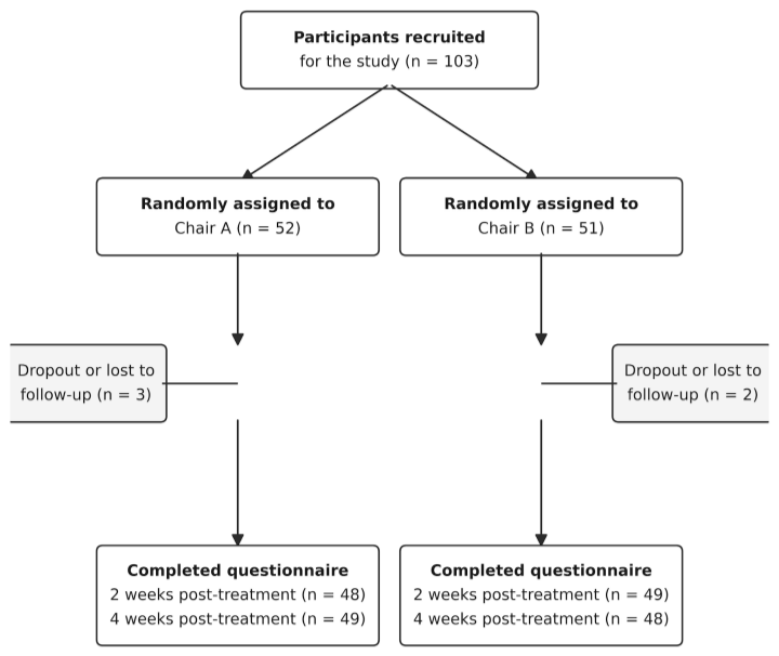
Figure 2.
Mean leakage frequency (ICIQ Q1) scores over time for Chair A (3 Tesla) and Chair B (8 Tesla). Both groups demonstrated significant improvement from baseline. Chair B showed earlier onset of improvement (after 2 sessions vs. 3 for Chair A) and significantly greater reduction at 4-week follow-up (p = 0.020; independent samples t-test). Error bars represent 95% confidence intervals around the group means. Daggers (†) indicate the first time point at which each group reached a statistically significant within-group reduction from baseline (paired t-test, p < 0.05).
Figure 2.
Mean leakage frequency (ICIQ Q1) scores over time for Chair A (3 Tesla) and Chair B (8 Tesla). Both groups demonstrated significant improvement from baseline. Chair B showed earlier onset of improvement (after 2 sessions vs. 3 for Chair A) and significantly greater reduction at 4-week follow-up (p = 0.020; independent samples t-test). Error bars represent 95% confidence intervals around the group means. Daggers (†) indicate the first time point at which each group reached a statistically significant within-group reduction from baseline (paired t-test, p < 0.05).
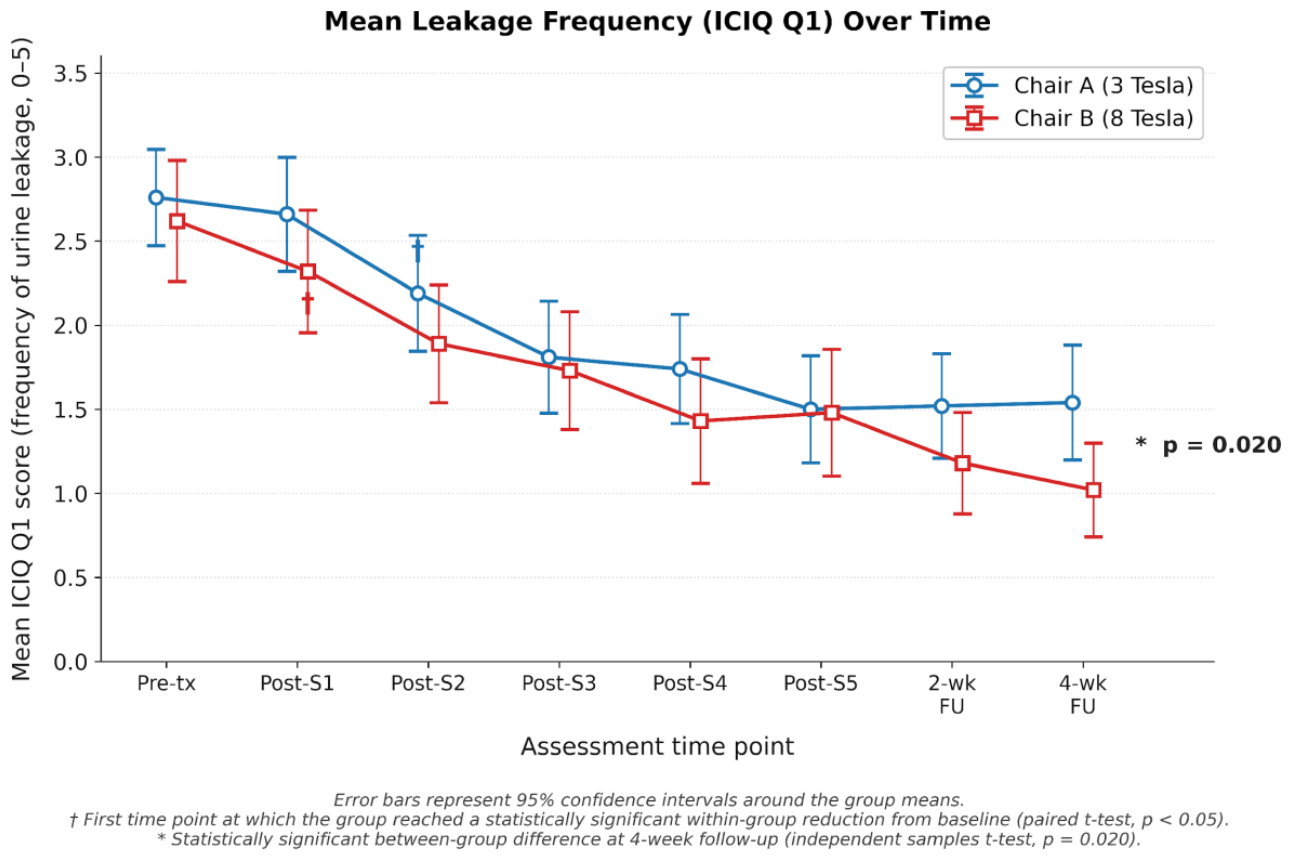

Table 1.
Inclusion and Exclusion Criteria.
| Inclusion Criteria | Exclusion Criteria |
| Female sex Age 20–80 years Clinical diagnosis of stress urinary incontinence (SUI) or mixed urinary incontinence (MUI) Willingness to comply with the study protocol, including attending all treatment and follow-up appointments |
Presence of metal implants in the body (e.g., pacemakers, cochlear implants, metal IUDs) History of pelvic organ prolapse greater than grade 1 Active urinary tract infection or other pelvic pathology Previous surgical treatment for urinary incontinence Pregnancy or lactation Neurological conditions affecting bladder control |
Table 2.
Demographic and Clinical Characteristics of Study Participants (n = 103).
| Characteristic | Entire Sample (n=103) | Chair A (n=52) | Chair B (n=51) | p-Value |
| Age (years) | 54.78 ± 8.42 [35–77] | 55.61 ± 9.18 [35–77] | 53.94 ± 7.58 [36–70] | 0.328 ᵀ |
| Vaginal deliveries | 1.66 ± 1.11 [0–4] | 1.51 ± 1.06 [0–4] | 1.82 ± 1.15 [0–4] | 0.196 ᴹ |
| Menopausal status | 0.906 ᶜ | |||
| Premenopausal | 11 (11.2%) | 5 (10.2%) | 6 (12.2%) | |
| Perimenopausal | 35 (35.7%) | 17 (34.7%) | 18 (36.7%) | |
| Postmenopausal | 52 (53.1%) | 27 (55.1%) | 25 (51.0%) | |
| Dropout/lost to follow-up | 5 (4.9%) | 3 (5.8%) | 2 (3.9%) | 1.00 ᶠ |
Values are Mean ± SD [range] or n (%). ᵀ independent samples t-test; ᴹ Mann–Whitney test; ᶜ chi-square test; ᶠ Fisher’s exact test.
Table 3.
Pre-Treatment ICIQ Scores (n = 103).
| Item | Scale | Chair A (n=52) | Chair B (n=51) | p-Value |
| Q1: Leakage frequency | 0–5 | 2.76 ± 1.14 | 2.62 ± 1.28 | 0.561 |
| Q2: Interference with daily life | 0–10 | 5.40 ± 2.64 | 4.73 ± 3.04 | 0.244 |
| Q3: Vaginal dryness discomfort | 0–3 | 0.97 ± 1.21 | 1.01 ± 1.10 | 0.866 |
| Q4: Bother from vaginal dryness | 0–10 | 3.73 ± 3.68 | 3.98 ± 3.64 | 0.747 |
| Q5: Nocturnal urination | 0–4 | 1.59 ± 1.06 | 1.32 ± 0.82 | 0.161 |
| Q6: Bother from nocturia | 0–10 | 5.53 ± 3.20 | 4.90 ± 3.68 | 0.361 |
| Average score (Q1–Q6) | 0–7 | 3.34 ± 1.44 | 3.05 ± 1.43 | 0.313 |
| Weighted average (Q1–Q6) | 0–10 | 4.56 ± 1.95 | 4.20 ± 1.83 | 0.333 |
Values are Mean ± SD. All comparisons by independent samples t-test.
Table 4.
Improvement in ICIQ Scores at 2 Weeks Post-Treatment (n = 97).
| Absolute Improvement | Chair A (n=48) | Chair B (n=49) | p-Value |
| Q1: Leakage frequency | 1.20* ± 1.08 | 1.40* ± 1.22 | 0.400 |
| Q2: Interference with daily life | 1.51* ± 2.96 | 1.39* ± 3.16 | 0.851 |
| Q3: Vaginal dryness discomfort | 0.53* ± 1.07 | 0.57* ± 0.87 | 0.834 |
| Q4: Bother from vaginal dryness | 1.60* ± 2.82 | 2.38* ± 3.19 | 0.235 |
| Q5: Nocturnal urination | 0.60* ± 0.61 | 0.51* ± 0.76 | 0.544 |
| Q6: Bother from nocturia | 2.84* ± 3.00 | 2.48* ± 3.33 | 0.592 |
| Average score (Q1–Q6) | 1.42* ± 1.21 | 1.46* ± 1.33 | 0.883 |
| Weighted average (Q1–Q6) | 1.95* ± 1.64 | 2.07* ± 1.73 | 0.739 |
Values are Mean ± SD. * Significant within-group improvement from baseline (paired t-test, p < 0.05). Between-group comparisons by independent samples t-test.
Table 5.
Improvement in ICIQ Scores at 4 Weeks Post-Treatment (n = 97).
| Absolute Improvement | Chair A (n=49) | Chair B (n=48) | p-Value |
| Q1: Leakage frequency | 1.20* ± 1.03 | 1.53* ± 1.11 | 0.135 |
| Q2: Interference with daily life | 1.54* ± 3.45 | 1.70* ± 3.04 | 0.820 |
| Q3: Vaginal dryness discomfort | 0.50* ± 1.08 | 0.71* ± 0.94 | 0.306 |
| Q4: Bother from vaginal dryness | 1.82* ± 3.29 | 2.70* ± 3.55 | 0.240 |
| Q5: Nocturnal urination | 0.53* ± 0.88 | 0.52* ± 0.73 | 0.953 |
| Q6: Bother from nocturia | 2.96* ± 3.34 | 2.16* ± 2.99 | 0.236 |
| Average score (Q1–Q6) | 1.45* ± 1.44 | 1.54* ± 1.30 | 0.769 |
| Weighted average (Q1–Q6) | 1.97* ± 1.92 | 2.18* ± 1.67 | 0.569 |
Values are Mean ± SD. * Significant within-group improvement from baseline (paired t-test, p < 0.05). Between-group comparisons by independent samples t-test.
Table 6.
Leakage Frequency (Q1) Scores Over Time.
| Time Point | Chair A | Chair B | p-Value |
| 1: Pre-treatment (before session 1) | 2.76 ± 1.03 | 2.62 ± 1.28 | 0.561 |
| 2: After session 1 (before session 2) | 2.66 ± 1.18 | 2.32* ± 1.27 | 0.173 |
| 3: After session 2 (before session 3) | 2.19* ± 1.20 | 1.89* ± 1.22 | 0.222 |
| 4: After session 3 (before session 4) | 1.81* ± 1.16 | 1.73* ± 1.22 | 0.709 |
| 5: After session 4 (before session 5) | 1.74* ± 1.13 | 1.43* ± 1.29 | 0.205 |
| 6: After session 5 (before session 6) | 1.50* ± 1.11 | 1.48* ± 1.31 | 0.935 |
| 7: Post-treatment, 2 weeks follow-up | 1.52* ± 1.07 | 1.18* ± 1.05 | 0.122 |
| 8: Post-treatment, 4 weeks follow-up | 1.54* ± 1.19 | 1.02* ± 0.96 | 0.020 |
Values are Mean ± SD. * Significant within-group improvement from baseline (paired t-test, p < 0.05). Between-group comparisons by independent samples t-test. Bold p-value indicates statistical significance.
Disclaimer/Publisher’s Note: The statements, opinions and data contained in all publications are solely those of the individual author(s) and contributor(s) and not of MDPI and/or the editor(s). MDPI and/or the editor(s) disclaim responsibility for any injury to people or property resulting from any ideas, methods, instructions or products referred to in the content. |
© 2026 by the authors. Licensee MDPI, Basel, Switzerland. This article is an open access article distributed under the terms and conditions of the Creative Commons Attribution (CC BY) license.
Copyright: This open access article is published under a Creative Commons CC BY 4.0 license, which permit the free download, distribution, and reuse, provided that the author and preprint are cited in any reuse.


