
Submitted:
26 May 2026
Posted:
27 May 2026
You are already at the latest version
Abstract
Randomized reward mechanisms are often described as repeated trials with a fixed success probability. Pity and guarantee rules depart from this symmetric baseline by making the hazard depend on the current state. This paper studies that state-dependent asymmetry for a finite soft-pity waiting-time model. The waiting time for one rare item is represented as an absorption time of a Markov chain whose transient state is the pity counter. For a specified piecewise-linear success schedule, backward recurrences are derived for the expectation and variance, and a dynamic-programming recursion gives the full probability mass function. Repeated convolution then yields the distribution for multiple independent stages. The numerical section reports quantiles, tail probabilities, VaR/CVaR-type summaries, expected excess values, sensitivity analyses, normal-approximation diagnostics, and distributional asymmetry indicators. A featured-target variant with a binary guarantee state is also included. Throughout, the reported quantities are consequences of the stated transition rule; Monte Carlo simulation is used only as a numerical check.
Keywords:
state-dependent asymmetry
; soft pity
; gacha
; pity timer
; absorbing Markov chain
; hitting time
; waiting-time distribution
; dynamic programming
; tail risk
; exact recurrence
MSC: 60J10; 60G40; 60C05; 91A60
1. Introduction
Randomized reward mechanisms have become a prominent feature of contemporary digital games. In an idealized constant-rate model, attempts are exchangeable in the following limited sense: conditional on no earlier rare item, the next draw has the same success probability as any previous draw. Pity mechanisms remove this draw-count homogeneity. A hard pity rule truncates the tail by forcing success at a fixed counter value, whereas a soft-pity rule raises the success probability before the hard guarantee. Featured-target rules introduce a second state variable, since the probability of receiving the desired target may depend on whether a guarantee is active.
This paper uses symmetry and asymmetry in this probabilistic sense. The point is not to develop a group-theoretic or physical theory of symmetry breaking, but to use the constant-hazard model as a reference case and to quantify how state dependence changes the induced waiting-time distribution. The resulting asymmetry is visible in the hazard function, the probability mass function, and upper-tail risk measures. This viewpoint is useful because the mean waiting time alone conceals much of the risk structure: two mechanisms with similar expectations may have different quantiles, expected excess values, and completion probabilities.
The broader psychological and consumer-protection literature provides the motivation for studying randomized reward mechanisms. Loot boxes and related random-item purchases have attracted attention because they share structural features with gambling-like reinforcement schedules, and because spending on such mechanisms has been associated with problem-gambling indicators in some samples [1,2,3,4]. The empirical evidence is not identical across contexts. For instance, Xiao, Fraser, and Newall report weak links between gambling and loot-box expenditure in a preregistered Chinese sample, while also discussing probability disclosures and pity timers [5]. More recent work has examined compliance with probability-disclosure rules in South Korea [6]. Outside video games, blind-box consumption has also been studied through curiosity, impulse buying, and price-consciousness mechanisms [7].
The present paper addresses a narrower mathematical question. Given a pity schedule, how can one compute the mean, variance, distribution, quantiles, tail probabilities, and distributional asymmetry of the waiting time for rare outcomes? The analysis is therefore model based. Its numerical values come from the stated transition rule rather than from observed draw histories, and simulation is used only to check the implementation of the exact recurrences.
Such a format is standard in applied probability. Finite Markov chains, absorption times, and first-step recurrences are routinely used to turn a specified stochastic mechanism into computable expectations and distributions [13,14,15,16]. Related work on hitting-time distributions for finite or skip-free Markov chains likewise emphasizes explicit recurrences, transforms, and numerical algorithms [9,10,11].
The model considered here has one primary state variable: the pity counter, i.e., the number of consecutive failures since the last rare item. A success resets this counter; a failure increases it by one; and a hard pity limit bounds the waiting time. A soft-pity region is represented by increasing the success probability before the hard guarantee. First-step analysis gives backward recurrences for the expected absorption time. The law of total variance gives a companion recurrence for the variance. A probability-mass recursion then yields the exact waiting-time distribution and, by convolution, exact distributions for sums of independent stages.
The contribution is computational and probabilistic. The paper gives a compact derivation for a soft-pity waiting-time model, interprets pity and guarantee rules as state-dependent departures from a constant-rate baseline, implements exact distributional computation, and reports risk summaries that are not visible from the mean alone. Commercial gacha systems may include additional mechanisms such as featured-item probability-up, 50/50 guarantees, duplicate outcomes, weapon-banner epitomized-path rules, cross-banner carry-over, and player stopping rules. Related economic work has considered gacha-like monetization through prospect theory and optimal pricing [8]. Those broader questions require additional state variables and behavioral assumptions; here they appear only as extensions or illustrative numerical variants.
The paper is organized as follows. Section 2 defines the pity-counter model and the representative transition schedule, including its symmetry/asymmetry interpretation. Section 3 derives exact recurrences for expectation, variance, and the probability mass function. Section 4 reports the core numerical results. Section 5 adds scaling experiments, upper-tail risk metrics, distributional asymmetry diagnostics, approximation checks, and a featured-target numerical extension. Section 6 records further modeling extensions. Section 7 discusses limitations and reproducibility.
2. Model
2.1. Pity-Counter State
Let the pity counter be
where t is the number of consecutive failures since the most recent rare item. A draw from state t succeeds with probability . On success, the current stage ends and the pity counter would reset to zero for the next stage. On failure, the counter increases from t to . At , the next draw is a hard guarantee and therefore succeeds with probability one.
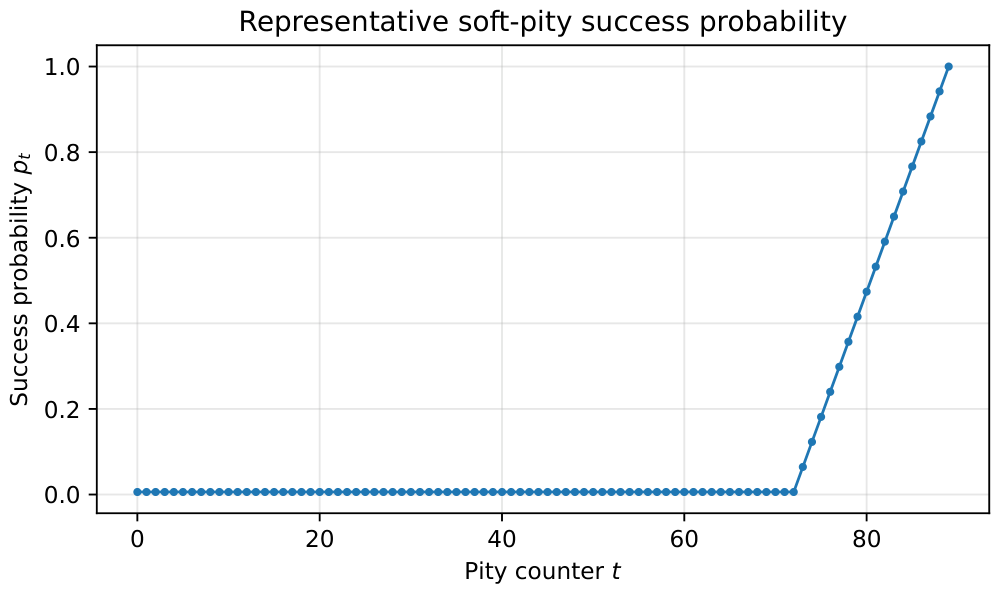
The representative schedule studied in this paper is
The base rate 0.006 is consistent with official disclosures for five-star drops in a well-known gacha title [12]. The soft-pity threshold and linear slope in (1), however, should not be interpreted as official parameters. They are used as a representative working schedule; if a different schedule is supplied, the same recurrences apply without structural change.
Figure 1.
Representative soft-pity success probability as a function of the pity counter. The probability is flat before the soft-pity region, rises sharply inside the ramp, and reaches the hard guarantee at .
Figure 1.
Representative soft-pity success probability as a function of the pity counter. The probability is flat before the soft-pity region, rises sharply inside the ramp, and reaches the hard guarantee at .
2.2. Symmetry and Asymmetry of the Transition Rule
The constant-rate no-pity model has a homogeneous transition structure: before absorption, the success probability is invariant with respect to the number of previous failures. In this limited but useful sense, every non-absorbed draw is probabilistically symmetric with every other non-absorbed draw. This is the only notion of symmetry used in the present paper. Hard pity and soft pity break this draw-count homogeneity. Hard pity preserves a constant hazard until the terminal counter and then imposes a boundary asymmetry at the guarantee. Soft pity breaks the symmetry earlier by assigning different transition probabilities to different pity-counter states.
Figure 2 compares the hard-pity-only hazard with the representative soft-pity hazard. The mathematical consequence of this state dependence is not merely a smaller expected value: it changes the shape, skewness, entropy, and upper-tail behavior of the absorption-time distribution. These effects are quantified later in Table 1 and Figure 3.
2.3. Single-Stage and Multi-Stage Quantities
A stage begins at and ends at the first success. Let denote the number of draws in one stage. Because success resets the pity counter, repeated attempts to obtain independent rare items can be modeled as independent copies of , provided that no additional mechanism changes the stage distribution. For m independent rare items, define
where are i.i.d. copies of . The numerical section focuses on to illustrate distributional convolution, but the formulas hold for arbitrary fixed m.
Remark 1
(Scope of independence). The independence in (2) is not a claim about all commercial gacha systems. It is valid only for the simplified model in which each rare-item acquisition resets the counter and the next stage has the same transition schedule. If featured-item guarantees or duplicate collection are added, the stage distribution changes with the collection state, and the enlarged process is still Markovian but no longer a sum of identical independent stages.
3. Exact Recurrences
3.1. Expectation
Let be the expected number of additional draws required to obtain a success when the current pity counter is t.
Proposition 1
(Expectation recurrence). The expected hitting times satisfy
and, for ,
Proof.
From state t, one draw is made. With probability , the draw succeeds and no further draws are needed. With probability , the draw fails and the process continues from state . Therefore
At , the next draw succeeds with probability one, so . □
The recurrence can also be written explicitly as a finite survival sum. If , then
with the empty product interpreted as one. The backward recurrence is usually more convenient computationally, but (5) highlights that the hitting time has bounded support.
3.2. Variance
Let be the variance of the number of additional draws needed from state t.
Proposition 2
(Variance recurrence). The variances satisfy
and, for ,
Proof.
Let be the additional number of draws to success from state t. Write
where if the first draw from state t succeeds, and if the first draw fails. Conditioning on the first draw outcome and using the law of total variance gives
The first term equals , since the successful branch has zero conditional variance and the failed branch has variance . The conditional expectation of equals 0 on the successful branch and on the failed branch. Hence its variance is
Adding the two terms proves (7). The boundary condition follows because the hitting time from is deterministically equal to one. □
For m independent stages,
3.3. Probability Mass Function
Expectation and variance summarize only part of the risk profile. Quantiles and tail probabilities require the full distribution. Let
Proposition 3
(PMF recursion). The probability mass function satisfies
Proof.
If , the hitting time is exactly one draw. If , a hitting time equal to one occurs exactly when the first draw succeeds. For , the first draw must fail and the remaining hitting time from state must be . This gives (). □
Once is obtained, the distribution of is the m-fold discrete convolution
Because , the support of is contained in . Direct convolution is therefore exact and computationally trivial for the values of m considered here.
3.4. Reproducibility Algorithm
The following pseudocode is sufficient to reproduce the numerical results in the paper.
- Step 1.
- Define by (1) for .
- Step 2.
- Initialize and compute by (4).
- Step 3.
- Initialize and compute by (7), using the already computed values of .
- Step 4.
- Initialize , then compute for decreasing t using ()–().
- Step 5.
- Repeatedly convolve with itself to obtain the PMF of .
- Step 6.
- Compute tail probabilities and quantiles directly from the cumulative distribution function.
These steps are deterministic once the transition schedule has been specified.
4. Numerical Results
This section evaluates the recurrences in Section 3 under Equation (1). The values are distributional consequences of that schedule.
4.1. Single-Stage Moments
Solving (4) and (7) under (1) gives
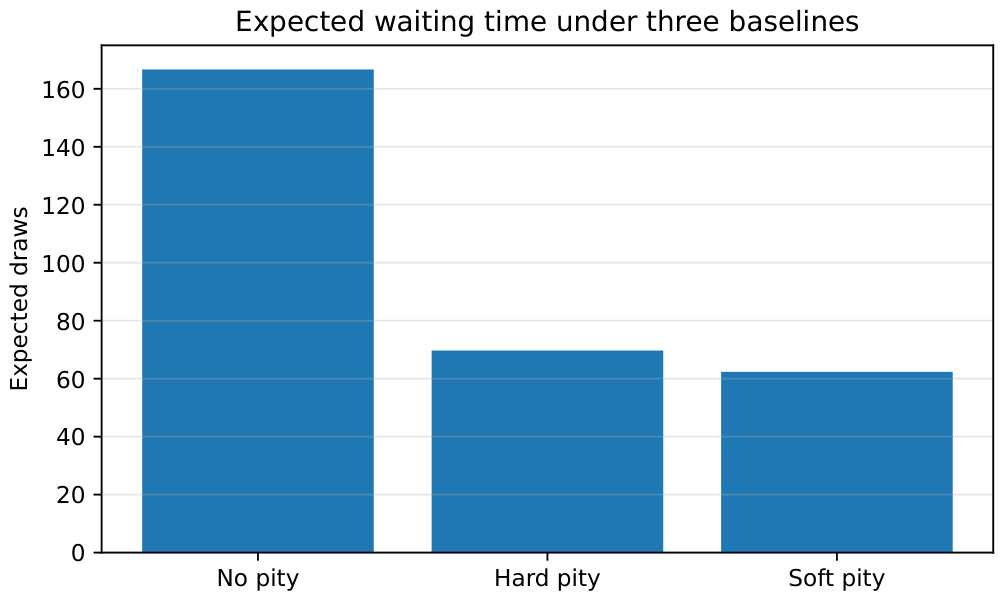
Thus one rare item requires about 62.34 draws on average under the representative soft-pity schedule.
It is useful to compare this value with two simple baselines. If there were no pity mechanism at all and every draw had success probability , then the waiting time would be geometric with mean
If there were a hard guarantee at 90 draws but no soft-pity ramp, then for and , which gives an expected waiting time of approximately 69.70 draws. The representative soft-pity ramp therefore reduces the mean by about 62.6% relative to the uncapped geometric baseline and by about 10.6% relative to the hard-pity-only baseline.

Table 2.
Single-stage benchmark comparison under base rate 0.006.
| Model | Expected draws | Comment |
| Uncapped no-pity geometric model | 166.67 | No guarantee |
| Hard pity only at 90 draws | 69.70 | No soft-pity ramp |
| Representative soft-pity model (1) | 62.34 | Linear ramp before hard pity |
Figure 4.
Expected waiting time under three baselines: uncapped geometric draws, hard pity without a soft-pity ramp, and the representative soft-pity schedule.
Figure 4.
Expected waiting time under three baselines: uncapped geometric draws, hard pity without a soft-pity ramp, and the representative soft-pity schedule.
4.2. Expected Remaining Draws Inside the Soft-Pity Region
Table 3 reports selected values of . The reduction column compares with .
The table shows why the phrase “close to pity” has a precise mathematical meaning in this model. By counter value 72, the expected remaining waiting time has fallen below six draws; by counter value 80, it is below two draws. These values are not simulations; they are direct outputs of the exact backward recurrence. Figure 5 and Figure 6 visualize the same recurrence outputs over the full counter range.
4.3. Single-Stage Distributional Shape
The exact PMF recursion gives more information than the first two moments. Figure 7 shows the single-stage distribution of , while Figure 8 gives the corresponding cumulative and survival functions. These plots make clear that the model has two distinct features: an initially long low-probability region and a sharp accumulation of mass around the soft-pity and hard-pity region.
4.4. Ten-Item Distribution
For , (8) gives
The exact convolution distribution gives the quantiles in Table 4.
Figure 9.
Exact distribution of , obtained by tenfold convolution of the single-stage PMF. The distribution is bounded between 10 and 900 draws.
Figure 9.
Exact distribution of , obtained by tenfold convolution of the single-stage PMF. The distribution is bounded between 10 and 900 draws.
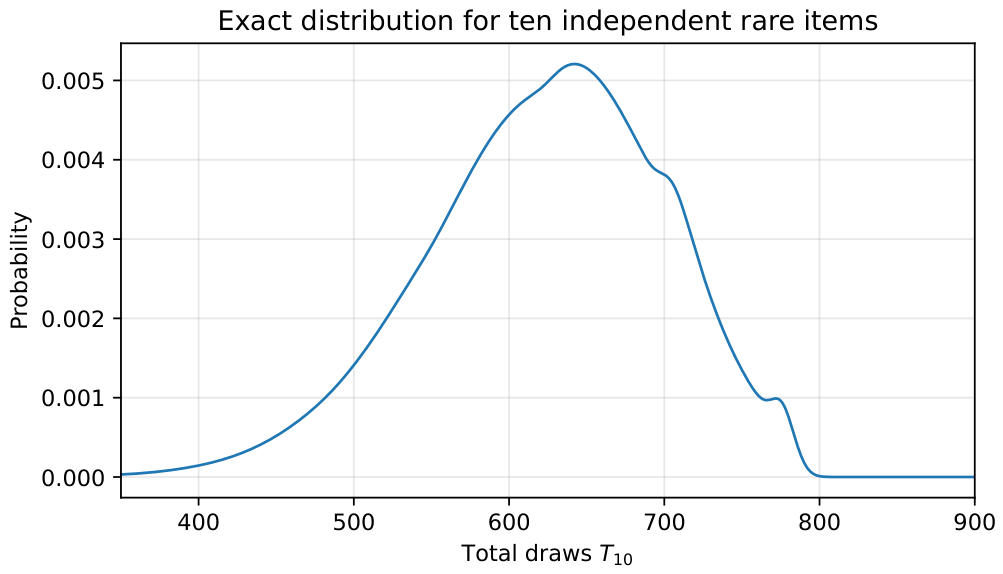
Figure 10.
Exact quantile curve of . The upper tail illustrates why quantiles provide information that is not visible from the mean alone.
Figure 10.
Exact quantile curve of . The upper tail illustrates why quantiles provide information that is not visible from the mean alone.
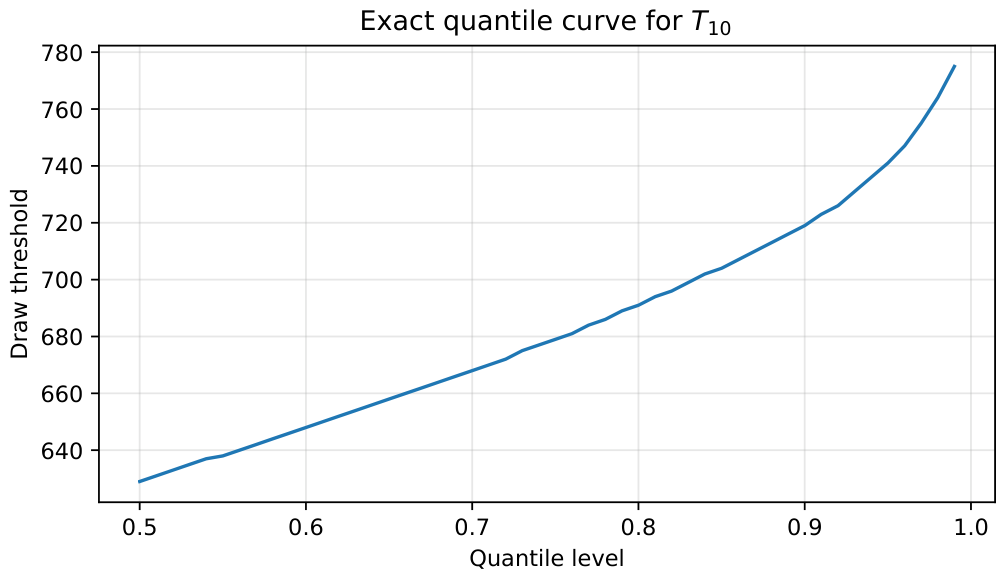
Figure 11.
Exact right-tail function for ten independent rare items. This figure converts a draw budget b into a non-completion probability under the simplified model.
Figure 11.
Exact right-tail function for ten independent rare items. This figure converts a draw budget b into a non-completion probability under the simplified model.
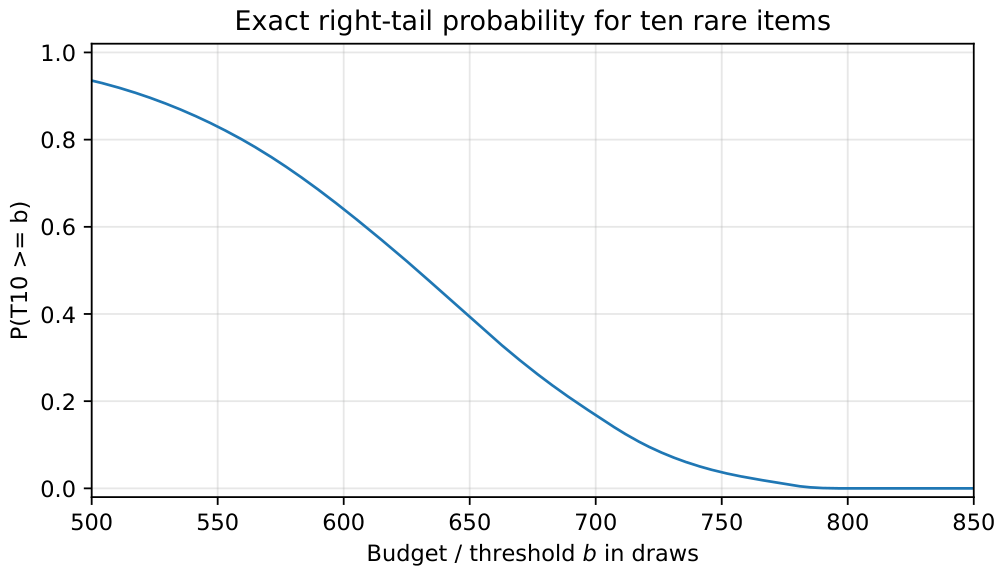
Table 5.
Exact right-tail probabilities for .
| Threshold b | |
| 650 | 0.39268 |
| 700 | 0.16794 |
| 724 | 0.08755 |
| 750 | 0.03692 |
| 778 | 0.00730 |
| 800 | 0.00004 |
For example, the exact right-tail probability at 724 draws is
Since , this event is approximately 1.31 standard deviations above the mean, not a two-standard-deviation event. A one-sided two-standard-deviation threshold is approximately
and the exact tail probability at 778 draws is approximately
These values are obtained by dynamic-programming convolution. A Monte Carlo run with replications differs by less than 0.001 for (16), as shown in Figure 12.
4.5. Auxiliary Sensitivity Analysis
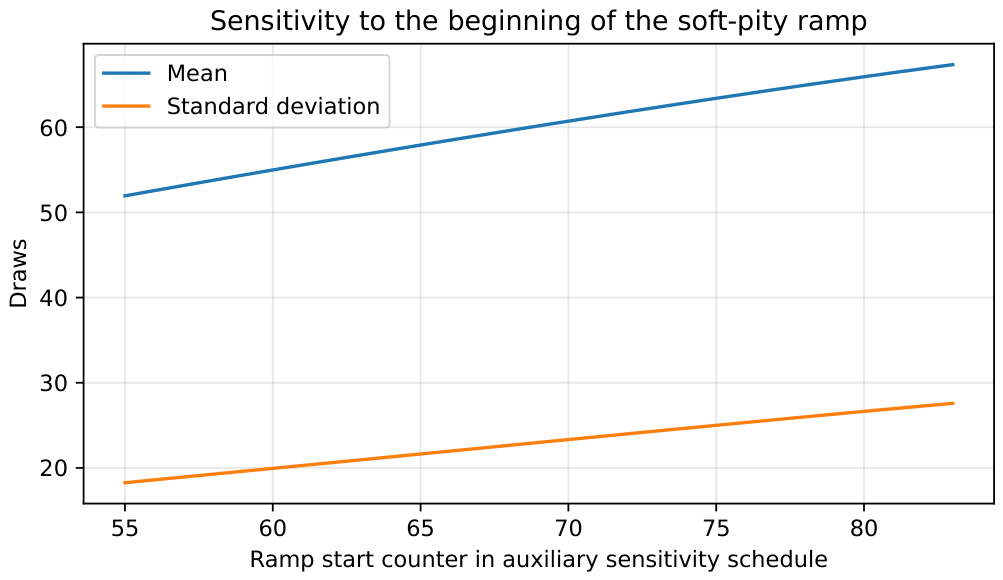
The representative schedule in Equation (1) is the main object of this paper. To illustrate how the same code can compare alternative designs, we also compute an auxiliary sensitivity experiment in which the start of a linear ramp is varied while the hard guarantee remains fixed at 90 draws. In this auxiliary experiment, the ramp is re-scaled so that it reaches probability one at the hard guarantee. The resulting values should not be interpreted as estimates of any particular commercial system; they only demonstrate how the recurrence framework can be used to compare schedules.
Table 6.
Sensitivity of the single-stage expected waiting time to the beginning of a linear ramp reaching hard pity at draw 90. This table uses an auxiliary ramp definition and is not the main schedule in Eq. (1).
Table 6.
Sensitivity of the single-stage expected waiting time to the beginning of a linear ramp reaching hard pity at draw 90. This table uses an auxiliary ramp definition and is not the main schedule in Eq. (1).
| Ramp start counter | ||
| 60 | 54.98 | 19.95 |
| 65 | 57.91 | 21.64 |
| 70 | 60.71 | 23.33 |
| 73 | 62.34 | 24.34 |
| 76 | 63.91 | 25.34 |
| 80 | 65.92 | 26.64 |
Figure 13.
Auxiliary sensitivity analysis in which the start of a linear ramp is varied while the hard guarantee remains at 90 draws. This figure is not a calibration claim; it only illustrates how the recurrences can compare alternative schedules.
Figure 13.
Auxiliary sensitivity analysis in which the start of a linear ramp is varied while the hard guarantee remains at 90 draws. This figure is not a calibration claim; it only illustrates how the recurrences can compare alternative schedules.
5. Extended Numerical Experiments
The preceding section reports the core quantities for the simplified rare-item model. This section expands the numerical analysis in four directions: scaling with the number of desired rare items, upper-tail risk metrics, approximation diagnostics, and an illustrative featured-target extension. All computations use the PMFs generated by the recurrences above or by explicitly stated auxiliary state spaces.
5.1. Scaling with the Number of Rare Items
For general m, the exact PMF of is obtained by repeated convolution. Table 7 and Figure 14 show how the mean and upper quantiles grow as m increases from 1 to 20. The mean grows linearly by construction, while upper quantiles include an additional dispersion term. A budget based only on generally gives a completion probability well below high-confidence levels such as 90% or 95%.
Figure 15 plots over both the desired number of rare items and the available draw budget. This directly answers how likely a given budget is to finish a target count.
5.2. VaR, CVaR, and Expected Excess
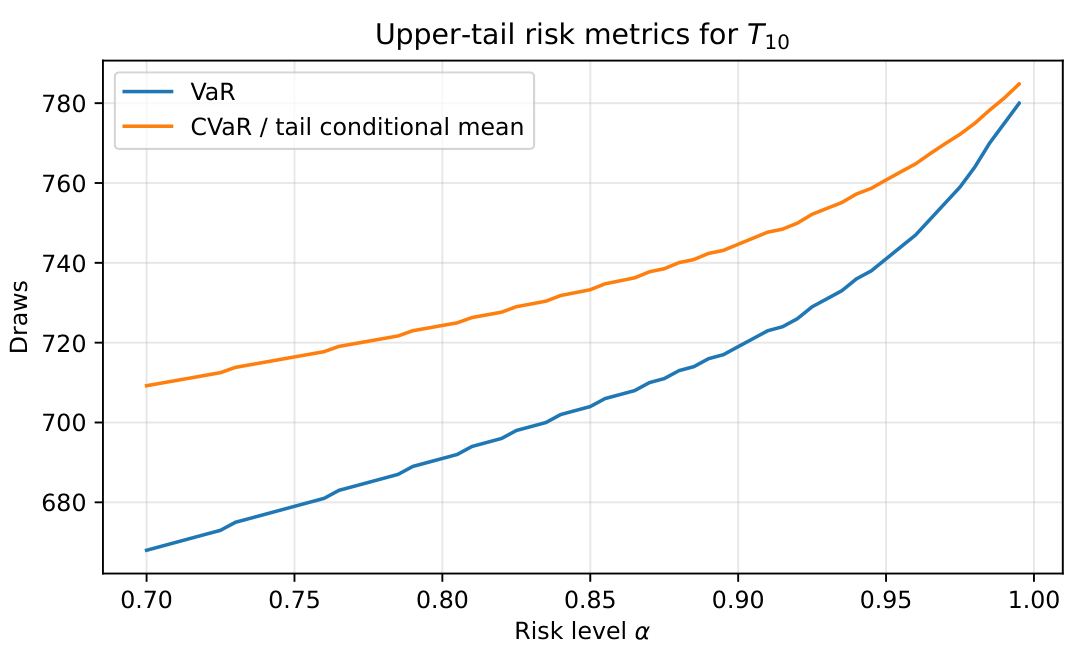
Quantiles do not describe how large the draw count can be after the quantile is exceeded. Table 8 reports Value-at-Risk and a discrete upper-tail conditional mean for . Here is used descriptively as . Table 9 reports completion probability and expected positive excess .
Figure 16.
Upper-tail risk metrics for . The CVaR curve lies above the VaR curve because it averages over the tail beyond the quantile.
Figure 16.
Upper-tail risk metrics for . The CVaR curve lies above the VaR curve because it averages over the tail beyond the quantile.
5.3. Normal Approximation Diagnostics
Because is a sum of bounded independent variables, a normal approximation becomes plausible as m grows. However, exact convolution allows this approximation to be checked rather than assumed. For , the maximum absolute CDF error of the continuity-corrected normal approximation is approximately 0.0280. Table 10 compares exact and normal-approximate tail probabilities, and Figure 17 shows the signed CDF error for several values of m.
5.4. Parameter Sensitivity
5.5. Illustrative Featured-Target Extension
Finally, we include an illustrative extension that adds one commonly discussed target-item feature. Suppose that a rare item is the desired featured target with probability when the guarantee state is off. If the rare item is not featured, the pity counter resets and the next rare item is guaranteed to be featured. The Markov state is then , where denotes no guarantee and denotes a featured guarantee. The target-acquisition state is absorbing for a single featured item. For , the transition probabilities from the non-guaranteed state are
The first transition is an ordinary non-rare draw, the second is a rare draw that is featured, and the third is a rare draw that is not featured; in the third case the pity counter resets and the guarantee state is switched on. At , the same formulas apply with . From the guaranteed state,
After a featured target has been obtained, the repeated-target calculations below assume that the next target begins again from , i.e., with pity reset and no active featured guarantee. This reset convention is part of the auxiliary model and is stated explicitly because other conventions would lead to different multi-target distributions.
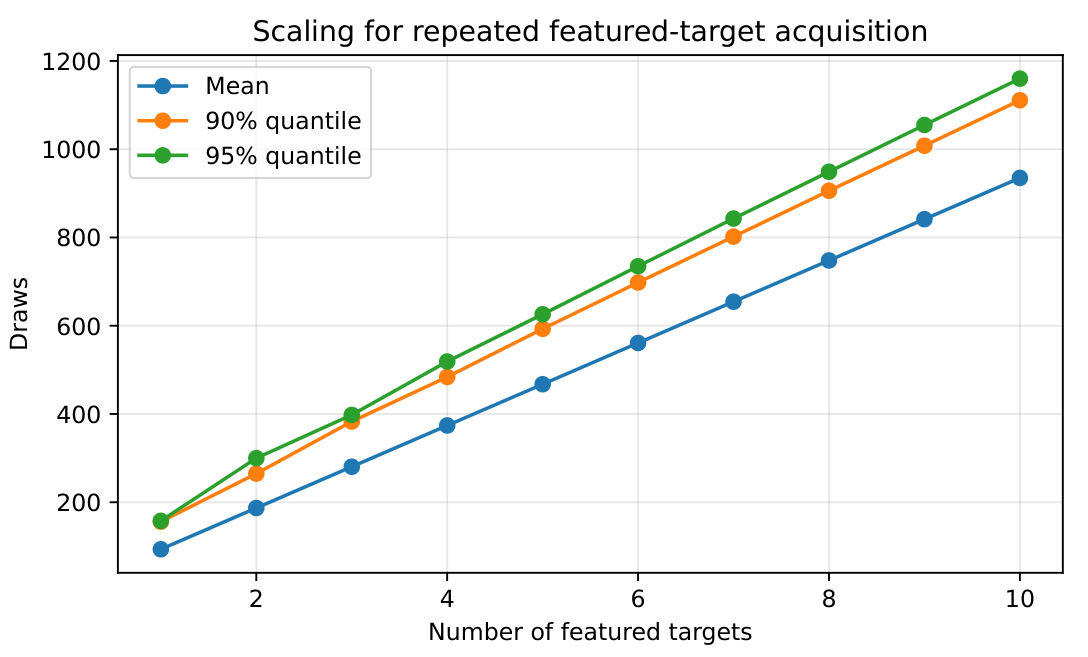
Under this illustrative 50/50 extension, starting without a guarantee gives an expected target-acquisition time of approximately 93.51 draws, with standard deviation approximately 43.13, a 90% quantile of 156, and a 95% quantile of 158. Table 11 reports the one-target summaries, and Table 12 gives repeated featured-target summaries under the convention that each featured success resets the guarantee state to no guarantee.
Figure 20.
PMF comparison between obtaining any rare item and obtaining a featured target from the no-guarantee state under the illustrative 50/50 extension.
Figure 20.
PMF comparison between obtaining any rare item and obtaining a featured target from the no-guarantee state under the illustrative 50/50 extension.
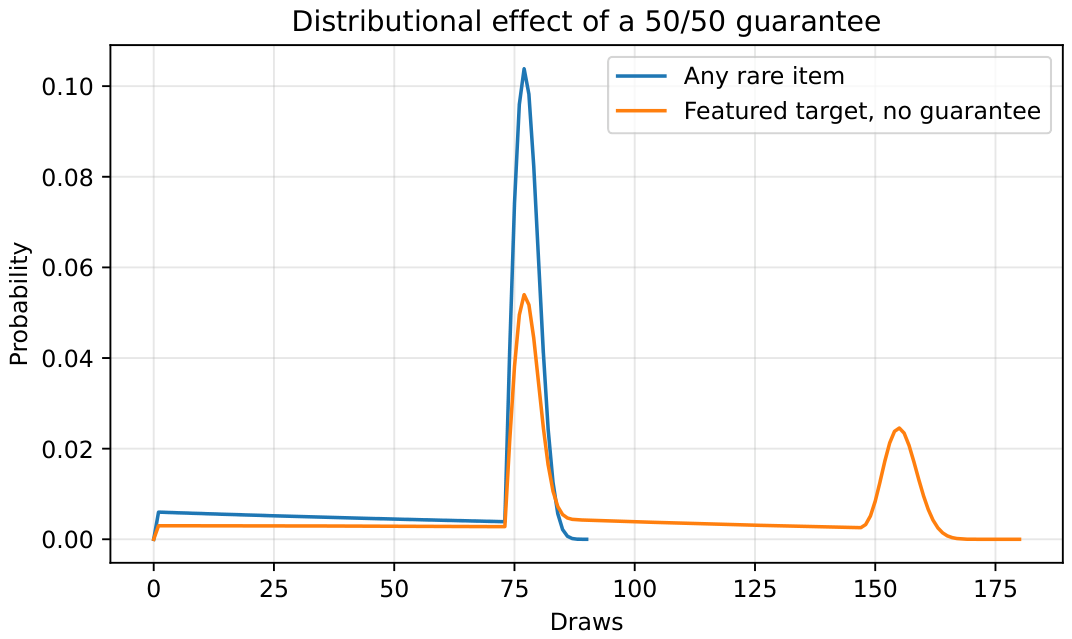
Figure 21.
CDF comparison between any-rare acquisition and featured-target acquisition. The featured-target distribution has support up to 180 draws because one may first lose the 50/50 and then require a guaranteed rare item.
Figure 21.
CDF comparison between any-rare acquisition and featured-target acquisition. The featured-target distribution has support up to 180 draws because one may first lose the 50/50 and then require a guaranteed rare item.
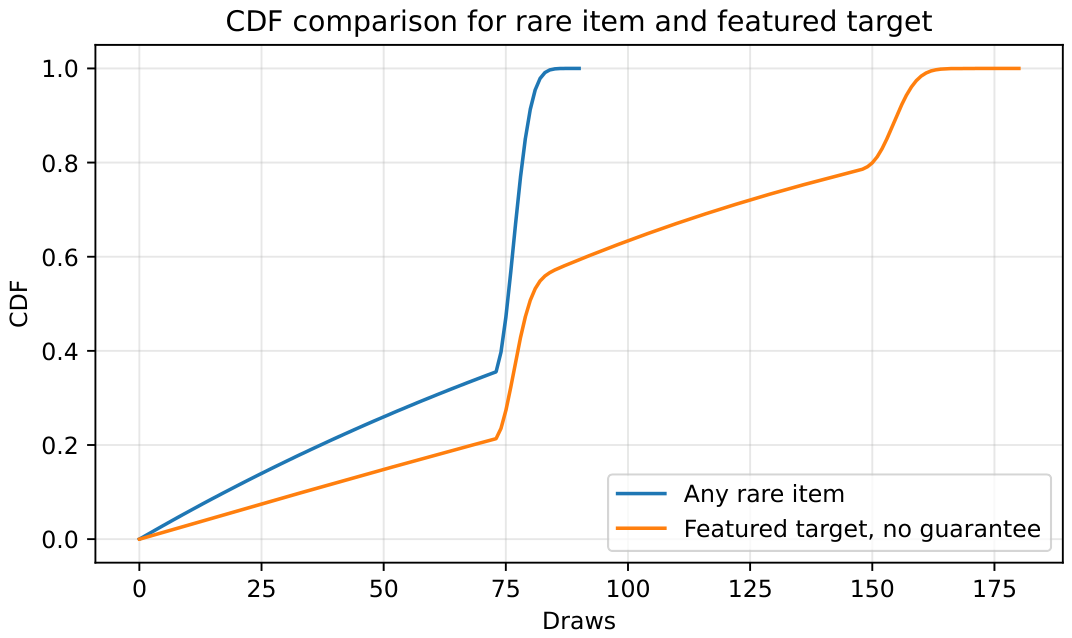
Figure 22.
Mean and upper quantiles for repeated featured-target acquisition under the illustrative extension.
Figure 22.
Mean and upper quantiles for repeated featured-target acquisition under the illustrative extension.
5.6. Distributional Asymmetry Diagnostics
The symmetry-breaking interpretation can also be inspected directly at the level of the waiting-time distribution. Table 1 reports compact distributional summaries for three model variants. The hard-pity-only and soft-pity distributions are both bounded, but the soft-pity ramp shifts probability mass toward the ramp region and changes the entropy and skewness of the PMF. The featured-target extension introduces an additional binary state asymmetry: starting from the no-guarantee state, the target-acquisition time is a mixture of one rare-item cycle and two rare-item cycles. This mixture explains why its skewness differs sharply from the one-stage rare-item waiting-time distributions. The negative skewness of the hard-pity-only distribution is also not an error: with bounded support and probability mass accumulating near the hard upper limit, the longer left-side spread relative to the terminal mass produces a left-skewed PMF.
6. Possible Extensions
The simplified model is useful because it isolates a single mathematical mechanism. Nevertheless, many realistic systems require larger state descriptions. This section records how the present framework can be extended without pretending that those extensions have already been analyzed in the numerical results.
6.1. Featured-Item Guarantees
A common featured-item mechanism can be represented by adding a binary guarantee state . Here means that the next rare item has only a stated featured-item probability, while means that the next rare item is guaranteed to be featured. The Markov state then becomes . A non-rare draw changes to . A rare draw resets the pity counter to zero and changes the guarantee state according to whether the featured item was obtained.
This enlarged chain is still finite and can be handled by the same first-step method. However, the single-stage distribution is no longer identical to the one studied above unless the initial guarantee state is fixed and the target is defined carefully. Therefore the numerical values in Section 4 should not be interpreted as featured-item acquisition times.
6.2. Duplicate Collection
Suppose a player seeks to collect all n distinct rare items and already owns k of them. If each rare item is equally likely conditional on a rare draw, the state must include both k and t. The transition structure is not obtained by simply replacing with , because a duplicate rare item resets the pity counter even though the collection count does not increase. A correct schematic transition is
This observation is important because treating duplicate rare items as ordinary failures would systematically distort the expected collection time.
6.3. Budget and Risk Metrics
Once the exact distribution of is known, one can compute budget-risk quantities without additional modeling assumptions. For a budget of b draws, the non-completion probability is simply
Similarly, Value-at-Risk can be read from the quantile table, and Conditional Value-at-Risk can be computed from the exact tail distribution. These quantities may be more informative than the mean alone because the player’s experience is governed by a realized tail event rather than by the expectation.
7. Discussion and Limitations
The analysis has three main implications for state-dependent asymmetry in randomized reward models. First, replacing a constant hazard by a counter-dependent hazard changes the full waiting-time distribution, not merely its expectation. Exact convolution makes quantiles, upper-tail probabilities, and expected excess values available without simulation error. Second, a hard guarantee bounds the support but does not remove practical tail risk when several stages are accumulated. Third, modest changes in the soft-pity threshold or ramp slope can move upper quantiles, so numerical conclusions should be tied to the stated schedule.
The word asymmetry is used here in the finite-state probabilistic sense: the transition law depends on the draw count and, in the featured-target extension, on a binary guarantee state. This interpretation is intentionally narrower than group-theoretic or physical symmetry breaking. Its role is to organize the comparison between a homogeneous repeated-trial baseline and state-dependent reward rules, and to motivate distributional summaries that are useful for risk assessment.
The transition schedule in Equation (1) is a representative mathematical input. Official disclosures can support a base probability such as 0.006 for certain five-star drops [12], but the soft-pity ramp used here is illustrative. The main model excludes behavioral responses, heterogeneous players, promotional timing, currency conversion, banner-specific rules, and budget-dependent stopping. The featured-target calculation in Section 5 is an auxiliary state-space extension rather than a complete model of all probability-up or weapon-banner systems. Empirical questions about spending, harm, or regulatory effectiveness would require independently documented data and a separate statistical design.
8. Conclusion
This paper derived exact recurrences for a simplified soft-pity gacha waiting-time model and computed the corresponding waiting-time distributions. Under the representative schedule in Equation (1), the expected waiting time for one rare item is approximately 62.34 draws, compared with approximately 166.67 draws in an uncapped geometric model and 69.70 draws in a hard-pity-only model. For ten independent rare items, the expected total is approximately 623.38 draws, the standard deviation is approximately 76.97 draws, and the 90% quantile is 719 draws.
The main methodological point is that state-dependent reward rules are best summarized distributionally. Once the transition probabilities are specified, finite recursion and convolution give quantiles, right-tail probabilities, expected excess, target-count scaling, and asymmetry indicators directly. Future mathematical work can extend the state space to incorporate featured-item guarantees, duplicate collection, carry-over across banners, and budget-dependent stopping rules. Empirical calibration would require independently documented draw histories and is outside the scope of the present model calculation.
Supplementary Materials
The following supporting information can be downloaded at the website of this paper posted on Preprints.org, Python scripts for reproducing all numerical calculations, tables, and figures; generated figure files; generated LaTeX table files; and a README file describing the local reproduction workflow.
Author Contributions
Conceptualization, S.H.; methodology, S.H. and Y.Z.; software, S.H.; validation, S.H. and S.Z.; formal analysis, S.Z.; investigation, Y.Z. and S.H.; data curation, S.H.; writing—original draft preparation, Y.Z.; writing—review and editing, S.H. and S.Z.; visualization, S.H.; supervision, S.Z.; funding acquisition, S.Z. All authors have read and agreed to the published version of the manuscript.
Funding
This research was funded by the Jiangsu Higher Education Institutions Basic Science (Natural Science) Research General Program, grant number 25KJD110002 (principal investigator: Sen Zhang).
Institutional Review Board Statement
Not applicable. This study does not involve humans or animals.
Informed Consent Statement
Not applicable.
Data Availability Statement
The manuscript uses no external empirical dataset. The Python scripts included in the manuscript package reproduce the expectation, variance, probability mass function, convolution, sensitivity analyses, and all generated tables and figures.
Acknowledgments
The author thanks colleagues for helpful discussions on stochastic modeling and numerical reproducibility.
Conflicts of Interest
The author declares no conflicts of interest.
Abbreviations
The following abbreviations are used in this manuscript:
| CDF | Cumulative distribution function |
| CVaR | Conditional Value-at-Risk |
| DP | Dynamic programming |
| PMF | Probability mass function |
| VaR | Value-at-Risk |
References
- Drummond, A.; Sauer, J.D. Video game loot boxes are psychologically akin to gambling. Nat. Hum. Behav. 2018, 2, 530–532. [Google Scholar] [CrossRef] [PubMed]
- Zendle, D.; Cairns, P. Loot boxes are again linked to problem gambling: Results of a replication study. PLoS ONE 2019, 14(3), e0213194. [Google Scholar] [CrossRef] [PubMed]
- King, D.L.; Delfabbro, P.H. Video game monetization (e.g., “loot boxes”): A blueprint for practical social responsibility measures. Int. J. Ment. Health Addctn. 2018, 17, 166–179. [Google Scholar] [CrossRef]
- González-Cabrera, J.; Basterra-González, A.; Montiel, I.; Calvete, E.; Pontes, H.M.; Machimbarrena, J.M. The mediating role of problematic use of loot boxes between internet gaming disorder and online gambling disorder: Cross-sectional analytical study. JMIR Serious Games 2024, 12, e57304. [Google Scholar] [CrossRef] [PubMed]
- Xiao, L.Y.; Fraser, T.C.; Newall, P.W.S. Opening Pandora’s loot box: Weak links between gambling and loot box expenditure in China, and player opinions on probability disclosures and pity-timers. J. Gambl. Stud. 2023, 39, 645–668. [Google Scholar] [CrossRef] [PubMed]
- Xiao, L.Y.; Park, S. Better than industry self-regulation: Compliance of mobile games with newly adopted and actively enforced loot box probability disclosure law in South Korea. Acta Psychol. 2025, 260, 105490. [Google Scholar] [CrossRef] [PubMed]
- Gong, X.; Yee, C.L.; Yang, J.; Zhang, X.; Li, Y.; Ahmad, M. Unveiling the enigma of blind box impulse buying curiosity: The moderating role of price consciousness. Heliyon 2024, 10(24), e40564. [Google Scholar] [CrossRef] [PubMed]
- Gan, T. Gacha game: When prospect theory meets optimal pricing. arXiv 2022; revised 2023, arXiv:2208.03602. [Google Scholar]
- Hong, W.; Zhou, K. Hitting time distribution for skip-free Markov chains: A simple proof. Stat. Probab. Lett. 2013, 83(7), 1782–1786. [Google Scholar] [CrossRef]
- Elliott, R.J.; van der Hoek, J.; Sworder, D. Markov chain hitting times. Stoch. Anal. Appl. 2012, 30(5), 827–830. [Google Scholar] [CrossRef]
- Górajski, M. Reduction of absorbing Markov chain. Ann. Univ. Mariae Curie-Skłodowska Sect. A – Math. 2009, 63(1), 91–107. [Google Scholar] [CrossRef]
- HoYoverse. Genshin Impact: Wish Drop Rate Notice. Available online: https://genshin.hoyoverse.com/en/news/public (accessed on 22 May 2026).
- Feller, W. An Introduction to Probability Theory and Its Applications, 3rd ed.; Wiley: New York, 1968; Vol. 1. [Google Scholar]
- Norris, J.R. Markov Chains; Cambridge University Press: Cambridge, 1997. [Google Scholar]
- Asmussen, S. Applied Probability and Queues, 2nd ed.; Springer: New York, 2003. [Google Scholar]
- Grimmett, G.; Stirzaker, D. Probability and Random Processes, 4th ed.; Oxford University Press: Oxford, 2020. [Google Scholar]
Figure 2.
Draw-count symmetry breaking in the transition rule. A hard-pity-only schedule remains nearly state-homogeneous until the terminal guarantee, whereas the soft-pity schedule introduces state-dependent transition probabilities before the hard boundary.
Figure 2.
Draw-count symmetry breaking in the transition rule. A hard-pity-only schedule remains nearly state-homogeneous until the terminal guarantee, whereas the soft-pity schedule introduces state-dependent transition probabilities before the hard boundary.
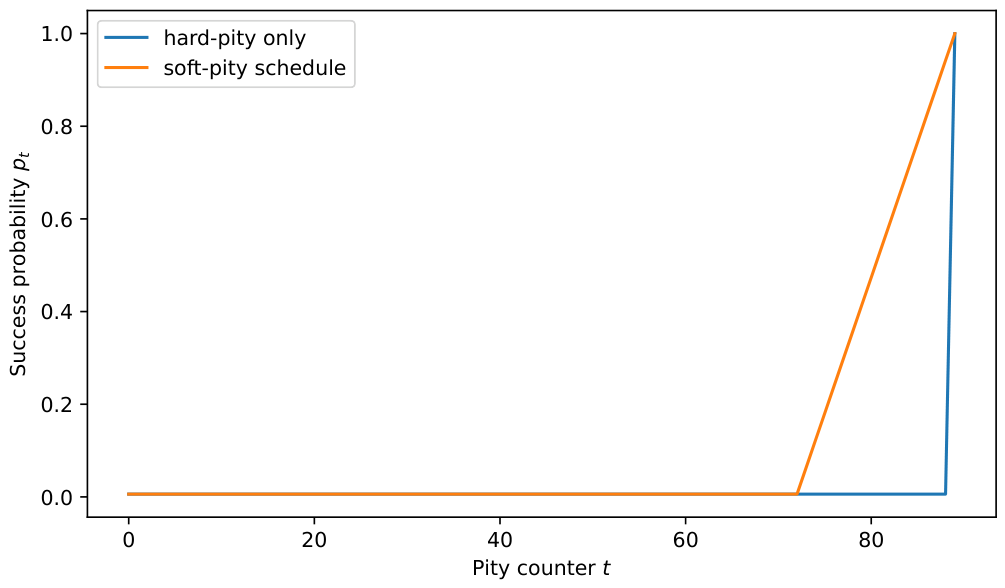
Figure 3.
Distributional asymmetry induced by hard pity, soft pity, and the featured-target guarantee extension. The plotted PMFs show how changing the transition symmetry changes the shape of the waiting-time distribution, not only its mean.
Figure 3.
Distributional asymmetry induced by hard pity, soft pity, and the featured-target guarantee extension. The plotted PMFs show how changing the transition symmetry changes the shape of the waiting-time distribution, not only its mean.
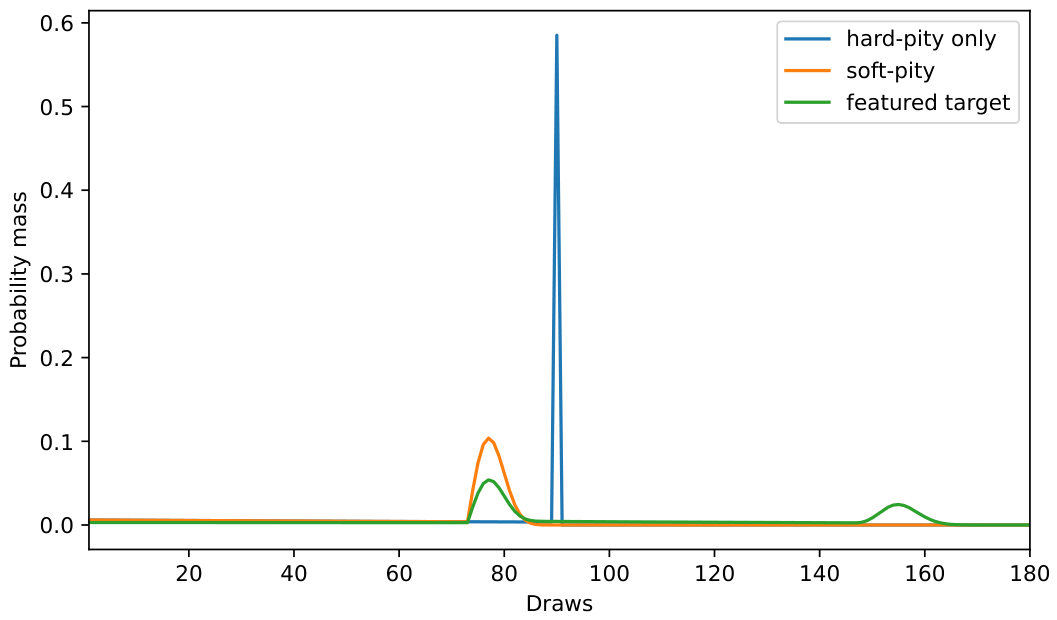
Figure 5.
Exact expected remaining draws obtained from the backward recurrence. The curve shows the rapid decrease in expected waiting time once the counter enters the soft-pity region.
Figure 5.
Exact expected remaining draws obtained from the backward recurrence. The curve shows the rapid decrease in expected waiting time once the counter enters the soft-pity region.
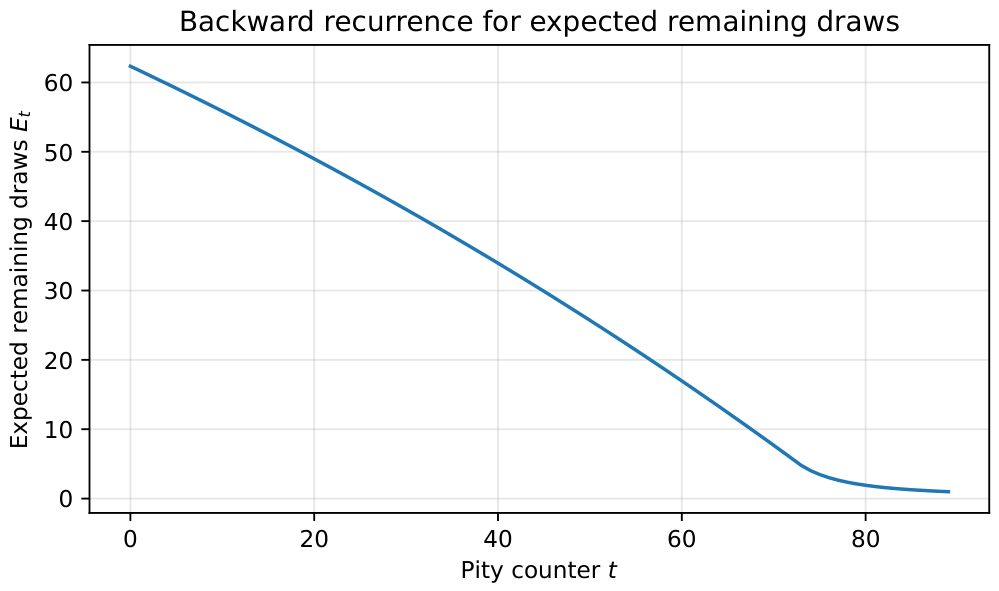
Figure 6.
Standard deviation of the remaining waiting time as a function of the pity counter. Both expectation and uncertainty decrease near the hard guarantee.
Figure 6.
Standard deviation of the remaining waiting time as a function of the pity counter. Both expectation and uncertainty decrease near the hard guarantee.
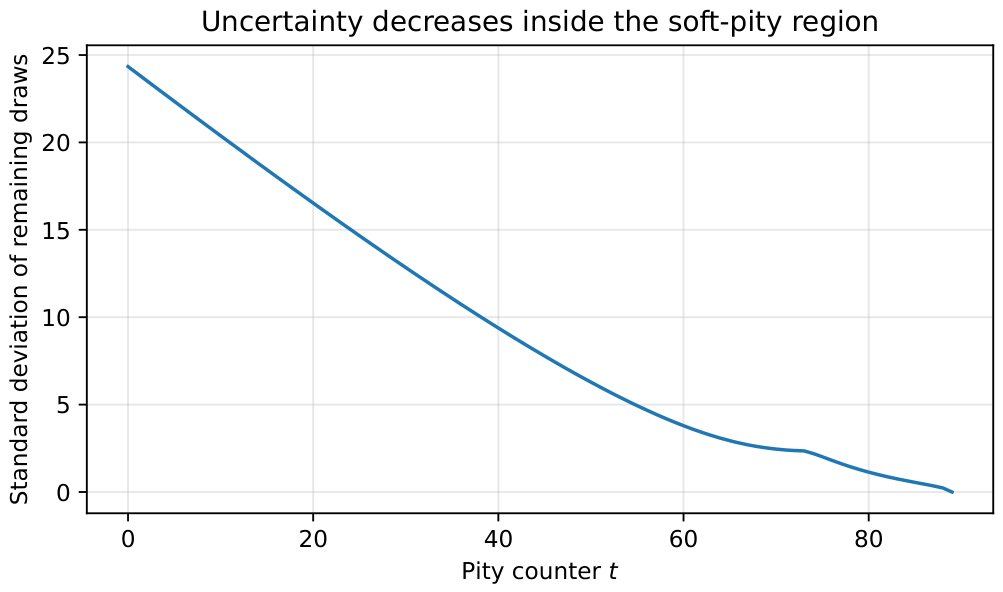
Figure 7.
Exact probability mass function of the single-stage waiting time . The mass shifts toward the soft-pity region but is truncated by the hard guarantee at 90 draws.
Figure 7.
Exact probability mass function of the single-stage waiting time . The mass shifts toward the soft-pity region but is truncated by the hard guarantee at 90 draws.
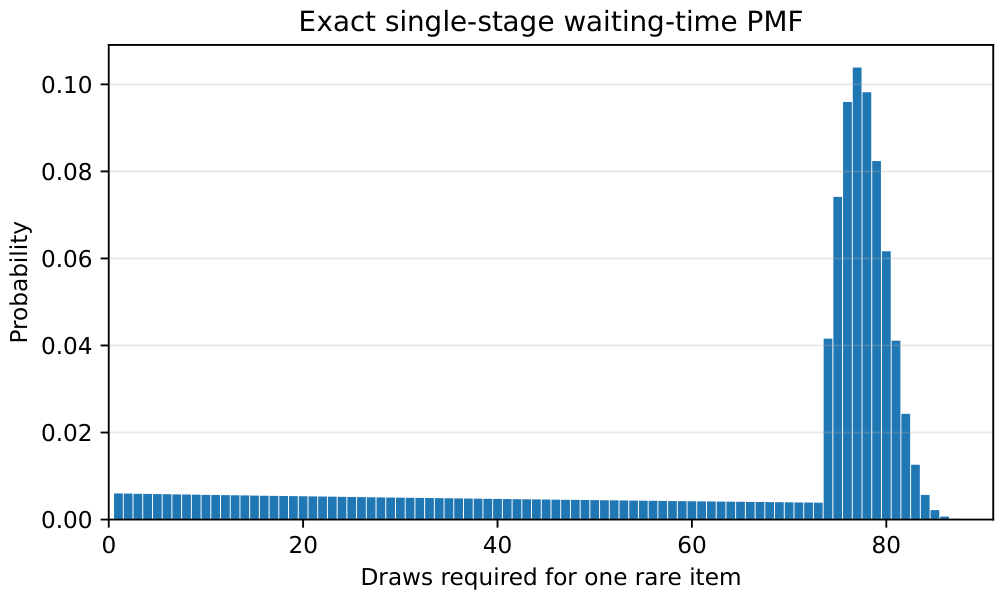
Figure 8.
Single-stage cumulative distribution and survival function. These curves provide a direct view of the probability of still not having obtained the rare item after a given number of draws.
Figure 8.
Single-stage cumulative distribution and survival function. These curves provide a direct view of the probability of still not having obtained the rare item after a given number of draws.
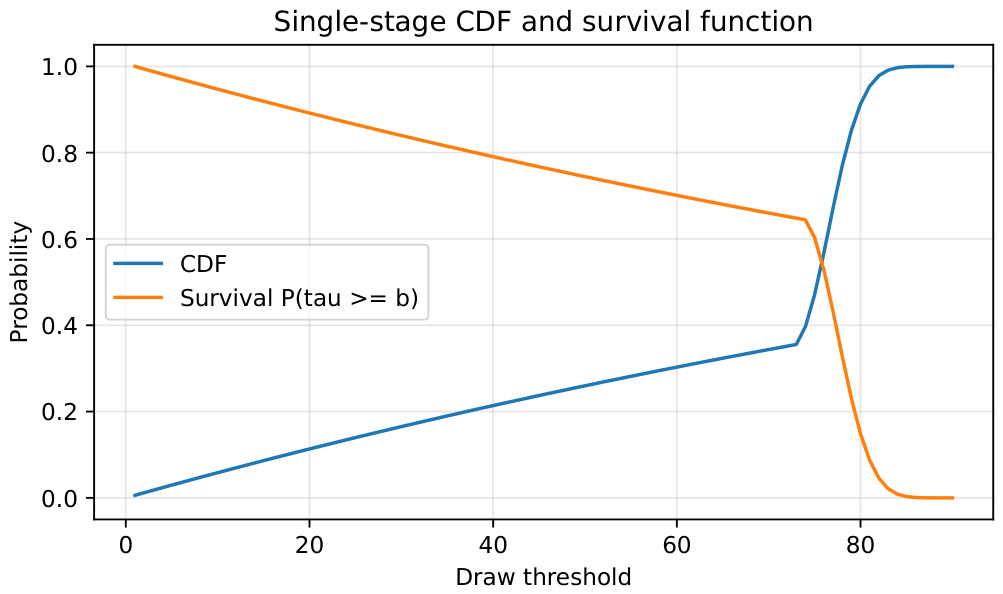
Figure 12.
Monte Carlo convergence for compared with the value obtained by convolution.
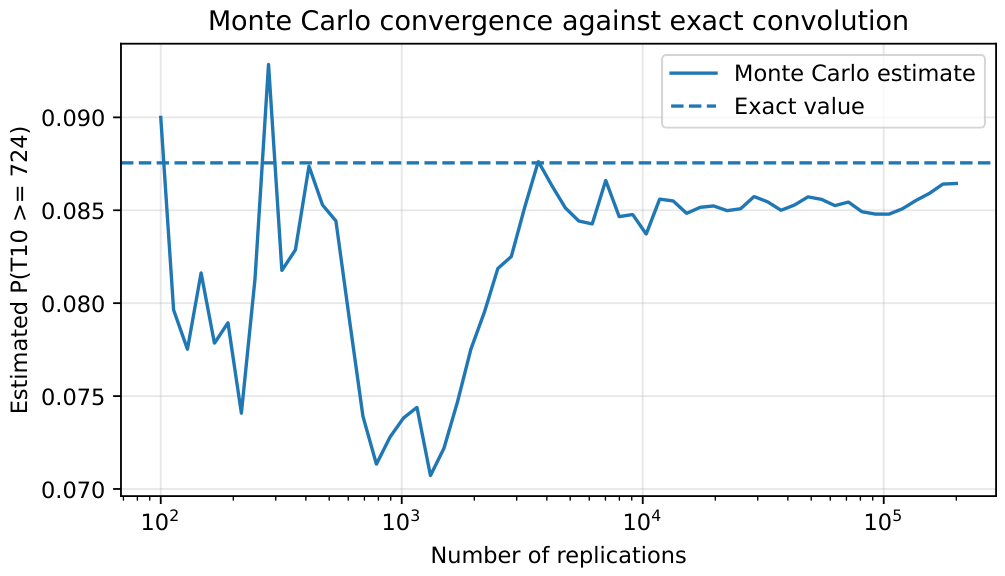
Figure 14.
Exact scaling of the mean and selected upper quantiles as the number of independent rare items varies.
Figure 14.
Exact scaling of the mean and selected upper quantiles as the number of independent rare items varies.
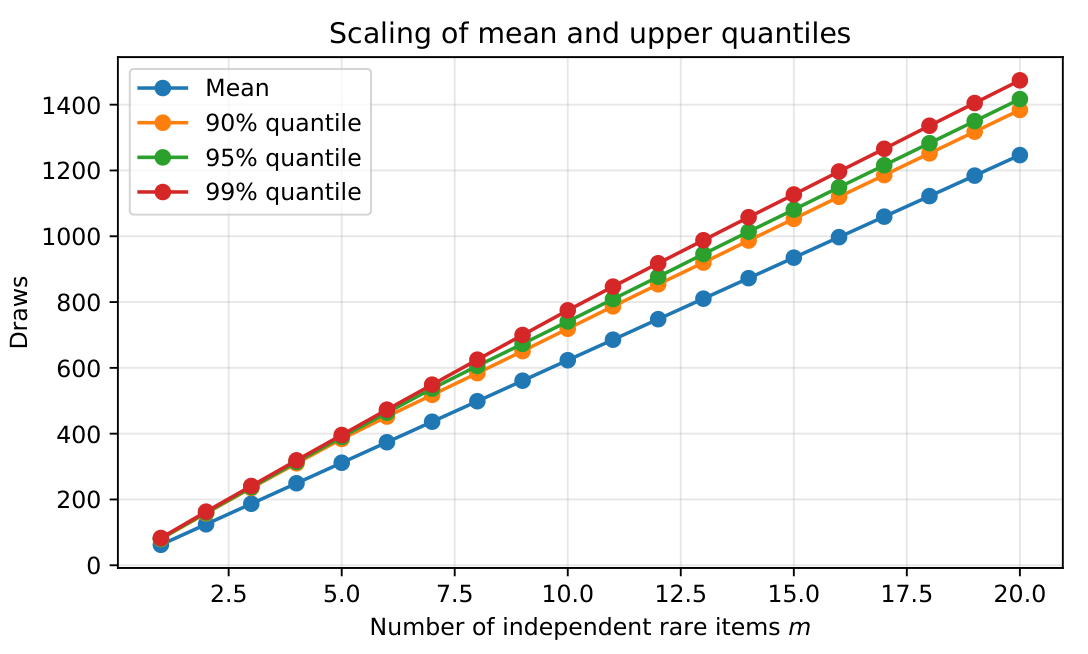
Figure 15.
Completion probability as a function of target count m and draw budget b.
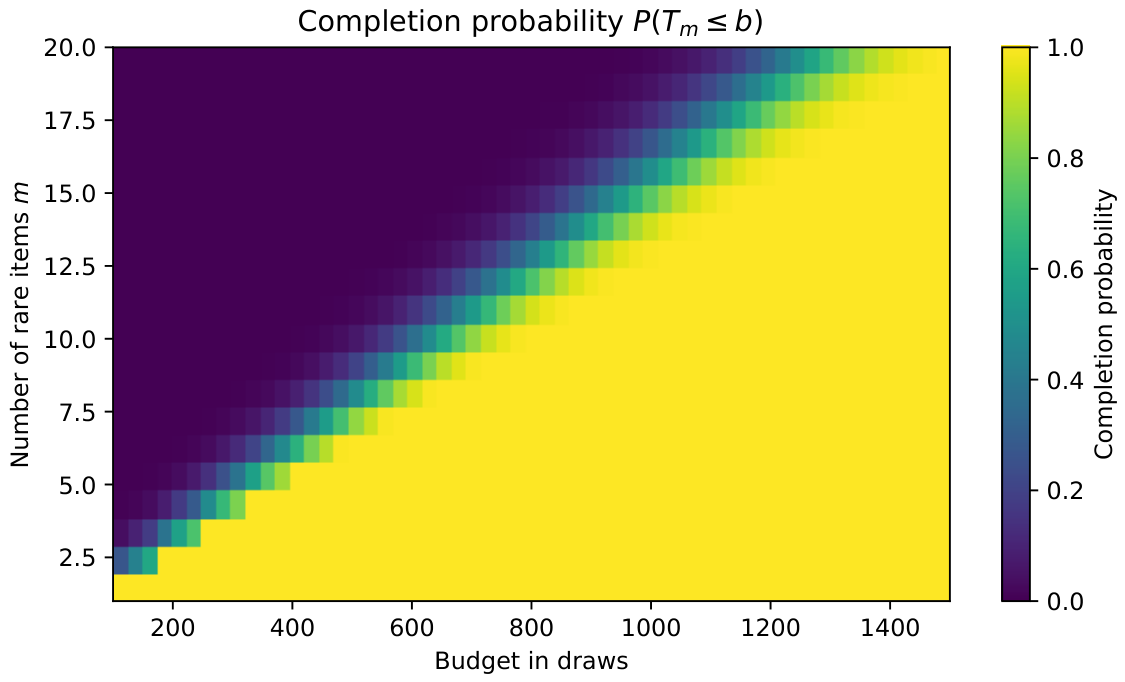
Figure 17.
Signed error of the continuity-corrected normal approximation. Exact convolution is used as the reference.
Figure 17.
Signed error of the continuity-corrected normal approximation. Exact convolution is used as the reference.
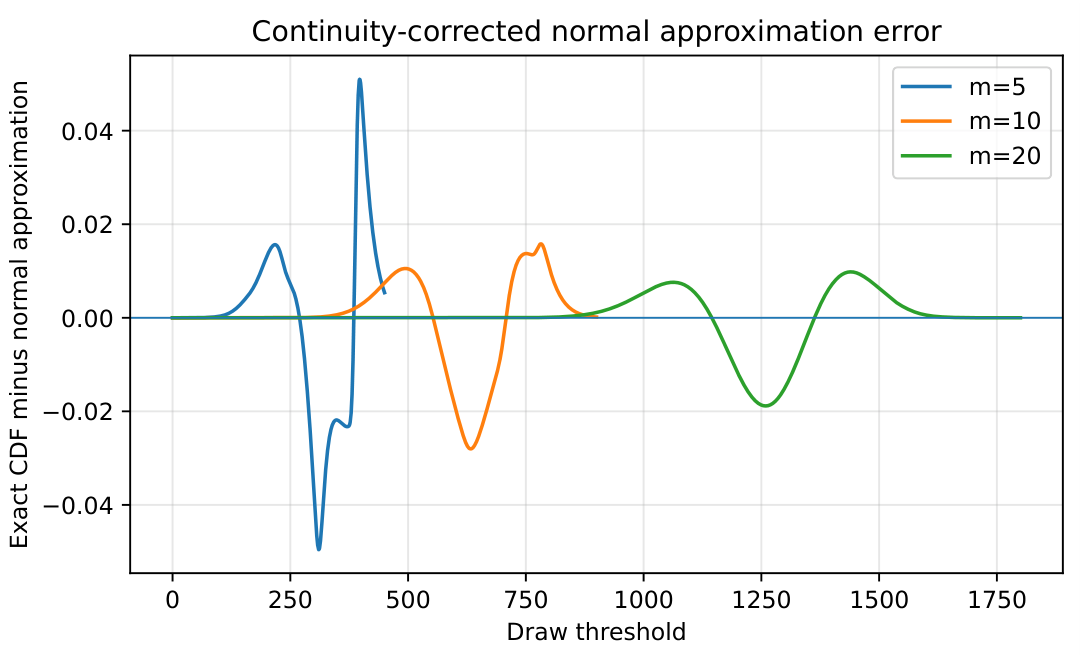
Figure 18.
Sensitivity heatmap for the single-stage mean under alternative ramp starts and slopes.
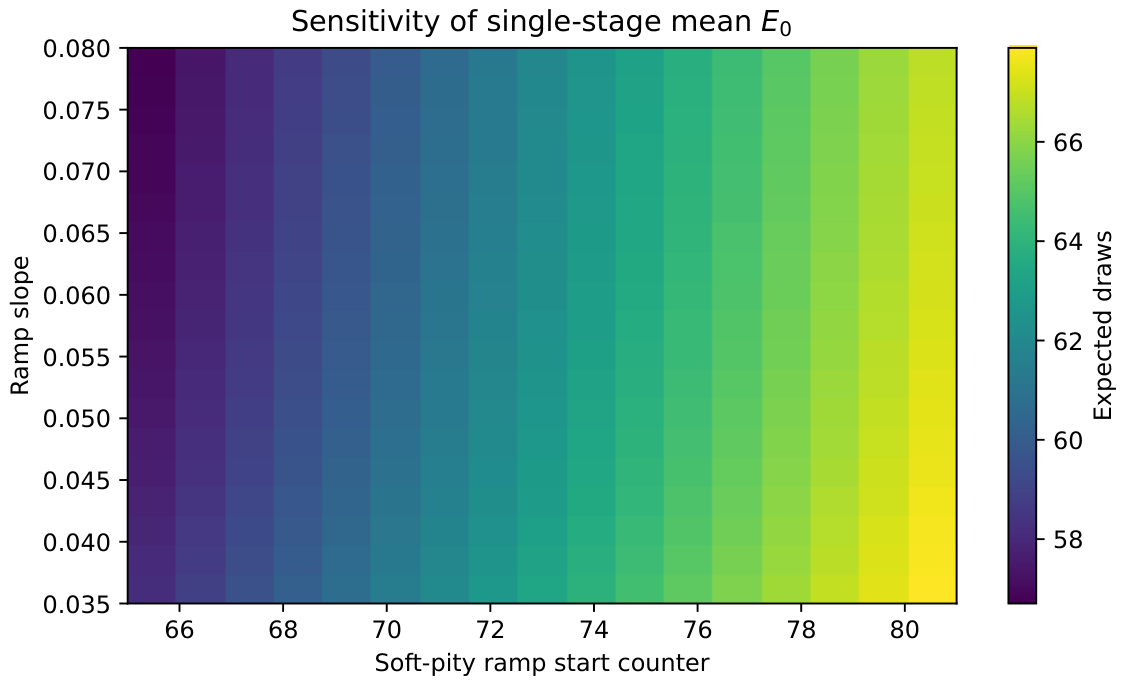
Figure 19.
Sensitivity to the base probability. The solid curve shows the single-stage mean, while the dashed curve shows the 90% quantile for .
Figure 19.
Sensitivity to the base probability. The solid curve shows the single-stage mean, while the dashed curve shows the 90% quantile for .
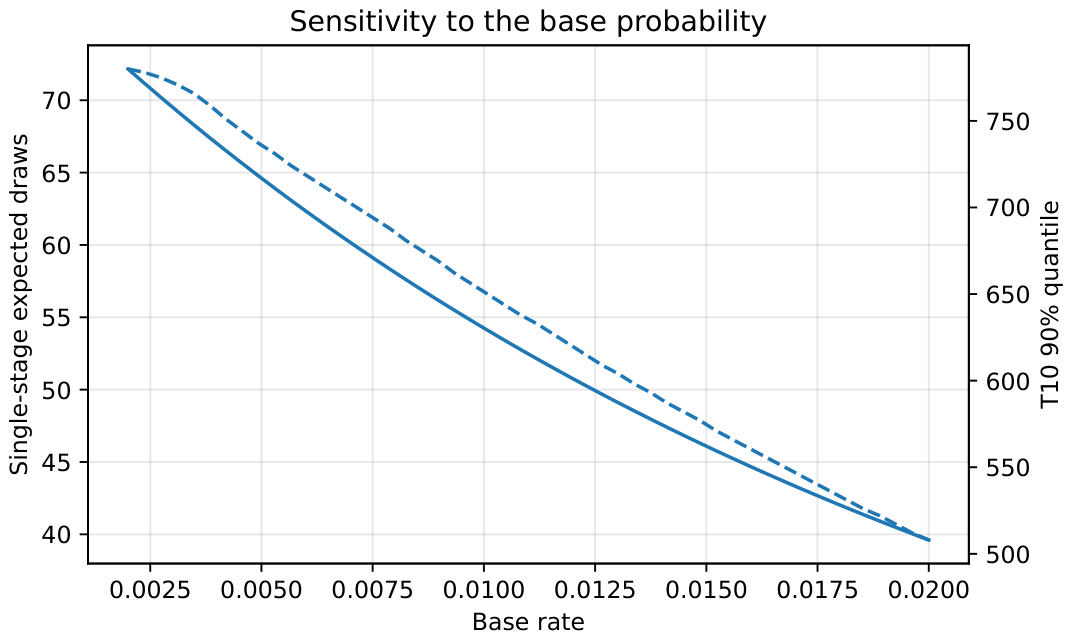
Table 1.
Distributional asymmetry summaries. Skewness measures right-tail asymmetry of the waiting-time distribution; entropy is the Shannon entropy of the discrete PMF in nats.
Table 1.
Distributional asymmetry summaries. Skewness measures right-tail asymmetry of the waiting-time distribution; entropy is the Shannon entropy of the discrete PMF in nats.
| Model | Mean | SD | CV | Skewness | Entropy |
| Hard-pity-only rare item | 69.70 | 29.18 | 0.419 | -1.078 | 2.535 |
| Soft-pity rare item | 62.34 | 24.34 | 0.390 | -1.241 | 3.607 |
| Featured target, no guarantee | 93.51 | 43.13 | 0.461 | 0.011 | 4.541 |
Table 3.
Expected additional draws to success at selected pity counters under schedule (1).
Table 3.
Expected additional draws to success at selected pity counters under schedule (1).
| Entry pity t | Reduction relative to | |
| 0 | 62.34 | – |
| 70 | 7.68 | 87.7% |
| 72 | 5.76 | 90.8% |
| 73 | 4.78 | 92.3% |
| 80 | 1.92 | 96.9% |
| 89 | 1.00 | 98.4% |
Table 4.
Selected exact quantiles for , computed by repeated convolution of the single-stage PMF.
| Quantile level | Draw threshold |
| 50% | 629 |
| 75% | 679 |
| 90% | 719 |
| 95% | 741 |
| 99% | 775 |
Table 7.
Exact distributional summaries as the number of independent rare items varies.
| m | Mean | SD | 90% quantile | 95% quantile | 99% quantile |
| 1 | 62.34 | 24.34 | 80 | 81 | 83 |
| 2 | 124.68 | 34.42 | 158 | 160 | 163 |
| 5 | 311.69 | 54.43 | 384 | 390 | 396 |
| 10 | 623.38 | 76.97 | 719 | 741 | 775 |
| 15 | 935.06 | 94.27 | 1053 | 1081 | 1127 |
| 20 | 1246.75 | 108.85 | 1384 | 1417 | 1474 |
Table 8.
Upper-tail risk metrics for . VaR is the exact quantile; CVaR is reported as .
| Level | Tail probability at VaR | ||
| 0.750 | 679 | 716.44 | 0.25264 |
| 0.900 | 719 | 744.66 | 0.10155 |
| 0.950 | 741 | 760.77 | 0.05082 |
| 0.975 | 759 | 772.22 | 0.02598 |
| 0.990 | 775 | 781.32 | 0.01010 |
Table 9.
Budget interpretation for under exact convolution. Completion probability is and expected excess is .
Table 9.
Budget interpretation for under exact convolution. Completion probability is and expected excess is .
| Budget b | Completion probability | Non-completion probability | Expected excess draws |
| 600 | 0.3640 | 0.6360 | 44.54 |
| 650 | 0.6125 | 0.3875 | 18.69 |
| 700 | 0.8359 | 0.1641 | 5.11 |
| 719 | 0.9014 | 0.0986 | 2.61 |
| 741 | 0.9509 | 0.0491 | 1.00 |
| 775 | 0.9909 | 0.0091 | 0.06 |
| 800 | 1.0000 | 0.0000 | 0.00 |
Table 10.
Exact tail probabilities for compared with a continuity-corrected normal approximation.
| Threshold b | Exact | Normal approximation | Absolute error |
| 650 | 0.39268 | 0.36716 | 0.02553 |
| 700 | 0.16794 | 0.16133 | 0.00661 |
| 724 | 0.08755 | 0.09666 | 0.00911 |
| 750 | 0.03692 | 0.05065 | 0.01373 |
| 778 | 0.00730 | 0.02262 | 0.01532 |
| 800 | 0.00004 | 0.01106 | 0.01103 |
Table 11.
Illustrative featured-target extension with a 50/50 guarantee.
| Initial state | Mean | SD | 90% quantile | 95% quantile | 99% quantile |
| Guaranteed | 62.34 | 24.34 | 80 | 81 | 83 |
| No guarantee | 93.51 | 43.13 | 156 | 158 | 161 |
Table 12.
Exact summaries for repeated featured-target acquisition, assuming each featured success resets the guarantee state to no guarantee.
Table 12.
Exact summaries for repeated featured-target acquisition, assuming each featured success resets the guarantee state to no guarantee.
| Number of featured targets | Mean | SD | 90% quantile | 95% quantile |
| 1 | 93.51 | 43.13 | 156 | 158 |
| 2 | 187.01 | 60.99 | 265 | 300 |
| 3 | 280.52 | 74.70 | 383 | 398 |
| 5 | 467.53 | 96.44 | 593 | 626 |
| 10 | 935.06 | 136.39 | 1111 | 1160 |
Disclaimer/Publisher’s Note: The statements, opinions and data contained in all publications are solely those of the individual author(s) and contributor(s) and not of MDPI and/or the editor(s). MDPI and/or the editor(s) disclaim responsibility for any injury to people or property resulting from any ideas, methods, instructions or products referred to in the content. |
© 2026 by the authors. Licensee MDPI, Basel, Switzerland. This article is an open access article distributed under the terms and conditions of the Creative Commons Attribution (CC BY) license (http://creativecommons.org/licenses/by/4.0/).
Copyright: This open access article is published under a Creative Commons CC BY 4.0 license, which permit the free download, distribution, and reuse, provided that the author and preprint are cited in any reuse.


