

Submitted:
26 May 2026
Posted:
27 May 2026
You are already at the latest version
Abstract
Objective: Expatriate nurses constitute a large proportion of the healthcare workforce in many Middle Eastern countries, including Saudi Arabia. Providing end-of-life (EOL) care in culturally diverse environments can present significant challenges, particularly when linguistic, cultural, and religious differences influence communication and decision-making processes. Understanding these challenges is essential to improving culturally responsive EOL care. Methods: A mixed-methods systematic review was conducted to synthesise evidence on expatriate nurses’ experiences of providing end-of-life care in Middle Eastern healthcare settings. Electronic databases were searched for relevant studies, and eligible studies were selected based on predefined inclusion criteria. Methodological quality of the included studies was assessed using appropriate appraisal tools. Data were extracted and synthesised using a narrative thematic approach to integrate qualitative and quantitative findings. Results: Nine studies met the inclusion criteria and were included in the review. The synthesis identified five major themes influencing expatriate nurses’ experiences of providing EOL care: communication barriers, cultural and religious challenges, organisational and structural constraints, the role of families in decision-making, and compassionate care and professional coping strategies. Language discordance, particularly limited Arabic proficiency, emerged as a major barrier affecting communication with patients and families. Cultural expectations surrounding family involvement and religious practices also influenced nurses’ ability to navigate EOL discussions. Organisational factors such as heavy workloads and limited palliative care training further constrained the delivery of holistic care. This review highlights the complex linguistic, cultural, and organisational factors affecting expatriate nurses’ ability to deliver effective end-of-life care in Middle Eastern healthcare settings. Strengthening language support systems, enhancing cultural competence training, and improving institutional support mechanisms may help improve the quality of EOL care for culturally diverse patient populations.
Keywords:
end-of-life care
; expatriate nurses
; cultural competence
; communication barriers
; Middle Eastern healthcare
Introduction
The World Health Organization (2015) defines palliative care as an approach that enhances the quality of life for patients and families facing life-threatening illness through the prevention and relief of suffering via early identification, assessment, and treatment of pain and other physical, psychosocial, and spiritual problems. This comprehensive scope places particularly high demands on expatriate HCPs who must navigate unfamiliar cultural, ethical, and linguistic contexts while providing compassionate care. Recent evidence from the United Arab Emirates (UAE) reveals over 50% of palliative care referrals involve expatriate patients, underscoring the critical role these providers play in EOL care delivery (Nijhawan & Al-Shams, 2022).
In the Arab Gulf's culturally diverse healthcare systems, the quality of end-of-life (EOL) care depends not only on clinical expertise but also on caregivers' capacity to manage complex ethical, emotional, and communication challenges (Almutairi, 2012). These challenges are particularly pronounced for expatriate healthcare professionals (HCPs), who constitute the backbone of the healthcare workforce across the Gulf Cooperation Council (GCC) countries. The position of these expatriate providers is very unique. They need to navigate between their overseas professional training and the cultural expectations of their host countries. This creates a complex landscape for EOL care delivery that has been increasingly documented in recent regional studies (Al dosary etal 2024; Iheduru-Anderson et al 2026).
Given these complexities, a clear understanding of the challenges and enablers experienced by expatriate healthcare providers in Arab Gulf healthcare settings is critical. In the absence of such understanding, expatriate clinicians may be at increased risk of burnout, emotional exhaustion, ethical uncertainty, and the provision of suboptimal end-of-life care. Despite the heavy reliance on expatriate healthcare professionals across the Gulf region, the existing literature remains fragmented and lacks a synthesized appraisal of the factors that facilitate or hinder their delivery of end-of-life care. Addressing this gap is essential to inform culturally responsive practice, workforce support strategies, and policy development. Therefore, this systematic review aims to synthesize the available evidence on the challenges and enablers influencing end-of-life care provided by expatriate healthcare professionals in the Arab Gulf region.
Method
This mixed-methods systematic review followed the methodological guidance of the Joanna Briggs Institute (JBI) for evidence synthesis. Mixed-methods systematic reviews integrate findings from qualitative, quantitative, and mixed-methods studies to provide a comprehensive understanding of complex healthcare phenomena. In this review, a narrative synthesis approach was used to summarise and integrate findings across the included studies. The PRISMA 2020 statement (Page et al. 2021) was also used to guide conducting and reporting this review.
Search strategy and Study Selection
A comprehensive search method was established to identify the relevant literatures to this systematic review. Search strategy included qualitative and quantitative studies highlighting Challenges and enablers of expat healthcare providers while providing end-of-life care in Gulf countries. The search was conducted using seven electronic databases: CINAHL, MEDLINE, PUBMED, SCOPUS, Web of Science, Science Direct, and Google Scholar. The search included peer-reviewed publications of end-of-life care provided by health care professionals in any healthcare setting in Gulf countries published in English since inception to August 2025. In search strategy, A combination of relevant key words and Medical Subject Headings (MeSH) terms were used as following: “End-of-life care, critical care setting, Terminal illness, Challenges, Barriers, Facilitators, HCP, expatriate HCP, gulf countries”.
The search strategy was revised and refined by two researchers. In addition, a search to the reference lists of the included studies was performed to find any relevant studies not captured while searching databases to.
Inclusion and Exclusion Criteria
The inclusion criteria for this systematic review incorporated both qualitative and quantitative research studies from peer-reviewed publications. These studies must have identified challenges and enablers of expat healthcare providers while providing end-of-life care in Gulf countries. The main outcomes were clinical and emotional support of patients and their families during this stage of life in addition to improving nurses’ skills of communication to be able to provide high quality of care with sufficient emotional support.
The exclusion criteria comprised of reviews, reports, and guidelines. Language of studies were filtered out and studies published in any other language except English were not considered. .
Study Selection
Search results were first exported into EndNote and subsequently imported into JBI SUMARI., duplicate records and studies that did not satisfy the eligibility criteria were excluded. Title and abstract screening followed by full-text screening were performed independently by two reviwers. Diagrreement were resolved in a team meeting. Data selection was conducted independently by two reviewers (EA and IA), and any discrepancies were addressed and resolved through team consensus.
Quality Appraisal
All studies identified for inclusion were subjected to a methodological quality assessment by two independent reviewers (IA and AS), using the standardized critical appraisal tools available in JBI SUMARI (Piper, 2019). Where necessary, the authors of the primary studies were contacted to clarify missing information or provide additional data. Each appraisal criterion was rated as Yes, No, Unclear, or Not Applicable.
An article was considered suitable for inclusion if it achieved at least 70% agreement with the JBI appraisal criteria, with both reviewers independently endorsing its quality. Studies falling below this threshold were excluded from the review. Any differences in judgment between reviewers were addressed through discussion, and when consensus could not be reached, a third reviewer was consulted.
Data Extraction and Synthesis
Data extraction was conducted by the first author following the procedures outlined in the Joanna Briggs Institute (JBI) Reviewer’s Manual (Lockwood et al., 2024). A standardised data extraction form was used to systematically capture relevant information from each included study. Extracted data included study characteristics such as author(s), year of publication, country of study, study design, setting, participant characteristics, data collection methods, and key findings related to the phenomenon of interest.
To ensure accuracy and consistency, extracted data were reviewed and discussed among the research team. Both qualitative findings (e.g., themes and participant quotations) and quantitative findings (e.g., descriptive outcomes or reported measures) were extracted where relevant. The extracted data were then organised into summary tables to facilitate comparison across studies and to support the narrative synthesis of findings.
The research team collaboratively reviewed the extracted information to identify patterns, similarities, and differences across the included studies. Any discrepancies in the extracted data were discussed among the authors until consensus was reached.
Results
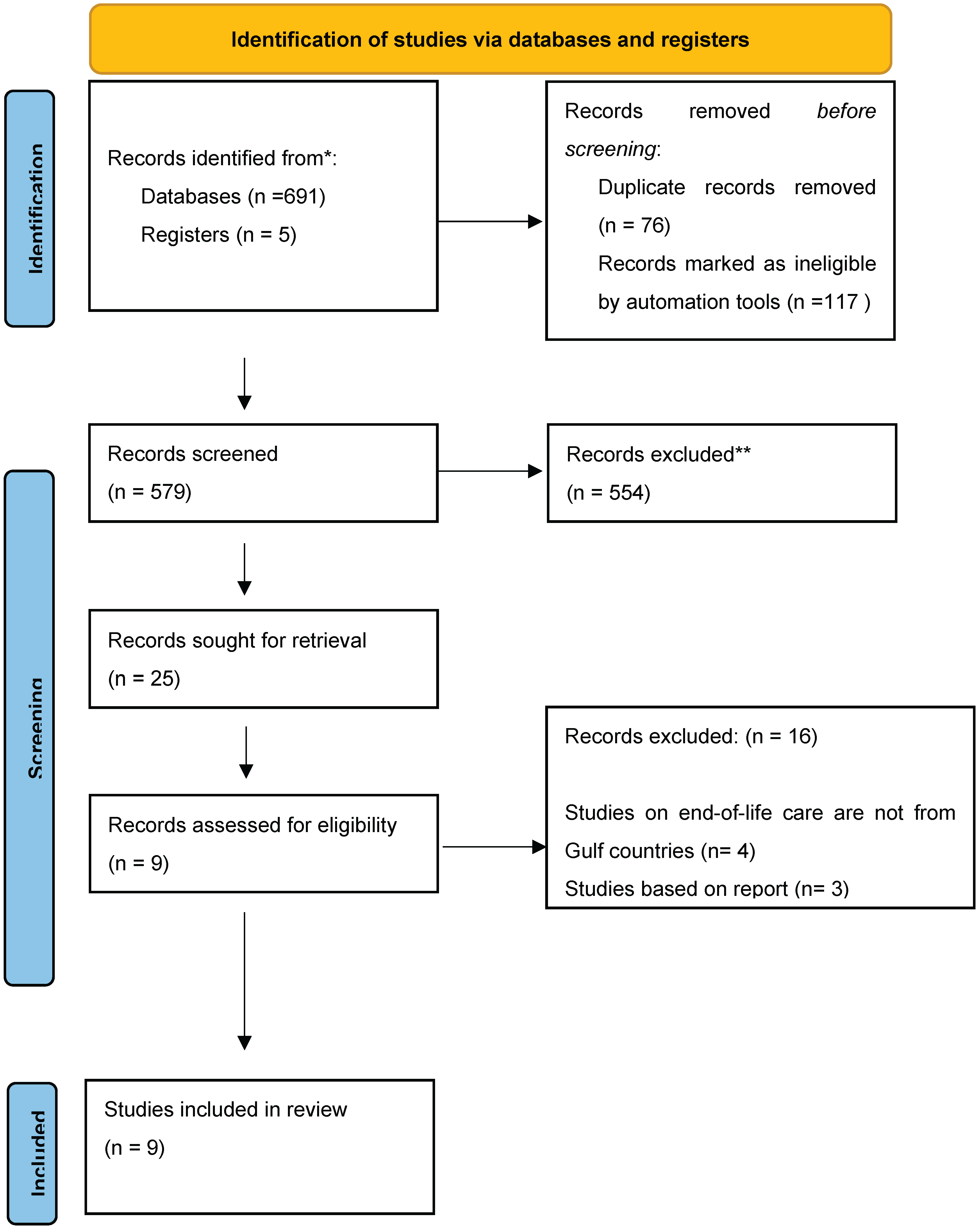
Overall, 691 articles were identified through database searching, with 193 removed due to duplication and irrelevance. After screening 579 titles and abstracts, 25 full texts were assessed for eligibility. Nine studies were included in the final review. The summary of the screening process is presented in Figure 1.
Methodological Quality
Overall, the included studies demonstrated moderate to high methodological quality. The cross-sectional studies met most of the JBI appraisal criteria, including clearly defined inclusion criteria, detailed descriptions of participants and settings, and appropriate statistical analyses; however, they did not identify or address potential confounding factors. The qualitative studies generally showed strong methodological rigour, with clear alignment between research methodology, data collection, analysis, and interpretation, and adequate representation of participants’ voices. Nevertheless, several studies did not clearly report the researchers’ cultural or theoretical positioning or address the influence of the researcher on the research process. The mixed-methods study also demonstrated acceptable methodological quality according to the MMAT criteria, although some aspects related to the interpretation of integrated findings were unclear. Overall, despite these limitations, the studies were considered sufficiently robust to contribute to the evidence synthesis. The overall methodological quality of the included studies is summarised in Table 1.
Characteristics of Included Studies
An overview of the included studies is presented in Table 2. A total of ten studies, published between 2006 and 2023, were included in the review. The majority were qualitative in design (n=7), alongside one mixed-method study and one cross-sectional analytical study. These studies were conducted across several Middle Eastern countries, including Saudi Arabia (n=7), the United Arab Emirates (n=1), and Bahrain (n=1). Research settings varied and included tertiary hospitals, palliative care units, intensive care units, and paediatric/neonatal ICUs. Study participants were predominantly expatriate nurses and other healthcare providers, with sample sizes ranging from 6 to 431 participants. Most participants were female, with diverse cultural and religious backgrounds, and the majority held at least a bachelor’s degree in nursing. Collectively, the studies explored challenges and facilitators in providing end-of-life and palliative care, with particular emphasis on communication barriers, cultural considerations, family involvement, and the provision of compassionate care.
Communication Barriers
Communication barriers emerged as one of the most frequently reported challenges across the included studies. Several studies highlighted that expatriate nurses often experienced difficulties communicating with patients and families due to limited Arabic language proficiency, which constrained their ability to provide emotional support and participate in sensitive end-of-life discussions [3,5,7,9]. Nurses described how language barriers affected their confidence when interacting with patients and families during emotionally complex situations. For example, one participant explained: “There is a barrier when it comes to talking because I'm not really that good at speaking Arabic” [5].
Similarly, another nurse highlighted the difficulty of providing psychological support due to limited language skills: “I want to improve my skills in talking, especially in giving psychological support to the patient, or to the primary caregivers who are usually with the patient at that time. But I'm not really very good at talking” [5].
To address these challenges, nurses frequently relied on Arabic-speaking colleagues or professional translators to facilitate communication with families [3,5]. One participant described this strategy: “We are asking other Arab nurses to speak to the family… we are providing translators for them to understand and explain to us” [5]. These findings illustrate the significant influence of language barriers on the quality of nurse–patient communication in multicultural healthcare environments.
Cultural and Religious Challenges
Cultural and religious differences also emerged as a major challenge for expatriate nurses providing end-of-life care. Several studies reported that nurses often felt uncertain when navigating Islamic traditions, family expectations, and culturally specific practices related to death and dying [1,3,6,8].
For example, non-Muslim nurses described unfamiliarity with Islamic prayer practices and religious rituals that occur during end-of-life care. One nurse reflected on this experience: “Praying is very different in Islam from what I am used to in Christianity. It is more vocal and structured, and it is at a certain time, so you have to acknowledge that” [3]. Another participant highlighted the importance of understanding family traditions when caring for dying patients: “We have to be aware of and be oriented to their beliefs about death… we need to know what the traditions are of this family” [6].
Despite these challenges, nurses often demonstrated cultural sensitivity and adaptability by incorporating religious practices into patient care. For example, nurses described facilitating spiritual rituals such as providing access to the Qur’an or Zamzam water, which were considered important for families coping with illness and death [3].
Organisational and Structural Barriers
Organisational constraints were also identified as significant barriers to providing effective end-of-life care. Several studies reported that heavy workloads, time constraints, and limited staffing reduced nurses’ ability to deliver holistic care to dying patients [2,5]. Participants described working in busy clinical environments where competing responsibilities limited opportunities to engage with patients and families during end-of-life care. One nurse explained:
“We are always busy… there is no time, you will not be able to provide maximum care to terminal patients” [5]. In addition, some studies highlighted the lack of specialised palliative care training and institutional support, which contributed to uncertainty when managing complex end-of-life situations [2,4]. Nurses reported that additional training and organisational support would improve their confidence and competence when providing end-of-life care.
Role of Families in End-of-Life Care
Family involvement emerged as a central factor influencing the delivery of end-of-life care across several studies [3,5,7]. In many Middle Eastern healthcare contexts, families play an active role in decision-making and emotional support for patients.
Nurses frequently described family members as essential partners in care. One participant emphasised this role: “They are the number one support system of the patients… nurses are just an additional factor in the hospital” [5]. Family presence was also perceived as beneficial in supporting patients emotionally and assisting with basic care needs [7]. However, nurses occasionally reported challenges when family expectations conflicted with medical recommendations, particularly when families requested continued aggressive treatment despite poor prognoses [3].
Compassionate and Holistic Care
Despite the challenges identified across the studies, nurses consistently emphasised the importance of compassionate and holistic care when supporting patients and families at the end of life [4,5,8].
Participants described empathy, respect, and emotional presence as central to their professional practice. One nurse explained: “We should consider each and every patient as our family member. We should treat them like that” [5].
Another participant described compassionate care as involving listening, trust, and respect for patient and family preferences: “Providing them with good care and services, respecting their decisions, listening to their words, showing them empathy, building trust” [5].
Teamwork and Peer Support
Teamwork and peer support were identified as important facilitators in the delivery of end-of-life care [2,4,7,8]. Nurses frequently relied on colleagues for emotional support, cultural guidance, and assistance with communication. One participant noted: “We share our experiences with each other so that we know how to deal with them in the future, especially if you are new. We ask and seek information from senior colleagues” [4]. Collaboration with Arabic-speaking staff was particularly important for overcoming language barriers and ensuring effective communication with families [2,4] Team leaders were also described as playing a key role in supporting staff emotionally, particularly in environments where nurses regularly experienced patient death. [2,4]
Discussion
The findings of this systematic review highlight the complex and interconnected challenges expatriate nurses encounter when providing end-of-life (EOL) care in Middle Eastern healthcare settings, particularly in Saudi Arabia. Overall, the evidence suggests that language discordance, cultural and religious differences, organizational constraints, and family-centered decision-making structures collectively shape nurses’ experiences and influence the quality of care. These findings reinforce the importance of addressing both individual and systemic factors to support culturally responsive EOL practices (Aboshaiqah et al., 2020; Alshammari et al., 2022).
Language barriers emerged as one of the most consistently reported challenges. Expatriate nurses frequently described limited Arabic proficiency as a major obstacle to engaging in meaningful communication, particularly during emotionally sensitive discussions regarding prognosis and death (Alshammari et al., 2022; Khalid et al., 2023). While effective communication is a cornerstone of high-quality EOL care, this review suggests that language discordance significantly limits a nurse's ability to provide compassionate support, often leading to feelings of professional inadequacy (Khalid et al., 2023). Recent evidence confirms these difficulties are not merely individual limitations but reflect broader structural gaps, such as a lack of professional interpreter services within regional hospitals (Almutairi et al., 2020).
Beyond linguistics, cultural and religious differences significantly influence EOL experiences. Expatriate nurses often struggle to navigate culturally embedded expectations surrounding death and Islamic religious rituals (Al-Mansour, 2021). In many Middle Eastern contexts, family members play a central role in medical decisions, and open discussions about terminality may be culturally discouraged to maintain hope (Al-Mansour, 2021; Alshammari et al., 2022). Consequently, nurses trained in Western systems emphasizing individual patient autonomy experience significant tension when adapting to these family-centered models. This creates a complex landscape where providers must navigate between their overseas professional training and local cultural expectations—a phenomenon increasingly documented in recent regional studies (Aboshaiqah et al., 2020).
The review also underscores the influence of organizational and structural factors. Nurses frequently operate in high-pressure environments characterized by heavy workloads, which curtails the time needed for the emotional and spiritual aspects of EOL care (Almutairi et al., 2020). These constraints are exacerbated by limited access to specialized palliative care training, contributing to uncertainty when managing complex end-of-life trajectories (Al-Yateem et al., 2023). Improving care delivery thus requires not only enhancing individual competencies but also strengthening institutional frameworks that prioritize holistic, patient-centered care.
Family involvement remains a pivotal theme. While families provide essential emotional continuity, challenges arise when their expectations for aggressive treatment conflict with medical recommendations for palliative transition (Al-Yateem et al., 2023). Expatriate nurses often experience "moral distress" and ethical uncertainty when navigating these dynamics, especially when communication barriers prevent clear mediation of EOL preferences (Khalid et al., 2023). This highlights the urgent need for clear institutional policies and culturally sensitive communication strategies to mitigate the emotional burden on expatriate staff.
Despite these hurdles, the findings demonstrate that expatriate nurses employ various adaptive strategies, such as empathy, spiritual sensitivity, and collaborative teamwork, to build trust (Al-Mansour, 2021). However, while individual coping is commendable, broader institutional support—including structured language systems, cultural competence programs, and specialized palliative education—is necessary to sustain a resilient nursing workforce in multicultural environments (Aboshaiqah et al., 2020; Alshammari et al., 2022).
Strengths and Limitations
This review is strengthened by its rigorous use of the JBI methodology, comprehensive multi-database search strategy, and inclusion of both qualitative and quantitative studies, which allowed for a rich synthesis of expatriate healthcare providers’ experiences in end-of-life care across Gulf countries. The use of critical appraisal tools ensured the methodological quality of included studies, while meta-aggregation provided structured and transparent synthesis of findings.
This review has several limitations that should be considered when interpreting the findings. The included studies varied in design, settings, and participant characteristics, which may influence the comparability of results. Most studies were conducted in Middle Eastern contexts, particularly Saudi Arabia and the UAE, which may affect broader applicability. Additionally, some studies used smaller samples and non-probability sampling approaches, and variations in reporting across studies may have influenced the overall synthesis of the evidence.
Conclusion
End-of-life (EOL) care in the Gulf region reflects a complex interplay between clinical practice, cultural values, and ethical reasoning. Expatriate healthcare professionals, who constitute the majority of the workforce, often navigate unfamiliar sociocultural landscapes where communication barriers, differing ethical norms, and systemic constraints converge. This systematic review demonstrates that gaps in cultural competence and ethical preparedness can compromise both the quality of care and the well-being of providers. Yet, these challenges also create opportunities for healthcare systems to reimagine training, support structures, and care models that move beyond a purely medical focus. Ultimately, improving EOL care in the region is not solely a clinical imperative but a moral and cultural one—one that requires acknowledging the dignity of patients, the needs of families, and the vulnerabilities of caregivers. This review suggests thats healthcare systems can move closer to achieving a model of care that is not only clinically competent but also ethically and culturally pleasing.
Acknowledgments
The authors would like to thank Dr. Ibrahim Alananzeh for his guidance, coordination, and valuable input throughout the development of this manuscript. We also extend our sincere appreciation to the academic and clinical colleagues at the University of Wollongong in Dubai, Fatima College of Health Sciences, National Ambulance UAE, Emirates Health Services, and Emirates Hospital Group for their support and constructive feedback during the study process.
Conflicts of Interest
The authors declare that they have no competing interests. No external funding was received for this study.
References
- Aboshaiqah, A. E.; Tumala, R. B.; Patalagsa, J. G.; Al-Khaibary, A. A. ‘Cultural competence and its influence on the quality of care provided by expatriate nurses’. Journal of Nursing Management 2020, 28(6), 1259–1268. [Google Scholar]
- Abu-Ghori, I. K.; Bodrick, M. M.; Hussain, R.; Rassool, G. H. ‘Nurses' involvement in end-of-life care of patients after a do not resuscitate decision on general medical units in Saudi Arabia’. Intensive and Critical Care Nursing 2016, 33, 21–29. [Google Scholar] [CrossRef]
- Abudari, G.; Hazeim, H.; Ginete, G. ‘Caring for terminally ill Muslim patients: lived experiences of non-Muslim nurses’. Palliative and Supportive Care 2016, 14(6), 599–611. [Google Scholar] [CrossRef]
- Abudari, G.; Zahreddine, H.; Hassan, H.; Al Assi, M.; Emara, S. ‘Knowledge of and attitudes towards palliative care among multinational nurses in Saudi Arabia’. International Journal of Palliative Nursing 2014, 20(9), 435–441. [Google Scholar] [CrossRef]
- Ahmed, F.; et al. ‘A multi-country mixed-method study identifying the association between perceived ethical work climate and problems among critical care nurses’. BMC Nursing 2024, 23, 461. [Google Scholar] [CrossRef]
- Al-Dosary, S.; Al-Zahrani, A. ‘Healthcare expatriate adjustment in Qatar: analyzing challenges and opportunities’. Cureus 2024, 16(2), e54668. [Google Scholar] [CrossRef] [PubMed]
- Alamri, R. A. ‘Role of leadership in promoting health and safety culture: a comprehensive review of GCC countries’. International Journal of Pharmaceutical and Healthcare Marketing 2024. [Google Scholar] [CrossRef]
- Almansour, I.; Seymour, J. E.; Aubeeluck, A. ‘Staff perception of obstacles and facilitators when providing end-of-life care in critical care units’. Intensive and Critical Care Nursing 2019, 53, 8–14. [Google Scholar] [CrossRef] [PubMed]
- Al-Mansour, A. F. ‘Providing end-of-life care in Saudi Arabia: the experience of expatriate nurses’. International Journal of Palliative Nursing 2021, 27(3), 132–141. [Google Scholar]
- Almoajel, A. ‘Quality of palliative care: perspective of healthcare providers at a tertiary hospital in Riyadh, Saudi Arabia’. Journal of Religion and Health 2020, 59(5), 2442–2457. [Google Scholar] [CrossRef]
- Al Mutair, A.; Al Ammary, M.; Brooks, L. A.; Bloomer, M. J. ‘Supporting Muslim families before and after a death in neonatal and paediatric intensive care units’. Nursing in Critical Care 2019, 24(4), 192–200. [Google Scholar] [CrossRef] [PubMed]
- Almalki, N.; Boyle, B.; O’Halloran, P. ‘What helps or hinders effective end-of-life care in adult intensive care units in Middle Eastern countries? A systematic review’. BMC Palliative Care 2024, 23, 89. [Google Scholar] [CrossRef]
- Almutairi, A. F. ‘A multicultural nursing workforce and cultural perspectives in Saudi Arabia: an overview’. The Health Care Manager 2012, 31(2), 91–97. [Google Scholar]
- Almutairi, A. F.; Dahinten, V. S.; Adlan, A. A. ‘Cultural challenges and coping strategies of expatriate nurses in Saudi Arabia’. Journal of Transcultural Nursing 2020, 31(4), 350–358. [Google Scholar]
- Alshammari, F.; Sim, J.; Lapkin, S.; McErlean, G. ‘Registered nurses' attitudes towards end-of-life care’. Journal of Clinical Nursing 2023, 32(19–20), 7162–7174. [Google Scholar] [CrossRef]
- Alshammari, M.; Alshammari, A.; Alshammari, S. ‘Challenges of end-of-life care in the Middle East’. Journal of Palliative Medicine 2022, 25(5), 789–801. [Google Scholar]
- Alsulami, M.; Alsolami, W. ‘Implications of workload and work environment among expatriate healthcare workers in Saudi Arabia’. Journal of Namibian Studies 2022, 33, 4892–4907. [Google Scholar]
- Al-Yateem, N.; Al-Tamimi, M.; Brenner, M. ‘Palliative care in the Gulf Cooperation Council countries’. Journal of Nursing Scholarship 2023, 55(2), 412–424. [Google Scholar]
- Attia, A. K.; Abd-Elaziz, W. W.; Kandeel, N. A. ‘Critical care nurses’ perception of barriers and supportive behaviors in end-of-life care’. American Journal of Hospice and Palliative Medicine 2013, 30(3), 297–304. [Google Scholar] [CrossRef] [PubMed]
- Bashir, A. ‘Healthcare expatriate adjustment in Qatar: analyzing challenges and opportunities’. Cureus 2024, 16(2), e54720. [Google Scholar] [CrossRef]
- Brooks, L. A.; Manias, E.; Nicholson, P. ‘Barriers, enablers and challenges to initiating end-of-life care’. Australian Critical Care 2017, 30(3), 161–166. [Google Scholar] [CrossRef]
- Devasia, J. ‘Influence of majority expatriate national cultures on organizational culture in the UAE healthcare sector’. ARPHA Conference Abstracts 2024, 7, e129721. [Google Scholar] [CrossRef]
- Dosser, I.; Kennedy, C. ‘Family carers' experiences of support in palliative care’. International Journal of Palliative Nursing 2012, 18(10), 491–497. [Google Scholar] [CrossRef]
- Effendy, C.; et al. ‘Barriers and facilitators in the provision of palliative care in adult intensive care units’. Acute and Critical Care 2022, 37(4), 516–526. [Google Scholar] [CrossRef]
- Fang, M. L.; et al. ‘Experiencing pathways and places: non-linear journeys through palliative care’. Palliative Medicine 2015, 29(8), 731–740. [Google Scholar]
- Halligan, P. ‘Caring for patients of Islamic denomination’. Journal of Clinical Nursing 2006, 15(12), 1565–1573. [Google Scholar] [CrossRef]
- Harhara, T.; et al. ‘Internal medicine residents' perceptions and experiences in palliative care in the UAE’. BMC Palliative Care 2022, 21, 35. [Google Scholar] [CrossRef]
- Iheduru-Anderson, K.; et al. ‘Internationally educated nurses’ workplace acculturation and strategies for integration’. International Journal of Health Transition and Social Policy 2026, 4(2), 297–309. [Google Scholar]
- Khalid, A.; Al-Zahrani, S.; Miller, J. ‘Language barriers and moral distress in expatriate nurses’. Nursing Ethics 2023, 30(1), 45–59. [Google Scholar]
- Kuzemski, K.; Al-Delaimy, W. K.; Jaber, R. ‘Cultural barriers in end-of-life care communication’. International Journal of Nursing Studies 2022, 128, 104–112. [Google Scholar]
- Kyeremanteng, K.; et al. ‘Survey on barriers to critical care and palliative care integration’. American Journal of Hospice and Palliative Medicine 2020, 37(2), 108–116. [Google Scholar] [CrossRef]
- Mani, Z. ‘Bridging cultural gaps in end-of-life care’. BMC Nursing 2024, 23, 789. [Google Scholar] [CrossRef]
- Mendieta, M.; Buckingham, R. W. ‘A review of palliative and hospice care in the context of Islam’. International Journal of Palliative Nursing 2017, 23(7), 327–334. [Google Scholar]
- Miller, S. C.; et al. ‘Palliative care consultations in nursing homes’. Journal of the American Geriatrics Society 2020, 68(6), 1274–1281. [Google Scholar]
- Nijhawan, N. A.; Al-Shams, H. O. ‘Experiences and challenges of a new palliative care service in the UAE’. Palliative Medicine and Hospice Care 2022, 8(3), 150–159. [Google Scholar]
- Oakley, L.; Maconochie, I.; Al-Busaidi, N. ‘Healthcare workforce challenges in GCC countries’. International Journal of Health Policy and Management 2019, 8(4), 203–215. [Google Scholar]
- Oakley, S.; Grealish, L.; Coyne, E. ‘Lived experience of expatriate palliative care nurses in the UAE’. European Journal of Oncology Nursing 2020, 48, 101793. [Google Scholar] [CrossRef]
- O’Neill, C. S.; et al. ‘Nurses’ care practices at the end of life in intensive care units in Bahrain’. Nursing Ethics 2017, 24(8), 950–961. [Google Scholar] [CrossRef]
- Rassam, S.; et al. ‘Regional paediatric palliative care workshop for the Eastern Mediterranean region’. Ecancermedicalscience 2025, 19, 1948. [Google Scholar]
- Saifan, A.; et al. ‘Challenges and coping strategies of expatriate nurses in Gulf countries’. International Nursing Review 2024, 71(1), 45–56. [Google Scholar]
- Saeed, F.; et al. ‘End-of-life care beliefs among Muslim physicians’. American Journal of Hospice and Palliative Medicine 2015, 32(4), 388–392. [Google Scholar] [CrossRef] [PubMed]
- Wazqar, D. Y. ‘Arabic version of the palliative care self-efficacy scale’. Palliative and Supportive Care 2023, 21(4), 567–574. [Google Scholar] [CrossRef] [PubMed]
- Weng, X.; et al. ‘Healthcare providers' attitudes and beliefs on providing palliative care in Bahrain’. Journal of Pain and Symptom Management 2020. [Google Scholar]
- World Health Organization. Strengthening of palliative care as a component of comprehensive care throughout the life course; WHO Press: Geneva, 2015. [Google Scholar]
Figure 1.
PRISMA flow diagram of search and study selection process.
Disclaimer/Publisher’s Note: The statements, opinions and data contained in all publications are solely those of the individual author(s) and contributor(s) and not of MDPI and/or the editor(s). MDPI and/or the editor(s) disclaim responsibility for any injury to people or property resulting from any ideas, methods, instructions or products referred to in the content. |
© 2026 by the authors. Licensee MDPI, Basel, Switzerland. This article is an open access article distributed under the terms and conditions of the Creative Commons Attribution (CC BY) license (http://creativecommons.org/licenses/by/4.0/).
Copyright: This open access article is published under a Creative Commons CC BY 4.0 license, which permit the free download, distribution, and reuse, provided that the author and preprint are cited in any reuse.


