

Submitted:
25 May 2026
Posted:
26 May 2026
You are already at the latest version
Abstract
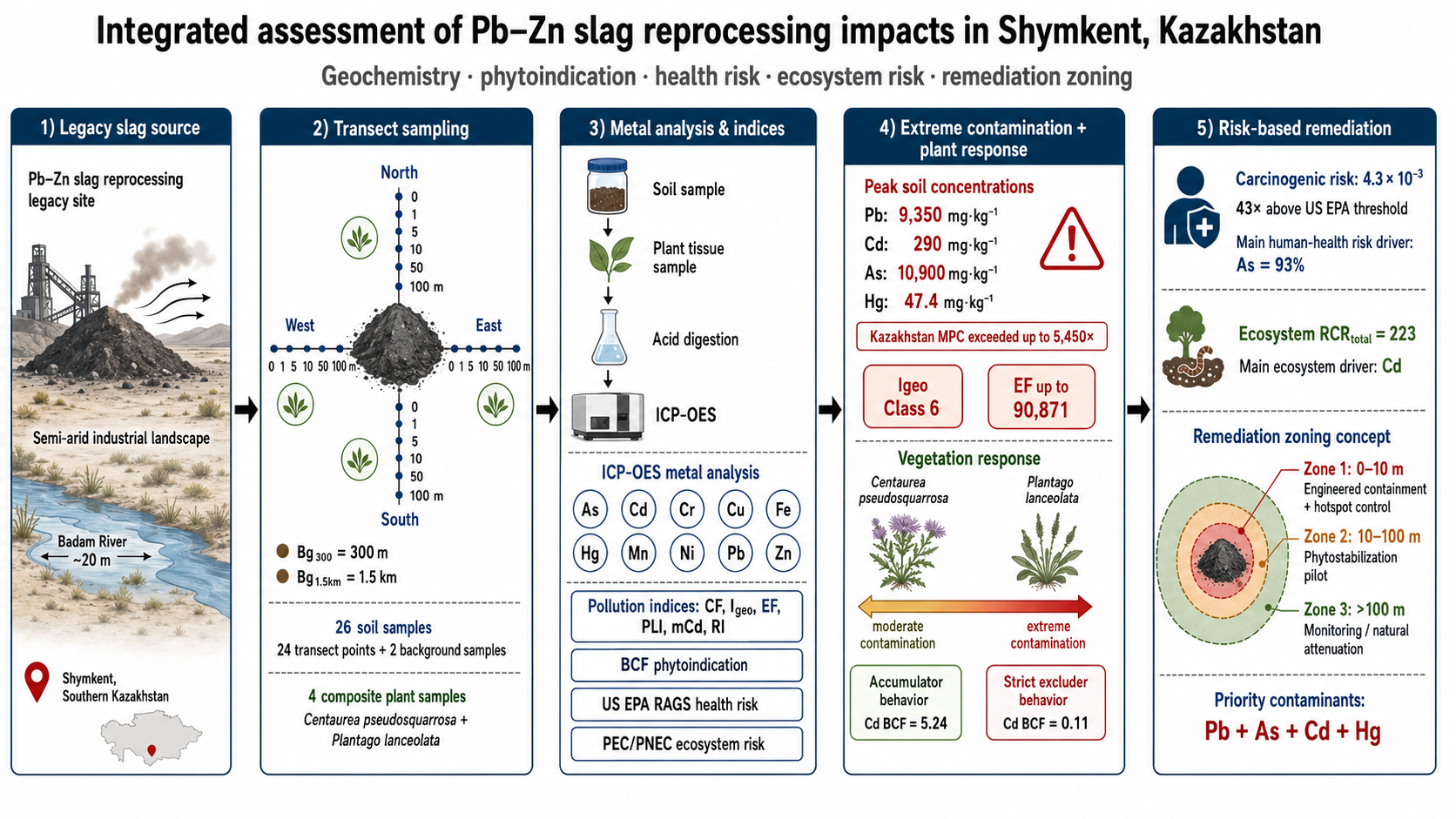
Reprocessing historical lead–zinc (Pb–Zn) slag offers a circular-economy pathway for secondary metal recovery, yet it can remobilize legacy contaminants where con-tainment is inadequate, transferring risk to the surrounding land. Sustainable man-agement of such sites requires frameworks that link contamination assessment to ac-tionable remediation. We integrated ICP-OES geochemistry, native-plant biomonitor-ing, and US EPA RAGS-based risk modeling at an active Pb–Zn slag reprocessing site in Shymkent, Southern Kazakhstan. Twenty-four soil samples along four cardinal transects, two reference samples, and four composite plant samples (Centaurea pseu-dosquarrosa + Plantago lanceolata) were analyzed for ten metals by ICP-OES. UCC-referenced indices classified six metals as geoaccumulation Class 6 at most points (enrichment factors up to 90,871, confirming an exclusively anthropogenic origin). Peak concentrations reached 9,350 mg·kg⁻¹ Pb, 290 mg·kg⁻¹ Cd, and 10,900 mg·kg⁻¹ As — exceeding Kazakhstan MPC by 72×, 290×, and 5,450×. Worst-case carcinogenic risk reached 4.3 × 10⁻³ (43× above the US EPA threshold), driven almost entirely by arsenic (93%); ecosystem risk (RCRtotal = 223) was dominated by cadmium (43%), arsenic (27%), and mercury (16%) — a disconnect between mass-based and toxicity-based prioritiza-tion. On this basis we propose a three-tier remediation framework (engineered con-tainment, phytostabilization, monitored attenuation) that couples resource recovery with contamination control, is transferable to analogous Pb–Zn legacy sites, and sup-ports sustainable land use, urban resilience, and responsible secondary-resource use.
Keywords:
heavy metal contamination
; circular economy
; contaminated site management
; risk assessment
; phytostabilization
; ecological risk
; arsenic
; cadmium
; slag reprocessing
; Central Asia
Copyright: This open access article is published under a Creative Commons CC BY 4.0 license, which permit the free download, distribution, and reuse, provided that the author and preprint are cited in any reuse.


