

Submitted:
26 May 2026
Posted:
27 May 2026
You are already at the latest version
Abstract
Background: For stage I non-small cell lung cancer surgery remains the cornerstone of the treatment and the use of minimally invasive technique is desirable. The lack of tactile feedback in RATS is a well-known drawback of this approach, so the precise identification of the disease is crucial for performing the lung resection. Methods: We present our retrospective case history, accounting for 82 patients, divided into two groups based on marking technique: 99mTc-MAA (99mTechnetium Albumin Macroaggregates) only (Tech group) (22 cases, 26,5%) and 99mTc-MAA + Indocianine green (Tech+ICG group) (61 cases, 73,49%). Results: In Tech group there were 11 males (50%) ad 11 females (50%), median nodule diameter was 21,5mm (IQR 16), median distance of the nodule from visceral pleura was 18 mm (IQR 21). Eighteen out of 22 nodules (81,82%) were subsolid. Three conversions were reported, all due to failure to identify the nodule (13,63%). Mean operative time was 111,6 ± 45,6 min. At the histopathological examination resulted 13 lung adenocarcinomas, 1 squamous cells carcinomas, 2 minimally invasive lung adenocarcinomas, 2 lung adenocarcinomas in situ, 3 metastases from another tumor and 1 benign nodule. In Tech+ICG group there were 27 males (44,26%) and 34 females (55,73%), median nodule diameter was 18mm (IQR 14), median distance of the nodule from visceral pleura was 24mm (IQR 15). Forty-six out of 61 nodules were subsolid (75,4%). Four conversion was reported, due to failure in nodule identification (6,55%). Operative time was 105,6 ± 36,8 min. At the histopathological examination resulted 12 lung adenocarcinomas, 7 squamous cells carcinoma, 9 minimally invasive lung adenocarcinomas, 12 lung adenocarcinomas in situ, 1 typical carcinoid, 7 atypical adenomatous hyperplasias, 7 metastases from another tumor and 6 benign nodules. The two groups are homogeneous in terms of median nodule diameter (p = 0,676), median distance from visceral pleura (p = 0,114), SUV max (p = 0,894), operative time (p = 0,512), nodule characteristics (solid vs subsolid) (p = 0,724). Conclusions: Both techniques appear to be safe and reproducible. Further standardized studies are needed to validate and confirm the results obtained from our case series.
Keywords:
RATS lung resection
; lung nodule localization
; nodule marking
; sublobar lung resection
1. Introduction
Increasing use of computed tomography (CT) scans, has led to the detection of small size lung nodules, including solid and subsolid ones [1]. For I stage non-small cell lung cancer (NSCLC) surgery remains the cornerstone of the treatment and the use of minimally invasive technique is desirable. Concurrently, the surgical management of early-stage NSCLC has undergone a paradigm shift after the results of the JCOG0802/WJOG4607L and CALGB 140503 trials [2,3], sublobar resection, including lung segmentectomy and wedge resection, has emerged as a valuable option for <2cm peripheral lung nodules. In addition, other efforts have focused on the management of part-solid lesions and pure ground-glass opacities (GGO), and the role of lymphadenectomy in these lesions [4].
However, the transition toward parenchymal-sparing surgery presents significant technical issues, particularly in the context of Robotic-Assisted Thoracic Surgery (RATS). The RATS provides superior visualization and greater maneuverability compared to conventional Video-Assisted Thoracic Surgery (VATS). However the lack of tactile feedback in RATS is a well-known drawback of this approach, so the precise identification of the disease is crucial for performing the lung resection, especially in cases where there is no preoperative histopathological diagnosis. This absence of tactile sensation makes the intraoperative identification of small, deep-located, or non-solid nodules challenging. Without precise localization, there is an increased risk of inadequate surgical margins, prolonged operative times, or the need for an unwanted conversion to thoracotomy.
The widespread implementation of lung cancer screening programs has led to a substantial increase in the detection of pulmonary nodules. While this has contributed to earlier diagnosis and improved survival in selected populations, it has simultaneously provided a growing cohort of lung nodules lacking a certain histological diagnosis [5]. The majority of these lesions are small, peripheral, and often non-palpable, posing significant challenges for intraoperative localization and diagnostic assessment. Consequently, the ability to accurately identify and localize pulmonary nodules has become a critical step in the diagnostic and therapeutic pathway.
Moreover, the increasing prevalence of subsolid nodules and ground-glass opacities, lesions often associated with early-stage adenocarcinoma [6], highlights the importance of accurate intraoperative identification. These lesions are particularly challenging due to their subtle radiological appearance and lack of distinct anatomical limits.
To overcome these limitations, several preoperative localization techniques have been developed, ranging from the use of metallic hooks and coils to the injection of liquid dyes [7,8]. Among these, localization using 99mTc-MAA has proven to be a reliable method [9]. The emission of gamma radiation allows for trans-parenchymal detection using a gamma probe which displays the recorded radioactivity using a numerical scale and an audible signal.
In the last decade near-infrared (NIR) fluorescence imaging using Indocyanine Green (ICG) has gained consensus [10,11]. In literature ICG has been injected directly on the segment of interest by mean of bronchoscopy. When injected peritumorally under CT guidance, ICG provides a clearly defined fluorescent mark on pleural surface, because of lung lymphatic drainage.
Despite the theoretical benefits of combining these tracers, there is a need for clinical data comparing the efficacy and safety of the mixed-technique approach versus fluorescence or Tc-99m alone. This study aims to evaluate and compare the surgical outcomes, localization success rates, and complication profiles of patients undergoing pulmonary nodule localization with 99mTc-MAA alone versus a combined 99mTc-MAA and ICG approach in the setting of RATS lung resection.
2. Materials and Methods
We conducted a study to evaluate the efficacy, the safety and the reproducibility of preoperative pulmonary nodule localization using two different markers: Tc-99m radiocolloid alone (Tech Group), and combination of Tc-99m-MAA and Indocyanine Green (Tech+ICG Group). This is a single center retrospective study that enrolled 83 patients from January 2019 to February 2026. Each patient was scheduled to RATS lung resection. For every patient demographic data were recorded (age at surgery, sex, Body Mass Index (BMI), smoker status and pack years). The study was conducted in accordance with the Declaration of Helsinki, and approved by the Institutional Review Board of Cardio-Thoraco-Vascular Department of Hospital San Camillo-Forlanini (protocol number 002326, approved on March 13rd, 2026). All patients approved written an informed consent form for both the nodule localization procedure and the surgical intervention.
None of the patients had a preoperative histological diagnosis, so in no case an anatomic lung resection has been preoperatively scheduled. In addition to a whole-body CT scan for staging, all patients also underwent a PET-CT (positron emission tomography) scan with 18FDG (18-fluorodeoxyglucose); nodule diameter, depth from visceral pleural, lobe of belonging and SUV max (maximum standard uptake value) were recorded for each patient. Nodule radiological characteristics were classified in pure GGO, solid nodule, part-solid nodule with CTR<0.5 (consolidation to tumor ratio) and part-solid nodule with CTR>0.5, according to Fleischner 2017 guidelines. Surgical data recorded includes operative time, conversion to open surgery, procedure complications, surgical complications, length of stay, and failure of marking technique.
The marking procedure were performed the day before the intervention (about 20 hours before the surgery), because based on our previous experience, it was observed that ICG distributed more effectively on the pleural surface and provided a clearer indication of the nodule’s location compared to marking procedure performed on the morning of the procedure.
In both groups the procedure was performed under CT guidance by two interventional radiologists experienced in lung nodule biopsy. In the Tech Group, 20-25 MBq of 99mTc-MAA was injected. In the Tech+ICG Group 25 mg of ICG powder, at a concentration of 5 mg/mL, is dissolved in 5 mL of saline solution, and 0,3 mL of this solution is then injected together with 99mTc-MAA. At the start of the experience the radiologist injected the solution directly into the nodule in some cases, based on the accessibility and the depth of the nodule. In such cases, the pathologist reported the presence of a neutrophilic inflammatory infiltrate into and nearby the lesion. For this reason, direct injection into the nodule was deliberately avoided, and injection near the lesion was preferred. At least 5 hours after the procedure, each patient underwent chest X-ray to check for pneumothorax and/or hemothorax, even though the presence of pneumothorax is routinely assessed by CT scan immediately after the procedure. Three patients in Tech group developed pneumothorax after the marking, that did not require pleural drainage, and one patient developed lung hematoma. In Tech+ICG group three patients experienced pneumothorax, managed conservatively.
Our standard approach for lung resection and lymphadenectomy procedures is a fully robotic four ports approach with carbon dioxide insufflation: three 8mm incisions and one 12mm anterior incision used for surgical specimen extraction.
During surgery, the Tech group relied only on a handheld gamma probe to detect radioactivity. In the Tech+ICG group, localization was achieved at first through the NIR fluorescence imaging, allowing for real-time visual identification of the region on the lung surface to underwent to resection, and a confirmation inserting the gamma probe in the chest, via the 12mm port access, or once the histological specimen has been removed.
Statistics
The data are presented as the median ± interquartile range (IQR) for normally distributed data, or as the mean ± standard deviation (SD) for non-normally distributed data. Statistical comparisons were performed using the Student's T-test or Mann-Whitney U test for continuous variables, and the Chi-square or Fisher’s exact test for categorical variables. A p-value < 0.05 was considered statistically significant. The data was processed using Microsoft Excel v16.108.3 and IBM SPSS Statistics v30.
3. Results
In Tech group there were 11 males (50%) ad 11 females (50%), median age was 50,5 years (IQR 28,25), median BMI was 28,7 kg/m2 (IQR 7,2). Six patients were current smokers and 11 former smokers with a mean pack years number of 34,88 (SD ± 19,18). Three nodules were located in right lower lobe, 4 in left upper lobe, 6 in middle lobe, 5 in right upper lobe and 4 in left lower lobe. Median nodule diameter was 21,5mm (IQR 16), median distance of the nodule from visceral pleura was 18 mm (IQR 21), mean SUV max was 5,54 (SD ± 3,22). Eighteen out of 22 nodules (81,82%) were subsolid: 5 pure GGO nodules, 7 nodules with CTR<0,5, 6 nodules with CTR> 0,5; four out of 22 nodules were solid (18,18%). Three conversions were reported, all due to failure to identify the nodule (13,63%). Operative time was 111,6 ± 45,6 min. Length of stay was 6 days (SD ± 2,8). At the histopathological examination resulted 13 lung adenocarcinoma, 1 squamous cells carcinoma, 2 minimally invasive lung adenocarcinoma, 2 lung adenocarcinoma in situ, 3 metastases from another tumor and 1 benign nodule.
In Tech+ICG group there were 27 males (44,26%) and 34 females (55,73%), median age was 44 years (IQR 31), median BMI was 27 kg/m2 (IQR 8,9). Twenty-four patients were current smokers and 20 former smokers with a mean pack years number of 33,52 (SD ± 16,39); 17 patients were never smokers. Sixteen nodules were located in right lower lobe, 18 in left upper lobe, 11 in middle lobe, 9 in right upper lobe and 7 in left lower lobe. Median nodule diameter was 18mm (IQR 14), median distance of the nodule from visceral pleura was 24mm (IQR 15), mean SUV max was 5,69 (SD ± 3,23). Forty-six out of 61 nodules were subsolid (75,4%): 19 pure GGO nodules, 17 nodules with CTR<0,5, 10 nodules with CTR> 0,5; fifteen out of 61 nodules were solid (24,6%). Four conversion was reported, due to failure in nodule identification (6,55%). Operative time was 105,6 ± 36,8 min. Length of stay was 5,5 days (SD ± 2,9). At the histopathological examination resulted 12 lung adenocarcinoma, 7 squamous cells carcinoma, 9 minimally invasive lung adenocarcinoma, 12 lung adenocarcinoma in situ, 1 typical carcinoid, 7 atypical adenomatous hyperplasia, 7 metastases from other tumor and 6 benign nodules.
The two groups are homogeneous in terms of median nodule diameter (p=0,676), median distance from visceral pleura (p=0,114), SUV max (p=0,894), operative time (p=0,512), nodule characteristics (solid vs subsolid) (p=0,724). No significant difference was observed in failure of technique between two groups TECH 13.6% vs Tech+ICG 6.6%, (p = 0.375).
4. Discussion
The accurate localization of small pulmonary nodules remains a challenge in thoracic surgery, particularly with the increasing use of minimally invasive techniques and the lack of tactile feedback that characterize RATS.
The literature reports several experiences regarding lung nodules marking. Ichinose et al. [8] classified the lung nodules localization in three groups: 1) methods based on ultrasonography or pressure sensors; 2) percutaneous insertion of hook wires, dyes, fluorescent agents and radioactive agent; 3) methods based on bronchoscopically injection
Dye injection was one of the first solution implemented in the field of lung nodules localization, later applied to minimally invasive thoracic surgery [12]. The dyes, like blue methylene, have a short period of persistence on lung surface, requiring performing lung resection few hours after the marking procedure.
Nomori et al. [7] reported their experience with lipiodol and colored collagen for fluoroscopy-assisted resection. This technique requires the use of fluoroscopy in the operating room exposing the patient and the operating room staff to ionizing radiation. The authors reported that they performed the resection between 1 and 3 days after the marking procedure, suggesting long lasting duration of these markers.
Intraoperative ultrasound has been reported since the end of the previous century [13] to identify intraoperatively lung nodules. The procedure is usually followed by injection of dye. This technique is affected by an elevated rate of identification failure. One of the cases presented in the experience of Shennib et al. shows a distance of up to 2cm between the marking and the actual position of lung nodules; this discrepancy is not acceptable in the era of sublobar resections. Moreover, as other ultrasound procedure, this kind of marking is strictly operator dependent. In the context of RATS accesses with pericentimetrics incisions, an ultrasound probe could be difficult to manage without extend the utility incision.
Abbas et al. [11] described their experience with ICG injection using electromagnetically guided bronchoscopy navigation. Their approach involves the use of software and equipment that is not available in all centers due to its cost, although it is a fully endoscopic solution that does not require injection into the lung parenchyma, thereby preventing the development of pneumothorax and pulmonary hematoma. Nevertheless, based on the images provided in their article, the marking obtained in this way appears to be more diffuse than that obtained with our technique, reducing the accuracy of localization. This method seems to be very useful for delimiting the extension of lung parenchyma resection in segmentectomies or subsegmental resection, but less appropriate for small nodule identification. Furthermore, the resections were performed immediately after marking, providing no information about fluorescence or methylene blue persistence.
At the end of 1999 an Italian pilot study regarding 99mTc-labelled human serum albumin microspheres radionuclide use in pulmonary nodules localization were conducted [9]. Compared with our case series it can be noted that the depth of the nodule from visceral pleura is greater in both of our groups, especially in the Tech+ICG group. In contrast, their case series used a lower dose of radioactivity (5–10 MBq vs 20-25 MBq). Their case history was referred to VATS resections, but the obtained results could be valid also for robotic resection, demonstrating the reliability and performance of technetium-based marking.
Nagai et al. in 2018 published their retrospective case history about ICG marking of lung nodules [10]. The most relevant result in our opinion is the mean lung nodule depth of 9mm (significantly inferior to data that we reported), remarking the strength of Technetium adding.
Theoretically every injecting approach carries a risk of pneumothorax, since it involves a transcutaneous puncture of the lung parenchyma. There is, however, a lower risk of bleeding or pulmonary hematomas compared to the placement of coils or metallic devices; metallic devices have also the risk of dislodgement in pleural space and migration [8]. In a paper by Ichinose et al. [8] is reported 15,1% of complications after hook wire devices, ranging from pulmonary hematoma to systemic air embolism; pneumothorax was detected by CT scan in 49% of the patients. This ratio of complications seems to be greater than other experience with other marking methods. In another case series, coil localization is less frequently associated with dislocation and results in fewer complications than hook wire localization (25% vs 54%) [14]. In this regard, it should also be noted that the coil positioning technique is more complex than that for injecting dyes or positioning hook wires; furthermore, the tail of the coil must remain visible on the visceral pleura [15].
Recently Han et al. [16] present a retrospective comparison of lung GGO localization using CT-guided hook wire positioning and CT-guided ICG injection. The resection was performed via VATS approach 3 hours after the marking procedure. The ICG group demonstrated a lower respiratory discomfort immediately after marking procedure, shorter time of localization and fewer complications (lung hemorrage, pneumothorax).
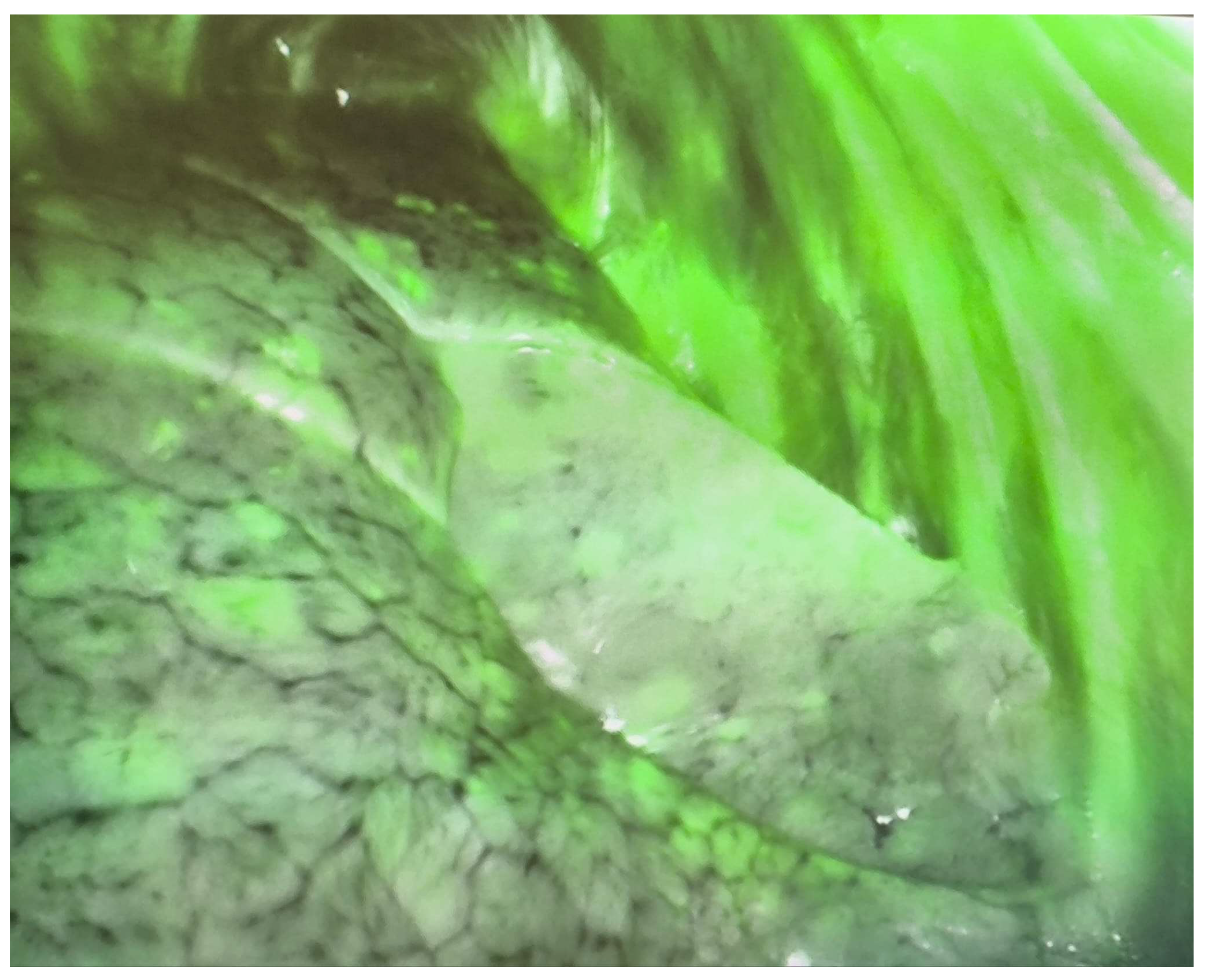
The 99mTc-MAA provides excellent depth penetration, allowing the surgeon to locate nodules that are not visible on the pleural surface, directly or indirectly, using the gamma probe. Applying pressure with the gamma camera to compress the lung parenchyma can also provide information about the depth of the nodule. Conversely, ICG provides an immediate visualization on the lung surface via NIR fluorescence (Figure 1) but does not provide information about the nodule depth, and consequently, on the depth of the lung resection to be performed. If the marking procedure fails, indocyanine green is completely useless. The most common scenario, in case of ICG marking failure, is leakage into the pleural cavity with the resulting indiscriminate marking of all structures (Figure 2).
Our analysis of the variables suggests that while both methods are safe, the hybrid technique may offer a higher success rate in cases of deeper nodules, although differences are not statistically significant. Furthermore, the hybrid method did not show a significant increase in procedural complications compared to the Tech group, suggesting that the addition of ICG is a safe enhancement to previous protocol.
We believe that the strengths of our technique lie in its ease of use (a single injection for both tracers), its precision, due to the procedure being performed under CT guidance by experienced operators, and the relatively low cost of the products used, which could potentially be available in all centers. The amount of radioactivity administered is minimal and has no significant impact on the patient or the operating room staff. The number of pneumothorax cases observed is acceptable given the total number of procedures, and furthermore, none of these required any intervention. We emphasize that the patient undergoes lung resection the day after the procedure; therefore, we consider the occurrence of this complication to be negligible unless it is of a very severe nature (massive pneumothorax). Our experience relates entirely to RATS resections, but the same technique can also be applied to VATS resections using an appropriate camera.
Finally, we would like to emphasize that close collaboration and communication among surgeons, radiologists and nuclear physicians are essential to the success of the procedure.
A notable finding of our case history is the lower conversion rate observed in the Tech+ICG group compared to the Tech-only group (6.55% vs 13.63%), with all conversions being attributed to failure in nodule identification, although this difference was not supported by formal statistical significance. From a histological point of view, both groups included a heterogeneous spectrum of lesions, ranging from benign nodules to invasive malignancies. This reflects real-world clinical practice, where preoperative diagnosis is often uncertain and surgical resection serves both diagnostic and therapeutic purposes. The high proportion of subsolid nodules highlights the importance of precise localization techniques, as these lesions are frequently early-stage adenocarcinomas or their precursors [6].
The combination of Tech+ICG for pulmonary nodule localization is a highly effective and reliable technique. Compared to the use of 99mTc-MAA alone, the Tech+ICG method facilitates easier identification of small or deep nodules during RATS, potentially leading to improve surgical outcomes. We recommend the adoption of this dual-modality localization as a valid solution for pulmonary nodules identification; in fact, the hybrid approach is the one we have chosen for our clinical practice.
Despite these stimulating findings, several limitations must be acknowledged. First, the retrospective design introduces potential selection bias. Further studies, randomization and larger surgical cohorts are needed; in fact, there is a lack of prospective studies that directly compare the performance of different marking systems. We encourage other authors to share their experience in lung nodules marking.
Author Contributions
Conceptualization: FF, SR, GV, AT, GC ; writing—Original Draft Preparation FF, LB, AS, MCM; writing—Review & Editing SR, EM, EP, GC ; supervision: EM, GV, EP, MCM, GC. All authors have read and agreed to the published version of the manuscript.
Funding
this research received no external funding.
Institutional Review Board Statement
The study was conducted in accordance with the Declaration of Helsinki, and approved by the Institutional Review Board of Cardio-Thoraco-Vascular Department of Hospital San Camillo-Forlanini (protocol number 002326, approved on March 13th, 2026).
Informed Consent Statement
Informed consent was obtained from all subjects involved in the study. Written informed consent has been obtained from the patient to publish this paper.
Data Availability Statement
The original contributions presented in this study are included in the article. Further inquiries can be directed to the corresponding author(s).
Conflicts of Interest
The authors declare no conflict of interest.
References
- MacMahon, H.; Naidich, D.P.; Goo, J.M.; Lee, K.S.; Leung, A.N.C.; Mayo, J.R.; et al. Guidelines for Management of Incidental Pulmonary Nodules Detected on CT Images: From the Fleischner Society 2017. Radiology 2017, 284(1), 228–43. [Google Scholar] [CrossRef] [PubMed]
- Altorki, N.; Wang, X.; Kozono, D.; Watt, C.; Landrenau, R.; Wigle, D.; et al. Lobar or Sublobar Resection for Peripheral Stage IA Non-Small-Cell Lung Cancer. N Engl. J. Med. 2023, 388(6), 489–98. [Google Scholar] [CrossRef] [PubMed]
- Saji, H.; Okada, M.; Tsuboi, M.; Nakajima, R.; Suzuki, K.; Aokage, K.; et al. Segmentectomy versus lobectomy in small-sized peripheral non-small-cell lung cancer (JCOG0802/WJOG4607L): a multicentre, open-label, phase 3, randomised, controlled, non-inferiority trial. Lancet 2022, 399(10335), 1607–17. [Google Scholar] [CrossRef] [PubMed]
- Cardillo, G.; Petersen, R.H.; Ricciardi, S.; Patel, A.; Lodhia, J.V.; Gooseman, M.R.; et al. European guidelines for the surgical management of pure ground-glass opacities and part-solid nodules: Task Force of the European Association of Cardio-Thoracic Surgery and the European Society of Thoracic Surgeons. Eur. J. Cardiothorac. Surg. 2023, 64(4). [Google Scholar] [CrossRef] [PubMed]
- Huang, J.; Yue, N.; Wu, J.; Shi, N.; Wang, Q.; Cui, T.; et al. Screening rate and influential factors of lung cancer with low-dose computed tomography in Asian population: a systematic review and meta-analysis. J. Public Health (Oxf) 2022, 44(2), 246–54. [Google Scholar] [CrossRef] [PubMed]
- Hutchinson, B.D.; Shroff, G.S.; Truong, M.T.; Ko, J.P. Spectrum of Lung Adenocarcinoma. Semin Ultrasound CT MR 2019, 40(3), 255–64. [Google Scholar] [CrossRef] [PubMed]
- Nomori, H.; Horio, H.; Naruke, T.; Suemasu, K. Fluoroscopy-assisted thoracoscopic resection of lung nodules marked with lipiodol. Ann. Thorac. Surg. 2002, 74(1), 170–3. [Google Scholar] [CrossRef] [PubMed]
- Ichinose, J.; Kohno, T.; Fujimori, S.; Harano, T.; Suzuki, S. Efficacy and complications of computed tomography-guided hook wire localization. Ann. Thorac. Surg. 2013, 96(4), 1203–8. [Google Scholar] [CrossRef] [PubMed]
- Chella, A.; Lucchi, M.; Ambrogi, M.C.; Menconi, G.; Melfi, F.M.; Gonfiotti, A.; et al. A pilot study of the role of TC-99 radionuclide in localization of pulmonary nodular lesions for thoracoscopic resection. Eur. J. Cardiothorac. Surg. 2000, 18(1), 17–21. [Google Scholar] [CrossRef] [PubMed]
- Nagai, K.; Kuriyama, K.; Inoue, A.; Yoshida, Y.; Takami, K. Computed tomography-guided preoperative localization of small lung nodules with indocyanine green. Acta Radiol. 2018, 59(7), 830–5. [Google Scholar] [CrossRef] [PubMed]
- Abbas, A.; Kadakia, S.; Ambur, V.; Muro, K.; Kaiser, L. Intraoperative electromagnetic navigational bronchoscopic localization of small, deep, or subsolid pulmonary nodules. J. Thorac. Cardiovasc Surg. 2017, 153(6), 1581–90. [Google Scholar] [CrossRef] [PubMed]
- Kerrigan, D.C.; Spence, P.A.; Crittenden, M.D.; Tripp, M.D. Methylene blue guidance for simplified resection of a lung lesion. Ann. Thorac. Surg. 1992, 53(1), 163–4. [Google Scholar] [CrossRef] [PubMed]
- Shennib, H.; Bret, P. Intraoperative transthoracic ultrasonographic localization of occult lung lesions. Ann. Thorac. Surg. 1993, 55(3), 767–9. [Google Scholar] [CrossRef] [PubMed]
- Rostambeigi, N.; Scanlon, P.; Flanagan, S.; Frank, N.; Talaie, R.; Andrade, R.; et al. CT Fluoroscopic-Guided Coil Localization of Lung Nodules prior to Video-Assisted Thoracoscopic Surgical Resection Reduces Complications Compared to Hook Wire Localization. J. Vasc. Interv. Radiol. 2019, 30(3), 453–9. [Google Scholar] [CrossRef] [PubMed]
- Fu, Y.F.; Zhang, M.; Wu, W.B.; Wang, T. Coil Localization-Guided Video-Assisted Thoracoscopic Surgery for Lung Nodules. J. Laparoendosc. Adv. Surg. Tech A 2018, 28(3), 292–7. [Google Scholar] [CrossRef] [PubMed]
- Han, R.; Wang, L.F.; Teng, F.; Lin, J.; Xian, Y.T.; Lu, Y.; et al. Presurgical computed tomography-guided localization of lung ground glass nodules: comparing hook-wire and indocyanine green. World J. Surg. Oncol. 2024, 22(1), 51. [Google Scholar] [CrossRef] [PubMed]
Figure 1.
ICG fluorescence is clear on lung surface.
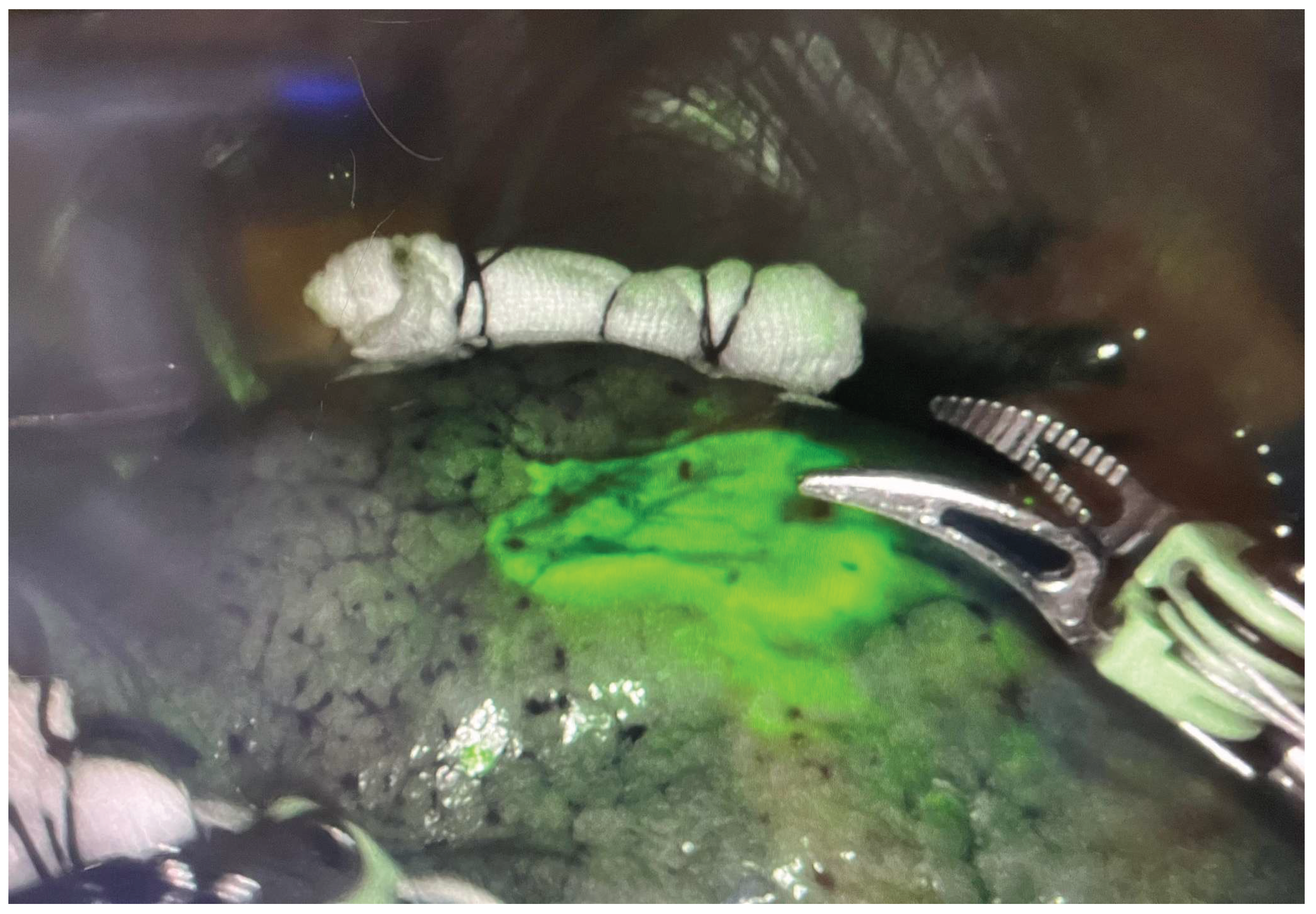
Figure 2.
Failure of ICG marking.
Disclaimer/Publisher’s Note: The statements, opinions and data contained in all publications are solely those of the individual author(s) and contributor(s) and not of MDPI and/or the editor(s). MDPI and/or the editor(s) disclaim responsibility for any injury to people or property resulting from any ideas, methods, instructions or products referred to in the content. |
© 2026 by the authors. Licensee MDPI, Basel, Switzerland. This article is an open access article distributed under the terms and conditions of the Creative Commons Attribution (CC BY) license (http://creativecommons.org/licenses/by/4.0/).
Copyright: This open access article is published under a Creative Commons CC BY 4.0 license, which permit the free download, distribution, and reuse, provided that the author and preprint are cited in any reuse.


