
Submitted:
26 May 2026
Posted:
26 May 2026
You are already at the latest version
Abstract
Time series generation (TSG) is widely used across domains, yet most existing methods assume regular sampling and fixed output resolutions. These assumptions are often violated in practice, where observations are irregular and sparse, while downstream applications require continuous and high-resolution TS. Although Neural Controlled Differential Equation (NCDE) is promising for modeling irregular TS, it is constrained by a single dynamics function, tightly coupled optimization, and limited ability to adapt learned dynamics to newly generated samples from the generative model. We propose Diff-MN, a continuous TSG framework that enhances NCDE with a Mixture-of-Experts (MoE) dynamics function and a decoupled architectural design for dynamics-focused training. To further enable NCDE to generalize to newly generated samples, Diff-MN employs a diffusion model to parameterize the NCDE temporal dynamics parameters (MoE weights), i.e., jointly learn the distribution of TS data and MoE weights. This design allows sample-specific NCDE parameters to be generated for continuous TS generation. Experiments on ten public and synthetic datasets demonstrate that Diff-MN consistently outperforms strong baselines on both irregular-to-regular and irregular-to-continuous TSG tasks. The code is available at the link \url{https://github.com/microsoft/TimeCraft/tree/main/Diff-MN}.
Keywords:
continuous time series generation
; ICML
1. Introduction
Time series generation (TSG) is essential across many real-world domains, including healthcare (Deng et al. 2025a), finance (Vasiliu et al. 2024; Zhang et al. 2024, 2025), manufacturing and energy systems (Fuest et al. 2025; Zhang et al. 2025, ?). It supports data augmentation (Tang et al. 2025), privacy-preserving data sharing (Tian et al. 2024), and high-fidelity simulation for decision-making (Turowski et al. 2024). Despite substantial progress, most TSG methods assume regularly sampled TS, treating both training and generated data as discrete observations at fixed intervals. As shown in Figure 1(a), existing approaches typically train on uniformly observed sequences and generate outputs at fixed resolutions (Ge et al. 2025; Huang et al. 2025; Li 2023; Mushunje et al. 2023). While a few methods allow irregular training data, they still generate sequences at fixed intervals, as illustrated in Figure 1(b) (Nikitin et al. 2024; Ramponi et al. 2018). This setting does not match real-world scenarios, where observations are often irregular and sparse, yet downstream tasks require continuous and high-resolution TS. For example, in ICU monitoring, electronic health records are irregular and sparse, while applications such as patient trajectory simulation or risk forecasting require dense sequences (Li et al. 2025; Tian et al. 2024). Consequently, continuous TSG in Figure 1(c) from irregular observations remains an under-explored but critical challenge.
Continuous-time modeling and irregular observations have been widely studied, leading to several approaches. Among them, Neural Ordinary Differential Equations (NODEs) and their extension, Neural Controlled Differential Equations (NCDE), are particularly popular. By combining continuous-time differential equations with learnable neural networks, NCDE-based methods effectively model temporal dynamics and handle irregular observations. Recent work has applied them to TSG (Lim et al. 2023; Naiman et al. 2024), typically following a two-stage paradigm: irregularly sampled TS are first transformed into regularly sampled ones using NCDE or their variants, and standard TSG models such as GANs (Jeon et al. 2022) and VAEs (Naiman et al. 2024) are then applied to generate data on regular time grids.
However, on the one hand, existing methods mainly use NCDE to process irregular inputs and then generate regularly sampled TS (Figure 1(b)), with limited exploration of continuous TSG and evaluation (Figure 1(c)). On the other hand, they directly adopt the standard NCDE without further improvement. Although standard NCDE are effective for modeling irregular TS, they rely on a single dynamics function, lack dynamics-focused optimization design, and cannot generalize learned dynamics to newly generated samples from a generative model. As a result, there remains substantial room to improve standard NCDE for irregular TS modeling and high-quality continuous-time generation.
In this study, we propose Diff-MN, a framework for continuous TSG with irregular observations. Our work differs from existing studies in the following aspects:
- 1.
- We are the first to formally study continuous TSG and evaluate it under the generated high-frequency TS data from two perspectives: TS forecasting performance and analytical solutions of cubic polynomials.
- 2.
- To enable effective continuous TSG, we improve standard NCDE in two key ways. (i) We replace the single dynamics function with a mixture-of-experts (MoE) dynamics function, where different experts capture distinct temporal patterns and are aggregated to model complex dynamics. The learned MoE weights explicitly encode temporal dynamics, providing a basis for using the diffusion model to parameterize them, thereby generalizing to newly generated samples. (ii) We propose a dynamics-focused, decoupled optimization strategy for NCDE. Specifically, we replace the State Initialization Network (SIN) and Readout Network (RN) with a pre-trained channel-wise autoencoder, which warm-starts training and allows the model to focus on optimizing the dynamics function.
- 3.
- Based on (i) and (ii), the MoE weights learned by the trained NCDE encode temporal dynamics that are specific to the training samples. When new samples are generated, their temporal dynamics may differ, leading to a mismatch with these sample-specific weights. To address this, we propose to parameterize the MoE weights for each new sample. Specifically, we jointly model TS data and their corresponding MoE weights with a diffusion model to learn their joint distribution. As a result, for each newly generated sample, matched MoE weights that reflect the true dynamics are generated and substituted back into the pre-trained NCDE, enabling more accurate continuous time series generation.
Our contributions are as follows:
- We are the first to formally study continuous TSG and evaluate it on generated high-frequency time series, filling an important research gap.
- For better continuous TSG, we first propose a decoupled Mixture-of-Experts Neural CDE (MoE-NCDE), which enhances standard NCDE with the MoE dynamic functions and dynamics-focused optimization design. This enables NCDE to better capture complex and dynamically changing temporal patterns from irregular observations.
- We further propose Diff-MN, a continuous TSG framework that jointly models TS data and MoE-NCDE temporal dynamics parameters (MoE weights) using a diffusion model. This design parameterizes the MoE weights and allows sample-specific weights to be generated and substituted back into a pre-trained MoE-NCDE, enabling accurate continuous TSG for newly generated samples.
- We conduct extensive experiments on four popular time-series generation datasets, four medical ECG datasets, and two synthetic datasets. Both quantitative and qualitative results demonstrate that Diff-MN consistently outperforms strong baselines on both irregular-to-regular and irregular-to-continuous generation tasks.
2. Related Work
Although limited work directly addresses continuous time series generation, several studies tackle closely related irregular time series modeling problems. Early work extends RNN-based models with irregular time-interval awareness: GRU-D (Che et al. 2018) introduces learnable temporal decay, ODE-RNN (Rubanova et al. 2019) evolves hidden states via ODEs between observations, and Latent ODE models continuous latent trajectories for interpolation and extrapolation at arbitrary time points. Building on these foundations, NCDE-based generators such as KOVAE (Jeon et al. 2022) and GTGAN (Naiman et al. 2024) conduct irregular-to-regular generation using standard NCDEs.
Attention-based methods naturally handle dependencies across arbitrary time steps without assuming regular intervals. HeTVAE (Shukla and Marlin Shukla and Marlin) incorporates continuous-time embeddings into attention, and TrajGPT (Song et al. 2025) introduces a Selective Recurrent Attention mechanism with learnable time decay to support extrapolation to unseen timestamps. ProFITi (Yalavarthi et al. 2025) instead leverages Conditional Normalizing Flows to enable uncertainty-aware forecasting on irregularly sampled data.
Unlike existing methods that primarily address irregular-to-regular modeling, we formally study the continuous TSG task and propose Diff-MN, a diffusion-based framework built upon a novel decoupled MoE-NCDE architecture. Related work about TSG models for regular data is provided in the Appendix A.
3. Method
Overview. Our method is shown in Figure 2. We next detail the training and generation process of Diff-MN.
Training: First, we train the decoupled MoE NCDE on irregular observations, learning shared State Initialization Network (SIN), Readout Network (RN), and dynamic-function neural networks, along with sample-specific MoE weights that encode each instance’s temporal dynamics. These components are then used to impute missing values. Next, to parameterize the MoE weights for generalizing to new samples, we jointly train a diffusion model on the imputed data and their corresponding MoE weights. Consequently, the diffusion model generates new samples together with matched MoE weights that reflect their temporal dynamics, enabling better continuous TSG.
Generation: The newly generated samples and MoE weights from the diffusion model are fed back into pretrained MoE-NCDE for continuous TSG, producing high-frequency, longer, and more informative TS.
3.1. Preliminary
Notation. Suppose we have N observed multivariate TS. Each TS , for , is a continuous multivariate function defined over its time interval, where M is the number of channels/variables. In practice, we observe each multivariate TS at discrete and irregular time points , where . The observed dataset is:
Problem Definition. Given dataset , the goal is to learn a generative model over discrete and irregular TS for irregular or continuous generation, i.e., our goal is to learn a model capable of sampling new sequences . The generated dataset is denoted as where denotes arbitrary time step of j-th sample.
Neural Controlled Differential Equation. Neural CDE (Kidger et al. 2020) extends Neural ODE (Chen et al. 2018) by modeling latent dynamics driven by a continuous control path. In continuous TSG, values generated between observations must align with surrounding temporal dynamics to avoid deviating from the true system distribution. Theoretically, we use NCDE instead of NODE because NCDE conditions the dynamics on irregular observations via a control path, enabling more accurate interpolation, whereas NODE may drift without observation guidance. The details of why NCDE is better in our task from both theoretical and experimental perspectives can be found in Appendix B.1. The NCDE is defined as:
where is a learnable dynamic-function neural network, and is a continuous interpolation (e.g., a natural cubic spline) of the discrete observations . is the initial latent state mapped from based on the network SIN.
Notably, although the control path is smooth due to spline interpolation, the latent trajectory can still be non-smooth because its evolution is governed by the nonlinear neural network and the mixture-of-experts, which together allow expressive, non-smooth, and highly diverse temporal patterns. The proof from both theoretical and experimental perspectives can be found in Appendix B.2.
Finally, CDESolver to solve NCDE is formalized as:
Its output is the latent state at arbitrary time points . Then, the network RN subsequently maps this hidden representation back to the original channel space to produce the predicted TS values.
3.2. Modeling Diverse Dynamics with Dense MoE
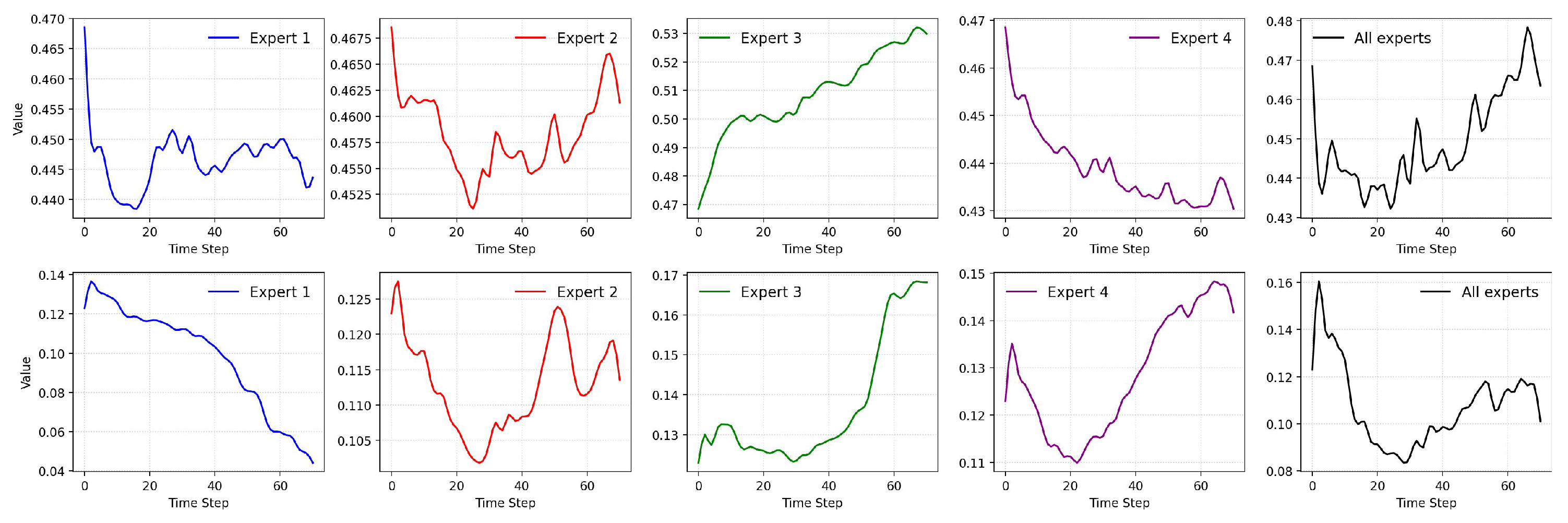
Real-world TS exhibit diverse temporal patterns that a single dynamic function often struggles to capture. Using a Mixture of Experts (MoE), the complex temporal dynamics are first decomposed, allowing each expert to focus on the patterns it is best suited to learn, such as local or global trends. This makes the overall dynamics easier to learn while enhancing both expressiveness and generalization. By combining their outputs, the MoE-NCDE produces richer and more flexible temporal representations. This is strongly supported by Figure 6 in the experimental section.
Notably, we use a dense MoE rather than a sparse one, prioritizing stability over efficiency. Dense MoE fully engages all experts at each step, enabling stable training and better learning of complex temporal dynamics in our task, which involves limited training data and low-parameter models.
The MoE dynamics consist of a MLP (Multilayer Perceptron) based router and dynamic functions (each parameterized as a neural network), where . The router takes (potentially irregular) observations as input and outputs a routing score for each expert. Specifically, we first impute the irregular TS using cubic interpolation and then feed them into to obtain all experts’ scores for the j-th sample. The router is implemented as a simple MLP. A softmax function is then applied over the scores to produce a dense routing distribution. Given , the final output is computed as a weighted combination of all expert functions:
Notably, the learned MoE weights explicitly encode the temporal dynamics of each training sample. This property provides a foundation for parameterizing the MoE via a diffusion model. Consequently, for newly generated samples, the diffusion model can produce adapted MoE weights that capture their temporal dynamics, enabling customized and effective continuous TSG. A detailed description will be provided in Section 3.4.
3.3. Decoupled Optimization Design for MoE-Dynamics-Focused Training
As shown in Figure 2(a), training a standard NCDE requires jointly optimizing the State Initialization Network (SIN), the Readout Network (RN), and the dynamic function network. Joint training can cause conflicts among modules and make the dynamic function network, which is the most critical component, difficult to learn effectively, especially when SIN and RN are poorly initialized.
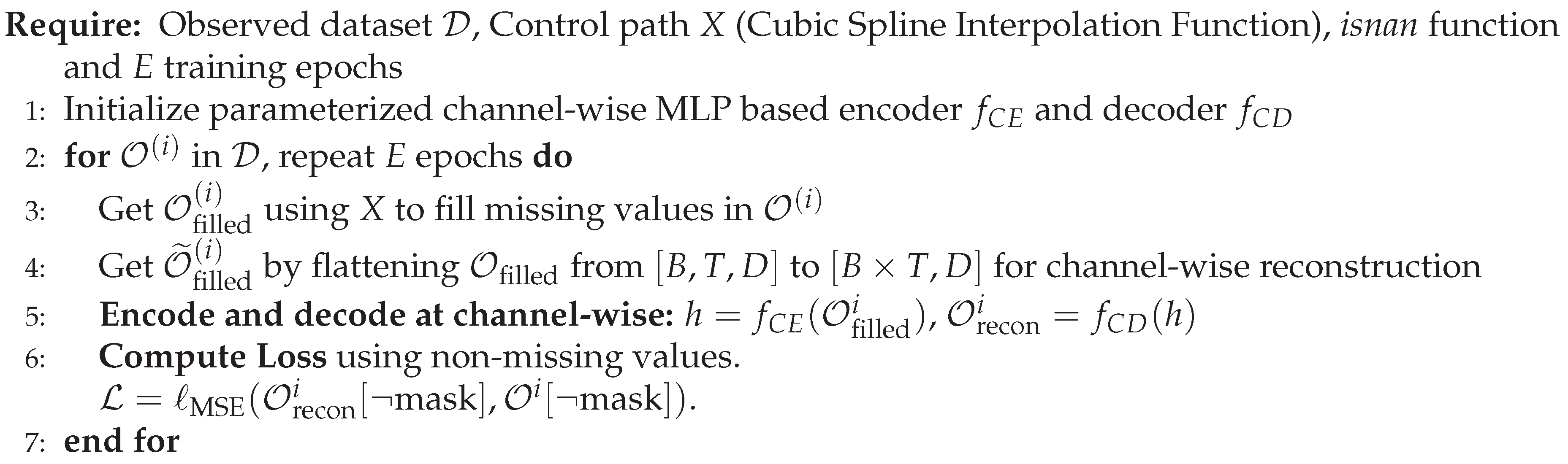
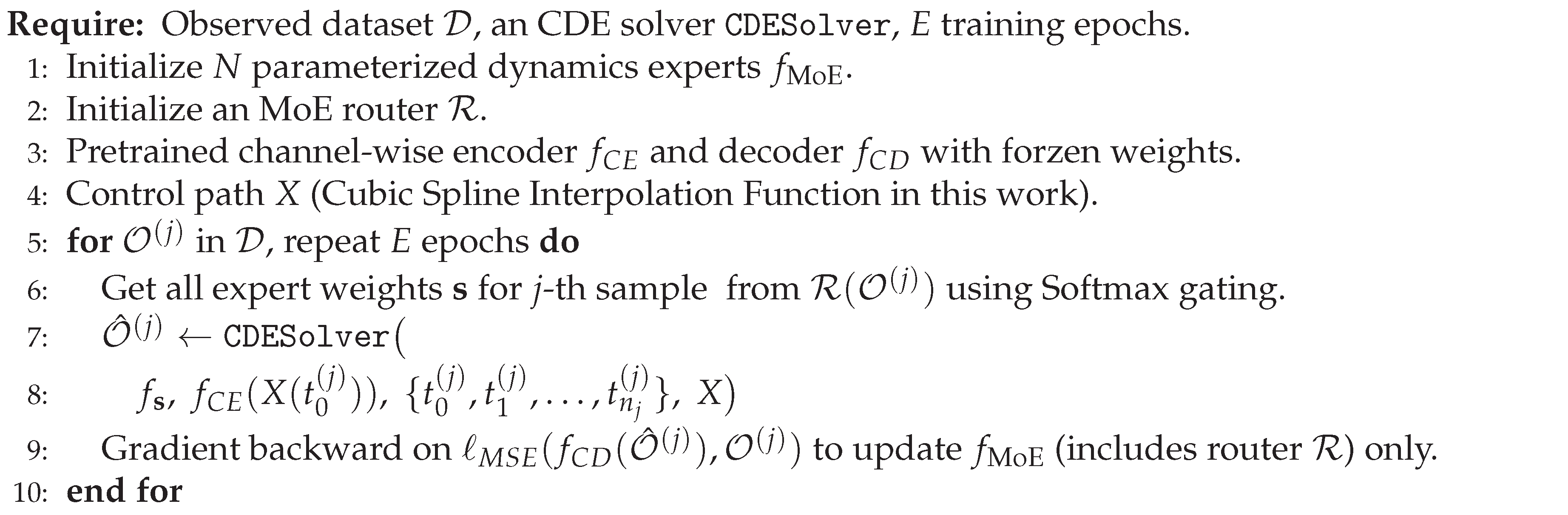
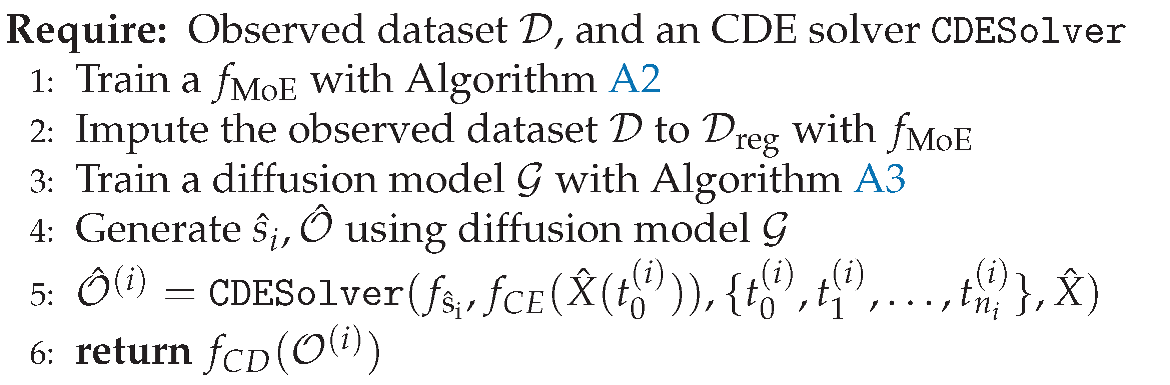
To address this, we pretrain a channel-wise autoencoder on the irregular data and replace SIN and RN with the pretrained Channel-wise Encoder (CE) and Decoder (CD), keeping them frozen. This decoupled optimization (termed Decoupled Design) enables training to focus on the optimization of MoE dynamic functions while using CE and CD for a warm start, providing effective gradients and improving training stability. This is feasible because the pretrained CE and CD have the same input and output dimensions as SIN and RN, allowing direct substitution. The training of the CE and CD is shown in Appendix Algorithm A1 and overall MoE-dynamics-focused training in Appendix Algorithm A2.
3.4. Diffusion Parameterized MoE-NCDE for Continuous TSG
Building on the MoE-NCDE trained on a batch of samples , it can generate continuous time sequences by predicting values at any consistent with contextual time information. However, the learned MoE weights, which encode temporal dynamics, are specific to the training samples. New samples generated via a diffusion model have different temporal dynamics, rendering the original MoE weights incompatible. To address this, we propose parameterizing the MoE weights with a diffusion model, enabling newly generated samples to obtain adapted MoE weights that capture their temporal dynamics and allow customized, effective continuous TSG.
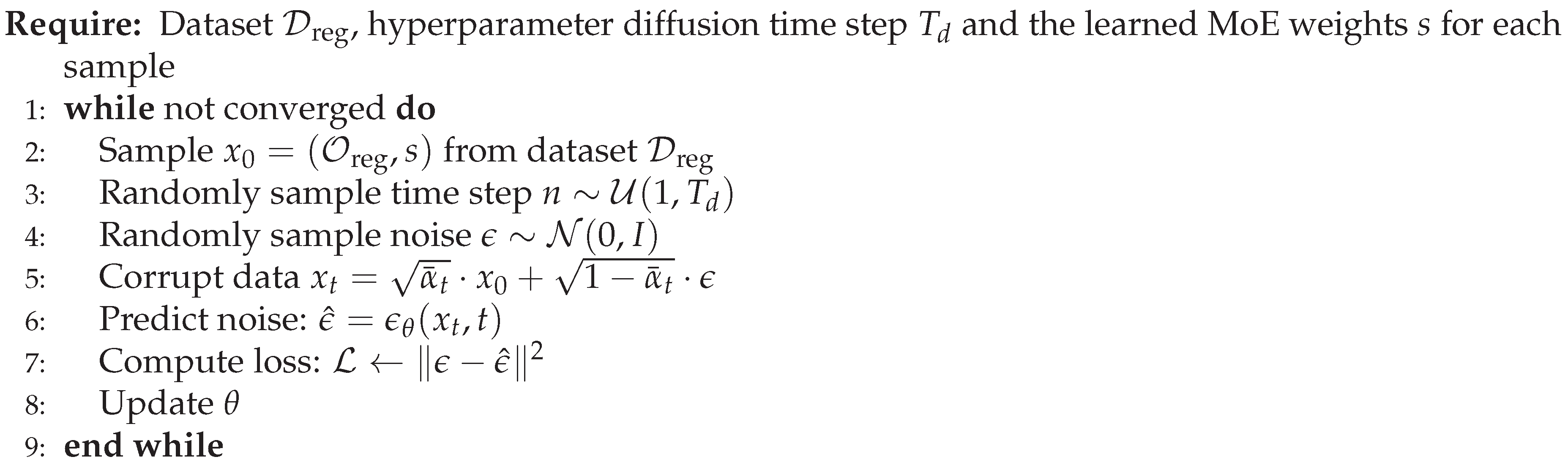
Specifically, the standard diffusion model requires regular data, but our training samples are irregular. We first use the pretrained MoE-NCDE to impute each sample into a regular sequence. The regularized samples, along with their corresponding MoE weights s, are then fed into the diffusion model to learn the joint distribution of temporal patterns and MoE weights. This parameterizes the MoE weights, allowing new samples to receive adapted weights that describe their temporal dynamics. The training process is shown in the Appendix Algorithm A3.
Finally, we input into the pre-trained MoE-NCDE and perform continuous TSG for each sample using its generated MoE weights and CDESolver. The process is shown in Appendix Algorithm A4.
4. Experiments
The experiment aims to answer the following questions:
- 1.
- How effective is Diff-MN at irregular-to-regular TSG? (Section 4.2)
- 2.
- How to evaluate and how effective is Diff-MN at irregular-to-continuous TSG? (Section 4.3)
- 3.
- Are Diff-MN’s tailored designs effective? (Section 4.4)
- 4.
- Does MoE decompose complex temporal dynamics for specialized learning and recombine them? (Table 5, Figure 6, and Appendix Table A8 discussed in Section 4.4)
- 5.
- Why is NCDE selected? (Appendix B.1) What is the impact of smooth interpolation functions? (Appendix B.2)
4.1. Experimental Settings
Datasets. The datasets include: (1) four public TSG datasets, Sines, Stocks, Energy, and MuJoCo; (2) ECG-related medical TS datasets from the UCR archive with diverse temporal patterns, including ECG200, ECG5K, ECGFD, and TLECG, with 2, 5,2 and 2 classes respectively; and (3) synthetic datasets, consisting of integrated signal waves and polynomial coefficient fitting data. For irregular modeling, we randomly discard 30%, 50%, and 70% of temporal observations to construct irregularly sampled datasets (Naiman et al. 2024). Details are provided in Appendix D.1.
Baselines. We compare our method with several representative advanced TSG methods, including irregular TSG methods: KO-VAE (Naiman et al. 2024), GTGAN (Jeon et al. 2022), ProFITi Yalavarthi et al. (2025) and HeTVAE (Shukla and Marlin Shukla and Marlin), as well as regular TSG methods: TimeGAN (Yoon et al. 2019), TimeVAE (Desai et al. 2021), and diffusion model (Huang et al. 2025). For regular TSG methods, we utilize standard NCDE to impute missing values before generation.
Implementation details. We conduct experiments using publicly available baseline code and train all models to convergence with recommended settings. In our method, the number of experts is fixed at four. More parameter settings, e.g., the diffusion model, are provided in the Appendix D.2.
For the four public datasets and two synthetic datasets, we construct training and evaluation samples with three sequence lengths (12, 24, and 36) and report averaged metrics. For the medical ECG classification datasets, samples are officially preprocessed, and default parameters are used.
Evaluation metrics. Following previous works (Huang et al. 2025; Naiman et al. 2024), we apply the following metrics for evaluating generation performance: (1) Discriminative score (DS), (2) Marginal distribution difference (MDD), (3) Kullback-Leibler divergence (KL), (4) Membership Inference Risk (MIR) metric (Tian et al. 2024) for privacy protection evaluation.
4.2. Performance of Irregular-to-Regular TSG
Quantitative evaluation. We first evaluate our model on the irregular TSG task. As shown in Table 1 and Table 2, our method consistently outperforms baselines on both popular TSG and medical datasets across various missing rate settings. Although baselines handle irregular data via NCDE, their performance is limited by weak dynamic modeling and coupled optimization design. In contrast, our MoE-NCDE leverages a mixture-of-experts function and a dynamics-focused optimization strategy with a pre-trained channel-wise autoencoder, enabling more effective learning of temporal dynamics for irregular TS.
Qualitative evaluation. We also qualitatively evaluate the similarity between real and generated sequences using two visualizations: (i) t-SNE projections and (ii) kernel density estimation of probability density functions (PDFs). As shown in Figure 3, the t-SNE plots (top) exhibit strong overlap between real and synthetic samples, while the PDFs (bottom) show closer alignment with real data compared to KO-VAE and GT-GAN.
Privacy protection analysis. This experiment evaluates whether synthetic data generated by different models leaks information from real data, with results reported in Appendix Table A4. Our method not only achieves superior fidelity in DS, KL, and MDD but also exhibits the lowest privacy leakage risk according to MIR. This is due to the MoE design, which promotes diverse generated samples rather than mere replication of the original data.
4.3. Performance of Irregular-to-Continuous TSG
Refined continuous TSG on the downstream task. In this experiment, we evaluate continuous TSG with irregular observations using a multivariate prediction task, which is conducted on the newly generated samples of each method. Baselines predict the last time step from length data. For Diff-MN, we apply MoE-NCDE for newly generated samples and MoE weights from the diffusion model. For KOVAE and GTGAN, we apply the trained standard NCDE to their newly generated samples for Continuous TSG. Continuous TSG generates new points between each time step, creating a refined sample that roughly doubles the length of the historical window. Following previous downstream evaluations Jeon et al. (2022); Naiman et al. (2024), the refined sample is then used to train the Gated Recurrent Unit (GRU) to predict the same last step. We set and report average MSE and MAE.
Table 3 shows that KOVAE-NCDE and GTGAN-NCDE perform worse than their non-continuous counterparts, indicating that standard NCDE for continuous generation is ineffective. In contrast, Ours- outperforms its non-continuous version, improving forecasting performance. This is due to our diffusion parameterized MoE-NCDE, which generates MoE weights capturing the temporal dynamics of the newly generated samples, enabling better continuous generation. Visualizations of continuous TS are in Appendix Figure A3 to Figure A5.
Refined continuous TSG on solving for the analytical solutions of polynomial functions. We further assess continuous TSG using a cubic function . For each coefficient, 2500 samples are drawn from normal distributions with varying means and standard deviations. With x linearly spaced over 24 values in , y forms time series (visualized in Appendix Figure A9). The model is trained on y, aiming for coefficients derived from generated to match the original distributions.
Figure 4 shows that analytical solutions from our generated closely match the true distribution. Both irregular-to-regular and irregular-to-continuous TSG preserve distributional similarity, with refined continuous generation (Figure 4(d)) closer to ground truth than non-continuous. This confirms the effectiveness of our method. In contrast, baselines using standard NCDE deviate significantly (Appendix Figure A10, Figure A12, Figure A13).
4.4. Ablation Study
Quantitative evaluation. Table 4 shows that removing MoE functions or the decoupled design significantly decreases model accuracy, and removing them together further deteriorates performance, indicating that these components are crucial. The MoE functions help NCDE learn temporal patterns, while the dynamics-focused decoupled optimization design (called Decoupled Design) uses a pre-trained channel-wise autoencoder to replace the network SIN and RN, allowing better focus on learning MoE dynamics.
Qualitative evaluation. We construct synthetic signals (e.g., sine, piecewise, sawtooth) and split them into training and test sets. We train MoE-NCDE and evaluate generation on the test set under component ablations (Figure 5). Only with both MoE dynamics and the dynamics-focused decoupled optimization design does the model produce signals resembling the real data; removing either causes high errors, confirming their effectiveness.
Exploring why MoE is effective. Table 5 compares NCDE performance between (i) four experts (each with one MLP and two linear layers, eight layers total) and (ii) a single expert with four stacked MLPs (same eight layers). The MoE approach significantly outperforms the single expert, as each expert specializes in learning distinct temporal dynamics, making the overall dynamics easier to learn while enhancing both expressiveness and generalization. Figure 6 further illustrates how MoE decomposes complex temporal patterns across experts and then integrates them, substantially enhancing NCDE’s ability to model diverse temporal behaviors. Moreover, Appendix Table A8 reports the average expert weights across datasets. The weights are non-sparse, and different datasets favor different experts, indicating that the Mixture of Experts structure is effectively utilized rather than collapsing to a single expert.

Table 5.
Comparison of four-expert (8 linear layers) vs. single-expert (8 linear layers) on medical datasets.
Table 5.
Comparison of four-expert (8 linear layers) vs. single-expert (8 linear layers) on medical datasets.
| 30% | 50% | 70% | ||||||||
|---|---|---|---|---|---|---|---|---|---|---|
| ECG200 | ECG5K | ECGFD | ECG200 | ECG5K | ECGFD | ECG200 | ECG5K | ECGFD | ||
| DS | Four-experts-eight-layers | 0.2 | 0.205 | 0.09 | 0.405 | 0.315 | 0.12 | 0.34 | 0.288 | 0.13 |
| One-expert-eight-layers | 0.328 | 0.364 | 0.13 | 0.44 | 0.389 | 0.23 | 0.392 | 0.412 | 0.21 | |
| MDD | Four-experts-eight-layers | 0.211 | 0.062 | 0.424 | 0.237 | 0.079 | 0.529 | 0.246 | 0.095 | 0.613 |
| One-expert-eight-layers | 0.288 | 0.12 | 0.694 | 0.321 | 0.152 | 0.831 | 0.314 | 0.165 | 0.837 | |
| KL | Four-experts-eight-layers | 0.052 | 0.009 | 0.055 | 0.107 | 0.014 | 0.05 | 0.098 | 0.02 | 0.049 |
| One-expert-eight-layers | 0.136 | 0.056 | 0.065 | 0.236 | 0.098 | 0.189 | 0.224 | 0.123 | 0.165 | |
Figure 6.
Visualization of temporal dynamics learned by different experts of MoE-NCDE on the MuJoCo dataset in continuous TSG. Energy dataset is shown in Appendix Figure A11.
Figure 6.
Visualization of temporal dynamics learned by different experts of MoE-NCDE on the MuJoCo dataset in continuous TSG. Energy dataset is shown in Appendix Figure A11.
Dense vs. Sparse MoE Comparison. To justify our choice of dense MoE, we conduct a systematic comparison between dense and sparse MoE under varying numbers of experts. For sparse MoE, we fix the total number of experts at 8 and activate 1, 2, 4, or 6 experts, respectively. All metrics are averaged across 30%, 50%, and 70% missing rates with sequence length 24.
As shown in Table 6, dense MoE achieves better overall performance (winning 7 vs. 5 on DS, 6 vs. 5 on MDD), where Win count is computed by pairwise Dense-vs-Sparse comparisons under the same expert count across all datasets. Dense MoE benefits from activating all experts, which provides more stable gradients and avoids routing to collapsed experts. Sparse MoE, which trains many experts but activates few during inference, is more susceptible to expert collapse under high data missingness, as insufficient data prevents effective specialization of individual experts.
4.5. Hyperparameter and Time Complexity Analysis
Hyperparameter analysis. Figure 7 shows that MoE-NCDE performance is not highly sensitive to the number of experts: using more than one improves performance, with four experts yielding satisfactory results.
Time complexity analysis. MoE-NCDE has higher time complexity than standard NCDE (e.g., 1.2s vs. 0.81s for double-length refined generation on 3,674 stock samples of length 12) due to mixture-of-experts dynamics. However, by parameterizing the MoE weights via the diffusion model, we can directly generate sample-specific MoE weights for new data, avoiding NCDE retraining, additional feature extraction, and forward propagation, thereby reducing computational overhead.
5. Limitations
MoE training under data missingness. Both dense and sparse MoE degrade as expert count increases (Table 6), due to insufficient data and limited class diversity for specialization. Effective sparse MoE training and diversity-promoting mechanisms under high missingness remain open challenges.
Scalability and data dependency. The primary computational bottleneck lies in native NCDE rather than MoE overhead. Generation quality also depends on observation quality and the interpolation functions used to construct continuous input paths.
Evaluation on naturally irregular data. Following prior works, we simulate missingness and use held-out values as ground truth. Developing evaluation protocols for naturally irregular data where ground truth is unavailable remains future work.
6. Conclusion
This paper presents the first study of continuous TSG. Built upon NCDEs, Diff-MN introduces a decoupled MoE-NCDE that enhances standard NCDEs with mixture-of-experts dynamic functions and dynamics-focused optimization design, enabling more effective modeling of complex temporal dynamics and irregular TS for continuous generation. Moreover, we parameterize MoE weights via a diffusion model to generate sample-specific weights that reflect their temporal dynamics. Combined with a pre-trained NCDE, this enables adaptive continuous TSG. Diff-MN achieves state-of-the-art performance on continuous generation across multiple public and synthetic datasets.
Impact Statement
This paper advances continuous time series generation applicable to diverse domains. While synthetic data generation offers benefits such as data augmentation and privacy-preserving sharing, it carries risks. For example, in healthcare, generated signals may contain hallucinated features that could mislead analysis if used without expert validation. Additionally, generative models may inadvertently memorize sensitive patterns from training data. We recommend applying appropriate privacy safeguards (e.g., differential privacy) before deploying on sensitive data, and caution that generated data should complement rather than replace real data in safety-critical applications.
Appendix A. Supplementary Related Work
TSG for regular TS has gained increasing attention as a way to produce synthetic data for training, privacy preservation, and simulation. Early work explored adversarial learning approaches such as TimeGAN (Yoon et al. 2019), which leverage adversarial objectives to jointly capture temporal dynamics and sample realism. Variational methods have also been developed, including TimeVAE (Desai et al. 2021) and Vector Quantized TimeVAE (Lee et al. 2023). More recently, diffusion-based models (Lin et al. 2024) have emerged, synthesizing high-fidelity sequences by iteratively denoising random noise. These approaches illustrate the rapid methodological progress in generative modeling for TS. Recently, an increasing number of generation methods based on diffusion models have been proposed Deng et al. (2025b, 2026); Huang et al. (2025); Li et al. (2025); Xia et al. (2025), such as task-oriented generation, cross-domain generation, causal generation, and text-controlled generation. High-quality synthetic TS data is also critical for advancing downstream tasks such as long-term forecasting (Zhang et al. 2026), predictability-aware training (Zhang et al. 2026), and fine-tuning large pre-trained time series models (Zhang, Wang, and Wang Zhang et al.), where data scarcity or distribution shift often limits performance.
Appendix B. Discussion About Why Using Neural Controlled Differential Equation (NCDE)
Appendix B.1. Comparisons Between NODE and NCDE
Appendix B.1.1. Theoretical Perspective
Neural ordinary differential equation (NODE) (Chen et al. 2018) provides a continuous-time modeling framework for irregularly-sampled time series. The latent dynamics are governed by the following differential equation:
where is the latent state at time s, and is a neural network parameterized by represent the dynamics of the differential equations.
However, NODE evolves the latent state solely from based on learned dynamics, without direct conditioning on the observed values. Consequently, the latent trajectory may drift away from the true data distribution.
We adopt NCDE because Diff-MN requires both imputing irregular observations and performing continuous generation. Values generated between existing observation points need to be consistent with the temporal dynamics of the surrounding context; otherwise, the generated values may deviate from the true distribution of the underlying dynamical system.
Appendix B.1.2. Experimental Perspective
GT-GAN incorporates ODE-RNN and CTFP Deng et al. (2020), where the latter borrows concepts from stochastic differential equation (SDE) and employs a Wiener process to introduce stochasticity. Ablation studies of GT-GAN consistently show that GT-GAN outperforms the two ODE-based methods. Additionally, KoVAE (a TSG method using NCDE) is reported to perform even better than GT-GAN, and our Diff-MN outperforms both GT-GAN and KoVAE. All of this indicates that NCDE-based TSG under observed-data constraints outperforms ODE-based methods.
Appendix B.2. Proving Interpolation Control in NCDE Does Not Cause Over-Smoothing
Appendix B.2.1. Theoretical Perspective
As discussed in the main text, NCDE can be defined as
where is the control path (obtained via interpolation and smoothing), and is a nonlinear function (neural network).
The neural network can model highly nonlinear dynamics, amplifying or bending small variations in the smooth control path and thereby inducing complex, rapidly changing behavior in the latent trajectory.
Hence, even if is smooth, the behavior of the integral result depends on the properties of . If is highly nonlinear, the derivative can vary rapidly with , leading to non-smooth trajectories.
Specifically, when is smooth and differentiable, the NCDE admits the following differential form:
Although the interpolated control path is smooth by construction, the evolution of is governed by the nonlinear function . As a result, even when is smooth, the product may vary rapidly due to the nonlinearity of , leading to non-smooth latent trajectories.
In our model, the is further parameterized as a Mixture-of-Experts:
where and are routing weights produced by the router , and denotes the i-th expert.
Substituting the MoE formulation into the NCDE dynamics yields
Since both the expert functions and the routing weights depend nonlinearly on the latent state, different experts may dominate the dynamics at different time instances. This allows the latent trajectory to exhibit rapid local variations and highly diverse temporal behaviors.
Therefore, even with a smooth interpolated control path , the NCDE equipped with MoE dynamics can generate expressive and potentially non-smooth latent trajectories.
Appendix B.2.2. Experimental Perspective
To validate this, we added visualizations of sequences generated solely by NCDE, as shown Figure A6, Figure A7 and Figure A8. These results show: (i) For intrinsically smooth data (e.g., sine in Figure 16), NCDE produces smooth trajectories and (ii) For intrinsically smooth data (e.g., sine in Figure 16), NCDE produces smooth trajectories.
Overall, while the control path is smooth, the nonlinear MoE–NCDE dynamics allow the generated sequences to exhibit fluctuating temporal behaviors, depending entirely on the underlying temporal dynamics.
Appendix C. Supplementary Algorithm Pseudocodes
This presents the algorithm pseudocodes omitted from the Method section of the main text due to space constraints. As all algorithms have already been properly referenced and discussed, we simply include them here for convenient reference.
Appendix C.1. Decoupled Optimization for MoE-Dynamics-Focused Training (Algorithm A2)
Appendix C.2. Training Channel-Wise Autoencoder (Algorithm A1)
Appendix C.3. Joint Diffusion Training for (Oreg, s) to Parameterize MoE Weights (Algorithm A3)
Appendix C.4. Continuous Time Series Generation (Algorithm A4)
| Algorithm A1 Training channel-wise autoencoder |
 |
| Algorithm A2 Decoupled optimization for MoE-dynamics-focused training |
 |
| Algorithm A3 Joint diffusion training for to parameterize MoE weights |
 |
| Algorithm A4 Continuous time series generation |
 |
Appendix D. Supplementary Experimental Settings
Appendix D.1. Datasets
We evaluate on four popular TSG datasets with diverse characteristics, following established benchmarks for generative time series (Jeon et al. 2022; Yoon et al. 2019). Sines is a simulated multivariate dataset where each channel follows a sinusoidal function with random frequency and phase, capturing continuous and periodic patterns. Stocks contains daily Google stock data (2004–2019) across six financial indicators, exhibiting aperiodic, random-walk behaviors. Energy is the UCI appliance energy prediction dataset (Candanedo 2017), comprising 28 correlated channels with noisy periodicity and continuous-valued measurements. Finally, MuJoCo (Multi-Joint dynamics with Contact) (Todorov et al. 2012) provides simulated physical dynamics with 14 channels.
The used medical ECG datasets are ECG200, ECG5000 (ECG5K), ECGFiveDays (ECGFD), and TwoLeadECG (TLECG), which can be downloaded from the link1. Their sequence lengths are 96, 140, 136, and 82. The number of classes is 2, 5, 2, and 2, respectively. The data sizes are 200, 5000, 884, and 1162, respectively.
Appendix D.2. More Implementation Details
When training MoE-NCDE, we use the Adam optimizer with a learning rate of , a batch size of 256, and a fixed hidden dimension of 64. For the TSG backbone of the standard diffusion model, the denoising network adopts a U-Net with four down- and up-sampling stages. Each stage contains two residual blocks and one cross-attention block, where residual blocks use two 1D convolution layers, and cross-attention employs 1D convolutions for input/output projections with eight attention heads. A middle block, placed between the down- and up-sampling paths, consists of two residual blocks and one attention block. In addition, we include input and output layers, each implemented with a single 1D convolution. SiLU is used as the activation function throughout. We train the model for 600 epochs with a batch size of 256, a learning rate of .
Appendix E. Supplementary Experimental Results
In Table 1 of the main text, we report the average performance of irregular-to-regular generation tasks across sequence lengths of 12, 24, and 36. Here, we additionally present results for each individual length. Overall, our method consistently outperforms others, in line with the conclusions from Table 1, and we therefore omit further discussion. We simply include them here for convenient reference.
Appendix E.1. Irregular to Regular TSG on Popular Datasets with Sequence Length 12 (Table A1)
Appendix E.2. Irregular to Regular TSG on Popular Datasets with Sequence Length 24 (Table A2)
Appendix E.3. Irregular to Regular TSG on Popular Datasets with Sequence Length 36 (Table A3)
Appendix E.4. TSNE and PDF Visualizations on Irregular to Regular TSG (Figure A2)
Appendix E.5. Evaluation of Privacy Protection Capability (Table A4)
Appendix E.6. Visualizations About MoE-NCDE Not Producing Overly smooth curves (Figure A6, Figure A7 and Figure A8)
Appendix E.7. Irregular to Continuous TSG on Popular Datasets with Sequence Length 12 (Table A5)
Appendix E.8. Irregular to Continuous TSG on Popular Datasets with Sequence Length 24 (Table A6)
Appendix E.9. Irregular to Continuous TSG on Popular Datasets with Sequence Length 36 (Table A7)
Appendix E.10. Visualization of Continuous TSG on the Stock Dataset (Figure A3 for Part 1, Figure A4 for Part 2, and Figure A5 for Part 3)
Appendix E.11. Visualization of Cubic Polynomial Curves (Figure A9)
Appendix E.12. Cubic Polynomial Solutions of Diff-MN with 50% and 70% Missing Values (Figure A10)
Appendix E.13. Cubic Polynomial Solutions of Diff-MN VS. KOVAE with 30%, 50% and 70% Missing Values (Figure A12)
Appendix E.14. Cubic Polynomial Solutions of Diff-MN VS. GT-GAN with 30%, 50% and 70% Missing Values (Figure A13)
Appendix E.15. Visualization of Temporal Dynamics Learned by Different Experts (Figure A11)
Appendix E.16. Average Expert Weights Learned by MoE-NCDE (Figure A11)
Appendix E.17. Impact of the Number of Experts on the DS Metric (Figure A1)
Figure A1.
The impact of the number of experts (1-9) on the DS metric.

Table A1.
Irregular to regular TSG on popular datasets with sequence length 12.
| 30% | 50% | 70% | |||||||||||
|---|---|---|---|---|---|---|---|---|---|---|---|---|---|
| Sines | Stocks | Energy | MuJoCo | Sines | Stocks | Energy | MuJoCo | Sines | Stocks | Energy | MuJoCo | ||
| DS | Ours | 0.077 | 0.084 | 0.386 | 0.268 | 0.13 | 0.042 | 0.472 | 0.417 | 0.222 | 0.054 | 0.494 | 0.45 |
| KoVAE | 0.218 | 0.103 | 0.500 | 0.358 | 0.202 | 0.106 | 0.500 | 0.390 | 0.211 | 0.228 | 0.500 | 0.451 | |
| GT-GAN | 0.300 | 0.385 | 0.499 | 0.498 | 0.423 | 0.357 | 0.499 | 0.496 | 0.434 | 0.370 | 0.498 | 0.497 | |
| TimeGAN-NCDE | 0.468 | 0.369 | 0.498 | 0.487 | 0.422 | 0.472 | 0.499 | 0.499 | 0.429 | 0.479 | 0.500 | 0.498 | |
| TimeVAE-NCDE | 0.354 | 0.493 | 0.496 | 0.433 | 0.466 | 0.497 | 0.491 | 0.477 | 0.500 | 0.497 | 0.498 | 0.480 | |
| Diffusion-NCDE | 0.264 | 0.428 | 0.426 | 0.323 | 0.353 | 0.472 | 0.482 | 0.437 | 0.480 | 0.491 | 0.497 | 0.475 | |
| ProFITi | 0.29 | 0.44 | 0.492 | 0.49 | 0.339 | 0.478 | 0.498 | 0.496 | 0.41 | 0.486 | 0.5 | 0.497 | |
| HeTVAE | 0.5 | 0.368 | 0.493 | 0.499 | 0.5 | 0.478 | 0.499 | 0.5 | 0.5 | 0.493 | 0.5 | 0.5 | |
| MDD | Ours | 1.015 | 0.16 | 0.303 | 0.303 | 1.337 | 0.2 | 0.251 | 0.319 | 1.783 | 0.219 | 0.319 | 0.34 |
| KoVAE | 10.137 | 0.289 | 0.343 | 0.326 | 10.12 | 0.288 | 0.377 | 0.372 | 10.13 | 0.312 | 0.399 | 0.635 | |
| GT-GAN | 3.574 | 0.746 | 0.598 | 0.540 | 3.898 | 0.600 | 0.414 | 0.565 | 3.38 | 0.733 | 0.562 | 0.585 | |
| TimeGAN-NCDE | 4.599 | 1.109 | 1.020 | 1.261 | 4.799 | 1.625 | 1.395 | 1.485 | 5.35 | 1.717 | 1.499 | 1.761 | |
| TimeVAE-NCDE | 8.661 | 0.712 | 0.451 | 0.463 | 6.045 | 0.864 | 0.587 | 0.586 | 5.184 | 1.054 | 0.652 | 0.707 | |
| Diffusion-NCDE | 2.150 | 0.328 | 0.306 | 0.276 | 2.128 | 0.538 | 0.365 | 0.428 | 2.902 | 0.854 | 0.506 | 0.508 | |
| ProFITi | 1.277 | 0.32 | 0.254 | 0.298 | 1.342 | 0.416 | 0.342 | 0.361 | 1.584 | 0.443 | 0.442 | 0.446 | |
| HeTVAE | 3.594 | 0.597 | 0.635 | 0.507 | 4.25 | 0.748 | 1.11 | 1.092 | 5.134 | 0.986 | 1.273 | 1.105 | |
| KL | Ours | 0.007 | 0.05 | 0.019 | 0.017 | 0.014 | 0.075 | 0.025 | 0.018 | 0.033 | 0.066 | 0.013 | 0.024 |
| KoVAE | 9.941 | 0.139 | 0.076 | 0.168 | 9.511 | 0.149 | 0.084 | 0.282 | 9.788 | 0.151 | 0.111 | 0.579 | |
| GT-GAN | 0.144 | 0.283 | 0.063 | 0.020 | 0.187 | 0.212 | 0.050 | 0.029 | 0.164 | 0.314 | 0.066 | 0.031 | |
| TimeGAN-NCDE | 5.230 | 1.742 | 0.210 | 0.575 | 1.125 | 7.401 | 0.716 | 0.997 | 15.176 | 12.148 | 0.854 | 2.397 | |
| TimeVAE-NCDE | 3.551 | 0.298 | 0.089 | 0.158 | 2.776 | 0.345 | 0.128 | 0.245 | 2.113 | 0.534 | 0.148 | 0.338 | |
| Diffusion-NCDE | 0.004 | 0.012 | 0.004 | 0.007 | 0.028 | 0.040 | 0.019 | 0.036 | 0.074 | 0.095 | 0.046 | 0.042 | |
| ProFITi | 0.078 | 0.084 | 0.022 | 0.016 | 0.082 | 0.124 | 0.032 | 0.016 | 0.11 | 0.137 | 0.044 | 0.032 | |
| HeTVAE | 0.036 | 0.302 | 0.376 | 0.102 | 2.655 | 0.46 | 1.124 | 0.934 | 0.288 | 0.78 | 1.275 | 1.079 | |
Table A2.
Irregular to regular TSG on popular datasets with sequence length 24.
| 30% | 50% | 70% | |||||||||||
|---|---|---|---|---|---|---|---|---|---|---|---|---|---|
| Sines | Stocks | Energy | MuJoCo | Sines | Stocks | Energy | MuJoCo | Sines | Stocks | Energy | MuJoCo | ||
| DS | Ours | 0.069 | 0.171 | 0.414 | 0.249 | 0.072 | 0.151 | 0.491 | 0.306 | 0.127 | 0.179 | 0.499 | 0.347 |
| KoVAE | 0.055 | 0.285 | 0.500 | 0.358 | 0.090 | 0.208 | 0.500 | 0.363 | 0.212 | 0.236 | 0.500 | 0.403 | |
| GT-GAN | 0.276 | 0.305 | 0.500 | 0.480 | 0.338 | 0.325 | 0.500 | 0.491 | 0.286 | 0.273 | 0.500 | 0.489 | |
| TimeGAN-NCDE | 0.457 | 0.351 | 0.500 | 0.486 | 0.433 | 0.454 | 0.500 | 0.497 | 0.438 | 0.472 | 0.499 | 0.499 | |
| TimeVAE-NCDE | 0.191 | 0.481 | 0.499 | 0.324 | 0.175 | 0.493 | 0.499 | 0.462 | 0.431 | 0.490 | 0.499 | 0.464 | |
| Diffusion-NCDE | 0.148 | 0.460 | 0.455 | 0.373 | 0.286 | 0.490 | 0.489 | 0.409 | 0.392 | 0.489 | 0.496 | 0.470 | |
| ProFITi | 0.298 | 0.459 | 0.498 | 0.496 | 0.365 | 0.487 | 0.499 | 0.498 | 0.409 | 0.492 | 0.5 | 0.498 | |
| HeTVAE | 0.48 | 0.306 | 0.498 | 0.499 | 0.5 | 0.401 | 0.5 | 0.499 | 0.5 | 0.476 | 0.5 | 0.5 | |
| MDD | Ours | 0.752 | 0.269 | 0.218 | 0.336 | 0.775 | 0.251 | 0.216 | 0.341 | 0.971 | 0.299 | 0.265 | 0.285 |
| KoVAE | 2.756 | 0.905 | 0.347 | 0.341 | 3.314 | 0.833 | 0.361 | 0.380 | 5.221 | 0.763 | 0.368 | 0.633 | |
| GT-GAN | 2.257 | 0.551 | 0.429 | 0.576 | 2.467 | 0.563 | 0.396 | 0.532 | 2.277 | 0.532 | 0.413 | 0.555 | |
| TimeGAN-NCDE | 3.162 | 1.134 | 1.046 | 1.173 | 3.555 | 1.597 | 1.226 | 1.553 | 3.609 | 1.592 | 1.605 | 1.651 | |
| TimeVAE-NCDE | 3.408 | 0.580 | 0.418 | 0.307 | 3.042 | 0.709 | 0.521 | 0.411 | 2.862 | 0.804 | 0.597 | 0.527 | |
| Diffusion-NCDE | 1.303 | 0.401 | 0.250 | 0.336 | 1.402 | 0.403 | 0.356 | 0.338 | 1.667 | 0.692 | 0.557 | 0.486 | |
| ProFITi | 0.961 | 0.311 | 0.261 | 0.284 | 1.446 | 0.472 | 0.358 | 0.333 | 1.645 | 0.436 | 0.444 | 0.407 | |
| HeTVAE | 2.775 | 0.582 | 0.607 | 0.722 | 3.431 | 0.787 | 0.993 | 1.09 | 3.677 | 1.071 | 1.229 | 1.445 | |
| KL | Ours | 0.011 | 0.084 | 0.009 | 0.007 | 0.022 | 0.092 | 0.014 | 0.006 | 0.035 | 0.105 | 0.023 | 0.013 |
| KoVAE | 1.696 | 1.347 | 0.058 | 0.150 | 1.861 | 1.205 | 0.061 | 0.198 | 2.840 | 1.380 | 0.071 | 0.508 | |
| GT-GAN | 0.065 | 0.163 | 0.042 | 0.032 | 0.139 | 0.161 | 0.053 | 0.019 | 0.190 | 0.184 | 0.051 | 0.034 | |
| TimeGAN-NCDE | 4.573 | 1.380 | 0.227 | 0.666 | 4.339 | 5.887 | 0.489 | 1.248 | 4.854 | 10.508 | 1.119 | 1.409 | |
| TimeVAE-NCDE | 2.18 | 0.209 | 0.067 | 0.046 | 1.291 | 0.245 | 0.102 | 0.070 | 1.038 | 0.284 | 0.132 | 0.112 | |
| Diffusion-NCDE | 0.060 | 0.438 | 0.073 | 0.033 | 0.053 | 0.440 | 0.099 | 0.041 | 0.077 | 0.498 | 0.114 | 0.047 | |
| ProFITi | 0.128 | 0.091 | 0.028 | 0.01 | 0.137 | 0.161 | 0.036 | 0.012 | 0.189 | 0.123 | 0.043 | 0.026 | |
| HeTVAE | 0.323 | 0.792 | 0.175 | 0.318 | 8.712 | 1.203 | 0.495 | 0.915 | 0.337 | 1.398 | 1.429 | 2.343 | |
Table A3.
Irregular to regular TSG on popular datasets with sequence length 36.
| 30% | 50% | 70% | |||||||||||
|---|---|---|---|---|---|---|---|---|---|---|---|---|---|
| Sines | Stocks | Energy | MuJoCo | Sines | Stocks | Energy | MuJoCo | Sines | Stocks | Energy | MuJoCo | ||
| DS | Ours | 0.169 | 0.170 | 0.466 | 0.363 | 0.183 | 0.218 | 0.499 | 0.403 | 0.196 | 0.085 | 0.499 | 0.381 |
| KoVAE | 0.152 | 0.286 | 0.429 | 0.399 | 0.222 | 0.247 | 0.500 | 0.439 | 0.261 | 0.176 | 0.500 | 0.422 | |
| GT-GAN | 0.331 | 0.272 | 0.499 | 0.489 | 0.487 | 0.297 | 0.500 | 0.494 | 0.303 | 0.234 | 0.500 | 0.489 | |
| TimeGAN-NCDE | 0.440 | 0.376 | 0.499 | 0.496 | 0.425 | 0.399 | 0.498 | 0.500 | 0.453 | 0.48 | 0.500 | 0.499 | |
| TimeVAE-NCDE | 0.157 | 0.437 | 0.500 | 0.368 | 0.282 | 0.464 | 0.499 | 0.451 | 0.347 | 0.490 | 0.498 | 0.485 | |
| Diffusion-NCDE | 0.189 | 0.435 | 0.498 | 0.368 | 0.352 | 0.462 | 0.496 | 0.436 | 0.391 | 0.493 | 0.497 | 0.474 | |
| ProFITi | 0.342 | 0.481 | 0.499 | 0.498 | 0.354 | 0.493 | 0.5 | 0.498 | 0.357 | 0.494 | 0.5 | 0.498 | |
| HeTVAE | 0.494 | 0.309 | 0.499 | 0.498 | 0.5 | 0.449 | 0.5 | 0.499 | 0.5 | 0.493 | 0.5 | 0.5 | |
| MDD | Ours | 1.091 | 0.322 | 0.288 | 0.402 | 1.167 | 0.392 | 0.288 | 0.293 | 1.17 | 0.38 | 0.253 | 0.267 |
| KoVAE | 2.509 | 0.933 | 0.350 | 0.456 | 3.319 | 0.865 | 0.366 | 0.506 | 3.828 | 0.798 | 0.363 | 0.588 | |
| GT-GAN | 2.101 | 0.593 | 0.673 | 0.558 | 2.568 | 0.604 | 0.610 | 0.692 | 2.021 | 0.543 | 0.620 | 0.74 | |
| TimeGAN-NCDE | 2.670 | 1.091 | 1.019 | 1.111 | 2.863 | 1.592 | 1.408 | 1.568 | 2.984 | 1.578 | 1.574 | 1.7 | |
| TimeVAE-NCDE | 2.232 | 0.499 | 0.463 | 0.243 | 2.195 | 0.604 | 0.491 | 0.331 | 2.144 | 0.670 | 0.564 | 0.462 | |
| Diffusion-NCDE | 0.934 | 0.295 | 0.319 | 0.308 | 0.963 | 0.487 | 0.331 | 0.345 | 1.421 | 0.682 | 0.475 | 0.468 | |
| ProFITi | 0.935 | 0.252 | 0.259 | 0.289 | 1.024 | 0.394 | 0.366 | 0.337 | 1.161 | 0.45 | 0.444 | 0.452 | |
| HeTVAE | 3.104 | 0.619 | 0.634 | 0.734 | 2.665 | 0.784 | 1.182 | 1.098 | 3.091 | 1.038 | 1.466 | 1.644 | |
| KL | Ours | 0.020 | 0.089 | 0.031 | 0.039 | 0.033 | 0.115 | 0.026 | 0.003 | 0.031 | 0.101 | 0.014 | 0.004 |
| KoVAE | 0.878 | 1.555 | 0.061 | 0.072 | 2.785 | 1.224 | 0.057 | 0.115 | 3.935 | 1.072 | 0.057 | 0.188 | |
| GT-GAN | 0.087 | 0.163 | 0.064 | 0.012 | 0.134 | 0.171 | 0.051 | 0.035 | 0.134 | 0.171 | 0.054 | 0.078 | |
| TimeGAN-NCDE | 5.086 | 2.104 | 0.341 | 0.440 | 3.398 | 7.039 | 0.551 | 1.214 | 17.403 | 12.235 | 1.012 | 1.625 | |
| TimeVAE-NCDE | 0.265 | 0.166 | 0.107 | 0.021 | 0.395 | 0.186 | 0.074 | 0.038 | 0.437 | 0.216 | 0.128 | 0.067 | |
| Diffusion-NCDE | 0.087 | 0.235 | 0.151 | 0.042 | 0.083 | 0.334 | 0.044 | 0.071 | 0.123 | 0.398 | 0.163 | 0.039 | |
| ProFITi | 0.08 | 0.054 | 0.022 | 0.012 | 0.172 | 0.115 | 0.036 | 0.011 | 0.192 | 0.121 | 0.047 | 0.029 | |
| HeTVAE | 3.174 | 2.16 | 0.194 | 0.353 | 1.34 | 2.537 | 1.131 | 1.14 | 6.838 | 2.659 | 2.03 | 3.184 | |
Table A4.
Privacy-leakage risk (MIR metric) of different methods on medical datasets (lower is better)
Table A4.
Privacy-leakage risk (MIR metric) of different methods on medical datasets (lower is better)
| 30% | 50% | 70% | ||||||||||||
|---|---|---|---|---|---|---|---|---|---|---|---|---|---|---|
| ECG200 | ECG5K | ECGFD | TLECG | ECG200 | ECG5K | ECGFD | TLECG | ECG200 | ECG5K | ECGFD | TLECG | Avg. | ||
| MIR | Ours | 0.6826 | 0.6944 | 0.6734 | 0.6671 | 0.6671 | 0.6676 | 0.6866 | 0.7302 | 0.697 | 0.6866 | 0.6765 | 0.6866 | 0.6846 |
| KoVAE | 0.6873 | 0.6849 | 0.7194 | 0.6882 | 0.6761 | 0.6873 | 0.8846 | 0.8679 | 0.7931 | 0.7077 | 0.697 | 0.697 | 0.7325 | |
| GT-GAN | 0.6993 | 0.8772 | 0.9709 | 0.9794 | 0.7698 | 0.7628 | 0.9583 | 0.9787 | 0.6765 | 0.7541 | 0.807 | 0.7667 | 0.8334 | |
| TimeGAN-NCDE | 0.7463 | 0.7463 | 0.7463 | 0.6817 | 0.7163 | 0.8482 | 0.807 | 0.807 | 0.807 | 0.7667 | 0.7419 | 0.807 | 0.7685 | |
| TimeVAE-NCDE | 0.7194 | 0.7067 | 0.6897 | 0.6676 | 0.6676 | 0.6698 | 0.7541 | 0.7541 | 0.7797 | 0.7419 | 0.7419 | 0.7419 | 0.7195 | |
| Diffusion-NCDE | 0.7067 | 0.7067 | 0.6873 | 0.6693 | 0.6698 | 0.6698 | 0.7541 | 0.7797 | 0.8364 | 0.7419 | 0.7188 | 0.7302 | 0.7226 | |
| ProFITi | 0.7067 | 0.7042 | 0.7194 | 0.6988 | 0.6798 | 0.6969 | 0.7797 | 0.902 | 0.807 | 0.7797 | 0.7188 | 0.8846 | 0.7565 | |
| HetVAE | 0.7692 | 0.6993 | 0.7117 | 0.7981 | 0.8163 | 0.8299 | 0.7931 | 0.8214 | 0.807 | 0.7188 | 0.7302 | 0.8519 | 0.7789 | |
Figure A2.
Qualitative evaluation with 2D t-SNE and probability density function (PDF) of real, KoVAE, and GT-GAN with 50% and 30% observations dropped.
Figure A2.
Qualitative evaluation with 2D t-SNE and probability density function (PDF) of real, KoVAE, and GT-GAN with 50% and 30% observations dropped.
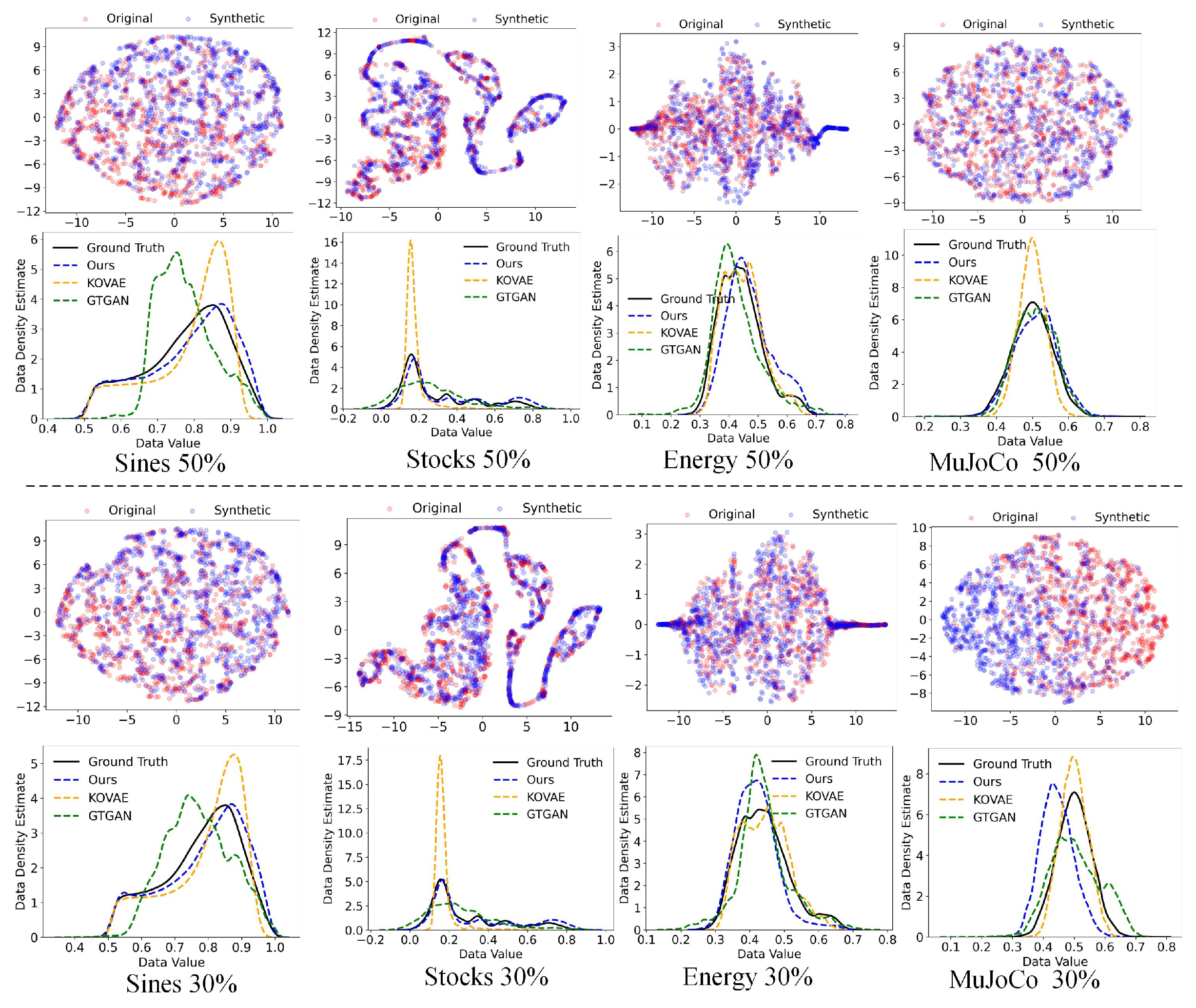
Table A5.
Diff-MN for continuous TSG on irregular time series (30%, 50%, 70% missing) with sequence length 12.
Table A5.
Diff-MN for continuous TSG on irregular time series (30%, 50%, 70% missing) with sequence length 12.
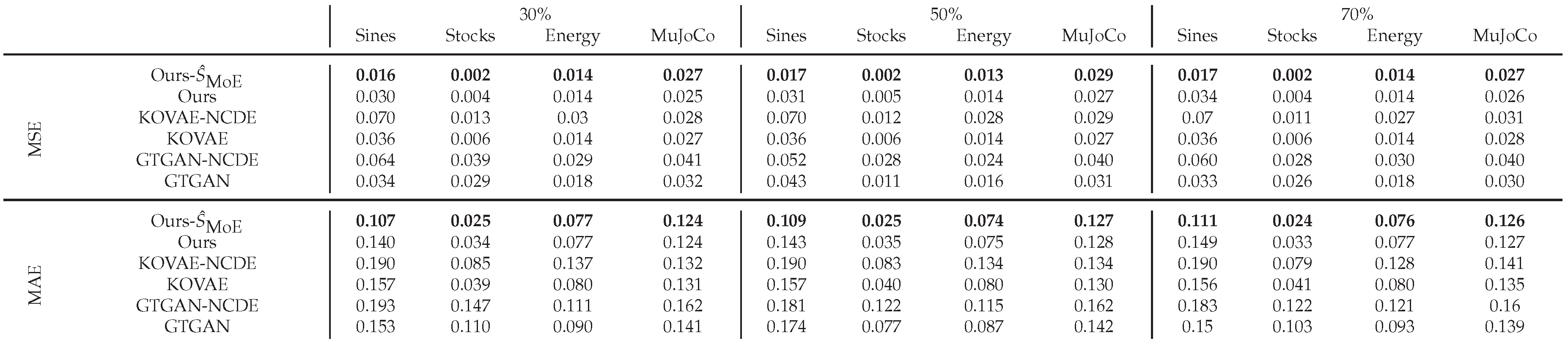 |
Table A6.
Diff-MN for continuous TSG on irregular time series (30%, 50%, 70% missing) with sequence length 24.
Table A6.
Diff-MN for continuous TSG on irregular time series (30%, 50%, 70% missing) with sequence length 24.
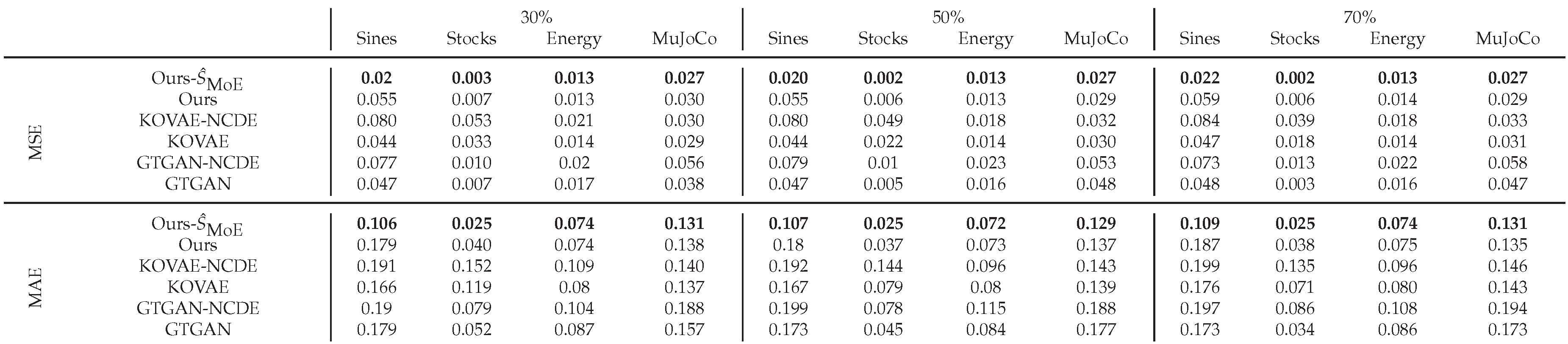 |
Table A7.
Diff-MN for continuous TSG on irregular time series (30%, 50%, 70% missing) with sequence length 36.
Table A7.
Diff-MN for continuous TSG on irregular time series (30%, 50%, 70% missing) with sequence length 36.
| 30% | 50% | 70% | |||||||||||
|---|---|---|---|---|---|---|---|---|---|---|---|---|---|
| Sines | Stocks | Energy | MuJoCo | Sines | Stocks | Energy | MuJoCo | Sines | Stocks | Energy | MuJoCo | ||
| MSE | Ours- | 0.041 | 0.002 | 0.013 | 0.031 | 0.042 | 0.002 | 0.013 | 0.031 | 0.044 | 0.003 | 0.013 | 0.032 |
| Ours-NCDE | 0.041 | 0.002 | 0.013 | 0.031 | 0.042 | 0.002 | 0.013 | 0.031 | 0.044 | 0.003 | 0.013 | 0.033 | |
| Ours | 0.063 | 0.005 | 0.013 | 0.038 | 0.064 | 0.005 | 0.014 | 0.035 | 0.068 | 0.005 | 0.014 | 0.036 | |
| KOVAE-NCDE | 0.077 | 0.057 | 0.018 | 0.033 | 0.078 | 0.046 | 0.018 | 0.035 | 0.082 | 0.039 | 0.017 | 0.036 | |
| KOVAE | 0.051 | 0.035 | 0.014 | 0.035 | 0.052 | 0.029 | 0.014 | 0.036 | 0.051 | 0.018 | 0.014 | 0.038 | |
| GTGAN-NCDE | 0.126 | 0.013 | 0.032 | 0.061 | 0.098 | 0.015 | 0.031 | 0.065 | 0.076 | 0.021 | 0.034 | 0.076 | |
| GTGAN | 0.052 | 0.006 | 0.022 | 0.054 | 0.064 | 0.007 | 0.020 | 0.062 | 0.058 | 0.004 | 0.023 | 0.065 | |
| MAE | Ours- | 0.162 | 0.026 | 0.074 | 0.133 | 0.161 | 0.027 | 0.074 | 0.135 | 0.163 | 0.026 | 0.075 | 0.137 |
| Ours | 0.203 | 0.035 | 0.074 | 0.149 | 0.204 | 0.036 | 0.074 | 0.144 | 0.209 | 0.036 | 0.076 | 0.145 | |
| KOVAE-NCDE | 0.214 | 0.159 | 0.096 | 0.146 | 0.218 | 0.141 | 0.099 | 0.149 | 0.225 | 0.133 | 0.091 | 0.151 | |
| KOVAE | 0.186 | 0.123 | 0.080 | 0.150 | 0.191 | 0.111 | 0.081 | 0.151 | 0.193 | 0.072 | 0.081 | 0.155 | |
| GTGAN-NCDE | 0.266 | 0.093 | 0.132 | 0.198 | 0.247 | 0.099 | 0.135 | 0.208 | 0.218 | 0.115 | 0.141 | 0.226 | |
| GTGAN | 0.197 | 0.046 | 0.103 | 0.182 | 0.209 | 0.048 | 0.098 | 0.202 | 0.201 | 0.034 | 0.117 | 0.208 | |
Figure A3.
Continuous TSG on the stock dataset with Diff-MN: 12 steps refined to 23 under 30% missing data (Part 1).
Figure A3.
Continuous TSG on the stock dataset with Diff-MN: 12 steps refined to 23 under 30% missing data (Part 1).
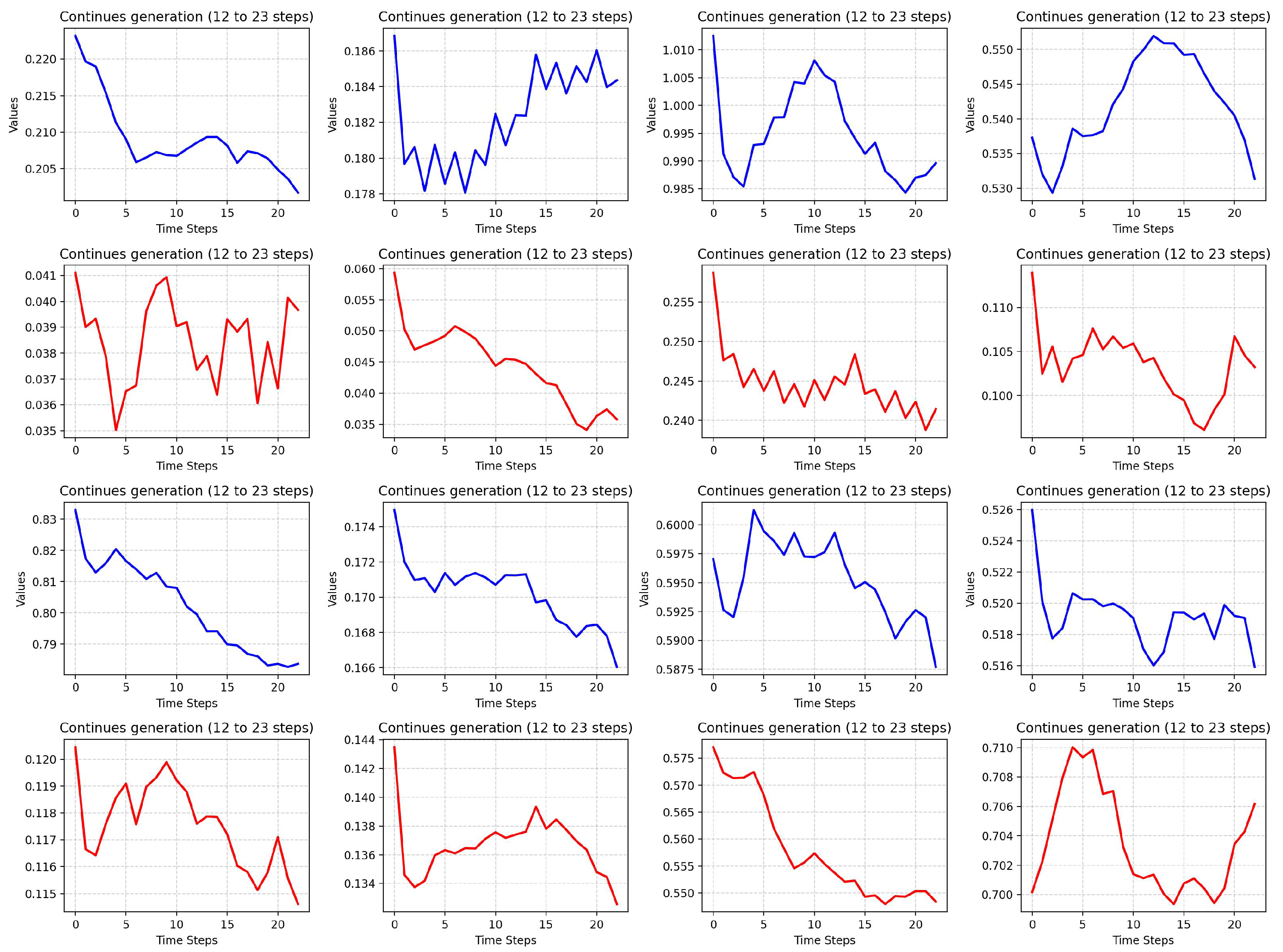
Figure A4.
Continuous TSG on the stock dataset with Diff-MN: 12 steps refined to 23 under 30% missing data (Part 2).
Figure A4.
Continuous TSG on the stock dataset with Diff-MN: 12 steps refined to 23 under 30% missing data (Part 2).
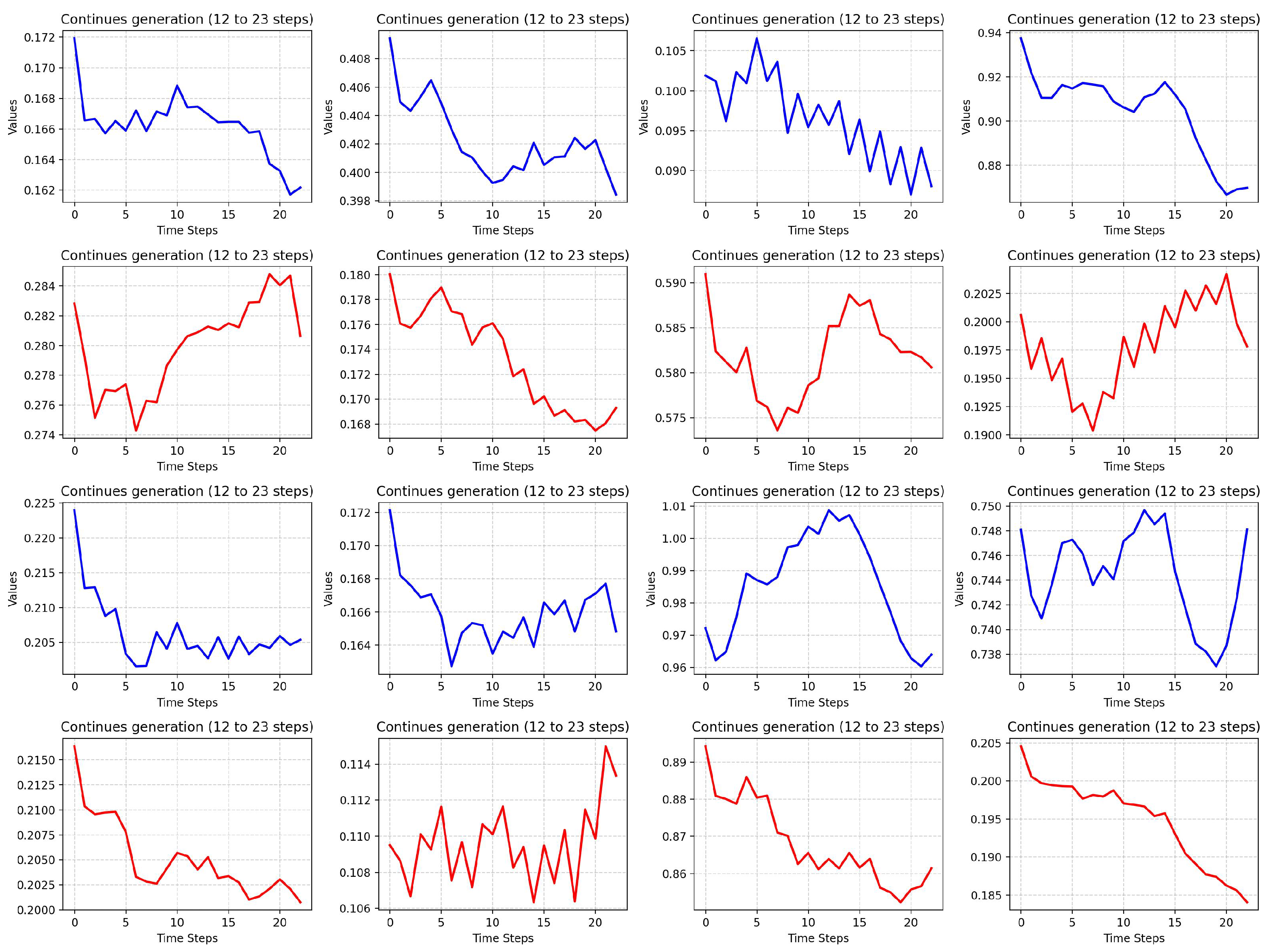
Figure A5.
Continuous TSG on the stock dataset with Diff-MN: 12 steps refined to 23 under 30% missing data (Part 3).
Figure A5.
Continuous TSG on the stock dataset with Diff-MN: 12 steps refined to 23 under 30% missing data (Part 3).
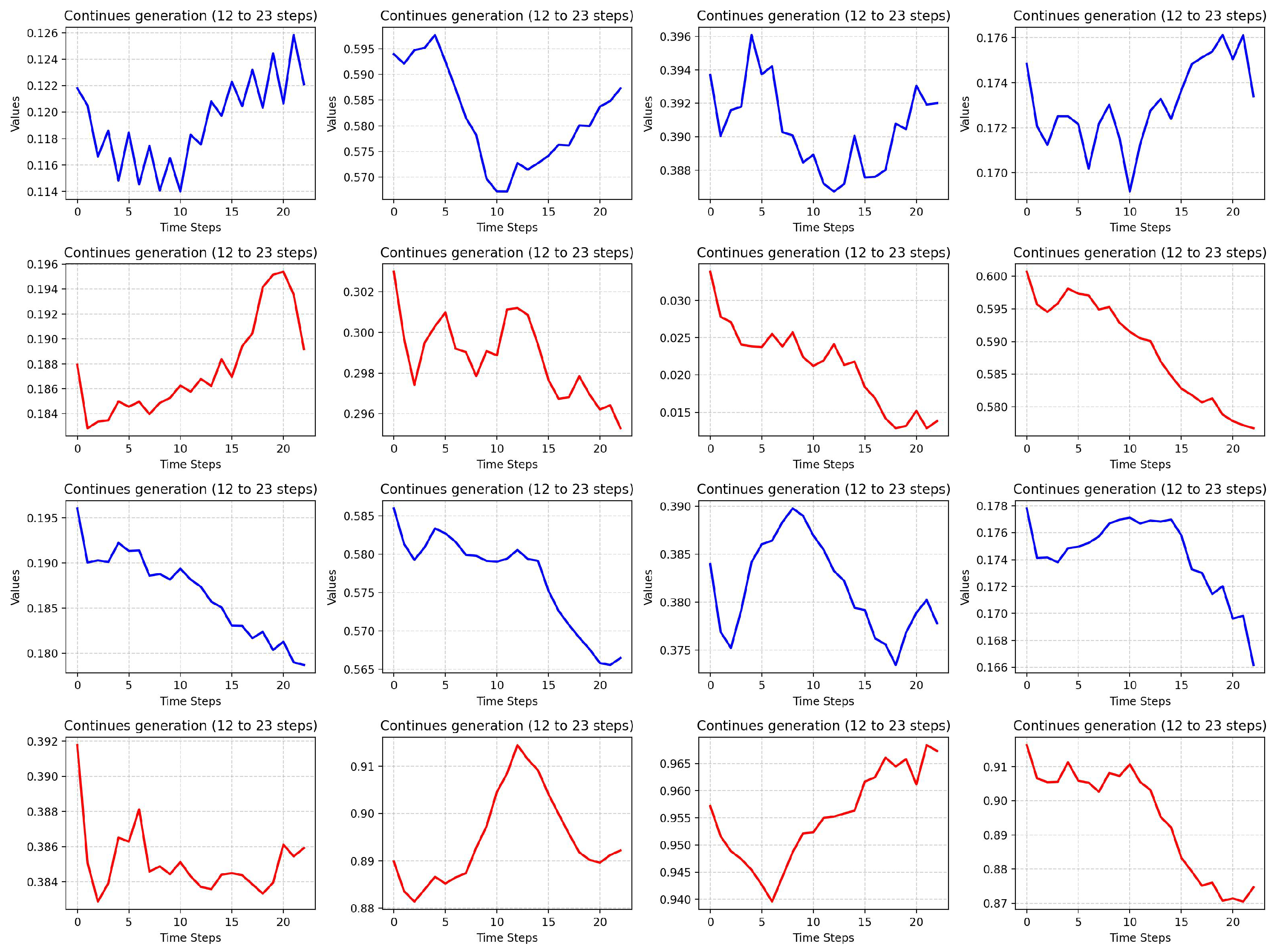
Figure A6.
Visualizations demonstrate that MoE-NCDE does not produce overly smooth curves on the stock dataset.
Figure A6.
Visualizations demonstrate that MoE-NCDE does not produce overly smooth curves on the stock dataset.
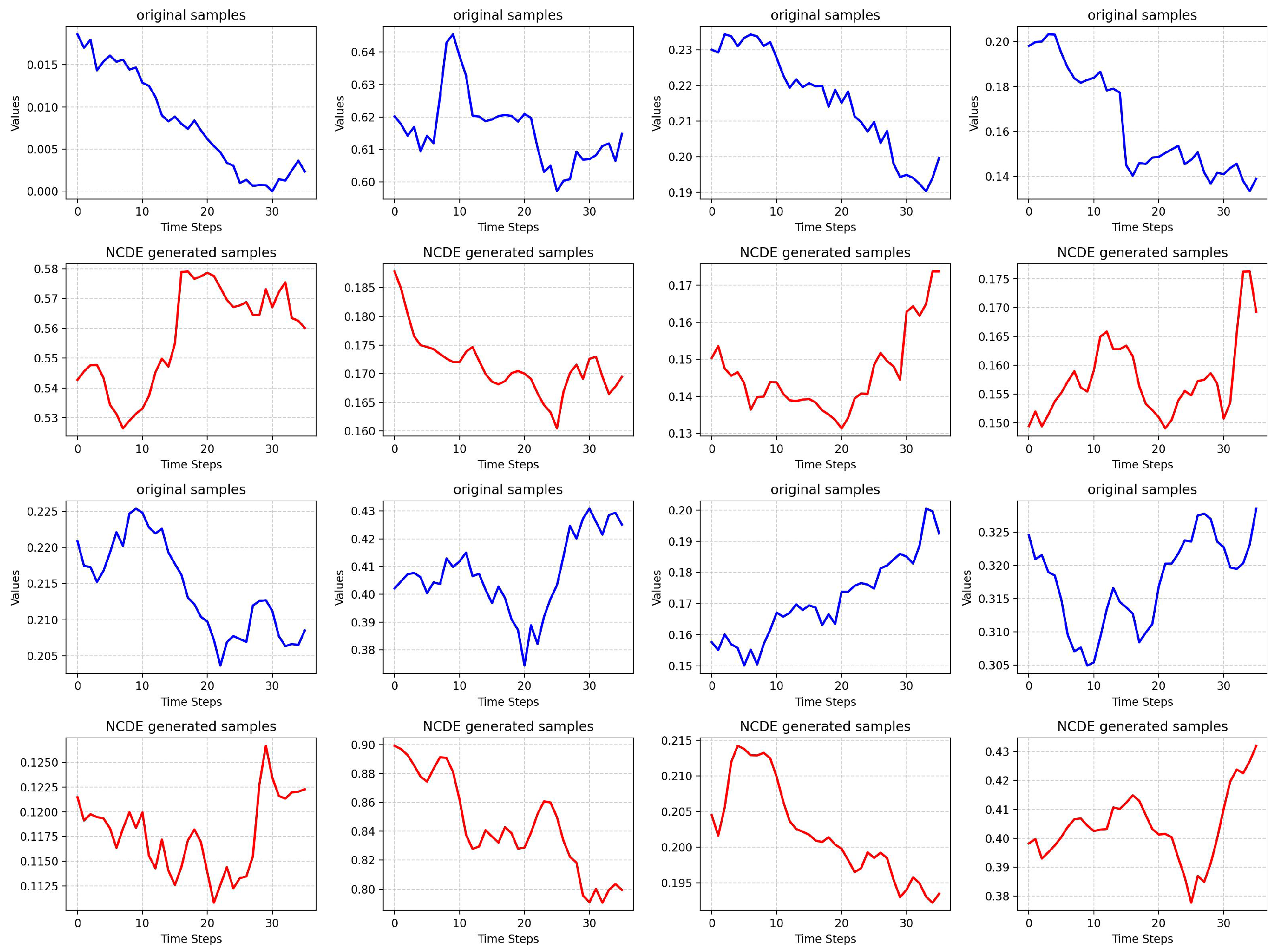
Figure A7.
Visualizations demonstrate that MoE-NCDE does not produce overly smooth curves on the energy dataset.
Figure A7.
Visualizations demonstrate that MoE-NCDE does not produce overly smooth curves on the energy dataset.
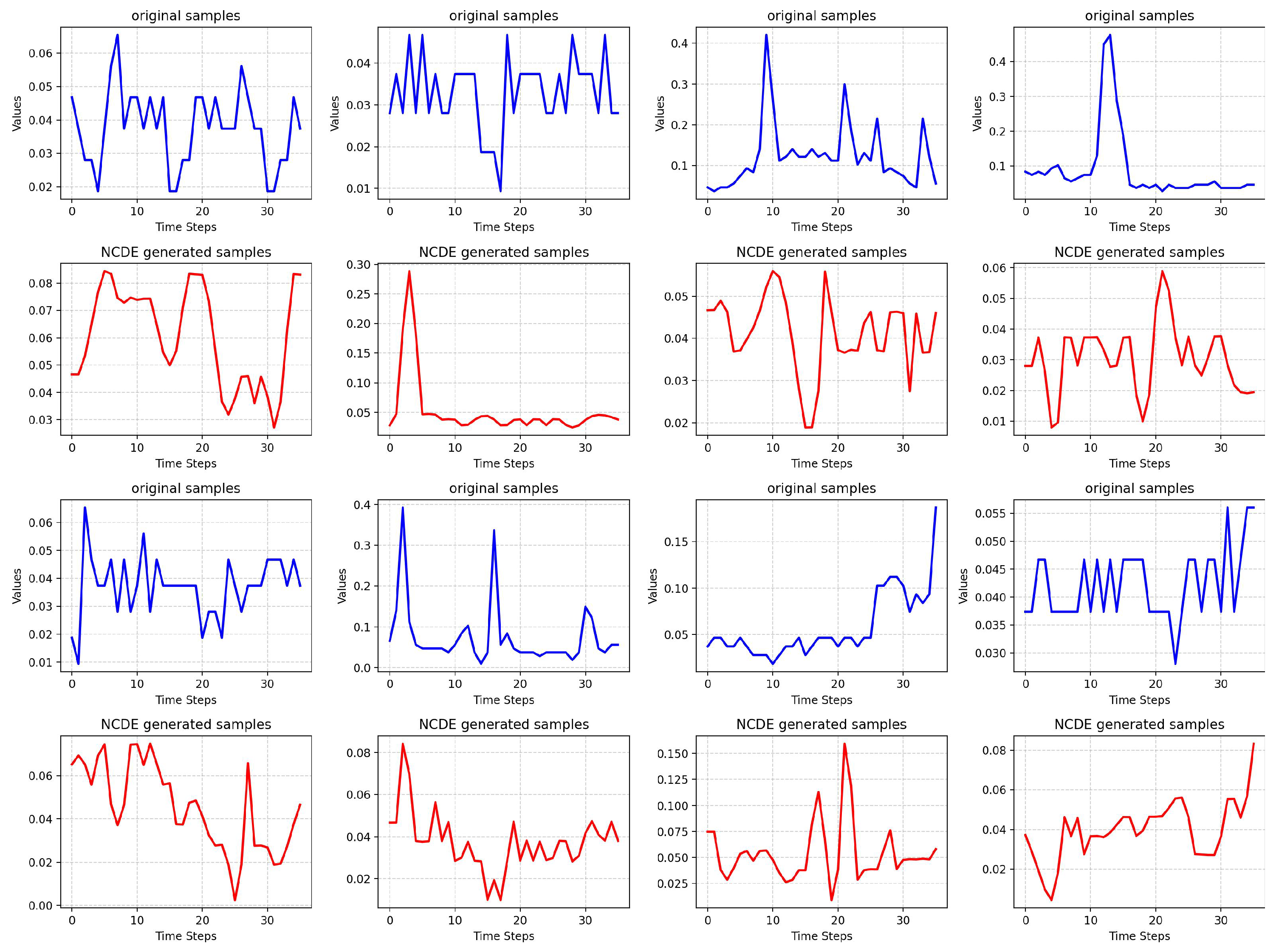
Figure A8.
Visualizations demonstrate that MoE-NCDE does not produce overly smooth curves on the sine dataset.
Figure A8.
Visualizations demonstrate that MoE-NCDE does not produce overly smooth curves on the sine dataset.
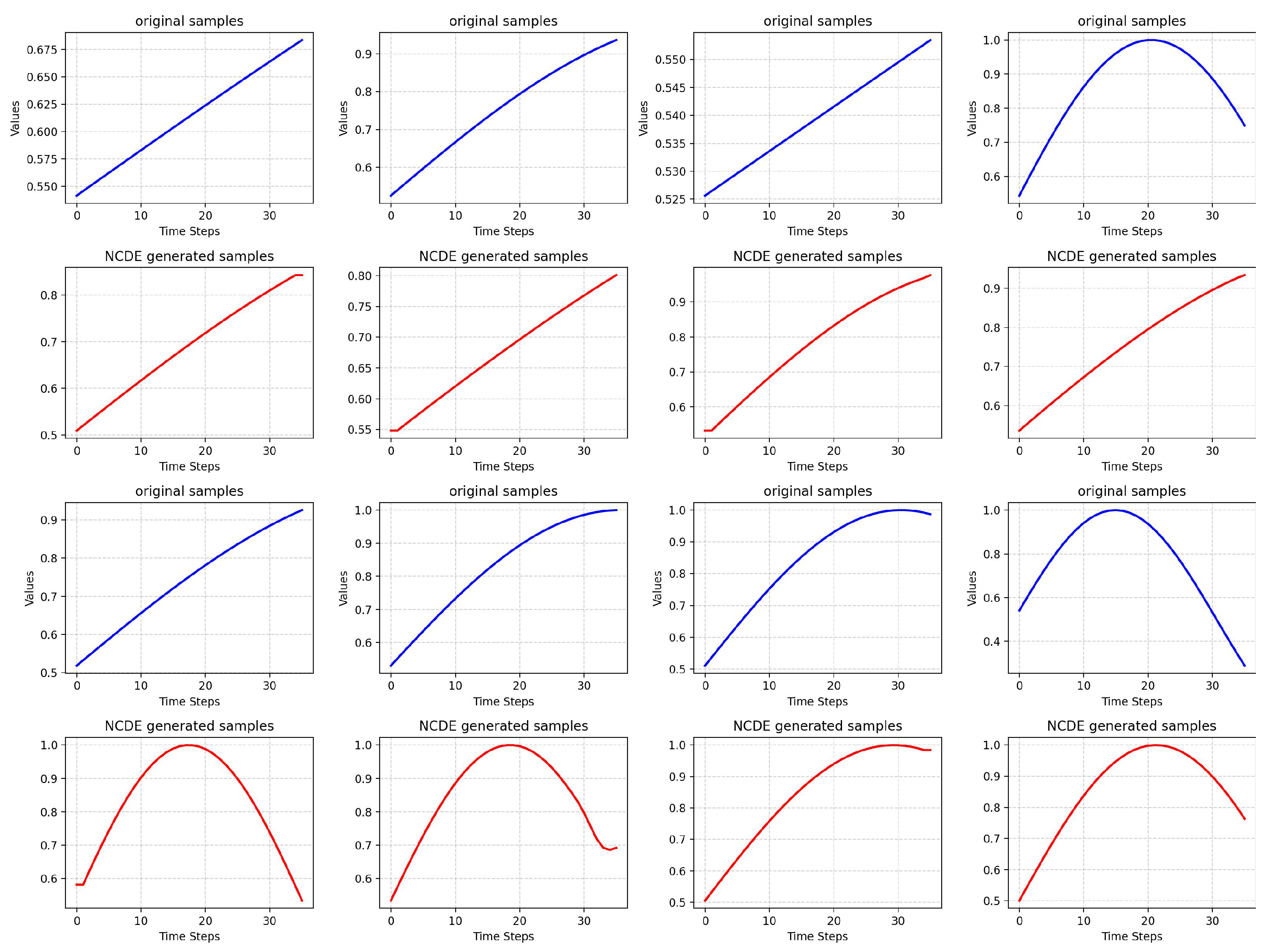
Figure A9.
Visualization of cubic polynomial curves with varying coefficients.
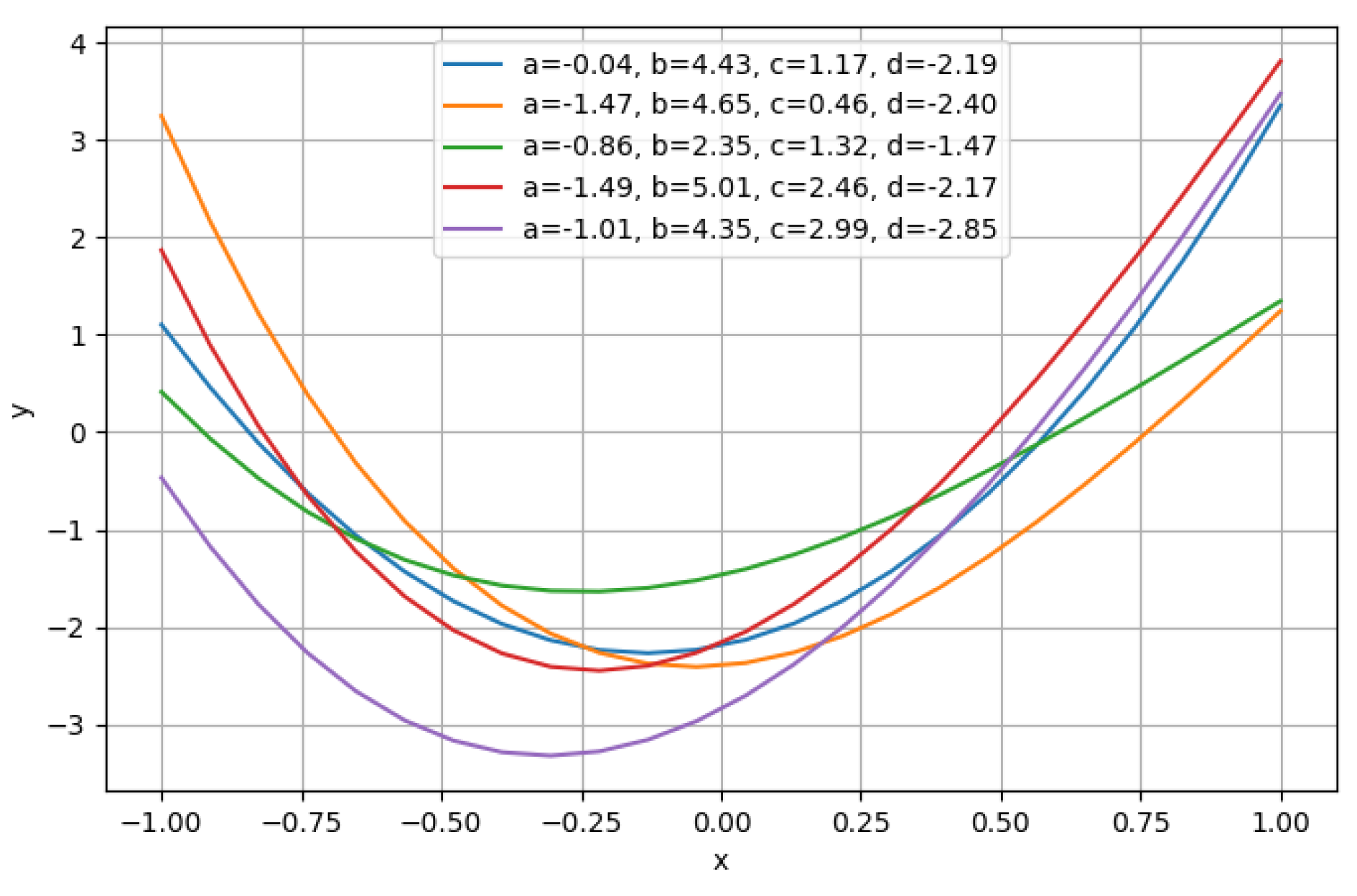
Figure A10.
Analytical solution recovery using continuous TSG samples (doubled length). Subplots show coefficients a, b, c, and d.
Figure A10.
Analytical solution recovery using continuous TSG samples (doubled length). Subplots show coefficients a, b, c, and d.
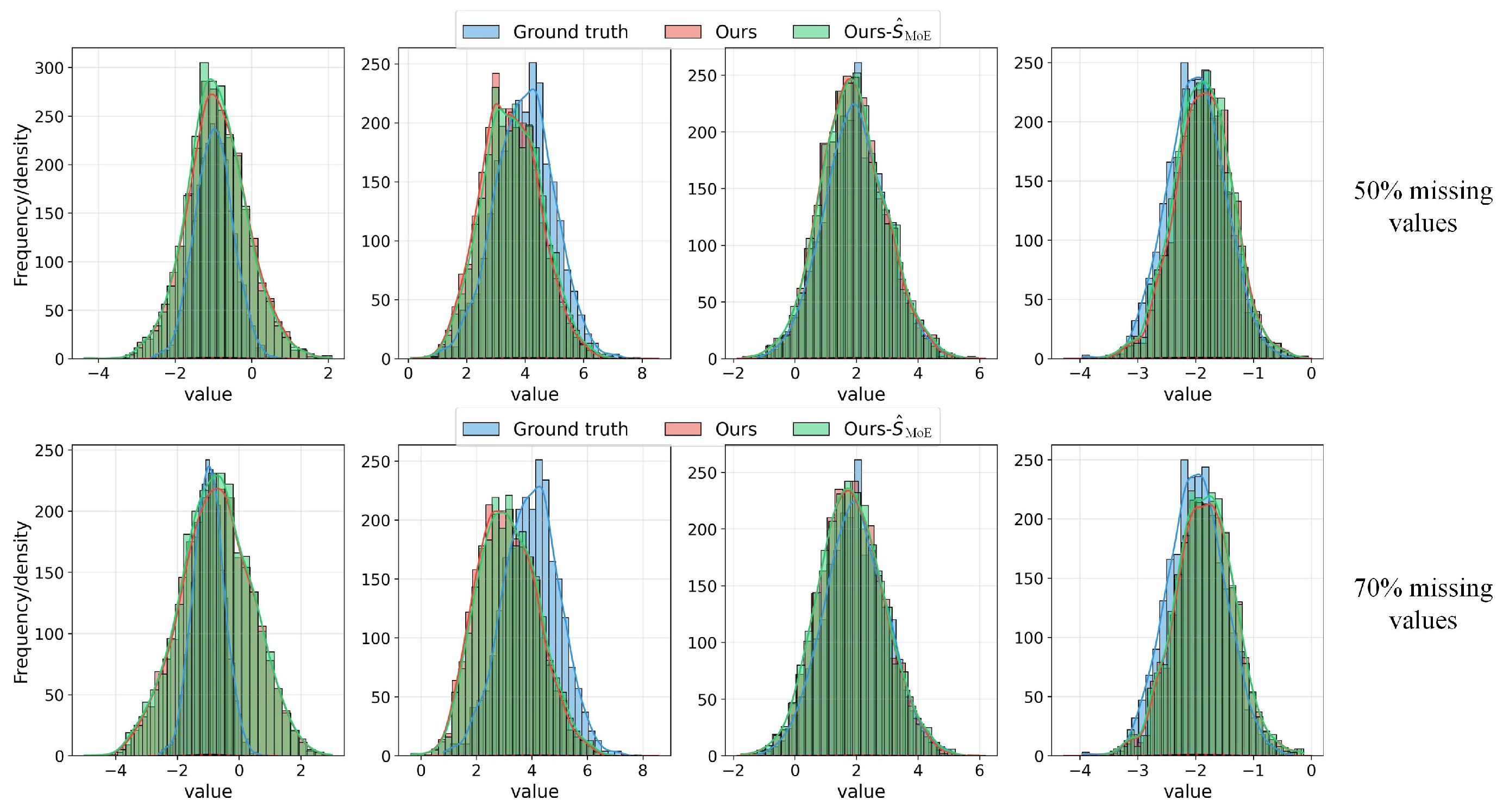
Figure A11.
Visualization of temporal dynamics learned by different experts of MoE-NCDE on the Energy dataset in continuous TSG.
Figure A11.
Visualization of temporal dynamics learned by different experts of MoE-NCDE on the Energy dataset in continuous TSG.
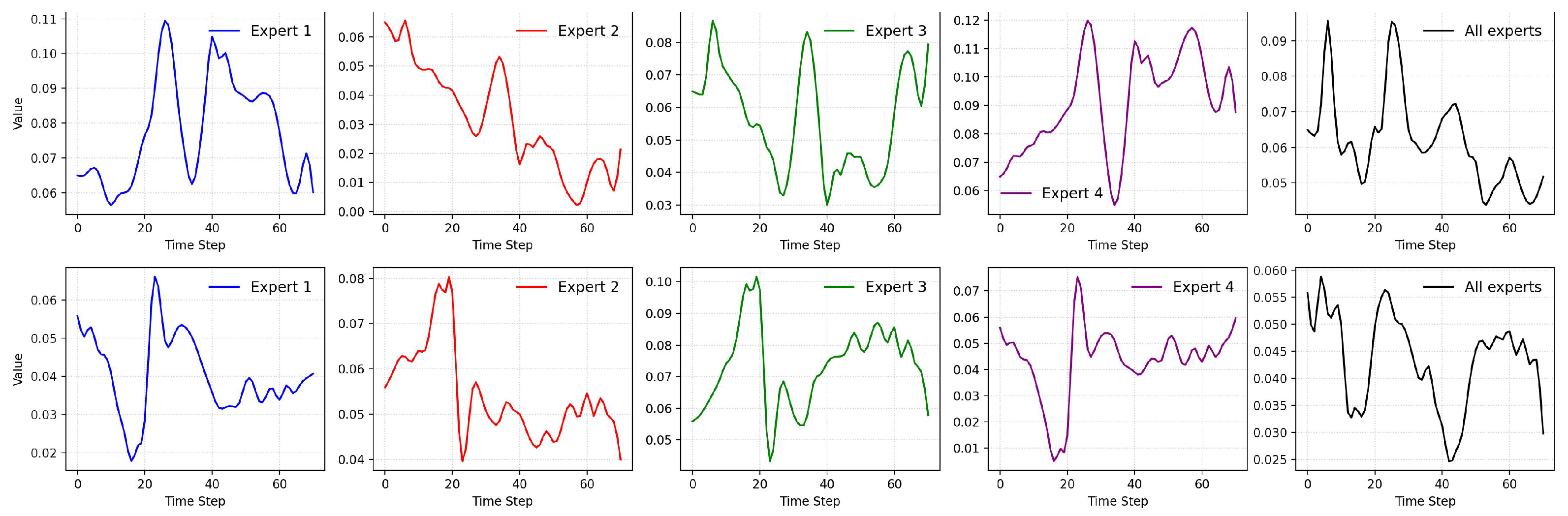
Figure A12.
Comparison of analytical solution recovery between our method and KOVAE. Subplots show coefficients a, b, c, and d.
Figure A12.
Comparison of analytical solution recovery between our method and KOVAE. Subplots show coefficients a, b, c, and d.
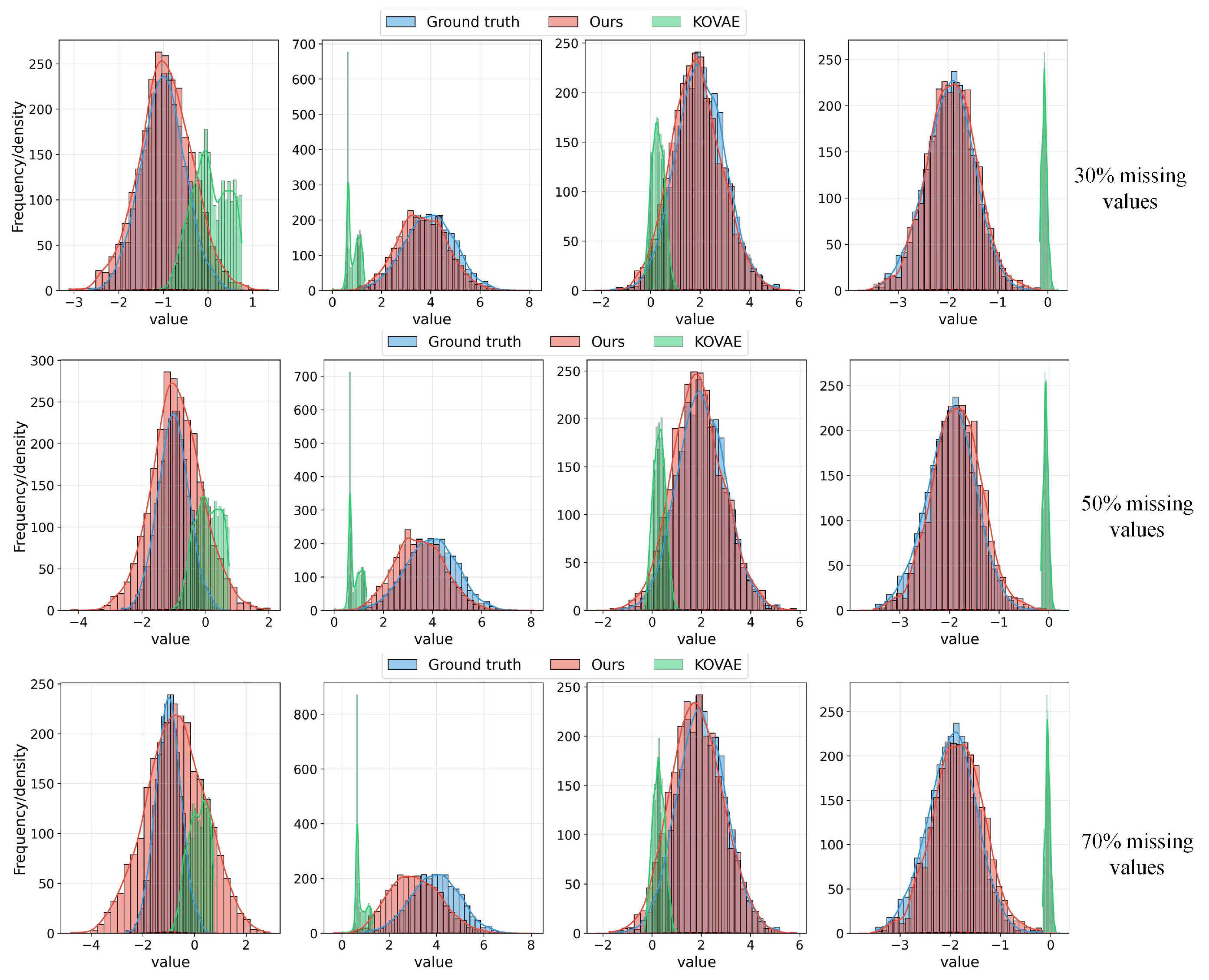
Figure A13.
Comparison of analytical solution recovery between our method and GT-GAN. Subplots show coefficients a, b, c, and d.
Figure A13.
Comparison of analytical solution recovery between our method and GT-GAN. Subplots show coefficients a, b, c, and d.
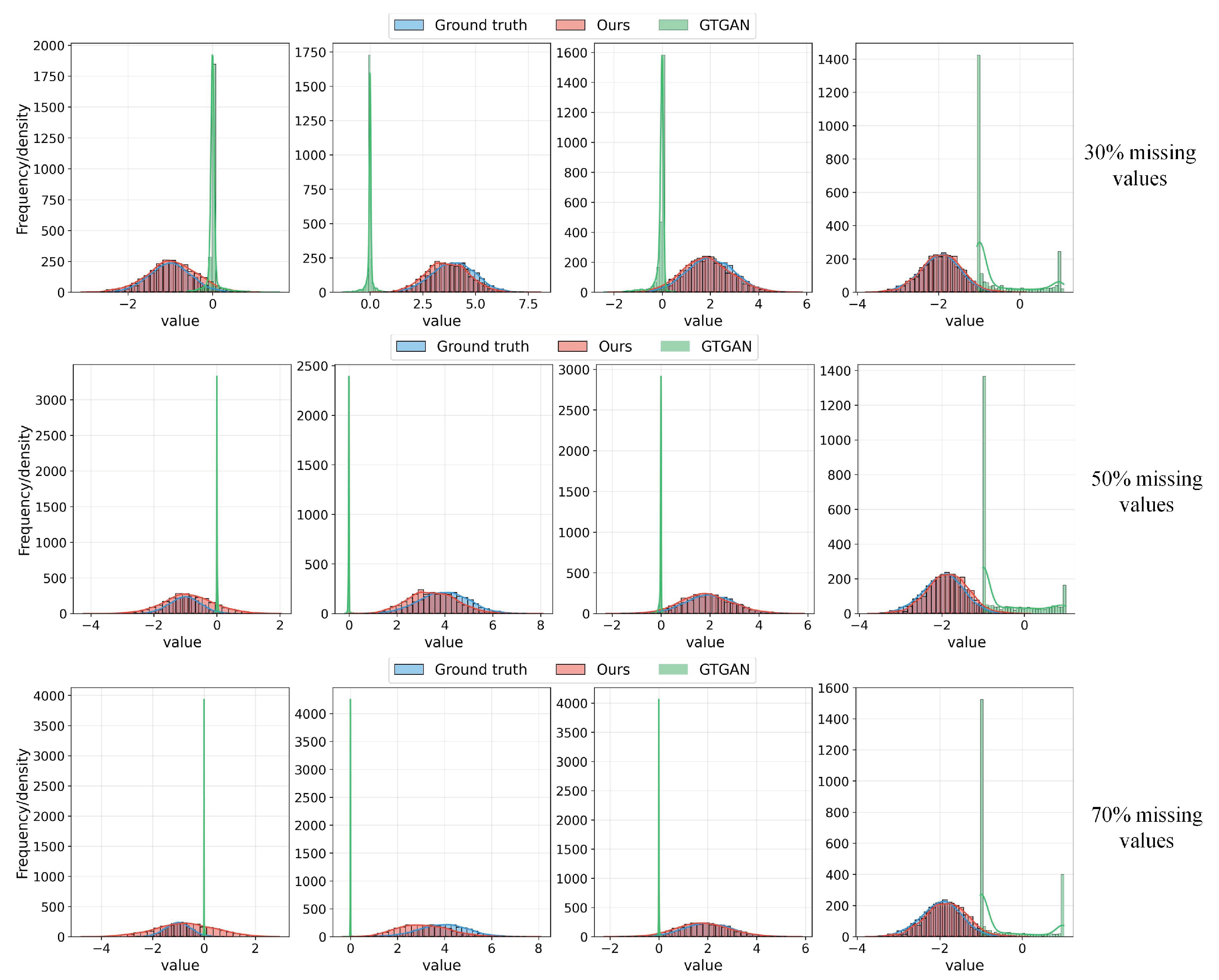
Table A8.
Average expert weights learned by MoE-NCDE across all samples from different datasets.
| Datasets | Expert 1 | Expert 2 | Expert 3 | Expert 4 | |
|---|---|---|---|---|---|
| Sines | 0.31384414 | 0.2231202 | 0.26881662 | 0.19421977 | |
| Stocks | 0.19200034 | 0.21767974 | 0.32304975 | 0.2672697 | |
| Energy | 0.2413441 | 0.31066164 | 0.2065838 | 0.24141027 | |
| MuJoCo | 0.18345672 | 0.241069 | 0.2046078 | 0.370866 | |
| ECG200 | 0.21229412 | 0.44273788 | 0.20304906 | 0.14191894 | |
| ECG5K | 0.21999635 | 0.182932 | 0.3610456 | 0.2360259 | |
| ECGFD | 0.17836495 | 0.31938562 | 0.2739047 | 0.2283447 | |
| TLECG | 0.19264506 | 0.2577268 | 0.3210036 | 0.2286246 |
References
- Candanedo, Luis. 2017. Appliances energy prediction. In UCI Machine Learning Repository. [Google Scholar]
- Che, Zhengping, Sanjay Purushotham, Kyunghyun Cho, David Sontag, and Yan Liu. 2018. Recurrent neural networks for multivariate time series with missing values. Scientific reports 8, 1: 6085. [Google Scholar] [CrossRef] [PubMed]
- Chen, Ricky TQ, Yulia Rubanova, Jesse Bettencourt, and David K Duvenaud. 2018. Neural ordinary differential equations. Advances in neural information processing systems 31. [Google Scholar]
- Deng, Bowen, Chang Xu, Hao Li, Yuhao Huang, Min Hou, and Jiang Bian. 2025a. Tardiff: Target-oriented diffusion guidance for synthetic electronic health record time series generation. CoRR abs/2504.17613.
- Deng, Bowen, Chang Xu, Hao Li, Yuhao Huang, Min Hou, and Jiang Bian. 2025b. Tardiff: Target-oriented diffusion guidance for synthetic electronic health record time series generation. arXiv arXiv:2504.17613. [Google Scholar]
- Deng, Junwei, Chang Xu, Jiaqi W. Ma, Ming Jin, Chenghao Liu, and Jiang Bian. 2026. Oats: Online data augmentation for time series foundation models. [Google Scholar] [CrossRef]
- Deng, Ruizhi, Bo Chang, Marcus A Brubaker, Greg Mori, and Andreas Lehrmann. 2020. Modeling continuous stochastic processes with dynamic normalizing flows. Advances in Neural Information Processing Systems 33, 7805–7815. [Google Scholar]
- Desai, Abhyuday, Cynthia Freeman, Zuhui Wang, and Ian Beaver. 2021. TimeVAE: a variational auto-encoder for multivariate time series generation. arXiv arXiv:2111.08095. [Google Scholar]
- Fuest, Michael, Alfredo Cuesta-Infante, and Kalyan Veeramachaneni. 2025. CENTS: generating synthetic electricity consumption time series for rare and unseen scenarios. CoRR abs/2501.14426.
- Ge, Yunfeng, Jiawei Li, Yiji Zhao, Haomin Wen, Zhao Li, Meikang Qiu, Hongyan Li, Ming Jin, and Shirui Pan. 2025. T2S: high-resolution time series generation with text-to-series diffusion models. CoRR abs/2505.02417.
- Huang, Yu-Hao, Chang Xu, Yueying Wu, Wu-Jun Li, and Jiang Bian. 2025. Timedp: Learning to generate multi-domain time series with domain prompts. Proceedings of the AAAI Conference on Artificial Intelligence 39: 17520–17527. [Google Scholar] [CrossRef]
- Jeon, Jinsung, Jeonghak Kim, Haryong Song, Seunghyeon Cho, and Noseong Park. 2022. GT-GAN: general purpose time series synthesis with generative adversarial networks. Advances in Neural Information Processing Systems 35, 36999–37010. [Google Scholar]
- Kidger, Patrick, James Morrill, James Foster, and Terry Lyons. 2020. Neural controlled differential equations for irregular time series. Advances in neural information processing systems 33, 6696–6707. [Google Scholar]
- Lee, Daesoo, Sara Malacarne, and Erlend Aune. 2023. Vector quantized time series generation with a bidirectional prior model. arXiv arXiv:2303.04743. [Google Scholar] [CrossRef]
- Li, Hao, Bowen Deng, Chang Xu, Zhiyuan Feng, Viktor Schlegel, Yu-Hao Huang, Yizheng Sun, Jingyuan Sun, Kailai Yang, Yiyao Yu, and et al. 2025. Mira: Medical time series foundation model for real-world health data. arXiv arXiv:2506.07584. [Google Scholar] [CrossRef]
- Li, Hao, Yuhao Huang, Chang Xu, Viktor Schlegel, Renhe Jiang, Riza Batista-Navarro, Goran Nenadic, and Jiang Bian. 2025. Bridge: Bootstrapping text to control time-series generation via multi-agent iterative optimization and diffusion modelling. Forty-second International Conference on Machine Learning. [Google Scholar]
- Li, Yangming. 2023. Ts-diffusion: Generating highly complex time series with diffusion models. CoRR abs/2311.03303.
- Lim, Haksoo, Minjung Kim, Sewon Park, Jaehoon Lee, and Noseong Park. 2023. Tsgm: Regular and irregular time-series generation using score-based generative models. [Google Scholar]
- Lin, Lequan, Zhengkun Li, Ruikun Li, Xuliang Li, and Junbin Gao. 2024. Diffusion models for time-series applications: a survey. Frontiers of Information Technology & Electronic Engineering 25, 1: 19–41. [Google Scholar]
- Mushunje, Leonard, David Allen, and Shelton Peiris. 2023. Volatility and irregularity capturing in stock price indices using time series generative adversarial networks (timegan). CoRR abs/2311.12987.
- Naiman, Ilan, N. Benjamin Erichson, Pu Ren, Michael W. Mahoney, and Omri Azencot. 2024. Generative modeling of regular and irregular time series data via koopman VAEs. The Twelfth International Conference on Learning Representations. [Google Scholar]
- Nikitin, Alexander V., Letizia Iannucci, and Samuel Kaski. 2024. TSGM: A flexible framework for generative modeling of synthetic time series. NeurIPS. [Google Scholar]
- Ramponi, Giorgia, Pavlos Protopapas, Marco Brambilla, and Ryan Janssen. 2018. T-CGAN: conditional generative adversarial network for data augmentation in noisy time series with irregular sampling. CoRR abs/1811.08295.
- Rubanova, Yulia, Ricky TQ Chen, and David K Duvenaud. 2019. Latent ordinary differential equations for irregularly-sampled time series. Advances in neural information processing systems 32. [Google Scholar]
- Shukla, Satya Narayan, and Benjamin Marlin. Heteroscedastic temporal variational autoencoder for irregularly sampled time series. International Conference on Learning Representations.
- Song, Ziyang, Qincheng Lu, He Zhu, David Buckeridge, and Yue Li. 2025. Trajgpt: Irregular time-series representation learning of health trajectory. IEEE Journal of Biomedical and Health Informatics. [Google Scholar] [CrossRef] [PubMed]
- Tang, Peihao, Zhen Li, Xuanlin Wang, Xueping Liu, and Peng Mou. 2025. Time series data augmentation for energy consumption data based on improved timegan. Sensors 25, 2: 493. [Google Scholar] [CrossRef] [PubMed]
- Tian, Muhang, Bernie Chen, Allan Guo, Shiyi Jiang, and Anru R. Zhang. 2024. Reliable generation of privacy-preserving synthetic electronic health record time series via diffusion models. J. Am. Medical Informatics Assoc. 31, 11: 2529–2539. [Google Scholar] [CrossRef] [PubMed]
- Todorov, Emanuel, Tom Erez, and Yuval Tassa. 2012. MuJoCo: a physics engine for model-based control. In 2012 IEEE/RSJ International Conference on Intelligent Robots and Systems. IEEE: pp. 5026–5033. [Google Scholar] [CrossRef]
- Turowski, M, B Heidrich, L Weingärtner, L Springer, K Phipps, B Schäfer, R Mikut, and V Hagenmeyer. 2024. Generating synthetic energy time series: A review. Renewable and Sustainable Energy Reviews 206, 114842. [Google Scholar] [CrossRef]
- Vasiliu, Laurentiu, Radu Prodan, Ahmet Soylu, and Dumitru Roman. 2024. An integrated approach using ontologies, knowledge graphs, machine learning, and rules models for synthetic financial time series generation. RuleML+RR (Companion), Volume 3816. CEUR-WS.org. [Google Scholar]
- Xia, Yutong, Chang Xu, Yuxuan Liang, Qingsong Wen, Roger Zimmermann, and Jiang Bian. 2025. Causal time series generation via diffusion models. arXiv arXiv:2509.20846. [Google Scholar]
- Yalavarthi, Vijaya Krishna, Randolf Scholz, Stefan Born, and Lars Schmidt-Thieme. 2025. Probabilistic forecasting of irregularly sampled time series with missing values via conditional normalizing flows. Proceedings of the AAAI Conference on Artificial Intelligence 39: 21877–21885. [Google Scholar] [CrossRef]
- Yoon, Jinsung, Daniel Jarrett, and Mihaela Van der Schaar. 2019. Time-series generative adversarial networks. Advances in neural information processing systems 32. [Google Scholar]
- Zhang, Xu, Zhengang Huang, Yunzhi Wu, Xun Lu, Erpeng Qi, Yunkai Chen, Zhongya Xue, Peng Wang, and Wei Wang. 2024. Self-adaptive scale handling for forecasting time series with scale heterogeneity. In ICASSP 2024-2024 IEEE International Conference on Acoustics, Speech and Signal Processing (ICASSP). IEEE: pp. 7485–7489. [Google Scholar]
- Zhang, Xu, Zhengang Huang, Yunzhi Wu, Xun Lu, Erpeng Qi, Yunkai Chen, Zhongya Xue, Qitong Wang, Peng Wang, and Wei Wang. 2025. Multi-period learning for financial time series forecasting. Proceedings of the 31st ACM SIGKDD Conference on Knowledge Discovery and Data Mining V. 1; pp. 2848–2859. [Google Scholar]
- Zhang, Xu, Peng Wang, Yichen Li, and Wei Wang. 2026. Amortized predictability-aware training framework for time series forecasting and classification. Proceedings of the ACM Web Conference; pp. 5624–5635. [Google Scholar]
- Zhang, Xu, Peng Wang, Chen Wang, Zhe Xu, Xiaohua Nie, and Wei Wang. 2025. Global feature enhancing and fusion framework for strain gauge status recognition. Companion Proceedings of the ACM on Web Conference 2025; pp. 611–620. [Google Scholar]
- Zhang, Xu, Peng Wang, and Wei Wang. Lost in the non-convex loss landscape: How to fine-tune the large time series model? The Fourteenth International Conference on Learning Representations.
- Zhang, Xu, Qitong Wang, Peng Wang, and Wei Wang. 2025. A lightweight sparse interaction network for time series forecasting. Proceedings of the AAAI Conference on Artificial Intelligence 39: 13304–13312. [Google Scholar] [CrossRef]
- Zhang, Xu, Qitong Wang, Peng Wang, and Wei Wang. 2026. Semixer: Semantics enhanced mlp-mixer for multiscale mixing and long-term time series forecasting. Proceedings of the ACM Web Conference 2026; pp. 5636–5647. [Google Scholar]
Figure 1.
Different TSG tasks categorized by the data continuity and sampling irregularity. Unlike (a) and (b), we generate continuous TS from irregular observations, producing high-frequency sequences with richer contextual information.
Figure 1.
Different TSG tasks categorized by the data continuity and sampling irregularity. Unlike (a) and (b), we generate continuous TS from irregular observations, producing high-frequency sequences with richer contextual information.
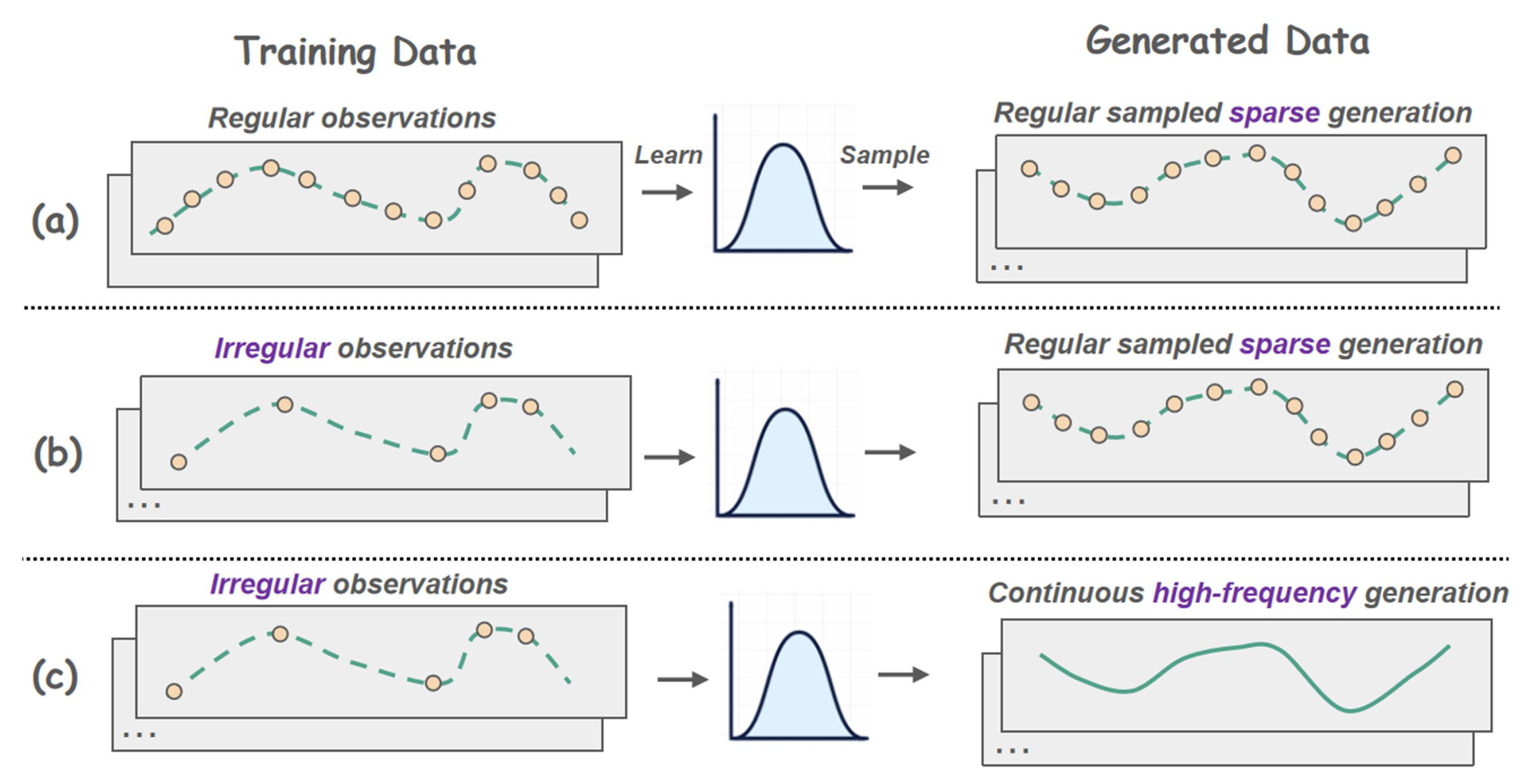
Figure 2.
Overview of our method. Frozen CE and CD are pretrained channel-wise encoder and channel-wise decoder, respectively.
Figure 2.
Overview of our method. Frozen CE and CD are pretrained channel-wise encoder and channel-wise decoder, respectively.
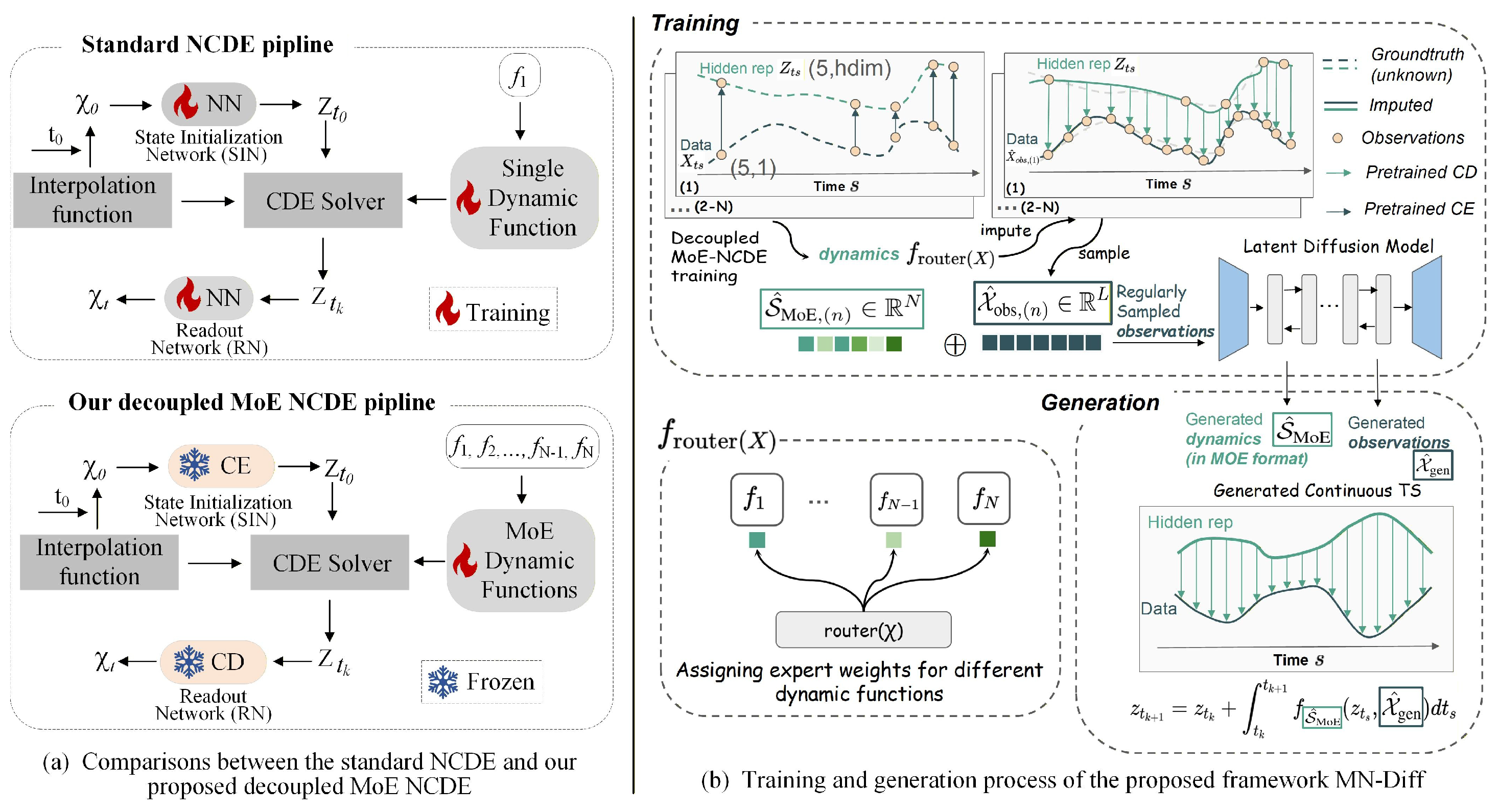
Figure 3.
Qualitative evaluation with 2D t-SNE (top) and probability density function (PDF) of real, KoVAE, and GT-GAN (bottom) with 70% missing values. Additional cases in Appendix Figure A2.
Figure 3.
Qualitative evaluation with 2D t-SNE (top) and probability density function (PDF) of real, KoVAE, and GT-GAN (bottom) with 70% missing values. Additional cases in Appendix Figure A2.
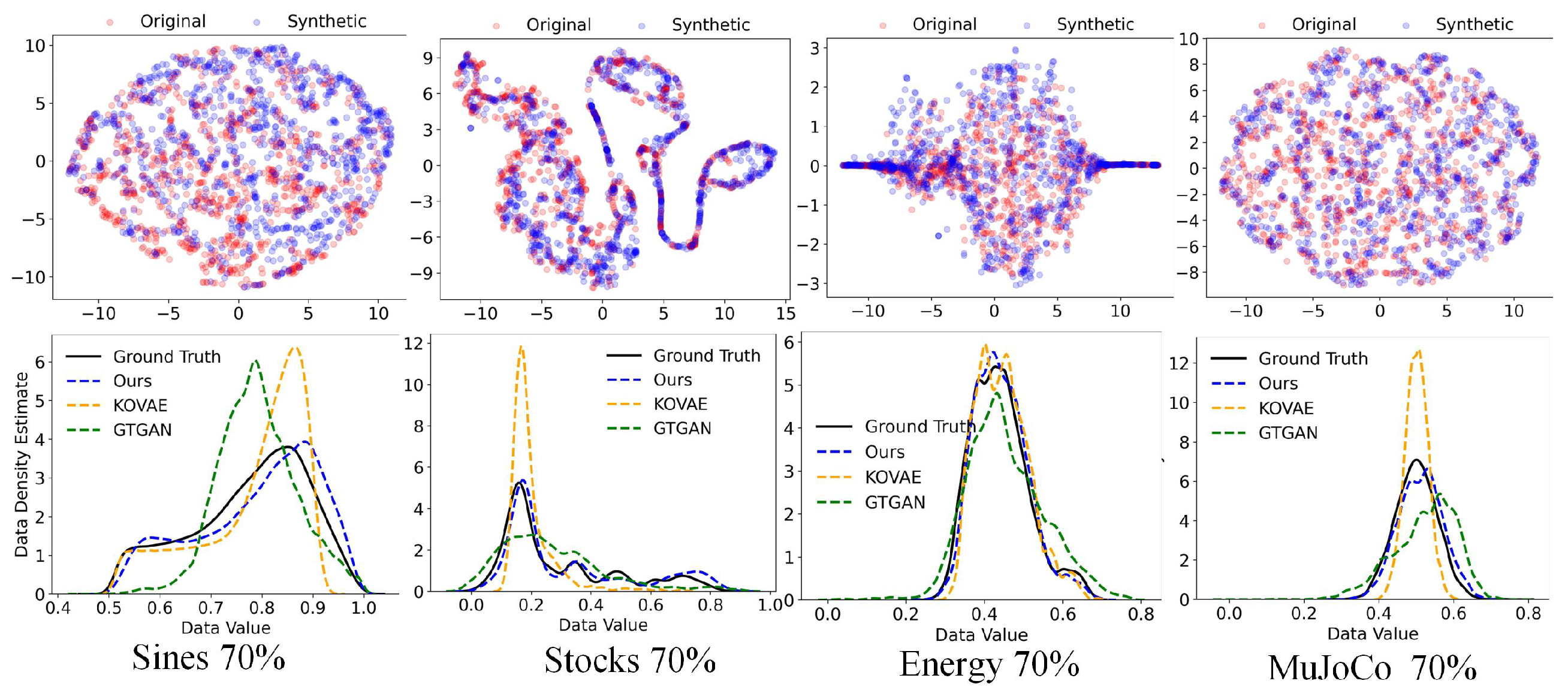
Figure 4.
Cubic polynomial solutions of Diff-MN with 30% missing values: “Ours” uses regular generation from irregular data. “Ours-” applies generated MoE weights for continuous TSG (doubled length). Other cases are in Appendix Figure A9, Figure A12, Figure A13.
Figure 4.
Cubic polynomial solutions of Diff-MN with 30% missing values: “Ours” uses regular generation from irregular data. “Ours-” applies generated MoE weights for continuous TSG (doubled length). Other cases are in Appendix Figure A9, Figure A12, Figure A13.
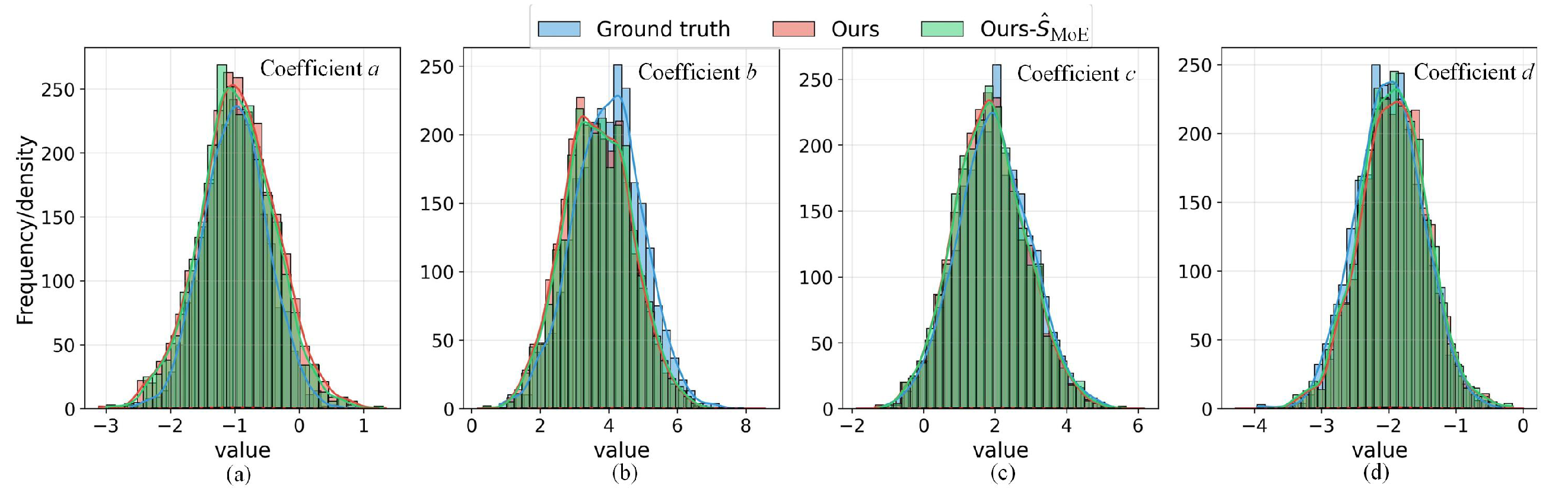
Figure 5.
Qualitative results of MoE-NCDE ablation on various synthetic signals.
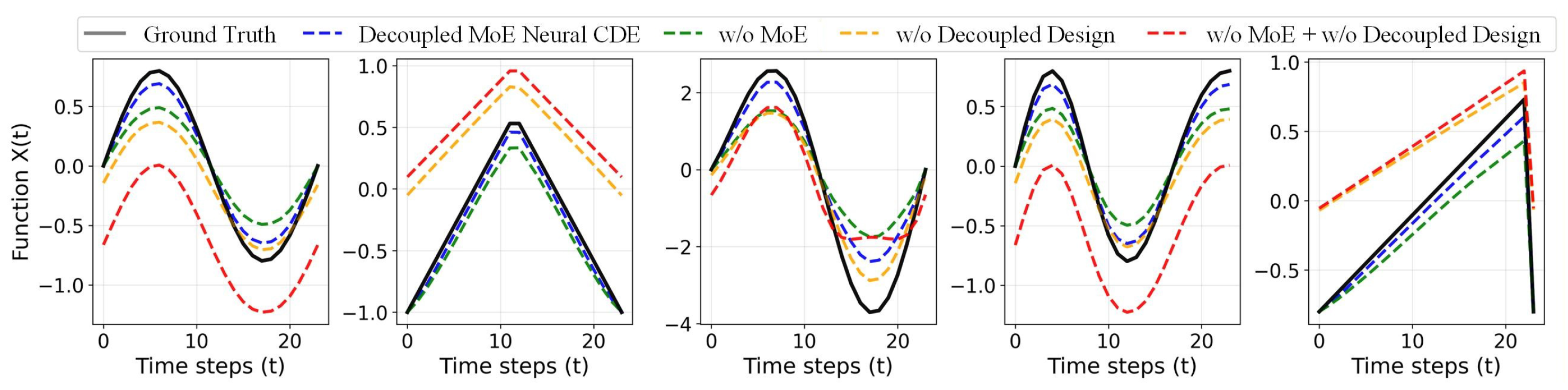
Figure 7.
The impact of the number of experts (1-9) on the MDD metric. DS metric is shown in Appendix Figure A1.
Figure 7.
The impact of the number of experts (1-9) on the MDD metric. DS metric is shown in Appendix Figure A1.

Table 1.
Irregular to regular TSG on popular datasets with 30%, 50%, and 70% of observations dropped. Performance is averaged over sequence lengths 12, 24, and 36. Results for each length are shown in Appendix Table A1, Table A2, and Table A3.
| 30% | 50% | 70% | |||||||||||
|---|---|---|---|---|---|---|---|---|---|---|---|---|---|
| Sines | Stocks | Energy | MuJoCo | Sines | Stocks | Energy | MuJoCo | Sines | Stocks | Energy | MuJoCo | ||
| DS | Ours | 0.105 | 0.142 | 0.422 | 0.293 | 0.128 | 0.137 | 0.487 | 0.375 | 0.182 | 0.106 | 0.497 | 0.393 |
| KoVAE | 0.142 | 0.225 | 0.476 | 0.372 | 0.171 | 0.187 | 0.500 | 0.397 | 0.228 | 0.213 | 0.500 | 0.425 | |
| GT-GAN | 0.302 | 0.321 | 0.499 | 0.489 | 0.416 | 0.326 | 0.500 | 0.494 | 0.341 | 0.292 | 0.499 | 0.492 | |
| TimeGAN-NCDE | 0.455 | 0.365 | 0.499 | 0.49 | 0.427 | 0.442 | 0.499 | 0.499 | 0.44 | 0.477 | 0.500 | 0.499 | |
| TimeVAE-NCDE | 0.234 | 0.470 | 0.498 | 0.375 | 0.308 | 0.485 | 0.496 | 0.463 | 0.426 | 0.492 | 0.498 | 0.476 | |
| Diffusion-NCDE | 0.200 | 0.441 | 0.460 | 0.355 | 0.330 | 0.475 | 0.489 | 0.427 | 0.421 | 0.491 | 0.497 | 0.473 | |
| ProFITi | 0.307 | 0.454 | 0.495 | 0.492 | 0.344 | 0.483 | 0.499 | 0.497 | 0.392 | 0.489 | 0.5 | 0.497 | |
| HeTVAE | 0.491 | 0.328 | 0.497 | 0.499 | 0.5 | 0.443 | 0.5 | 0.499 | 0.5 | 0.487 | 0.5 | 0.5 | |
| MDD | Ours | 0.953 | 0.25 | 0.270 | 0.347 | 1.093 | 0.281 | 0.252 | 0.318 | 1.308 | 0.299 | 0.279 | 0.297 |
| KoVAE | 5.134 | 0.709 | 0.347 | 0.374 | 5.584 | 0.662 | 0.368 | 0.419 | 6.393 | 0.624 | 0.377 | 0.619 | |
| GT-GAN | 2.644 | 0.630 | 0.567 | 0.558 | 2.978 | 0.589 | 0.473 | 0.596 | 2.559 | 0.603 | 0.532 | 0.627 | |
| TimeGAN-NCDE | 3.477 | 1.111 | 1.028 | 1.182 | 3.739 | 1.605 | 1.343 | 1.535 | 3.981 | 1.629 | 1.559 | 1.704 | |
| TimeVAE-NCDE | 4.767 | 0.597 | 0.444 | 0.338 | 3.761 | 0.726 | 0.533 | 0.443 | 3.397 | 0.843 | 0.604 | 0.565 | |
| Diffusion-NCDE | 1.462 | 0.341 | 0.292 | 0.371 | 1.498 | 0.476 | 0.351 | 0.37 | 1.997 | 0.743 | 0.513 | 0.487 | |
| ProFITi | 1.163 | 0.297 | 0.255 | 0.295 | 1.236 | 0.408 | 0.35 | 0.353 | 1.443 | 0.445 | 0.442 | 0.448 | |
| HeTVAE | 3.158 | 0.599 | 0.625 | 0.654 | 3.449 | 0.773 | 1.095 | 1.093 | 3.967 | 1.032 | 1.323 | 1.398 | |
| KL | Ours | 0.013 | 0.074 | 0.020 | 0.021 | 0.023 | 0.094 | 0.022 | 0.009 | 0.033 | 0.091 | 0.017 | 0.014 |
| KoVAE | 4.172 | 1.014 | 0.065 | 0.130 | 4.719 | 0.859 | 0.067 | 0.198 | 5.521 | 0.868 | 0.08 | 0.425 | |
| GT-GAN | 0.099 | 0.203 | 0.056 | 0.021 | 0.153 | 0.181 | 0.051 | 0.028 | 0.163 | 0.223 | 0.057 | 0.048 | |
| TimeGAN-NCDE | 4.963 | 1.742 | 0.259 | 0.560 | 2.954 | 6.776 | 0.585 | 1.153 | 12.478 | 11.63 | 0.995 | 1.810 | |
| TimeVAE-NCDE | 1.999 | 0.224 | 0.088 | 0.075 | 1.487 | 0.259 | 0.101 | 0.118 | 1.196 | 0.345 | 0.136 | 0.172 | |
| Diffusion-NCDE | 0.056 | 0.085 | 0.065 | 0.045 | 0.070 | 0.094 | 0.058 | 0.058 | 0.095 | 0.105 | 0.087 | 0.078 | |
| ProFITi | 0.079 | 0.074 | 0.022 | 0.015 | 0.112 | 0.121 | 0.033 | 0.015 | 0.138 | 0.132 | 0.045 | 0.031 | |
| HeTVAE | 1.178 | 1.085 | 0.248 | 0.258 | 4.236 | 1.4 | 0.917 | 0.996 | 2.488 | 1.612 | 1.578 | 2.202 | |
Table 2.
Irregular to regular TSG on medical datasets (more diverse TS patterns) with 30%, 50%, and 70% of observations dropped.
Table 2.
Irregular to regular TSG on medical datasets (more diverse TS patterns) with 30%, 50%, and 70% of observations dropped.
| 30% | 50% | 70% | |||||||||||
|---|---|---|---|---|---|---|---|---|---|---|---|---|---|
| ECG200 | ECG5K | ECGFD | TLECG | ECG200 | ECG5K | ECGFD | TLECG | ECG200 | ECG5K | ECGFD | TLECG | ||
| DS | Ours | 0.188 | 0.182 | 0.120 | 0.240 | 0.250 | 0.326 | 0.070 | 0.160 | 0.390 | 0.424 | 0.140 | 0.340 |
| KoVAE | 0.500 | 0.500 | 0.420 | 0.400 | 0.485 | 0.498 | 0.410 | 0.440 | 0.485 | 0.500 | 0.380 | 0.400 | |
| GT-GAN | 0.467 | 0.493 | 0.450 | 0.490 | 0.457 | 0.495 | 0.380 | 0.470 | 0.475 | 0.497 | 0.430 | 0.490 | |
| TimeGAN-NCDE | 0.495 | 0.500 | 0.410 | 0.500 | 0.482 | 0.478 | 0.420 | 0.500 | 0.490 | 0.500 | 0.420 | 0.490 | |
| TimeVAE-NCDE | 0.440 | 0.371 | 0.350 | 0.430 | 0.427 | 0.370 | 0.380 | 0.440 | 0.415 | 0.400 | 0.400 | 0.450 | |
| Diffusion-NCDE | 0.458 | 0.334 | 0.390 | 0.430 | 0.460 | 0.396 | 0.430 | 0.430 | 0.458 | 0.429 | 0.380 | 0.400 | |
| ProFITi | 0.48 | 0.496 | 0.3 | 0.45 | 0.462 | 0.497 | 0.38 | 0.45 | 0.48 | 0.498 | 0.36 | 0.46 | |
| HeTVAE | 0.5 | 0.496 | 0.42 | 0.5 | 0.5 | 0.498 | 0.43 | 0.5 | 0.5 | 0.5 | 0.43 | 0.5 | |
| MDD | Ours | 0.25 | 0.09 | 0.85 | 1.016 | 0.247 | 0.109 | 0.794 | 0.972 | 0.253 | 0.108 | 0.833 | 1.064 |
| KoVAE | 0.551 | 0.364 | 1.588 | 1.467 | 0.565 | 0.359 | 1.581 | 1.439 | 0.523 | 0.357 | 1.604 | 1.475 | |
| GT-GAN | 0.495 | 0.409 | 0.97 | 1.158 | 0.506 | 0.437 | 0.968 | 1.091 | 0.556 | 0.296 | 0.99 | 1.177 | |
| TimeGAN-NCDE | 0.807 | 0.592 | 1.609 | 1.656 | 0.804 | 0.573 | 1.683 | 1.679 | 0.806 | 0.558 | 1.608 | 1.681 | |
| TimeVAE-NCDE | 0.417 | 0.173 | 1.026 | 1.136 | 0.37 | 0.175 | 0.970 | 1.265 | 0.363 | 0.154 | 0.939 | 1.131 | |
| Diffusion-NCDE | 0.389 | 0.187 | 0.945 | 1.125 | 0.369 | 0.190 | 0.973 | 1.082 | 0.328 | 0.198 | 0.958 | 1.130 | |
| ProFITi | 0.31 | 0.185 | 0.989 | 1.074 | 0.298 | 0.196 | 1.006 | 1.115 | 0.325 | 0.247 | 1.003 | 1.138 | |
| HeTVAE | 0.807 | 0.492 | 1.51 | 1.608 | 0.806 | 0.461 | 1.538 | 1.576 | 0.81 | 0.569 | 1.532 | 1.594 | |
| KL | Ours | 0.053 | 0.014 | 0.052 | 0.129 | 0.09 | 0.021 | 0.099 | 0.073 | 0.113 | 0.018 | 0.04 | 0.153 |
| KoVAE | 8.645 | 7.584 | 10.158 | 9.482 | 8.693 | 7.537 | 10.112 | 9.440 | 8.692 | 7.537 | 10.144 | 9.477 | |
| GT-GAN | 5.129 | 3.305 | 2.004 | 5.314 | 5.013 | 3.592 | 2.543 | 7.912 | 7.126 | 2.672 | 3.754 | 12.539 | |
| TimeGAN-NCDE | 17.57 | 16.615 | 13.165 | 17.182 | 17.56 | 14.408 | 13.154 | 17.191 | 17.57 | 9.431 | 13.165 | 17.191 | |
| TimeVAE-NCDE | 0.917 | 0.113 | 2.236 | 2.397 | 0.641 | 0.096 | 2.106 | 3.005 | 0.731 | 0.073 | 2.103 | 1.386 | |
| Diffusion-NCDE | 0.639 | 0.095 | 1.867 | 0.788 | 0.87 | 0.125 | 1.156 | 0.632 | 0.365 | 0.136 | 1.117 | 1.336 | |
| ProFITi | 0.085 | 0.053 | 0.204 | 0.245 | 0.073 | 0.044 | 0.262 | 0.346 | 0.149 | 0.066 | 0.395 | 1.188 | |
| HeTVAE | 17.216 | 8.574 | 8.218 | 16.49 | 17.199 | 6.251 | 13.445 | 16.41 | 17.193 | 10.316 | 13.445 | 16.458 | |
Table 3.
Diff-MN for continuous TSG on irregular time series (30%, 50%, 70% missing values). The performance is averaged over sequence lengths 12, 24, and 36. Results of each length are in Appendix Table A5–Table A7 and visualizations are in Appendix Figure A3 to Figure A8.
| 30% | 50% | 70% | |||||||||||
|---|---|---|---|---|---|---|---|---|---|---|---|---|---|
| Sines | Stocks | Energy | MuJoCo | Sines | Stocks | Energy | MuJoCo | Sines | Stocks | Energy | MuJoCo | ||
| MSE | Ours- | 0.026 | 0.002 | 0.013 | 0.029 | 0.026 | 0.002 | 0.013 | 0.029 | 0.028 | 0.002 | 0.013 | 0.029 |
| Ours | 0.049 | 0.005 | 0.014 | 0.031 | 0.05 | 0.005 | 0.014 | 0.030 | 0.054 | 0.005 | 0.014 | 0.030 | |
| KOVAE-NCDE | 0.076 | 0.041 | 0.023 | 0.030 | 0.076 | 0.036 | 0.021 | 0.032 | 0.079 | 0.0300 | 0.020 | 0.033 | |
| KOVAE | 0.044 | 0.025 | 0.014 | 0.030 | 0.044 | 0.019 | 0.014 | 0.031 | 0.045 | 0.014 | 0.014 | 0.032 | |
| GTGAN-NCDE | 0.089 | 0.021 | 0.027 | 0.053 | 0.076 | 0.018 | 0.026 | 0.053 | 0.070 | 0.021 | 0.028 | 0.058 | |
| GTGAN | 0.044 | 0.014 | 0.019 | 0.042 | 0.051 | 0.008 | 0.017 | 0.047 | 0.046 | 0.011 | 0.019 | 0.047 | |
| MAE | Ours- | 0.125 | 0.025 | 0.075 | 0.129 | 0.126 | 0.026 | 0.073 | 0.131 | 0.128 | 0.025 | 0.075 | 0.131 |
| Ours | 0.174 | 0.036 | 0.075 | 0.137 | 0.176 | 0.036 | 0.074 | 0.136 | 0.182 | 0.036 | 0.076 | 0.136 | |
| KOVAE-NCDE | 0.199 | 0.132 | 0.114 | 0.139 | 0.200 | 0.123 | 0.110 | 0.142 | 0.204 | 0.116 | 0.105 | 0.146 | |
| KOVAE | 0.170 | 0.094 | 0.080 | 0.139 | 0.172 | 0.076 | 0.080 | 0.140 | 0.175 | 0.061 | 0.080 | 0.144 | |
| GTGAN-NCDE | 0.216 | 0.106 | 0.116 | 0.183 | 0.209 | 0.100 | 0.122 | 0.186 | 0.199 | 0.108 | 0.123 | 0.193 | |
| GTGAN | 0.176 | 0.069 | 0.093 | 0.160 | 0.186 | 0.056 | 0.089 | 0.174 | 0.174 | 0.057 | 0.099 | 0.173 | |
Table 4.
Ablation study of MoE-NCDE on irregular medical ECG time series (30%, 50%, 70% missing).
| 30% | 50% | 70% | ||||||||
|---|---|---|---|---|---|---|---|---|---|---|
| ECG200 | ECG5K | ECGFD | ECG200 | ECG5K | ECGFD | ECG200 | ECG5K | ECGFD | ||
| MDD | Ours | 0.211 | 0.062 | 0.424 | 0.237 | 0.079 | 0.507 | 0.246 | 0.095 | 0.624 |
| w/o MoE | 0.226 | 0.152 | 0.740 | 0.255 | 0.179 | 0.778 | 0.244 | 0.196 | 0.784 | |
| w/o Decoupled Design | 0.370 | 0.191 | 0.878 | 0.397 | 0.174 | 0.850 | 0.361 | 0.154 | 0.865 | |
| w/o MoE + w/o Decoupled Design | 0.412 | 0.173 | 0.965 | 0.363 | 0.175 | 0.968 | 0.361 | 0.157 | 0.984 | |
| KL | Ours | 0.052 | 0.009 | 0.055 | 0.107 | 0.014 | 0.037 | 0.098 | 0.02 | 0.037 |
| w/o MoE | 0.097 | 0.091 | 0.068 | 0.111 | 0.13 | 0.037 | 0.082 | 0.155 | 0.076 | |
| w/o Decoupled Design | 0.466 | 0.094 | 0.035 | 0.502 | 0.081 | 0.028 | 0.836 | 0.083 | 0.034 | |
| w/o MoE + w/o Decoupled Design | 0.877 | 0.109 | 1.203 | 0.583 | 0.096 | 1.211 | 0.667 | 0.074 | 1.323 | |
Table 6.
Expert collapse analysis on DS (↓) and MDD (↓). Metrics are averaged across 30%, 50%, 70% missing rates with sequence length 24. For sparse MoE, total experts = 8 with varying active experts. Numbers in parentheses indicate the number of experts used to achieve the best result.
Table 6.
Expert collapse analysis on DS (↓) and MDD (↓). Metrics are averaged across 30%, 50%, 70% missing rates with sequence length 24. For sparse MoE, total experts = 8 with varying active experts. Numbers in parentheses indicate the number of experts used to achieve the best result.
| DS (↓) | MDD (↓) | |||||
|---|---|---|---|---|---|---|
| ECG200 | ECG5K | ECGFD | ECG200 | ECG5K | ECGFD | |
| Dense-1-Expert | 0.268 | 0.388 | 0.130 | 0.242 | 0.176 | 0.767 |
| Dense-2-Experts | 0.229 | 0.365 | 0.153 | 0.230 | 0.103 | 0.541 |
| Dense-4-Experts | 0.315 | 0.269 | 0.153 | 0.231 | 0.079 | 0.518 |
| Dense-6-Experts | 0.279 | 0.287 | 0.170 | 0.238 | 0.077 | 0.542 |
| Sparse-1-Expert | 0.335 | 0.292 | 0.177 | 0.235 | 0.085 | 0.542 |
| Sparse-2-Experts | 0.371 | 0.287 | 0.133 | 0.248 | 0.087 | 0.595 |
| Sparse-4-Experts | 0.288 | 0.291 | 0.173 | 0.231 | 0.082 | 0.568 |
| Sparse-6-Experts | 0.288 | 0.314 | 0.143 | 0.226 | 0.084 | 0.551 |
| Dense Best | 0.229 (2) | 0.269 (4) | 0.130 (1) | 0.230 (2) | 0.077 (6) | 0.518 (4) |
| Sparse Best | 0.288 (4) | 0.287 (2) | 0.133 (2) | 0.226 (6) | 0.082 (4) | 0.542 (1) |
Disclaimer/Publisher’s Note: The statements, opinions and data contained in all publications are solely those of the individual author(s) and contributor(s) and not of MDPI and/or the editor(s). MDPI and/or the editor(s) disclaim responsibility for any injury to people or property resulting from any ideas, methods, instructions or products referred to in the content. |
© 2026 by the authors. Licensee MDPI, Basel, Switzerland. This article is an open access article distributed under the terms and conditions of the Creative Commons Attribution (CC BY) license (http://creativecommons.org/licenses/by/4.0/).
Copyright: This open access article is published under a Creative Commons CC BY 4.0 license, which permit the free download, distribution, and reuse, provided that the author and preprint are cited in any reuse.


