

Submitted:
25 May 2026
Posted:
26 May 2026
You are already at the latest version
Abstract
This study evaluated the effect of mechanical homogenization on the structure and performance of nopal mucilage in a real cyanidation barren solution. The aqueous ex-tract obtained from Opuntia ficus-indica cladodes was processed with a household blender for 0, 30, and 60 s before spray drying, yielding powders designated as CA, CB, and CC, respectively. These powders were characterized by physicochemical, thermal, microstructural, and FTIR analyses, and were reconstituted in water to evaluate hy-drodynamic size, ζ potential, rheology, and coagulant flocculant capacity. Homogeni-zation reduced water activity, decreased the hydrodynamic size of reconstituted mu-cilage from 1.8 to 1.3 μm, and significantly modified the ζ potential. Rheological anal-ysis showed a frequency dependent viscoelastic response, consistent with changes in chain association and hydrocolloid network continuity. The reconstituted mucilages removed more than 98% of Pb, Ni, and As at all evaluated concentrations, including 200 mg·L⁻¹, whereas Cd showed more variable removal. FTIR analysis of recovered flocs revealed a hybrid matrix with a signal near 2104 cm⁻¹ compatible with C≡N groups, suggesting retention of cyanide related species. Overall, these findings show that reconstituted nopal mucilage can act as a sustainable hydrocolloid coagulant for real, chemically complex cyanidation effluents, while mechanical homogenization primarily modified its structural, colloidal, and rheological features.
Keywords:
Opuntia ficus-indica mucilage
; mechanical homogenization
; barren solution treatment
1. Introduction
Nopal comprises most species of the genus Opuntia [1]. Among them, Opuntia ficus-indica stands out for its wide agricultural distribution in arid and semi-arid regions. Its cladodes contain approximately 50% water; a condition associated with the water retention capacity provided by its mucilage [2]. This mucilage is a heteropolysaccharide mainly composed of arabinose, xylose, galactose, and variable amounts of galacturonic acid [3,4]. Owing to its hydrocolloid nature, nopal mucilage forms viscous aqueous dispersions and colloidal solutions, with gelling capacity dependent on factors such as pH and Ca²⁺ concentration [2,5].
The functional properties of nopal mucilage depend on its chemical structure, which can vary significantly according to the extraction method and processing conditions [2,6]. In conventional protocols, mechanical grinding or blending of fresh or dried cladodes is commonly used to reduce plant tissue size, increase the contact area during aqueous maceration, and promote mucilage release. However, a substantial portion of the literature does not report the grinding, blending, or homogenization time applied during this stage [3,7,8,9,10]. In studies that report this variable, processing times in commercial blenders vary considerably, including 45 to 50 s at maximum speed [11], 1 min [12,13], and 5 min [14]. Moreover, some studies report the processing time but not the blender type or operating configuration [14], whereas others only mention grinding without specifying the conditions applied [15,16,17].
This lack of methodological standardization is relevant because mechanical homogenization is not necessarily a neutral step for polymer solutions. In systems exposed to hydrodynamic fields, shear forces can modify polymer conformation, colloidal organization, and rheological behavior. Harrington [18] proposed that, in high-speed rotary homogenizers, the formation of a boundary layer near the blade generates velocity gradients capable of introducing tensile stresses on polymer chains. Furthermore, Wang et al. [19] reported that homogenization can generate high shear stresses and inertial forces and observed that increasing homogenization pressure reduced the storage modulus (G’) and loss modulus (G’’) in flaxseed gum solutions. These findings suggest that shear history can be decisive for interpreting the properties of reconstituted mucilages, particularly when processing, structure, and functional performance are intended to be linked.
This relationship is especially important because nopal mucilage has been studied as a thickener, gelling agent, encapsulating material, and environmental remediation material [6]. Within the latter field, its use as a natural coagulant and flocculant has received attention because of its ability to promote contaminant removal, including heavy metals (HM), through mechanisms associated with charge neutralization, adsorption, and bridging [20,21]. However, the performance of these biopolymers has not been reported while considering their processing history and how this history may control their interaction with metallic species by modifying their colloidal, thermal, and rheological properties.
Gold mining is an economically relevant sector in Mexico [22] and generates cyanide bearing solutions during gold and silver extraction. After precious metal recovery, the barren solution (BS) retains residual cyanide species and HM [23], so these effluents require treatment to reduce their contaminant load before disposal or recirculation [24]. The persistence and bioaccumulation of HM pose significant risks to aquatic ecosystems and human health, even at low concentrations [25]. Although methods such as chemical precipitation, ion exchange, and adsorption can be effective, they also present limitations related to cost, generation of nonbiodegradable sludge, and specialized operational requirements [26,27]. Previous studies have demonstrated the potential of nopal mucilage for HM removal in synthetic and natural aqueous systems [6,28].
Despite the growing interest in nopal mucilage as a sustainable alternative for water treatment, it remains unclear how the duration of mechanical homogenization, using a technically and economically accessible device such as a household blender before spray drying, affects the properties of the reconstituted hydrogel and its performance as a natural coagulant-flocculant for removing HM from a real BS.
2. Results and Discussion
2.1. Physicochemical and Colloidal Properties
To facilitate interpretation of the results, the samples were identified according to the homogenization time applied to the aqueous mucilage extract before spray drying. CA corresponded to the non-homogenized control, whereas CB and CC corresponded to extracts homogenized for 30 and 60 s, respectively. After this process, the three extracts were spray-dried to obtain mucilage powders. Unless otherwise stated, CA, CB, and CC refer to these powders. When the analyses required prior hydration, the use of water-reconstituted mucilages is explicitly indicated.
The proximate composition and water activity of CA, CB, and CC are summarized in Table 1. Moisture content did not differ significantly among samples (p > 0.05), which can be attributed to the fact that all samples were spray-dried under identical conditions. In contrast, water activity (aw), measured at ambient temperature (36 ± 1 °C), decreased significantly after homogenization, from 0.135 in CA to 0.110 in CB and 0.115 in CC (p < 0.05). However, no significant differences were observed between CB and CC, indicating that the effect occurred within the first 30 s of homogenization and that extending the process to 60 s did not further reduce aw. This decrease, without changes in total moisture content, suggests a modification in the way water is associated within the polysaccharide matrix. In this regard, Quintero-García et al. [8], although they did not evaluate water activity, also reported that mechanical processing of fresh cladodes by wet milling with a blade mill did not significantly modify the moisture content of nopal mucilage.
Protein and ash contents were significantly higher in CC than in CA and CB. These differences are unlikely to derive from mechanical homogenization itself, since this process should not generate or eliminate proteins or minerals. A more plausible explanation is the natural variability of the plant material. Although the cladodes were harvested on a single day and from the same field, nopal composition can vary among cladodes due to physiological, edaphic, and developmental factors [2]. In addition, the harvested batch was subdivided for aqueous mucilage extraction, which may have contributed to small compositional differences among samples.
Particle size and ζ potential were analyzed in CA, CB, and CC mucilages reconstituted in water at 0.13% w·v-1 and at their native pH of 6.8 ± 0.2. The ζ potential differed significantly among the three samples (p < 0.05). Homogenization made the ζ potential more negative relative to the control, shifting from −15.7 mV in CA to −18.3 mV in CB and −17.0 mV in CC. CB showed the most negative value, followed by CC and CA, indicating that homogenization modified the surface charge of the reconstituted mucilage and favored greater relative electrostatic repulsion, which is associated with higher colloidal stability [30]. However, the fact that CC was less negative than CB suggests that the effect of homogenization time on surface charge was not linear, as observed in other hydrocolloids subjected to mechanical shear [19].
The average particle diameter decreased significantly from 1.8 μm in CA to 1.3 μm in CB and CC (p < 0.05). CA differed from CB and CC, whereas no significant differences were observed between the homogenized samples. This reduction indicates that homogenization favored the fragmentation or dispersion of colloidal structures present in the reconstituted mucilage. However, the absence of differences between CB and CC suggests the existence of a size reduction threshold reached within the first 30 s of homogenization, beyond which additional shear did not further decrease the average diameter. Despite this reduction in particle size, the polydispersity index (PDI) remained around 0.6 in all samples, without significant differences. This indicates that homogenization modified the average particle size but did not significantly narrow the size distribution. A PDI above 0.5 is commonly associated with a broad distribution [5], which is consistent with the inherent polydispersity of complex colloidal systems such as reconstituted nopal mucilage. These results are compatible with previous studies on the mechanical homogenization of flaxseed gum and chia mucilage, in which shear modified particle size and colloidal properties without necessarily producing linear responses as the intensity or duration of mechanical treatment increased [19,31].
2.2. Rheological Behavior of Reconstituted Nopal Mucilage
The rheological properties of CA, CB, and CC mucilages reconstituted at 10% w·v-1 showed that mechanical homogenization modified the structural organization of the system, although the effect did not follow a linear relationship with processing time. In the frequency sweeps performed within the linear viscoelastic region (Figure 1), the samples showed a frequency dependent response. At low frequencies, the viscous modulus (G″) was higher than the elastic modulus (G′) over part of the interval, whereas increasing frequency led to a transition toward G′ predominance. This behavior is compatible with systems in which polymer chains, in the state of random coils, interact mainly through physical entanglements rather than through a permanently crosslinked network, corresponding to a transient entanglement network [32].
In CA and CB, crossover points between G′ and G″ were identified around 1.7 and 2.2 Hz, respectively. Above these frequencies, G′ remained higher than G″, indicating that the system showed a greater elastic contribution when less time was available for relaxation during oscillatory deformation. This transition suggests that the structures present in the mucilage can reorganize at low frequencies but offer greater elastic resistance when deformation occurs more rapidly. In CC, the multiple crossover points observed at low frequencies suggest a less defined structural response, possibly associated with transient physical associations, heterogeneous hydrated domains, or overlapping relaxation processes [33].
The rheological response of mucilage should be interpreted by considering concentration, pH, ionic strength, processing history, and reconstitution state. Although this study used concentrated dispersions at 10% w·v-1 to obtain robust signals under the operating conditions of the rheometer, the observed behavior is similar to that reported by Quinzio et al. [33] at concentrations of 0.5% and 1%, where viscous predominance at low frequencies followed by elastic predominance at higher frequencies was associated with an entanglement network. In contrast, at concentrations of 1.5% and 4.5%, these authors observed that G′ exceeded G″ throughout the entire frequency range, which was interpreted as a tendency to form macromolecular networks with substantial elastic properties, similar to the more rigid and structured behavior of xanthan gum. This comparison suggests that the nominal concentration of mucilage does not by itself determine effective structural connectivity, since previous processing, colloidal dispersion, and chain reorganization can also modulate the viscoelastic response.
Comparison with other studies confirms that mucilage can exhibit contrasting rheological responses depending on formulation and analytical conditions. Torregrossa et al. [5], when formulating mucilage with sucrose and calcium salts, reported that G’’ consistently exceeded G′ over an angular frequency range of 0.1 to 100 rad s⁻¹, equivalent to approximately 0.016 to 15.9 Hz, indicating a predominantly viscous response even in weak hydrogels. Contreras-Padilla et al. [7], in turn, analyzed 1% aqueous mucilage suspensions over an angular frequency range of 1 to 600 rad s⁻¹, equivalent to approximately 0.159 to 95.5 Hz, and reported that G′ and G″ remained close to each other, with predominance of viscous behavior. Together, these findings place the present results in an intermediate region, since the reconstituted mucilages did not behave as strong gels throughout the entire frequency range but developed a more elastic, hydrogel-type response at higher frequencies.
Tan δ curves (Figure 2) reinforced this interpretation. Since tan δ represents the G″/G′ ratio, values above 1 indicate viscous predominance, whereas values below 1 indicate elastic predominance [32]. In CA, tan δ shifted from values above 1 to values below 1 between 1.585 and 1.995 Hz, whereas in CB this transition occurred between 1.995 and 2.512 Hz. In CC, the transition occurred at lower frequencies, between 0.5012 and 0.631 Hz. These results confirm that the three samples shifted toward a more elastic response as frequency increased, although with different transition scales. CB showed the highest tan δ values over the evaluated interval and maintained a value of 0.44 at 10 Hz, higher than those of CA (0.19) and CC (0.16). This indicates that CB retained a greater relative viscous contribution, even when G′ predominated at high frequencies.
The greater relative viscous contribution of CB is consistent with its more negative ζ potential and reduced average particle size. Greater electrostatic repulsion may favor a more stable colloidal dispersion, with fewer effective contacts among chains or hydrated domains. Under this scenario, the structures may move or slide more independently during oscillatory deformation, increasing relative viscous dissipation and delaying the transition toward elastic predominance compared with CA and CC.
The complex viscosity (η*) (Figure 3a) also showed relevant differences among samples. Between 0.5 and 10 Hz, the viscosity of CA increased from 0.0250 to 0.0651 Pa·s, whereas CB increased from 0.0243 to 0.0566 Pa·s. Although both samples showed an increase in η* with frequency, their values remained close to each other and the increase was moderate. In contrast, CC increased from 0.0119 to 0.1284 Pa·s, indicating a much more frequency dependent response. This behavior should not be interpreted as shear thickening under steady flow, but rather as greater dynamic resistance under oscillatory deformation. In this sense, the marked increase in η* in CC suggests that its viscoelastic structure responded with a substantial increase in the complex modulus (G*) as the time available for structural relaxation decreased.
These results can be related to the physicochemical and colloidal characterization. CA retained the largest average particle diameter and the least negative ζ potential, suggesting the presence of larger and less dispersed hydrated domains. CB showed a smaller average size and the most negative ζ potential, indicating greater colloidal dispersion and stronger electrostatic repulsion. This condition may have limited the formation of structural contacts among chains, explaining its greater relative viscous contribution. In CC, the average size did not decrease further compared with CB, but the ζ potential was less negative and η* increased markedly with frequency. This suggests that increasing homogenization time in the aqueous nopal mucilage extract did not produce additional fragmentation of the system, but rather a possible partial reorganization of chains or hydrated domains.
In general, the data suggest that homogenization for 30 s mainly favored system dispersion, whereas homogenization for 60 s may have induced partial structural reorganization, with the formation of weak and transient physical associations. Under oscillatory deformation, these associations could break and reform at low frequencies, generating a less defined response, whereas at higher frequencies they would not fully relax and would contribute to greater dynamic resistance. Therefore, the reconstituted mucilages should not be described as strong gels, but as frequency dependent viscoelastic systems with a transition toward hydrogel type behavior at higher frequencies.
Figure 3b schematically summarizes this interpretation. CA is represented as a system with larger hydrated aggregates, CB as a more dispersed and electrostatically stabilized structure, and CC as a weak and discontinuous network with transient associations that could explain its greater frequency dependence during oscillatory deformation.
2.3. Fourier Transform Infrared Spectroscopy (FTIR) of Nopal Mucilage
The molecular structure of CA, CB, and CC mucilage powders were analyzed by ATR-FTIR spectroscopy. Figure 4 shows the normalized spectra in the 4000 to 400 cm⁻¹ range. Overall, the three samples showed the characteristic profile spectra of nopal mucilage polysaccharides, with bands associated with hydroxyl groups, C-H bonds, carbonyl and carboxylate groups, and vibrations characteristic of the glycosidic backbone.
The broad band centered around 3215 cm⁻¹ is mainly attributed to O-H stretching vibrations, related to intra- and intermolecular hydrogen bonding of retained water and carbohydrates within the polysaccharide matrix [7,8]. The signal observed at 2920 cm⁻¹ corresponds to C-H stretching vibrations associated with methylene groups and pyranose ring structures [7,8,34]. The band near 1710 cm⁻¹ can be related to C=O stretching vibrations of carboxylic or carbonyl groups present in uronic acids, whereas the signal around 1584 cm⁻¹ is mainly associated with asymmetric stretching of the carboxylate group COO⁻, characteristic of galacturonic acid residues and other uronic acids [7,8,34]. The band at 1390 cm⁻¹ is attributed to symmetric stretching of the carboxylate group COO⁻ and to contributions from O-H bending vibrations [8,34]. Finally, the intense signal at 1037 cm⁻¹ corresponds to C-O and C-C stretching vibrations of the sugar backbone, a characteristic region of polysaccharides [7,8,34].
Although the spectra of CA, CB, and CC retained the same overall pattern, relative intensity changes were observed in specific regions. In particular, the bands at 3215, 2920, and 1390 cm⁻¹ progressively increased with homogenization time. Since the spectra were normalized, these changes should be interpreted as relative variations in the spectral contribution of specific functional groups, rather than as an absolute increase in their concentration. Even so, the increase in intensity in the O-H region suggests that homogenization modified the environment of hydroxyl groups and the organization of hydrogen bonds within the polysaccharide matrix. Similarly, the changes at 2920 and 1390 cm⁻¹ indicate modifications in the vibrational environment of C-H and carboxylate groups, respectively.
These results are compatible with the hypothesis that the mechanical shear applied during homogenization may have altered the conformation and supramolecular arrangement of the mucilage, favoring the relative exposure of hydroxyl and carboxylate groups. However, these changes should not be interpreted as direct evidence of chain scission, since complementary information on molar mass or molecular weight distribution would be necessary to confirm macromolecular degradation. In this regard, previous studies have shown that homogenization can modify the structural, colloidal, and rheological properties of polysaccharide hydrocolloids [19], as well as induce spectral changes in regions associated with uronic acids, as reported for chia mucilage treated by high-pressure homogenization [31].
2.4. Thermogravimetric Analysis (TGA) of Nopal Mucilages
The thermal stability of CA, CB, and CC mucilage powders was evaluated by TGA and DTG. Figure 5 shows the thermal profiles, and Table 2 summarizes the main parameters obtained. The initial mass loss occurred mainly below 200 °C and is attributed to the evaporation of free water, adsorbed water, and water associated with the polysaccharide matrix through hydrogen bonding [8,34,35]. The temperature corresponding to 5% mass loss was 142.2 °C for CA, 136.1 °C for CB, and 137.6 °C for CC, whereas 10% mass loss was reached at 172.6, 171.3, and 172.3 °C, respectively. These differences were small, suggesting that homogenization only slightly modified the initial water removal stage without substantially altering the overall thermal behavior of the powders.
The main degradation event occurred between 215 and 220 °C and is attributed to the thermal decomposition of the polysaccharide structure, including dehydration, depolymerization, and rupture of components associated with the pectic fraction and uronic acids. This range agrees with previous reports for Opuntia mucilages, in which the major mass loss occurs approximately between 200 and 320 °C [8,34]. CA showed a Tmax of 215.2 °C, whereas CB and CC showed slightly higher values of 218.4 and 219.3 °C. Because these differences were below 5 °C, the results indicate that homogenization did not significantly compromise the main thermal stability of the mucilage.
However, the interpretation of CC should consider its higher ash content. The mineral fraction may influence water retention, interactions with carboxylate groups, and the apparent thermal stability of the polysaccharide matrix. Therefore, the slight increase in Tmax observed for CC should not be attributed exclusively to the longer homogenization time, but rather to the combined effect of shear history, physical organization of the mucilage, and the contribution of the inorganic fraction [6,8].
The maximum degradation rate decreased slightly after homogenization. DTGmax changed from −0.2587%/°C in CA to −0.2455%/°C in CB and −0.2425%/°C in CC, indicating a slightly slower maximum thermal degradation rate in the homogenized samples. In the region after the main peak, between 280 and 330 °C, CB showed more negative DTG values than CA and CC. At 284 °C, the values were −0.2176%/°C for CB, −0.2057%/°C for CA, and −0.2012%/°C for CC. This difference suggests that homogenization for 30 s may have modified the thermal stability of a minor material fraction, possibly through greater dispersion or accessibility of polysaccharide domains, whereas in CC this effect may have been partially offset by structural reorganization and by its higher mineral content.
In this study, Tmax values ranged from 215.2 to 219.3 °C, below the Tmax of 254 °C reported by Otálora et al. [34] for mucilage extracted from fresh cladodes. This difference should not be interpreted solely as a consequence of homogenization, since mucilage thermal stability may depend on multiple factors, including the origin of the plant material, cladode age or developmental stage, extraction method, drying process, mineral composition, and macromolecular characteristics of the polysaccharide. In this regard, Rodríguez-González et al. [4] noted that growing conditions may influence polymer molecular weight, which is relevant because chain size and macromolecular organization can affect the thermal response of mucilage.
Overall, the TGA and DTG results indicate that the mucilage powders retained adequate thermal stability after homogenization and spray drying. The observed changes were subtle and were mainly reflected in the initial mass loss stage, the maximum degradation rate, and the region after the main event, but not in a relevant shift of Tmax.
2.5. Microstructural Analysis of Mucilage Powders
The surface microstructure of the spray-dried mucilage powders was examined by scanning electron microscopy (SEM). Figure 6 shows representative micrographs of CA, CB, and CC, corresponding to the non-homogenized control and to the mucilages homogenized for 30 and 60 s, respectively. The images were quantitatively analyzed using texture descriptors derived from the gray level co-occurrence matrix (GLCM) and fractal dimension (FD) analysis, tools commonly used to characterize morphological and textural changes in processed biopolymeric systems [36,37]. Table 3 summarizes the angular second moment (ASM), contrast, inverse difference moment (IDM), entropy, and total fractal dimension of the three samples.
ASM, which is associated with textural uniformity, increased significantly (p < 0.05) from 5.00 × 10⁻⁴ in CA to 7.47 × 10⁻⁴ in CB and 7.77 × 10⁻⁴ in CC, without additional significant differences between the homogenized samples. This behavior indicates that mechanical homogenization applied to the aqueous extract before spray drying favored the formation of more uniform surfaces. Consistently, contrast decreased from 469.17 in CA to 375.56 in CB and 353.08 in CC, suggesting a reduction in local intensity variations and, therefore, lower surface heterogeneity.
Fractal dimension decreased slightly but significantly from 2.23 in CA to 2.16 in CB and 2.17 in CC. In surfaces analyzed by fractal dimension, values closer to 2 are associated with relatively less complex surfaces, whereas values approaching 3 indicate greater roughness and geometric complexity [38,39]. Therefore, the observed decrease in FD suggests that homogenization reduced the surface complexity of the spray-dried particles. This result is consistent with the reduction in the average hydrodynamic diameter of the reconstituted mucilages, which decreased from 1.8 μm in CA to 1.3 μm in CB and CC (Table 1), as well as with the FTIR changes (Figure 4), where relative variations in bands associated with hydroxyl and carboxylate groups suggest modifications in the chemical and supramolecular environment of the mucilage.
Overall, the GLCM descriptors and fractal dimension indicate that homogenization produced powders with more uniform, less heterogeneous, and geometrically less complex surfaces. The fact that CB and CC showed statistically similar values for texture parameters and FD suggests that 30 s of homogenization were sufficient to reach a plateau in the surface changes detectable by this analysis, without evident additional modifications after extending the process to 60 s. This trend agrees with the behavior observed in particle size and in some thermal parameters, where CB and CC also showed similar responses. Therefore, the microstructural results support the general interpretation that homogenization mainly modified the physical and supramolecular arrangement of the mucilage, without producing a linear progression of the effect as processing time increased.
2.6. Removal of HM Using Reconstituted Nopal Mucilages
Reconstituted CA, CB, and CC mucilages were highly effective in removing Pb, Ni, and As under the challenging conditions of a real cyanidation barren solution. As shown in Table 4, removal percentages for these three elements exceeded 98% at all mucilage concentrations tested (200, 400, and 800 mg·L⁻¹). No statistically significant differences were observed between the non-homogenized control (CA) and the homogenized mucilages (CB and CC) (p > 0.05), indicating that even the lowest dose provided active sites for the near quantitative capture of Pb, Ni, and As. This result is consistent with previous studies documenting the affinity of nopal mucilage for a range of heavy metals [20,28,40]. The present findings extend these observations to a complex leachate containing cyanide species and high ionic strength.
Unlike Pb, Ni, and As, Cd removal (Table 4) showed much higher variability (SD between 13% and 27%), with removal percentages ranging from 40% to 94%, and no significant differences among treatments (p > 0.05). Therefore, Cd was included in Table 4 but interpreted separately from Pb, Ni, and As. This behavior may be explained by two main factors. First, the low initial Cd concentration (0.5 ± 0.015 mg L⁻¹) means that small absolute differences among replicates translate into large percentage differences when residual concentrations approach the limit of quantification, as noted by Vargas-Solano et al. [21], who attributed the low Cd removal in their study to the low initial concentration and suboptimal pH. Second, Cd²⁺ has lower affinity for carboxylate groups than Pb²⁺, which may make its adsorption more sensitive to small variations in the local chemical environment and in the physical accessibility of binding sites [28,40]. Despite this variability, the mean Cd removal values for CC were consistently higher than those for CB (30 s), suggesting that the fragile and discontinuous network of CC generated greater accessibility of binding domains. Previous studies have described how the structure of nopal pectin flocs influences heavy metal incorporation [40] and how high-pressure homogenization does not impair the binding capacity for metals such as iron [31], which is consistent with the absence of significant differences among CA, CB, and CC in the present study.
Overall, reconstituted nopal mucilage showed high potential as a natural coagulant and flocculant for mining effluents, with exceptional efficiency for Pb, Ni, and As (removal >98%) and moderate to high Cd removal (40% to 94%) that depended more on dose and structural accessibility than on the degree of homogenization. Satarug et al. [41] emphasized the high toxicity of Cd even at trace levels; therefore, its removal deserves attention despite its relatively low initial concentration.
2.7. FTIR Analysis of the Evaporated Barren Solution
Direct FTIR characterization of aqueous cyanidation effluents is limited by the strong infrared masking effect of liquid water. Therefore, analysis of the evaporated barren solution (BS) provides a useful approach to identify the main species retained in the saline residue and to establish a spectral reference for the subsequent interpretation of inorganic components and cyanide related species incorporated into the recovered flocs. The BS used in this study was a real effluent from a gold cyanidation plant, and therefore its spectroscopic and physicochemical characteristics reflect the complex chemical environment associated with the Merrill-Crowe process [42].
The pH of the BS was 11.28, which is consistent with the alkaline conditions used in cyanidation circuits to favor the persistence of cyanide as CN⁻ and limit the formation of volatile HCN. In these processes, lime is used to maintain the system at an alkaline pH close to or above 10.5, since the equilibrium between CN⁻ and HCN is strongly pH dependent [43]. This alkalinity also favors the coexistence of hydroxylated species, carbonates, and hydrated salts, which explains the complexity of the FTIR spectrum of the evaporated BS (Figure 7).
The broad band centered at 3303 cm⁻¹ and the signal located at 1586 cm⁻¹ are associated with O-H stretching and H-O-H bending vibrations, respectively, indicating the presence of water retained in the saline residue even after evaporation. This response is compatible with a highly hygroscopic matrix, typical of solutions with high ionic strength and abundant salts. The signal at 1401 cm⁻¹ can be attributed to carbonate species, mainly CO₃²⁻, whose formation is consistent with atmospheric CO₂ absorption in strongly alkaline media. This assignment also agrees with previous reports on Opuntia mucilage, where carbonate related signals have been identified in regions close to 1420 cm⁻¹ and 875 cm⁻¹, associated with calcium mineral compounds present in the plant matrix [8].
The intense band around 1092 cm⁻¹ is compatible with the presence of sulfate (SO₄²⁻), which may originate from the oxidation of sulfide minerals during the processing of gold ores under alkaline conditions. Together, the signals associated with retained water, carbonates, and sulfates confirm that the evaporated BS is not a simple matrix, but rather a complex saline residue containing hydrated, alkaline, and inorganic species that may influence subsequent interactions with mucilage.
The weak signal observed around 2102 cm⁻¹ lies within the characteristic region of vibrations associated with C≡N bonds. This band may be related to residual cyanide species, including metal coordinated species, rather than exclusively to free cyanide. This interpretation is consistent with studies on real gold cyanidation wastewater, where metals such as Cu, Zn, and Fe have been reported to remain in solution as metal cyanide complexes, and where FTIR analysis showed C≡N signals around 2050 to 2053 cm⁻¹ in phases loaded with cyanide complexes [44]. However, in the present study, this assignment should be considered compatible but not conclusive, since FTIR can identify the vibrational contribution of the C≡N group but cannot by itself resolve the complete speciation of the cyanide complexes present.
The coexistence of carbonates, sulfates, hydrated salts, and cyanide species confirms that the mucilage was evaluated in a matrix with high ionic strength and high chemical complexity. This condition is relevant for interpreting its performance as a natural coagulant and flocculant, since the species present may compete for interaction sites, modify metal availability, and affect floc formation. At pH 11.28, the carboxyl groups of the mucilage are predominantly deprotonated, favoring their participation in interactions with available metal species, ionic bridging, physical entrapment, and coagulation and flocculation processes. This interpretation is consistent with the chemistry of Opuntia mucilage, whose carboxylate groups derived from uronic acids can interact with water and cations, including calcium, and contribute to its colloidal and functional properties [8].
In this context, the high removal of Pb, Ni, and As, together with the partial and more variable removal of Cd, indicates that the functional groups and supramolecular structure of the mucilage remained active even in an aggressive chemical matrix. However, because cyanide, carbonate, sulfate, and other ions were present, removal should not be attributed solely to direct electrostatic binding between carboxylates and metal cations. It is more prudent to consider the combined participation of complexation, partial charge neutralization, bridging, physical entrapment, and floc sedimentation. The band in the C≡N region is also relevant for the subsequent interpretation of the recovered flocs, as it allows assessment of whether cyanide species or BS associated complexes were incorporated or retained within the solid phase formed after mucilage treatment.
2.8. FTIR Analysis of the Flocs
The flocs recovered after the coagulation and flocculation process were coded as FA, FB, and FC according to the mucilage from which they originated. Thus, FA200, FA400, and FA800 corresponded to the flocs obtained with CA at 200, 400, and 800 mg·L⁻¹, respectively. The same criterion was applied to FB and FC, which corresponded to the flocs obtained with CB and CC. Figure 8 shows the FTIR spectra of the recovered and dried flocs after treatment of the BS.
The spectra suggest that the flocs constituted a hybrid matrix formed by the organic fraction of the mucilage and inorganic components from the barren solution. This interpretation is supported by comparing the spectra of the flocs with those of the mucilage powders (Figure 4) and the evaporated barren solution (Figure 7). The barren solution originated from a real cyanidation matrix associated with hydrometallurgical gold recovery, in which the Merrill-Crowe process and the presence of metal cyanide species are part of the chemical context of the system [43,45].
Characteristic mucilage signals were retained in the flocs, including the broad band around 3374 cm⁻¹, attributed to O-H stretching of hydroxyl groups and hydrogen bonding, the signal near 2921 cm⁻¹, associated with aliphatic C-H stretching, and the region near 1003 cm⁻¹, related to C-O and C-O-C vibrations of the polysaccharide backbone. These assignments are consistent with spectroscopic characterizations reported for Opuntia ficus-indica mucilages [8,46]. The persistence of these signals confirms the participation of mucilage in the recovered solid phase, although it does not by itself allow the conclusion that the polymer chain remained intact in terms of molar mass.
The most relevant signal was the band near 2104 cm⁻¹, observed in the flocs formed at 200 mg L⁻¹ and absent in the mucilage powders. This band coincides with the signal recorded in the evaporated barren solution, around 2102 cm⁻¹, and falls within the characteristic region of C≡N vibrations. Therefore, it can be tentatively attributed to residual cyanide species, including species coordinated to metals. This interpretation is consistent with the chemistry of cyanidation solutions, where free cyanide and metal cyanide complexes may coexist under alkaline conditions [43], as well as with reports on real cyanidation wastewaters in which FTIR and ESI MS showed that metals can occur as metal cyanide complexes [44]. Nevertheless, FTIR does not allow the individual speciation of the complexes present to be resolved.
The intensity of this signal did not follow a linear trend with mucilage concentration. At 400 mg·L⁻¹, the band near 2104 cm⁻¹ was no longer evident, possibly because the spectral contribution of the polysaccharide matrix dominated the spectrum or because the flocculation regime did not favor proportional incorporation of cyanide species into the solid phase. At 800 mg L⁻¹, the signal reappeared, which is compatible with greater retention or physical entrapment of species from the barren solution within a more extensive flocculated network.
Overall, the FTIR spectra suggest that the flocs were not composed solely of mucilage, but rather of an organic and inorganic matrix generated during coagulation and sedimentation. The presence of the band near 2104 cm⁻¹ is particularly relevant because it indicates that species compatible with C≡N groups were retained in the solid phase. However, this evidence should be interpreted qualitatively, as an indication of incorporation or entrapment of cyanide species in the flocs, not as definitive identification of a specific chemical species or as direct quantification of cyanide.
3. Conclusions
This study demonstrated that mechanical homogenization of aqueous nopal mucilage extract using a household blender, applied before spray drying, measurably modified its physicochemical, colloidal, microstructural, and rheological properties. Compared with the non-homogenized control (CA), the mucilages homogenized for 30 s (CB) and 60 s (CC) showed lower water activity, smaller average hydrodynamic diameter, and significant differences in ζ potential, without compromising the main thermal stability of the powders or their general chemical identity as polysaccharide materials.
The rheological response confirmed that the reconstituted mucilages retained a frequency dependent viscoelastic behavior, characteristic of structured hydrocolloid systems. Variations in the viscoelastic moduli, tan δ, and complex viscosity indicate that shear history modified chain association, molecular mobility, and network continuity. This evidence, together with the FTIR, TGA, and SEM results, suggests a physical and supramolecular reorganization of the mucilage, possibly associated with greater relative exposure of hydroxyl and carboxylate groups. However, these results do not allow direct confirmation of chain scission or severe macromolecular degradation, since molar mass and molecular weight distribution were not determined.
The reconstituted mucilages were highly effective as natural coagulant and flocculant agents for the treatment of a real cyanidation barren solution. Pb, Ni, and As removal exceeded 98% at all evaluated concentrations, including 200 mg L⁻¹. In contrast, Cd showed a more variable and statistically more sensitive response, likely related to its lower initial concentration, residual values close to the limit of quantification, and greater dependence on the local chemical environment and floc structure.
FTIR characterization of the evaporated barren solution and recovered flocs showed that removal cannot be explained solely by molecular interactions with active sites in the mucilage. The flocs exhibited polysaccharide signals and bands associated with species from the barren solution, including a signal near 2104 cm⁻¹ compatible with C≡N groups. This suggests the formation of a hybrid organic and inorganic matrix capable of incorporating or retaining dissolved species through coagulation, physical entrapment, and sedimentation.
Overall, the results support the potential of spray dried and water reconstituted nopal mucilage as a natural hydrocolloid with coagulant and flocculant capacity in real matrices of high ionic complexity. Homogenization using a household blender represents a simple, low complexity strategy to modulate its functional properties, although its effect on removal depended on the element evaluated.
4. Materials and Methods
4.1. Mucilage Extraction and Pretreatment
O. ficus-indica cladodes with approximately 15 days of growth were collected from San Juan Tlacotenco, Tepoztlán, Morelos, Mexico (19°01′05.2″ N, 99°05′43.6″ W). The cladodes were stored at 4 °C until processing. After removing spines, the cladodes were washed with distilled water and cut into pieces (3.5 × 2.5 × 0.5 cm). The pieces were hydrated with distilled water in a 1:1 (w·v⁻¹) ratio for 4 h at room temperature (35 ± 2 °C) protected from light. The mixture was filtered through a stainless-steel mesh (No. 60), and the liquid mucilage extract was recovered.
The mucilage extract was processed in 400 mL batches. Mechanical homogenization was performed using a household blender (Oster, 250 W) placed at the bottom center of the vessel, applying an energy density of 625 W·L⁻¹. Homogenization was carried out for 0 s (CA, non-homogenized control), 30 s (CB, homogenized for 30 s), and 60 s (CC, homogenized for 60 s). The temperature of the extract was monitored to ensure it did not exceed 30 °C during processing. All samples were then spray-dried using a pilot-scale atomizer (Niro) with a 13 cm diameter disc operated at 23,000 rpm. The inlet air temperature was set at 230 ± 5 °C, and the outlet temperature was maintained at 75 ± 5 °C by controlling the feed rate with a peristaltic pump (Masterflex L/S 7510-00, Cole-Parmer). The resulting powders were stored in sealed polyethylene bags in a desiccator with silica gel.
4.2. Physicochemical Characterization
4.2.1. Proximate Composition
Moisture, protein (Kjeldahl method, N × 6.25), ash, and lipid contents were determined according to AACC methods 44-19.01, 46-13.04, and 44-19.01, respectively [47]. Carbohydrate content was calculated by difference.
4.2.2. Water Activity
Water activity was measured at ambient temperature (36 ± 1 °C) using a WA 60 A hygrometer (AMTAST, Guangzhou, China) following the method described by Du Toit et al. [48].
4.2.3. Hydrodynamic Diameter and Zeta Potential
Mucilage powders were reconstituted at 0.13% (w·v⁻¹) in HPLC-grade water at 25 °C and stirred for 1 h to ensure complete solubilization. The average hydrodynamic diameter and zeta potential (ζ) were determined by dynamic light scattering (DLS) using a Zetasizer Nano ZS (Malvern Instruments, Worcestershire, UK) at 25 °C [22]. The natural pH of the reconstituted dispersion was 6.8 ± 0.2, and no pH adjustment was made.
4.3. Rheological Measurements
Dispersions for rheology were prepared at 10% (w·v⁻¹) by dissolving 5 g of powder in 50 mL of distilled water under gentle magnetic stirring for 30 min. This higher concentration was necessary to obtain measurable viscoelastic signals. All rheological measurements were performed at 20 °C.
4.3.1. Dynamic Oscillatory Measurement
Dynamic oscillatory measurements were performed using a rotational rheometer (Kinexus, Malvern Instruments, UK) equipped with a parallel-plate geometry (40 mm diameter). The linear viscoelastic region (LVR) was determined by strain amplitude sweeps at 1 Hz at 20 °C. Frequency sweeps were conducted from 0.1 to 10 Hz at 0.5% strain within the LVR. The storage modulus (G′), loss modulus (G″), and complex viscosity (η*) were recorded. The complex viscosity was calculated according to Equation (1):
where η* is the complex viscosity, |G*| is the complex modulus and ω is the angular frequency expressed in rad s⁻¹. The angular frequency was calculated as , where is the oscillation frequency in Hz.
4.4. Fourier Transform Infrared Spectroscopy (FTIR)
FTIR spectra were obtained using an IR-Affinity 1 spectrometer (Shimadzu, Kyoto, Japan) equipped with an attenuated total reflectance (ATR) accessory. All spectra were recorded at room temperature. Powdered samples (mucilage powders and dried flocs) were measured directly without further preparation. Spectra were recorded in the range of 400 to 4000 cm⁻¹ with 100 scans at a resolution of 4 cm⁻¹ [1]. Spectra were normalized to the [0,1] range using OriginPro 9.0.
4.5. Thermogravimetric Analysis (TGA)
Thermogravimetric analysis (TGA) was conducted using a Q5000 IR thermogravimetric analyzer (TA Instruments, USA) to assess the thermal stability of nopal mucilage. The samples (2–5 mg) were heated from 25 °C to 650 °C at a heating rate of 10 °C·min⁻¹ under a nitrogen atmosphere (flow rate 50 mL min⁻¹). The maximum degradation temperature (Tmax) was determined from the peak of the first derivative (DTG) curve.
4.6. Microstructure and Image Analysis
4.6.1. Scanning Electron Microscope (SEM)
Mucilage powder samples were observed using an Inspect F50 scanning electron microscope (FEI, Hillsboro, OR, USA) operated at an accelerating voltage of 5 kV. Images were acquired using the Everhart–Thornley detector in secondary electron mode at 2000× magnification. All micrographs were stored in uncompressed TIFF format at 2048 × 1887 pixels resolution.
4.6.2. Image Digital Analysis
SEM micrographs were processed using ImageJ version 1.54g (National Institutes of Health, Bethesda, MD, USA) following the methodology described by Avila-Reyes et al. [36] and Moreno-León et al. [37]. For each treatment (CA, CB, CC), 160 regions of interest of 50 × 50 pixels were randomly selected from the original images, ensuring that each subimage contained only the particle surface without edges or background.
Texture parameters were extracted using the gray level co-occurrence matrix (GLCM) algorithm. The following descriptors were calculated:
- Angular second moment (ASM), a measure of textural uniformity (Equation 2):
- Contrast, which quantifies local variations in gray level values (Equation 3):
- Inverse difference moment (IDM), representing local homogeneity (Equation 4):
- Entropy, which measures the disorder or randomness of the image (Equation 5):
where is the probability of occurrence of a pair of gray levels and at given displacement distance and direction.
Fractal dimension (FD) was determined using the shifting differential box counting (SDBC) method with the FracLac plugin in ImageJ. The fractal dimension (FD) was calculated as an indicator of surface geometric complexity.
4.7. Heavy Metal Removal Assay
BS was obtained from a gold cyanidation plant located in Pachuca, Hidalgo, Mexico. The solution was stored at 4 °C until use. Initial concentrations of Pb, Ni, As and Cd were determined by flame atomic absorption spectrometry (AAnalyst 100, PerkinElmer) equipped with hollow cathode lamps and an air-acetylene burner. Wavelengths, lamp currents, and bandwidths were adjusted according to the manufacturer’s recommendations for each metal. Quantification followed the test method established in NMX-AA-051-SCFI-2001 [49].
For each jar test (500 mL final volume), 450 mL of BS were mixed with 50 mL of an aqueous mucilage stock solution to achieve final concentrations of 200, 400, and 800 mg·L⁻¹. The mixtures were processed in a programmable jar test apparatus PB-700 (Phipps & Bird, Richmond, VA, USA) at 150 rpm for 1.5 min (coagulation), then at 25 rpm for 20 min (flocculation), followed by 60 min settling [50]. After settling, 30 mL of the supernatant was collected and analyzed for residual metal concentrations by flame atomic absorption spectrometer. Removal efficiency (%) was calculated as Equation (6):
where is the average metal concentration in the BS and is the final concentration measured in replicate after treatment. The average removal percentage for each experimental condition was then determined as Equation (7):
4.7.1. FTIR Analysis of Flocs
Recovered flocs were dried at 40 °C for 24 h. FTIR spectra were recorded using an IR-Affinity 1 spectrometer (Shimadzu) with ATR accessory over 400–4000 cm⁻¹ (100 scans, 4 cm⁻¹ resolution). Spectra were normalized using OriginPro 9.0 [13].
4.8. Statistical Analysis
All quantitative determinations used for statistical comparison were performed in triplicate, unless otherwise stated. Results are expressed as mean ± standard deviation. Proximate composition, water activity, zeta potential, particle size, PDI, and microstructural parameters were analyzed by one-way analysis of variance (ANOVA), using the mucilage sample (CA, CB, and CC) as the main factor. When significant differences were detected, Tukey’s test was applied for mean comparison at p < 0.05.
For potentially toxic element removal assays, Pb, Ni, and As were analyzed using the same two-way ANOVA design, with mucilage sample (CA, CB, and CC), dose (200, 400, and 800 mg L⁻¹), and their interaction as fixed factors. Statistical comparisons were performed within each element and were not interpreted as direct comparisons among elements because their initial concentrations, aqueous speciation, analytical limits, and removal variability differed. Cd was analyzed separately because it showed lower initial concentration, higher relative dispersion, and residual concentrations close to the quantification limit. Differences were considered statistically significant at p < 0.05. All statistical analyses were performed using OriginPro 9.0.
Author Contributions
Conceptualization, A.V.V.B.; methodology, A.V.V.B. and G.P.V.; formal analysis, A.V.V.B. and F.R.G.; investigation, A.V.V.B.; resources, A.V.V.B., J.S.F., and D.R.; data curation, A.V.V.B.; writing—original draft preparation, A.V.V.B.; writing—review and editing, J.S.F., B.H.C.D., and D.R.; visualization, B.H.C.D.; supervision, J.S.F.; project administration, A.V.V.B., J.S.F., and D.R.; funding acquisition, I.G.R.M.; A.V.V.B., J.S.F., and D.R. All authors have read and agreed to the published version of the manuscript.
Funding
This research was funded by the Programa Institucional de Formación de Investigadores (PIFI) of the Instituto Politécnico Nacional (IPN) in Mexico, through the project number 20241632, and by resources from the Proyectos de Desarrollo Tecnológico o Innovación para Alumnos del IPN granted under its 2023 call for proposals.
Abbreviations
The following abbreviations are used in this manuscript:
| CA | Non-homogenized control mucilage |
| CB | Mucilage homogenized for 30 s |
| CC | Mucilage homogenized for 60 s |
| ζ | Zeta potential |
| HM | Heavy metals |
| BS | Barren solution |
| aw | Water activity |
| PDI | Polydispersity index |
| G″ | Loss modulus |
| G′ | Storage modulus |
| tan δ | Loss tangent |
| η* | Complex viscosity |
| G* | Complex modulus |
| ATR-FTIR | Attenuated total reflectance Fourier transform infrared spectroscopy |
| TGA | Thermogravimetric analysis |
| DTG | Derivative thermogravimetry |
| Tmax | Temperature of maximum degradation rate |
| DTGmax | Maximum mass loss rate |
| T5% | Temperature at 5% mass loss |
| T10% | Temperature at 10% mass loss |
| SEM | Scanning electron microscopy |
| GLCM | Gray level co-occurrence matrix |
| FD | Fractal dimension |
| ASM | Angular second moment |
| IDM | Inverse difference moment |
| SD | Standard deviation |
| LOD | Limit of detection |
| LOQ | Limit of quantification |
| FA | Flocs obtained using CA mucilage |
| FB | Flocs obtained using CB mucilage |
| FC | Flocs obtained using CC mucilage |
| AACC | American Association of Cereal Chemists |
| DLS | Dynamic light scattering |
| LVR | Linear viscoelastic region |
| SDBC | Shifting differential box counting |
| FD | fractal dimension |
References
- Madera-Santana, T.J.; Vargas-Rodríguez, L.; Núñez-Colín, C.A.; González-García, G.; Peña-Caballero, V.; Núñez-Gastélum, J.A.; Gallegos-Vázquez, C.; Rodríguez-Núñez, J.R. Mucilage from Cladodes of Opuntia Spinulifera Salm-Dyck: Chemical, Morphological, Structural and Thermal Characterization. CYTA-J. Food 2018, 16, 650–657. [Google Scholar] [CrossRef]
- León-Martínez, F.M.; Cano-Barrita, P.F. de J. Cactus Mucilage: A Review of Its Rheological and Physicochemical Properties and Use as Bio-Admixture in Building Materials. Int. J. Biol. Macromol. 2024, 279, 135111. [Google Scholar] [CrossRef]
- del Mar García Martín, C.; Ramírez, O.; Bonardd, S.; López-Darias, M.; Franco, L.; M’Rabet, Y.; Khwaldia, K.; Díaz Díaz, D. Unlocking the Potential of Opuntia Species Mucilage in Chemistry. Int. J. Biol. Macromol. 2024, 268, 131647. [Google Scholar] [CrossRef]
- Rodríguez-González, F.; Pérez-González, J.; Muñoz-López, C.N.; Vargas-Solano, S.V.; Marín-Santibáñez, B.M. Influence of Age on Molecular Characteristics and Rheological Behavior of Nopal Mucilage. Food Sci. Nutr. 2021, 9, 6776–6785. [Google Scholar] [CrossRef]
- Torregrossa, F.; Pollon, M.; Liguori, G.; Gargano, F.; Albanese, D.; Malvano, F.; Cinquanta, L. Rheological and Physical Properties of Mucilage Hydrogels from Cladodes of Opuntia Ficus-Indica: Comparative Study with Pectin. Gels 2025, 11. [Google Scholar] [CrossRef]
- Mukaila, Y.O.; Adeyemi, J.O.; Fawole, O.A. Towards Sustainable Biopolymer Innovation: A Review of Opuntia Ficus-Indica Mucilage. Processes 2025, Vol. 13, 2025, 13. [Google Scholar] [CrossRef]
- Contreras-Padilla, M.; Rodríguez-García, M.E.; Gutiérrez-Cortez, E.; Valderrama-Bravo, M. del C.; Rojas-Molina, J.I.; Rivera-Muñoz, E.M. Physicochemical and Rheological Characterization of Opuntia Ficus Mucilage at Three Different Maturity Stages of Cladode. Eur. Polym. J. 2016, 78, 226–234. [Google Scholar] [CrossRef]
- Quintero-García, M.; Gutiérrez-Cortez, E.; Bah, M.; Rojas-Molina, A.; Cornejo-Villegas, M. de los A.; Del Real, A.; Rojas-Molina, I. Comparative Analysis of the Chemical Composition and Physicochemical Properties of the Mucilage Extracted from Fresh and Dehydrated Opuntia Ficus Indica Cladodes. Foods 2021, 10. [Google Scholar] [CrossRef]
- Scognamiglio, F.S.; Gattia, D.M.; Roselli, G.; Persia, F.; De Angelis, U.; Santulli, C. Thermoplastic Starch (TPS) Films Added with Mucilage from Opuntia Ficus Indica: Mechanical, Microstructural and Thermal Characterization. Materials 2020, 13. [Google Scholar] [CrossRef]
- Martínez-Cruz, A.; Rojas Valencia, M.N.; Araiza-Aguilar, J.A.; Nájera-Aguilar, H.A.; Gutiérrez-Hernández, R.F. Leachate Treatment: Comparison of a Bio-Coagulant (Opuntia Ficus Mucilage) and Conventional Coagulants Using Multi-Criteria Decision Analysis. Heliyon 2021, 7. [Google Scholar] [CrossRef]
- Adjeroud, N.; Elabbas, S.; Merzouk, B.; Hammoui, Y.; Felkai-Haddache, L.; Remini, H.; Leclerc, J.P.; Madani, K. Effect of Opuntia Ficus Indica Mucilage on Copper Removal from Water by Electrocoagulation-Electroflotation Technique. J. Electroanal. Chem. 2018, 811, 26–36. [Google Scholar] [CrossRef]
- Rivera-Corona, J.L.; Rodríguez-González, F.; Rendón-Villalobos, R.; García-Hernández, E.; Solorza-Feria, J. Thermal, Structural and Rheological Properties of Sorghum Starch with Cactus Mucilage Addition. LWT-Food Sci. Technol. 2014, 59, 806–812. [Google Scholar] [CrossRef]
- Rodríguez-González, S.; Martínez-Flores, H.E.; Chávez-Moreno, C.K.; Macías-Rodríguez, L.I.; Zavala-Mendoza, E.; Garnica-Romo, M.G.; Chacón-García, L. EXTRACTION AND CHARACTERIZATION OF MUCILAGE FROM WILD SPECIES OF OPUNTIA. 2014. [Google Scholar] [CrossRef]
- Bernardino-Nicanor, A.; Montañez-Soto, J.L.; Conde-Barajas, E.; Negrete-Rodríguez, M. de la L.X.; Teniente-Martínez, G.; Vargas-León, E.A.; Juárez-Goiz, J.M.S.; Acosta-García, G.; González-Cruz, L. Spectroscopic and Structural Analyses of Opuntia Robusta Mucilage and Its Potential as an Edible Coating. Coatings 2018, 8. [Google Scholar] [CrossRef]
- Fedala, N.; Lounici, H.; Drouiche, N.; Mameri, N.; Drouiche, M. Physical Parameters Affecting Coagulation of Turbid Water with Opuntia Ficus-Indica Cactus. Ecol. Eng. 2015, 77, 33–36. [Google Scholar] [CrossRef]
- Lugo-Arias, J.; Lugo-Arias, E.; Ovallos-Gazabon, D.; Arango, J.; de la Puente, M.; Silva, J. Effectiveness of the Mixture of Nopal and Cassava Starch as Clarifying Substances in Water Purification: A Case Study in Colombia. Heliyon 2020, 6. [Google Scholar] [CrossRef]
- Rivera Cañón, A.F.; Hernández Carrillo, C.G.; Gómez Cuaspud, J.A. Evaluation of Physicochemical Properties of Nopal (Opuntia Ficus-Indica) as Bio Coagulant-Flocculant for Water Treatment. In Proceedings of the Journal of Physics: Conference Series; IOP Publishing Ltd, 18 October 2021; Vol. 2046. [Google Scholar]
- Harrington, R.E. Degradation of Polymers in High Speed Rotary Homogenizers: A Hydrodynamic Interpretation. J. I’OLYMlSR Sci. PART A-1 1966, 4, 489–510. [Google Scholar] [CrossRef]
- Wang, Y.; Li, D.; Wang, L.J.; Xue, J. Effects of High Pressure Homogenization on Rheological Properties of Flaxseed Gum. Carbohydr. Polym. 2011, 83, 489–494. [Google Scholar] [CrossRef]
- Fox, D.I.; Pichler, T.; Yeh, D.H.; Alcantar, N.A. Removing Heavy Metals in Water: The Interaction of Cactus Mucilage and Arsenate (As (V)). Environ. Sci. Technol. 2012, 46, 4553–4559. [Google Scholar] [CrossRef]
- Vargas-Solano, S.V.; Rodríguez-González, F.; Martínez-Velarde, R.; Morales-García, S.S.; Jonathan, M.P. Removal of Heavy Metals Present in Water from the Yautepec River Morelos México, Using Opuntia Ficus-Indica Mucilage. Environ. Adv. 2022, 7. [Google Scholar] [CrossRef]
- Secretaría de Economía Minería. Available online: https://www.gob.mx/se/acciones-y-programas/mineria (accessed on 13 May 2026).
- Mekuto, L.; Ntwampe, S.K.O.; Akcil, A. An Integrated Biological Approach for Treatment of Cyanidation Wastewater. Sci. Total Environ. 2016, 571, 711–720. [Google Scholar] [CrossRef]
- Zhang, Y.; Yu, X.; Wang, Q.; Jiang, Z.; Fang, T. Adsorption of Zinc onto Anionic Ion-Exchange Resin from Cyanide Barren Solution. Chin. J. Chem. Eng. 2015, 23, 646–651. [Google Scholar] [CrossRef]
- Tchounwou, P.B.; Yedjou, C.G.; Patlolla, A.K.; Sutton, D.J.; Tchounwou, P.B.; Yedjou, C.G.; Patlolla, A.K.; Sutton, D.J. Heavy Metal Toxicity and the Environment. EXS 2012, 101, 133–164. [Google Scholar] [CrossRef]
- Barakat, M.A.; Barakat, M.A. New Trends in Removing Heavy Metals from Industrial Wastewater. Arab. J. Chem. 2011, 4, 361–377. [Google Scholar] [CrossRef]
- Crini, G.; Lichtfouse, E. Advantages and Disadvantages of Techniques Used for Wastewater Treatment. Environ. Chem. Lett. 2019, 17, 145–155. [Google Scholar] [CrossRef]
- González-Avilez, E.; Rodríguez-González, F.; Vargas-Solano, S.V.; Osorio-Ruiz, A.; Jonathan, M.P.; Campos-Villegas, L.E. Effect of the Concentration of Uronic Acids in Opuntia Mucilage on the Removal of Heavy Metals and Water Quality of the Yautepec River, Mexico. Arab. J. Chem. 2024, 17, 105636. [Google Scholar] [CrossRef]
- Hernández-Carranza, P.; Rivadeneyra-Mata, M.; Ramos-Cassellis, M.E.; Aparicio-Fernández, X.; Navarro-Cruz, A.R.; Ávila-Sosa, R.; Ochoa-Velasco, C.E. Characterization of Red Prickly Pear Peel (Opuntia Ficus-Indica L.) and Its Mucilage Obtained by Traditional and Novel Methodologies. J. Food Meas. Charact. 2019, 13, 1111–1119. [Google Scholar] [CrossRef]
- Dick, M.; Dal Magro, L.; Rodrigues, R.C.; Rios, A. de O.; Flôres, S.H. Valorization of Opuntia Monacantha (Willd.) Haw. Cladodes to Obtain a Mucilage with Hydrocolloid Features: Physicochemical and Functional Performance. Int. J. Biol. Macromol. 2019, 123, 900–909. [Google Scholar] [CrossRef]
- Saporittis, K.; Morales, R.; Martinez, M.J. High Pressure Homogenization: A Promising Approach to Expand Food Applications of Chia Mucilage. Int. J. Biol. Macromol. 2024, 263, 129787. [Google Scholar] [CrossRef]
- Picout, D.R.; Ross-Murphy, S.B. Rheology of Biopolymer Solutions and Gels. ScientificWorldJournal. 2003, 3, 105–121. [Google Scholar] [CrossRef]
- Quinzio, C.; Ayunta, C.; Alancay, M.; de Mishima, B.L.; Iturriaga, L. Physicochemical and Rheological Properties of Mucilage Extracted from Opuntia Ficus Indica (L. Miller). Comparative Study with Guar Gum and Xanthan Gum. J. Food Meas. Charact. 2018, 12, 459–470. [Google Scholar] [CrossRef]
- Otálora, M.C.; Wilches-Torres, A.; Gómez Castaño, J.A. Extraction and Physicochemical Characterization of Dried Powder Mucilage from Opuntia Ficus-Indica Cladodes and Aloe Vera Leaves: A Comparative Study. Polymers . 2021, 13. [Google Scholar] [CrossRef]
- Gheribi, R.; Habibi, Y.; Khwaldia, K. Prickly Pear Peels as a Valuable Resource of Added-Value Polysaccharide: Study of Structural, Functional and Film Forming Properties. Int. J. Biol. Macromol. 2019, 126, 238–245. [Google Scholar] [CrossRef]
- Avila-Reyes, S. V.; Márquez-Morales, C.E.; Moreno-León, G.R.; Jiménez-Aparicio, A.R.; Arenas-Ocampo, M.L.; Solorza-Feria, J.; García-Armenta, E.; Villalobos-Espinosa, J.C. Comparative Analysis of Fermentation Conditions on the Increase of Biomass and Morphology of Milk Kefir Grains. Appl. Sci. 2022, 12, 2459. [Google Scholar] [CrossRef]
- Moreno-León, G.R.; Avila-Reyes, S. V.; Villalobos-Espinosa, J.C.; Camacho-Díaz, B.H.; Tapia-Maruri, D.; Jiménez-Aparicio, A.R.; Arenas-Ocampo, M.L.; Solorza-Feria, J. Effect of Agave Fructans on Changes in Chemistry, Morphology and Composition in the Biomass Growth of Milk Kefir Grains. Microorg. 2023 2023, 11, 1570. [Google Scholar] [CrossRef]
- Bhuiyan, M.H.R.; Yeasmen, N.; Orsat, V. Food Surface Characterization by Scanning Electron Microscopy and Fractal Analysis: A Review. Food Chem. 2026, 498, 147148. [Google Scholar] [CrossRef]
- Smoczyn’ski, M.; Smoczyn’ski, S. Fractal Analysis of the Microstructure of Milk Powders Produced at Various Temperatures. J. Food Sci. Technol. 2020, 57, 2303–2309. [Google Scholar] [CrossRef]
- Ibarra-Rodríguez, D.; Lizardi-Mendoza, J.; López-Maldonado, E.A.; Oropeza-Guzmán, M.T. Capacity of ‘Nopal’ Pectin as a Dual Coagulant-Flocculant Agent for Heavy Metals Removal. Chem. Eng. J. 2017, 323, 19–28. [Google Scholar] [CrossRef]
- Satarug, S.; Garrett, S.H.; Sens, M.A.; Sens, D.A. Cadmium, Environmental Exposure, and Health Outcomes. Environ. Health Perspect. 2010, 118, 182. [Google Scholar] [CrossRef]
- Parga, J.R.; Valenzuela, J.L.; Díaz, J.A. Cyanide and Copper Recovery from Barren Solution of the Merrill Crowe Process. In TMS Annual Meeting; Springer: Cham, 2013; pp. 287–294. ISBN 978-3-319-48763-2. [Google Scholar]
- Parga, J.R.; Munive, G.T.; Valenzuela, J.L.; Vazquez, V. V.; Zamarripa, G.G.; Parga, J.R.; Munive, G.T.; Valenzuela, J.L.; Vazquez, V. V.; Zamarripa, G.G. Copper Recovery from Barren Cyanide Solution by Using Electrocoagulation Iron Process. Adv. Chem. Eng. Sci. 2013, 3, 150–156. [Google Scholar] [CrossRef]
- Song, Y.; Li, Y.; He, X.; Zhang, H.; Zhou, M.; Liu, G. Recycling of Residual Valuable Metals in Cyanide-Leached Gold Wastewater Using the N263-TBP System. J. Environ. Chem. Eng. 2021, 9. [Google Scholar] [CrossRef]
- Kim, J.; Kim, R.; Han, K.N. Advances in Hydrometallurgical Gold Recovery through Cementation, Adsorption, Ion Exchange and Solvent Extraction. Minerals 2024, 14. [Google Scholar] [CrossRef]
- Otálora, M.C.; Carriazo, G.; Iturriaga, L.; Nazareno, A.; Osorio, C. Microencapsulation of Betalains Obtained from Cactus Fruit (Opuntia Ficus-Indica) by Spray Drying Using Cactus Cladode Mucilage and Maltodextrin as Encapsulating Agents. 2015. [Google Scholar] [CrossRef] [PubMed]
- AACC. Approved Methods of the American Association of Cereal Chemist, 10th ed.; AACC International: St. Paul, 2000. [Google Scholar]
- Du Toit, A.; De Wit, M.; Fouché, H.J.; Taljaard, M.; Venter, S.L.; Hugo, A. Mucilage Powder from Cactus Pears as Functional Ingredient: Influence of Cultivar and Harvest Month on the Physicochemical and Technological Properties. J. Food Sci. Technol. 2019, 56, 2404–2416. [Google Scholar] [CrossRef]
- Secretaría de Economía Análisis de Agua.-Medición de Metales Por Absorción Atómica En Aguas Naturales, Potables y Resuiduales Tratadas-Método de Prueba (Cancela a La NMX-AA-051-SCFI-2001) 2016.
- Wan, J.; Chakraborty, T.; Xu, C.; Ray, M.B. Treatment Train for Tailings Pond Water Using Opuntia Ficus-Indica as Coagulant. Sep. Purif. Technol. 2019, 211, 448–455. [Google Scholar] [CrossRef]
Figure 1.
Frequency sweeps of the storage modulus (G′, filled symbols) and loss modulus (G″, open symbols) of reconstituted nopal mucilage dispersions prepared from powders obtained at different homogenization times. CA corresponds to the non-homogenized control, CB to mucilage homogenized for 30 s, and CC to mucilage homogenized for 60 s. Measurements were performed at 20 °C and 0.5% strain within the linear viscoelastic region. The vertical dotted line in (a) indicates the G′ and G″ crossover frequency for CA, approximately 1.7 Hz. In (b), the crossover for CB occurs at approximately 2.2 Hz. In (c), CC shows multiple crossovers at low frequencies, highlighted by the shaded region.
Figure 1.
Frequency sweeps of the storage modulus (G′, filled symbols) and loss modulus (G″, open symbols) of reconstituted nopal mucilage dispersions prepared from powders obtained at different homogenization times. CA corresponds to the non-homogenized control, CB to mucilage homogenized for 30 s, and CC to mucilage homogenized for 60 s. Measurements were performed at 20 °C and 0.5% strain within the linear viscoelastic region. The vertical dotted line in (a) indicates the G′ and G″ crossover frequency for CA, approximately 1.7 Hz. In (b), the crossover for CB occurs at approximately 2.2 Hz. In (c), CC shows multiple crossovers at low frequencies, highlighted by the shaded region.
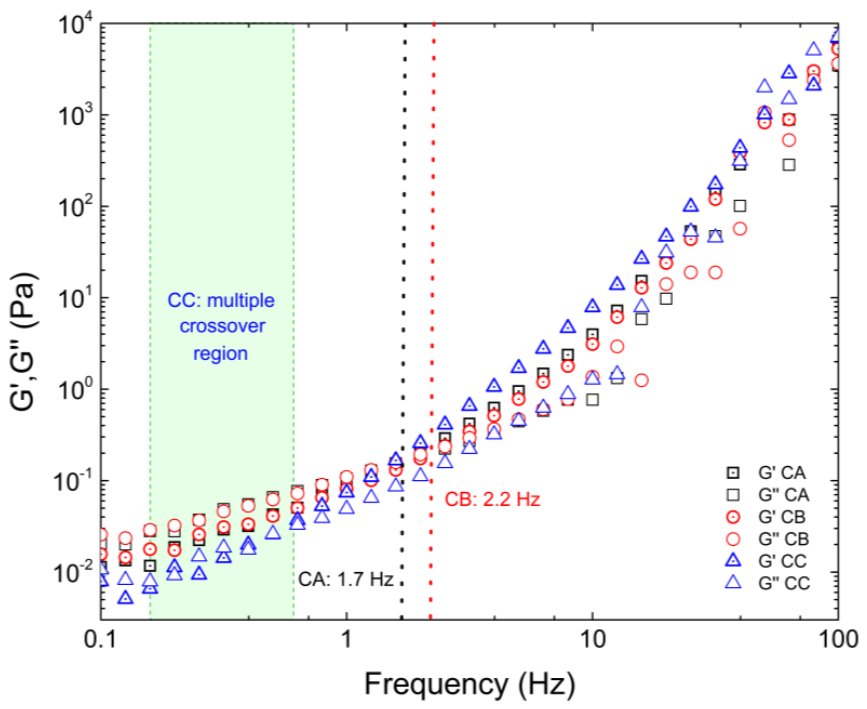
Figure 2.
Loss tangent (tan δ = G″/G′) as a function of frequency for reconstituted nopal mucilage dispersions prepared from CA, CB, and CC powders. CA corresponds to the non-homogenized control, CB to mucilage homogenized for 30 s, and CC to mucilage homogenized for 60 s. The horizontal dashed line indicates tan δ = 1, which marks the transition between predominant viscous behavior (tan δ > 1) and predominant elastic behavior (tan δ < 1).
Figure 2.
Loss tangent (tan δ = G″/G′) as a function of frequency for reconstituted nopal mucilage dispersions prepared from CA, CB, and CC powders. CA corresponds to the non-homogenized control, CB to mucilage homogenized for 30 s, and CC to mucilage homogenized for 60 s. The horizontal dashed line indicates tan δ = 1, which marks the transition between predominant viscous behavior (tan δ > 1) and predominant elastic behavior (tan δ < 1).
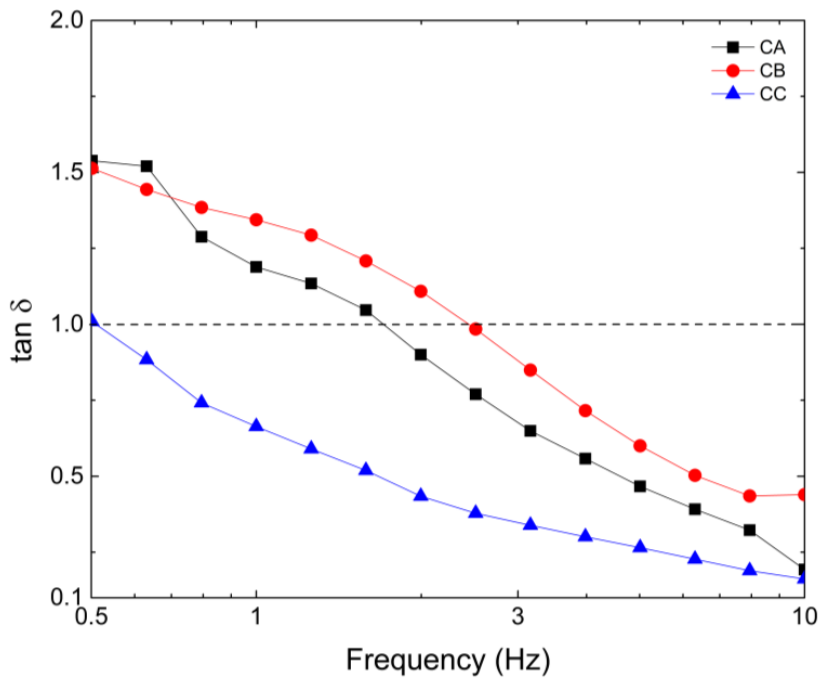
Figure 3.
Rheological response and proposed structural interpretation of reconstituted nopal mucilage dispersions. (a) Complex viscosity (η*) as a function of frequency for CA, CB, and CC. CA corresponds to the non-homogenized control, CB to mucilage homogenized for 30 s, and CC to mucilage homogenized for 60 s. (b) Schematic representation of the proposed structural organization of the reconstituted mucilages, where CA is represented by larger hydrated aggregates, CB by a more dispersed and electrostatically stabilized structure, and CC by a weak, discontinuous network with transient physical associations.
Figure 3.
Rheological response and proposed structural interpretation of reconstituted nopal mucilage dispersions. (a) Complex viscosity (η*) as a function of frequency for CA, CB, and CC. CA corresponds to the non-homogenized control, CB to mucilage homogenized for 30 s, and CC to mucilage homogenized for 60 s. (b) Schematic representation of the proposed structural organization of the reconstituted mucilages, where CA is represented by larger hydrated aggregates, CB by a more dispersed and electrostatically stabilized structure, and CC by a weak, discontinuous network with transient physical associations.
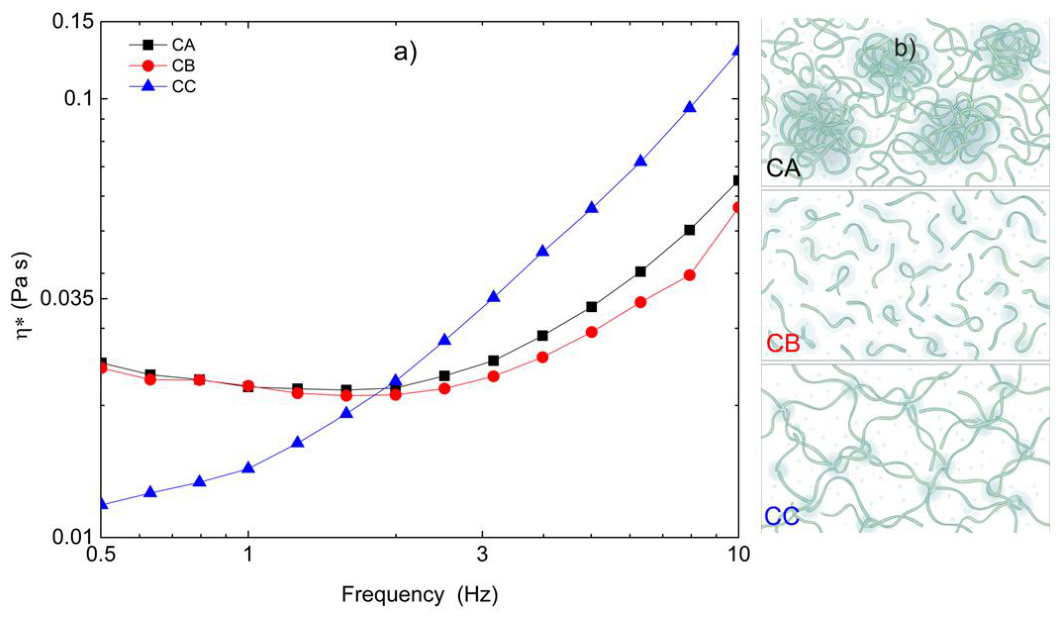
Figure 4.
Normalized ATR-FTIR spectra of spray-dried nopal mucilage powders obtained at different homogenization times. (a) CA, non-homogenized control. (b) CB, mucilage homogenized for 30 s. (c) CC, mucilage homogenized for 60 s. Spectra were recorded in the 4000 to 400 cm⁻¹ range and normalized to the 0 to 1 interval.
Figure 4.
Normalized ATR-FTIR spectra of spray-dried nopal mucilage powders obtained at different homogenization times. (a) CA, non-homogenized control. (b) CB, mucilage homogenized for 30 s. (c) CC, mucilage homogenized for 60 s. Spectra were recorded in the 4000 to 400 cm⁻¹ range and normalized to the 0 to 1 interval.
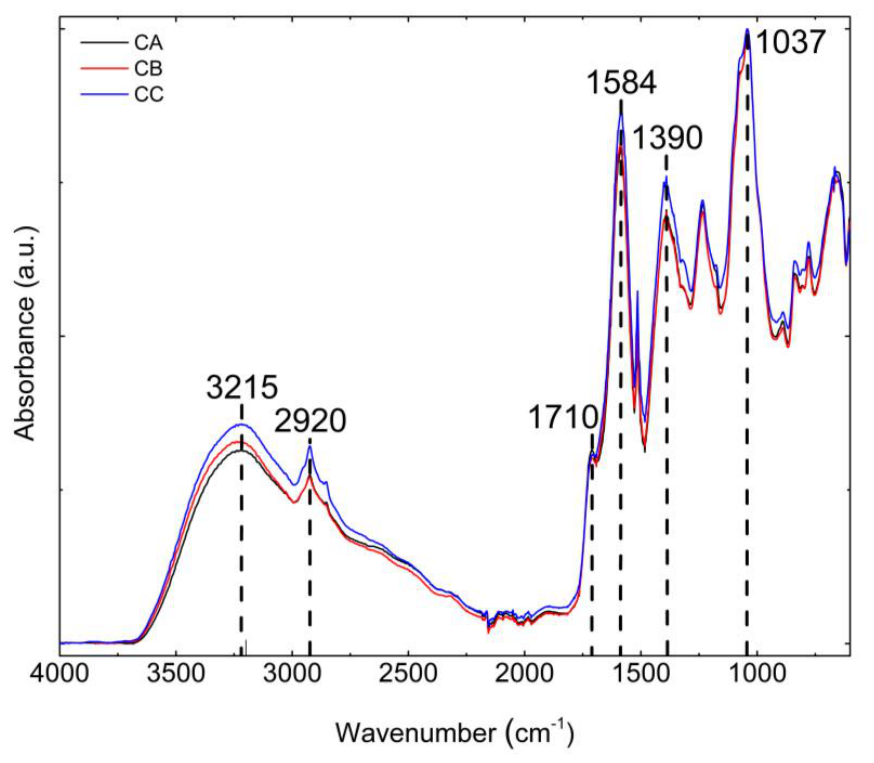
Figure 5.
Thermogravimetric analysis (TGA) and derivative thermogravimetry (DTG) curves of spray-dried nopal mucilage powders. CA corresponds to the non-homogenized control, CB to mucilage homogenized for 30 s, and CC to mucilage homogenized for 60 s. The green vertical line indicates the Tmax of 254 °C reported for mucilage extracted from fresh cladodes [31]. The numerical labels in black, red, and blue indicate the Tmax values obtained in this study for CA, CB, and CC, respectively.
Figure 5.
Thermogravimetric analysis (TGA) and derivative thermogravimetry (DTG) curves of spray-dried nopal mucilage powders. CA corresponds to the non-homogenized control, CB to mucilage homogenized for 30 s, and CC to mucilage homogenized for 60 s. The green vertical line indicates the Tmax of 254 °C reported for mucilage extracted from fresh cladodes [31]. The numerical labels in black, red, and blue indicate the Tmax values obtained in this study for CA, CB, and CC, respectively.
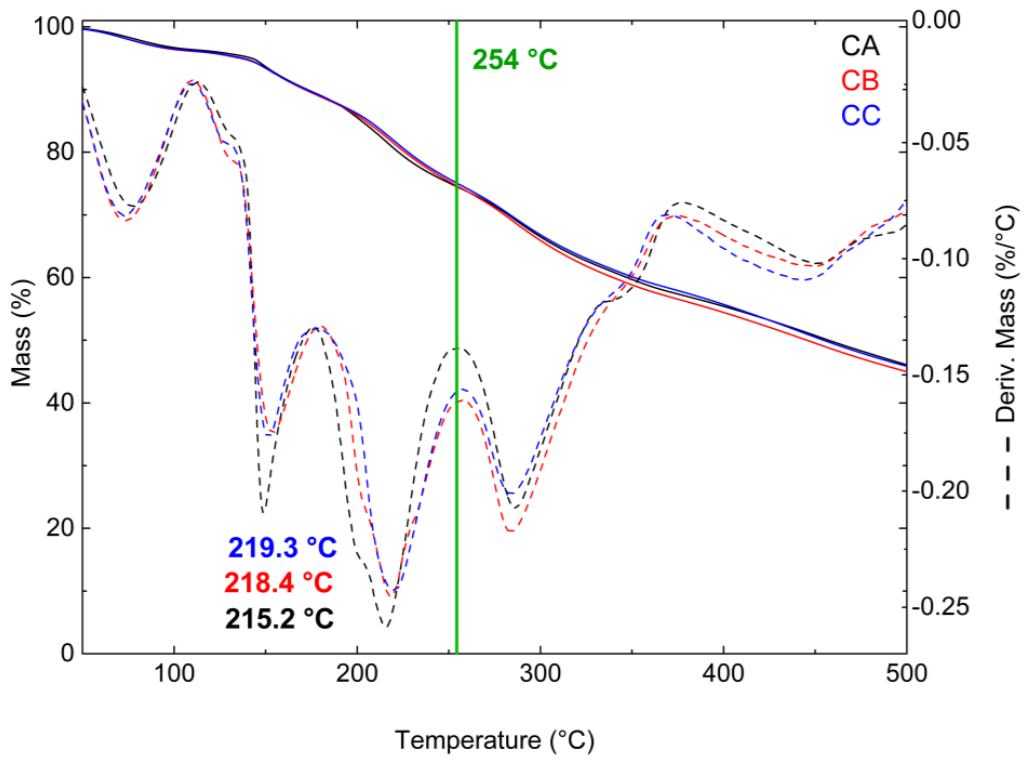
Figure 6.
Scanning electron microscopy (SEM) images of the surface morphology of spray-dried nopal mucilage powders obtained at different homogenization times. CA, non-homogenized control. CB, mucilage homogenized for 30 s. CC, mucilage homogenized for 60 s. Images were acquired at 2000× magnification.
Figure 6.
Scanning electron microscopy (SEM) images of the surface morphology of spray-dried nopal mucilage powders obtained at different homogenization times. CA, non-homogenized control. CB, mucilage homogenized for 30 s. CC, mucilage homogenized for 60 s. Images were acquired at 2000× magnification.
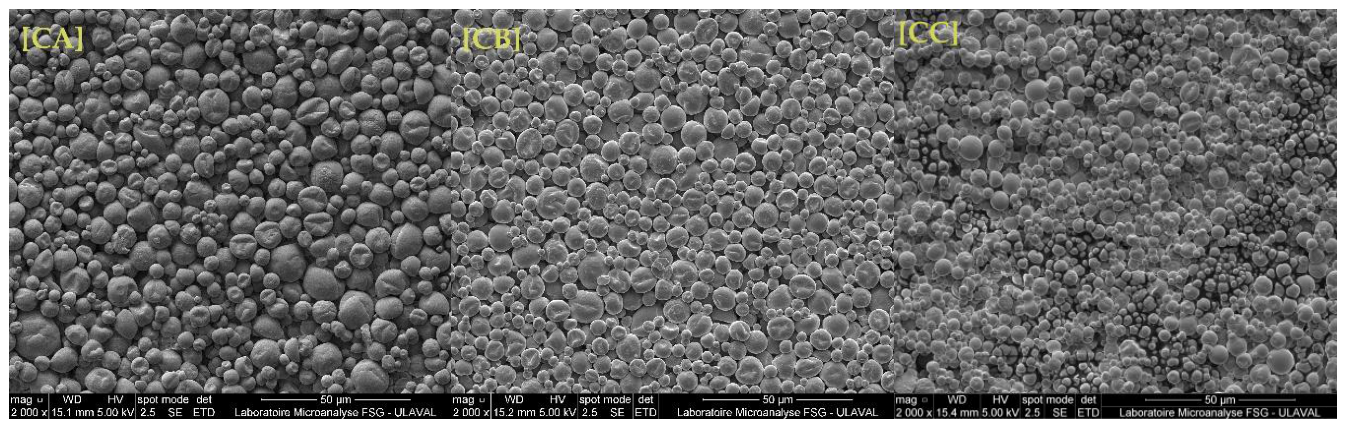
Figure 7.
ATR-FTIR spectrum of the evaporated barren solution collected from a gold cyanidation plant. The spectrum was used as a reference to identify the main signals associated with the saline matrix and cyanide related species before treatment with reconstituted nopal mucilage.
Figure 7.
ATR-FTIR spectrum of the evaporated barren solution collected from a gold cyanidation plant. The spectrum was used as a reference to identify the main signals associated with the saline matrix and cyanide related species before treatment with reconstituted nopal mucilage.
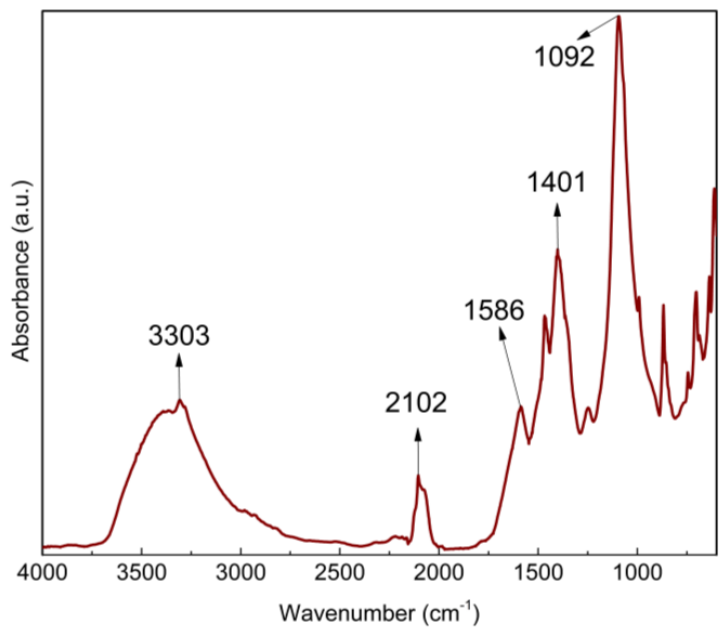
Figure 8.
ATR-FTIR spectra of dried flocs recovered after jar tests using reconstituted nopal mucilage at final concentrations of (a) 200 mg L⁻¹, (b) 400 mg L⁻¹, and (c) 800 mg L⁻¹. Flocs were coded according to the mucilage used for treatment. FA corresponds to flocs obtained with CA, FB to flocs obtained with CB, and FC to flocs obtained with CC. CA is the non-homogenized control, while CB and CC correspond to mucilage homogenized for 30 and 60 s, respectively. The band near 2104 cm⁻¹ is compatible with C≡N containing species retained in the solid phase.
Figure 8.
ATR-FTIR spectra of dried flocs recovered after jar tests using reconstituted nopal mucilage at final concentrations of (a) 200 mg L⁻¹, (b) 400 mg L⁻¹, and (c) 800 mg L⁻¹. Flocs were coded according to the mucilage used for treatment. FA corresponds to flocs obtained with CA, FB to flocs obtained with CB, and FC to flocs obtained with CC. CA is the non-homogenized control, while CB and CC correspond to mucilage homogenized for 30 and 60 s, respectively. The band near 2104 cm⁻¹ is compatible with C≡N containing species retained in the solid phase.
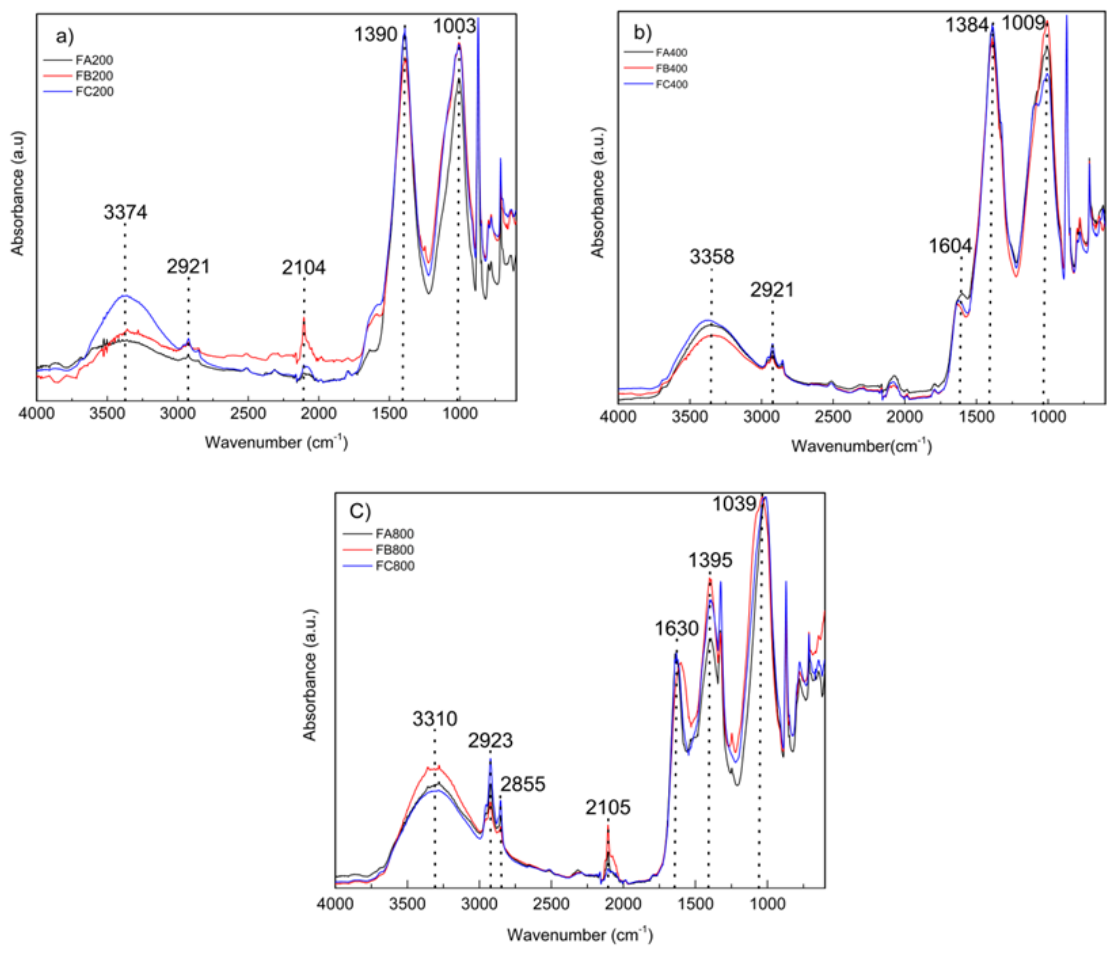

Table 1.
Proximate composition and physicochemical properties of nopal mucilage obtained at different homogenization times.
Table 1.
Proximate composition and physicochemical properties of nopal mucilage obtained at different homogenization times.
| Parameter | CA | CB | CC |
|---|---|---|---|
| Moisture* (%) | 2.70 ± 0.03 a | 2.74 ± 0.08 a | 2.68 ± 0.17 a |
| Protein* (%) | 9.22 ± 0.20 b | 8.64 ± 0.20 b | 9.92 ± 0.40 a |
| Ash* (%) | 27.56 ± 0.37 a | 27.49 ± 0.32 a | 29.95 ± 0.55 b |
| Lipids* (%) | 3.93 ± 0.20 a | 4.10 ± 0.18 a | 4.15 ± 0.21 a |
| Carbohydrates* (%) | 56.59 ± 0.61 | 57.03 ± 0.43 | 53.30 ± 0.73 |
| Water activity (aw) | 0.135 ± 0.007 a | 0.110 ± 0.000 b | 0.115 ± 0.007 b |
| Zeta potential (mV) | -15.7 ± 0.3 a | -18.3 ± 0.4 b | -17.0 ± 0.5 c |
| Average particle diameter (µm) | 1.8 ± 0.2 a | 1.3 ± 0.1 b | 1.3 ± 0.1 b |
| Polydispersity index | 0.60 ±0.17 a | 0.63 ± 0.04 a | 0.60 ± 0.10 a |
*Values are expressed as mean ± standard deviation. Proximate composition values are expressed as g per 100 g of sample. Carbohydrates were calculated by difference, as commonly reported for proximate composition analysis of Opuntia ficus-indica mucilage [10,29]. CA: control without homogenization; CB: sample homogenized for 30 s; CC: sample homogenized for 60 s. Different superscript letters within the same row indicate significant differences among samples according to Tukey’s test (p < 0.05). Water activity (aw) was measured at 36 ± 1 °C. Zeta potential and particle size were determined in reconstituted mucilage dispersions (0.13% w·v-1) at their natural pH (6.8 ± 0.2).
Table 2.
Thermal parameters of nopal mucilage powders obtained at different homogenization times.
| Sample | T5% (°C) | T10% (°C) | Tmax (°C) | DTGmax (%/°C) |
|---|---|---|---|---|
| CA | 142.2 | 172.6 | 215.2 | -0.2587 |
| CB | 136.1 | 171.3 | 218.4 | -0.2455 |
| CC | 137.6 | 172.3 | 219.3 | -0.2425 |
CA: control without homogenization; CB: sample homogenized for 30 s; CC: sample homogenized for 60 s. T5% and T10% correspond to the temperature at which 5% and 10% mass loss occurred, respectively, Tmax corresponds to the temperature of the maximum degradation rate obtained from DTG. DTGmax corresponds to the maximum mass loss rate.
Table 3.
Effect of homogenization time on texture parameters and fractal dimension of nopal mucilage.
Table 3.
Effect of homogenization time on texture parameters and fractal dimension of nopal mucilage.
| Sample | Contrast | Entropy | ASM (x10-4) | IDM | FD |
|---|---|---|---|---|---|
| CA | 469.17±136.16a | 7.81±0.20a | 5.00±1.28a | 0.094±0.015a | 2.23±0.06a |
| CB | 375.56±97.56b | 7.45±0.23 b | 7.47±1.83b | 0.134±0.015b | 2.16±0.05b |
| CC | 353.08±95.01b | 7.42±0.25b | 7.77±2.32b | 0.135±0.017 b | 2.17±0.06b |
*Data are expressed as mean ± standard deviation (n = 160). Different superscript letters within the same column indicate significant differences according to Tukey’s test (p < 0.05). ASM: angular second moment (uniformity); IDM: inverse difference moment (local homogeneity); FD: total fractal dimension.
Table 4.
Removal efficiency and residual concentration of target elements after treatment with reconstituted nopal mucilage.
Table 4.
Removal efficiency and residual concentration of target elements after treatment with reconstituted nopal mucilage.
| Sample | CA | CB | CC | |||||||
|---|---|---|---|---|---|---|---|---|---|---|
| Dose (mg/L) |
200 | 400 | 800 | 200 | 400 | 800 | 200 | 400 | 800 | |
| Pb | Removal (%) |
98.08±1.40 | 98.23±1.15 | 98.65±0.14 | 98.46±0.23 | 98.89±0.29 | 99.08±0.61 | 99.09±0.61 | 98.59±0.94 | 98.44±0.73 |
| Residual (mg/L) | 0.038±0.028 | 0.036±0.023 | 0.027±0.003† | 0.031± 0.005† | 0.022±0.006† | 0.018±0.012† | 0.018±0.012† | 0.028±0.019† | 0.031±0.015† | |
| Ni | Removal (%) |
99.23±0.92 | 99.21±0.91 | 99.25±0.79 | 98.97±0.87 | 99.10±1.16 | 99.20±0.92 | 99.22±0.84 | 98.99±0.69 | 99.12±0.80 |
| Residual (mg/L) | 0.038± 0.046 | 0.040±0.045 | 0.037±0.04† | 0.051±0.044 | 0.045± 0.058 | 0.040± 0.046 | 0.039±0.042 | 0.050±0.034 | 0.044±0.04 | |
| As | Removal (%) |
99.96±0.08 | 98.90±1.56 | 98.28±2.01 | 99.81±0.39 | 99.38±1.24 | 98.83±1.92 | 99.90±0.20 | 100.00 ±0.00 | 99.92±0.16 |
| Residual (mg/L) | 0.004±0.008‡ | 0.110±0.156† | 0.172±0.201† | 0.02±0.039‡ | 0.062±0.124‡ | 0.117±0.192† | 0.01±0.02‡ | < LOD‡ | 0.008±0.016‡ | |
| Cd | Removal (%) |
86.31±27.38 | 76.81±26.97 | 82.66±21.17 | 87.12±25.76 | 39.93±25.81 | 59.40±21.98 | 93.16±13.67 | 93.75±12.50 | 89.02±21.96 |
| Residual (mg/L) | 0.069±0.137 | 0.116± 0.135 | 0.087±0.106 | 0.064±0.129 | 0.300±0.129 | 0.203± 0.11 | 0.034±0.068† | 0.031±0.063† | 0.055±0.11† | |
CA: non-homogenized control; CB: mucilage homogenized for 30 s; CC: mucilage homogenized for 60 s. The numbers 200, 400, and 800 indicate the final concentration of reconstituted mucilage added to the barren solution (mg·L⁻¹). Initial concentrations in the untreated barren solution were Pb = 2.00 ± 0.0735 mg·L⁻¹, Ni = 5.00 ± 0.1838 mg·L⁻¹, As = 10.00 ± 0.3675 mg·L⁻¹, and Cd = 0.50 ± 0.0184 mg·L⁻¹. Data are expressed as mean ± standard deviation (n = 3). Instrumental limits were LOD: Pb = 0.011, Ni = 0.0124, As = 0.100, and Cd = 0.018 mg L⁻¹; LOQ: Pb = 0.034, Ni = 0.038, As = 0.302, and Cd = 0.056 mg L⁻¹. † Mean residual concentration below LOQ but above LOD. ‡ Mean residual concentration below LOD. Values below LOQ are reported to document removal calculations and should be interpreted as semi-quantitative estimates. Negative values obtained after blank correction were set to zero before calculating removal percentages. Statistical comparisons were performed within each element and were not interpreted as direct comparisons among elements because their initial concentrations, aqueous speciation, and analytical limits differed.
Disclaimer/Publisher’s Note: The statements, opinions and data contained in all publications are solely those of the individual author(s) and contributor(s) and not of MDPI and/or the editor(s). MDPI and/or the editor(s) disclaim responsibility for any injury to people or property resulting from any ideas, methods, instructions or products referred to in the content. |
© 2026 by the authors. Licensee MDPI, Basel, Switzerland. This article is an open access article distributed under the terms and conditions of the Creative Commons Attribution (CC BY) license (http://creativecommons.org/licenses/by/4.0/).
Copyright: This open access article is published under a Creative Commons CC BY 4.0 license, which permit the free download, distribution, and reuse, provided that the author and preprint are cited in any reuse.


