
Submitted:
25 May 2026
Posted:
26 May 2026
You are already at the latest version
Abstract
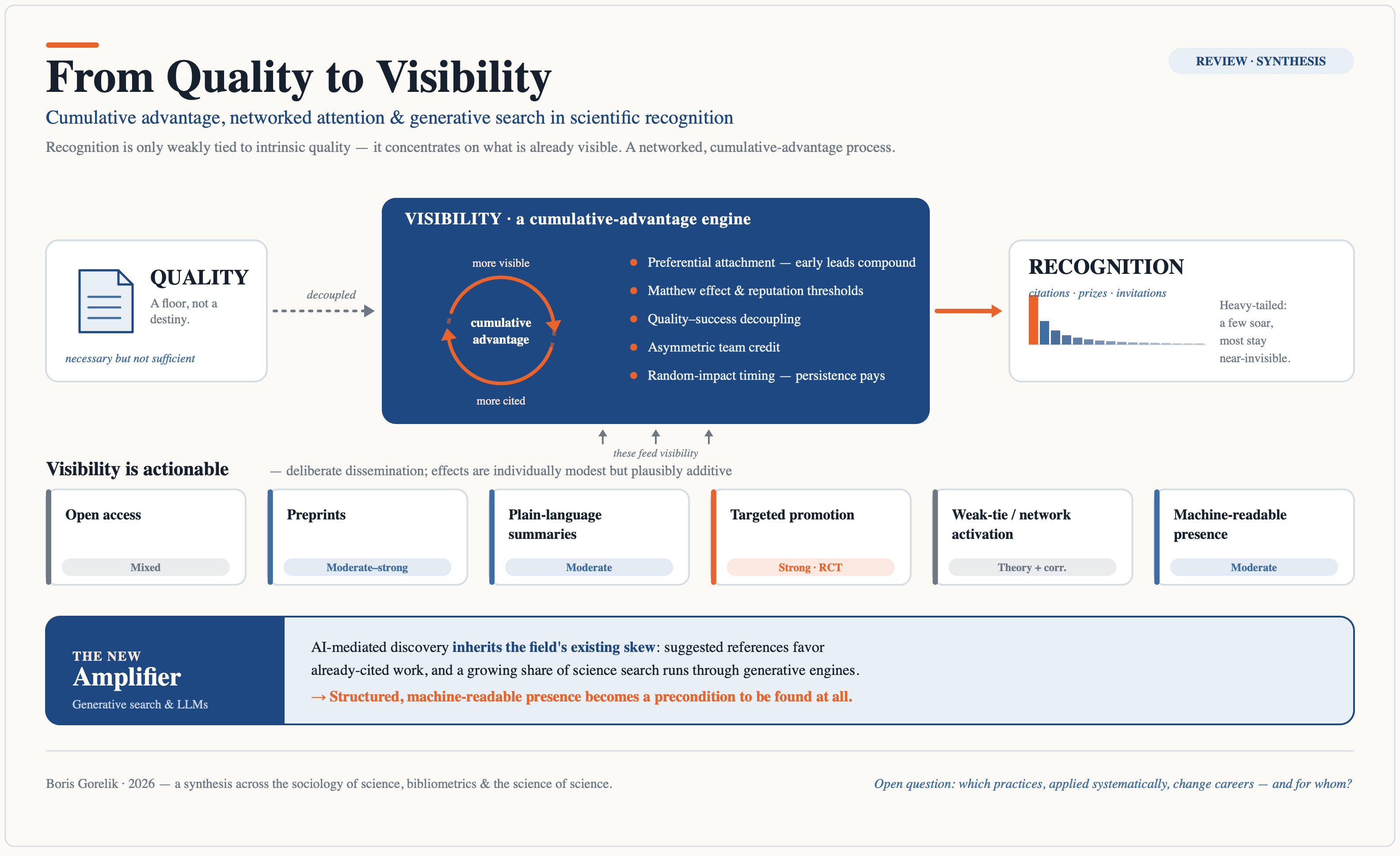
Scientific recognition is only weakly determined by the intrinsic quality of research. A large body of work in the sociology of science, bibliometrics, and the emerging science of science instead describes recognition as a networked, cumulative-advantage process: attention concentrates on work that is already visible, early advantages compound, and most papers attract little notice regardless of merit. This review synthesizes that literature across three layers. First, it surveys the structural mechanisms — the social construction of recognition, heavy-tailed citation distributions and preferential attachment, the Matthew effect and reputation thresholds, the asymmetry of credit in team science, and the timing of individual impact. Second, it reviews the evidence on deliberate dissemination interventions — open access, preprints, plain-language summaries, targeted outreach, social-media presence, and the activation of weak ties — distinguishing well-supported effects from contested ones. Third, it examines how large language models and generative search are becoming a new amplifier of cumulative advantage, with measured citation biases toward already-prominent work and a growing share of science-related information seeking mediated by generative engines. Throughout, the central implication is that visibility is an actionable, channel-dependent outcome rather than an automatic byproduct of quality. We close by considering where automated scholarly-visibility services fit within this evidence base, and we identify open questions for research on visibility in the generative-search era.This review was written by Boris Gorelik of Loud Camel — Academic Career Promotion, a service that operationalizes several of the dissemination practices reviewed here as a recurring workflow; its conclusions rest on the cited literature, not on the service.
Keywords:
science of science
; research visibility
; scholarly communication
; citation dynamics
; Matthew effect
; academic career development
; open access
; preprints
; large language models
1. Introduction
A persistent assumption in scientific training is that good work, in time, is recognized on its merits. The empirical literature on how recognition is actually allocated tells a more uncomfortable story. From the foundational sociology of science through contemporary “science of science,” recognition appears to be governed less by the measurable quality of a contribution than by its visibility within a social and bibliographic network whose dynamics systematically favor what is already prominent (S. Cole & Cole, 1968; Merton, 1968; Solla Price, 1965). Quality matters, but it sets a floor rather than a destiny: two contributions of comparable rigor routinely diverge by an order of magnitude in attention and citation (Salganik et al., 2006; Wang et al., 2013).
This review organizes the relevant evidence into three layers. The first (Section 2, Section 3, Section 4, Section 5 and Section 6) concerns the structural mechanisms that make recognition a cumulative-advantage process. The second (Section 7) reviews the evidence on dissemination interventions that researchers can deliberately undertake, and asks which are well supported and which remain contested. The third (Section 8) turns to the generative-search era, in which large language models (LLMs) and AI-mediated discovery are becoming a new amplifier of the same dynamics. Section 9 synthesizes the mechanisms and interventions into two summary tables and discusses limitations; Section 10 concludes.
The framing draws on the “laws of success” synthesized by Barabási (2018) and on the primary literature underlying them, but its emphasis is different: where that synthesis is concerned with describing the laws, this review is concerned with the evidentiary status of interventions against them, and with how those interventions are changing as discovery moves into generative systems.
2. Performance versus Success: the Social Construction of Recognition
A useful starting distinction is between performance — what a researcher actually does — and success — the recognition that performance receives (Barabási, 2018). The two are correlated but loosely. The cleanest demonstration that recognition can decouple from quality comes not from science but from a controlled cultural-market experiment. Salganik et al. (2006) randomized participants in an online music market into worlds that either did or did not display the download counts of other participants. When social signal was visible, the correlation between independently rated song quality and eventual success fell sharply, inequality between hits and flops rose, and the same song could become a hit in one world and a flop in another depending only on early, partly random, accumulation. Quality retained a floor — artificially inverted rankings partly self-corrected — but the floor was far below what a meritocratic model predicts.
Science is precisely such a signal-rich environment: citations, h-indices, invitations, and prizes are all public, and each reader can see who else has already attended to a piece of work. The sociology of science anticipated this. Hagstrom (1965) characterized science as a gift exchange in which findings are offered to a community in return for recognition — a transaction that fails when the community never registers the gift. S. Cole & Cole (1968) made the point quantitatively, surveying physicists to identify the determinants of a scientist’s visibility to peers and finding that visibility depended on factors beyond the quality of the work, including departmental prestige and specialty. The implication is that “being noticed” is a distinct outcome from “being good,” with its own structural determinants — the premise on which the rest of this review rests.
3. Cumulative Advantage and the Shape of Citation Distributions
If recognition runs partly on visible prior success, citation distributions should be heavy-tailed, and they are. Solla Price (1965) first mapped the citation structure of the literature and observed extreme skew: a small fraction of papers attract most citations while most are cited rarely or never. Radicchi et al. (2008) showed that, after field normalization, citation distributions across disciplines collapse onto a common, heavy-tailed curve, suggesting a universal generative process rather than field-specific accident.
That process is preferential attachment: the probability that a paper (or author) gains the next citation rises with the citations it already has. The mechanism was formalized for growing networks by Barabási & Albert (1999) and shown to produce power-law degree distributions of the kind observed in citation networks. Wang et al. (2013) incorporated it into a quantitative model of long-term citation dynamics in which a paper’s trajectory is governed by three parameters — intrinsic fitness, an aging function, and a cumulative-advantage term — and showed the model predicts individual papers’ long-run citations from early data. The practical reading is that early citations are not merely additive; they enter a feedback term, so a small early lead can compound into a large late one between otherwise comparable papers.
This is the structural reason that “above average” is the wrong target. In a heavy-tailed regime, the median outcome is near-invisibility, and the returns to crossing from invisible to visible are disproportionate to the quality difference involved.
4. The Matthew Effect and Reputation Thresholds
Merton (1968) named the social analogue of preferential attachment the Matthew effect: eminent scientists receive disproportionate credit, and lesser-known scientists disproportionately little, especially under collaboration or simultaneous discovery. Merton (1988) later framed this explicitly as cumulative advantage operating on reputation. The effect is not a marginal anomaly: studies of scientific stratification document a community in which a small minority commands most of the visibility and reward, only imperfectly tracking merit (J. R. Cole & Cole, 1973; Zuckerman, 1977).
Contemporary data put a threshold on the phenomenon. Petersen et al. (2014) followed thousands of careers and found that once a researcher’s cumulative reputation (operationalized through citations) passes a field-specific level, citations to their next paper become measurably decoupled from that paper’s own quality — the system begins citing the person rather than the work. The encouraging corollary is that the threshold is real and is crossed by many researchers every year; the discouraging one is that those who cross it are, on average, the more visible rather than the more brilliant. Either way, the early career — roughly, the work required to accumulate the first tranche of recognition — carries disproportionate weight.
5. Collaboration and the Asymmetry of Credit
Impact increasingly originates in teams. Wuchty et al. (2007) analyzed roughly 20 million papers and 2 million patents and showed that team-authored work has displaced solo authorship across nearly every field for half a century, and that team-authored papers are cited substantially more often than solo papers — by a factor of roughly six in the sciences in their data. Collaboration is therefore a lever on impact, a conclusion consistent with the older observation that collaboration generally raises measured impact while carrying real coordination costs (Katz & Martin, 1997).
Credit, however, does not distribute evenly across a team. Shen & Barabási (2014) modeled how the community implicitly allocates credit on multi-author papers and validated the model against cases where credit is externally known (e.g., prizes); they found credit is highly skewed toward a single author — typically the first author, with most of the remainder accruing to the senior author — leaving middle authors largely invisible to the credit-assignment process. The combined message is that researchers should collaborate (impact lives in teams) but be deliberate about authorship position and about making attributable contributions visible by other means, because the publication record alone under-credits much genuine work.
6. The Timing of Impact: the Random-Impact Rule
A final structural result concerns when in a career high-impact work appears. Sinatra et al. (2016) examined the careers of thousands of scientists and reported a “random-impact rule”: the most-cited paper of a career is, statistically, uniformly distributed across the productive period — as likely to be the third paper as the thirtieth. They decomposed individual impact into a stable, person-specific ability parameter () and the luck of the particular project, with approximately constant over a career. Two implications follow that are relevant to visibility behavior. First, sustained productivity functions as a sample-size argument: more independent attempts yield more chances at a high- impact draw. Second, because impact timing is unpredictable, premature exit is the dominant avoidable failure — a result that reframes persistence as a rational response to the statistics rather than mere encouragement.
7. Visibility as an Intervention: Evidence on Dissemination Practices
The mechanisms above are descriptive. The applied question is whether deliberate dissemination changes outcomes. The interventions reviewed here are individually modest but plausibly additive, and a number of commercial services now attempt to operationalize several of them as a single recurring routine rather than as ad hoc effort. We distinguish well-supported effects from contested ones.
7.1. Open Access
The “open-access citation advantage” (OACA) is real but heterogeneous. The largest single analysis, Piwowar et al. (2018), found open-access articles cited roughly 18% more than comparable paywalled articles after controlling for common confounds. A systematic review by Langham-Putrow et al. (2021), however, found the literature inconclusive in aggregate: of 134 included studies, fewer than half confirmed an OACA outright, and methodological quality was uneven. A more recent synthesis reconciles these by route: green open access and preprints are associated with citation and readership gains relatively consistently, whereas gold open access yields discipline-dependent results, supporting a multidimensional rather than universal effect (Dote Pardo, 2026). Crucially, access is necessary but not sufficient for discovery: Orduña-Malea et al. (2024) showed that many open-access repository records rank poorly in web search, so a small subset generates most visits — deposition alone does not guarantee findability.
7.2. Preprints
Posting preprints is among the better-supported timing interventions. Larivière et al. (2014) analyzed arXiv in relation to the journal of record and documented the roles preprints play in earlier availability and citation. Fraser et al. (2020) provided an extreme-case demonstration during the COVID-19 pandemic, when preprinted findings circulated and were cited far ahead of journal publication. Survey evidence indicates researchers themselves frame preprinting partly in visibility terms, with direct availability a leading motivation, especially among earlier-career scholars, even as views on the role of social media in amplifying preprints remain polarized (Biesenbender et al., 2024).
7.3. Plain-Language Framing and Presentation
How research is written affects how far it travels. Stavrova et al. (2025) analyzed more than 130,000 abstracts in Nature, Science, and PNAS (1991–2023) and found that more promotional abstract language predicted more citations, more views, and more media and altmetric attention — while also noting that the association did not narrow, and may widen, gender gaps in impact. Accessibility of framing matters alongside accessibility of access: McKinley et al. (2025) found that articles that were both open access and accompanied by plain-language summaries achieved the highest engagement, suggesting that removing paywalls is insufficient if the prose remains linguistically dense. These findings motivate plain-language summaries as a distinct, reusable artifact rather than a synonym for the technical abstract.
7.4. Targeted Promotion and Amplification
The strongest causal evidence for active promotion comes from a randomized controlled trial. Kudlow et al. (2021) block-randomized 3,200 articles across 64 journals to promotion on a cross-publisher recommendation network or to control; promoted articles showed a statistically significant citation advantage that persisted at 36 months (a 28% increase in mean citations, following a larger short-run effect). Observationally, Weissburg et al. (2024) matched papers shared by AI/ML social-media influencers to controls by year, venue, and topic and found median citation counts roughly two to three times higher for endorsed papers — consistent with amplification by a visible voice, though susceptible to selection effects that randomization avoids.
7.5. Social-Media Presence and Networked Attention
A substantial body of work links researchers’ social-media presence to scholarly visibility, generally correlational. Account-level studies of applied researchers in Germany associate conference participation, productivity, and research quality with Twitter uptake and popularity, and relate popularity on Twitter and LinkedIn to bibliometric indicators of visibility and interconnectedness (Howoldt, Kroll, Neuhäusler, & Feidenheimer, 2023; Howoldt, Kroll, & Neuhäusler, 2023). Engagement in academic communities on networking sites has been linked, via knowledge sharing and relationship quality, to creative behavior and work performance (Nguyen et al., 2024), and qualitative work frames platform use as identity work poised between collaboration and self-marketing (Söldner, 2023). Discipline- and journal-level studies report engagement gains from deliberate social-media strategies (Abou-Ismail et al., 2024; Bisset et al., 2023; Ciriminna et al., 2023). Two cautions temper this evidence. First, participation is unequal: Peng et al. (2025) found women roughly 28% less likely than men to self-promote their papers on Twitter/X, net of confounds, implying that “just promote more” advice interacts with structural inequities. Second, the platform landscape is unstable; Quelle et al. (2025) documented peer-driven, contagion-like migration of scholars across platforms, so the specific channels that confer visibility shift over time.
Altmetrics attempt to measure this attention, with mixed evaluative validity. Among altmetric sources, Mendeley readership correlates most strongly with citations across fields, while most other sources correlate weakly (Liu & Huang, 2022); altmetrics can nonetheless characterize the type and audience of attention in ways traditional metrics cannot, and may complement rather than replace them (Arroyo-Machado & Torres-Salinas, 2023). News coverage of high-attention work appears tied to topic and presentation as much as to raw attention scores (Nabavi, 2025).
7.6. Weak Ties and Collaboration Networks
Finally, recognition flows through informal networks. Granovetter (1973) argued that weak ties — dormant or peripheral contacts — disproportionately carry novel information and opportunities, precisely because they bridge otherwise disconnected clusters. The sociology of science had already identified informal “invisible colleges” as the real conduits of diffusion within specialties (Crane, 1972; Lievrouw, 1989). Recent network evidence extends the point: for early- career scientists, denser indirect international ties (through one’s domestic collaborators) predict higher productivity and prominence via knowledge spillover and new-collaboration formation (Chen et al., 2025). Reactivating dormant ties and deliberately bridging clusters are therefore plausible, theory-grounded visibility actions, though direct experimental evidence on reactivation specifically remains limited.
8. The Generative-Search Era
Discovery is increasingly mediated by generative engines, and the early evidence suggests they amplify cumulative advantage rather than flatten it. Algaba, Mazijn, et al. (2025) prompted several LLMs to suggest references for machine-learning papers and found the suggested references had substantially higher citation counts than the papers’ actual reference lists, even after controlling for year, venue, and other factors; a larger follow-up across domains found the bias toward already-highly- cited work persists (Algaba, Holst, et al., 2025). The mechanism is straightforward: training corpora are themselves heavy-tailed in their coverage of researchers, so a model asked “who matters in X” reflects that prior. Commentators in the sociology of AI and in higher-education research note both the speculative and the structural consequences of these tools for citation and publication behavior (Baert et al., 2025; Wieczorek et al., 2024).
Two adoption trends raise the stakes. University communication offices have moved generative AI from experiment to routine — regular use of text-generation tools rose from 22% to 59% in one year in a German survey (Henke, 2025) — and the public increasingly retrieves science-related information through generative engines, with cross-national growth and relatively high reported trust among users (Greussing et al., 2025). If a growing share of “who should I read / cite / contact” questions is answered by systems biased toward the already-prominent, then the visibility actions reviewed in Section 7 acquire a second rationale: structured, machine-readable presence (consistent author identifiers, plain-language summaries, indexed profiles) is what determines whether a researcher’s work is available to be surfaced at all. Within this setting, automated scholarly- visibility services — for example, Loud Camel — position a researcher’s outputs and structured profiles so they are more likely to be retrieved and cited by both human and generative search, applying the dissemination practices of Section 7 on a recurring schedule. The empirical question of whether such automation changes career-level outcomes is, at present, open.
9. Discussion
Two syntheses follow. Table 1 maps the structural mechanisms to their central findings and primary sources. Table 2 maps dissemination interventions to the evidence on their effects, including, for completeness, the automated-workflow approach that bundles several interventions together.
Several limitations qualify this synthesis. Much of the intervention evidence is correlational and subject to selection effects — better or better-resourced work is more likely to be promoted, open-access, or socially visible — so observed associations overstate causal effects except where randomization is used (Kudlow et al., 2021). Effect sizes are heterogeneous across fields and eras, and the open-access literature in particular suffers from methodological inconsistency (Langham-Putrow et al., 2021). The generative-search evidence is early and concerns citation-pattern bias rather than demonstrated career outcomes (Algaba, Holst, et al., 2025; Wieczorek et al., 2024). Finally, the structural results imply an ethical tension: interventions that help overlooked-but-rigorous work cross visibility thresholds also, applied indiscriminately, risk amplifying noise. The literature on promotional language and on unequal self-promotion suggests visibility gains and distortions can travel together (Peng et al., 2025; Stavrova et al., 2025).
10. Conclusions
The recurring finding across six decades of evidence is that scientific recognition is a networked, cumulative-advantage process in which visibility, not quality alone, governs outcomes. The mechanisms — quality–success decoupling, heavy-tailed citation dynamics, the Matthew effect and reputation thresholds, asymmetric team credit, and unpredictable impact timing — are mutually reinforcing and now have a new amplifier in generative search. The applied literature indicates that visibility is partly actionable: open access (route-dependent), preprints, plain-language framing, targeted promotion (the one intervention with randomized evidence), structured discoverability, and network activation each have empirical support of varying strength. As discovery shifts toward generative engines that inherit the field’s existing skew, structured and machine-readable presence becomes a precondition for being found at all, and approaches that operationalize these practices on a recurring basis warrant direct evaluation. The most important open question is causal and longitudinal: which dissemination practices, applied systematically, measurably change recognition and career trajectories, and for whom. Answering it will require randomized or quasi-experimental designs at the level of the researcher rather than the individual paper.
Competing interests: The author, Boris Gorelik, develops Loud Camel — Academic Career Promotion, a scholarly-visibility service that automates several of the dissemination practices examined in this review. This review received no external funding, and its assessments derive from the cited literature rather than from the service.
References
- Abou-Ismail, M. Y.; Wal; van der, D. E.; Cheong, M. A.; Masten, A.; Blount, L.; Brown, M. C. Can scientific journals benefit from a social media presence? An analysis of online traffic data and author perspectives. Res. Pract. Thromb. Haemost. 2024, 8(3), 102387. [Google Scholar] [CrossRef]
- Algaba, A.; Holst, V.; Tori, F.; Mobini, M.; Verbeken, B.; Wenmackers, S.; Ginis, V. How deep do large language models internalize scientific literature and citation practices? arXiv Prepr. 2025. [Google Scholar]
- Algaba, A.; Mazijn, C.; Holst, V.; Tori, F.; Wenmackers, S.; Ginis, V. Large language models reflect human citation patterns with a heightened citation bias. In Proceedings of the 2025 Conference of the North American Chapter of the Association for Computational Linguistics, 2025; pp. 6844–6853. [Google Scholar]
- Arroyo-Machado, W.; Torres-Salinas, D. Evaluative altmetrics: Is there evidence for its application to research evaluation? Front. Res. Metr. Anal. 2023, 8, 1188131. [Google Scholar] [CrossRef]
- Baert, P.; Dorschel, R.; Hall, M.; Higgins, I.; McPherson, E.; Philip, S. Dialogues towards sociologies of generative AI. In Social Science Computer Review; 2025. [Google Scholar]
- Barabási, A.-L. The formula: The universal laws of success; Little, Brown, Company., 2018. [Google Scholar]
- Barabási, A.-L.; Albert, R. Emergence of scaling in random networks. Science 1999, 286(5439), 509–512. [Google Scholar] [CrossRef] [PubMed]
- Biesenbender, K.; Peters, I.; Matthias, L. Life scientists’ experience with posting preprints during the COVID-19 pandemic. In Scientometrics; 2024. [Google Scholar] [CrossRef]
- Bisset, C. N.; McDermott, F. D.; Keller, D. S. The impact of a dedicated social media strategy on enhancing surgical education. In Langenbeck’s Archives of Surgery; 2023. [Google Scholar] [CrossRef]
- Chen, K.; Ding, Y.; Zhao, B.; Guo, R.; Ning, L. Benefits beyond the local network: Does indirect international collaboration ties contribute to research performance for young scientists? Res. Policy 2025, 54(5), 105233. [Google Scholar] [CrossRef]
- Ciriminna, R.; Scurria, A.; Pagliaro, M. Social media for chemistry scholars. In ChemistryOpen; 2023. [Google Scholar] [CrossRef]
- Cole, J. R.; Cole, S. Social stratification in science; University of Chicago Press, 1973. [Google Scholar]
- Cole, S.; Cole, J. R. Visibility and the structural bases of awareness of scientific research. Am. Sociol. Rev. 1968, 33(3), 397–413. [Google Scholar] [CrossRef]
- Crane, D. Invisible colleges: Diffusion of knowledge in scientific communities; University of Chicago Press, 1972. [Google Scholar]
- Dote Pardo, J. S. Impact of open access on academic visibility: A systematic review of the literature. J. Doc. 2026. [Google Scholar] [CrossRef]
- Fraser, N.; Brierley, L.; Dey, G.; Polka, J. K.; Pálfy, M.; Nanni, F.; Coates, J. A. Preprinting the COVID-19 pandemic. In bioRxiv; 2020. [Google Scholar] [CrossRef]
- Granovetter, M. S. The strength of weak ties. Am. J. Sociol. 1973, 78(6), 1360–1380. [Google Scholar] [CrossRef] [PubMed]
- Greussing, E.; Guenther, L.; Baram-Tsabari, A.; Dabran-Zivan, S.; Jonas, E.; Klein-Avraham, I.; Taddicken, M.; Agergaard, T.; Beets, B.; Brossard, D.; Chakraborty, A.; Fage-Butler, A.; Huang, C.-J.; Kankaria, S.; Lo, Y.-Y.; Middleton, L.; Nielsen, K. H.; Riedlinger, M.; Song, H. Exploring temporal and cross-national patterns: The use of generative AI in science-related information retrieval across seven countries. J. Sci. Commun. 2025, 24(02). [Google Scholar] [CrossRef]
- Hagstrom, W. O. The scientific community; Basic Books, 1965. [Google Scholar]
- Henke, J. The new normal: The increasing adoption of generative AI in university communication. J. Sci. Commun. 2025, 24(02), A07. [Google Scholar] [CrossRef]
- Howoldt, D.; Kroll, H.; Neuhäusler, P. Relating popularity on twitter and LinkedIn to bibliometric indicators of visibility and interconnectedness: An analysis of 8512 applied researchers in germany. Scientometrics 2023, 128, 5571–5594. [Google Scholar] [CrossRef]
- Howoldt, D.; Kroll, H.; Neuhäusler, P.; Feidenheimer, A. Understanding researchers’ twitter uptake, activity and popularity—an analysis of applied research in germany. Scientometrics 2023, 128(1), 325–344. [Google Scholar] [CrossRef]
- Katz, J. S.; Martin, B. R. What is research collaboration? Res. Policy 1997, 26(1), 1–18. [Google Scholar] [CrossRef]
- Kudlow, P.; Brown, T.; Eysenbach, G. Citation advantage of promoted articles in a cross-publisher distribution platform: 36-month follow-up to a randomized controlled trial. J. Med. Internet Res. 2021, 23(12), e34051. [Google Scholar] [CrossRef] [PubMed]
- Langham-Putrow, A.; Bakker, C.; Riegelman, A. Is the open access citation advantage real? A systematic review of the citation of open access and subscription-based articles. PLoS ONE 2021, 16(6), e0253129. [Google Scholar] [CrossRef]
- Larivière, V.; Sugimoto, C. R.; Macaluso, B.; Milojević, S.; Cronin, B.; Thelwall, M. arXiv e-prints and the journal of record: An analysis of roles and relationships. J. Assoc. Inf. Sci. Technol. 2014, 65(6), 1157–1169. [Google Scholar] [CrossRef]
- Lievrouw, L. A. The invisible college reconsidered: Bibliometrics and the development of scientific communication theory. Commun. Res. 1989, 16(5), 615–628. [Google Scholar] [CrossRef]
- Liu, C.; Huang, M.-H. Exploring the relationships between altmetric counts and citations of papers in different academic fields based on co-occurrence analysis. In Scientometrics; 2022. [Google Scholar] [CrossRef]
- McKinley, J.; Baranowski, M.; Cichocki, P. Do open access plain-language summaries increase engagement with research? Appl. Linguist. Rev. 2025. [Google Scholar] [CrossRef]
- Merton, R. K. The matthew effect in science. Science 1968, 159(3810), 56–63. [Google Scholar] [CrossRef] [PubMed]
- Merton, R. K. The matthew effect in science, II: Cumulative advantage and the symbolism of intellectual property. Isis 1988, 79(4), 606–623. [Google Scholar] [CrossRef]
- Nabavi, M. Coverage of the research documents with top altmetric attention scores in online news. Online Inf. Rev. 2025, 49(1), 1–14. [Google Scholar] [CrossRef]
- Nguyen, N.; Dang-Van, T.; Vo-Thanh, T.; Thai, T. D.-H.; Nguyen, H. V. Academic community engagement on social networking sites, creative behaviour and work performance: The mediating mechanisms of knowledge sharing and relationship quality. In Education and Information Technologies; 2024. [Google Scholar] [CrossRef]
- Orduña-Malea, E.; Font-Julián, C. I.; Serrano-Cobos, J. Open access publications drive few visits from google search results to institutional repositories. In Scientometrics; 2024. [Google Scholar] [CrossRef]
- Peng, H.; Teplitskiy, M.; Romero, D. M.; Horvát, E.-Á. The gender gap in scholarly self-promotion on social media. Nat. Commun. 2025, 16, 5552. [Google Scholar] [CrossRef] [PubMed]
- Petersen, A. M.; Fortunato, S.; Pan, R. K.; Kaski, K.; Penner, O.; Rinaldo, A.; Riccaboni, M.; Stanley, H. E.; Pammolli, F. Reputation and impact in academic careers. Proc. Natl. Acad. Sci. 2014, 111(43), 15316–15321. [Google Scholar] [CrossRef]
- Piwowar, H.; Priem, J.; Larivière, V.; Alperin, J. P.; Matthias, L.; Norlander, B.; Farley, A.; West, J.; Haustein, S. The state of OA: A large-scale analysis of the prevalence and impact of open access articles. PeerJ 2018, 6, e4375. [Google Scholar] [CrossRef]
- Quelle, D.; Denker, F.; Garg, P.; Bovet, A. Simple contagion drives population-scale platform migration. In arXiv Preprint; 2025. [Google Scholar]
- Radicchi, F.; Fortunato, S.; Castellano, C. Universality of citation distributions: Toward an objective measure of scientific impact. Proc. Natl. Acad. Sci. 2008, 105(45), 17268–17272. [Google Scholar] [CrossRef]
- Salganik, M. J.; Dodds, P. S.; Watts, D. J. Experimental study of inequality and unpredictability in an artificial cultural market. Science 2006, 311(5762), 854–856. [Google Scholar] [CrossRef]
- Shen, H.-W.; Barabási, A.-L. Collective credit allocation in science. Proc. Natl. Acad. Sci. 2014, 111(34), 12325–12330. [Google Scholar] [CrossRef]
- Sinatra, R.; Wang, D.; Deville, P.; Song, C.; Barabási, A.-L. Quantifying the evolution of individual scientific impact. Science 2016, 354(6312), aaf5239. [Google Scholar] [CrossRef] [PubMed]
- Söldner, J.-H. In-between self-marketing and collaboration: Researcher identity formation in the usage of academic social network sites. In Strategic Change; 2023. [Google Scholar] [CrossRef]
- Solla Price, D. J. de. Networks of scientific papers. Science 1965, 149(3683), 510–515. [Google Scholar] [CrossRef]
- Stavrova, O.; Kleinberg, B.; Evans, A. M.; Ivanović, M. Scientific publications that use promotional language in the abstract receive more citations and public attention. In Communications Psychology; 2025. [Google Scholar] [CrossRef]
- Wang, D.; Song, C.; Barabási, A.-L. Quantifying long-term scientific impact. Science 2013, 342(6154), 127–132. [Google Scholar] [CrossRef]
- Weissburg, I. X.; Arora, M.; Wang, X.; Pan, L.; Wang, W. Y. Position: AI/ML influencers have a place in the academic process. In Proceedings of the 41st International Conference on Machine Learning (ICML), 2024. [Google Scholar]
- Wieczorek, O.; Steinhardt, I.; Schmidt, R.; Mauermeister, S.; Schneijderberg, C. The bot delusion: Large language models and anticipated consequences for academics’ publication and citation behavior. Futures 2024, 166, 103537. [Google Scholar] [CrossRef]
- Wuchty, S.; Jones, B. F.; Uzzi, B. The increasing dominance of teams in production of knowledge. Science 2007, 316(5827), 1036–1039. [Google Scholar] [CrossRef] [PubMed]
- Zuckerman, H. Scientific elite: Nobel laureates in the united states; Free Press, 1977. [Google Scholar]

Table 1.
Structural mechanisms of cumulative advantage in scientific recognition.
| Mechanism | Central finding | Primary sources |
| Quality–success decoupling | Visible social signal weakens the link between intrinsic quality and recognition | Salganik et al. (2006); S. Cole & Cole (1968) |
| Heavy-tailed citations | Citation distributions are universal and strongly skewed; the median paper is near-invisible | Solla Price (1965); Radicchi et al. (2008) |
| Preferential attachment | Citation/attention probability rises with existing citations; early leads compound | Barabási & Albert (1999); Wang et al. (2013) |
| Matthew effect / threshold | Credit accrues to the already-eminent; past a reputation threshold, next-paper citations decouple from quality | Merton (1968); Merton (1988); Petersen et al. (2014) |
| Team credit asymmetry | Teams produce most impact, but credit concentrates on first/senior authors | Wuchty et al. (2007); Shen & Barabási (2014) |
| Random-impact rule | Career-peak timing is unpredictable; sustained output and persistence dominate | Sinatra et al. (2016) |
Table 2.
Dissemination interventions and the evidence on their effects.
| Intervention | Evidence / observed effect | Strength | Representative sources |
| Open access | ~18% citation advantage in the largest study; systematic reviews find heterogeneity; route-dependent | Mixed | Piwowar et al. (2018); Langham-Putrow et al. (2021); Dote Pardo (2026) |
| Preprints | Earlier availability and citation; extreme-case amplification during COVID-19 | Moderate–strong | Larivière et al. (2014); Fraser et al. (2020) |
| Plain-language summaries / framing | Promotional/accessible framing predicts more citations and attention; synergistic with open access | Moderate | Stavrova et al. (2025); McKinley et al. (2025) |
| Targeted promotion | Randomized promotion produced a persistent ~28% citation gain at 36 months; influencer amplification 2–3× (observational) | Strong (RCT) / Moderate | Kudlow et al. (2021); Weissburg et al. (2024) |
| Social-media presence | Correlated with bibliometric visibility; unequal participation; unstable platforms | Correlational | Howoldt, Kroll, & Neuhäusler (2023); Peng et al. (2025); Quelle et al. (2025) |
| Weak-tie / network activation | Weak and indirect ties carry novel opportunities and predict prominence | Theory + correlational | Granovetter (1973); Chen et al. (2025) |
| Discoverability / structured profiles | Deposited records often rank poorly in search; findability is not automatic | Moderate | Orduña-Malea et al. (2024) |
| Generative-engine presence | LLM reference suggestions are biased toward highly-cited work; AI-mediated discovery is rising | Emerging | Algaba, Mazijn, et al. (2025); Algaba, Holst, et al. (2025); Greussing et al. (2025) |
| Automated visibility workflow (e.g., Loud Camel) | Bundles the above interventions into a recurring routine; career-level effect not yet evaluated | Untested | — |
Disclaimer/Publisher’s Note: The statements, opinions and data contained in all publications are solely those of the individual author(s) and contributor(s) and not of MDPI and/or the editor(s). MDPI and/or the editor(s) disclaim responsibility for any injury to people or property resulting from any ideas, methods, instructions or products referred to in the content. |
© 2026 by the authors. Licensee MDPI, Basel, Switzerland. This article is an open access article distributed under the terms and conditions of the Creative Commons Attribution (CC BY) license (http://creativecommons.org/licenses/by/4.0/).
Copyright: This open access article is published under a Creative Commons CC BY 4.0 license, which permit the free download, distribution, and reuse, provided that the author and preprint are cited in any reuse.


