

Submitted:
25 May 2026
Posted:
26 May 2026
You are already at the latest version
Abstract
Occupational health and safety (OHS) malpractices may cause injuries and are a significant public health problem in the iron and steel industries, often leading to disability and death. Information on OHS practices related to occupational injuries in the iron and steel industries is limited in many countries. This study aimed to assess OHS practices in relation to occupational injuries among workers in the iron and steel industries in Tanzania. A cross-sectional study was conducted among 321 production line workers. Data was collected by interviews, using a structured OHS questionnaire and the modified International Labour Organization (ILO) injury assessment tool. Lack of safety inspections (OR= 1.63, 95% CI: 1.02-2.59) and lack of personal protective equipment (PPE) use (OR= 1.76, 95% CI: 1.08-2.83) were associated with injury occurrence. Adjusting for more than ten working hours daily modified these results. No relationship was found between severe injuries and OHS practices. In conclusion, occupational injuries in Tanzania’s iron and steel industry were more likely when safety inspections and PPE use were lacking, although this association weakened after accounting for long working hours. Severe injuries did not show any relationship with OHS practices, underscoring the need for strong, comprehensive safety measures.
Keywords:
iron and steel industry
; occupational injury
; occupational health and safety practices
; Tanzania
1. Introduction
The iron and steel industry is among the most crucial sectors globally, serving as a backbone for construction, infrastructure development, and manufacturing. Steel consumption is widely recognized as an indicator of economic growth, with the industry contributing to about US$8.2 trillion of the global economy, equivalent to 10.7% of global GDP, and employing about 6 million people worldwide [1]. In Tanzania, the sector employs approximately 14,889 workers and continues to expand due to increasing demand driven by infrastructure development, industrial growth, and rapid urbanization [2].
Despite its economic importance, the iron and steel industry is associated with a wide range of occupational hazards. Workers are exposed to risks such as noise, vibration, extreme temperatures, working in confined spaces, slips, trips and falls, falling objects, electric shock, burns from molten metal, unguarded machinery, fires, and explosions [3]. These hazards significantly increase the likelihood of occupational injuries, particularly in settings where occupational health and safety (OHS) practices are inadequately implemented.
Occupational injuries remain a major public health concern worldwide. According to the International Labour Organization (ILO), an occupational injury refers to any personal injury, disease, or death resulting from an occupational accident [4]. A systematic review conducted across fifteen countries reported a pooled prevalence of 55% of occupational injuries among iron and steel workers [5], which is higher than estimates reported in other sectors, including small-scale industries in Sub-Saharan Africa, with a pooled prevalence of 53.2% [6].
The provision of a safe and healthy working environment is a fundamental right and a key principle in occupational health [7]. A safe and healthy working environment can be achieved if OHS measures are implemented effectively within the workplace. OHS practices encompass several interrelated components, including the presence of safety policies, use of personal protective equipment (PPE), regular safety inspections, risk assessment, health surveillance, and safety training programs [8].
Previous studies have demonstrated the importance of these components in reducing occupational injuries. For example, the availability and enforcement of OHS policies have been associated with improved safety outcomes and reduced injury rates [9]. Similarly, safety training and on-the-job education have been shown to significantly reduce occupational accidents by improving workers’ awareness and preventive behaviors [10,11]. Regular safety inspections play a critical role in identifying hazards and ensuring compliance with safety standards [12,13]. In addition, the consistent use of PPE has been reported to lower the risk of injuries in various industrial settings significantly [14,15,16]. Medical examinations, including pre-employment and periodic assessments, also contribute to early detection of health risks and support preventive strategies [17,18].
Although these studies highlight the importance of individual OHS components, most existing research has focused on specific aspects of OHS practices or on sectors other than iron and steel. Globally, there is limited evidence examining the combined effect of multiple OHS practices on occupational injuries within the iron and steel industry. In Tanzania, research on OHS practices remains scarce. Existing studies have primarily focused on general OHS conditions [19], or specific sectors such as construction and agriculture, often reporting low levels of OHS implementation [20,21]. A study conducted in a sugarcane factory examined selected OHS components and their relationship with occupational injuries, but did not comprehensively assess the relative contribution of different OHS practices [22].
Therefore, there is a need for comprehensive empirical evidence for better understanding of how various OHS practices interact and contribute to the prevention of occupational injuries in the iron and steel industry. Such information is essential for designing effective workplace interventions and improving occupational safety in this high-risk sector. This study aimed to assess OHS practices and examine their association with occupational injuries among workers in the iron and steel industries in Tanzania.
2. Materials and Methods
2.1. Study Setting and Design
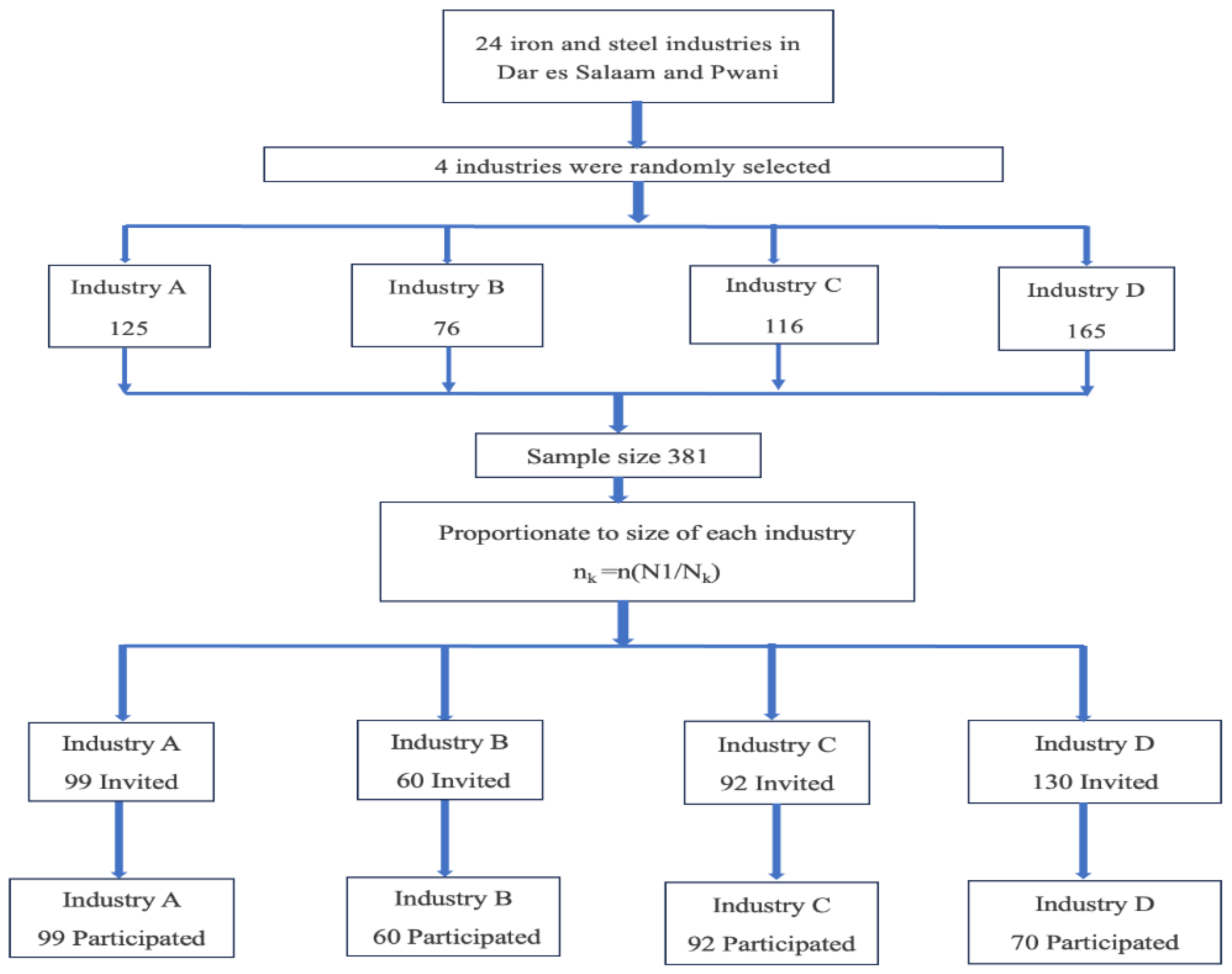
This cross-sectional study was conducted from July 2022 to September 2023 in Dar es Salaam and the coastal (Pwani) regions of Tanzania. These two regions were selected due to the availability of large numbers of iron and steel industries there, compared to other regions in Tanzania. Four factories were randomly selected for participation from a list of iron and steel industries provided by the Occupational Safety and Health Authority in Tanzania. Two industries were in Dar es Salaam and two in the Coastal region.
2.2. Sample Size
This study was part of a larger investigation concerning occupational injuries in the iron and steel industries. The sample size was determined using Open Epi software for estimating a single population proportion. Assuming a prevalence of occupational injuries of 33% based on a previous study conducted in Addis Ababa, Ethiopia [23], a 95% confidence level, and a margin of error of 5%, the calculated sample size was 381. To obtain 381 participants working in the production line from four iron and steel industries, we proportionately sampled based on the number of workers in the production line of each factory. Industry A had 125 workers in the production line, and we randomly selected 99 participants from this group. Similarly, industry B had 76 production workers, and 60 workers were randomly selected; industry C had 116 production workers, and 92 were randomly selected; and industry D had 165 workers, and 130 were randomly selected.
Figure 1.
Sampling strategy and recruitment.
2.3. Data Collection Tool and Procedures
A structured questionnaire modified from an ILO manual on methods for occupational injuries statistics from household surveys and establishment surveys [4] was used to obtain information on occupational injuries. The structured OHS questionnaire was used to measure OHS practices. The questionnaire was originally in English and was then translated into Swahili and subsequently back-translated from Swahili into English. Before the actual data collection, a pre-test was conducted in 2022 in 5% of the total sample size in another industry not participating in the present study, and a few corrections were made afterwards. A few questions needed clarification, with more words for explanations. A research assistant with a bachelor’s degree in sociology, who had experience with data collection, was trained to collect the data by interviewing each worker. The data were collected by the principal investigator and the research assistant, and the interviews took place at the worksite, in a private room during working hours. The research assistant reported and discussed the data collected daily with the principal investigator throughout data collection period.
2.4. Sociodemographic and Work Characteristics
The questionnaire included the following socio-demographic variables: age, and education level. In addition, the workers were asked for their number of working years (1-4 years or above 4 years), working hours per day (<, 10 hours and above 10 hours), shift work (daytime work only or work including night shifts) and work section.
2.5. Measurement of Occupational Injuries
The presence of occupational injuries in the past year among iron and steel industry workers was the outcome variable. Occupational injuries were specifically defined for the participants as all accidents that had caused a personal injury at the workplace or elsewhere, while the worker was carrying out the business of the employer [4]. In addition, the injury must have caused the worker to be unable to work (incapacitated) for at least one day apart from the day of the accident [4]. The following two questions were asked to identify the occupational injury:
- 1)
- Have you ever been injured in an occupational accident that occurred in the last 12 months?
- 2)
- Did any of the injuries you experienced in the last 12 months result in you being absent from work, or unable to work, for at least one day, apart from the day of the accident?
These questions should be answered YES or NO. Both questions needed to be answered YES for the event to be registered as experiencing an occupational injury. In case of severity, we asked the worker to describe the number of workdays lost due to the most recent occupational injury. Injuries resulting in three or fewer days lost were classified as minor injury while those leading to more than three days lost were classified as serious injury. This classification was based on definitions by ILO and the Tanzania OSHA Act on accident notification and recording [9,24].
2.6. Measurement of Occupational Health and Safety Practices
The OHS practices were measured by using questions developed through an extensive review of relevant regulatory and empirical sources. These included the Tanzania Occupational Safety and Health Act of 2003 [24], a performance audit report on the management of OHS in Tanzania, the status of OHS and related challenges in the expanding economy of Tanzania [19], and a survey on the implementation of the OHS Act at an academic hospital in Johannesburg [25]. Based on this review, questions were formulated to capture key dimensions of OHS practice within the workplace. Respondents were asked whether: 1. Does your workplace have a written OHS policy? 2. Do safety officers and safety supervisors at your workplace carry out safety inspections at regular intervals to detect hazards? 3. Do you use PPE? 4. Are the PPE appropriate to your job task? 5. Is personal protective equipment easily accessible? PPE was defined as equipment used to prevent or minimize exposure to hazards. 6. Have you received any on-the- job training related to your job? 7. Did your employer provide you with comprehensive training on health and safety issues? 8. Do you have an effective accident reporting procedure that is known by all employees? 9. Are all accidents investigated timely to improve safety in the workplace? 10. Is a pre-employment physical examination offered by your employer? 11. Does your employer provide periodic health examinations? All questions should be answered YES or NO.
2.7. Data Analysis
The collected data were cleaned, coded, entered, and analyzed using Statistical Package for Social Sciences (SPSS), version 27. Continuous variables were described by mean and standard deviation (mean; SD), and categorical variables were described by proportion (%). Chi-square tests were used for comparisons of categorical variables. The significance level was set to less or equal to 0.05. Binary and multivariate logistic regression analysis were performed to assess the potential determinants of occupational injuries. Adjustment for working hours per day was performed since working hours are shown to be associated with occupational injuries in this population [26]. This variable had two categories, below or equal to ten hours, and above ten hours daily work.
2.8. Ethics
Ethical approval was obtained from the Muhimbili University of Health and Allied Science institutional review board on 31/03/2022 with approval number MUHAS-REC-03-2022-1061. Permission letters for all managers of selected industries were distributed to the workers. All participants gave their written consent before the interview was performed, and confidentiality regarding their information was maintained. The study has been performed in accordance with the Declaration of Helsinki.
3. Results
3.1. Description of Study Participants
Of 381 invited workers, 321 (84%) participated in the study. All participants were male, with a mean age of 32 (±8) years. Most workers had completed secondary education (53%). The majority works in rolling mills (56.7). About (76.3%) had less or equal to 4 working years. Many of the iron- and steelworkers (76%) worked for more than 10 hours per day, and the workers with a daytime work shift schedule were about (42.7%). The study is a part of a larger project, and details describing the population have been described in a previous paper about occupational injury prevalence [26]. The prevalence of occupational injuries was 209 (65.1%).

Table 1.
Occupational health and safety practices among workers in the production line (n= 321).
| Safety practice variable | Frequency | Percent |
|---|---|---|
| Does your workplace have a written occupational health and safety policy? | ||
| Yes | 111 | 34.6 |
| No | 210 | 65.4 |
| Do safety officers and safety supervisors at your workplace carry out safety inspections at regular intervals to detect hazards? | ||
| Yes | 130 | 40.5 |
| No | 191 | 59.5 |
| Do you use PPE? | ||
| Yes | 187 | 58.3 |
| No | 134 | 41.7 |
| Are the PPE appropriate to your job task? | ||
| Yes | 138 | 43 |
| No | 183 | 57 |
| Is personal protective equipment easily accessible at your workplace? | ||
| Yes | 153 | 47.7 |
| No | 168 | 52.3 |
| Have you received any on-the- job training related to your job? | ||
| Yes | 202 | 62.9 |
| No | 119 | 37.1 |
|
Has your employer provided you with comprehensive training on health and safety issues? |
||
| Yes | 174 | 54.2 |
| No | 147 | 45.8 |
| Do you have effective accident reporting procedures at your workplace that is known by all employees? | ||
| Yes | 253 | 78.8 |
| No | 68 | 21.2 |
| Are ll accidents at your workplace investigated in a timely matter to improve safety? | ||
| Yes | 251 | 78.2 |
| No | 70 | 21.8 |
| Does your employe offer pre-employment physical examinations? | ||
| Yes | 74 | 23.1 |
| No | 247 | 76.9 |
| Does your employer provide periodic health examinations? | ||
| Yes | 17 | 5.3 |
| No | 304 | 94.7 |
3.2. Occupational Injuries and Safety Practices
A total of 221 (68.8%) of study participants reported having experienced at least one injury at work in the 12 months preceding the survey. Of these, 209 (65.1%) had injuries that restricted them from working for at least 1 day, fulfilling the definition of occupational injury. Comparing safety practices among workers who had experienced an occupational injury in the past year and those who had not, univariate regression analyses showed that failure of safety officers and safety supervisors to conduct regular safety inspections to identify hazards (OR= 1.6, 95% CI: 1.02-2.59) and non-use of PPE (OR= 1.8, 95% CI: 1.08-2.83) were significantly associated with occupational injury (Table 2). Our previous study of this population showed a significant relationship between injuries and working hours per day [26]. Working hours was an independent predictor for injuries (OR= 2.40, 95% CI: 1.42-4.06) and when adjusting for this variable, the effect of safety inspection and PPE use on occurrence of occupational injuries was modified ().
3.3. Occupational Health and Safety Practices
Overall, 65.4% of the workers reported that their workplace did not have a written OHS policy. In addition, only 58.3% of the workers reported using PPE. Most respondents (78.8%) indicated that an effective incident reporting procedure was in place and known to all employees.Among respondents, 76 .9% reported that their employer did not provide a pre-employment physical examination, while 94.7% reported that no periodic health examinations were offered.
3.4. Occupational Injury Severity and Safety Practices
Among the 209 workers who had experienced occupational injuries, 135 (64%) reported minor (injuries resulting in three or fewer workdays lost), and serious injuries (with more than three days lost) were 74 (33.4%). In univariate analysis, we found no association between severity of the injury and safety practices, Table 3.
4. Discussion
This study aimed to assess OHS practices in relation to occupational injuries among workers in the iron and steel industries. The findings revealed the inadequate implementation of OHS practices in this sector, and a relationship between occupational injuries and lack of safety inspections and lack of personal protective equipment (PPE) use.
We found that about 65.4% of workers reported the absence of a written OHS policy in their workplace. Although Tanzania's Occupational Health and Safety Act No. 5 of 2003 in Section 96, states that “Every employer who has more than four employee in his employment in any factory shall have the duty to prepare a written policy on the protection of health and safety of employees and description of the organization for the implementing the policy and also require to distribute the copy of policy and guideline to all employees”[24], this was not implemented. OHS policy is a written statement by an employer describing the employer's commitment to protect the health and safety of employees and the public. The iron and steel industries failed to implement this requirement. This failure undermines the efforts to uphold OHS standards at the workplace. An effective OHS policy is essential as it informs the workers about potential hazards and outlines preventive measures to reduce the risk of injury. It also ensures that employees receive proper training, safety equipment, and other resources necessary for safe work practices. The absence of an OHS policy significantly increases the risk of occupational accidents and injuries to workers, while also reflecting weak law enforcement. This lack of compliance may explain the high prevalence of occupational injury in the iron and steel industries, where, about 64.8% of workers reported that they did not have a policy in their workplace, they had been injured, this findings is more similar to the study done in two Canadian provinces where they reported that those workers who experienced policy and procedure vulnerability, 50.3% reported a physical injury in the preceding 12 months compared with just 10.3% of those who were not vulnerable and had a supportive supervisor [13].
Regarding safety inspection, the study showed that 59.5% of workers reported that safety officers and safety supervisors do not carry out safety inspections at regular intervals to detect hazards, and among them, 70.4% have been injured. These findings are consistent with a study conducted in South Africa, which revealed that failures in supervision, including the failure to ensure routine inspections, indicate an ineffective safety culture within the railway industry and may contribute to increased accident rates [12]. In many workplaces, internal inspections are not performed until after an accident has occurred, and it makes them reactive rather than preventive. In some industries, inspections are conducted only a few days before OSHA visits, primarily for compliance purposes. However, inspections should be proactive in nature, focusing on the prevention of accidents and occupational illnesses, as well as on promoting effective OSH management practices [27]. When inspections are not conducted effectively, the workplace hazards may remain undetected, necessary corrective action may be delayed, and the risk of occupational injury may increase. Therefore, to reduce accident rates, industries need to shift from a reactive approach to a proactive safety culture. By doing so, they can significantly enhance workplace safety, protect their employees, and reduce the likelihood of costly accidents and regulatory penalties.
The majority of workers who did not use PPE had experienced injuries compared to their counterparts who used PPE. This finding is consistent with previous empirical evidence, which collectively reported that inadequate utilization of PPE constitutes a risk factor for occupational injury [5,15,28]. Among the factors reported by workers as barriers to PPE utilization was limited accessibility. Whereas, about 63.1% of participants reported that PPE was not easily accessible and consequently did not use it. This finding aligns with a study conducted in Ethiopia, where 40.9% of non-users cited unavailability as the reason for not wearing PPE [14]. Furthermore, among workers who reported the PPE is not appropriate for their job task, about 82.1% are not using PPE. This result is consistent with a study from Egypt, which reported that 40.6% of these workers reported not using PPE, and among the reasons was the poor fit of PPE [16]. For PPEs to be effective in accident prevention, they have to be readily available, accessible, and appropriately fit.
Regarding training, about 45.8% of the respondents in our study stated that their employer did not provide comprehensive training on health and safety issues, and 92 (62.7%) of them had experienced an occupational injury. Our findings are supported by a qualitative investigation to discover occupational injury causes and preventive countermeasures in manufacturing companies conducted in Iran, This Iranian study reported that a lack of safety training courses can contribute to occupational injuries [29]. Likewise, in a study conducted in the USA dairy product manufacturing industry, about 24% of the respondents reported that lack of training or knowledge is reasons to a high occupational injury in their workplace [30]. Safety training is a very important aspect of a workplace, since it enables the worker to identify occupational hazards and increase awareness about adverse health effects from hazardous substances and makes the worker to be eager to adhere the safety rules and regulation available in the workplace such proper use of PPE and ultimately decreases the rate of occupational injury [11].
Pre-employment and periodic physical examination are neglected in the iron and steel industries, where 76 .9% of respondents reported that their employer did not offer a pre-employment physical examination, and 94.7% reported that their employer did not provide a periodic health examination. Pre-employment medical examinations are essential for evaluating a worker’s capacity to perform job tasks without posing risk to their own or others’ health [17]. The absence of such assessments may result in recruitment of employees with pre-existing medical conditions, who may then be exposed to multiple hazardous substance typical of in the iron and steel industries, potentially exacerbating their health status. Furthermore, the lack of pre-employment examinations can complicate compensation processes, as it becomes difficult to establish causality or provide evidence that a particular condition is work-related. And one of the barrier of premedical examination and periodic examinations was the high cost of examinations [18].
In this study, we found that working hours were significantly associated with occupational injury and attenuated the effect of safety practices. Exposure to long working hours may increase fatigue, which is connected to reduced alertness, impaired decision making, and diminished concentration and memory. It may also promote risk- taking behaviour and ultimately reduce adherence to safety practices [31], thereby increasing the risk of occupational injury at the workplace. This finding has been shown in other studies demonstrating the impact of long working hours on occupational injuries [32,33]. Although non-use of PPE and the failure of safety officers and supervisors to carry out safety inspections were not statistically significant after adjustment for working hours, their effects on occupational injury should not be overlooked. Their odds ratios remained above one, indicating that they may still function as risk factors for occupational injuries. Therefore, these findings suggest that effective occupational injury prevention strategies should include regulation of work schedules to reduce fatigue, strengthening internal inspections, and promoting a consistent use of PPE.
The Strengths and Limitation of the Study
This is the first study conducted in Tanzania assessing OHS practices and occupational injuries in the iron and steel industry. The response rate in this study was high, as the workers were generally willing to provide information. However, several limitations should be acknowledged. First, the cross-sectional design precludes establishing causal relationships between OHS practices and occupational injuries, as both exposure and outcome were assessed at a single point in time. Future studies should adopt longitudinal designs to better capture temporal relationships between OHS practices, and occupational injury occurrence. Also, future studies should use both quantitative and qualitative research methods to provide deeper insights into the underlying reasons for the interaction between OHS practice and occupational injuries. Additionally, the data in this study were collected through self-reports, which may introduce information biases due to recall inaccuracies or misreporting. However, this risk was mitigated by using a validated tool for obtaining injury information and limiting the recall period to the past year. Social desirability bias is another potential concern, as the workers might have hesitated to provide honest responses due to fear of management repercussions. To minimize this, interviews were conducted in a private setting, and the participants were assured of confidentiality and anonymity.
The study was conducted in four factories across two regions in Tanzania. It is likely that these factories are representative of the iron and steel industries in the country, although this cannot be confirmed with certainty. Therefore, one should be careful when generalizing the findings to other settings, particularly given variation in OHS policies, regulations, and practices across countries. Nevertheless, similar findings might be observed in comparable factory sites in other low- and middle-income countries.
5. Conclusions
This study showed inadequate OHS practices in the iron and steel industries. Occupational injuries in Tanzania’s iron and steel industry were more likely when safety inspections and PPE use were lacking, although this association weakened after accounting for long working hours. These findings indicate the need for comprehensive preventive strategies, including the regulation of working schedules to reduce occupational injuries.
Author Contributions
S.S. conceived the study, collected data, conducted data analysis, and wrote the first draft of the manuscript. S.H.M. conceived the study and reviewed the manuscript. W.D., S.H.M., and B.E.M. participated in the data analysis and reviewed the manuscript. All authors have read and agreed to the published version of the manuscript.
Funding
This research was funded by NORAD through the NORHED program (Norwegian Program for Capacity Development in Higher Education and Research for Development) via the NORHED II SAFE WORKERS PROJECT, no. 69181.
Institutional Review Board Statement
This study was conducted in accordance with the guidelines of the Declaration of Helsinki and was approved by the Publications Committee of Muhimbili University of Health and Allied Sciences on March 31, 2022, with approval number MUHAS-REC-03-2022-1061.
Informed Consent Statement
All the participants were informed about the study and gave their written consent before their interview was conducted.
Data Availability Statement
Data for this study are available upon reasonable request from the corresponding author.
Acknowledgements
We are most grateful to Matiku and Materu from OSHA for their invaluable support and cooperation. We would like to sincerely thank the management team, health and safety officers, and workers who consented to participate in this study.
Conflicts of Interest
The authors declare no conflicts of interest. The study received funding from NORAD, but the funder was not involved in the study design, collection, analysis, interpretation of data, the writing of this article, or the decision to submit it for publication.
Abbreviations
The following abbreviations are used in this manuscript:
| GDP | Gross Domestic Product |
| ILO | International Labour Organization |
| OHS | Occupational Health and Safety |
| OSHA | Occupational Safety and Health Authority |
| WCF | Worker’s Compensation Fund |
References
- Development, O. for E.C. and. OECD Steel Outlook 2025. Available online: https://www.oecd.org/en/publications/oecd-steel-outlook-2025_28b61a5e-en.html (accessed on 25 Feb 2026).
- National Bureau of Statistics (NBS) and the Ministry of Industry (MITI). The 2013 Census of Industrial Production: Summary Report. Dar es Salaam, Tanzania. MITI. Available online: https://www.nbs.go.tz/uploads/statistics/documents/en-1705493816-Census_of_Industrial_Production_2013-Summary_Report.pdf (accessed on 25 Feb 2026).
- Programme, I.L. Organisation.S.A., 2005. In ternational Labour Organisation. Sectoral Activities Programme. Code of Practice on Safety and Health in the Iron and Steel Industry: Meeting of Experts to Develop a Revised Code of Practice on Safety and Health in the Iron and Steel Industry, Geneva; International Labour Office; Google Scholar, 2005. [Google Scholar]
- Taswell, K.; Wingfield-Digby, P. Occupational Injuries Statistics from Household Surveys and Establishment Surveys; Intern. labour office; Google Scholar, 2008. [Google Scholar]
- Shabani, S.; Bachwenkizi, J.; Mamuya, S.H.; Moen, B.E. The prevalence of occupational injuries and associated risk factors among workers in iron and steel industries: a systematic review and meta-analysis. BMC Public Heal. 2024, 24, 1–11. [Google Scholar] [CrossRef]
- Atalay, Y.A.; Gebeyehu, N.A.; Gelaw, K.A. Prevalence and determinants of occupational injuries among small-scale industry workers in sub-saharan Africa. A systematic review and meta-analysis. J. Prev. Med. Holist. Heal. 2023, 9, 76–85. [Google Scholar] [CrossRef]
- International Labour Organization (ILO). A safe and healthy working environment is a fundamental principle and right at work https://www.ilo.org/topics-and-sectors/safety-and-health-work/safe-and-healthy-working-environment-fundamental-principle-and-right-work#:~:text=At its 110th Session in,safety and health management system. accessed. (accessed on 27 Jan 2026).
- Alli, B.O. FUNDAMENTAL PRINCIPLES OF OCCUPATIONAL HEALTH AND SAFETY; International Labour Office: Geneva; Google Scholar, 2008. [Google Scholar]
- Ehnes, H.; Niu, S. Improvement of National Reporting, Data Collection, and Analysis of Occupational Accidents and Diseases. In Int. Labour Organ.; Google Scholar: Geneva, 2012. [Google Scholar]
- Jayadi, Y.D.; Lestari, F.; Tejamaya, M.; Prasetyo, S.; Fikawati, S.; S, S.; Astono, S.; Mayawati, H.; Noor, I.H.; Modjo, R.; et al. Occupational safety and health education for reducing workplace accidents in oil palm plantations. Int. J. Occup. Saf. Heal. 2025, 15, 361–369. [Google Scholar] [CrossRef]
- Yu, I.T.; Yu, W.; Li, Z.; Qiu, H.; Wan, S.; Xie, S.; Wang, X. Effectiveness of participatory training in preventing accidental occupational injuries: a randomized-controlled trial in China. Scand. J. Work. Environ. Heal. 2017, 43, 226–233. [Google Scholar] [CrossRef]
- Tau, S. Analyzing the Impact that Lack of Supervision Has on Safety Culture and Accident Rates as a Proactive Approach to Curbing the South African Railway Industry’s High Incident Occurrence Rate; CONFERENCE NAME, LOCATION OF CONFERENCE, COUNTRYDATE OF CONFERENCE; pp. 189–197.
- Yanar, B.; Lay, M.; Smith, P.M. The Interplay Between Supervisor Safety Support and Occupational Health and Safety Vulnerability on Work Injury. Saf. Heal. Work. 2019, 10, 172–179. [Google Scholar] [CrossRef]
- Teym, A.; Zeleke, T.K. Utilization of personal protective equipment and its key factors among WA oil factory workers in Debre Markos town, Ethiopia. Front. Public Heal. 2025, 13, 1529436. [Google Scholar] [CrossRef]
- Malta, G.; Matera, S.; Plescia, F.; Calascibetta, A.; Argo, A.; Cannizzaro, E. Occupational accidents and the use of PPE: a global meta-analysis. Front. Public Heal. 2024, 12, 1368991. [Google Scholar] [CrossRef] [PubMed]
- Sehsah, R.; El-Gilany, A.-H.; Ibrahim, A.M. Personal protective equipment (PPE) use and its relation to accidents among construction workers. La. Med. Del Lav. 2020, 111, 285–295. [Google Scholar] [CrossRef] [PubMed]
- Palmer, K.T.; Cox, R.A.F.; Brown, I. Fitness for Work: The Medical Aspects; Oxford university press; Google Scholar, 2007. [Google Scholar]
- Hannani, M.; Sadaf, M.; Kashani, M.M.; Saberi, H.R.; Akbari, H.; Bidgoli, S.D. Investigating and prioritizing of the barriers of performing periodic occupational examinations in industries of Kashan city in 2019. Int. Arch. Heal. Sci. 2021, 8, 122–126. [Google Scholar] [CrossRef] [PubMed]
- Mrema, E.J.; Ngowi, A.V.; Mamuya, S.H. Status of Occupational Health and Safety and Related Challenges in Expanding Economy of Tanzania. Ann. Glob. Heal. 2015, 81, 538–47. [Google Scholar] [CrossRef]
- Gervas, A.; Torm, N.; Kinyondo, G. Health and Safety Compliance in Tanzania: Regulatory Impediments in the Construction Sector. Afr. Stud. Q. 2023, 21, 29–48. [Google Scholar] [CrossRef]
- Mhando, Y.B.; Arusha Technical College. Factors of inefficient use of personal protective equipment: A survey of construction workers at Arusha urban in Tanzania. J. Constr. Eng. Manag. Innov. 2021, 4, 1–11. [Google Scholar] [CrossRef]
- Mwera, I.C.; Sichalwe, M.M.; Mamuya, S.H.; Mwelange, L.P. Work-related injuries and occupational safety practices among sugar factory workers in Tanzania: A cross-sectional study. SAGE Open Med. 2025, 13. [Google Scholar] [CrossRef] [PubMed]
- Kifle, M.; Engdaw, D.; Alemu, K.; Sharma, H.R.; Amsalu, S.; Feleke, A.; Worku, W. Work related injuries and associated risk factors among iron and steel industries workers in Addis Ababa, Ethiopia. Saf. Sci. 2014, 63, 211–216. [Google Scholar] [CrossRef]
- General, O. of the A. The Occupational Health and Safety Act. Available online: https://elibrary.osg.go.tz/items/6c524261-4e5a-44ea-bced-167a6a72acda (accessed on 27 Jan 2026).
- Foromo, M.R.; Chabeli, M.; Satekge, M.M. Survey on the implementation of the Occupational Health and Safety Act at an academic hospital in Johannesburg. Curationis 2016, 39, 10 pages–e10. [Google Scholar] [CrossRef]
- Shabani, S.; Moen, B.E.; Deressa, W.; Mamuya, S.H. Prevalence of occupational injuries among workers in the iron and steel industries in Tanzania. Ann. Glob. Heal. 2025, 91, 9. [Google Scholar] [CrossRef]
- International Labour Office; Geneva. The inspection of occupational safety and health in ports : a review of existing guidance and practice. Report from International Labour Organization, 2008. Available online: https://webapps.ilo.org/public/libdoc/ilo/2008/424785.pdf (accessed on 21 May 2026).
- Dodoo, J.E.; Al-Samarraie, H. A systematic review of factors leading to occupational injuries and fatalities. J. Public Heal. 2021, 31, 99–113. [Google Scholar] [CrossRef]
- Ghahramani, A.; Amirbahmani, A. A qualitative investigation to discover causes of occupational injuries and preventive countermeasures in manufacturing companies. Heliyon 2022, 8, e10501. [Google Scholar] [CrossRef]
- Van Derlyke, P.; Marín, L.S.; Zreiqat, M. Discrepancies Between Implementation and Perceived Effectiveness of Leading Safety Indicators in the US Dairy Product Manufacturing Industry. Saf. Heal. Work. 2022, 13, 343–349. [Google Scholar] [CrossRef]
- Jafarizaveh, M.; Jafarizadeh, R.; Esmaili, M.; Tabrizi, A. The impact of occupational fatigue on safety and health performance in the porcelain manufacturing industry: An analysis using the ELMERI index. Dialog-Heal. 2026, 8. [Google Scholar] [CrossRef]
- Salminen, S. Long Working Hours and Shift Work as Risk Factors for Occupational Injury. Ergon. Open J. 2016, 9, 15–26. [Google Scholar] [CrossRef]
- Friedman, L.S.; Almberg, K.S.; A Cohen, R. Injuries associated with long working hours among employees in the US mining industry: risk factors and adverse outcomes. Occup. Environ. Med. 2019, 76, 389–395. [Google Scholar] [CrossRef] [PubMed]
Table 2.
Logistic regression on occupational injury and occupational health safety practices among workers in the production line (n= 321).
Table 2.
Logistic regression on occupational injury and occupational health safety practices among workers in the production line (n= 321).
| Safety practice variable | Occupational injury | OR (95%CI) | P-Value | AOR (95%CI) | P-Value | |
|---|---|---|---|---|---|---|
| Yes | No | |||||
| Does your workplace have a written occupational health and safety policy? | ||||||
| Yes | 73 (65.8) | 38 (34.2) | ref | - | ||
| No | 133 (64.8) | 74 (35.2) | 0.96 (0.59-1.55) | 0.858 | - | |
| Do safety officers and safety supervisors carry out safety inspections at regular intervals to detect hazards? | ||||||
| Yes | 71 (56.8) | 54 (43.2) | ref | ref | ||
| No | 138 (70.4) | 58 (29.6) | 1.63 (1.02-2.59) | 0.040 | 1.39 (0.82-2.35) | 0.225 |
| Do you use PPE | ||||||
| Yes | 112 (59.9) | 75 (40.1) | ref | ref | ||
| No | 97 (72.4) | 37 (27.6) | 1.76 (1.08-2.83) | 0.021 | 1.50 (0.87-2.59 | 0.150 |
| Are the PPE appropriate to your job task? | ||||||
| Yes | 83 (60) | 55 (40) | ref | |||
| No | 126 (69) | 57 (31) | 1.46 (0.92-2.33) | 0.106 | ||
| Personal protective equipment is easily accessible? | ||||||
| Yes | 96 (62.7) | 57 (37.3) | ref | - | ||
| No | 113 (67.3) | 55 (32.7 ) | 1.22 (0.77-1.93) | 0.397 | - | |
| Are there any on job trainings? | ||||||
| Yes | 132 (65.3) | 70 (34.7) | ref | - | ||
| No | 77 (64.7) | 42 (35.3) | 0.97 (0.61-1.56) | 0.907 | - | |
|
Did your employer provide you with comprehensive training on health and safety issues? |
||||||
| Yes | 117 (67.2) | 57 (32.8) | ref | - | ||
| No | 92 (62.7) | 55 (37.3) | 0.82 (0.51-1.29) | 0.383 | - | |
| Do you have effective incident reporting procedure that is known by all employees | ||||||
| Yes | 161 (63.6) | 92 (36.4) | ref | - | ||
| No | 48 (70.6) | 20 (29.4) | 1.37 (0.77-2.45) | 0.287 | - | |
| All incidents are investigated in a timely matter to improve safety in the workplace? | ||||||
| Yes | 162 (64.5) | 89 (35.5) | ref | - | ||
| No | 47 (67.1) | 23 (32.9) | 1.12 (0.64-1.97) | 0.686 | - | |
| Does the pre-employment physical examination offered by the employer? | ||||||
| Yes | 53 (71.6) | 21 (28.4) | ref | |||
| No | 156 (63.2) | 91 (36.8) | 0.7 (0.39-1.19) | 0.182 | 0.66(0.37-1.19) | 0.169 |
| Does your employer provide periodic health examinations? | ||||||
| Yes | 13 (76.5) | 4 (23.5) | ref | - | ||
| No | 196 (64.5) | 108 (35.5) | 0.56 (0.18-1.76) | 0.319 | - | |
| Working hours per day | ||||||
| ≤10 hours | 38 (49.4) | 39 (50.6) | Ref | Ref | ||
| >10 hours |
171 (70.1) | 73 (29.9) | 2.40 (1.42-4.06) | 0.001 | ||
OR = Odds ratio, AOR=adjusted odds ratio, adjusted for working hours, 95% CI = 95% confidence interval.
Table 3.
Occupational injury severity and occupational health safety practices among workers in the production line (n= 321).
Table 3.
Occupational injury severity and occupational health safety practices among workers in the production line (n= 321).
| Safety practice variable | Severity of occupational injury |
OR (95%CI) | P-Value | |
|---|---|---|---|---|
| 1-3 days lost | > 3 days lost | |||
| Does your workplace have a written occupational health and safety policy? | ||||
| Yes | 47 (64.4) | 26 (35.6) | ref | |
| No | 88 (64.7) | 48 (35.3) | 0.99 (0.54-1.79) | 0.963 |
| Do safety officers and safety supervisors carry out safety inspections at regular intervals to detect hazards? | ||||
| Yes | 48 (63.2) | 28 (36.8) | ref | |
| No | 87 (65.4) | 46 (34.6 ) | 0.90 (0.50-1.63) | 0.743 |
| Do you use PPE | ||||
| Yes | 68 (60.7) | 44 (39.3) | ref | |
| No | 67 (69) | 30 (31) | 0.69 (0.39-1.23) | 0.208 |
| Are the PPE appropriate to your job task? | ||||
| Yes | 47 (56.6) | 36 (43.4) | ref | |
| No | 88 (69.8) | 38 (30.2) | 0.56 (0.32-1.00) | 0.052 |
| Personal protective equipment is easily accessible? | ||||
| Yes | 62 (64.6) | 34 (35.4) | ref | |
| No | 73 (64.6) | 40 (35.4 ) | 0.99 (0.57-1.77) | 0.998 |
| Are there any on job trainings? | ||||
| Yes | 86 (65.2) | 46 (34.8) | ref | |
| No | 49 (63.6) | 28 (36.4) | 1.07 (0.59-1.92) | 0.825 |
|
Did your employer provide you with comprehensive training on health and safety issues? |
||||
| Yes | 79 (67.5) | 38 (32.5) | ref | |
| No | 56 (60.9) | 36 (39.1) | 1.34 (0.76-2.36) | 0.319 |
| Do you have effective incident reporting procedure that is known by all employees | ||||
| Yes | 100 (62.1) | 61 (37.9) | ref | |
| No | 35 (72.9) | 13 (27.1) | 0.61 (0.30-1.24) | 0.172 |
| All incidents are investigated in a timely matter to improve safety in the workplace? | ||||
| Yes | 101 (62.3) | 61 (37.7) | ref | ref |
| No | 34 (72.3) | 13 (27.7) | 0.63 (0.31-1.29) | 0.209 |
| Does the pre-employment physical examination offered by the employer? | ||||
| Yes | 37 (69.8) | 16 (30.2) | ref | |
| No | 98 (62.8) | 58 (37.2) | 1.37 (0.70-2.68) | 0.359 |
| Does your employer provide periodic health examinations? | ||||
| Yes | 7 (53.8) | 6 (46.2) | ref | |
| No | 128 (65.3) | 68 (34.7) | 0.62 (0.20-1.92) | 0.406 |
OR = crude odds ratio, adjusting for working hours, 95% CI = 95% confidence interval.
Disclaimer/Publisher’s Note: The statements, opinions and data contained in all publications are solely those of the individual author(s) and contributor(s) and not of MDPI and/or the editor(s). MDPI and/or the editor(s) disclaim responsibility for any injury to people or property resulting from any ideas, methods, instructions or products referred to in the content. |
© 2026 by the authors. Licensee MDPI, Basel, Switzerland. This article is an open access article distributed under the terms and conditions of the Creative Commons Attribution (CC BY) license (http://creativecommons.org/licenses/by/4.0/).
Copyright: This open access article is published under a Creative Commons CC BY 4.0 license, which permit the free download, distribution, and reuse, provided that the author and preprint are cited in any reuse.


