Preprint
Article

This version is not peer-reviewed.

Etoricoxib–Betamethasone Combination Attenuates Inflammatory Nociception and Edema in Adjuvant-Induced Arthritis via Cytokine and Macrophage Axis Modulation

Submitted:

26 May 2026

Posted:

27 May 2026

You are already at the latest version

Abstract

limiting systemic exposure. We assessed whether co-therapy with the selective cyclooxygenase-2 (COX-2) inhibitor etoricoxib and the corticosteroid betamethasone provides antinociceptive and anti-edema activity in complete Freund’s adjuvant–induced arthritis (AIA) in rats. Methods: Male Wistar rats (n = 10/group) were allocated to seven groups: intact, AIA disease control, indomethacin 5 mg/kg, etoricoxib 8 mg/kg, betamethasone 0.022 mg/kg, low-dose combination (4 + 0.011 mg/kg) and full-dose combination (8 + 0.022 mg/kg), administered orally once daily from Day 4 to Day 28. Paw edema, von Frey withdrawal thresholds and clinical arthritis score were assessed longitudinally as area-under-the-curve (AUC). Terminal joint tissues were profiled for cytokines, prostaglandin pathway mediators and immune cell markers. Results: Both combinations reduced edema and improved mechanical thresholds versus disease control. The full-dose combination produced the greatest restoration of integrated mechanical sensitivity and arthritis index, exceeding either monotherapy, consistent with additive activity of two mechanistically complementary agents. The low-dose combination achieved improvements equivalent to full-dose monotherapies, a pattern consistent with a dose-reduction effect. Biomarker shifts indicated attenuated prostaglandin signaling and a pro-resolving cytokine balance, with macrophage-associated markers trending toward intact levels. Conclusions: These findings support further evaluation of etoricoxib–betamethasone co-therapy for acute inflammatory conditions.
Keywords: 
;  ;  ;  ;  ;  

1. Introduction

Acute inflammatory pain flares — such as gout attacks, acute deteriorations of rheumatoid arthritis, and sudden exacerbations of osteoarticular or musculoskeletal disorders — require fast symptom control yet are often managed in patients with cardiometabolic comorbidities and polypharmacy. The pathogenesis of gout, the prototypical acute inflammatory flare, involves hyperuricaemia, deposition of monosodium urate crystals in articular structures, and culminates in an innate immune response mediated by the NLRP3 inflammasome, with IL-1β as a central effector cytokine [1,2]. Current guideline-supported options for acute gout include non-steroidal anti-inflammatory drugs (NSAIDs), colchicine, and systemic or intra-articular corticosteroids, which may be used as monotherapy or in combination, depending on disease severity, risk–benefit considerations, and contraindications [3,4,5].
Moreover, updated rheumatoid arthritis guidelines allow the concomitant use of NSAIDs and systemic corticosteroids as adjunctive symptomatic therapy, particularly as short-term bridge treatment when initiating or adjusting disease-modifying antirheumatic drugs (DMARDs), with the aim of controlling pain and inflammation while awaiting DMARD efficacy. However, this strategy is not recommended for long-term management and should be limited to the lowest effective doses and the shortest feasible duration in light of safety considerations [6,7,8].
The most recent guidance on acute gout flares from the National Institute for Health and Care Excellence (NICE NG219, 2022) reinforces the central role of NSAIDs, colchicine, and short-course oral corticosteroids as first-line options, with explicit consideration of combination strategies when initial monotherapy is insufficient or contraindicated [31]. This guideline-level endorsement of combination practice is consistent with patterns observed in large pharmacy-claim datasets, where many patients with acute flares receive overlapping prescriptions of NSAIDs and oral corticosteroids — particularly when cardiometabolic comorbidities, chronic kidney disease, or peptic ulcer disease limit the use of either drug class at full monotherapy doses. The clinical and regulatory momentum has therefore shifted toward dose-rationalized combination therapy as a means of preserving efficacy while reducing adverse-event exposure, but this clinical practice has not been accompanied by systematic preclinical pharmacological characterization of specific NSAID–corticosteroid pairings.
Indeed, a recent systematic review and network meta-analysis of randomized controlled trials evaluating NSAIDs and corticosteroids as symptomatic therapy in rheumatoid arthritis identified only 26 eligible trials over more than two decades, with meta-analyses feasible only for NSAIDs; the evidence base for prednisolone or prednisone proved insufficient to support quantitative pooling, and no trial directly compared a fixed NSAID–corticosteroid combination against either monotherapy [28]. This evidence gap is mirrored at the preclinical level: while individual NSAIDs and corticosteroids have been extensively characterized in animal models of inflammatory arthritis, head-to-head preclinical comparisons of specific COX-2 inhibitor + corticosteroid pairings — with parallel quantification of behavioral nociception, edema, terminal cytokine profiles, and prostaglandin-pathway mediators — remain scarce. The present work addresses this preclinical evidence gap for the specific pairing of etoricoxib and betamethasone, both of which have established clinical use as monotherapy but whose combined pharmacodynamic profile has not been systematically characterized in a standardized inflammatory arthritis model.
In this context, selective COX-2 inhibition targets prostaglandin-mediated nociception and edema, while corticosteroids broadly suppress inflammatory transcriptional programs. Etoricoxib has demonstrated clinical efficacy comparable to indomethacin in the treatment of acute gouty arthritis [9]. Likewise, in patients with rheumatoid arthritis, once-daily etoricoxib has shown efficacy comparable to twice-daily naproxen [10]. Moreover, etoricoxib has a favorable safety profile, with comparative studies reporting a lower incidence of gastrointestinal adverse events and fewer discontinuations due to dyspepsia than with nonselective NSAIDs [11].
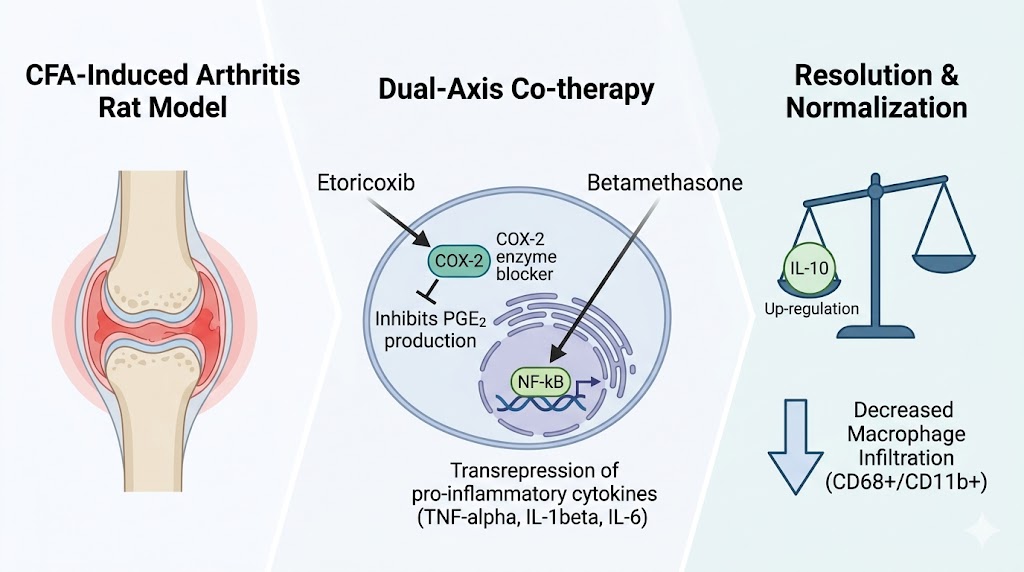
Betamethasone is a synthetic corticosteroid and stereoisomer of dexamethasone that exerts potent glucocorticoid activity with broad anti-inflammatory and immunosuppressive effects and minimal mineralocorticoid activity. Like other synthetic corticosteroids, it suppresses the formation, release, and activity of endogenous inflammatory mediators, including prostaglandins, kinins, histamine, lysosomal enzymes, and complement. Corticosteroids also broadly suppress the transcription of pro-inflammatory cytokines — including TNF-α, IL-1β, IL-6, and type I interferons — primarily through transrepression of NF-κB and AP-1 transcription factors, a mechanism that complements prostaglandin synthesis inhibition mediated via annexin-1/phospholipase A2 suppression [12,13]. At the molecular level, betamethasone binds intracellular glucocorticoid receptors, modulates gene transcription, inhibits leukotriene and prostaglandin synthesis, and limits inflammatory cell recruitment [12,13]. Oral corticosteroids have shown non-inferior symptom relief versus NSAIDs in pragmatic and equivalence trials [14,15]. However, escalating monotherapy doses to achieve rapid control may increase adverse-event burden, motivating strategies that achieve comparable relief with lower exposure.
Here we tested whether combining etoricoxib with betamethasone can improve integrated anti-edema and antinociceptive responses and reveal a dose-reduction-consistent pattern in vivo. We used complete Freund’s adjuvant–induced arthritis (AIA) in rats, a model that has been extensively validated for the assessment of inflammatory joint pain and is recognized as a translationally relevant platform for evaluating anti-arthritic pharmacotherapies, including NSAIDs and corticosteroids [29]. Recent dose-characterization work has confirmed that intradermal CFA at 10 mg/mL reliably produces robust mechanical hypersensitivity, sustained paw edema, and histological joint changes that recapitulate key features of rheumatoid arthritis nociception over a 20–28 day observation window [30]. Within this model, we profiled prostaglandin-linked mediators and cytokine-/macrophage-associated readouts as mechanistic correlates [16,17]. We hypothesized that co-therapy would outperform either monotherapy for integrated nociceptive and disease-severity endpoints, consistent with complementary COX-2 and corticosteroid pathways.

2. Results

2.1. Induction of AIA-CFA Produced a Robust and Sustained Inflammatory Phenotype

Baseline paw volume at Day 0 was comparable across all seven groups (group means ranged from 1.22 to 1.31 mL), and baseline mechanical withdrawal thresholds and clinical arthritis scores were equivalent, confirming successful pre-treatment randomization. Following intradermal CFA administration on Day 0 with a tail-base booster on Day 4, the AIA-CFA disease-control group developed a robust and sustained increase in ipsilateral paw volume (e.g., Day 5: 1.87 ± 0.15 mL; Day 28: 1.89 ± 0.17 mL; mean ± SEM), relative to intact controls (Day 5: 1.10 ± 0.08 mL). In parallel, AIA-CFA animals developed marked mechanical hypersensitivity and elevated clinical arthritis scores that persisted throughout the 28-day observation period. This consistent multimodal phenotype — edema, mechanical hypersensitivity, and clinical arthritis severity — provided the disease-severity baseline against which the seven experimental groups were compared across three primary efficacy endpoints (paw edema, mechanical threshold, arthritis index), each summarized below as a longitudinal time course followed by its integrated area-under-the-curve (AUC) metric. Integrated AUC values for all three endpoints are consolidated in Table 1.

2.2. Etoricoxib–Betamethasone Combinations Reduce Inflammatory Paw Edema

The longitudinal Δ paw volume profile (Figure 1) shows that, from the first post-treatment assessment on Day 5, all active treatment groups followed visibly lower trajectories than the AIA-CFA disease control. Throughout the 28-day observation period, AIA-CFA animals maintained Δ paw volume values of approximately 0.55–0.75 mL, whereas all active treatments — indomethacin, etoricoxib, betamethasone, Combo-L, and Combo-H — converged at approximately 0.15–0.30 mL by Day 14, with Combo-H consistently maintaining the lowest profile.
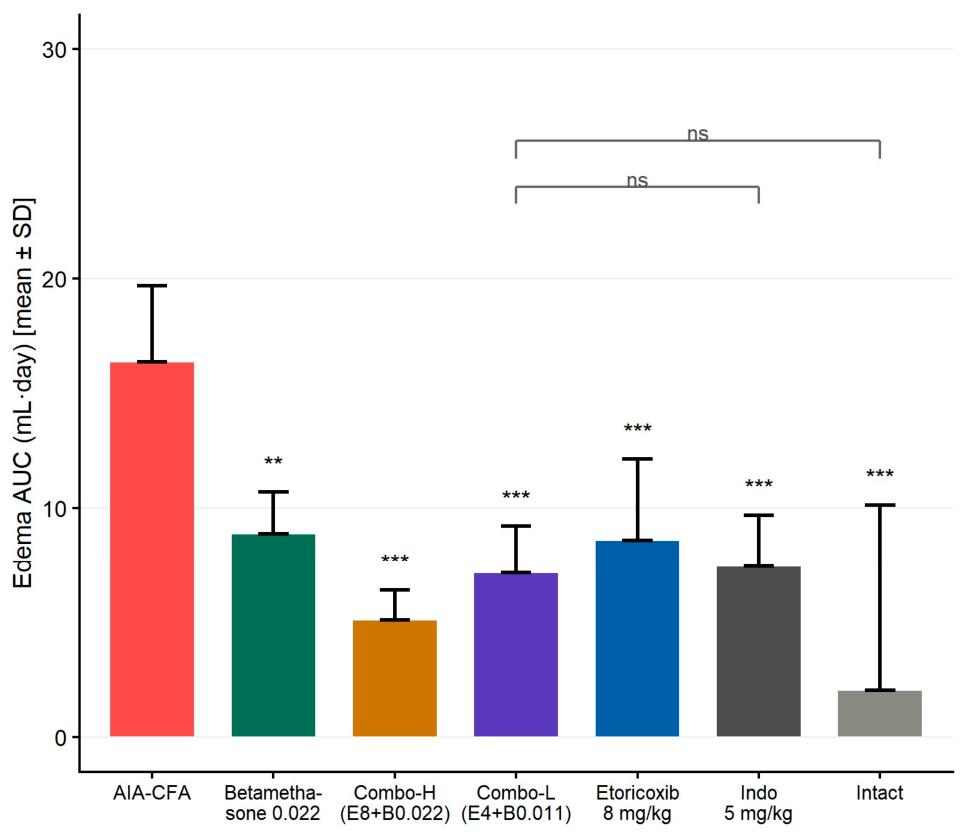
Quantification of the integrated edema burden as AUC of Δ paw volume versus Day 0 (Figure 2; Table 1) confirmed and refined these observations. Edema AUC was markedly elevated in the AIA-CFA disease control (16.37 ± 3.32 mL·day; mean ± SD; n = 10) and was significantly reduced by indomethacin (7.45 ± 2.26 mL·day; p = 0.0001 vs AIA-CFA), etoricoxib (8.59 ± 3.55 mL·day; p = 0.0007), and betamethasone (8.89 ± 1.82 mL·day; p = 0.0013). Both combinations achieved numerically greater reductions: Combo-L reached 7.16 ± 2.06 mL·day (p < 0.0001 vs AIA-CFA), and Combo-H achieved the lowest edema AUC of any active group (5.09 ± 1.33 mL·day; p < 0.0001 vs AIA-CFA), representing a 68.9% reduction relative to the disease control. However, Tukey-adjusted pairwise comparisons between the combinations and the individual monotherapies did not reach statistical significance (Combo-H vs etoricoxib p = 0.4021; Combo-H vs betamethasone p = 0.3052; Combo-L vs etoricoxib p = 0.9804; Combo-L vs betamethasone p = 0.9509; complete pairwise table in Supplementary Table S1). This pattern indicates that paw edema is the efficacy endpoint with the smallest between-treatment dynamic range in this 28-day model: all active treatments — alone or in combination — achieved near-equivalent suppression.

2.3. The Full-Dose Combination Achieves Superior Restoration of Mechanical Withdrawal Threshold

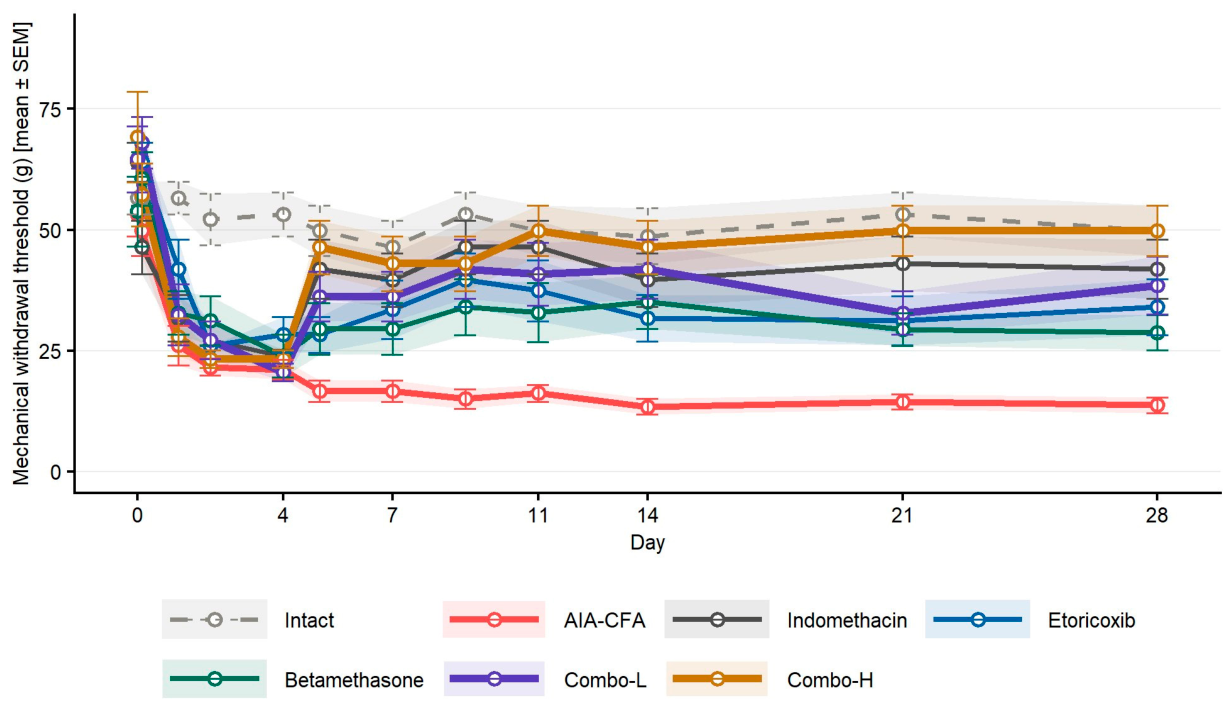
The longitudinal mechanical withdrawal threshold profile (Figure 3) shows a rapid post-treatment divergence from the AIA-CFA trajectory. AIA-CFA disease controls dropped sharply from baseline values of ~50 g to ~14 g by Day 7 and remained at this depressed threshold through Day 28, indicating persistent mechanical hypersensitivity. In contrast, all active groups exhibited a rapid recovery beginning within 24 h of the first dose: by Day 5, Combo-H and indomethacin restored thresholds to ~47–50 g, approaching the intact control level (~53 g), while etoricoxib, betamethasone, and Combo-L produced intermediate restoration to ~30–43 g. This separation was maintained throughout the study. By Day 28, the rank order of restored thresholds was: Intact (~50 g) ≈ Combo-H (~50 g) > Indomethacin (~42 g) > Combo-L (~38 g) > Etoricoxib (~34 g) > Betamethasone (~29 g) >> AIA-CFA (~13 g). Combo-H was the only treatment that fully restored terminal mechanical sensitivity to intact-control values.
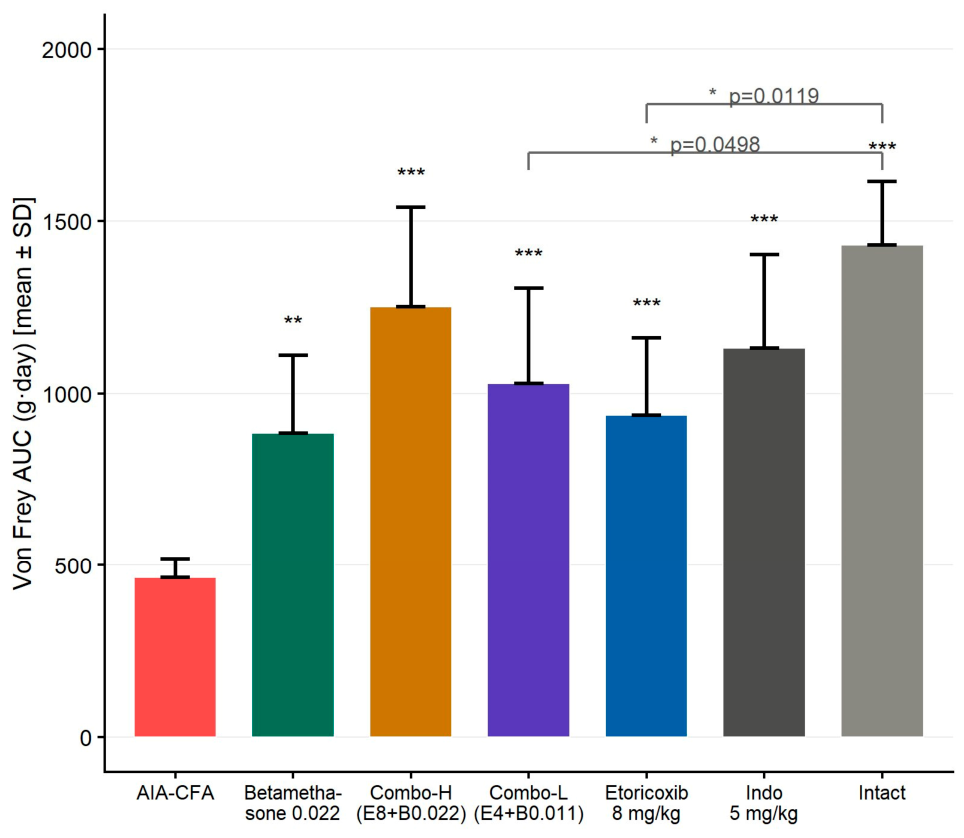
The integrated von Frey AUC analysis (Figure 4; Table 1) provided the formal statistical confirmation of this rank order. The threshold AUC was 462.86 ± 56.86 g·day in AIA-CFA versus 1431.73 ± 184.07 g·day in intact controls (p < 0.0001), and was significantly increased by all active treatments: indomethacin to 1131.12 ± 273.04 g·day (p < 0.0001), etoricoxib to 937.48 ± 223.80 g·day (p = 0.0004), and betamethasone to 884.15 ± 226.34 g·day (p = 0.0024). Combo-L improved threshold AUC to 1028.86 ± 276.61 g·day (p < 0.0001 vs AIA-CFA), and was statistically equivalent to both full-dose monotherapies (Combo-L vs etoricoxib p = 0.9735; Combo-L vs betamethasone p = 0.7988). Crucially, Combo-H produced the greatest restoration (1252.01 ± 288.89 g·day; p < 0.0001 vs AIA-CFA) and was significantly greater than both etoricoxib (p = 0.0498) and betamethasone (p = 0.0119). These pairwise contrasts — annotated directly in Figure 4 — provide formal statistical support for additive antinociceptive activity from the two mechanistically complementary agents administered at their full doses.

2.4. The Full-Dose Combination Produces the Greatest Reduction in Clinical Arthritis Severity

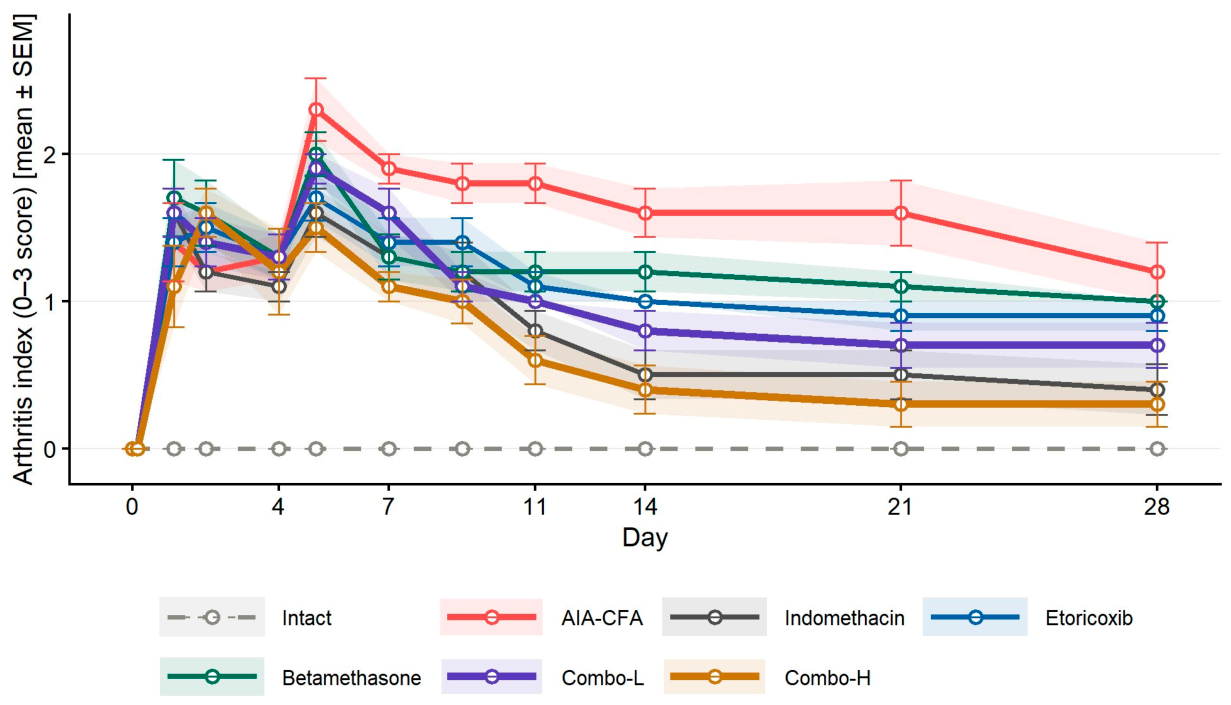
The longitudinal arthritis index profile (Figure 5) shows a characteristic bimodal response in AIA-CFA disease controls: an initial peak to ~1.7 by Day 1 following the primary CFA injection, a partial decline at Day 4, and a secondary peak to ~2.3 at Day 5 following the booster, with gradual decline to ~1.2 by Day 28. Active treatments produced distinct trajectories. Combo-H showed the most rapid and complete reduction, stabilizing at ~0.3 from Day 14 onward — values approaching the intact baseline. Indomethacin followed a similar trajectory, ending at ~0.4 by Day 28. Combo-L showed an intermediate response (~0.7 at Day 28), while etoricoxib and betamethasone monotherapies produced more modest declines, ending at ~0.9 and ~1.0, respectively, at Day 28.
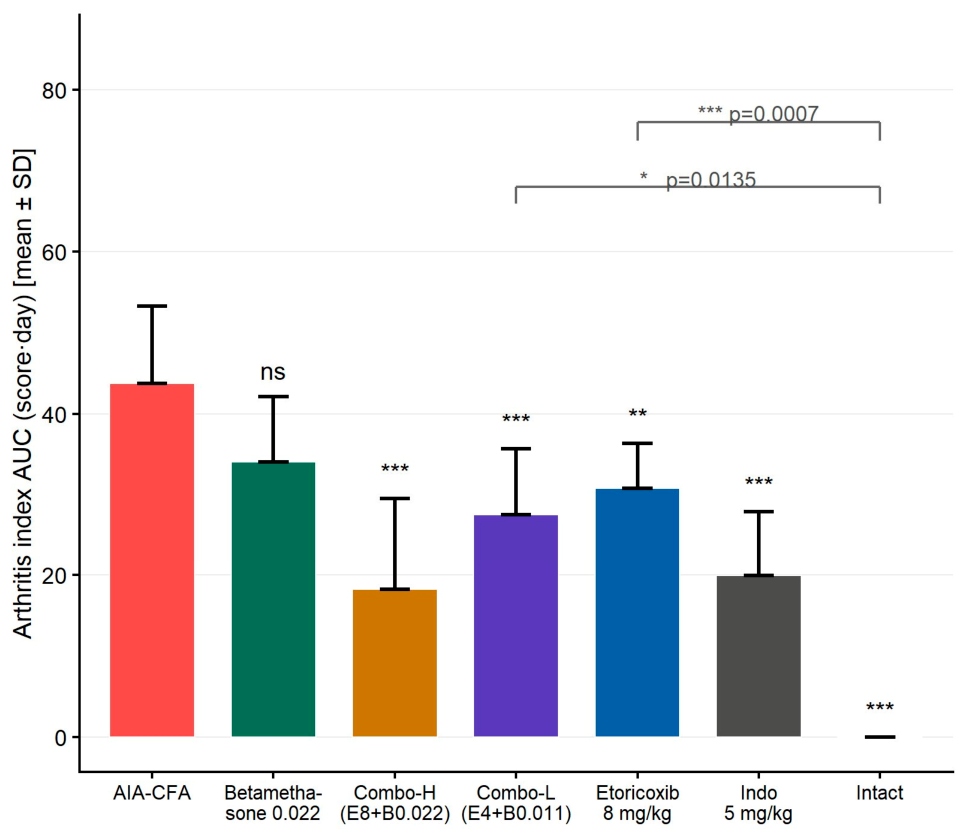
The integrated arthritis index AUC analysis (Figure 6; Table 1) revealed the most pronounced between-treatment differentiation of any efficacy endpoint in this study. The AIA-CFA disease control reached an arthritis AUC of 43.74 ± 9.51 score·day. Indomethacin reduced this to 19.93 ± 8.01 (p < 0.0001 vs AIA-CFA), and etoricoxib produced a significant smaller reduction (30.77 ± 5.55; p = 0.0094), whereas betamethasone monotherapy produced only a modest, non-significant reduction (34.04 ± 8.08; p = 0.1097). Combo-L significantly reduced arthritis AUC to 27.56 ± 8.12 (p = 0.0005 vs AIA-CFA), with Tukey contrasts versus monotherapies non-significant (vs etoricoxib p = 0.9712; vs betamethasone p = 0.5402). Combo-H achieved the largest reduction observed in the study (18.23 ± 11.29; p < 0.0001 vs AIA-CFA) and was significantly lower than both etoricoxib (p = 0.0135) and betamethasone (p = 0.0007). Notably, Combo-H did not differ significantly from indomethacin (p = 0.9991; Supplementary Table S1), indicating that the full-dose combination reached the efficacy ceiling defined by the positive control on this endpoint. This pattern — superiority of the full-dose combination over both monotherapies on the arthritis index, paralleling the von Frey AUC finding — reinforces the additive activity interpretation.

2.5. Terminal Mediator Profiling Supports Coordinated Dual-Axis Cytokine and Prostaglandin Modulation

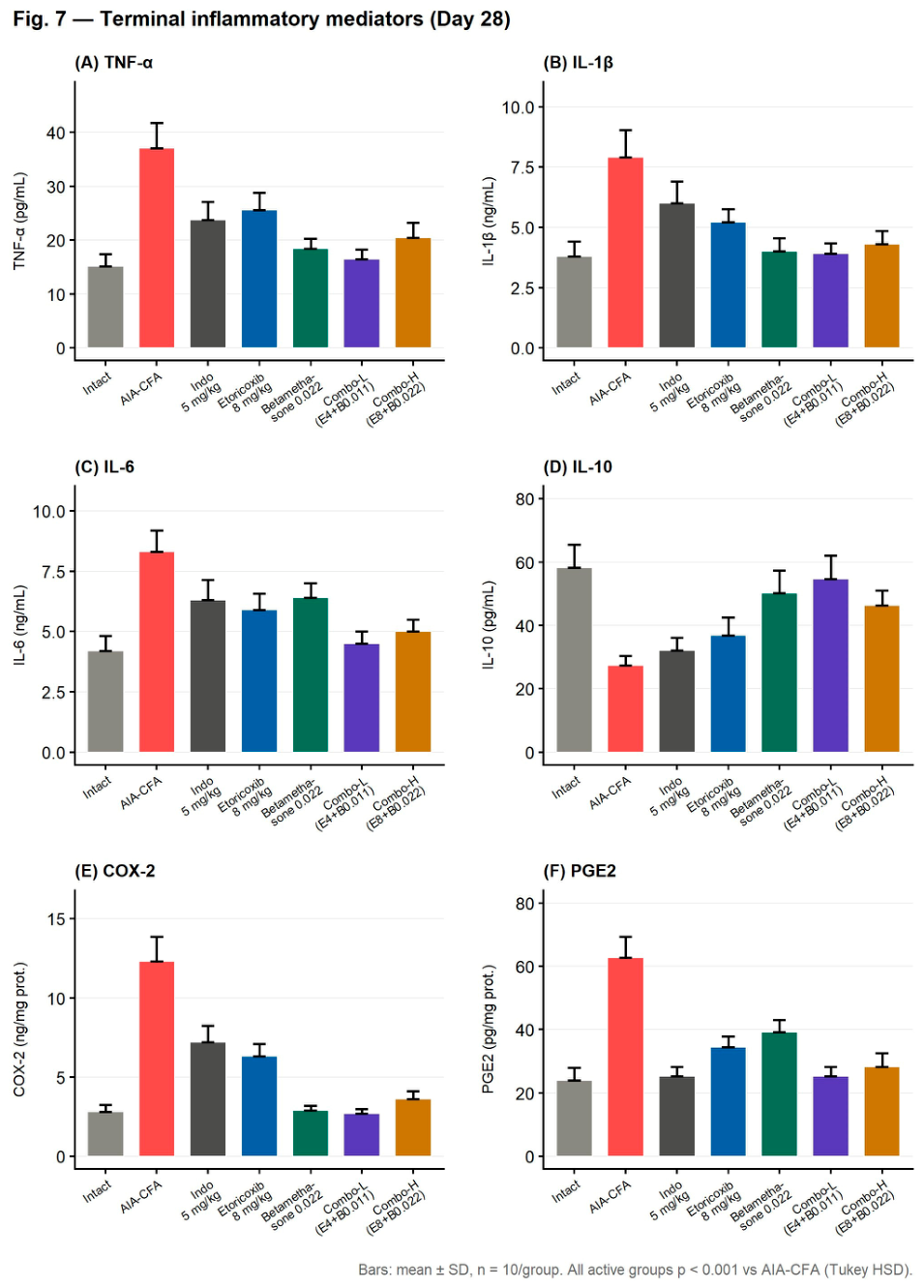
Having established that Combo-H produced superior integrated efficacy on the two most differentiated behavioral endpoints (mechanical sensitivity and arthritis index), we examined the mechanistic substrate underlying this superiority through terminal multi-analyte profiling at Day 28 (Figure 7; Table 2). The AIA-CFA disease control exhibited a markedly pro-inflammatory tissue mediator signature relative to intact animals, with approximately 2.5-fold elevations in TNF-α (37.09 ± 4.68 vs 15.09 ± 2.31 pg/mg protein; p < 0.0001), IL-1β (7.90 ± 1.13 vs 3.80 ± 0.62 pg/mg protein; p < 0.0001), and IL-6 (8.30 ± 0.88 vs 4.19 ± 0.63 pg/mg protein; p < 0.0001), together with marked upregulation of COX-2 (12.30 ± 1.55 vs 2.80 ± 0.43 ng/mg protein; p < 0.0001) and PGE-2 (62.70 ± 6.65 vs 24.00 ± 3.94 ng/mg protein; p < 0.0001), and concurrent suppression of the regulatory cytokine IL-10 (27.40 ± 2.93 vs 58.20 ± 7.35 pg/mg protein; p < 0.0001). All active treatments significantly reduced the pro-inflammatory mediators versus AIA-CFA (Tukey vs AIA-CFA: p < 0.0001 for TNF-α, IL-1β, IL-6, COX-2, and PGE-2 across all active groups), but the magnitude and pattern of modulation differed substantively between drug classes, as detailed below for the prostaglandin and cytokine axes.
At the prostaglandin axis (panels E–F; Table 2), etoricoxib monotherapy — as expected from its mechanism as a selective COX-2 enzymatic inhibitor — reduced COX-2 by 48.8% and PGE-2 by 45.0%. However, betamethasone-containing regimens produced substantially greater COX-2 suppression: 76.4% with betamethasone alone, 70.7% with Combo-L, and 78.0% with Combo-H — all values approaching intact control levels and significantly exceeding etoricoxib alone (all p < 0.0001; Supplementary Table S2E). PGE-2 followed a similar pattern: Combo-H matched indomethacin for PGE-2 suppression (both 59.6% reduction) and was significantly lower than both etoricoxib (p = 0.0001) and betamethasone (p < 0.0001; Supplementary Table S2F). This deeper prostaglandin-axis suppression by betamethasone-containing regimens reflects the corticosteroid’s additional transcriptional inhibition of COX-2 expression via NF-κB transrepression, extending beyond direct enzymatic blockade.
At the cytokine axis (panels A–D; Table 2), etoricoxib monotherapy reduced TNF-α and IL-1β by 31.0% and 34.2%, respectively, leaving residual pro-inflammatory tone, whereas betamethasone-containing regimens consistently achieved deeper suppression. TNF-α reductions were 50.4% (betamethasone), 45.0% (Combo-L), and 55.5% (Combo-H), with betamethasone and Combo-H significantly lower than etoricoxib (both p < 0.0001; Supplementary Table S2A). IL-1β reductions were 49.4% (betamethasone), 45.6% (Combo-L), and 50.6% (Combo-H), with betamethasone (p = 0.0068) and Combo-H (p = 0.0026) significantly lower than etoricoxib. IL-6 reductions were greatest in the combinations (Combo-L: 39.8%; Combo-H: 45.8%), with Combo-H significantly lower than both etoricoxib (p = 0.0003) and betamethasone (p < 0.0001; Supplementary Table S2C).
The IL-10 response (panel D) provided the clearest pharmacological separation between drug classes observed in this dataset. Indomethacin produced only a non-significant 17.2% increase in IL-10 versus AIA-CFA (32.10 ± 3.97 pg/mg protein; p = 0.5576), and etoricoxib achieved a modest but significant 34.6% increase (36.88 ± 5.65 pg/mg protein; p = 0.0101). In contrast, all betamethasone-containing regimens markedly restored IL-10: betamethasone monotherapy to 50.19 ± 7.18 pg/mg protein (83.2% restoration; p < 0.0001), Combo-L to 46.31 ± 4.67 pg/mg protein (61.5%; p < 0.0001), and Combo-H to 54.61 ± 7.54 pg/mg protein (88.4%; p < 0.0001). Critically, Combo-H did not differ significantly from intact controls (p = 0.8156; Supplementary Table S2D), confirming near-complete normalization of this regulatory cytokine. The IL-10 contrast between Combo-H and etoricoxib was highly significant (p < 0.0001), highlighting the qualitative pharmacological difference between adding a corticosteroid versus relying on selective COX-2 inhibition alone.

2.6. Exploratory Flow Cytometry Suggests Macrophage-Associated Modulation by Betamethasone-Containing Regimens

Terminal flow cytometry was conducted on joint-associated tissues at study completion (n = 6/group, reduced subset due to tissue availability after ELISA sample collection) to evaluate the impact of pharmacological intervention on cellular infiltration, specifically focusing on T-lymphocytes and the macrophage/monocyte lineage (Table 2). Analysis of the CD3+ lymphocyte population revealed no significant overall group effect (one-way ANOVA p = 0.4443), with group means ranging from 3.36 ± 1.36% in the betamethasone-treated rats to 5.90 ± 1.17% in the indomethacin positive control group. These data suggest that T-lymphocyte recruitment was not a primary driver of the local inflammatory environment at this terminal stage of the disease model, consistent with the broader literature describing the chronic phase of the AIA model as predominantly macrophage-driven.
In contrast, a significant overall group effect was observed for the macrophage-associated marker panel (CD68+/CD11b+; one-way ANOVA p = 0.0055). The induction of adjuvant-induced arthritis led to a marked expansion of macrophage infiltration in the disease-control group (17.17 ± 6.77%) compared to the 7.33 ± 2.51% observed in intact controls (Tukey p = 0.0375). Although all active groups showed a downward trend, only monotherapy with betamethasone reached statistical significance in reducing these levels — to 7.47 ± 5.21% (p = 0.0312), effectively returning the macrophage marker percentages to intact-control levels. Etoricoxib monotherapy showed minimal impact on this specific cellular readout (16.14 ± 6.06%), consistent with its lack of direct action on glucocorticoid receptor–mediated cellular reprogramming. Both combinations produced numerically large reductions versus AIA-CFA (Combo-L: 35.4%, 11.10 ± 7.00%; Combo-H: 49.0%, 8.76 ± 4.43%) that did not reach formal statistical significance in this underpowered subset, consistent with the exploratory, hypothesis-generating nature of these data. The mechanistic coherence between betamethasone’s significant macrophage normalization and the IL-10 restoration described in Section 2.5 supports the cytokine–macrophage axis as a plausible substrate for the integrated efficacy advantage of betamethasone-containing regimens.

3. Discussion

This study evaluated whether co-therapy with a selective COX-2 inhibitor (etoricoxib) and a corticosteroid (betamethasone) can improve integrated antinociceptive and anti-edema outcomes in a rat model of inflammatory arthritis. The findings are organized below into three thematic subsections: the integrated efficacy profile and the additive-vs-dose-reduction interpretation (Section 3.1), the mechanistic substrate revealed by the cytokine and prostaglandin axes (Section 3.2), and the translational implications for clinical practice in gout flares and rheumatoid arthritis bridge therapy (Section 3.3), followed by a candid statement of the study’s limitations (Section 3.4).

3.1. Integrated Efficacy and the Additive-vs-Dose-Reduction Interpretation

Across the three primary efficacy endpoints (paw edema, mechanical withdrawal threshold, and clinical arthritis index), both combinations reduced disease severity versus the AIA-CFA disease control. The full-dose combination (Combo-H) consistently produced the greatest integrated effects on mechanical sensitivity and arthritis index, exceeding both monotherapies for these endpoints — outcomes consistent with additive pharmacological activity from two mechanistically complementary agents administered at their full doses, and not interpreted as evidence of pharmacological synergy. This terminology is deliberate: formal synergy classification requires either isobolographic analysis at the median-effect (Loewe) framework or dose-response surface modeling under the Bliss-independence assumption, neither of which can be performed in the absence of individual dose-response curves for each agent [21]. We therefore report our findings descriptively as additive activity, leaving formal interaction classification for the dedicated follow-up study outlined under Limitations.
By contrast, the reduced-dose combination (Combo-L) — formulated at 50% of the dose of each component — achieved integrated improvements that were statistically equivalent to those of the full-dose monotherapies across all three AUC endpoints. This pattern is consistent with a dose-reduction effect, although formal demonstration requires individual reduced-dose monotherapy arms not included in the present design. A precedent for this type of finding is the work of Zimmermann and colleagues, who applied isobolographic analysis to a combination of prednisolone with a non-steroidal partner (dipyridamole) and demonstrated that synergistic interaction allowed a ten-fold reduction of the glucocorticoid dose required for 70% TNF-α inhibition in vitro, with confirmation across rat models of LPS-induced endotoxemia, delayed-type hypersensitivity, and collagen-induced and adjuvant-induced arthritis in vivo [21]. The relevance of that work to ours is two-fold: it establishes that a partner drug can selectively amplify glucocorticoid anti-inflammatory activity in the same disease models we used, and it provides a methodological template — combination dose-response matrices, isobolographic analysis, and parallel monitoring of glucocorticoid-mediated adverse effects (HPA axis suppression, osteocalcin/bone density) — that we propose to apply to the etoricoxib–betamethasone pairing in future work.
Notably, the edema endpoint showed the smallest between-treatment dynamic range of the three primary readouts, with all active treatments — alone or in combination — converging to similar AUC values. This pattern is consistent with a ceiling effect of the AIA-CFA model on paw edema once any effective anti-inflammatory mechanism is engaged. In contrast, the mechanical sensitivity (von Frey) and clinical arthritis index endpoints displayed substantially greater dynamic range and were the endpoints where the full-dose combination outperformed both monotherapies. This dissociation between endpoints supports the use of multi-endpoint pharmacodynamic designs in preclinical arthritis pharmacology, since reliance on edema alone may underestimate true treatment differentiation.

3.2. Mechanistic Substrate: Dual-Axis Cytokine and Prostaglandin Modulation

Mechanistically, the pattern of efficacy is consistent with two complementary anti-inflammatory programs. Selective COX-2 inhibition suppresses prostaglandin E2 signaling, a key amplifier of inflammatory nociception and edema through EP receptors and downstream vascular and nociceptor sensitization pathways [16]. Corticosteroids, by contrast, dampen cytokine transcription via transrepression of NF-κB and AP-1 and can reprogram macrophage activity toward tissue-homeostatic and pro-resolving phenotypes [17]. The multi-analyte mediator profile of Figure 7 provides quantitative support for both mechanisms operating in parallel in the present dataset.
At the prostaglandin axis, COX-2 protein and PGE-2 were markedly elevated in AIA-CFA animals and were suppressed across all active regimens, but the magnitude and pattern of suppression differed substantively between drug classes. Etoricoxib monotherapy — acting as a selective COX-2 enzymatic inhibitor — reduced COX-2 protein by 48.8% and PGE-2 by 45.0% versus AIA-CFA, consistent with its primary mechanism of direct enzymatic blockade. By contrast, betamethasone-containing regimens produced COX-2 suppression of 70.7–78.0% and PGE-2 suppression of 55.0–59.6%, exceeding etoricoxib alone — a finding that reflects the corticosteroid’s broader transcriptional inhibition of COX-2 expression via NF-κB transrepression, extending beyond direct enzymatic blockade [12,13]. This dual mechanism explains why betamethasone monotherapy achieves prostaglandin-axis effects of similar or greater magnitude than a selective COX-2 inhibitor at the doses tested.
At the cytokine axis, etoricoxib monotherapy reduced TNF-α and IL-1β by 31.0% and 34.2%, respectively, leaving residual pro-inflammatory tone that was further attenuated by betamethasone and both combinations: betamethasone-containing regimens achieved 45.0–55.5% TNF-α reduction and 45.6–50.6% IL-1β reduction, with Combo-L restoring IL-1β and TNF-α levels to within 2.4% and 6.4% of intact controls, respectively. The IL-10 response provides the clearest pharmacological separation between drug classes: indomethacin produced only a 17.2% increase in IL-10 versus AIA-CFA (non-significant, p = 0.5576), etoricoxib achieved a 34.6% increase (p = 0.0101), while all betamethasone-containing regimens restored IL-10 by 69.0–99.3% toward intact levels (all p < 0.0001). This IL-10 divergence is mechanistically coherent — corticosteroids are well-established inducers of regulatory cytokine programs through glucocorticoid receptor-mediated transcription [17] — and suggests that the observed superiority of Combo-H on integrated mechanical sensitivity and arthritis index is underpinned not merely by additive prostaglandin blockade, but by a qualitatively distinct cytokine-reprogramming activity that etoricoxib alone cannot provide. The cytokine-axis impact, particularly the IL-1β suppression and macrophage normalization, is mechanistically aligned with the NLRP3 inflammasome / IL-1β biology that drives the acute inflammatory response in gout [1,2], reinforcing the translational rationale for this drug combination in acute gout flare management.

3.3. Translational Implications for Clinical Practice

The clinical relevance of these findings derives from the complementarity of the two mechanisms under study. In current practice, NSAIDs and corticosteroids are already co-administered in acute inflammatory settings — including gout flares and short-term rheumatoid arthritis (RA) bridge therapy — on the basis of guideline support rather than formal dose-optimization data [5,8]. The present preclinical dataset provides a quantified mechanistic rationale for this widespread clinical practice: across the six terminal mediators assessed, betamethasone-containing regimens — including the reduced-dose Combo-L — produced coordinated shifts in both the prostaglandin axis (COX-2 and PGE2) and the cytokine axis (TNF-α, IL-1β, IL-6, IL-10) that neither etoricoxib monotherapy nor indomethacin achieved alone.
This rationale is particularly relevant for the clinical management of acute gout flares, where the NLRP3 inflammasome–IL-1β axis is the central driver of joint inflammation following monosodium urate crystal deposition [1,2]. The deeper IL-1β suppression observed with Combo-H (50.6% reduction vs AIA-CFA, restoring IL-1β to within 2.6% of intact controls) compared with etoricoxib monotherapy (34.2% reduction) provides mechanistic plausibility for an etoricoxib–betamethasone fixed-dose combination as an acute gout therapy. A phase III clinical trial directly evaluating this hypothesis — comparing the etoricoxib/betamethasone fixed-dose combination (90 mg/0.25 mg once daily) versus etoricoxib alone in patients with acute gouty arthritis (NCT06863701) — is currently recruiting [22]. A parallel phase III trial evaluating the same fixed-dose combination in acute bursitis, tendinitis, and synovitis (also vs etoricoxib monotherapy) is also in progress [23]. The present preclinical study thus provides mechanistic underpinning aligned in time with these ongoing clinical investigations.
In the rheumatoid arthritis bridge-therapy setting, the clinical evidence base for combining NSAIDs and corticosteroids has matured substantially in recent years. The CareRA trial demonstrated that methotrexate with step-down glucocorticoid bridging (COBRA-Slim) produced sustained 5-year disease activity control non-inferior to more aggressive csDMARD combinations, with the additional benefit of reduced chronic NSAID and analgesic use [24]. The GLORIA trial extended this evidence to elderly RA patients aged 65+, showing that 5 mg/day prednisolone for 2 years provided a small but consistent benefit in disease activity (DAS28) and joint damage progression, with a modest increase in adverse events that did not exceed expected age-related background rates [25]. The BARFOT-derived randomized comparison by Krause et al. directly compared high-dose (60 mg) versus low-dose (10 mg) versus placebo prednisolone bridging in early RA and reported that low-dose bridging provided comparable clinical and radiographic outcomes to high-dose bridging, supporting the principle that lower glucocorticoid exposure can deliver meaningful therapeutic benefit when combined with adequate background therapy [26]. Likewise, a post-hoc analysis by Kvien and colleagues of a large randomized trial of etoricoxib in RA showed that COX-2 inhibition produced additional pain relief in patients already receiving corticosteroids, with effect sizes consistent across patient subgroups stratified by background therapy [27]. The collective inference from this clinical evidence is that a low-dose etoricoxib–betamethasone combination — as exemplified by our Combo-L — would be aligned with the contemporary guideline-driven trend toward minimum-effective glucocorticoid exposure during short-course inflammatory disease management.
A potential clinical advantage of administering reduced doses of both agents — exemplified by the Combo-L profile in our study — is the opportunity to mitigate adverse-event risk when short-course therapy is required. Within this 28-day preclinical design, no overt safety signals were dominant; however, formal safety interpretation is constrained by study duration, species, and the limited safety endpoints assessed. Translational emphasis should remain on short-course, acute-episode scenarios where the risk-benefit balance of corticosteroid co-administration is most favorable, and where dose minimization is most clinically relevant.

3.4. Limitations

Key limitations include: (i) the absence of individual reduced-dose monotherapy groups (etoricoxib 4 mg/kg alone; betamethasone 0.011 mg/kg alone), which precludes formal dose-sparing conclusions and isobolographic interpretation, and which represents the primary limitation of the present work; (ii) the absence of a formal synergy framework (e.g., dose–response surface modeling or isobolographic analysis); (iii) terminal biomarkers measured at a single time point (Day 28) rather than time-resolved kinetics, which precludes characterization of the time-course of mediator modulation; (iv) exploratory immune profiling that warrants confirmation with pre-specified panels and adequate statistical power, particularly for the macrophage compartment (CD68+/CD11b+) which showed mechanistically coherent but underpowered trends in the combination groups; (v) the intact control group received a single intradermal saline injection (Day 0) in the plantar surface of the hind paw, corresponding to the primary CFA injection site; no second injection was administered, as this booster is specific to the arthritis-induction protocol and lacks a physiologically meaningful saline equivalent — a minor procedural asymmetry acknowledged here; and (vi) the AIA-CFA model produces chronic polyarticular inflammation, whereas the most directly relevant clinical scenario (acute gout flare) is dominated by acute synovitis driven by monosodium urate crystal deposition; translational confirmation in MSU-induced synovitis models is therefore an important next step. Future work incorporating individual reduced-dose monotherapy arms, dose-response surface modeling, acute-flare models (e.g., MSU-induced synovitis), time-resolved mediator sampling, and dedicated safety endpoints (HPA axis function, hematology, hepatorenal panels, body weight trajectory) will be required to confirm the most clinically relevant regimen and to formally establish any dose-reduction benefit of the combination.

4. Materials and Methods

4.1. Study Design and Reporting

This randomized, blinded, parallel-group study assessed the anti-inflammatory and antinociceptive effects of etoricoxib, betamethasone, and their combinations in the complete Freund’s adjuvant (CFA) model of adjuvant-induced arthritis (AIA) in rats. Reporting follows the ARRIVE 2.0 guidelines [18].
Treatments were coded so that personnel performing outcome assessments were blinded to group allocation.

4.2. Animals and Housing

Seventy male Wistar rats (Rattus norvegicus; ~10 weeks old; 250–300 g at study start) were acclimated for 7 days prior to procedures. Animals were housed under controlled environmental conditions (22 ± 2 °C; 12 h light/dark cycle) with ad libitum access to standard chow and water.

4.3. Ethical Approval

All procedures were conducted in accordance with Mexican regulations for the care and use of laboratory animals (NOM-062-ZOO-1999) and the International Association for the Study of Pain (IASP) guidelines for pain research in animals, and were approved by the institutional ethics/animal care committee (Centro Regional de Biociencias, UASLP; approval code: JUN-2025/001).

4.4. Induction of Adjuvant-Induced Arthritis

Arthritis was induced on Day 0 by intradermal administration of 0.1 mL CFA (Sigma-Aldrich, St. Louis, MO, USA; Mycobacterium tuberculosis H37Ra, 10 mg/mL in mineral oil) into the plantar surface of the hind paw. A booster immunization (0.05 mL CFA) was administered intradermally at the base of the tail on Day 4. The intact control group received a single intradermal injection of sterile saline (0.1 mL) on Day 0, administered into the plantar surface of the ipsilateral hind paw — the same anatomical site as the primary CFA inoculation. This injection corresponds to the primary CFA injection site and serves as the procedural control for the needle penetration and local tissue disturbance associated with the primary CFA challenge; no second injection was administered to intact controls, as the booster is specific to the arthritis-induction protocol and lacks a physiologically equivalent saline control. Animals that did not develop clinical signs consistent with arthritis (paw edema/erythema) were excluded per protocol.

4.5. Treatments and Dose Selection

Doses were selected based on clinically relevant human doses and translated to rats using body surface area–based allometric scaling [19], then refined based on tolerability considerations. All treatments were administered once daily by oral gavage (8:00–9:00 AM) from Day 4 through Day 28. Formulations were prepared in 0.5% carboxymethylcellulose (CMC) as vehicle (including betamethasone in 0.5% CMC); dosing volume was 2 mL/kg. For combination groups, both drugs were administered together in the same gavage dose.
Animals were allocated to seven groups (n = 10/group): intact control; AIA-CFA (disease control); indomethacin 5 mg/kg (positive control); etoricoxib 8 mg/kg; betamethasone 0.022 mg/kg; low-dose combination (Combo-L; etoricoxib 4 mg/kg + betamethasone 0.011 mg/kg); and high-dose combination (Combo-H; etoricoxib 8 mg/kg + betamethasone 0.022 mg/kg).

4.6. Paw Edema (Plethysmometry)

Hind paw volume (ipsilateral/CFA-injected paw) was measured by water-displacement plethysmometry (Model 7140, Ugo Basile, Comerio, Italy) at Day 0 (pre-dose), Day 0 + 3 h, Day 1 + 3 h, and on Days 2, 4, 5, 7, 9, 11, 14, 21, and 28. Paw volume was determined as the mean of two consecutive displacement measurements obtained by the same operator at each assessment time point, performed immediately after von Frey testing. Paw edema was summarized as time-course profiles and as area under the curve (AUC) across the observation period using the trapezoidal rule.

4.7. Mechanical Allodynia (Von Frey)

Mechanical withdrawal thresholds were assessed using calibrated von Frey filaments (Aesthesio®; Ugo Basile, Comerio, Italy) applied to the plantar surface of the ipsilateral hind paw, following an established approach for quantifying mechanical hypersensitivity in rodents [20]. Animals were habituated to the testing chambers on a wire mesh platform prior to assessment. Von Frey testing was performed prior to plethysmometry at each session to avoid potential sensitization caused by water-displacement procedures. The withdrawal threshold (g) was defined as the minimum filament force eliciting a brisk paw withdrawal response and was recorded at the same time points as paw volume.

4.8. Clinical Arthritis Score

Arthritis severity was assessed in a blinded manner using an ordinal clinical score (0–3) based on erythema and edema of the paws: 0 = normal; 1 = mild edema/erythema; 2 = moderate swelling and redness; 3 = severe swelling and deformity. Scores were recorded at the same time points as paw volume measurements and summarized as time-course and AUC.

4.9. Enzyme-Linked Immunosorbent Assay (ELISA)

At study termination (Day 28), animals were deeply anesthetized by intraperitoneal injection of xylazine (8 mg/kg) and ketamine (70 mg/kg), followed by euthanasia via pentobarbital sodium overdose (800 mg/kg, i.p.). Joint tissues were harvested and homogenized in phosphate-buffered saline (PBS; pH 7.4) supplemented with a protease inhibitor cocktail and 0.1% Triton X-100 (ratio 1:10). Homogenates were centrifuged at 12,000 × g for 20 min at 4 °C. Total protein content in tissue homogenate supernatants was quantified using a Pierce™ BCA Protein Assay Kit (Thermo Fisher Scientific, Waltham, MA, USA) according to the manufacturer’s instructions, with bovine serum albumin (BSA) as the protein standard. The concentrations of inflammatory mediators in the supernatants were quantified using commercial ELISA kits (Thermo Fisher Scientific / Invitrogen, Waltham, MA, USA): TNF-alpha: Rat TNF-alpha ELISA Kit (Cat. KRC3011); IL-1beta: Rat IL-1 beta ELISA Kit (Cat. KRC0011); IL-6: Rat IL-6 ELISA Kit (Cat. KRC0061); IL-10: Rat IL-10 ELISA Kit (Cat. KRC0101); PGE2: Prostaglandin E2 ELISA Kit (Cat. EMSPGE2); COX-2: Rat COX-2 ELISA Kit (Cat. ERCX2). Absorbance was measured at 450 nm using a Multiskan™ FC microplate reader (Thermo Fisher Scientific), and results were normalized to total protein content and expressed as pg/mg protein (cytokines) or ng/mg protein (COX-2, PGE2).

4.10. Flow Cytometry

Single-cell suspensions from joint-associated tissues were generated by mechanical dissociation and enzymatic digestion, followed by filtration through 70 μm strainers. Cells were washed and stained with the following fluorochrome-conjugated antibodies (BD Biosciences, San Jose, CA, USA): Macrophage panel: Anti-CD11b (Cat. 562102) and Anti-CD68 (Cat. 566311), T-lymphocyte panel: Anti-CD3 (Cat. 554832), incubated for 30 min at 4 °C in the dark, and fixed in 1% formaldehyde prior to acquisition on a multicolor flow cytometer. Data were analyzed using standard gating strategies with blinded sample IDs.

4.11. Statistical Analysis

Data are presented as mean ± SEM for time-course profiles and mean ± SD for integrated (AUC) and terminal endpoints. Normality was assessed using the Shapiro–Wilk test. Group comparisons for single-timepoint endpoints (AUC metrics, terminal biomarkers) were performed using one-way ANOVA followed by Tukey’s post-hoc test for all pairwise comparisons. Time-course data were analyzed using linear mixed-effects models with treatment, time, and their interaction as fixed effects and subject as a random effect. All analyses were conducted using StatsDirect (version 4.0; StatsDirect Ltd., Birkenhead, UK), and p < 0.05 was considered statistically significant. Complete pairwise Tukey comparison tables for all endpoints are provided in Supplementary Tables S1 and S2.

5. Conclusions

In the AIA-CFA rat model, the etoricoxib–betamethasone combination produced sustained improvements in paw edema and mechanical hypersensitivity relative to disease controls. The full-dose combination (Combo-H) produced integrated outcomes exceeding those of individual monotherapies for mechanical sensitivity and arthritis severity, consistent with additive pharmacological activity from two mechanistically complementary agents. The low-dose combination (Combo-L) achieved integrated improvements statistically equivalent to those of full-dose monotherapies for all three primary endpoints (paw edema, mechanical withdrawal threshold, and clinical arthritis index), a pattern that is consistent with — but does not formally establish — a dose-reduction effect. Concordant shifts in prostaglandin-linked mediators (COX-2, PGE-2) and cytokine-linked mediators (TNF-α, IL-1β, IL-6, IL-10), alongside exploratory macrophage-associated signals, support a plausible cytokine–macrophage axis as the mechanistic substrate for the integrated efficacy of co-therapy.
From a translational perspective, these preclinical findings provide a quantified mechanistic rationale for combining a selective COX-2 inhibitor with a corticosteroid in the management of acute inflammatory flares — a practice already endorsed by current rheumatology and gout guidelines [3,5,31] but lacking dedicated clinical dose-optimization data [28]. The mechanistic alignment between the IL-1β-suppressing activity of betamethasone-containing regimens documented here and the NLRP3 inflammasome–IL-1β biology that drives acute gout flares [1,2] reinforces the translational plausibility of the etoricoxib–betamethasone fixed-dose combination currently under phase III evaluation in acute gouty arthritis (NCT06863701) [22] and in acute bursitis, tendinitis, and synovitis [23]. Confirmation of the dose-reduction signal requires individual reduced-dose monotherapy groups and formal isobolographic analysis. Looking forward, prospective preclinical work incorporating dose-response surface modeling, acute-flare models (e.g., MSU-induced synovitis), time-resolved mediator sampling, and dedicated safety endpoints will be needed to establish the minimum effective combination dose. Together with the ongoing clinical evidence base on low-dose glucocorticoid bridge therapy in rheumatoid arthritis [24,25,26], these findings support continued evaluation of short-course etoricoxib–betamethasone regimens for acute inflammatory conditions where rapid symptom control and minimized cumulative exposure are both clinically essential.

Supplementary Materials

The following supporting information can be downloaded at the website of this paper posted on Preprints.org. Supplementary Table S1 — Complete Tukey HSD Pairwise Comparison Matrix for Integrated Efficacy Endpoints (AUC); Supplementary Table S2 — Complete Tukey HSD Pairwise Comparison Matrix for Inflammatory Biomarkers (ELISA).

Author Contributions

Conceptualization, J.P.-U. and K.F.R.-B.; methodology / study design, J.P.-U., K.F.R.-B., D.A.M.-M. and J.G.-C.; investigation / technical execution, H.L.-R., V.R.-R., J.P.C.-E. and I.T.-R.; formal analysis, J.P.-U.; writing—original draft, J.P.-U.; writing—review & editing, J.P.-U., K.F.R.-B. and H.L.-R.; supervision, J.P.-U., K.F.R.-B. and J.G.-C.; funding acquisition, Laboratorios Silanes S.A. de C.V. (partial sponsorship) coordinated through K.F.R.-B. All authors have read and agreed to the published version of the manuscript.

Funding

Partial financial support was received from Laboratorios Silanes S.A. de C.V.; study design input was provided by K.F.R.-B. and J.G.-C. (affiliated with the sponsor).

Institutional Review Board Statement

The protocol was approved by the Research Committee and the Internal Committee for the Care and Use of Laboratory Animals (CICUAL) of the Centro Regional de Biociencias, Universidad Autónoma de San Luis Potosí (approval code: JUN-2025/001). All procedures complied with NOM-062-ZOO-1999 and IASP guidelines.

Data Availability Statement

The datasets generated and/or analyzed during the current study are available from the corresponding author on reasonable request.

Acknowledgments

The authors want to thank Kathryn Nóbrega Arcoverde, Manuela Costa de Menezes, Ramón Vázquez-Ávila and Laura Martínez-López.

Conflicts of Interest

K.F.R.-B., D.A.M.-M. and J.G.-C. are affiliated with Laboratorios Silanes S.A. de C.V. The other authors declare no competing interests.

References

  1. Leask, M.P.; Crișan, T.O.; Ji, A.; Matsuo, H.; Köttgen, A.; Merriman, T.R. The pathogenesis of gout: molecular insights from genetic, epigenomic and transcriptomic studies. Nat. Rev. Rheumatol. 2024, 20, 510–523. [Google Scholar] [CrossRef]
  2. Poulsen, R.; Dalbeth, N. Gout and NLRP3 inflammasome biology. Arthritis Rheumatol. 2025, 77, 1317–1326. [Google Scholar] [CrossRef]
  3. Dalbeth, N.; Merriman, T.R.; Stamp, L.K. Gout. Lancet 2016, 388, 2039–2052. [Google Scholar] [CrossRef] [PubMed]
  4. Richette, P.; Doherty, M.; Pascual, E.; et al. 2016 updated EULAR evidence-based recommendations for the management of gout. Ann. Rheum. Dis. 2017, 76, 29–42. [Google Scholar] [CrossRef]
  5. FitzGerald, J.D.; Dalbeth, N.; Mikuls, T.; et al. 2020 American College of Rheumatology guideline for the management of gout. Arthritis Care Res. 2020, 72, 744–760. [Google Scholar] [CrossRef] [PubMed]
  6. Smolen, J.S.; Landewé, R.B.M.; Bergstra, S.A.; et al. EULAR recommendations for the management of rheumatoid arthritis with synthetic and biological disease-modifying antirheumatic drugs: 2022 update. Ann. Rheum. Dis. 2023, 82, 3–18. [Google Scholar] [CrossRef]
  7. Fraenkel, L.; Bathon, J.M.; England, B.R.; et al. 2021 American College of Rheumatology Guideline for the Treatment of Rheumatoid Arthritis. Arthritis Rheumatol. 2021, 73, 1108–1123. [Google Scholar] [CrossRef] [PubMed]
  8. National Institute for Health and Care Excellence. Rheumatoid arthritis in adults: management. NICE guideline [NG100]; published July 2018, last updated 12 October 2020; NICE: London, UK, 2020; Available online: https://www.nice.org.uk/guidance/ng100 (accessed on 13 May 2026).
  9. Schumacher, H.R., Jr.; Boice, J.A.; Daikh, D.I.; et al. Randomised double blind trial of etoricoxib and indometacin in treatment of acute gouty arthritis. BMJ 2002, 324, 1488. [Google Scholar] [CrossRef]
  10. Matsumoto, A.K.; Melian, A.; Mandel, D.R.; et al. A randomized, controlled, clinical trial of etoricoxib in the treatment of rheumatoid arthritis. J. Rheumatol. 2002, 29, 1623–1630. [Google Scholar]
  11. Laine, L.; Curtis, S.P.; Cryer, B.; Kaur, A.; Cannon, C.P.; MEDAL Steering Committee. Assessment of upper gastrointestinal safety of etoricoxib and diclofenac in patients with osteoarthritis and rheumatoid arthritis in the Multinational Etoricoxib and Diclofenac Arthritis Long-term (MEDAL) programme: a randomised comparison. Lancet 2007, 369, 465–473. [Google Scholar] [CrossRef]
  12. Strehl, C.; Spies, C.M.; Buttgereit, F. Pharmacodynamics of glucocorticoids. Clin. Exp. Rheumatol. 2011, 29 (Suppl. 68), S13–S18. [Google Scholar] [PubMed]
  13. Stahn, C.; Löwenberg, M.; Hommes, D.W.; Buttgereit, F. Molecular mechanisms of glucocorticoid action and selective glucocorticoid receptor agonists. Mol. Cell. Endocrinol. 2007, 275, 71–78. [Google Scholar] [CrossRef]
  14. Janssens, H.J.E.M.; Janssen, M.; van de Lisdonk, E.H.; van Riel, P.L.C.M.; van Weel, C. Use of oral prednisolone or naproxen for the treatment of gout arthritis: a double-blind, randomized equivalence trial. Lancet 2008, 371, 1854–1860. [Google Scholar] [CrossRef]
  15. Rainer, T.H.; Cheng, C.H.; Janssens, H.J.E.M.; et al. Oral prednisolone in the treatment of acute gout: a pragmatic, multicenter, double-blind, randomized trial. Ann. Intern. Med. 2016, 164, 464–471. [Google Scholar] [CrossRef]
  16. Kawahara, K.; Hohjoh, H.; Inazumi, T.; Tsuchiya, S.; Sugimoto, Y. Prostaglandin E2-induced inflammation: relevance of prostaglandin E receptors. Biochim. Biophys. Acta 2015, 1851, 414–421. [Google Scholar] [CrossRef]
  17. Diaz-Jimenez, D.; Kolb, J.P.; Cidlowski, J.A. Glucocorticoids as Regulators of Macrophage-Mediated Tissue Homeostasis. Front. Immunol. 2021, 12, 669891. [Google Scholar] [CrossRef]
  18. Percie du Sert, N.; Hurst, V.; Ahluwalia, A.; et al. The ARRIVE guidelines 2.0: updated guidelines for reporting animal research. PLoS Biol. 2020, 18, e3000410. [Google Scholar] [CrossRef]
  19. Nair, A.B.; Jacob, S. A simple practice guide for dose conversion between animals and human. J. Basic Clin. Pharm. 2016, 7, 27–31. [Google Scholar] [CrossRef] [PubMed]
  20. Chaplan, S.R.; Bach, F.W.; Pogrel, J.W.; Chung, J.M.; Yaksh, T.L. Quantitative assessment of tactile allodynia in the rat paw. J. Neurosci. Methods 1994, 53, 55–63. [Google Scholar] [CrossRef]
  21. Zimmermann, G.R.; Avery, W.; Finelli, A.L.; Farwell, M.; Fraser, C.C.; Borisy, A.A. Selective amplification of glucocorticoid anti-inflammatory activity through synergistic multi-target action of a combination drug. Arthritis Res. Ther. 2009, 11, R12. [Google Scholar] [CrossRef]
  22. Laboratorios Silanes S.A. de C.V. Efficacy and Safety Study for the Combination of Etoricoxib/Betamethasone Compared to Etoricoxib for the Treatment of Patients Diagnosed With Acute Gout Arthritis. ClinicalTrials.gov Identifier NCT06863701; Phase III, randomized, double-blind, multicenter trial; status: recruiting; first posted 2025. Available online: https://clinicaltrials.gov/study/NCT06863701 (accessed on 13 May 2026).
  23. Silanes, Laboratorios; S.A. de, C.V. Efficacy and Safety of Etoricoxib/Betamethasone Combination in Acute Bursitis, Tendinitis and Synovitis. Phase III, multicenter, randomized, double-blind, parallel-group trial of etoricoxib/betamethasone 90 mg/0.25 mg vs etoricoxib 90 mg once daily for 14 days. Available online: https://ctv.veeva.com/study/efficacy-and-safety-of-etoricoxib-betamethasone-combination-in-acute-bursitis-tendinitis-and-synovi (accessed on 13 May 2026).
  24. Stouten, V.; Westhovens, R.; Pazmino, S.; De Cock, D.; Van der Elst, K.; Joly, J.; Bertrand, D.; Verschueren, P. Five-year treat-to-target outcomes after methotrexate induction therapy with or without other csDMARDs and temporary glucocorticoids for rheumatoid arthritis in the CareRA trial. Ann. Rheum. Dis. 2021, 80, 965–973. [Google Scholar] [CrossRef] [PubMed]
  25. Boers, M.; Hartman, L.; Opris-Belinski, D.; Bos, R.; Kok, M.R.; Da Silva, J.A.P.; Griep, E.N.; Klaasen, R.; Allaart, C.F.; Baudoin, P.; et al. Low dose, add-on prednisolone in patients with rheumatoid arthritis aged 65+: the pragmatic randomised, double-blind placebo-controlled GLORIA trial. Ann. Rheum. Dis. 2022, 81, 925–936. [Google Scholar] [CrossRef] [PubMed]
  26. Krause, D.; Mai, A.; Klaassen-Mielke, R.; Timmesfeld, N.; Trampisch, U.; Rudolf, H.; Baraliakos, X.; Schmitz, E.; Fendler, C.; Klink, C.; et al. The Efficacy of Short-Term Bridging Strategies With High- and Low-Dose Prednisolone on Radiographic and Clinical Outcomes in Active Early Rheumatoid Arthritis: A Double-Blind, Randomized, Placebo-Controlled Trial. Arthritis Rheumatol. 2022, 74, 1628–1637. [Google Scholar] [CrossRef] [PubMed]
  27. Kvien, T.K.; Greenwald, M.; Peloso, P.M.; Wang, H.; Mehta, A.; Gammaitoni, A. Do COX-2 inhibitors provide additional pain relief and anti-inflammatory effects in patients with rheumatoid arthritis who are on biological disease-modifying anti-rheumatic drugs and/or corticosteroids? Post-hoc analyses from a randomized clinical trial with etoricoxib. BMC Musculoskelet. Disord. 2015, 16, 26. [Google Scholar] [CrossRef]
  28. Paglia, M.D.G.; Silva, M.T.; Lopes, L.C.; Barberato-Filho, S.; Mazzei, L.G.; Abe, F.C.; Bergamaschi, C.C. Use of corticoids and non-steroidal anti-inflammatories in the treatment of rheumatoid arthritis: Systematic review and network meta-analysis. PLoS ONE 2021, 16, e0248866. [Google Scholar] [CrossRef]
  29. Fischer, B.D.; Adeyemo, A.; O’Leary, M.E.; Bottaro, A. Animal models of rheumatoid pain: experimental systems and insights. Arthritis Res. Ther. 2017, 19, 146. [Google Scholar] [CrossRef]
  30. Mohd Noh, A.S.; Chuan, T.D.; Mohamed Khir, N.A.; Zin, A.A.M.; Ghazali, A.K.; Long, I.; Ab Aziz, C.B.; Ismail, C.A.N. Effects of different doses of complete Freund’s adjuvant on nociceptive behaviour and inflammatory parameters in polyarthritic rat model mimicking rheumatoid arthritis. PLoS ONE 2021, 16, e0260423. [Google Scholar] [CrossRef]
  31. National Institute for Health and Care Excellence. Gout: diagnosis and management. NICE guideline [NG219]; NICE: London, UK, June 2022; Available online: https://www.nice.org.uk/guidance/ng219 (accessed on 13 May 2026).
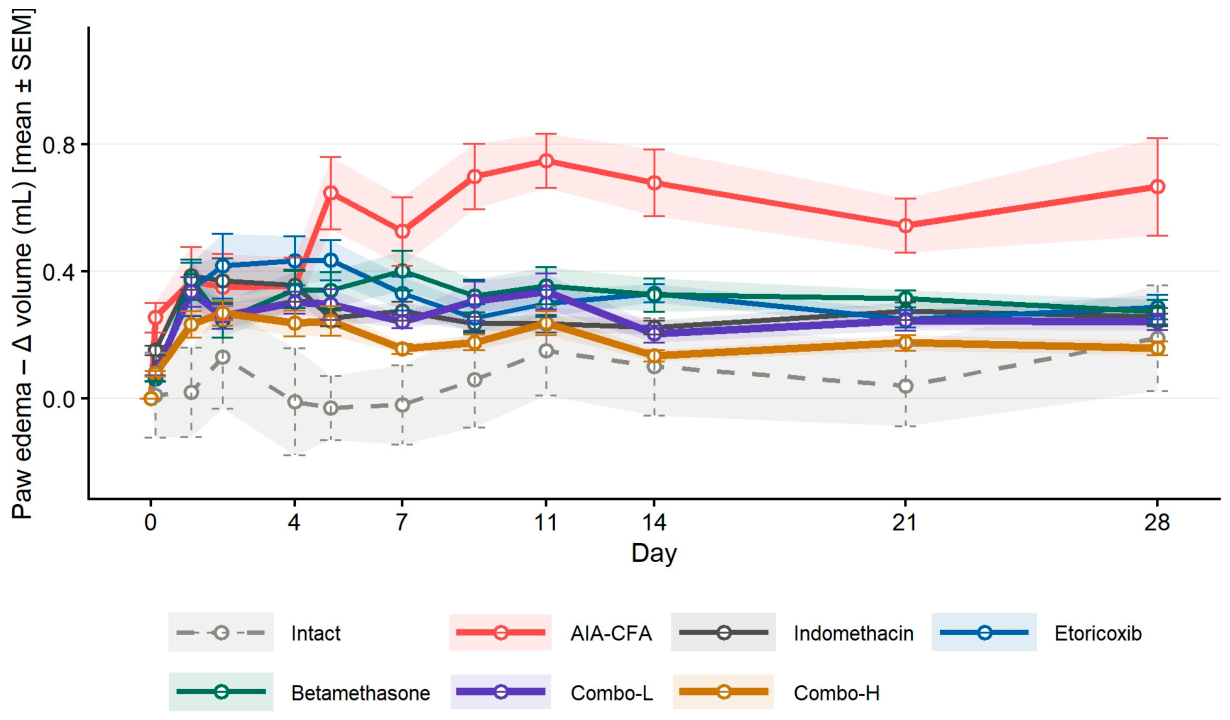
Figure 1. Paw edema time course in the CFA-injected hind paw assessed by water-displacement plethysmometry. Data are mean ± SEM; n = 10/group. Groups: Intact control, AIA-CFA disease control, Indomethacin (5 mg/kg), Etoricoxib (8 mg/kg), Betamethasone (0.022 mg/kg), Combo-L (Etoricoxib 4 mg/kg + Betamethasone 0.011 mg/kg), Combo-H (Etoricoxib 8 mg/kg + Betamethasone 0.022 mg/kg). Treatments were administered orally once daily from Day 4 to Day 28.
Preprints 215379 g001
Figure 2. Integrated paw edema burden quantified as area under the curve (AUC) of Δ paw volume versus Day 0. Bars represent mean ± SD; n = 10/group. Significance vs AIA-CFA disease control (one-way ANOVA, Tukey’s post hoc test): *** p < 0.001, ** p < 0.01. Tukey-adjusted pairwise comparisons between combination groups and monotherapies were non-significant for all edema AUC contrasts (all p > 0.30; see Supplementary Table S1). Groups as in Figure 1.
Preprints 215379 g002
Figure 3. Mechanical withdrawal threshold (von Frey) time course assessed in the ipsilateral hind paw. Data are mean ± SEM; n = 10/group. Higher values indicate reduced mechanical hypersensitivity. Groups as in Figure 1. Treatments administered orally once daily from Day 4 to Day 28.
Preprints 215379 g003
Figure 4. Integrated mechanical sensitivity quantified as AUC of withdrawal threshold (von Frey). Bars represent mean ± SD; n = 10/group. Significance vs AIA-CFA disease control (one-way ANOVA, Tukey’s post hoc test): *** p < 0.001, ** p < 0.01. Combo-H was significantly greater than both Etoricoxib (p = 0.0498) and Betamethasone (p = 0.0119); Combo-L did not differ from either monotherapy (all p > 0.79). Groups as in Figure 1.
Preprints 215379 g004
Figure 5. Clinical arthritis index time course. Arthritis severity was scored on an ordinal scale (0 = normal; 1 = mild edema/erythema; 2 = moderate swelling and redness; 3 = severe swelling and deformity). Data are mean ± SEM; n = 10/group. Groups as in Figure 1.
Preprints 215379 g005
Figure 6. Integrated arthritis severity quantified as AUC of the clinical arthritis index. Bars represent mean ± SD; n = 10/group. Significance vs AIA-CFA disease control (one-way ANOVA, Tukey’s post hoc test): *** p < 0.001, ** p < 0.01. Combo-H was significantly lower than both Etoricoxib (p = 0.0135) and Betamethasone (p = 0.0007); Combo-L did not differ from either monotherapy (all p > 0.54). Groups as in Figure 1.
Preprints 215379 g006
Figure 7. Terminal inflammatory mediator profile in inflamed paw tissue at study completion (Day 28). Cytokines and prostaglandin-pathway mediators were quantified in homogenates from CFA-injected hind paw/joint-associated tissues. Panels show: (A) TNF-α, (B) IL-1β, (C) IL-6, (D) IL-10 (pg/mg protein), (E) COX-2 and (F) PGE-2 (ng/mg protein). Bars represent mean ± SD (n = 10 rats/group). Versus AIA-CFA, all active treatments significantly reduced TNF-α, IL-1β, IL-6, COX-2 and PGE-2 (Tukey p < 0.0001 for each contrast); IL-10 increases were most pronounced for betamethasone-containing regimens: Combo-H (54.61 pg/mg protein; p < 0.0001 vs AIA-CFA) approached intact control levels and did not differ significantly from the intact group (p = 0.8156), and Combo-L (46.31 pg/mg protein; p < 0.0001) also showed marked restoration; etoricoxib produced a smaller but significant increase (p = 0.0101), but not for indomethacin (p = 0.5576). Relative to etoricoxib, betamethasone and Combo-H reduced IL-1β (p = 0.0068 and p = 0.0026), Combo-H reduced IL-6 (p = 0.0003), betamethasone/Combo-L/Combo-H reduced COX-2 (all p < 0.0001), and indomethacin/Combo-L/Combo-H reduced PGE-2 (p = 0.0001, p = 0.022, and p = 0.0001, respectively).
Preprints 215379 g007
Table 1. Integrated efficacy endpoints (AUC) for paw edema (Δ paw volume), mechanical withdrawal threshold (von Frey), and arthritis index across the 28-day study. Values are mean ± SD; n = 10 per group. p-values are vs AIA-CFA (one-way ANOVA with Tukey’s post hoc test).
Group Edema AUC (mL·day) p (vs AIA-CFA) Edema von Frey AUC (g·day) p (vs AIA-CFA) von Frey Arthritis AUC (score·day) p (vs AIA-CFA) Arthritis
Intact 2.23 (8.33) <0.0001 1431.73 (184.07) <0.0001 0.00 (0.00) <0.0001
AIA-CFA 16.37 (3.32) 462.86 (56.86) 43.74 (9.51)
Indomethacin 7.45 (2.26) 0.0001 1131.12 (273.04) <0.0001 19.93 (8.01) <0.0001
Etoricoxib 8.59 (3.55) 0.0007 937.48 (223.80) 0.0004 30.77 (5.55) 0.0094
Betamethasone 8.89 (1.82) 0.0013 884.15 (226.34) 0.0024 34.04 (8.08) 0.1097
Combo-L 7.16 (2.06) <0.0001 1028.86 (276.61) <0.0001 27.56 (8.12) 0.0005
Combo-H 5.09 (1.33) <0.0001 1252.01 (288.89) <0.0001 18.23 (11.29) <0.0001
Combo-L: etoricoxib 4 mg/kg + betamethasone 0.011 mg/kg; Combo-H: etoricoxib 8 mg/kg + betamethasone 0.022 mg/kg. Complete pairwise Tukey contrast matrices for all three endpoints are provided in SupplementaryTable S1.
Table 2. Inflammatory biomarkers and inflammatory cell infiltration in the AIA-CFA model. Values are mean ± SD (n = 10 rats/group for biomarkers and n = 6 rats/group for inflammatory cell infiltration). p-values represent Tukey-adjusted post hoc comparisons of each treatment group versus the AIA-CFA disease control.
Endpoint Intact (p vs AIA-CFA) AIA-CFA Indomethacin (p vs AIA-CFA) Etoricoxib (p vs AIA-CFA) Betamethasone (p vs AIA-CFA) Combo-L (p vs AIA-CFA) Combo-H (p vs AIA-CFA)
TNF-α (pg/mg protein) 15.09 ± 2.31
(<0.0001)
37.09 ± 4.68
(—)
23.69 ± 3.39
(<0.0001)
25.60 ± 3.17
(<0.0001)
18.40 ± 1.86
(<0.0001)
20.40 ± 2.81
(<0.0001)
16.50 ± 1.77
(<0.0001)
IL-1β (pg/mg protein) 3.80 ± 0.62
(<0.0001)
7.90 ± 1.13
(—)
6.00 ± 0.91
(<0.0001)
5.20 ± 0.56
(<0.0001)
4.00 ± 0.55
(<0.0001)
4.30 ± 0.55
(<0.0001)
3.90 ± 0.45
(<0.0001)
IL-6 (pg/mg protein) 4.19 ± 0.63
(<0.0001)
8.30 ± 0.88
(—)
6.30 ± 0.82
(<0.0001)
5.90 ± 0.67
(<0.0001)
6.40 ± 0.60
(<0.0001)
5.00 ± 0.48
(<0.0001)
4.50 ± 0.50
(<0.0001)
IL-10 (pg/mg protein) 58.20 ± 7.35
(<0.0001)
27.40 ± 2.93
(—)
32.10 ± 3.97
(N.S.)
36.88 ± 5.65
(0.0101)
50.19 ± 7.18
(<0.0001)
46.31 ± 4.67
(<0.0001)
54.61 ± 7.54
(<0.0001)
COX-2 (ng/mg protein) 2.80 ± 0.43
(<0.0001)
12.30 ± 1.55
(—)
7.20 ± 1.03
(<0.0001)
6.30 ± 0.78
(<0.0001)
2.90 ± 0.29
(<0.0001)
3.60 ± 0.50
(<0.0001)
2.70 ± 0.29
(<0.0001)
PGE-2 (ng/mg protein) 24.00 ± 3.94
(<0.0001)
62.70 ± 6.65
(—)
25.30 ± 2.99
(<0.0001)
34.50 ± 3.42
(<0.0001)
39.10 ± 3.95
(<0.0001)
28.20 ± 4.34
(<0.0001)
25.30 ± 3.01
(<0.0001)
CD3+ lymphocytes (%) 4.60 ± 0.61
(N.S.)
4.70 ± 0.97
(—)
5.90 ± 1.17
(N.S.)
4.70 ± 0.87
(N.S.)
3.36 ± 1.36
(N.S.)
4.48 ± 2.55
(N.S.)
4.52 ± 1.97
(N.S.)
CD68+/CD11b+ macrophages (%) 7.33 ± 2.51
(0.0375)
17.17 ± 6.77
(—)
9.61 ± 3.56
(N.S.)
16.14 ± 6.06
(N.S.)
7.47 ± 5.21
(0.0312)
11.10 ± 7.00
(N.S.)
8.76 ± 4.43
(N.S.)
Abbreviations: AIA, adjuvant-induced arthritis; CFA, complete Freund’s adjuvant; COX-2, cyclooxygenase-2; PGE-2, prostaglandin E2; N.S., not significant. Combo-L: etoricoxib 4 mg/kg + betamethasone 0.011 mg/kg; Combo-H: etoricoxib 8 mg/kg + betamethasone 0.022 mg/kg. Complete pairwise Tukey contrast matrices for all biomarkers are provided in SupplementaryTables S2A–S2F.
Disclaimer/Publisher’s Note: The statements, opinions and data contained in all publications are solely those of the individual author(s) and contributor(s) and not of MDPI and/or the editor(s). MDPI and/or the editor(s) disclaim responsibility for any injury to people or property resulting from any ideas, methods, instructions or products referred to in the content.
Copyright: This open access article is published under a Creative Commons CC BY 4.0 license, which permit the free download, distribution, and reuse, provided that the author and preprint are cited in any reuse.
Prerpints.org logo

Preprints.org is a free preprint server supported by MDPI in Basel, Switzerland.

Subscribe

Disclaimer

Terms of Use

Privacy Policy

Privacy Settings

© 2026 MDPI (Basel, Switzerland) unless otherwise stated