
Submitted:
25 May 2026
Posted:
26 May 2026
You are already at the latest version
Abstract
Nigeria operated multiple exchange rate regimes which have created significant distortions in the economy resulting to low standard of living, inflation, and loss of investors' confidence. To address these challenges, the Nigerian government officially implemented exchange rate unification to close the gap between official and parallel market rates to reduce poverty level in the economy. The purpose of this study is to examine the effect of exchange rate unification on poverty in Nigeria which is yet to be investigated in the literature. The Autoregressive Distributed Lag model (ARDL) was used as a method of analysis whilst poverty is measured using multidimensional poverty. Data on Multidimensional Poverty, Exchange Rate Unification (ERU) (ratio between official and parallel rate), inflation, economic growth, unemployment, and government social expenditure were extracted from World Bank’s data base and Central Bank of Nigeria statistical bulletin. The study found that exchange rate unification is very significant in explaining long run poverty dynamics than conventional macro economic variables in Nigeria. The study further reveals that exchange rate unification exerts significant reduction in multidimensional poverty, contradicting the perception that unification harms the poor through short-run inflationary pressures, thereby establishing exchange rate unification as an effective policy instrument for inclusive development.
Keywords:
exchange rate unification
; poverty
; ARDL model
; Nigeria
1. Introduction
Nigeria’s economy has long been characterized by heavy dependence on oil exports for foreign exchange earnings, coupled with a high reliance on imports for essential goods such as food, raw materials, and manufactured products. This structural vulnerability has made the management of the exchange rate a critical policy instrument for macroeconomic stability. Historically, Nigeria operated multiple exchange rate regimes, including fixed, managed float, and segmented windows (official, Investors’ and Exporters’ (I&E), and parallel market rates), which created significant distortions, arbitrage opportunities, rent-seeking behavior, and loss of investor confidence (Femi-Olagundoye, & Adedokun, 2025). By early 2023, the gap between the official and parallel market rates had widened dramatically to over 60% in some periods exacerbating price distortions and undermining the effectiveness of monetary policy (Ozili, 2024).
In response to these challenges, the Central Bank of Nigeria (CBN), under the administration of President Bola Ahmed Tinubu, officially implemented a landmark exchange rate unification policy on June 14, 2023. The reform collapsed all segmented foreign exchange windows into a single Investors’ and Exporters’ (I&E) window (later renamed the Nigerian Foreign Exchange Market or NFEM), adopting a “willing buyer, willing seller” market-determined regime. This effectively ended the managed float system that had prevailed since 2014 and unified the official and parallel market rates into one transparent, market-driven rate. The primary objectives were to eliminate arbitrage and round-tripping, enhance price discovery, improve transparency, attract foreign investment, boost non-oil exports, and restore confidence in the foreign exchange market (Central Bank of Nigeria, 2023; Ozili, 2024).
The immediate aftermath of unification was a sharp depreciation of the naira. The official rate moved from approximately ₦460–₦500 per US dollar pre-unification to over ₦700 immediately after the announcement and further to levels exceeding ₦1,500–₦1,600 per dollar in subsequent months. This depreciation triggered significant pass-through effects to domestic prices, particularly for imported essentials, leading to accelerated inflation especially food inflation which reached record highs. Households faced rising costs of living, reduced purchasing power, and heightened economic hardship, with low-income and rural populations bearing a disproportionate burden due to their high dependence on imported food items and limited access to foreign exchange hedging mechanisms (Ayodeji, 2024; Zakari et al., 2025).
The link between exchange rate movements and poverty in Nigeria is well-established in the literature. Exchange rate depreciation and volatility transmit through higher import costs, inflationary pressures, reduced real wages, and disruptions in employment, particularly in import-dependent sectors. These effects erode household welfare by increasing the cost of basic consumption baskets, limiting access to essential services, and exacerbating multidimensional deprivations. Earlier studies have shown that exchange rate instability contributes significantly to poverty through channels such as unemployment, lower household consumption, and widened inequality (Nzekwu, 2006; Edeme & Okafor, 2017). More recent analyses confirm that unification, while aimed at long-term efficiency, has short- to medium-term adverse consequences, including rising poverty levels, as evidenced by computable general equilibrium (CGE) modeling in similar contexts such as “The Effect of Unification of Exchange Rate on Poverty in Iran Using the Computable General Equilibrium Model” and Nigeria-specific observations of post-reform inflation and cost-of-living crises (Parvin & Banouei, 2020).
Official poverty statistics underscore the urgency of examining this relationship. According to the National Bureau of Statistics’ Multidimensional Poverty Index, 63% of Nigerians (approximately 133 million people) were multidimensionally poor as of 2022. World Bank projections indicate that the national poverty headcount (using the $3.00/day line, 2021 PPP) rose sharply post-2018, reaching an estimated 52.5% in 2025, with rural poverty exceeding 75% in some assessments. These increases have been compounded by the 2023 macroeconomic reforms including fuel subsidy removal and exchange rate unification which, while necessary for fiscal and external balance, have eroded purchasing power and deepened poverty, particularly among vulnerable groups (World Bank, 2025).
Some studies examined effect of exchange rate on poverty (see Omojimite and Oriavwote 2012; Adelowokan et al., 2019; Ashraq and Azhar, 2024; Chukwuka and Uduh, 2024; Gnangnon, 2021; Paul, 2025) but these studies failed to address the effect of exchange rate unification on poverty in Nigeria. Therefore, this study will expands the body of knowledge on the relationship between exchange rate unification and poverty level in Nigeria. The study comprises five sections. The literature review is contained in section two, the method is in section three, and sections four and five contain the result and discussion, conclusion, and recommendation of the study.
2. Literature Review
Omoniyi (2018) records that exchange rate volatility and inflation also worsen the situation of poverty in Nigeria together as they decrease real incomes, especially among the vulnerable households. Similarly, Ebunoluwa and Yusuf (2018), believe that inflation detected through exchange rate can lead to decreased access to necessities and services, thus further increasing the welfare deprivation. Their results imply that the instability in exchange rates produces negative distributional effects, particularly in those economies that have a poor social protection mechanism. Chukwuka and Uduh (2024) use a qualitative and exploratory research design to investigate the relationship between monetary policy, exchange rate stability, and poverty reduction in Nigeria. Their review opens a strong relationship between the volatility of the exchange rate and poor performance as it accentuates ineffective monetary coordination, which amplifies a reduction in welfare. Likewise, through ARDL modelling, error correction and Granger causality, Ashraq and Azhar (2024) in their study on Iraq data conclude that the imports inflation variable plays a role in the short-run dynamics of poverty but no long-term causality association is determined. Their findings however support a long run correlation between fluctuations of exchange rates and more general development indices, which validates the theoretical assumption that external price shocks do in the long run have a welfare outcome. In addition to inflation being a way of spreading poverty, the mode of exchange rate changes also shows some great overall macroeconomic interdependence.
Paul (2025) examined the nexus between inflation, interest rates, and exchange rate fluctuations in Nigeria, concluding that monetary shocks are the primary drivers of exchange rate changes in the market. The study further established that coordinated policy frameworks, particularly exchange rate unification, serve as an effective mechanism for reducing volatility spillovers and promoting macroeconomic stability in Nigeria. The presence of a long-run relationship between the dynamics of the real-exchange rate and poverty in Nigeria, has earlier been established by Omojimite and Oriavwote (2012), employing annual data, 1980-2010 drafted in a Framework of Vector Error Correction Model (VECM). According to their result, persistent exchange rate volatility worsens poverty through the heightening of domestic price volatility, decreasing real wages, and augmenting the uncertainty of production. The authors suggest exchange rate management policies with an addition of the human capital investment as the invaluable elements of the poverty reduction process. In cross-country study, Apergis and Cooray (2018) examine 99 developing and emerging economies in the timeframe between 1980 and 2015 and report the presence of the asymmetric welfare impact of the exchange rate movements. Their findings indicate that the impact of real exchange rate depreciation can alleviate poverty in those economies relying on remittances, by raising domestic values of remittance inflows. Nevertheless, this effect is determined by structural factors such as the level of household involvement in sectors of trade and remittance channels. This study consequently highlights the relevance of structural features and nonlinear dynamics in evaluating the poverty bearing of exchange rate policy.
In addition to the effects of prices, exchange rate instability interacts with structural variables like employment and output growth. Adelowokan et al. (2019) reveal that there is a negative relationship between unemployment, poverty, and economic growth, as well as exchange rate volatility limiting industrial productivity and competitiveness. Long-term effects of continuous currency volatility will raise the level of uncertainty among investors and entrepreneurs discouraging long-term investment, and only a few jobs can be created. This means that inflationary exchange rate changes in Nigeria cannot be perceived by being restricted to mere macroeconomic shocks; however, they are structural shocks directly relating to low poverty rates and inclusive development. The study by Abasi et al. (2018) how economic growth affects the reduction of poverty in Nigeria between the periods, 1980-2017. It adopted Ordinary Least Square analysis (OLS) and revealed that there is a positive association between Gross Domestic Product and life expectancy, per capita income, and population. Contrarily, the relationship between GDP and mortality rate, corruption rate, and poverty rate is negative. Chude et al. (2019) investigated the correlation between government spending, economic growth, and poverty reduction in Nigeria using the technique of Error Correction Model (ECM), the study was conducted over the period, 1980 -2013 and it was discovered that there exists a positive relationship between government spending and economic growth.
Dada and fanowopo (2020) examined the institutions in the nexus of economic growth and poverty reduction in Nigeria, over the period, 1984 -2018. The Cointegration method of Auto Regression Distributed Lag used for the study showed that the enhancement of the environment free of corruption, aggregate institutional quality, and political stability declines the poverty in the short-term. At the long-run, institutions are directly related to the household consumption as well as alleviating poverty. The outcome also showed that capital accumulation is critical in minimizing poverty whereas primary school enrolment cannot minimise poverty at the long-run. Orajaka and Okoli (2018) empirically examined how the human capital development has influenced poverty reduction in Nigeria during the years, 1991 -2017. The study adopted the Ordinary Least Square analysis, which simultaneously discovered that development of human capital, government spending, and acquisition of skills, small scale enterprise, health, and education are statistically significant in alleviating poverty in Nigeria.
3. Methods
The study has the basis on the theoretical approach which is the Pro-Poor Growth Theory (Dollar and Kraay, 2002; Ravallion and Chen, 2003). The Pro-Poor Growth Theory with the distribution of the gains of growth, especially to the poor. The Pro-poor growth theory evolved the classic trickle-down hypothesis, according to which all sectors of the society gain as an extension of economic growth, into a more complex interpretation that growth will alleviate poverty only when coupled with inclusionary policies like creation of employment, price stability, and social expenditure.
The basic model of Pro-Poor Growth may be formulated as:
Nevertheless, literatures have also established other factors that define poverty to be:
= Poverty (proxied by Multidimensional Poverty Index), = Real GDP (Income), = Vector of control variables (e.g., inflation, unemployment, government social expenditure), < 0 implies that higher growth reduces poverty (pro-poor growth), = Error term
In cases where exchange rate unification improves growth () and inflation stabilization, the attained macroeconomic stability will generate greater purchasing power of households hence decrease poverty. This channel is the mechanism of transmission between growth and welfare.
Exchange rate unification can be defined to have the following effect on poverty:
Equation 3 is a functional form which implies that poverty () is indirectly determined by exchange rate unification () through its effect on growth () and directly through its influence on inflation, employment, and government expenditure ().
Based on the work by Gnangnon (2021) that models poverty based on exchange rate pressure and fiscal redistribution in developing countries, and Ebong and Ogwumike (2013), which analyzes macroeconomic determinants (growth, inflation, unemployment, government expenditure) of poverty reduction in Nigeria using ARDL. Our extensions include exchange rate unification and as the dependent variable the Multidimensional Poverty Index (MPI) to include the non-income deprivations, without giving up dynamic estimation techniques.
This model specification can be written as below:
Where: is representing poverty, is representing exchange rate unification, is representing economic growth, is representing Inflation, is representing unemployment, is representing government social expenditure.
The a-priori assumption is that unification of exchange rates would have a negative impact on poverty since this enhances better macroeconomic stability, precludes inflationary trends, and accessibility to foreign exchange, thus increasing household welfare. Another hypothesis that economic growth is expected to mitigate negative relationship with poverty is pro-poor growth hypothesis, which states that economic growth generates employment and the growth of incomes. Inflation would make people poorer through the diminishing of purchasing power and the escalation of cost of living and unemployment is also supposedly positively correlated with poverty since unemployment directly exacerbates the welfare conditions. Lastly, the social expenditure of the government is expected to influence poverty negatively, as increased spending on education, health, and social policies promote redistribution and enhance the living standards.
This study adopts the preliminary tests of Augmented Dickey-Fuller (ADF), as well as Phillips-Perron (PP) to determine the stationarity of the secondary data. These tests’ statistics are adopted because they allow for control of higher-order autocorrelation (Harris & Sollis, 2003). Thereafter, the ARDL model was deployed to analyse the data. The ARDL was used because it is a consistent estimate that allows for long-run normal coefficient regardless of whether the variables are stationary at order zero, i.e., I(0) or order one, i.e., I(1), or if the variables are a mixture of both (Harris & Sollis, 2003; Pesaran et al., 2001). In other words, the ARDL model places less emphasis on the degree of integration of the variables but yields an unbiased estimate of the long-run model even when the size of the sample is small (Harris & Sollis, 2003).
The ARDL model may be expressed as:
Where: The short-run dynamics are captured by the coefficients. The long-run effects are represented by the coefficients. is the white-noise error term.
The bounds-testing procedure is used to determine whether cointegration exists among the variables. The null hypothesis of no cointegration (= = … = = 0) is rejected if the F-statistic exceeds the upper critical bound, confirming the existence of a long-run relationship between exchange rate unification and poverty in Nigeria.
To capture short-run adjustments, an Error Correction Model (ECM) is estimated:
Where: is the lagged error correction term derived from the long-run equation. (the adjustment coefficient) is expected to be negative and significant, indicating convergence back to equilibrium after short-run shocks. The data is managed and estimated using EViews.
4. Results
4.1. Unit Root
The preliminary tests of Augmented Dickey-Fuller (ADF) plus Phillips-Perron (PP) were examined and presented in Table 1 with the major aim of determining the unit root properties inherent in the variables. Since the ARDL bound test exists and is premised on the hypothesis that the variables are either of I(0) series or I(1) series (Ouattara, 2004). Therefore, to establish the stationarity properties, Oteng-Abayie and Frimpong (2006) warned that no variable should be integrated of order two. The outcomes of the unit root test are presented in Table 1, which shows that all the variables are a mixture of series that are I(0) and I(1) which is the rationale for the use of the ARDL model.
4.2. Cointegration Test
Table 2 shows the bound testing/cointegration estimation of the ARDL. The result confirms the rejection of the null hypothesis which indicates the existence of a long-run relationship amongst the variables where it shows the magnitude of the F-statistic of the effect of exchange rate unification on poverty in Nigeria. F-statistic of the ARDL bound testing and cointegration indicates the computed F-statistic (3.82) which is higher than the upper critical bound of 5 percent critical values as presented in Table 2. This provides sufficient proof to reject the null hypothesis of the absence of cointegration at a 1 percent significance level for the model. The study, therefore, concludes from the ARDL bound testing that there is a long-run relationship amongst the variables at 5 percent critical values.
4.3. Lag Length Selection Criteria
Furthermore, this study determines the maximum number of lags that should be used through the following criteria: (i) the Akaike Information Criterion (AIC); (ii) the Schwartz Information Criterion (SIC); and (iii) the Hannan-Quinn Information Criterion (HQC). Both the Akaike Information Criterion (AIC) and Hannan-Quinn Information Criterion (HQC) suggested a maximum lag length of four lags while the Schwartz Information Criterion (SC) recommended one as the maximum lag length. Hence, the long-run estimate of the effect of exchange rate unification on poverty is based on a maximum lag of four.

Table 3.
Lag length selection criteria.
| Endogenous variables: ERU GDPGR INF UNEMP GSEXP | ||||||
|---|---|---|---|---|---|---|
| Sample: 1986-2024 | ||||||
| Lag | LogL | LR | FPE | AIC | SC | HQ |
| 0 | -527.3252 | NA | 11175984 | 30.41859 | 30.64078 | 30.49529 |
| 1 | -402.0697 | 207.5664 | 36953.10 | 24.68969 | 26.02285* | 25.14990 |
| 2 | -363.7463 | 52.55778* | 18940.43 | 23.92836 | 26.37248 | 24.77207 |
| 3 | -334.9766 | 31.23563 | 19713.69 | 23.71295 | 27.26803 | 24.94016 |
| 4 | -297.7744 | 29.76178 | 17287.96* | 23.01568* | 27.68172 | 24.62640* |
| * indicates the lag order selected by criterion | ||||||
Source: Author’s Computation.
4.4. ARDL Long Run Estimate
After the long-run cointegrating association has been confirmed amongst the variables used in this study, then the estimate of the ARDL long-run and short-run regression was conducted. The long-run estimates furnish unambiguous and strong evidence on how the concept of exchange rate unification can affect poverty in Nigeria between 1986 and 2024. In its turn, the coefficient on Exchange Rate Unification (ERU) is negative (-2.05) and statistically significant. (t = -2.91, p = 0.00). This indicates that the level of poverty among the people is greatly minimized when there is increased exchange rate unification in the long run. To be more specific, one unit increase in the exchange rate unification is caused by 2.05units decrease in the poverty level, ceteris paribus. This observation outlines the negative impact of long term exchange rate distortions and multi money practises on the poor. The presence of fragmented exchange rate regimes also creates imported inflation, destroys real household incomes, alters resource allocation, discourages foreign investment and eventually increases multidimensional poverty. On the other hand, the effective and sustained policy of unification leads to a more predictable macroeconomic environment that, therefore, disproportionately acts in favour of vulnerable groups by stabilizing prices and increasing the availability of necessities and services (Gray, 2021). Most studies (Theophilus, 2025; Umaru et al., 2025; World Bank, 2025) show that vulnerable groups are hurt rather than helped by unification in the near term. The supporting studies acknowledge long-run benefits but consistently caveat them on the condition of complementary macroeconomic policies being in place. (Ozili, 2024; de la Torre and Ize, 2014; Ayodeji, 2025).
The economic growth, which is to be represented by the GDP growth rate (GDPGR) is positive (0.15) and statistically significant (t = 1.83, p = 0.08) which shows that economic growth worsens poverty in the long run. This result is contrary to the a-priori expectation of negative dependence between growth and poverty, yet it is in line with the structural attributes of the Nigerian economy. Growth gains in exchange rate unification seem to have been focused on capital intensive and foreign exchange sensitive sectors, with little trickle down to productive employment, household welfare and human development. Although exchange rate unification enhanced the efficiency in allocation, it might have contributed to the increase in cost pressures due to the increase in import prices and inflation, thus reducing the real incomes and living standards, especially those of the vulnerable households. This means that the growth in aggregate output has not been accompanied by its corresponding growth in welfare indicating non-inclusive and distributionally unequal growth. This finding highlights that, in the context of the structural and institutional environment in Nigeria, economic growth particularly in cases where exchange rate adjustments are taking place is not guaranteed to reduce poverty unless it is complemented by other policies suggesting that they can improve productive capacity, safeguard the welfare of households and promote broad-based involvement in the economy to grow. Akinbobola (2012) indirectly supports the finding through his evidence that exchange rate stabilization suppresses inflationary pressure in the long run, which is the primary transmission channel through which unification can protect household welfare and improve access to necessities. de la Torre and Ize (2014) also support the finding by demonstrating that rapid and well-managed exchange rate unification, when complemented by targeted fiscal cushions, maximizes efficiency gains and creates a fairer economic environment by eliminating the rent-seeking behaviors that disproportionately tax the poor under fragmented exchange rate systems. In contrast, Obansa et al. (2016) demonstrated that currency devaluation increases poverty, which is short-run costs, but the opposite of the long-run reduction in this case as unification is maintained.
The coefficient of inflation (INF) is positive (0.03) which is expected to mean that the greater the inflation the bigger the poverty will be since purchasing power will decrease. The impact, however, is statistically insignificant (p = 0.28), so that when exchange rate distortions are explicitly taken into consideration, general price increases do not have a separate long-run impact on poverty over the period estimated in this study.. This finding is credible because, in most instances, the inflationary periods experienced in Nigeria during the sample were as a result of exchange rate pass-through and not autonomous monetary reasons.
The coefficient of unemployment (UNEMP), appears negative and statistically insignificant (-0.70, p = 0.25). The counterintuitive sign is however statistically insignificant, which may be attributable to the well-documented measurement challenges associated with official unemployment statistics in Nigeria, particularly given the prevalence of a large informal sector where disguised unemployment and labour market slack are pervasive, or alternatively, to multicollinearity between unemployment and other macroeconomic distress indicators included in the model. These findings are corroborated by related research; for example, Osinubi and Apanisile (2019) conducted a similar study and found that unemployment increases poverty regardless of growth in terms of the effects of unification, which is consistent with your poverty-enhancing GDPGR effect and the role of UNEMP.
Government Social Expenditure (GSEXP) is capturing the expected sign of poverty reduction (-0.00) but is insignificant statistically (p = 0.13). The low scale and insignificance of social expenditure probably indicates the bottlenecks of implementation, leakages, imperfect targeting, and the comparatively low size of social expenditure as a proportion of aggregate fiscal expenditures during the majority of the research period, consistent with evidence that government spending in Nigeria has historically had little impact on poverty reduction due to poor resource management, budget indiscipline, and weak policy-budget linkages that create loopholes in implementation (Aruwa, 2024; Eze & Ogiji, 2016; World Bank, 2022). However, the negative sign provides some weak evidence that better and higher levels of social protection can help to reduce long-run poverty with the macroeconomic stability that is even broader.
The constant term is positive and meaningful, which reflects the autonomous part of poverty when all other clarifying variables take the zero value. The long-run findings, in general, put a heavy emphasis on the exchange rate unification as the policy tool that is most effective in implementing sustainable poverty reduction in Nigeria, well ahead of the efforts exerted by the other controls in statistical and economic terms.
Table 4.
ARDL Long run estimate.
| Variables | Coefficients | Standard Error | t-statistic | Probability |
|---|---|---|---|---|
| C | 3.0053 | 1.9087 | 1.5745 | 0.13 |
| ERU | -2.0482 | 0.7043 | -2.9106 | 0.00*** |
| GDPGR | 0.1544 | 0.0842 | 1.8339 | 0.08* |
| INF | 0.0248 | 0.0222 | 1.1165 | 0.28 |
| UNEMP | -0.6952 | 0.5808 | -1.1969 | 0.25 |
| GSEXP | 0.0007 | 0.0005 | 1.5745 | 0.13 |
Notes: (*) Significant at the 10% (**) Significant at the 5%; (***) Significant at the 1% Source: Author’s Computation.
4.6. ARDL Short Run Estimate
The Error Correction Model (ECM) of the ARDL model displays short-run dynamics and the rate of the model adaptation to the long-run equilibrium.
The coefficient of error correction CointEq (-1) = -0.34, which is very significant (t = -5.87, p = 0.00). This confirms that the long-run relationship is correct, and means that the rate of adjustment is fairly rapid: about 40 percent of any imbalance in poverty will be adjusted in one year. Although not as fast as in certain macroeconomic associations, this rate is large and economically significant, and suggests that the shocks (caused by sudden exchange rate fragmentation or unification events) are eradicated at a relatively rapid rate in which the economy returns to its long-run path of poverty equilibrium.
Exchange rate unification D(ERU) in the short run has a very high and negative impact on poverty. This shows that there is an immediate increase in unity which leads to strong and immediate decrement in poverty. It has bigger magnitude than the long-run effect indicating that the positive effect of uniting is front-loaded and vulnerable households benefit at a swift pace with real purchasing power increasing and the availability of goods that became distorted decreasing when the distortions are minimized.
The effect of inflation D (INF) is negative and large meaning that an increase in inflation in the present period would place downward pressure on the level of poverty in the extremely short run perhaps by the effect of inflation on nominal income or measurement error but not by any longer-term erosive effects.
The unemployment terms are rich with contemporary change D(UNEMP) and the first lag of unemployment terms are insignificant. The second and third lags being positive and significant suggests that only after a delay of 2–3 years do increases in unemployment begin to aggravate poverty, which is characteristic of hysteresis, loss of skills, and cumulative deprivation effects are consistent with evidence by Akinbobola and Saibu (2004) and Dauda (2020) demonstrating that unemployment exerts delayed and cumulative poverty-deepening effects through the erosion of human capital and productive capacity over time.
The model also has good overall fit with R-squared of 0.81 and adjusted R-squared of 0.77 indicating that around 75-78 percent of the short-run variance in poverty can be explained by the variables and lags used. The value of 2.36 on the Durbin-Watson statistic shows no residual autocorrelation and standard error of regression is low and the information criteria are favourable shows that the model is well-specified and parsimonious.
The combination of the ECM results supports the main conclusion that the exchange rate unification is not only poverty-reducing in the long-run, but provides massive and direct welfare benefits in the short-run, and a realistic and reasonably rapid adjustment mechanism that facilitates recovery of the equilibrium in the aftershocks.
Table 5.
ARDL short-run estimates.
| Variables | Coefficients | Standard Error | t- Statistic | Probability |
|---|---|---|---|---|
| D(ERU) | -1.4843 | 0.2468 | -6.0133 | 0.00*** |
| D(INF) | -0.0001 | 0.0030 | -0.0449 | 0.97 |
| D(INF(-1)) | -0.0065 | 0.0027 | -2.3953 | 0.03* |
| D(UNEMP) | 0.0160 | 0.1217 | 0.1318 | 0.90 |
| D(UNEMP(-1)) | 0.4553 | 0.1416 | 3.2148 | 0.00*** |
| D(UNEMP(-2)) | 0.6579 | 0.1492 | 4.4084 | 0.00*** |
| D(UNEMP(-3)) | 0.1245 | 0.0367 | 3.3970 | 0.00*** |
| ECt-1 | -0.3428 | 0.0584 | -5.8660 | 0.00*** |
Notes: (*) Significant at the 10% (**) Significant at the 5%; (***) Significant at the 1% Source: Author’s Computation.
4.7. Diagnostics Tests
The stability test of the macroeconomic variables used in this study was carried out using the plots of the cumulative sum (CUSUM) and cumulative sum of squares (CUSUMsq) which is a residuals test based on the Schwarz Bayesian Criterion. The plots on Figure 1 and Figure 2 reveal that the CUSUM and the CUSUMsq remains relatively stable and inside the bounds of the 5% level of significance throughout the study. The Breusch-Godfrey LM test returns an F-statistic of 0.64 (p = 0.54), confirming the absence of debilitating serial correlation, while the Breusch-Pagan-Godfrey heteroskedasticity test yields an F-statistic of 1.38 (p = 0.25), indicating that the model is free from variance instability. These diagnostic results collectively confirm that the estimated ARDL model is statistically well specified with residuals approximating white noise. The findings therefore validate that the observed poverty-alleviating effects of exchange rate unification reflect genuine economic relationships rather than misspecification or statistical artefacts. Given this, we conclude that all variables used in this study are very stable.
Table 6.
Results of the Diagnostics Tests.
| Test | F-statistic | Prob. Value | Remarks |
|---|---|---|---|
| Serial correlation Test | 0.64 | 0.54 | No serial correlation |
| Heteroskedasticity Test | 1.38 | 0.25 | No Heteroskedasticity |
Source: Author’s Computation, 2026.
5. Conclusion
The study concludes that one of the most pro-poor macroeconomic reforms of Nigeria in the recent time is the unification of the exchange rates especially the radical change of policy adopted in June 2023. This empirical data of 1986-2024 conclusively shows that the prolonged exchange-rate unification leads to high-speed multidimensional poverty cuts. However, the study observes that the government should improve supportive fiscal and social policies. To derive a significant impact of GSEXP in reducing poverty, the government ought to increase and enhance focusing on social programs (e.g., cash transfers, conditional subsidies on necessities). Combine these with unification to absorb short-run inflationary shocks, which may result in inclusive growth and offset the negative impact of GDPGR on poverty. Drawing from the positive experiences of Egypt and Ghana in managing exchange rate reform consequences, Nigeria should institutionalize a dedicated monitoring framework anchored by the National Bureau of Statistics, the Central Bank of Nigeria, and multilateral partners such as the IMF and World Bank. This framework should systematically track and evaluate the real-time poverty impacts of exchange rate unification to ensure that policy adjustments remain evidence-driven and responsive to emerging welfare outcomes.
Authors Contribution
Conceptualisation, Methodology, First Draft Writing, T. G. Oluwaniyi; Review, and Editing O. F. Ajayi; Supervision, T. O. Akinbobola. All authors have read and agreed to the publish this version of the manuscript.
Funding
This research received no external funding.
Conflicts of Interest
The authors declare no conflicts of Interest.
References
- Adelowokan, O. A.; Maku, O. E.; Adesoye, A. B. Unemployment, poverty and economic growth in Nigeria. J. Econ. Sustain. Dev. 2019, 10(4), 23–36. [Google Scholar] [CrossRef]
- Akinbobola, T. O. The dynamics of money supply, exchange rate and inflation in Nigeria. J. Appl. Financ. Bank. 2012, 2(4), 117–132. [Google Scholar]
- Apergis, N.; Cooray, A. Real exchange rate movements and poverty reduction. World Dev. 105 2018, 90–103. [Google Scholar]
- Ashraq, H.; Azhar, M. Exchange rate changes and poverty index in Iraq. Int. J. Econ. Financ. Issues 2024, 14(2), 144–158. [Google Scholar]
- Ayodeji, I. O. Evaluating the effect of exchange rate unification on exchange rate volatility in emerging markets: A case study of Nigeria. Sri Lankan J. Appl. Stat. 2025, 26(1), 25–45. [Google Scholar] [CrossRef]
- Ayodeji, I. O. Exchange rate unification and exchange rate volatility in emerging markets. J. Int. Financ. Econ. 2025, 25(1), 61–79. [Google Scholar]
- Central Bank of Nigeria. Circular on operational changes to the foreign exchange market; 2023. [Google Scholar]
- Dollar, D.; Kraay, A. Growth is good for the poor. J. Econ. Growth 2002, 7(3), 195–225. [Google Scholar] [CrossRef]
- Ebong, F. S.; Ogwumike, F. O. Economic growth and poverty reduction in Nigeria. J. Econ. Sustain. Dev. 2013, 4(13), 31–38. [Google Scholar]
- Edeme, R. K.; Okafor, R. G. Exchange rate instability and poverty in Nigeria: A time series analysis. J. Econ. Sustain. Dev. 2017, 8(12), 1–10. [Google Scholar]
- Femi-Olagundoye, M.; Adedokun, S. A. Exchange rate management in Nigeria: Historical trends and policy insights. Int. J. Res. Innov. Soc. Sci. 2025, 9(2), 88–102. [Google Scholar] [CrossRef]
- Gnangnon, S. K. Exchange rate pressure, fiscal redistribution and poverty in developing countries. Econ. Change Restruct. 2021, 54(4), 1035–1068. [Google Scholar] [CrossRef]
- Gray, M. S. T. Recognizing Reality—Unification of Official and Parallel Market Exchange Rates; International Monetary Fund, 2021. [Google Scholar]
- National Bureau of Statistics. Nigeria multidimensional poverty index. 2022. [Google Scholar]
- Nzekwu, G. Exchange rate stability and poverty reduction in Nigeria. CBN Bullion 2006, 30(4), 45–60. [Google Scholar]
- Obansa, S. A. J.; Okoro, C. O.; Eke, O. Currency devaluation and poverty in Nigeria: An empirical investigation. J. Econ. Sustain. Dev. 2016, 7(3), 1–12. [Google Scholar]
- Omojimite, B. U.; Oriavwote, V. E. Exchange rate dynamics and poverty in Nigeria. Int. J. Econ. Manag. Sci. 2012, 1(8), 32–45. [Google Scholar]
- Osinubi, T. T. Income inequality, globalization and poverty in Nigeria: An institutional perspective. Ilorin J. Econ. Policy 2020, 7(2), 45–67. [Google Scholar]
- Osinubi, T. T.; Apanisile, O. T. Unemployment, poverty and economic growth in Nigeria. J. Econ. Manag. Sci. 2019, 4(2), 112–130. [Google Scholar]
- Oteng-Abayie, E. F.; Frimpong, J. M. Bound Testing Approach to Cointegration: An Examination of Foreign Direct Investment Trade and Growth Relationships. Am. J. Appl. Sci. 2006, 3(11), 2079–2085. [Google Scholar] [CrossRef]
- Ouattara, B. Foreign Aid and Fiscal Policy in Senegal; Mimeo University of Manchester: Manchester, UK, 2004. [Google Scholar]
- Ozili, P. K. Exchange rate unification in Nigeria: Benefits and implications. J. Financ. Regul. Compliance 2024, 32(2), 180–198. [Google Scholar]
- Paul, G. O. The effects of macroeconomic variables on foreign exchange rate behavior in Nigeria. Int. J. Res. Innov. Soc. Sci. 2025, 1135–1148. [Google Scholar] [CrossRef]
- Pesaran, M. H.; Shin, Y.; Smith, R. J. Bounds testing approaches. J. Appl. Econom. 2001, 16(3), 289–326. [Google Scholar] [CrossRef]
- Ravallion, M.; Chen, S. Measuring pro-poor growth. Econ. Lett. 2003, 78(1), 93–99. [Google Scholar] [CrossRef]
- World Bank. Nigeria development update: Staying the course; World Bank Group, 2024. [Google Scholar]
- World Bank. Nigeria development update (or Macro Poverty Outlook); World Bank Group: Washington, DC, 2025. [Google Scholar]
- Zakari, T. O.; Bakkihs, D. T.; Asue, E. A. Exchange rate unification policy in Nigeria: The implications for the economy. Int. J. Res. Innov. Soc. Sci. 2025. [Google Scholar] [CrossRef]
Figure 1.
CUSUM at 5% significance level.
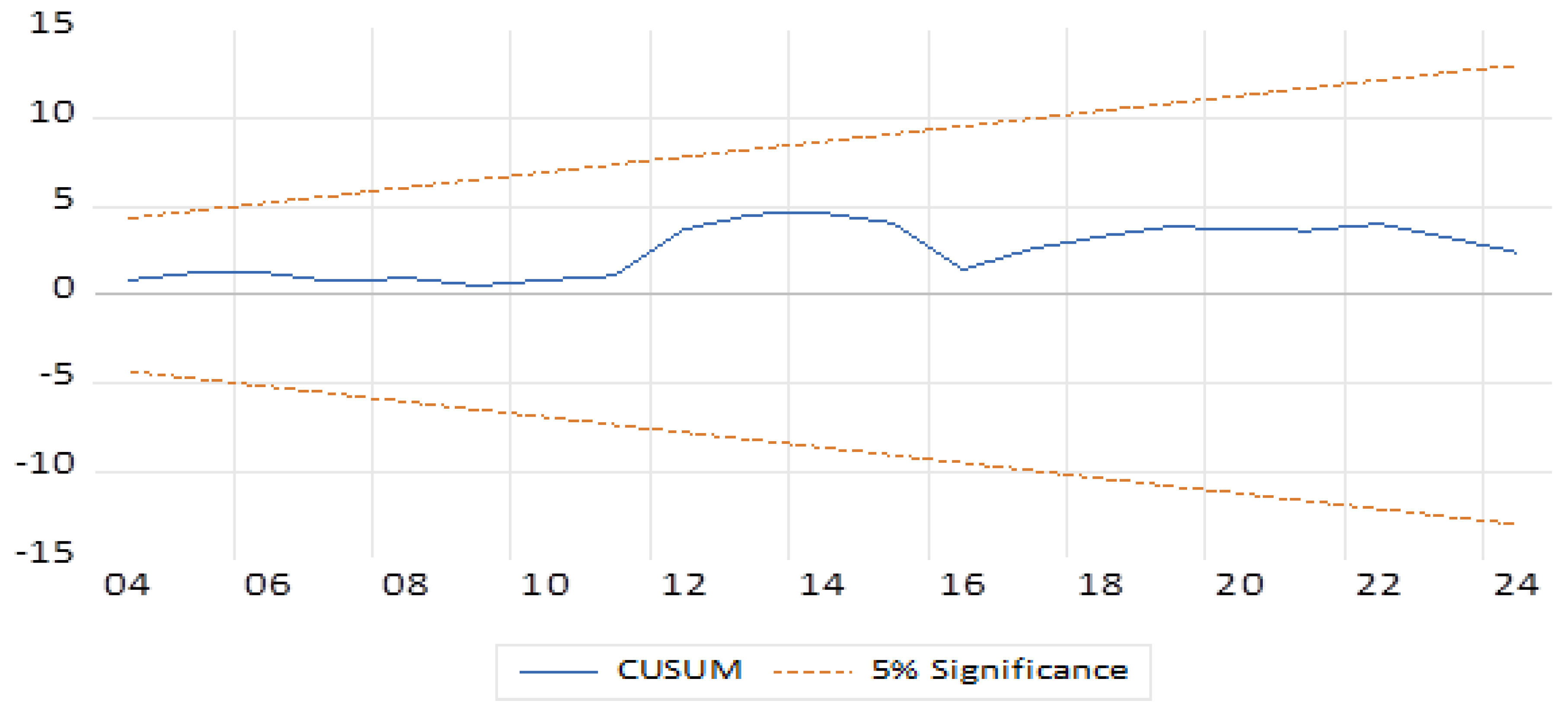
Figure 2.
CUSUMsq at 5% significance level.
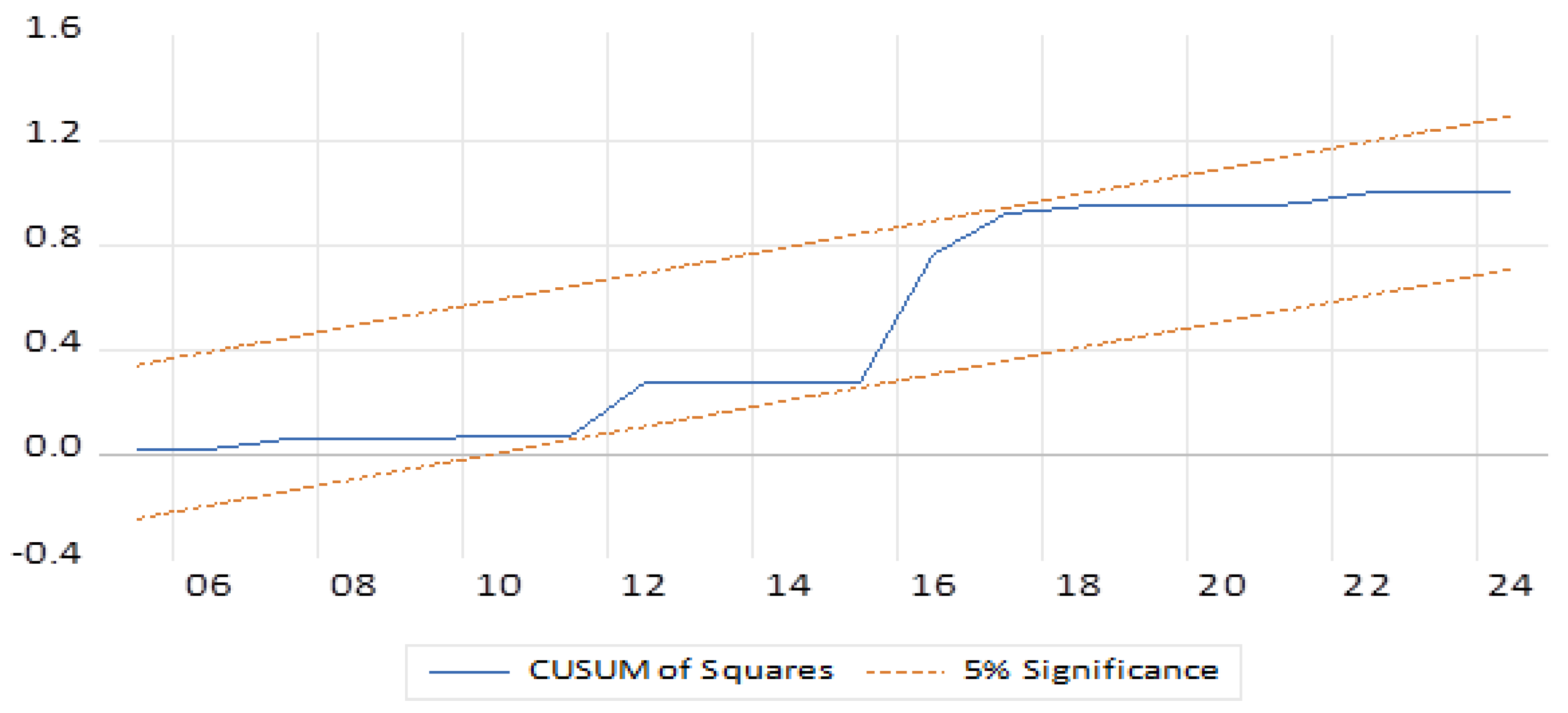
Table 1.
Stationarity Test.
| Augmented Dickey-Fuller (ADF) Test | Phillips-Perron (PP) Test | |||||
| Variables | Level | 1st Diff. | Status | Level | 1st Diff. | Status |
| GDPGR | -4.30*** | -11.01*** | I(0) | -4.23*** | -16.13*** | I(0) |
| ERU | -1.48 | -6.62*** | I(1) | -1.56 | -6.60*** | I(1) |
| GSEXP | 1.17 | -4.93*** | I(1) | 1.05 | -4.97*** | I(1) |
| INF | -3.55** | -5.39*** | I(0) | -2.99** | -6.37*** | I(0) |
| UNEMP | -4.10*** | -2.75* | I(0) | -9.56*** | -22.28*** | I(0) |
Source: Author’s Computation (2026). Note * = 10%, ** = 5%, *** = 1% significance level.
Table 2.
Bound Testing/ Cointegration Test.
| t- Statistic | Value | K |
|---|---|---|
| F- Statistic | 3.823313 | 5 |
| Critical Values Bound | ||
| Significance | I(0) | I(1) |
| 5% | 2.56 | 3.49 |
Author’s Computation, 2026.
Disclaimer/Publisher’s Note: The statements, opinions and data contained in all publications are solely those of the individual author(s) and contributor(s) and not of MDPI and/or the editor(s). MDPI and/or the editor(s) disclaim responsibility for any injury to people or property resulting from any ideas, methods, instructions or products referred to in the content. |
© 2026 by the authors. Licensee MDPI, Basel, Switzerland. This article is an open access article distributed under the terms and conditions of the Creative Commons Attribution (CC BY) license (http://creativecommons.org/licenses/by/4.0/).
Copyright: This open access article is published under a Creative Commons CC BY 4.0 license, which permit the free download, distribution, and reuse, provided that the author and preprint are cited in any reuse.


